
Judge, 1900-01-27 · page 7 of 16
Judge — January 27, 1900 — page 7: what you’re looking at
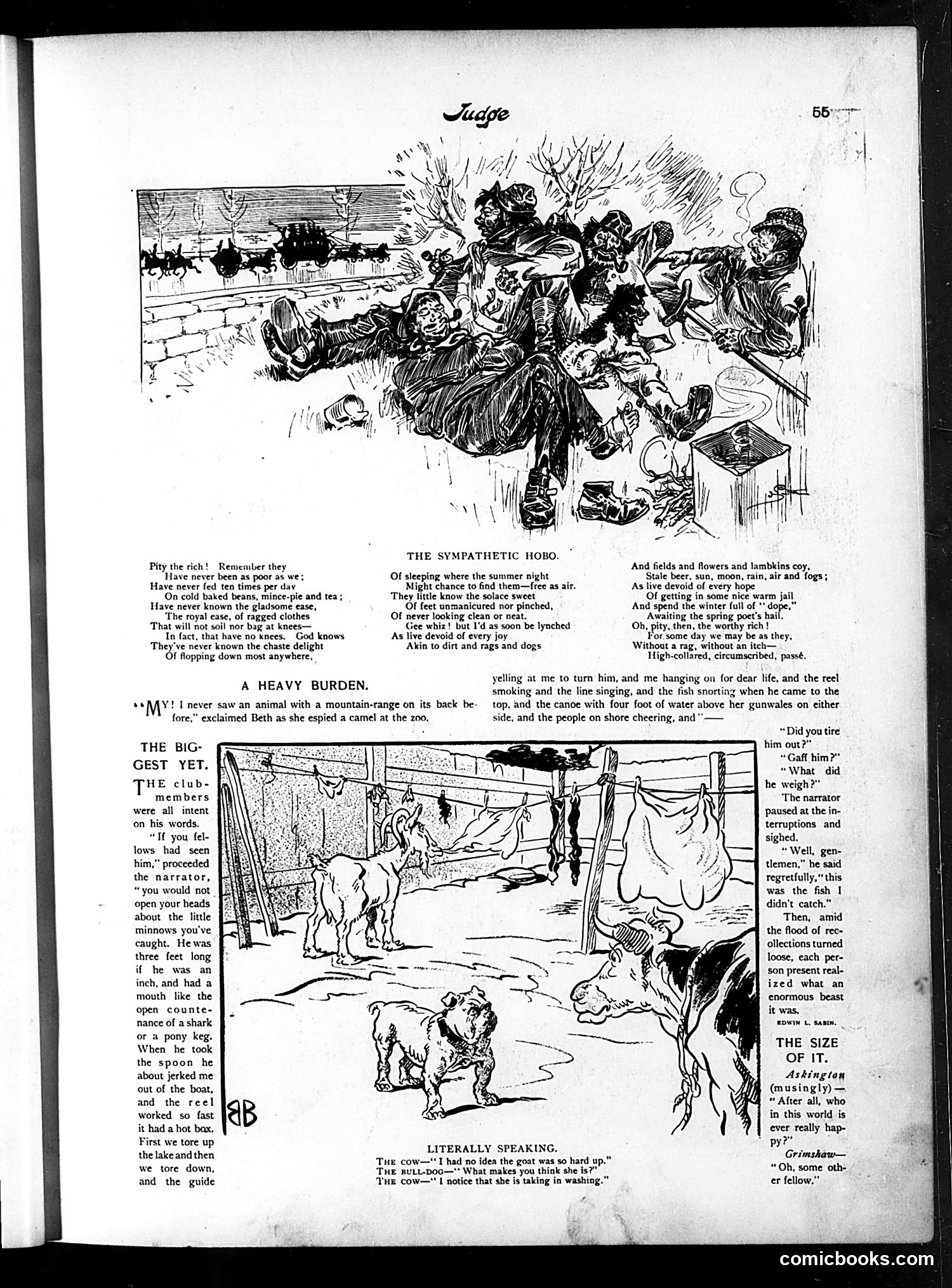
What you’re looking at
This page contains three distinct pieces satirizing American society: **"The Sympathetic Hobo"** (top) ironically celebrates poverty's supposed superiority over wealth. The hobo claims the rich are pitiful for lacking the "joys" of rags, dirt, jail, and hunger—inverting conventional values. The satire mocks both wealthy complacency and the romanticization of destitution, suggesting class resentment underlying Gilded Age inequality. **"A Heavy Burden"** (middle) shows a fishing story where the narrator's fish "got away," yet club members remain impressed by his exaggerated tale. This satirizes male club culture and the tall-tale tradition—poking fun at how men construct status through storytelling rather than actual accomplishment. **"Literally Speaking"** (bottom) is a brief joke playing on misunderstandings: a cow suggests a goat is "hard up" because she's "taking in washing"—wordplay on economic desperation versus literal laundry work. The cartoons collectively reflect turn-of-century American anxieties about class, masculine pride, and social pretension.
📄 Transcribed text from this page (OCR, searchable)
Machine-transcribed from the original scan — historical spelling and the odd misread are preserved.
Pity the rich! Remember they Have never been as poor as we; Have never fed ten times per dav On cold baked beans, mince-pie and tea; Have never known the gladsome ease, ‘The royal ease, of ragged clothes That will not soil nor bag at knees— In fact, that have no knees. God knows ‘They've never known the chaste delight Of flopping down most anywhere, A HEAVY BURDEN. . ‘MY I never saw an animal with a mountain-range on its back be- fore,” exclaimed Beth as she espied a camel at the zoo, THE BIG- GEST YET. TH E club- members were all intent on his words. “If you fel- lows had seen him,” proceeded the narrator, “you would not open your heads about the little minnows you've caught. He was three feet long if he was an inch, and had a mouth like the open counte- nance of a shark or a pony keg. When he took the spoon he about jerked me out of the boat, and the reel worked so fast it had a hot bax. First we tore up the lakeand then we tore down, and the guide THE SYMPATHETIC HOBO. Of sleeping where the summer night Might chance to find them—free as air. They little know the solace sweet Of feet unmanicured nor pinched, Of never looking clean or neat. Gee whiz! but I'd as soon be lynched As live devoid of every joy Akin to dirt and rags and dogs And fields and flowers and lambkins coy, Stale beer, sun, moon, rain, air and fogs; As live devoid of every hope Of getting in some nice warm jail And spend the winter full of ** dope,” Awaiting the spring poet's hail. Oh, pity, then, the worthy rich ! For some day we may be as they, Without a rag, without an itch— High-collared, circumscribed, passé. yelling at me to turn him, and me hanging on for dear life, and the reel LITERALLY SPEAKING. Tue cow—I had no idea the goat was so hard up.” THE RULL-Doo—** What makes you think she is?” ‘THe cow—* I notice that she is taking in washing.” smoking and the line singing, and the fish snorting when he came to the top. and the canoe with four foot of water above her gunwales on either side, and the people on shore cheering, and "—— “Did you tire him out?” “Gaff him?” “What did he weigh?" The narrator paused at the in- terruptions and sighed. “Well, gen- tlemen,” he said regretfully,“ this was the fish I didn’t catch.” Then, amid the flood of rec- ollections turned loose, each per- son present real ized what an enormous beast it was. RDWIN L. SABIN. THE SIZE OF IT. Ashington (musingly) — “ After all, who in this world is ever really hap- ty? Grimskaw— “Ob, some oth er fellow.” comicbooks.com