
A complete issue · 16 pages · 1900
Judge — January 6, 1900
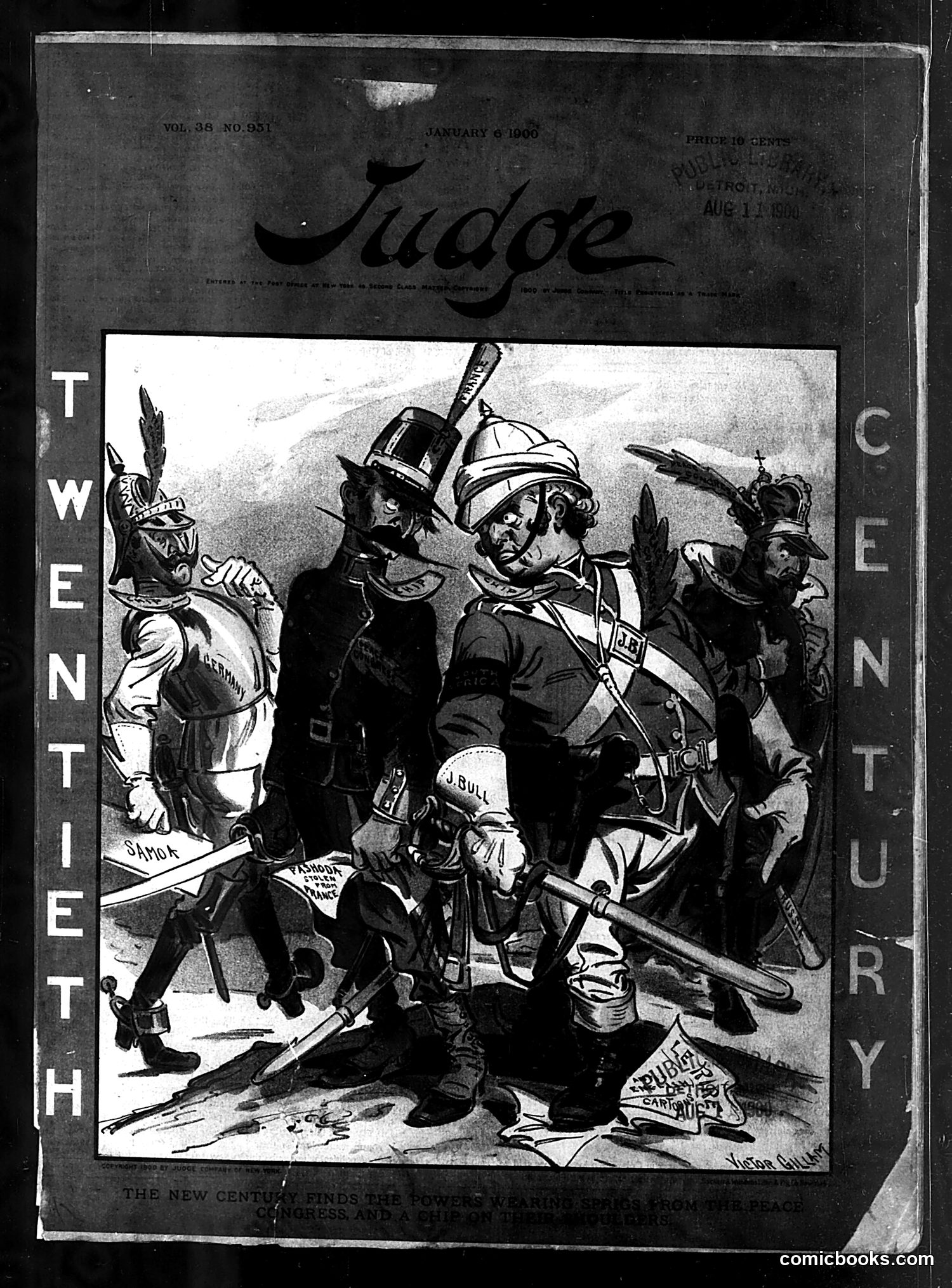
This January 6, 1900 *Judge* cover depicts the transition between centuries as military conflict. The central figure in a spiked Prussian helmet (representing German militarism or imperial power) confronts soldiers from the previous era. The caption states "THE NEW CENTURY ENDS THE NINETEENTH CENTURY'S REIGN OF PEACE." The satire suggests that the 1900s will be characterized by warfare and aggression, contrasting with a (idealized) peaceful nineteenth century. The caricatured soldiers and military imagery emphasize this shift toward conflict. The Boer War (1899-1902) was ongoing, likely informing this pessimistic view of the new century's prospects for continued peace.
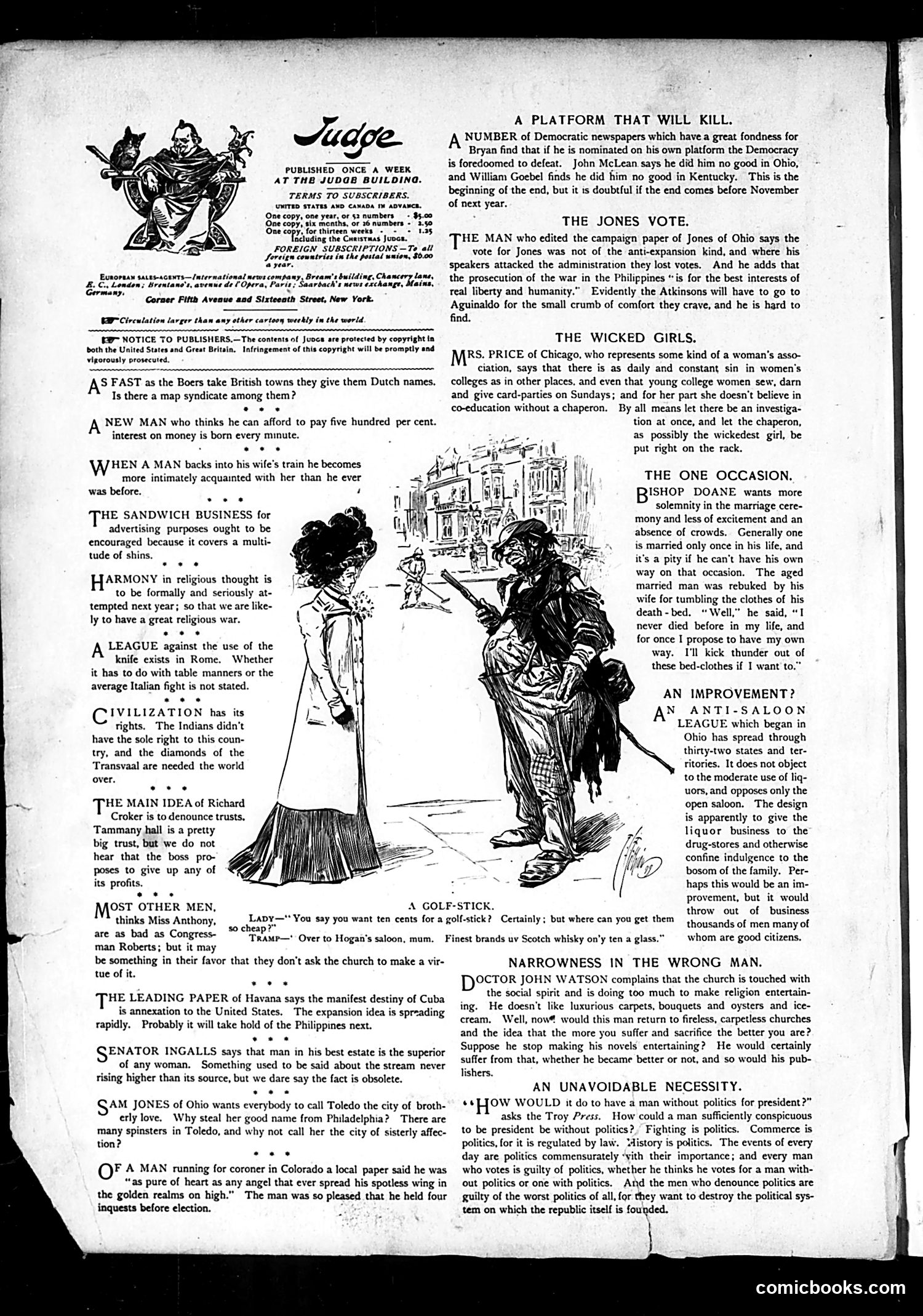
This page contains several brief political commentaries typical of Judge's format. The main cartoon titled "A Golf-Stick" depicts a woman requesting a golf stick from a man at what appears to be a saloon, with the joke playing on double meanings about obtaining liquor cheaply. The text items mock various targets: Bryan's political platform (called doomed to defeat), a Chicago woman's association claiming daily sin in colleges, Bishop Doane's preference for private over public weddings, and an anti-saloon league spreading through states. The final section "An Unavoidable Necessity" argues that politics is inherent to commerce and citizenship—a man cannot avoid politics without destroying the republic itself. The satire reflects turn-of-century American debates about temperance, women's morality, and political engagement.
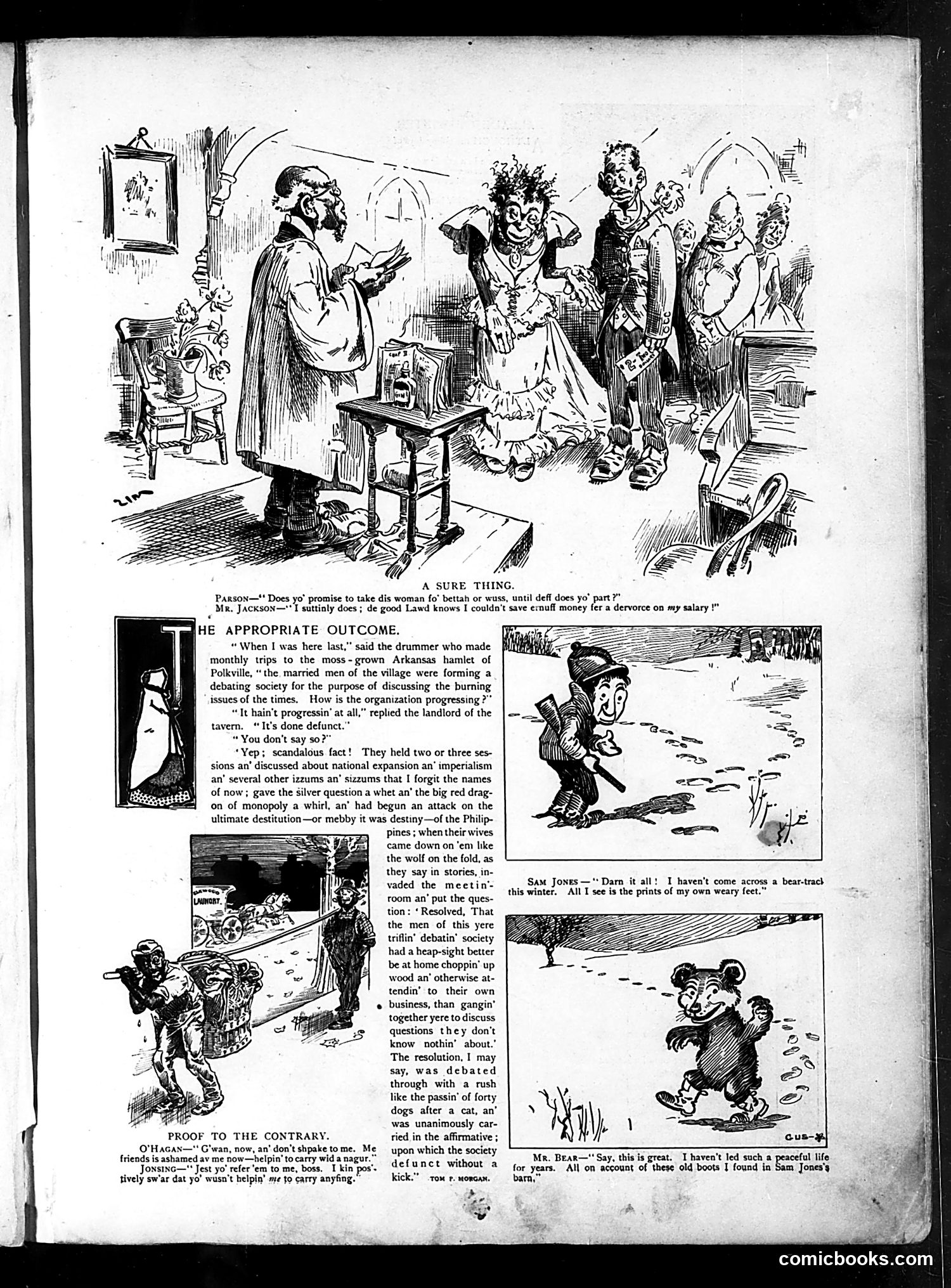
This page contains three separate satirical pieces from an early 20th-century American magazine: 1. **"A Sure Thing"** (top): A clergyman approaches a bride and groom at the altar, asking if she promises to obey. The parson jokes that marriage vows are unrealistic—the bride won't obey, and he couldn't save money anyway. The satire mocks both marriage expectations and clerical financial struggles. 2. **"The Appropriate Outcome"** (center): A drummer recounts how a small Arkansas town debated "national expansion and imperialism" before their wives arrived. The wives quickly ended the debate, forcing the men home. This satirizes how domestic concerns override political discourse. 3. **Remaining cartoons** appear to reference frontier/wilderness themes with exaggerated character caricatures, though their specific satirical targets are unclear without additional context.
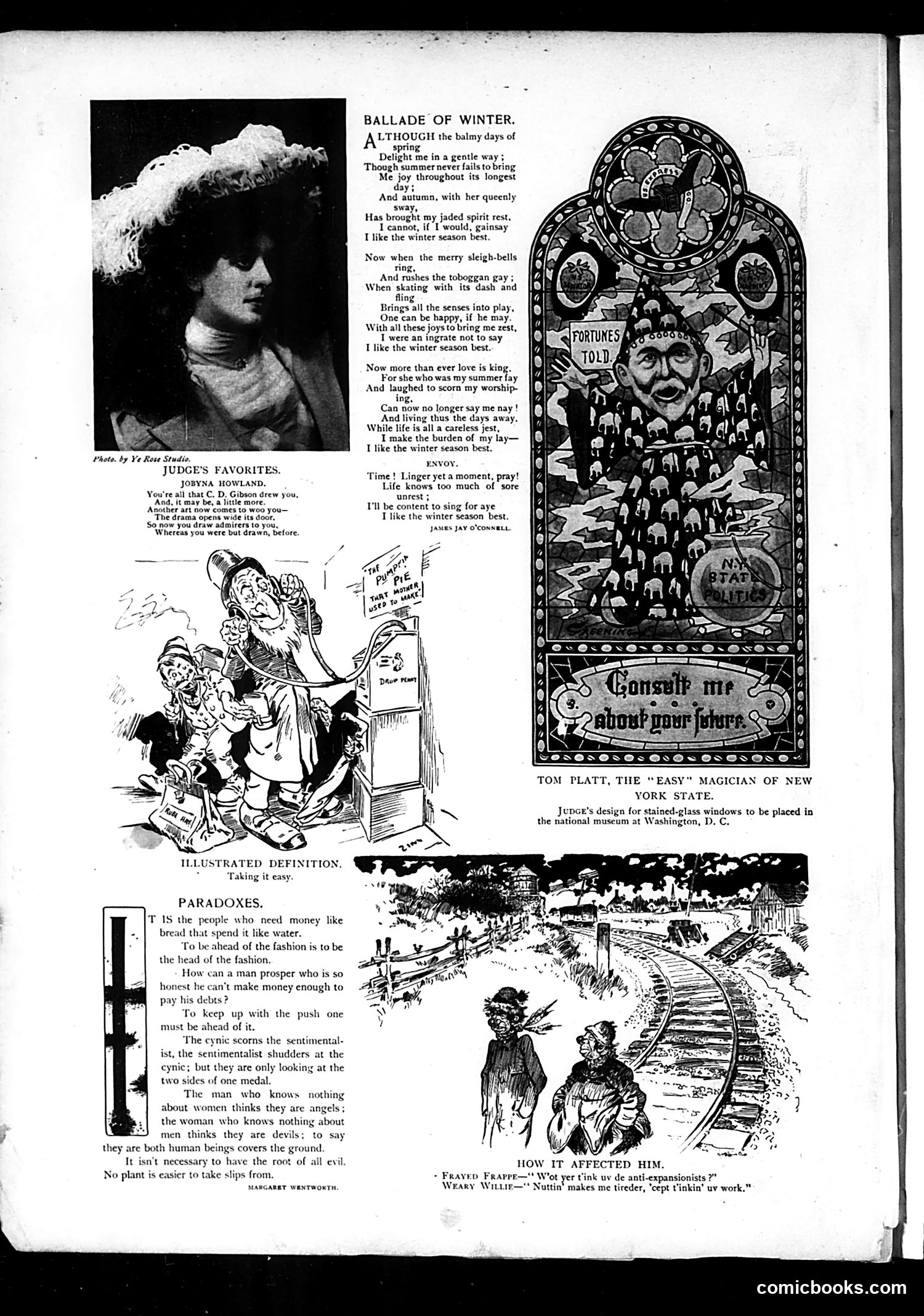
This page contains several distinct pieces: **"Ballade of Winter"** (top left): A poem accompanying a portrait photo, celebrating winter season pleasures despite spring's appeal. **"Judge's Favorites"** (middle left): A humorous poem about Joryna Howland, with an accompanying cartoon showing figures at a pie stand, likely satirizing social pretensions or dining habits. **"Paradoxes"** (bottom left): A philosophical humor section by Margaret Wentworth, presenting witty contradictions about human nature and social behavior. **Stained Glass Window Design** (right): An ornate Art Nouveau-style illustration titled "Consult me" and credited to Tom Platt as a design for the National Museum in Washington, D.C. **"How It Affected Him"** (bottom right): A railway scene with dialogue between characters, appears to be a brief humorous anecdote about anti-expansionists. The page is primarily literary/artistic content rather than political satire.
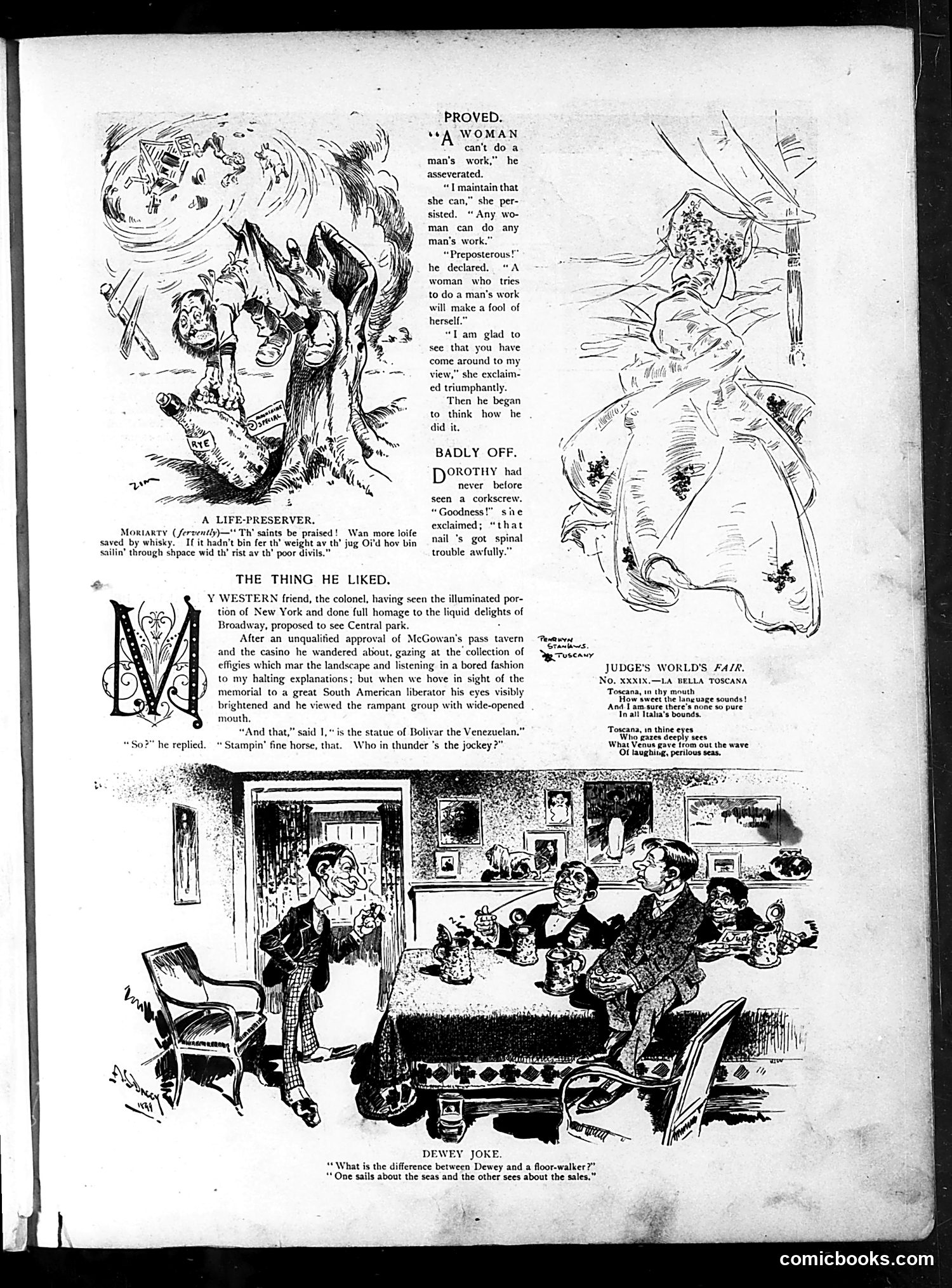
This page contains multiple brief satirical pieces typical of Judge's humor: **"Proved"** mocks a man's contradictory logic: he argues women can't do men's work, then admits "any woman can do any man's work"—proving her point while he fails to recognize his own inconsistency. **"A Life-Preserver"** features an Irish character (indicated by dialect) crediting whiskey for saving him in an accident, joking that the bottle's weight kept him grounded. **"The Thing He Liked"** satirizes a Western colonel visiting New York's attractions (Broadway, Central Park). He ignores cultural monuments but becomes animated viewing an equestrian statue, mistaking the rider for a jockey—suggesting Americans value entertainment over art. **"Dewey Joke"** is a pun: Admiral Dewey "sails about the seas" while a floor-walker "sees about the sales"—wordplay on homophones. **"Judge's World's Fair"** appears to be a recurring feature celebrating Italian beauty (La Bella Toscana). The humor relies on class commentary, ethnic stereotypes, and wordplay typical of early 1900s American satire.
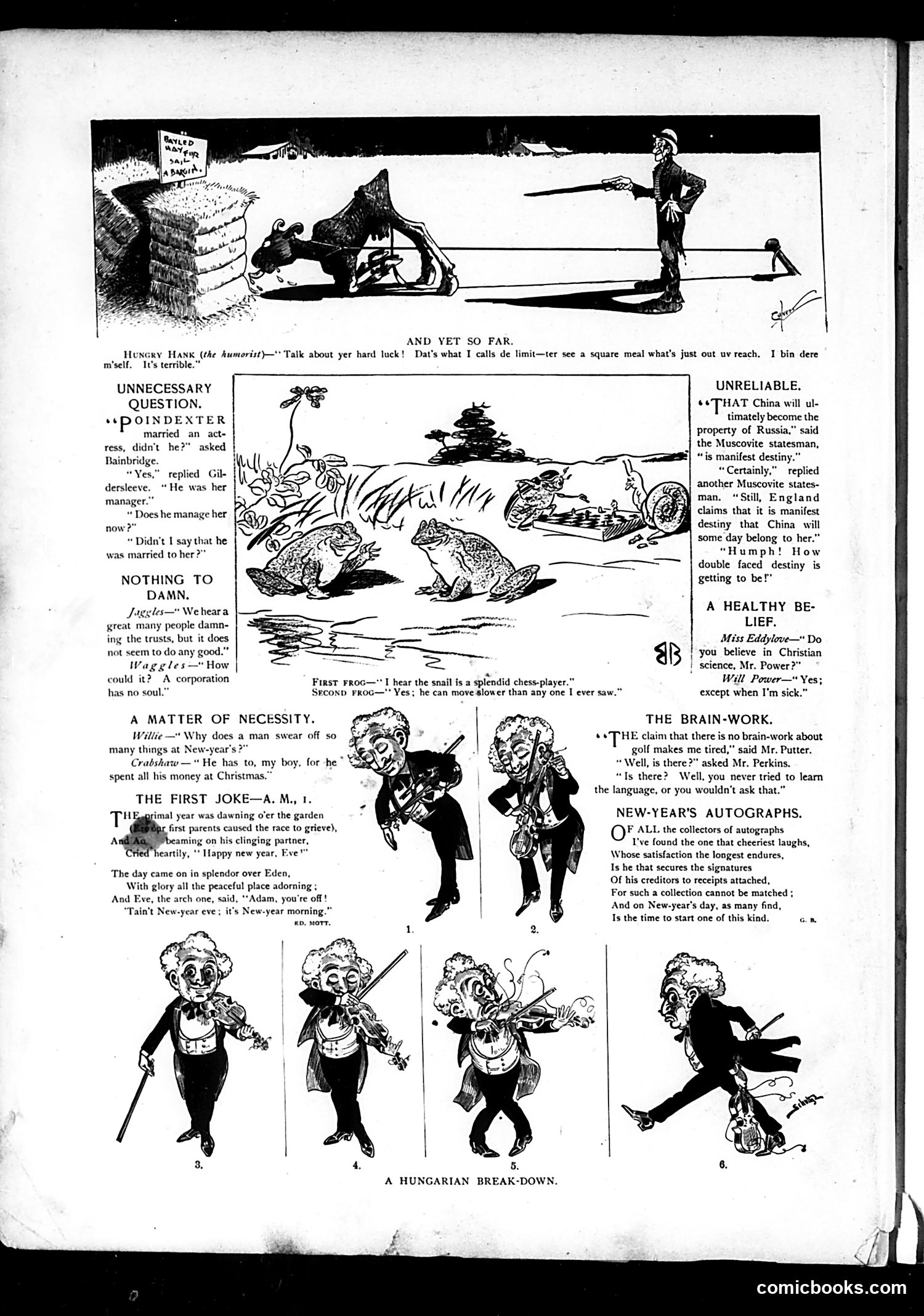
This page contains multiple brief satirical jokes and cartoons typical of early 20th-century American humor: **Top cartoon**: "And Yet So Far" depicts a starving man ("Hungry Hank") viewing food just beyond reach—commentary on poverty and economic hardship. **Various short jokes** mock: - **Theater marriages**: An actress's husband manages her career, suggesting exploitative relationships - **New Year's resolutions**: Men swear off luxuries after Christmas spending - **Trust-busting**: Complaints about corporate monopolies are ineffectual because corporations lack moral conscience - **Imperialism**: Russia and England both claim "manifest destiny" regarding China, satirizing competing colonial powers' self-serving rhetoric - **Christian Science**: Believers selectively apply faith (excluding when sick) - **Golf snobbery**: Pretentious claims golf requires intellectual rigor - **Debt collection**: New Year's humor about collecting creditors' signatures on receipts The "Hungarian Break-Down" appears to be a musical/dance illustration unrelated to Hungarian politics. Overall, the page reflects Progressive-era concerns about capitalism, empire, and social hypocrisy through humor.
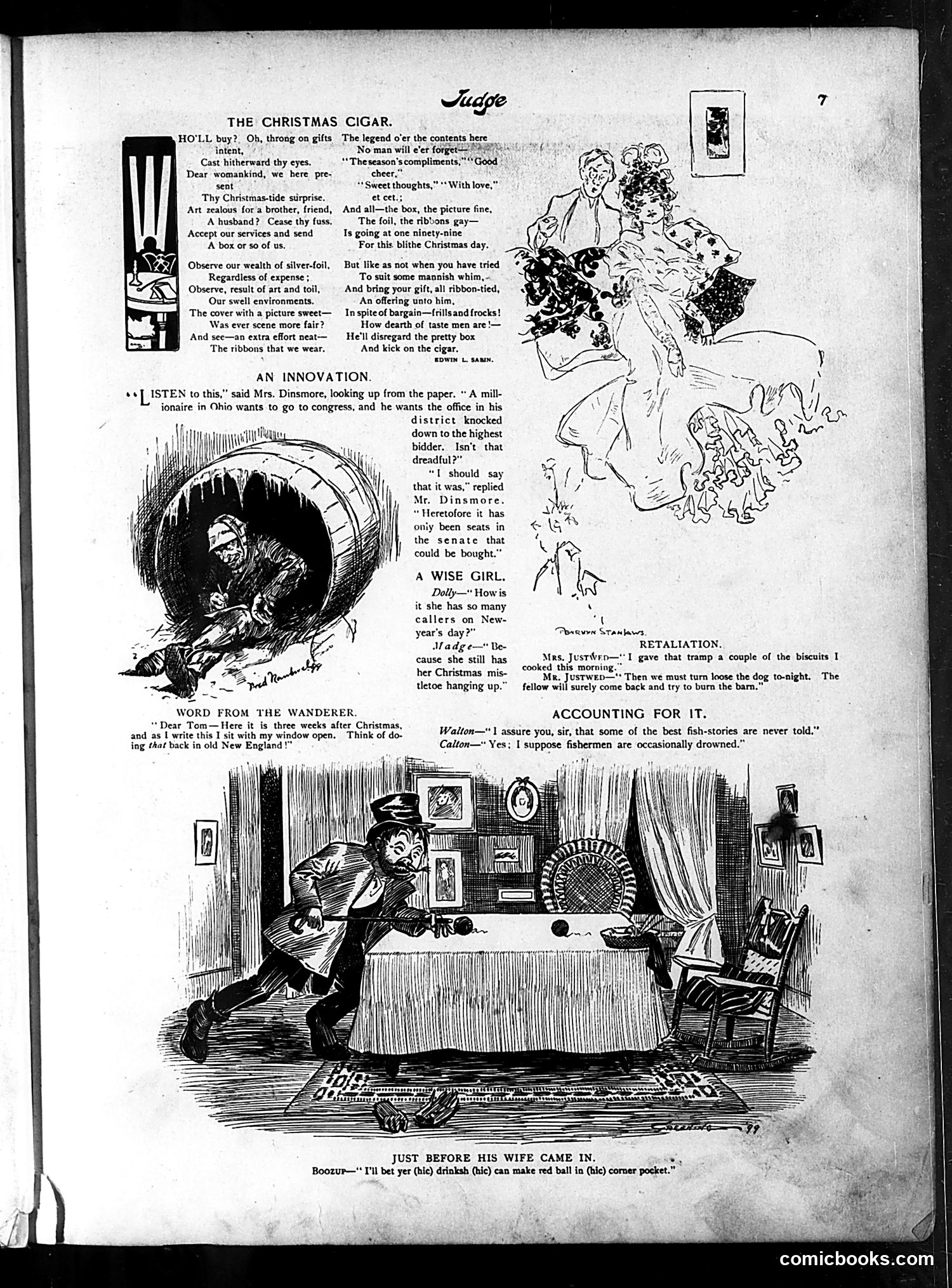
This page from *Judge* magazine contains several satirical pieces about Christmas and social behavior circa early 1900s: **"The Christmas Cigar"** (top): A mock advertisement promoting cigars as gifts for men. The satire: despite elaborate, expensive packaging with ribbons and decorative boxes, men only care about the cigar itself and will ignore the presentation entirely—critiquing both wasteful gift-wrapping and masculine indifference to aesthetic effort. **"An Innovation"**: Mrs. Dinsmore reads that a wealthy Ohio businessman wants to buy a congressional seat. The joke: she's shocked that offices are now being auctioned to the highest bidder, while her husband notes that at least *senate* seats have long been purchasable—satirizing political corruption as normalized practice. **Other brief humor pieces** include jokes about mistletoe-hanging, fish-story exaggeration, and a drunk man bragging about billiards before his wife arrives—typical period comedy about masculine behavior and domestic life. The overall tone criticizes consumerism, political venality, and male foolishness.
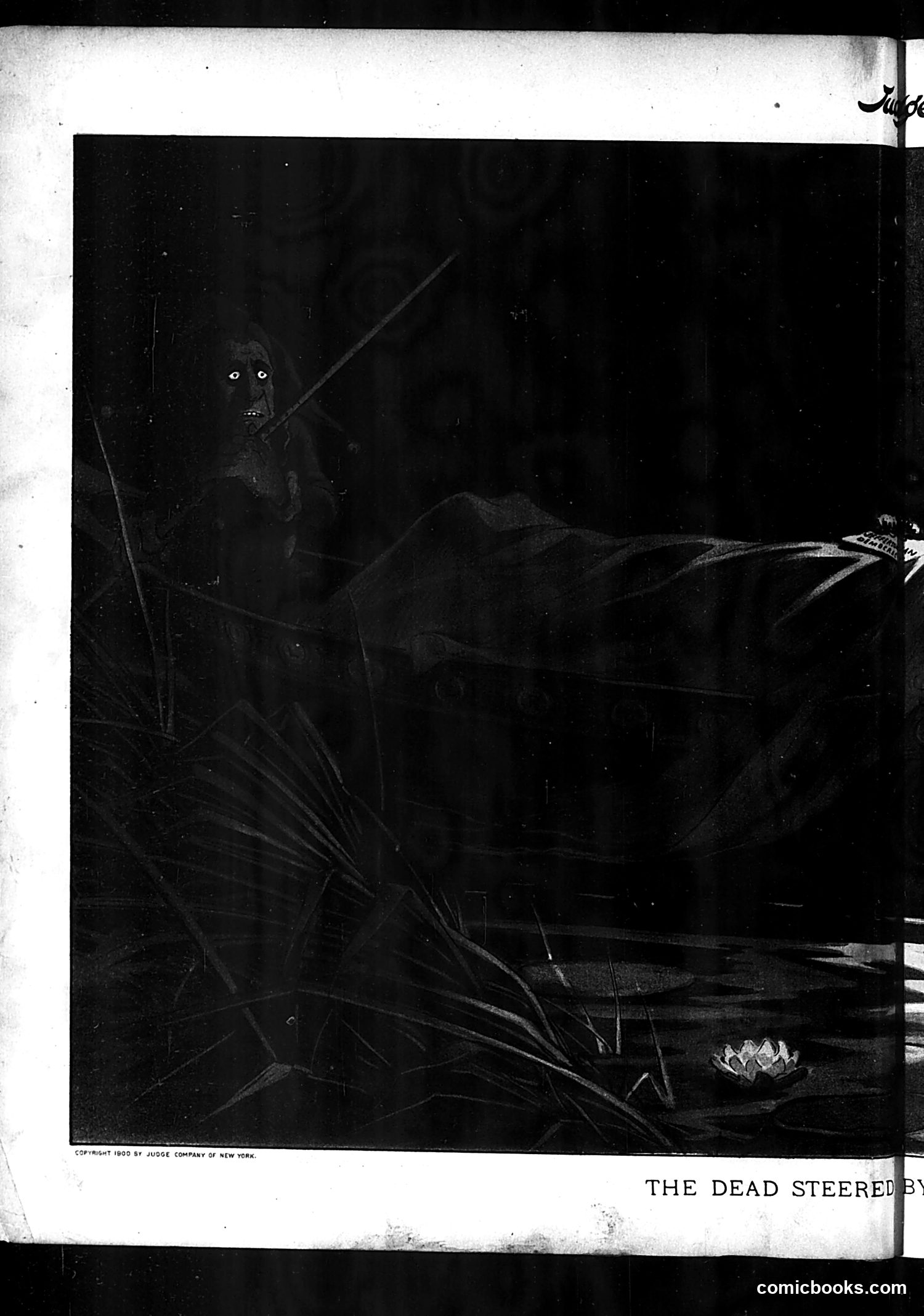
This appears to be a darkly surreal cartoon from Judge magazine (copyright 1920 by Judge Company of New York). The image depicts a skeletal or death-like figure with glowing eyes steering what appears to be a large vessel or entity through darkness, with plant-like forms (possibly cattails or reeds) in the foreground and a small lotus flower visible. The incomplete title "The Dead Steered By" suggests social or political commentary—likely criticizing leadership or governance by corrupt or morally bankrupt figures. The skeletal imagery and nocturnal setting evoke themes of death, corruption, or moral decay guiding society. Without the complete title or additional context, the specific target remains unclear, though the satirical intent is evident in depicting dangerous or inappropriate guidance of public affairs.
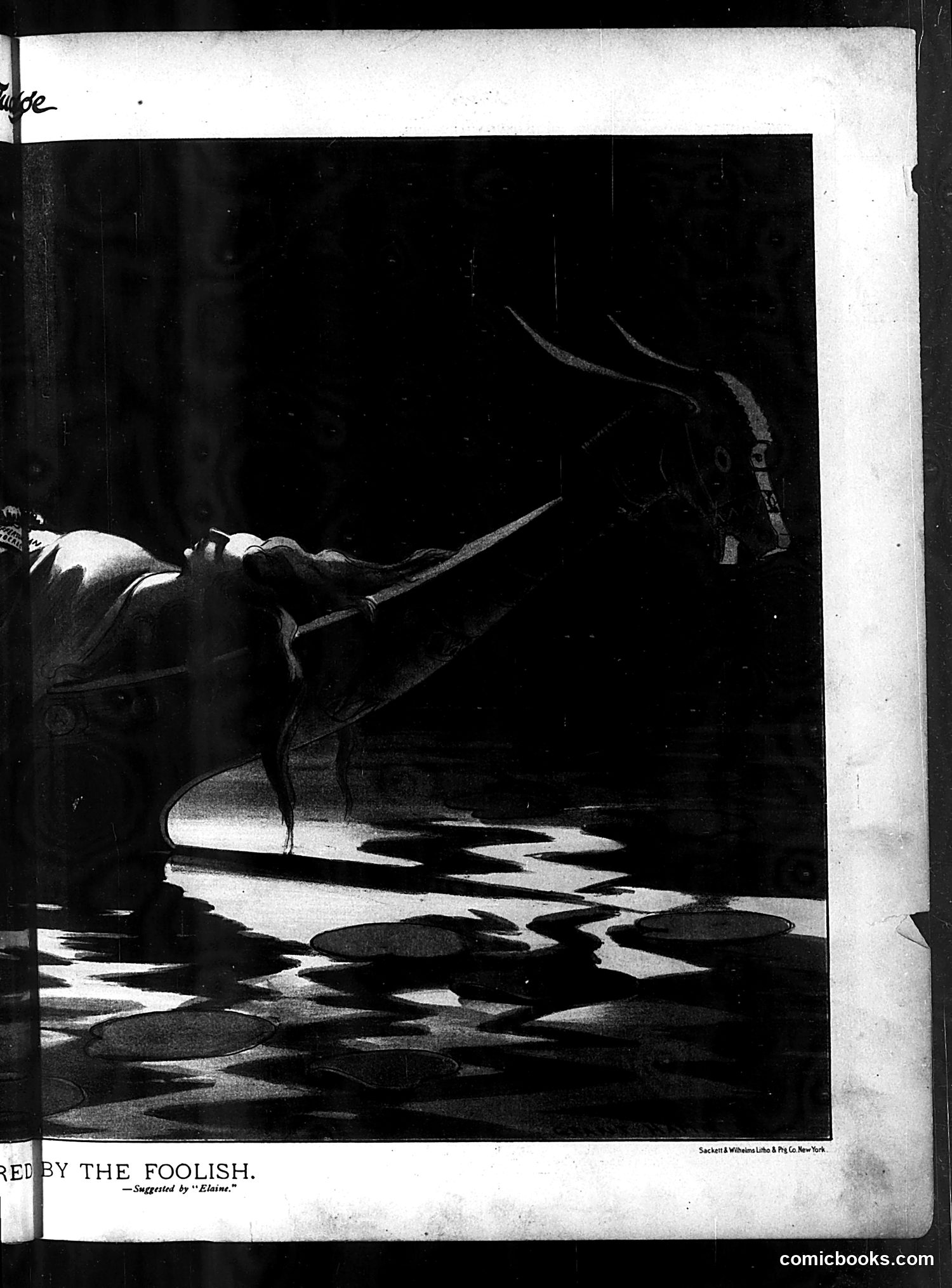
This appears to be a dramatic illustration rather than a traditional political cartoon. The image shows a figure in light clothing being lured or drawn toward a dark, menacing silhouette with horns—suggesting a demonic or evil entity. The caption references "Elaine," likely alluding to Alfred, Lord Tennyson's poem "Lancelot and Elaine" from *Idylls of the King*. The satire appears to critique foolish individuals who are metaphorically "lured" toward temptation or moral danger, personified here as a devilish force. The artwork uses dramatic chiaroscuro (light and shadow) to emphasize the contrast between innocence and wickedness. Without additional context about Judge magazine's publication date, the specific social commentary remains unclear, though it likely addresses contemporary moral or social folly.
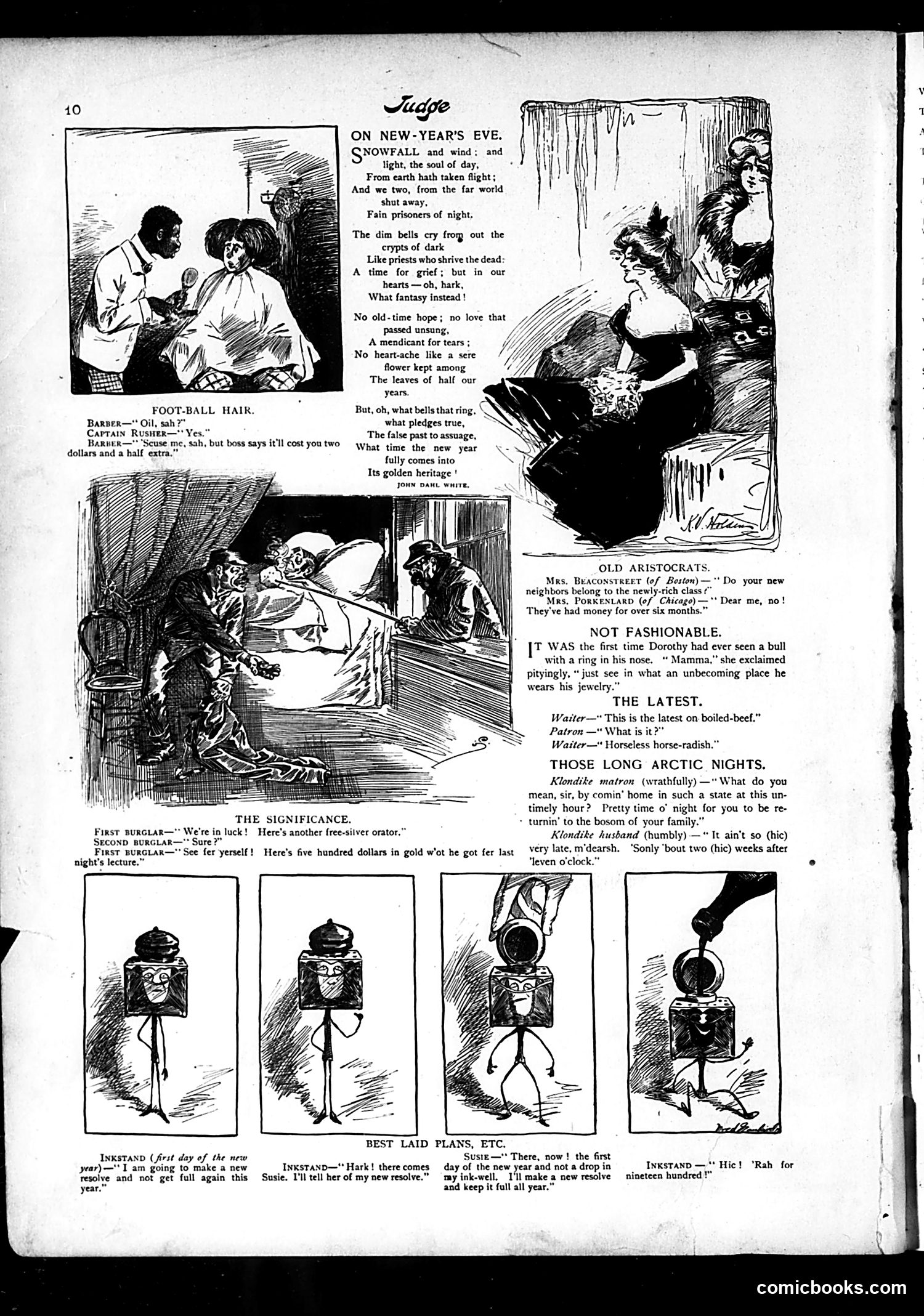
This Judge magazine page from New Year's Eve contains multiple brief satirical sketches typical of the era's humor. The "Old Aristocrats" joke mocks newly wealthy social climbers: a Boston blue-blood notes that Chicago neighbors aren't "newly-rich"—they've had money for six whole months, implying old money considers even slight wealth accumulation insufficiently established. "The Significance" burglar sketch appears to reference free-silver debate (a major 1890s political issue), joking that a free-silver orator carries substantial gold—satirizing the contradiction between political rhetoric and actual wealth. "Best Laid Plans" shows an inkstand making resolutions to reform, only to immediately break them—generic New Year's satire about failed resolutions. Other sketches ("Not Fashionable," "Those Long Arctic Nights," "The Latest") are simple pun-based humor about fashion, Klondike gold rush references, and restaurant wordplay. The page is primarily comedic rather than pointed political commentary.
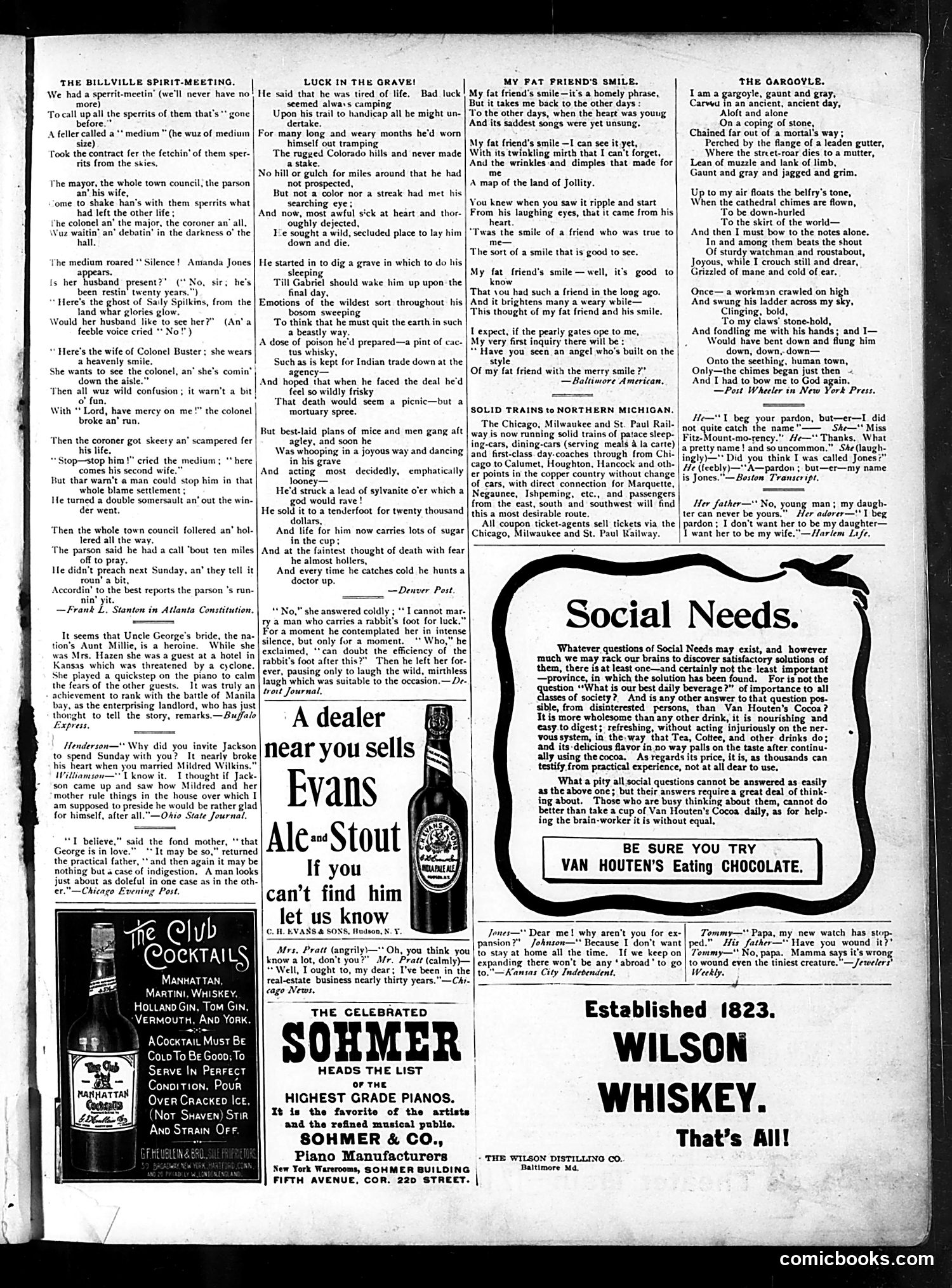
This page is primarily **advertising and miscellaneous content** rather than political cartoons. The main narrative piece, "The Billville Spirit-Meeting," is a humorous dialect poem about a fraudulent séance in a small town. When a "medium" conjures the ghost of a dead wife, the living Colonel panics and flees through a window—triggering a comedic stampede of townspeople (the mayor, council, parson) also running away. The satire targets **gullible belief in spiritualism**, a popular but widely-ridiculed practice of the era. Other brief items mock domestic life and romance, while the advertisements promote liquor (Evans Ale and Stout, Wilson Whiskey), pianos (Sohmer), and cocktails (The Club). The "Social Needs" column discusses cocoa and beverages without clear satirical intent. **Overall**: This is a typical Judge page blending light verse satire with period advertising, not focusing on political figures or events.
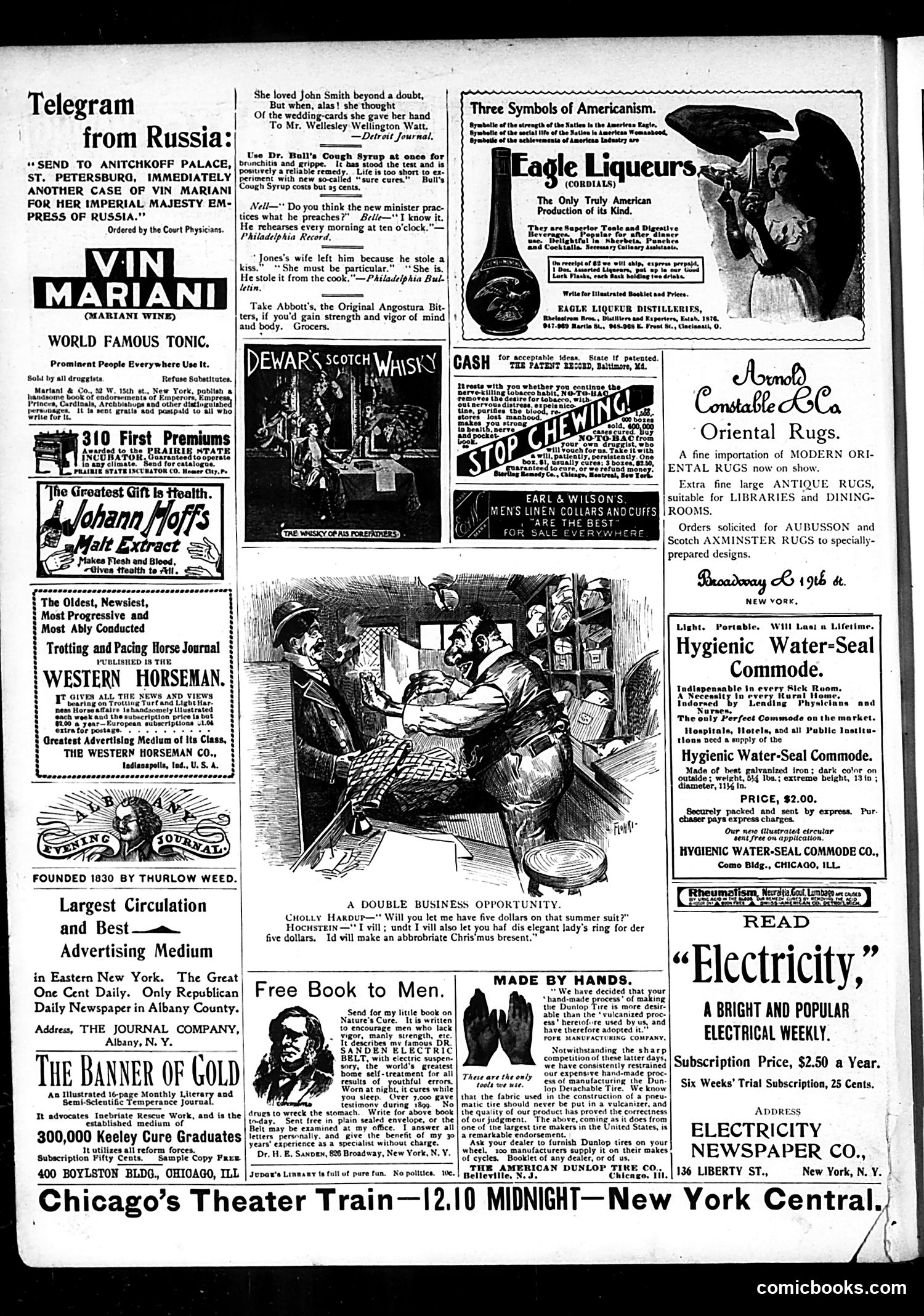
This page is primarily **advertising**, with minimal editorial cartoon content. The main satirical elements are brief: **"A Double Business Opportunity"** (center): A humor sketch about a man named Cholly Handup trying to pawn a summer suit to a pawnbroker named Hochstein. The joke plays on Jewish-immigrant dialect stereotypes common in period humor—Hochstein offers both a loan and throws in a woman's ring to sweeten the deal, suggesting he'll profit either way. The humor relies on ethnic caricature typical of early-1900s American satire. **Top telegram joke**: A mock telegram about the Russian Empress ordering Vin Mariani wine "for her imperial majesty"—satirizing both the product's dubious medical claims and European royalty's supposed dependency on tonics. The page is otherwise dominated by period product advertisements (Vin Mariani wine tonic, Eagle Liqueurs, Johann Hoff's Malt Extract, patent medicines, rugs, and the "Hygienic Water-Seal Commode").
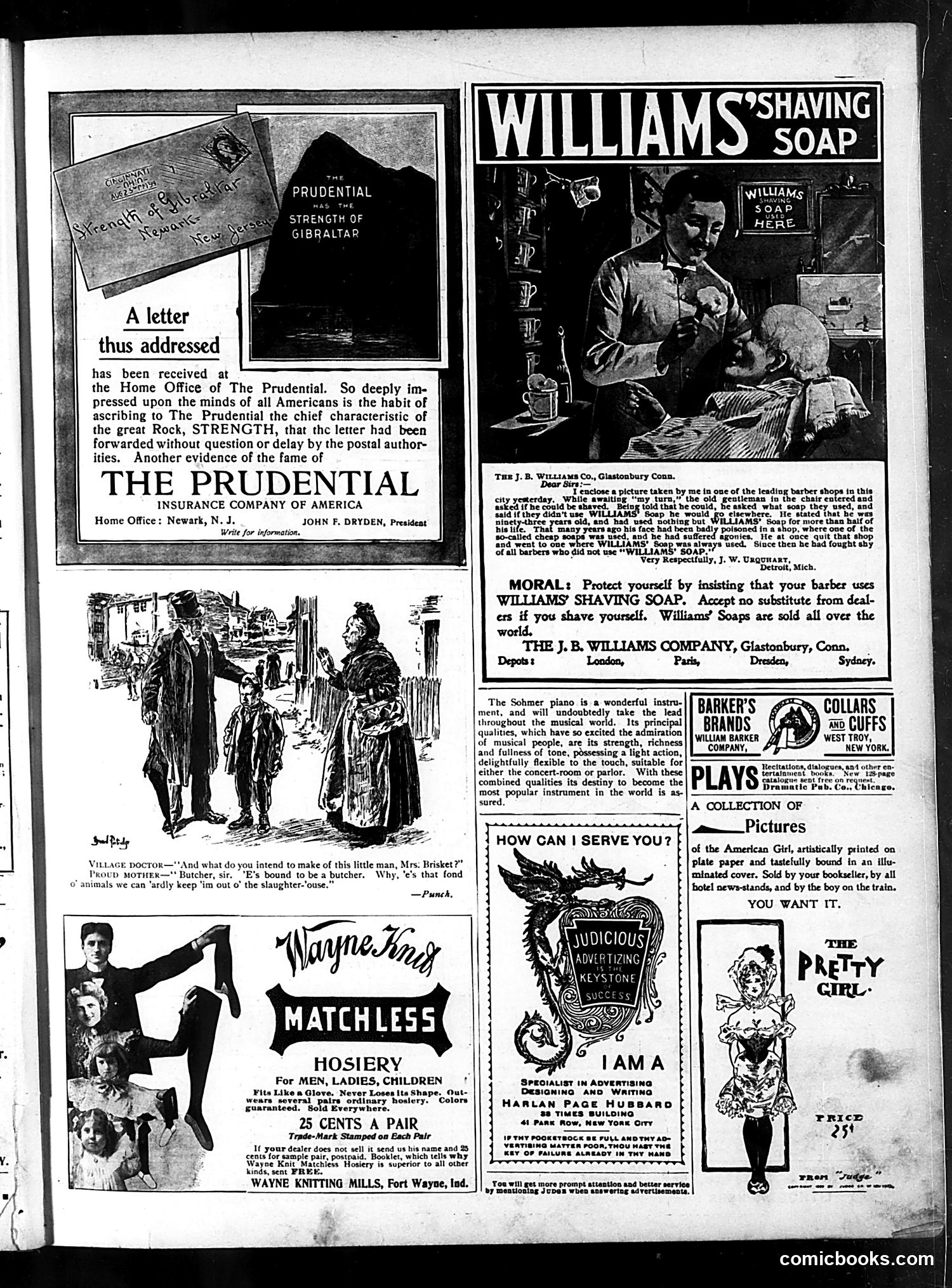
This page is primarily **advertising**, with one small editorial cartoon. The main narrative centers on a testimonial letter to **The Prudential Insurance Company**, cleverly framed as being misdirected to "Gibraltar" due to Americans' association of Prudential with strength and stability—a marketing play on the famous Rock of Gibraltar. The one **cartoon** (attributed to Punch) satirizes class attitudes: a poor mother tells a Victorian-era doctor she intends to make her young son a butcher, explaining he's "so fond of animals" they "can hardly keep him out of the slaughter-house." The joke mocks working-class parents' limited ambitions for their children and uses dark irony about child labor. The remainder consists of product advertisements: Williams Shaving Soap (featuring customer testimonials), Wayne Knit Hosiery, Sohmer pianos, and Barker's Collars. The page reflects early 20th-century advertising strategy emphasizing brand loyalty and social respectability.
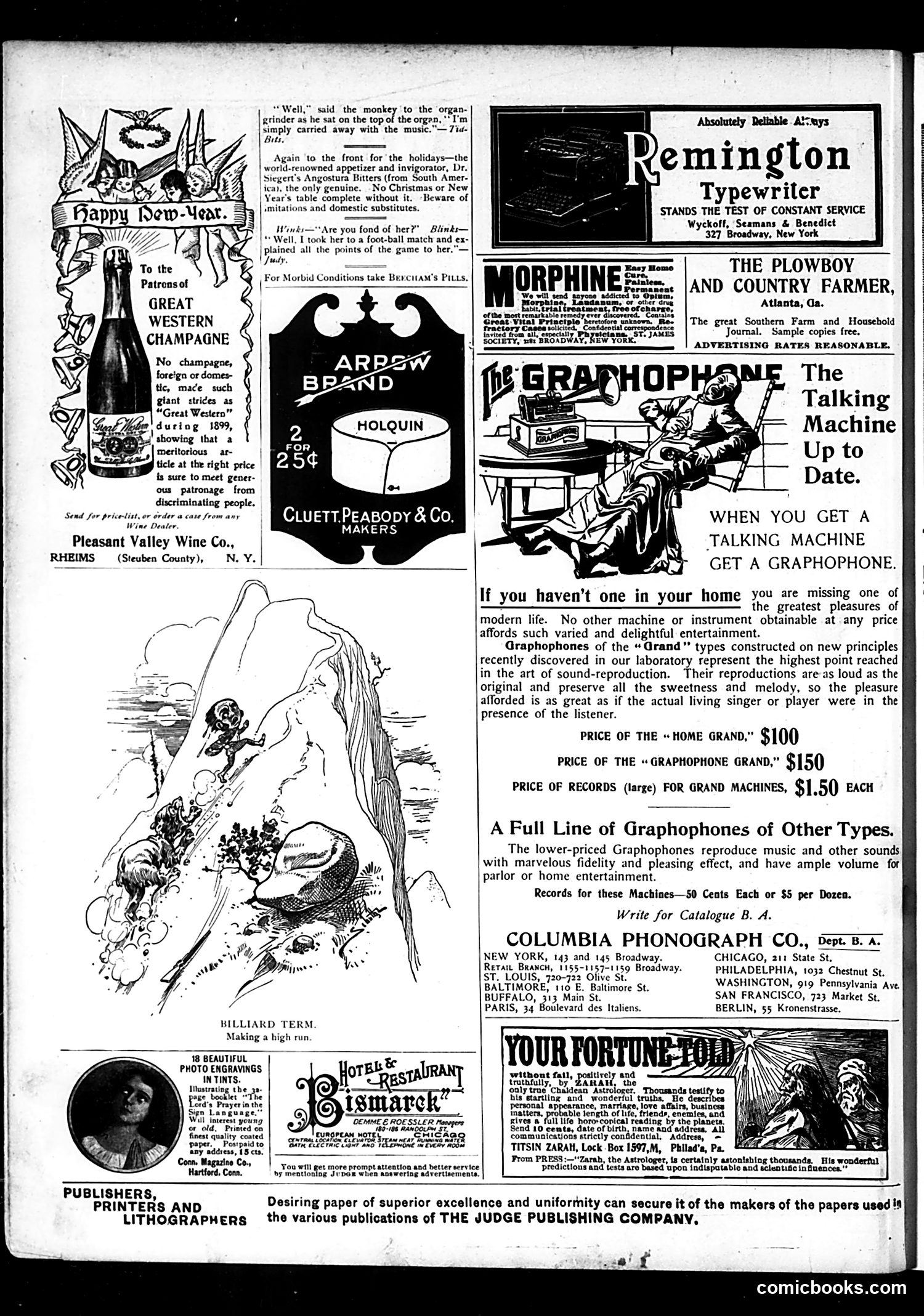
This is primarily an **advertising page** from an early-1900s Judge magazine, with minimal satirical content. The notable cartoon appears at top left: a brief joke about a **monkey and organ grinder**—a common street entertainment duo of the era. The monkey claims to be "carried away with the music," a pun playing on the monkey literally being transported on top of the organ. Below that is another short joke about a man taking his girlfriend to a **football match** and explaining the rules to her—apparently an unsuccessful romantic strategy. The bulk of the page consists of period product advertisements: **Angostura Bitters** (a digestive tonic), **Great Western Champagne**, **Remington Typewriters**, **Graphophones** (early phonographs), and fortune-telling services. There's also a **billiards illustration**. The humor is gentle and domestic rather than political. The page primarily served to generate advertising revenue rather than deliver substantive satire.
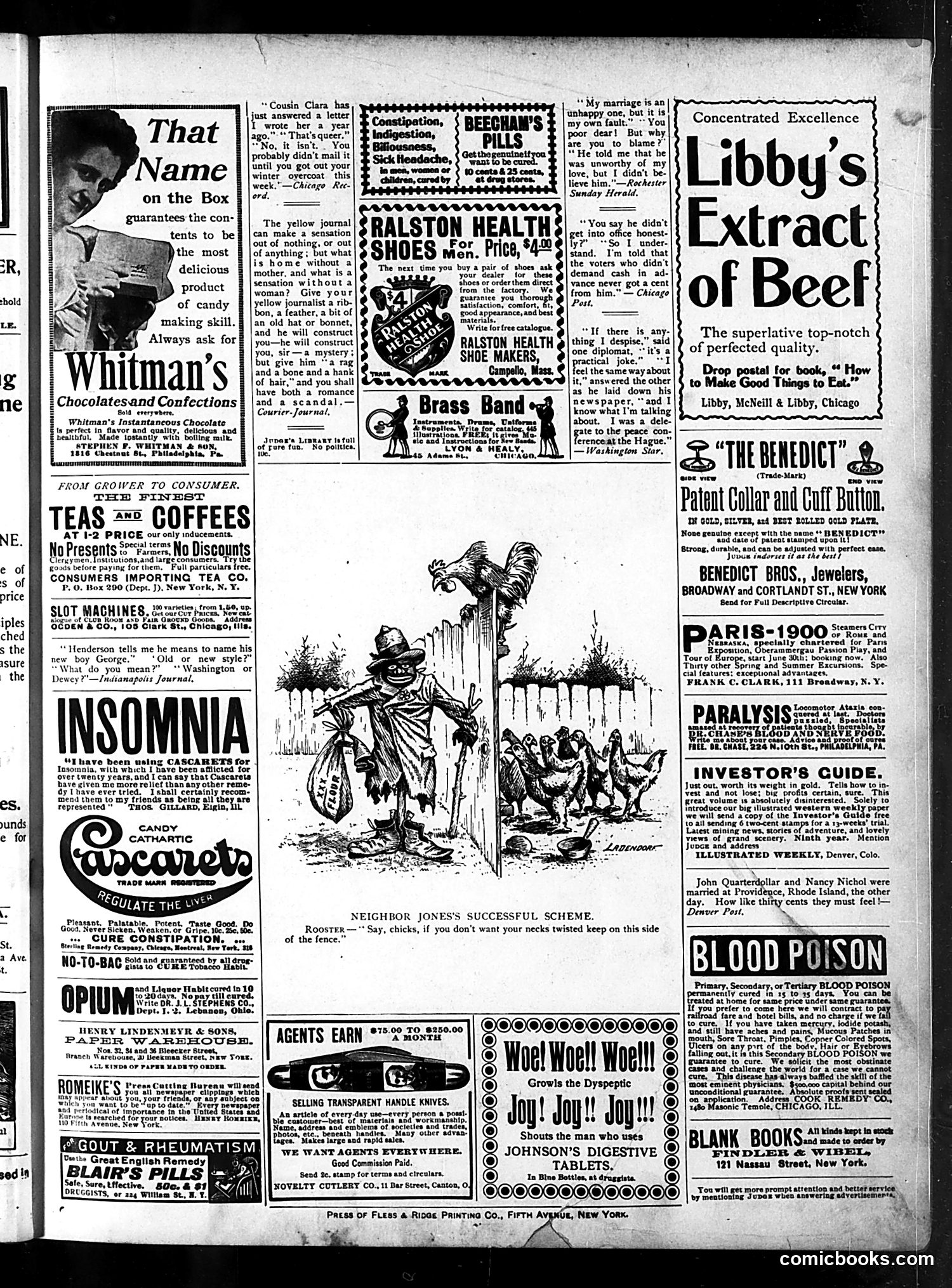
This single-panel cartoon shows a rooster addressing hens near a fence, warning them to stay on one side to avoid having their "necks twisted." The joke is a dark pun: Jones is apparently using the hens for his own purposes—likely killing them for food or profit—and this "scheme" is presented as clever or successful, hence the ironic title. The satire targets the common practice of keeping backyard poultry around 1900. The rooster's "warning" treats fatal slaughter as merely a practical inconvenience rather than harm, reflecting period attitudes toward animal welfare and farm life. The cartoon's humor derives from depicting brutal necessity through the lens of casual barnyard conversation. The surrounding advertisements (patent medicines, slot machines, knives) suggest the page targets working-class readers familiar with small-scale farming.
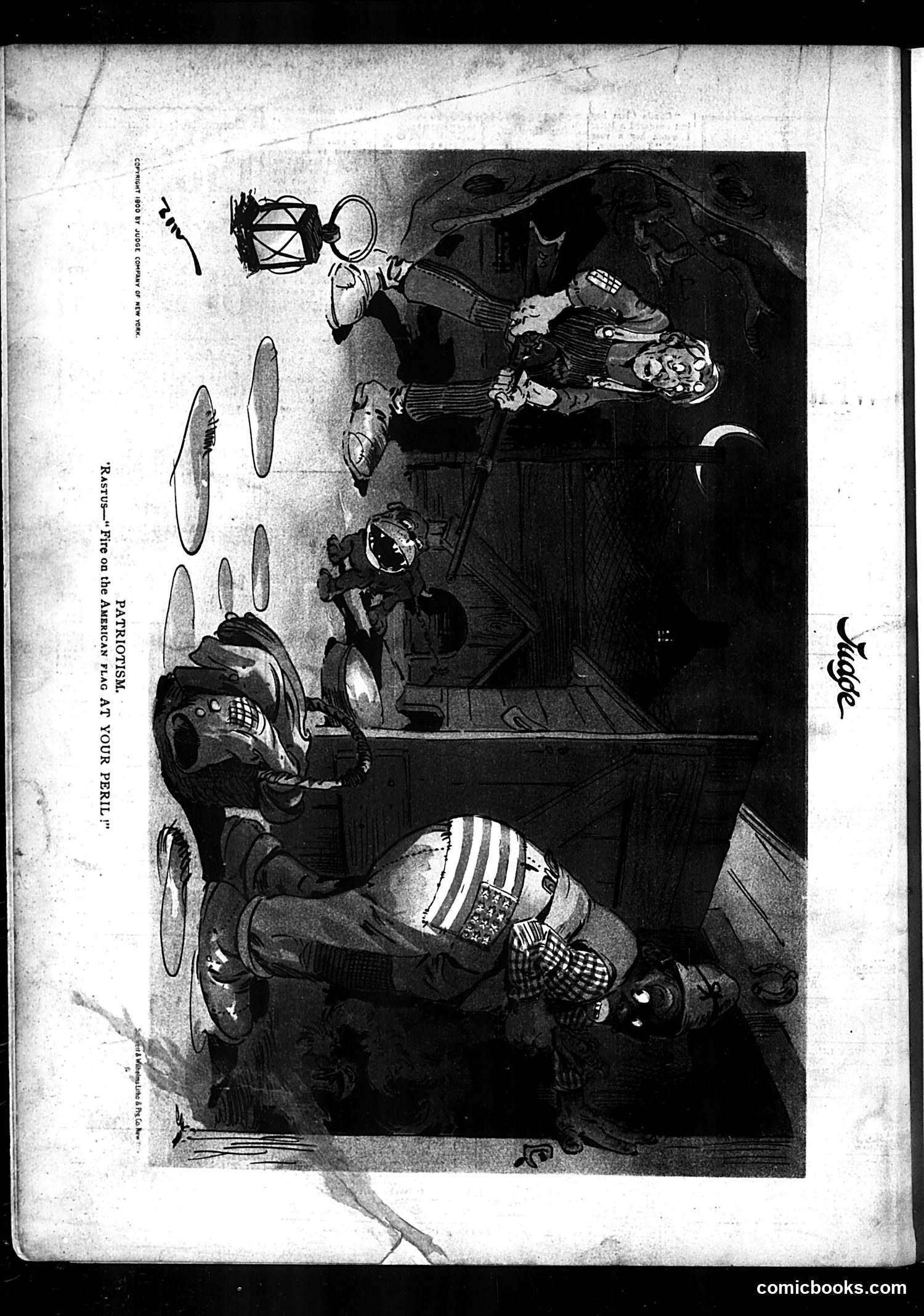
This Judge cartoon satirizes conflicting patriotic claims during what appears to be a labor or social conflict (circa 1900). The image shows a figure labeled "'Rastus" (a racist caricature common to the era) threatening violence against someone attempting to desecrate the American flag. The satire likely critiques how patriotism was weaponized in contemporary disputes—perhaps labor strikes or political protests—where competing groups each claimed the moral high ground of flag-protection. The cartoon mocks the absurdity of using patriotic rhetoric and flag-desecration threats as political tools rather than addressing substantive issues. The racist caricature reflects Judge's regrettable era conventions. The cartoon's point appears to be: invoking patriotism and threatening violence over symbolic acts obscures real problems requiring genuine civic discourse.