
Judge, 1900-01-06 · page 3 of 16
Judge — January 6, 1900 — page 3: what you’re looking at
What you’re looking at
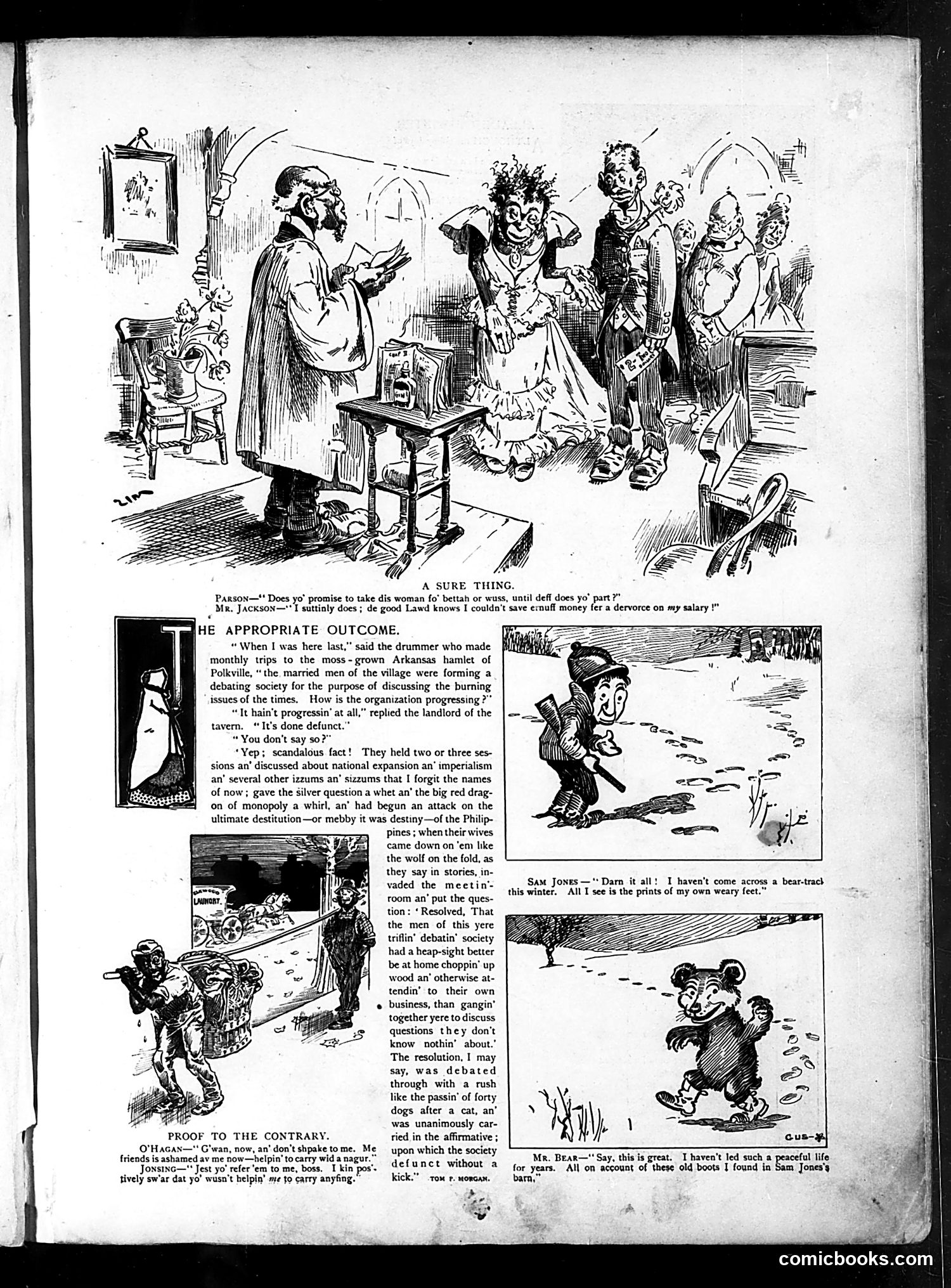
This page contains three separate satirical pieces from an early 20th-century American magazine: 1. **"A Sure Thing"** (top): A clergyman approaches a bride and groom at the altar, asking if she promises to obey. The parson jokes that marriage vows are unrealistic—the bride won't obey, and he couldn't save money anyway. The satire mocks both marriage expectations and clerical financial struggles. 2. **"The Appropriate Outcome"** (center): A drummer recounts how a small Arkansas town debated "national expansion and imperialism" before their wives arrived. The wives quickly ended the debate, forcing the men home. This satirizes how domestic concerns override political discourse. 3. **Remaining cartoons** appear to reference frontier/wilderness themes with exaggerated character caricatures, though their specific satirical targets are unclear without additional context.
📄 Transcribed text from this page (OCR, searchable)
Machine-transcribed from the original scan — historical spelling and the odd misread are preserved.
A SURE THING. Parson—"* Does yo" promise to take dis woman fo’ bettah or wuss, until deff does yo" part ?” MR. Jackson—"'T suttinly does ; de good Lawd knows I couldn't save ernufl money fer a dervorce on my salary !" HE APPROPRIATE OUTCOME. “ When I was here last,’ said the drummer who made monthly trips to the moss-grown Arkansas hamlet of Polkville, “the. married men of the village were forming a debating society for the purpose of discussing the burning issues of the times. How is the organization progressing?” “It hain’t progressin’ at all,” replied the landlord of the tavern. “It’s done defunct.” ‘ou don't say so?" "Yep; scandalous fact! They held two or three ses- sions an’ discussed about national expansion an’ imperialism an’ several other izzums an’ sizzums that I forgit the names of now; gave the dilver question a whet an’ the big red drag- on of monopoly a whirl, an’ had begun an attack on the ultimate destitution—or mebby it was destiny—of the Philip- pines ; when their wives came down on ‘em like the wolf on the fold, as they say in stories, in- vaded the meetin’: Sam Jones —" Darn it all! I haven't come across a bear-trach a this winter. All I see is the prints of my own weary feet.” room an’ put the ques- tion: ‘Resolved, That the men of this yere triflin’ debatin’ society had a heap-sight better be at home choppin’ up wood an’ otherwise at- tendin’ to their own business, than gangin’ together yere to discuss questions they don't know nothin’ about.’ The resolution, I may say, was debated through with a rush like the passin’ of forty dogs after a cat, an’ was unanimously car- PROOF TO THE CONTRARY. ried in the affirmative ; " HAGAN—"* G'wan, now, an’ don't shpake tome. Me whi ‘ Hleneueeinctes Tre sow helpinrtocany wida nagur.” se oe er Mx. Bear—" Say, this is great. [haven't led such a peaceful life Jonsinc—"* Jest yo’ refer'em to me, boss. I kin . See for years. All on account of these old boots J found in Sam Jones's tively sw'ar dat yo’ wusn't helpin’ me to carry anyfing. kick.” tom r. woncan. barn,” > ni We Arg comicbooks.com |