
A complete issue · 16 pages · 1899
Judge — November 25, 1899
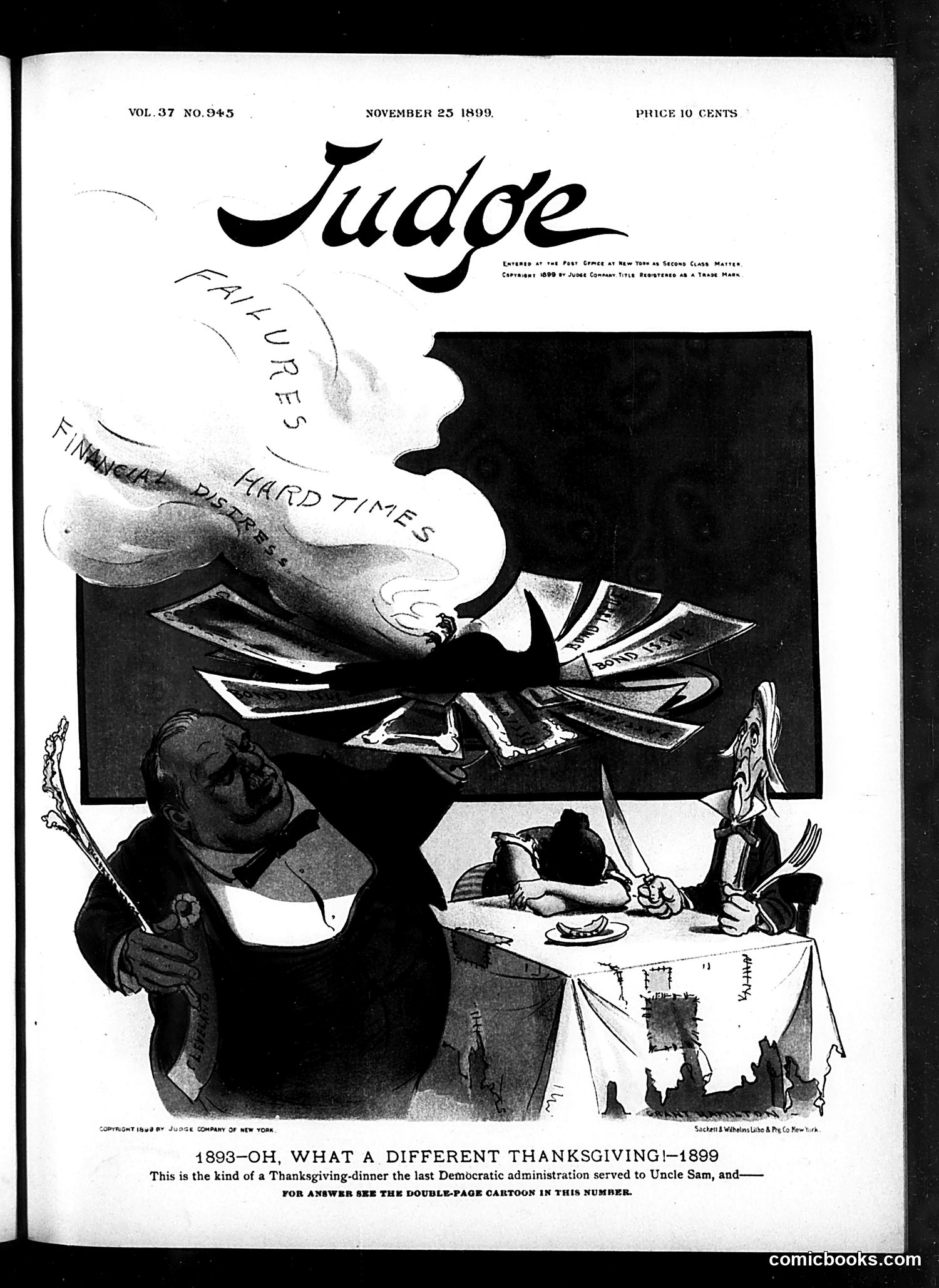
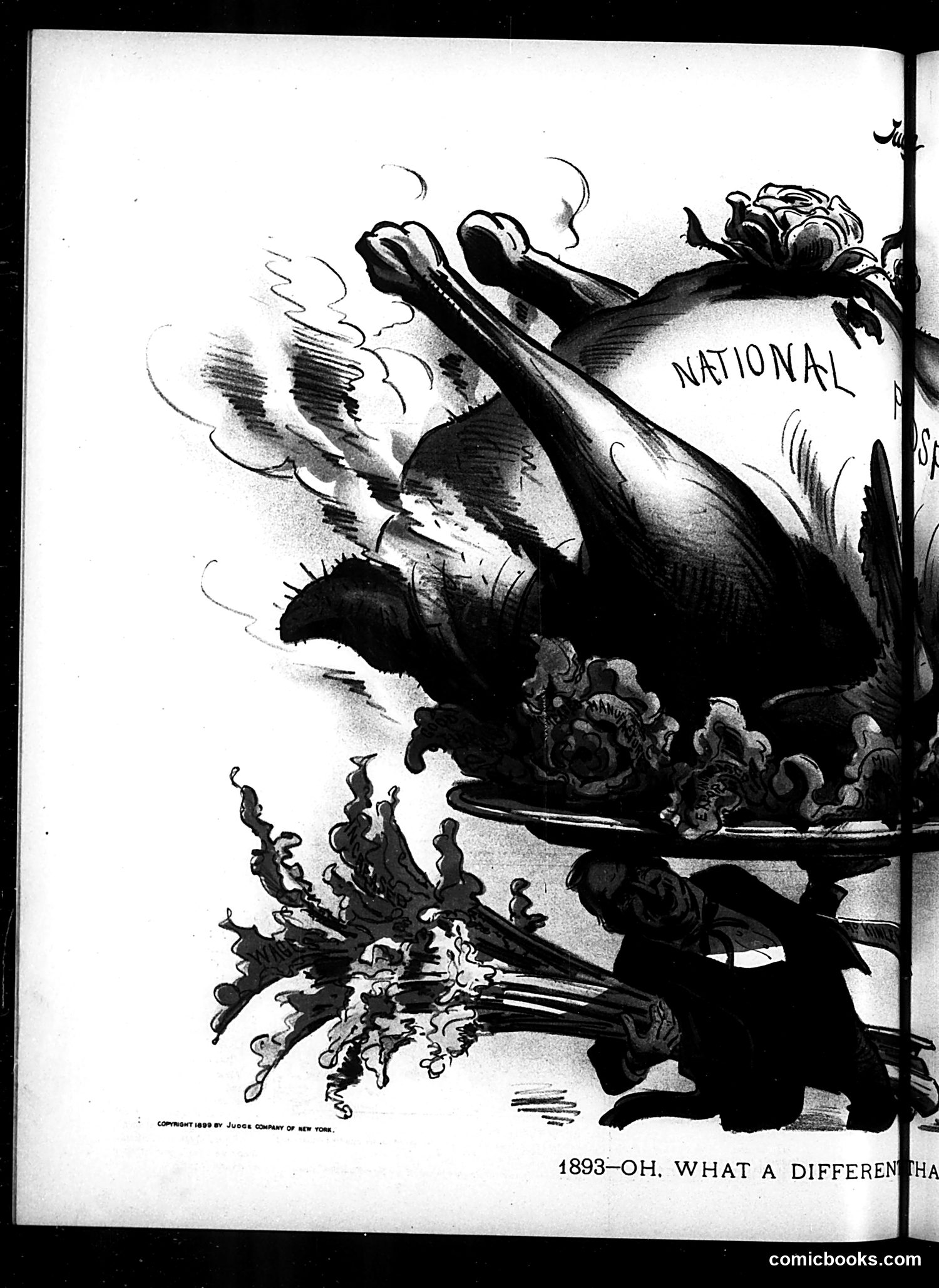
This *Judge* magazine cover compares Thanksgiving dinners under different Democratic and Republican administrations. The caption indicates this satirizes the last Thanksgiving dinner served during the Democratic administration (likely referencing President Grover Cleveland's administration, which ended in 1897). The imagery shows a stark contrast: a well-fed figure on the left representing Republican prosperity versus what appears to be hardship or scarcity associated with Democratic rule. The overflowing cornucopia and scattered financial documents suggest economic debates of the 1890s. The cartoon reflects the severe economic depression of 1893-1897 under Cleveland, which Republicans blamed on Democratic policies. By 1899, under Republican President McKinley, the magazine suggests improved economic conditions and better "times."
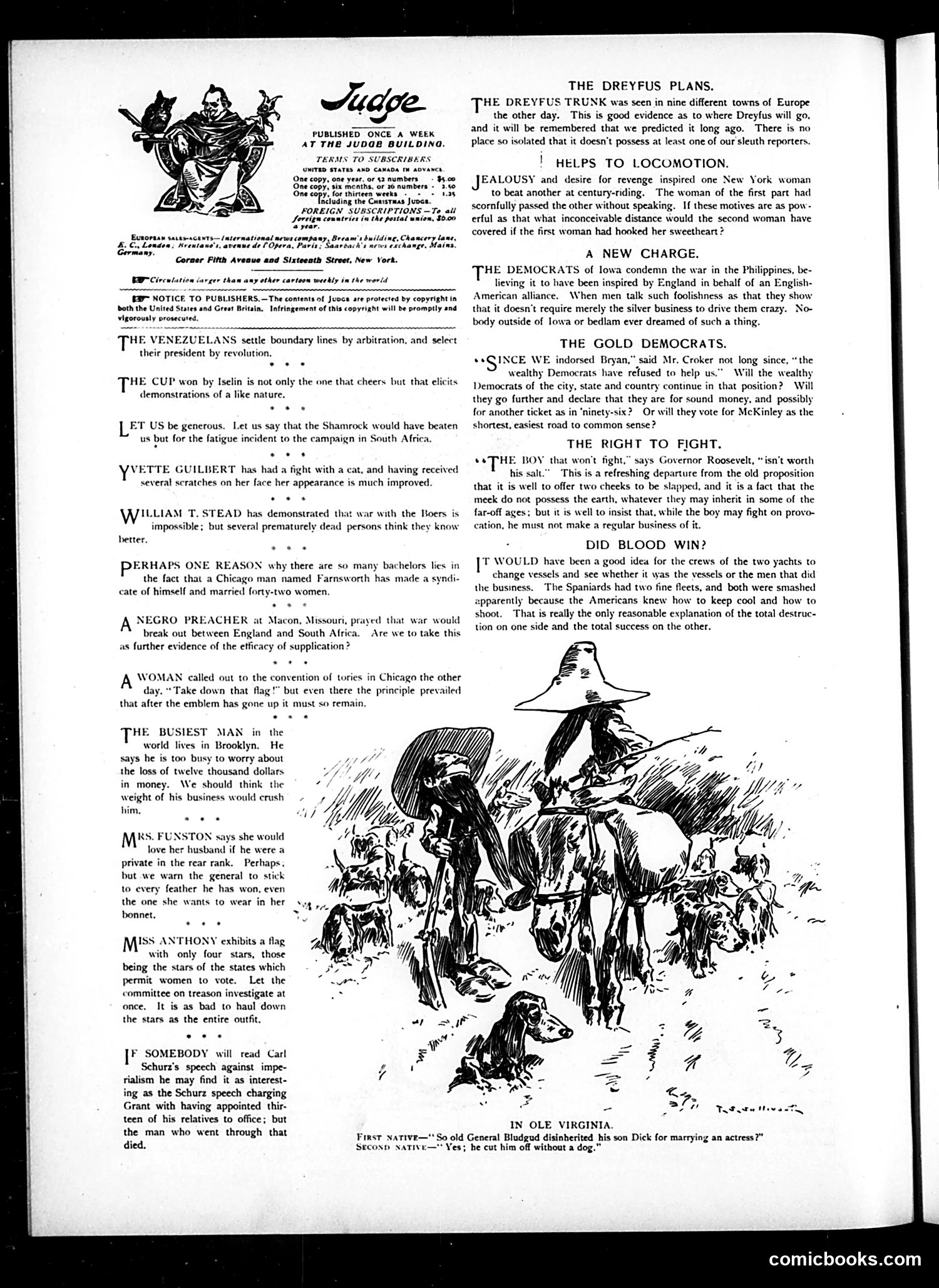
This page contains political commentary and humor pieces typical of Judge magazine's satirical approach. The main cartoon, titled "In Ole Virginia," depicts two men discussing a scandal where "General Bluegood disinherited his son Dick for marrying an actress." The second figure responds, "Yes; he cut him off without a dog." The joke relies on the phrase "cut off without a cent" (disinheritance), but substitutes "dog" for "cent," creating absurdist humor about Southern aristocratic values and class prejudice against actresses—a profession often morally condemned in early 20th-century America. The surrounding text pieces mock various political figures and social issues of the era, including Democrats, military matters, and contemporary scandals, employing Judge's characteristic biting wit.
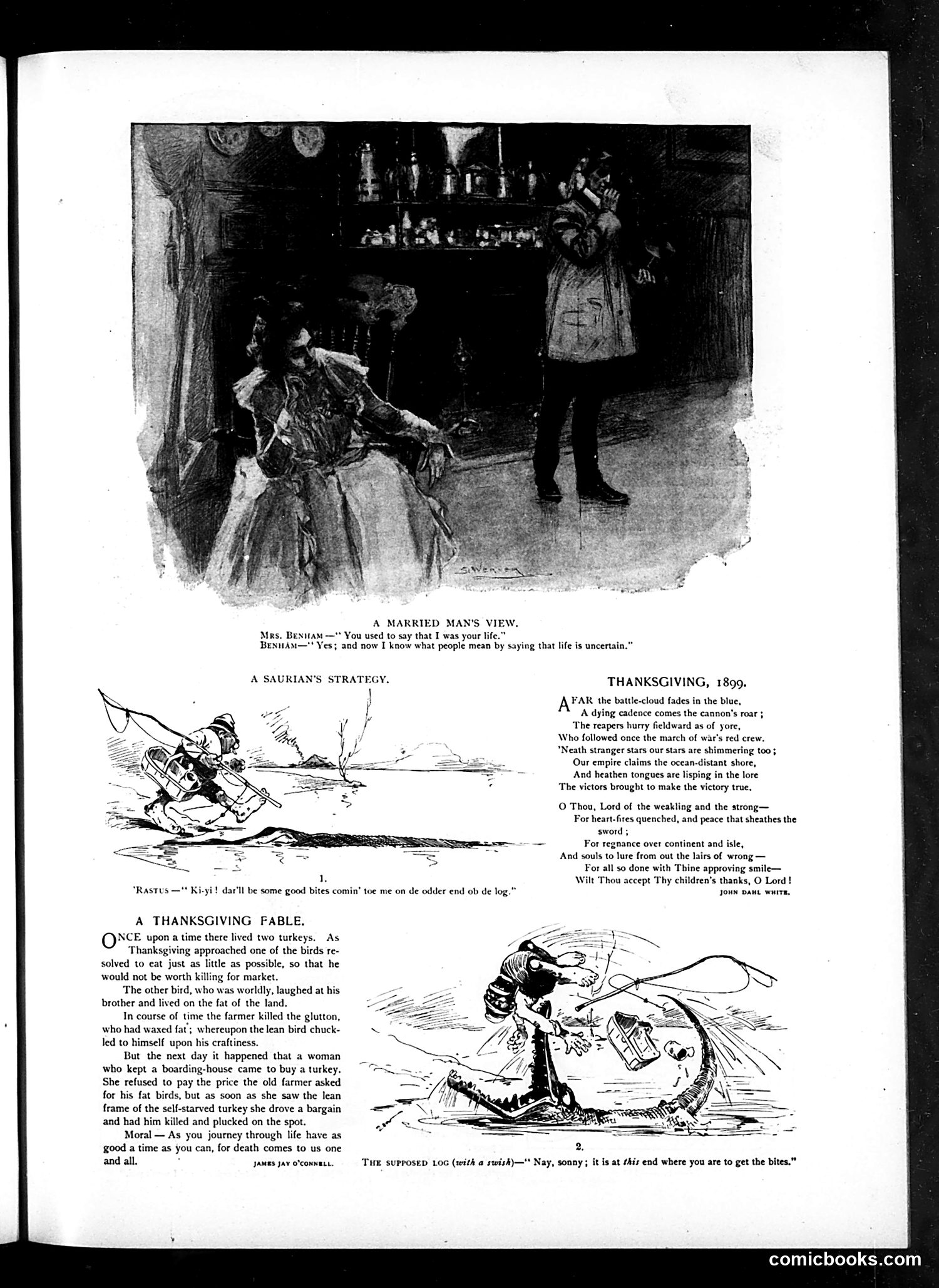
This page contains three separate pieces from 1899: **"A Married Man's View"** shows a domestic scene where a husband questions his wife's certainty about life, suggesting marital philosophical disagreement. **"A Saurian's Strategy"** depicts a crocodile or alligator in a tactical pose, likely a metaphorical cartoon about deceptive strategy (crocodiles were common symbols for cunning). **"A Thanksgiving Fable"** tells a moral story about two turkeys—one gluttonous, one prudent—where the fat bird is killed while the lean one survives, illustrating the virtue of restraint. The accompanying poem "Thanksgiving, 1899" appears patriotic, referencing imperial conquest and military victory. These pieces use animal fables and domestic humor typical of Judge's satirical approach to social morality and contemporary events.
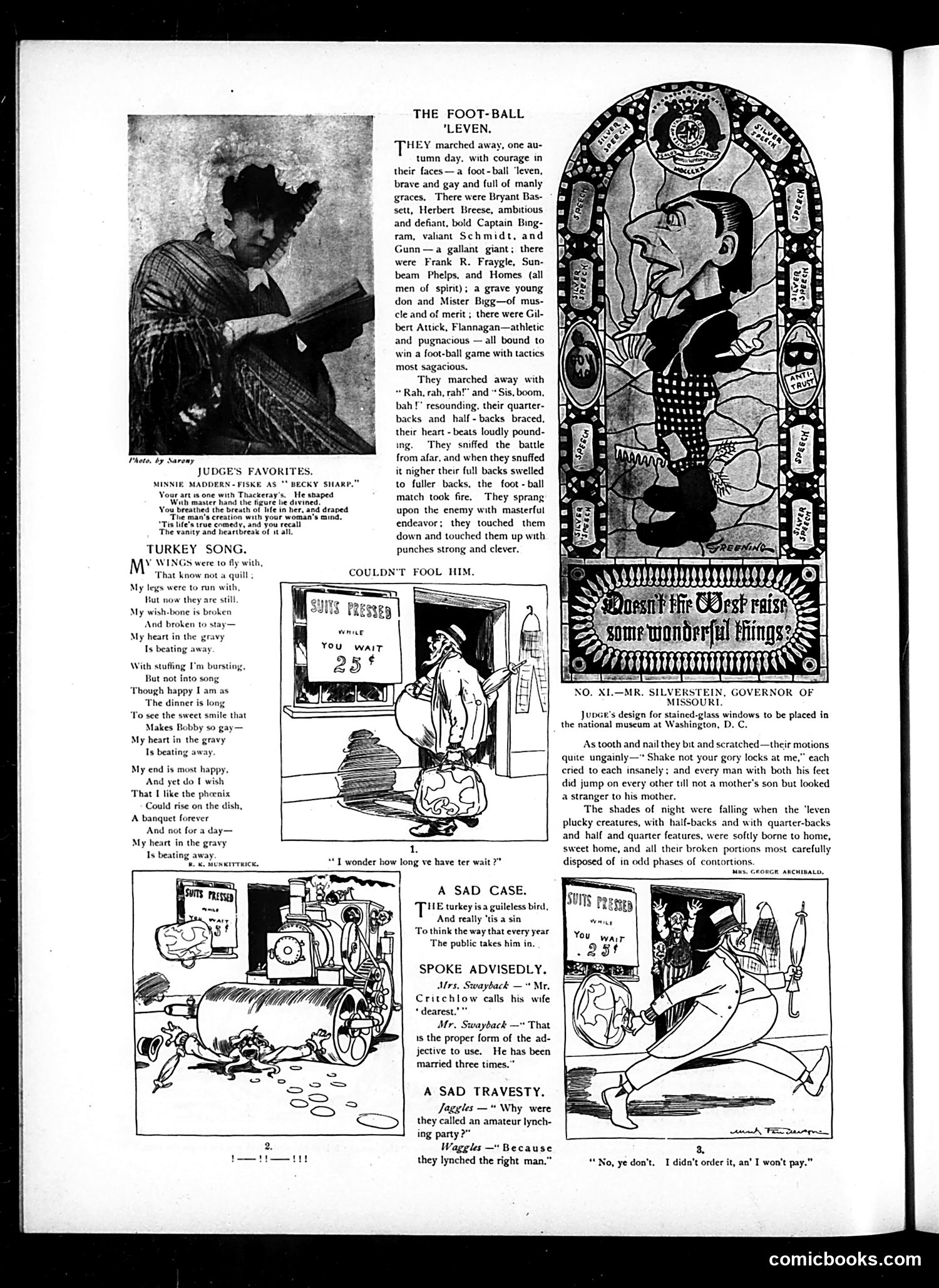
This Judge magazine page contains satirical stories and cartoons from the early 20th century. **"The Football 'Leven"** recounts a youth football team marching to battle with colorful player names (Bryant Hassett, Herbert Breese, Captain Bergram, Schmidt, etc.). The narrative uses mock-heroic language comparing football to warfare. **"Turkey Song"** is sentimental verse about turkeys destined for Thanksgiving dinner—a darkly comic commentary on holiday tradition. The cartoons mock domestic life: one shows a wife waiting to serve dinner while her husband delays; another depicts a man surprised by his wife's bill, with a joke about calling women "dearest" regardless of marital status; a final cartoon features a woman refusing to pay, quipping "No, ye don't. I didn't order it, an' I won't pay." The humor relies on early 20th-century domestic stereotypes and gender dynamics typical of Judge's satirical approach.
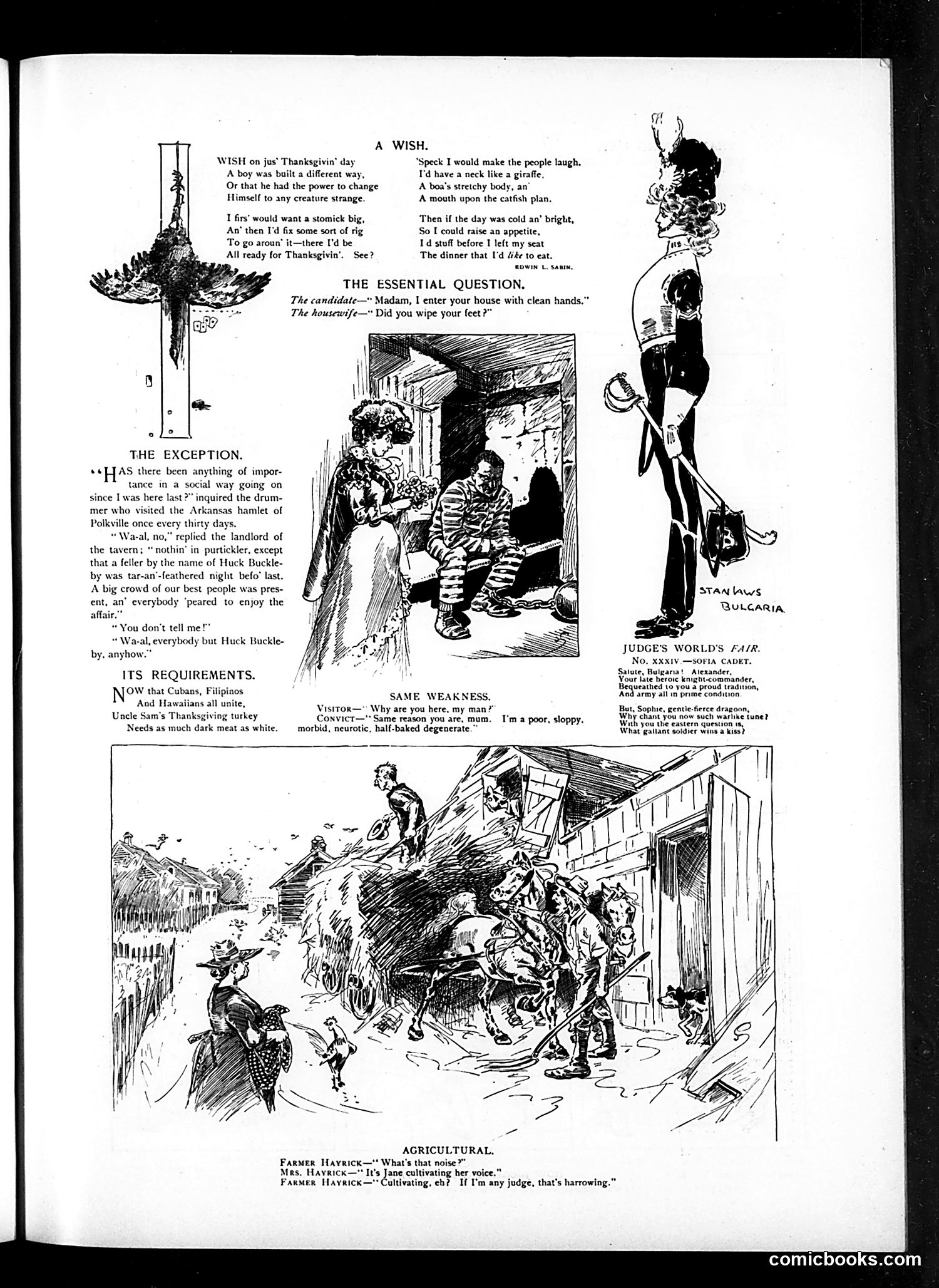
This page contains several satirical sketches typical of early 20th-century American humor: **"A Wish"** presents a boy imagining fantastical Thanksgiving transformations—a giraffe neck, boa constrictor body, catfish mouth—to consume more food. It's straightforward juvenile humor about gluttony. **"The Essential Question"** jokes about class etiquette: a candidate claims to enter with "clean hands" (moral purity), but the housewife asks only if he wiped his feet—reducing his pretensions to mundane domestic concerns. **"The Exception"** satirizes frontier vigilantism: a traveling salesman learns that tar-and-feathering occurred in this Arkansas town, yet everyone "enjoyed" it except the victim—dark commentary on mob violence normalized by "respectable people." **"Its Requirements"** references American imperial expansion (Cuba, Philippines, Hawaii) recently acquired, joking that the national "turkey" now needs diverse constituencies. **"Same Weakness"** presents a prison visitor and inmate as morally equivalent—both "sloppy" and "half-baked"—social criticism masquerading as humor. **"Agricultural"** is a pun: "cultivating her voice" sounds like "harrowing"—wordplay without deeper meaning.
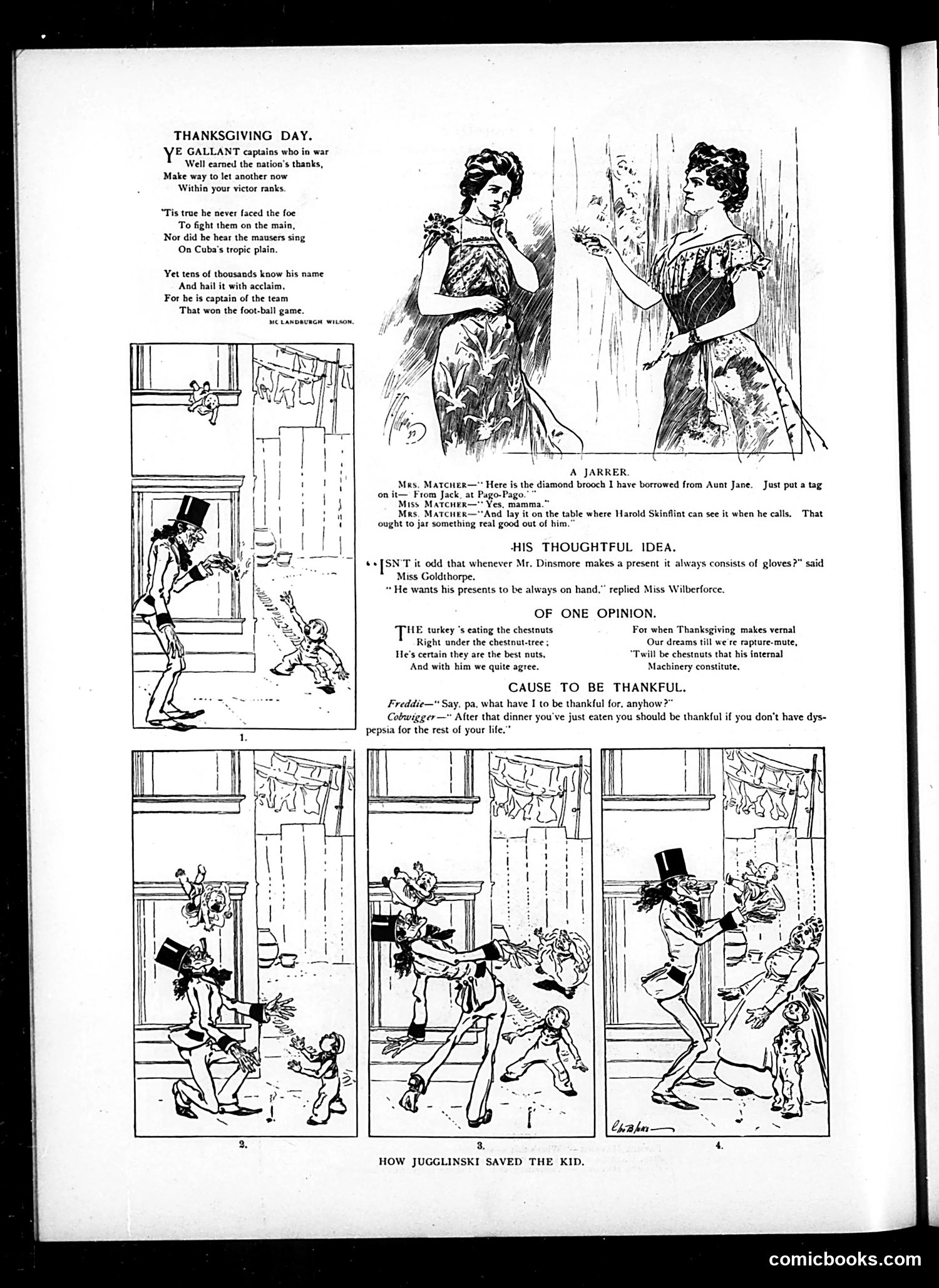
This page contains several unrelated satirical pieces typical of Judge magazine's format: **"Thanksgiving Day"** poem ironically elevates a college football team captain to the status of war heroes, suggesting American culture's disproportionate celebration of sports figures over actual military veterans—a commentary on misplaced national priorities. **"A Jarrer"** depicts a wealthy woman borrowing jewelry and falsely attributing it to impress a potential suitor, mocking upper-class deception and materialism. **"His Thoughtful Idea"** jokes about a man who only gives gloves as gifts—a pun on keeping presents "on hand." **"Of One Opinion"** uses a turkey's appetite for chestnuts as crude humor about Thanksgiving dinner. **"Cause to Be Thankful"** presents dark humor about indigestion, typical of period comedy. **"How Jugglinski Saved the Kid"** (bottom) appears to be a sequential comic strip involving acrobatic rescue or performance, though the narrative is unclear without full caption text. The page reflects Edwardian-era satirical concerns: social pretension, consumerism, and sports obsession.
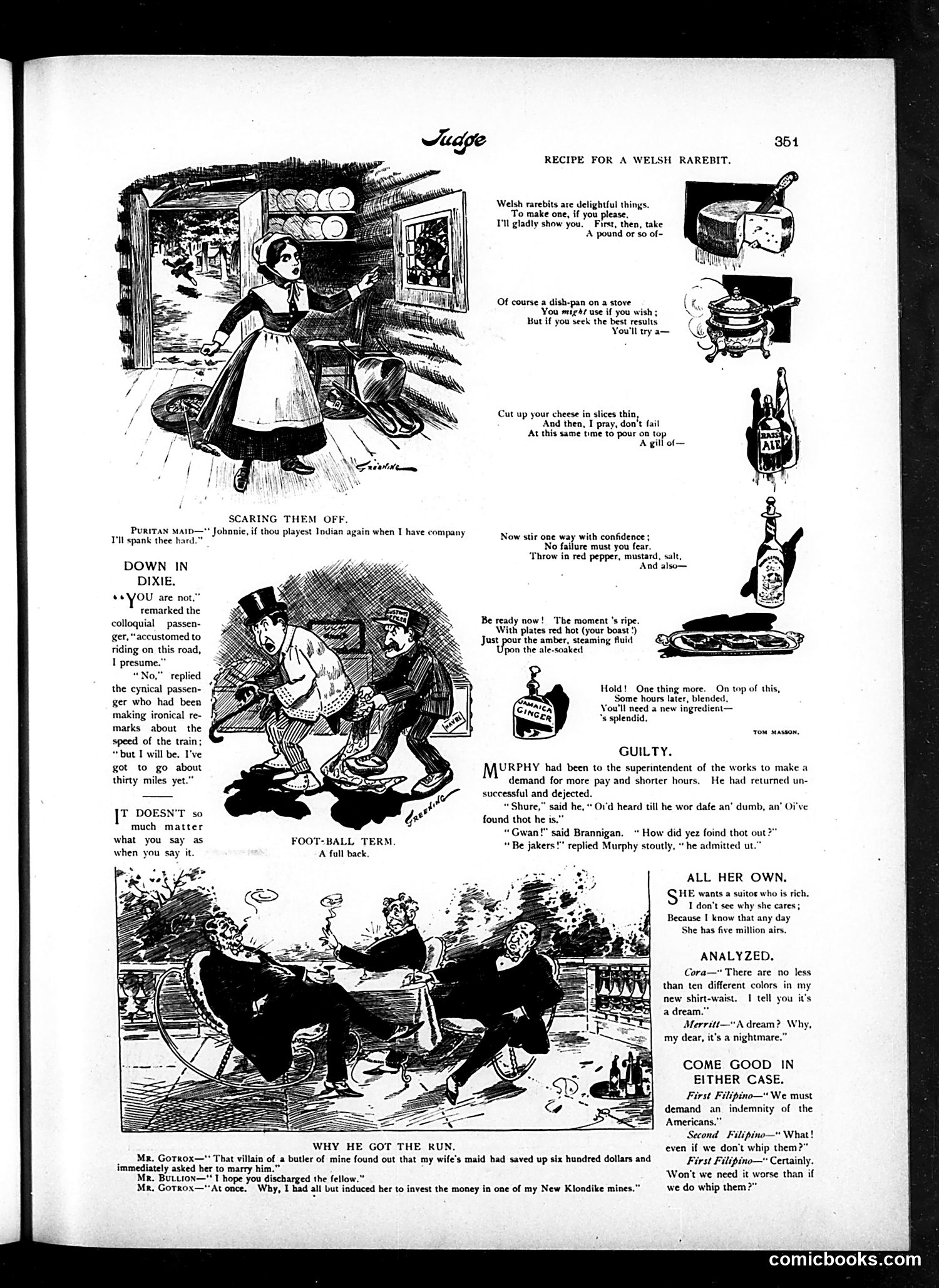
This page contains several unrelated satirical pieces typical of Judge magazine's format: **"Recipe for a Welsh Rarebit"** (top right): A humorous cooking instruction with intentionally vague or absurd ingredients—a joke about unclear recipes rather than political satire. **"Scaring Them Off"** and **"Down in Dixie"**: Brief dialogue pieces poking fun at American regional stereotypes and social behaviors, not specific political events. **"Guilty"** and other short items: Workplace and domestic comedy sketches with no apparent political reference. **"Why He Got the Run"** (bottom): A joke about a man trying to swindle his wife's maid into investing in a "Klondike mine scheme"—likely mocking the Klondike Gold Rush speculation craze of the 1890s, when get-rich-quick schemes abounded. **"Come Good in Either Case"**: A brief joke about Filipino independence demands—possibly referencing post-Spanish American War (1898) Philippine political debates, though the reference is too vague to confirm. Overall, this is **primarily humor and light satire** rather than pointed political commentary.
This 1893 Judge magazine cartoon depicts a large figure labeled "NATIONAL" wielding a club or bat against smaller figures below, who appear to be fleeing or cowering. The text "OH, WHAT A DIFFEREN@HA" (likely "DIFFERENCE A" with OCR error) suggests commentary on changing circumstances. The cartoon likely satirizes national policy or economic impact—1893 was the year of a severe financial panic and depression in America. The "NATIONAL" figure represents federal government or national interests, while the smaller figures probably represent workers, citizens, or specific groups affected by economic crisis or policy decisions. The violent imagery emphasizes the cartoon's critical tone toward national actions or their consequences. Without complete text visibility, the specific target remains unclear, though it concerns a dramatic shift in national circumstances.
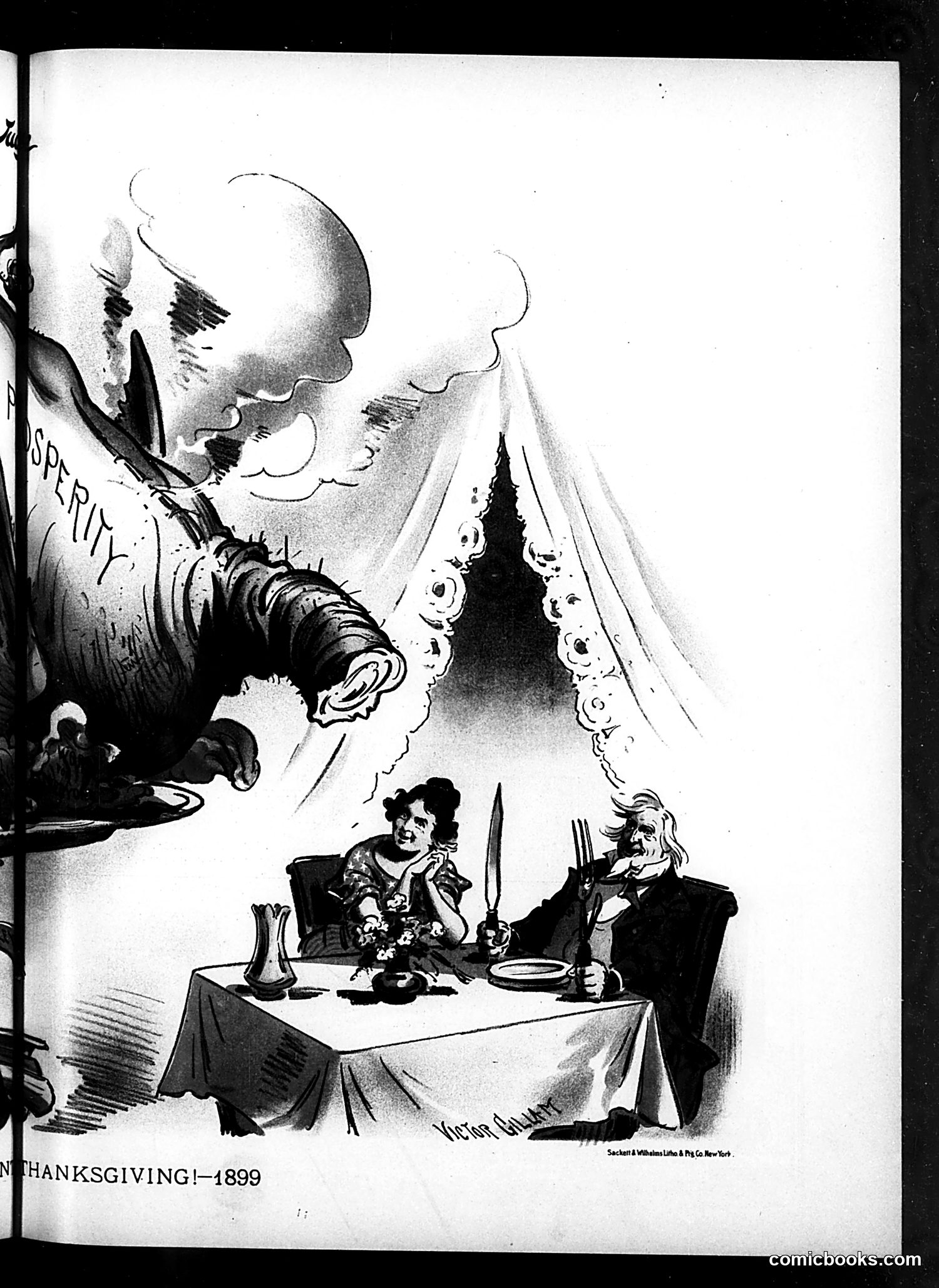
This political cartoon depicts two grotesque, menacing figures looming over a couple dining at a table. The figures appear to be caricatures—possibly representing threats or anxieties of 1899 America. One figure on the left wears clothing marked "SPERRY," though the significance is unclear from the image alone. The two diners below seem oblivious or resigned to the threatening presences overhead, suggesting satirical commentary on Americans attempting to celebrate Thanksgiving despite lurking dangers or concerns of the period. The exaggerated, nightmarish quality of the looming figures implies the cartoon critiques some contemporary threat—possibly related to trusts, monopolies, or political figures—that haunted the American consciousness even during festive occasions. The signature appears to be by Cesare Liverati, a Judge magazine cartoonist.
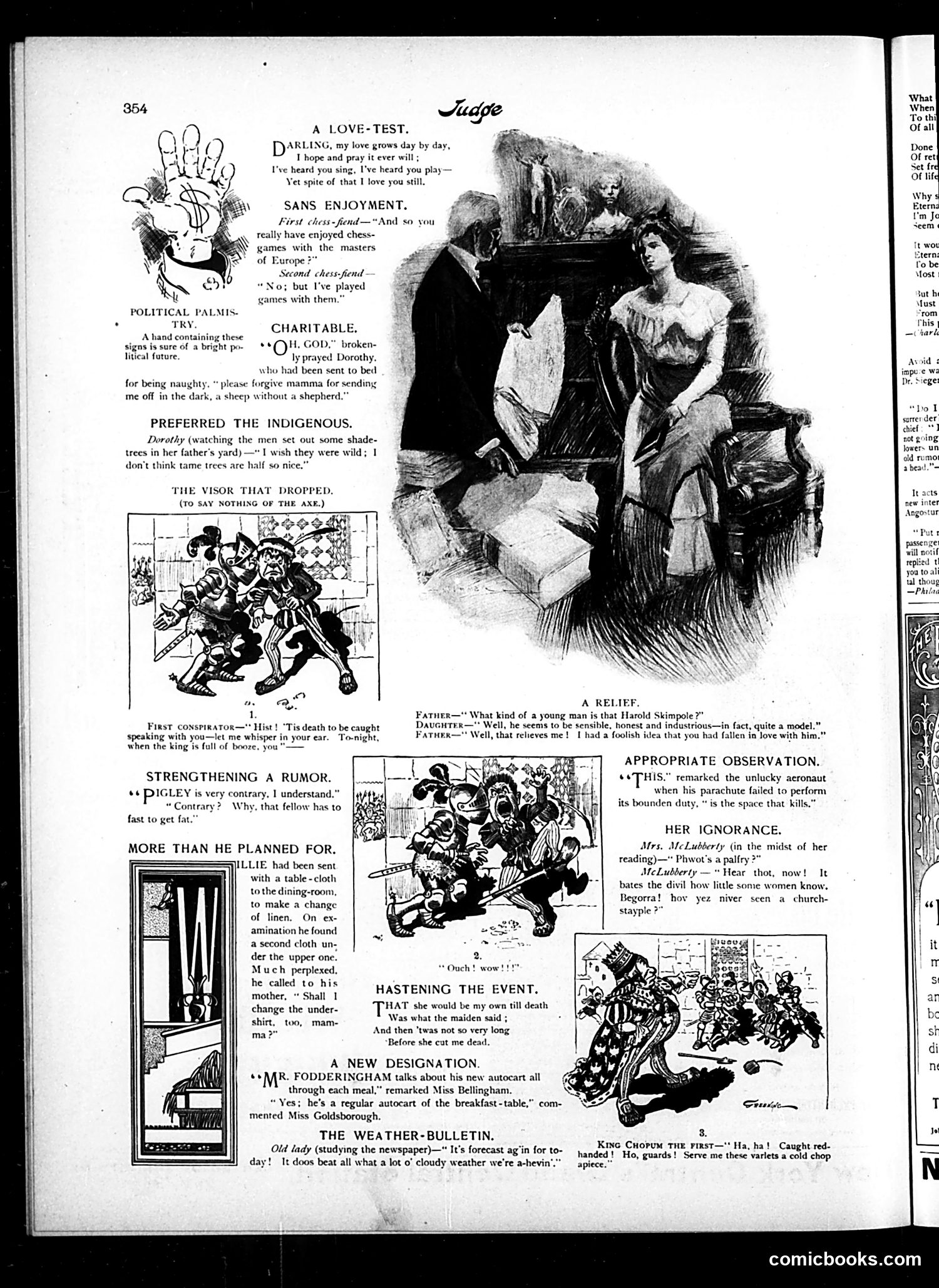
This page presents short humorous sketches typical of early 20th-century American satirical magazines. The cartoons mock various social types and situations: **"A Love-Test"** satirizes romantic declarations that ring hollow—professing love despite the beloved's artistic mediocrity. **Chess references** joke about European masters versus casual players. **"Political Palmistry"** uses the hand-reading fad to mock politicians' predictable success regardless of merit. **The aeronaut cartoon** makes dark humor from an early aviation disaster—parachute failure—a contemporary concern as aviation was new and dangerous. **"Her Ignorance"** features a stereotyped Irish servant character (McLubberty) unfamiliar with "paltry," playing on period ethnic humor about working-class immigrants' limited education. **"The Visor That Dropped"** depicts slapstick domestic comedy about a woman's suitor. **The automobile reference** mocks nouveau-riche men obsessed with their new "autocars," a contemporary status symbol. These sketches reflect genteel magazine humor targeting educated middle-class readers through wordplay, class mockery, and stereotypes now considered offensive.
This page consists primarily of **advertisements and literary content** rather than political cartoons. The visible material includes: **Literary pieces:** Poems and short prose about identity, death, and social commentary—including Charlotte Perkins Stetson's "Eternal Me" (a reflection on losing individual identity) and a dialect poem "Gone Ter Res'" about an African American man's peaceful acceptance of death. **Advertisements:** The bulk of the page features product ads for Evans' Ale, Sohmer pianos, Prudential Insurance, Wilson Whiskey, and a "New Gem" safety razor—typical of Judge's era. **Humor columns:** Brief comic exchanges about handwriting, typewriters, and social embarrassments, reflecting turn-of-century anxieties about modern technology and propriety. The page demonstrates Judge's format: mixing satirical editorial content with commercial advertising, rather than featuring prominent political cartoons.
This page is primarily **advertising** for various products and services typical of early 20th-century America, interspersed with brief humorous anecdotes rather than sustained political cartoons. The main satirical content includes: **The Tesla joke** mocking inventor Nikola Tesla's repeated promises of imminent breakthroughs in wireless telegraphy—suggesting his announcements are so predictable that even Gabriel's trumpet blast couldn't impress him. **The Laurier reference** jokes about Canadian Prime Minister Sir Wilfrid Laurier's popularity-building tactic of kissing babies, sarcastically praising his "courage" given the allegedly dangerous nature of Chicago babies. **Minor social humor** about hair color changes, political patronage, and marital nagging fills the remaining space. The page reflects **Judge's** satirical style: topical, often cynical about public figures and domestic life, with an emphasis on quick wit over elaborate visual satire. Most space is devoted to product advertisements (liqueur, chocolate, hosiery, knives), indicating the magazine's revenue model.
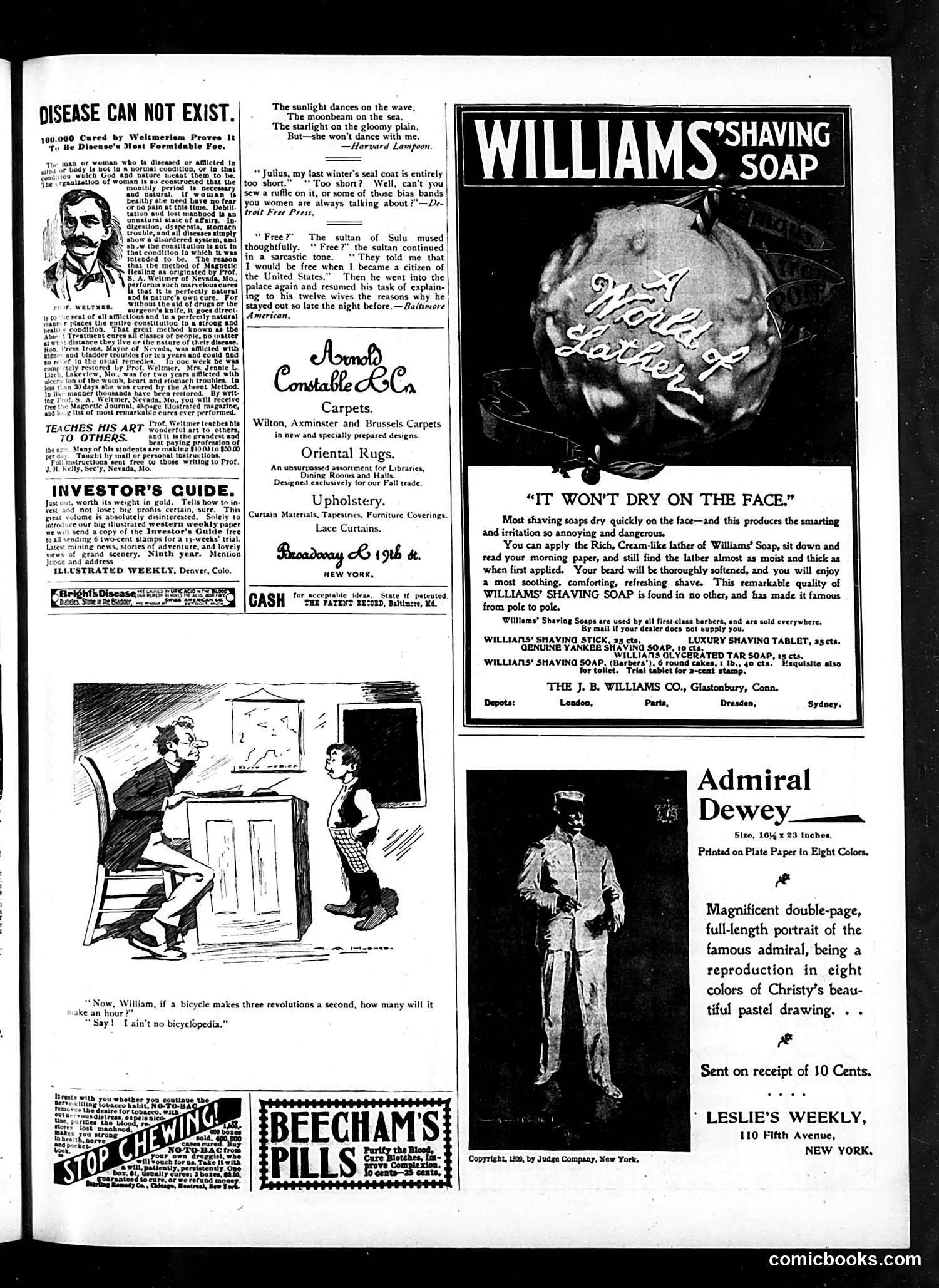
This page is primarily **advertising**, with minimal political content. The main elements are: **Advertisements:** Williams' Shaving Soap (large), Beecham's Pills, Admiral Dewey portrait, carpet/rug dealers, and various patent/investment schemes. **Cartoons/Humor:** - A small cartoon showing a man asking a boy a math question about bicycle revolutions; the boy replies he "ain't no bicyclopedia"—a pun on "encyclopedia." - Several quoted jokes from other publications, including one about a "Sultan of Sulu" becoming a U.S. citizen and complaining about lack of freedom. **Social Context:** The Sultan reference likely alludes to early 1900s U.S. colonial involvement in the Philippines. The shaving soap ad emphasizes cream quality—typical consumer messaging of the era. The page is primarily a commercial vehicle rather than political satire.
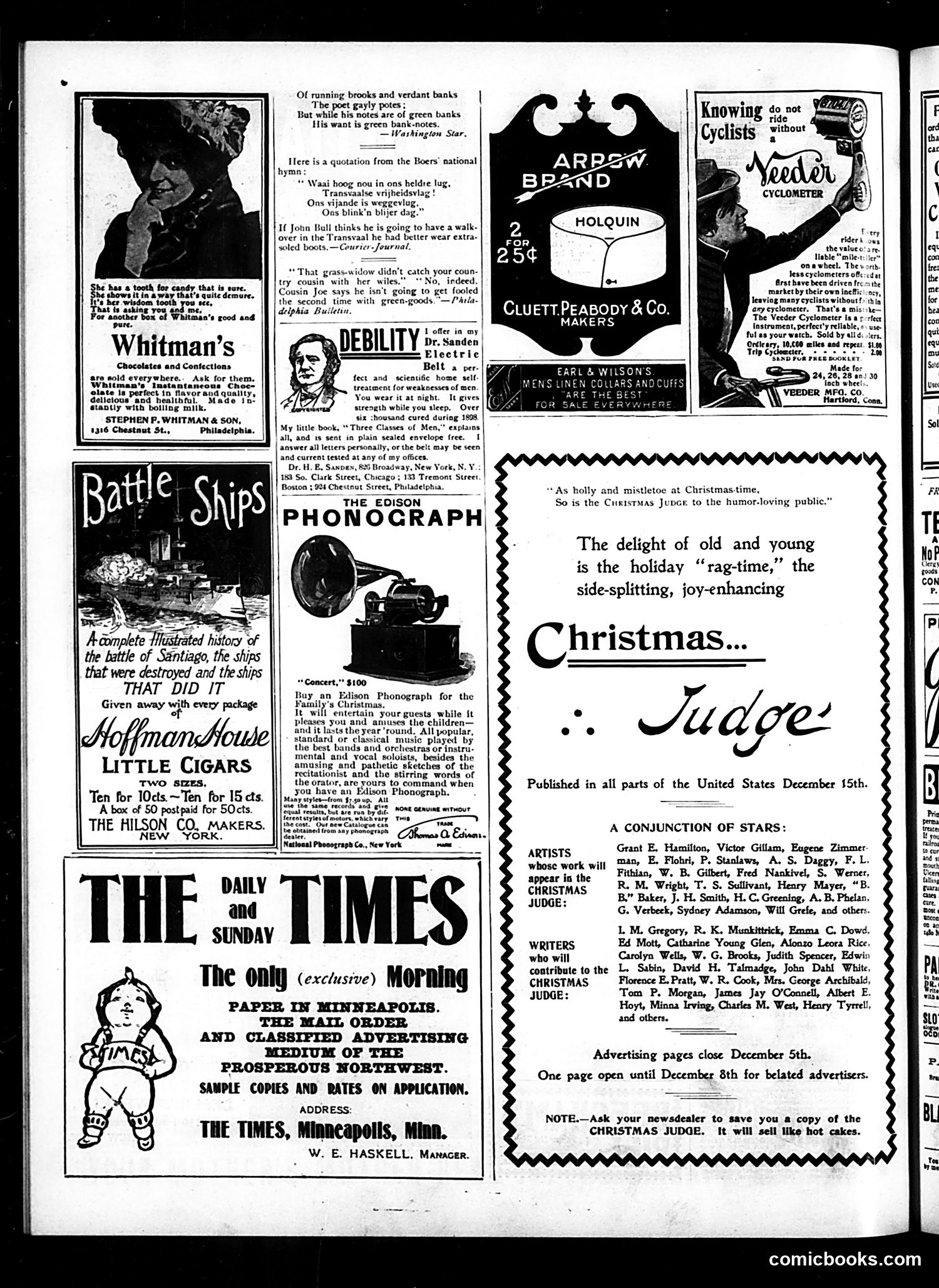
This page is primarily **advertising and promotional content** for an upcoming special Christmas issue of Judge magazine (published December 15th). It's not a political cartoon page but rather a cover for the holiday edition. The page includes various period advertisements (Whitman's chocolates, Edison phonographs, Hoffman House cigars, Dr. Sanden's "Debility Belt") and announces the Christmas Judge issue featuring prominent artists and writers of the era. The only satirical content visible is brief text snippets at the top: a Washington Star poem mocking poets who write about "green banks" while wanting "green bank-notes" (money), and a reference to the Boers' national anthem during the Boer War, suggesting Britain ("John Bull") shouldn't expect easy victory in the Transvaal. The page's main purpose is promoting Judge's holiday issue and attracting advertisers and readers—it functions as a table of contents and advertising prospectus rather than presenting substantive political satire.
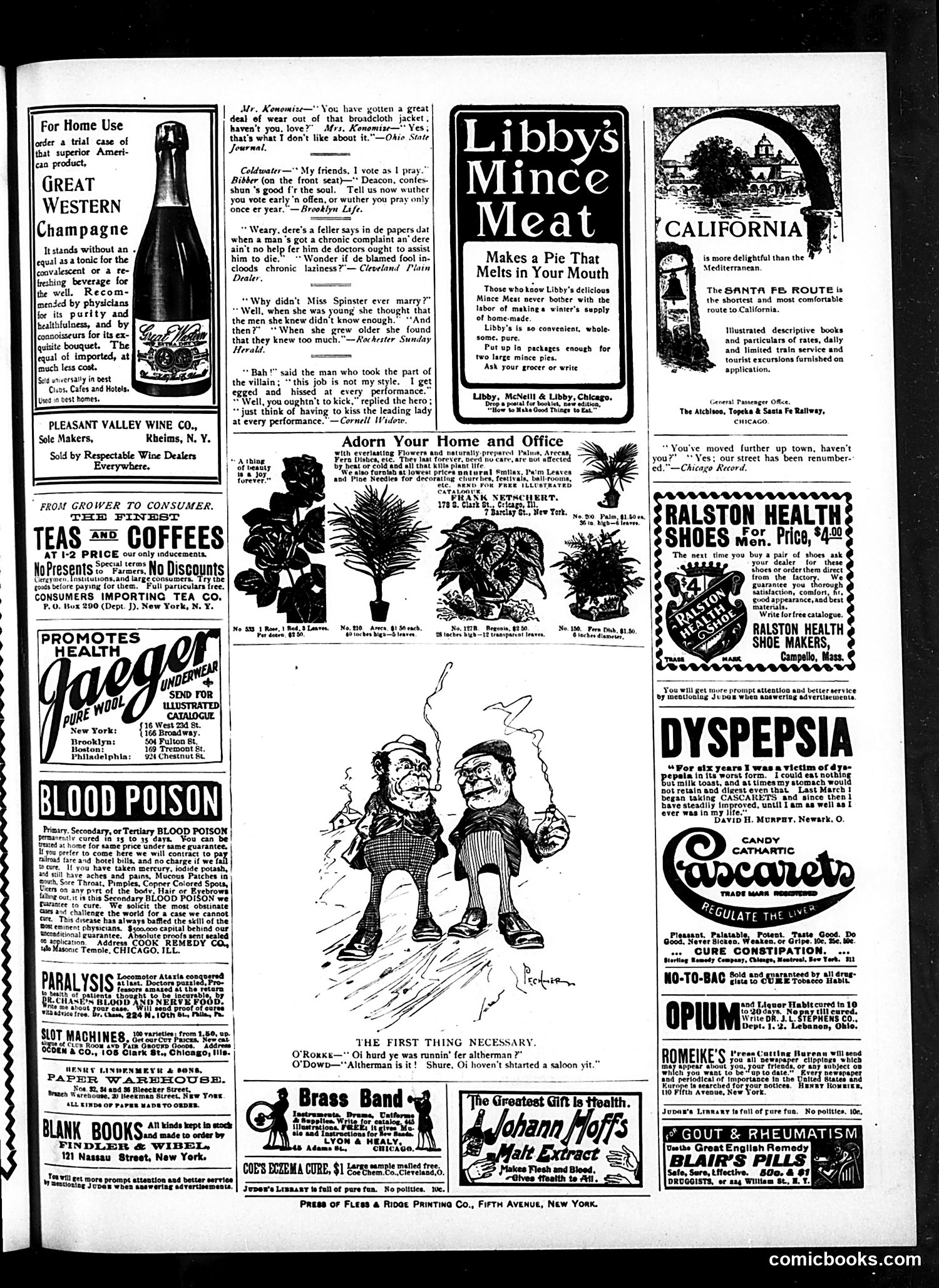
This appears to be primarily an **advertising page** from Judge magazine, with one central cartoon joke and numerous product advertisements typical of early 20th-century publications. ## The Main Cartoon The illustrated cartoon shows two figures with exaggerated features in what appears to be a comedic scene. The caption reads: "THE FIRST THING NECESSARY. O'Rourke—'O Bud! be wan of the briniest fer silerman?' O'Dowd—'Ailbumnerius it is! Shure, O! haven't I shirted a saloon yit.'" This uses **Irish dialect humor** (common in period satire), depicting working-class Irish characters in a conversation about obtaining alcohol, likely referencing Prohibition-era concerns or saloon culture. ## Advertisements The page is dominated by patent medicines and tonics (Cascarets, Johann Hoff's Malt Extract, Opium treatments), shoes, wine, and tea—reflecting an era before FDA regulations when such products made extraordinary health claims without evidence. The overall page reflects early 1900s American popular humor and commercial culture rather than coherent political satire.
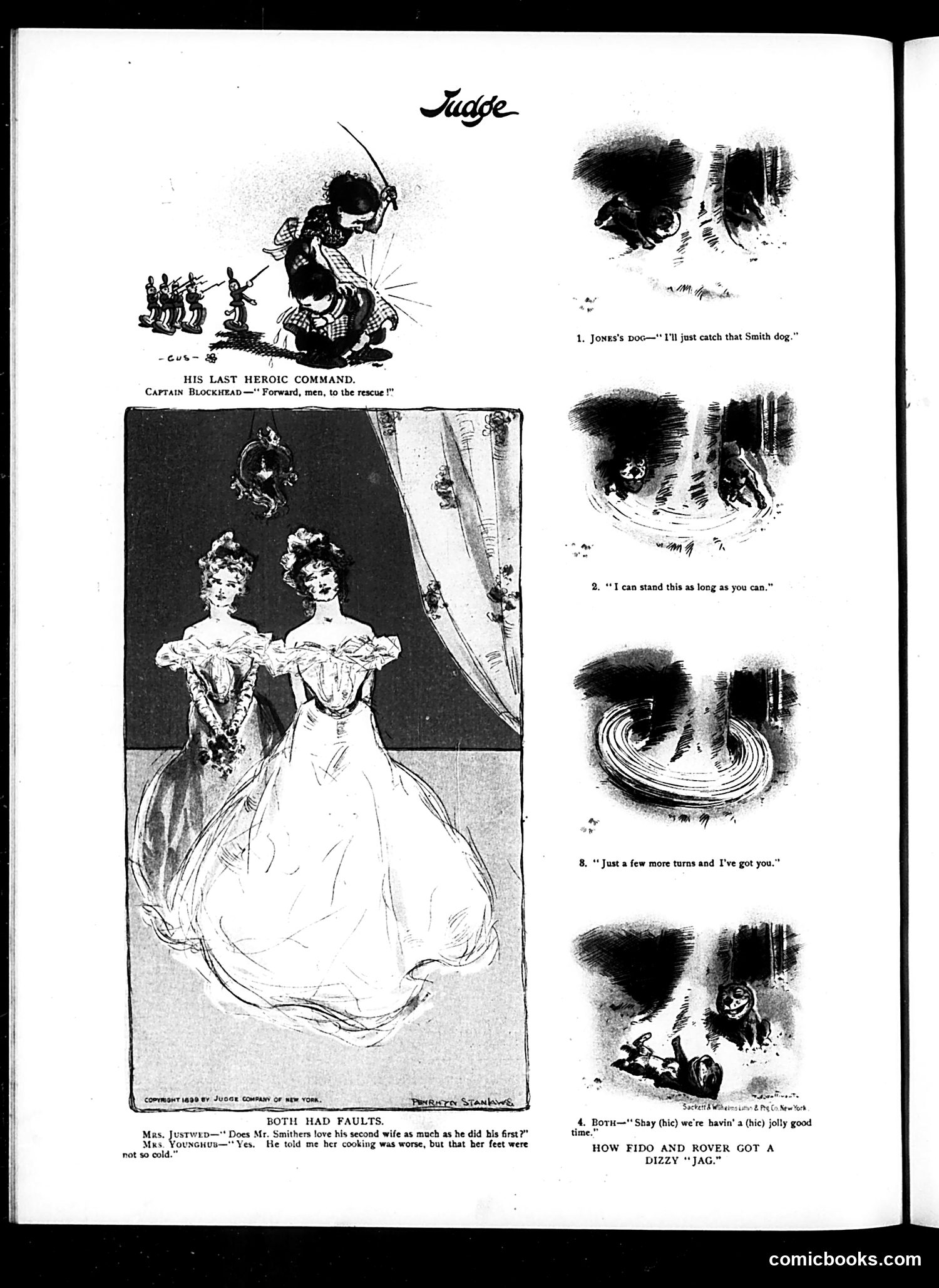
This page contains four separate humorous cartoons typical of early Judge magazine satire: 1. **"His Last Heroic Command"**: A military parody showing "Captain Blockhead" ordering men forward—the joke plays on incompetent military leadership, a recurring satirical target. 2. **"Both Had Faults"**: A domestic humor piece contrasting a man's two wives. The joke hinges on backhanded compliments: while he loves his second wife equally, his only praise is that her cooking is worse but her feet are warmer—mocking both matrimonial dissatisfaction and the absurdity of male logic. 3. **"Fido and Rover Got a Dizzy Jag"**: A four-panel sequence depicting dogs becoming intoxicated (the panels show increasingly chaotic dog behavior). This satirizes contemporary concerns about drunkenness by applying them to animals for comedic effect. The overall tone reflects Judge's characteristic blend of social satire, domestic humor, and wordplay aimed at educated urban readers of the era.