
A complete issue · 16 pages · 1899
Judge — November 4, 1899
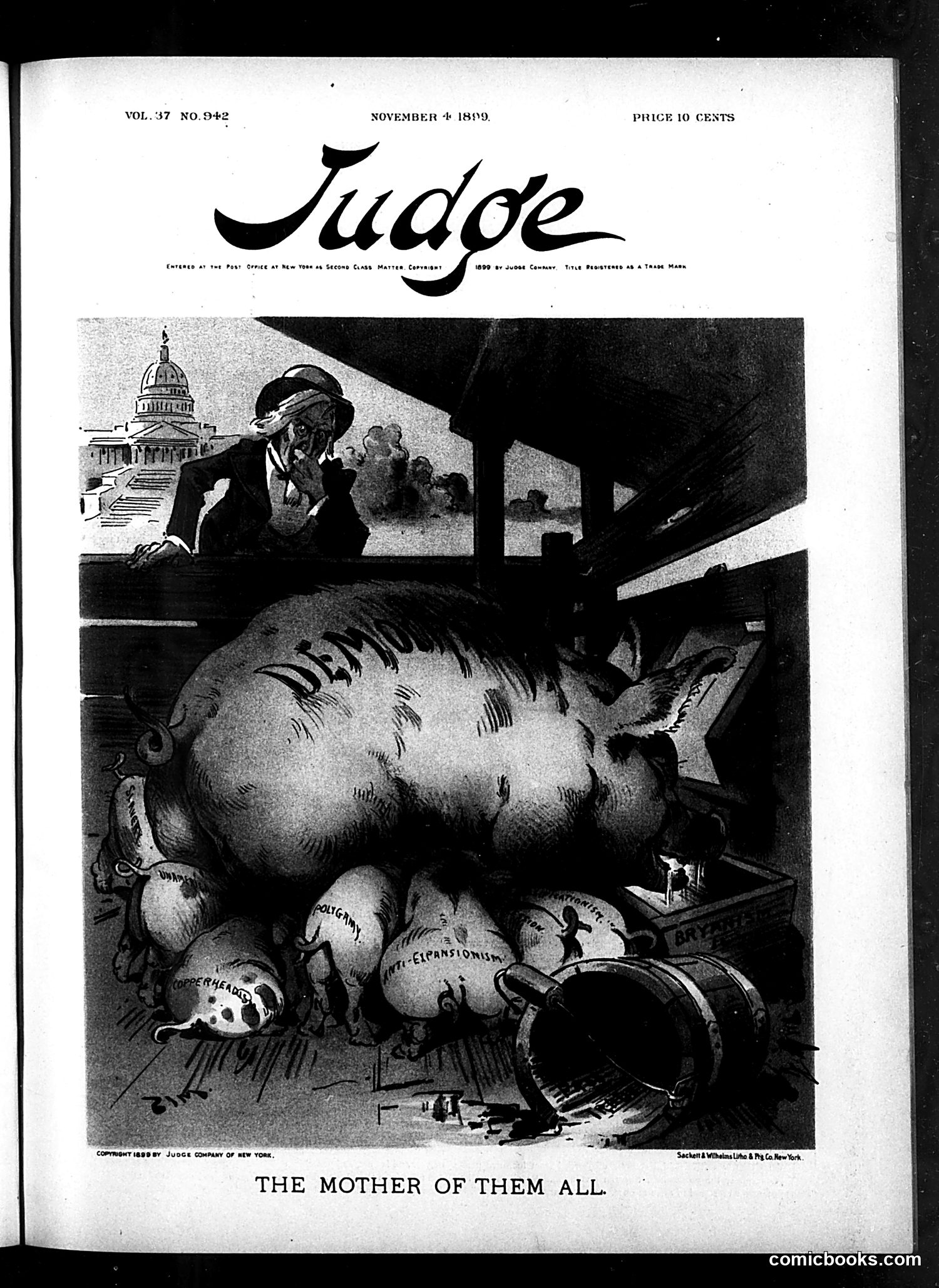
This November 1899 *Judge* cartoon satirizes political corruption and excess. The central figure is a bloated pig labeled with various names including "Corruption," "Monopoly," and "Expansionism"—representing the vices the artist associates with American politics of the era. The pig's offspring are smaller pigs labeled with specific scandals or political issues (text partially illegible but appears to reference contemporary controversies). Officials in the background observe this scene near the Capitol, suggesting government complicity. The cartoon critiques how corruption breeds further corruption and social problems. The "mother" metaphor suggests these issues stem from a single corrupting source—likely American imperial expansion, monopolistic business practices, or political patronage networks that dominated Gilded Age politics.
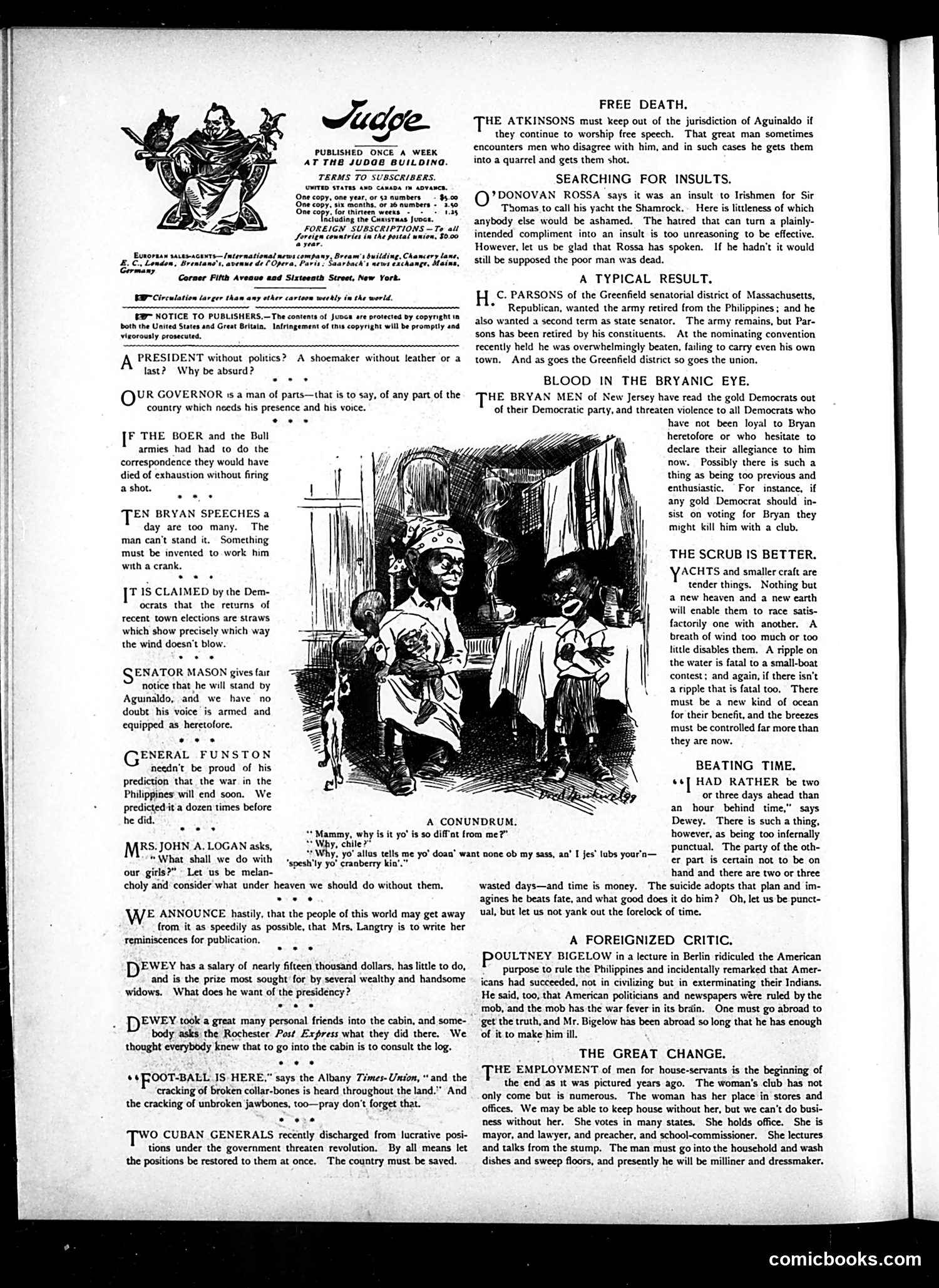
The central cartoon depicts a woman (likely representing a suffragist or women's rights advocate) confronting a man in military uniform, illustrating contemporary debates over women's roles during the early 20th century. The surrounding text addresses several political controversies: disputes over Democratic party loyalty, Senator Mason's position on Philippine policy, General Funston's military role, and Mrs. John A. Logan's advocacy for women's participation in governance. The cartoon satirizes tension between traditional gender roles and emerging women's activism. The military figure appears resistant to the woman's demands or arguments, reflecting period anxieties about women's expanding social and political participation. The overall page critiques conservative opposition to progressive reforms while endorsing women's greater involvement in national affairs.
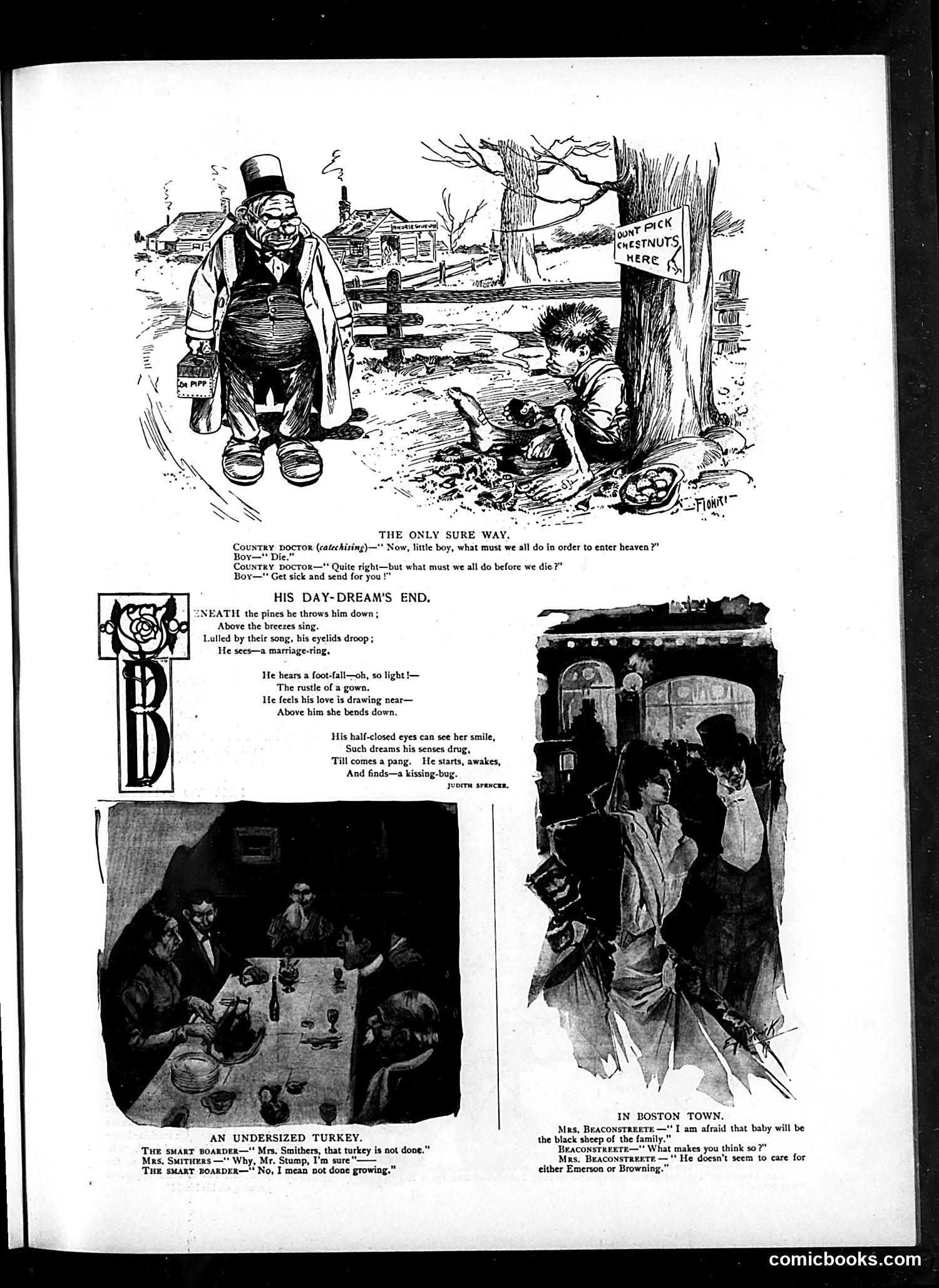
This page contains three satirical pieces from early 20th-century America: **"The Only Sure Way"** depicts a country doctor telling a boy that to enter heaven, "we all do in order to enter heaven." The satire mocks rural medical practices and perhaps religious hypocrisy. **"His Day-Dream's End"** is a poem about a boy daydreaming of romance and marriage before being startled awake by reality—typical sentimental humor of the era. **"An Undersized Turkey"** and **"In Boston Town"** appear to be domestic humor sketches about everyday middle-class life—a conversation about an inadequate holiday turkey and a Boston family discussion about a misbehaving child. The overall tone reflects Judge's typical focus on gentle social observation and domestic comedy rather than sharp political commentary.
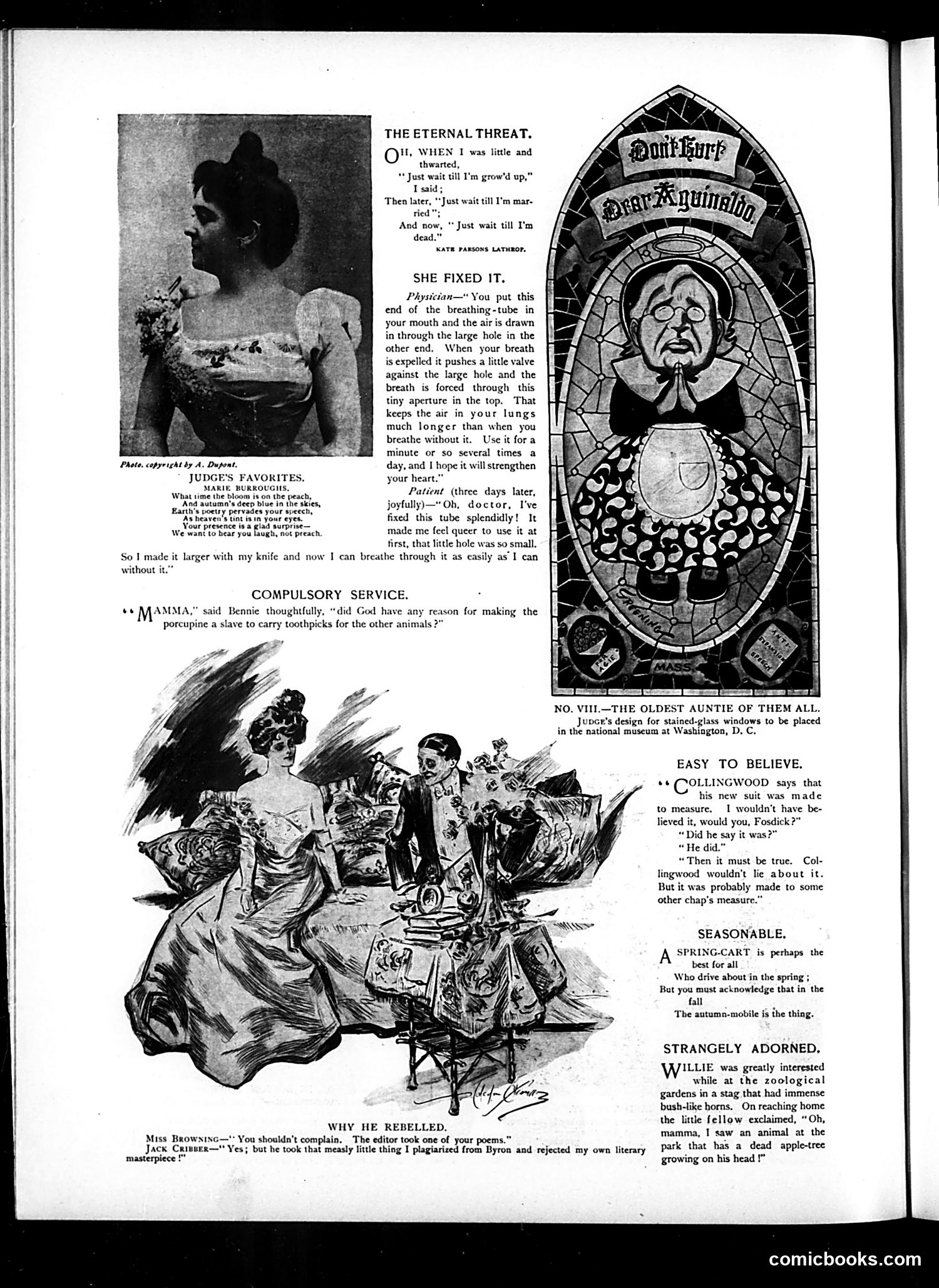
This page contains several short humorous anecdotes rather than political cartoons. The content includes: **"The Eternal Threat"**: A woman's quip about waiting until she's grown, married, and dead—satirizing empty parental threats. **"She Fixed It"**: A medical anecdote about a breathing tube device, likely referencing contemporary medical innovations. **"Compulsory Service"**: A joke questioning why porcupines must serve other animals—absurdist humor. **"Why He Rebelled"**: A dispute between Miss Browning and Jack Capers about plagiarized poetry, poking fun at literary pretension. The right page features "The Oldest Auntie of Them All," a stained-glass design intended for a museum, plus brief anecdotes about clothing and zoo animals. This appears to be a humor/joke compilation page typical of Judge magazine's miscellaneous content rather than focused political satire.
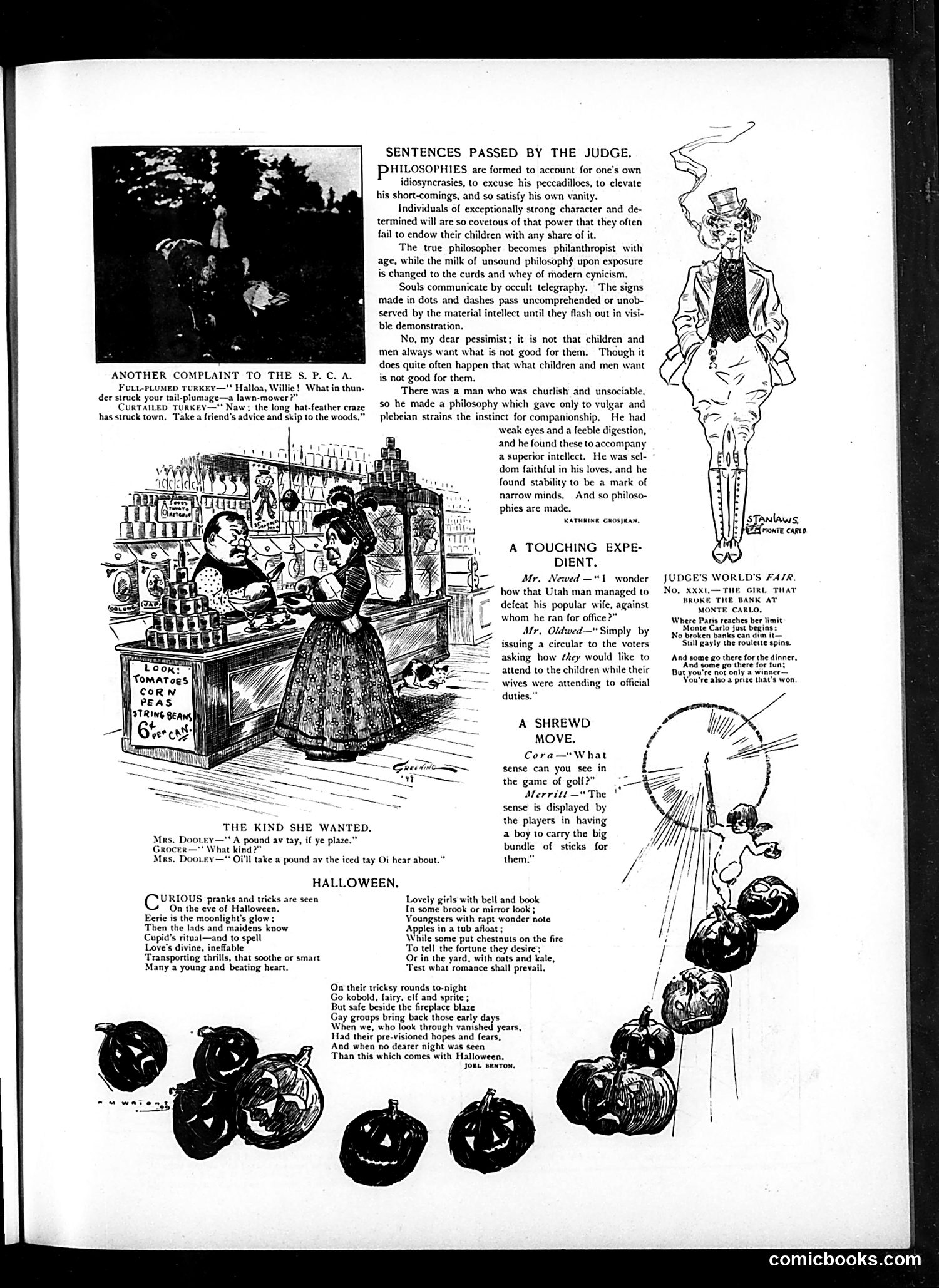
This page from Judge magazine contains satirical commentary and seasonal humor typical of late 19th or early 20th-century American satire. **"The Kind She Wanted"** mocks Irish immigrant speech patterns, a common Judge target. Mrs. Dooley requests "iced tay" (iced tea) by the pound—absurd because tea is measured by weight, not volume—playing on stereotypes of Irish working-class unfamiliarity with American commerce. **"A Touching Expedient"** satirizes polygamy debates, likely referencing Utah's prominent Mormon practice. A candidate defeats his polygamist opponent by circulating a pamphlet asking voters whether wives should attend official duties while childcare remains undone—exposing the impracticality of polygamy. **"Halloween"** is straightforward seasonal poetry celebrating the holiday's traditions among young people: divination games, fortune-telling, and romantic rituals. The ornamental philosophizing at top is typical Judge filler—pseudo-intellectual commentary on human nature and hypocrisy. The page's illustrations emphasize working-class and immigrant subjects, reflecting Judge's satirical focus on American social hierarchies of the era.
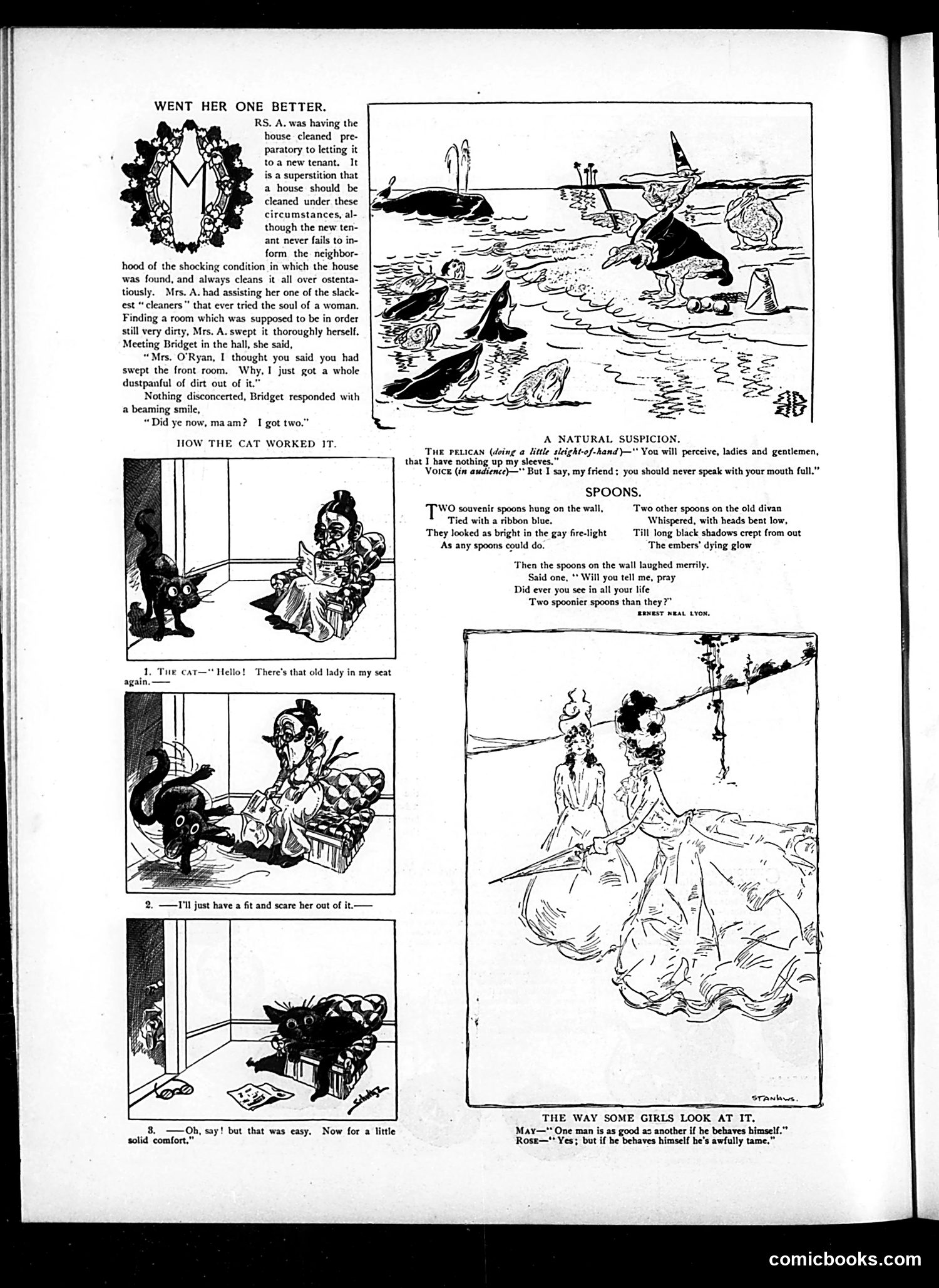
This page contains several unrelated satirical pieces typical of early 20th-century humor magazines. **"Went Her One Better"** mocks Irish domestic servants through the character "Bridget O'Ryan," a common stereotype. The joke: Mrs. A. scolds Bridget for failing to sweep properly, but Bridget cheerfully claims she actually swept *twice*—implying lazy incompetence masked by false pride. **"How the Cat Worked It"** shows a magician's act where a pelican heckler points out the magician speaks with his mouth full—a mild joke about performing with food. **"Spoons"** is whimsical verse personifying souvenir spoons, making a pun on "spoonier" (more sentimental/romantic). **"The Way Some Girls Look At It"** satirizes women's romantic preferences, suggesting they find virtuous, well-behaved men boring compared to misbehaving ones. The page reflects period attitudes: Irish servant mockery, anthropomorphized objects for humor, and gender stereotypes about women's romantic judgment.
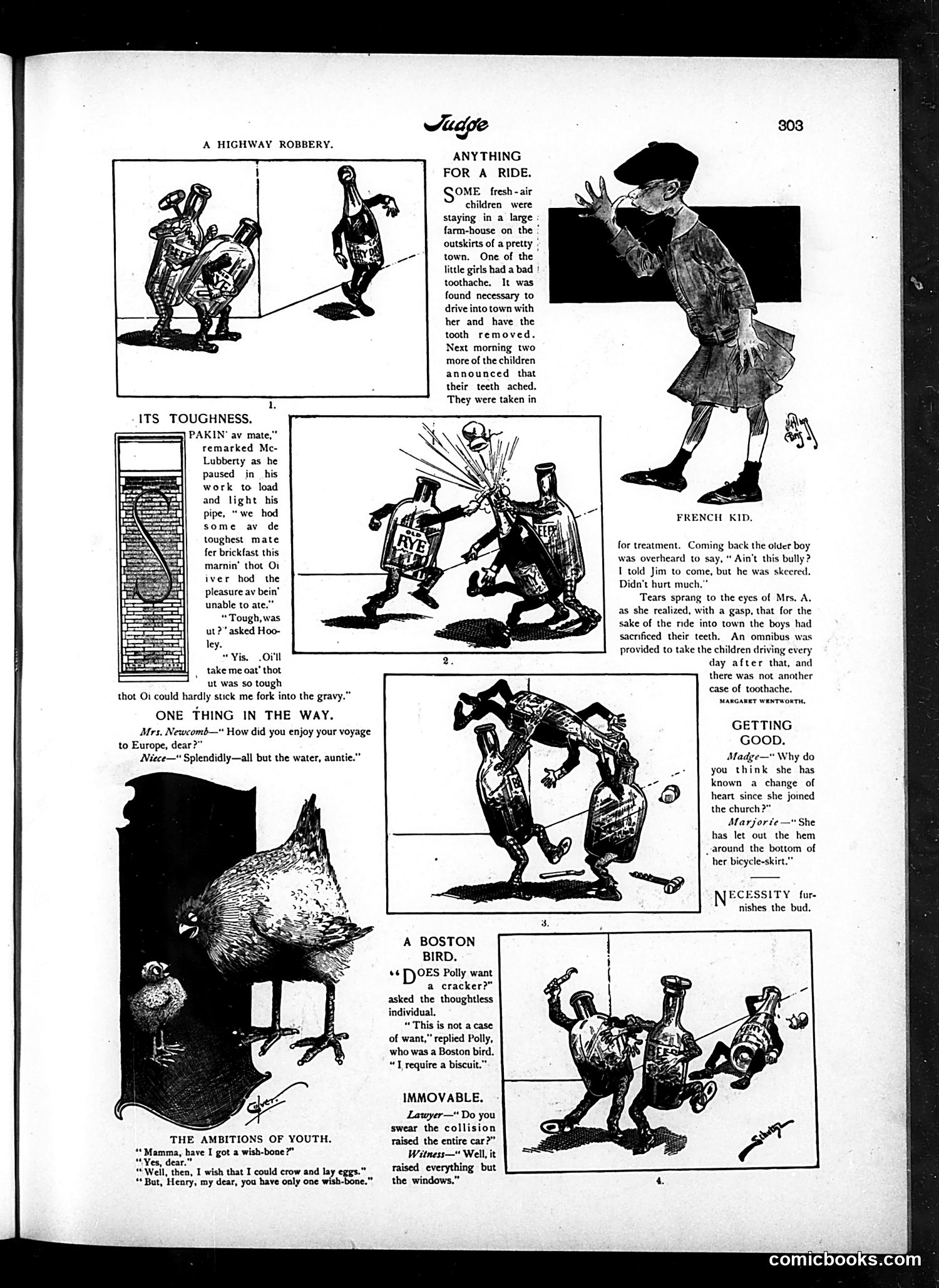
This page contains six unrelated humorous pieces typical of early 20th-century American satire: **"Anything for a Ride"** mocks children's willingness to fabricate illness for entertainment—after one girl gets a legitimate toothache treated in town, boys fake dental pain to enjoy the carriage ride, sacrificing their teeth for the thrill. **"Highway Robbery," "Its Toughness," "One Thing in the Way,"** and **"A Boston Bird"** are brief joke vignettes about working-class speech patterns, maritime travel complaints, and pretentious Boston attitudes respectively. **"The Ambitions of Youth"** satirizes childhood absurdity—a child wishes to both crow and lay eggs simultaneously, a logical impossibility that critiques childish reasoning. **"Getting Good"** jokes about religious hypocrisy: a woman who joined the church supposedly showed moral improvement only by hemming her bicycle-skirt higher—a superficial change mocking performative piety. The cartoons feature exaggerated character types and working-class dialect humor common to the era's satirical magazine style.
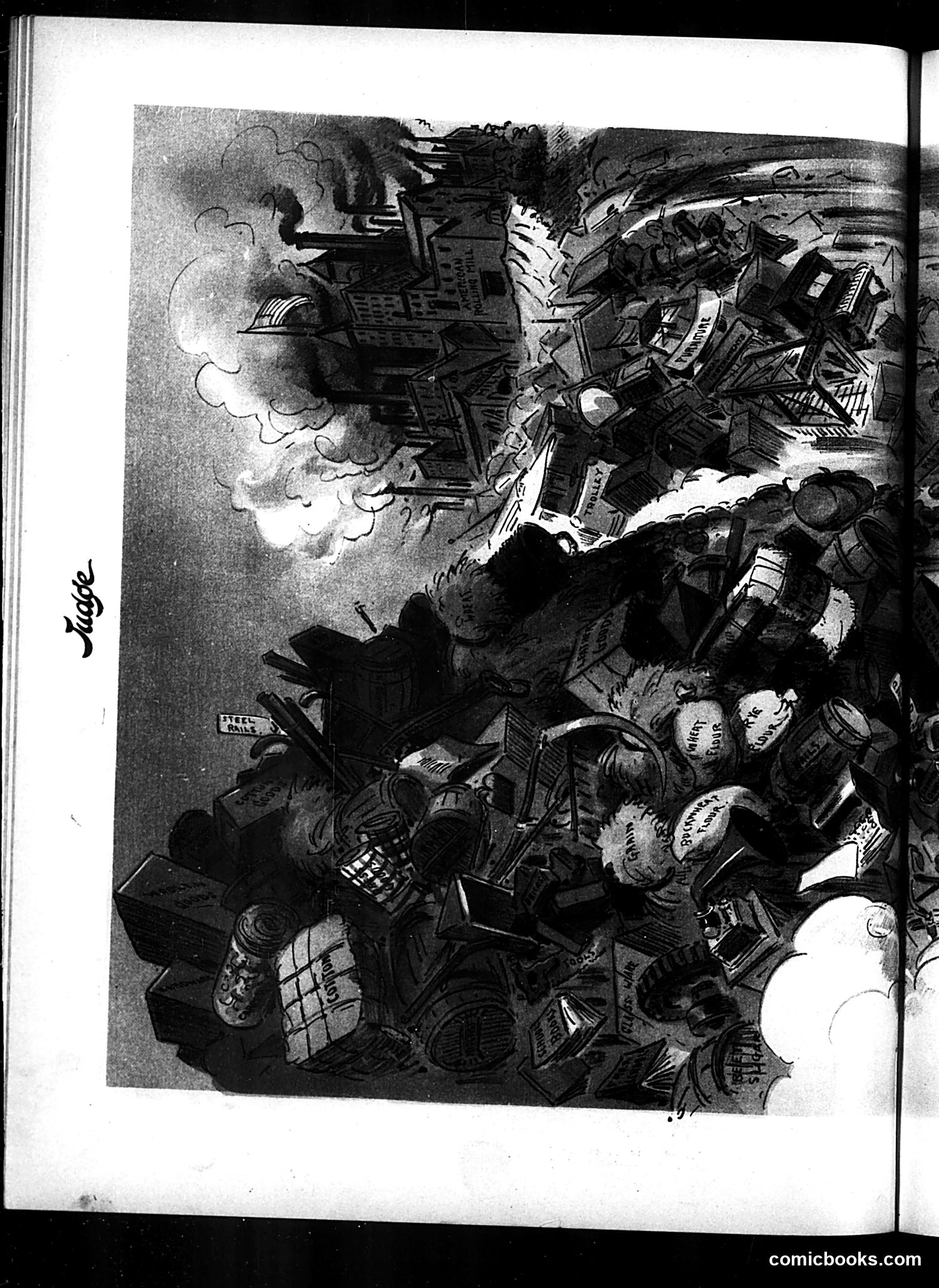
This appears to be a Judge magazine cartoon (rotated 90 degrees) satirizing industrial labor and working conditions. The image shows a chaotic pile of factory workers, machinery, and industrial equipment, with smoke or explosions emerging from what resembles a factory or steel mill. A "STEEL MILLS" label is visible. The satire likely critiques dangerous factory conditions, worker exploitation, or industrial accidents common in early-to-mid 20th century American manufacturing. The tangled, violent composition—with bodies and machinery jumbled together—suggests commentary on how workers' safety was subordinated to industrial production. Without the magazine's publication date visible, the specific historical moment remains unclear, though this reflects Judge's typical focus on labor and industrial commentary during America's industrial era.
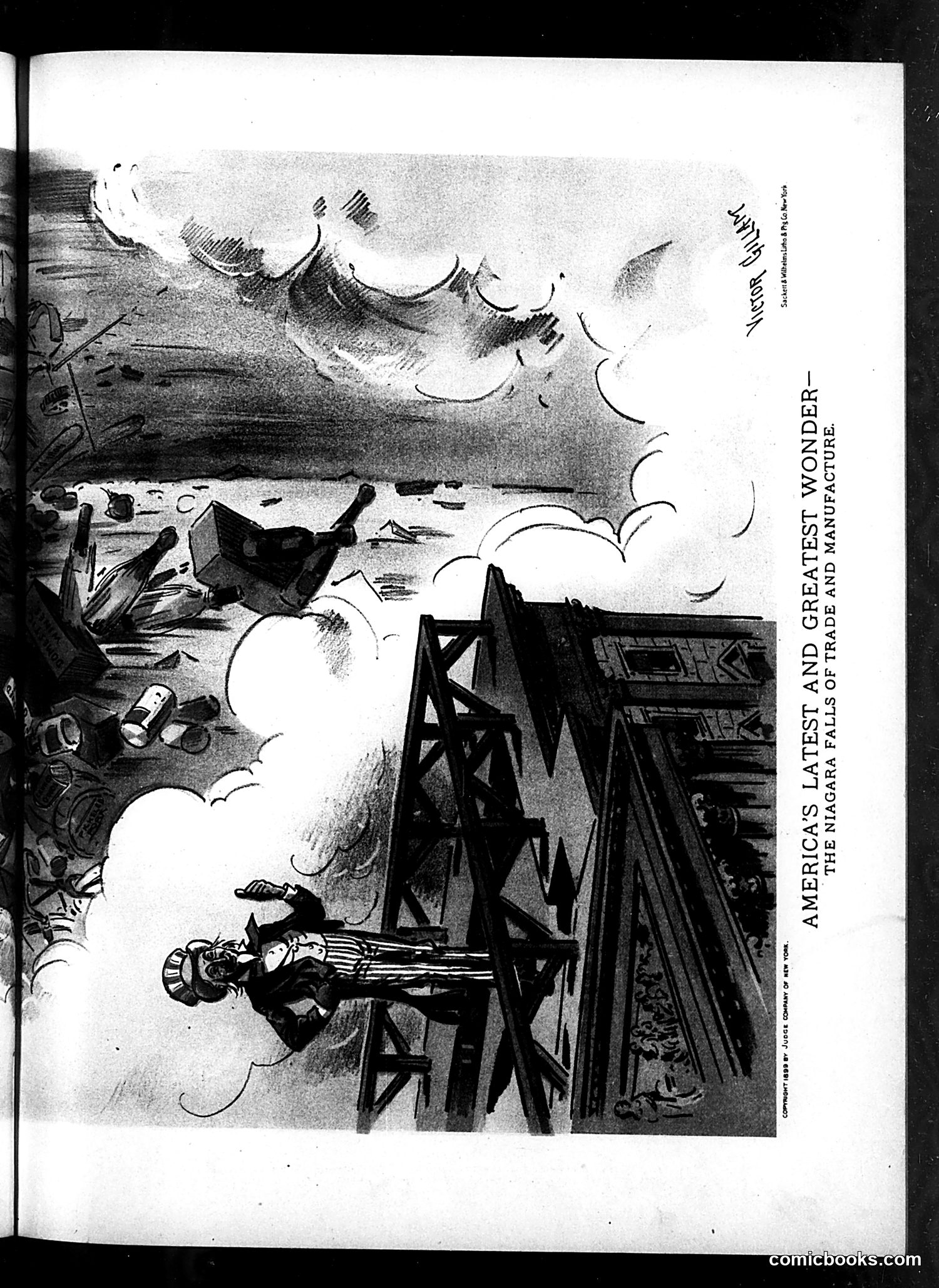
I can see this is a political cartoon from Judge magazine, but the OCR text is largely corrupted and illegible, making it difficult to read the caption or dialogue with certainty. From the IMAGE alone, I can observe: A figure wearing what appears to be Uncle Sam attire stands before industrial/commercial structures (possibly representing American trade or manufacturing). The scene shows destruction or chaos in the background with smoke and debris, along with scattered objects on the ground. The cartoon appears to comment on American industrial power or trade, likely from the early 20th century based on the art style. However, **without legible text, I cannot confidently identify the specific political event, figures being caricatured, or the precise satirical point** the cartoonist intended. To properly explain this cartoon's meaning to a modern reader, I would need either clearer OCR text or additional context about the publication date and political circumstances.
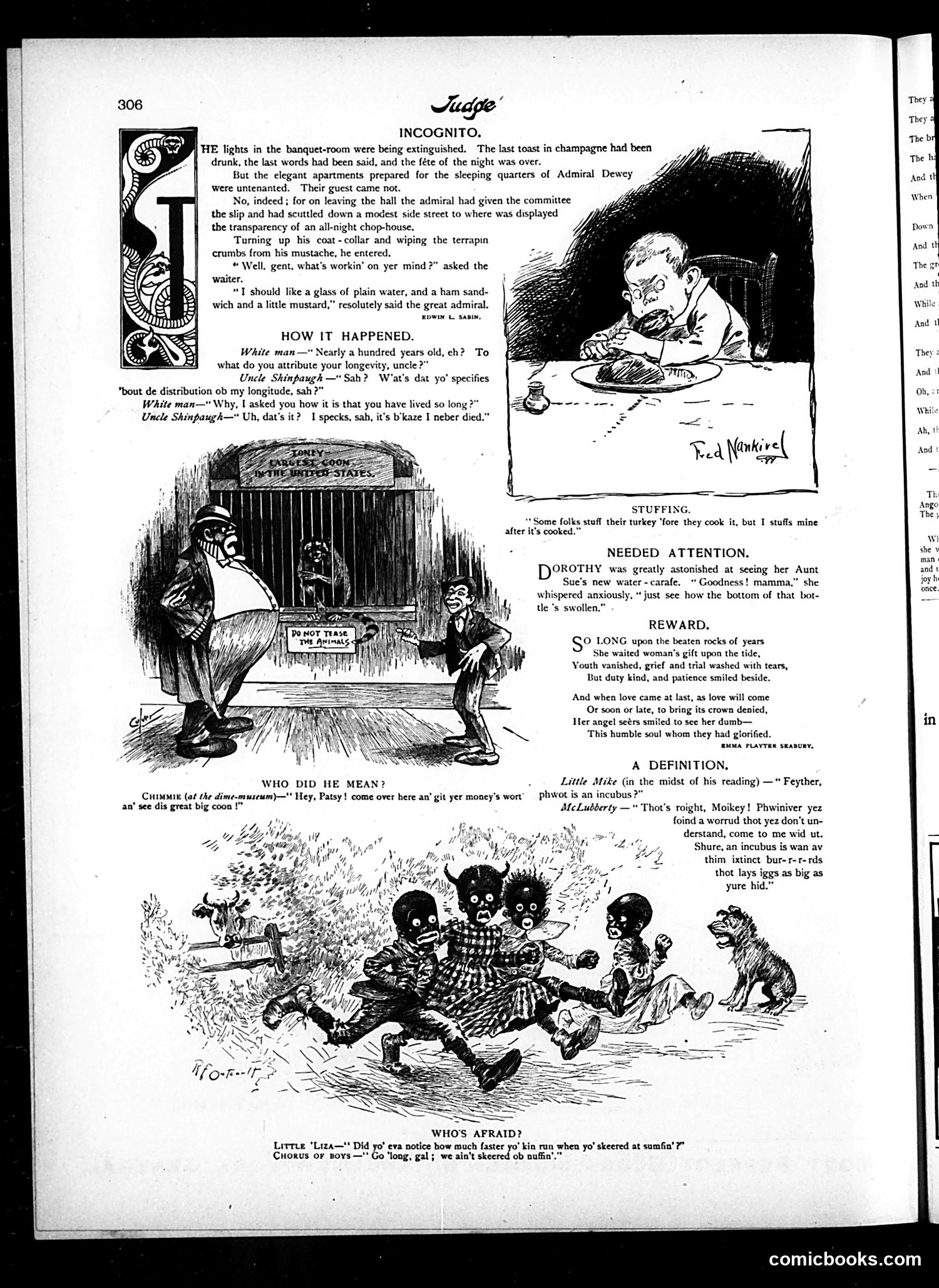
This page contains multiple short humor pieces typical of Judge magazine's satirical format: **"Incognito"** depicts Admiral Dewey (a Spanish-American War hero celebrated in the 1890s) sneaking away from an elaborate formal reception to eat simple food at a cheap chop-house, satirizing the gap between public spectacle and private reality. **"How It Happened"** uses racial dialect humor (then-common in American publications) featuring an elderly Black man whose longevity is attributed simply to "never dying"—a joke about tautological reasoning. **Other brief pieces** include food jokes ("Stuffing"), a sentimental poem about female virtue ("Reward"), and dialect-based humor featuring Irish and Black characters with exaggerated speech patterns. The cartoons throughout employ crude ethnic stereotyping standard to the era. The page reflects Judge's mix of topical satire, wordplay, and the period's casual racial caricature that modern readers would find offensive, though historically common in American humor publications.
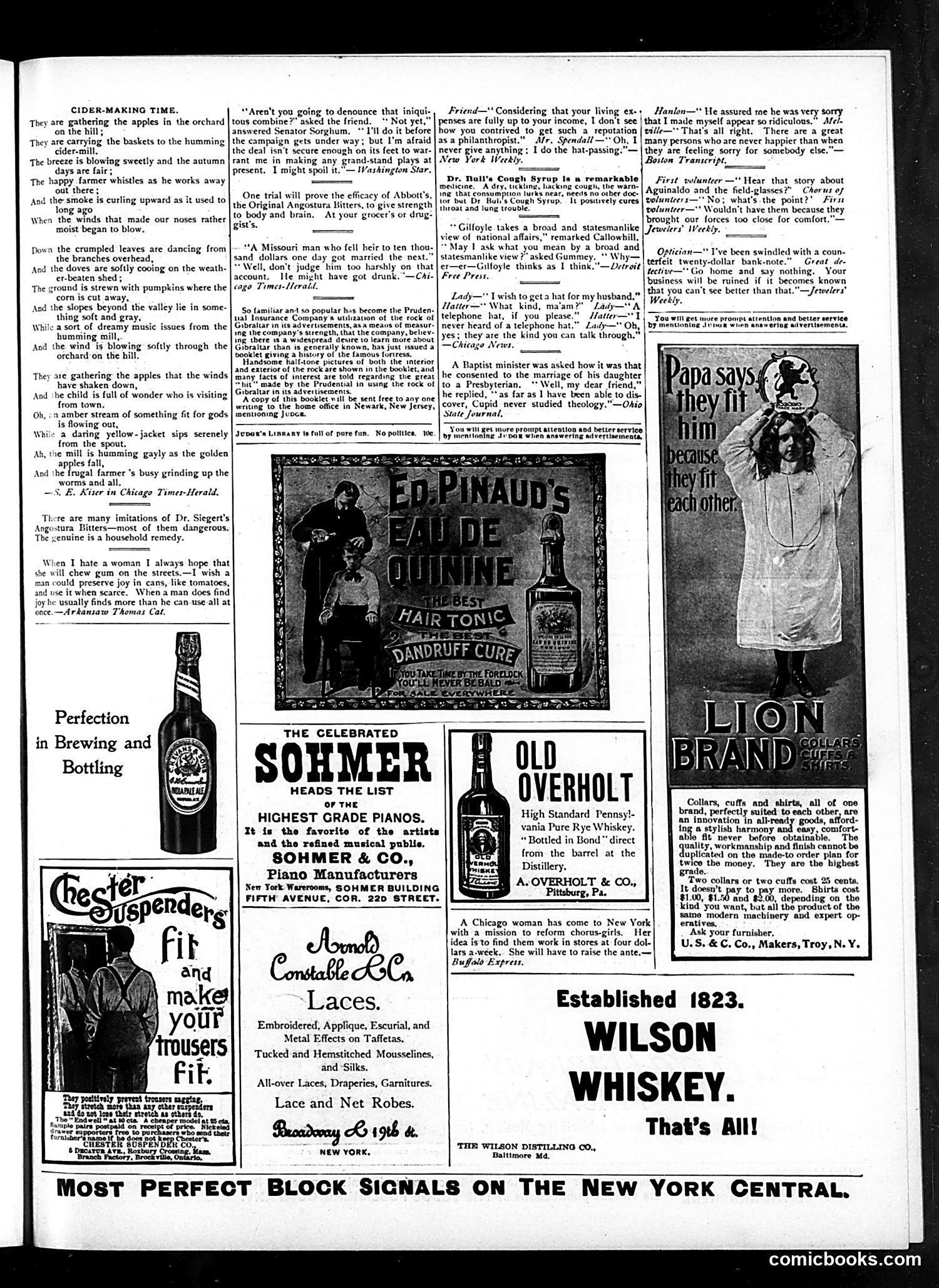
This page is primarily **advertising and light humor**, not political satire. The dominant content consists of period product advertisements (whiskey, piano manufacturers, hair tonic, corset suspenders, lace products) interspersed with short humorous anecdotes and a nostalgic poem about cider-making. The poem "Cider-Making Time" celebrates rural autumn traditions in sentimental terms. The humor pieces are genteel jokes about romance, politics, and human nature—for instance, a senator refusing to denounce a corrupt "combine" until the deal is secure enough to exploit for political gain (satirizing political opportunism), and quips about marriage, gum-chewing, and charitable giving. The page reflects **early 20th-century Judge magazine's blend of advertising revenue and light entertainment** rather than hard-hitting political cartooning. There are no identifiable caricatures of specific public figures visible.
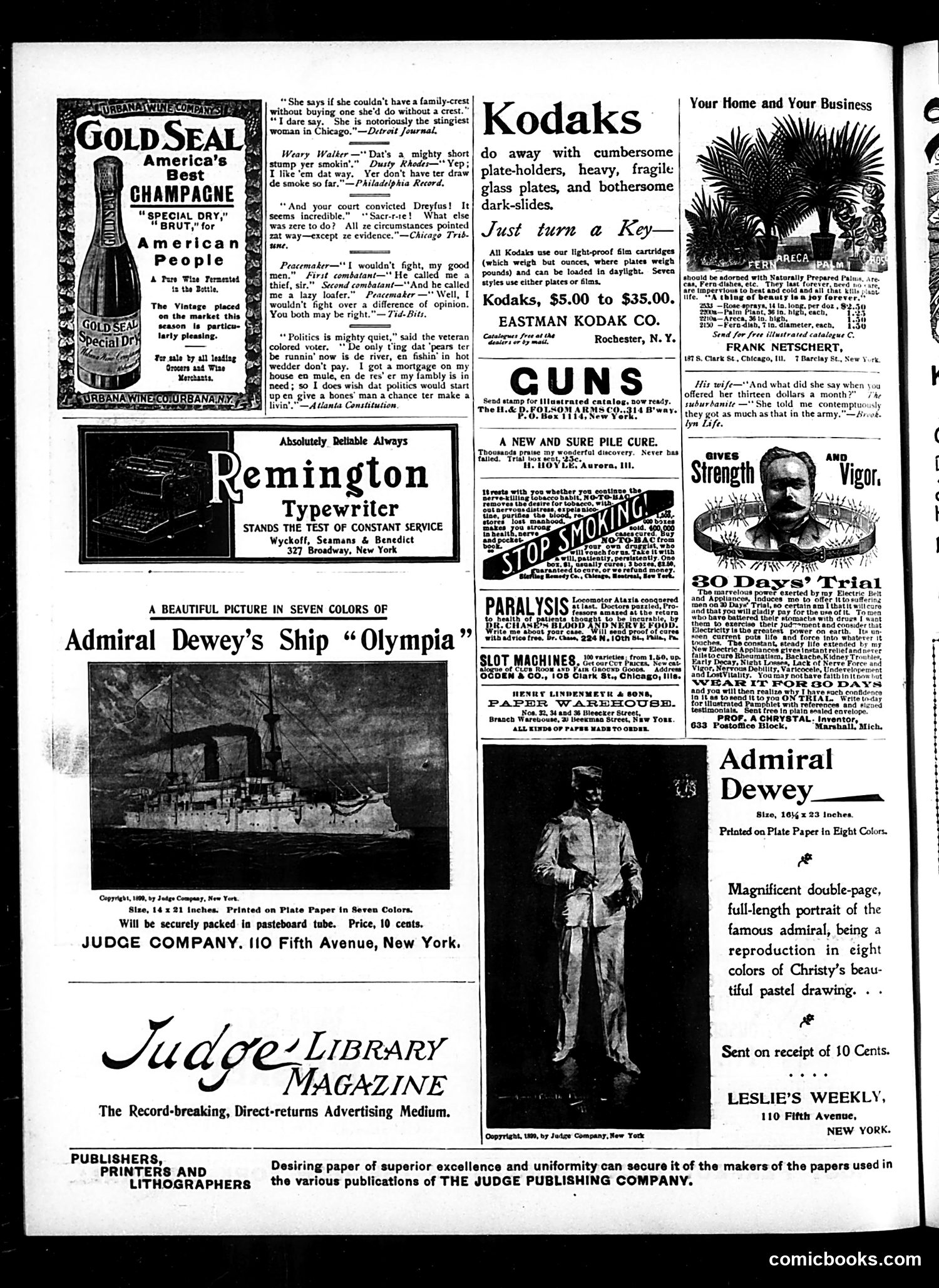
This page is primarily **advertising**, not satirical cartoons. Most of the content consists of period ads for consumer goods and services: champagne, Kodak cameras, typewriters, guns, and patent medicines. The small captioned illustrations that do appear are joke-cartoons depicting working-class or marginalized characters. One shows "Weary Walker" and "Dusty Rhodes" (stock tramp figures in Judge magazine) discussing cigarettes. Another features a "colored voter" discussing politics and fishing—this employs racist dialect and stereotypes typical of era magazines, reflecting contemporary attitudes. **What's notable**: The page features Admiral Dewey prominently—he was celebrated following the 1898 Spanish-American War and remained culturally significant around 1900. The "Dreyfus" reference alludes to the contemporary French scandal involving alleged antisemitic framing of a Jewish officer. The satire, where present, is gentle social humor aimed at class differences and contemporary absurdities—not political critique in a modern sense.
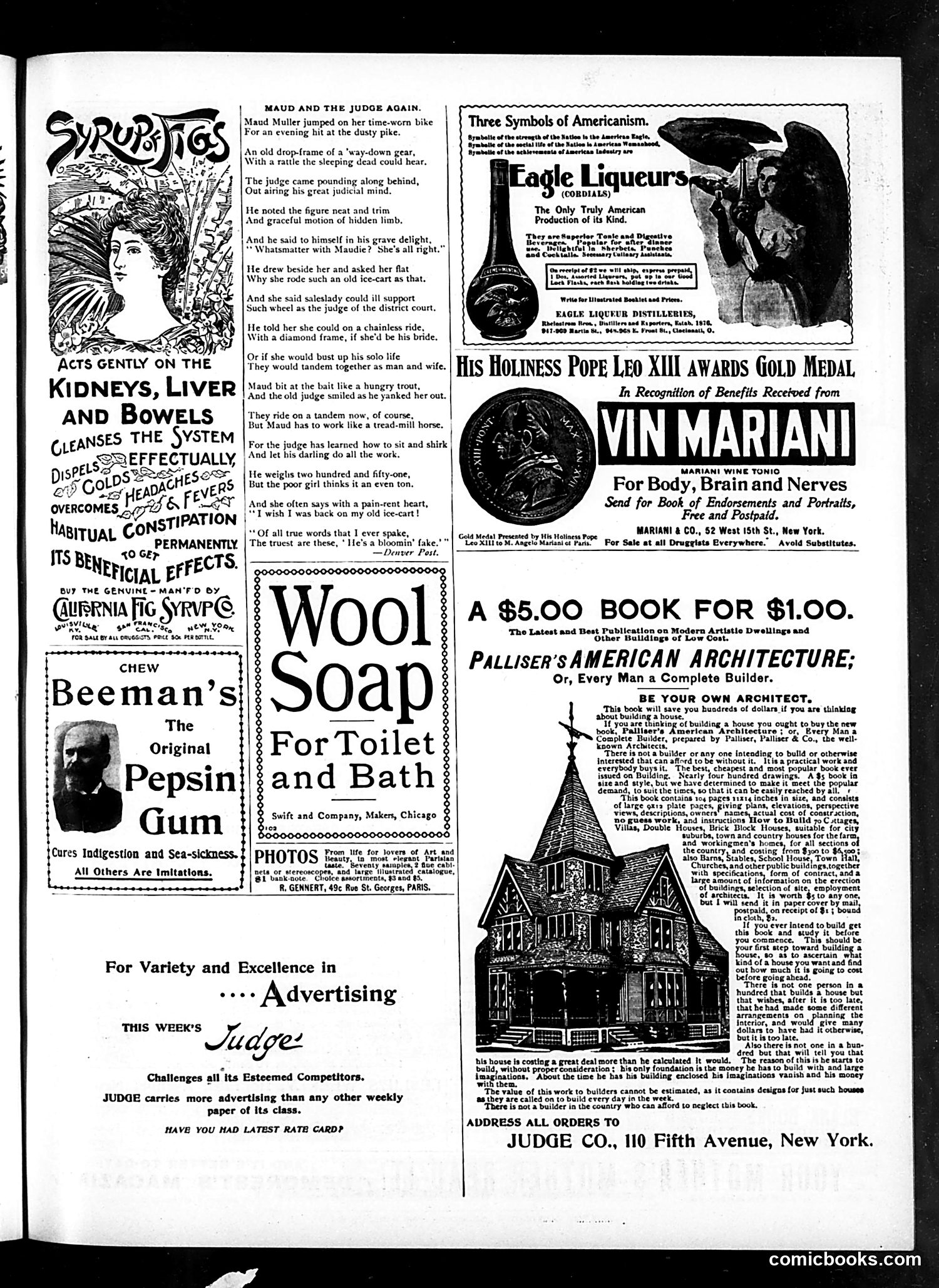
This poem satirizes courtship and marriage dynamics. "Maud Muller" references an earlier American poem about a young woman. Here, the judge (likely a public official) encounters Maud riding an old bicycle and persuades her to marry him by offering an upgrade to a modern tandem bike—a metaphor for social advancement. The satire's point: the judge tricks Maud into marriage under false pretenses. Once married, he exploits her labor while taking credit and leisure ("learned how to sit and shirk"), while she regrets losing her independence. Her final admission—"He's a bloomin' fake"—exposes how marriage can be a con, where women surrender autonomy for promised security that never materializes. The poem reflects turn-of-the-century anxieties about matrimony and gender roles, using the bicycle (then a symbol of female liberation) as ironic counterpoint to marital entrapment.
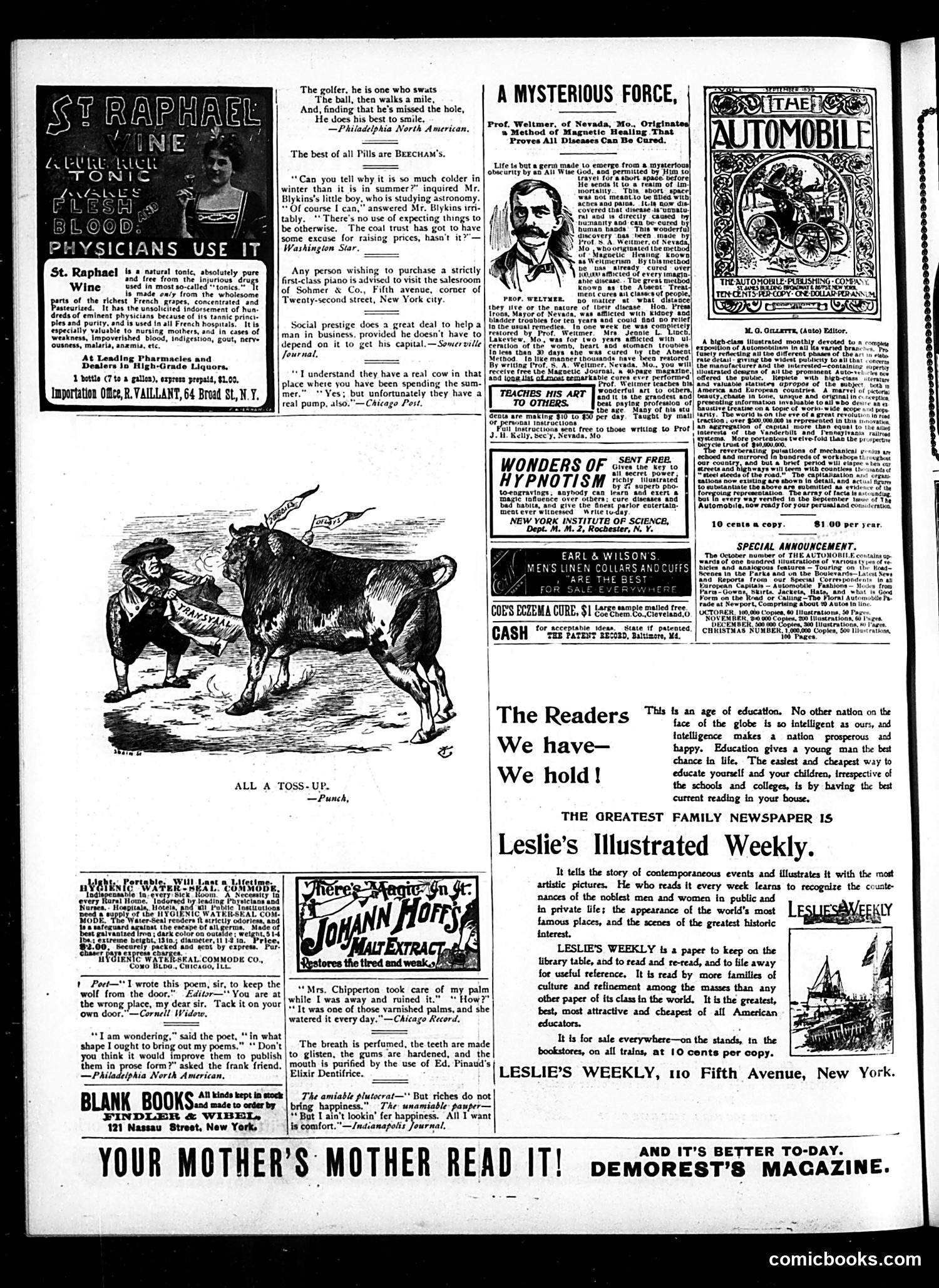
This page is primarily **advertisements and light humor** rather than political satire. Here's what it contains: **Main Content:** - Multiple product ads (St. Raphael Wine, Beecham's Pills, Sohmer pianos, etc.) - A prominent ad for Prof. Weltmer's "magnetic healing" treatment, claiming to cure all diseases—a pseudo-scientific medical fraud typical of the era - An ad promoting "Wonders of Hypnotism" from the New York Institute of Science **Cartoons/Humor:** - One cartoon shows a bullfighter or matador with a large bull, captioned "All a Toss-Up" (Punch)—a generic joke about risk/chance - Multiple brief jokes about golfers, coal trusts, palm plants, etc.—mostly wordplay and domestic humor unrelated to politics **Context:** This reflects late 19th/early 20th-century *Judge* magazine's mixed content: satirical commentary mixed with advertising for dubious "cures" and patent medicines. The pseudo-scientific ads are notable as historical examples of unregulated medical fraud that flourished before FDA oversight. The page demonstrates how satirical magazines survived through advertising rather than pure editorial content.
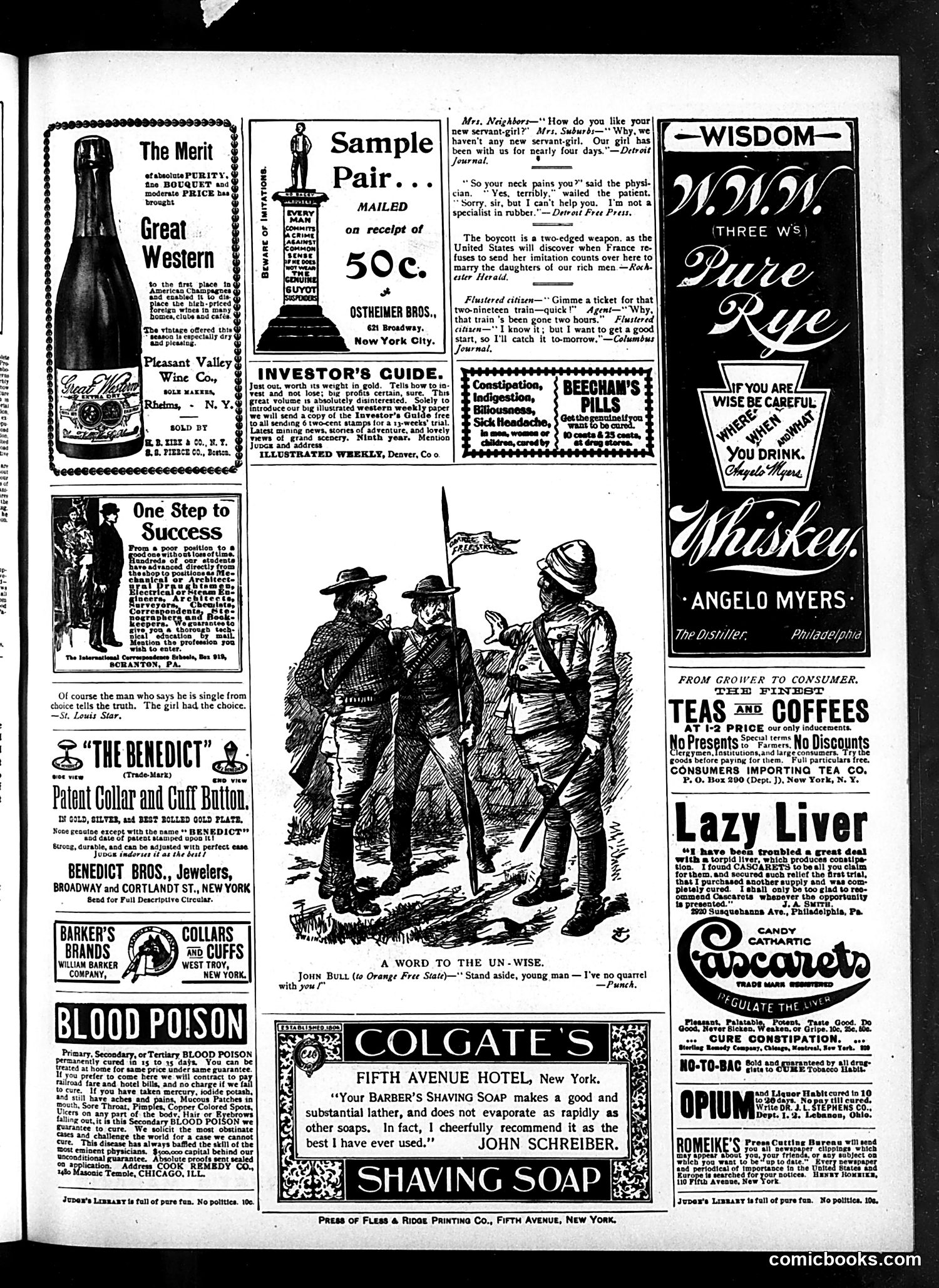
This page is primarily **advertisements and filler content** rather than political cartoons. The main cartoon—"A Word to the Un-Wise"—depicts **John Bull** (personification of Britain) telling a young soldier to "stand aside" because he has "no quarrel with you." This likely references the **Boer War** (1899-1902), with the "young man" representing either the United States or another neutral party, and Bull asserting British military dominance. The page otherwise contains period product advertisements (wine, patent collar buttons, shaving soap, patent medicines) and humorous one-liners on marriage, medical incompetence, and social mishaps. The "Three Ws" whiskey ad and various patent remedies (for blood poison, constipation, liver issues) are typical of early 1900s Judge content—mixing satire with dubious commercial claims. The overall tone reflects American attitudes toward British imperialism and contemporary consumer culture.
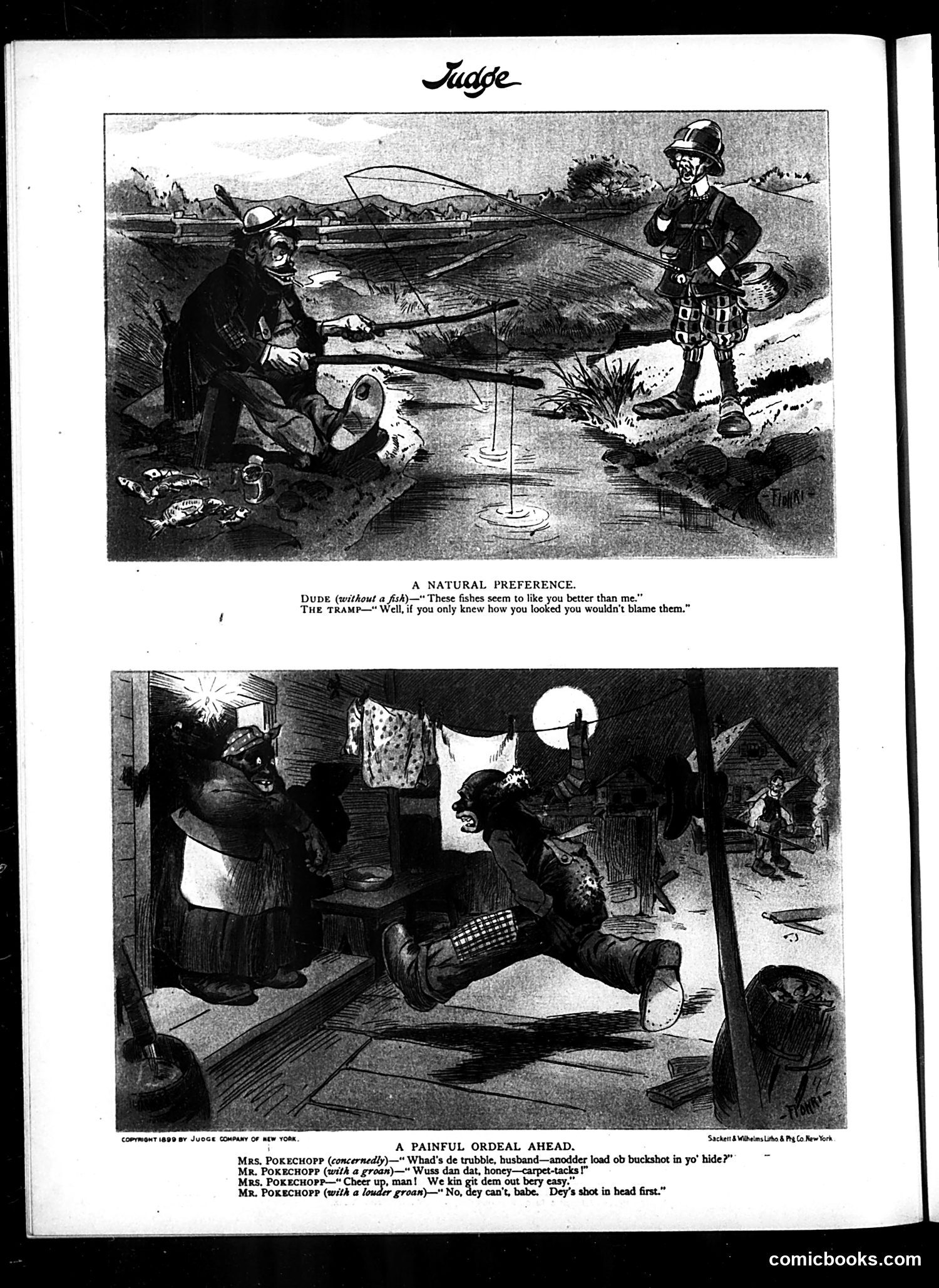
These two cartoons from Judge satirize class differences and working-class life through contrasting scenarios. The top cartoon compares a well-dressed "dude" (wealthy idler) fishing unsuccessfully with a ragged tramp who catches fish readily. The joke plays on appearance: the tramp's shabby looks make him blend into nature better, suggesting that refined dress and manners actually distance one from genuine experience or natural success. The bottom cartoon depicts Mr. and Mrs. Pokechopp (names using period dialect stereotypes) in domestic distress. Mr. Pokechopp has apparently swallowed carpet-tacks, complicating the removal of buckshot already embedded in his body—suggesting a life of constant physical hardship and industrial danger. The dark humor emphasizes the brutal, painful circumstances of poverty, where medical treatment itself becomes impossible. Both comics employ visual caricature and dialect to mock class pretensions while highlighting working-class suffering.