
A complete issue · 17 pages · 1899
Judge — September 23, 1899
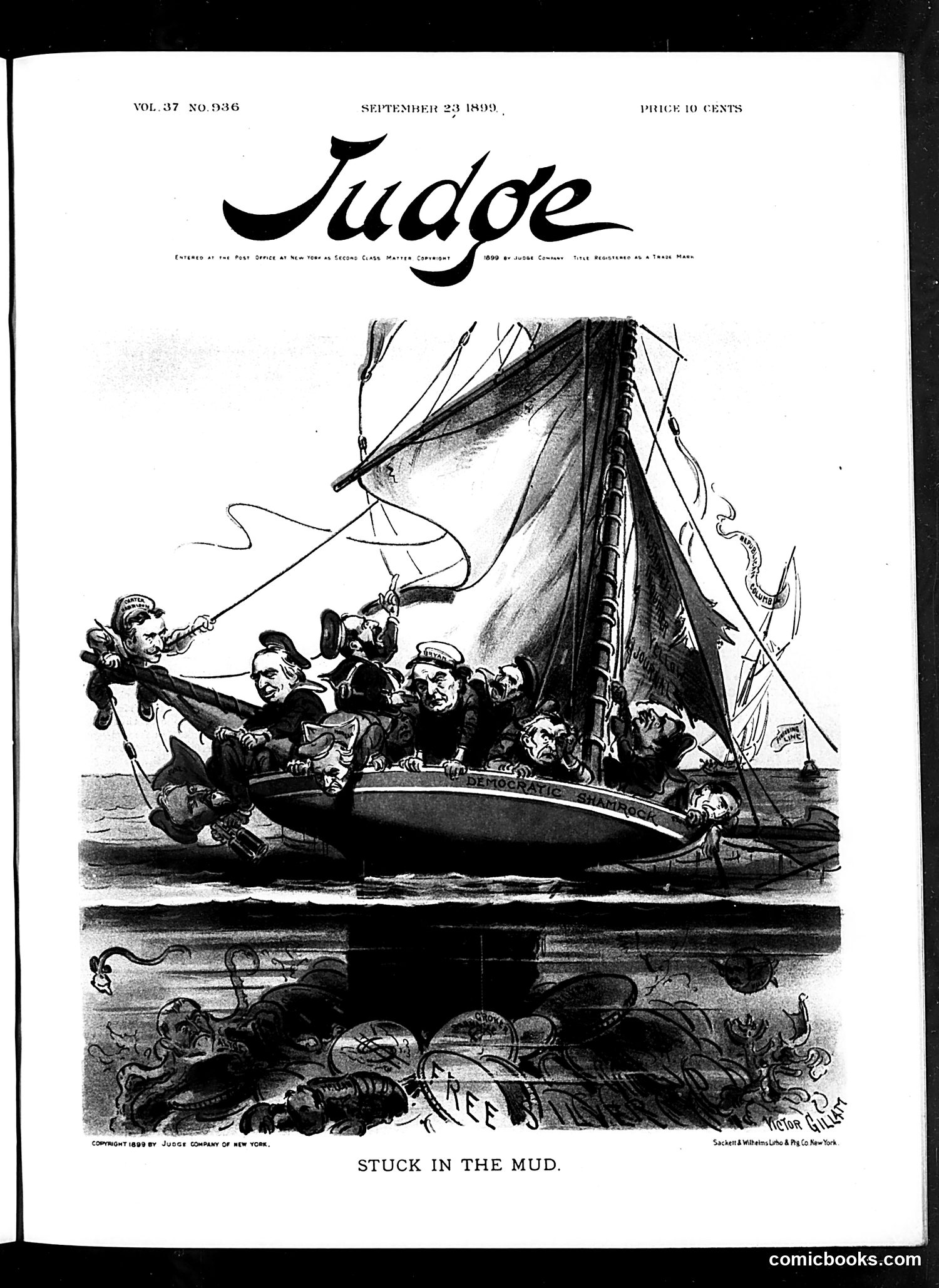
This political cartoon satirizes a group of political figures whose boat is mired in mud, unable to progress. The men in the boat above water appear to be struggling politicians or government leaders, while below the waterline, caricatured figures (likely representing corrupt interests, political opponents, or problematic policies) are depicted as creatures pulling them down into the muck. The title "Stuck in the Mud" suggests stalled political progress or an administration bogged down by obstacles. Without clearer identification of the specific figures, the exact context remains unclear, but this appears to critique either governmental incompetence, corruption, or entanglement with disreputable forces preventing forward movement on important issues circa 1899.
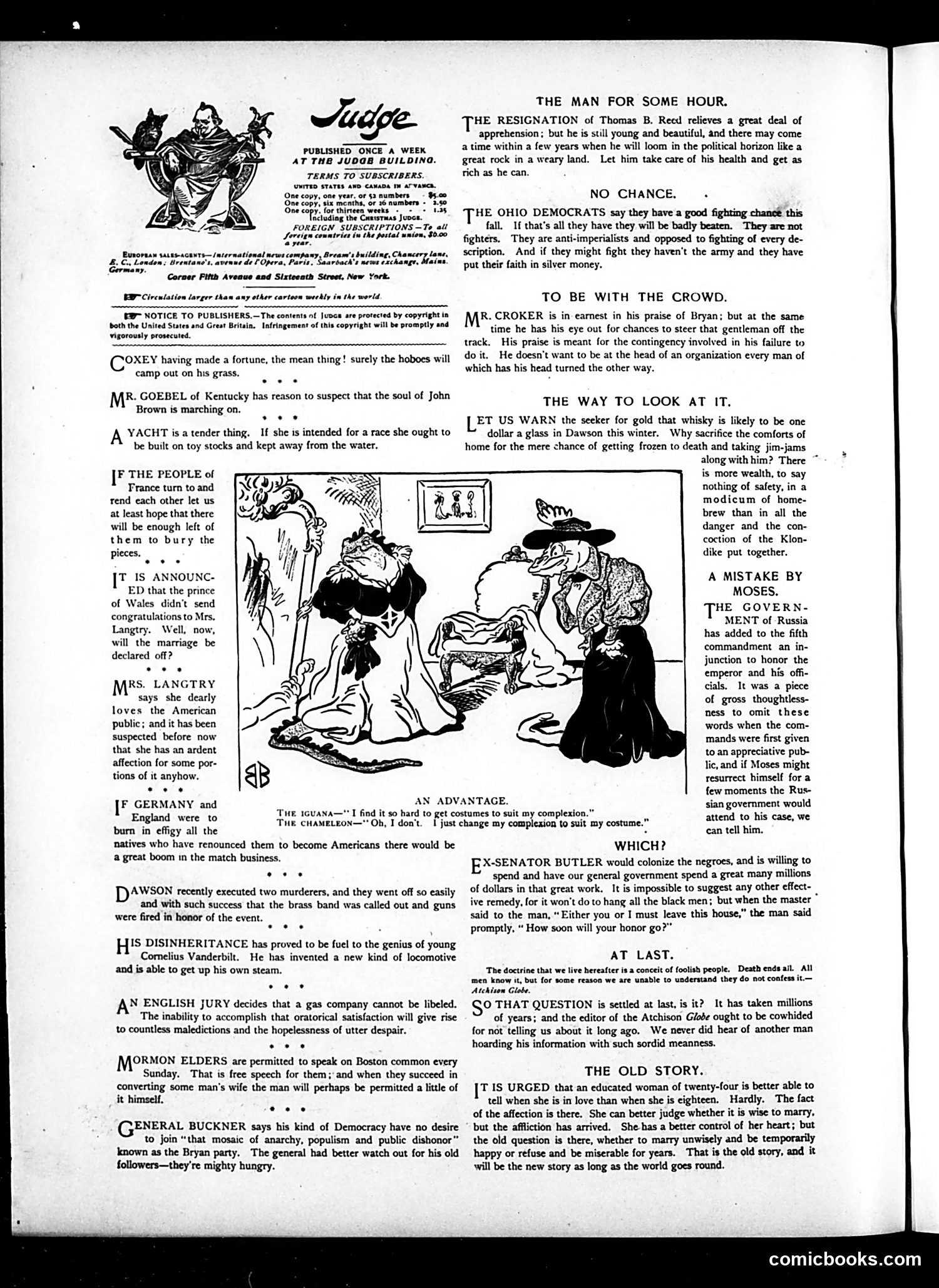
The main cartoon titled "AN ADVANTAGE" depicts two figures discussing costumes. The caption reads: "I find it so hard to get costumes to suit my complexion" and "Oh, I don't. I just change my complexion to suit my costume." This appears to be satirizing racial attitudes or theatrical blackface practices common in early 20th-century entertainment. The joke relies on the racist assumption that changing one's complexion to match costume choices is feasible or acceptable. The surrounding text columns offer political commentary on various topics including Democratic politics, the Prince of Wales, and international affairs. The magazine's satirical tone targets public figures and contemporary social issues through both visual caricature and written commentary typical of Judge's editorial stance during this era.
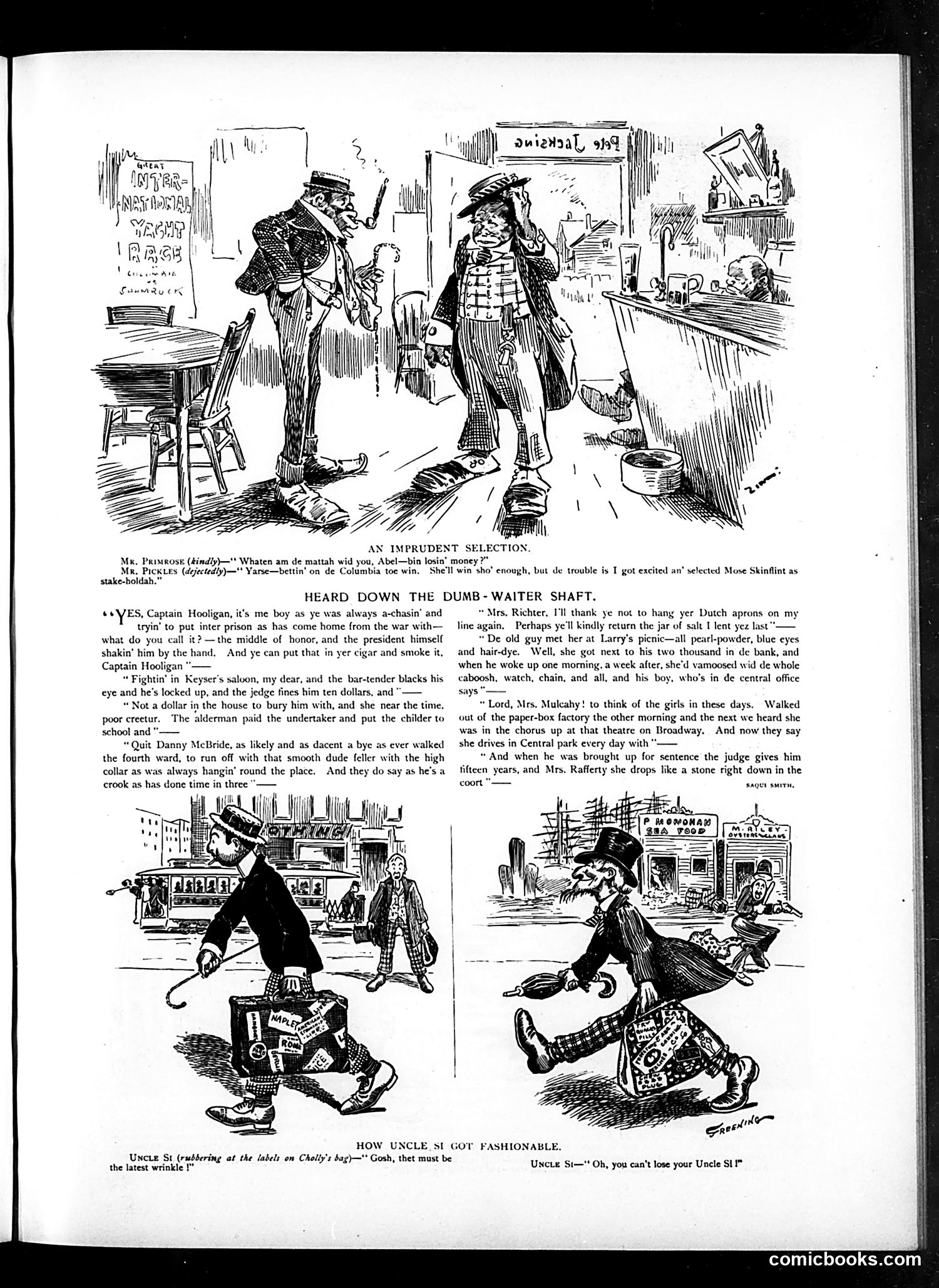
This page contains two satirical pieces from an early 20th-century American humor magazine. **Top cartoon** ("An Imprudent Selection"): Shows a woman selecting a man as a suitor, with dialogue about money and marriage prospects. The satire targets courtship customs where financial considerations drove match-making. **Bottom section** ("Heard Down the Dumb-Waiter Shaft"): Presents gossip overheard between servants, including stories about criminal behavior, prison, and social scandal. The humor relies on servants' working-class perspective on wealthy employers' misdeeds. **"How Uncle Si Got Fashionable"**: Depicts a man acquiring fashionable status, likely mocking social climbing and pretension. The magazine's consistent theme: satirizing class dynamics, courtship rituals, and social hypocrisy through exaggerated character types and eavesdropped dialogue typical of Judge's social commentary style.
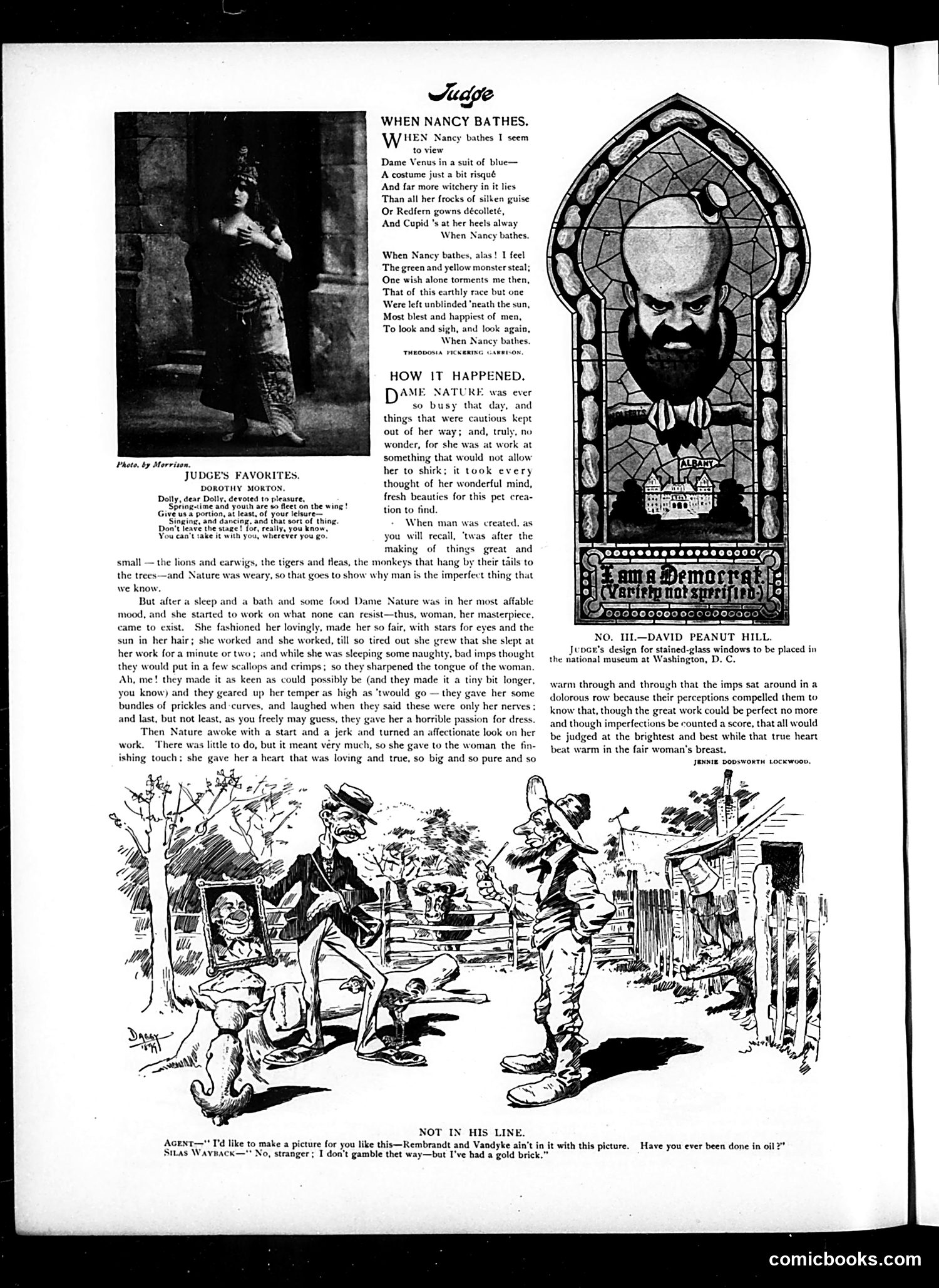
This page contains three distinct pieces: 1. **"When Nancy Bathes"** — A poem celebrating actress Nancy (likely referencing a contemporary stage performer) and her beauty, accompanied by a theatrical photograph. 2. **"Judge's Favorites" and "How It Happened"** — A narrative piece about Dame Nature creating an ideal woman, emphasizing her mind and character alongside physical beauty. This reflects early 20th-century ideals balancing traditional femininity with emerging notions of female intelligence. 3. **"Not in His Line"** — A cartoon depicting what appears to be two working-class men (one labeled "Agent," the other "Silas Wayback") discussing art and commerce, with a crude portrait visible. The humor satirizes the tension between artistic pretension and practical business concerns among working people. The overall page mixes theatrical promotion with gentle social satire typical of Judge's approach.
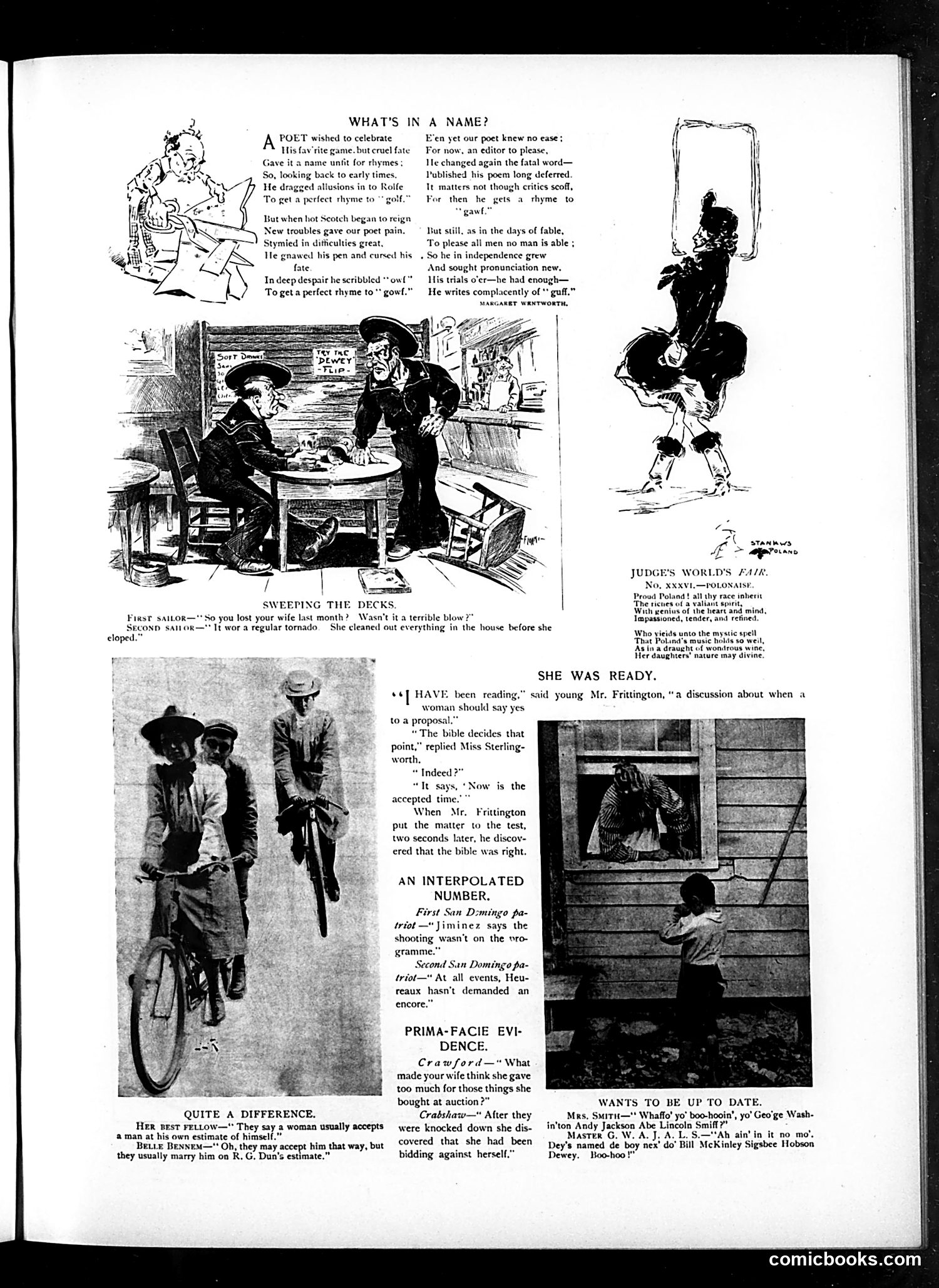
This page contains multiple satirical pieces typical of Judge's humor: **"What's in a Name?"** mocks a poet struggling to write about golf, repeatedly changing the spelling ("gowf," "guff") to find workable rhymes—satirizing both poets' pretensions and the sport's awkward nomenclature. **"Sweeping the Decks"** depicts sailors discussing a wife's destructive departure, joking about domestic upheaval. **"She Was Ready"** is a courtship joke: a woman agrees to marriage so quickly that a man discovers the Biblical phrase "now is the accepted time" applies literally. **"An Interpolated Number"** references San Domingo (Haiti) political violence, with patriots joking that an assassination wasn't "on the programme"—dark humor about instability. **"To Be Up to Date"** satirizes naming children after contemporary heroes: Washington, Jackson, Lincoln, McKinley, Dewey—reflecting late-1890s American patriotic fashion. The remaining pieces are brief social humor about marriage, auctions, and gender dynamics. The page reflects Judge's blend of political commentary and domestic satire aimed at educated readers.
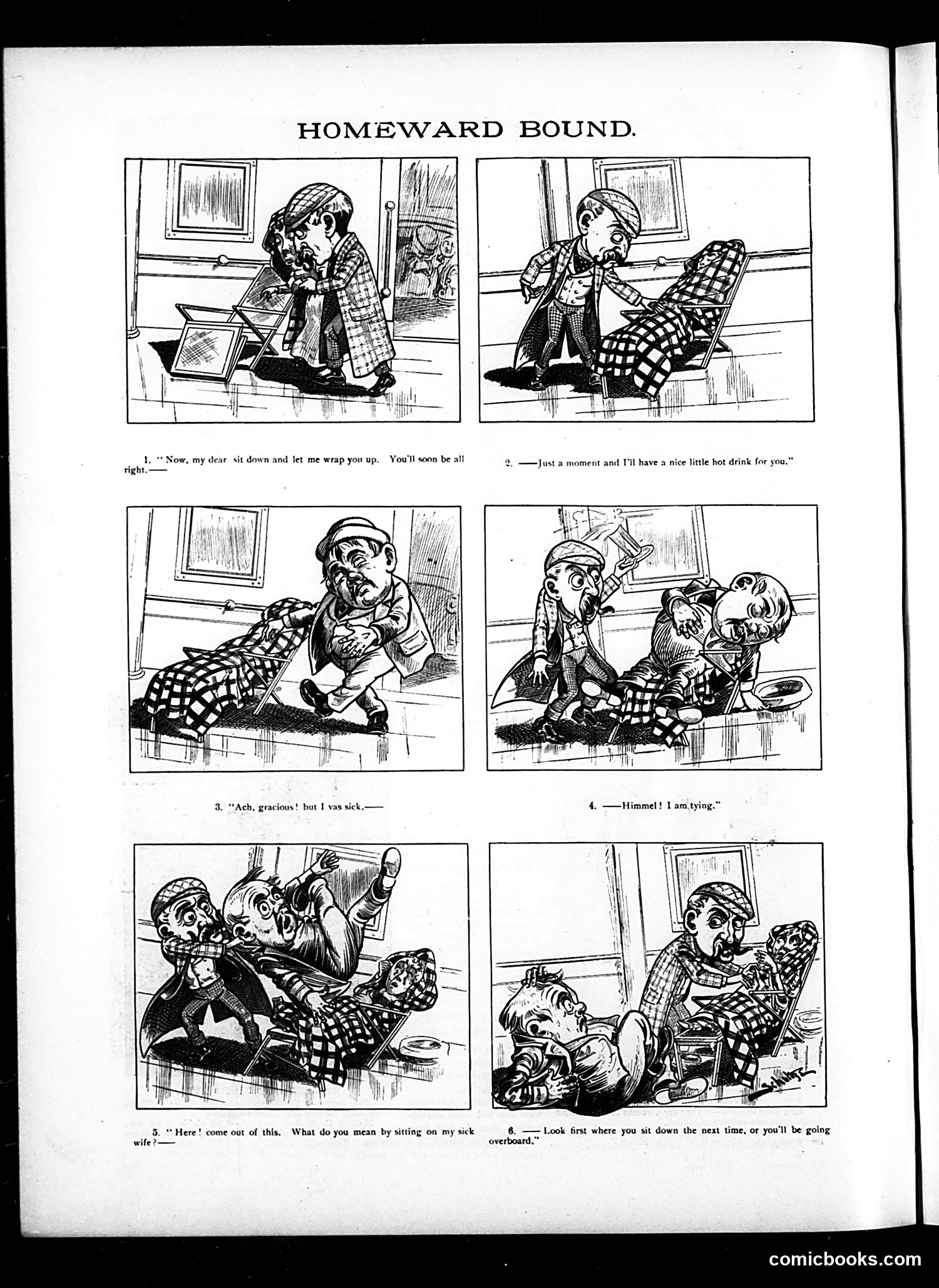
This is a sequential comic strip depicting a seasickness narrative aboard a ship. A man tends to his ill wife, wrapping her in blankets (panel 1) and offering her a hot drink (panel 2). She becomes nauseous (panel 3) and lies down (panel 4). In panel 5, the husband angrily discovers someone sitting on his sick wife. Panel 6 shows the consequence: a crew member warns him to check where he sits next time "or you'll be going overboard"—a threat of being thrown off the ship. The humor relies on slapstick confusion during seasickness and the rough maritime threat. This appears to be early 20th-century leisure travel satire, mocking both seasickness afflictions and shipboard social chaos among passengers and crew.
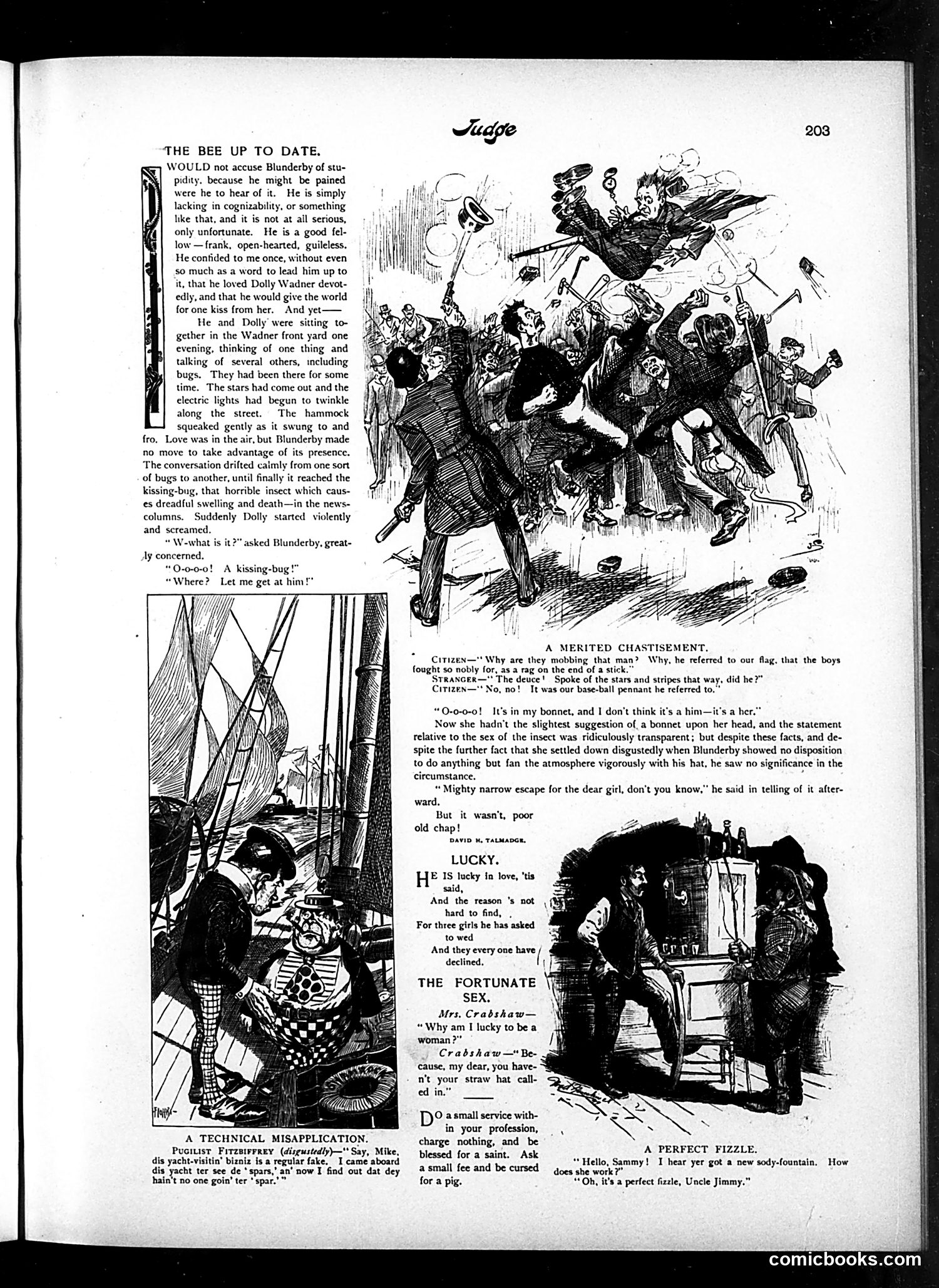
This page contains multiple satirical pieces typical of Judge's humor circa early 1900s: **"The Bee Up to Date"** mocks an awkward suitor named Blunderby who, despite romantic opportunity with Dolly in a moonlit hammock, fails to kiss her when a kissing-bug appears. His inaction demonstrates obliviousness—he later describes it as a "narrow escape" for her, completely missing the obvious hint she was giving him. **"A Merited Chastisement"** satirizes misplaced patriotism: a man is mobbed for insulting "our flag," but the actual offense was calling a *baseball pennant* a rag—revealing the crowd's knee-jerk nationalism over the real issue. **"A Technical Misapplication"** plays on dock-worker dialect: a visitor boards a yacht expecting to see the rigging ("spars") but finds none, not grasping the pun. The remaining items are brief one-liners about luck in courtship and a failed soda fountain, typical filler humor. The page exemplifies Judge's reliance on romantic mishaps and wordplay for comedy.
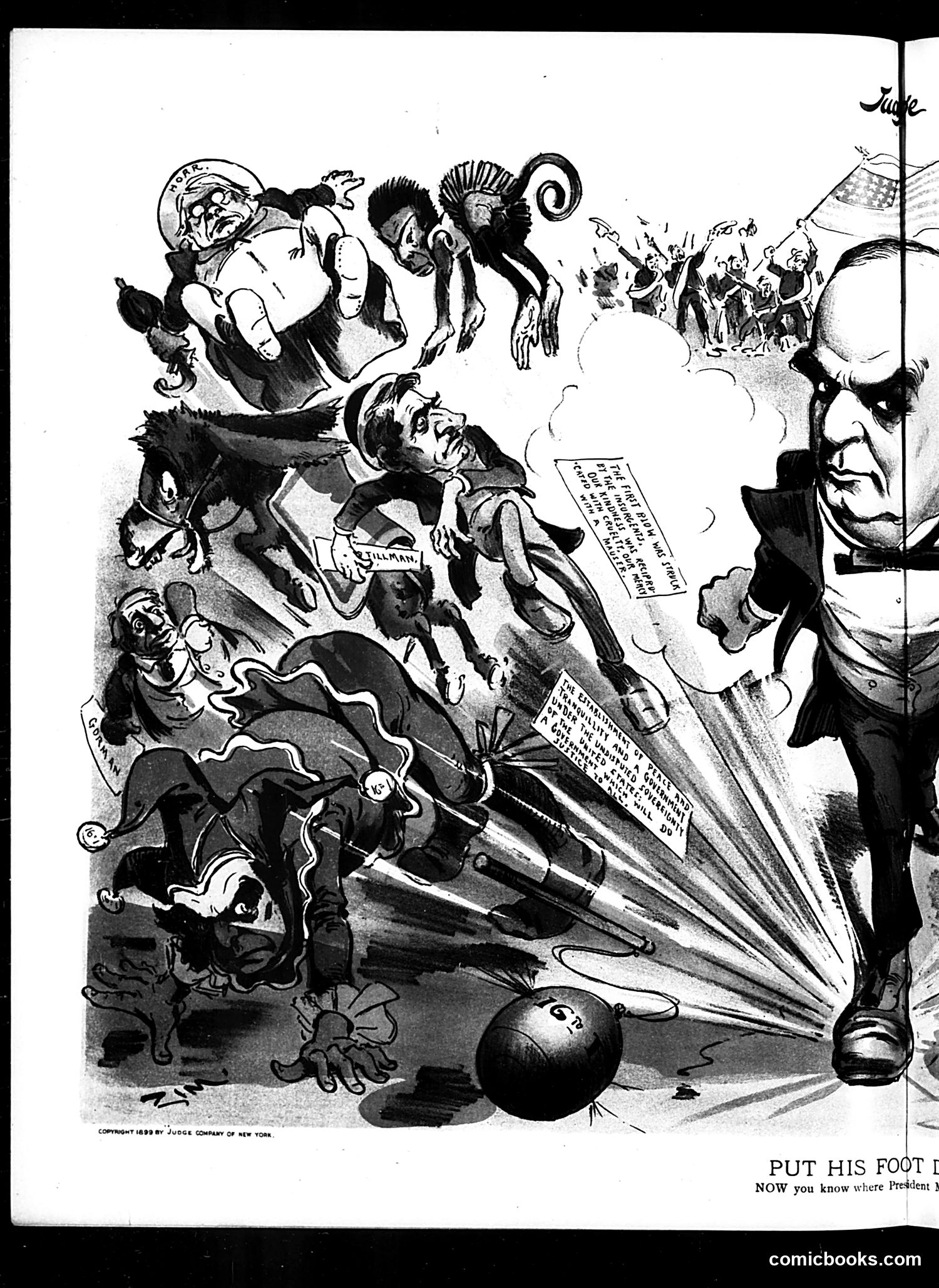
This is a political cartoon from Judge magazine (copyright 1899). The caption "PUT HIS FOOT IN" refers to President McKinley stepping into a chaotic situation. The image depicts demons, devils, and monstrous figures erupting from what appears to be a bomb or explosive device, with crowds of people visible in the background. This likely satirizes McKinley's foreign policy decisions during the Spanish-American War era (1898-1899) or his intervention in the Philippines, suggesting his actions unleashed unintended consequences or "opened Pandora's box." The demonic imagery represents the chaos, violence, or moral complications resulting from his political decisions. The cartoon mocks the president for stumbling into a problematic situation, using exaggerated grotesque figures to convey the severity of the perceived misstep.
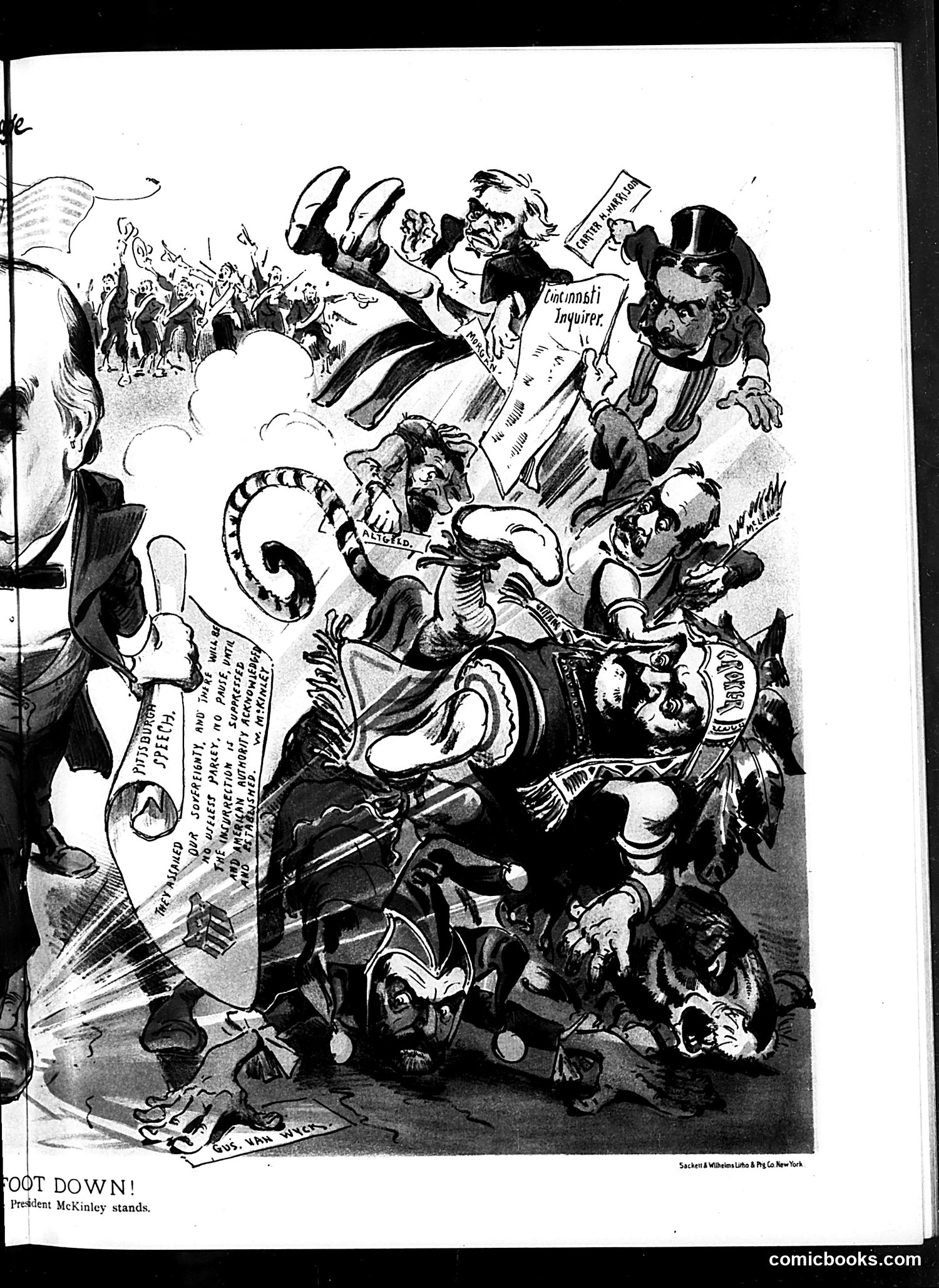
This political cartoon satirizes President McKinley (likely from the early 1900s) as he struggles to control chaotic forces beneath him. The title "FOOT DOWN!" suggests McKinley is attempting to assert authority. The image shows various caricatured figures and creatures—appearing to represent political opposition, anarchists, or social unrest—that McKinley is trying to suppress or control. Visible text references include "Cincinnati Inquirer" (a newspaper), suggesting media involvement in the conflict. The cartoon likely critiques McKinley's handling of domestic turmoil, possibly related to labor disputes, anarchist threats, or political opposition of the era. The crowded, chaotic composition emphasizes the difficulty of his position and implies his efforts to maintain control are precarious or ineffective.
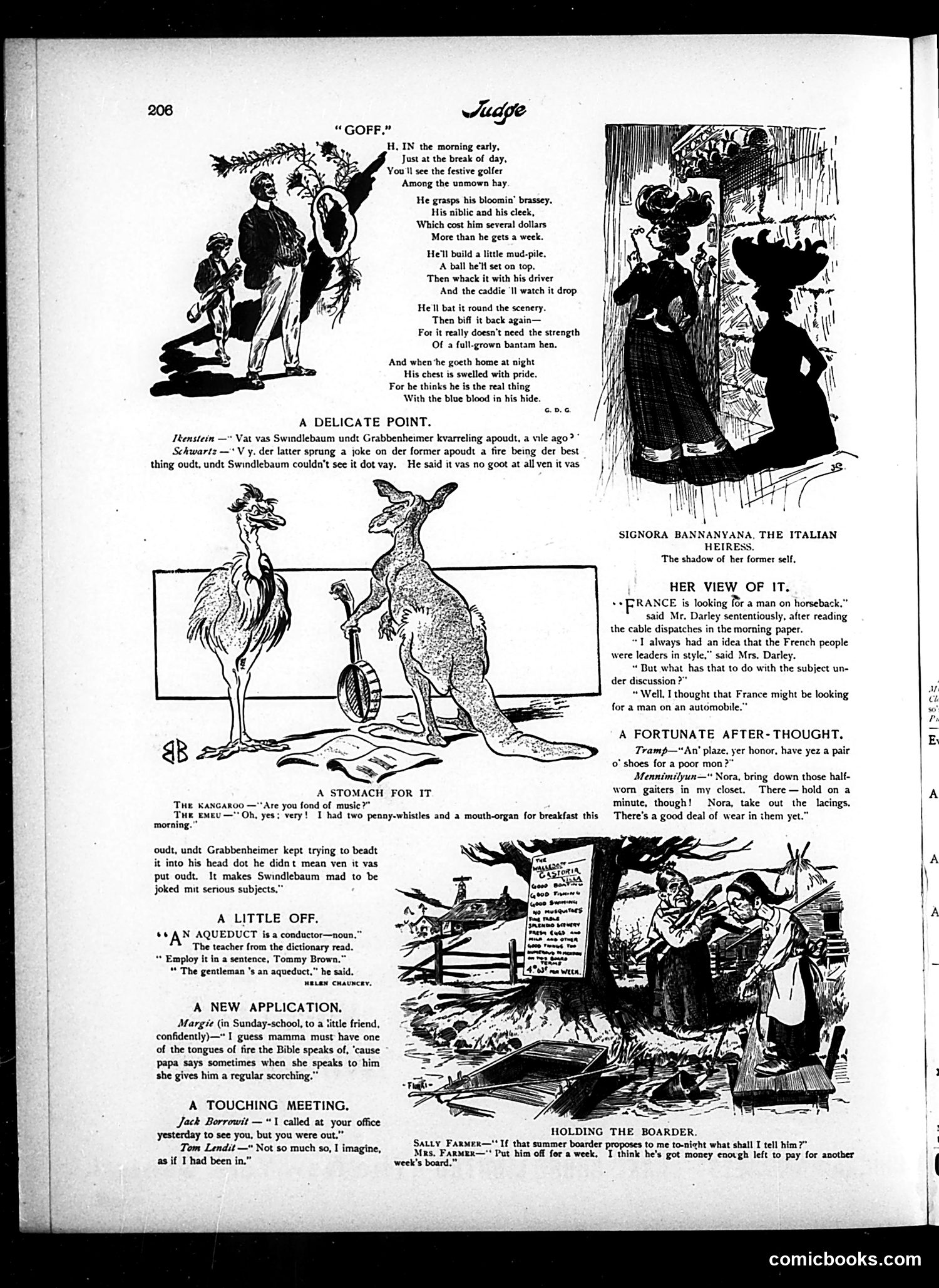
This page from *Judge* contains multiple satirical sketches targeting early 20th-century American social pretensions and follies. **"Goff"** mocks golf enthusiasts—likely wealthy amateurs who spend lavishly on equipment ("several dollars / More than he gets a week") yet display modest skill, inflating their self-importance through the sport. **"A Delicate Point"** features Jewish characters (Steinberg, Schwartz, Swindlebaum) in stereotypical dialect humor, common in period satire, joking about disagreements over puns. **"Her View of It"** jokes about France seeking leadership—the husband's quip about an "automobile" instead of a "man on horseback" suggests modernization over traditional power. **"A Fortunate After-Thought"** depicts a tramp receiving worn gaiters; the humor lies in the lady's second thought to remove valuable lacings before giving charity. Minor sketches mock pretension: an "aqueduct" grammar mistake, a kangaroo's diet, and domestic nagging. The page reflects period attitudes toward class, ethnicity, and social aspiration through crude but recognizable stereotypes.
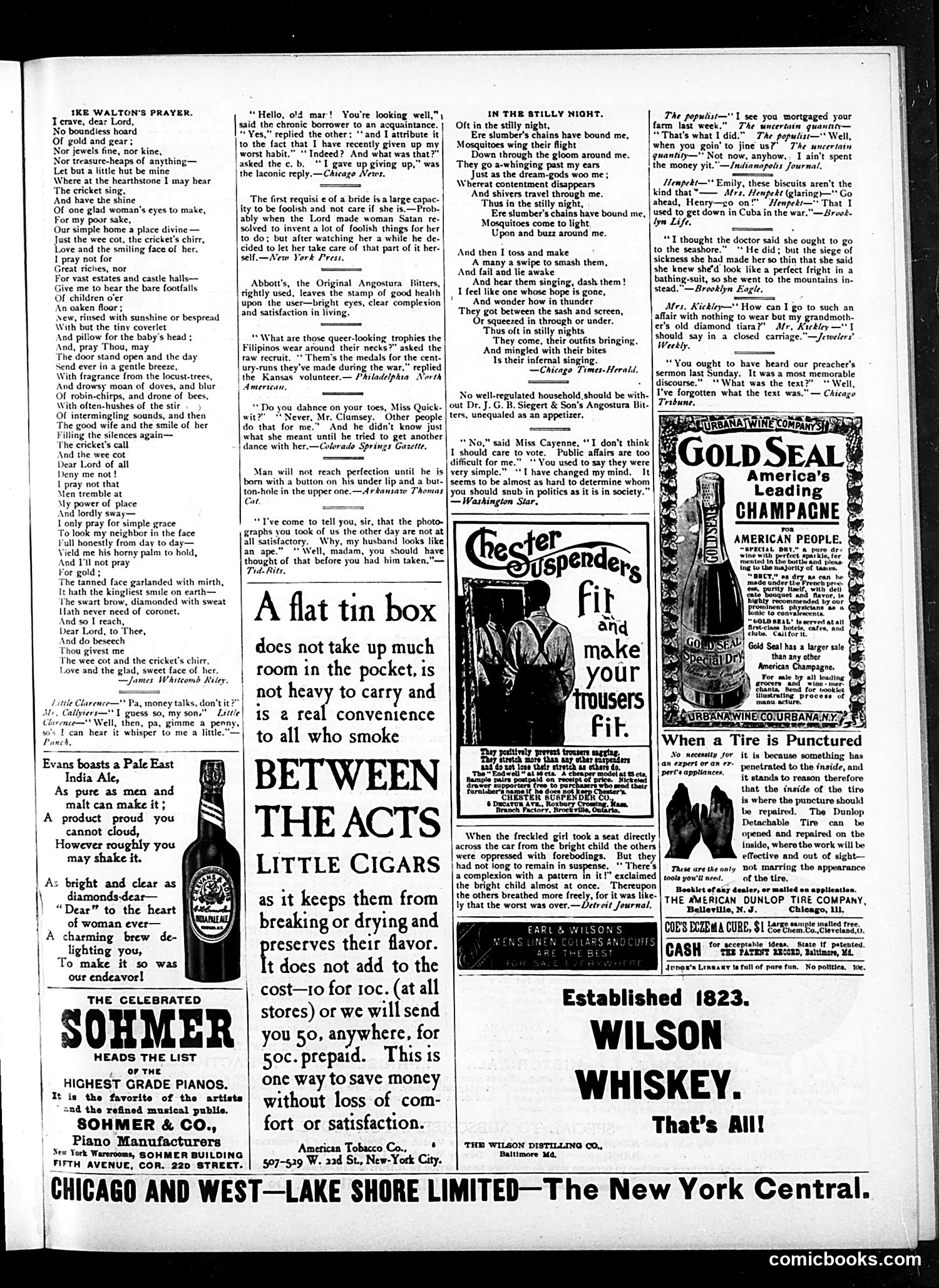
This page is primarily **advertising and light humor**, not political satire. The content includes: **Poetry & Humor:** - James Whitcomb Riley's "Ike Walton's Prayer," a sentimental poem celebrating simple domestic life - Several short joke exchanges about money, borrowing, dancing, and photography—typical period humor with no political edge **Advertisements:** The page is dominated by product ads: Evans Pale East India Ale, Chester Suspenders, Gold Seal Champagne, Sohmer pianos, Between the Acts Little Cigars, Wilson Whiskey, and tire repair services. These ads reflect early 20th-century consumer goods and messaging. **No Political Content:** There are no identifiable political figures, caricatures, or social commentary requiring historical context. The page represents typical Judge magazine filler—entertainment and commercial content rather than satirical commentary on current events. The humor is universal ("pa, money talks") rather than topical.
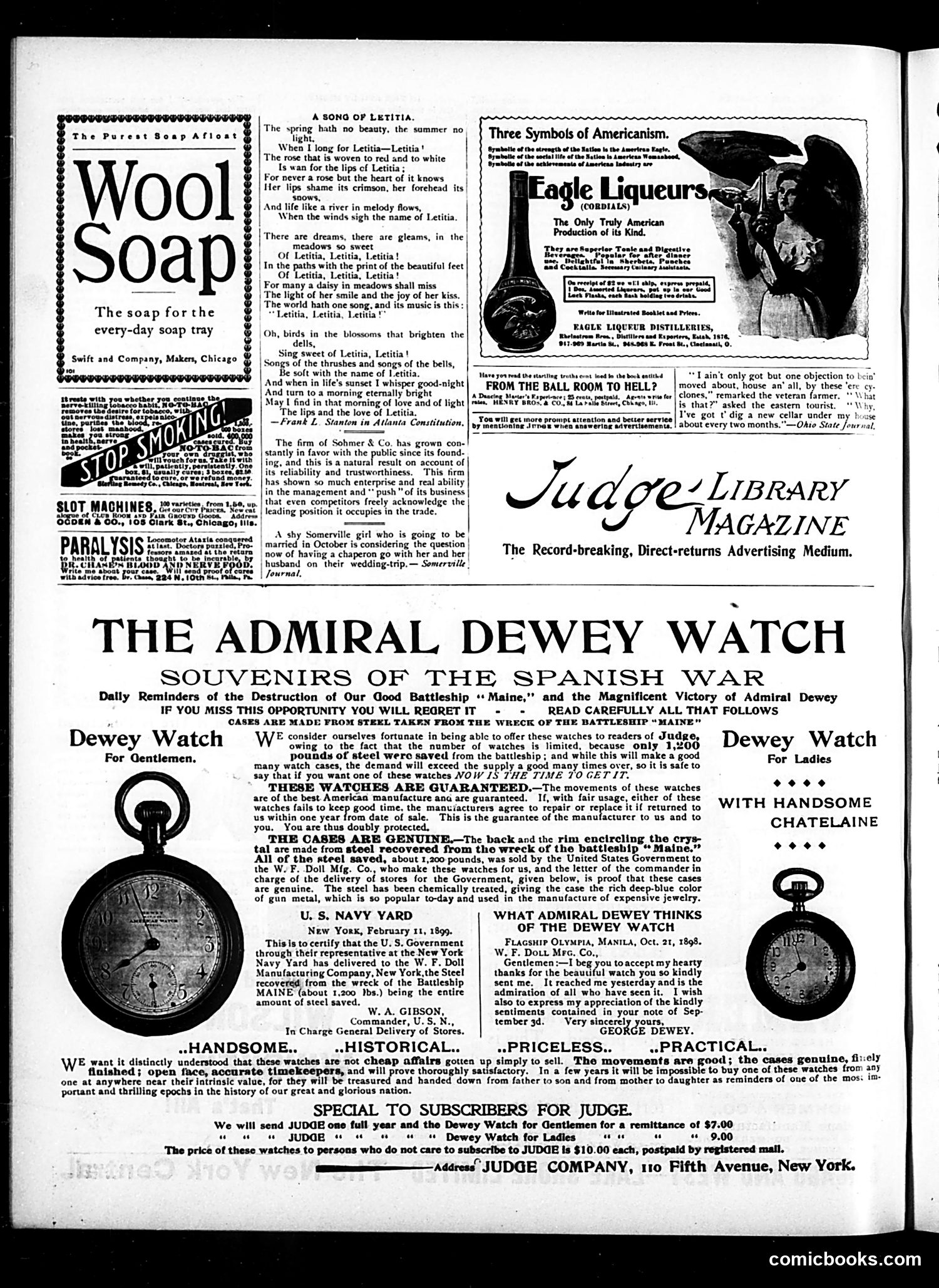
This page is primarily **advertising**, not political satire. The dominant content consists of commercial advertisements interspersed with sentimental poetry. The main feature is a large advertisement for **Admiral Dewey Watches**, marketed as patriotic souvenirs made from steel recovered from the USS *Maine* wreckage. This references the 1898 Spanish-American War and the *Maine*'s explosion—a pivotal event that sparked American military action. The watches capitalize on Dewey's popularity as a national naval hero. Supporting ads include: Wool Soap, Eagle Liqueurs (featuring an eagle as an "American" symbol), and promotions for Judge's own subscriptions and library magazine. The page also contains a sentimental poem "A Song of Letitia" by Frank L. Stanton—romantic verse unrelated to satire or politics. Minor comedic snippets appear (a farmer's joke about cellar-digging), but they're filler content, not substantive commentary. The page demonstrates how Judge monetized patriotic sentiment and celebrity following the Spanish-American War.
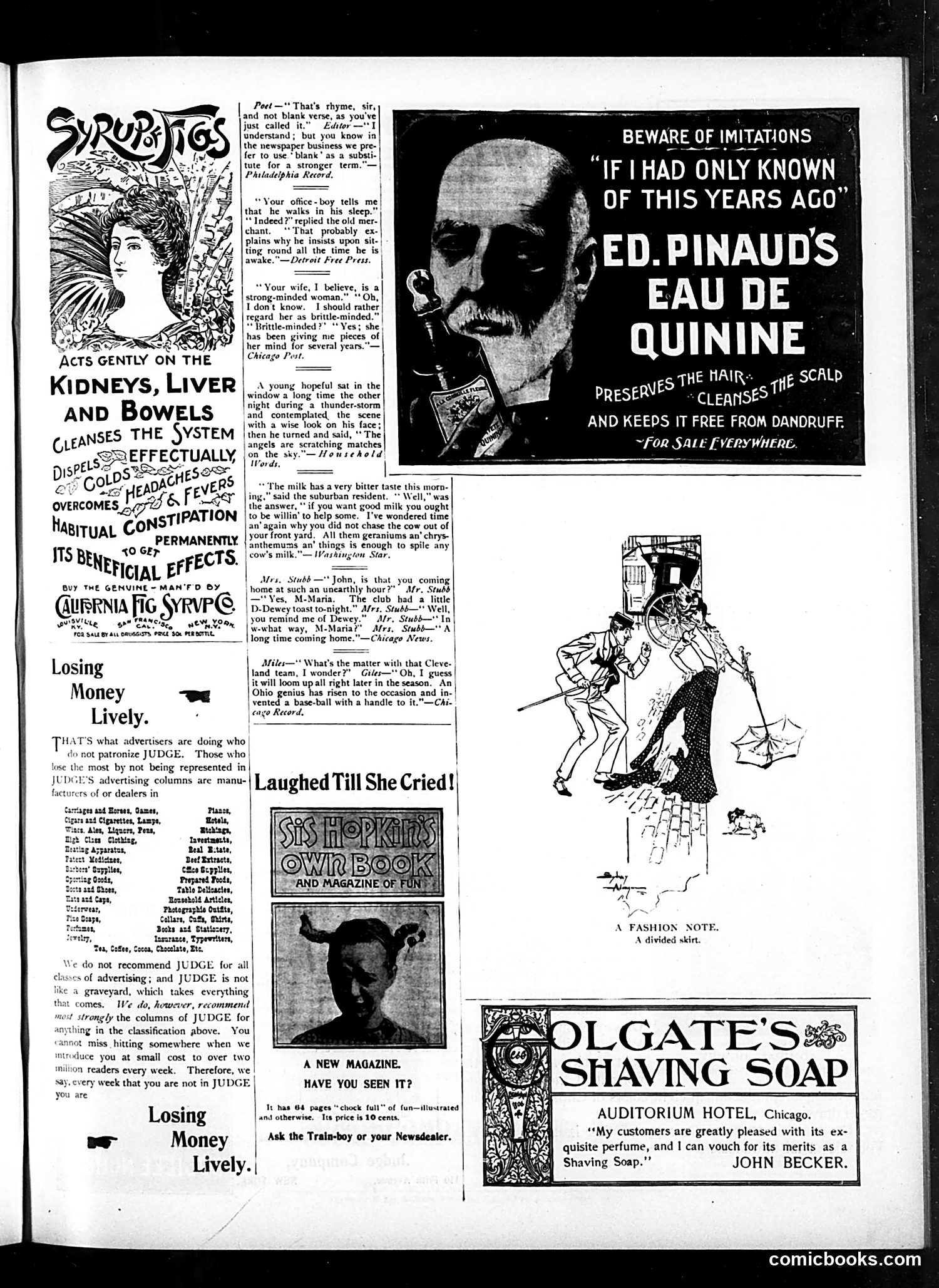
This page from *Judge* (a satirical weekly) combines humor columns, advertisements, and social commentary typical of early 20th-century American journalism. **Main Content:** The page features brief comedic anecdotes lampooning everyday life—a poet correcting an editor's vocabulary, a wife described as "brittle-minded" for changing opinions, a suburban resident's complaint about a cow ruining her flowers. These gentle jokes target middle-class pretension and domestic friction. **Advertising:** The California Fig Syrup ad dominates the left side, emphasizing bowel regularity—a common Victorian health concern. The Ed. Pinaud's Eau de Quinine advertisement (top right) promises hair preservation and dandruff removal, while Colgate's Shaving Soap appears at the bottom, all typical patent medicines and grooming products of the era. **Point:** The page reflects *Judge*'s primary function: entertaining urban, educated readers through light social satire while generating revenue through product advertising. Nothing here is overtly political—it's humor for the genteel middle class.
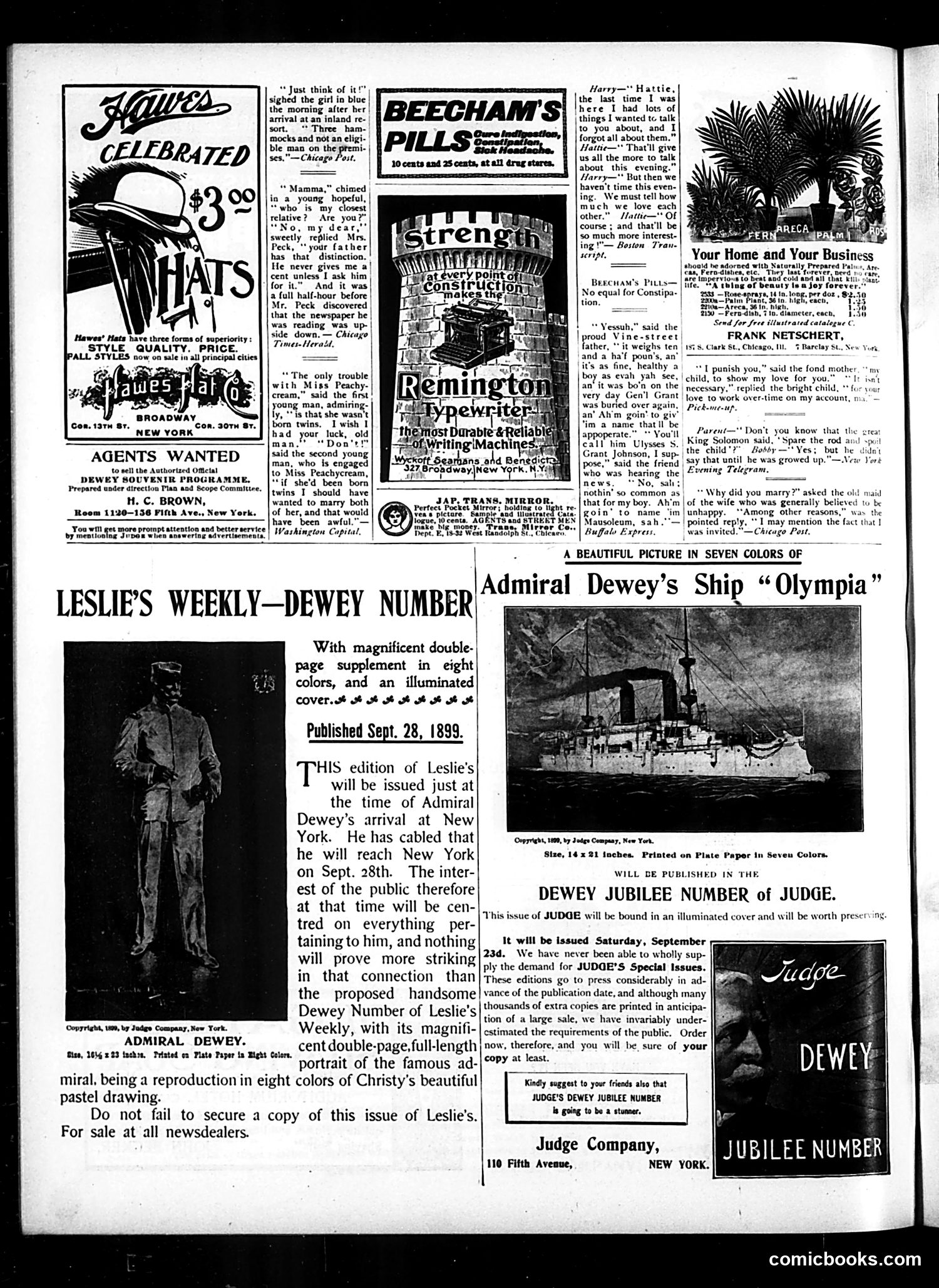
This page is primarily **advertising and announcement content**, not political satire cartoons. The dominant feature announces Leslie's Weekly's special "Dewey Number" commemorating Admiral George Dewey's arrival in New York on September 28, 1899—celebrating his naval victory in the Spanish-American War. The page includes: - **Product advertisements** (Hawes hats, Beecham's pills, Frank Netschert palms) - **Small comic anecdotes** about relationships and family life—light humor unrelated to current events - **A portrait of Admiral Dewey** (reproduction of a pastel drawing) - **A photograph of the USS Olympia**, Dewey's flagship - **Promotional notices** for the upcoming Dewey Jubilee Number of Judge magazine The content reflects **late-1890s American celebration of military victory and imperial expansion**. Dewey's Manila Bay triumph made him a national hero, and this page documents the commercial and media frenzy surrounding his homecoming—magazines competing to publish commemorative special editions.
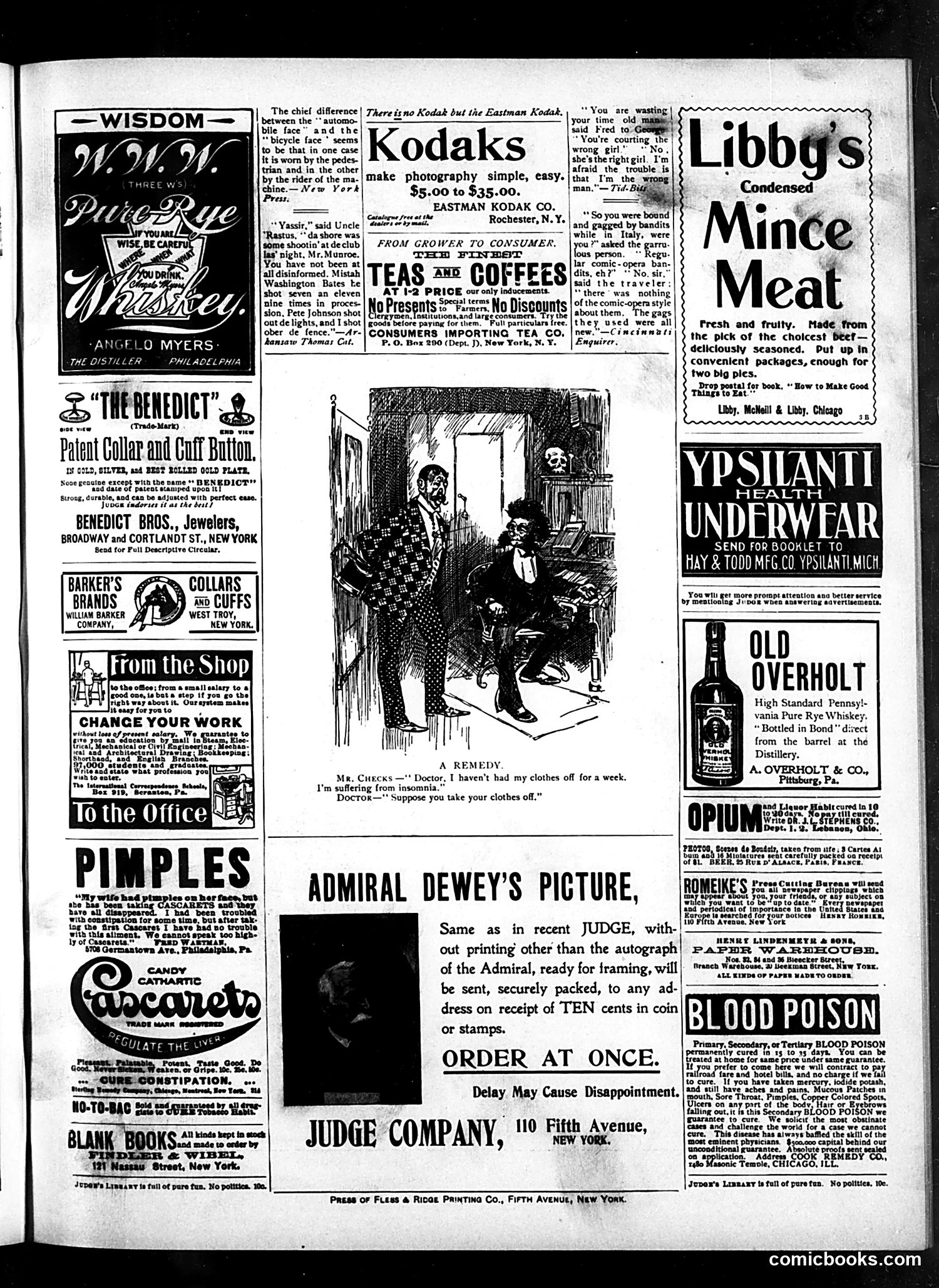
This is primarily an **advertising page** from Judge magazine with one cartoon and numerous product ads typical of early 1900s publications. ## The Cartoon The single cartoon titled **"A Remedy"** depicts a doctor and patient in a simple joke: the insomniac patient complains he hasn't removed his clothes in a week, and the doctor's obvious solution is "suppose you take your clothes off." It's a mild, straightforward gag playing on the patient's literal interpretation of suffering. ## The Advertisements The page reflects contemporary commercial interests: Kodak cameras (democratizing photography), patent collar buttons, mincemeat, whiskey, tea/coffee, underwear, and various patent medicines (including opium-based remedies and "blood poison" cures—then-common treatments for syphilis). **Notable**: The ad for Admiral Dewey's picture (the Spanish-American War hero) shows his celebrity status and Judge's willingness to monetize patriotic figures. The page contains no political satire or sophisticated commentary—it's essentially a commercial vehicle with minimal editorial humor, typical of turn-of-the-century magazine publishing.
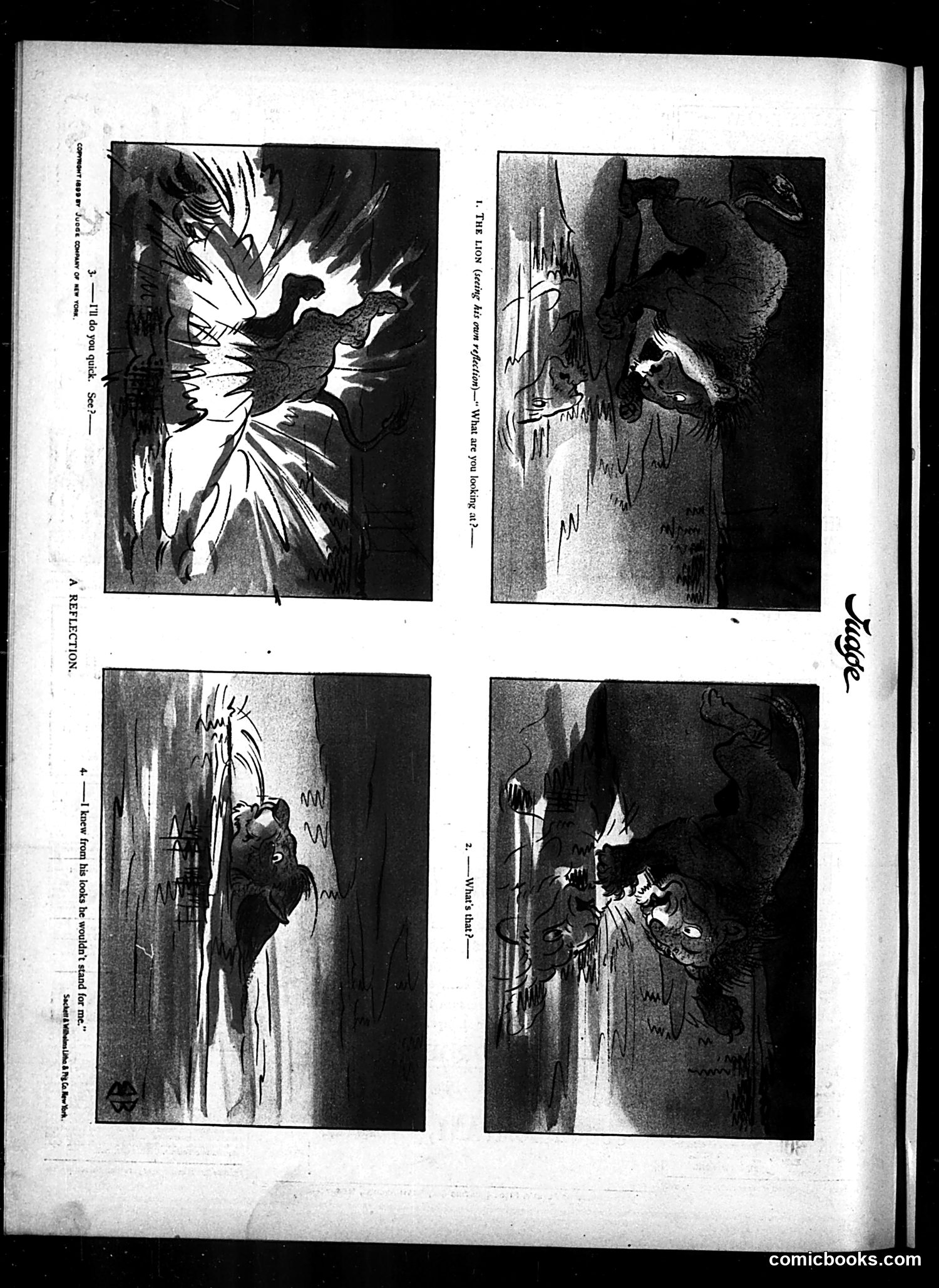
This appears to be a four-panel satirical cartoon, likely from the late 19th or early 20th century, depicting a street encounter between two figures. The dialogue suggests a con artist or street hustler ("I'll do you quick") attempting to solicit or swindle an unwilling mark. The title "A Reflection" and the sequential panels showing the interaction's progression—from the initial approach through the target's refusal—satirize common street schemes or confidence games prevalent in urban areas like New York at that time. The crude, dramatic illustration style and captions emphasize the lower-class or criminal nature of the encounter, typical of Judge's satirical approach to urban vice and social problems.

I can see this is a page from *Judge* magazine, but the image is almost entirely black with only a white vertical line on the left edge and the "comicbooks.com" watermark visible in the bottom right corner. The OCR text provided contains only the watermark text. **I cannot discern any cartoon content, caricatures, figures, text, or satirical material from this image.** The page appears either to be a blank page, severely degraded, improperly scanned, or otherwise unreadable. Without visible content to analyze, I cannot identify political references, historical figures, or the intended satire or joke. A higher quality image would be needed to provide meaningful analysis.