
A complete issue · 16 pages · 1899
Judge — September 2, 1899
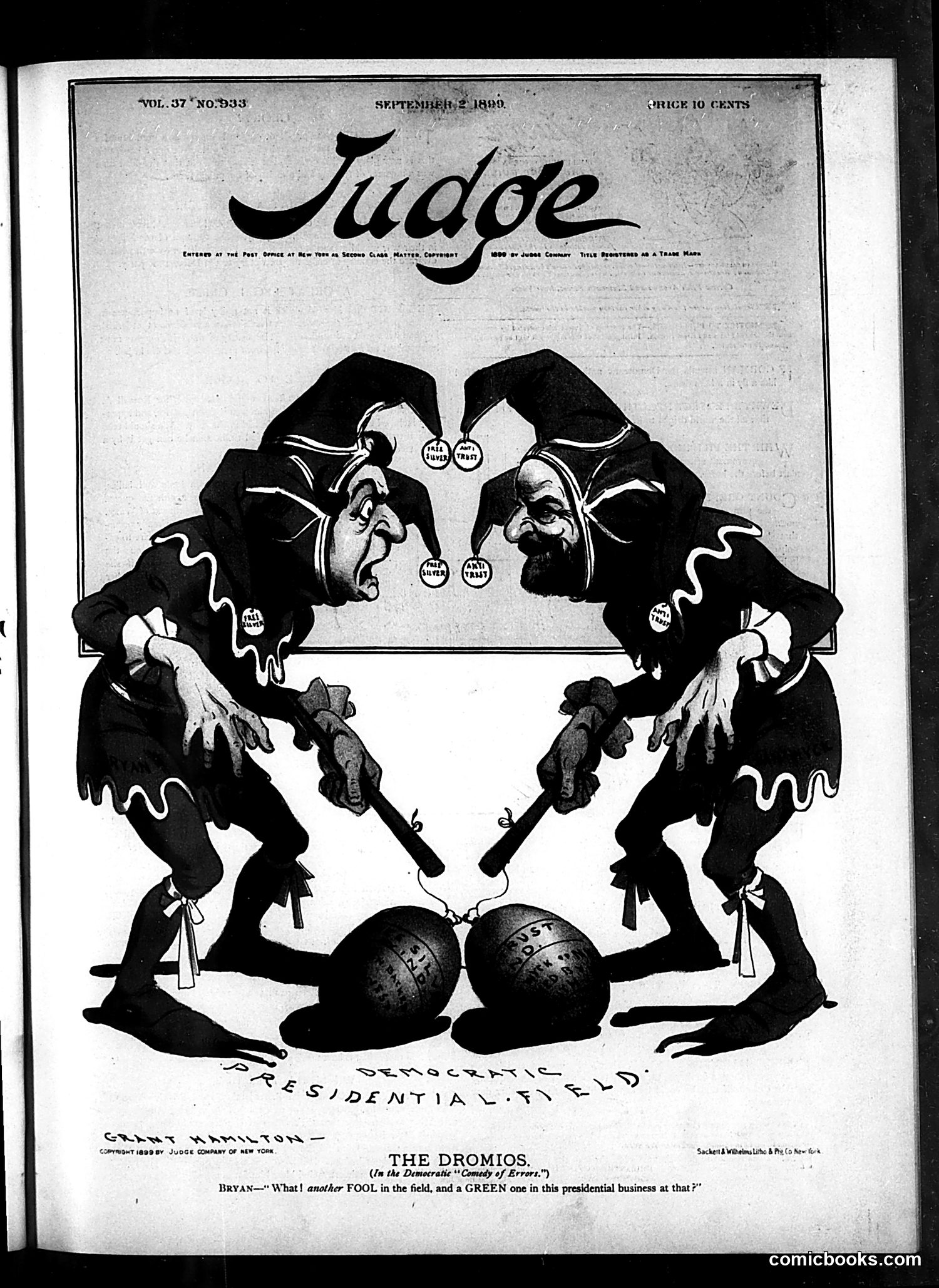
This cartoon satirizes the 1908 U.S. presidential race. Two identical mirror-image figures—representing Democratic and Republican candidates—juggle balls labeled "TRUST" while standing in a "Democratic Presidential Field." The caption quotes Bryan asking: "What! *another* FOOL in the field, and a GREEN one on this presidential business at that?" This likely references William Jennings Bryan (the three-time Democratic candidate) commenting on the crowded field of candidates. The mirrored "dromos" (Greek racing track term) suggests both parties are running the same race with interchangeable, foolish candidates. The balls represent trusts—monopolistic corporations—the era's major political issue, implying candidates merely juggle the same corporate problems regardless of party.
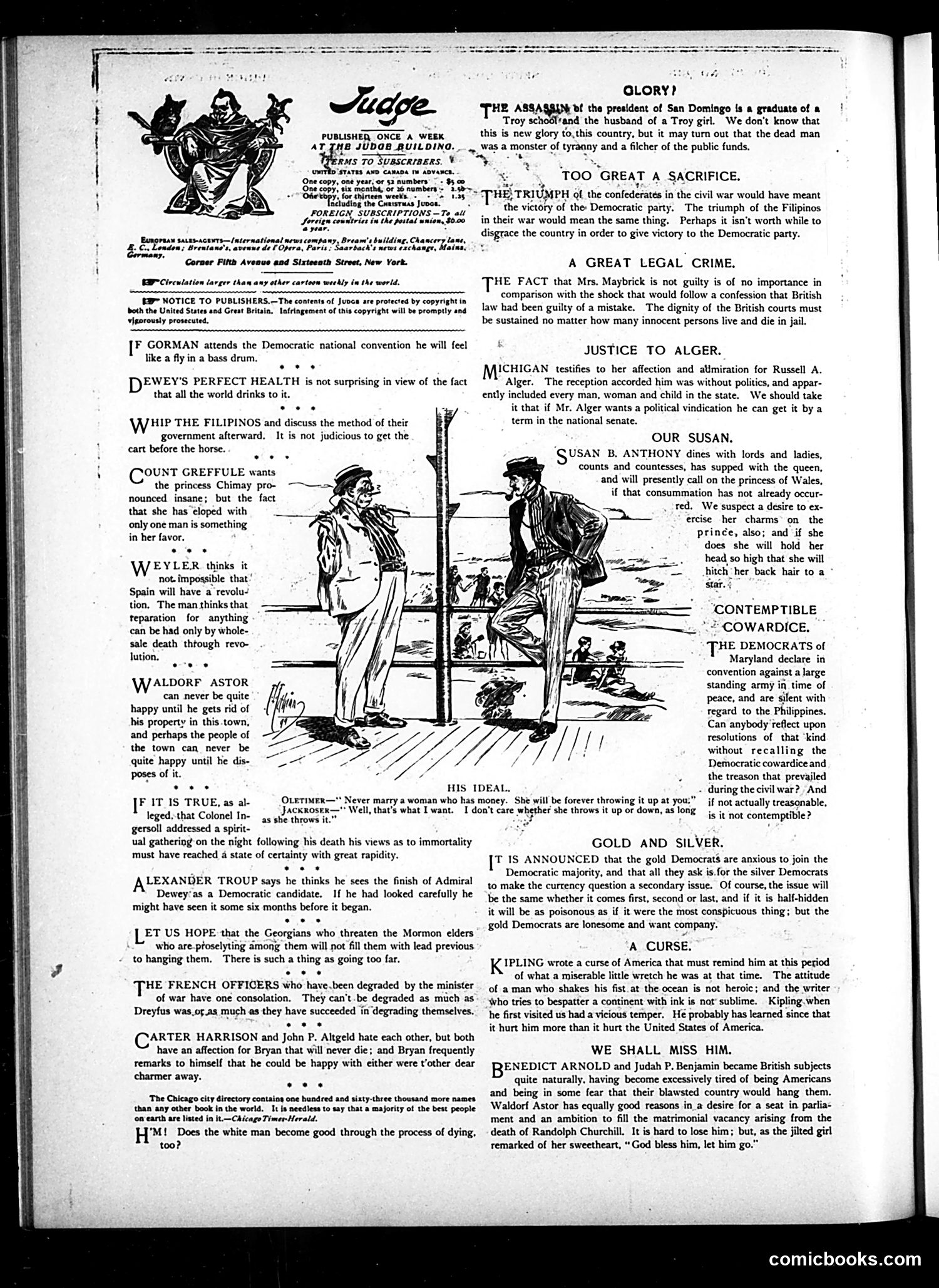
This page contains multiple political commentaries from Judge magazine. The main cartoon depicts two figures on a dock in what appears to be a casual conversation about marriage and money—likely satirizing social attitudes of the era. The text sections criticize various political figures and events: - "GLORY!" attacks the Assassin (likely referring to a political figure) as a tyrant - "TOO GREAT A SACRIFICE" criticizes Democratic Party positions on the Philippines - "A GREAT LEGAL CRIME" references Mrs. Maybriek's guilt conviction - "JUSTICE TO ALGER" defends Russell A. Alger's political vindication - Multiple brief items mock figures like Gorman, Dewey, and others on contemporary political issues The overall tone is Republican/conservative, attacking Democratic policies and defending Republican figures. Without specific dates visible, the exact historical moment is unclear, but references suggest early 1900s American politics.
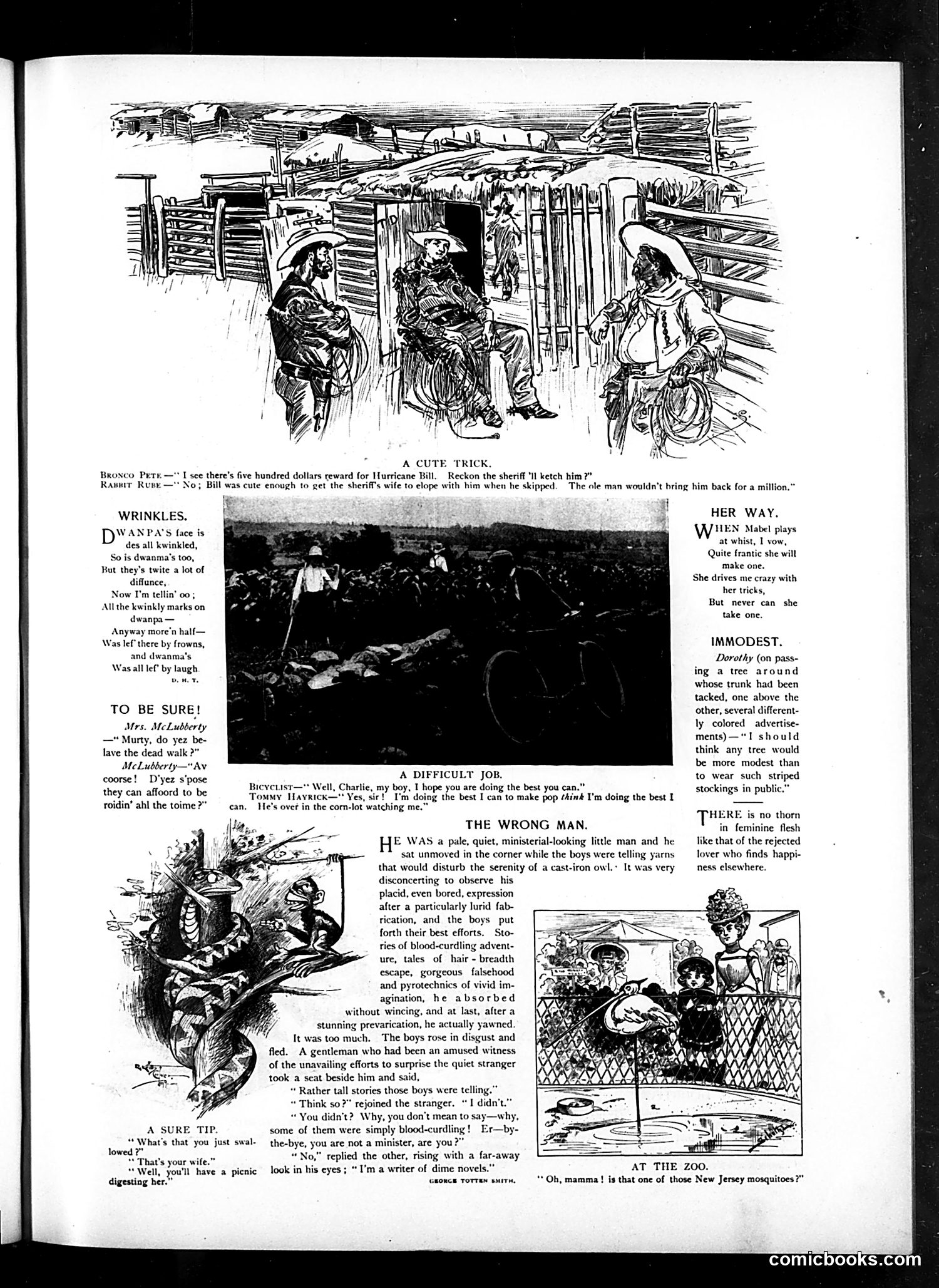
This page contains several unrelated humorous sketches and short stories typical of Judge's satirical format: **"A Cute Trick"** (top): A joke about capturing the outlaw "Hurricane Bill" by exploiting his wife's infidelity—the sheriff uses her elopement as bait. **"Wrinkles," "To Be Sure," "A Sure Tip"**: Brief comedic dialogues about everyday situations (a man's facial wrinkles, poses for art, and marital advice). **"The Wrong Man"**: A story about boys tormenting a quiet, ministerial stranger with blood-curdling tales, expecting shock—but he reveals himself as a dime-novel writer, already familiar with such sensationalism. **"At the Zoo"**: A brief joke about a New Jersey mosquito at the zoo. The page represents Judge's mix of visual and textual humor targeting middle-class American readers, with no apparent political content or specific historical reference.
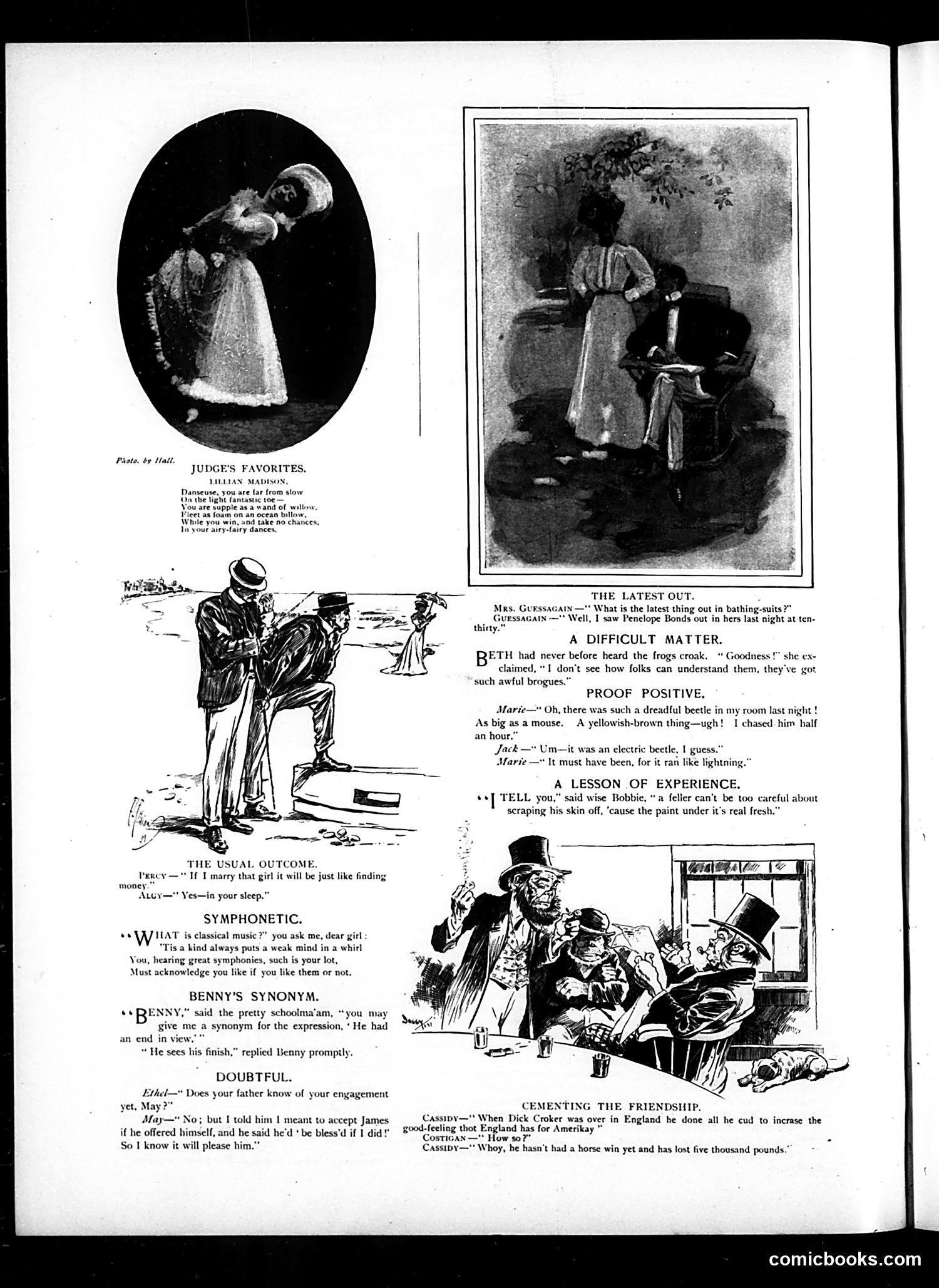
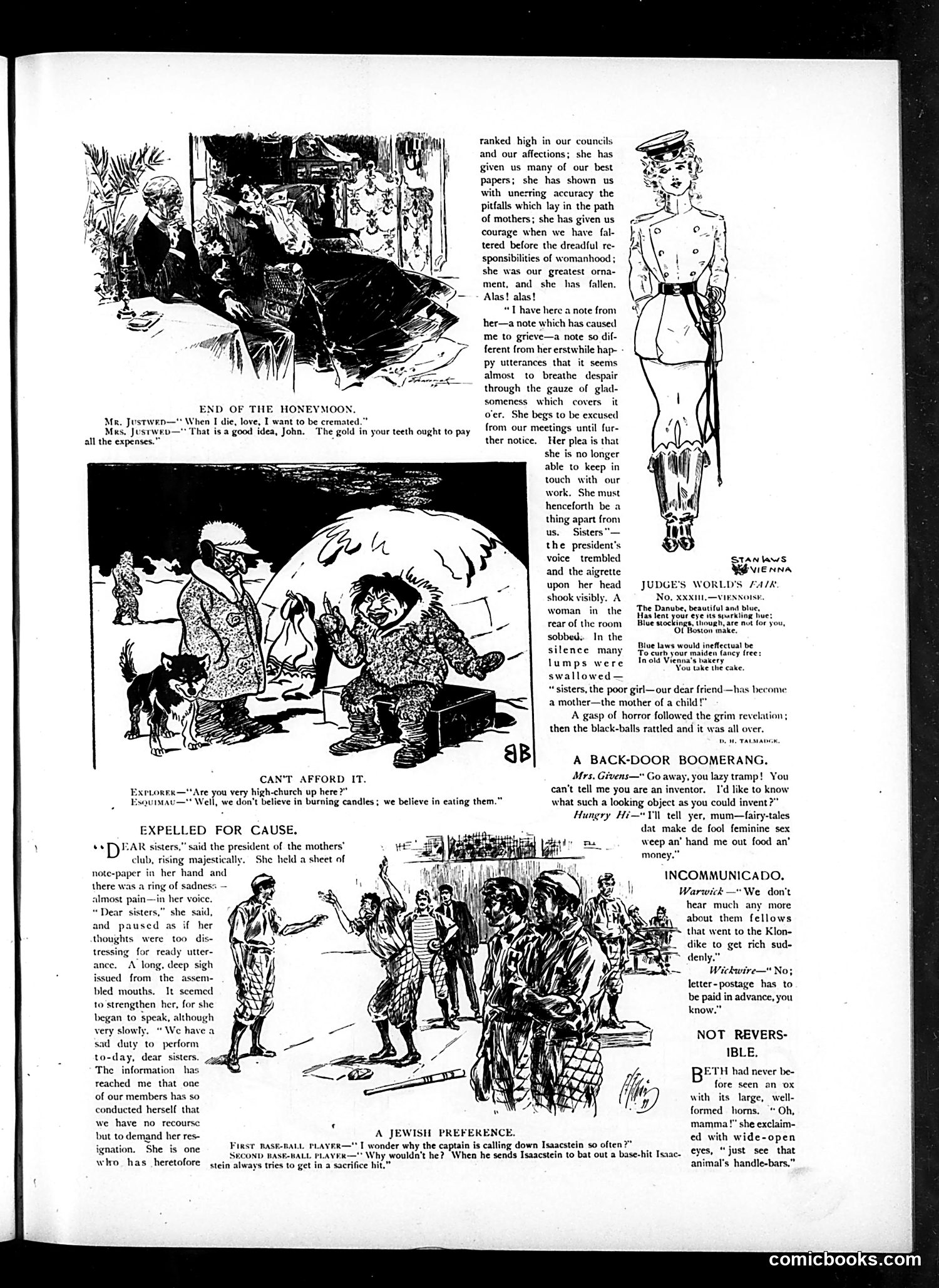
This page contains several satirical cartoons mocking social conventions of the era: **"Expelled for Cause"** depicts a mothers' club expelling a member for becoming an unwed mother—ridiculing the rigid moral standards and hypocrisy of such organizations. The lengthy preamble emphasizes how the woman contributed to the club before her "fall," highlighting the cruelty of their judgment. **"End of the Honeymoon"** jokes about cremation costs, with a husband noting his wife's gold teeth will offset expenses—dark humor about marital practicality. **"Can't Afford It"** mocks high-church Protestantism through an exchange about eating versus burning candles—a jab at religious pretension among the wealthy. The remaining cartoons ("A Jewish Preference," "A Back-Door Boomerang," "Incommunicado," "Not Reversible") use ethnic and class-based stereotypes typical of early 20th-century satire—depicting poverty, Jewish stereotypes, and immigrant dialect humor that reflects period prejudices rather than sophisticated critique.
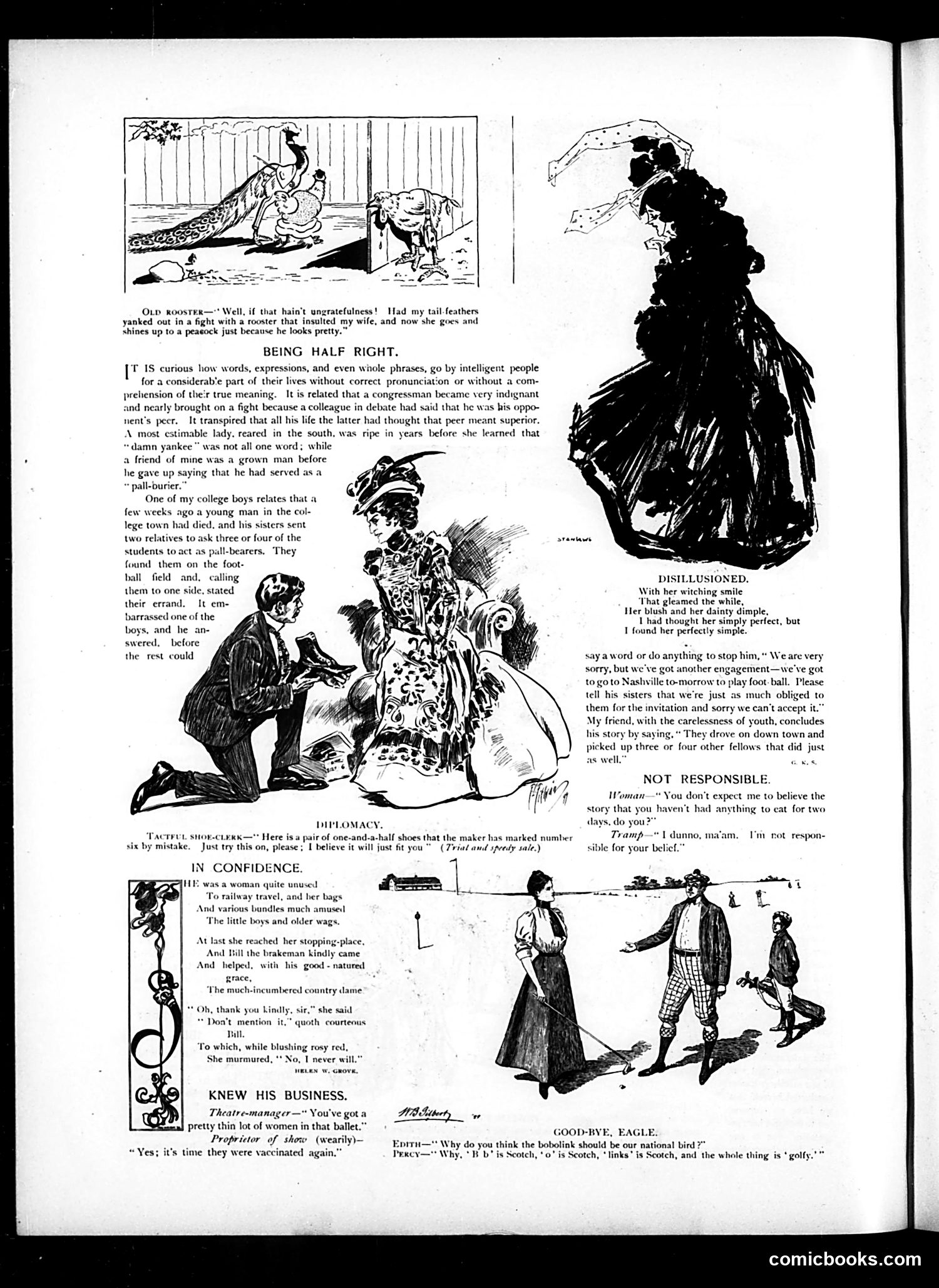
This page contains multiple short humorous pieces satirizing everyday American life and social conventions. **"Being Half Right"** mocks linguistic ignorance among otherwise respectable people—a congressman misunderstanding "peer" as "superior," a Southern lady not realizing "damn yankee" was two words, and college boys mishearing "pall-bearers" as "pall-buriers." **"Diplomacy"** depicts a well-dressed woman realizing her suitor values appearance over substance—she's "perfectly simple" rather than "simply perfect." **"Not Responsible"** jokes about a vagrant's shamelessness: when a woman expresses disbelief at his hunger claim, he refuses accountability. **"In Confidence"** plays on rural naivety: a country woman, grateful to a helpful brakeman, innocently promises never to mention his kindness—misunderstanding his polite brush-off. **"Knew His Business"** cynically suggests a theater manager views female dancers as disposable—needing replacement "vaccination" (likely euphemism for replacement) when worn out. These pieces reflect early-20th-century urban-rural class divisions and condescending attitudes toward outsiders and working-class figures.
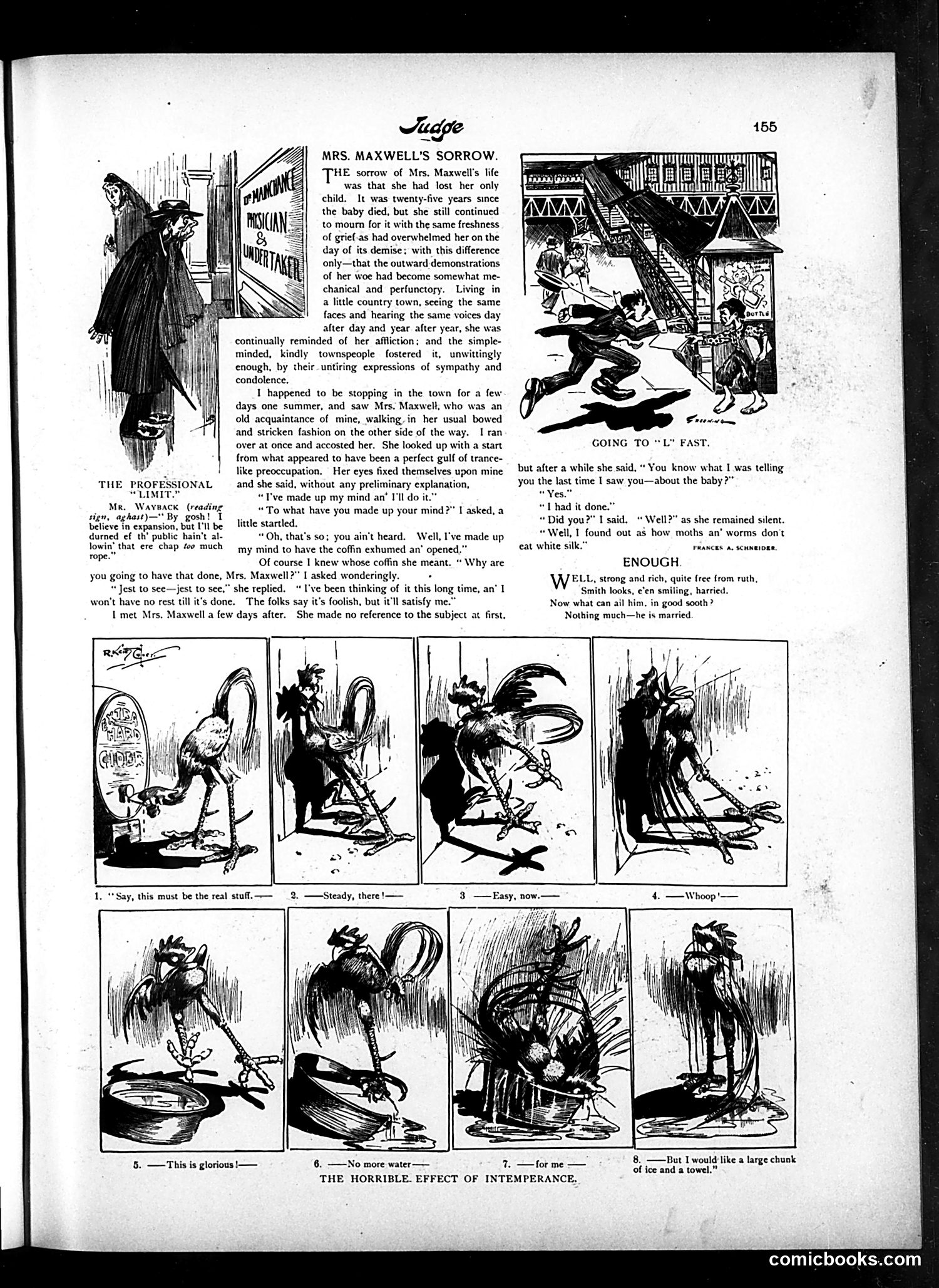
**Main Story: "Mrs. Maxwell's Sorrow"** A widow obsesses for 25 years over her dead infant, maintaining performative grief that has become "mechanical and perfunctory." The narrator encounters her planning to exhume and open the child's coffin. Days later, she reveals she did so—only to discover moths and worms don't eat white silk, implying the baby's burial clothes were preserved, disappointing her morbid expectations. The satire targets excessive, performative mourning and how small-town sympathy enables rather than heals psychological fixation. The story critiques both artificial grief display and how communities unconsciously perpetuate suffering. **Comic Strip: "The Horrible Effect of Intemperance"** A crude sequence showing an increasingly disheveled, distressed figure experiencing progressively worse circumstances—suggesting alcohol's degenerative effects. This appears standard temperance-era moralizing common to Judge magazine. **Minor Political Cartoon**: "The Professional Gambit"—unclear reference without fuller context.
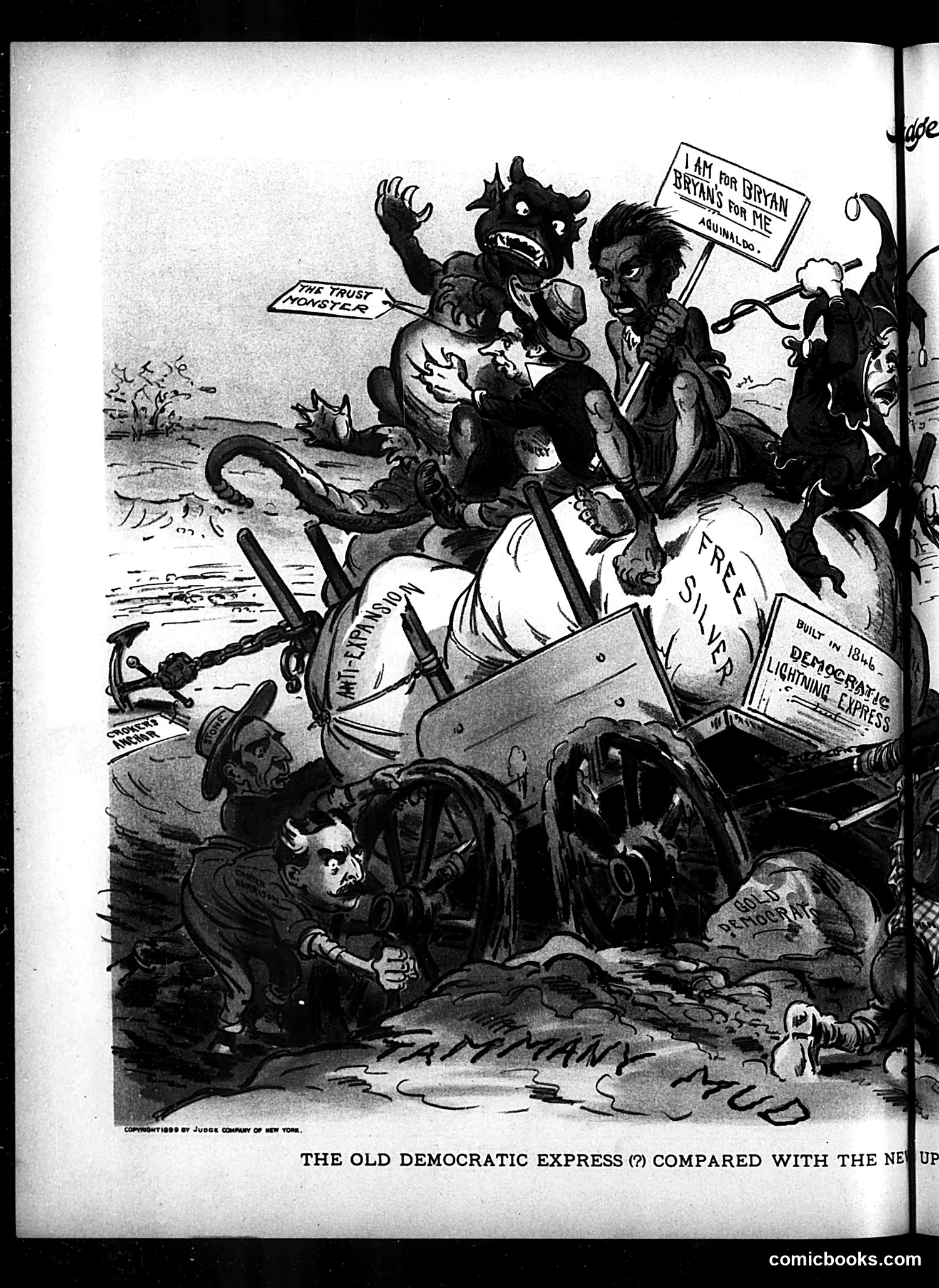
This satirical cartoon compares two versions of the Democratic Party's political "express" (campaign locomotive). The image depicts demonic or monstrous figures operating an old, decrepit Democratic locomotive labeled "FREE SILVER" and "DEMOCRATIC EXPRESS" (built in 1896), contrasted with what appears to be a newer Republican alternative. The demons likely represent political corruption or undesirable Democratic policies. Signs reading "DON'T TRUST MONOPOLIES" and "BUY FOR BRYAN" reference William Jennings Bryan's 1896 presidential campaign, which championed free silver—the unlimited coining of silver to inflate the currency. The cartoon's message criticizes the Democratic Party's outdated or dangerous platform, suggesting the GOP's alternative is superior. The monstrous imagery expresses Judge magazine's Republican editorial stance against Democratic policies of that era.
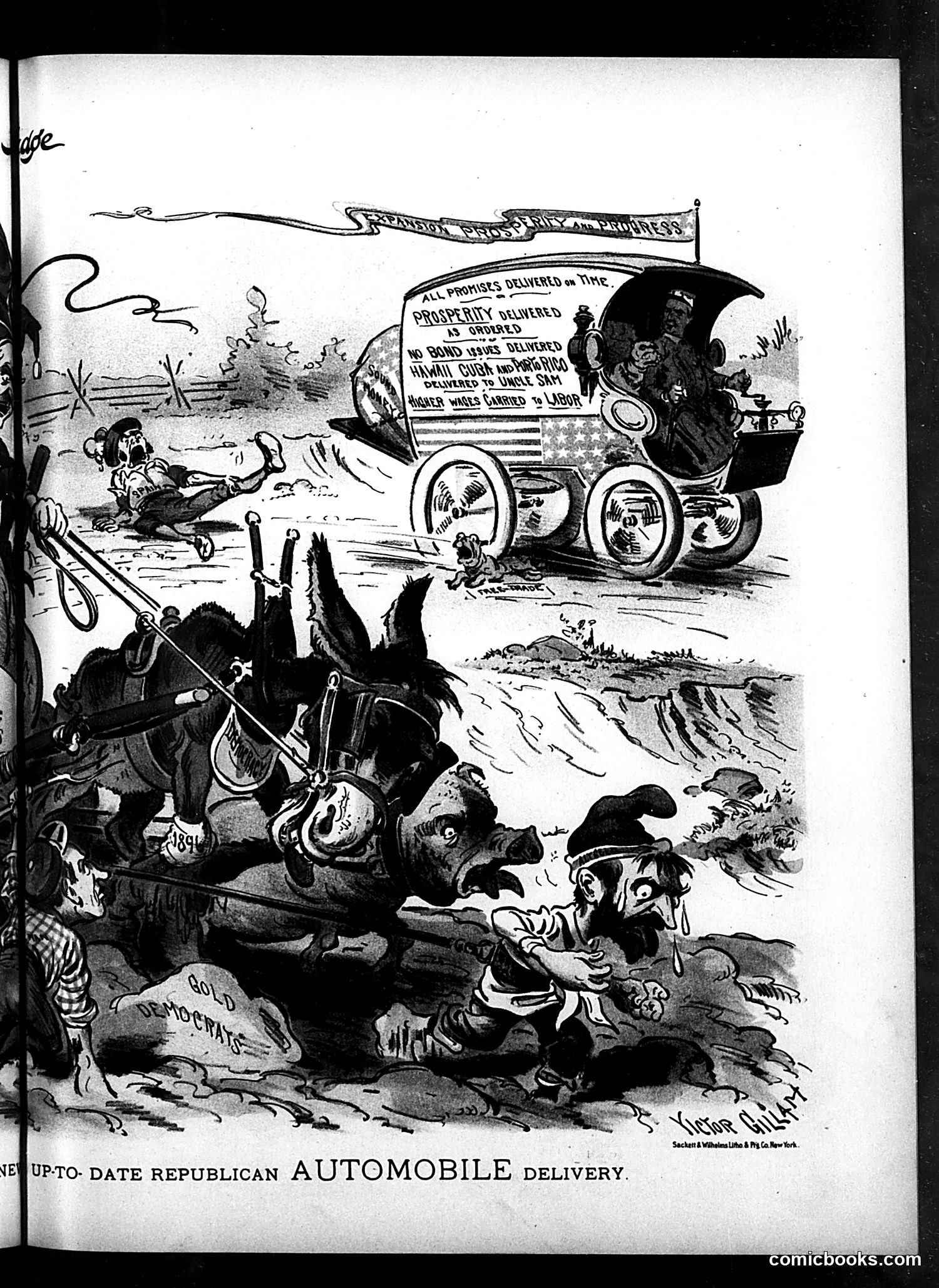
This is a satirical cartoon attacking Republican campaign promises. The image depicts a fancy automobile labeled with various Republican pledges ("All Promises Delivered on Time," "Prosperity Delivered," "No Bond Uses Delivered," etc.) being driven recklessly through a landscape where Democrats lie scattered and injured in its wake. The satire suggests Republicans made grandiose promises they couldn't deliver—the vehicle's fine words contrast sharply with the actual damage ("delivery") caused. The trampled Democratic figures at the bottom reinforce the critique: Republican policies harm Democrats, contradicting promises of broad prosperity. The cartoon's title emphasizes the gap between Republican rhetoric and reality, mocking their claims as merely theatrical rather than substantive. This appears to be election-cycle criticism from Judge magazine's perspective.
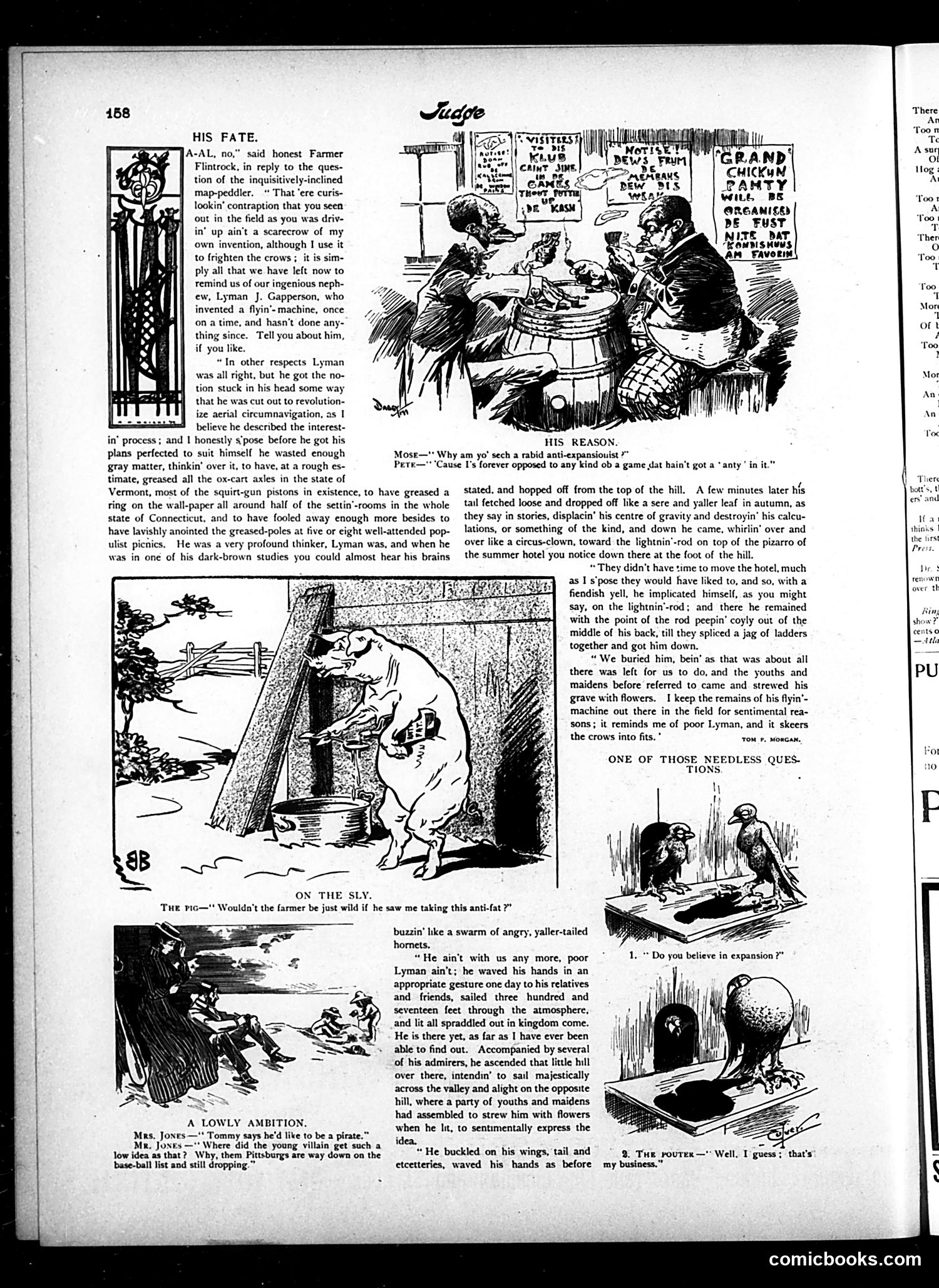
This page contains multiple satirical cartoons mocking late-19th-century American aspirations and follies. **"His Fate"** ridicules the obsession with flying-machine invention. Farmer Tintrock describes his nephew Lyman J. Gapperson, who wasted enormous mental effort designing an aircraft. The joke: Gapperson actually flew—directly into a lightning rod on a hotel, becoming a scarecrow-like corpse. This mocks the era's aviation enthusiasts and their dangerous, impractical experiments. **"His Reason"** satirizes political anti-expansionism through dialect humor, suggesting opposition to territorial expansion is merely because the opponent dislikes games without "aunty" (likely "ante," the poker stake)—trivial reasoning masked as principle. **"On the Sly"** shows a pig stealing anti-fat medicine, playing on class anxieties about weight and propriety. **"A Lowly Ambition"** jokes that Pittsburgh baseball players rank so low that piracy seems respectable by comparison—contemporary sports mockery. The cartoons reflect Gilded Age preoccupations: technological mania, political hypocrisy, and social status anxiety.
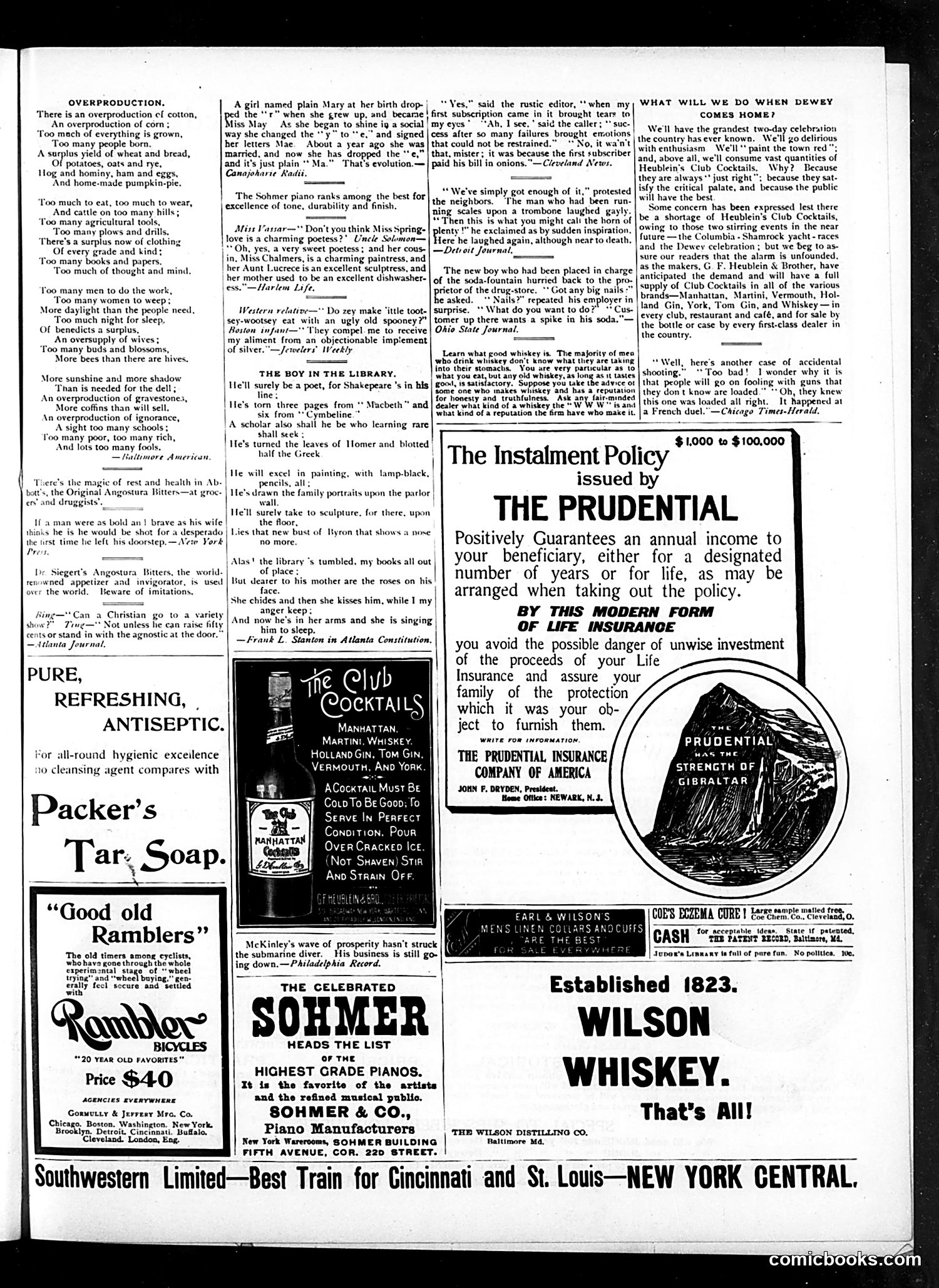
This page consists mainly of **advertisements and light humor pieces**, not political cartoons. The **"Overproduction"** poem satirizes late-19th-century economic anxieties about agricultural and industrial surplus, suggesting everything is being produced in excess—a concern during periods of economic instability. The humor pieces are social jokes: a girl's name changes from "Mary" to "Mae" to "Ma" as she ages and marries; a uncle's critique of female artists uses mocking "-ess" suffixes (poetess, paintress, sculptress); a trombone player makes a pun about the "horn of Plenty"; a soda fountain worker misunderstands "spike" (ingredient) as a nail. The page primarily showcases **period advertisements** for Packer's Tar Soap, Rambler Bicycles, Sohmer Pianos, and notably **Heublein's Club Cocktails**—tied to the imminent homecoming of Admiral Dewey from the Spanish-American War, promoting celebratory drinking as patriotic consumption.
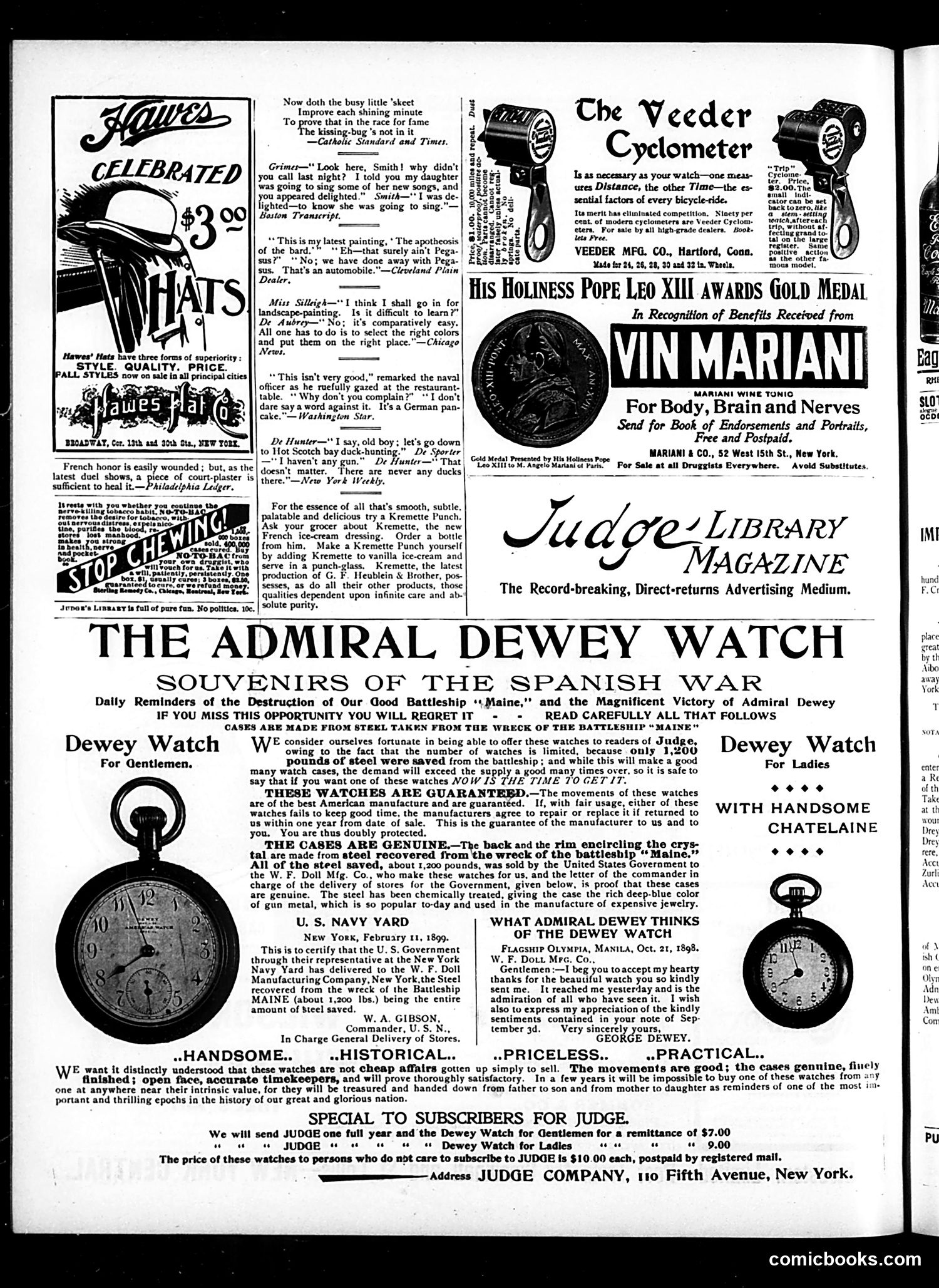
This page is primarily **advertising**, not political satire. The dominant content features the "Admiral Dewey Watch"—a commercial product marketed as souvenirs of the Spanish-American War, made from steel salvaged from the USS Maine wreckage. The historical context: The Maine's 1898 explosion killed 266 sailors and became a rallying cry ("Remember the Maine!") for U.S. entry into war against Spain. Admiral Dewey's naval victory at Manila Bay made him a national hero. The watches capitalized on this patriotic fervor, offering Americans tangible connections to these recent, emotionally resonant events. The marketing emphasizes authenticity ("genuine" steel from the wreck) and patriotic duty. The page also includes minor humor pieces and advertisements for other products (Mariani Wine Tonic, Veeder Cyclometer, Hawes Hats). The jokes reference painting, German food, and courtship—typical period humor with no apparent political content. This represents commercial exploitation of military glory and national pride.
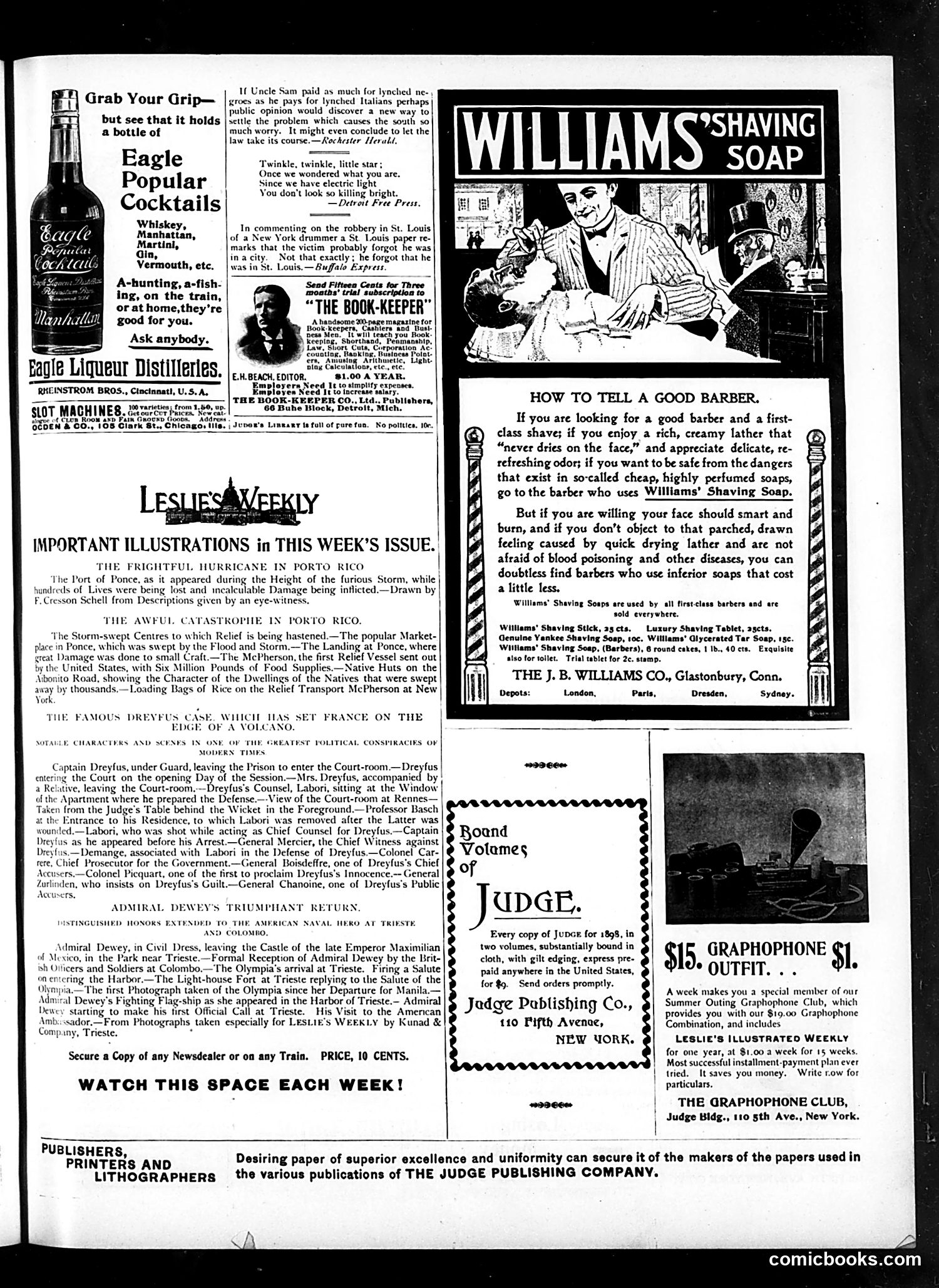
This page is primarily **advertisements and editorial content** rather than satirical cartoons. The main visual is a **Williams' Shaving Soap advertisement** showing a barber at work, with text arguing that cheap, perfumed soaps dry the face and pose health risks. The **text snippets** appear to be editorial commentary on contemporary issues: 1. **Lynching commentary**: A brief note comparing Uncle Sam's payment for lynched Italians versus African Americans—suggesting the U.S. should apply consistent standards to racial violence. 2. **Puerto Rico coverage**: Multiple references to Hurricane and disaster relief in Porto Rico (Puerto Rico), indicating Judge's coverage of the 1898 disaster. 3. **Dreyfus Case**: Extensive discussion of the famous French military scandal involving Captain Alfred Dreyfus, a Jewish officer accused of treason—a major international controversy of the 1890s dividing French society. 4. **Admiral Dewey**: Coverage of the Spanish-American War naval hero's triumphant return. The page reflects Judge's role as a news-commentary magazine covering major domestic and international events of 1898-1899.
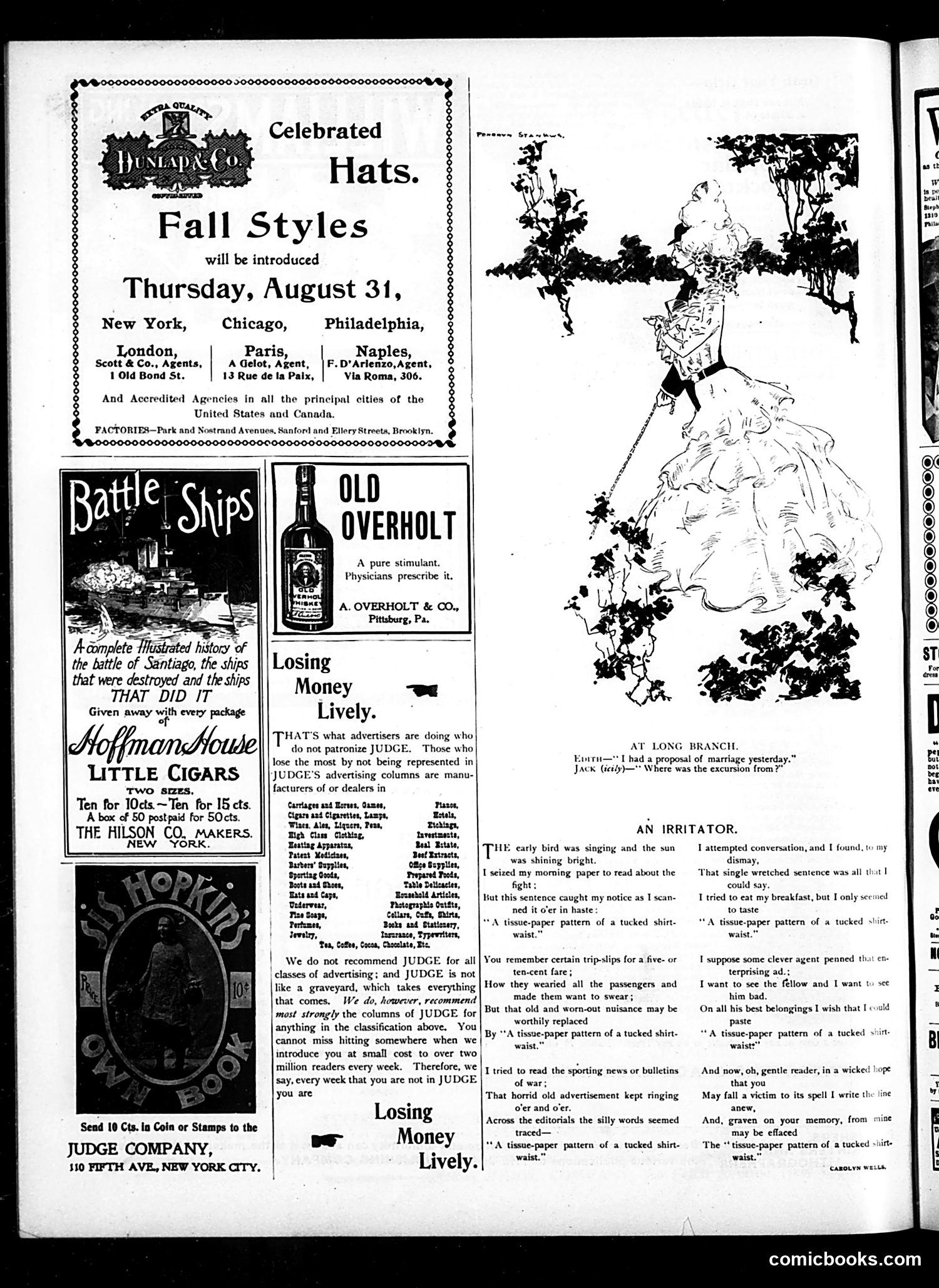
This page is primarily **advertising and light satire** rather than political commentary. The main content is a humorous poem mocking an intrusive advertisement. **The Satire:** The poem satirizes aggressive advertising by depicting a ubiquitous ad for a "tissue-paper pattern of a tucked shirt-waist" that appears *everywhere*—in newspapers, sports sections, editorials, and even the narrator's thoughts. The joke is that the repetitive ad is so omnipresent and annoying that it's literally inescapable, infiltrating even breakfast and conversation. **The Target:** This critiques early advertising's invasive techniques. The advertiser has saturated *Judge* magazine itself with this phrase, making the satire meta-commentary: *Judge* magazine's own ad practices are being ridiculed within *Judge's* pages. **Historical Context:** This reflects late 19th/early 20th-century frustration with aggressive commercial marketing. The "tissue-paper pattern" (a sewing pattern) was apparently a real product being relentlessly promoted, and the poem captures readers' exasperation with inescapable consumer messaging—a surprisingly modern complaint. The page otherwise contains typical period advertisements for cigars, alcohol, hats, and books.
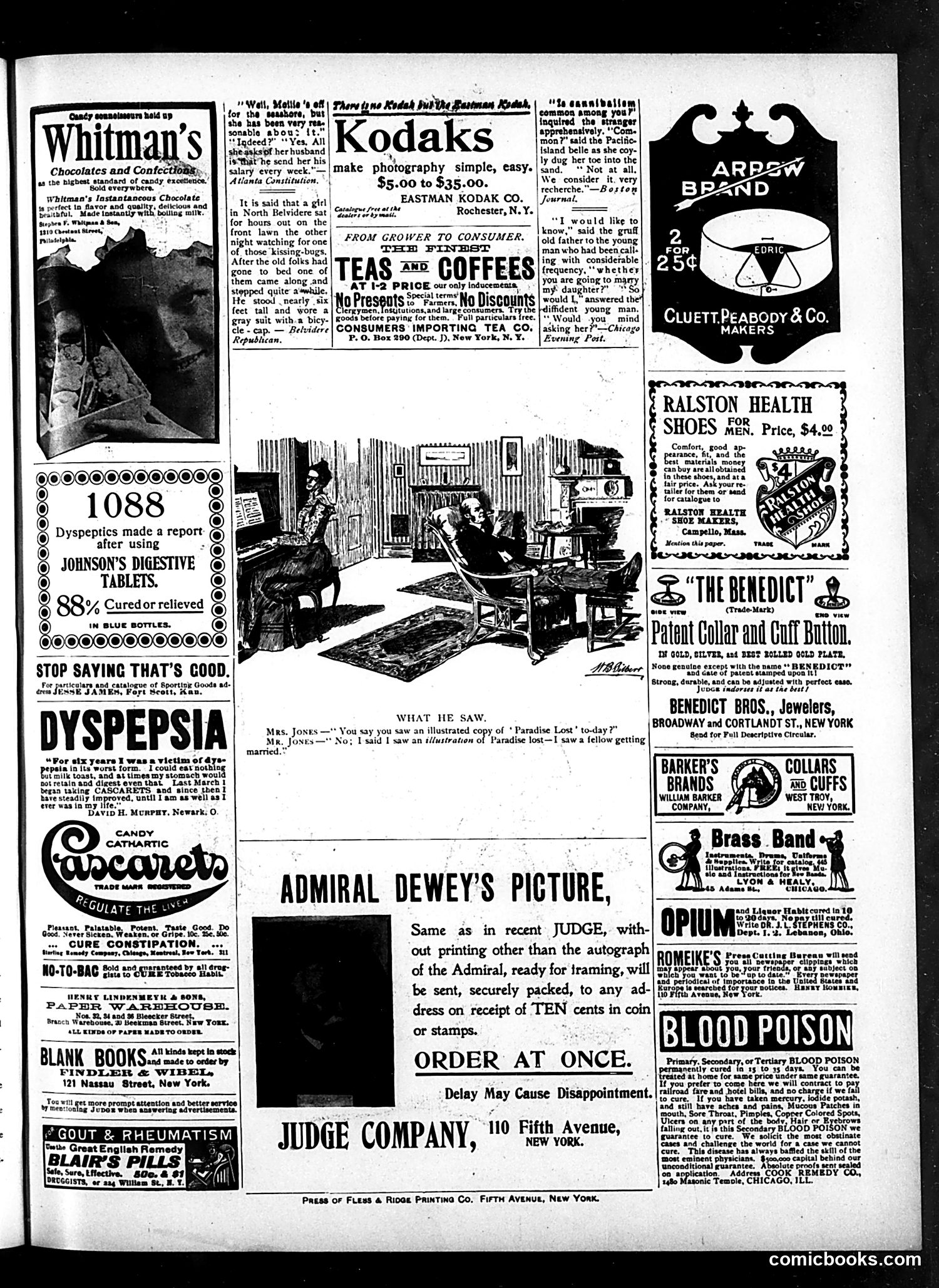
This page is primarily **advertisements and filler content** from *Judge* magazine, with minimal political or satirical cartooning. The one identifiable cartoon is titled "WHAT HE SAW"—a brief domestic joke about a wife claiming she "saw an illustrated copy of Paradise Lost today," while the husband skeptically notes he "saw an illustration of Paradise lost—I saw a fellow getting married." This is a mild satire on marriage as a loss of paradise—a common trope of the era. The rest of the page consists of period advertisements for products like Kodak cameras, patent medicines (Cascarets, Johnson's Digestive Tablets, "Blood Poison" cure), shoes, collars, and other goods typical of early-20th-century magazines. There is a separate illustrated scene labeled "ADMIRAL DEWEY'S PICTURE" advertising his autographed portrait for ten cents—likely capitalizing on Dewey's fame from the Spanish-American War. No clear political figures or contemporary references are satirized on this particular page.
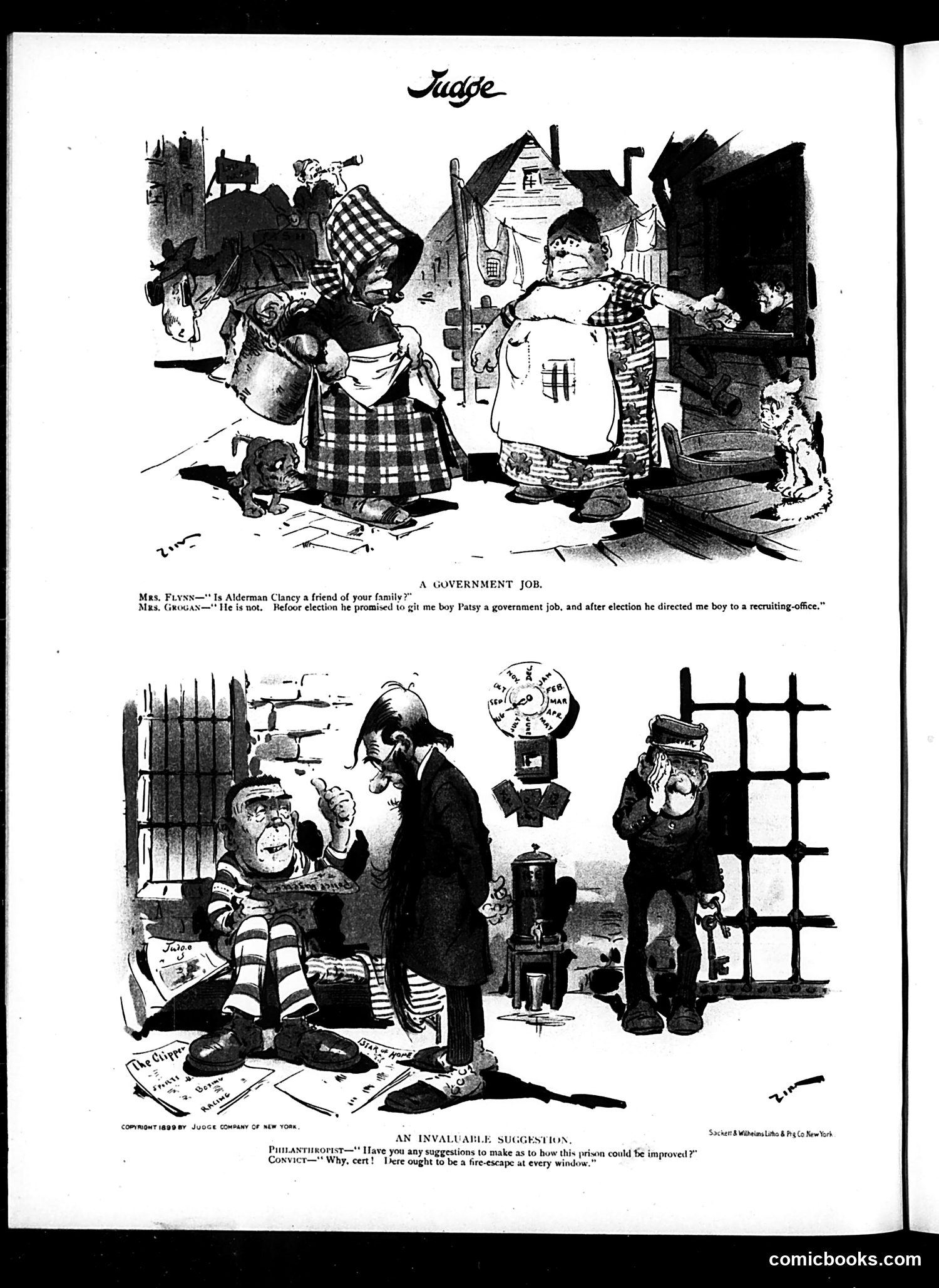
**Top cartoon ("A Government Job"):** Satirizes machine politics and broken promises. An Irish immigrant woman confronts Alderman Clancy, accusing him of lying about securing her son Patsy a government job before the election. Instead of a cushy political appointment, the boy was sent to a military recruiting office—a far less desirable outcome. The cartoon mocks the corrupt practice of trading jobs for votes and the exploitation of working-class immigrant voters. **Bottom cartoon ("An Invaluable Suggestion"):** A prisoner offers to improve prison conditions by installing fire-escapes at windows. The joke is darkly humorous: the "improvement" would enable escapes rather than genuine reform. It satirizes both prison conditions and convict cunning, while critiquing the futility of philanthropic prison reform efforts. Both cartoons employ ethnic caricature and working-class stereotypes typical of 1890s satirical magazines.