
Judge, 1899-09-02 · page 7 of 16
Judge — September 2, 1899 — page 7: what you’re looking at
What you’re looking at
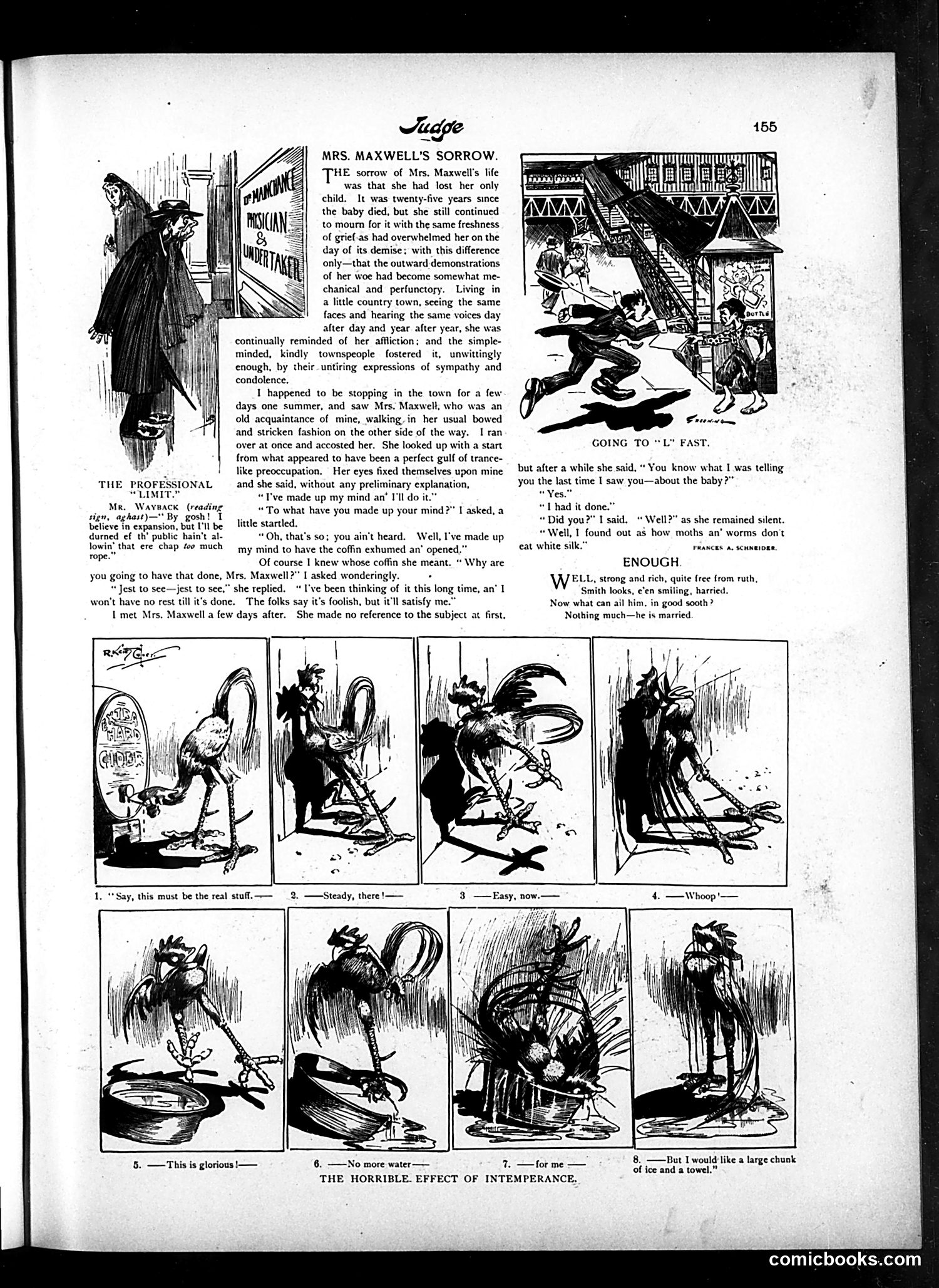
**Main Story: "Mrs. Maxwell's Sorrow"** A widow obsesses for 25 years over her dead infant, maintaining performative grief that has become "mechanical and perfunctory." The narrator encounters her planning to exhume and open the child's coffin. Days later, she reveals she did so—only to discover moths and worms don't eat white silk, implying the baby's burial clothes were preserved, disappointing her morbid expectations. The satire targets excessive, performative mourning and how small-town sympathy enables rather than heals psychological fixation. The story critiques both artificial grief display and how communities unconsciously perpetuate suffering. **Comic Strip: "The Horrible Effect of Intemperance"** A crude sequence showing an increasingly disheveled, distressed figure experiencing progressively worse circumstances—suggesting alcohol's degenerative effects. This appears standard temperance-era moralizing common to Judge magazine. **Minor Political Cartoon**: "The Professional Gambit"—unclear reference without fuller context.
📄 Transcribed text from this page (OCR, searchable)
Machine-transcribed from the original scan — historical spelling and the odd misread are preserved.
THE Mr. K (reading sign, aghast)—" By gosh! T believe in expansion, but I'll be durned ef th’ public hain't al- lowin’ that ere chap foo much ila widge MRS. MAXWELL’S SORROW. THE sorrow of Mrs. Maxwell's life was that she had lost her only child. It was twenty-five years since the baby died, but she still continued to mourn for it with the same freshness of grief.as had overwhelmed her on the day of its demise; with this difference only—that the outward demonstrations of her woe had become somewhat me- chanical and perfunctory. Living in a little country town, seeing the same faces and hearing the same voices day after day and year after year, she w: continually reminded of her affliction; and the simple- minded, kindly townspeople fostered it, unwittingly enough, by their untiring expressions of sympathy and condolence. I happened to be stopping in the town for a few days one summer, and saw Mrs. Maxwell, who was an old acquaintance of mine, walking, in her usual bowed and stricken fashion on the other side of the way. I ran over at once and accosted her. She looked up with a start from what appeared to have been a perfect gulf of trance- like preoccupation. Her eyes fixed themselves upon mine and she said, without any preliminary explanation, “T've made up my mind an’ I'll do “To what have you made up your mind?" little startled. “Oh, that’s so; you ain't heard. Well, I've made up my mind to have the coffin exhumed an’ opened,” Of course I knew whose coffin she meant. asked, a Why are you going to have that done, Mrs. Maxwell?” I asked wonderingly. - UpUUTTAH NUTT YAL ayia Ele Ei GOING TO “L” FAST. but after a while she said, “You know what I you the last time I saw you—about the baby?” “y “Thad it done.” “Did you?” I said. “Well?” as she remained silent. “Well, I found out aS how moths an’ worms don't eat white silk.” FRANCES A, SCHMEIDEE ENOUGH WELL, strong and rich, quite free from ruth, “ Jest to see—jest to see,” she replied.“ I've been thinking of it this long time, an’ 1 won't have no rest till it's done. The folks say it’s foolish, but it'll satisfy me.” I met Mrs, Maxwell a few days after. She made no reference to the subject at first. Smith looks, e’en smiling, harried. Now what can ail him, in good sooth ? Nothing much—he is married 5. —This is glorious !—— 8. ——But I would like a large chunk of ice and a towel.” 6. ——No more water— THE HORRIBLE. EFFECT OF INTEMPERANCE. comicbooks.com