
A complete issue · 16 pages · 1899
Judge — August 5, 1899
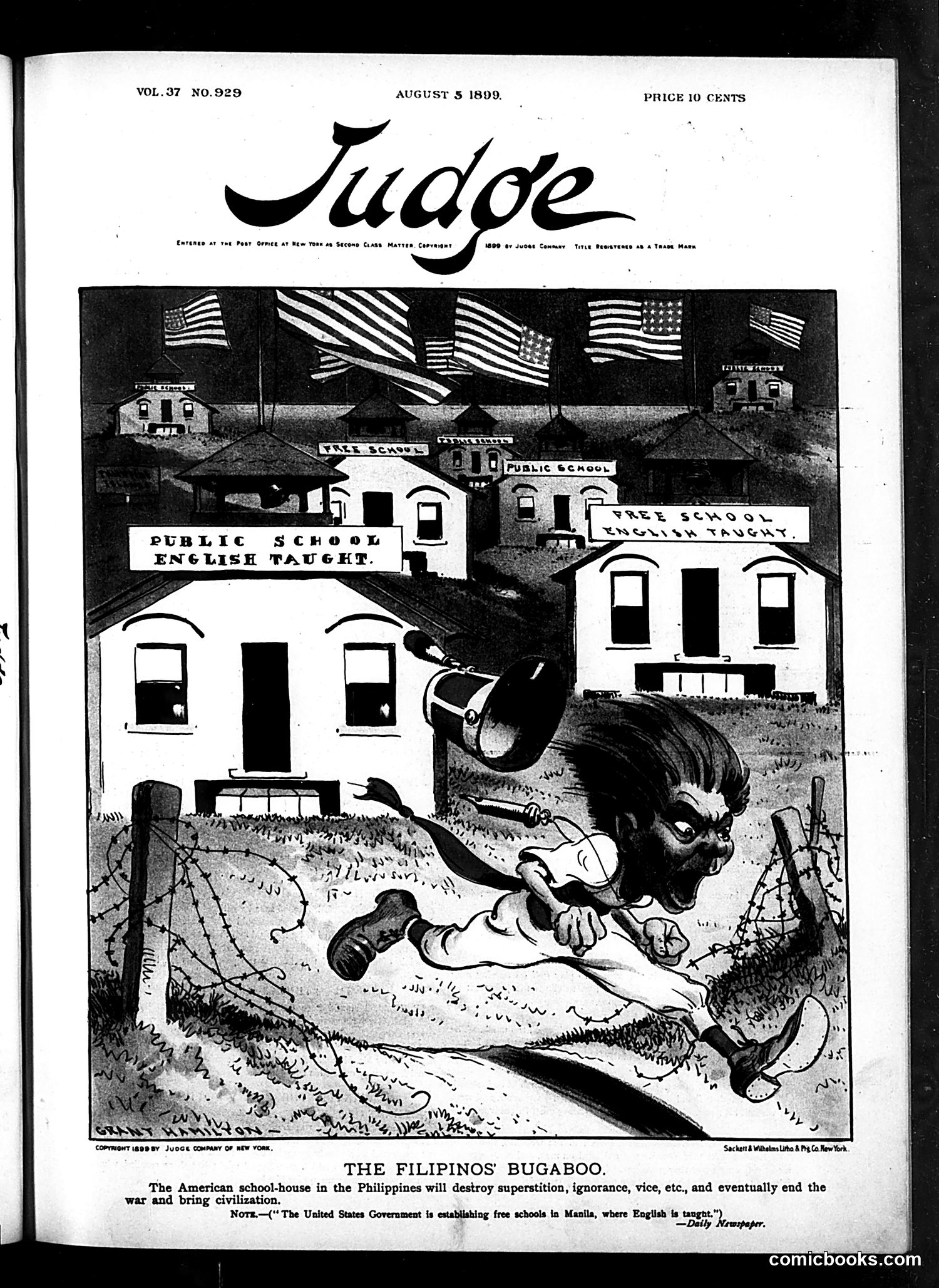
This 1899 *Judge* cartoon satirizes American imperial policy in the Philippines following the Spanish-American War. The image depicts a grotesque caricatured Filipino figure being frightened by American schoolhouses labeled "Public School - English Taught" and "Free School - English Taught." The caption claims American schoolhouses will "destroy superstition, ignorance, vice, etc., and eventually end the war and bring civilisation." The satire works on multiple levels: it mocks both the racist caricature of Filipinos as fearful of education, and sarcastically critiques the American justification for colonization—that education and "civilization" justify military occupation and cultural erasure. The numerous American flags overhead emphasize imperial dominance.
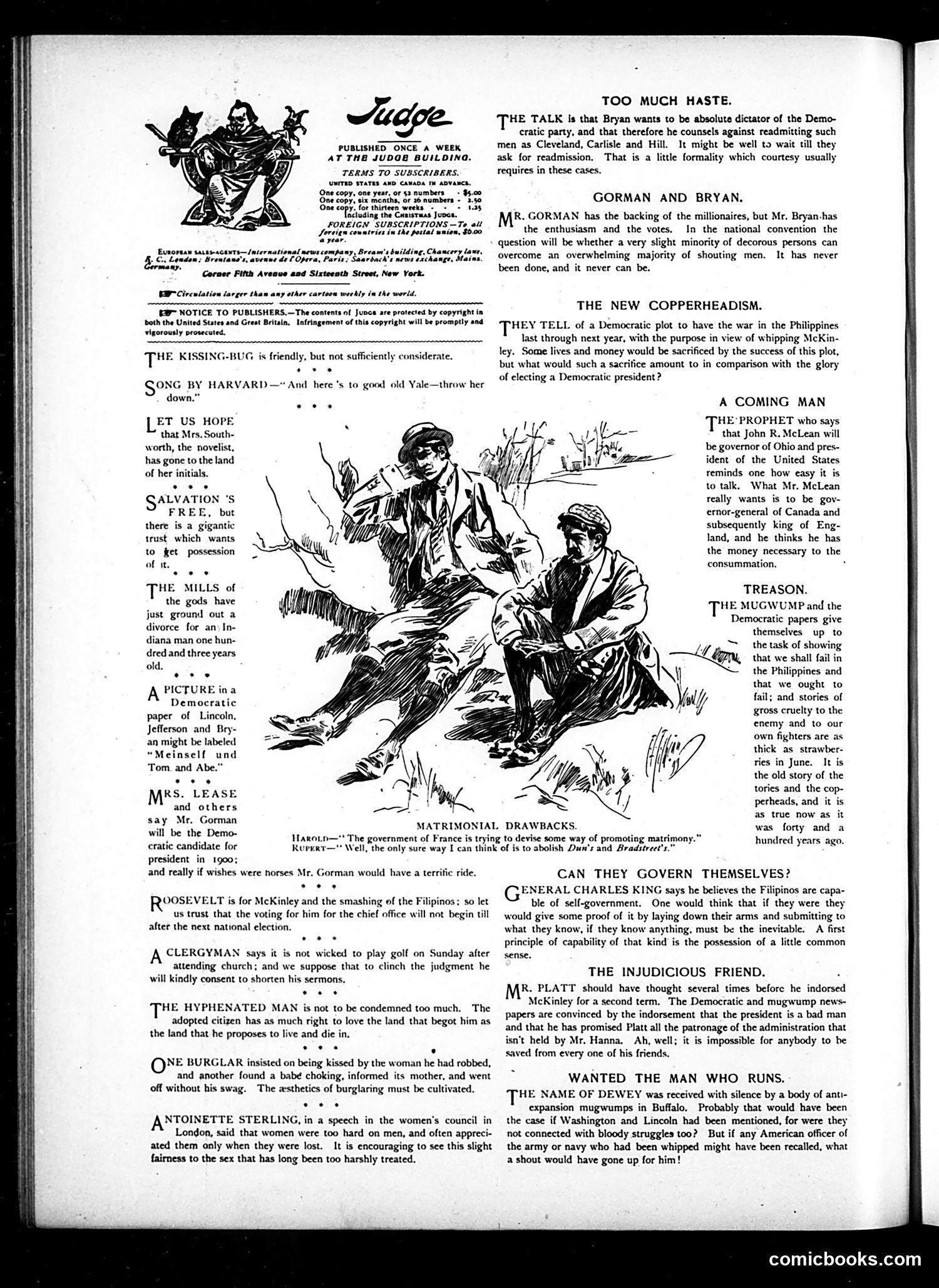
The central cartoon, titled "Matrimonial Drawbacks," depicts two men examining a prone figure, with text referencing France's government attempting to "devise some way of preventing matrimony." This appears to be satirizing French political debates about marriage law. The surrounding text columns mock various political figures and Democratic Party positions, including criticism of William Jennings Bryan's authority within the party, attacks on John R. McLean's political ambitions, and ridicule of Democratic claims about Filipino policy. The overall page attacks the Democratic Party's internal contradictions and leadership, using sharp satirical commentary typical of Judge's Republican-leaning editorial stance during the early 20th century. The specific elections and personalities referenced suggest this dates to the McKinley-Bryan era.
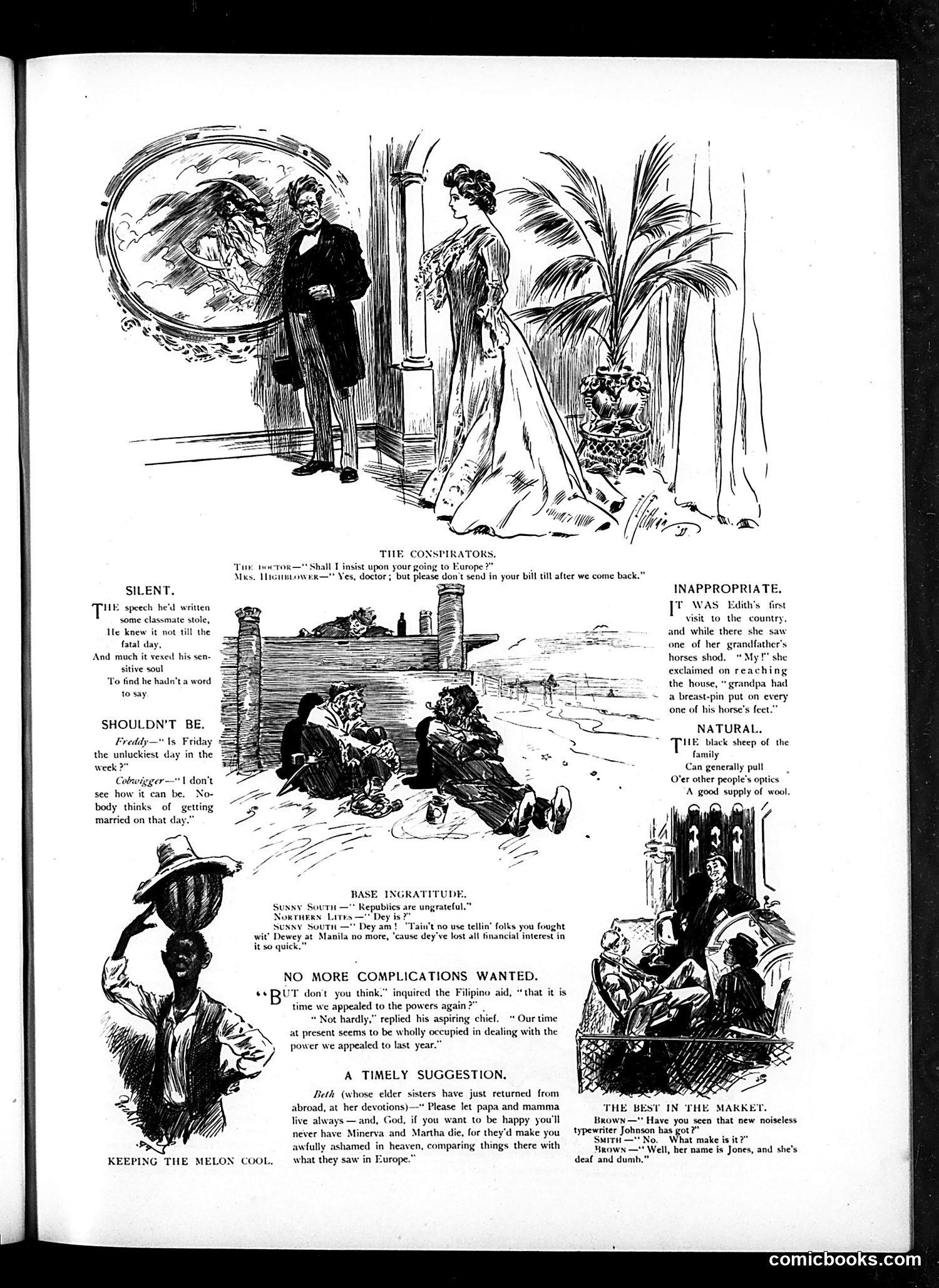
This page contains multiple satirical sketches and humorous dialogue pieces typical of Judge magazine's format. **"The Conspirators"** (top): Shows a man in formal dress and a woman in an elegant gown, with dialogue about going to Europe. The satirical point appears to concern financial concerns during travel—the woman wants assurance her husband will send money while abroad. **Other sketches** address contemporary social observations: "Silent" concerns unmarried people and Friday superstitions; "Shouldn't Be" jokes about marriage on Friday; "Keeping the Melon Cool" depicts a servant figure; and pieces titled "Inappropropriate," "Natural," "Base Ingratitude," and "No More Complications Wanted" offer brief comedic social commentary. **"A Timely Suggestion"** references sisters returning from Europe, satirizing concerns about propriety and family reputation. The page demonstrates Judge's style of mixing visual cartoons with joke-driven dialogue reflecting upper-class American social anxieties of the period.
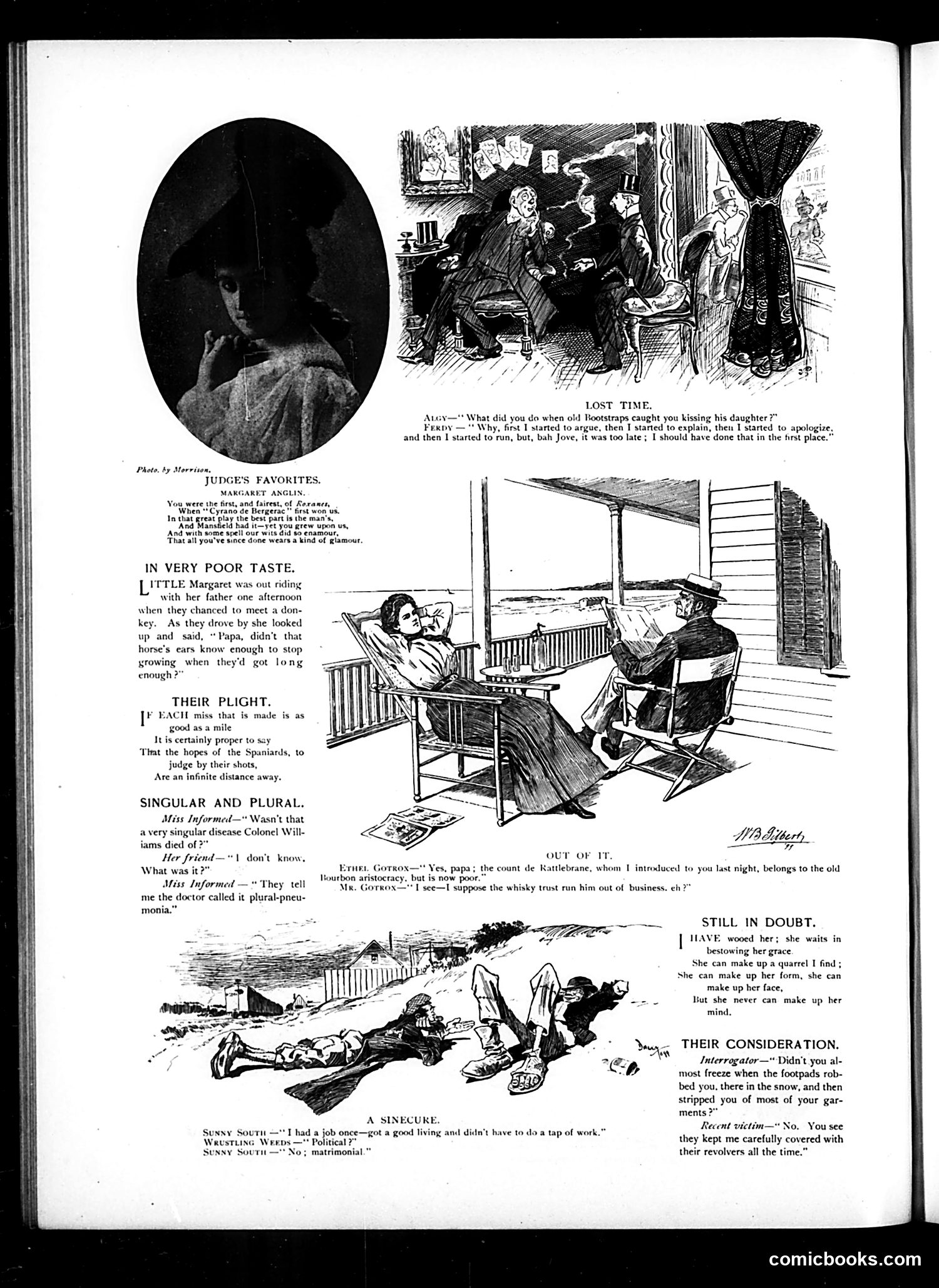
This page contains several humorous sketches and jokes typical of Judge magazine's satirical style. The content includes: **"Lost Time"** - A domestic humor piece where a father catches his daughter kissing, leading to an escalating series of apologies and explanations that ironically makes things worse. **"Judge's Favorites"** and other titled sections feature brief comedic anecdotes about social situations - poor taste in fashion choices, flirtation mishaps, and linguistic confusion (singular vs. plural disease names). **"A Sunecure"** depicts working-class characters discussing political patronage jobs - satirizing how such positions were obtained through connections rather than merit. The illustrations use exaggerated line work characteristic of early 20th-century American humor magazines. Overall, this represents Judge's formula: domestic comedy, social embarrassment humor, and gentle political satire targeting corruption and pretension.
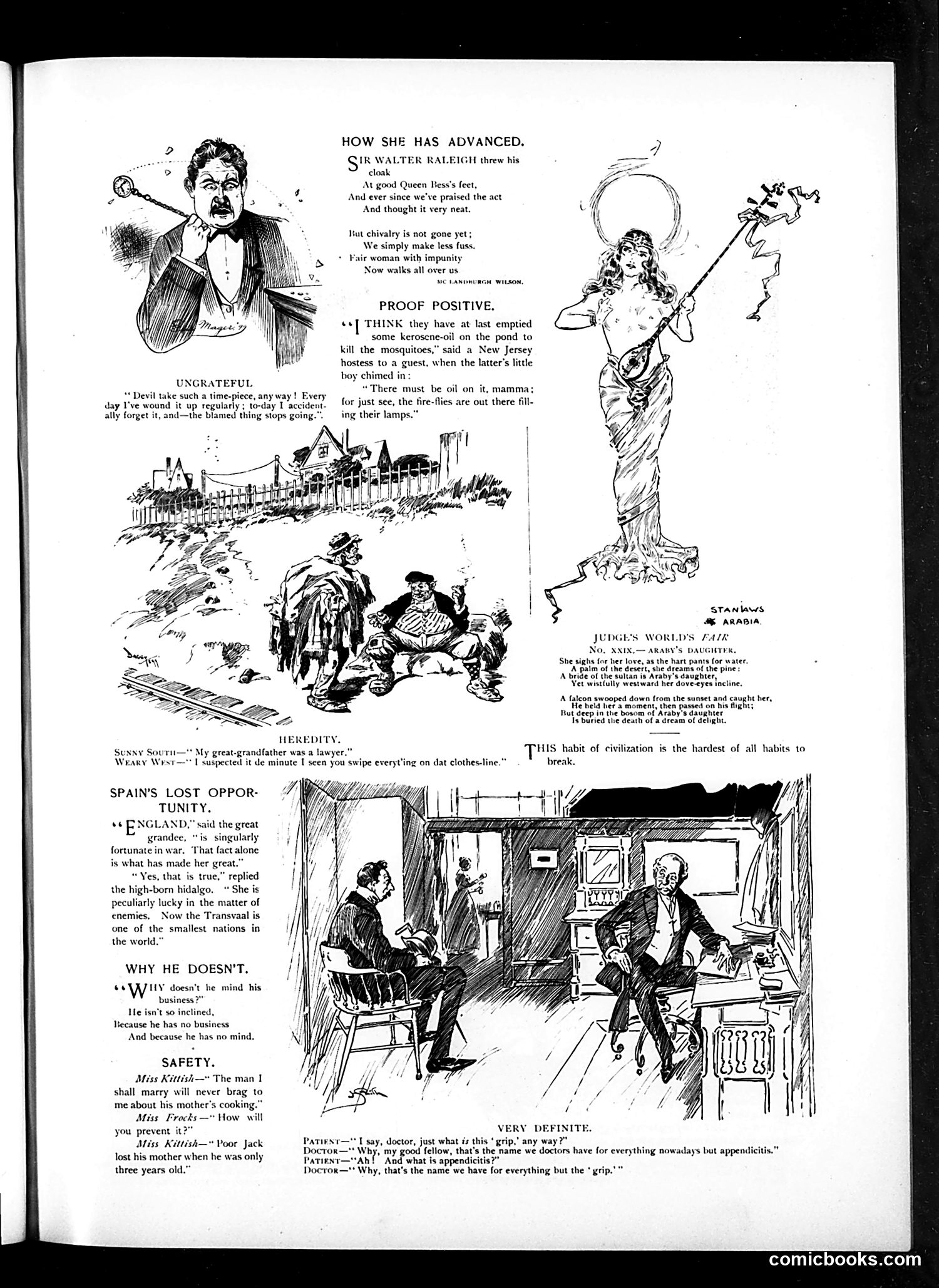
This page from *Judge* contains several brief satirical pieces typical of turn-of-the-century American humor: **"How She Has Advanced"** contrasts Sir Walter Raleigh's gallant gesture (throwing his cloak for Queen Elizabeth) with modern women who now dominate men without reciprocal courtesy—satirizing women's changing social position. **"Proof Positive"** and related brief jokes mock poor logic and everyday absurdities (mosquitoes and kerosene; timepieces and fireflies). **"Spain's Lost Opportunity"** references Spain's military losses, likely alluding to the Spanish-American War (1898) and Spain's subsequent loss of colonies. The Transvaal reference suggests contemporary tensions in the Boer War (1899-1902). **"Judges World's Fair: Araby's Daughter"** presents romantic poetry about an Arab woman longing for Western civilization—reflecting period orientalist attitudes. **"Very Definite"** is a doctor joke playing on medical terminology, with doctors evasively naming diseases after what they *aren't* rather than what they are—satirizing medical uncertainty or obfuscation. The page reflects early 1900s preoccupations: gender role changes, imperial politics, and technological/medical confidence.
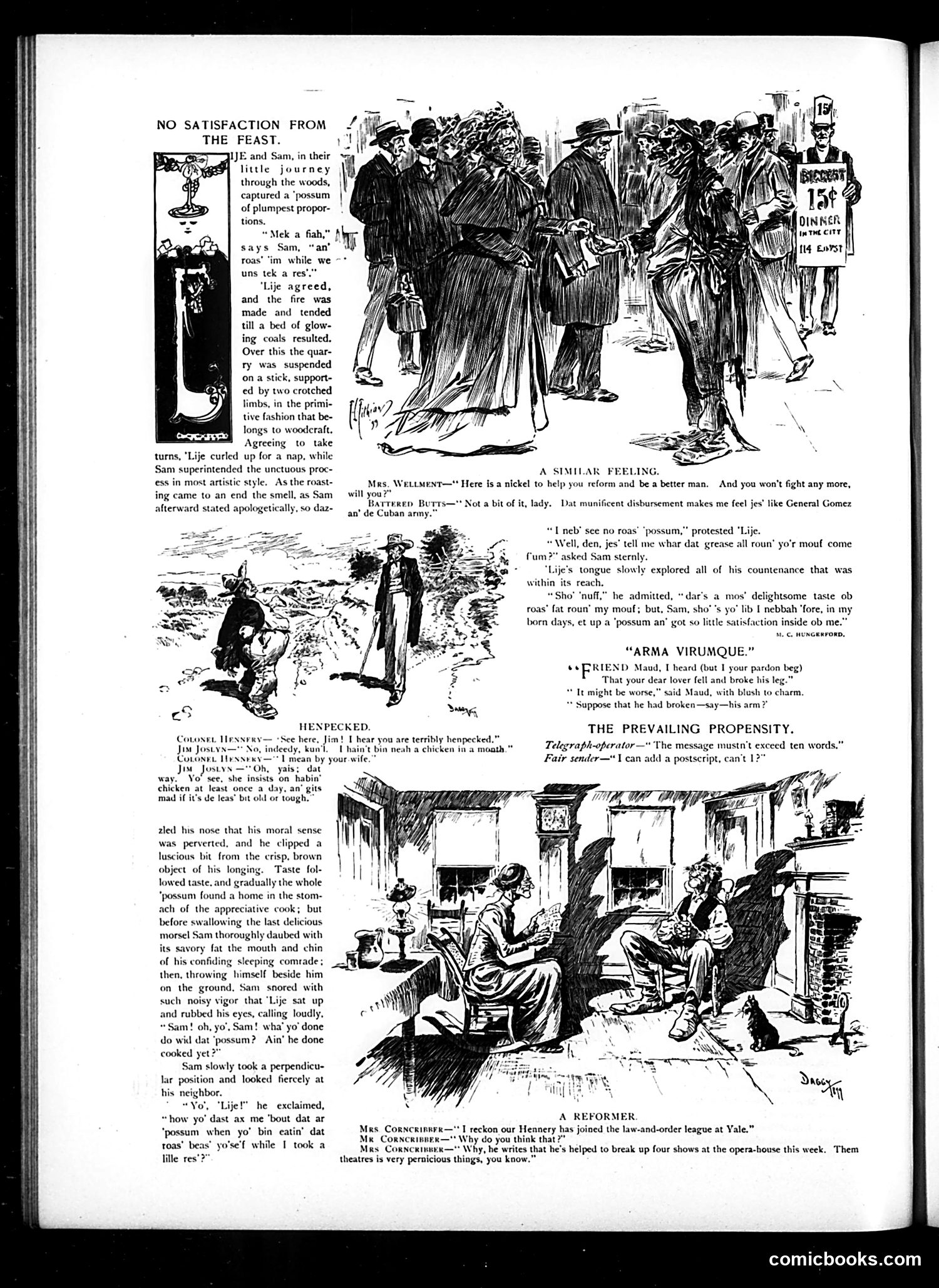
This page from *Judge* magazine contains several satirical sketches mocking social hypocrisy and foolishness: **"No Satisfaction from the Feast"** (top): A rural dialect story where one man eats an entire roasted possum while his companion naps, then denies it despite grease around his mouth. The satire targets working-class dishonesty and gluttony. **"A Reformer"** (bottom): A mother proudly reports her son has "joined the law-and-order league" at Yale by disrupting four opera shows. The joke mocks self-righteous reformers who destructively impose morality while claiming virtue—breaking things in the name of order. **Minor sketches** mock henpecked husbands, a beggar comparing a nickel donation to Spanish General Gómez's war efforts, and someone trying to exceed a telegram's word limit with a "postscript." The common thread: exposing the gap between people's stated principles and actual behavior, particularly among social climbers and would-be moralists.
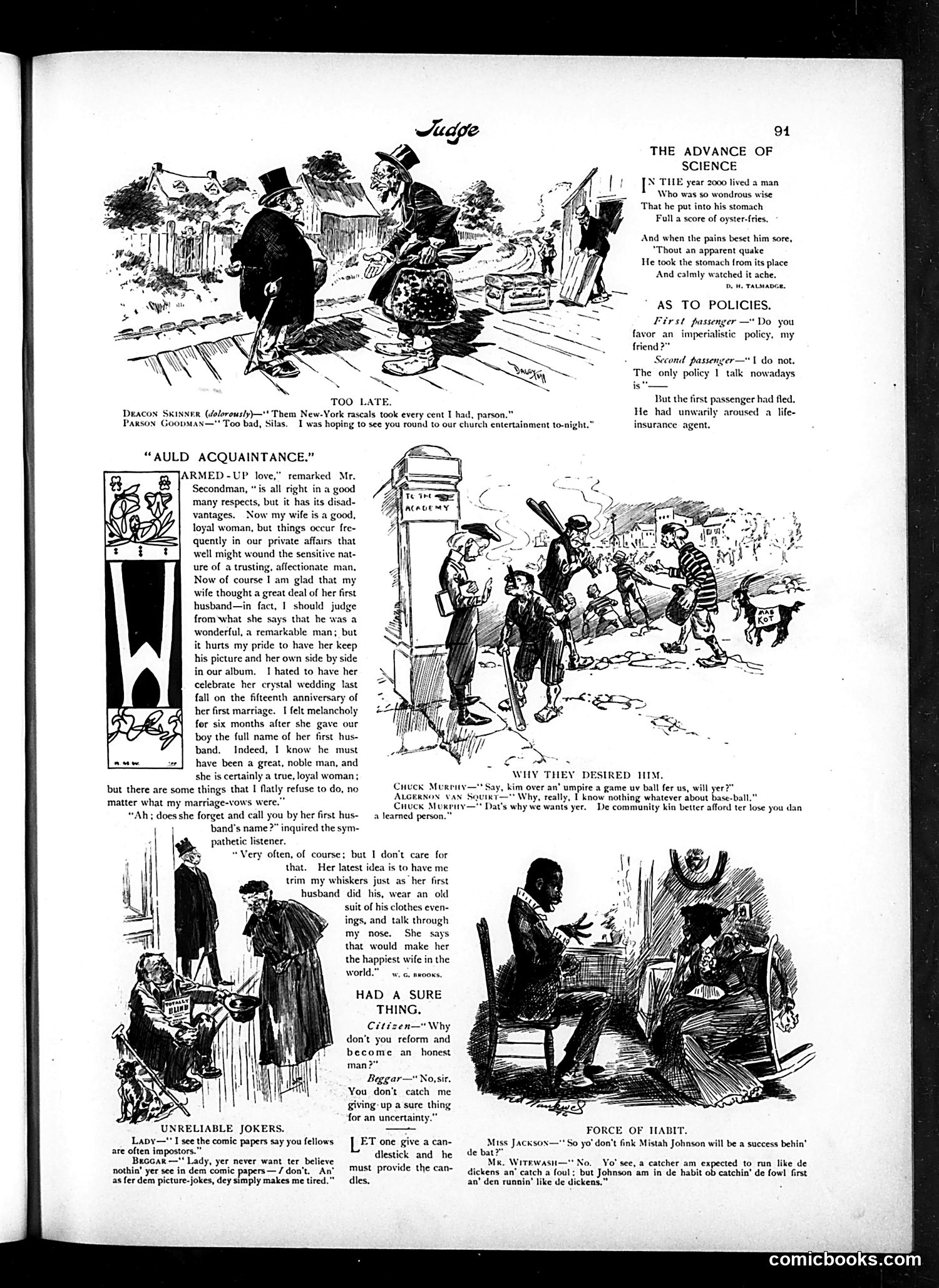
This page contains several satirical sketches on social and marital themes common to early 1900s America: **"The Advance of Science"**: A futuristic joke about 2000 AD where a man removes his stomach to watch it ache separately—mocking both speculative science fiction and hypochondria. **"As to Policies"**: Social satire where discussing "imperialistic policy" (America's contemporary debate over overseas expansion) causes one passenger to flee, suggesting the topic was divisive and uncomfortable in polite company. **"Auld Acquaintance"**: A jealous husband resents his wife's reverence for her deceased first husband—constantly comparing him favorably, keeping his picture, celebrating their anniversary. The humor targets both male insecurity and women's loyalty to previous marriages. **Other sketches** ("Had a Sure Thing," "Unreliable Jokers," "Force of Habit") present short comedic dialogues on various topics—beggary, journalism reliability, baseball. The page reflects early-20th-century concerns: American imperialism, marital psychology, and urban social dynamics. The tone is gently mocking rather than biting.
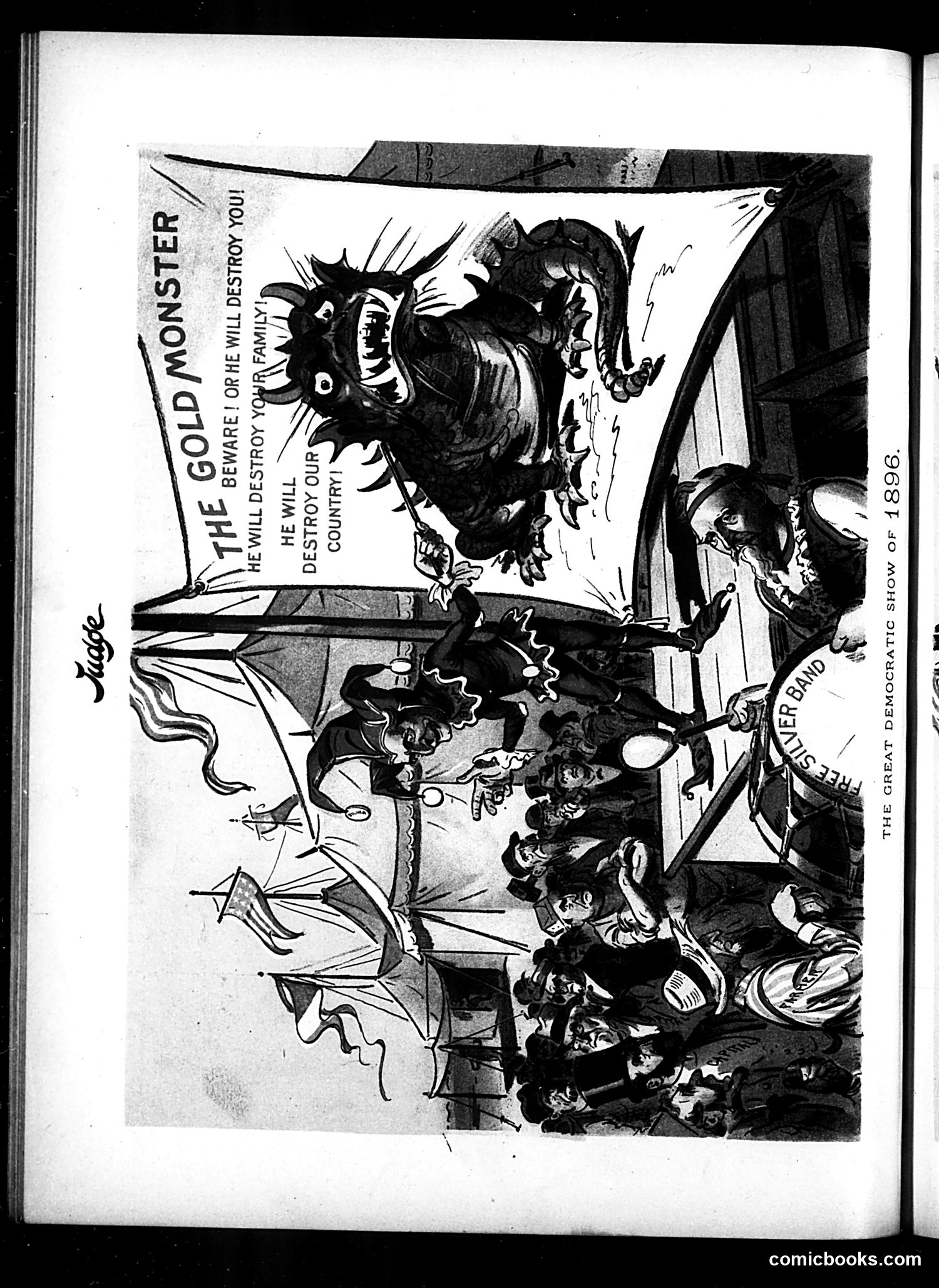
This appears to be a satirical cartoon from *Judge* magazine (dated 1896 based on the visible notation). The image depicts a menacing, multi-headed monster labeled "THE GOLD MONSTER," suggesting anxieties about gold's economic dominance or the gold standard. The text banner reads: "HE WILL DESTROY YOU / HE WILL BEWIRE / OR HE WILL DESTROY OUR COUNTRY BY POVERTY AND WANT." The cartoon shows ordinary citizens (appearing distressed or defensive) confronting this creature, likely representing working-class concerns about monetary policy. This aligns with 1890s American debates over the gold standard versus free silver—a major political issue where advocates claimed gold-based currency harmed farmers and laborers. The satire critiques either: (1) goldbugs (gold standard advocates) as monsters threatening ordinary people, or (2) anti-gold sentiment as paranoid hysteria—depending on the magazine's stance. The grotesque, multi-faced design emphasizes the perceived threat's pervasiveness and inescapability.
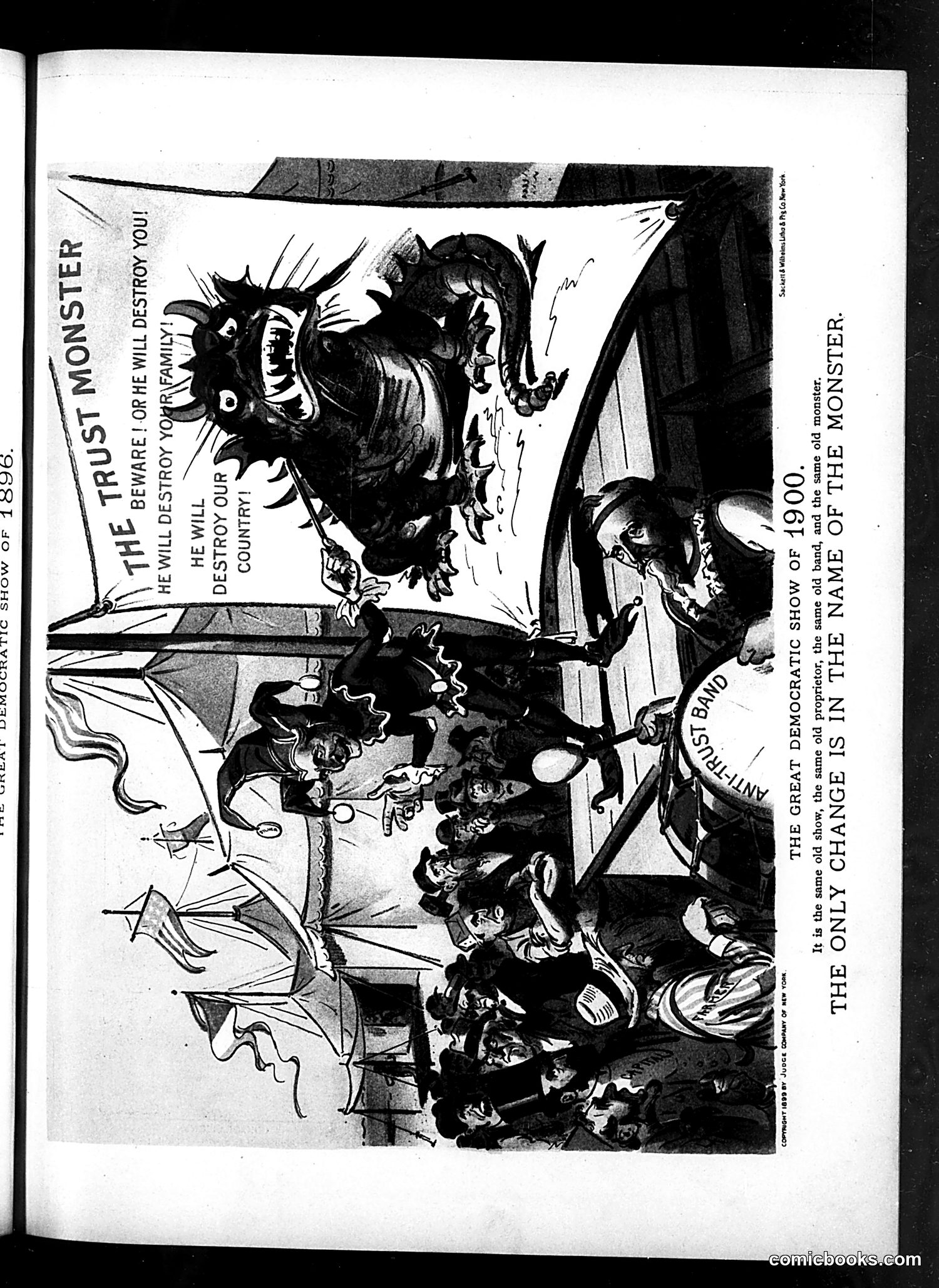
This appears to be a satirical cartoon from *Judge* magazine circa 1896, though the OCR text is largely corrupted and unreadable. The image shows a theatrical scene where figures on stage display a monstrous creature labeled "THE TRUST MONSTER" with text referencing it as a threat that "will destroy your family" and "destroy our country." Below the stage, an audience of ordinary citizens reacts with alarm. The satire targets **corporate monopolies** (trusts) as a major political concern of the 1890s. The cartoon suggests that wealthy business interests were deliberately theatricalizing fears of trusts to manipulate public opinion—essentially using scare tactics. The "great democratic show" caption implies this was performative politics meant to distract rather than solve actual problems. This reflects the Progressive Era's genuine anxiety about industrial consolidation and corporate power, while critiquing how political and business elites exploited these fears for their own purposes.
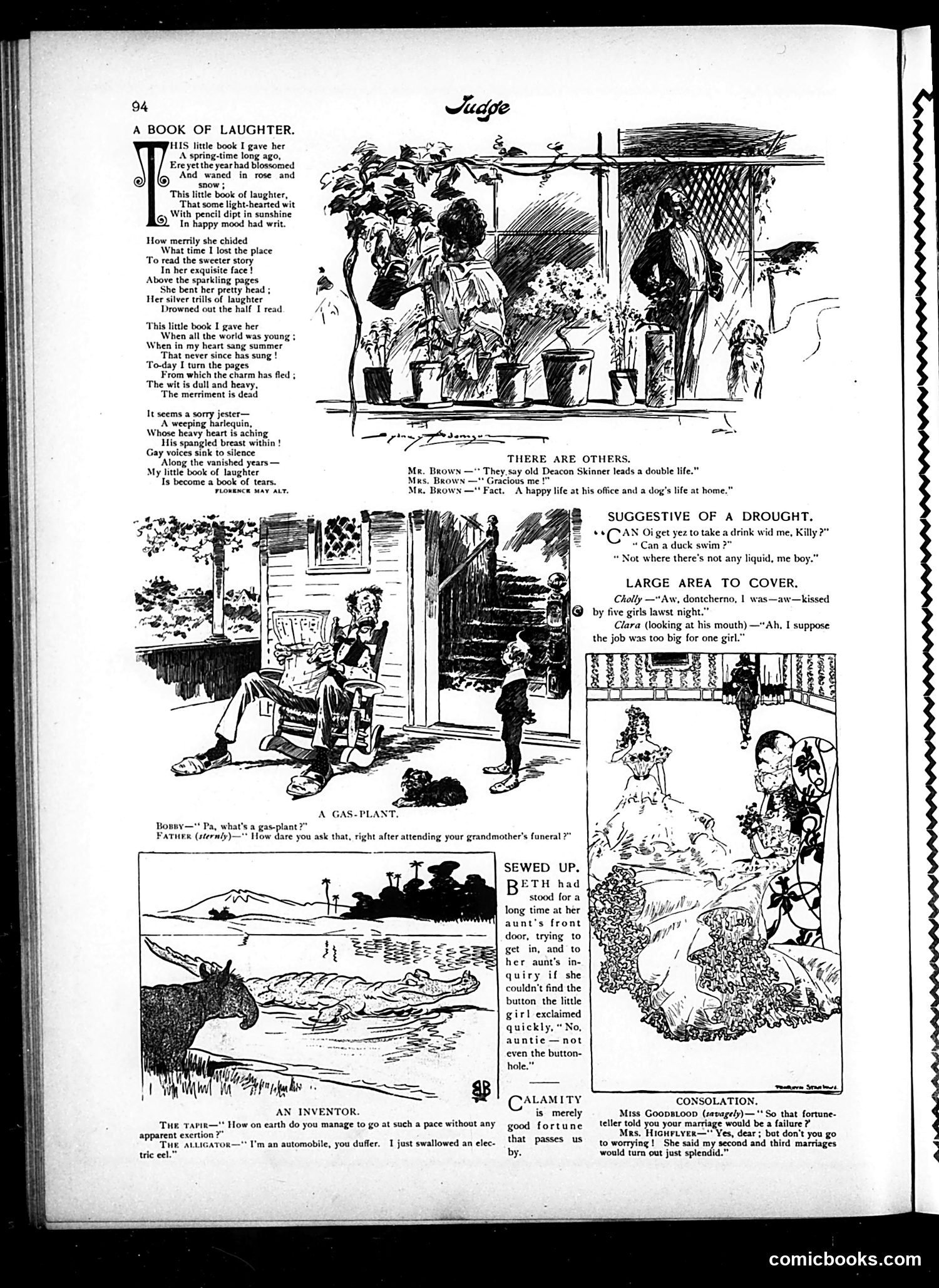
This is a **humor and joke compilation page** from Judge magazine, not a political cartoon. It contains multiple unrelated gags typical of early 20th-century American humor: **Key content:** - A sentimental poem about a gift book that once brought joy but now seems hollow—nostalgic reflection on lost youth and faded romance - Several short joke vignettes mocking domestic life, Irish immigrants (the "Killy" dialect joke), courtship, and class differences - "A Gas-Plant" jokes about a father's stern reaction to innocent questions - References to drought/lack of drinking water - Marriage jokes depicting husbands as miserable ("dog's life at home") - An "inventor" alligator claiming to be an automobile **The satire targets:** marriage as misery, class pretensions (the "Cholly" character), immigrant stereotypes, and general domestic unhappiness. The recurring theme is disillusionment—with love, life, and marriage. These are **gentle social comedies** rather than sharp political satire.
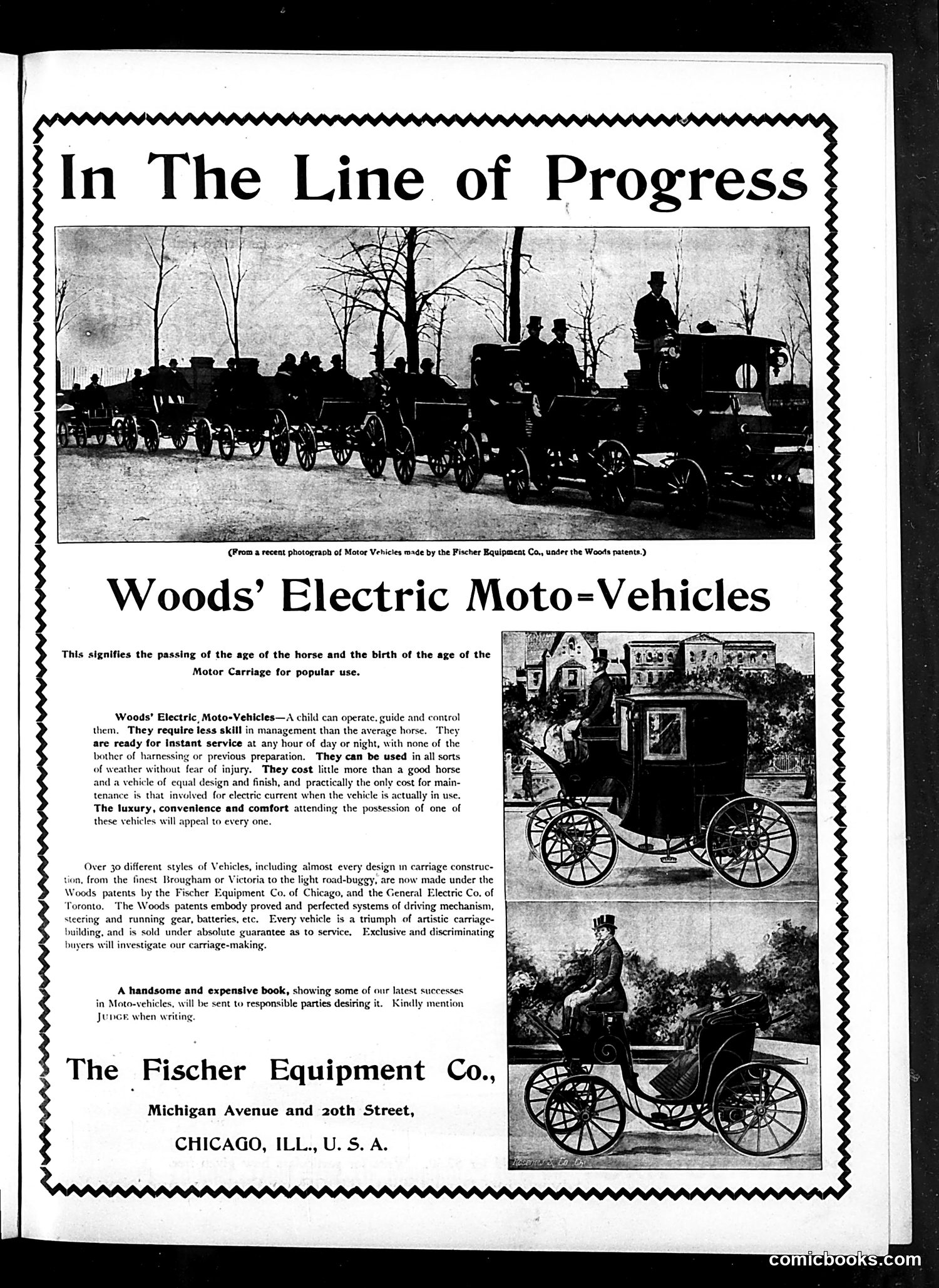
This is primarily **advertising content**, not satire—though Judge's inclusion of it is telling. The page promotes electric automobiles from Fischer Equipment Co., using Woods patents. The "satire" lies in Judge's framing: the title "In The Line of Progress" ironically presents these vehicles as revolutionary replacements for horses. The top photograph shows horse-drawn carriages alongside early electric cars—a visual commentary on technological transition. The advertisement's language reveals period anxieties: it emphasizes that electric cars require "less skill" than horses, can operate in any weather, need no "harnessing," and cost "little more than a good horse." These reassurances suggest the target market—wealthy, cautious consumers skeptical of new technology. By 1900s standards, this represented genuine innovation: electric vehicles were briefly competitive with gasoline cars before being displaced. Judge's placement suggests both promotion and gentle mockery of the "automobile age" enthusiasm gripping America's elite.
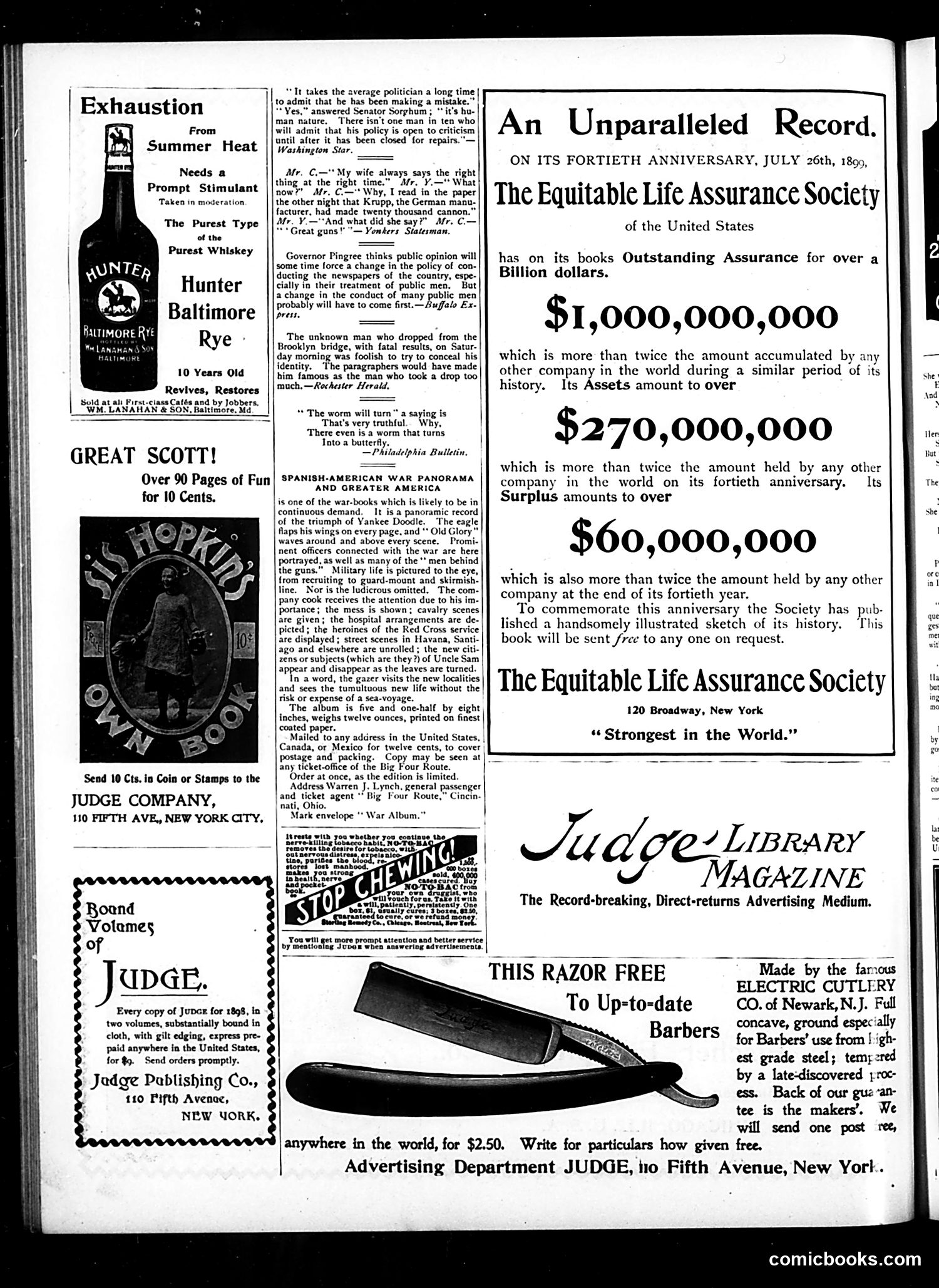
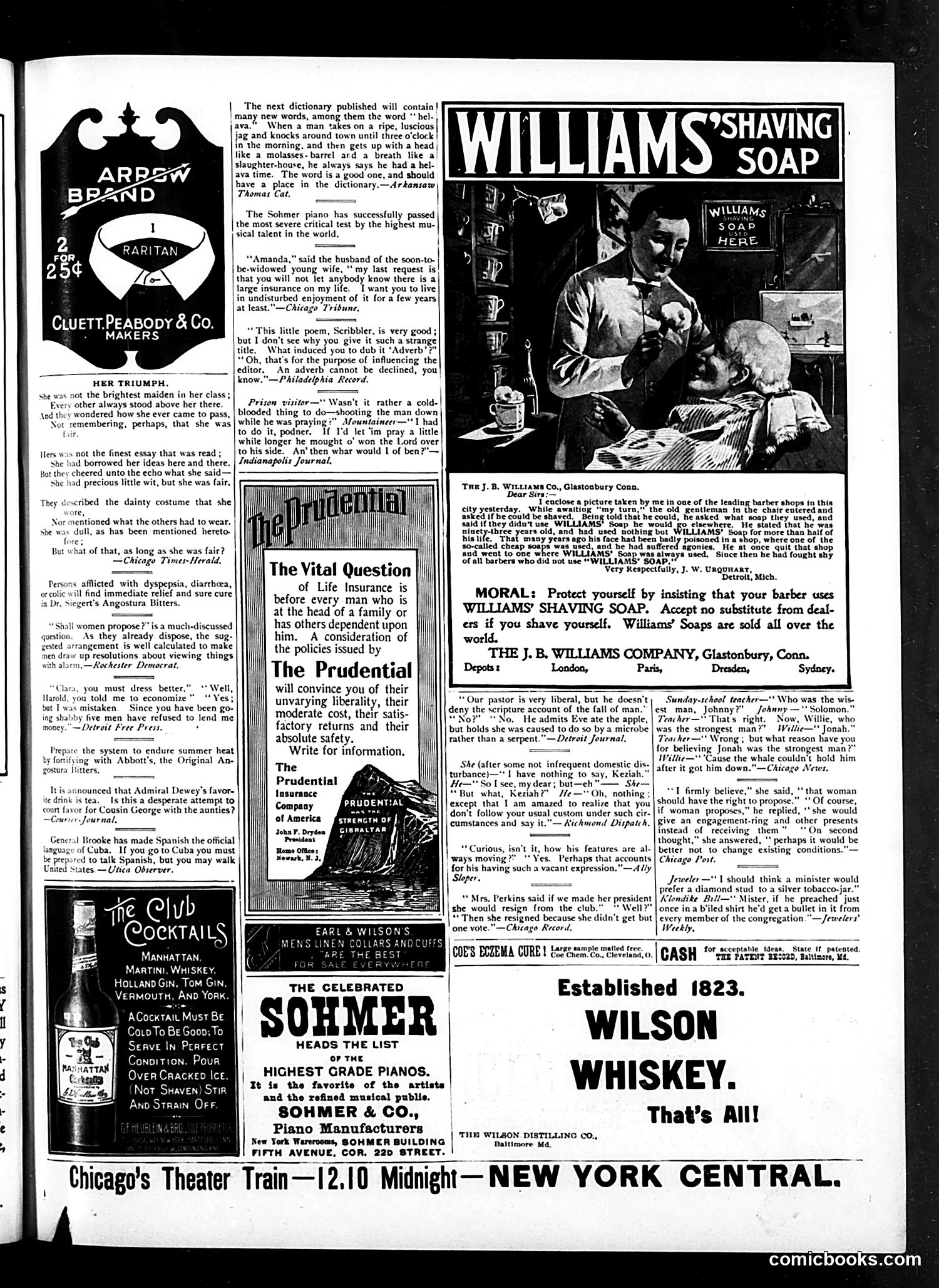
This page is primarily **advertising**, not political satire or editorial content. The page contains scattered short humorous anecdotes and jokes (typical filler for *Judge* magazine) surrounding commercial advertisements. Notable ads include Williams' Shaving Soap, Wilson Whiskey, Sohmer pianos, The Prudential Insurance Company, and The Club Cocktails. The anecdotes—about a fair but unremarkable woman, dictionary slang, insurance, and a prison scene—are generic period humor with no specific political targets. One mentions "General Brooke" making Spanish official in Cuba (likely referring to post-Spanish-American War military administration), but offers no satirical commentary. The "Her Triumph" poem satirizes society's tendency to praise attractive women regardless of merit—a common early-1900s social critique about gender and appearance, not directed at specific figures or events. This is essentially a magazine page balancing editorial content with revenue-generating advertisements.
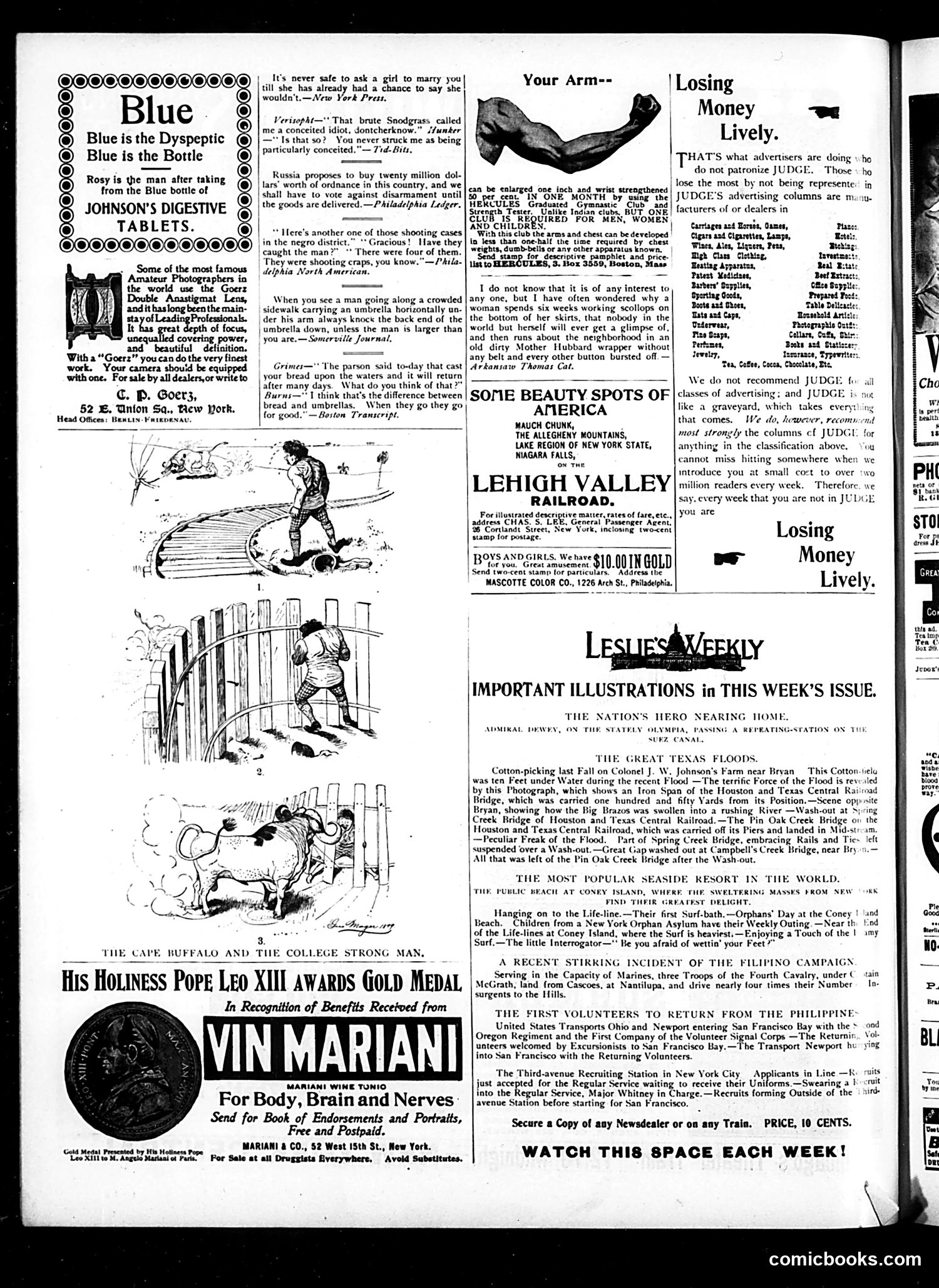
This page from the satirical magazine *Judge* is primarily a collection of **advertisements, humorous anecdotes, and editorial commentary** rather than traditional political cartoons. The main visual content includes cartoons illustrating period humor: a man with an umbrella (referencing social etiquette), a figure with a camera, and a man climbing (titled "The Cape Buffalo and the College Strong Man"). **Key content:** The anecdotes mock human behavior—vanity in photography, pretension ("That brute Snodgrass called me a conceited idiot"), gender stereotypes (a woman's inexplicable wardrobe choices), and absurdity (comparing bread on water to umbrellas). **The satire:** The repeated theme warning advertisers not to patronize *Judge* is self-promotional irony: the magazine jokingly suggests excluding their pages will cost readers access to products and services. This playful misdirection drives the magazine's advertising strategy. **Context for modern readers:** This reflects early 1900s humor—mannered, relying on domestic observations and gender-based jokes that modern audiences would find dated and occasionally offensive.
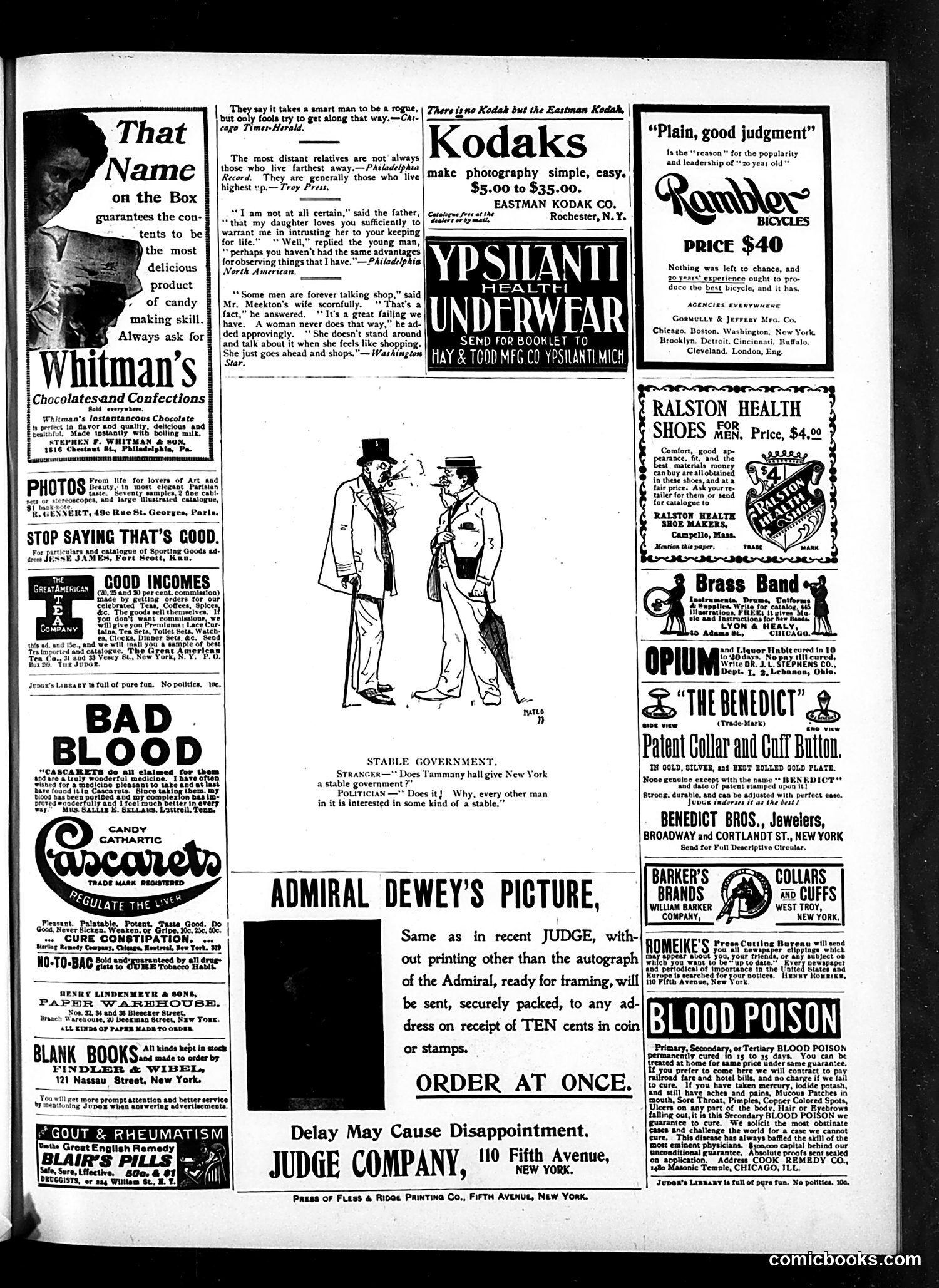
This page is primarily **advertisements** with one central political cartoon. ## The Cartoon The single cartoon depicts two well-dressed men in conversation labeled "STABLE GOVERNMENT." One is identified as a **Stranger**, the other a **Politician**. The joke plays on the word "stable"—when the Stranger asks if Tammany Hall (the infamous New York Democratic machine) provides stable government, the Politician responds that "every other man in it is interested in some kind of a stable," suggesting they're only interested in horses/stables, not actual governance. This satirizes **Tammany Hall's corruption and incompetence**, portraying its members as more concerned with vice and frivolous interests than actual public administration. ## Historical Context Tammany Hall was notorious for political corruption and cronyism in late 19th/early 20th century New York. The cartoon mocks this through wordplay—a common technique in Judge's satirical humor. The rest of the page contains typical period advertisements for patent medicines, bicycles, cameras, and other products.
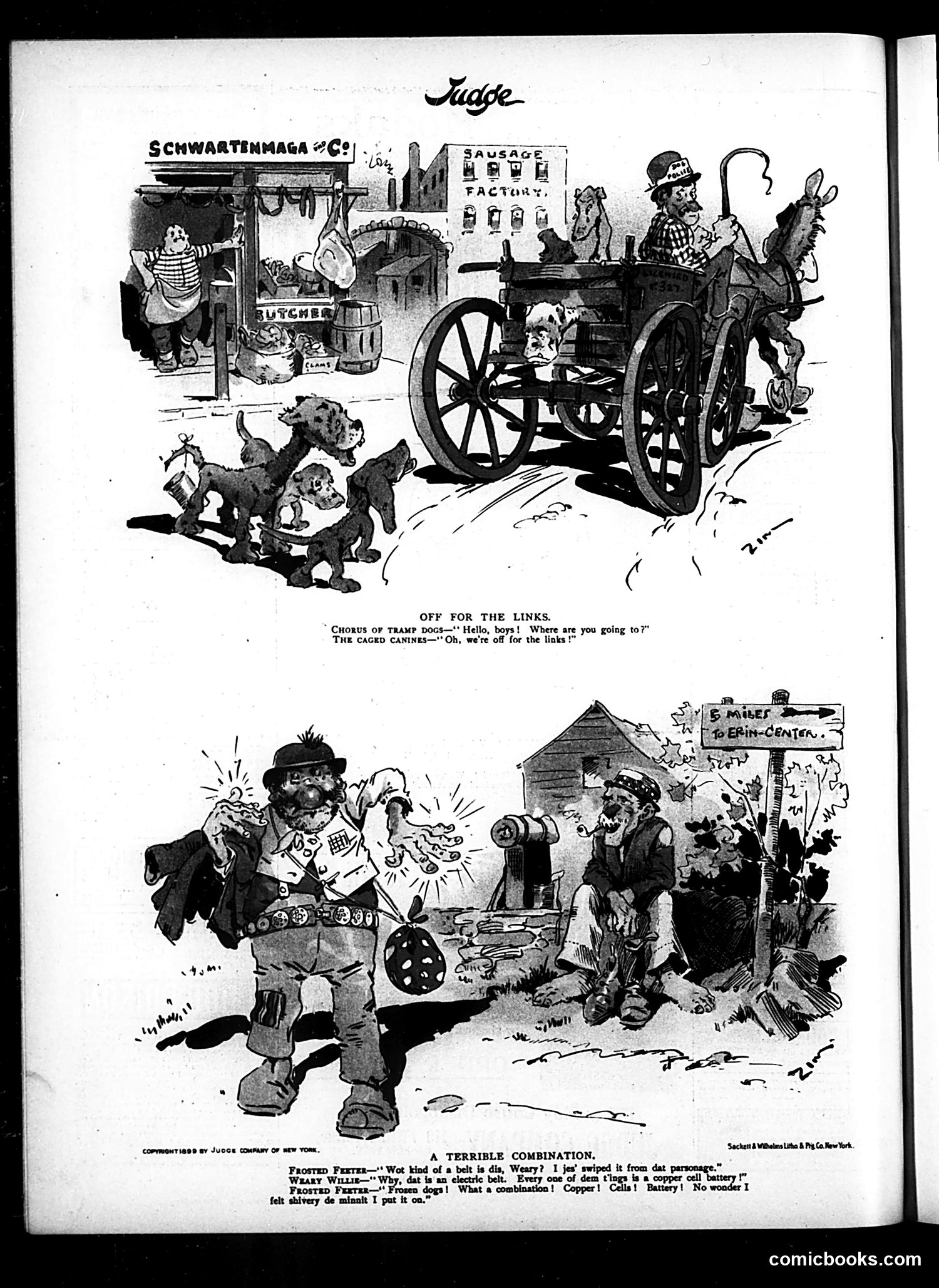
This page contains two cartoon jokes from 1899 targeting tramps and vagrant life. **"Off for the Links"** (top): Tramp dogs escape a butcher shop and sausage factory, joking they're "off for the links"—a pun on golf links. The humor relies on the double meaning: the dogs are fleeing to freedom while the phrase suggests leisure, when tramps would actually be desperate and hunted. **"A Terrible Combination"** (bottom): Two tramps ("Weary Willie" and "Frosted Fentzer") discuss a stolen electric belt. The joke hinges on wordplay: one tramp warns that combining "copper" (both the metal in the belt and slang for police) with a "battery" creates danger. The final pun—feeling "shivery"—conflates electrical shock with the tramps' actual physical misery. Both cartoons mock homeless men through crude caricature and puns, reflecting late-19th-century attitudes treating poverty as comic subject matter.