
A complete issue · 17 pages · 1899
Judge — May 6, 1899
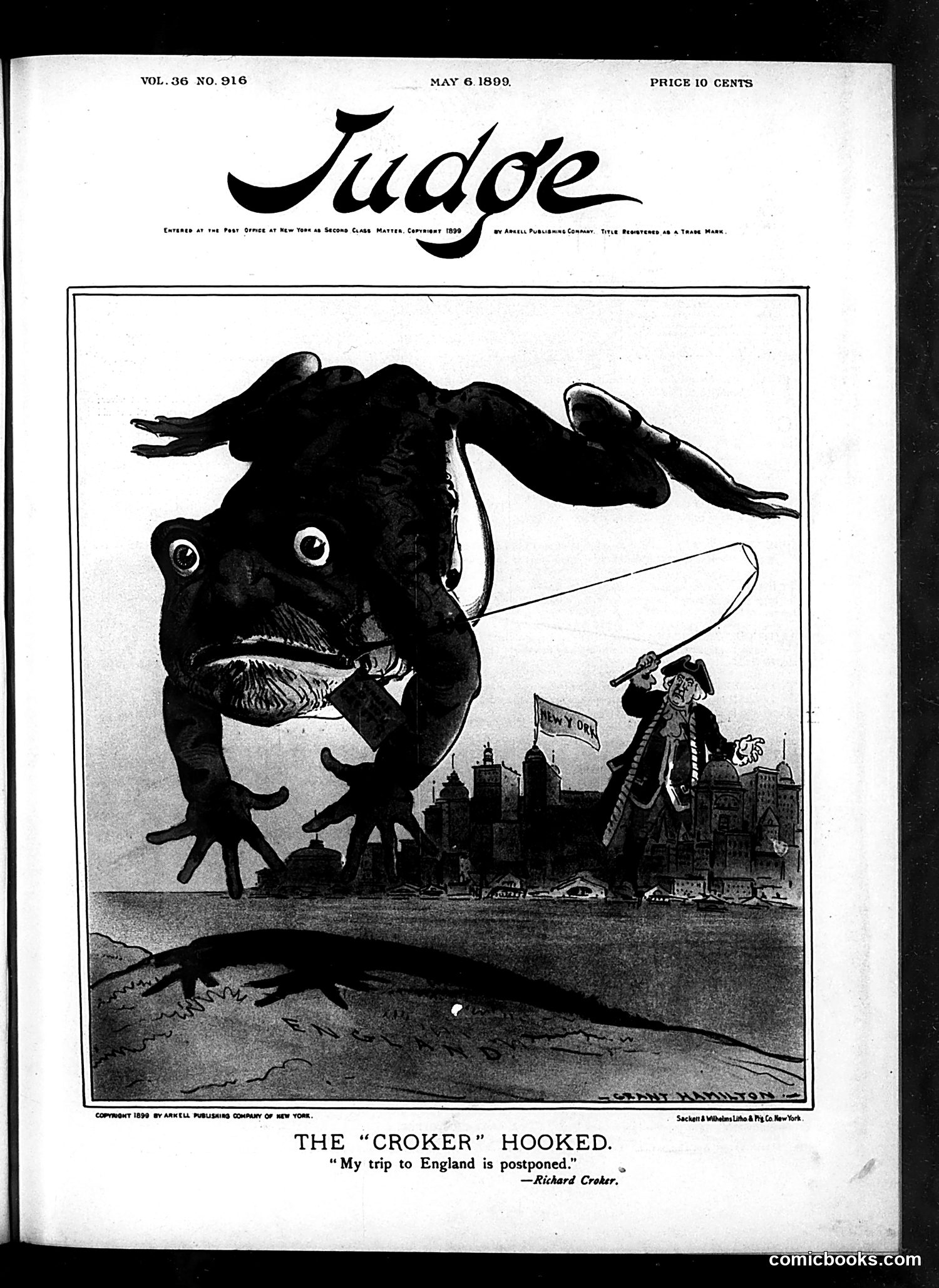
This 1909 Judge cartoon satirizes **Richard Croker**, the notorious Tammany Hall boss (visible in the small figure at right). The giant, grotesque creature represents political corruption itself—specifically the scandal surrounding Croker's political machine in New York. The fishing metaphor is key: someone (likely reformers or law enforcement) has "hooked" Croker, catching him like a fish. The New York skyline in the background grounds this in the city's political context. The caption quotes Croker: *"My trip to England is postponed,"* suggesting his plans have been disrupted by legal trouble or political exposure. This implies Croker was forced to stay and face consequences rather than escape abroad—a commentary on accountability finally catching up with a corrupt political operator.
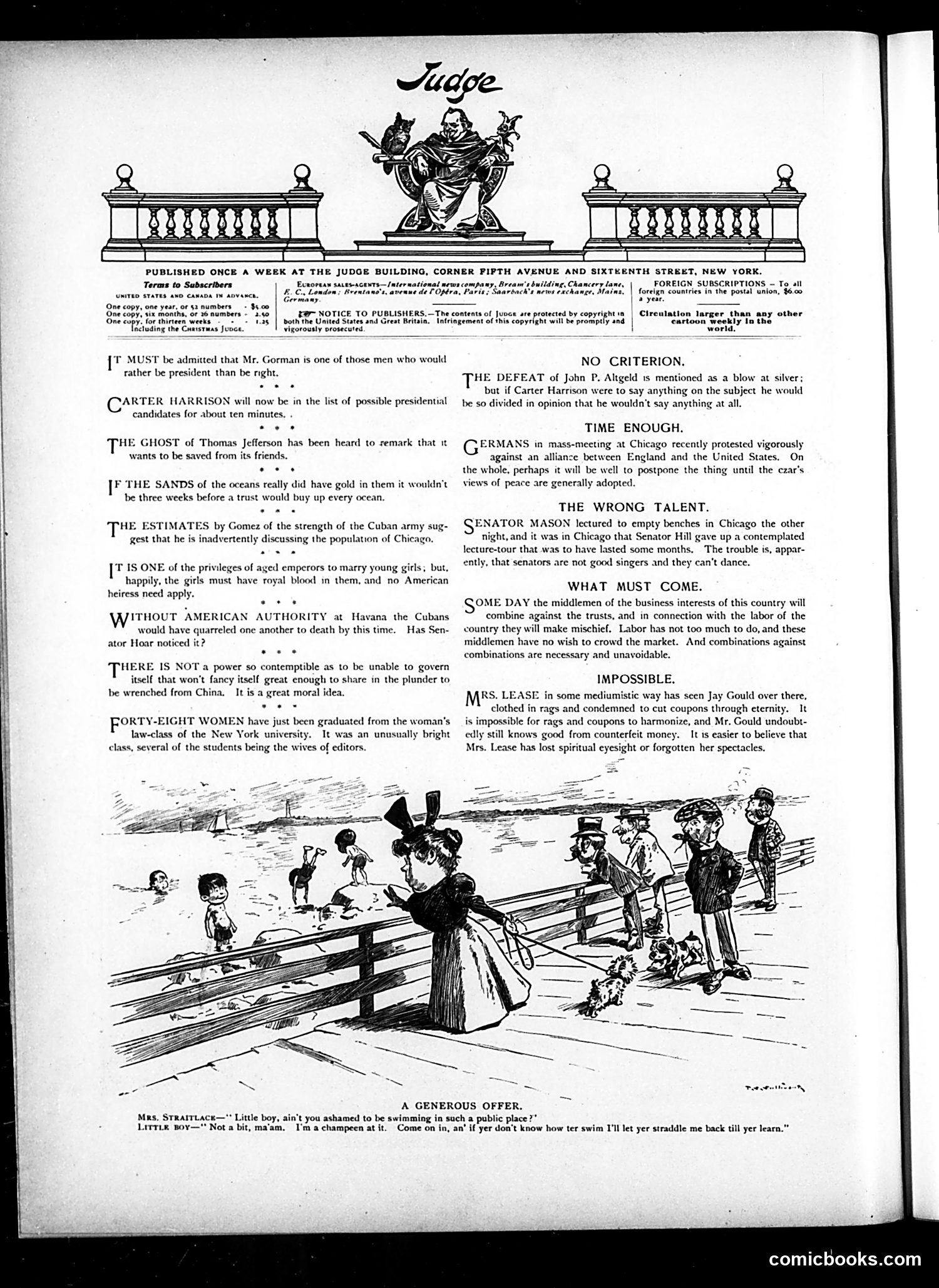
The main cartoon, titled "A Generous Offer," depicts a wealthy woman (Mrs. Straitlace) at a beach boardwalk offering a poor boy money—but with condescending strings attached. She claims giving him money in "such a public place" would be shameful, so she'll instead control his spending ("straddle me back till yer learns"). This satirizes upper-class hypocrisy: wealthy individuals performed charitable acts publicly for reputation while maintaining paternalistic control over the poor rather than offering genuine assistance or dignity. The setting emphasizes class division—the boardwalk as a space where social hierarchies were visibly performed. The surrounding text items mock various public figures and political issues of the era (likely early 1900s), using brief satirical quips typical of Judge's format.
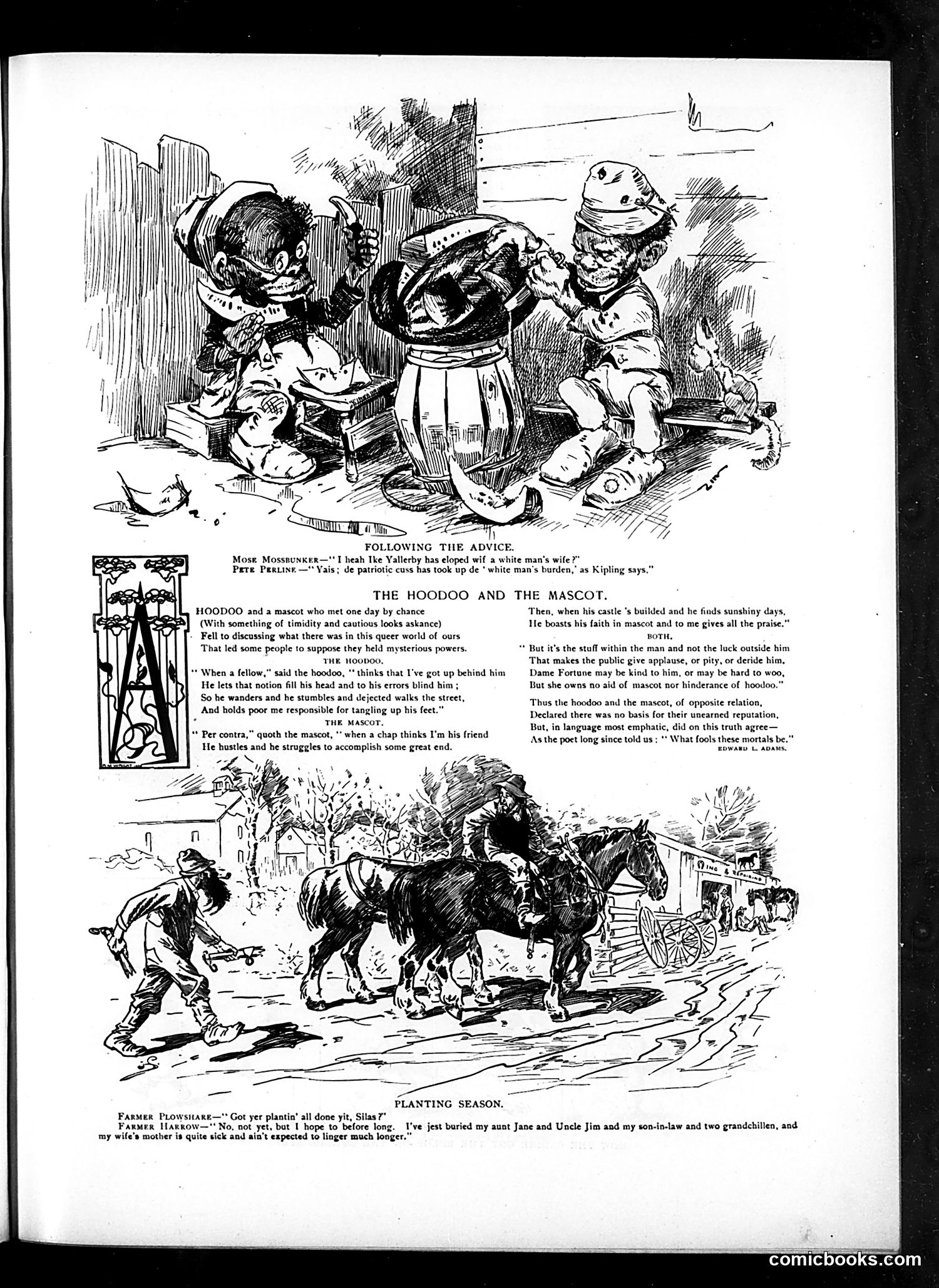
This page satirizes superstition and folk beliefs prevalent in late 19th/early 20th-century America. The top cartoon shows characters discussing a "hoodoo" (bad luck curse) and a "mascot" (good luck charm)—both rooted in African American folklore that had entered popular culture. The satire mocks how people of all classes relied on these "mysterious powers" rather than practical solutions. The dialogue between "More Mossbunker" and "Pete Pulsing" emphasizes the absurdity: one character believes in curses while another trusts mascots, yet both avoid actual responsibility. The bottom illustration shows a rural planting scene, illustrating how such superstitions persisted in agricultural communities where unpredictable outcomes made magical thinking appealing.
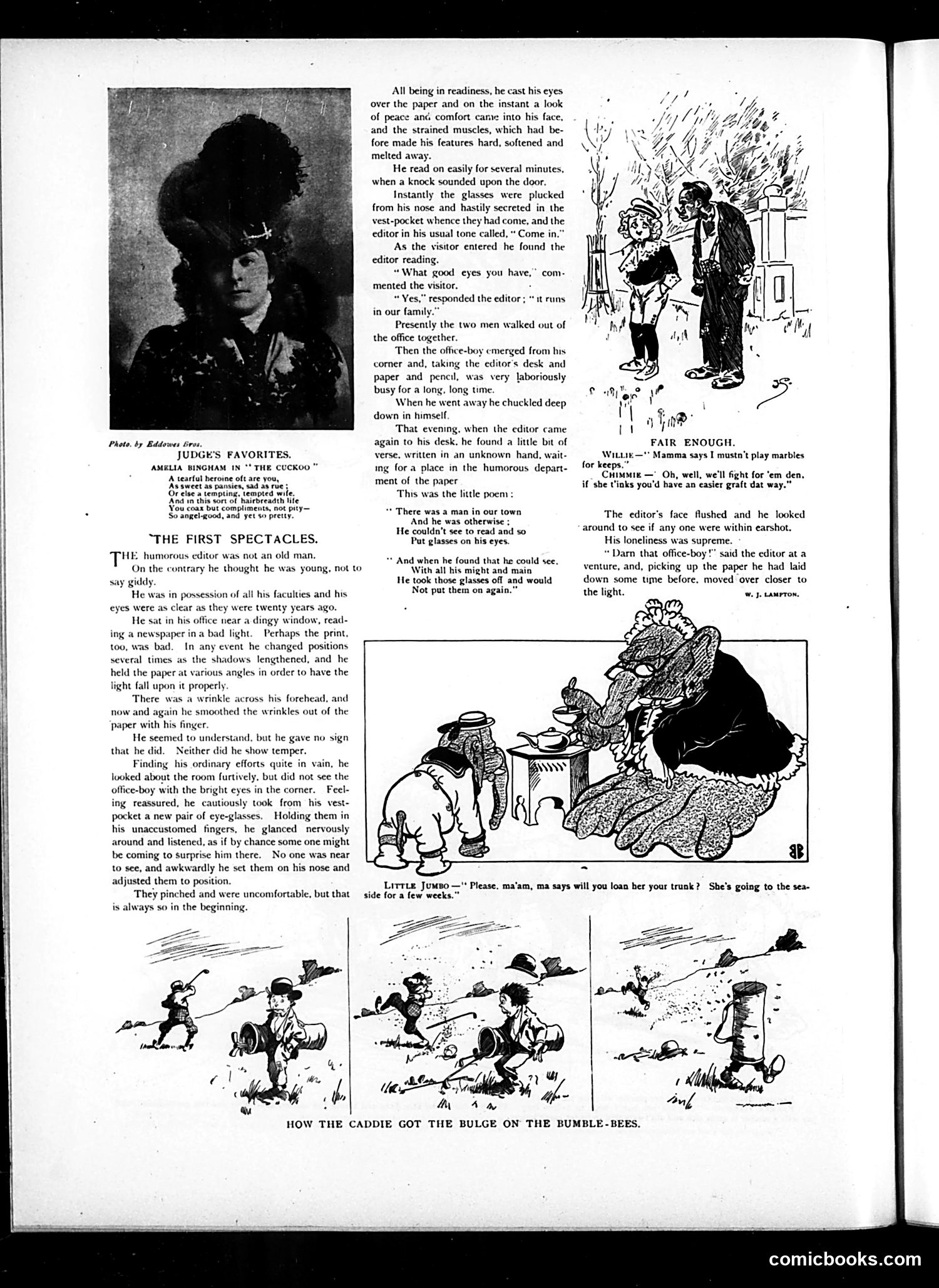
This page contains a story titled "The First Spectacles" about an editor struggling with vision problems, and several humorous cartoons. The main narrative describes an editor who, after years of eyestrain from poor office lighting and newspaper work, finally acquires eyeglasses. The story satirizes his reluctance to wear them publicly and his initial discomfort—a relatable commentary on vanity and the stigma surrounding corrective eyewear in this era. The bottom cartoon, "How the Caddie Got the Bulge on the Bumble-Bees," appears to be a lighthearted children's story about a caddie (golf course worker) outwitting bees through a sequence of comic misadventures. The page reflects early-20th-century humor about everyday life, workplace frustrations, and social anxieties around visible signs of aging or physical limitation.
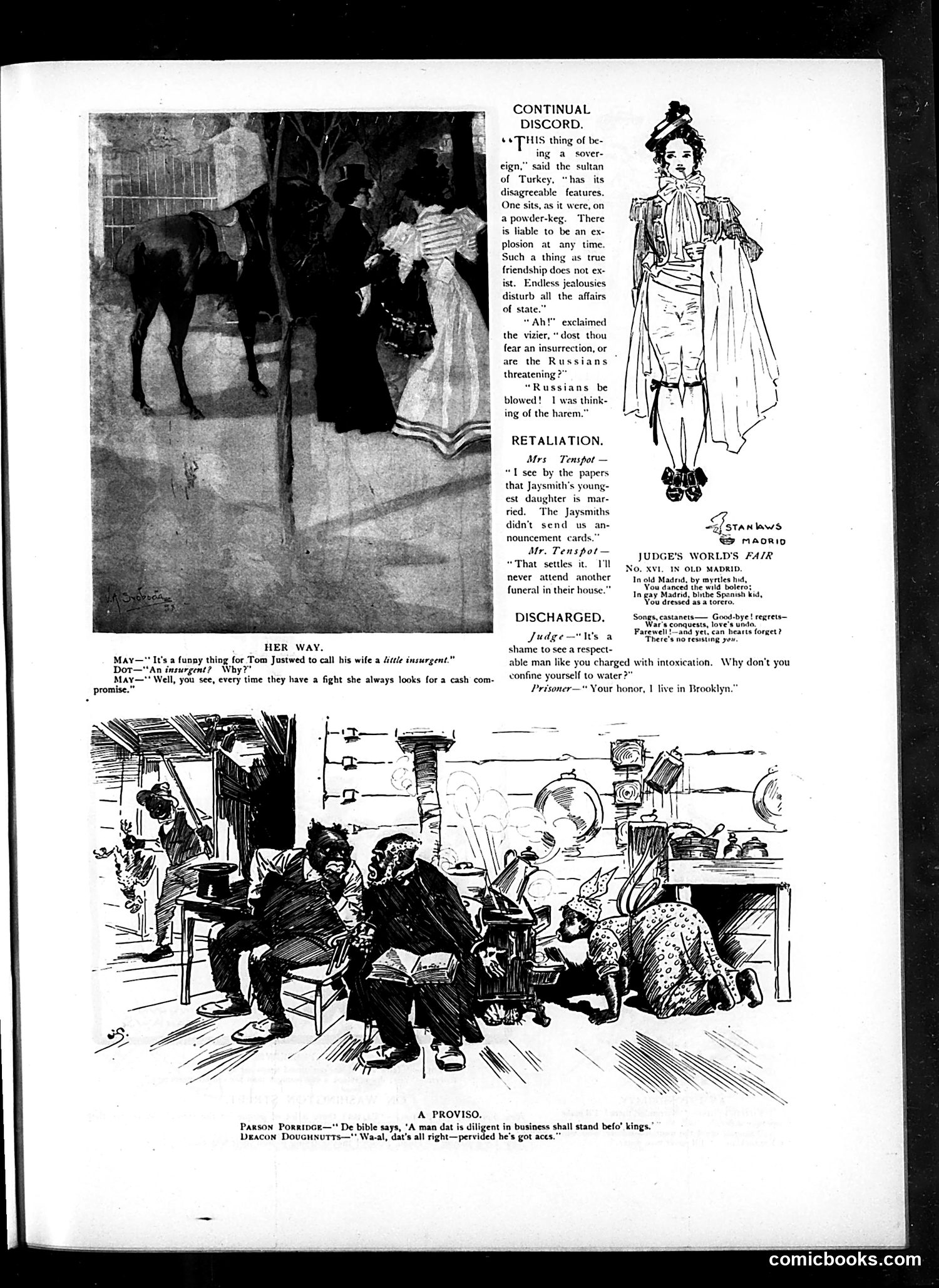
This page satirizes various social and political absurdities of the era. The top section mocks the Ottoman Sultan's instability—he worries about revolution and Russian threats, but his vizier suggests the real danger is harem intrigue, implying the Turkish government is preoccupied with petty domestic drama rather than serious governance. "Retaliation" jokes about bourgeois social snubbing: the Tenpots didn't receive wedding announcements from the Jaysmiths, so they'll reciprocate by ignoring their funeral—a petty revenge over etiquette. Other sketches include marital humor about an "insurgent" wife, a drunk man defending his Brooklyn water consumption, and a preacher's hypocrisy about biblical diligence in business (caveat: "provided he's got aces"—suggesting connections matter more than virtue). The fashion illustration showcases contemporary women's clothing. The humor relies on class anxieties, domestic discord, and religious hypocrisy—typical Judge fare mocking middle-class pretensions.
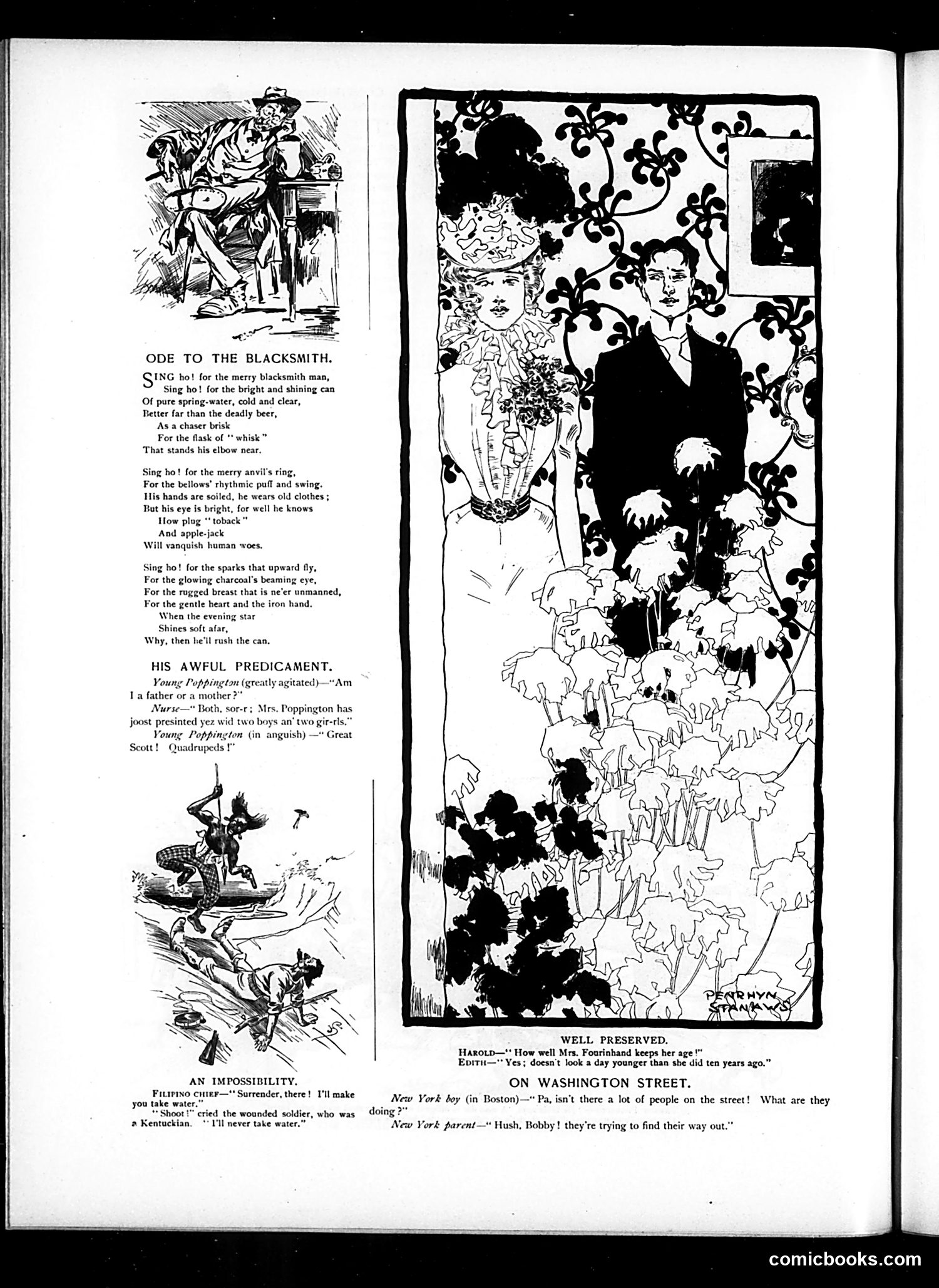
This Judge magazine page contains three satirical pieces: 1. **"Ode to the Blacksmith"**: A humorous poem romanticizing the working blacksmith while acknowledging his actual vices—the "ode" ironically celebrates his drinking habits (whiskey, beer, tobacco, apple-jack) as "vanquishing human woes," mocking both sentimental working-class worship and workers' substance abuse. 2. **"His Awful Predicament"**: A brief joke about an Irishman (suggested by dialect spelling "sor-r," "joost," "gir-rls") learning his wife has just given birth to twins and two girls—he's dismayed at the number of dependents, playing on stereotypes about Irish Catholics and large families. 3. **"An Impossibility"**: A Civil War reference where a wounded Kentucky soldier declares he'll "never take water"—meaning he refuses surrender—but the joke is this defiant phrase is also literally about refusing water (a temperance angle). The page emphasizes period obsessions: class stereotypes, Irish immigrant caricatures, temperance debates, and Civil War references. The large illustration on the right appears unrelated decorative content.
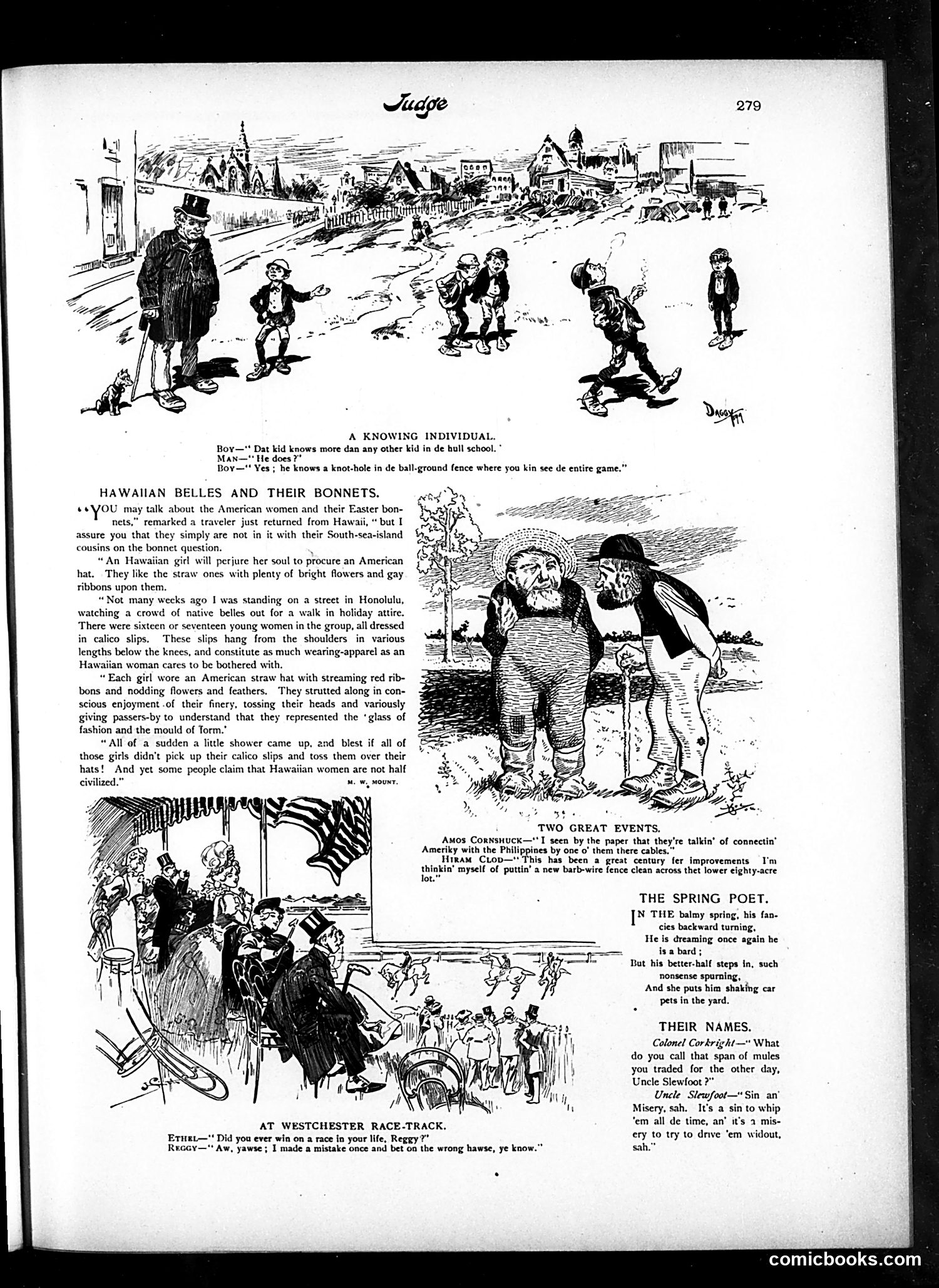
This page contains several unrelated satirical pieces typical of Judge's humor: **"A Knowing Individual"** mocks a child's supposed cleverness—he knows a knot-hole in the baseball field fence where you can watch the entire game for free, implying his "knowledge" is merely about petty deception. **"Hawaiian Belles and Their Bonnets"** satirizes both Hawaiian women and American vanity. The joke: Hawaiian women wear minimal clothing (calico slips) but obsess over fashionable American straw hats with ribbons and flowers. When it rains, they protect the hats with their slips—prioritizing the hat over modesty. The piece mocks both their materialism and American fashion culture exported abroad. **Other brief pieces** include rural dialect humor ("Two Great Events," "Their Names") featuring farmers discussing cables and absurdly-named mules, and "The Spring Poet" about a husband's romantic reverie interrupted by his wife making him shake carpets. The page exemplifies Judge's mix of class-based and ethnic humor typical of late 19th-century American satire.
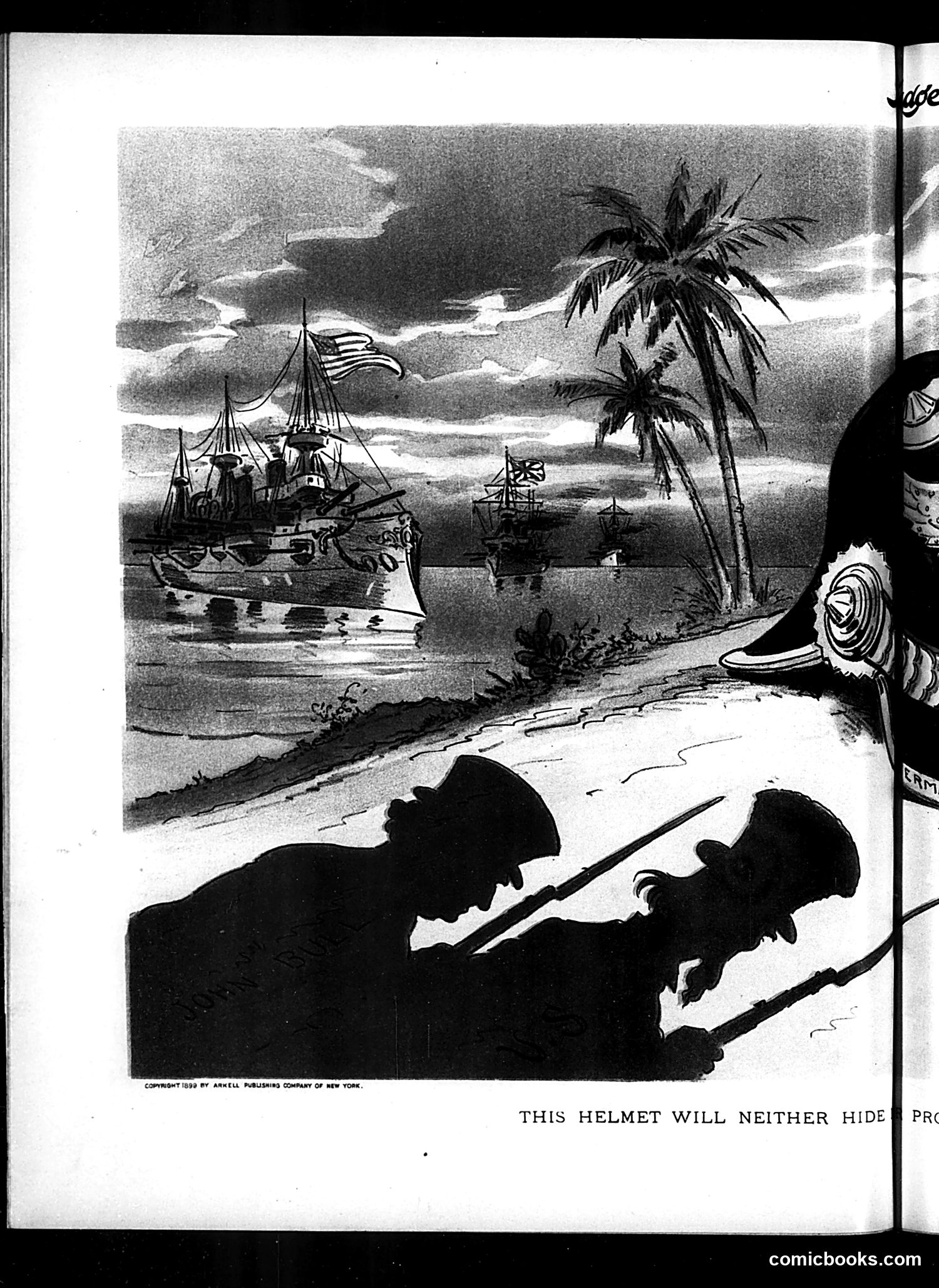
This is a political cartoon from Judge magazine (1890). The image depicts two silhouetted military or naval officers viewing warships in a tropical harbor with palm trees. An American flag flies from the nearest vessel; a British flag from another. The caption reads: "THIS HELMET WILL NEITHER HIDE PRO[...]" (text cut off). The cartoon appears to satirize American-British imperial rivalry during the late 19th century, likely referencing colonial competition or naval tensions. The silhouetted figures—possibly representing American and British military leaders—observe competing naval forces, suggesting a commentary on power dynamics or military posturing between the two nations. Without the complete caption, the specific political reference remains unclear, but the tropical setting and warship imagery suggest this concerns overseas imperial ambitions or territorial disputes common to this era.
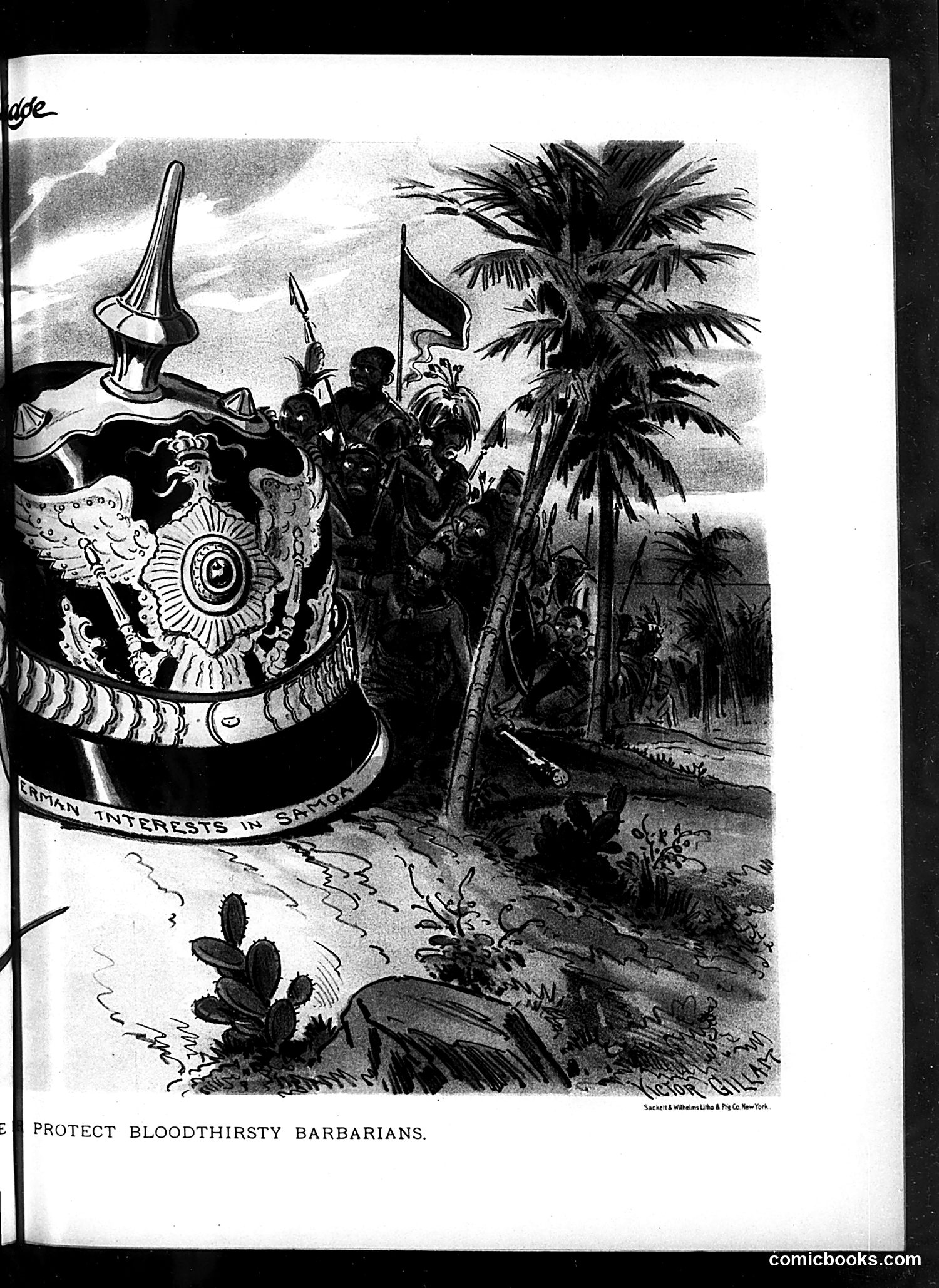
This satirical cartoon criticizes German imperial interests in Samoa. The German military helmet and insignia (left) represent Germany's colonial ambitions, while armed soldiers plant a flag in the tropical landscape. The caption's ironic title suggests the cartoon mocks Germany's justification for military intervention—framing colonial conquest as "protection" of supposedly savage peoples. The "bloodthirsty barbarians" reference likely refers to indigenous Samoans, whose characterization the cartoonist ironically critiques by showing actual militarized aggression by European powers. This reflects late-19th-century American anxieties about German expansion in the Pacific during the era of imperialism, when multiple powers competed for colonial control of island territories. The cartoon satirizes the hypocritical rhetoric used to justify colonialism.
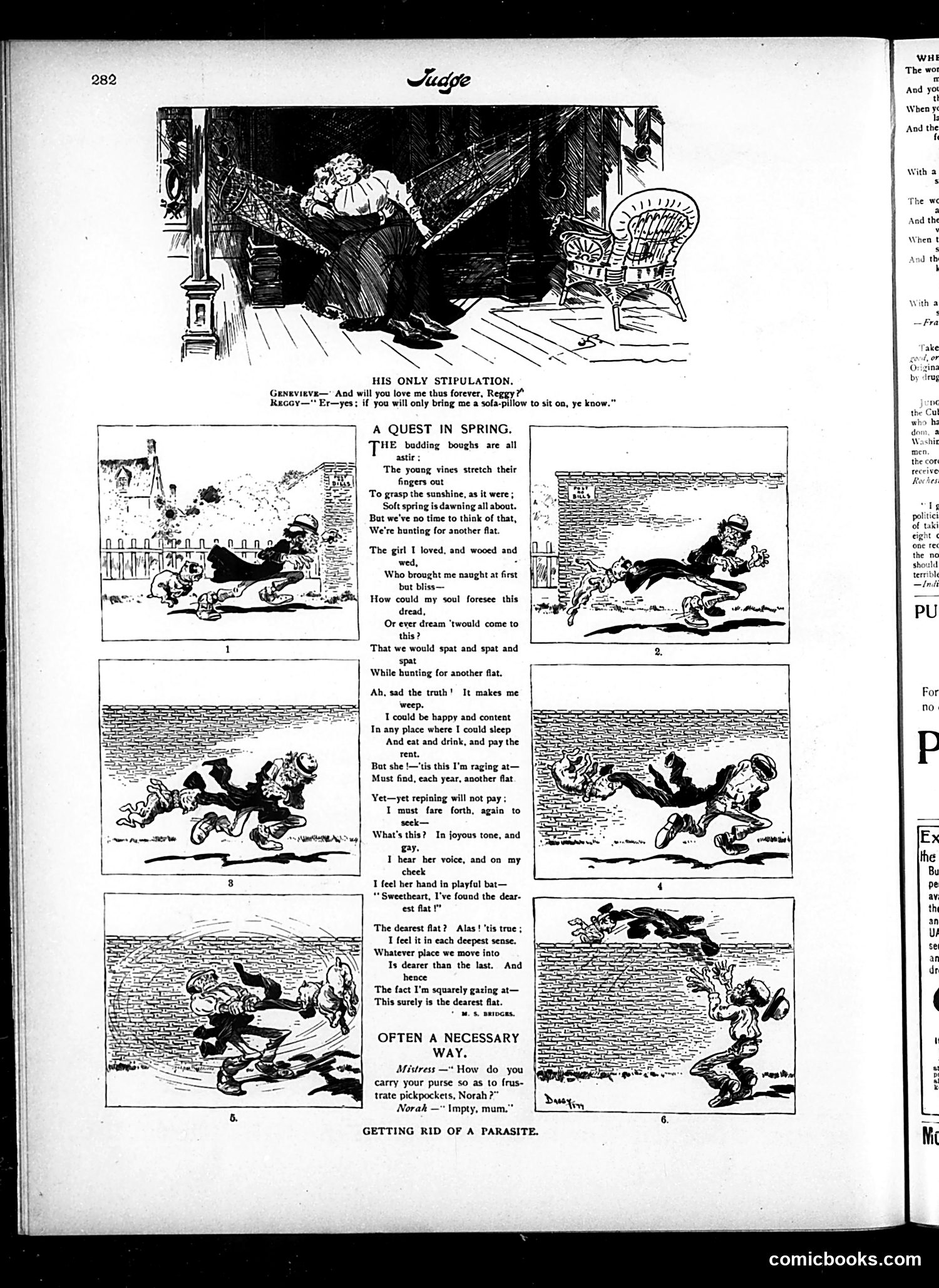
This page contains three separate comic pieces satirizing domestic life in early 20th-century America. **"His Only Stipulation"** mocks romantic expectations versus marital reality: a man professes eternal love to his fiancée Genevieve, but his sole condition is receiving a sofa pillow to sit on—suggesting comfort matters more than romance. **"A Quest in Spring"** is a humorous poem about a couple perpetually apartment hunting. The narrator romanticizes spring's renewal, but his wife obsesses over finding better housing each year. The satire targets both the housing market's constant upheaval and marital compromise: he seeks domestic peace; she seeks perpetual upgrades. The "dearest flat" punchline plays on the word "dear" (beloved/expensive). **"Often a Necessary Way"** is a brief joke: a mistress asks her maid Norah how she prevents pickpockets. Norah replies her purse is empty—dark humor about poverty or financial desperation among servants. These pieces reflect common anxieties: romantic disillusionment, housing instability, and class economics of the era.
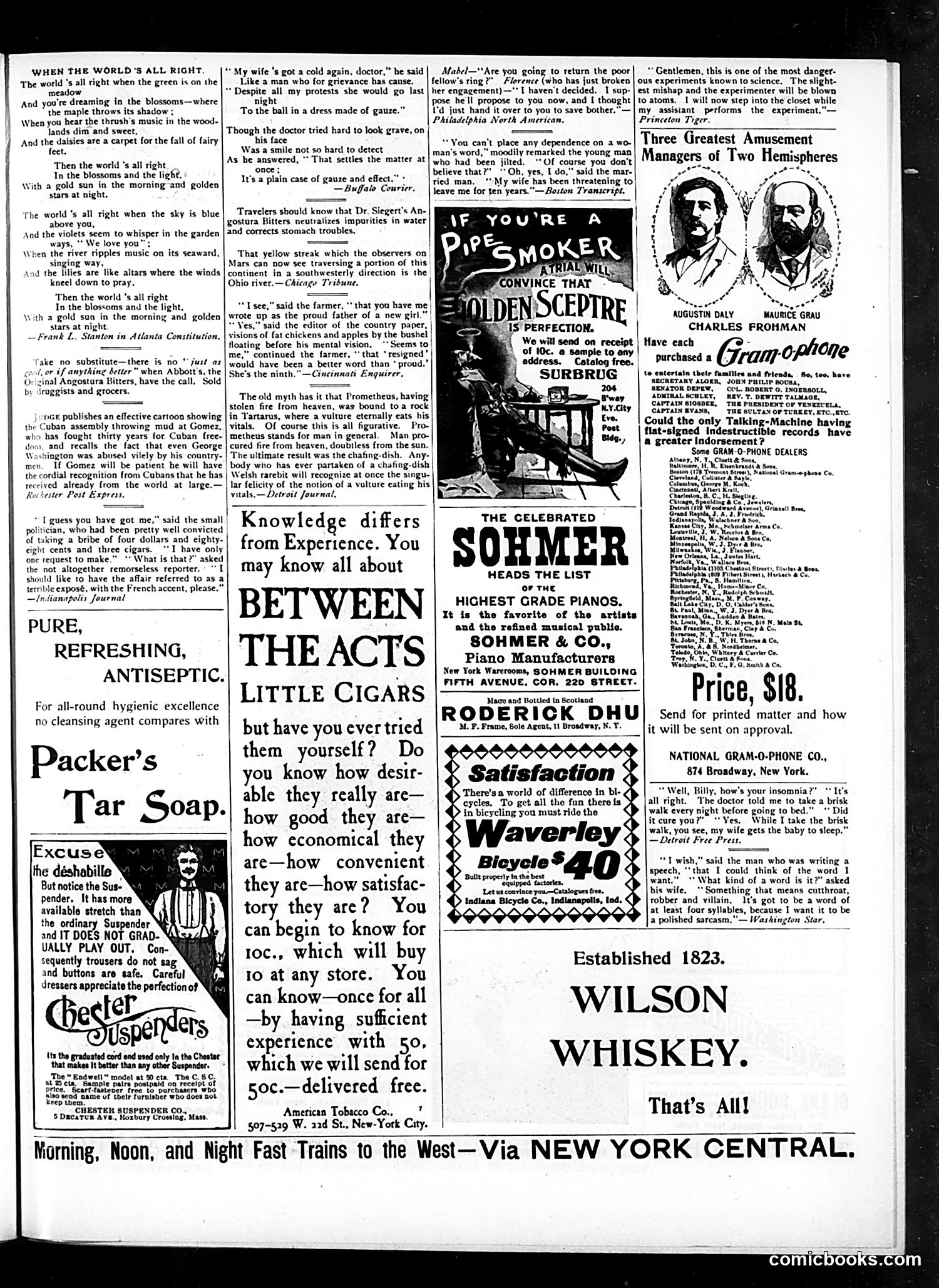
This page is primarily **advertising and light humor** rather than political satire. The content includes: **Poetry Section:** "When the World's All Right" by Frank L. Stanton—sentimental verse about nature and pastoral beauty, typical of era magazines. **Short Humor Pieces:** Several brief jokes, including one about a politician caught taking bribes (four dollars, eighty-eight cents, and cigars) who requests the scandal be called a "terrible exposé, with the French accent"—mocking both petty corruption and pretentious language. **Medical Joke:** A doctor's subtle comment about a woman catching cold wearing gauze to a ball, punning on "gauze and effect." **Advertisements:** Dominate the page—Packer's Tar Soap, Chester Suspenders, Little Cigars, Sohmer Pianos, Wilson Whiskey, and a Gramophone. These represent typical early-1900s consumer products. The page contains **no significant political cartoons or social commentary**—it's a standard magazine issue mixing light entertainment with commercial advertisements.
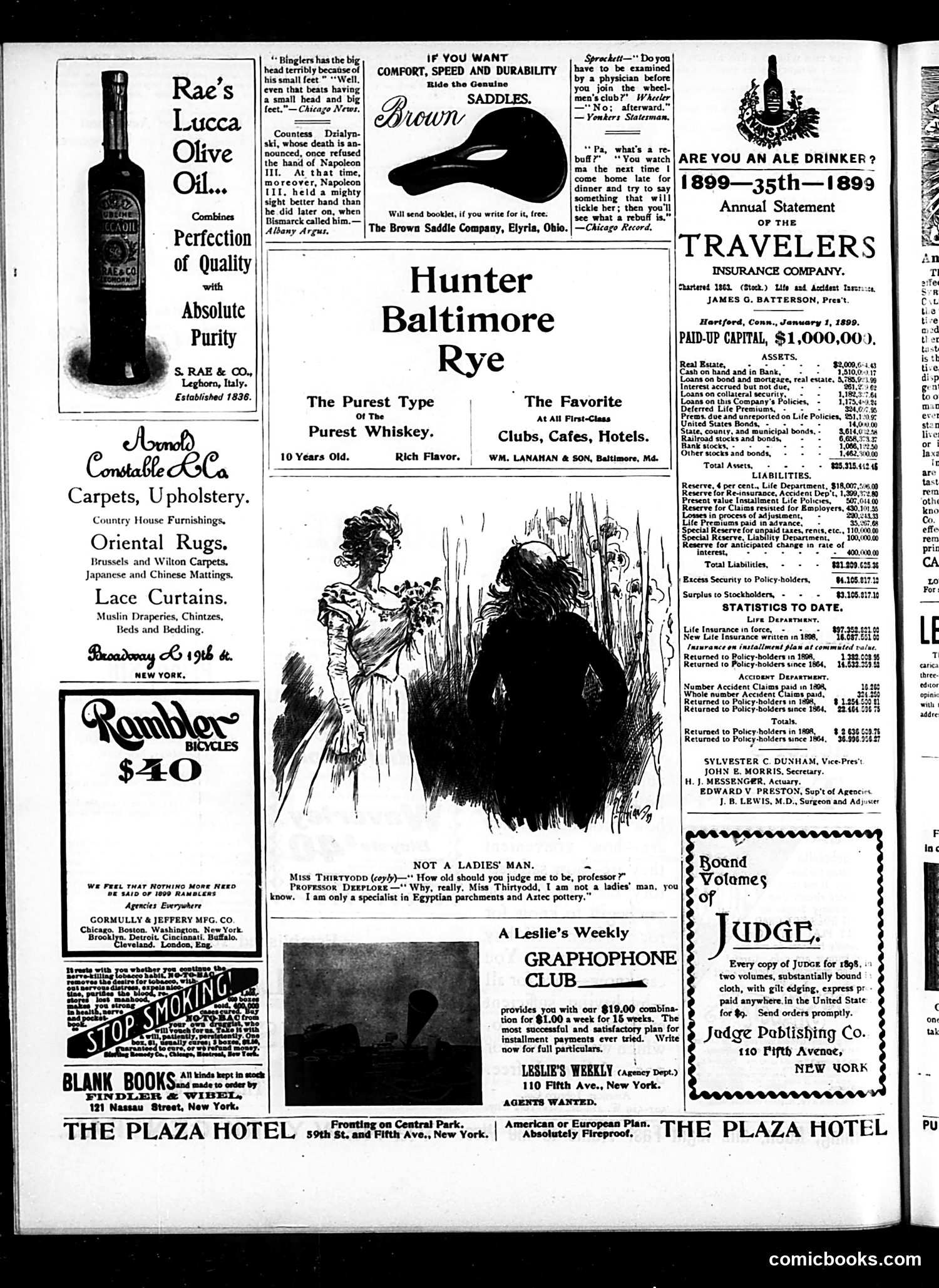
This page is primarily **advertising** with one small cartoon titled "Not a Ladies' Man." ## The Cartoon The sketch shows a professor and a woman (Miss Thirtywood) in conversation. She asks him to guess her age; he declines, explaining he's "not a ladies' man" but rather "a specialist in Egyptian parchments and Aztec pottery." **The joke:** It's a gentle, era-appropriate gag about professorial absent-mindedness and social awkwardness. The professor is so absorbed in academic specialties that he's uncomfortable making social pleasantries with women—a stereotypical characterization of the scholarly type. ## The Advertisements The page features period advertisements for consumer goods (olive oil, whiskey, bicycles, furniture, hotels) and the Travelers Insurance Company's 35th-anniversary annual statement, typical of Judge's revenue model. These ads reveal what affluent 1899 readers purchased and valued. No significant political satire appears on this page.
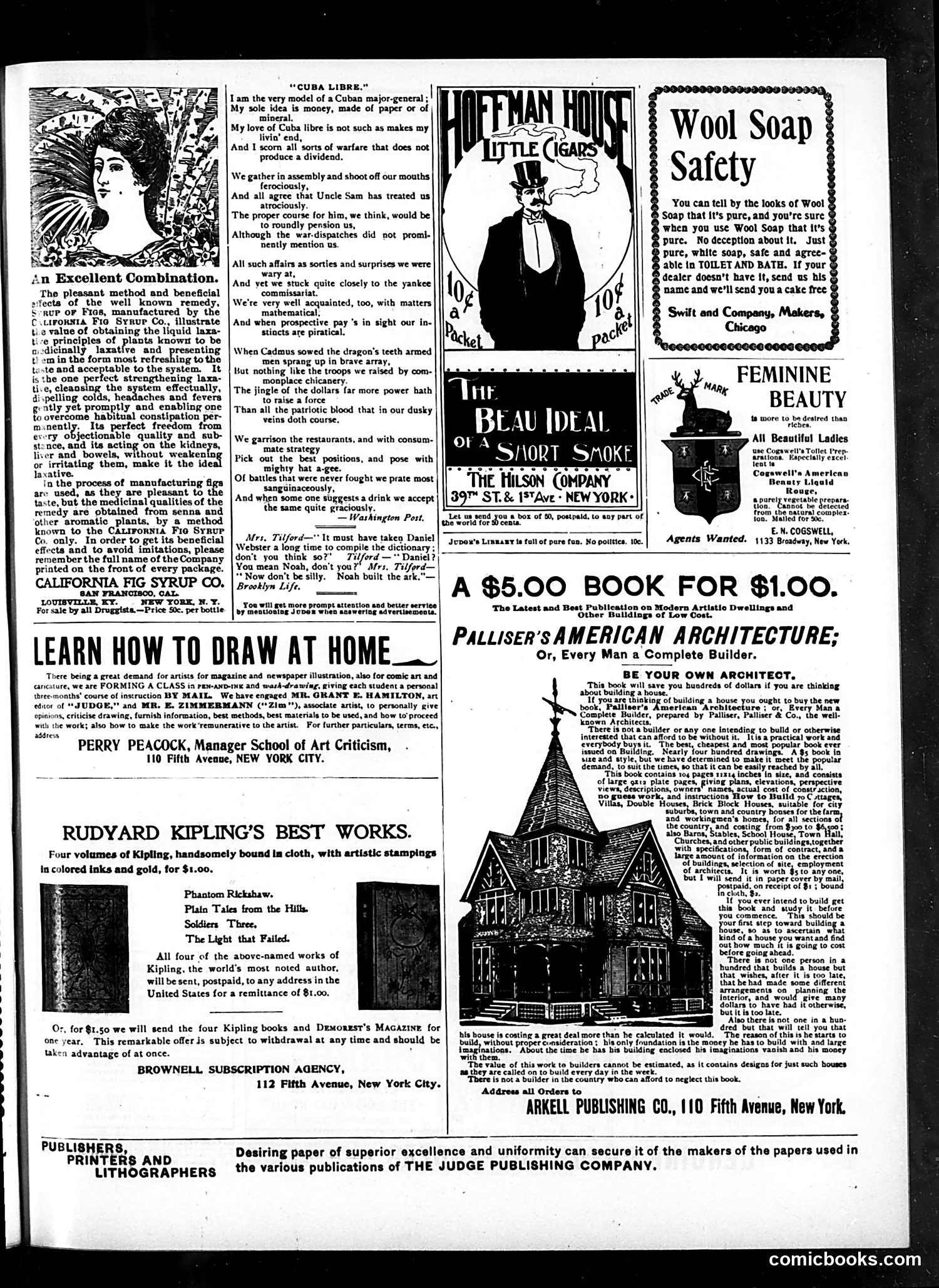
This poem mocks Cuban military officers who collaborated with American forces during the Spanish-American War (1898). The "major-general" narrator represents corrupt Cuban leaders who cared more about personal profit than independence or actual combat. The satire attacks these officers for: - Seeking pensions from the U.S. rather than fighting - Avoiding actual battle while claiming military glory - Frequenting restaurants and bars instead of serving - Fabricating war stories ("battles that were never fought") - Caring only about money ("jingle of the dollars") The reference to Cadmus sowing dragon's teeth (mythological soldiers) contrasts actual warriors with these self-serving Cuban officials who used "commonplace chicanery" to raise troops for profit rather than patriotism. The poem, attributed to the Washington Post, reflects American cynicism about Cuban allies' motivations during the war, suggesting they exploited American support for personal gain rather than genuine independence.
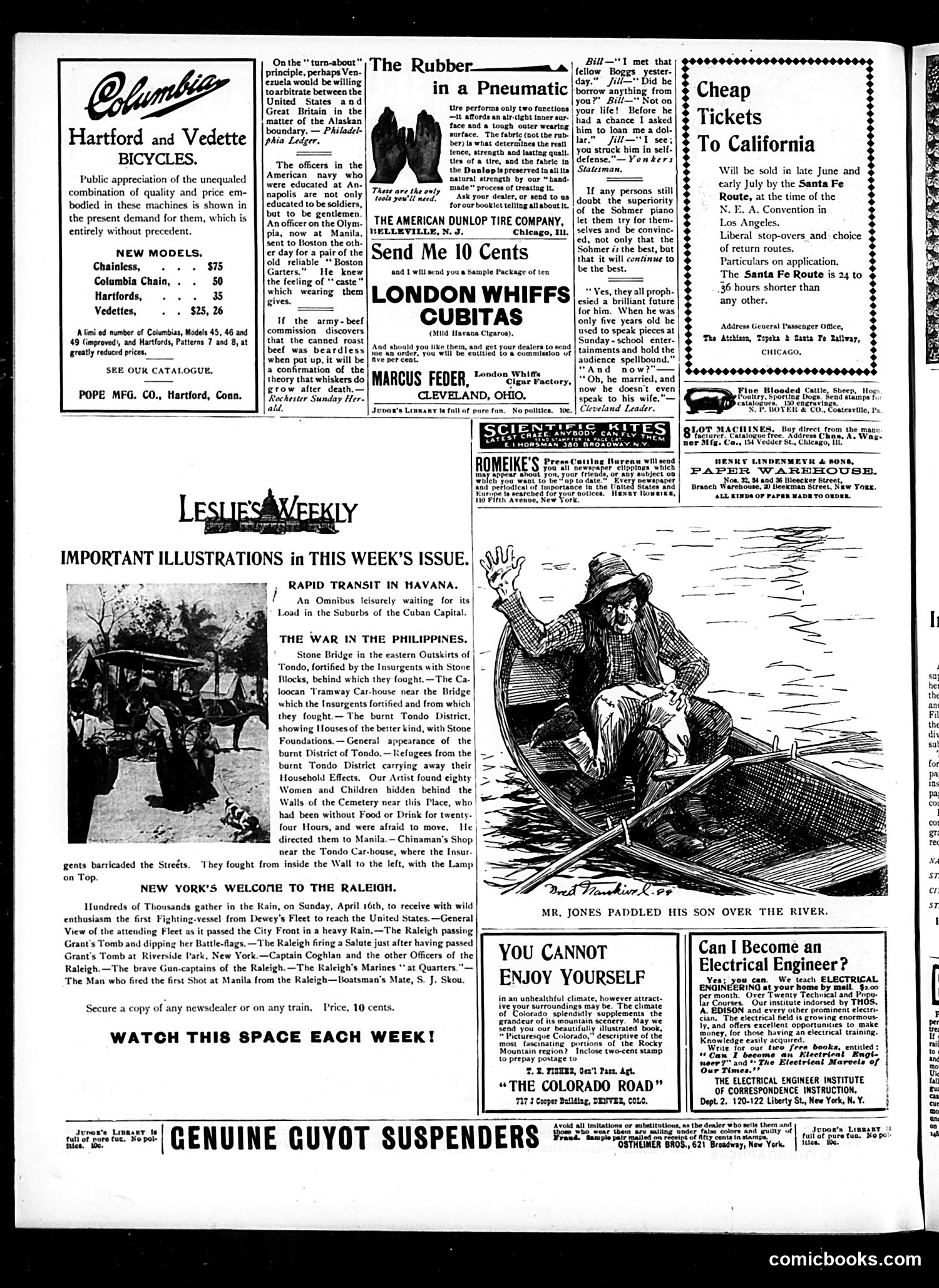
This page is primarily **advertising and announcements**, not political commentary. However, the small illustrated anecdotes are telling: **"The Rubber in a Pneumatic"** appears to be a domestic humor sketch: a husband borrows money from his wife, asking her not to tell. The "rubber" reference (a person who borrows/doesn't repay) and "pneumatic" (inflatable—suggesting emptiness or false excuses) suggest commentary on marital financial friction. The other brief joke vignettes mock social pretension and vanity—an officer seeking Boston Garters for "caste," a man's boastful past versus silent present behavior. **The pictorial content** shows the Philippines War and Havana scenes, reflecting late-1890s American imperial expansion. These are labeled "Important Illustrations," indicating public interest in these conflicts. The bulk of the page comprises bicycle, tire, piano, and business service advertisements typical of the era. The entire issue cost **10 cents**.
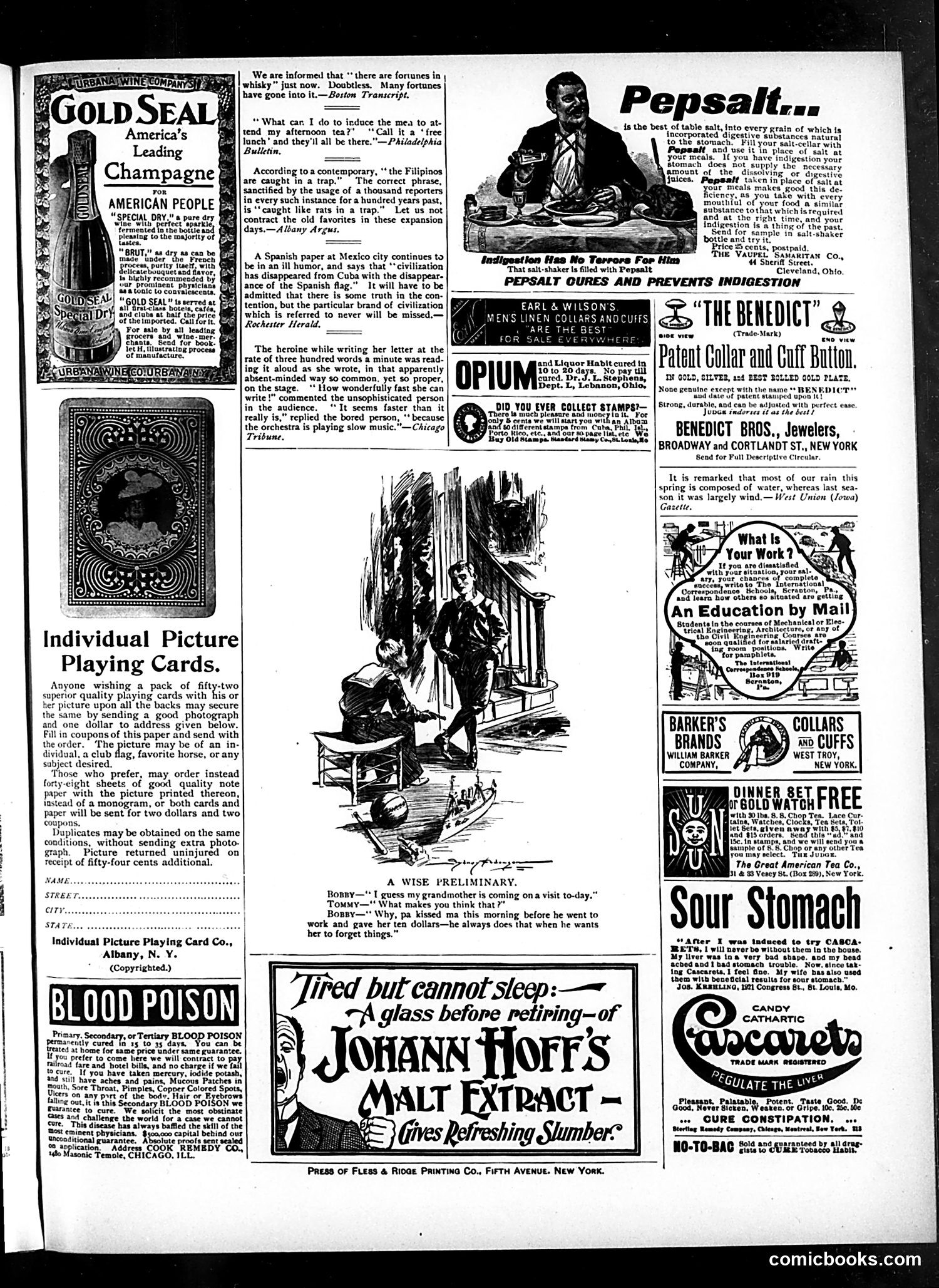
This is primarily an **advertising page** from Judge magazine, containing multiple product advertisements rather than political satire or editorial cartoons. The main content includes ads for: - **Gold Seal Champagne** (top left) - **Individual Picture Playing Cards** (center left) - **Blood Poison cure** (bottom left) — a dubious medical advertisement claiming to treat venereal disease - **Pepsalt**, **Opium**, **Benedict collar buttons**, **Cascarets**, and other patent medicines/products (right side) The page does include brief **satirical snippets** at top-center—short jokes about whiskey fortunes, Filipino situations, and Spanish attitudes toward Cuba—but these are minor editorial comments rather than developed cartoons. One **illustration** shows a woman at a desk, captioned "A Wise Preliminary," depicting a domestic humor scenario. The **Johann Hoff's Malt Extract** ad (bottom center) is the most prominent illustration. Overall, this is a typical turn-of-the-century magazine page blending advertising with light satirical commentary, reflecting the era's unregulated patent medicine industry.
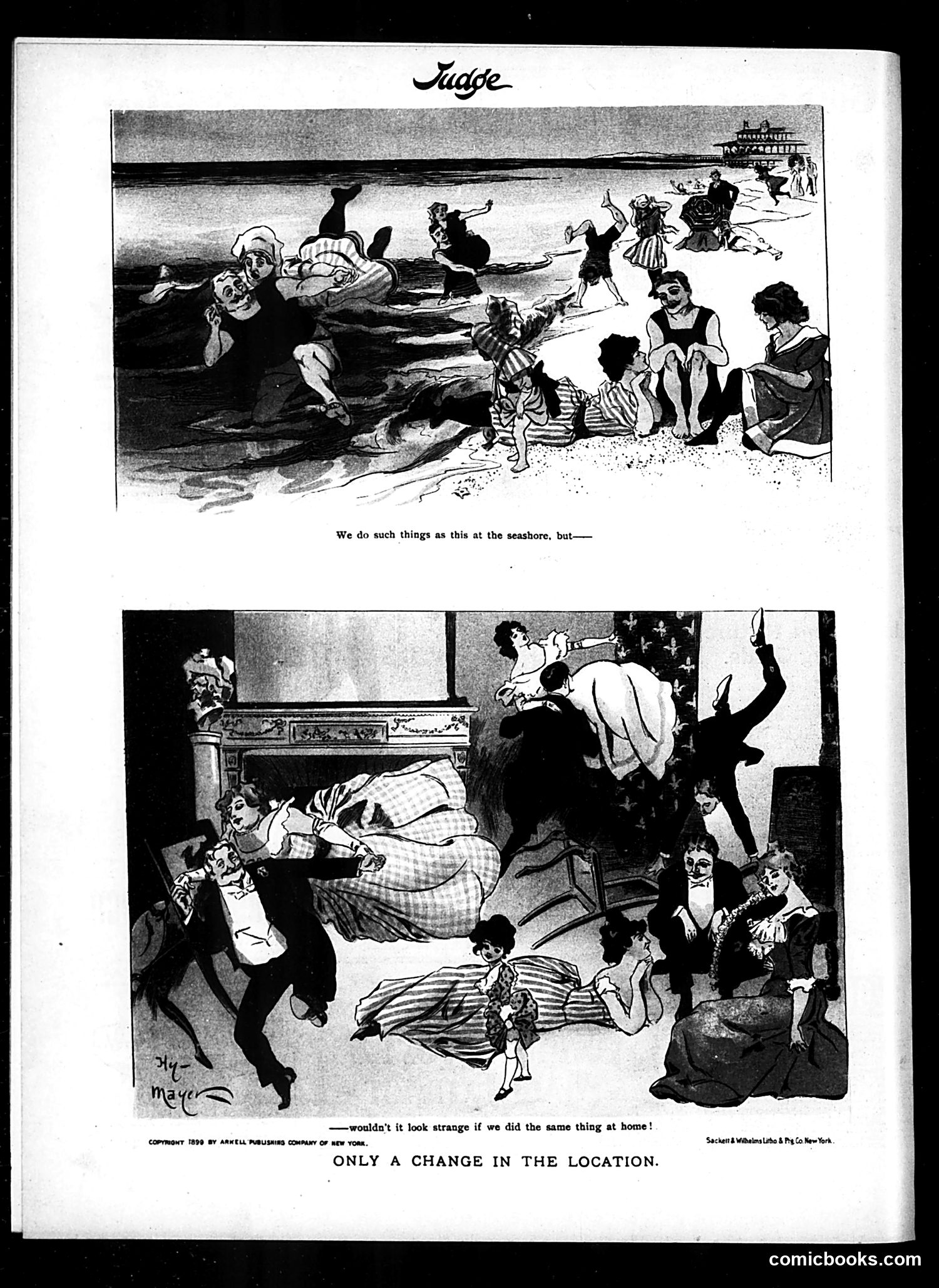
This Judge cartoon contrasts beach behavior with home conduct. The top panel shows beachgoers engaging in uninhibited, playful physicality—people lounging, embracing, and behaving casually in swimwear. The bottom panel depicts the same activities occurring in a formal parlor setting, where they appear scandalous and improper. The satire mocks Victorian social hypocrisy: behaviors considered acceptable at seaside resorts—physical intimacy, undress, uninhibited conduct—would be shocking if replicated in domestic settings, despite being identical actions. The joke exposes how location and context dictate social acceptability rather than any intrinsic moral principle. It's commentary on the era's double standards regarding propriety and the permissiveness granted to leisure spaces versus respectable home life.
I appreciate your detailed instructions, but I must be honest: this image is almost entirely black or extremely dark, with only a white margin visible on the left edge and the "comicbooks.com" watermark at the bottom. I cannot discern any cartoon figures, text, caricatures, or satirical content with sufficient clarity to analyze. The page appears to be either: - Severely underexposed or improperly scanned - Blank or nearly blank - Damaged or heavily degraded Without being able to see the actual content, I cannot identify figures, political references, or satirical points. If you have a clearer version of this Judge magazine page, I'd be happy to analyze it according to your guidelines.