
Judge, 1899-05-06 · page 4 of 17
Judge — May 6, 1899 — page 4: what you’re looking at
What you’re looking at
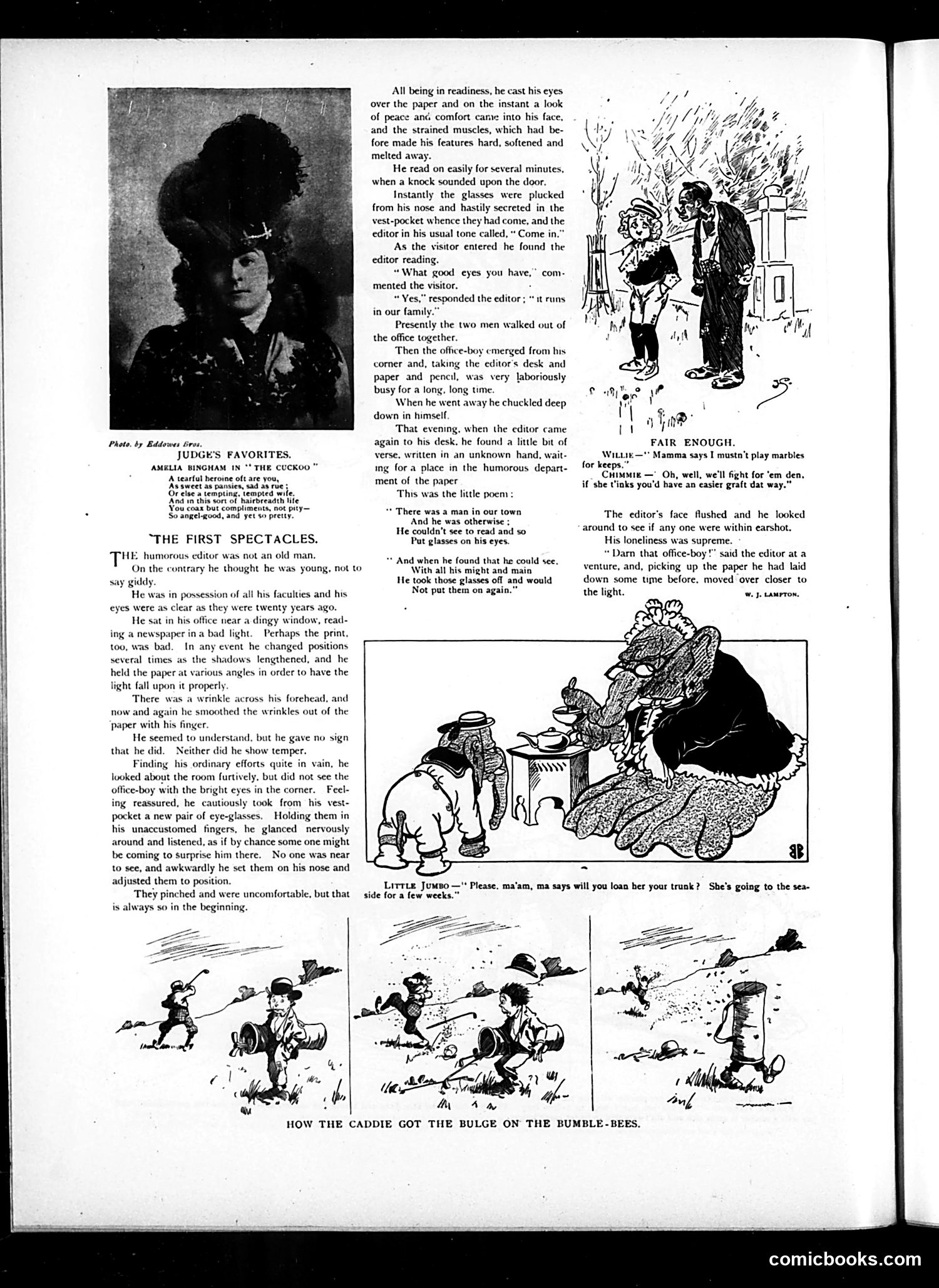
This page contains a story titled "The First Spectacles" about an editor struggling with vision problems, and several humorous cartoons. The main narrative describes an editor who, after years of eyestrain from poor office lighting and newspaper work, finally acquires eyeglasses. The story satirizes his reluctance to wear them publicly and his initial discomfort—a relatable commentary on vanity and the stigma surrounding corrective eyewear in this era. The bottom cartoon, "How the Caddie Got the Bulge on the Bumble-Bees," appears to be a lighthearted children's story about a caddie (golf course worker) outwitting bees through a sequence of comic misadventures. The page reflects early-20th-century humor about everyday life, workplace frustrations, and social anxieties around visible signs of aging or physical limitation.
📄 Transcribed text from this page (OCR, searchable)
Machine-transcribed from the original scan — historical spelling and the odd misread are preserved.
Photo. by Bddowes bres JUDGE'S FAVORITES. AMELIA BINGHAM IN “* THE CUCKOO " A tearful heroine oft are you, ‘As sweet as pansies, sad as rue ; Or else a tempting, tempted wile. And in this sort of hairbreadth Ii You coax but compliments, not pity— So angel-good, and yet $0 pretty. “THE FIRST SPECTACLES. HE humorous editor was not an old man, On the contrary he thought he was young, not to say giddy. He was in possession of all his faculties and his clear as they were twenty years ago. He sat in his office near a dingy window, read- ing a newspaper ina bad light. Perhaps the print, too, was bad. In any event he changed positions several time eyes wert the shadows lengthened, and he held the paper at various angles in order to have the light fall upon it properly. There was a wrinkle across his forehead, and now and again he smoothed the wrinkles out of the paper with his finger. He seemed to understand, but he gave no sign that he did. her did he show temper. Finding his ordinary efforts quite in vain, he looked about the room furtively, but did not see the office-boy with the bright eyes in the corner. Feel- ing reassured, he cautiously took from his vest- pocket a new pair of eye-glasses. Holding them in his unaccustomed fingers, he glanced nervously around and listened, as if by chance some one might be coming to surprise him there. No one was near to see, and awkwardly he set them on his nose and adjusted them to position. They pi is always so in the beginning. hed and were uncomfortable, but that side for a few weeks. All being in readiness, he cast his eyes over the paper and on the instant a look of peace anc, comfort cane into his face, and the strained muscles, which had be- fore made his features hard, softened and melted away. He read on easily for several minutes, when a knock sounded upon the door. Instantly the glasses were plucked from his nose and hastily secreted in the vest-pocket whence they had come, and the editor in his usual tone called, “Come in.” As the visitor entered he found the editor reading. “What good eyes you have,” com- mented the visitor. : * Yes,” responded the editor ; “it runs in our family. Presently the two men walked out of the office together. Then the office-boy emerged from his corner and, taking the editor's desk and paper and pencil, was very laboriously busy for a long, long time. When he went away he chuckled deep down in himself That evening, when the editor came again to his desk. he found a little bit of verse, written in an unknown hand, wait- ing fora place in the humorous depart- ment of the paper This was the little poem : “There was a man in our town ‘And he was otherwise ; He couldn't see to read and so Pat glasses on his eyes. ** And when he found that he could see, With all his might and main He took those glasses off and would Not put them on again.” FAIR ENOUGH. Witte —" Mamma says I mustn't play marbles for keeps.” Crime — Ob, well, we'll fight for ‘em den, if she t'inks you'd have an easier graft dat way.” The editor's face flushed and he looked around to see if any one were within earshot. His loneliness was supreme. “Darn that office-boy!” said the editor at a venture, and, picking up the paper he had laid down some ume before, moved over closer to the light. 1. J. LAMITON. Lirrie Jumvo < M An HOW THE CADDIE GOT THE BULGE ON THE BUMBLE-BEES. Tee CaS comicbooks.com