
Judge, 1899-05-06 · page 7 of 17
Judge — May 6, 1899 — page 7: what you’re looking at
What you’re looking at
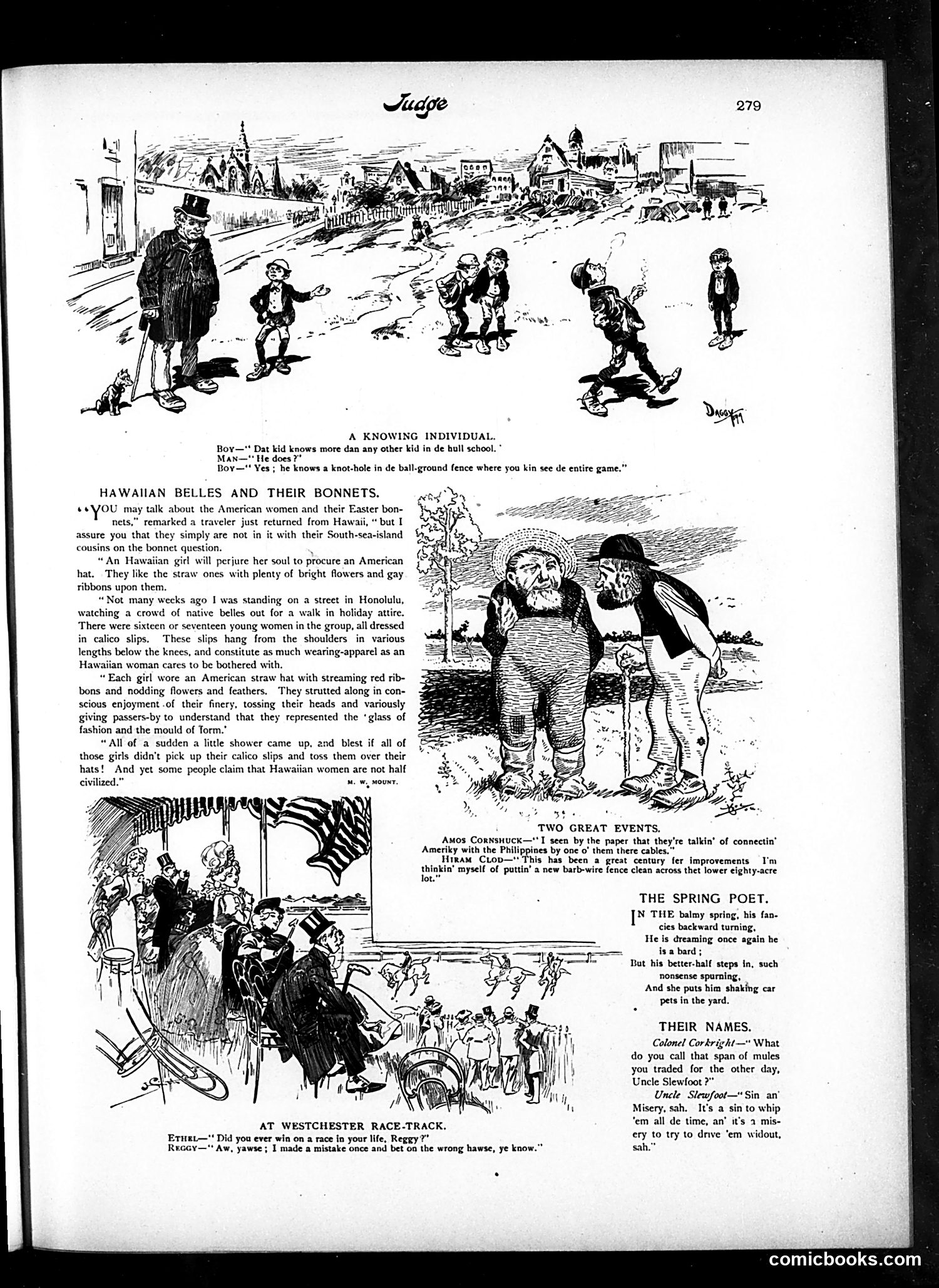
This page contains several unrelated satirical pieces typical of Judge's humor: **"A Knowing Individual"** mocks a child's supposed cleverness—he knows a knot-hole in the baseball field fence where you can watch the entire game for free, implying his "knowledge" is merely about petty deception. **"Hawaiian Belles and Their Bonnets"** satirizes both Hawaiian women and American vanity. The joke: Hawaiian women wear minimal clothing (calico slips) but obsess over fashionable American straw hats with ribbons and flowers. When it rains, they protect the hats with their slips—prioritizing the hat over modesty. The piece mocks both their materialism and American fashion culture exported abroad. **Other brief pieces** include rural dialect humor ("Two Great Events," "Their Names") featuring farmers discussing cables and absurdly-named mules, and "The Spring Poet" about a husband's romantic reverie interrupted by his wife making him shake carpets. The page exemplifies Judge's mix of class-based and ethnic humor typical of late 19th-century American satire.
📄 Transcribed text from this page (OCR, searchable)
Machine-transcribed from the original scan — historical spelling and the odd misread are preserved.
A KNOWING INDIVIDUAL. at kid knows more dan any other kid in de hull school. * ie does?" Yes ; he knows a knot-hole in de ball-ground fence where you kin see de entire game.” HAWAIIAN BELLES AND THEIR BONNETS. +s YOU may talk about the American women and their Easter bon- nets,” remarked a traveler just returned from Hawaii, “ but I assure you that they simply are not in it with their South-sea-island cousins on the bonnet question. ‘ “An Hawaiian gil will perjure her soul to procure an American hat. They like the straw ones with plenty of bright flowers and gay ribbons upon them. “Not many weeks ago I was standing on a street in Honolulu, watching a crowd of native belles out for a walk in holiday attire. There were sixteen or seventeen young women in the group, all dressed in calico slips. These slips hang from the shoulders in various lengths below the knees, and constitute as much wearing-apparel as an Hawaiian woman cares to be bothered with. Each girl wore an American straw hat with streaming red rib- bons and nodding flowers and feathers. They strutted along in con- scious enjoyment .of their finery, tossing their heads and variously giving passers-by to understand that they represented the ‘glass of fashion and the mould of form.’ “All of a sudden a little shower came up, and blest if all of those girls didn’t pick up their calico slips and toss them over their hats! And yet some people claim that Hawaiian women are not half civilized.” eee : TWO GREAT EVENTS. Amos Cornsuuck—"'I seen by the paper that they're talkin’ of connectin’ Ameriky with the Phi peice by one o' them there cables.” Hiram CLop—" This has been a great century fer improvements I'm think myself of puttin’ a new barb-wire fence clean across thet lower eighty-acre jot.” THE SPRING POET. [8 THE balmy spring, his fan cies backward turning, He is dreaming once again he is a bard ; But his better-half steps in, such nonsense spurning, And she puts him shaking car pets in the yard, THEIR NAMES. Colonel Corkright—" What do you call that span of mules you traded for the other day, Uncle Slewfoot ?" Uncle Stewfoot—" Sin an’ Misery, sah. It's a sin to whip AT WESTCHESTER RACE-TRACK. sna Oe ties nS am “* Did you ever win on a race in your life, Reggy?” ery to try to dnve ‘em widout, * Aw, yawse ; I made a mistake once and bet on the wrong hawse, ye know.” sah, comicbooks.com