
A complete issue · 16 pages · 1899
Judge — April 29, 1899
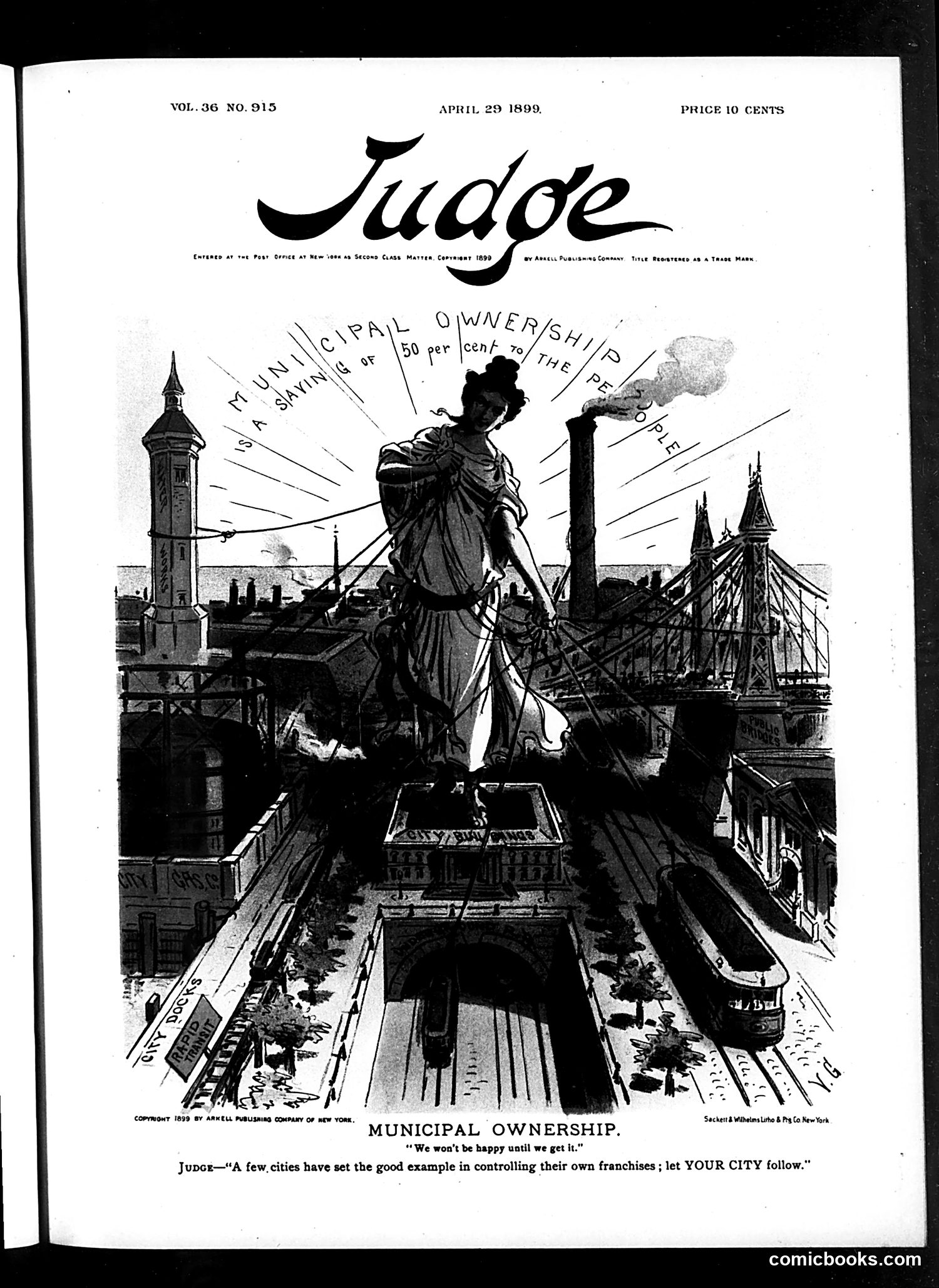
This 1899 *Judge* magazine cover advocates for **municipal ownership** of public utilities and transportation franchises. Lady Justice (the classical female figure) stands over an industrial cityscape (appearing to be London, with Big Ben visible), radiating text about "Municipal Ownership" and "50 per cent saving" to the people. The caption quotes Judge encouraging cities to follow the example of those that controlled their own franchises rather than granting them to private corporations. The cartoon's message: public ownership of infrastructure benefits citizens through cost savings and democratic control, opposing the late-19th-century practice of cities granting lucrative monopoly franchises to private companies. This reflects Progressive Era debates over whether utilities should be publicly or privately operated.
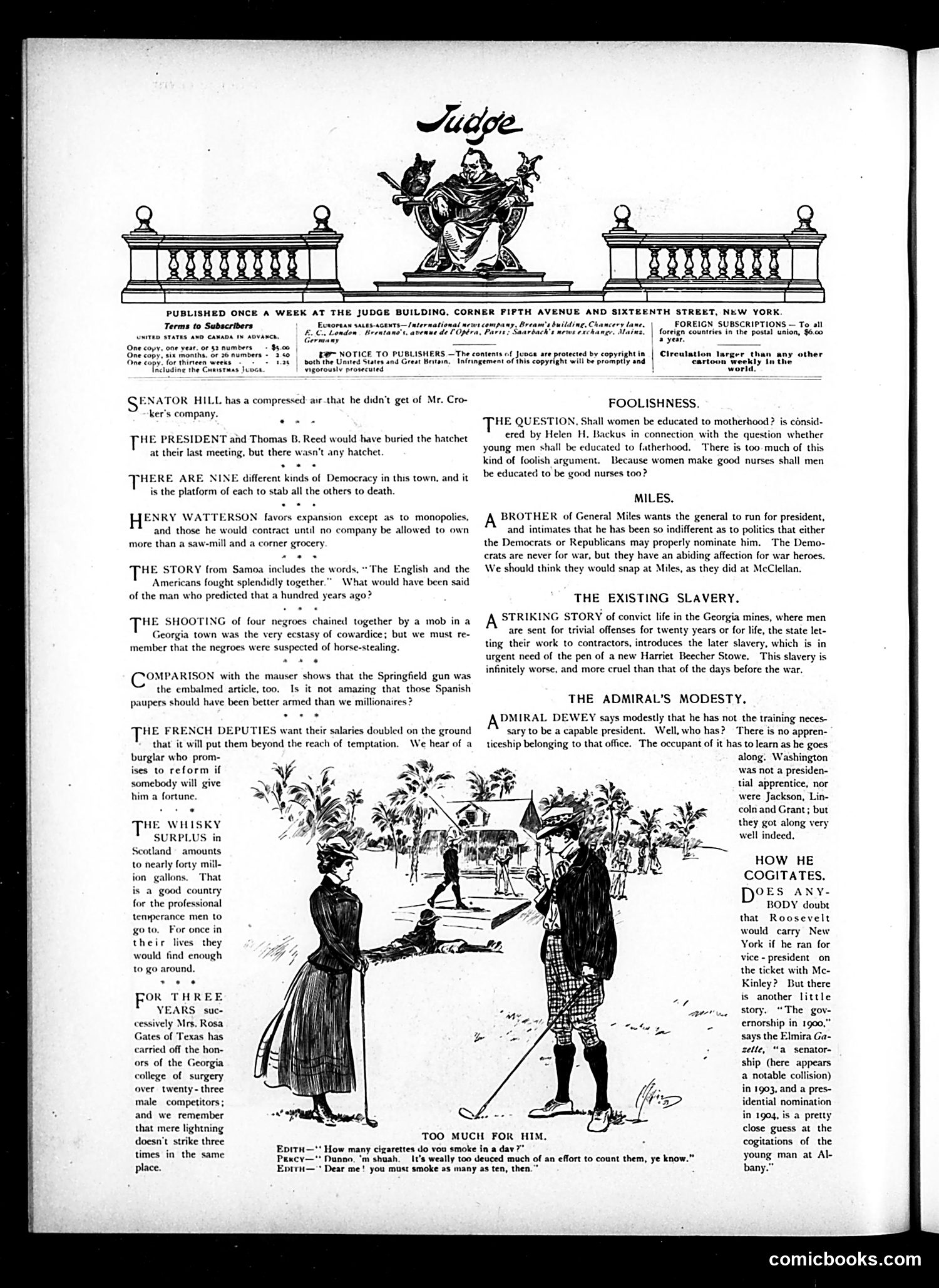
The central cartoon depicts a woman (labeled "Edith") speaking to a man (labeled "Edwin"), with the caption explaining she's asking him to count the stars—"it's really too taxed much of an effort to count them, you know." This appears to be satirizing gender roles and intellectual capacity. The woman's request is deliberately simple and whimsical, yet the man finds it overwhelming. The joke likely mocks either male incompetence at basic tasks or, conversely, contemporary assumptions about women's limited intellectual abilities—playing on the irony that even a "simple" woman's request overwhelms the man. The satire reflects turn-of-the-century debates about gender and education referenced in the "Foolishness" section above.
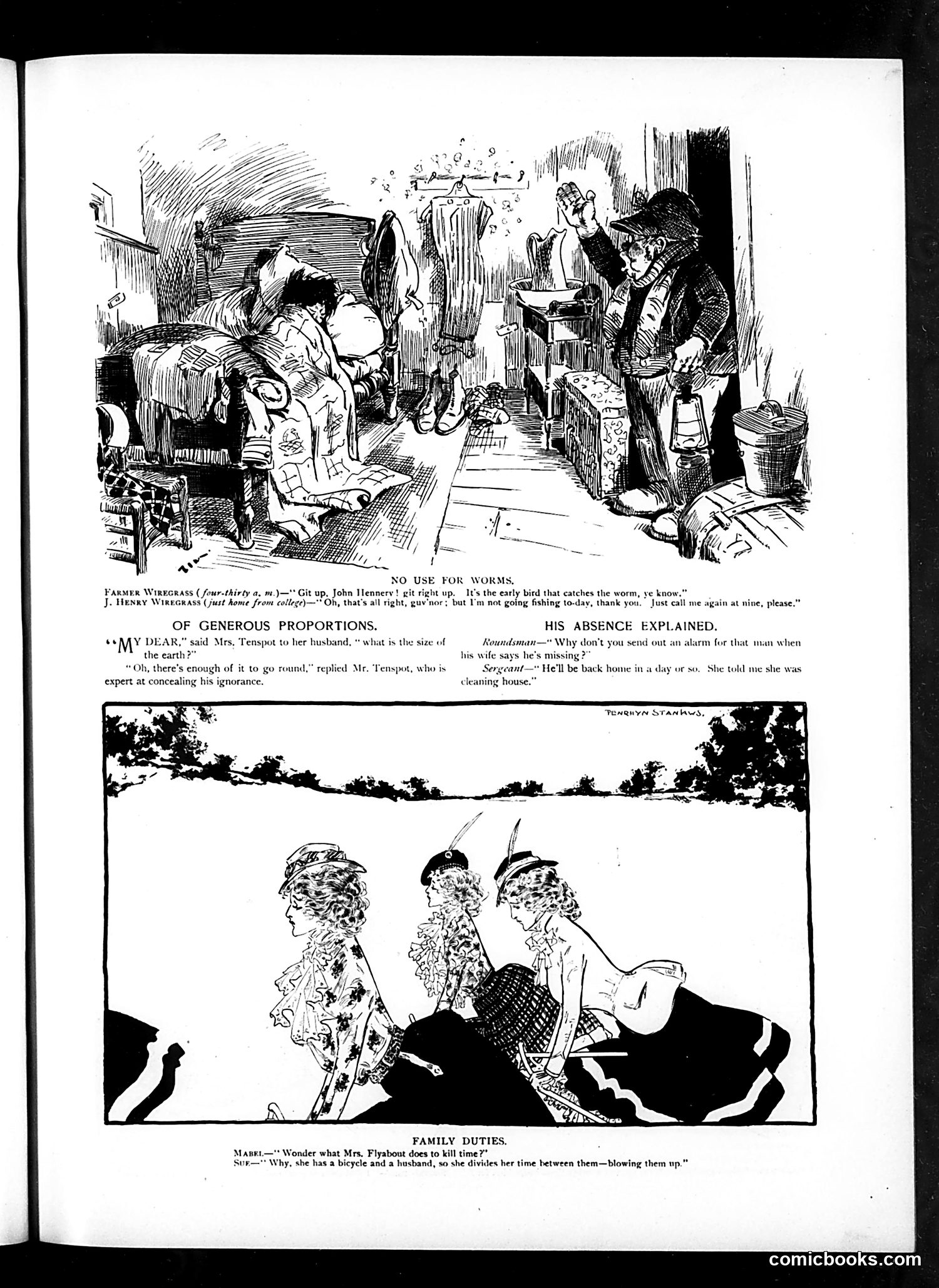
This page contains three separate satirical pieces: 1. **"No Use for Worms"** (top): A domestic scene mocking rural/farming life. Farmer Wiregrass boasts he won't go fishing, dismissing it as futile—humor derives from the incongruity between rural stereotypes and pretentious reasoning. 2. **"Of Generous Proportions" / "His Absence Explained"** (middle): A joke about a wife asking her husband the "size of the earth." His expert evasion of a straightforward question, and her later explanation that he's "cleaning house," satirizes masculine avoidance of domestic duties and marital dynamics. 3. **"Family Duties"** (bottom): Two fashionable women discuss how Mrs. Flybottom "kills time"—dividing it between a bicycle and husband, "blowing them up." This mocks both the bicycle craze of the 1890s-1900s and women's leisure activities.
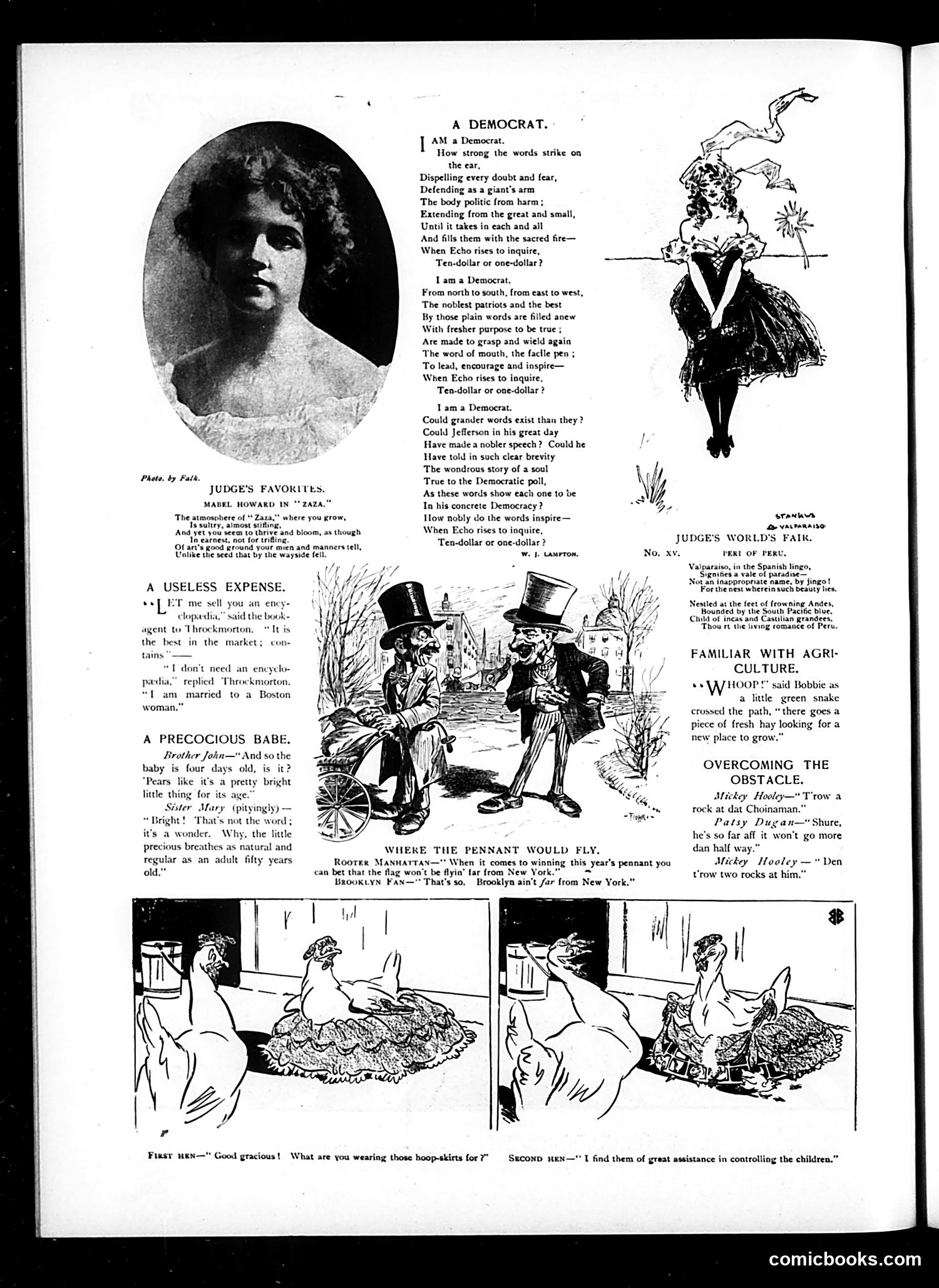
This page contains several satirical pieces from an early 20th-century American humor magazine. **"A Democrat"** features a poem celebrating Democratic Party ideals and principles, suggesting Democratic self-promotion or parody of party rhetoric. **"Judge's Favorite"** and **"Judge's World's Fair"** appear to be celebrity commentary pieces, though the specific figures aren't clearly identifiable from visible text. **"A Useless Expense"** and **"A Precocious Babe"** are brief humorous anecdotes—common filler content in period satirical magazines. **"Where the Pennant Would Fly"** is a baseball joke about pennant races, with dialogue suggesting New York teams. The **bottom cartoon panels** depict a domestic scene involving women discussing household items (possibly corsets or "hoopskirts"), likely satirizing women's fashion or domestic management of that era. The overall page mixes political satire with society humor and sports references typical of Judge's format.
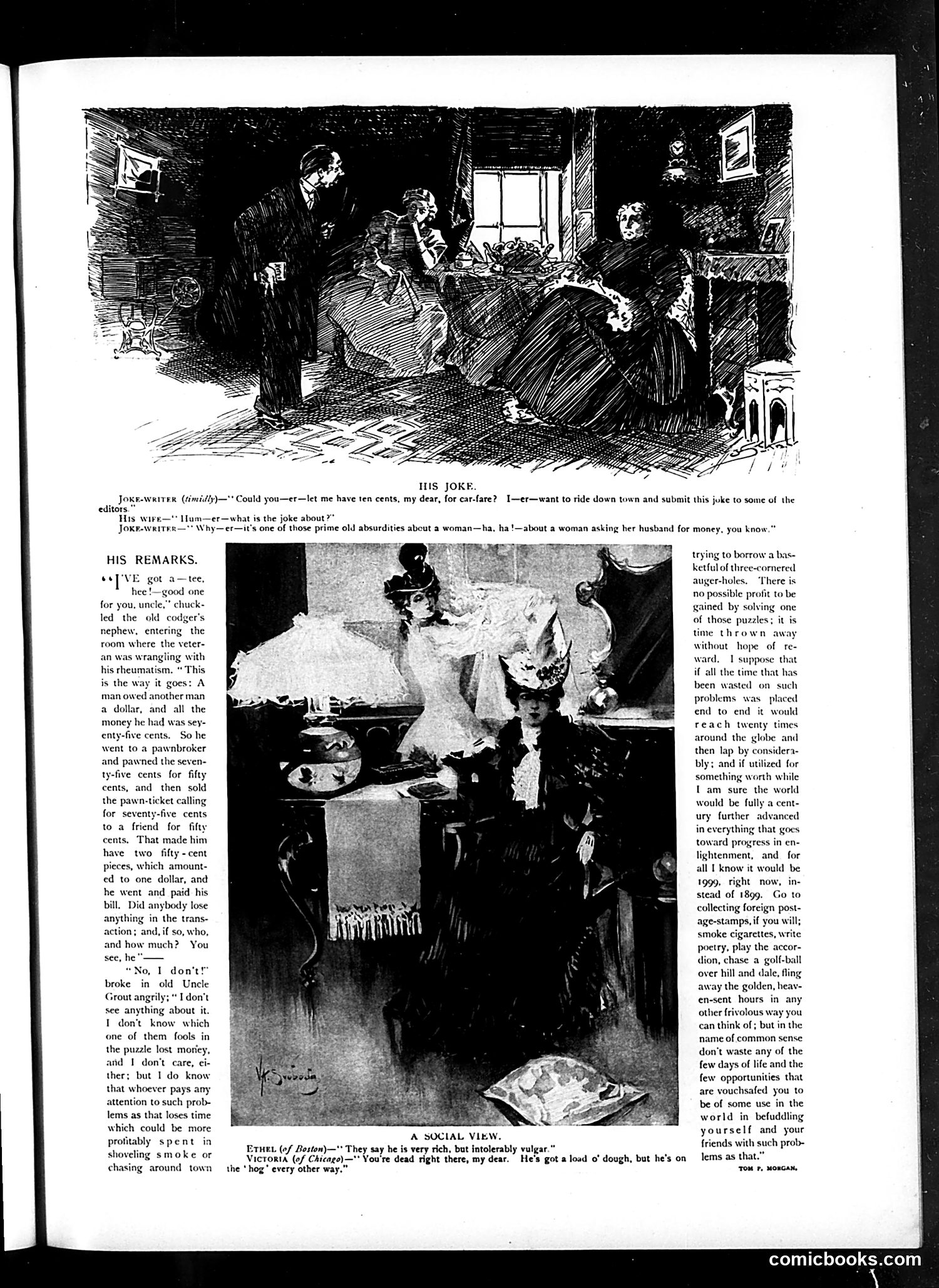
This page contains two separate satirical pieces: **"His Joke"** (top): Satirizes the struggling writer/journalist. A husband asks his wife for ten cents carfare to submit a joke to editors, suggesting economic desperation among creative professionals trying to break into publishing. **"His Remarks"** (middle): An elderly man (Uncle Grout) rants against wasting time on mathematical puzzles and logic problems. The satire targets the leisure class's frivolous pastimes—puzzle-solving, stamp collecting, golf, poetry—as worthless distractions. He argues this wasted time could advance civilization meaningfully. This reflects 19th-century anxieties about idleness and productivity. **"A Social View"** (bottom): Two women discuss a wealthy but "vulgar" man from Chicago. The satire mocks snobbish Eastern elites (Boston) judging new money from the Midwest, suggesting that wealth alone cannot purchase social refinement or respectability. All three pieces use humor to critique American social pretensions and economic anxieties of the 1890s era.
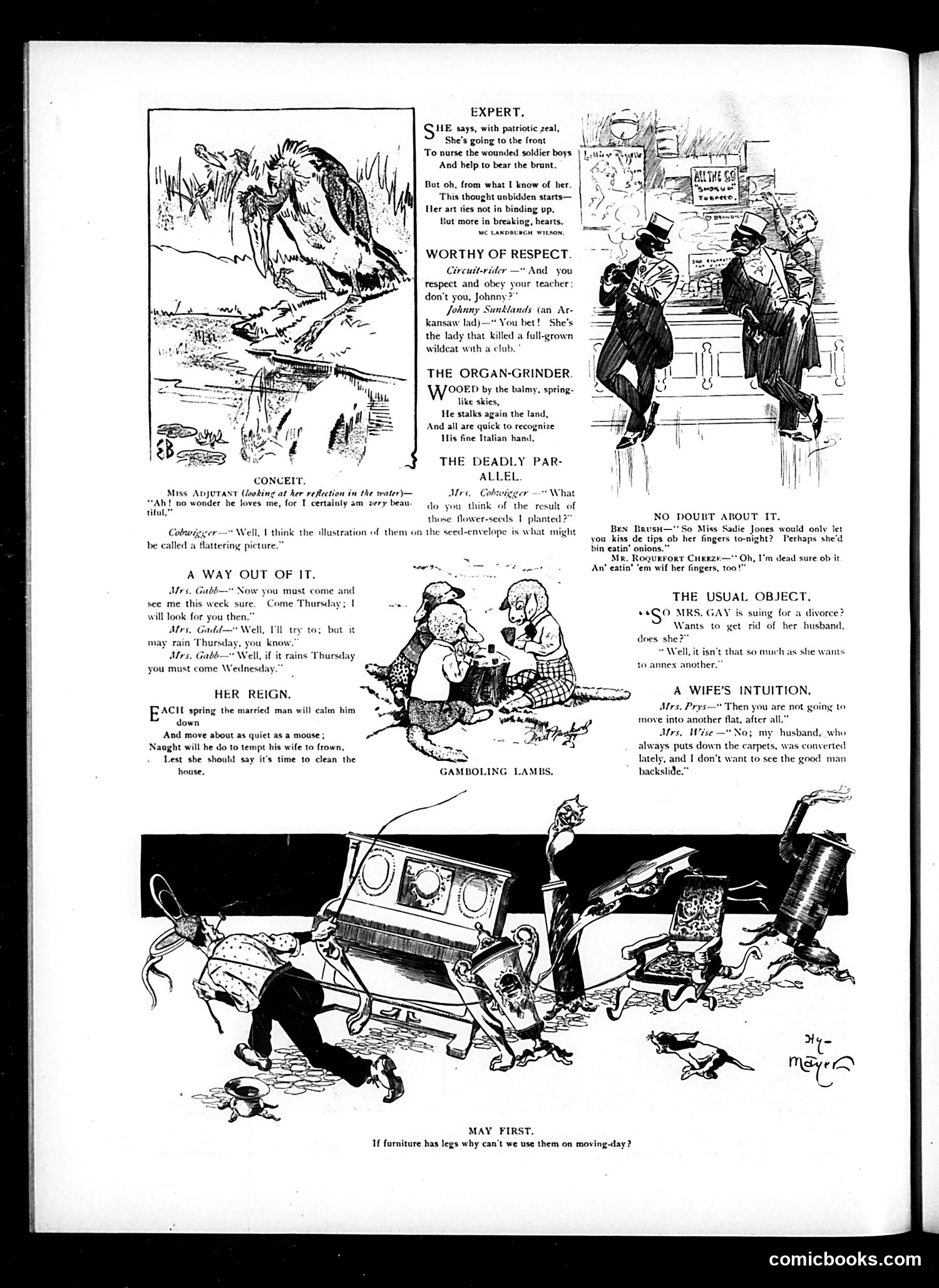
This page contains multiple short satirical pieces typical of early 20th-century American humor: **"Expert"** mocks women claiming patriotic duty as nurses while having reputations for romantic entanglements rather than genuine care. **"Worthy of Respect"** jokes about an Arkansas boy respecting his teacher—a woman who killed a wildcat with a club, playing on frontier stereotypes and gender role reversals. **"The Organ-Grinder"** appears to reference an Italian street musician returning seasonally, possibly with political undertones about Italian immigration. **"Conceit"** satirizes a vain woman's poor gardening results, blaming the seed-packet illustration's flattery. **"A Way Out of It"** depicts a woman using weather excuses to reschedule social obligations. **"Her Reign"** comments on newlyweds' domestic harmony being conditional on the wife's satisfaction. The remaining pieces mock divorce motivations, marital dynamics, and spousal communication—common Judge subjects reflecting middle-class anxieties about changing gender relations and marriage customs of the era.
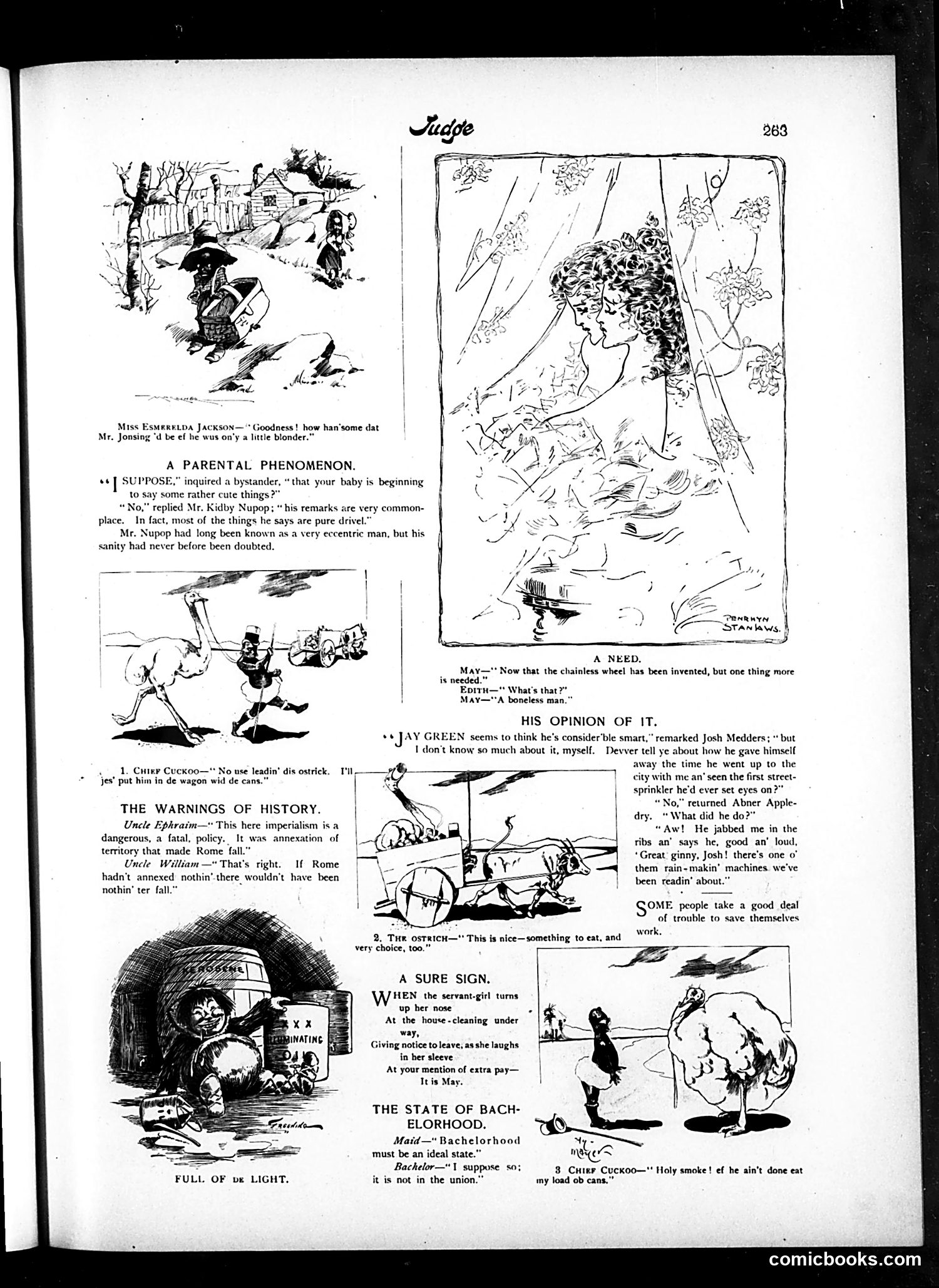
This page from Judge contains multiple satirical vignettes typical of the era's humor: **"A Parental Phenomenon"** mocks Mr. Nupop, an eccentric man who refuses to acknowledge his baby speaks nonsense, claiming his drivel is "pure" speech—satirizing parental delusion. **"The Warnings of History"** presents a dialogue between uncles debating imperialism, with Uncle Ephraim warning that annexation caused Rome's fall. This reflects late 19th/early 20th-century American anxieties about imperial expansion. **Various short jokes** address contemporary topics: the "chainless wheel" (new bicycle technology), servant girls' behavior during spring cleaning season, and bachelorhood's supposed ideals. The **caricatures and dialect** reflect period conventions—including racial stereotypes in the Jackson and "Cuckoo" sections—standard for Judge's humor at the time, though offensive by modern standards. Overall, the page satirizes American social pretensions, technological novelties, and imperial ambitions through crude humor and exaggerated characters typical of turn-of-the-century American satire.
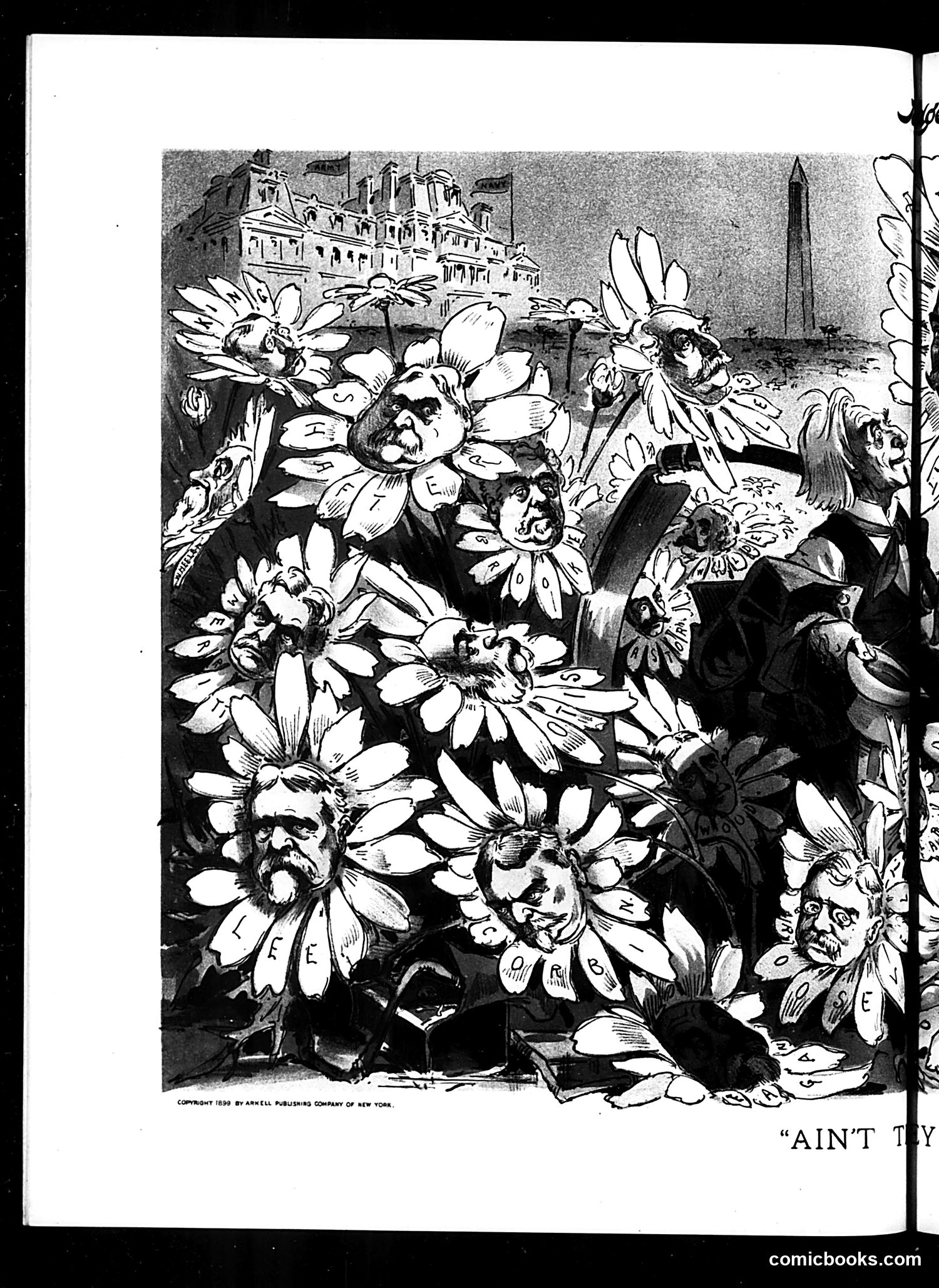
This is a satirical cartoon from *Judge* magazine (copyright 1898, per the visible text). The image depicts numerous human heads emerging from daisy flowers arranged in a field, with Washington D.C. landmarks (the Capitol and Washington Monument) visible in the background. The heads appear to be caricatured political figures or politicians of the era. The partial caption reads "AIN'T THY..." (likely continuing beyond the visible portion). The flowers-with-heads motif suggests the cartoon is satirizing politicians as interchangeable, superficial, or blooming/flourishing in some mocking way. The specific identity of depicted figures and the complete satirical point remains unclear without the full caption and additional historical context about 1898 politics.
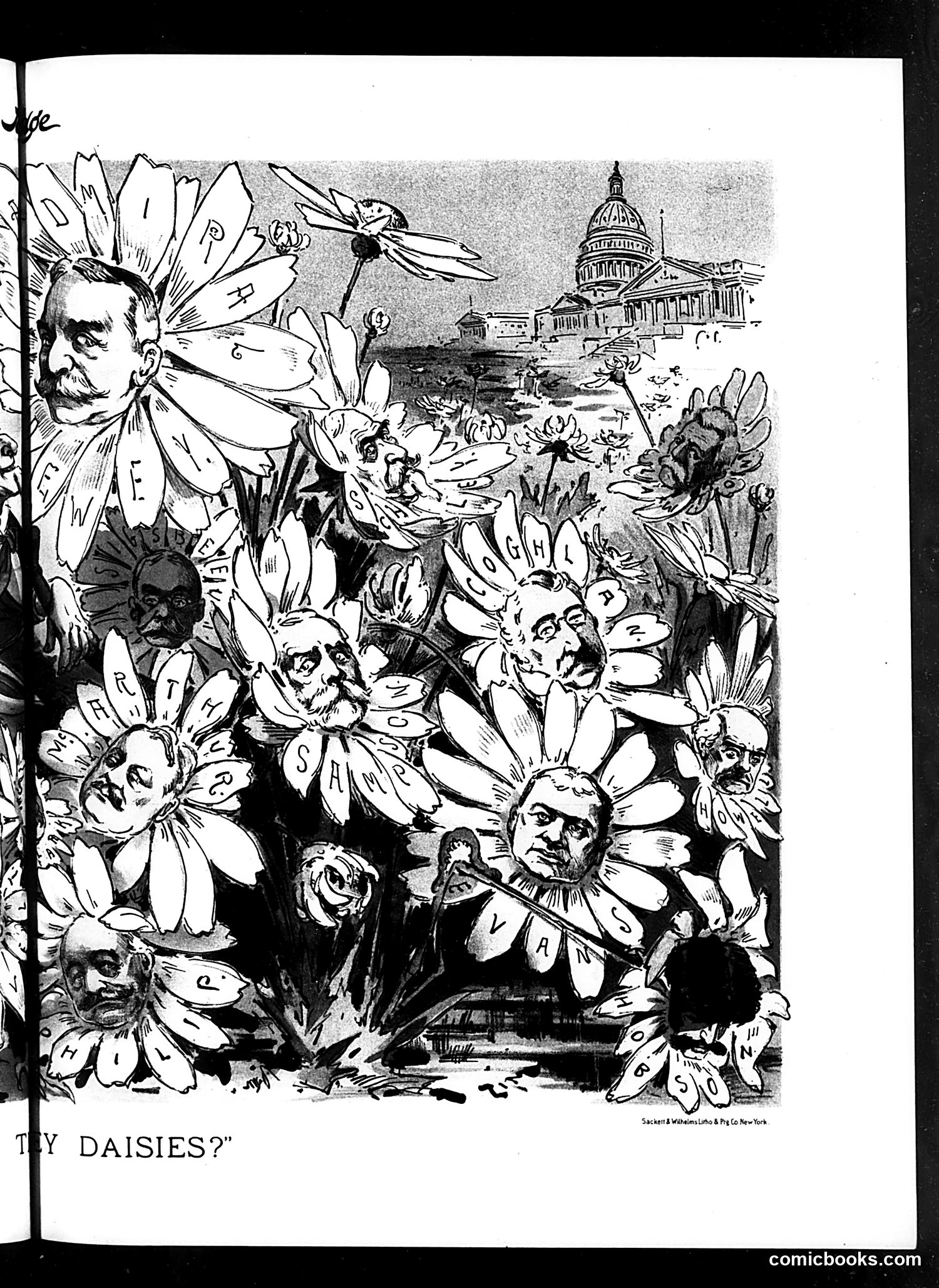
This is a satirical cartoon from *Judge* magazine depicting a field of daisies whose petals are labeled with individual faces and names (though specific text is difficult to read clearly in this reproduction). The cartoon critiques political or social figures through the "loves me, loves me not" daisy-plucking metaphor. In the background, the U.S. Capitol building is visible, suggesting this targets federal politicians. A man's profile appears prominently on the left—likely a political leader or public figure being satirized—while insects/bees pollinate the daisy-faced figures, implying political manipulation or influence. The title "Thy Daisies?" suggests questioning someone's political allies or supporters. Without clearer label visibility, the specific targets remain uncertain, but this appears to mock political patronage networks or shifting political loyalties of the era.
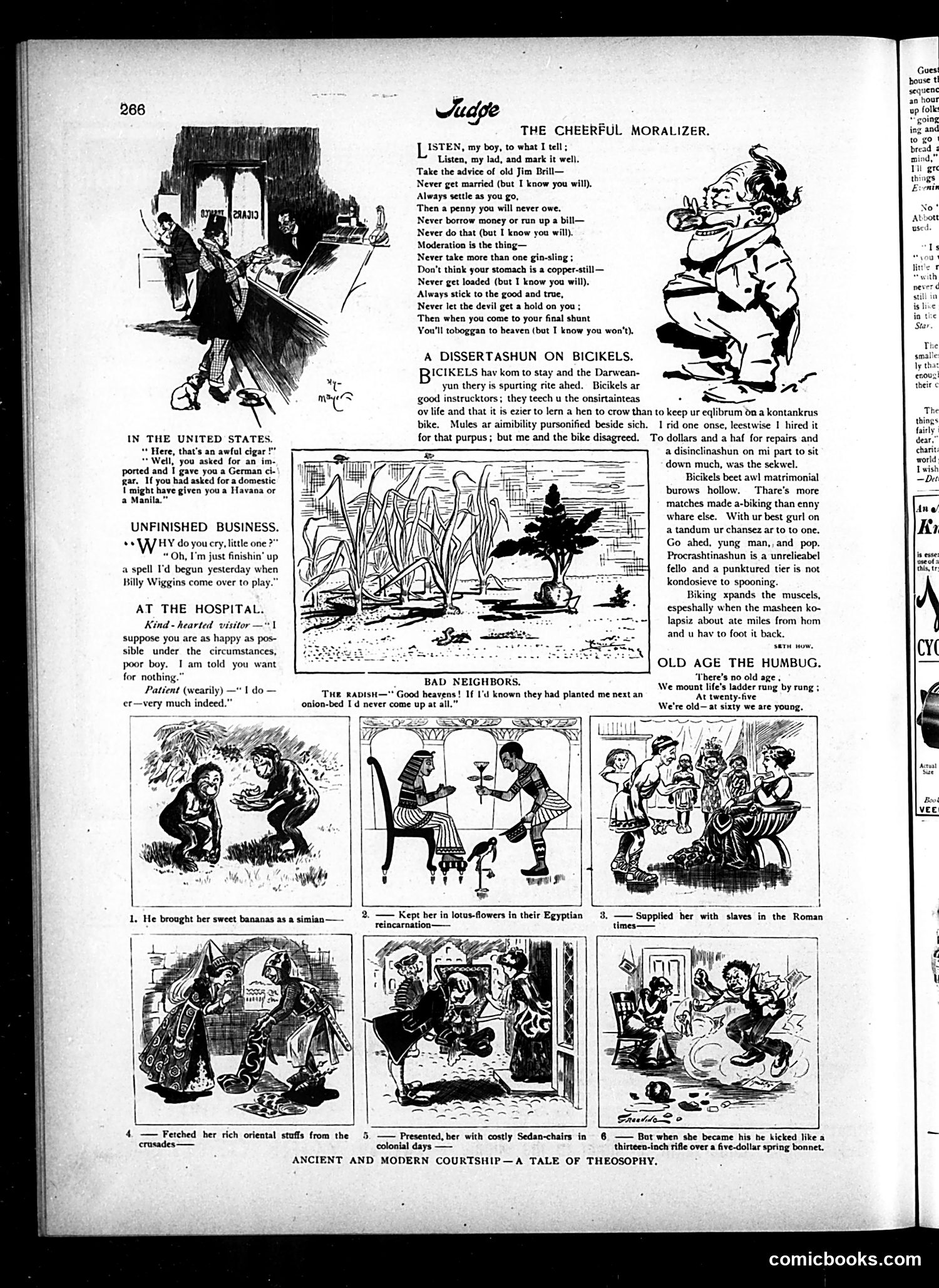
This page contains multiple satirical pieces typical of Judge's humor: **"The Cheerful Moralizer"** mocks hypocritical advice-givers who preach virtue while acknowledging people won't follow it ("Never get married...but I know you will"). The joke targets sanctimonious moralists. **"A Dissertashun on Bicikels"** uses intentionally misspelled text to satirize pseudo-intellectual commentary. It humorously positions bicycles as relationship-builders and muscle-developers while poking fun at bicycle accidents and mechanical failure. **"Bad Neighbors" / "Ancient and Modern Courtship"** presents a six-panel reincarnation narrative mocking both Theosophical beliefs and changing courtship customs. A man treats a woman lavishly across historical periods (as a simian, in Egyptian/Roman times) but becomes abusive once married in modern times—satirizing both pseudo-mystical philosophy and contemporary marriage dynamics. The remaining pieces ("In the United States," "Unfinished Business," "At the Hospital") are brief, standalone jokes about cigars, childhood play, and hospital etiquette.
This page from the satirical magazine *Judge* contains mostly **advertisements and brief comic anecdotes** rather than political cartoons. The visible content includes: **Comic snippets** satirizing everyday situations: a child envious of dinner guests while sent to bed on bread and milk; a painter's illogical artistic choices; a congressman's complaint about political pressures; and a woman's skepticism about marriage proposals. **Product advertisements** dominate the page: Dr. Bull's Cough Syrup, Angostura Bitters, Wilson Whiskey, Sohmer pianos, The Club Cocktails, and a Prudential Insurance endowment policy. These ads reflect turn-of-the-century consumer culture. **Social commentary** appears incidental—brief observations about female "artlessness," porterhouse steak pricing, and architectural choices. The page reflects *Judge*'s typical format: lighthearted domestic humor mixed with commercial promotion, rather than pointed political satire. No specific political figures or events are identifiable from the visible text and images.
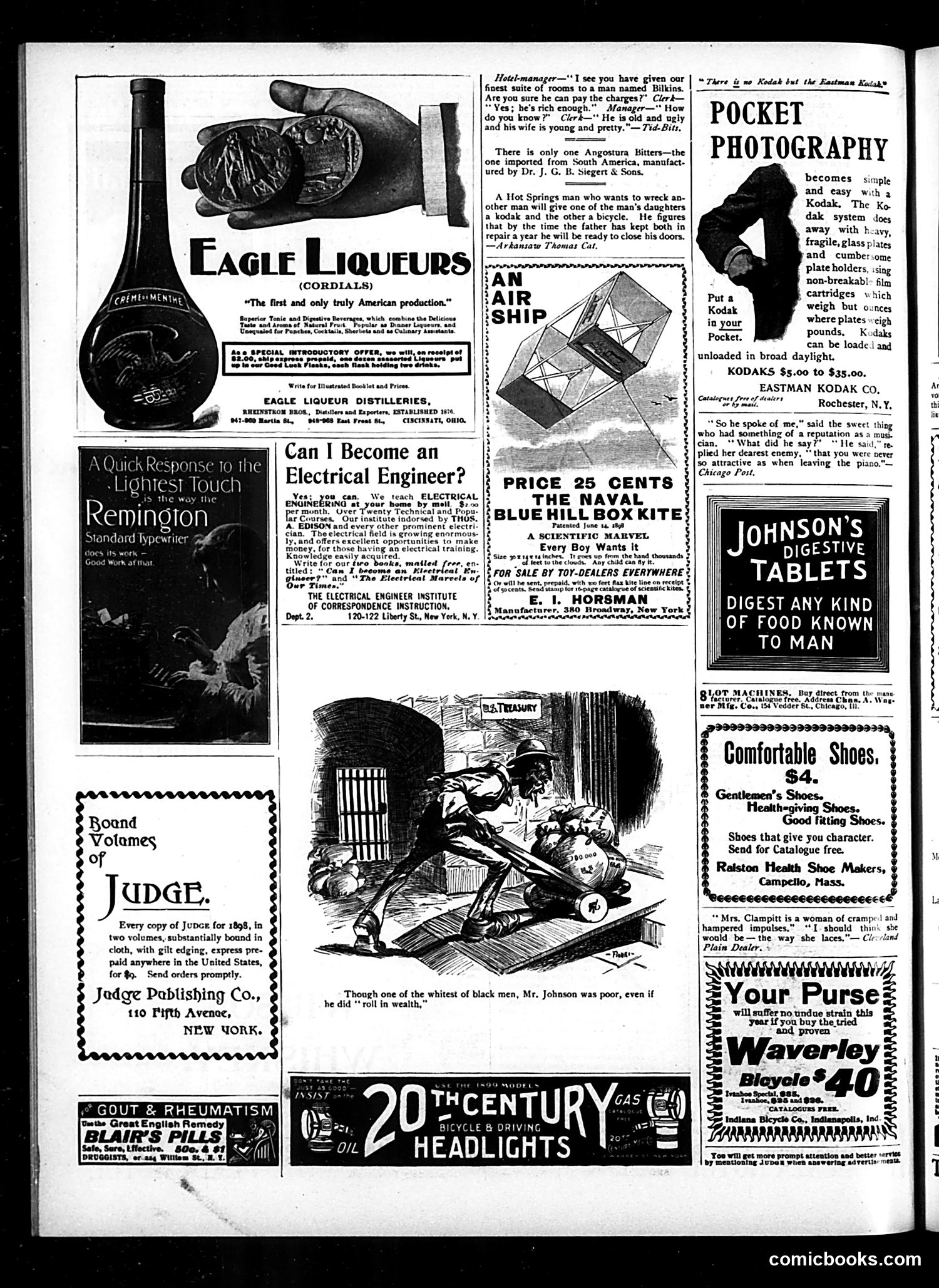
This page is primarily **advertisements and filler content** rather than political satire or editorial cartoons. The one illustrated narrative present—a small cartoon showing a man in a jail cell labeled "TREASURY"—appears to be a joke about financial mismanagement or embezzlement, though the caption ("Though one of the whitest of black men, Mr. Johnson was poor, even if he did 'roll in wealth'") references an unnamed "Mr. Johnson," making the specific historical reference unclear without additional context. The rest of the page consists of period product advertisements: Eagle Liqueurs, Remington typewriters, correspondence courses in electrical engineering, Kodak cameras, kites, shoes, digestive tablets, and bicycles. One joke in the text mocks a wealthy man buying his daughters a kodak and bicycle, predicting repair costs will bankrupt him—typical early-1900s humor about new technology expenses. The page reflects Judge's era and audience rather than containing substantive political content.
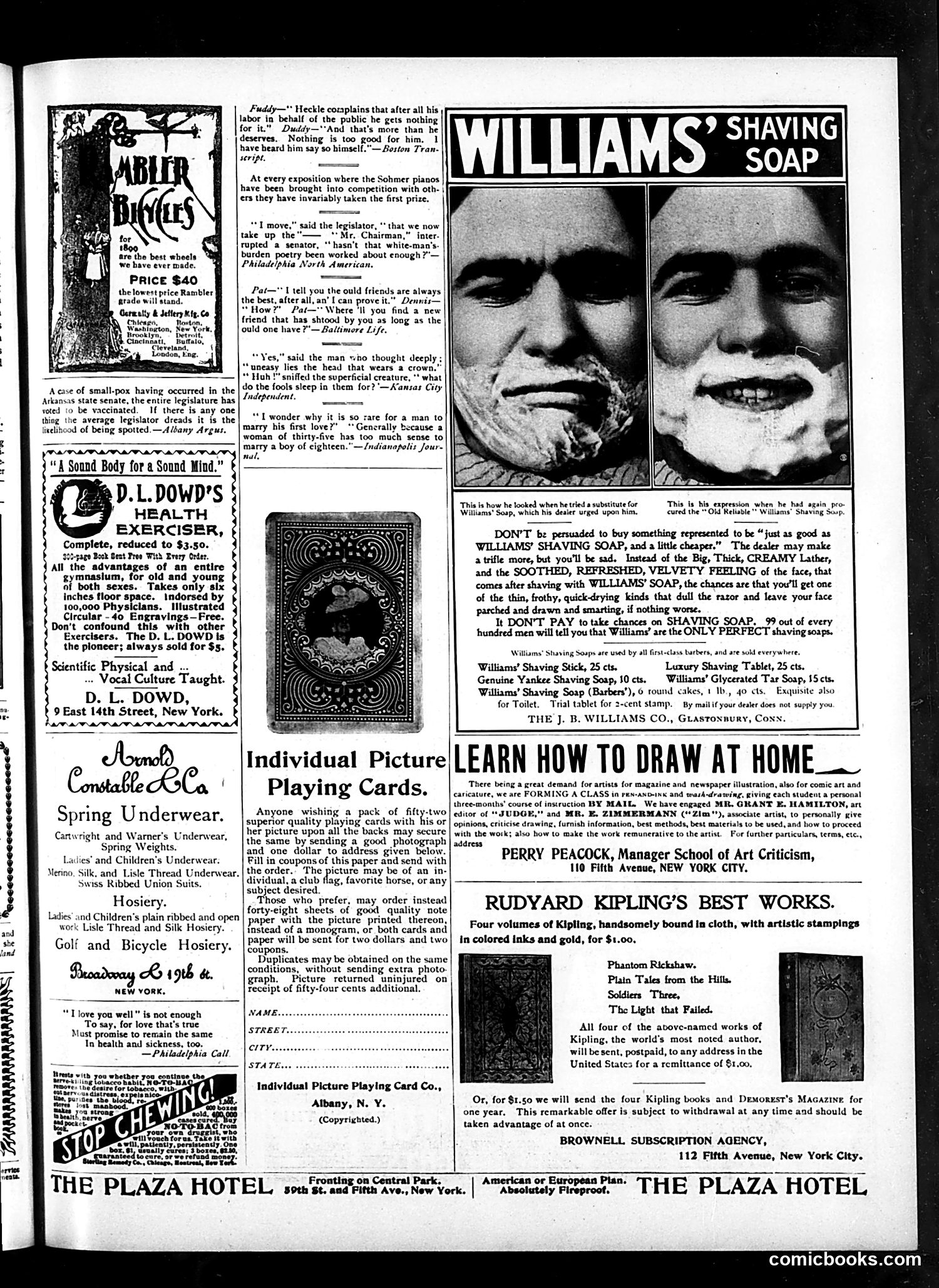
This page is primarily **advertisements and brief satirical quips** rather than a sustained cartoon narrative. The main content includes: **Satirical jokes** (short paragraphs with attributed sources): - A joke about Arkansas legislators being vaccinated after smallpox in the state senate—the humor being that legislators "dread being spotted" (wordplay on vaccination marks and political scandal) - Various short anecdotes about friendship, marriage, and labor/politics **The Williams' Shaving Soap advertisement** (right side) uses before/after facial expressions to humorously contrast a customer's disappointment when trying a substitute soap versus his satisfaction returning to "Old Reliable" Williams' brand. **Numerous product ads**: exercisers, underwear, playing cards, Rudyard Kipling books, The Plaza Hotel. The page reflects early 20th-century American advertising style and Judge's format of mixing brief, pun-based humor with commercial notices. No major political figures or sustained satirical commentary are evident—it's typical period magazine filler content.
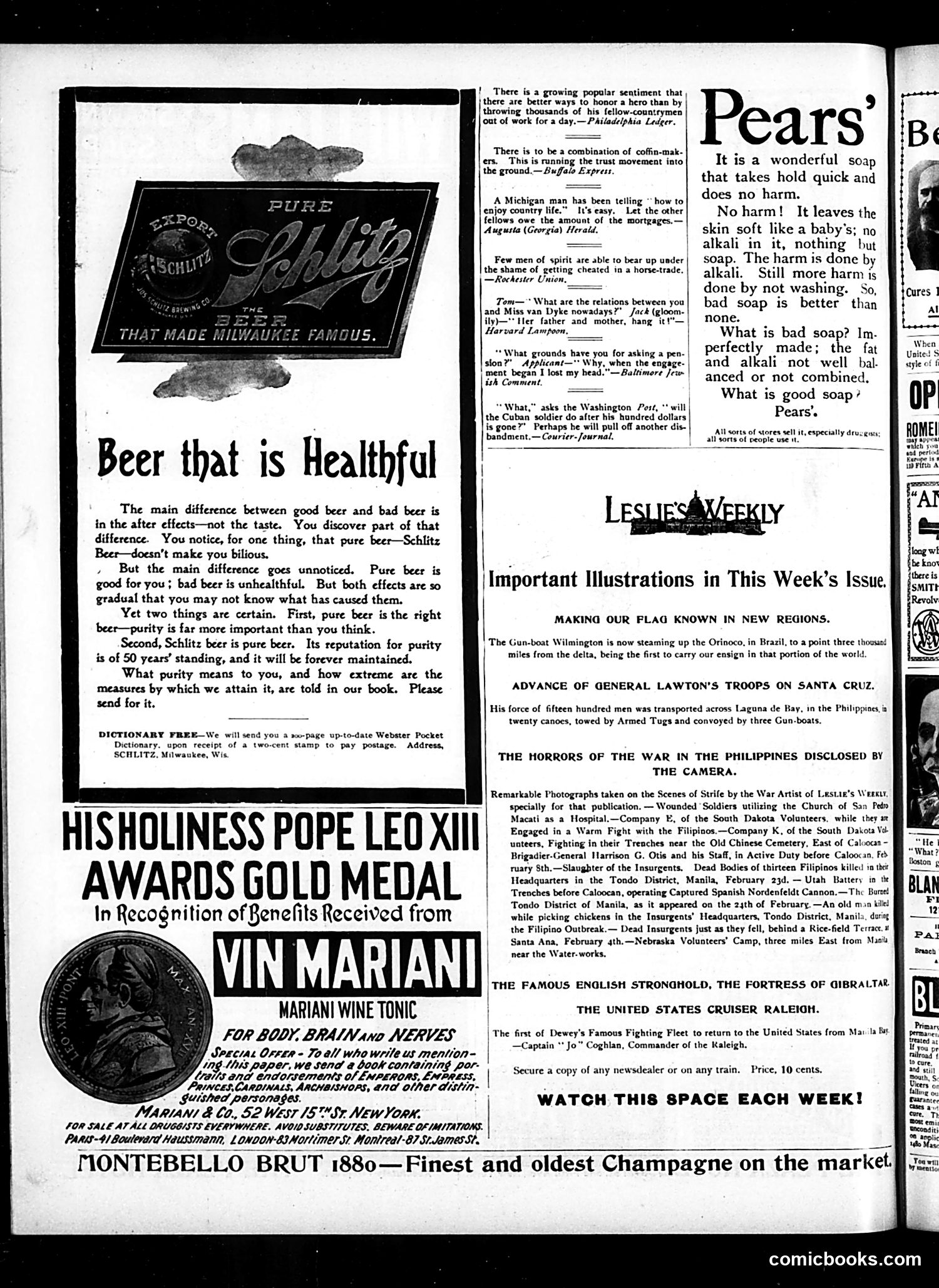
This page is primarily **advertising and promotional content** for Judge magazine, not satire or political cartoons. The main advertisements are: **Schlitz Beer** claims to be "pure" and healthful, distinguishing itself from "bad beer" that makes you bilious—a common early 1900s pitch using pseudo-scientific health claims. **Pears' Soap** advertises similar purity benefits, claiming no harmful alkali. **Mariani Wine Tonic** promotes itself as beneficial for "body, brain and nerves," noting papal and royal endorsements—a common marketing tactic for patent medicines of this era. The page also announces **Leslie's Weekly illustrations** covering contemporary topics: American naval expansion (the Wilmington in Brazil), General Lawton's military campaign in the Philippines, and war photography from the Philippine-American War. The single editorial quote satirizing Cuban soldiers receiving "hundred dollars" may mock post-Spanish-American War compensation, but the page is overwhelmingly commercial rather than satirical.
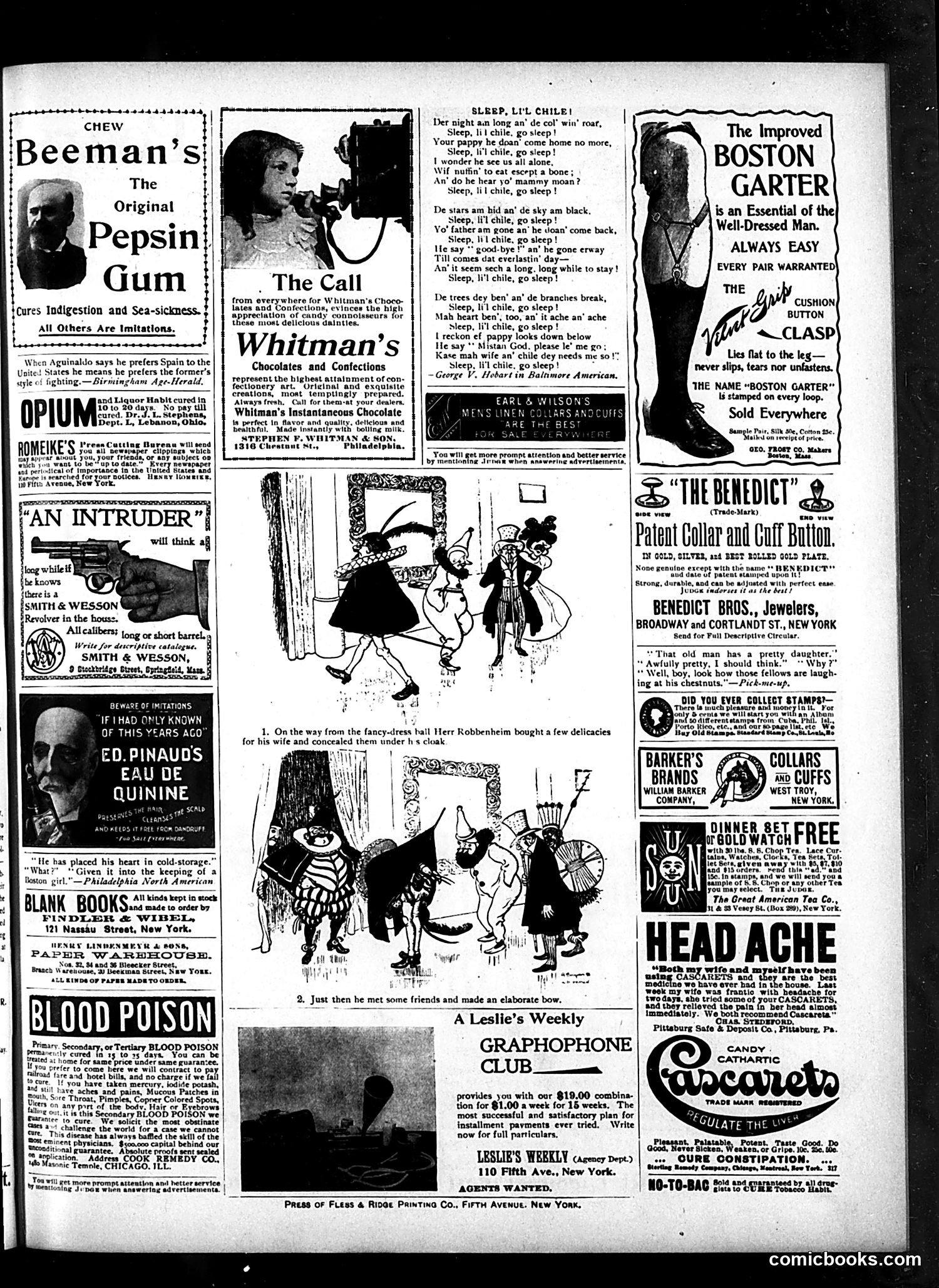
This page from *Judge* contains a sentimental poem set in the American South, apparently addressing an enslaved or impoverished Black child, depicting a mother comforting her son about an absent father ("pappy") who won't return. The nostalgic dialect representation and tragic domestic scene reflect late 19th/early 20th-century white editorial sentimentality about Southern racial conditions. Given the OCR reference to "Aguinaldo" (Filipino independence leader, circa 1900), this likely dates to the Spanish-American War era when Judge frequently published commentary on American imperialism. The poem's themes of loss and hardship may obliquely reference post-war or post-slavery circumstances, though the text doesn't make this explicit. The remainder is mostly **advertising**: patent medicines (blood poison cures, quinine tonics), garters, collar buttons, chocolates, and revolvers—typical *Judge* content mixing satirical humor with commercial notices. Without clearer visual identification in the cartoons themselves, the specific satirical intent remains unclear.
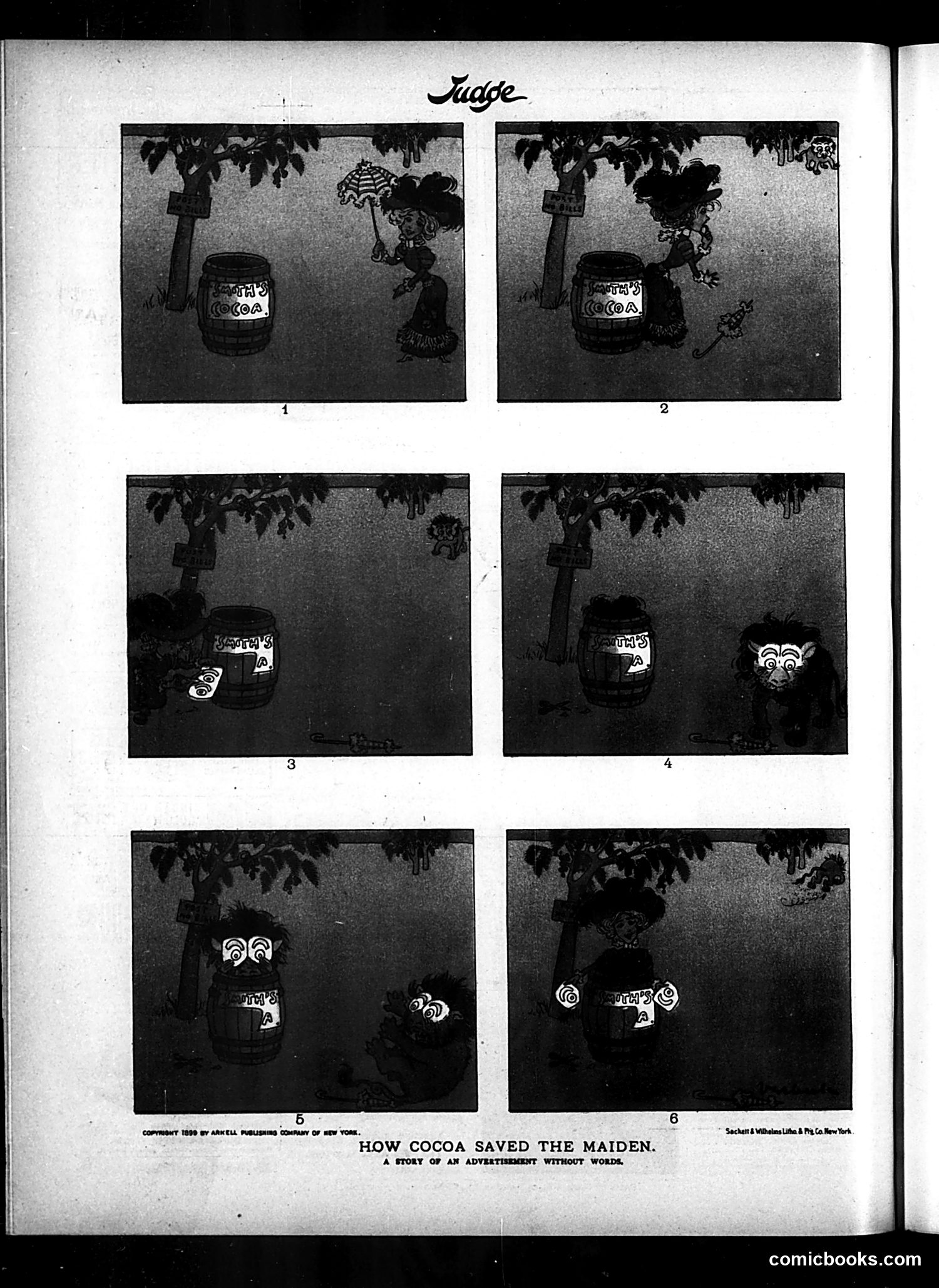
This is a six-panel wordless comic strip advertising cocoa. The narrative shows a maiden in distress—apparently threatened by what appears to be a menacing figure or creature near a barrel marked with a cocoa brand. Through the sequential panels, a barrel of cocoa intervenes, ultimately saving the maiden from danger. The satire here mocks melodramatic advertising of the era, which often deployed exaggerated rescue narratives to sell products. By presenting cocoa as literally heroic—intervening to save a damsel—Judge ridicules the absurd claims and emotional manipulation common in turn-of-the-century advertisements. The phrase "advertisement without words" emphasizes how visual storytelling alone conveys the cocoa's supposed miraculous properties, poking fun at advertising's reliance on narrative suggestion rather than rational argument.