
A complete issue · 16 pages · 1899
Judge — February 11, 1899
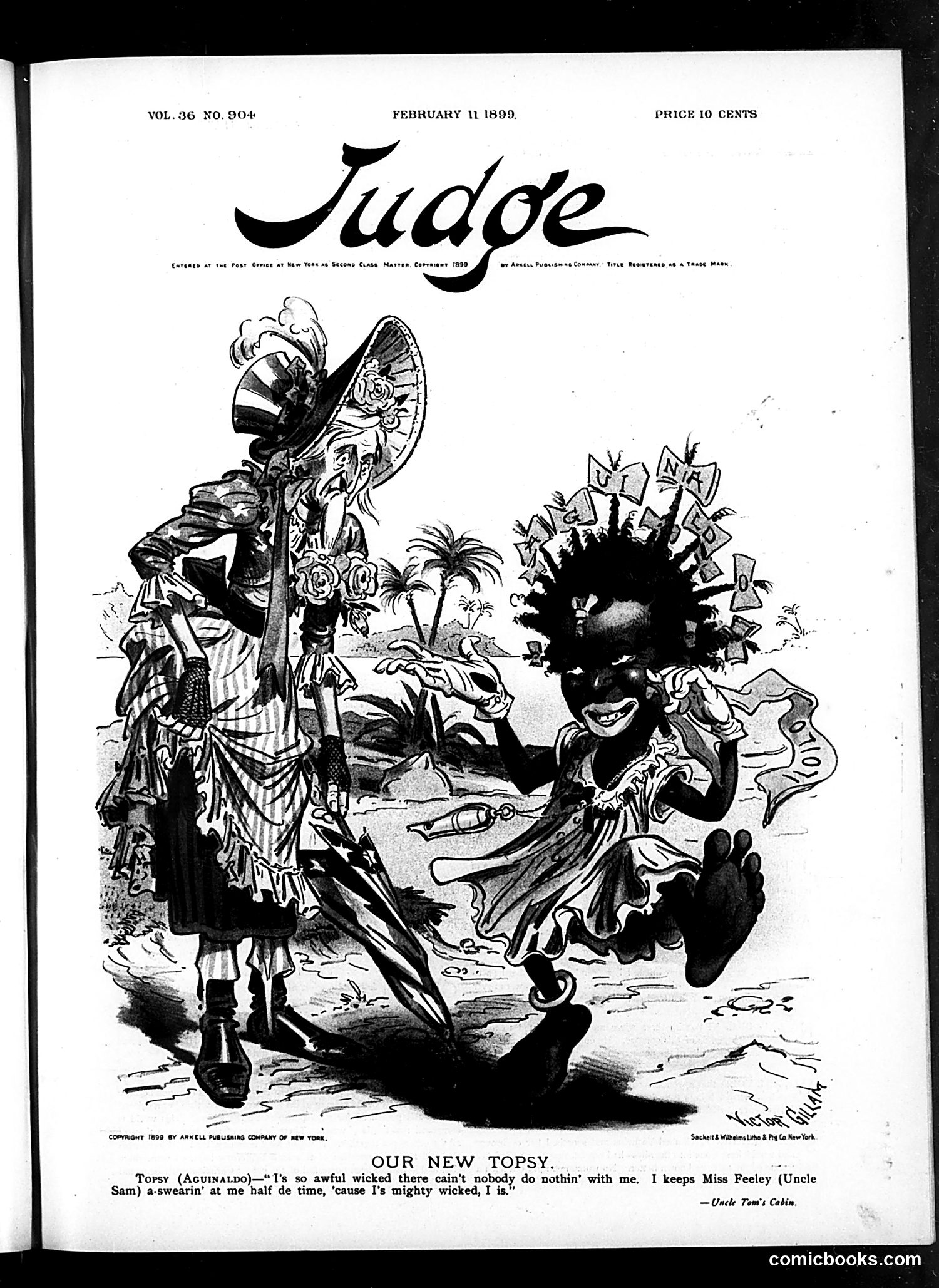
This cartoon satirizes a character named "Topsy" (labeled "Aguinaldo"), referencing the famous enslaved character from *Uncle Tom's Cabin*. The figure appears to be Emilio Aguinaldo, leader of Filipino resistance during the Philippine-American War (1899-1902). The satire compares Aguinaldo to Topsy—a character known for mischief and claiming she "just growed" without proper upbringing. The caption has Topsy boast about being "mighty wicked," suggesting the cartoon portrays Filipino independence fighters as inherently lawless or uncivilized. This reflects American imperialist attitudes of the era, using racist caricature to justify U.S. military intervention in the Philippines. The tropical setting and exaggerated features are typical of period racist imagery used to dehumanize colonial subjects.
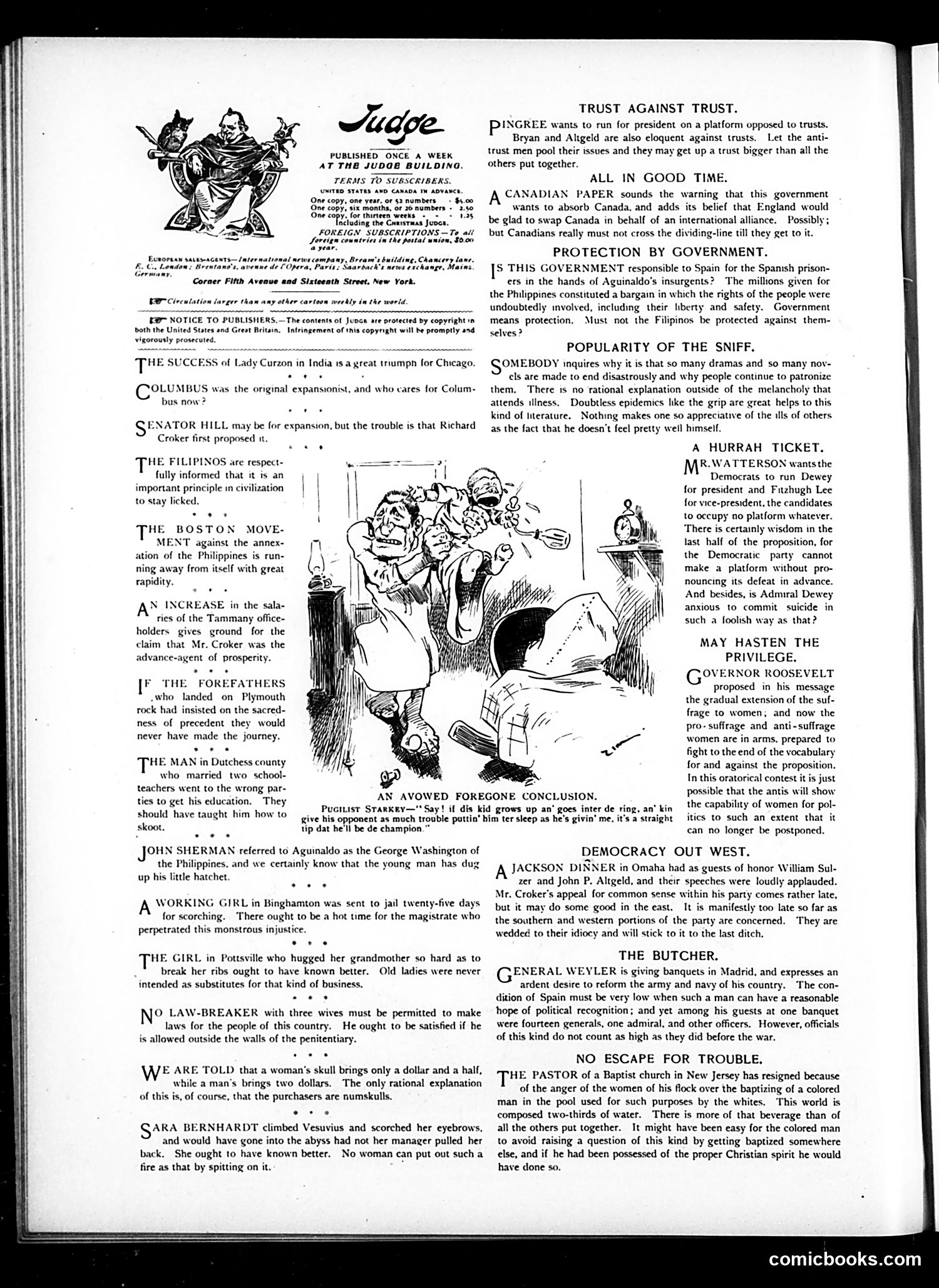
The central cartoon titled "An Avowed Foregone Conclusion" depicts a chaotic scene of multiple figures struggling together, with one saying it's a "straight fight" but admitting the outcome is predetermined—a commentary on electoral dishonesty. The surrounding editorial snippets criticize various political figures and issues of the era: - **"Trust Against Trust"**: Pingree's presidential platform opposing monopolies - **"Protection by Government"**: Questions whether government safeguards citizens' rights - **"A Hurrah Ticket"**: Satirizes Democratic candidates (Dewey, Fitzhugh Lee) as offering no real platform alternative - **"Democracy Out West"**: Mocks a Jackson Dinner featuring political speeches as empty rhetoric - **"The Butcher"**: References Spanish military reform efforts The overall tone criticizes corrupt politics, empty campaign promises, and the illusion of democratic choice.
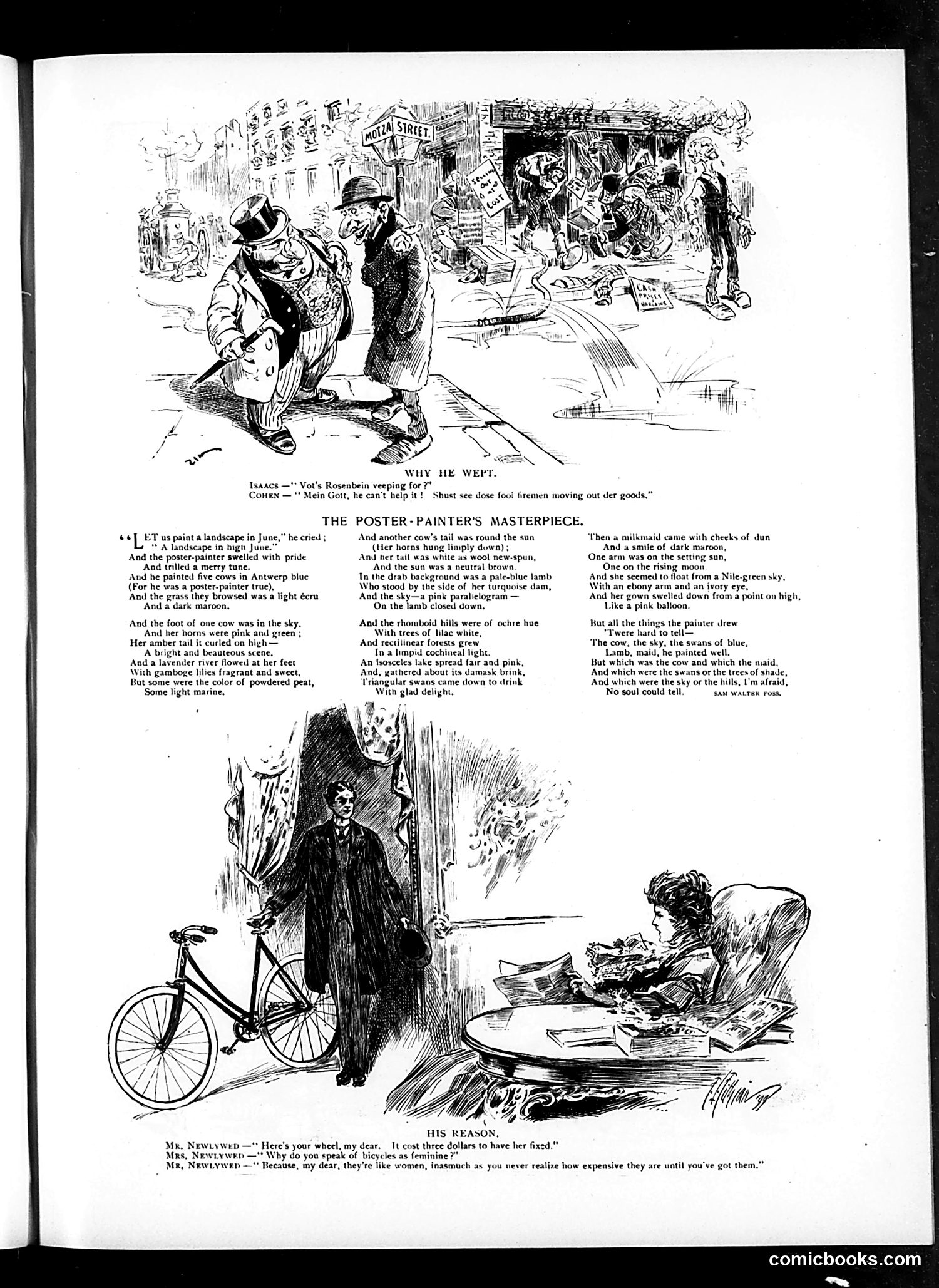
This page contains two satirical cartoons from *Judge* magazine: **Top cartoon ("Why He Wept"):** Shows two men on a street near "Mort Street" where food vendors operate. One character appears distressed while the other observes. The dialogue suggests commentary on food quality or street commerce, likely mocking poor urban conditions or vendor practices common in early 20th-century American cities. **Bottom cartoon ("His Reason"):** Depicts a man with a bicycle speaking to a woman. The dialogue reveals he won't let her use his bicycle because "bicycles are like women"—expensive and high-maintenance. This is social satire about gender attitudes and the emerging "New Woman" era when bicycles represented female independence and mobility, which apparently alarmed some men. Both cartoons reflect class and gender tensions of the period.
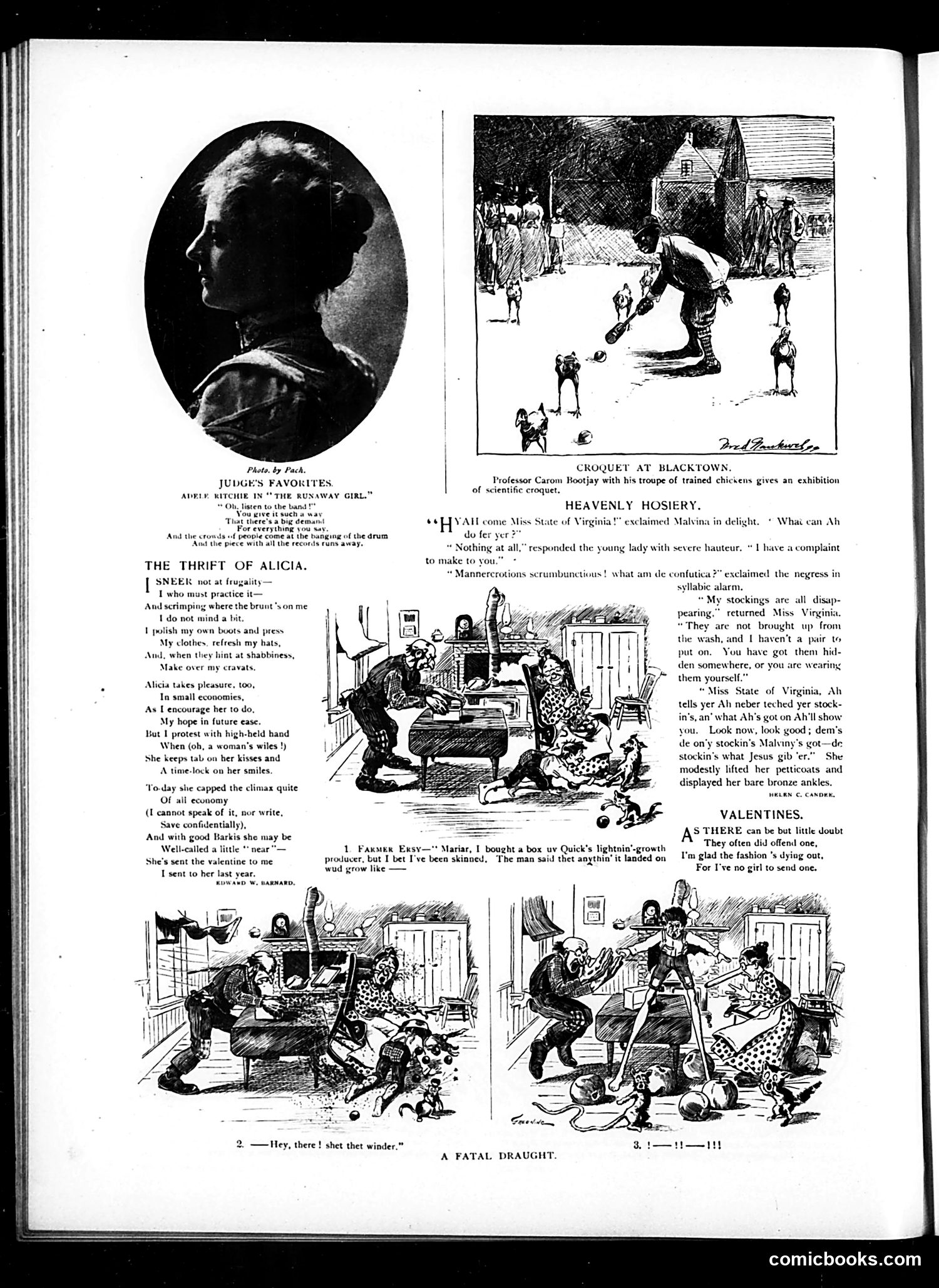
This page contains literary and illustrative content rather than political satire. The main features are: **"The Thrift of Alicia"** — a poem about a woman who steals minor items, presented as humorous domestic verses. **"Heavenly Hosiery"** — a dialogue sketch mocking Southern dialect and pretension, where "Miss State of Virginia" complains about stockings to "Ah" (likely representing African American vernacular speech for comedic effect). This reflects period racial stereotyping common in early 20th-century humor magazines. **"Valentines"** and **"A Fatal Draught"** — illustrated comic vignettes depicting domestic mishaps and romantic situations. The page emphasizes light humor, wordplay, and domestic comedy rather than political commentary. The racial humor element reflects Judge's casual period prejudices.
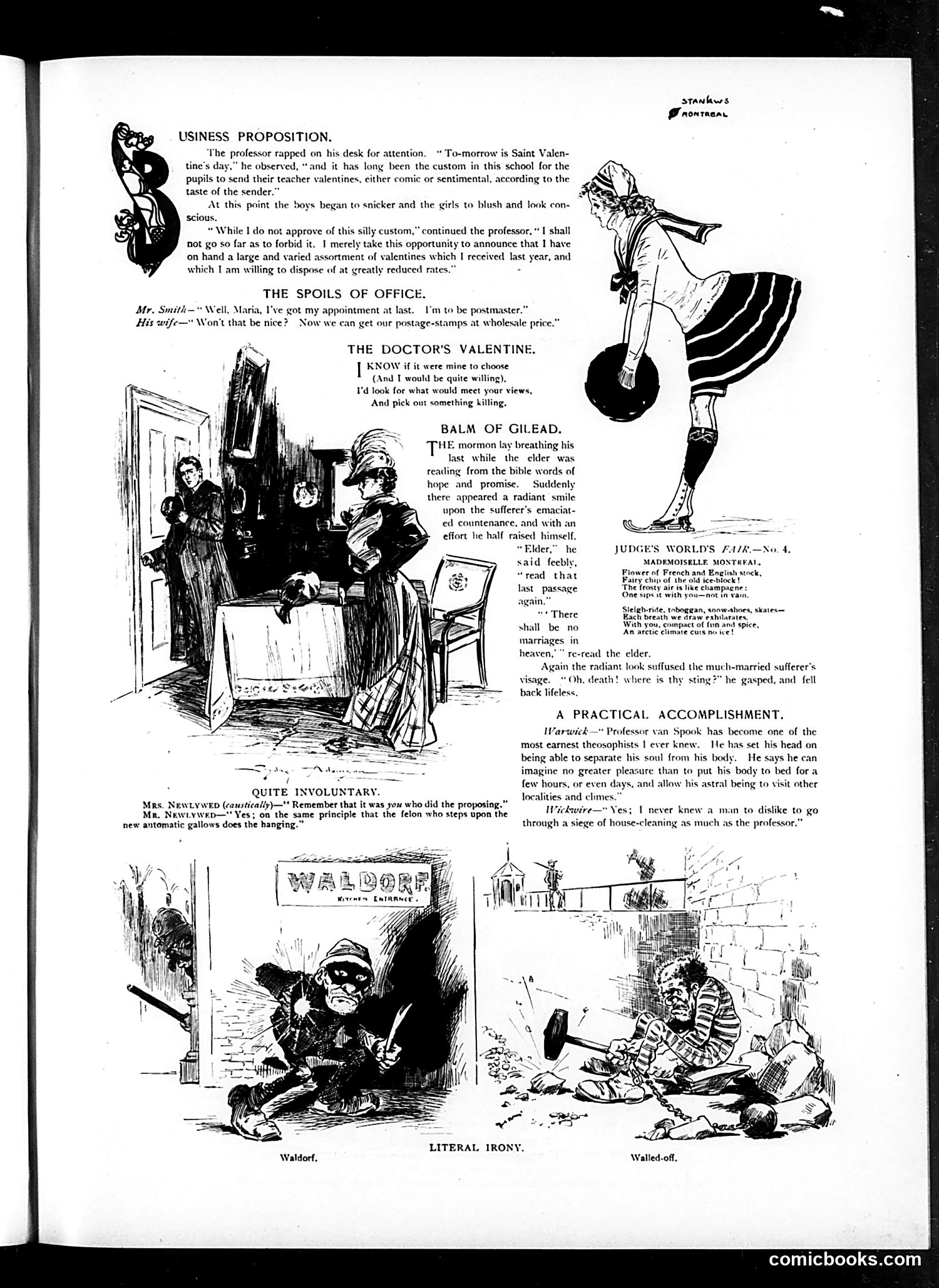
This page contains multiple satirical pieces typical of late 19th/early 20th-century American humor: **"Business Proposition"**: A professor cynically exploits Saint Valentine's Day custom by selling leftover valentines to students at "greatly reduced rates"—the joke being his transparent attempt to profit from a tradition he claims not to endorse. **"The Spoils of Office"**: Satirizes political patronage; a newly appointed postmaster jokes about buying stamps wholesale, suggesting government positions exist primarily for personal financial gain. **"Balm of Gilead"**: Mocks Mormon polygamy. A dying polygamist smiles upon hearing there are "no marriages in heaven"—darkly suggesting relief at escaping his many wives. **"Literal Irony"**: The two cartoons labeled "Waldorf" and "Walled-off" appear to be visual puns about exclusivity or social barriers, though details are unclear from the image. **"A Practical Accomplishment"**: Ridicules theosophical spiritualism, specifically astral projection claims—contemporary pseudoscience. The page demonstrates Judge's satirical targets: institutional hypocrisy, political corruption, religious practices, and intellectual fads.
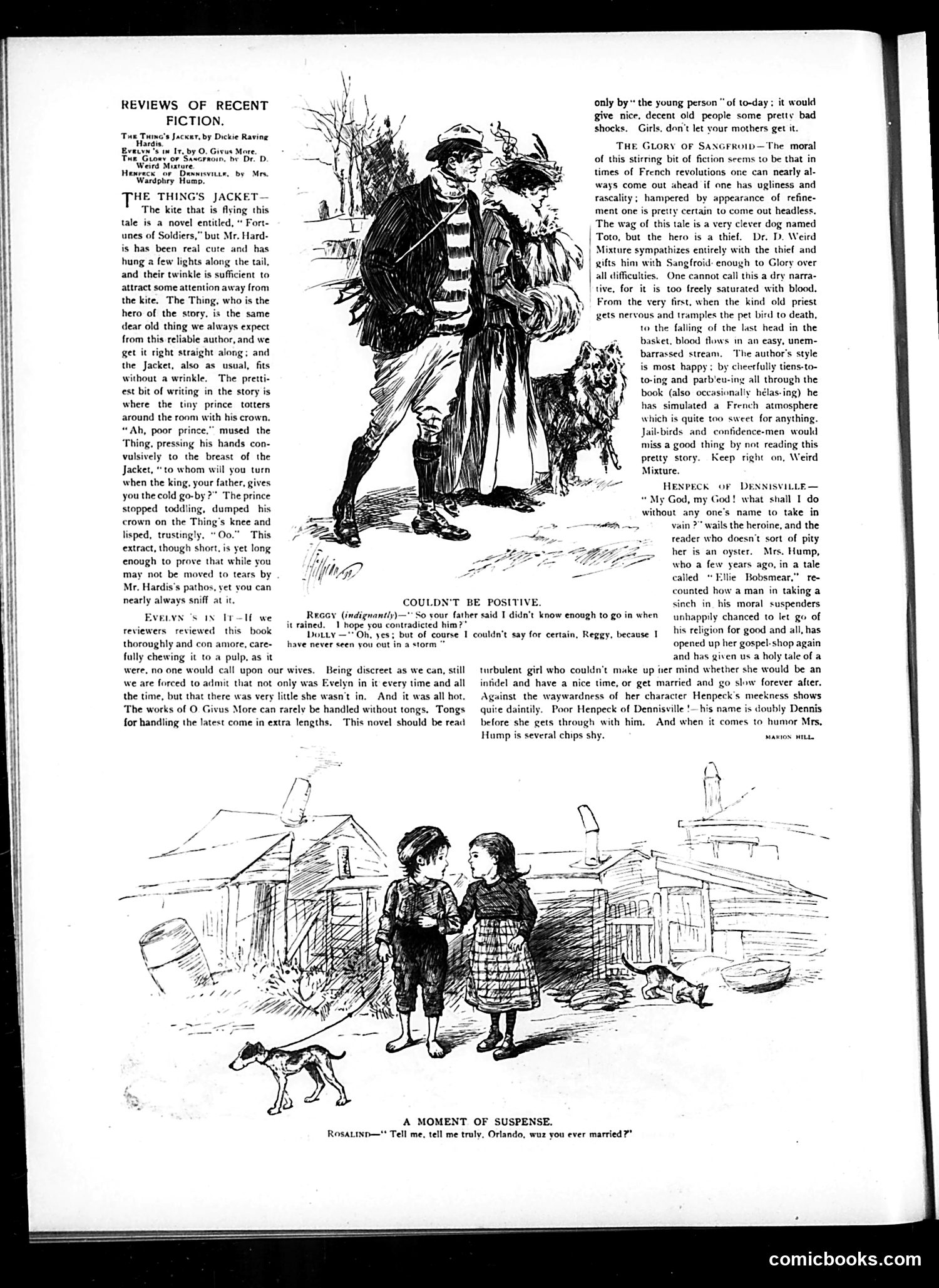
This page contains **book reviews** from *Judge* magazine—satirical critiques of contemporary fiction. The reviews mock overwrought Victorian-era novels with exaggerated, melodramatic plots. **"The Thing's Jacket"** ridicules a sentimental tale about a prince and kite, mocking the author's tearful prose ("Ah, poor prince"). The reviewer dismisses it as predictably saccharine. **"The Glory of Sangfroid"** satirizes a French Revolutionary-era adventure novel glorifying a morally corrupt thief-protagonist. The reviewer acidly notes the story is "freely saturated with blood" and relies on French affectations ("parbleu," "hélas") for atmosphere. **"Henpeck of Dennisville"** mocks a pious religious novel about a conflicted heroine choosing between sin and marriage—typical "uplift" fiction of the era. The cartoon "Couldn't Be Positive" jokes about uncertainty in courtship, while "A Moment of Suspense" depicts children asking about marriage. The satire targets Victorian literature's melodrama, moral preachiness, and overwrought sentimentality—criticizing how such books were marketed to respectable audiences.
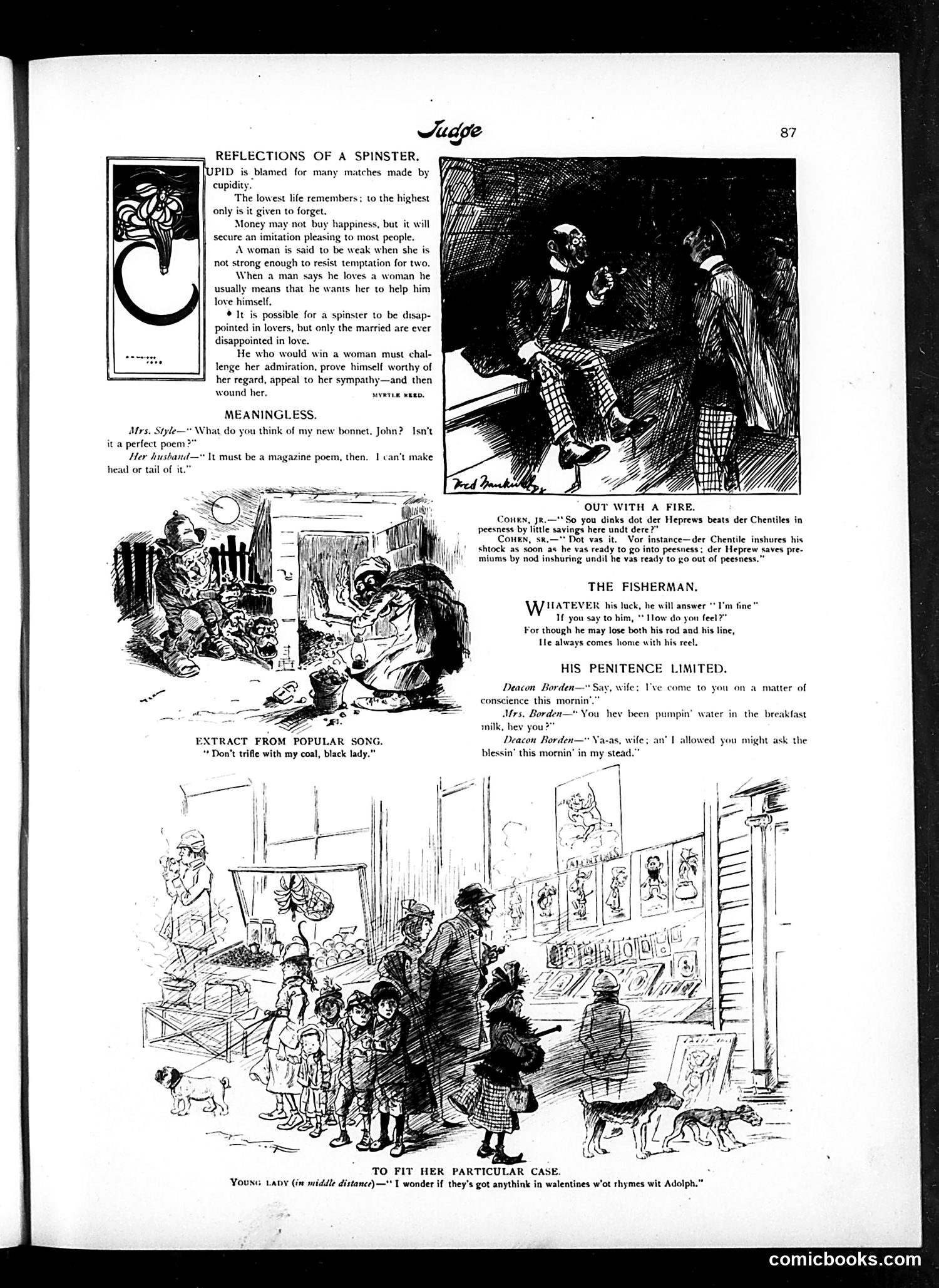
This page contains multiple satirical pieces targeting early-20th-century social conventions: **"Reflections of a Spinster"** presents cynical observations about romance and marriage, suggesting men are self-serving and that disappointment is exclusive to married women—critiquing romantic idealization. **"Meaningless"** jokes about a woman's incomprehensible hat design, humorously likening it to obscure poetry. **"Out with a Fire"** uses heavy ethnic stereotypes (German-Jewish dialect) to present a joke about insurance practices—the "Hebrew" saves money by avoiding premiums until business closure, while the "Gentile" insures immediately. This reflects period prejudices about ethnic business practices. **"The Fisherman"** offers gentle humor about optimistic fishermen who always return home satisfied despite poor catches. **"His Penitence Limited"** depicts a deacon confessing minor wrongdoing (watering milk) while asking his wife to say grace—satirizing selective conscience and male authority. The final cartoon shows a young woman seeking Valentine's cards rhyming with "Adolph"—likely referencing period immigration waves. The tone throughout reflects Judge's satirical approach to marriage, gender relations, and ethnic stereotypes common to early American humor magazines.
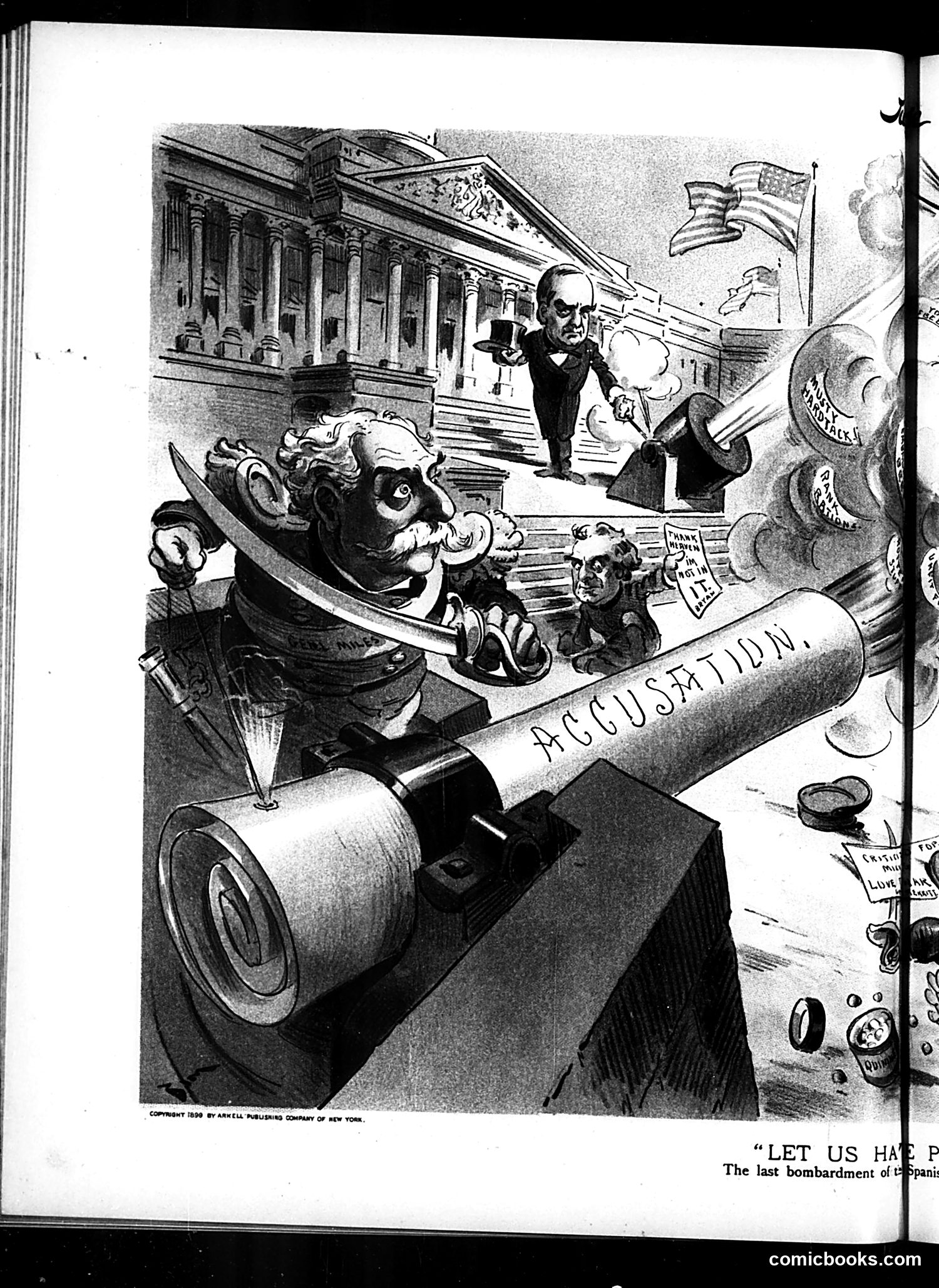
This 1898 Judge magazine cartoon, titled "Let Us Have Peace: The Last Bombardment of Spain," uses satire to comment on American military intervention. A large cannon labeled "ACCUSATION" dominates the foreground, aimed at a classical building (representing Spain's government). Demonic or caricatured figures emerge from the cannon's barrel, while dignified officials stand on the capitol steps above. The satire appears critical of American warmongering—suggesting that accusations and inflammatory rhetoric are being weaponized against Spain like cannon fire. The "last bombardment" reference likely alludes to the Spanish-American War (1898). The cartoon seems to mock or question the justifications used for military aggression, presenting accusations as destructive "ammunition" rather than legitimate grievances. The overall message critiques how nations manufacture pretexts for warfare.
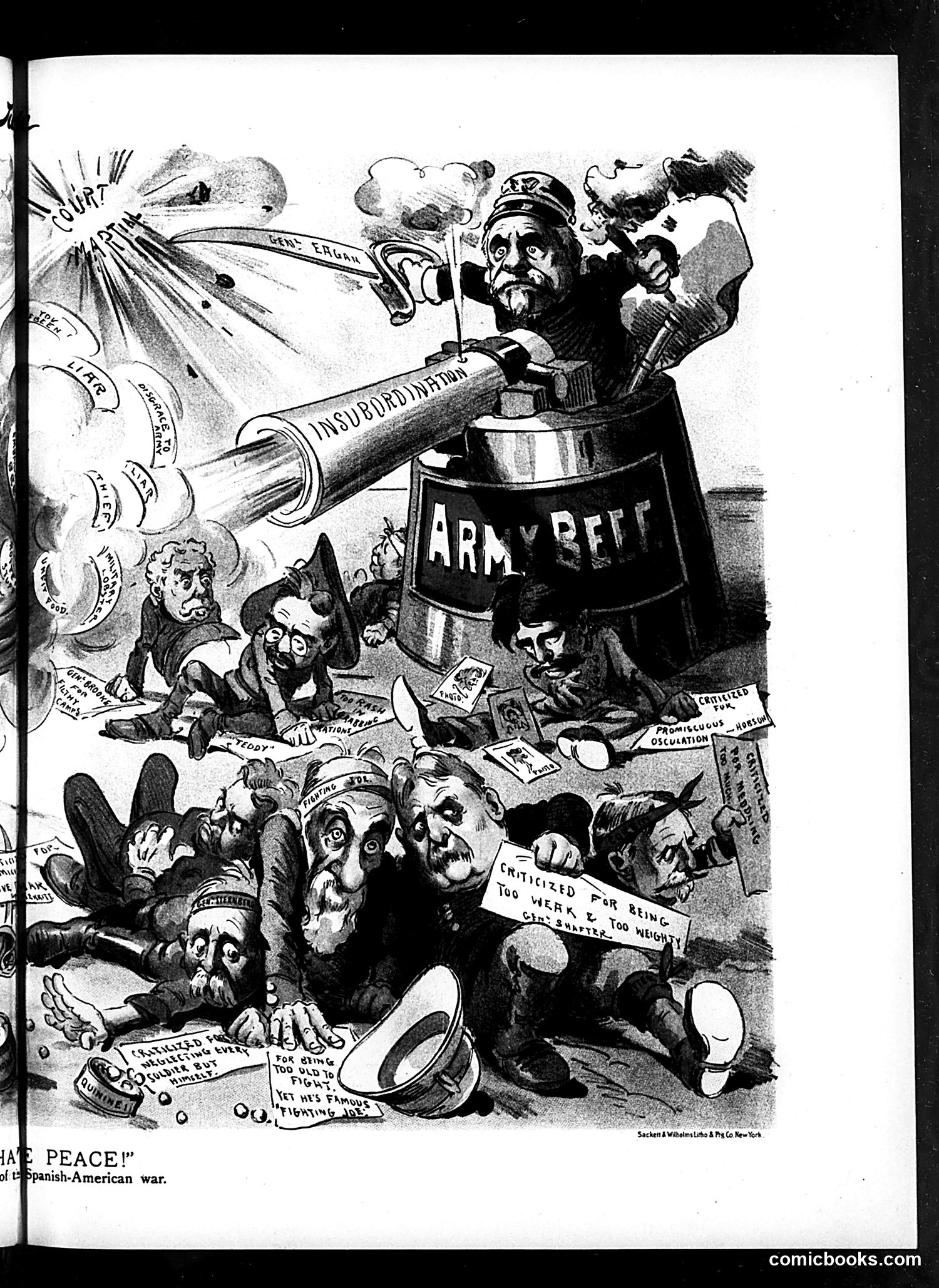
This Judge magazine cartoon satirizes military leadership during the Spanish-American War. A bearded military figure (likely representing Army leadership or a specific general) operates a large syringe labeled "SUBORDINATION," spraying various caricatured soldiers below. The soldiers appear to be criticized figures—labels mention they were "criticized for being too weak" and "too mighty," suggesting internal military disputes about command authority and troop discipline. The cartoon's title references "peace," likely sarcastically commenting on how military subordination (forced obedience) is being imposed rather than achieved naturally. The absurd imagery—injecting "subordination" into soldiers—mocks the heavy-handed approach to military hierarchy and discipline during this period. The overall message critiques both military leadership and the soldiers' conduct during the war.
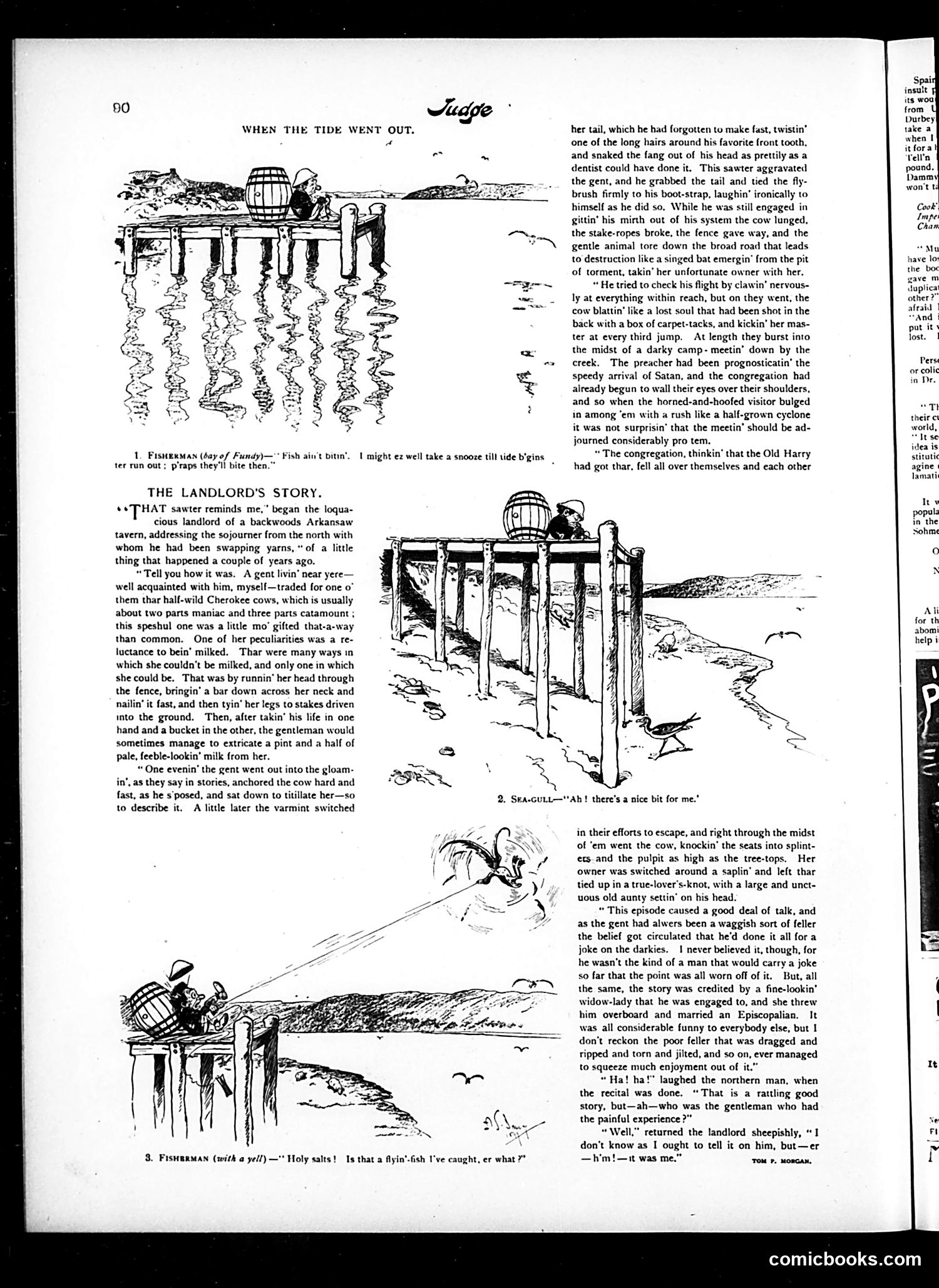
This page contains three illustrated anecdotes, likely from the late 19th or early 20th century, framed around rural/frontier humor. **The cartoons depict**: 1. A fisherman at Bay of Fundy complaining fish aren't biting during low tide 2. A sea-gull rejecting bait ("not a nice bit for me") 3. A fisherman celebrating catching what appears to be a sea-creature **"The Landlord's Story"** is the main text—a tall tale about an Arkansaw tavern-keeper recounting how a wild Cherokee cow, while being milked, breaks free with the farmer attached and charges through a Black revival camp meeting, creating comic chaos. The congregation mistakes the horned cow for the Devil. The humor relies on rural stereotypes, slapstick violence, and racial caricature (the "darky camp-meetin'" scene). For modern readers, this reflects period attitudes toward rural Southerners, African Americans, and animals as comedy subjects—elements that mark the satirical sensibilities of Judge's era.
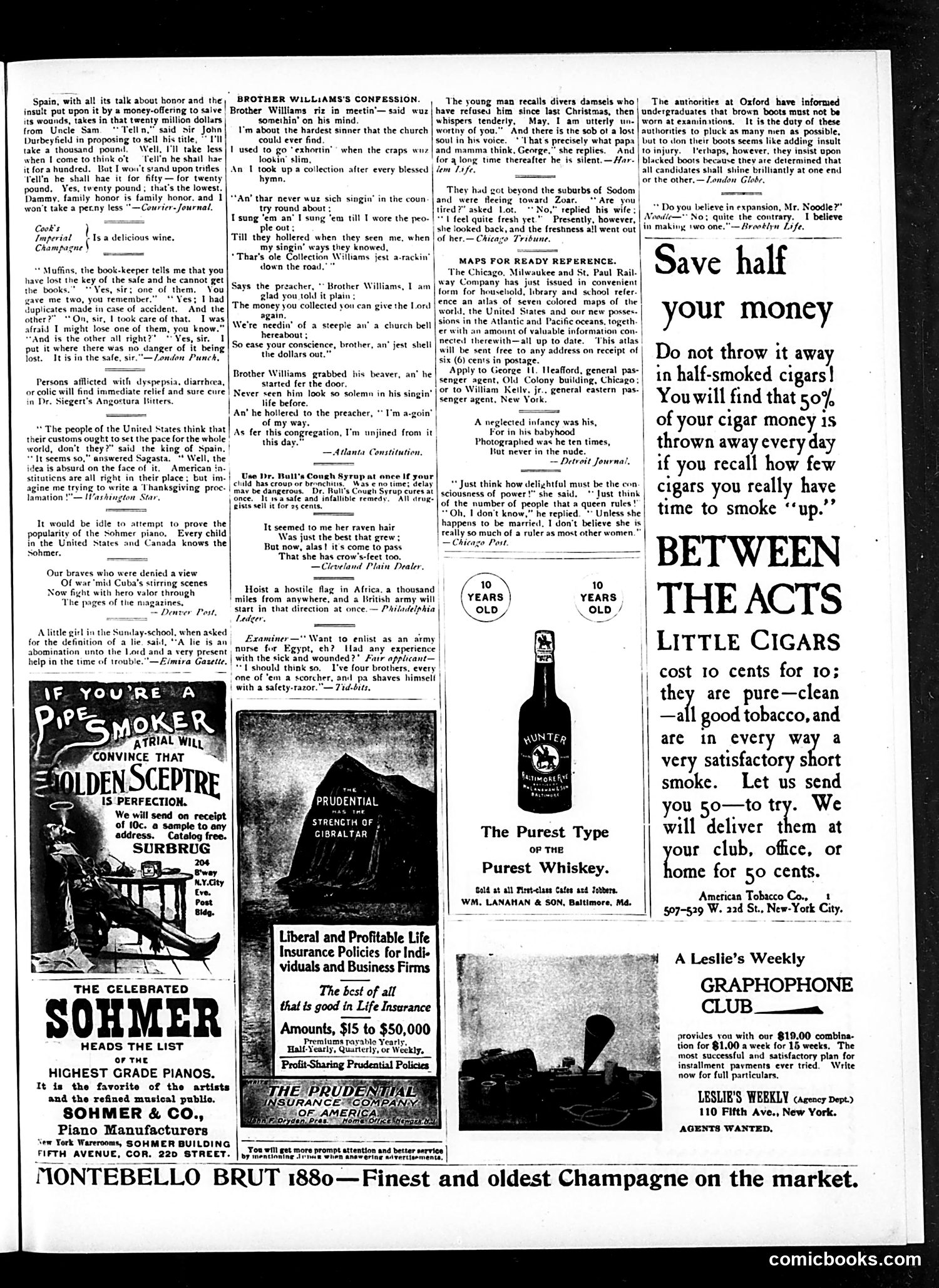
This page is primarily **advertising and humorous short pieces**, not political cartoons. The main content includes: **Humor pieces:** Brief anecdotes mocking various subjects—a Spanish king's dismissal of American customs, a foolish bookkeeper, a lying child's Sunday school definition, and "Brother Williams's Confession," a dialect poem about a fraudulent preacher who collected money under false pretenses and must now surrender it. **Advertisements:** Dominant content includes ads for Sohmer pianos, Golden Sceptre tobacco pipes, Hunter whiskey, Little Cigars (50 cents), life insurance, and a graphophone club. The famous Montebello Champagne appears at bottom. **Social commentary:** The "Brother Williams" piece satirizes religious hypocrisy and financial manipulation within churches—a preacher using emotional singing to extract money from congregants, then reluctantly returning it when caught. There are **no identifiable political figures or cartoons** on this page. It reflects early-1900s American attitudes toward commerce, morality, and entertainment through humor and period advertising.
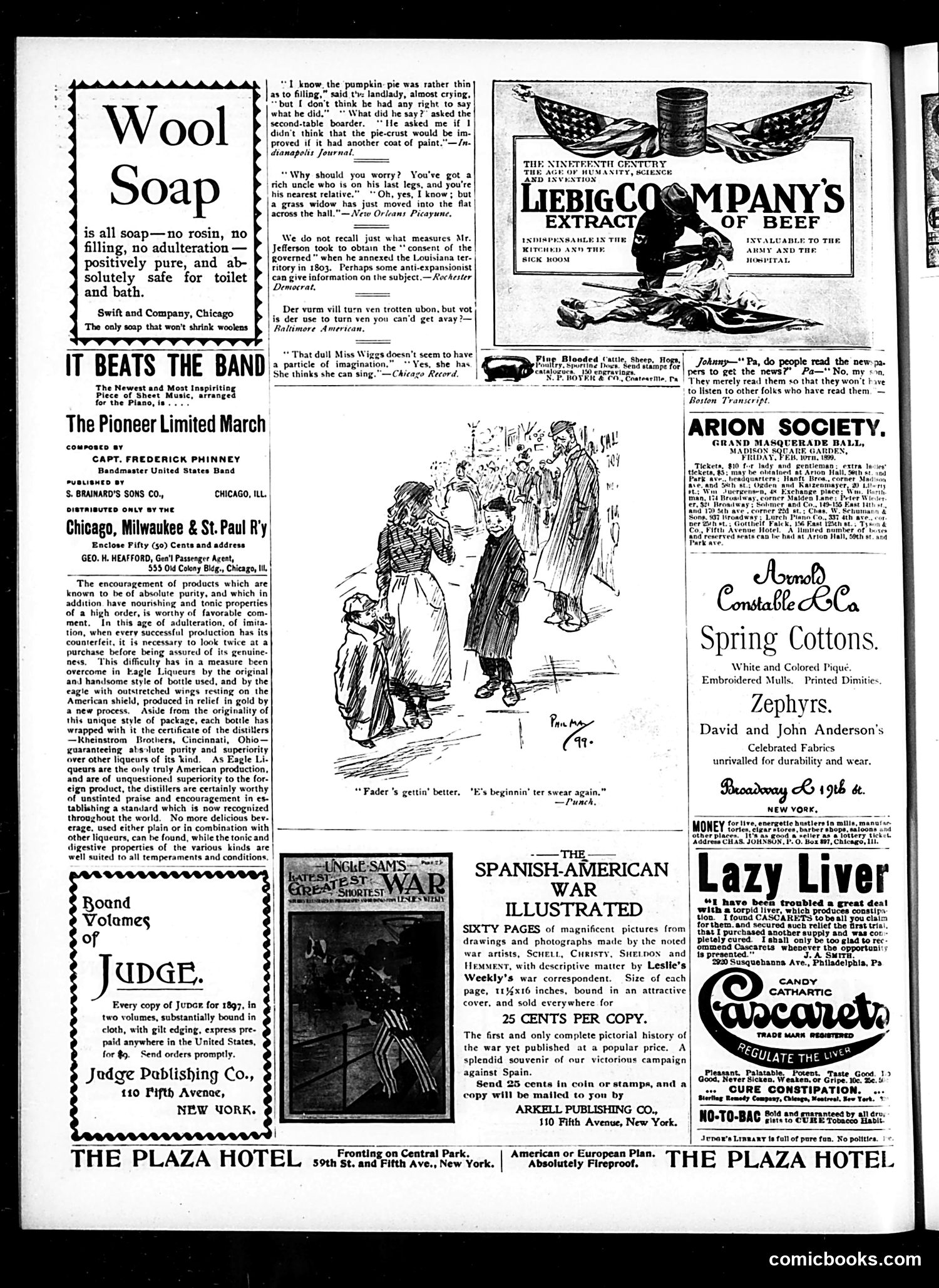
This page is primarily **advertisements and reprinted humor**, not original political satire. The main content consists of: **Humorous one-liners** (top section): Brief jokes about landlords complaining about pie crusts, inheritance anxiety, and worms—typical turn-of-the-century domestic humor with no specific political target. **One substantive reference**: A joke about Mr. Jefferson obtaining "consent of the governed" when annexing Louisiana Territory (1803), with a sarcastic jab at "anti-expansionists"—suggesting contemporary debate over American imperialism, likely referencing the Spanish-American War era. **The bulk of the page**: Advertisements for Wool Soap, sheet music, liqueurs, cotton fabrics, a hotel, and patent medicines. The "Lazy Liver" advertisement uses the common period phrase suggesting digestive complaints. The page reflects Judge's mix of light satirical humor and commercial content typical of early 1900s American magazines. There are no identifiable caricatured political figures or sustained cartoons—just generic domestic comedy and ads.
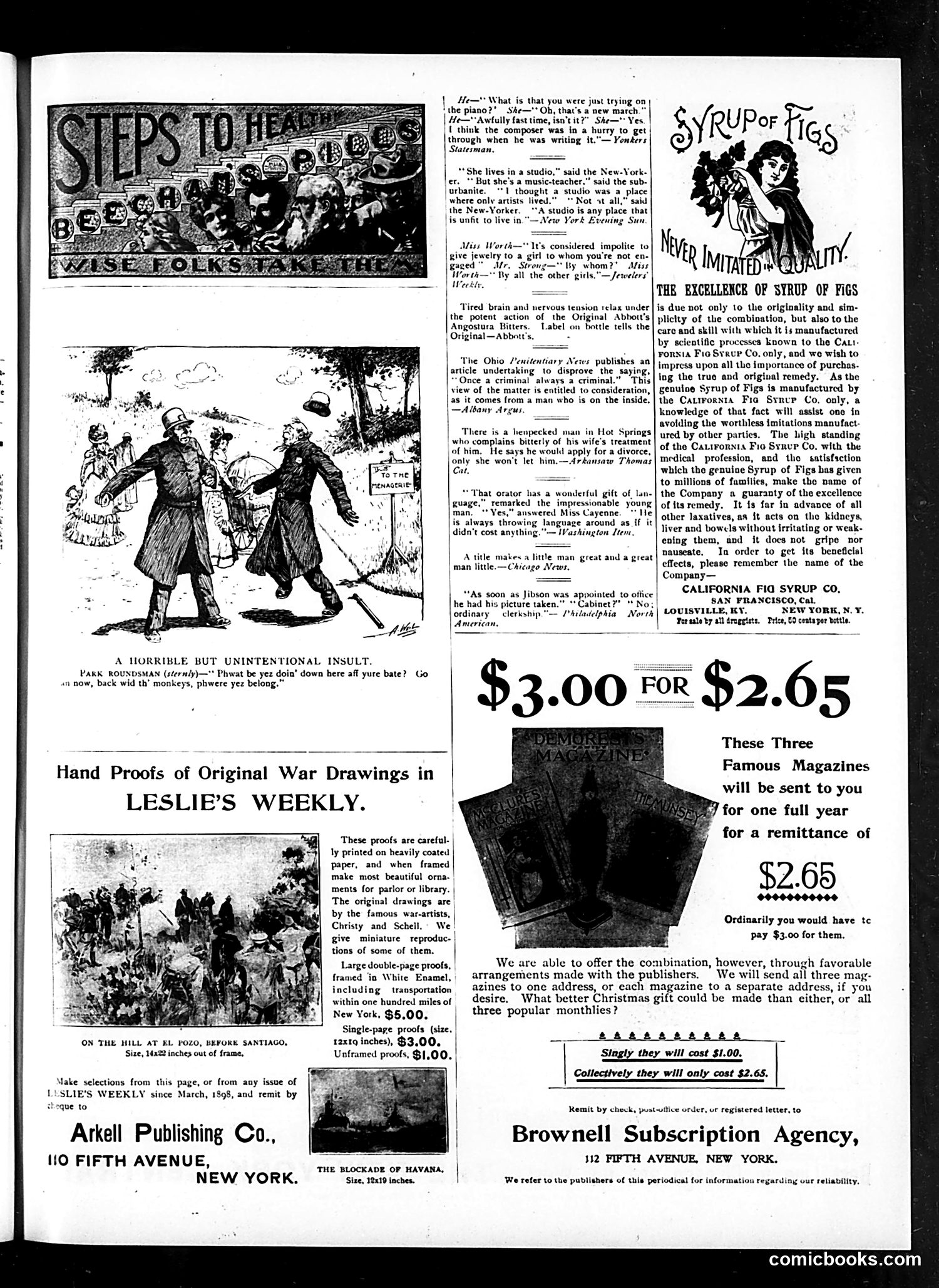
**The Cartoon**: "A Horrible But Unintentional Insult" depicts a park roundsman (likely Irish, suggested by the dialect) telling someone to leave the park and "back wid th' monkeys, phwere yez belong." The joke's "insult" appears to be the roundsman's careless comparison of the person to monkeys—unintentionally offensive rather than deliberately cruel. **Context**: This reflects late 19th/early 20th-century casual racism and ethnic stereotyping common in American humor. The Irish dialect of the roundsman himself marks him as working-class, while the target of his insult's identity remains ambiguous from the image alone. **The Page**: The remainder is mostly advertising—Leslie's Weekly selling war drawings from the Spanish-American War (Santiago, Havana blockade) and subscription offers for magazines. The scattered jokes throughout reflect period humor about relationships, social climbing, and bureaucratic absurdity. **Historical Note**: This appears from a *Judge* magazine issue circa 1898, during America's imperial expansion.
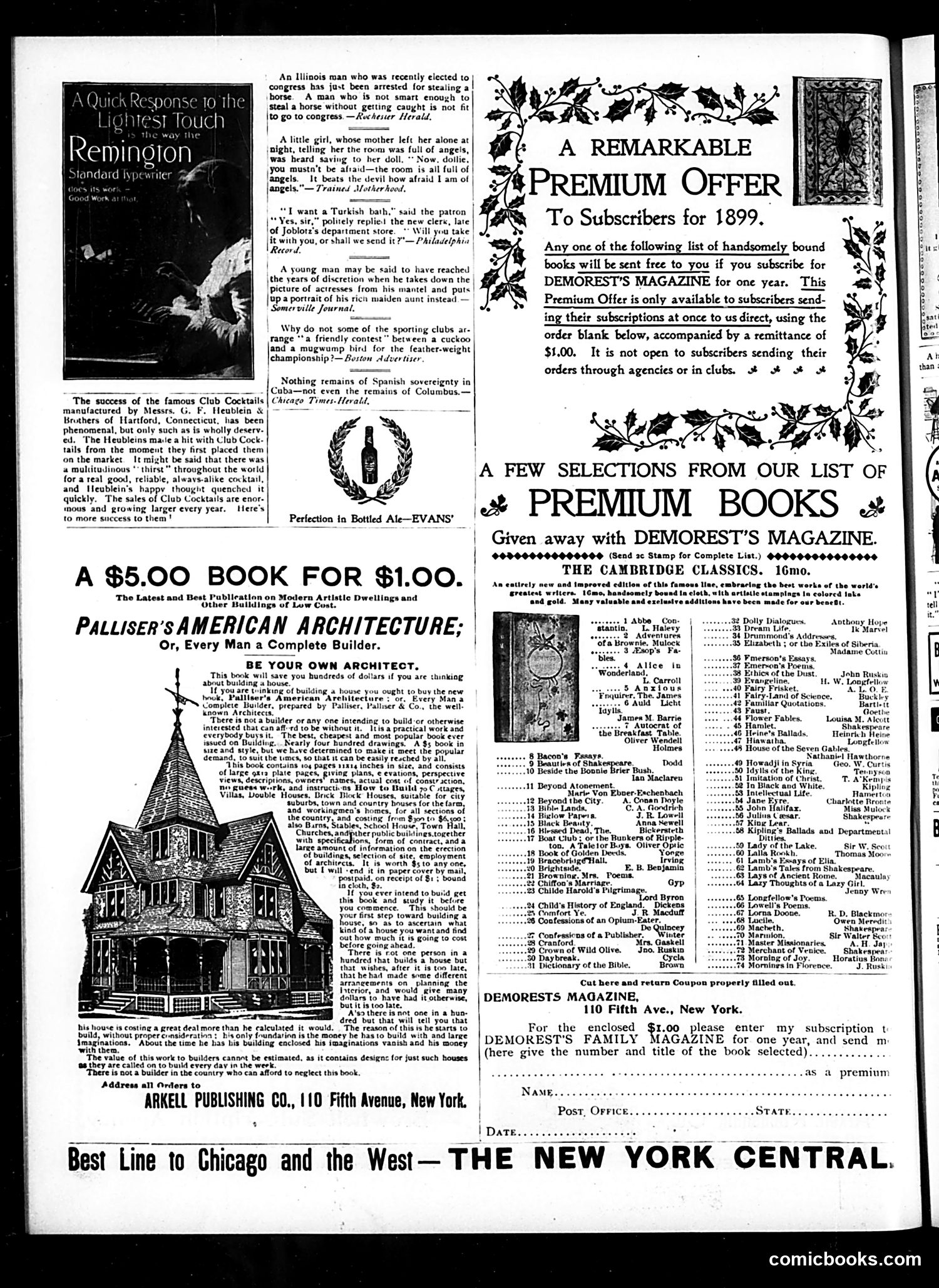
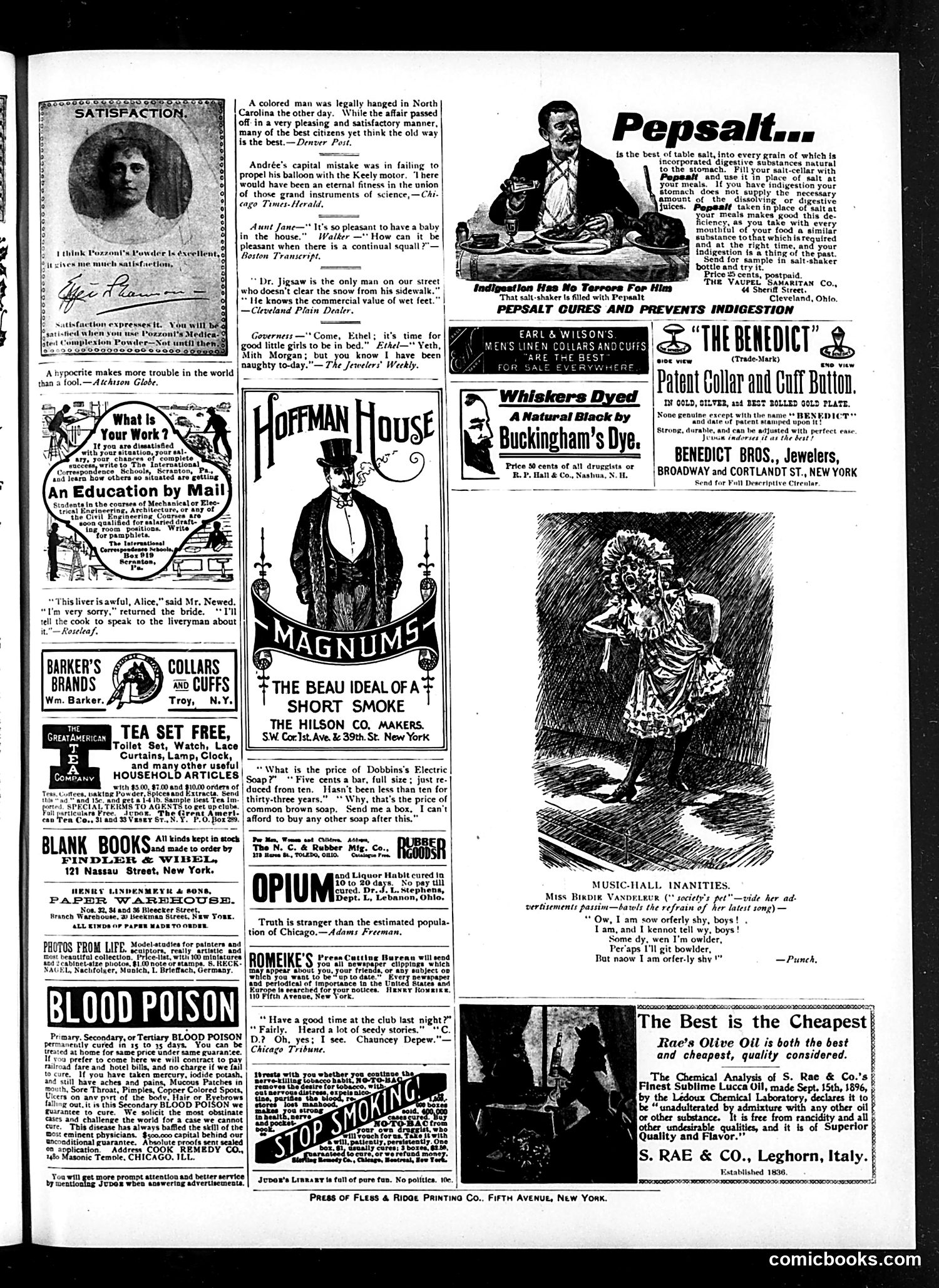
This page is primarily **advertisements and brief humorous quips**, typical of Judge magazine's format. The satirical content is minimal and dated: **Notable items:** 1. **Opening quote** criticizes North Carolina's casual attitude toward a lynching—the satire targets Southern hypocrisy by sarcastically praising how "pleasingly" the execution went while noting citizens still prefer older (extrajudicial) methods. This is dark commentary on racist violence. 2. **Brief jokes** throughout mock everyday absurdities: a man who won't shovel snow (to keep sidewalks dangerously icy), misunderstandings about servants, etc. These are generic humor with no political edge. 3. **Advertisements dominate**: collars, soap, blank books, hair dye, jewelry—period products with no satirical intent. 4. **"Blood Poison" ad** (syphilis treatment) reflects medical quackery of the era. The page reveals Judge's dual nature: genuinely satirical commentary on racism and hypocrisy alongside lightweight domestic humor and commercial messaging—all presented without distinction.
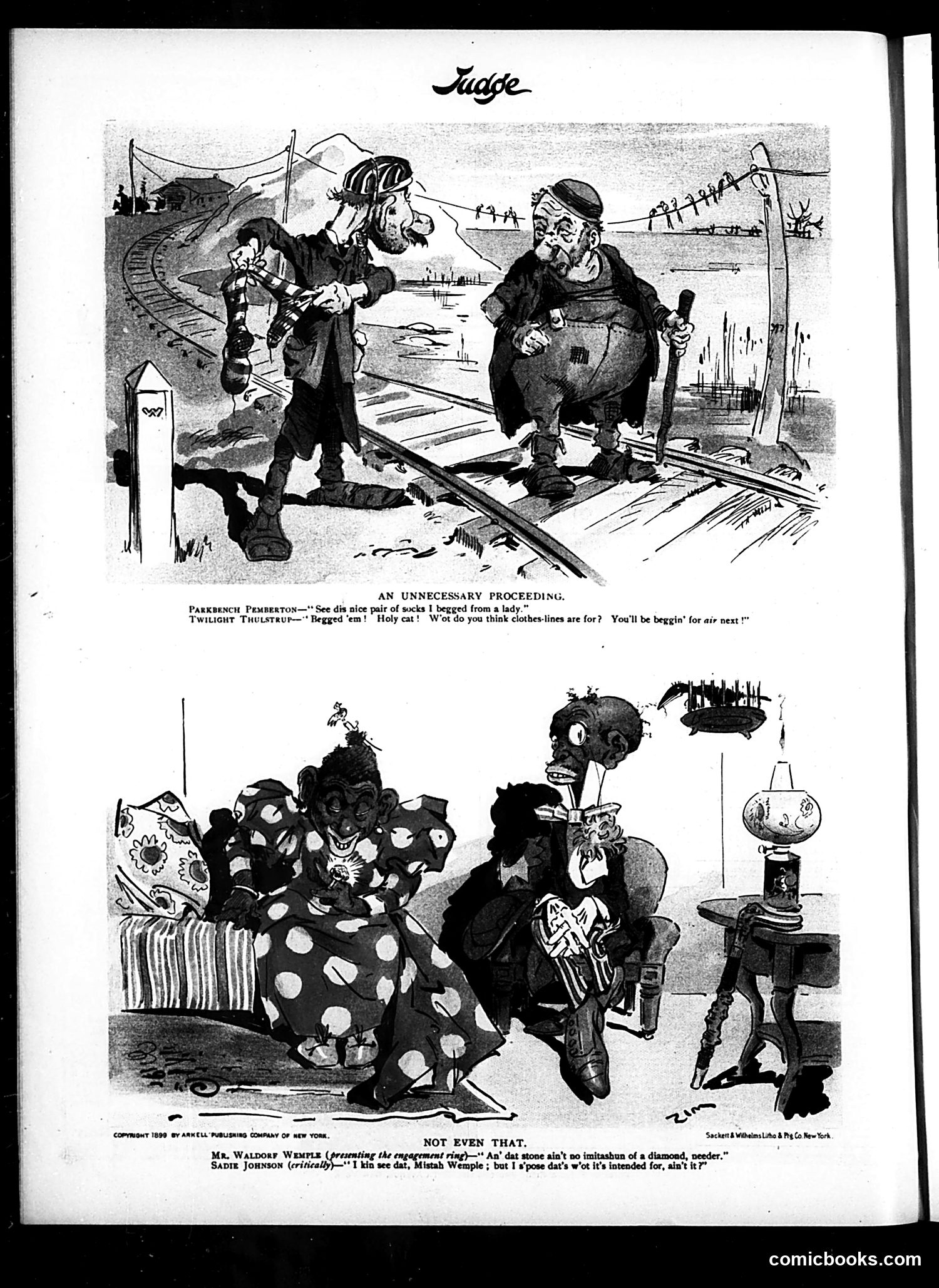
**Top cartoon ("An Unnecessary Proceeding"):** Two working-class men examine stolen socks. "Parkbench Pemberton" and "Twilight Thirstdrop" (names suggesting vagrants or derelicts) debate whether the socks were actually begged from a lady, with crude dialect suggesting they're discussing petty theft. The joke mocks both the absurdity of stealing socks and the characters' street-level desperation. **Bottom cartoon ("Not Even That"):** Mr. Waldorf Wemple presents an engagement ring to Sadie Johnson, claiming the stone "ain't no imitation." She responds skeptically that it's "s'pose aes wot it's intended for"—sarcastically suggesting the fake diamond is exactly what such a cheap suitor would give. The humor targets class pretension: a low-status man attempting to appear respectable through a false diamond engagement ring. Both use exaggerated dialect and caricature to satirize working-class and lower-class social aspirations.