
Judge, 1899-02-11 · page 7 of 16
Judge — February 11, 1899 — page 7: what you’re looking at
What you’re looking at
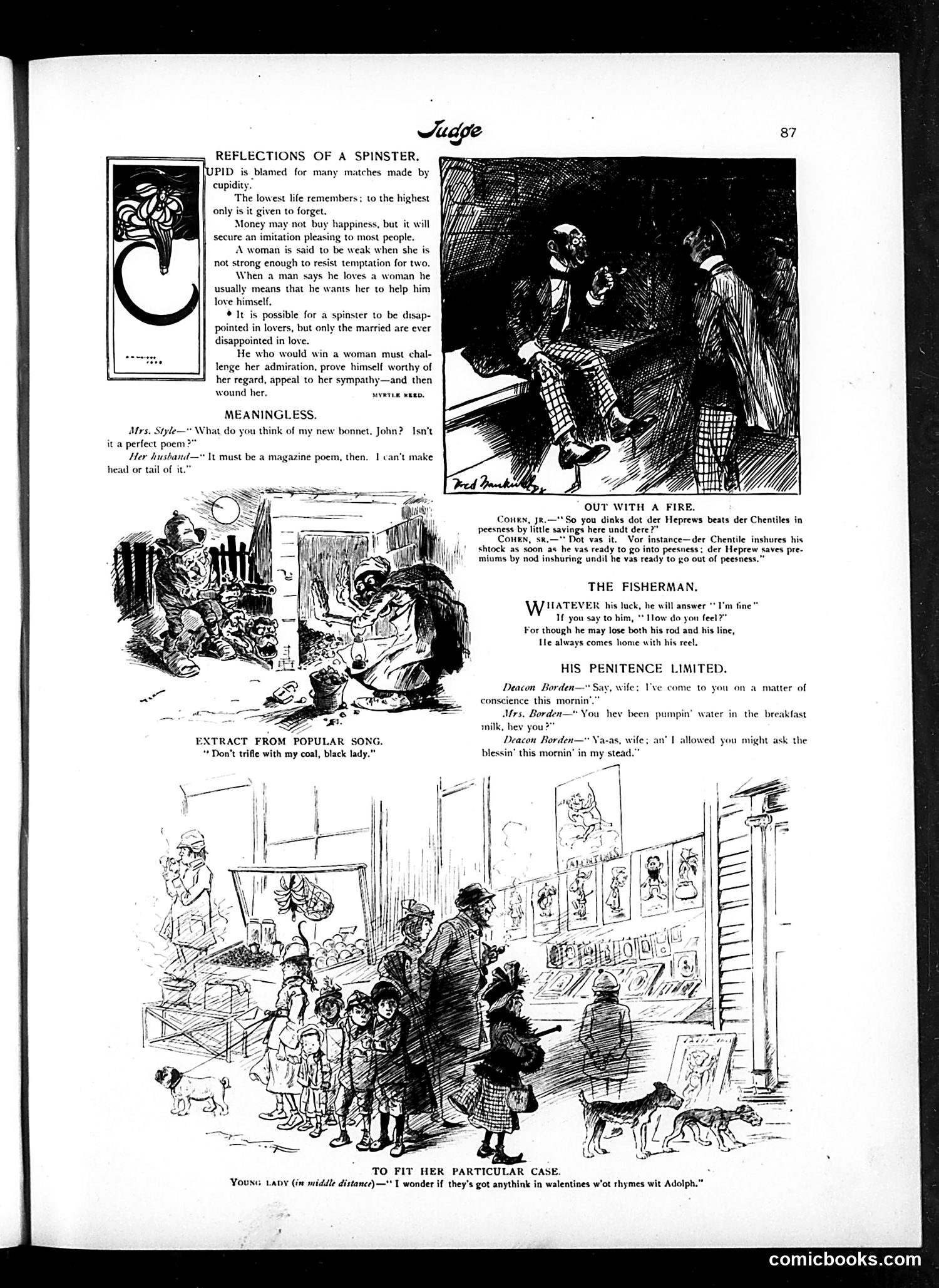
This page contains multiple satirical pieces targeting early-20th-century social conventions: **"Reflections of a Spinster"** presents cynical observations about romance and marriage, suggesting men are self-serving and that disappointment is exclusive to married women—critiquing romantic idealization. **"Meaningless"** jokes about a woman's incomprehensible hat design, humorously likening it to obscure poetry. **"Out with a Fire"** uses heavy ethnic stereotypes (German-Jewish dialect) to present a joke about insurance practices—the "Hebrew" saves money by avoiding premiums until business closure, while the "Gentile" insures immediately. This reflects period prejudices about ethnic business practices. **"The Fisherman"** offers gentle humor about optimistic fishermen who always return home satisfied despite poor catches. **"His Penitence Limited"** depicts a deacon confessing minor wrongdoing (watering milk) while asking his wife to say grace—satirizing selective conscience and male authority. The final cartoon shows a young woman seeking Valentine's cards rhyming with "Adolph"—likely referencing period immigration waves. The tone throughout reflects Judge's satirical approach to marriage, gender relations, and ethnic stereotypes common to early American humor magazines.
📄 Transcribed text from this page (OCR, searchable)
Machine-transcribed from the original scan — historical spelling and the odd misread are preserved.
Sua REFLECTIONS OF A SPINSTER. blamed for many matches made by The lowest life remembers: to the highest only is it given to forget. Money may not buy happiness, but it will secure an imitation pleasing to most people. A woman is said to be weak when she is not strong enough to resist temptation for two. When a man says he loves a woman he usually means that he wants her to help him love himself. # It is possible for a spinster to be disap- pointed in lovers, but only the married are ever disappointed in love. He who would win a woman must chal- lenge her admiration. prove himself worthy of her regard, appeal to her sympathy—and then, wound her. MEANINGLESS. Mrs, Style—* What do you think of my new bonnet, John? Isn't it a perfect poer Her husband—" lt must be a magazine poem, then. I can’t make head or tail of it.” MYRTLE REED. OUT WITH A FIRE. Cours, jx.—"*So you dinks dot der Heprews beats der Chentiles in y Tittle savings here undt dere?” Conn, sk,—** Dot vas it. Vor instance—der Chentile inshures his shtock as soon as he vas ready to go into peesness: der Heprew saves pre- miums by nod inshuring undil he vas ready to go out of peesness.” THE FISHERMAN, WHATEVER his luck, he will answer **T'm fine If you say to him, ** How do you feel?” For though he may lose both his rod and his line, He always comes home with his reel, HIS PENITENCE LIMITED. Deacon Borden— » Wife; I've come to you on a matter of conscience this mor Mrs. Borden—"You hey been pumpin’ water in the breakfast mnilk, hev you 2” EXTRACT FROM POPULAR SONG. “* Don't trifle with my coal, black lady.” Deacon Borden—"*Na-as, wile; an’ | allowed you might ask the blessin’ this mornin’ in my stead.” TO FIT HER PARTICULAR CASE. YouNG tapy (in middle distance)—* 1 wonder if they's got anythink in walentines w'ot rhymes wit Adolph, comicbooks.com