
Judge, 1899-02-11 · page 3 of 16
Judge — February 11, 1899 — page 3: what you’re looking at
What you’re looking at
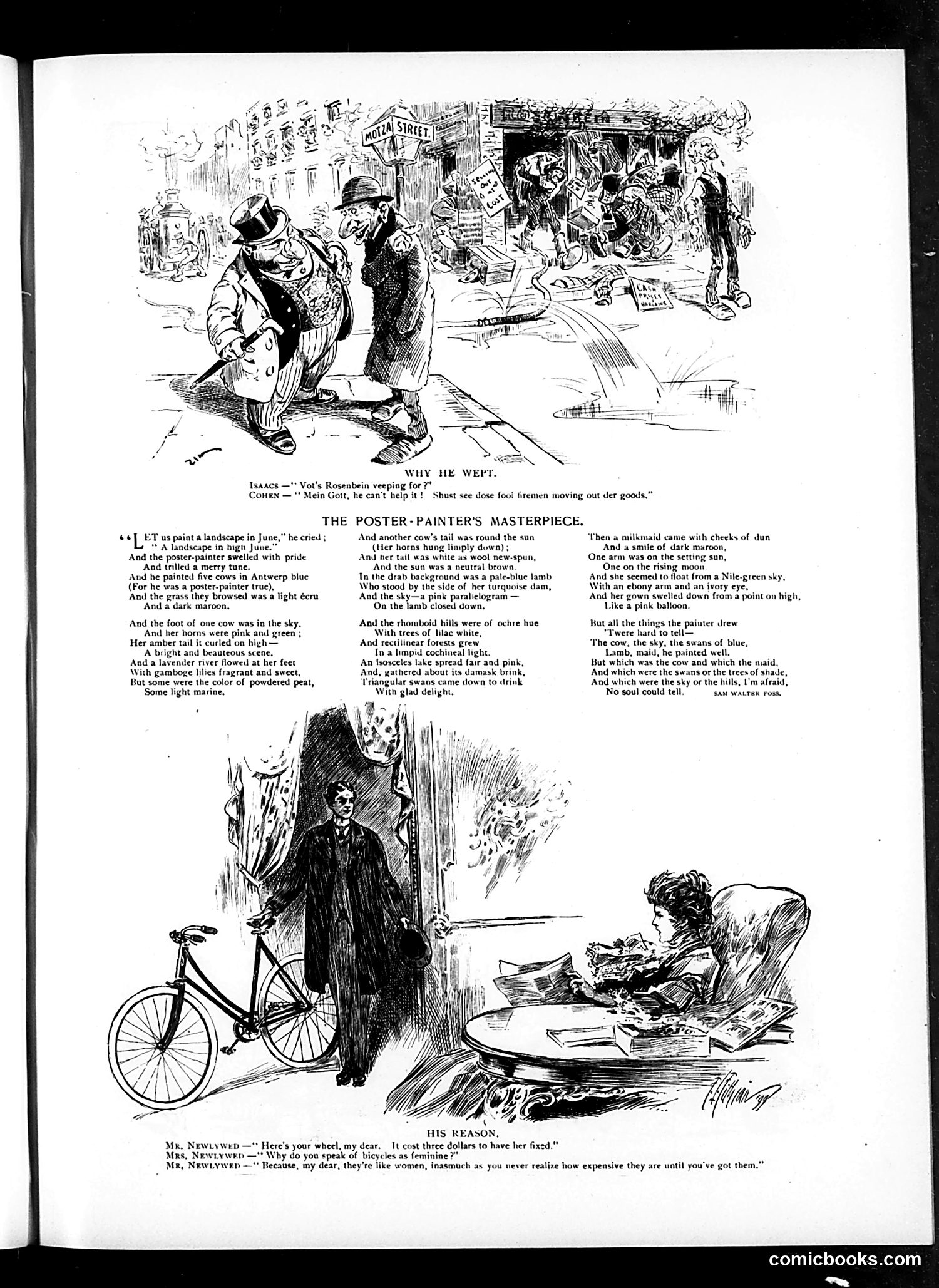
This page contains two satirical cartoons from *Judge* magazine: **Top cartoon ("Why He Wept"):** Shows two men on a street near "Mort Street" where food vendors operate. One character appears distressed while the other observes. The dialogue suggests commentary on food quality or street commerce, likely mocking poor urban conditions or vendor practices common in early 20th-century American cities. **Bottom cartoon ("His Reason"):** Depicts a man with a bicycle speaking to a woman. The dialogue reveals he won't let her use his bicycle because "bicycles are like women"—expensive and high-maintenance. This is social satire about gender attitudes and the emerging "New Woman" era when bicycles represented female independence and mobility, which apparently alarmed some men. Both cartoons reflect class and gender tensions of the period.
📄 Transcribed text from this page (OCR, searchable)
Machine-transcribed from the original scan — historical spelling and the odd misread are preserved.
Isaacs —"* Vot's Rosenbein veeping for ?” Conen —“ Mein Gott, he can't help it! Shust see dose foo! firemen moving out der goods.” THE POSTER-PAINTER’S MASTERPIECE, 64 PT us paint a landscape in June,” he cried ; “A landscape in high June.” And the poster-painter swelled with pride And trilled a merry tune. And he painted five cows in Antwerp blue (For he was a poster-painter true), And the grass they browsed was a light écru ‘And a dark maroon, And the foot of one cow was in the sky, And her horns were pink and green ; Her amber tail it curled on high — A bright and beauteous scene, And a lavender river flowed at her feet With gamboge lilies fragrant and sweet, But some were the color of powdered peat, ‘Some light marine. And another cow's tail was round the sun (ter horns hung limply down) ; And her tail was white as wool new-spun, And the sun was a neutral brown. In the drab background was a palesblue lamb Who stood by the side of her turquoise dam, And the sky—a pink paralielogram — On the lamb closed down, And the rhomboid hills were of ochre hue With trees of lilac white, And rectilinear forests grew In a limpid cochineal light. An Isosceles lake spread fair and pink, And, gathered about its damask brink, Triangular swans came down to drink With glad delight, HIS KEASON, Mx. Newtywep —" Here's your wheel, my dear. It cost three dollars to have her fixed.” Mrs, NewLywen —"* Why do you speak of bicycles as feminine ?” Mr, Newiywen —' Because, my dear, they're like women, inasmuch as you never realize how expensive they are until you've got them." ‘Then a milkmaid came with cheeks of dun ‘And a smile of dark maroon, One arm was on the setting sun, One on the rising moon And she seemed to float from a Nile-green sky, With an ebony ari and an ivory eye, And her gown swelled down from a point on high, Like a pink balloon. But all the things the painter drew “Twere hard to tell— ‘The cow, the sky, the swans of blue, Lamb, maid, he painted well, But which was the cow and which the maid, And which were the swans or the trees of shade, And which were the sky or the hills, I'm afraid, No soul could tell. SAM WALTRIE FOSS, comicbooks.com ,