
A complete issue · 16 pages · 1899
Judge — January 28, 1899
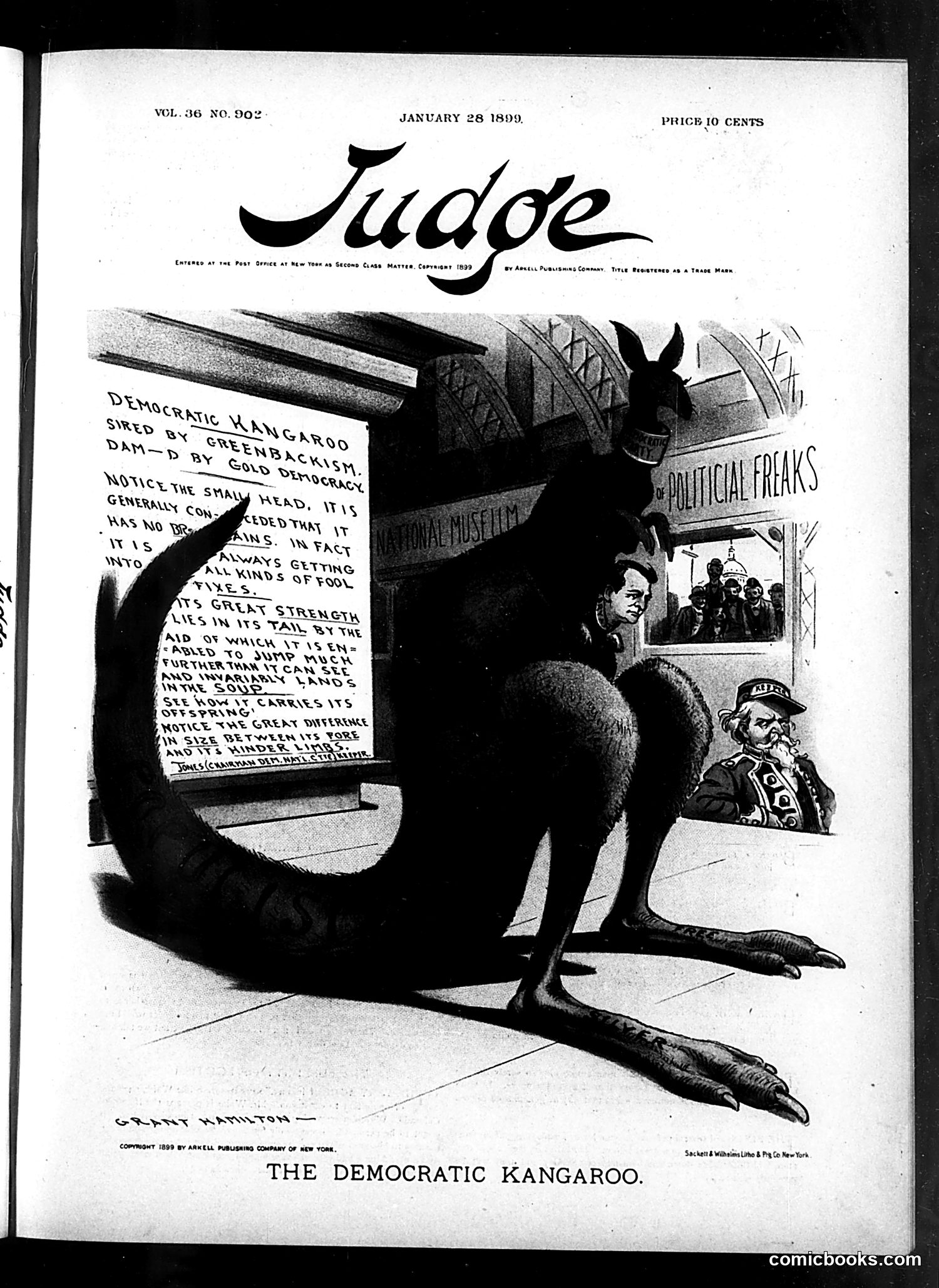
This political cartoon satirizes the Democratic Party as a kangaroo displaying contradictory characteristics. The text on the kangaroo's body critiques Democratic inconsistency: the party is "sired by greenbackism" (an obsolete currency position), "dammed by gold democracy" (conflicting monetary policy), and suffers from internal contradiction and weakness. The kangaroo's unusual anatomy—described in the visible text as having "shallow head," "weak spine," and conflicting traits—represents the party's perceived lack of coherent principles and leadership. The "Political Freaks" museum setting suggests Democrats are oddities unfit for serious governance. This reflects late-1890s Republican attacks on Democratic division over monetary policy (gold versus silver standards), which fractured the party during William Jennings Bryan's era.
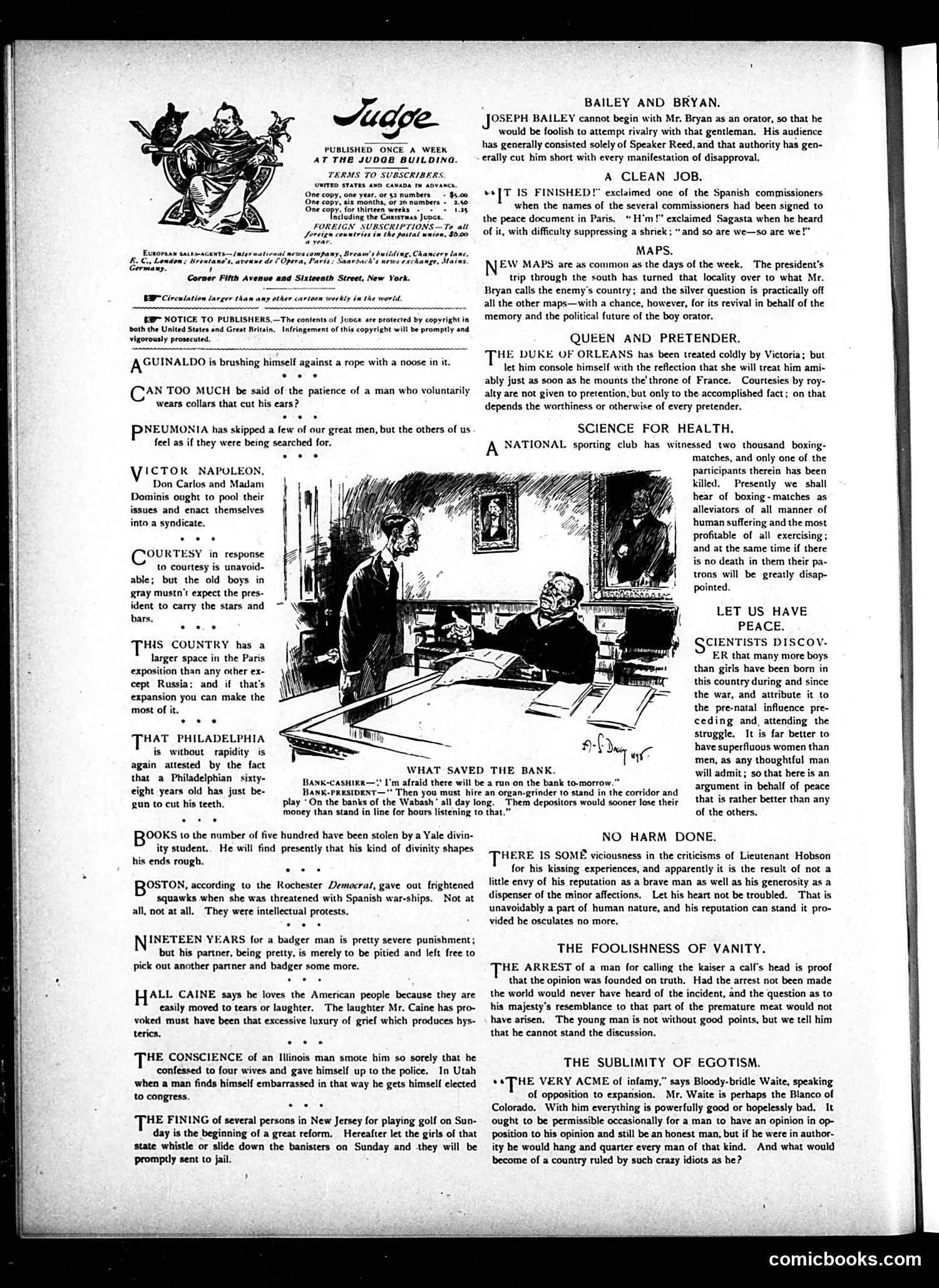
The main cartoon, titled "WHAT SAVED THE BANK," depicts a banker and another figure in what appears to be a financial crisis scenario. The dialogue suggests a humorous solution: hiring an organ-grinder with a monkey to distract depositors attempting a bank run by having them listen to music instead of withdrawing funds. This satirizes both banking instability of the era and public gullibility. The surrounding text includes various political commentary on topics like peace negotiations, boxing matches, and political figures including references to "Mr. Caine" and discussions of American politics. Without specific dating visible on this page, the exact historical moment remains unclear, though the content suggests early-to-mid 20th century American politics and financial concerns typical of Judge magazine's satirical focus.
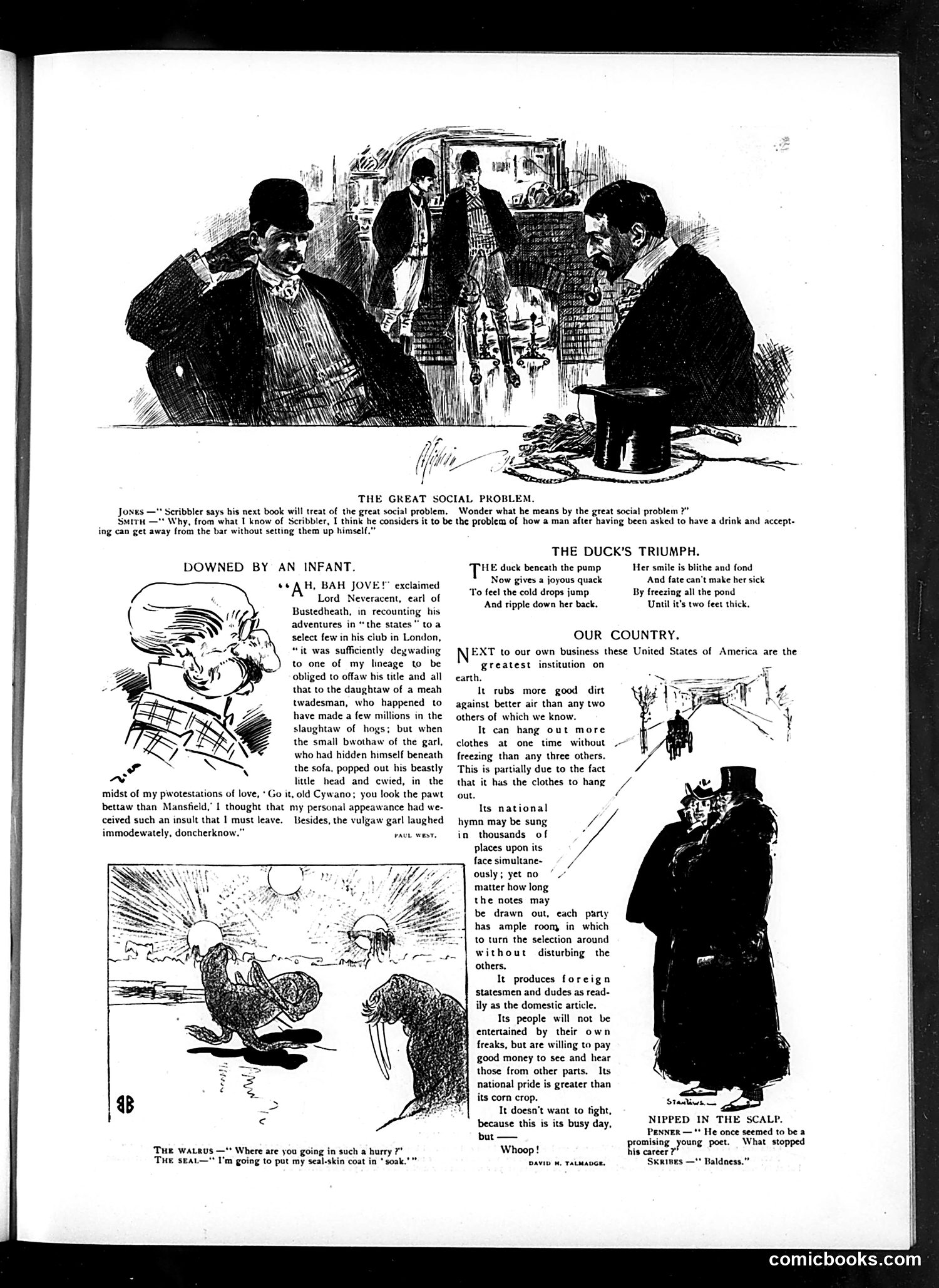
**"The Great Social Problem"** (top): Two well-dressed men debate whether a book on "the great social problem" refers to poverty or "how a man after having been taken to have a drink and accepting cab fare away from the bar without settling isn't himself." This satirizes vague, fashionable discourse about social issues among the upper class—mocking how wealthy people debate poverty in abstract terms while ignoring concrete solutions. **Other content**: The page includes humorous anecdotes ("Downed by an Infant," "The Walrus and the Seal") and patriotic verse celebrating America ("Our Country"), typical of Judge's mix of political satire and general humor. These appear peripheral to the main social commentary on the page.
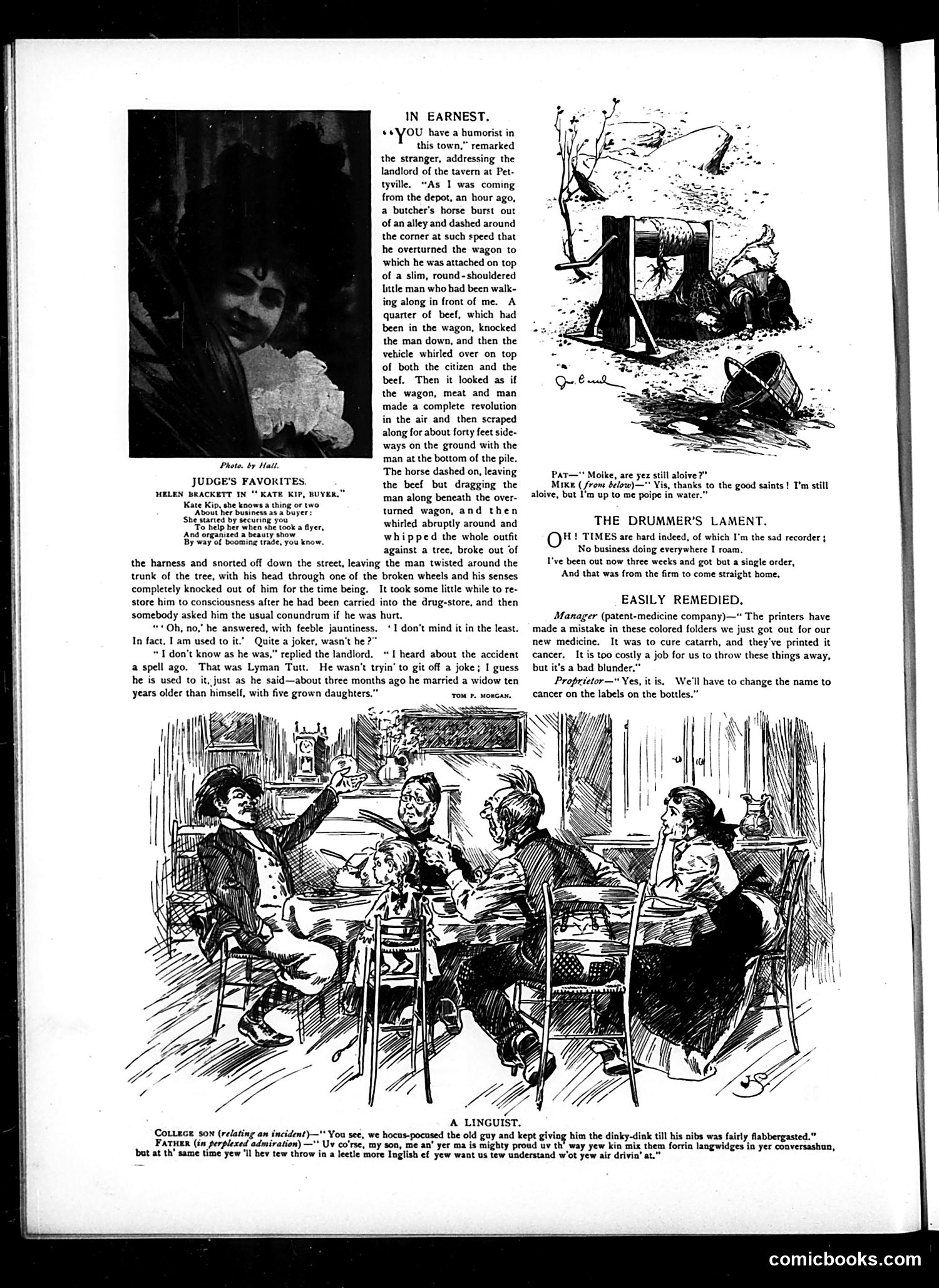
This page contains three distinct humorous pieces: **"Judge's Favorites"** (top left): A photographic portrait labeled with what appears to be a judge or legal figure, accompanied by a poem about a "beef kit, buyer" and "beauteous show." **"In Earnest"** (center): A story about a runaway horse and wagon accident in Pettyville involving a butcher's cart, where a small man and beef quarter caused chaos. The humor derives from the absurd collision and its comedic consequences. **"The Drummer's Lament"** and **"Easily Remedied"** (right): Brief humorous exchanges—one about business troubles, the other about a patent medicine company's mistake printing "cancer" instead of another ailment on their folders. **"A Linguist"** (bottom): A sketch showing men dining, with dialogue mocking affected foreign speech and pretension. The caption jokes about incomprehensible "English" from affected speakers. These represent typical Judge magazine humor: satirizing accidents, medical quackery, and social affectation.
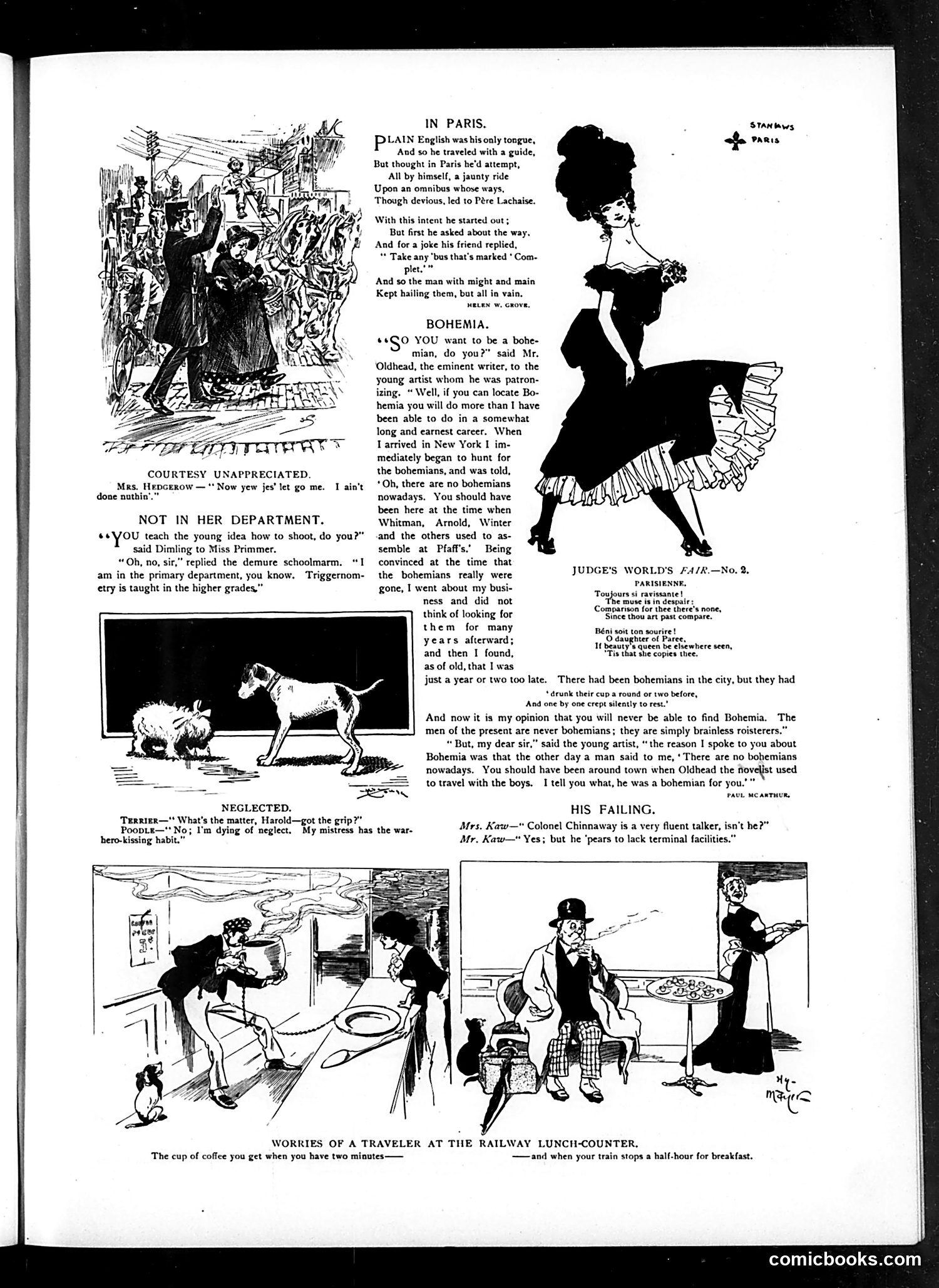
This page contains several unrelated humorous sketches satirizing early 20th-century American life: **"In Paris"**: A visitor to Paris, speaking only English, is pranked by a friend who tells him to board any omnibus marked "Complet" (French for "full"). The joke: he keeps hailing full buses that won't stop, misunderstanding the warning as directions. **"Bohemia"**: An older writer (Oldhead) tells a young artist that true bohemians—referencing the famous literary circle at Pfaff's bar featuring Whitman, Arnold, and Winter—no longer exist. The irony: the artist then reveals Oldhead *himself* was once considered a bohemian. The satire mocks nostalgia for a vanished artistic lifestyle. **"Not in Her Department"** and other brief quips: Simple wordplay jokes about teaching and grammar. **Railway Lunch-Counter cartoon**: Satirizes the frustration of railway travel—you get a tiny cup of coffee during a 2-minute stop, but a full breakfast break when you're not ready. The page reflects turn-of-the-century American humor: travel mishaps, literary pretension, and urban inconveniences.
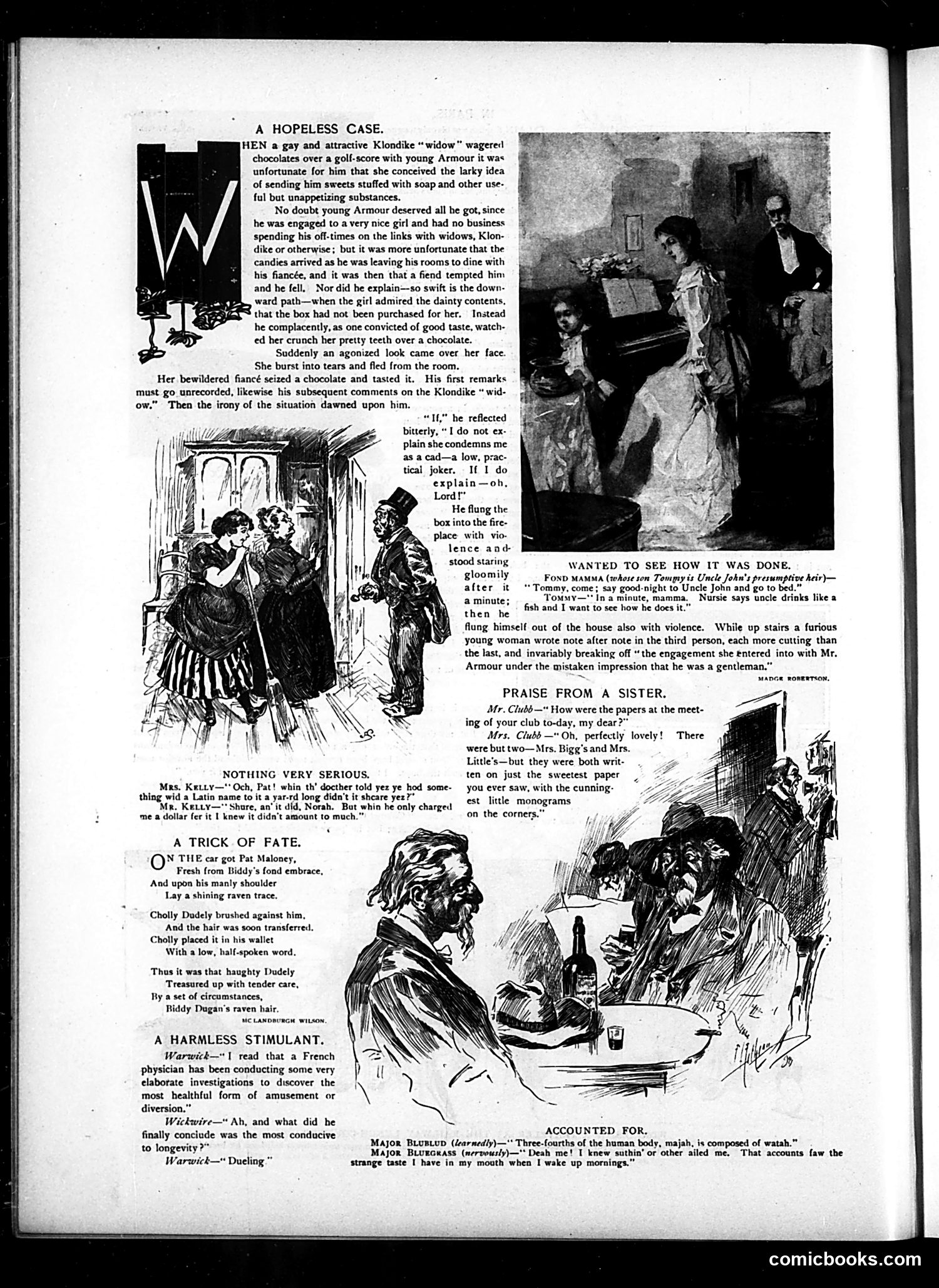
This page contains multiple brief comedic sketches typical of Judge magazine's satirical humor. The main story, "A Hopeless Case," mocks a young man named Armour engaged to a respectable woman. A Klondike widow (a woman from the gold rush era, implying dubious morality) pranks him by sending chocolates filled with soap after losing a golf wager. Armour unwittingly gives these to his fiancée, who tastes soap and assumes he's cruel or a "cad." When he tries to explain, he must either admit infidelity with the widow or appear dishonest—hence "hopeless." The satire targets male hypocrisy: Armour deserves punishment for courting widows while engaged, yet his attempted deception creates his real downfall. The Klondike reference suggests frontier-era loose morality. Other sketches mock social pretension, Irish accents (typical period stereotypes), and abstract medical claims. The humor relies on Victorian-era class consciousness and gender expectations now unfamiliar to modern readers.
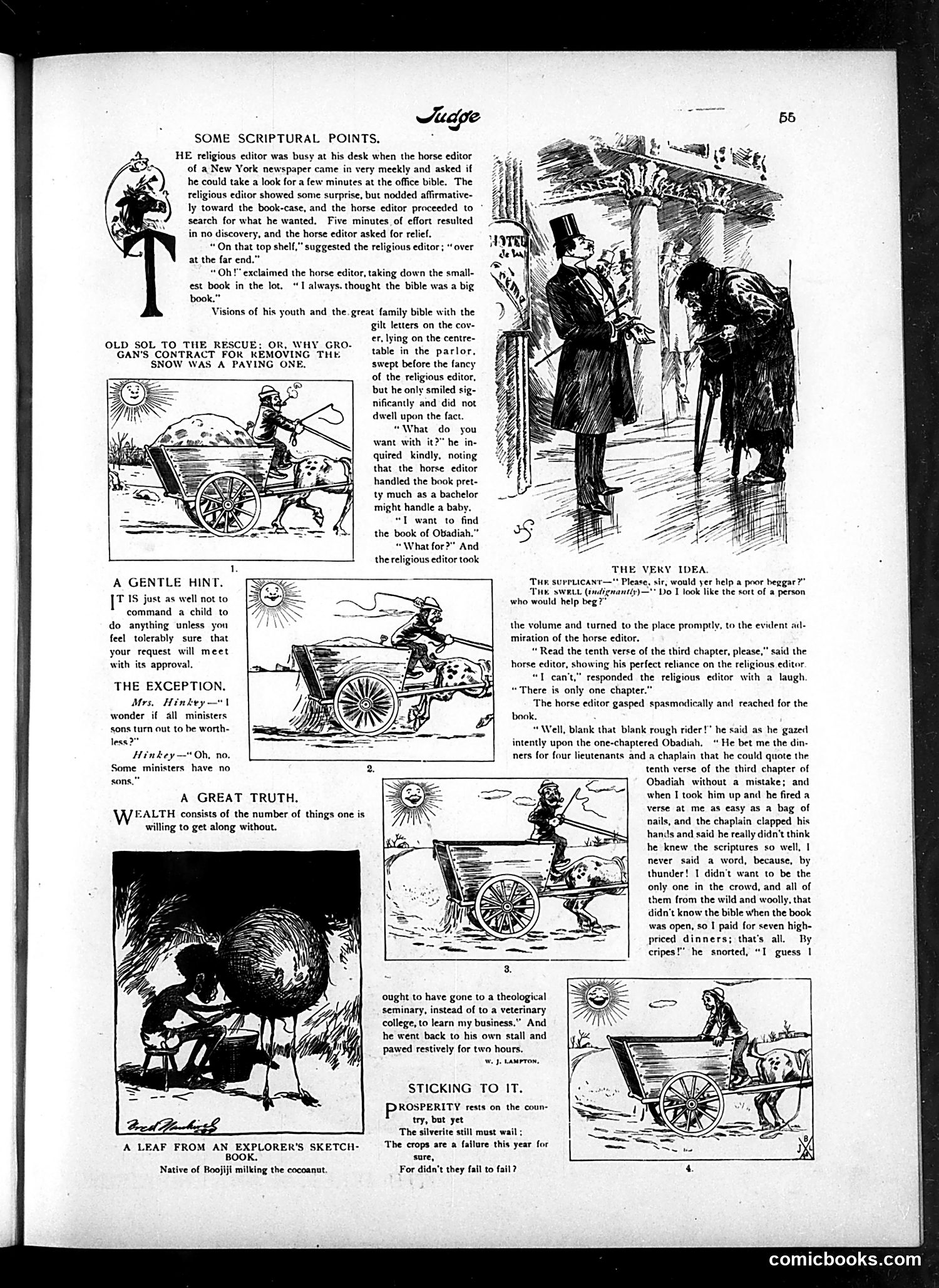
This page contains several humorous anecdotes and editorial cartoons typical of late 19th/early 20th-century American satire: **"Some Scriptural Points"**: A horse racing editor seeks the Bible to look up Obadiah, expecting a large book. He's surprised to find it small—likely mocking the editor's ignorance of scripture and implying those focused on worldly matters (horse racing) lack religious knowledge. **"The Very Idea"**: A well-dressed man refuses to help a beggar, claiming he doesn't look like "the sort of person who would help beg"—satirizing aristocratic pretension and callousness toward poverty. **Other sections** include gentle moral observations ("A Gentle Hint," "A Great Truth") and a satirical poem about silverite (silver currency advocates) who complain crops failed even though they didn't, mocking political complainers. The illustrations use the horse-drawn vehicle and rural/period imagery typical of the era. The overall tone is lighthearted social commentary on hypocrisy, ignorance, and human folly.
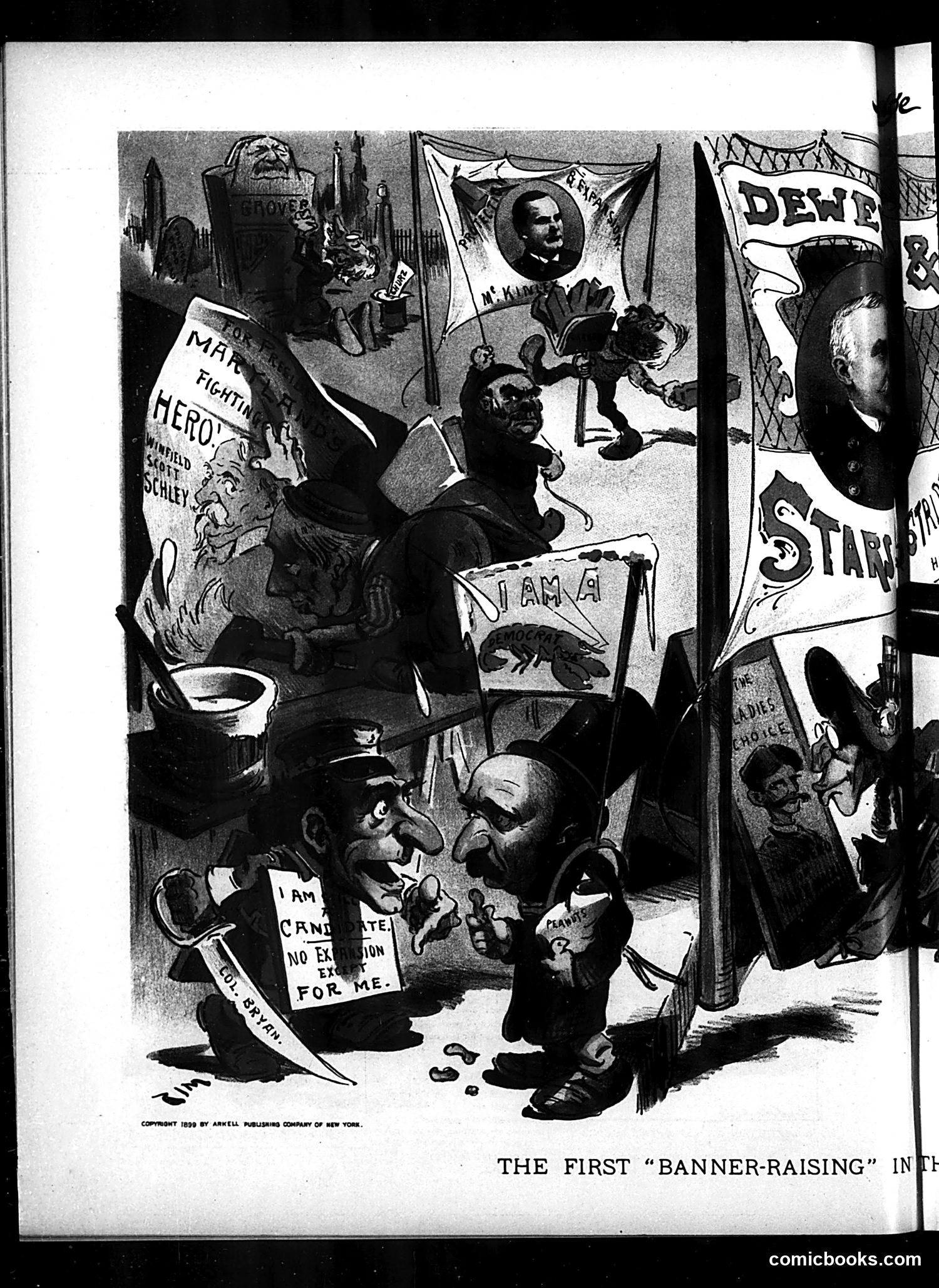
This appears to be a satirical cartoon titled "The First 'Banner-Raising'" from Judge magazine. The image shows caricatured political figures holding various campaign banners and signs at what seems to be a political rally or convention. The figures are depicted with exaggerated features in the style typical of late 19th/early 20th-century political cartoons. One figure holds a sign reading "I AM A CANDIDATE - NO EXCUSE FOR ME," suggesting satire about political candidacy and self-promotion. Multiple banners with portraits and slogans are visible, though specific names are difficult to read clearly. The cartoon likely satirizes a particular political moment involving multiple candidates or party factions competing for attention, mocking the spectacle and grandiosity of campaign politics. However, without the complete caption or publication date, I cannot identify the specific historical event or figures referenced.
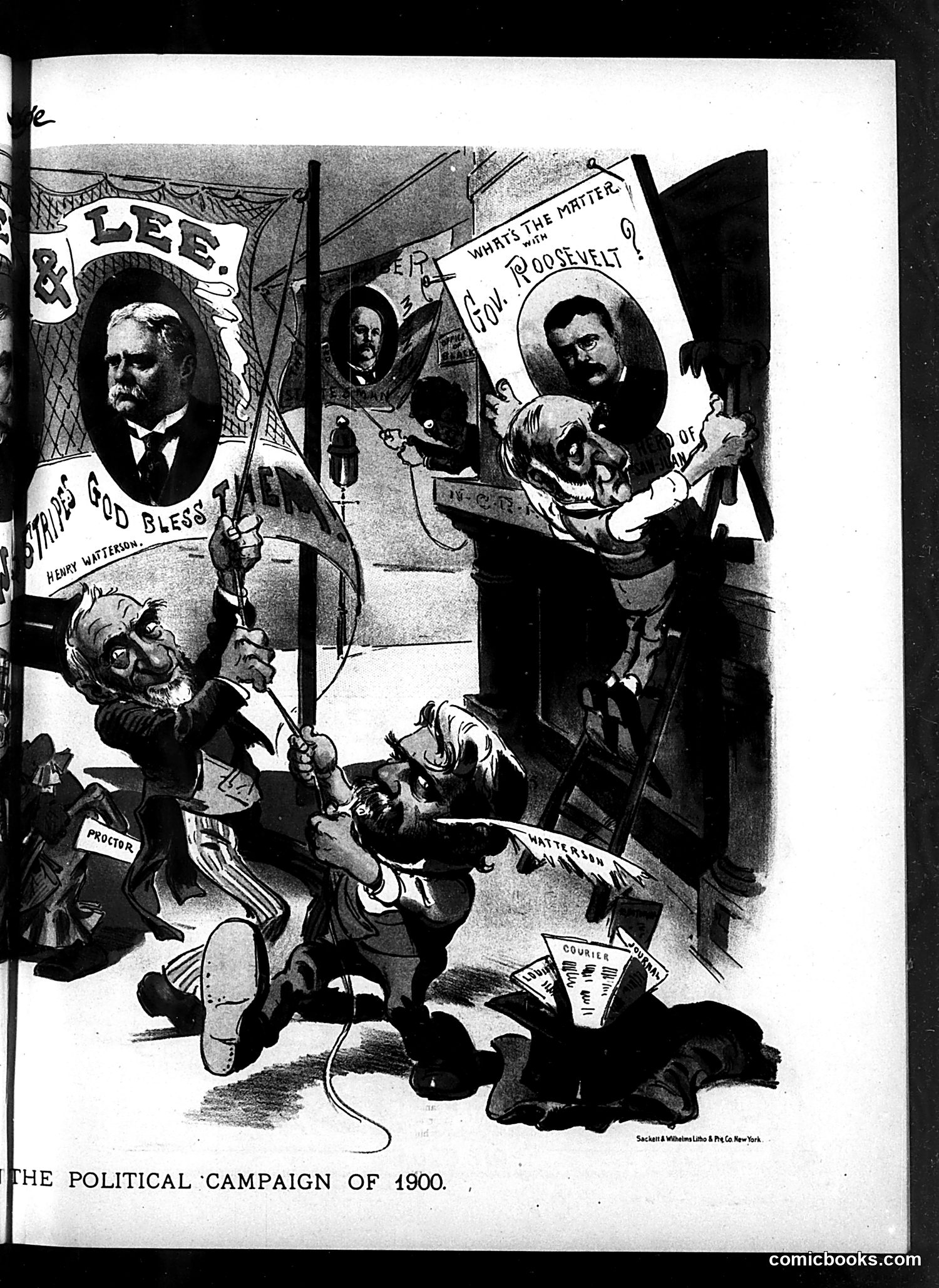
This Judge magazine cartoon satirizes the 1900 U.S. presidential election. The image shows political figures depicted as caricatures—including what appears to be Henry Watterson (labeled "PROCTOR") and others—parading with banners supporting candidates. One banner references "What's the Matter? For Roosevelt!" and another reads "God Bless" with portraits. The satire mocks the chaotic, performative nature of campaign theater, with exaggerated facial features and theatrical posturing typical of Gilded Age political cartoons. Small demon-like figures crawling below suggest corruption or unseemly dealings underlying the pageantry. The cartoon critiques how politicians and party operatives present sanitized public campaigns while engaging in backroom machinations—a perennial concern in American politics that remains relevant today.
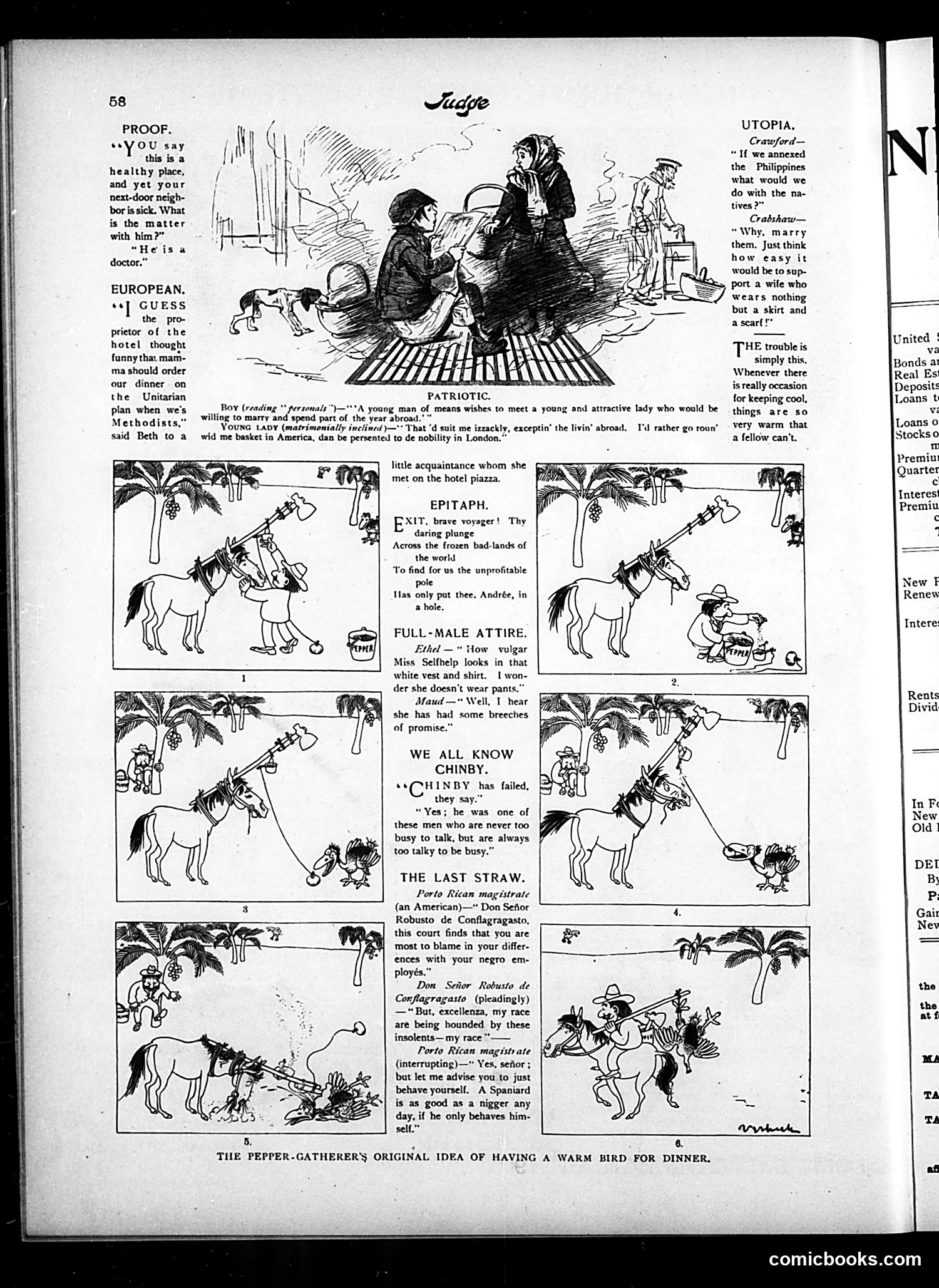
This page contains multiple satirical cartoons reflecting early 1900s American attitudes: **"Utopia"** mocks imperialist expansion, specifically Philippine annexation. The joke: if America took the Philippines, supporting wives who wear "nothing but a skirt and a scarf" would be economical—a racist caricature suggesting colonial subjects required minimal resources. **"Patriotic"** shows a young man seeking romance, preferring American women over European nobility—commentary on class and national identity. **"Epitaph"** references Andrée, a Swedish explorer's failed Arctic expedition, sardonic commentary on doomed exploration. **"Full-Male Attire"** mocks women wearing masculine clothing, with a pun on "breeches of promise" (broken engagement). **"We All Know Chinby"** offers generic social commentary about talkative failures. **"The Last Straw"** depicts a Puerto Rican magistrate (American) ironically telling a Spanish employer that Spaniards equal "niggers"—exposing American racial hypocrisy while governing colonial territories. The cartoon critiques both racism and imperial administration's contradictions.
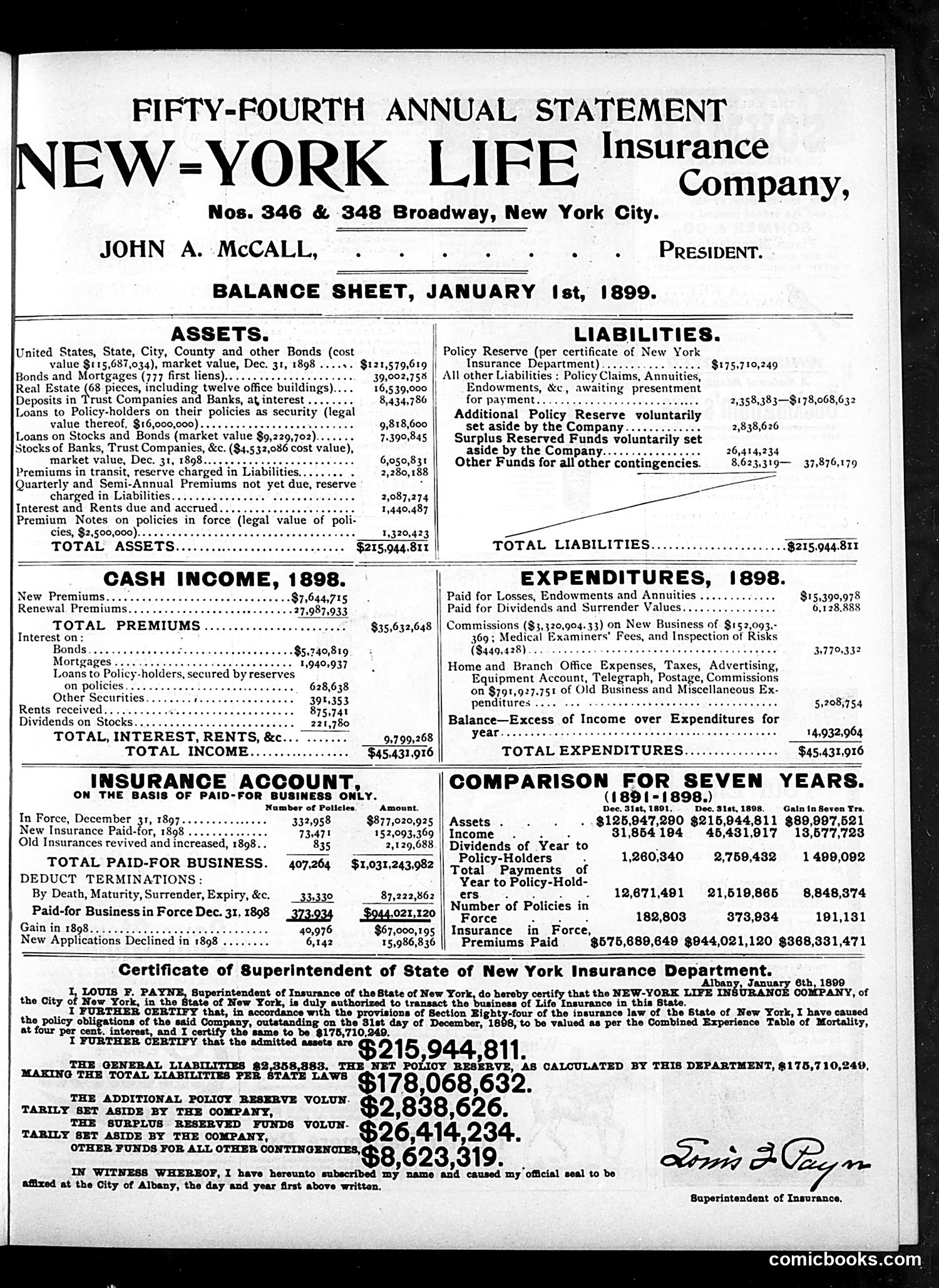
This page is **not a cartoon or satirical content**—it's a corporate financial document: the fifty-fourth annual statement of the New York Life Insurance Company, dated January 1, 1899. The document presents the company's balance sheet, cash flow, and seven-year comparative data. It's certified by Louis F. Payne, Superintendent of Insurance for New York State (signature visible at bottom). The statement shows the company's assets ($215.9 million), liabilities, income from premiums and investments, and expenditures for 1898. This appears in *Judge* magazine likely as a **full-page advertisement** or corporate announcement rather than satirical content. Such prestigious financial statements were sometimes published in major periodicals to demonstrate stability and trustworthiness to potential policyholders—an important marketing tool during an era when insurance company failures were not uncommon.
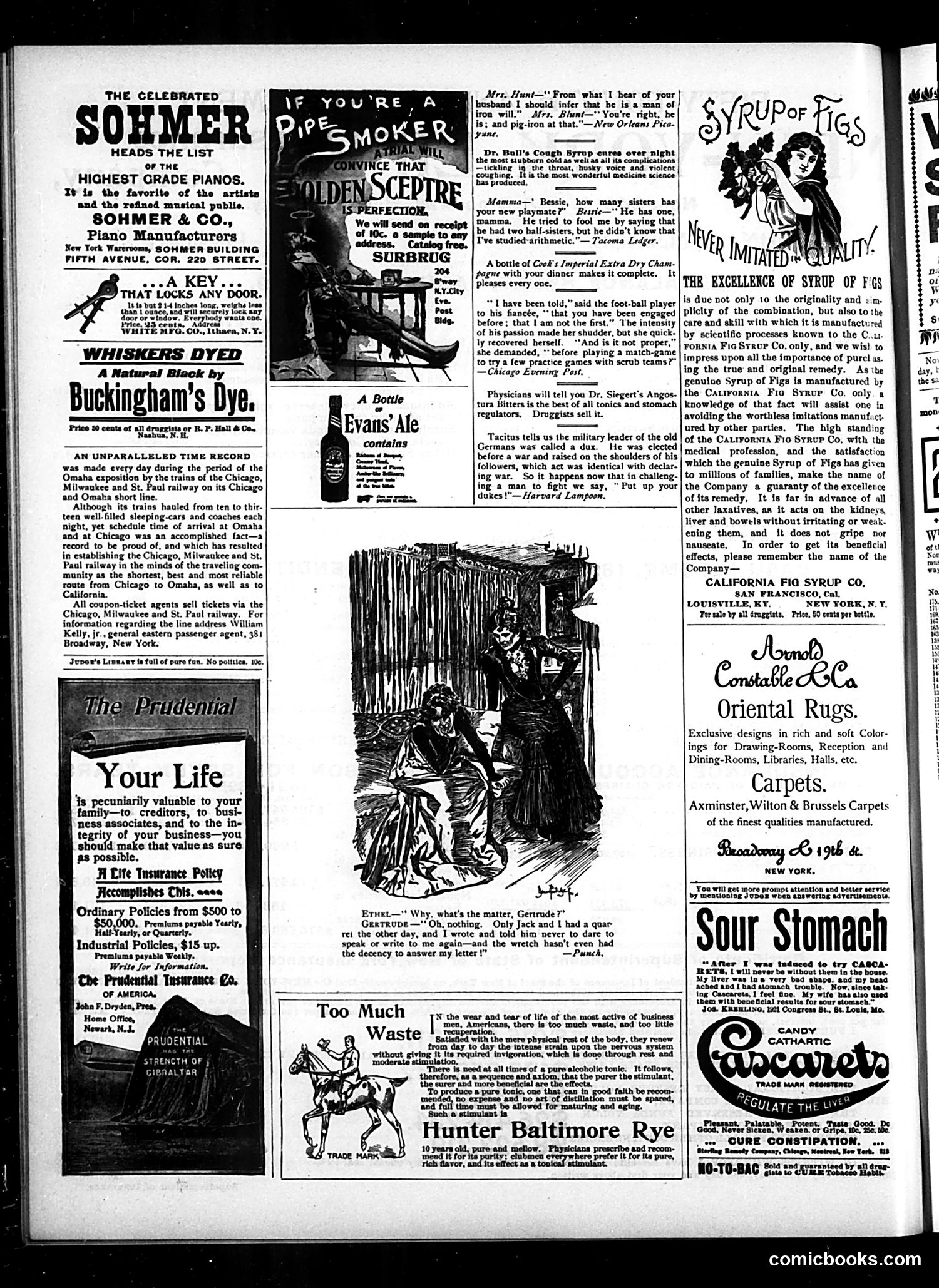
This is primarily a **advertisements page** from Judge magazine, with minimal satirical content. The main cartoon visible depicts a scene with multiple figures in what appears to be a dramatic moment—possibly illustrating one of the humorous anecdotes printed on the page. The cartoons and jokes scattered throughout are typical Judge fare: light social humor about domestic life and relationships. The page is dominated by **period product advertisements** (piano manufacturers, hair dye, life insurance, whiskey, rugs, stomach remedies), which was standard for early 1900s magazines. The small jokes and anecdotes reflect contemporary concerns: a woman frustrated her fiancé isn't responding to her angry letter; commentary on German military terminology; domestic marital sparring. These are genteel drawing-room humor, not political satire. **No major political figures or events are evident.** This appears to be a filler page from Judge's run, showcasing the magazine's mix of advertising revenue and light social comedy rather than its signature political cartoons.
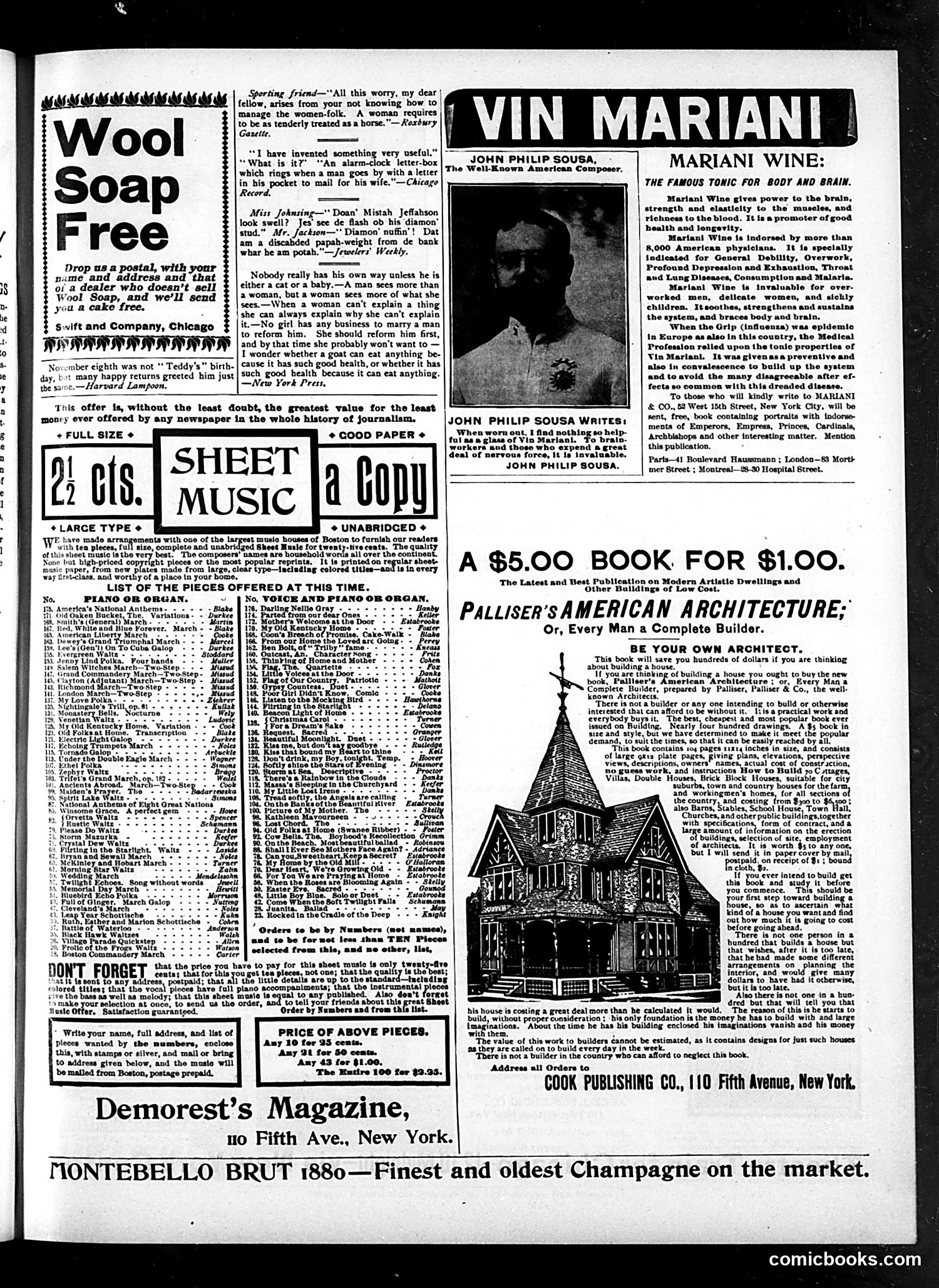
This page from Judge magazine is primarily **advertising and filler content**, not political satire. It contains: **Main advertisements:** - Wool Soap (free sample offer from Swift and Company) - Sheet Music offer (25 cents for full-size pieces from Boston music houses) - Mariani Wine (marketed as a tonic for "body and brain," with testimonial from composer John Philip Sousa) - Palliser's American Architecture book ($5 for $1) - Demorest's Magazine **Humor content:** Brief, generic jokes and aphorisms about relationships, animals, and human nature—typical filler material for period magazines. One joke references "Teddy" (likely Theodore Roosevelt), but these are just reprinted quips from other publications. **Historical note:** The Mariani Wine advertisement reflects the era's unregulated patent medicine market; such "tonics" often contained cocaine or other substances. This appears to be a standard magazine page designed primarily to generate advertising revenue rather than deliver satirical commentary.
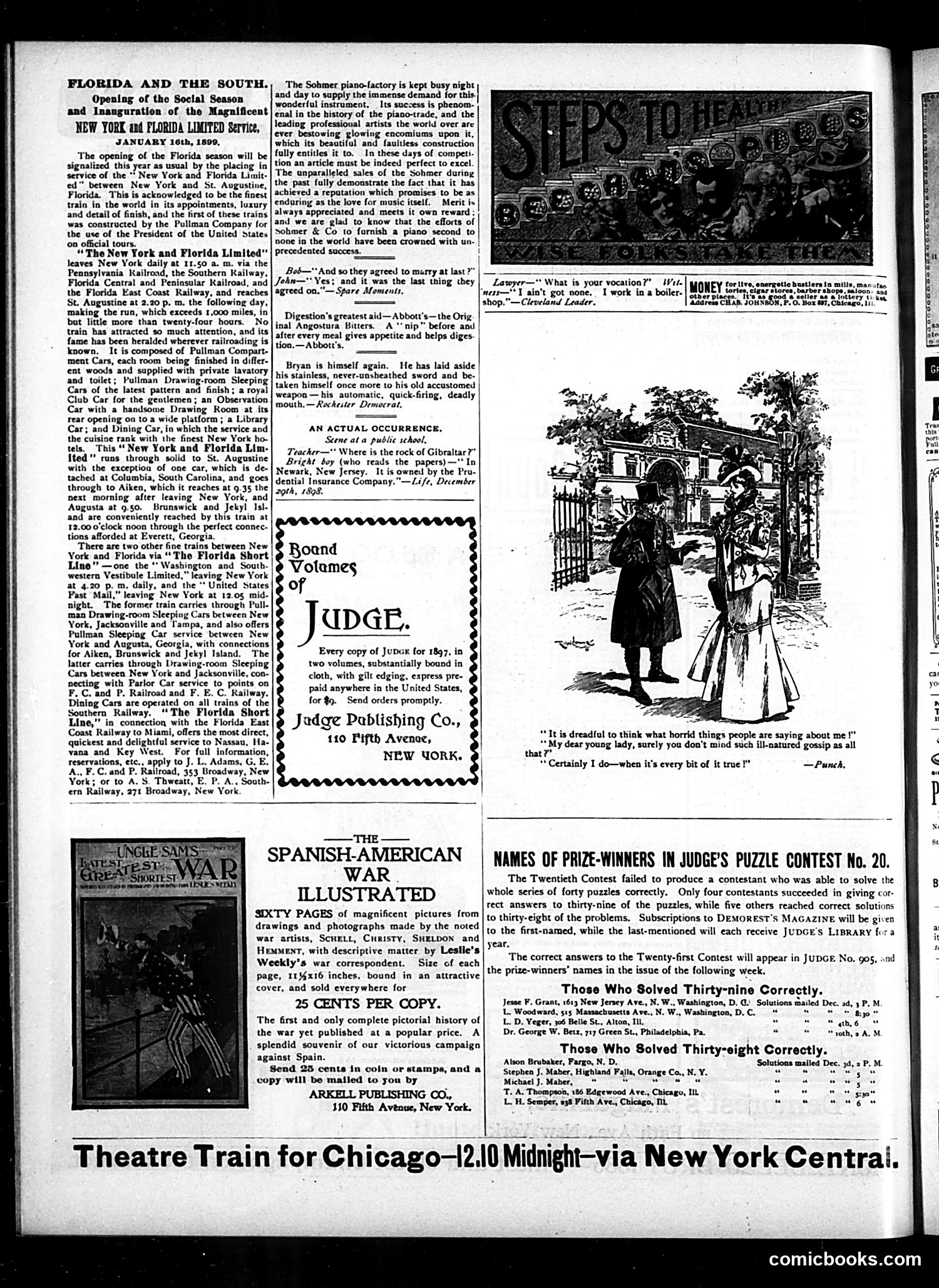
This page is primarily **advertising and announcements**, not political satire. The dominant content includes: **Main Advertisement**: The "New York and Florida Limited" luxury train service, detailing its elegant Pullman cars, amenities, and schedule—targeting wealthy travelers heading to Florida's social season. **Secondary Advertisements**: - Sohmer piano factory promotion - Judge Publishing Co.'s bound volumes - Spanish-American War illustrated history book - Judge's puzzle contest results **Small Cartoon**: A modest illustration (upper right) shows two women in conversation—appears to be social commentary about courtship or romance, though details are difficult to discern. **Context**: This reflects 1899 America's "Gilded Age"—when railroads advertised luxury travel to newly fashionable winter destinations like Florida, and pianos were status symbols for aspiring middle-class families. The page emphasizes conspicuous consumption and leisure rather than political critique.
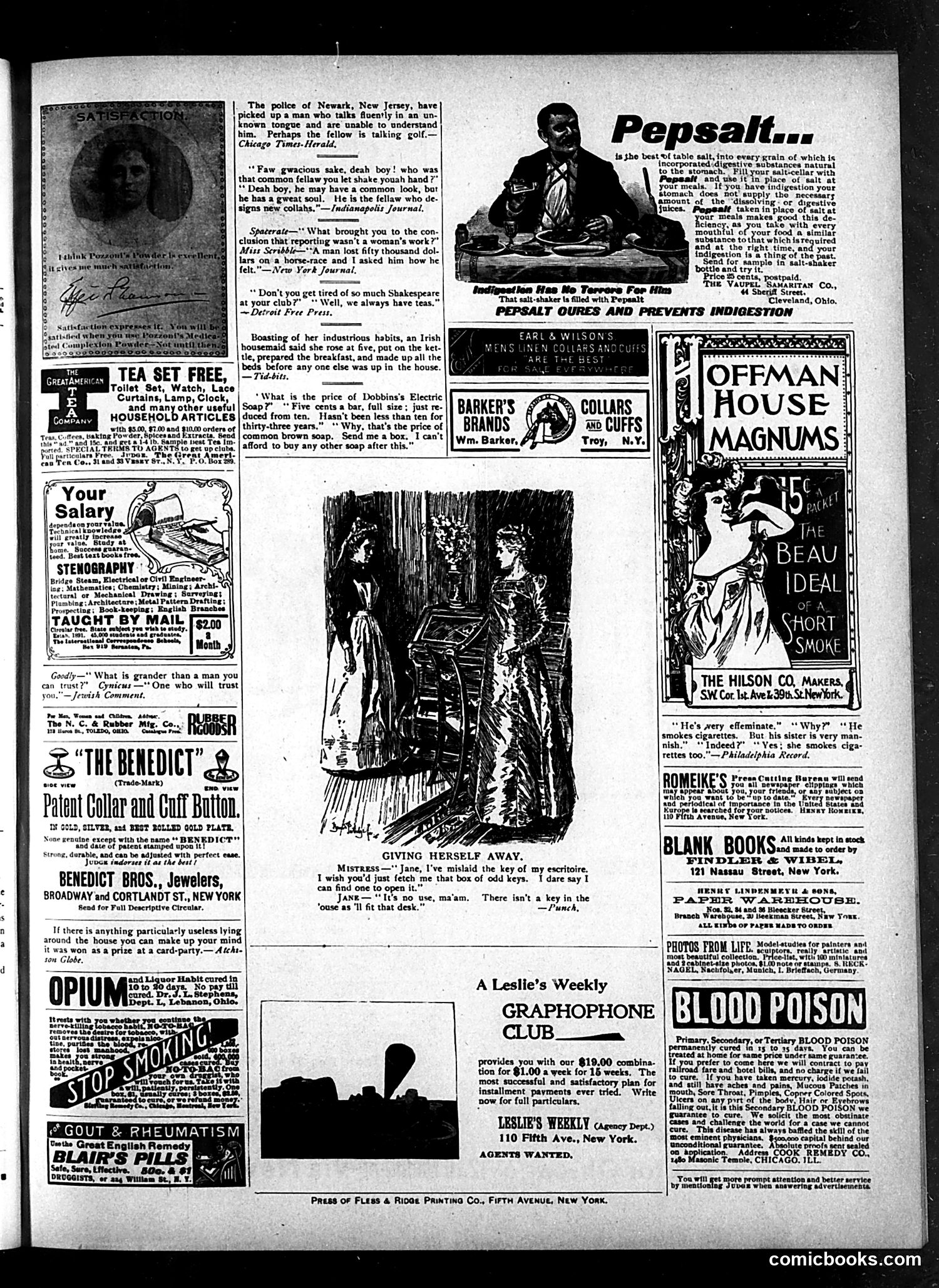
This is primarily **an advertising page** from Judge's satirical magazine, dominated by classified ads and product promotions typical of the era (late 1800s/early 1900s). The few editorial cartoons/jokes scattered among ads include: **Small satirical items:** - A Newark police story mocking golfers' incomprehensibility - Comments on working women reporters and their emotional reactions - Irish servant humor (period-typical ethnic stereotyping) - Upper-class dialogue ridiculing "new money" types **The main visual cartoon** (center-left) shows figures in what appears to be a domestic scene—likely satirizing class pretension or household relations, though details are unclear from this reproduction. **Key advertised products** include: - Pepsalt (digestive salt substitute) - Tea Set premiums - Stenography courses - Opium-based remedies (legal then) - Graphophone (early phonograph) payment plans The page reflects early 1900s American magazine culture: mixing lightweight social satire with dubious patent medicines and installment offers.
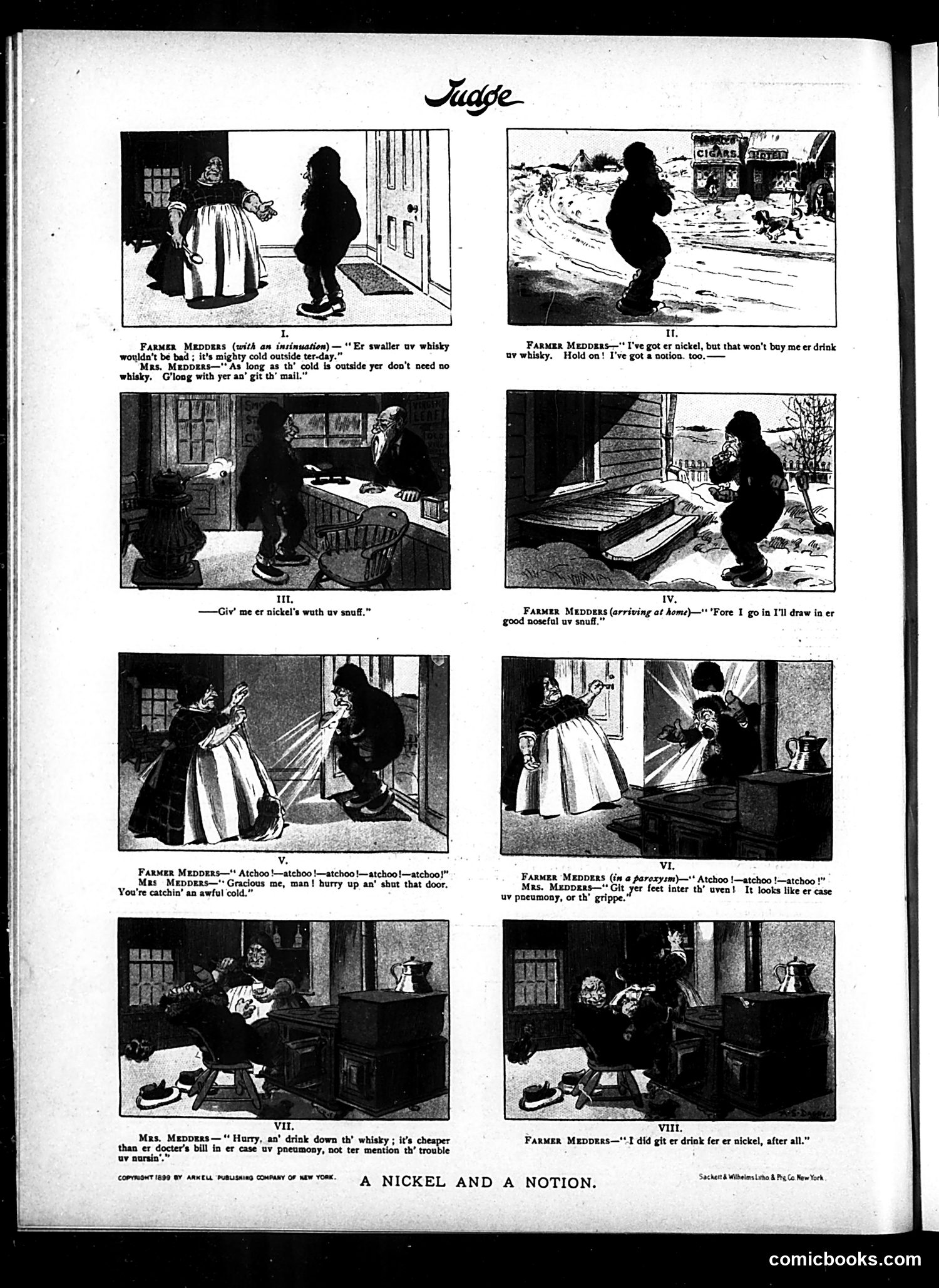
This eight-panel comic strip satirizes rural poverty and folk medicine superstitions circa 1899. Farmer Medders wants whisky to ward off cold but lacks funds. His wife Mrs. Medders refuses, insisting the outdoor cold means he doesn't need it. Medders devises a "notion" (scheme): he buys snuff for a nickel instead. Upon arriving home, he inhales the snuff forcefully, triggering violent sneezing fits that mimic illness symptoms. His wife, believing he's genuinely ill with pneumonia or grippe, reverses course and insists he drink whisky—which she now sees as medicine rather than vice. The joke mocks both rural working-class desperation and the era's confused medicine: the cheap snuff trick gets him the whisky anyway, while simultaneously exposing how thin the line was between "remedy" and mere drinking. The satire targets folk logic and gender economics in farm households.