
A complete issue · 14 pages · 1898
Judge — November 19, 1898
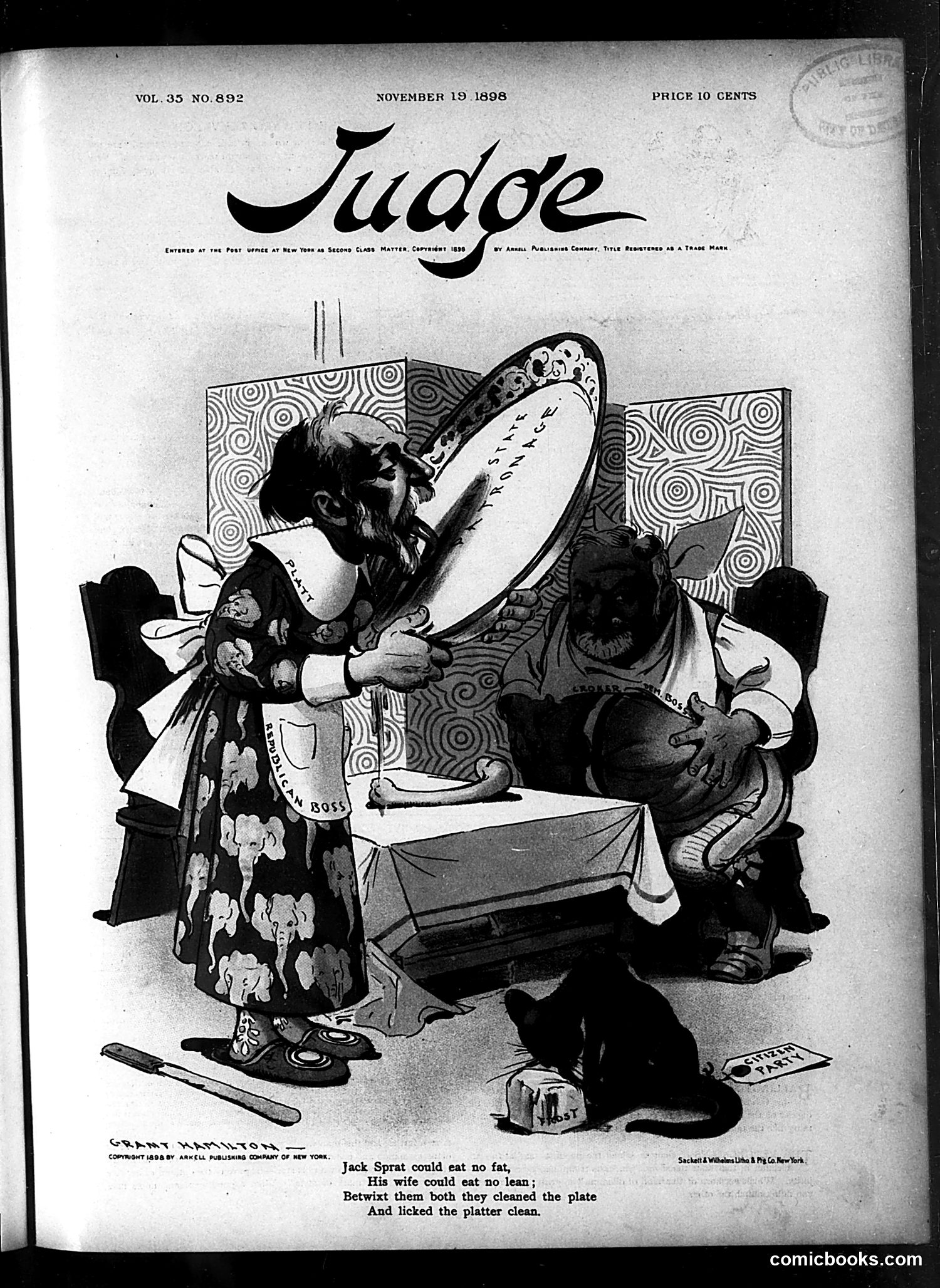
This page satirizes Jack Sprat, the nursery rhyme character whose wife could eat no lean while he could eat no fat. The illustration shows two caricatured figures (likely representing political or social opponents) at a dining table, with text suggesting they "cleaned the plate / And licked the platter clean"—implying they consumed everything despite their supposed opposing preferences. The cartoon appears to critique political compromise or collusion: two parties with ostensibly different positions ultimately cooperating to consume shared resources. The nursery rhyme serves as a vehicle for mockery of politicians or public figures who claim ideological differences but actually work together for mutual benefit. The specific identities of "Jack Sprat" figures are unclear without additional context.
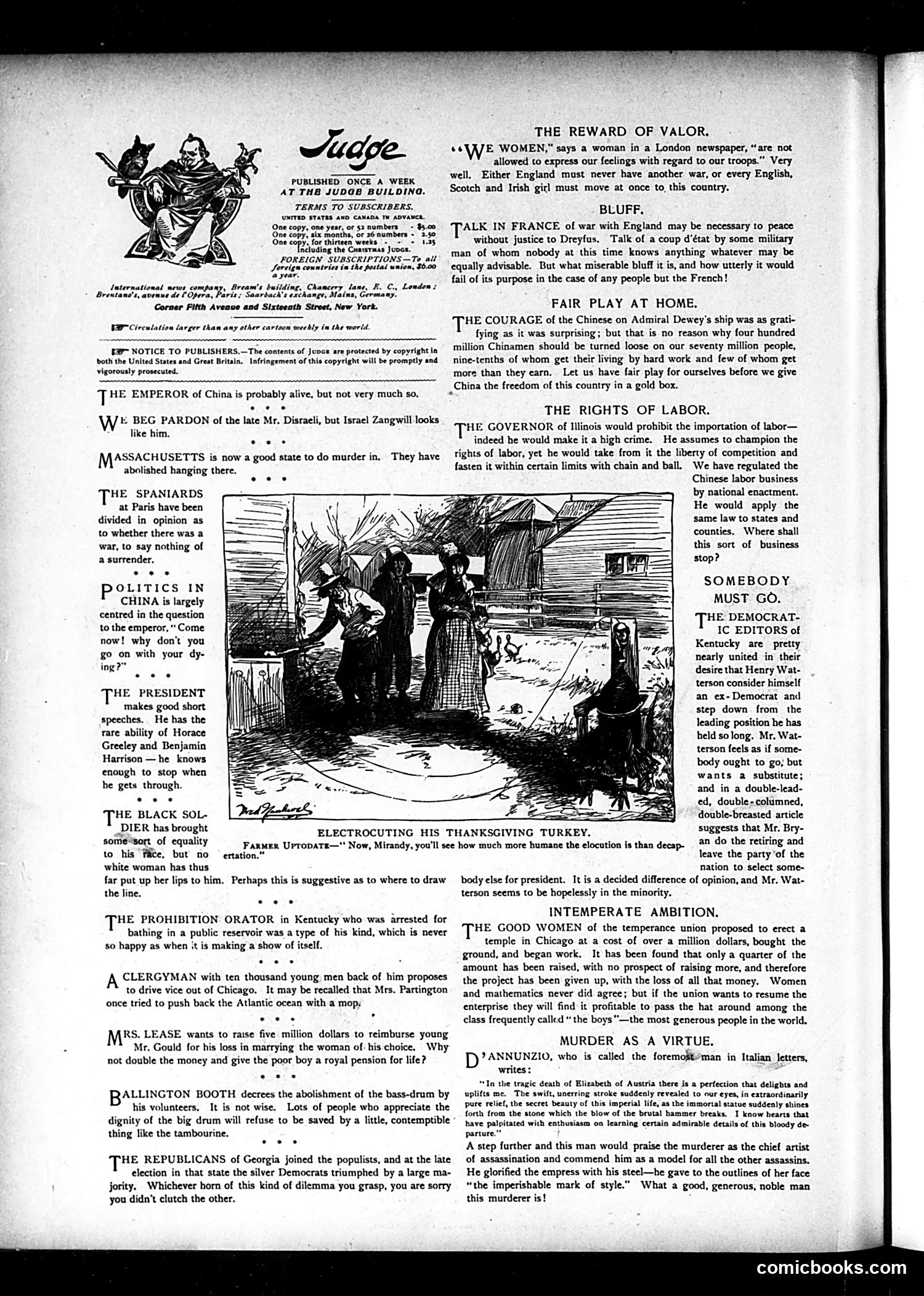
The cartoon depicts a farmer preparing to execute his turkey for Thanksgiving dinner using electrical current—a darkly comic reference to electrocution as a contemporary execution method (likely the electric chair, newly adopted for capital punishment in America). The farmer explains to his wife (Miranda) that this method will be "much more humane" than traditional slaughter. The satire works on multiple levels: it mocks both the enthusiasm for applying modern technology to everyday tasks and the contemporary debate over whether electrocution represented "progress" in criminal justice. The accompanying farmer update caption suggests ironic social commentary about mechanization and its unintended consequences. The joke reflects late 19th-century anxieties about technology's role in violence.
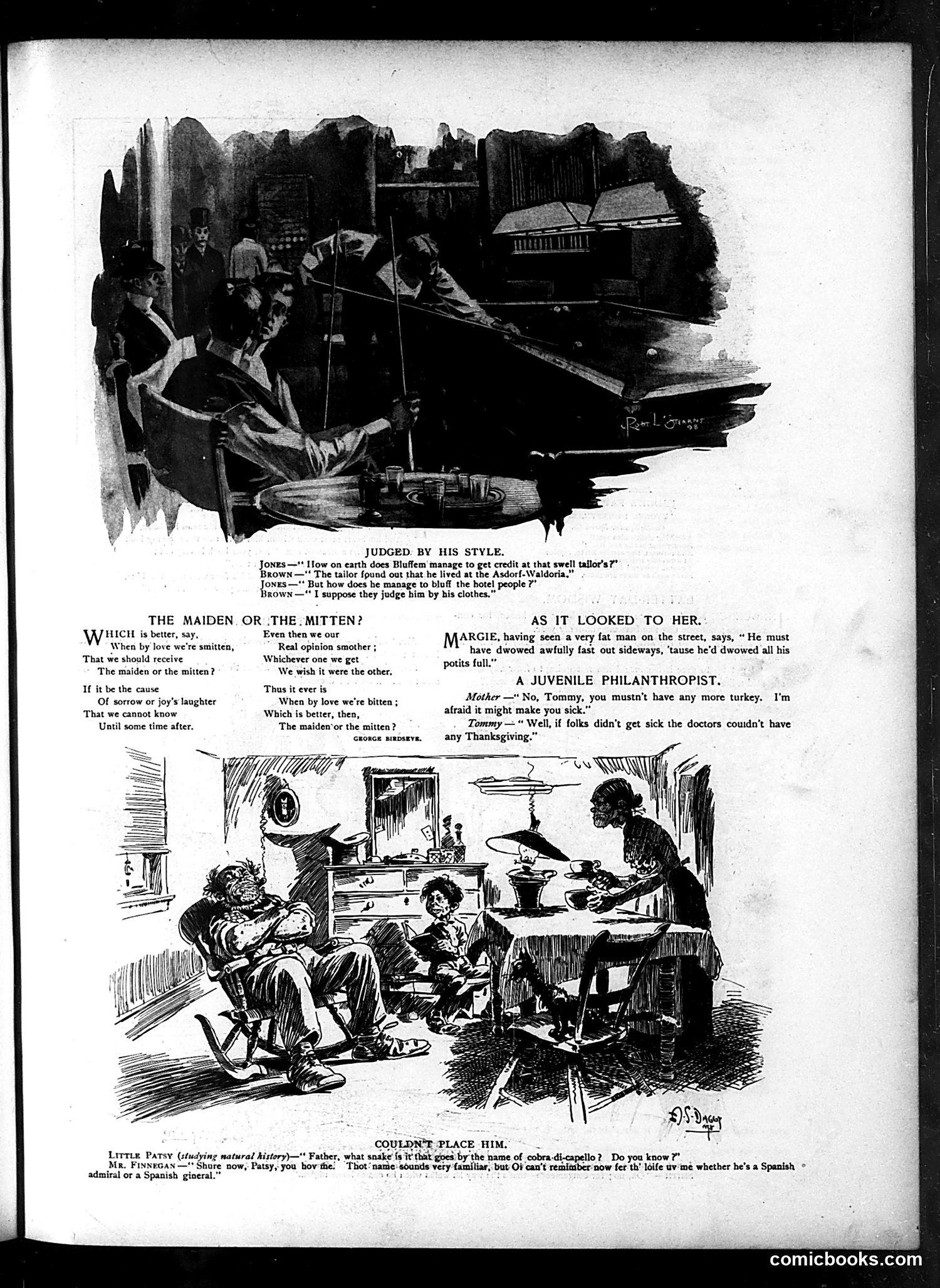
This page contains three separate satirical pieces: **Top cartoon "Judged by His Style"** mocks social class judgment based on appearance. Characters discuss a tailor's creditworthiness, concluding people are evaluated by their clothes rather than character. **Middle poems** ("The Maiden or the Mitten?" and "A Juvenile Philanthropist") are light verse—one about romantic choices, another about a child avoiding Thanksgiving turkey to prevent overeating. **Bottom cartoon "Couldn't Place Him"** features a father quizzing his son about Spanish military ranks, suggesting the boy's education is incomplete or confused. The humor derives from the child's inability to identify a "robes-di-capello" (likely a fabricated term), playing on period anxieties about American children's knowledge of foreign affairs. These reflect turn-of-century middle-class concerns: social pretension, education, and proper conduct.
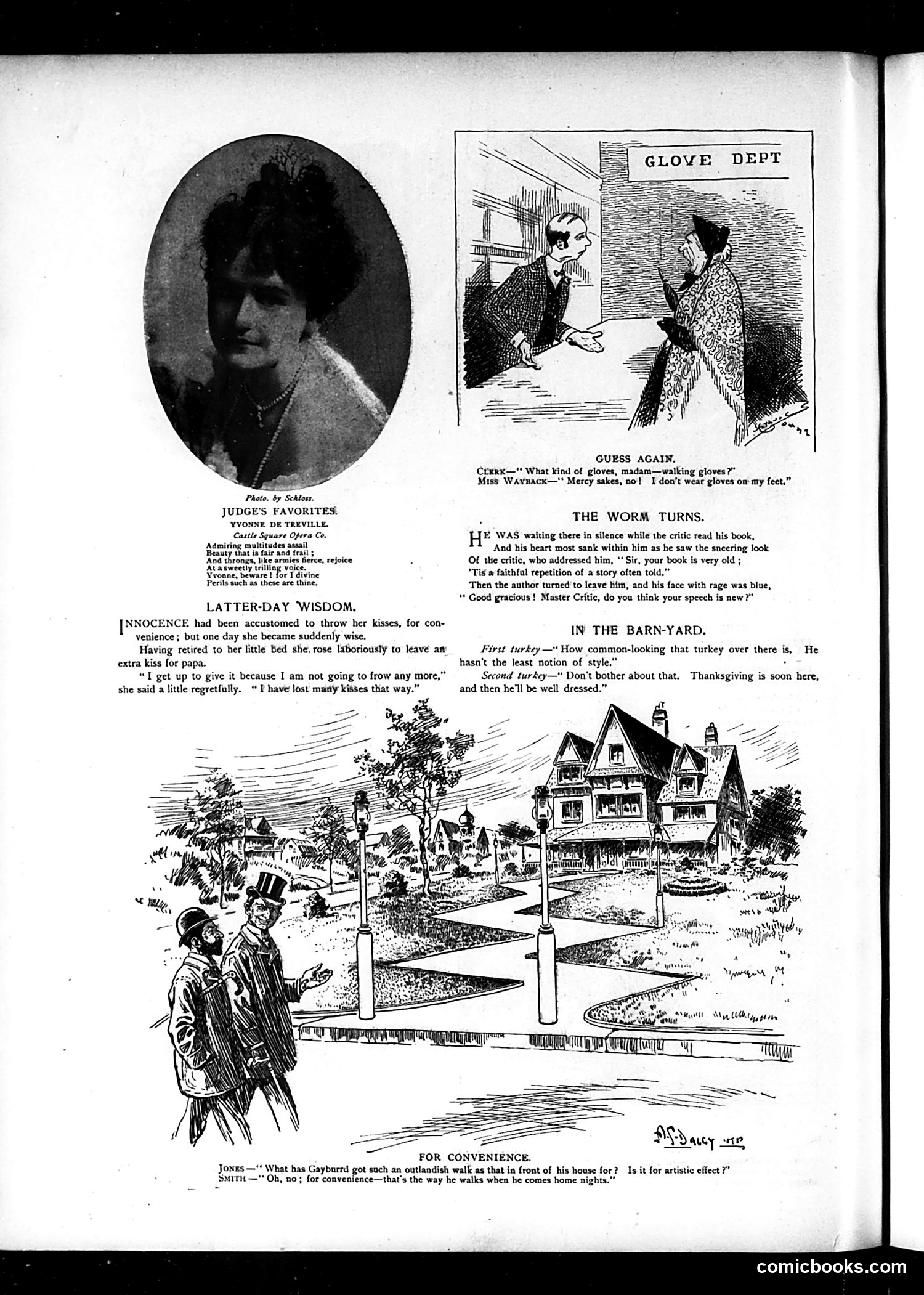
This page contains several satirical items typical of early 20th-century Judge magazine: **"Judge's Favorites"** features a photograph of **Yvonne de Treville**, a Castle Square Opera Company performer, followed by complimentary verse. **"Latter-Day Wisdom"** presents a brief anecdote mocking romantic sentimentality—a woman refuses a suitor's kiss, claiming she's "lost many kisses that way," suggesting she's calculating rather than sentimental. **"The Worm Turns"** depicts an author confronting a critic who praised his book, only to discover the critic hasn't actually read it—social satire on superficial literary judgment. **"In the Barn-Yard"** offers mild humor about turkeys and Thanksgiving. **"For Convenience"** jokes about an eccentric architectural choice—an outdoor walkway design that's actually practical rather than artistic. The page is primarily light entertainment and society commentary rather than hard political satire.
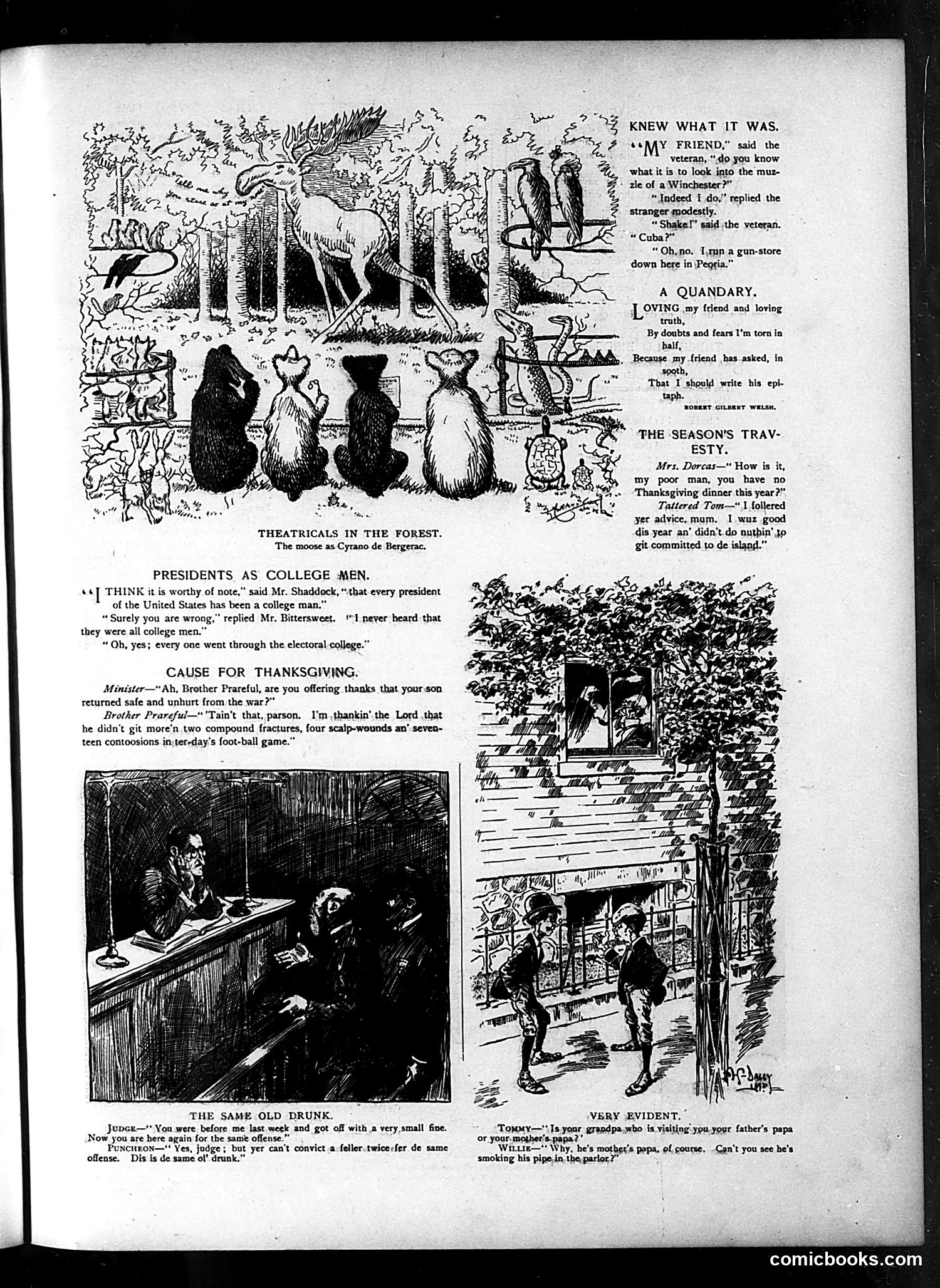
This page contains several satirical pieces typical of early 20th-century American humor: **"Presidents as College Men"** mocks politicians' claims of education by punning that every U.S. president attended "the electoral college"—wordplay suggesting they owe their positions to voting mechanics, not genuine scholarship. **"Cause for Thanksgiving"** satirizes the brutality of American football by having a father thank God his son suffered "only" multiple fractures and wounds in a game, treating football injuries as casually as war casualties. **"The Same Old Drunk"** jokes about a repeat offender's misunderstanding of legal protections—he believes being the "same" person means double jeopardy prevents reconviction, displaying humorous ignorance of law. **"Knew What It Was"** plays on the Spanish-American War (Cuba reference). A veteran assumes another man's familiarity with looking down a Winchester rifle barrel means combat experience, but the man merely works in a gun store. The page also includes poetry and an illustration joke about a grandfather smoking in the parlor, humorously "proving" he's the maternal rather than paternal grandfather.
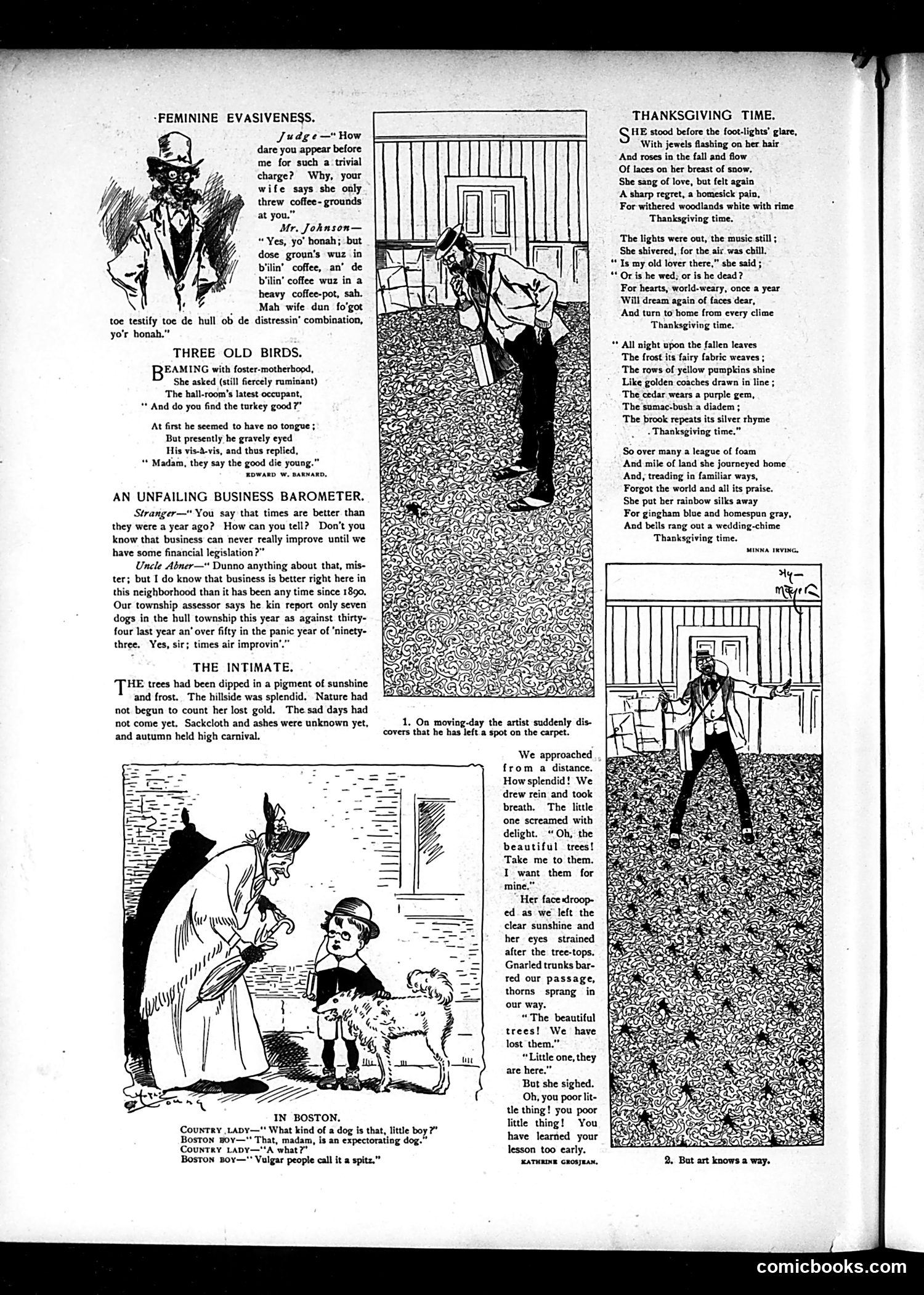
This Judge magazine page contains several satirical pieces: **"Feminine Evasiveness"** mocks a legal proceeding where a Black man (depicted with period dialect) attempts to explain to a judge that his wife threw not just coffee grounds but scalding coffee at him. The satire targets both the justice system's dismissal of domestic violence and stereotypical depictions of Black dialect. **"Three Old Birds"** is a brief joke about elderly women discussing Thanksgiving dinner—a guest's cryptic comment about "the good die young" darkly suggests the turkey (or the meal itself) killed him. **"An Unfailing Business Barometer"** presents a rural character claiming economic improvement based on fewer stray dogs—satirizing simplistic economic indicators and rural versus urban understanding of finance. **"The Intimate"** is a sentimental story about a child's disappointment discovering beautiful autumn trees are inaccessible, teaching harsh life lessons prematurely. **"Thanksgiving Time"** is romantic verse about a theatrical performer longing for home and lost love, ultimately reuniting and marrying—a sentimental celebration of the holiday's emotional pull. The page emphasizes period-typical racial humor alongside sentimental and satirical content about class, economics, and nostalgia.
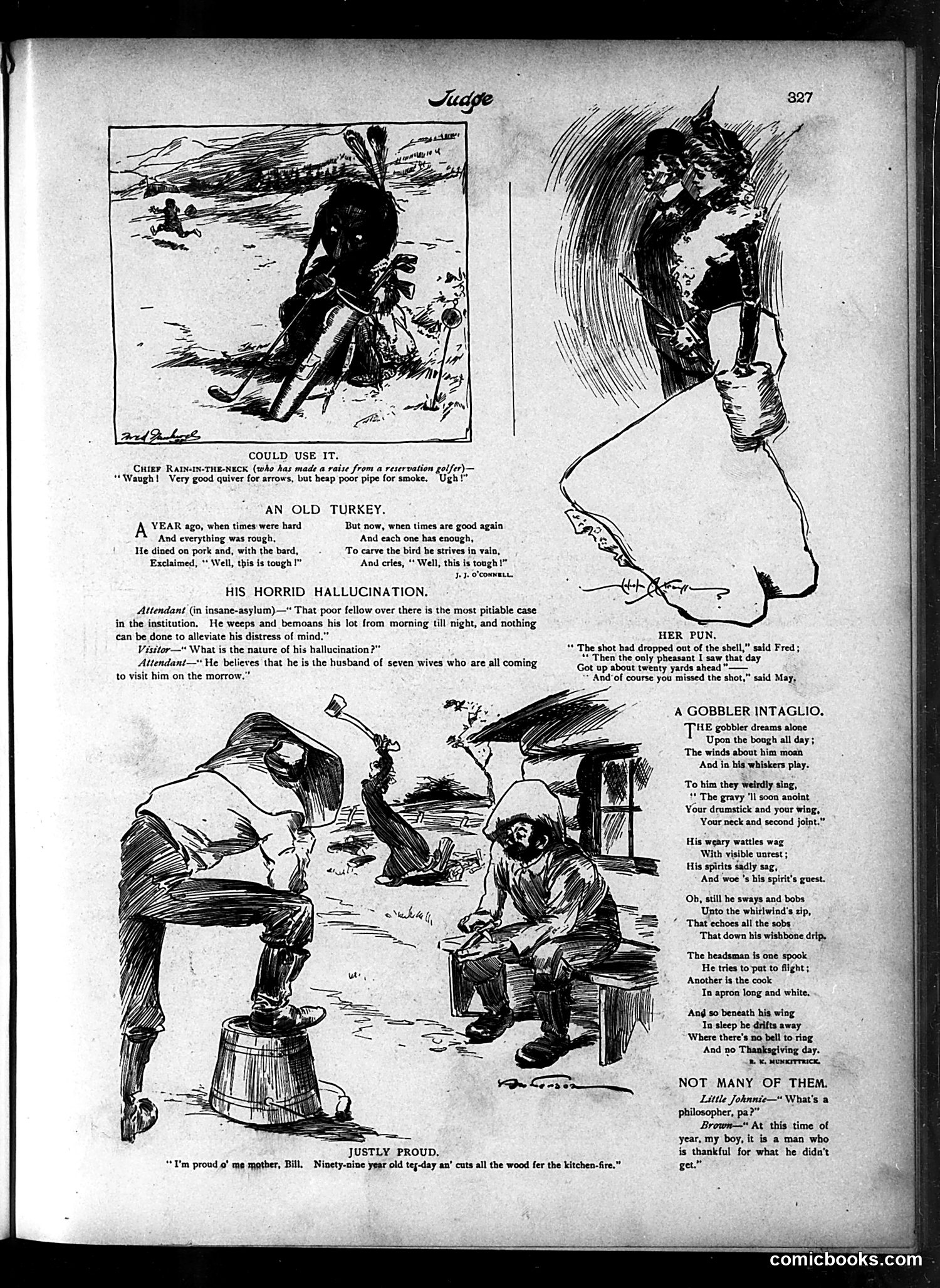
This page contains several satirical cartoons and verses typical of late 19th-century American humor: **"Could Use It"** mocks a Native American ("Chief Rain-in-the-Neck") who obtained wealth from a golf course, suggesting he lacks refinement—he appreciates the quiver as a weapon but dismisses it as a poor pipe, implying stereotypical "uncivilized" behavior. **"An Old Turkey"** uses economic conditions as humor: a year ago during hard times, a man called tough food "tough"; now with prosperity, he still complains carving the bird is "tough"—satirizing perpetual human discontent. **"His Horrid Hallucination"** jokes darkly about an asylum patient believing he's married to seven wives visiting tomorrow—the horror being domestic entrapment rather than mental illness. **"A Gobbler Intaglio"** personifies a turkey dreading Thanksgiving, anthropomorphizing its death anxiety poetically. The remaining pieces offer mild domestic humor about hunting, gender relations, and holiday philosophy, reflecting period sensibilities and anxieties.
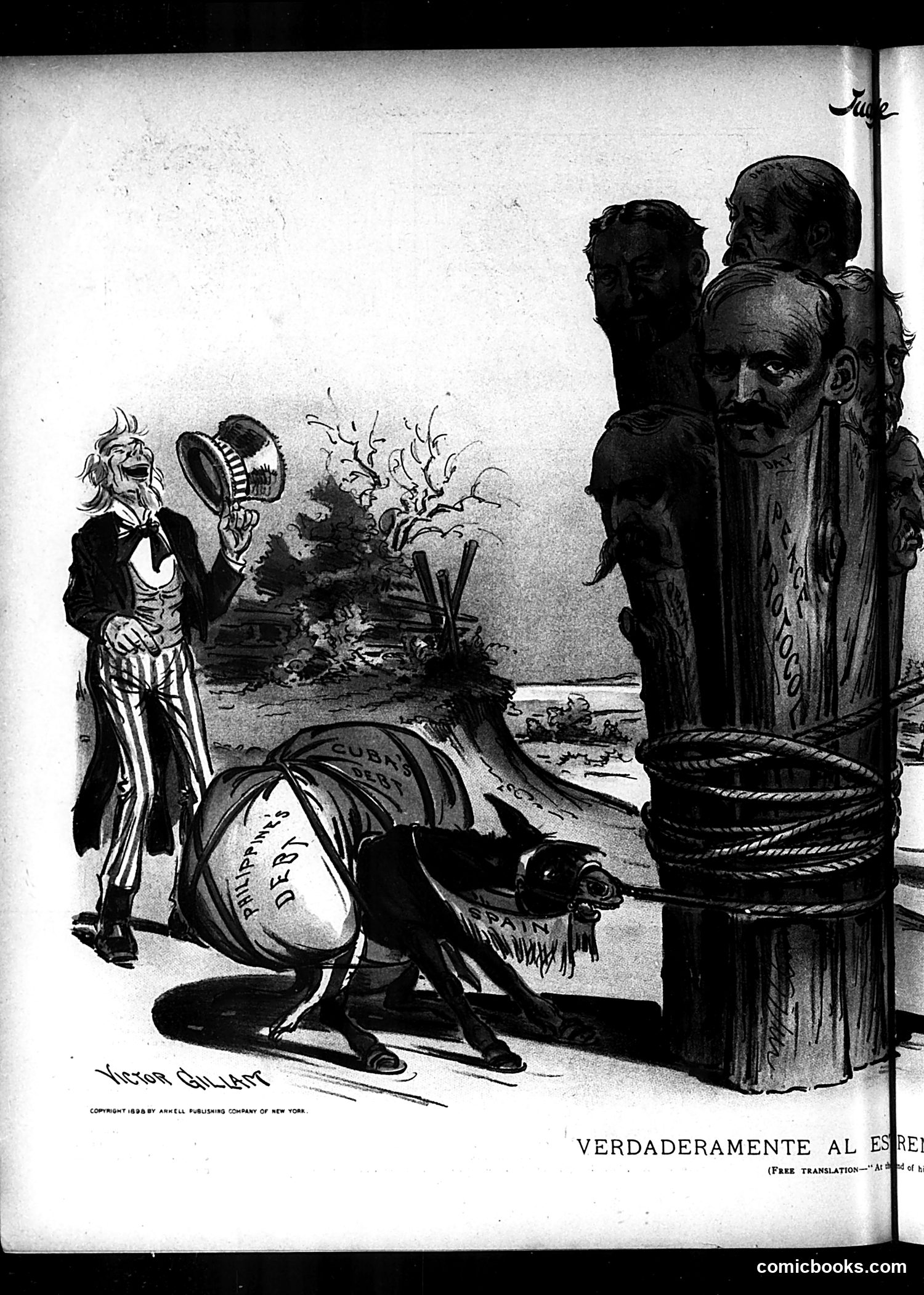
This 1898 *Judge* cartoon titled "Verdaderamente Al Es|Rei" (Spanish: "Truly to the King") appears to be satirizing Spanish colonial authority, likely referencing the Spanish-American War period. The left figure—a caricatured Spanish official or aristocrat—stands with a megaphone beside a barrel labeled "POWDER" (gunpowder), suggesting military aggression or warmongering. The right side shows figures bound to a post with rope, appearing to represent colonial subjects or prisoners. The barren landscape with dead vegetation suggests destruction and ruin caused by Spanish rule. The cartoon likely critiques Spanish imperialism and violence toward colonized peoples, positioning Spain's leaders as destructive warmongers indifferent to human suffering. The Spanish-language title suggests this may have been commentary aimed at Spanish readers or addressing Latin American audiences regarding Spain's colonial methods.
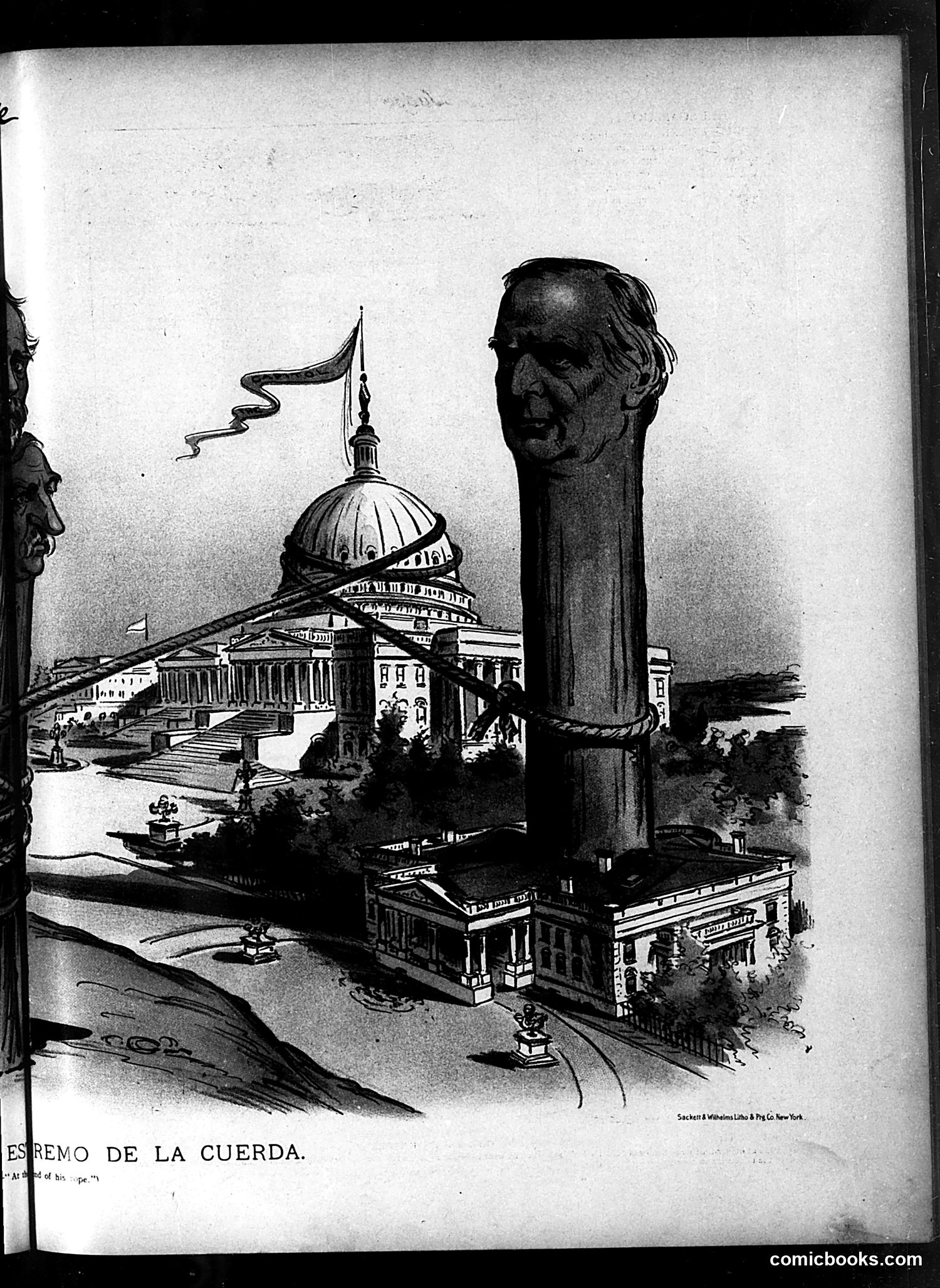
This appears to be a Spanish-language political cartoon titled "ESREMO DE LA CUERDA" (roughly "The Rope's End" or similar). The image shows a large bronze bust or monument of a man's head, bound with rope, positioned before a classical government building with a dome and flag. The cartoon uses the Spanish title and architectural setting to suggest this comments on Latin American politics—likely depicting a political leader or figure being constrained or "hanged" by governmental/political forces. The rope binding the monument symbolizes restraint, control, or execution. Without clearer context about the publication date or specific historical figure depicted, the exact reference remains unclear, but the satire appears to critique political oppression or the downfall of a particular leader through state power.
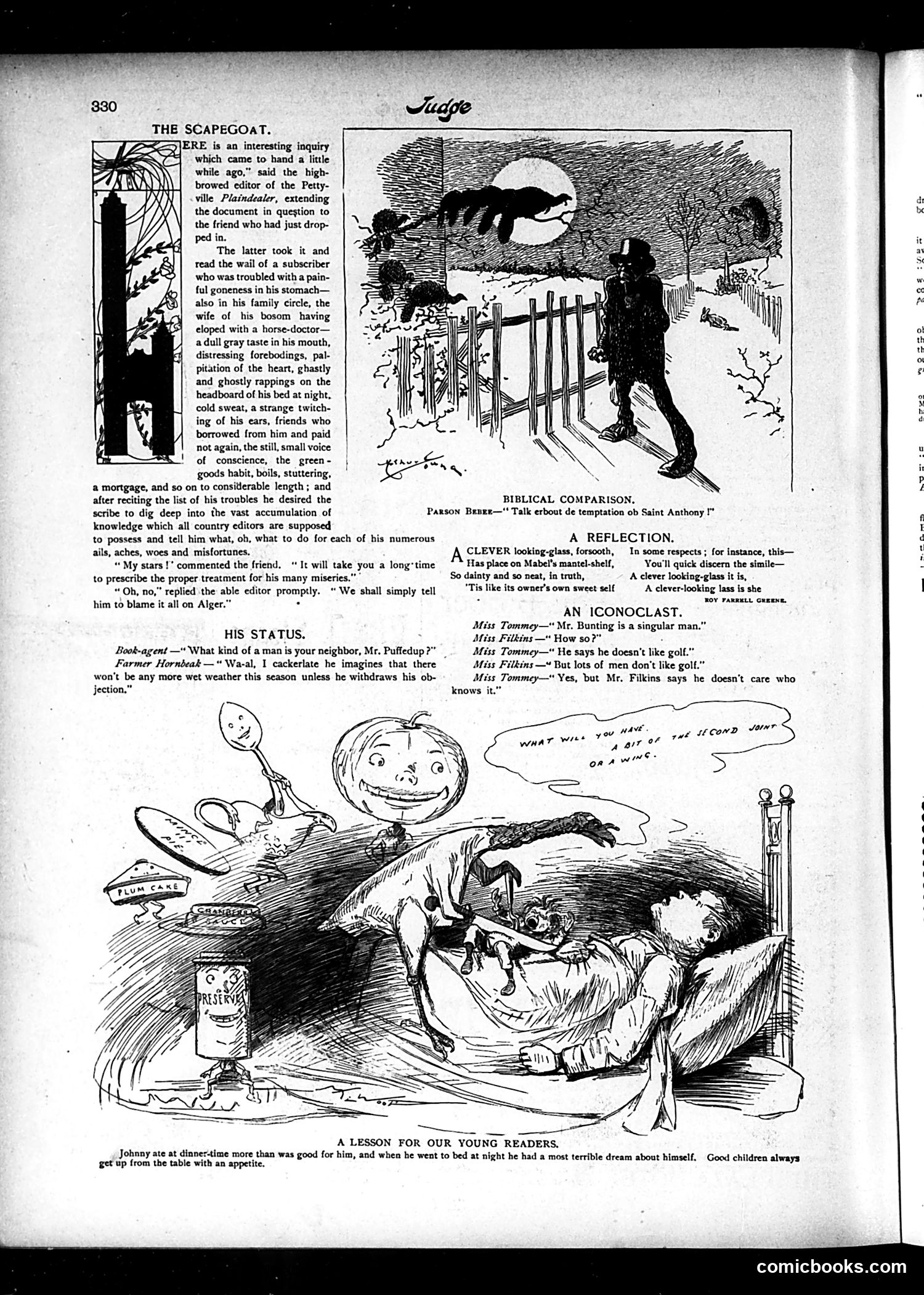
This page from *Judge* contains several satirical items typical of American humor magazines of the late 19th/early 20th century. **"The Scapegoat"** (main article with illustration): A country newspaper editor receives a complaint letter from a subscriber listing endless personal miseries—from stomach pain to financial troubles to supernatural disturbances. When asked how he'll help, the editor dismissively says he'll simply "tell him to blame it all on Alger," referring to likely **Horatio Alger Jr.**, whose rags-to-riches novels promoted self-reliance. The satire mocks editors who use scapegoats rather than offering genuine solutions. **"His Status"** (cartoon): A farmer boasts his neighbor is so vain he believes rain won't fall unless he permits it—satirizing arrogant self-importance. **"A Lesson for Our Young Readers"** (bottom): A cautionary illustrated tale where gluttonous Johnny's overeating causes nightmares, warning children against excess at table. The remaining items are brief humorous observations on manners, appearance, and social behavior typical of *Judge*'s satirical commentary on contemporary American society.
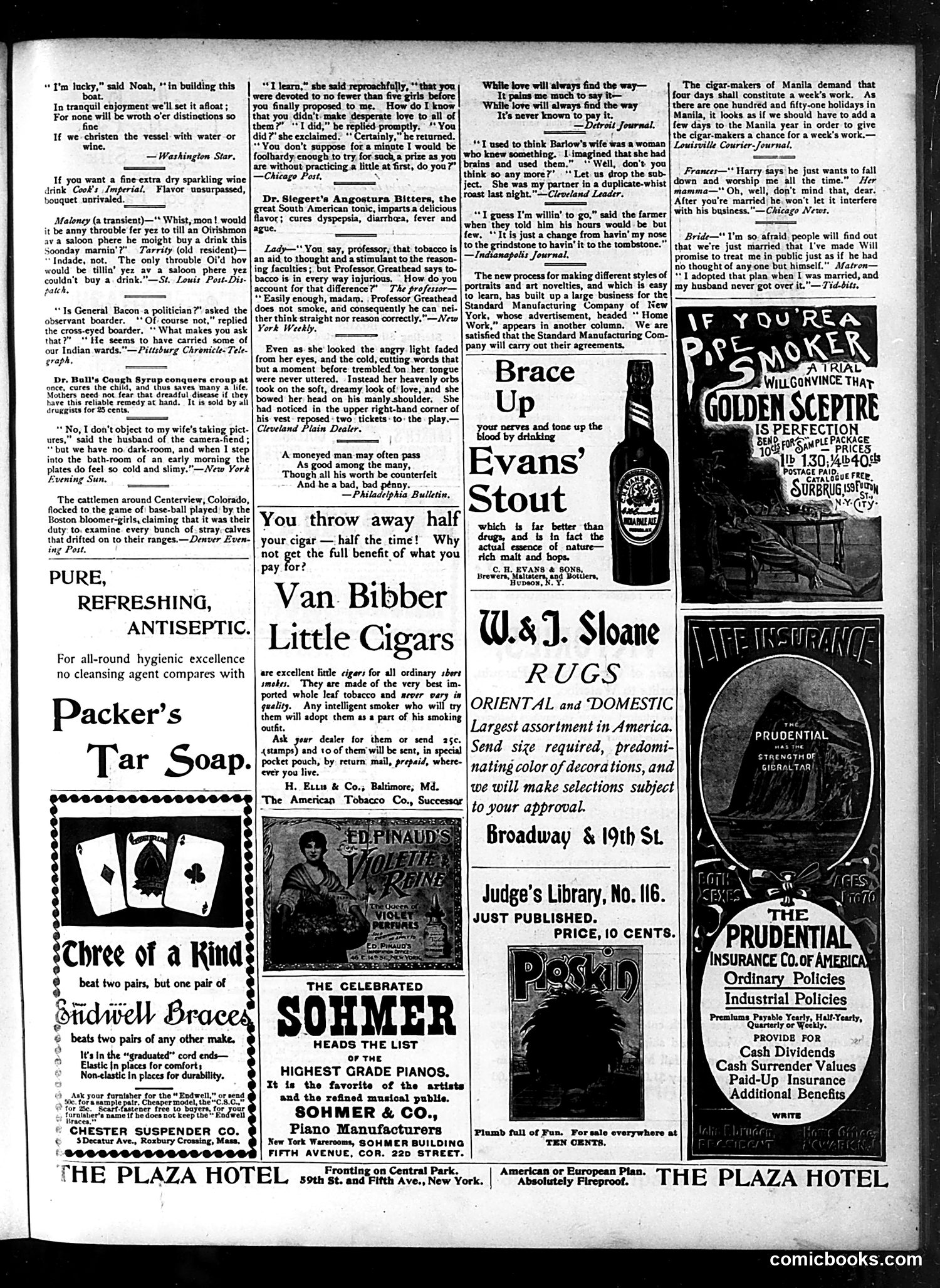
This is primarily an **advertising page** from Judge magazine, with several brief satirical jokes interspersed among product advertisements. The visible cartoons/jokes include: 1. **Noah's boat joke** (Washington Star): A pun about christening Noah's ark with "water or wine"—playing on the dual meaning of "christening" (blessing a vessel). 2. **Irish saloon joke**: An Irish immigrant asking directions to a Sunday saloon, with a resident ironically noting the only problem would be finding one where you *could* buy a drink—satirizing Prohibition-era drinking restrictions. 3. **General Bacon joke**: A brief political jab, likely referencing a politician or public figure named Bacon, with a veiled reference to "Indian wards" (unclear without more context). 4. **Marriage proposal joke**: A husband reveals he practiced proposing before asking his wife—mocking romantic pretense. The **advertisements** dominate: Van Bibber cigars, Evans' Stout beer, Packer's Tar Soap, Sohmer pianos, and insurance products. The humor throughout is gentle, domestic, and topical rather than deeply political.
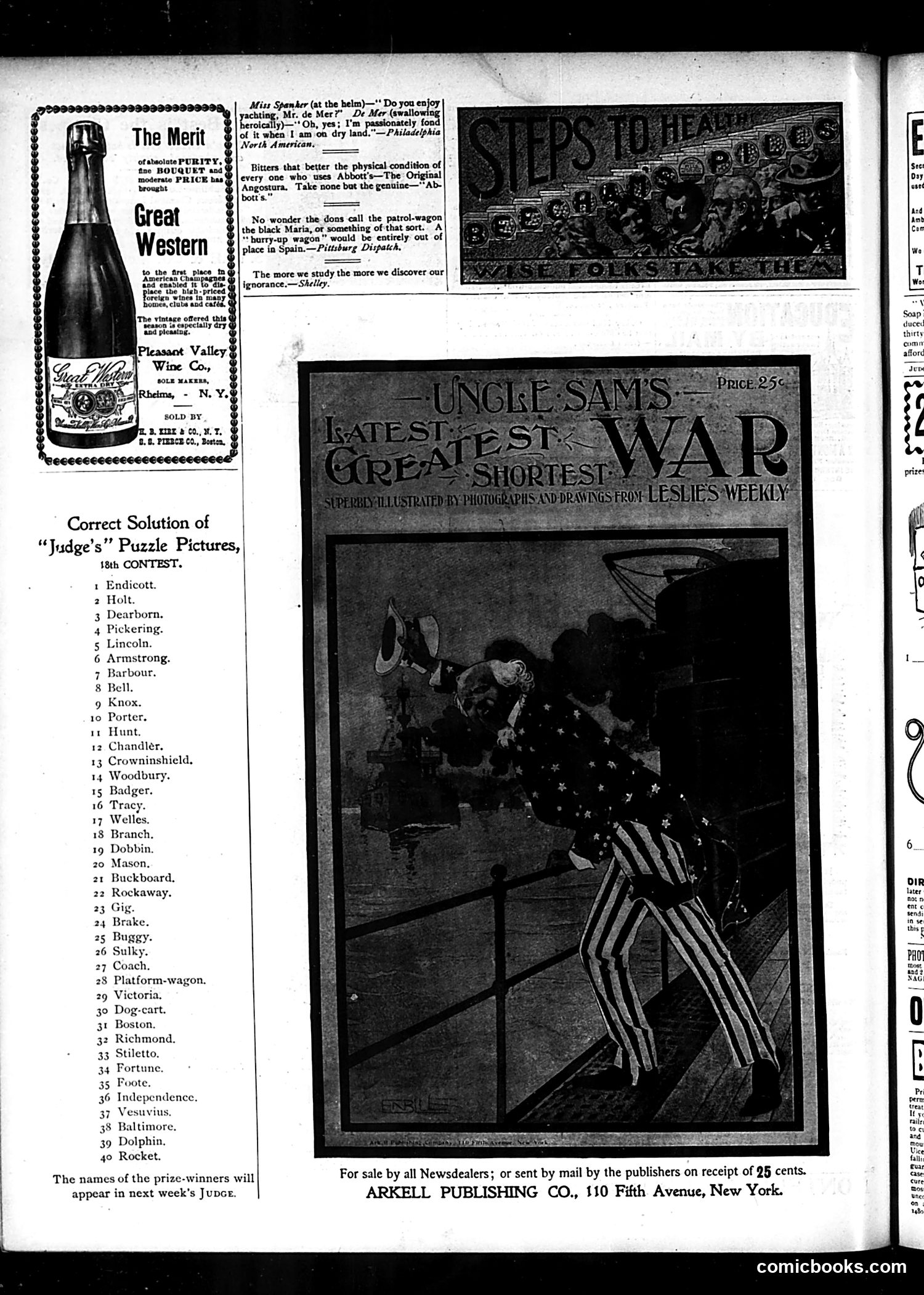
This page is primarily **advertising and contest results**, not political satire. The dominant content includes: 1. **Wine advertisement** (left): Promoting "Great Western" champagne as superior to expensive foreign wines 2. **Contest solution** (center-left): Answers to Judge's 18th puzzle contest—a list of 40 names (mostly American surnames like Lincoln, Armstrong, Hancock) that readers had to identify from illustrated pictures 3. **Central image**: "Uncle Sam's Latest, Greatest, Shortest War" from Leslie's Weekly—a war-themed illustration (likely WWI-era) showing a figure with an American flag, available for 25 cents 4. **Small humorous captions** (top): Brief jokes about seasickness and Spanish police wagons The page reflects early 20th-century magazine culture: mixing humor, commerce, reader competitions, and timely war-related content to boost circulation. The "war" reference appears topical but specific context isn't clear from this excerpt alone.
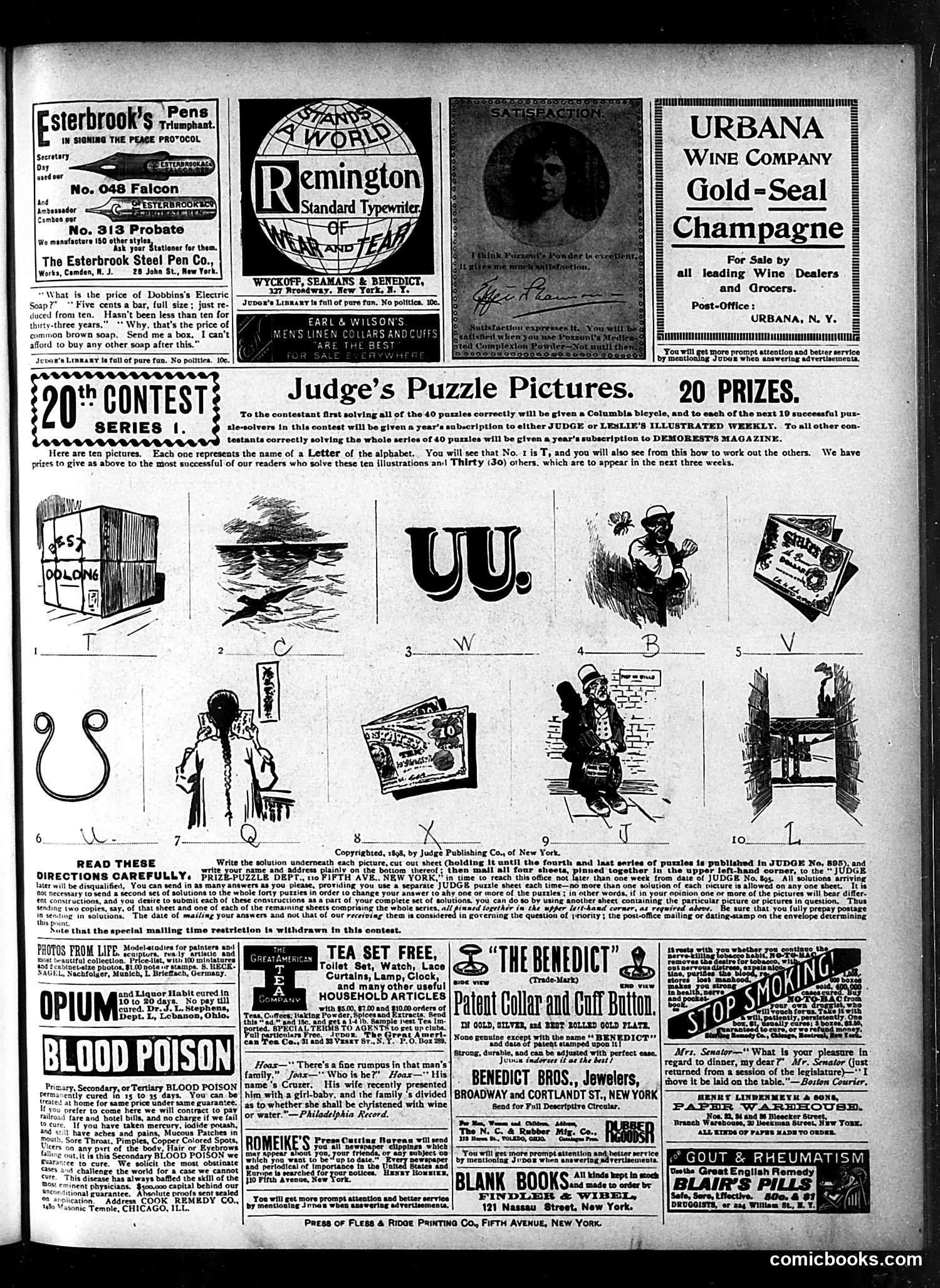
This page is primarily **advertising and a puzzle contest**, not political satire. The main content is Judge's "20th Contest Series I"—a puzzle competition offering prizes including a Columbia bicycle and magazine subscriptions. Readers must identify letters of the alphabet from ten rebus-style illustrations (images 1-10 shown), then solve forty total puzzles across multiple issues. The page is dominated by **commercial advertisements** for products typical of the 1890s: Esterbrook pens, Remington typewriters, Urbana Wine Company champagne, and various patent medicines (opium, blood tonics, "stop smoking" remedies). There's also an ad for Benedict Bros. jewelry. A small joke appears about Dobbins's Electric Soap being inexpensive—a consumer humor bit, not political commentary. **The historical interest here is documentary**: it shows how turn-of-century magazines funded operations through advertising, and what products were marketed to readers. There is **no discernible political cartoon or satire** on this particular page.
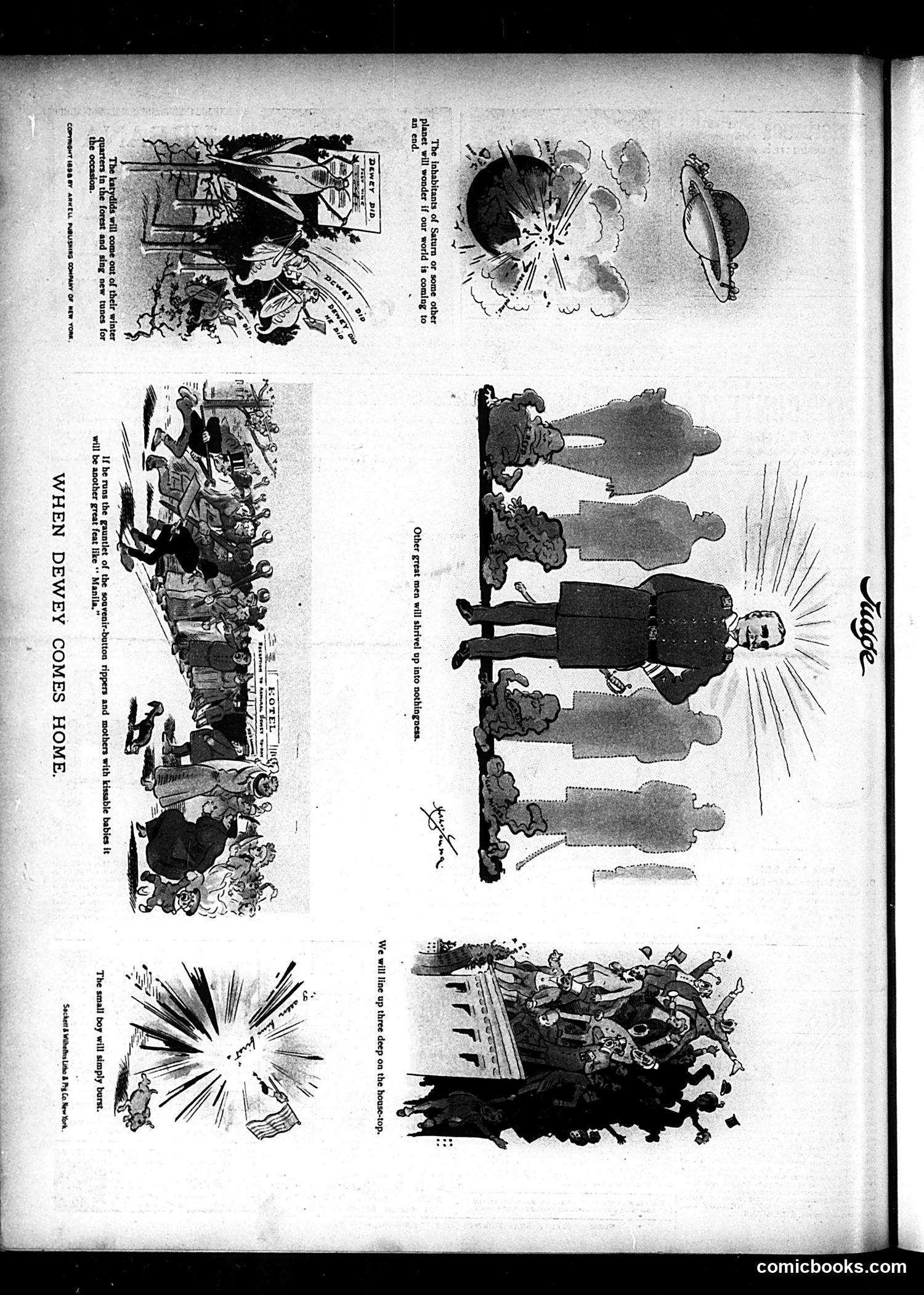
This page satirizes the anticipated homecoming of Admiral George Dewey following his 1898 victory at Manila Bay during the Spanish-American War. The cartoons mock the excessive public enthusiasm expected for his return. The central image shows Dewey surrounded by crowds, with smaller panels depicting the chaos of his arrival: enthusiastic crowds on rooftops, mothers eager to present their babies for kissing, and souvenir-hunters tearing at his uniform for buttons. The satire suggests this celebration will be so chaotic and overwhelming that it rivals the Manila victory itself—treating the homecoming as another military "feat." The tone is gently mocking, using hyperbolic imagery (inhabitants of other planets witnessing Earth's apparent madness, small boys bursting with excitement) to ridicule American hero-worship and the media-driven frenzy around celebrity returns. It critiques both public giddiness and the commercial exploitation (souvenirs) surrounding national figures.