
A complete issue · 16 pages · 1898
Judge — October 15, 1898
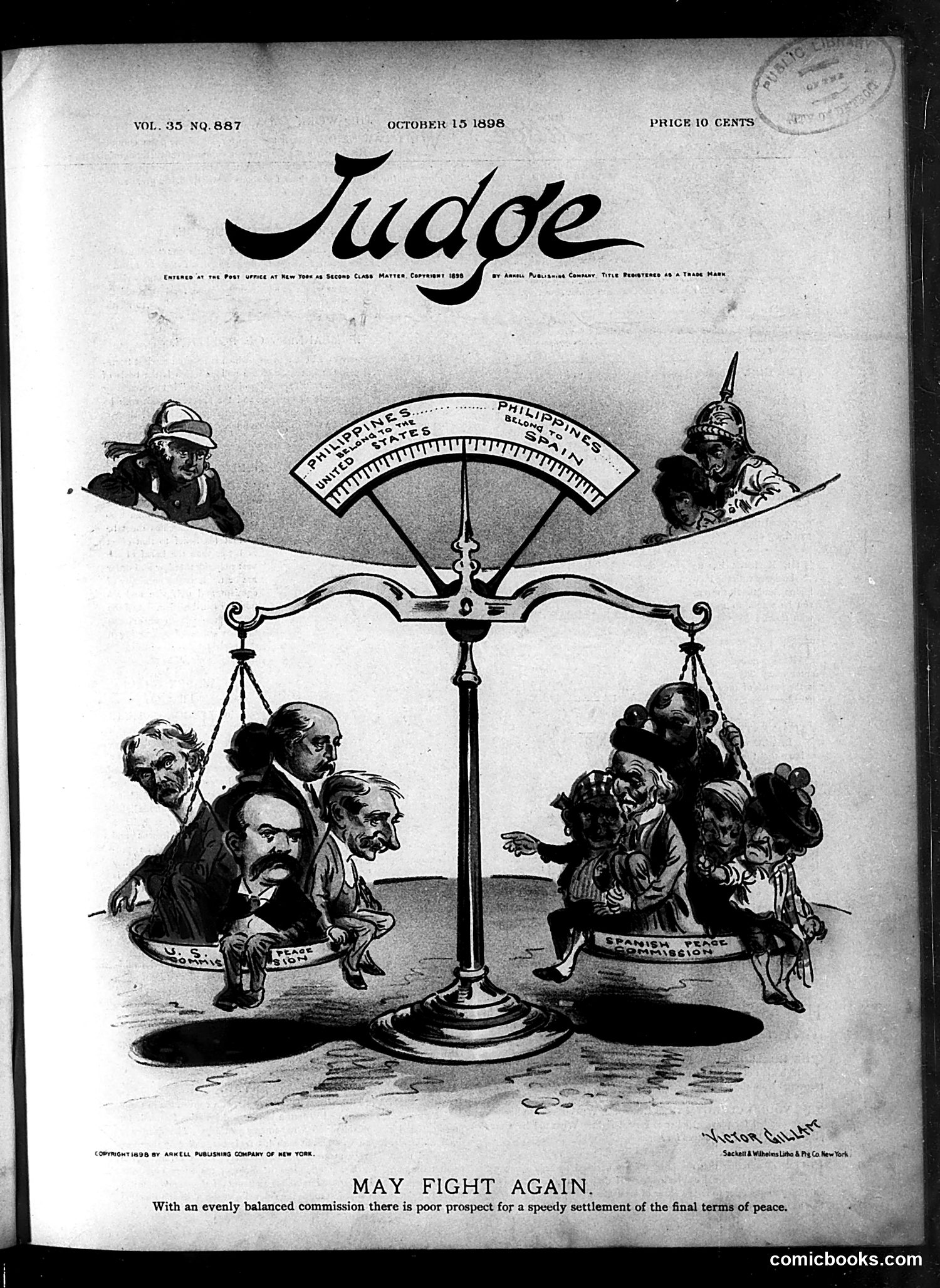
This political cartoon depicts a scale balancing two sides of the Spanish-American War's peace negotiations. The top shows two military figures (American and German soldiers, based on the helmets). The left pan labeled "U.S. DEMANDS" contains caricatured figures representing American interests. The right pan labeled "SPANISH TRADE COMMISSION" shows Spanish negotiators. The caption warns that "with an evenly balanced commission there is poor prospect for a speedy settlement of the final terms of peace"—suggesting the peace talks are deadlocked. The cartoon satirizes the difficulty of reaching agreement over war reparations and territorial concessions following Spain's defeat. The scale imagery emphasizes the opposing interests preventing resolution of post-war settlement terms.
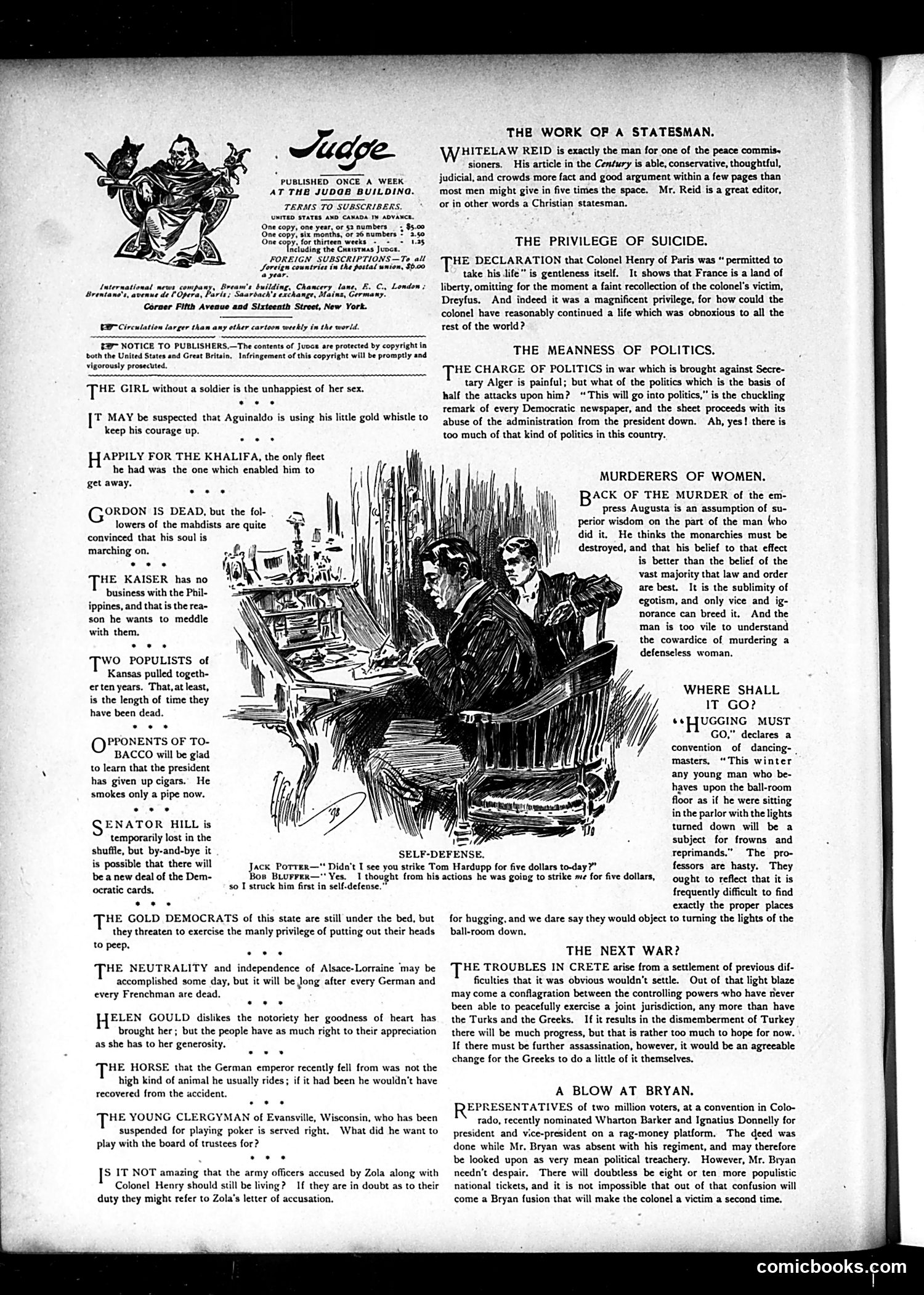
The central illustration depicts two men at a desk in what appears to be an office or study, labeled "SELF-DEFENSE." The accompanying text discusses a man striking another "Tom Hardup for five dollars today" in self-defense, with the struck man claiming he was "going to strike him for five dollars." The satire critiques the absurdity of claiming self-defense when initiating violence first—a commentary on questionable justifications for aggression. The cartoon illustrates the logical contradiction: the man who strikes preemptively can hardly claim he was defending himself. The surrounding editorial content addresses various political topics including Secretary Alger's wartime conduct, Colonel Henry of Paris's death, and Democratic politics, typical of Judge's satirical approach to contemporary 1890s-era issues.
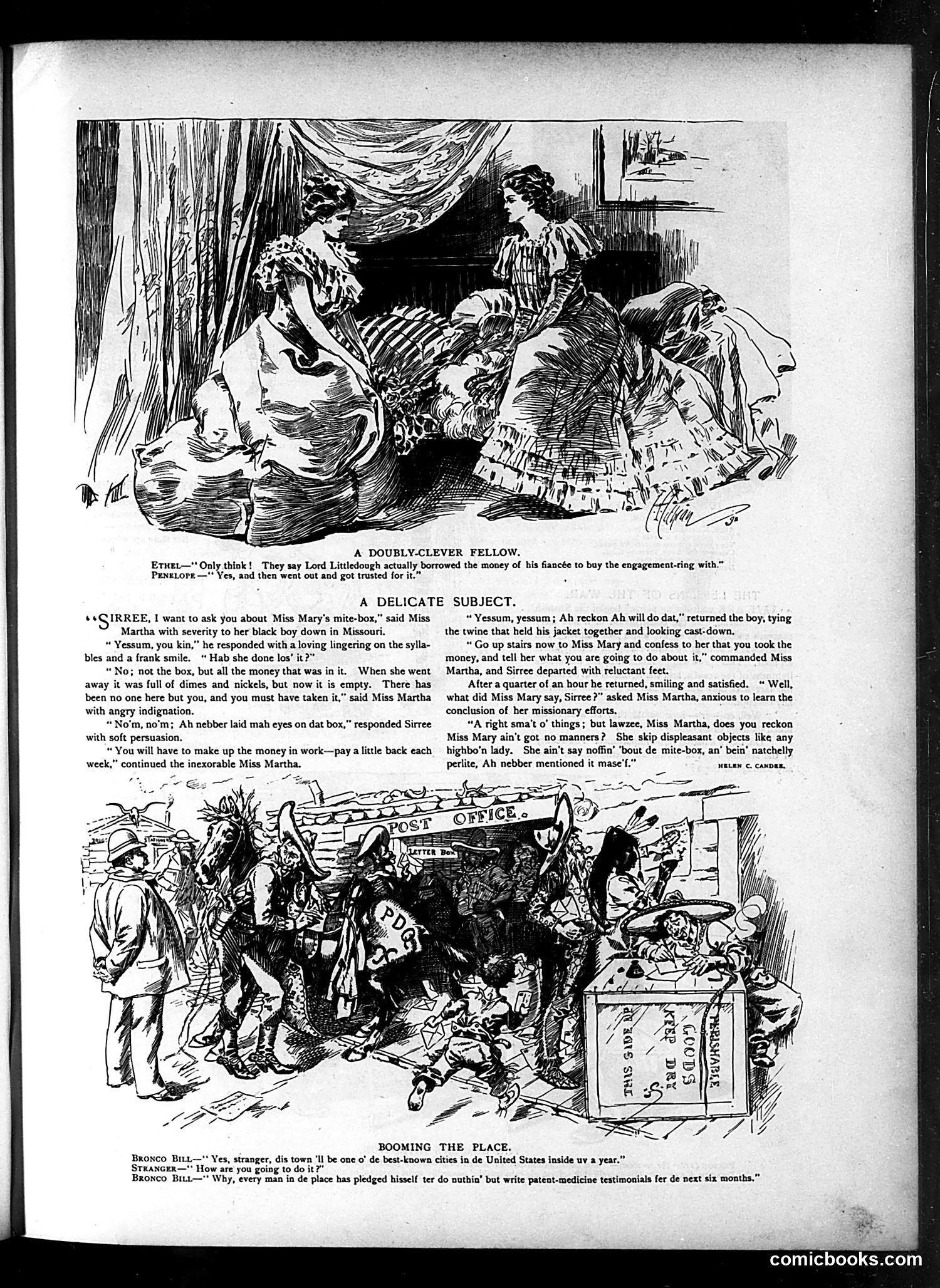
**Top Cartoon - "A Doubly-Clever Fellow":** This depicts a social satire about engagement rings and deception. A character named Lord Littlesough apparently borrowed money from his fiancée to purchase an engagement ring, then didn't repay it. The joke mocks both his dishonesty and the women's focus on material displays of wealth. Characters named Ethel and Penelope discuss the scandal with indignation. **Bottom Cartoon - "Booming the Place":** This appears to satirize Western frontier boosterism or town promotion. "Bronco Bill" and "Stranger" discuss making a town "one of de best-known cities in de United States," with residents pledging dubious testimonials for patent medicines. The satire targets exaggerated promotional schemes and medicinal fraud common in frontier towns. Both cartoons mock contemporary social pretension and dishonesty.
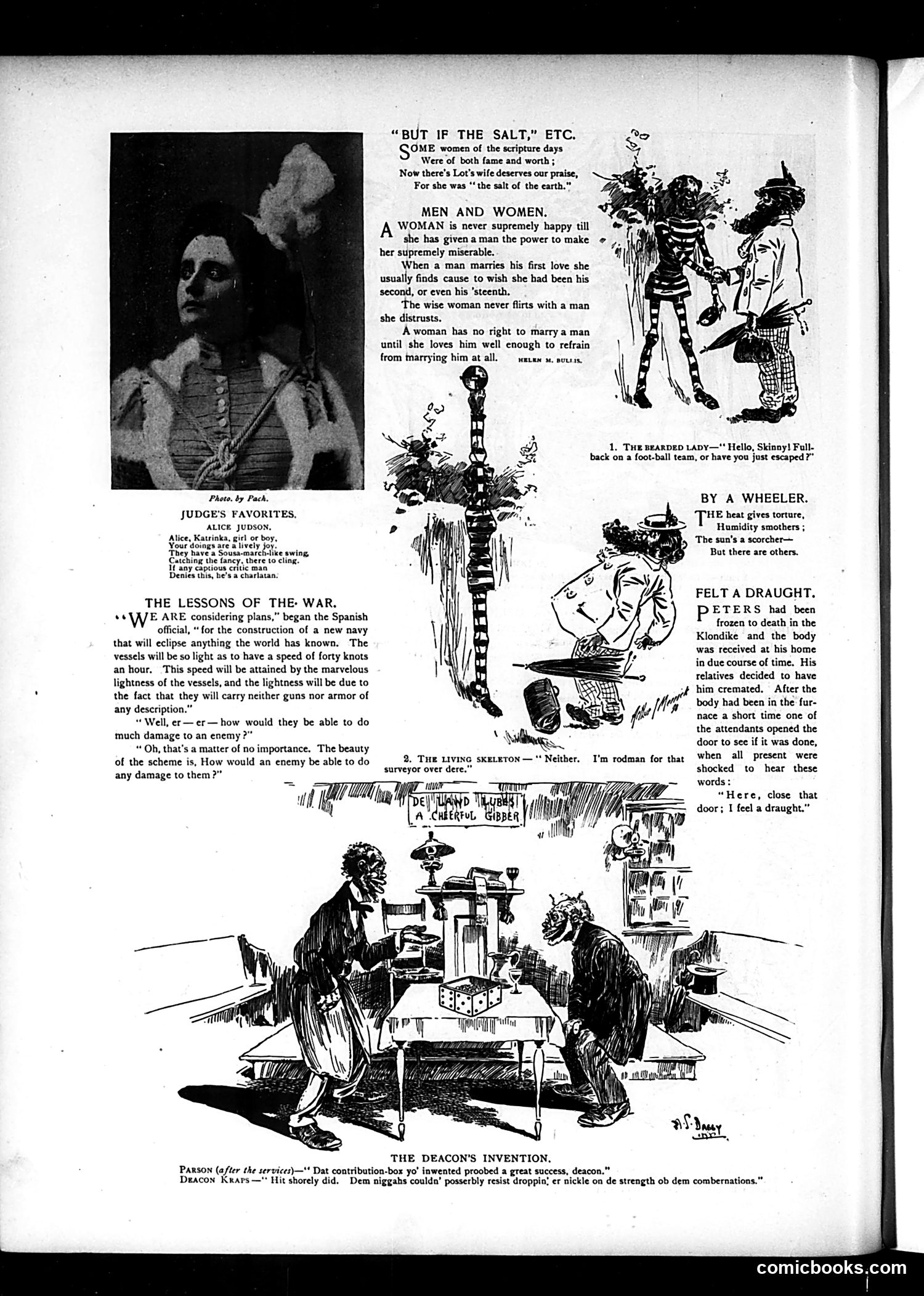
This page contains several distinct satirical pieces. "Judge's Favorites" features a photograph of a woman with a poem praising her beauty. "The Lessons of the War" mocks a Spanish official's boast about naval construction plans, with the cartoon's joke being that enemy ships need not fear damage from vessels that will never actually be built—satirizing Spanish military incompetence, likely referencing the Spanish-American War. "The Deacon's Invention" depicts two figures examining a mechanical contraption, with dialect humor suggesting rural characters and their invented "contribution-box." The page also includes a section on "Men and Women" offering cynical observations about marriage and women's agency—typical period attitudes presented as social commentary.
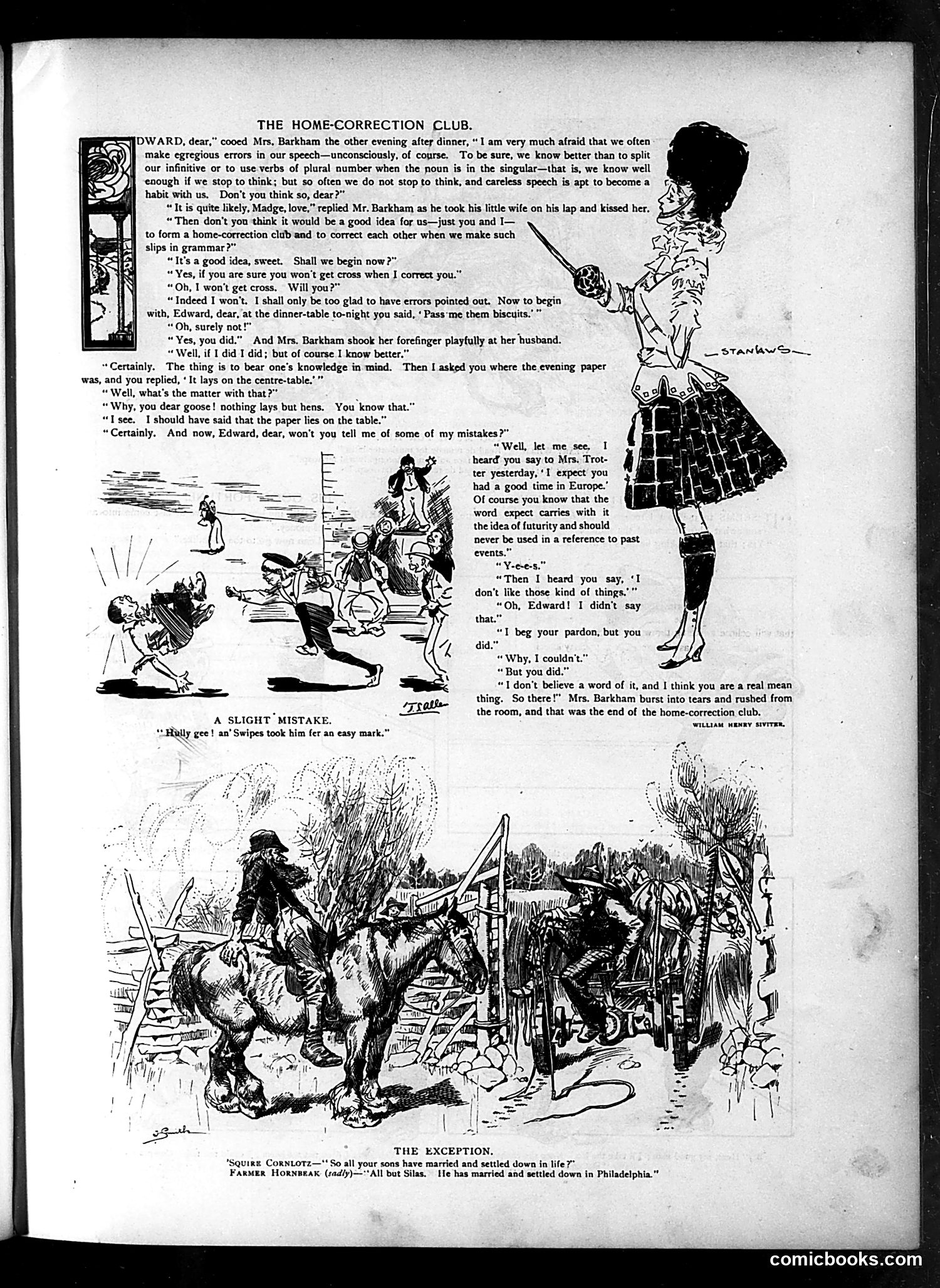
This page satirizes the pretentiousness of middle-class self-improvement through three pieces: **Main Story**: "The Home-Correction Club" mocks couples who police each other's grammar. Mr. and Mrs. Barkham agree to form a correction club, but the wife's criticism of her husband's speech ("them biscuits," "it lays") quickly turns hostile when he corrects her use of "expect" (she used it for past events, when it implies futurity). Rather than accept correction gracefully, she tears up and abandons the club—revealing the hypocrisy: people want to feel superior correcting *others* but cannot tolerate criticism themselves. **Bottom Cartoons**: "A Slight Mistake" shows a character being cheated, while "The Exception" jokes that a farmer's son settling in Philadelphia (rather than staying on the farm) represents failure—a mild regional jab at urban life. The satire targets the era's anxiety about "correct" speech as class marker and the self-righteousness of grammar pedantry.
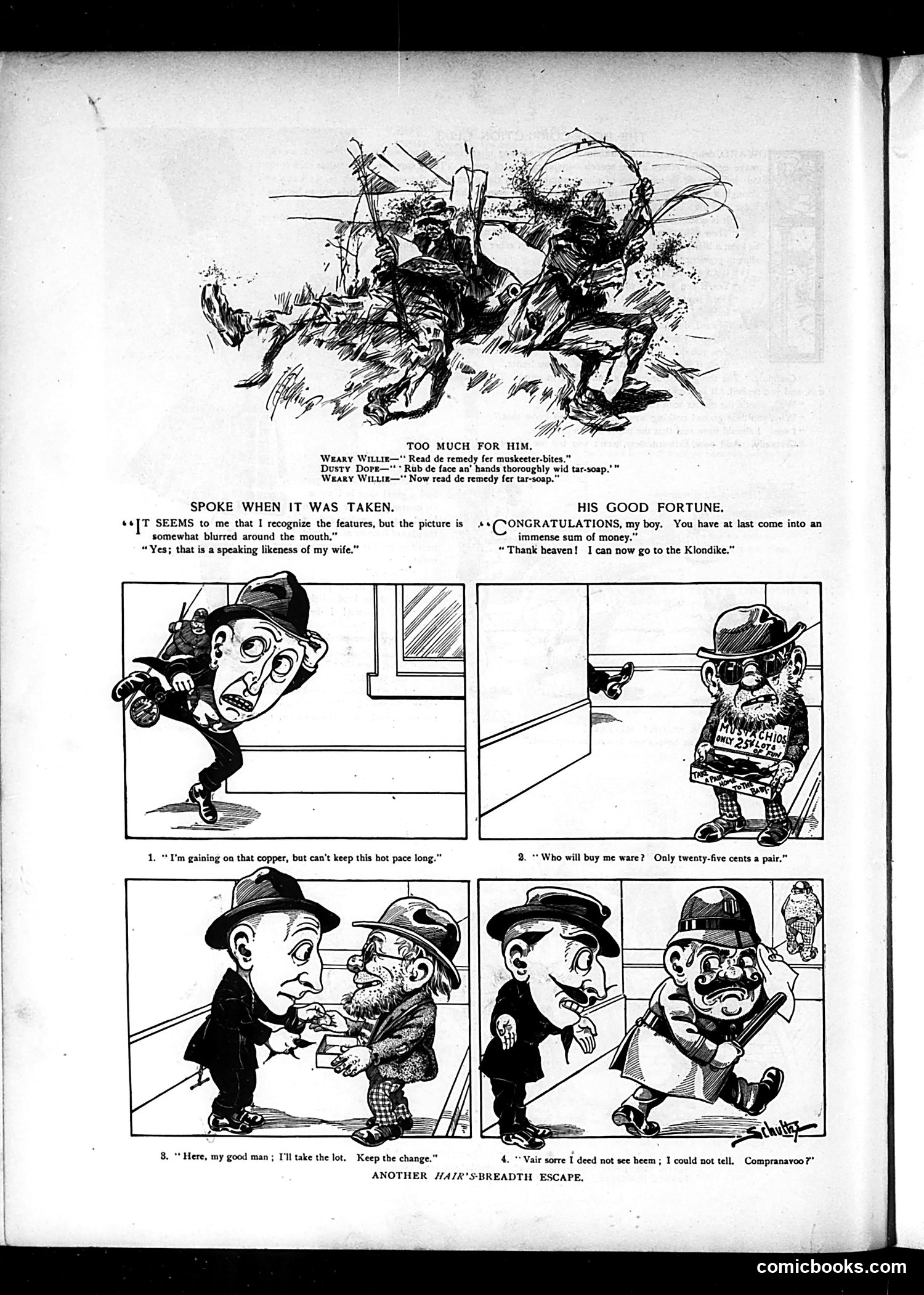
This page contains two separate satirical pieces from early Judge magazine (likely 1890s-1900s): **Top section** ("Too Much for Him"): A crude joke about a character trying remedies—tar soap for mosquito bites creates an absurd recursive problem: the tar soap itself becomes unbearable, requiring its own remedy. **Bottom section** ("Another Hair's-Breadth Escape"): A four-panel comic about the Klondike Gold Rush. A man receives unexpected wealth and immediately plans to go to the Klondike (the 1890s gold rush in Canada). The panels show his various misadventures attempting to prepare for this journey, featuring exaggerated character types and dialect humor typical of the era. The final panel includes a foreign character speaking broken English, mocking non-English speakers. Both pieces use the era's characteristic heavy caricature, dialect humor, and slapstick comedy. The Klondike reference dates this to the Gold Rush period (late 1890s).
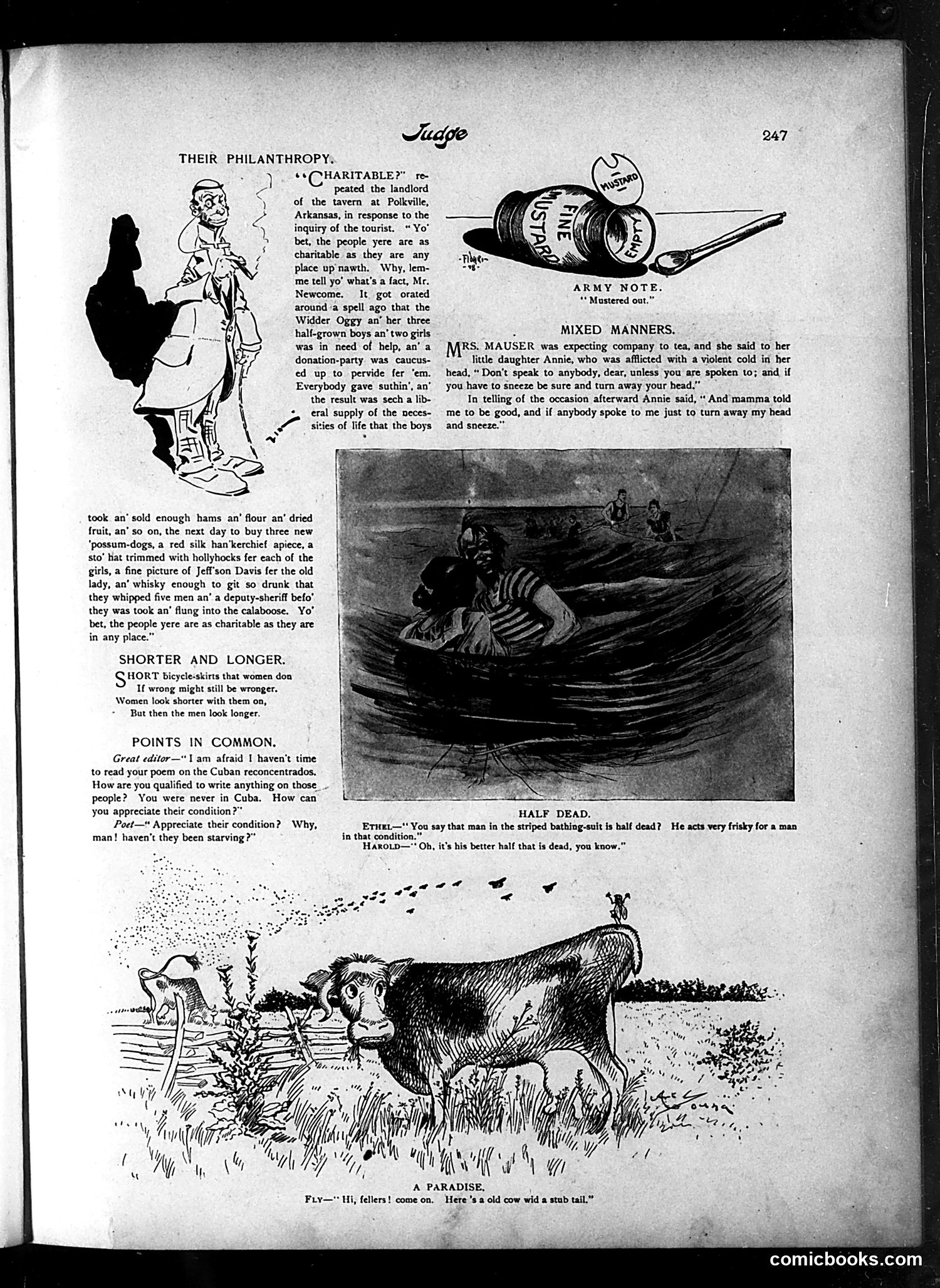
This page contains several satirical pieces typical of late-19th-century American humor: **"Their Philanthropy"** mocks Southern (Arkansas) hypocrisy. A tavern keeper boasts about charitable giving to a poor widow's family, but the punchline reveals the recipients immediately sold donated goods to buy luxuries (whiskey, fine hats, Jefferson Davis pictures) and got so drunk they violently assaulted men. The satire targets both false moral superiority and the recklessness of poor rural communities. **"Mixed Manners"** is a brief joke about a child with a cold instructed to be polite—then demonstrates this by turning away to sneeze, which seems impolite but follows mother's contradictory rules. The remaining items are minor humor: observations on women's bicycle skirts, an editor skeptical of unqualified poets writing about Cuba's humanitarian crisis, a marital joke about "better halves," and a sight gag about flies attracted to an old cow. The page emphasizes period anxieties about propriety, regional stereotypes, and contemporary politics (Cuban reconcentrados reference suggests Spanish-American War era).
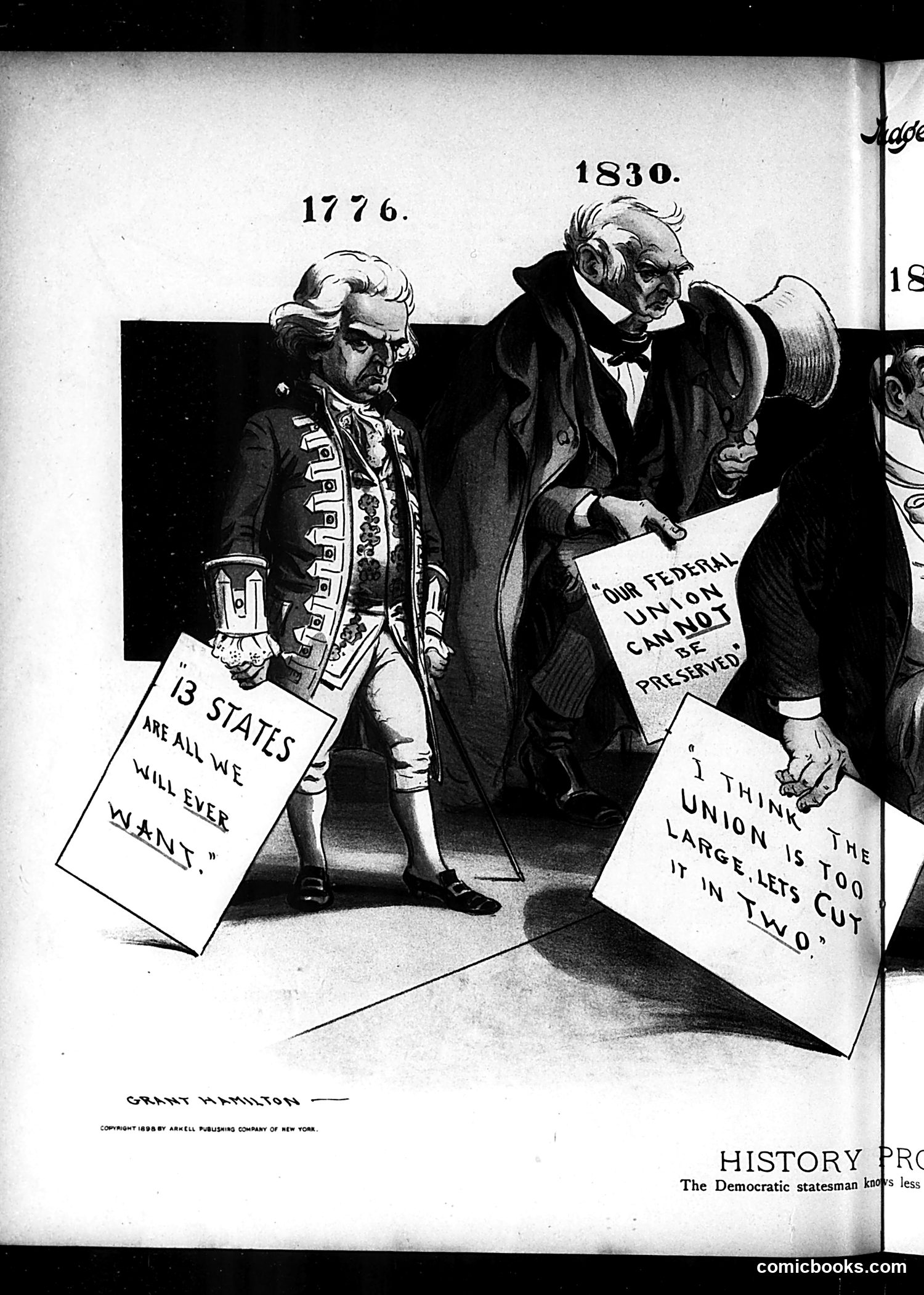
This 1898 Judge cartoon depicts two figures labeled by year: one from 1776 (dressed in 18th-century Revolutionary attire) and one from 1830 (in 19th-century formal dress). They hold signs expressing conflicting views on federal union—the earlier figure advocates for strong states ("13 States / Are all we will ever want"), while the later figure argues the union has become too large and unwieldy ("I think the Union is too large, let's cut it in two"). The cartoon satirizes Democratic political divisions regarding federalism and union expansion. It suggests Democratic statesmen held inconsistent or outdated positions on national unity across different historical periods. The artist (credited as "Garlpast" or similar) uses temporal contrast to mock Democratic ideology's evolution or contradiction regarding the proper size and scope of the American federal union.
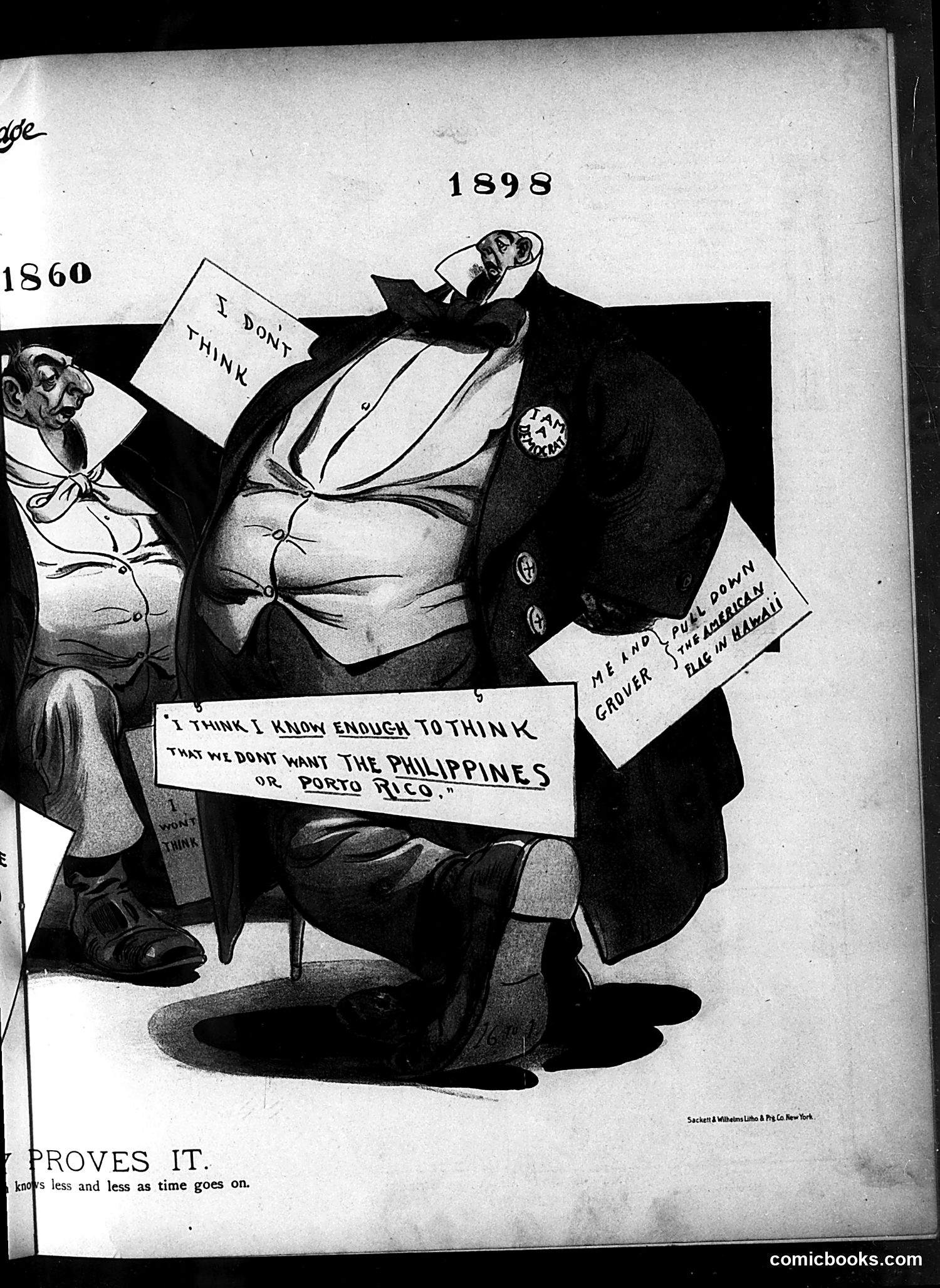
This 1898 Judge magazine cartoon satirizes American imperial expansion. The central figure represents Uncle Sam (identifiable by the stars and patriotic imagery), depicted as bloated and straining under the weight of territorial acquisitions. The labels reference the Spanish-American War's aftermath: "1860" and "1898" mark the timespan, while notes reference the Philippines and Porto Rico [sic]—territories the U.S. gained from Spain in 1898. The cartoon's message: Uncle Sam's expansion ambitions are burdensome and problematic. One figure says "I don't think," another holds a sign reading "I think I know enough to think that we don't want the Philippines or Porto Rico." The satire criticizes imperial overreach, arguing these territorial acquisitions prove costly and undesirable—a contemporary debate about American imperialism.
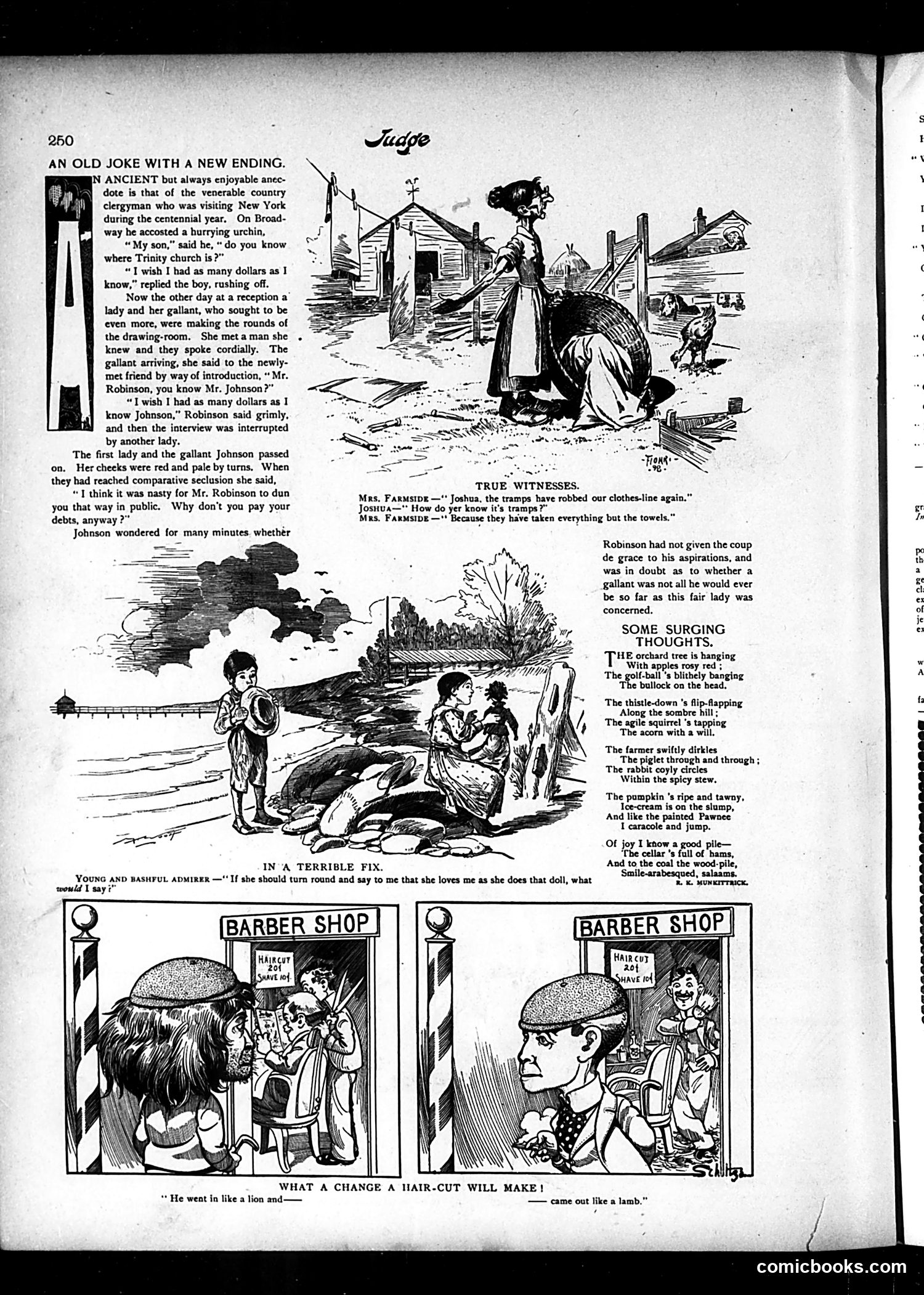
This page contains several satirical pieces typical of the era: **"An Old Joke with a New Ending"** retells a classic anecdote about a country clergyman asking a street urchin for directions, adapted to mock social pretension. A man named Robinson uses the same "I wish I had as many dollars as I know [you]" quip to insult Johnson in public—suggesting Johnson is a known debtor or disreputable character. The joke critiques both the awkwardness of social introductions and financial irresponsibility. **"True Witnesses"** is a brief domestic humor piece about a wife attributing clothesline theft to tramps because "they have taken everything but the towels"—implying tramps wouldn't steal towels, a joke about practical thieves' priorities. **"What a Change a Hair-Cut Will Make"** contrasts a wild, unkempt man entering a barber shop with a respectable, docile-looking man leaving—satirizing how appearance transforms social perception. The other pieces ("In a Terrible Fix," "Some Surging Thoughts") are brief comedic vignettes typical of Judge's miscellaneous humor format.
This page from *Judge* contains primarily **advertisements and light humor pieces** rather than political cartoons. The main content is a **romantic dialect poem** ("Sittin' wid Con Magee") written in Irish-immigrant vernacular, depicting a courtship scene on a hay wagon—a sentimental, flirtatious piece typical of period humor. The page also includes numerous **short jokes and observations** on miscellaneous topics: Spanish colonial losses, British imperial expansion in Egypt, romantic protocols, pension bureaucracy, and small-town life. These reflect contemporary 1898-1899 concerns (post-Spanish-American War, imperial rivalries) but are presented as light quips rather than biting satire. The bulk of the page is **commercial advertising** for liquor (Evans' Stout, Hunter Baltimore Rye), tobacco (Yale Mixture), pianos (Sohmer), upholstery, and shaving products (Williams' Shaving Stick)—typical of *Judge*'s revenue model. There is **no identifiable political cartoon** on this page. The humor is genteel and domestic rather than sharply satirical.
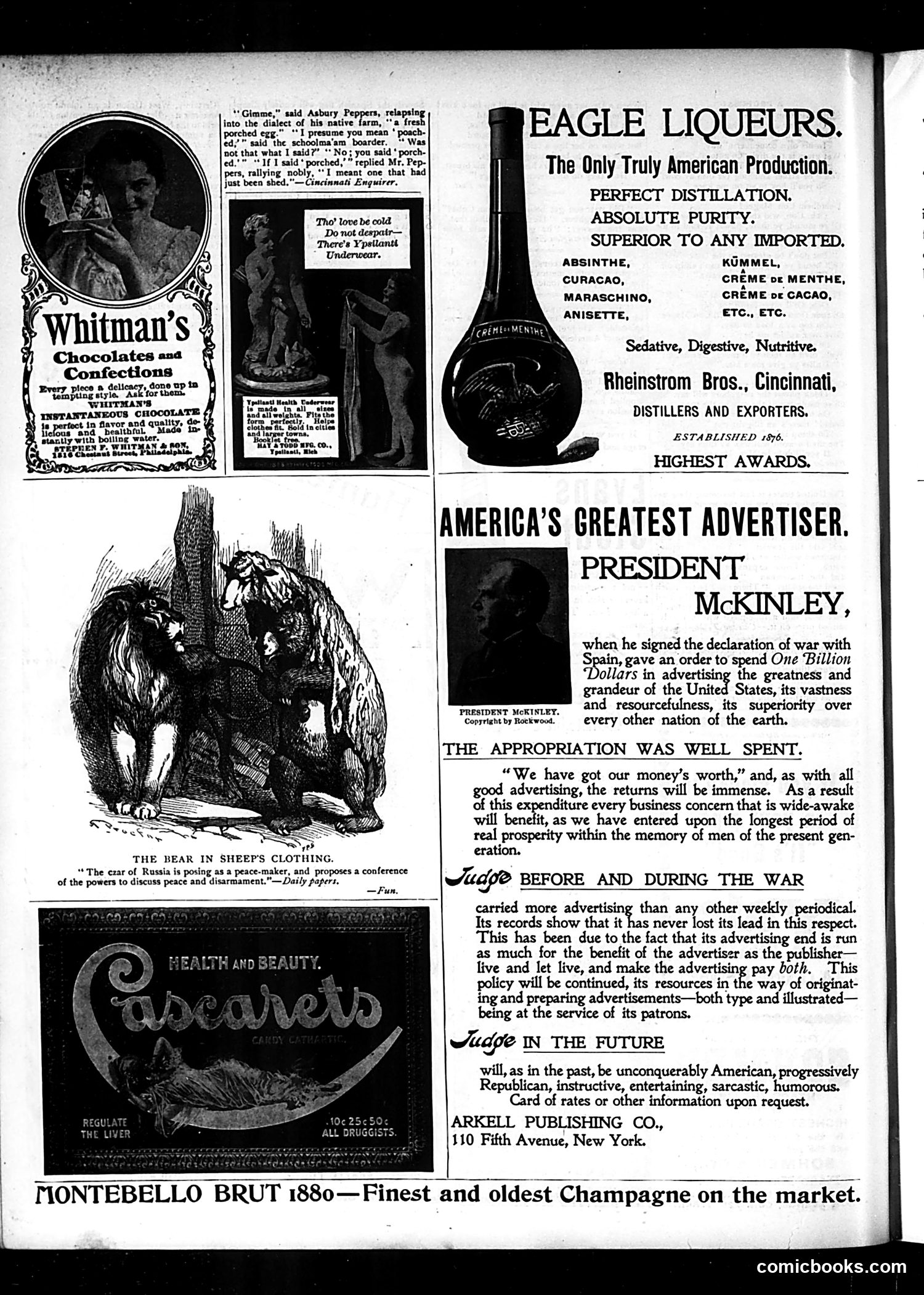
This political cartoon satirizes **Tsar Nicholas II of Russia**, who is depicted as a dangerous predator disguised as a peaceful creature. The caption references newspaper reports that the czar was "posing as a peace-maker" and proposing an international disarmament conference. The satire's point: Russia's peaceful rhetoric is a deception—the "bear" (a common symbol for Russia) is merely wearing sheep's clothing to hide its true aggressive nature. Judge questions the sincerity of Russian peace proposals, suggesting the czar cannot be trusted despite his diplomatic gestures. This likely appeared during or shortly after the Russo-Japanese War (1904-05), when Russia's military ambitions were evident despite diplomatic overtures. The cartoon warns American readers not to be fooled by Russia's apparent peacemaking efforts. The rest of the page consists of advertisements for liqueurs, chocolates, and Judge magazine itself, promoting American products and the magazine's coverage during wartime.
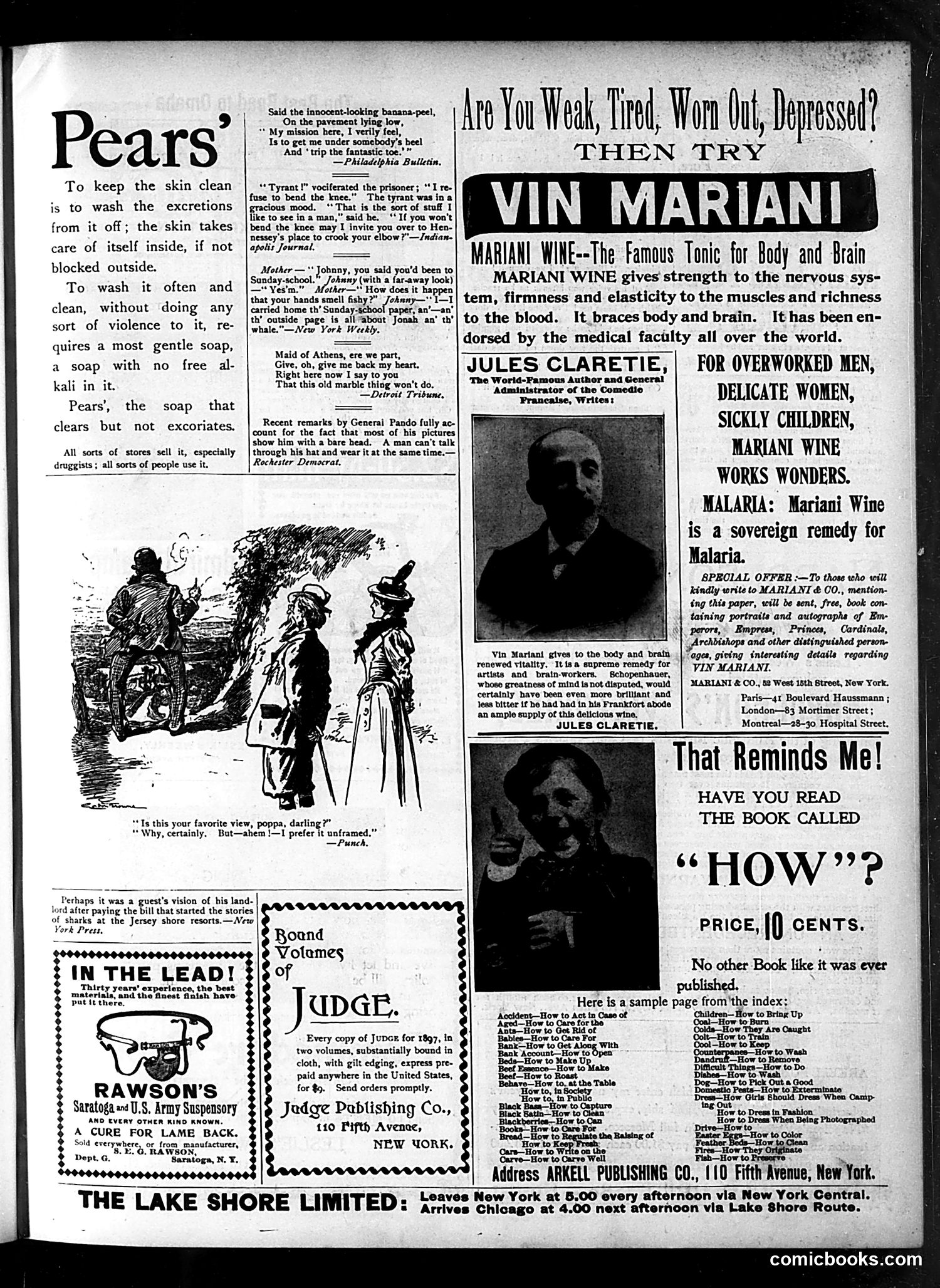
This page mixes editorial cartoons and jokes with product advertisements. The cartoons depict humorous social situations: a man fishing with a banana peel ("fantastic toe" reference), a prisoner refusing to bend the knee to a tyrant who invites him for drinks instead, a boy explaining his fishy hands by citing a Sunday School story about Jonah and the whale, and similar light satire on everyday life and hypocrisy. The advertisements dominate the space, particularly for Mariani Wine, pitched as a medicinal tonic supposedly endorsed by famous figures like composer Schopenhauer. These patent medicines were common in this era; Mariani Wine notably contained cocaine. The page also advertises Pears' Soap, bound volumes of *Judge* magazine itself, and other products—typical of late-19th-century publications that relied heavily on advertising revenue to sustain operations.
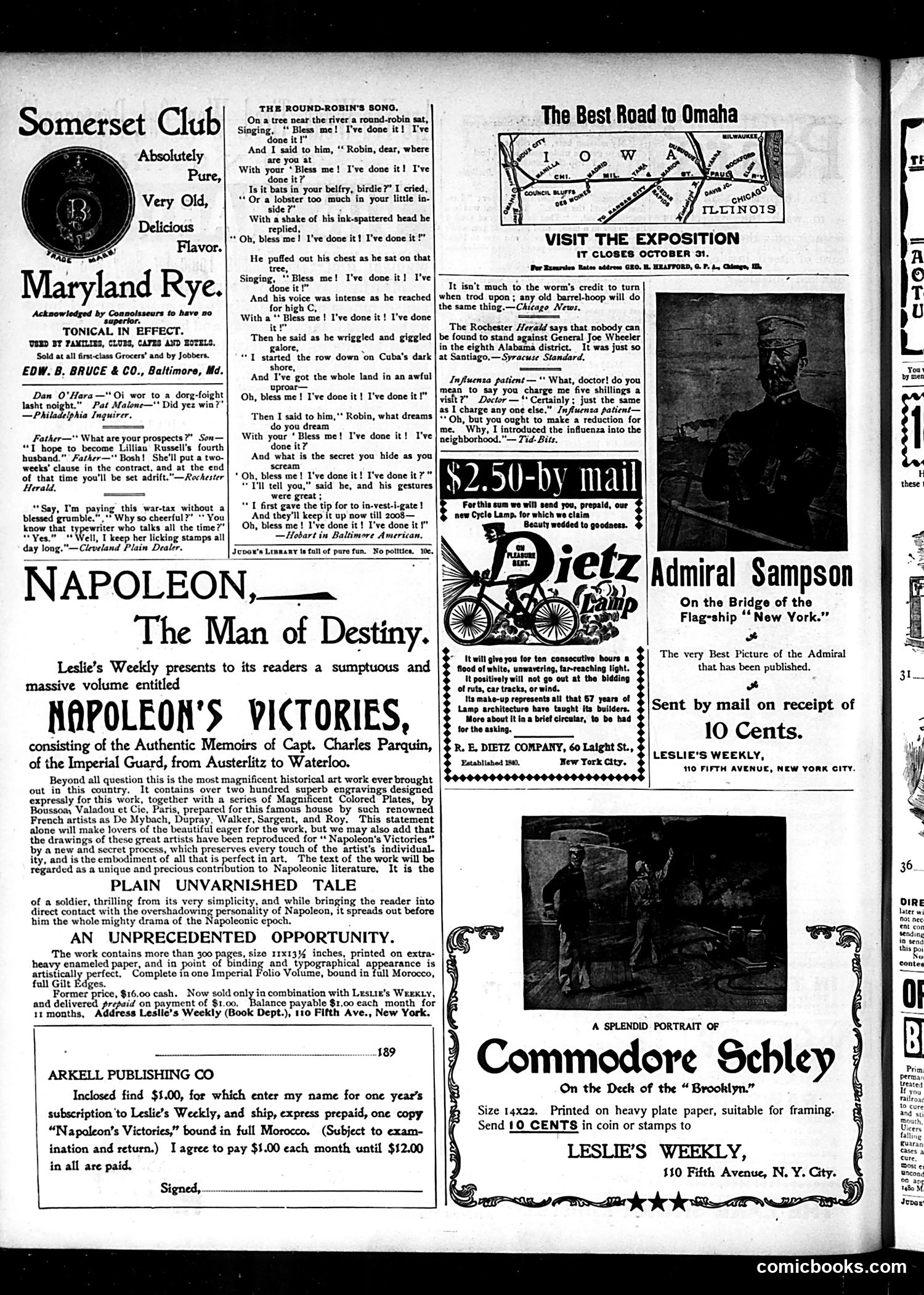
This page is primarily **advertising and promotional content** rather than political cartoons. The dominant feature is a lengthy advertisement for "Napoleon's Victories," a book collecting memoirs of French Imperial Guard Captain Charles Parquin, lavishly illustrated with engravings by renowned artists. The only satirical content is **"The Round-Robin's Song,"** a poem about a robin boasting of starting trouble in Cuba and keeping it going until 2008. This appears to be **commentary on American interventionism in Cuba** (likely referencing the Spanish-American War era), mocking someone—possibly a political figure—for proudly initiating conflict while remaining detached from consequences. The remaining items are brief humorous anecdotes and advertisements for Maryland Rye whiskey and other products. The page reflects Judge's typical mix of satire, advertising, and light humor circa the early 1900s.
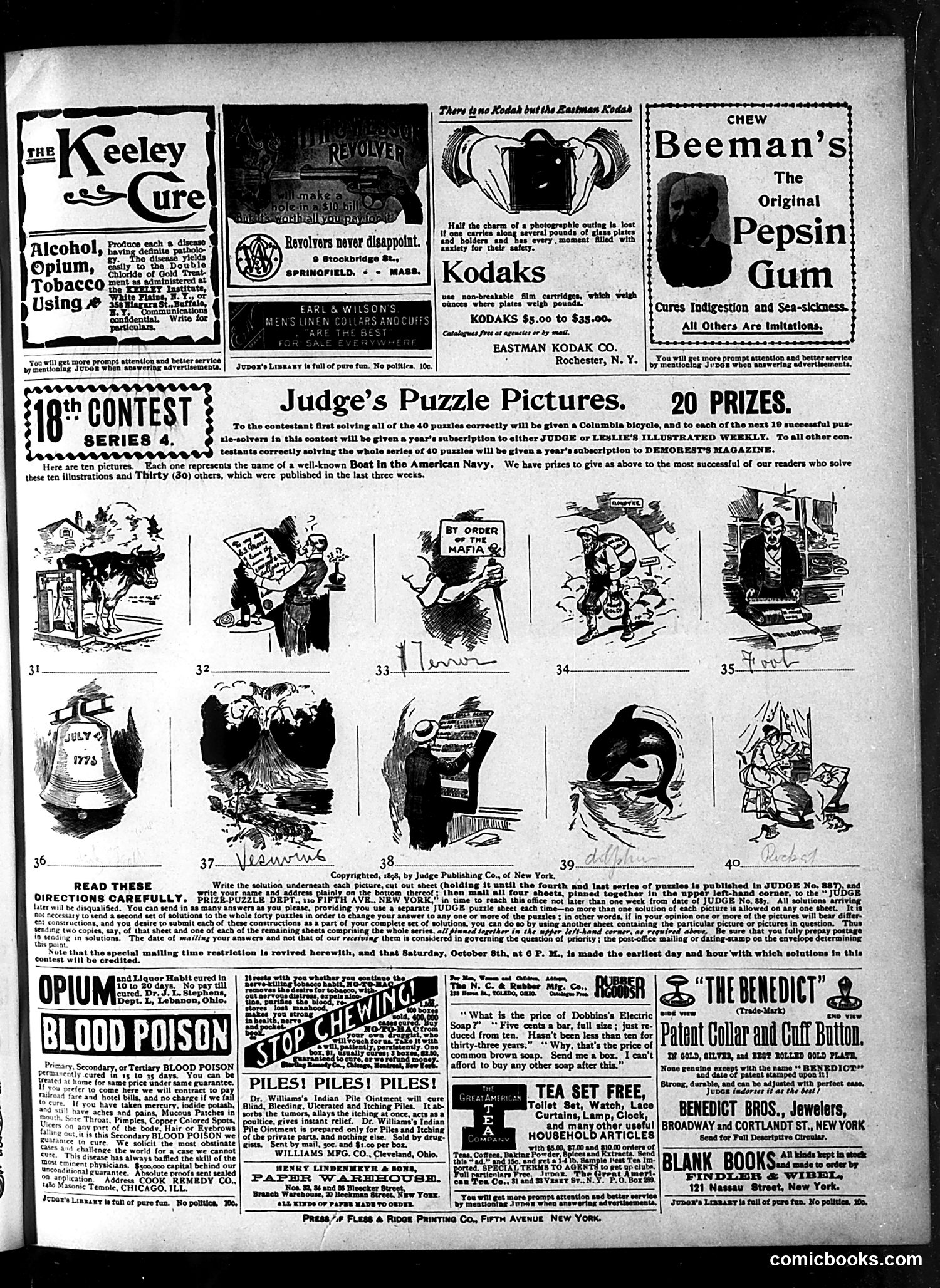
This page is primarily **advertisements and a puzzle contest**, not political satire. The main content is Judge's "Puzzle Pictures" contest (#18 in a series), offering prizes including a Columbia bicycle and magazine subscriptions for solving 40 rebus-style visual puzzles depicting "well-known Boat in the American Navy." The surrounding ads promote period medicines and products: Keeley Cure (alcohol/opium/tobacco addiction treatment), revolvers, Kodak cameras, Beeman's Pepsin Gum, and various patent remedies for blood poison and other ailments—typical of 1890s magazine advertising. The page includes standard contest rules and disclaimers. There are no identifiable political cartoons or satirical commentary visible. This appears to be a typical late-19th-century magazine page mixing entertainment puzzles with commercial advertising, reflecting the era's medical quackery and commercial culture.
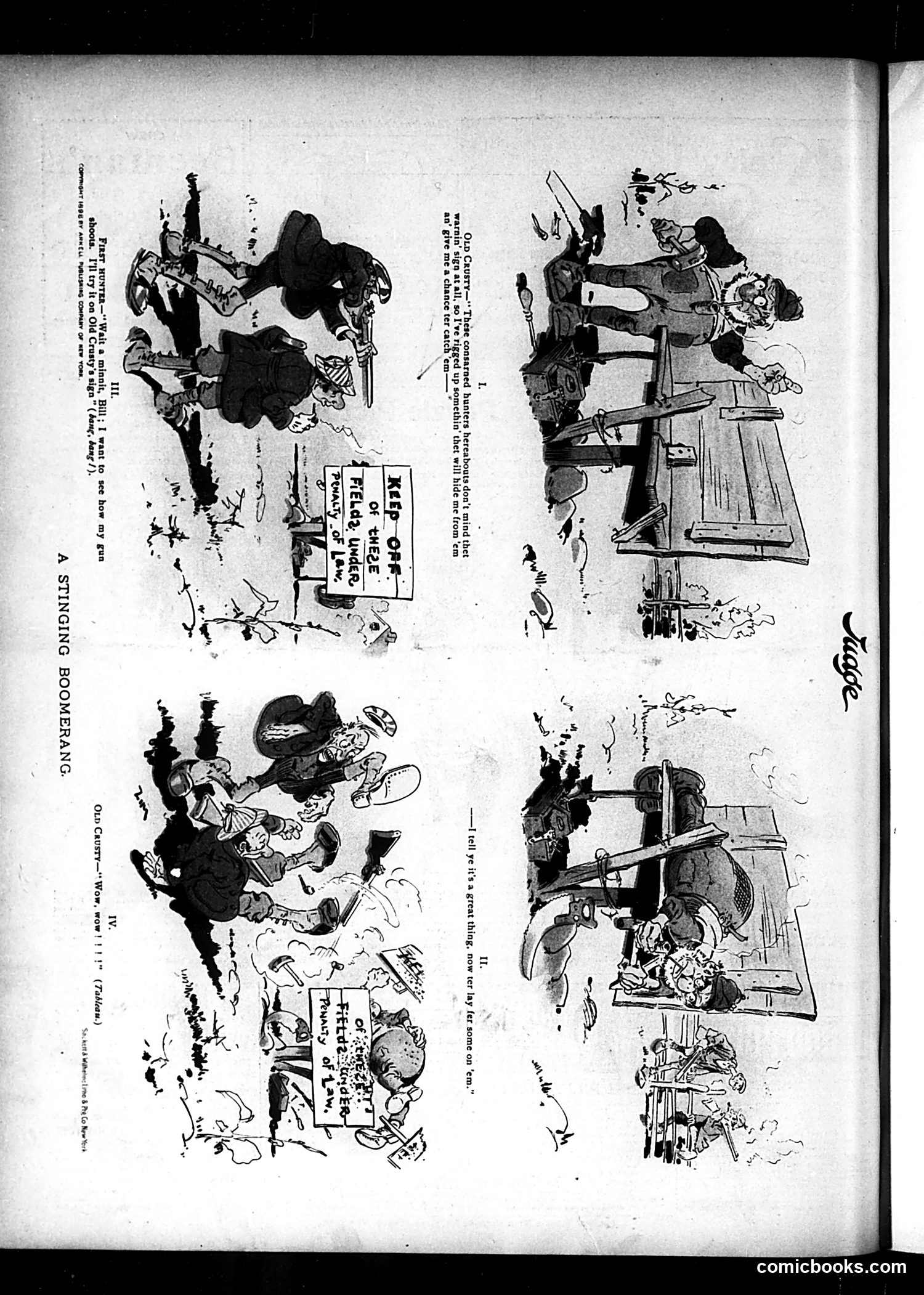
This appears to be a four-panel sequential comic depicting a practical joke or revenge scenario. A character (Bill) shoots at an old man's (Old Crusty's) warning sign with a gun, apparently to test the weapon. The joke's "boomerang" effect—where an action backfires on the perpetrator—occurs when Old Crusty discovers what Bill has done and retaliates, causing Bill to experience the consequences he didn't anticipate. The humor relies on the classic satirical device of comeuppance: someone's mischievous action returns to harm them. The title "A Stinging Boomerang" emphasizes this reversal of fortune. Without clearer image resolution, specific political figures are unclear, but the cartoon appears to mock human foolishness and the principle that reckless behavior invites retaliation.