
A complete issue · 16 pages · 1898
Judge — September 24, 1898
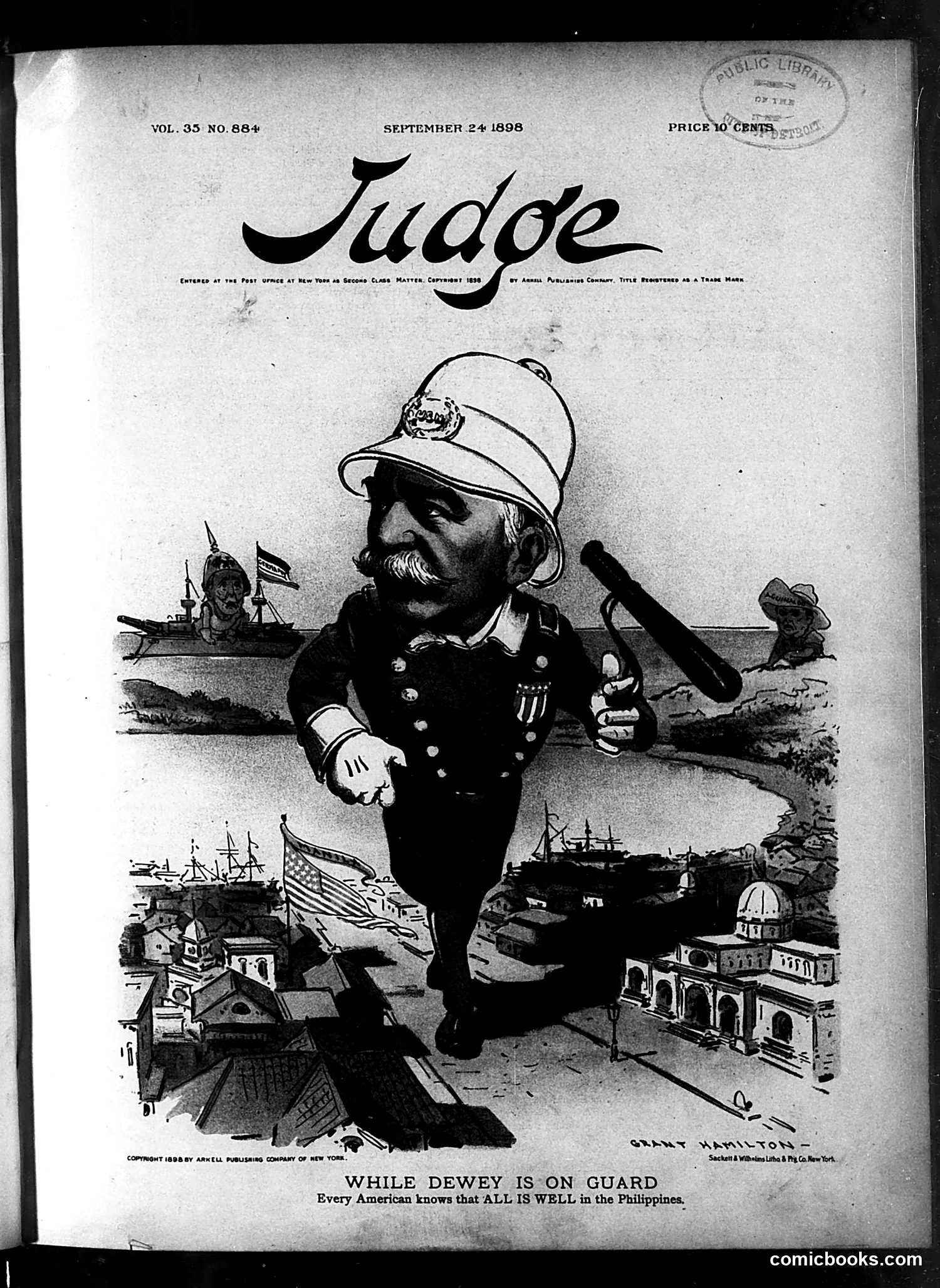
This is a political cartoon satirizing Admiral George Dewey, the American naval commander who famously defeated the Spanish fleet at Manila Bay during the Spanish-American War (1898). The caricature shows Dewey as a swaggering military figure wearing a colonial/tropical helmet, positioned prominently above scenes of American naval vessels and Philippine architecture. The caption "While Dewey is on Guard / Every American knows that ALL IS WELL in the Philippines" is ironic satire. Judge is mocking American confidence in Dewey's military control of the newly-acquired Philippines, suggesting this confidence may be misplaced. The cartoon critiques American imperial expansion and the assumption that military dominance ensures stability in occupied territories.
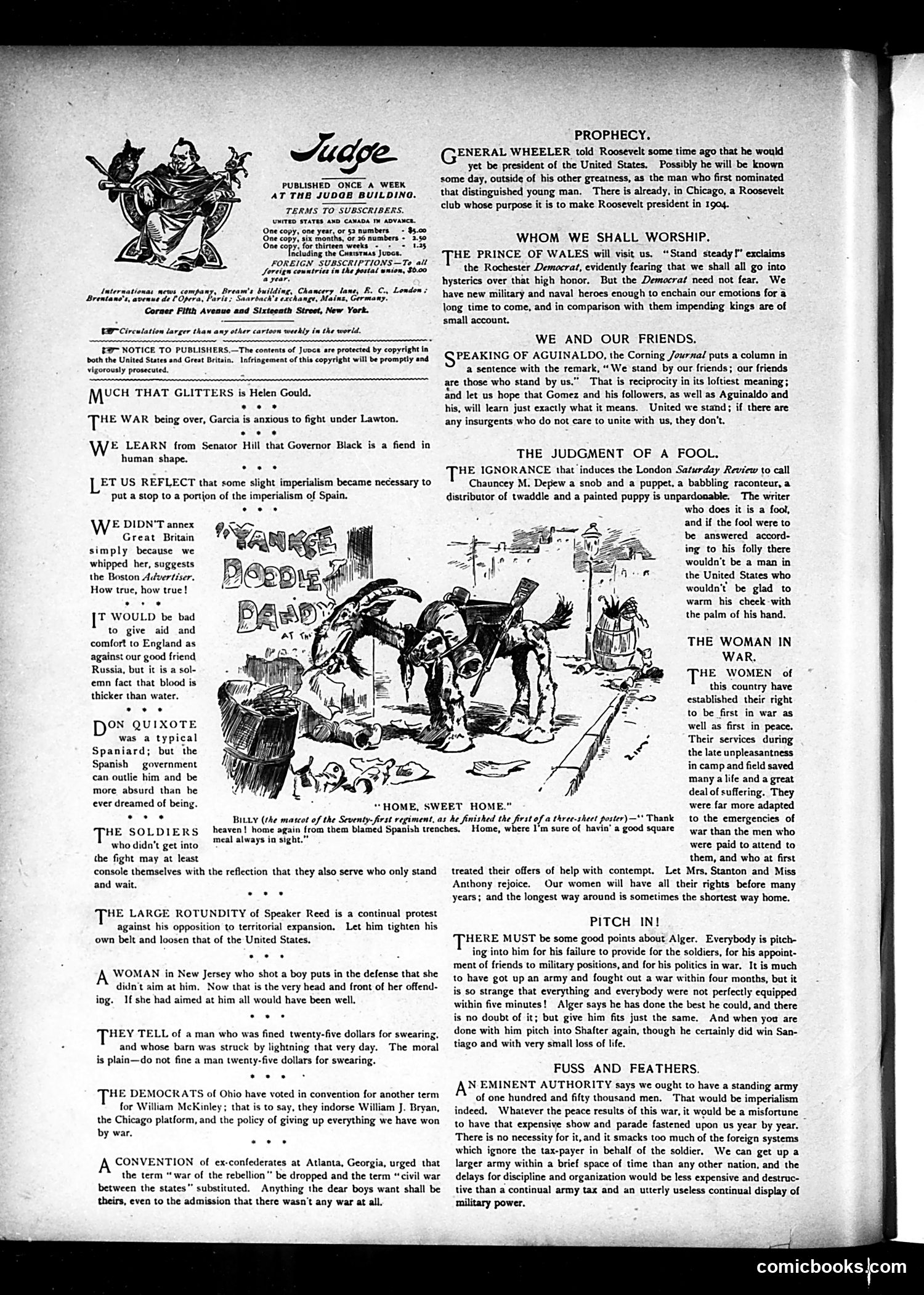
The central cartoon titled "HOME, SWEET HOME" depicts a donkey being kicked and beaten amid destruction, labeled with "ANARCHY" and "BLOOD." The caption identifies the donkey as "Billy (the mascot of the Seventy-first regiment, at St. finished the first of a three-short peace)"—suggesting this represents an American military unit or regiment. The satire appears to criticize the chaotic aftermath of war or military conflict, using the suffering donkey as a symbol for soldiers or the nation itself. The "home sweet home" title ironically contrasts with the brutal violence shown, mocking the disconnect between romanticized notions of military service and the actual destructive reality soldiers faced. The surrounding editorial commentary discusses military readiness, soldiers' welfare, and political debates about American military policy during what appears to be the early 1900s.
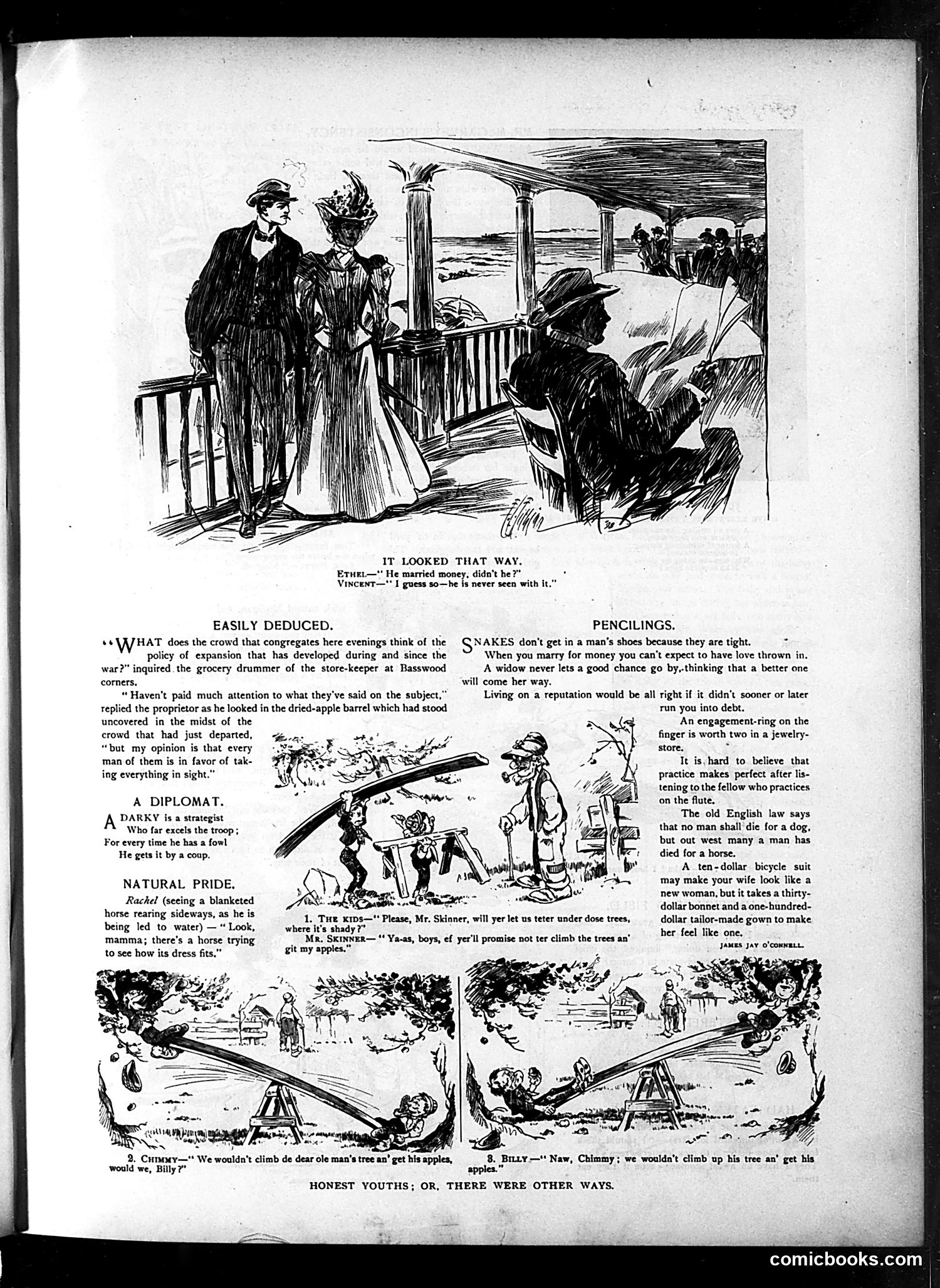
This page from *Judge* contains satirical short stories and illustrations rather than political cartoons. The main pieces—"Easily Deduced," "A Diplomat," "Natural Pride," and "Penicilings"—are humorous vignettes about social behavior and class relations. The top illustration depicts what appears to be well-dressed figures at a seaside resort, establishing an upper-class setting. The stories mock various character types: a grocer's son trying to gain social status, a man too proud to admit being led by his wife, and discussions about marriage for money versus love. The humor relies on observations about human nature and social pretension rather than specific political events. The "Honest Youths" caption suggests mockery of youthful naiveté. Overall, this represents *Judge*'s general satirical approach to contemporary manners and class dynamics of the era.
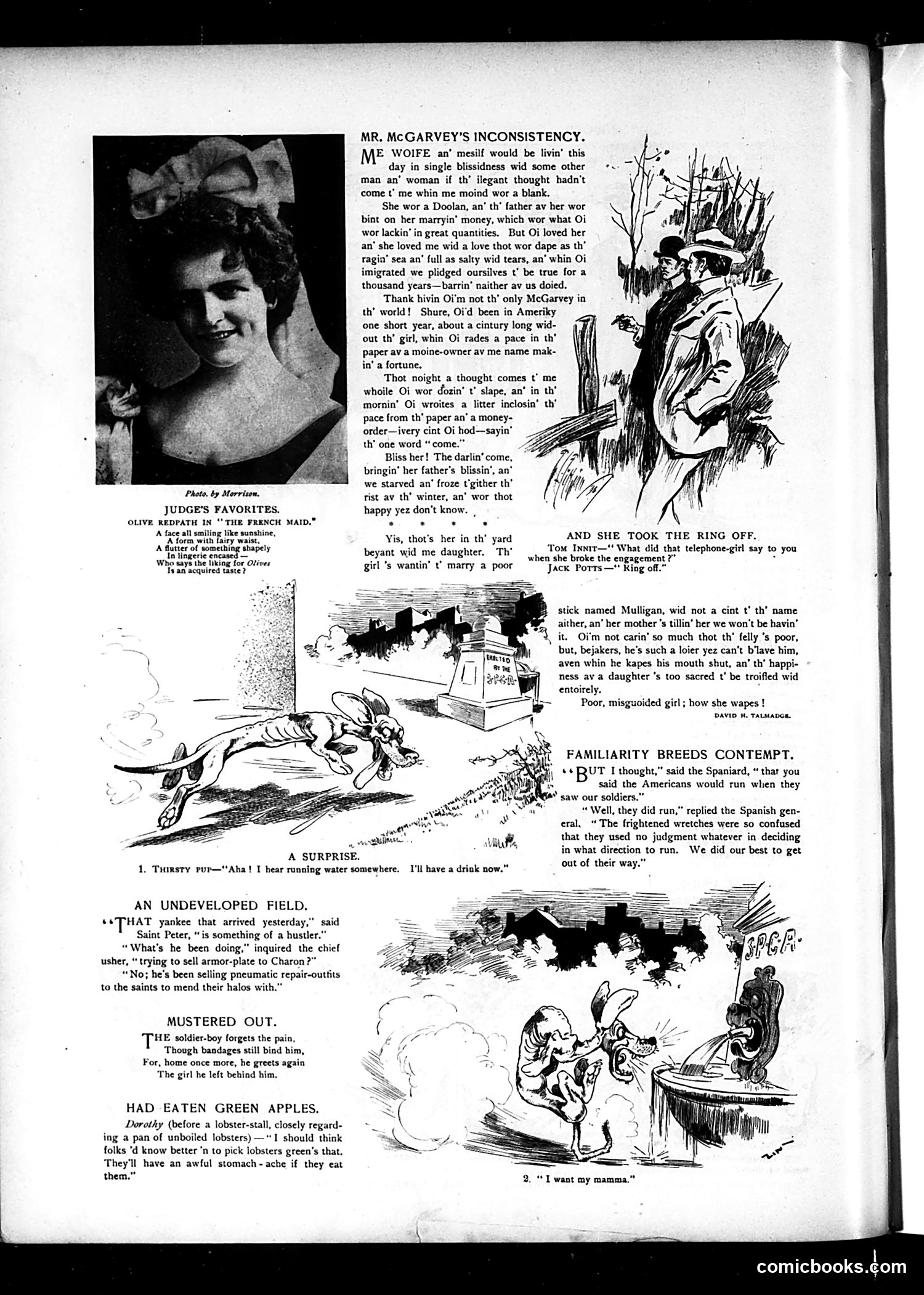
This page contains several unrelated satirical pieces and illustrations typical of Judge's format: **"Mr. McGarvey's Inconsistency"** mocks an Irish-American man's contradictory behavior—he romanticizes Irish heritage while seeking wealth through marriage to an American woman. The dialect humor reflects period stereotypes of Irish immigrants. **"Judge's Favorites"** appears to be a photo feature of an actress in a theatrical role. The remaining sections are short humorous sketches with minimal political content: "A Surprise" (dog cartoon), "An Undeveloped Field" (business satire), "Mustered Out" (post-war soldier humor), and "Had Eaten Green Apples" (domestic comedy). The cartoons use broad social humor rather than pointed political satire, typical of Judge's lighter editorial content alongside more serious commentary elsewhere in the magazine.
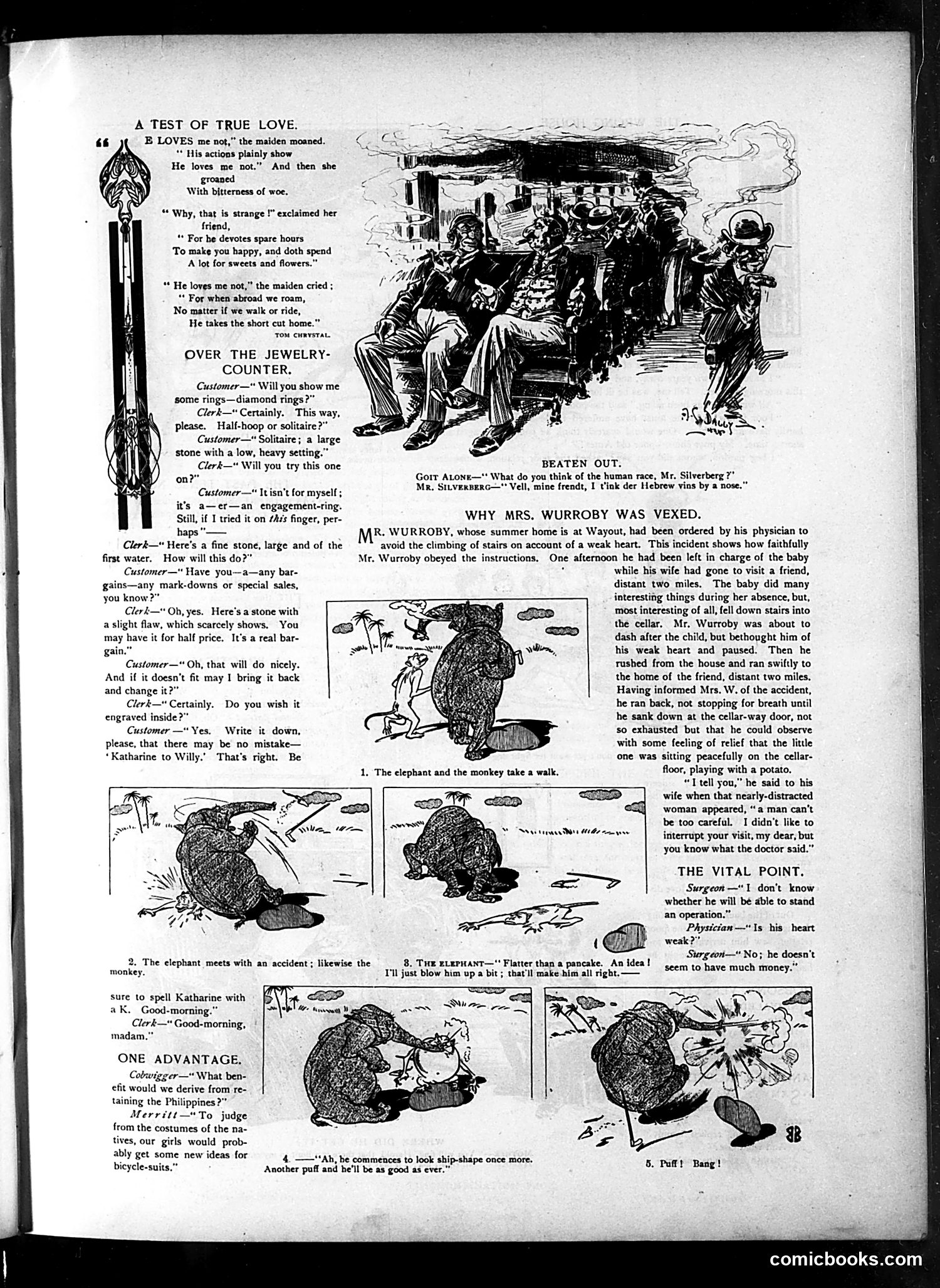
This page contains several unrelated satirical pieces typical of Judge magazine: **"A Test of True Love"** is a poem mocking a woman's romantic expectations. She complains her suitor "doesn't love her" despite his devotion—his only failing is taking shortcuts home rather than prolonging outings. The satire targets unreasonable female romantic demands. **"Over the Jewelry Counter"** depicts a humorous jewelry store exchange where a man awkwardly purchases an engagement ring, attempting to hide his nervousness through stammering. The joke plays on masculine discomfort with romantic commitment and jewelry shopping. **"Why Mrs. Wurroby Was Vexed"** shows a man who, despite doctor's orders to avoid exertion due to weak heart, sprints two miles to fetch his wife when their baby falls downstairs—then runs back. The satire critiques masculine anxiety about health versus perceived duty, with ironic outcomes. **"The Vital Point"** is a brief doctor/surgeon exchange joking that a patient's capacity to pay matters more than cardiac health for surgery viability. The elephant-and-monkey series appears to be wordless comic strips with visual punchlines about mishaps and recovery.
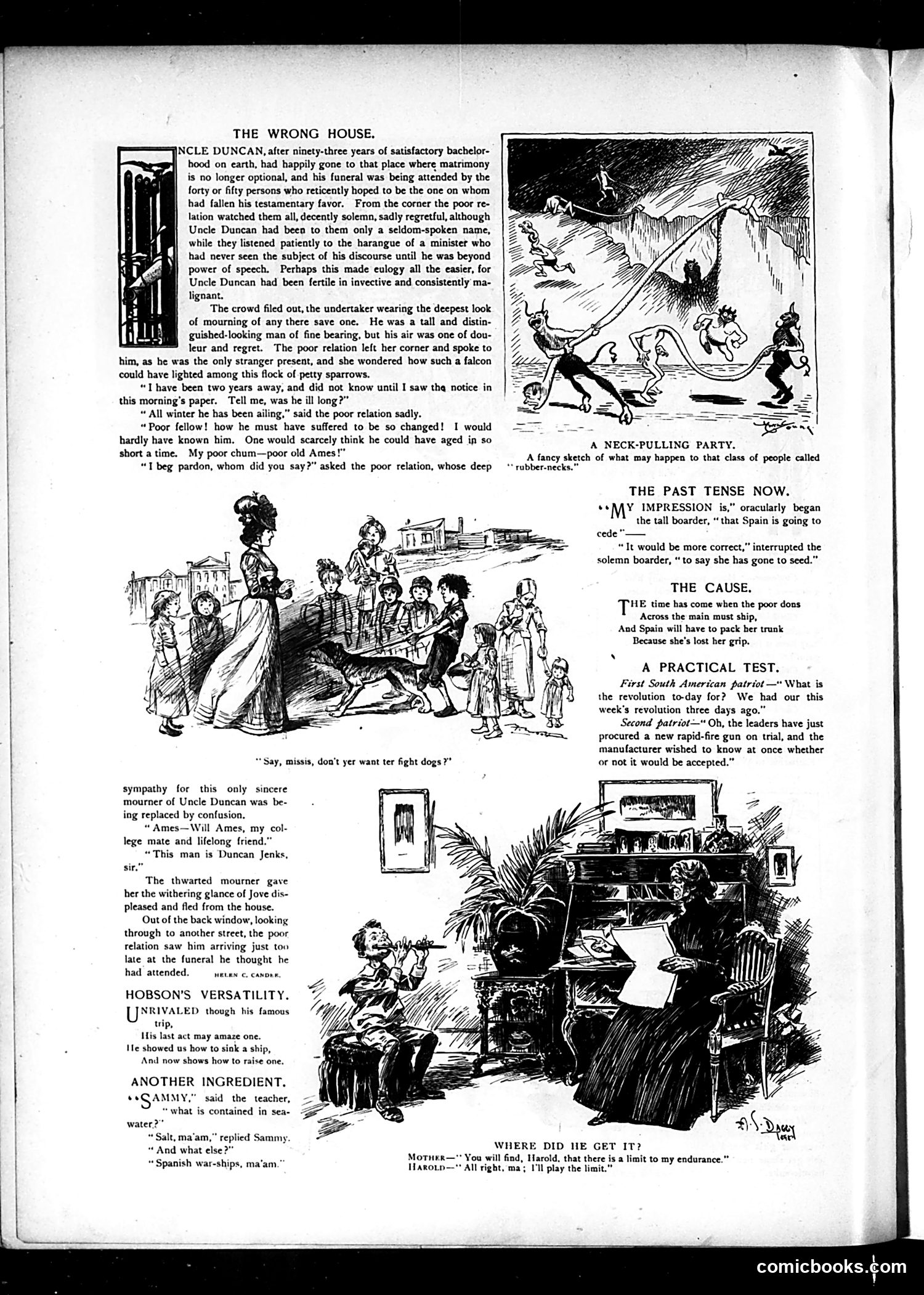
This page contains multiple satirical pieces typical of Judge magazine's social commentary: **Main Story**: "The Wrong House" mocks grief-stricken relatives attending Uncle Duncan's funeral, hoping to inherit. The joke centers on a distinguished mourner arriving at the *wrong* funeral—he's deeply grieving for "Ames" when the deceased is actually "Duncan Jenks." The satire targets both the hypocrisy of mercenary relatives and the absurdity of mourning strangers. **"Hobson's Versatility"**: References Admiral Hobson's famous 1898 ship-sinking during the Spanish-American War, now sardonically crediting him with "raising" ships—likely commentary on postwar reconstruction or jingoism. **"Spanish War-ships"**: A topical joke about Spanish naval losses in the recent Spanish-American War (1898), using a schoolboy's innocent answer to mock Spain's military weakness. **Other sketches** satirize "rubber-necks" (gawkers), boardinghouse characters, and Latin American political instability with rapid-fire gun testing. The overall tone targets American wealth-seeking, imperial triumphalism, and contemporary social pretension.
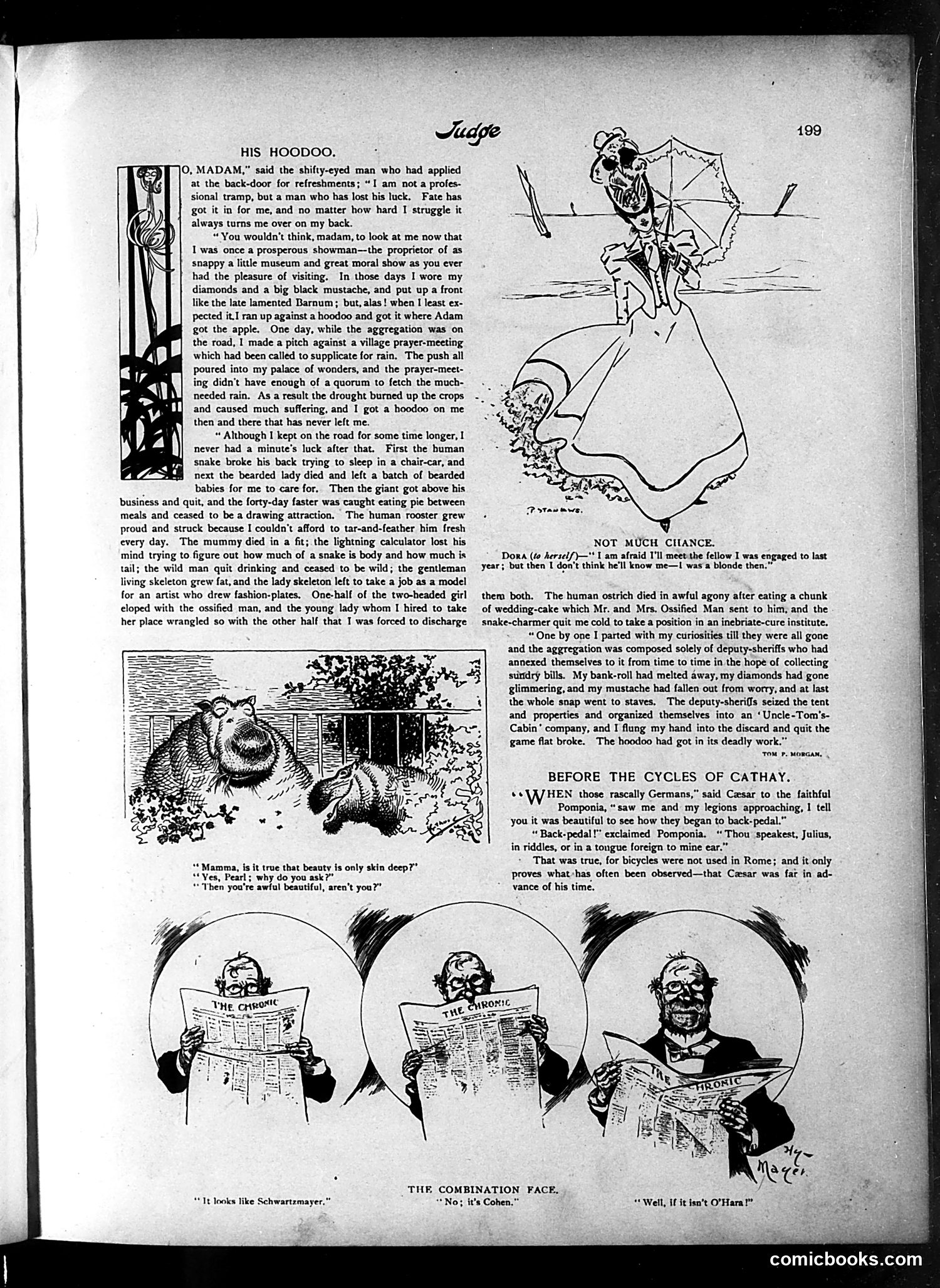
**"His Hoodoo"** (top story): A failed showman recounts his misfortune to a beggar woman. Once a prosperous circus/museum proprietor resembling P.T. Barnum, he angered a village by drawing crowds away from a prayer meeting, causing drought. His subsequent "hoodoo" (curse) systematically destroyed his attractions—performers died, quit, or scandalized themselves. The satire mocks both the charlatan showman world and superstitious belief in curses, with dark humor about the gruesome fates of his "curiosities" (sideshow acts). It's a morality tale about comeuppance for exploiting credulity. **"The Combination Face"** (bottom cartoon): Three identical figures reading newspapers labeled "The Chronic," displaying different facial expressions while holding identical papers. The joke appears to reference political or social hypocrisy—how the same news provokes different reactions depending on one's perspective or allegiance. Captions reference "Schwartzmayer," "Cohen," and "O'Hara," suggesting ethnic commentary. **"Not Much Chance"** and other brief sketches occupy the remaining space, offering light domestic humor.
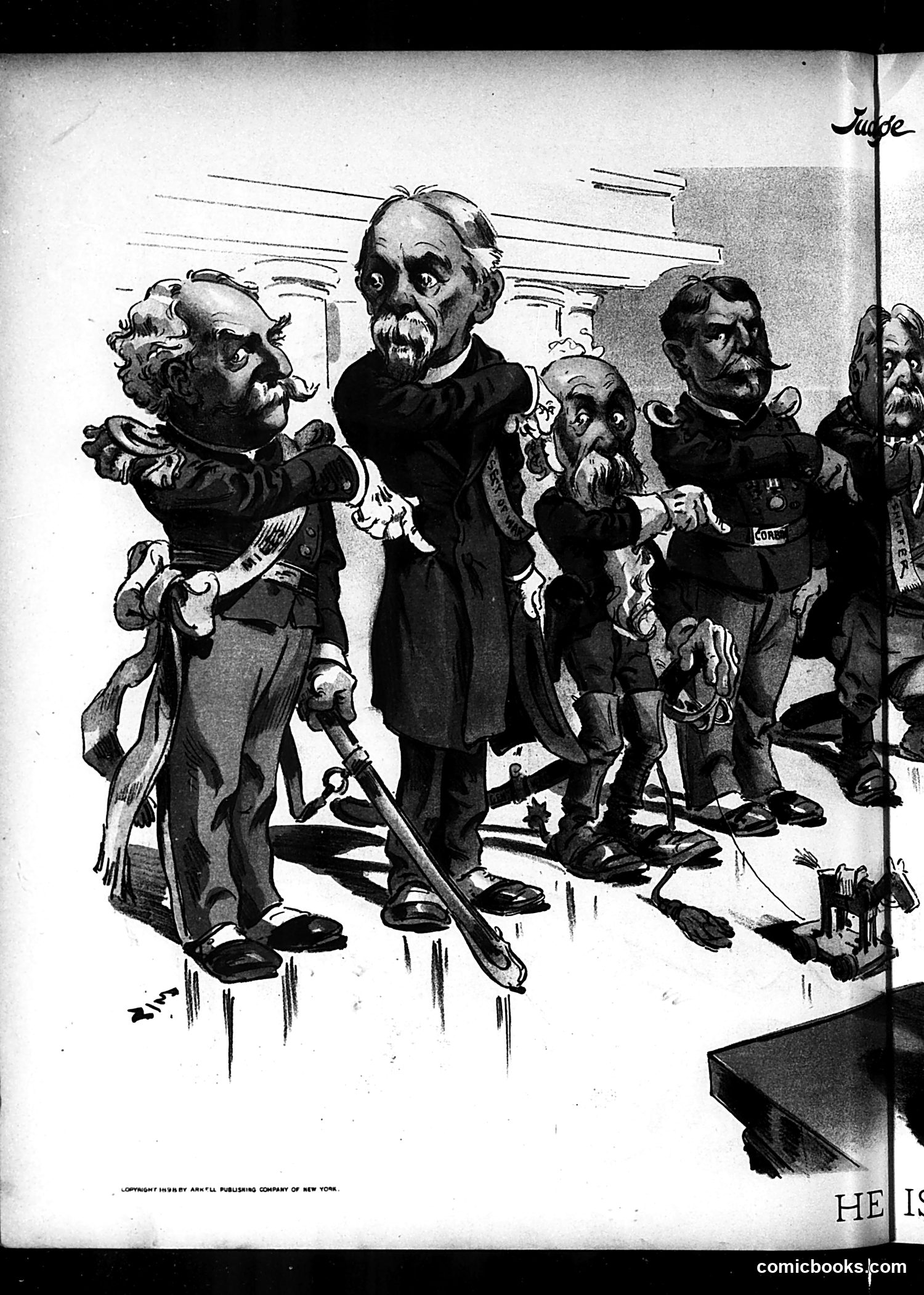
This appears to be a satirical Judge magazine cartoon depicting several caricatured political or public figures standing together. The exaggerated facial features—particularly the prominent beards and distinctive noses—suggest these are meant to represent specific contemporary politicians or leaders, likely European given the artistic style and military-style clothing visible on some figures. The figures appear to be in some form of confrontation or tense gathering, possibly commenting on international diplomatic tensions or political alliances. However, without clearer identification markers or visible text in the image itself, I cannot definitively identify which specific figures or historical moment this references. The cartoon's satirical intent appears critical of these figures, but the exact political commentary remains unclear from the visual elements alone. The OCR text provided contains only formatting characters, offering no additional context.
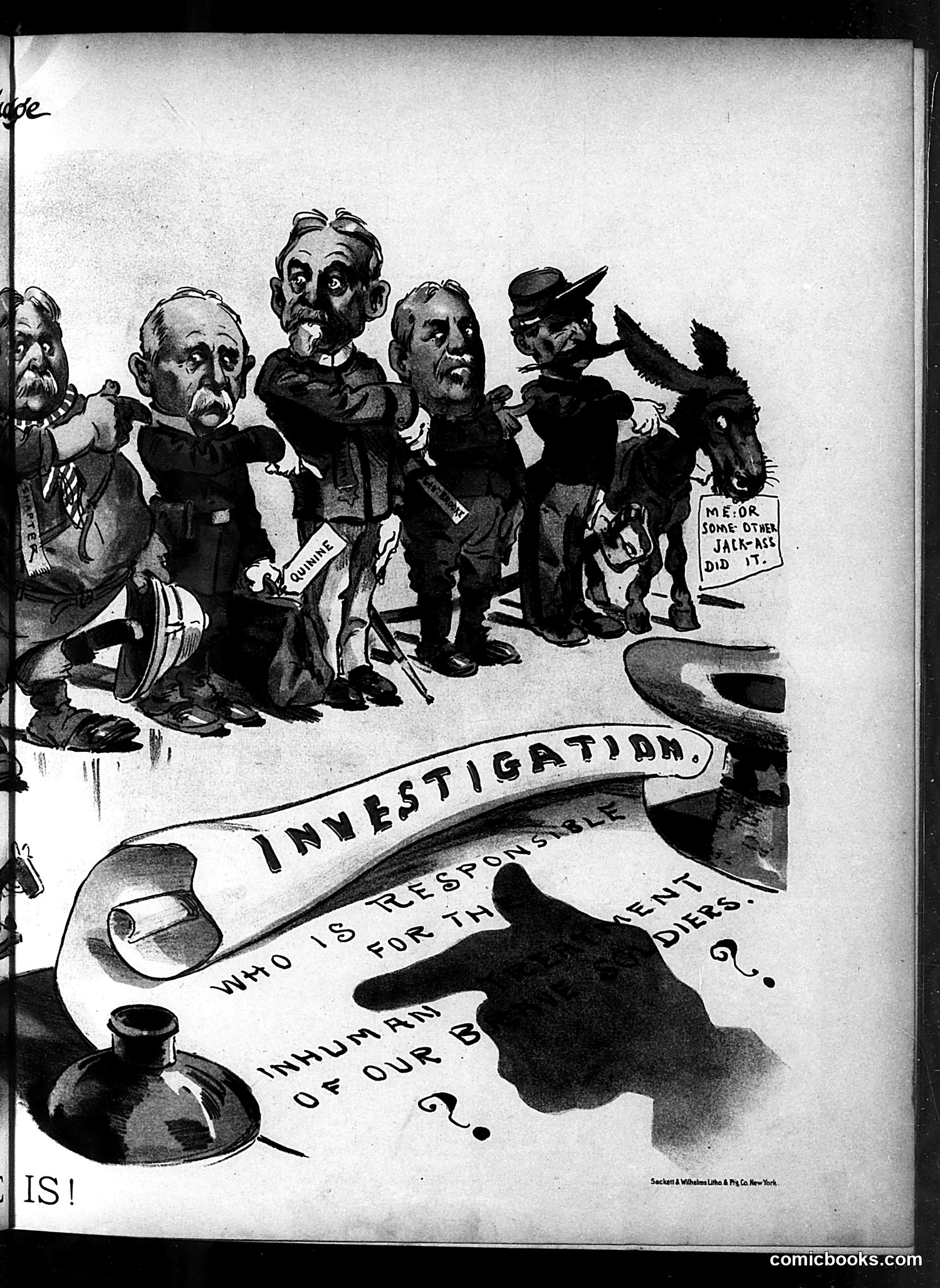
This satirical cartoon depicts an investigation into a scandal. Five caricatured male figures stand before a large wrench labeled "INVESTIGATION" with text asking "WHO IS RESPONSIBLE FOR THE RECENT DIREST?" (likely "DISASTER"). One figure holds a bottle labeled "QUININE," suggesting illness or disease context. The rightmost figure, sitting on a donkey, claims "MEJOR JOSE JACK-ASS DID IT"—a pun playing on "jack-ass" (fool) and possibly referencing a political figure named José. The cartoon satirizes political finger-pointing during a crisis, with officials deflecting blame onto a scapegoat. The wrench imagery suggests mechanical or systemic failure requiring investigation. Without knowing the specific historical event and date, the exact identities remain unclear, but this represents typical Gilded Age political satire mocking governmental accountability dodging.
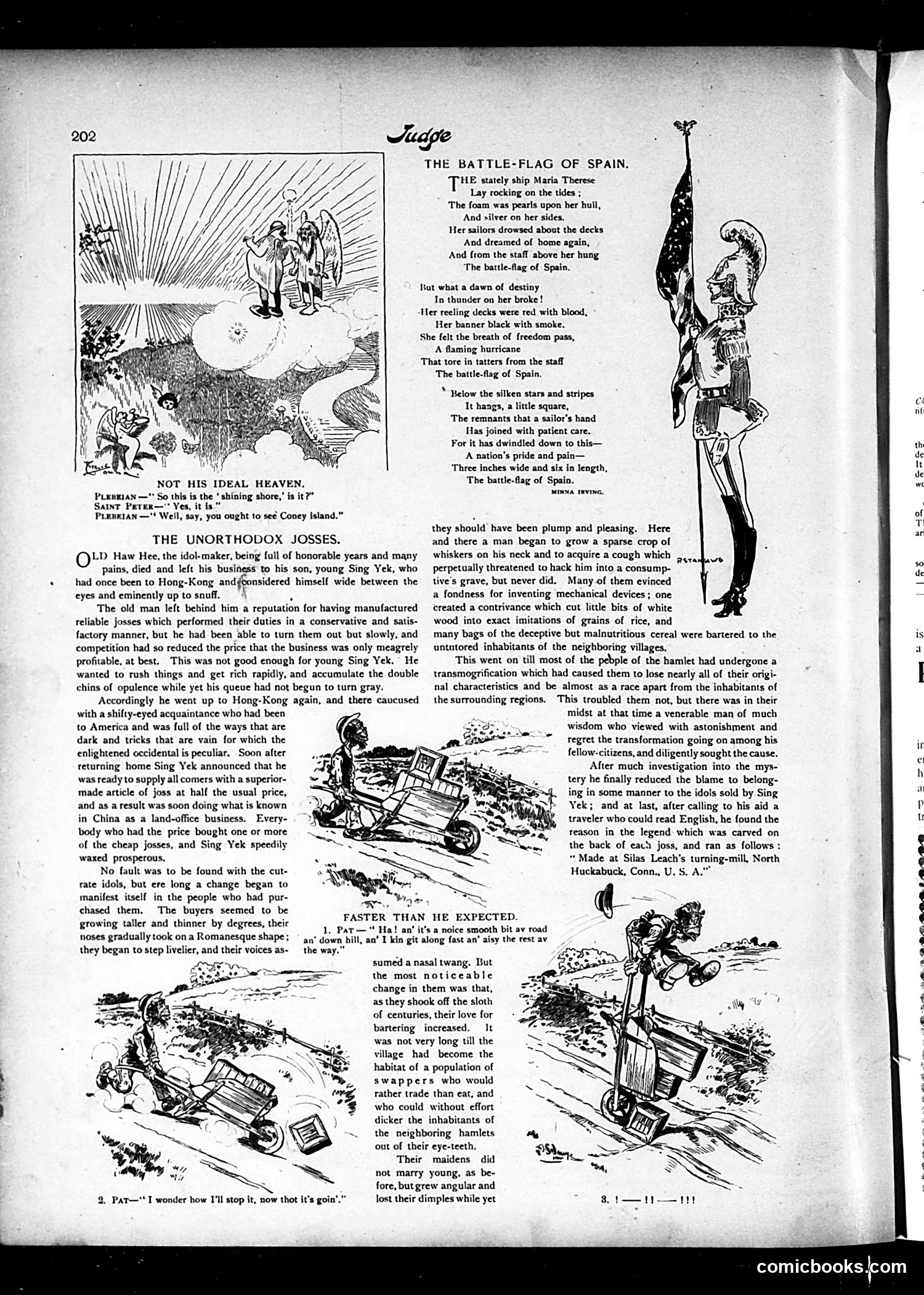
This Judge page contains three distinct pieces: **"Not His Ideal Heaven"**: A brief joke contrasting a Chinese immigrant's ("Plebeian") vision of paradise with Coney Island, a popular American amusement park. **"The Unorthodox Josses"**: A satirical story mocking Chinese people through exaggerated racial stereotypes. Young Sing Yek manufactures cheap idol statues ("josses") using American business tricks. Customers who buy them mysteriously transform: they grow taller, develop prominent noses, acquire nasal accents, and become obsessive traders—essentially "becoming American" in caricatured, unflattering ways. The satire targets both the supposed corrupting influence of American capitalism and mocks Chinese people as fundamentally different and inferior. **"The Battle-Flag of Spain"**: A sentimental poem about the Spanish ship *Maria Theresa*, apparently damaged in battle (likely the Spanish-American War, 1898), with its flag reduced to tatters—symbolizing Spanish imperial decline. The page reflects late-19th-century American attitudes: dismissive humor about immigrants, celebration of American commercial dominance, and imperialist sentiment.
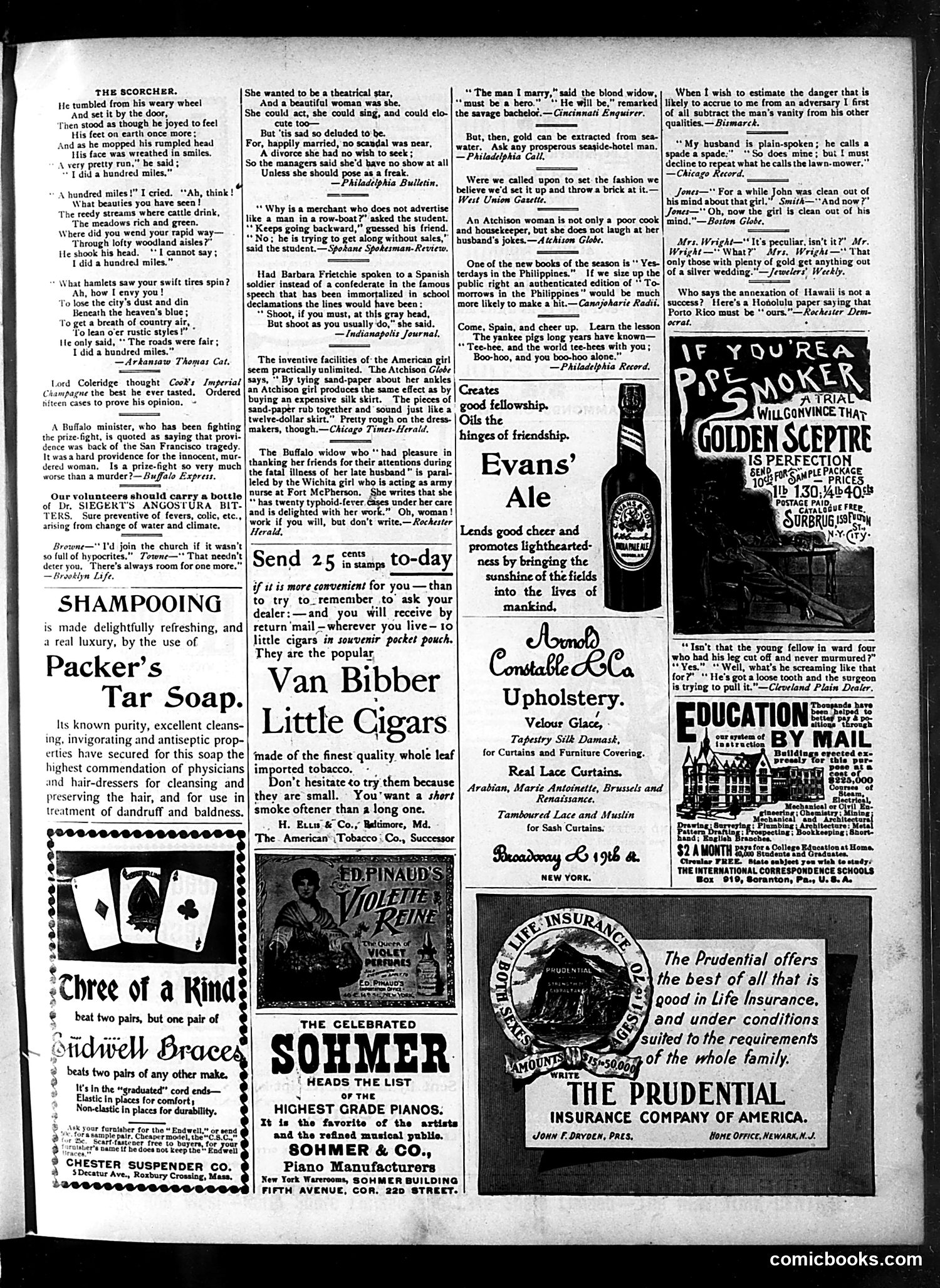
This poem satirizes the absurdity of bicycle enthusiasts who obsess over distance traveled while completely ignoring the actual experience of their journey. A cyclist brags about riding "a hundred miles," but when pressed about the beautiful scenery, charming hamlets, and natural wonders he must have witnessed, he can only repeat mechanically: "The roads were fair; I did a hundred miles." The joke targets the shallow competitive spirit of the cycling craze (then enormously popular). The cyclist has reduced travel to a mere statistic—distance as an end in itself—rather than appreciating the journey's actual purpose or beauty. It's social commentary on mechanical achievement divorced from meaningful experience, mockingly suggesting that obsessive record-chasing makes one oblivious to everything else. The page is otherwise filled with period advertisements (cigars, soap, ale, insurance, piano manufacturers).
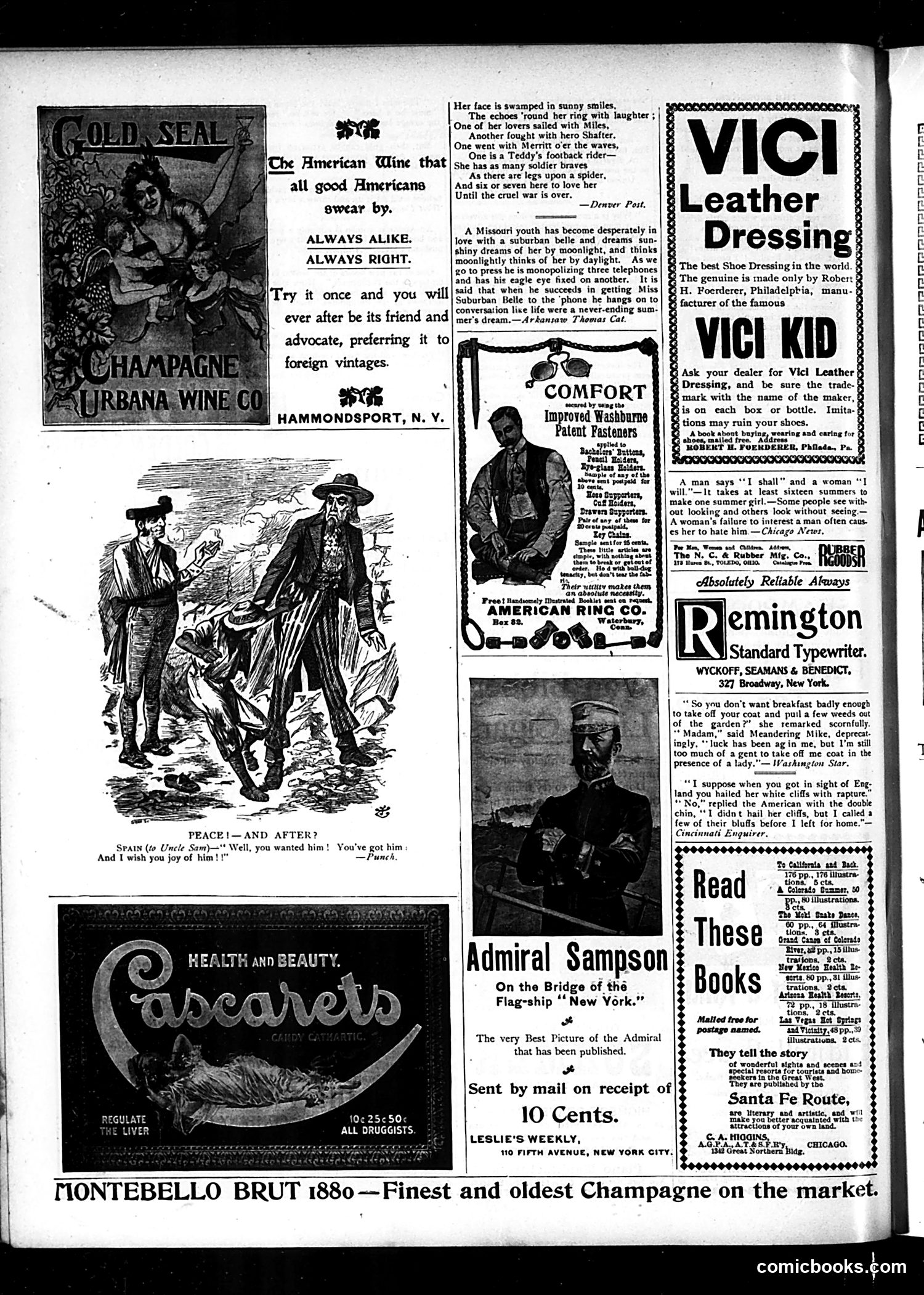
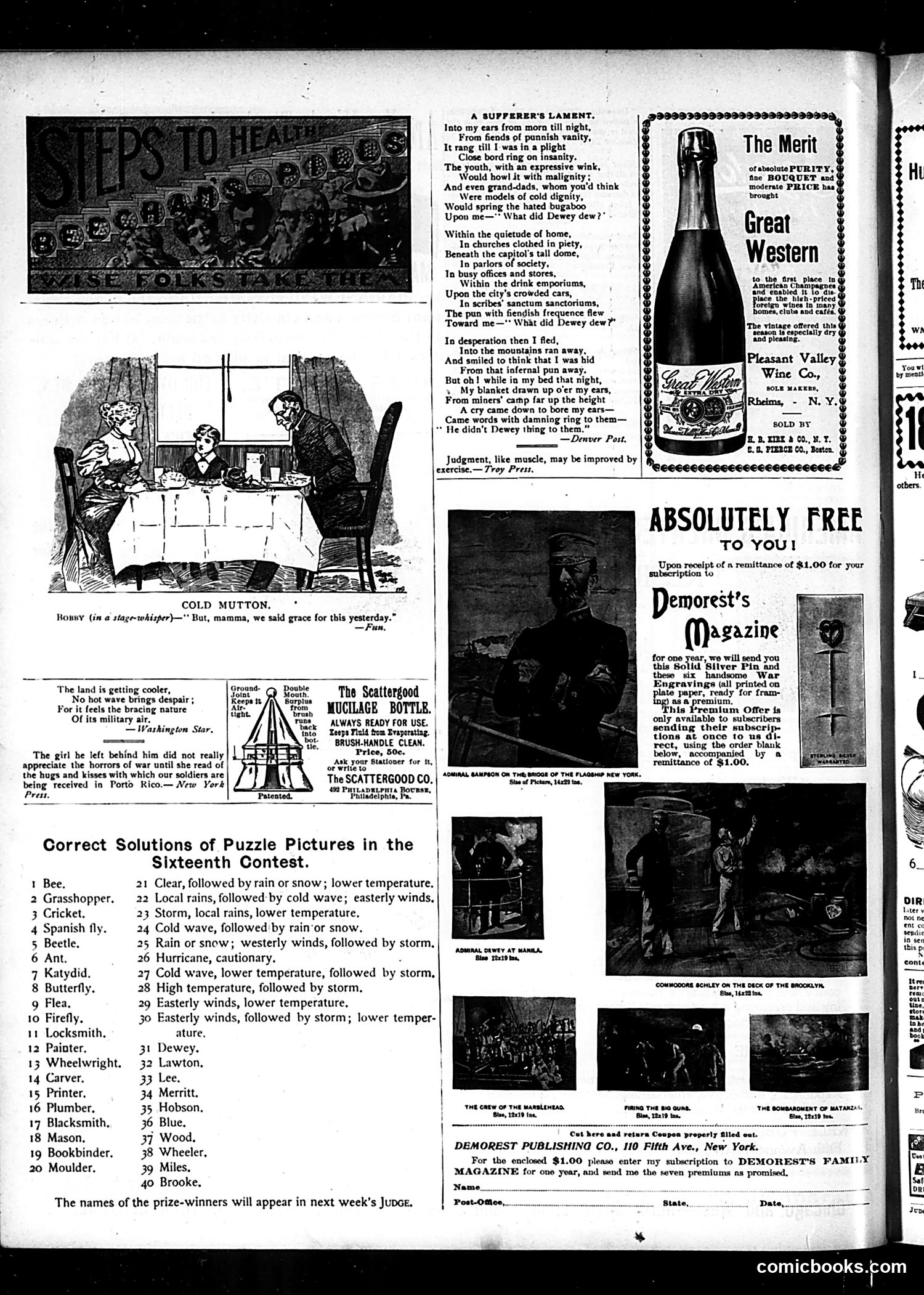
This page primarily contains advertisements and light humor rather than political cartoons. The main satirical content is the "Peace!—and After?" cartoon, which depicts Spain speaking to Uncle Sam after the Spanish-American War (1898). Spain says, "Well, you wanted him! You've got him / And I wish you joy of him!"—a reference to the Philippines, which the U.S. acquired from Spain. The joke is Spain's ironic congratulations, implying the Philippines will prove troublesome for America. Other content includes period poetry about American soldiers and their romantic conquests during the war, and various product advertisements (champagne, shoe dressing, typewriters, books). The "Admiral Sampson" reference relates to the naval war hero from the recent conflict. Overall, this reflects post-Spanish-American War American triumphalism mixed with skepticism about imperial commitments.
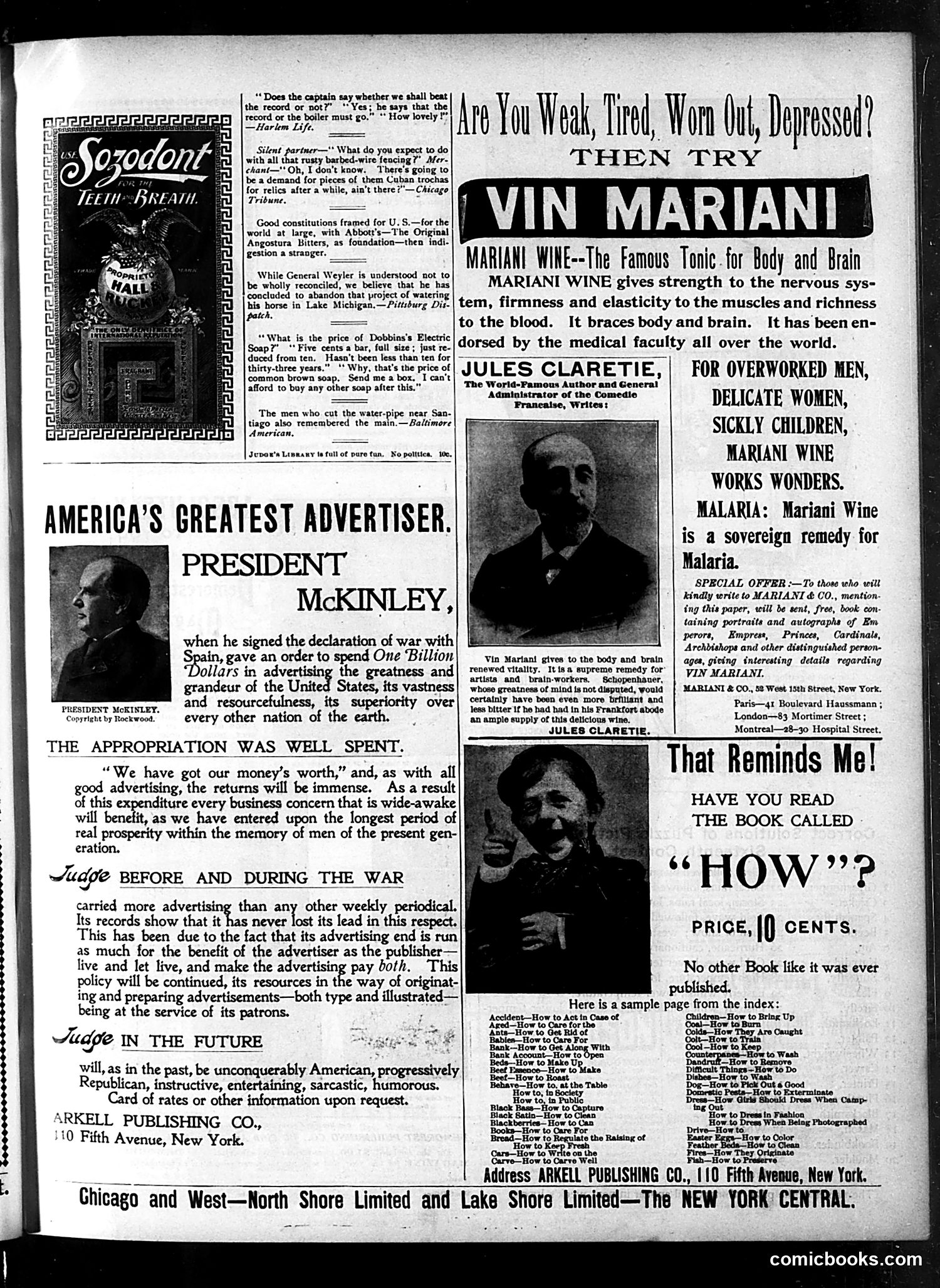
This page is primarily **advertising**, not political satire. The dominant content consists of several advertisements and a publisher's statement about Judge magazine itself. ## Key Content: **McKinley Advertisement Section**: References President McKinley's authorization of one billion dollars in war advertising (likely related to the Spanish-American War, circa 1898). Judge uses this to claim the magazine benefited from increased advertising spending and positions itself as America's leading advertiser, benefiting the nation's prosperity. **Vin Mariani Wine Advertisement**: A large section promoting "Mariani Wine" as a tonic for weakness, fatigue, and depression. It claims endorsement by medical professionals and quotes French author Jules Claretie, claiming the wine provides mental vitality. **Minor Comic Quips**: Small captioned illustrations with jokes about boat captains, General Weyler (Spanish general in Cuba), and water pipes—these appear to reference the Spanish-American War context. **"How" Book Advertisement**: Promotes a 10-cent instructional book covering practical topics. The page reflects **turn-of-century American commercialism**, with medical "tonics" (likely containing cocaine or alcohol) heavily advertised as cure-alls.
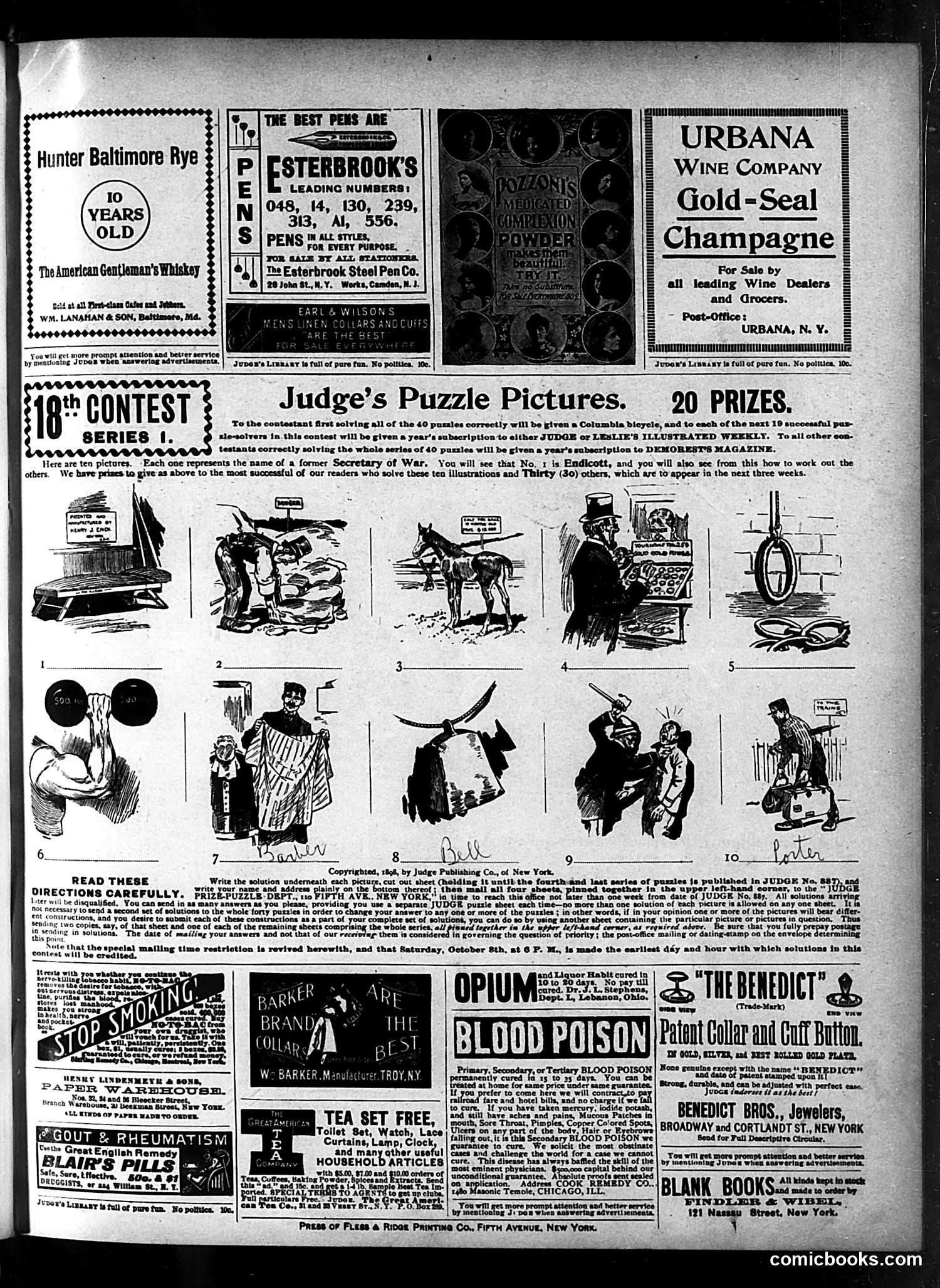
This is primarily an **advertising page** with a puzzle contest. The main content is "Judge's Puzzle Pictures"—a competition where readers solve ten illustrations representing former Secretaries of War (picture 1 is identified as "Endicott"). Winners receive a Columbia bicycle; other solvers get magazine subscriptions. The page is dominated by **product advertisements** typical of the era: whiskey (Hunter Baltimore Rye), champagne, fountain pens, and patent medicines (blood poison treatments, rheumatism remedies). These ads reflect turn-of-the-century commerce. The puzzle itself appears to be a **visual rebus game**—readers must identify historical figures from illustrations, a popular form of intellectual entertainment in Judge magazine during this period. **No significant political satire is evident on this page.** It functions as a standard magazine feature combining entertainment with advertising revenue, rather than editorial commentary.
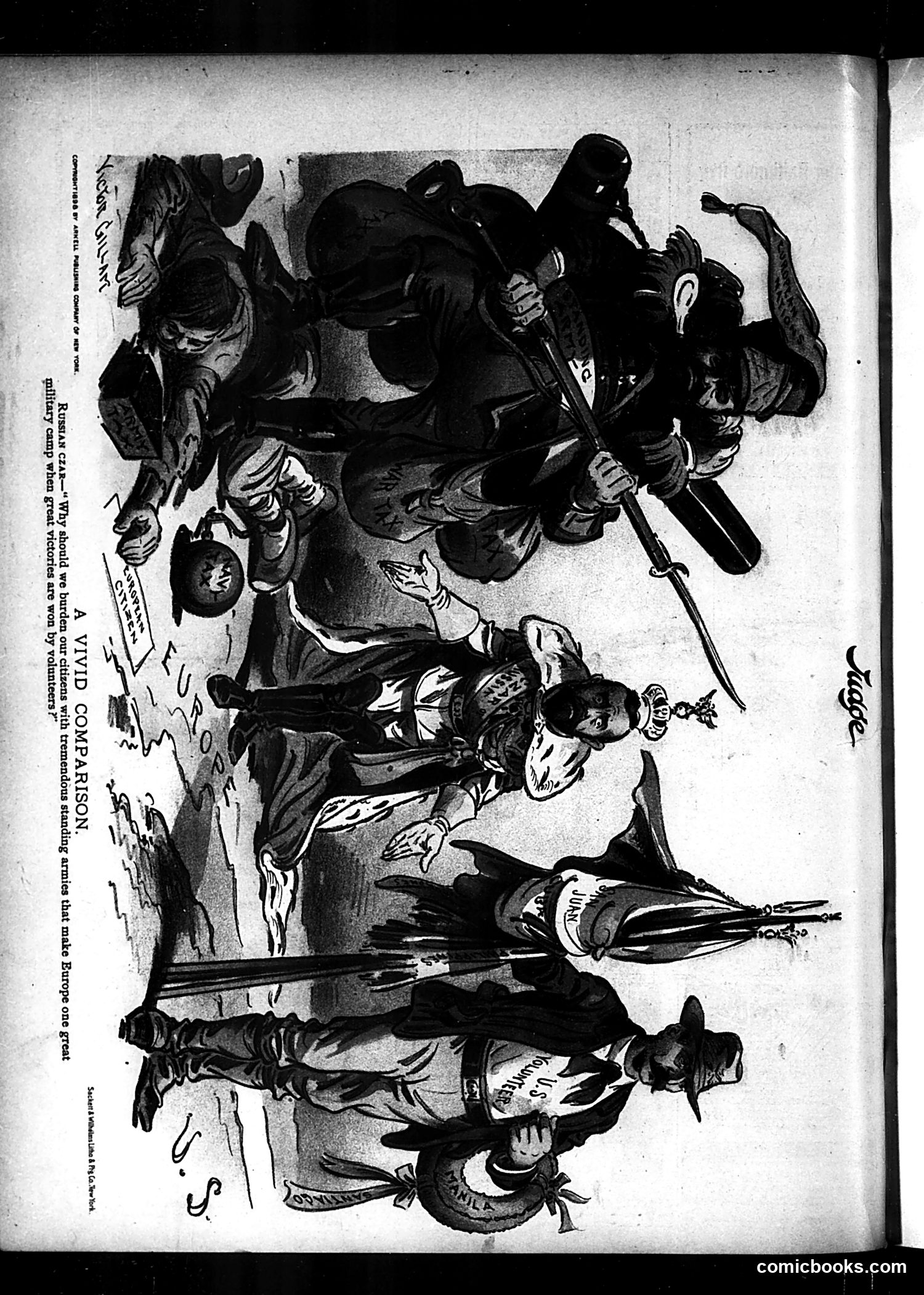
This political cartoon compares military organization systems through the Russian Czar's rhetorical question about standing armies versus volunteer forces. The Czar argues that huge professional militaries burden citizens and militarize Europe unnecessarily, suggesting volunteers achieve "great victories" instead. The satire's point is likely ironic: the Russian autocrat—historically dependent on massive conscription and state control—questions expensive military establishments, while the comparison presumably shows the superiority of volunteer systems (likely the American model). This appears to critique either Russian military inefficiency, hypocrisy about military spending, or to promote American volunteerism as preferable to European militarism during what seems to be a period of international military buildup (possibly early 1900s based on style). The cartoon uses the Czar as a foil to make arguments about military policy through the absurdity of him making them.