
A complete issue · 16 pages · 1898
Judge — September 3, 1898
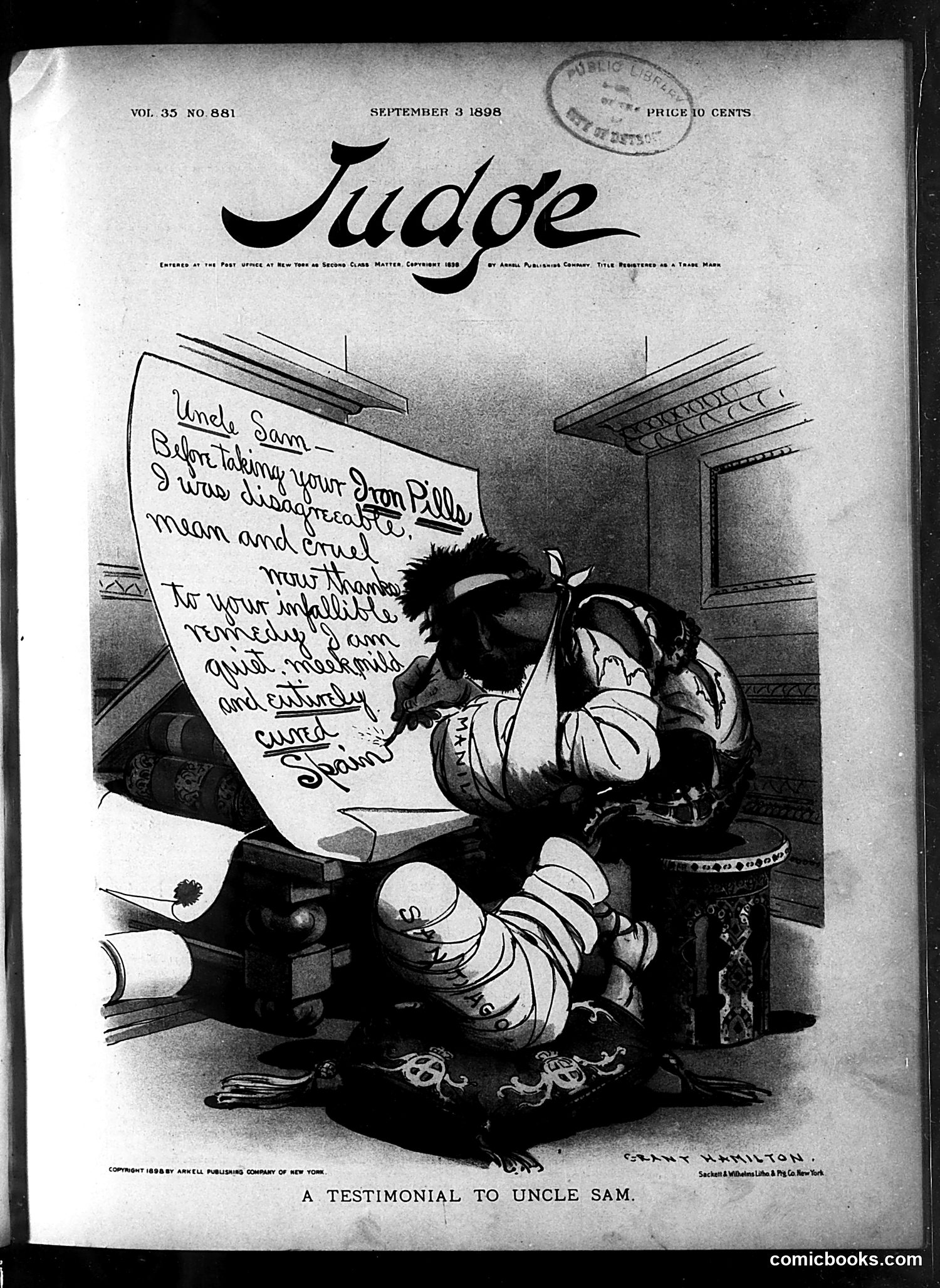
This September 3, 1898 *Judge* cartoon satirizes American imperialism following the Spanish-American War. The central figure appears to be Uncle Sam (personification of the U.S. government), depicted as a mummy wrapped in bandages—suggesting he's been consumed or damaged by imperial ambitions. The letter he holds, signed "Sham," reads as a mock testimonial praising Uncle Sam for being "mean and cruel" and "wasteful" toward his "invalids," suggesting the war effort harmed Americans, particularly soldiers and veterans. The satirical title treats this as a positive "testimonial," but the visual imagery (mummy, deterioration) and sarcastic letter content convey criticism of American military expansion and its human costs. The cartoon opposes the war's imperial agenda.
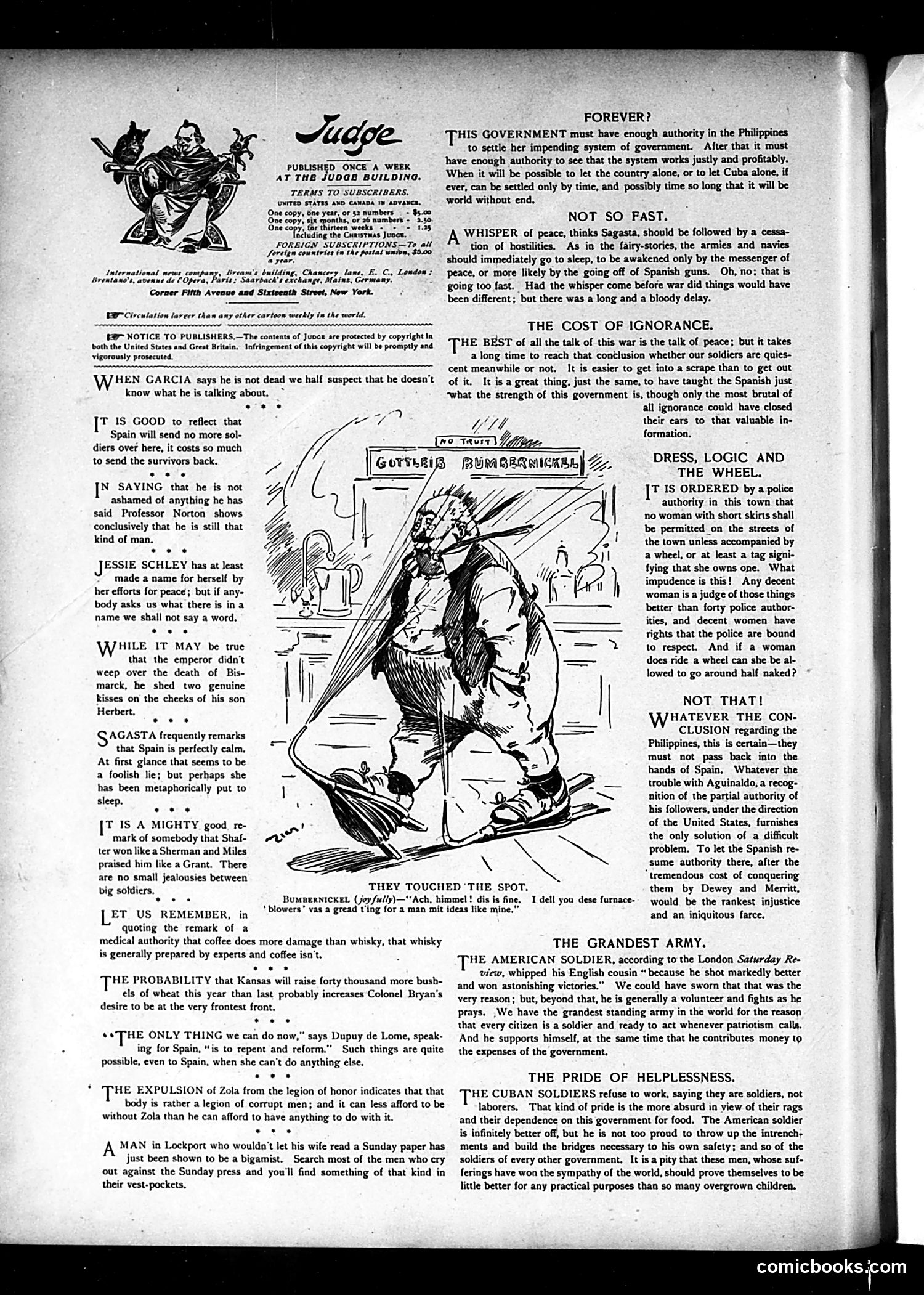
This page from Judge magazine contains political commentary on the Spanish-American War and Philippine conflict. The central cartoon, "They Touched the Spot," depicts a bearded man (likely representing Spain or Spanish authority) reacting with pain—the caption's dialogue suggests he's been hit where it hurts most, probably referencing American military victories. The accompanying text discusses Philippine governance, Spanish colonial authority, and American intervention. Multiple short commentary sections critique various figures and situations: Sagasta's "perfect calm" about Spain's predicament, discussions of peace negotiations, and commentary on American soldiers' conduct. The satire targets Spain's weakening position, questions about Philippine independence, and debates over American imperial expansion—central issues of this 1898-1899 conflict period.
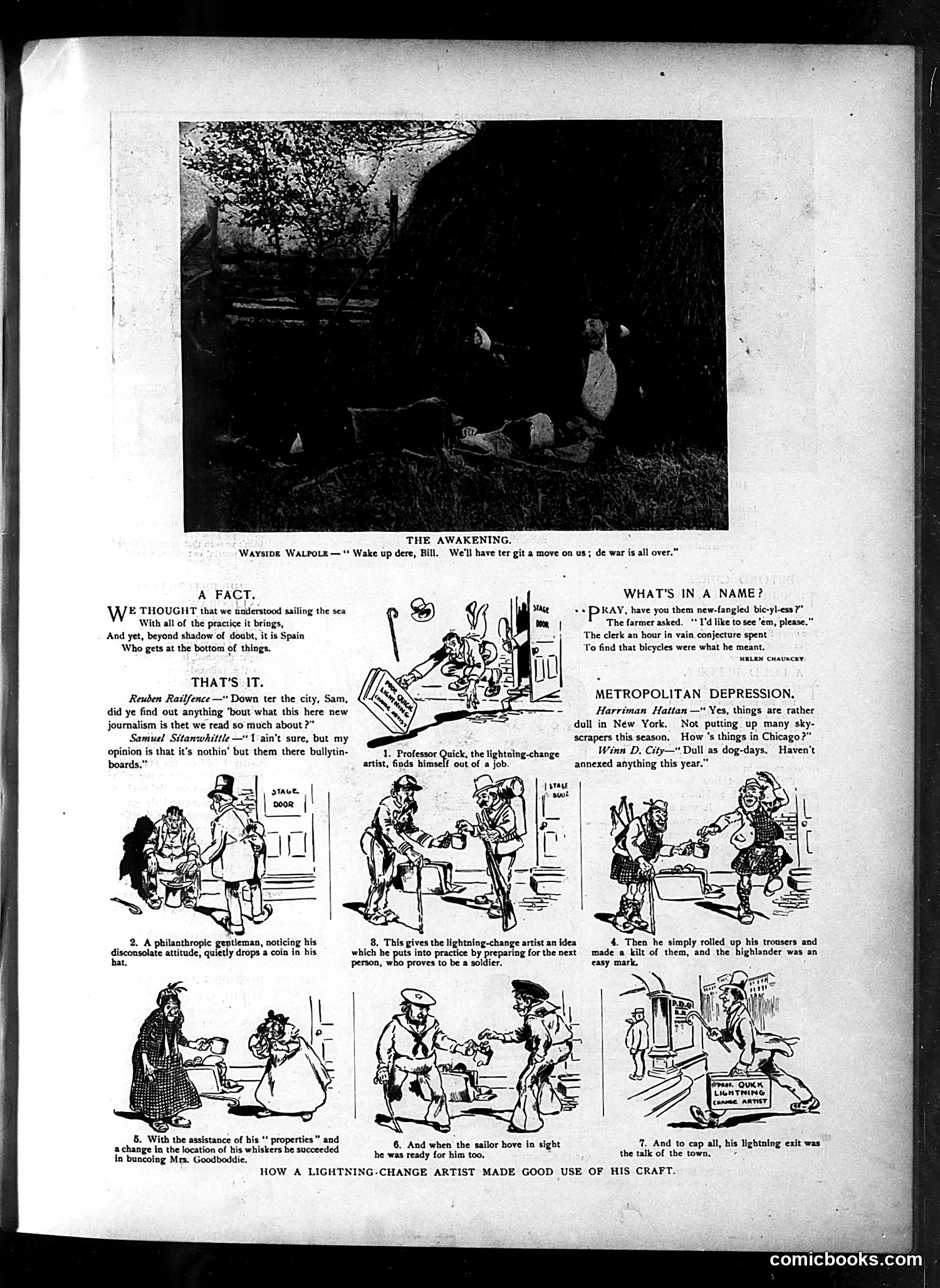
This page contains short humorous pieces and a comic strip titled "How a Lightning-Change Artist Made Good Use of His Craft." **The main comic strip** satirizes a stage magician ("lightning-change artist") who transitions into military service during wartime. The seven-panel narrative shows him using his quick-change stage illusions to transform into a soldier, impress military officers, and ultimately succeed in uniform—suggesting that his theatrical skills translate unexpectedly well to military life. **The surrounding text pieces** are brief jokes about unrelated topics: maritime practices, bicycles, and urban economic conditions in various cities. The satire's point appears to be gentle commentary on unexpected career pivots and how unconventional talents might prove useful during wartime, though the specific historical context remains unclear without additional dating information.
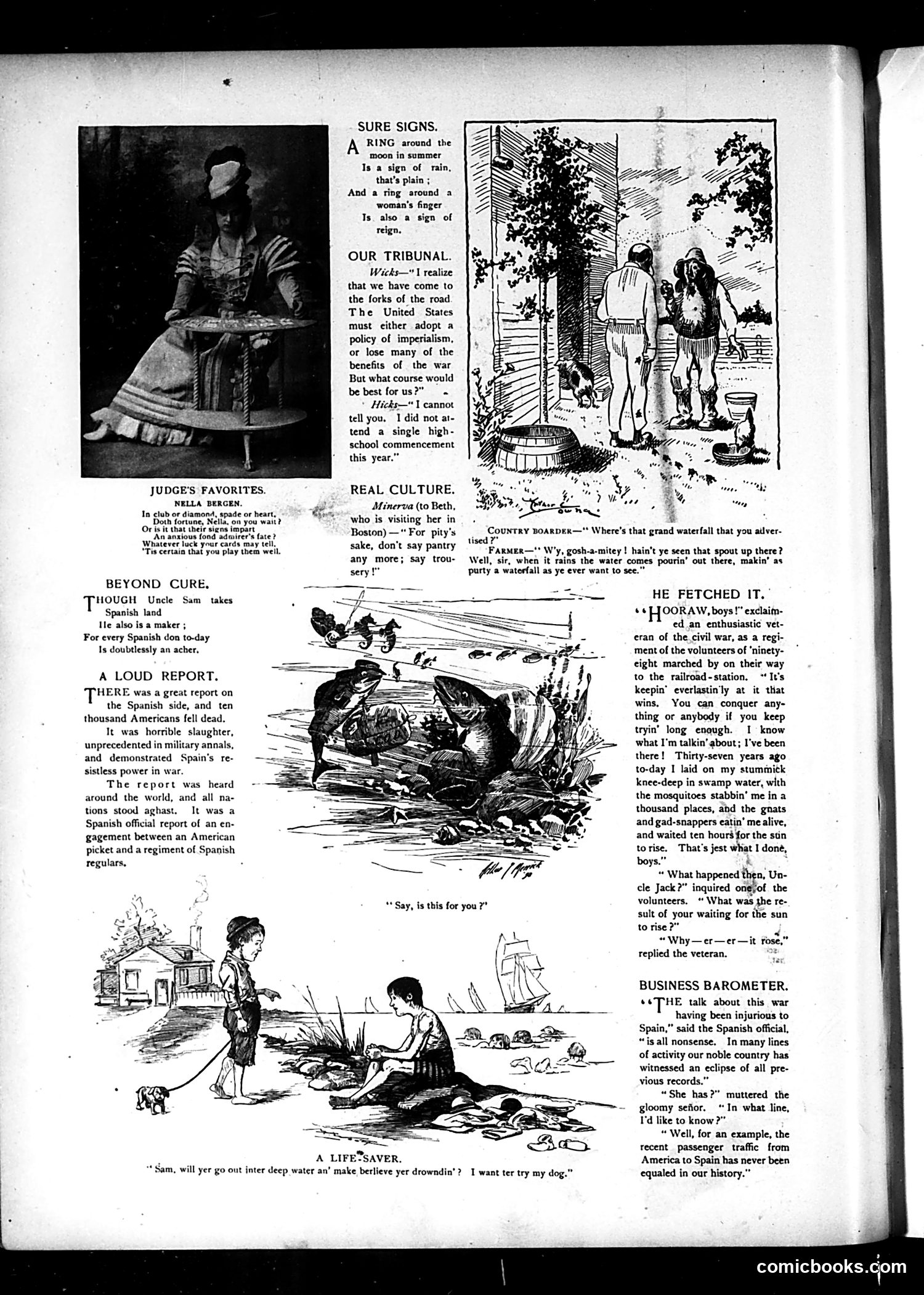
This page contains multiple satirical pieces from Judge, likely early 1900s. **"Sure Signs"** mocks weather superstitions—a ring around the moon and a woman's ring finger supposedly predict rain and marriage respectively. **"Our Tribunal"** presents a debate about U.S. foreign policy, specifically whether America should pursue imperialism or avoid entangling military commitments—a major political controversy of the era. **"A Loud Report"** satirizes exaggerated news coverage of Spanish military weakness, suggesting American newspapers sensationalized Spain's military defeats. **"He Fetched It"** features a Civil War veteran's tall tale about enduring extreme conditions—typical contemporary humor mocking elderly veterans' embellished war stories. **"Business Barometer"** criticizes claims that Spanish-American War commerce figures prove American prosperity, presented as Spanish official propaganda. The illustrations throughout use period cartoon conventions to mock contemporary politics and social pretensions.
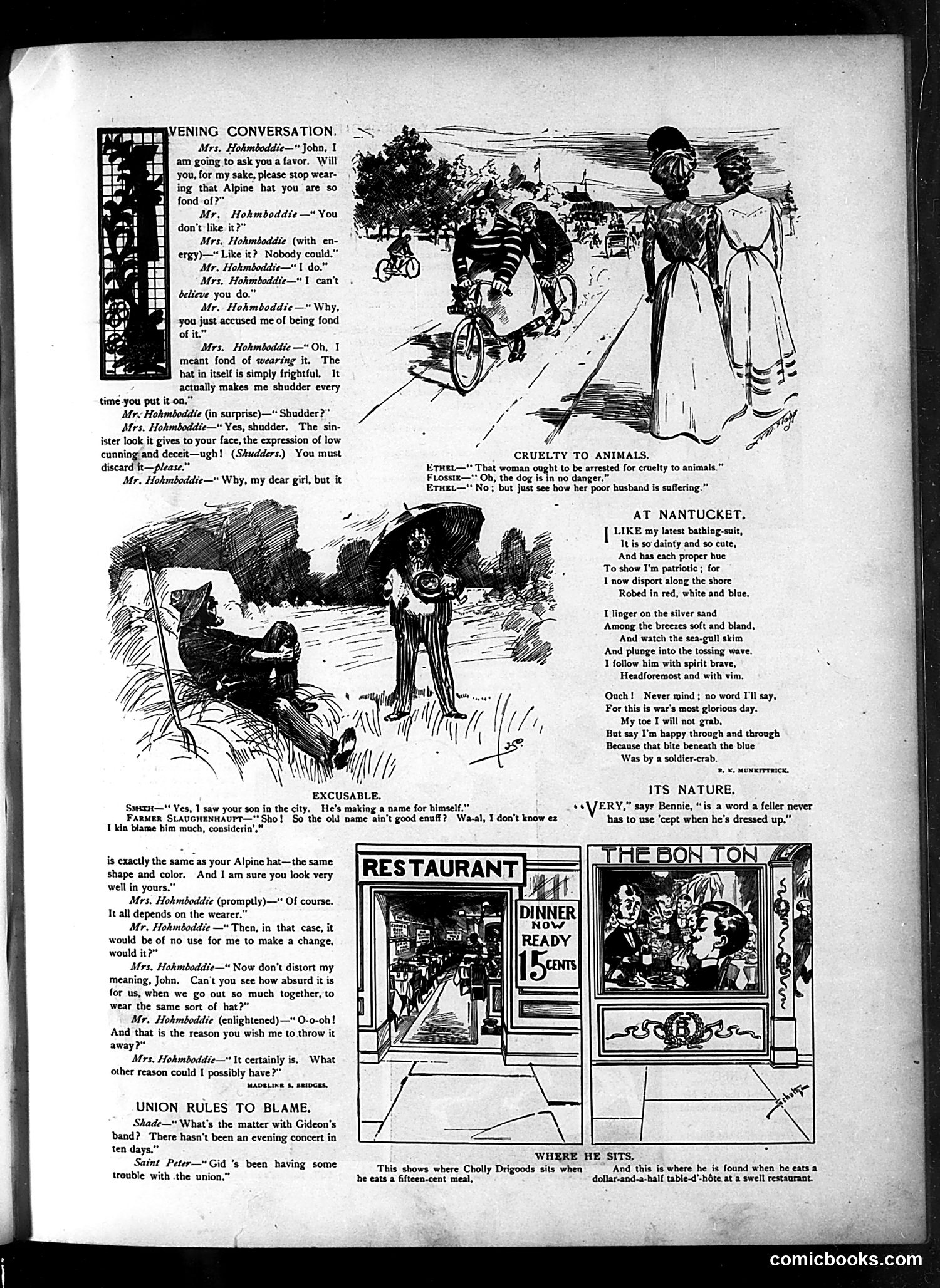
This page contains several satirical pieces typical of early 20th-century American humor: **"Evening Conversation"** mocks marital dynamics through a couple debating a man's Alpine hat. The wife claims the hat itself is ugly and gives her husband a sinister appearance, but when he agrees to change it, she reveals the real issue: they can't be seen wearing identical hats in public. The satire targets feminine vanity and the absurdity of marital arguments. **"At Nantucket"** is patriotic verse about a woman in a red, white, and blue bathing suit who gets bitten by a "soldier-crab" while patriotically bathing—likely a humorous reference to WWI-era patriotism. **"Cruelty to Animals"** and other brief pieces continue the magazine's typical format of short jokes and one-liners. The page is primarily **humorous domestic and social satire** rather than political commentary, focusing on everyday absurdities of American middle-class life. The advertisements for a restaurant complete the commercial nature of the publication.
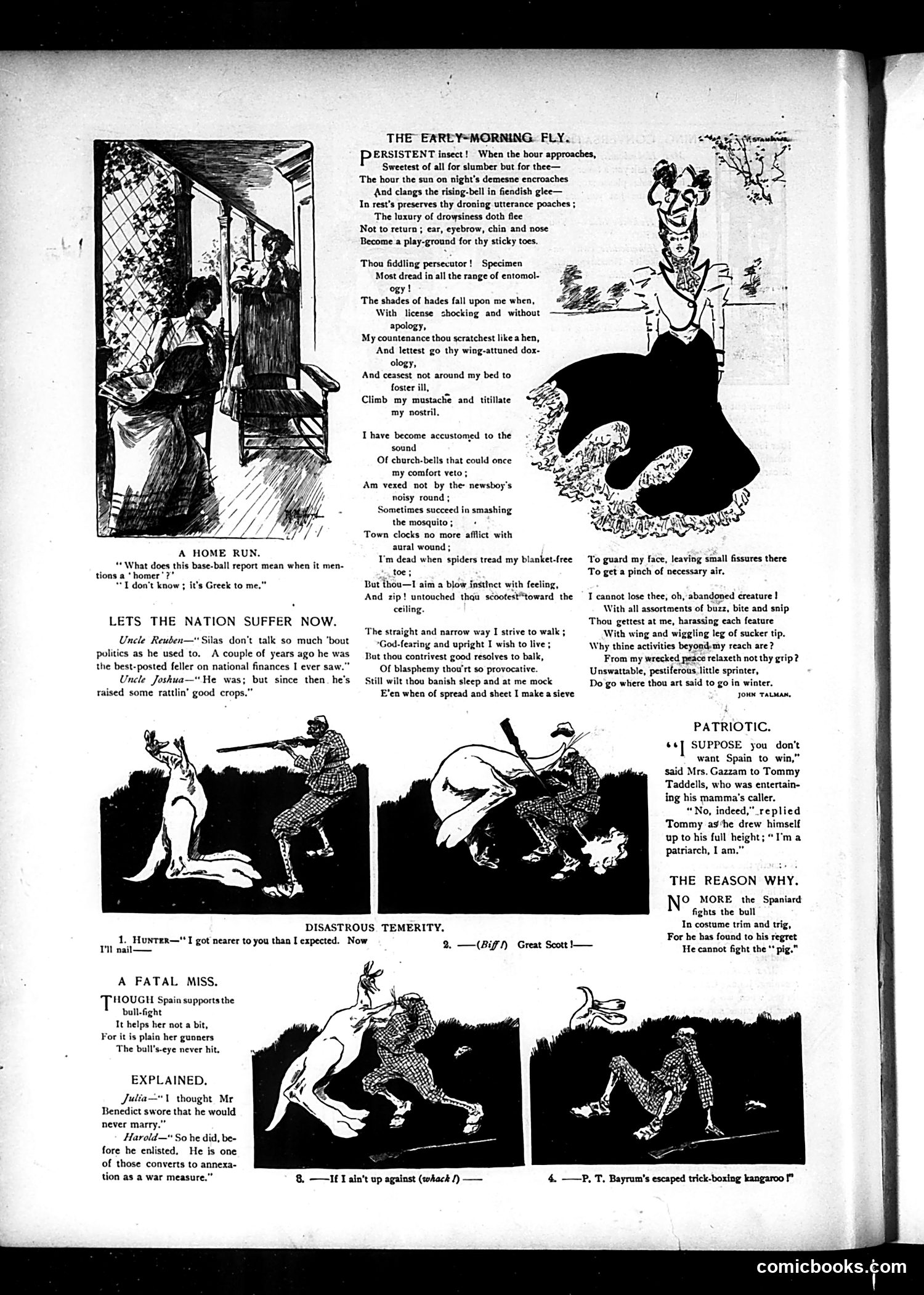
This page from *Judge* magazine contains WWI-era American satire (likely 1898, during the Spanish-American War). **Main cartoons:** 1. **"A Home Run"** and **"Lets the Nation Suffer Now"**: These mock American men abandoning political engagement for farm prosperity—a jab at those who ignore national affairs when personally comfortable. 2. **"The Early-Morning Fly"**: An elaborate poetic complaint about a persistent housefly—satirizing overwrought Victorian sentimentality through absurdly flowery language about a trivial annoyance. 3. **Hunting/bullfighting comics**: Dark humor about poor marksmanship and hunting mishaps. 4. **"The Reason Why"** and **"Patriotic"**: Pro-American propaganda mocking Spain's military incompetence. The "pig" joke suggests Spanish soldiers are cowardly; young Tommy Taddells comically mispronounces "patriot" as "patriarch," gently mocking childish patriotism. The page reflects American triumphalism during the Spanish-American War, mixing humor with nationalist messaging.
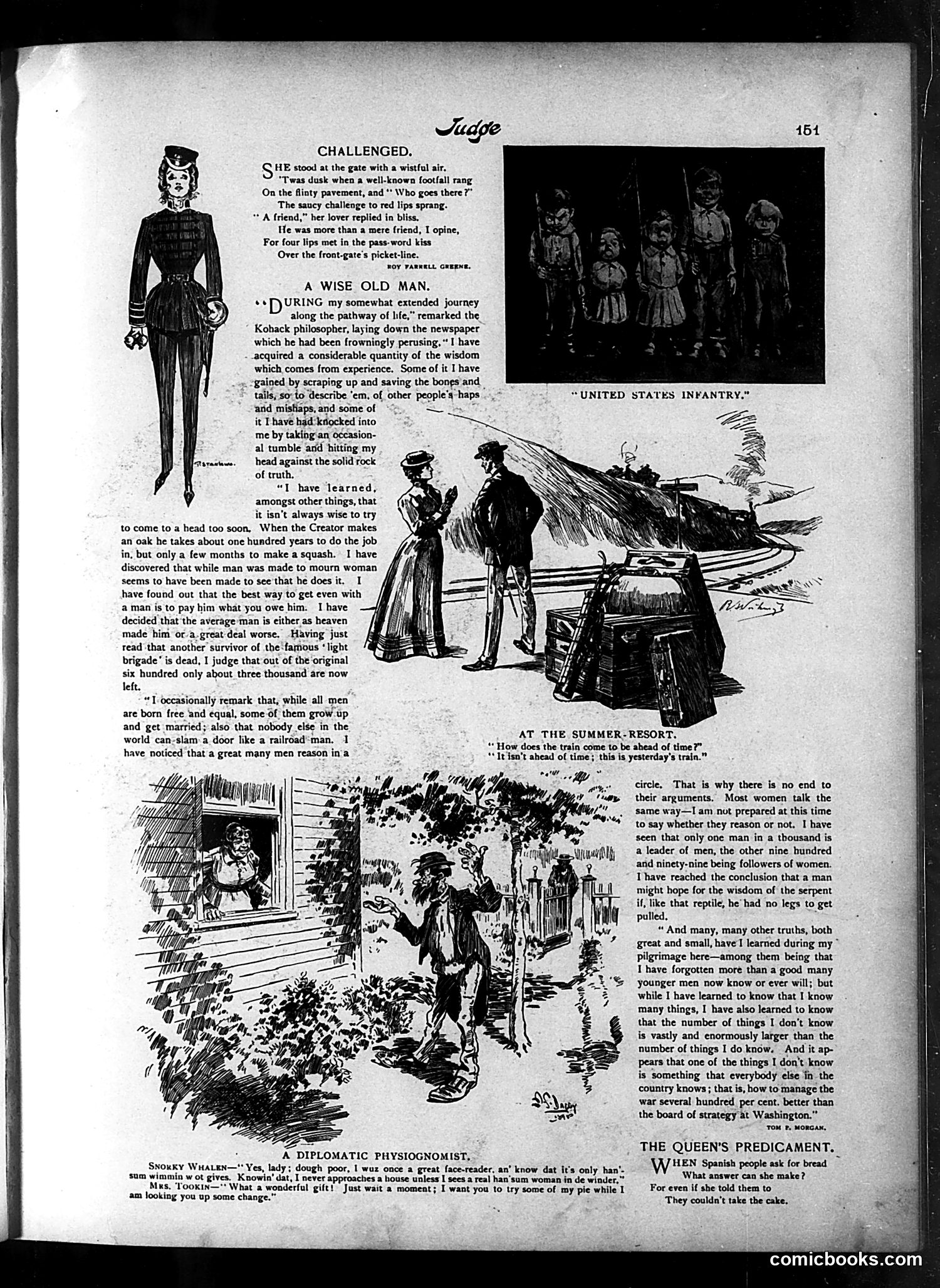
This page contains three satirical pieces typical of early Judge magazine humor: **"Challenged"** and **"A Wise Old Man"**: Romantic and philosophical verses with accompanying illustrations—standard light humor content without specific political reference. **"United States Infantry" and "At the Summer Resort"**: Military and domestic scene illustrations, likely commenting on contemporary military readiness or social customs, though specific context is unclear from the image alone. **"A Diplomatic Physiognomist"**: A dialect joke featuring "Smokey Whalen," a poor but charming man claiming face-reading abilities to access wealthy households. The humor relies on ethnic stereotyping (thick accent, crude dialect) common to period comedy. Mrs. Tookin's response about "pie" and the final caption's pun ("couldn't take the cake") complete the joke structure. **"The Queen's Predicament"**: A brief quip about Spanish people asking for bread—possibly referencing Spain's economic or political situation, though specifics are unclear. The page reflects Judge's mix of romantic verse, domestic humor, and ethnic-stereotype comedy typical of early 20th-century American satire.
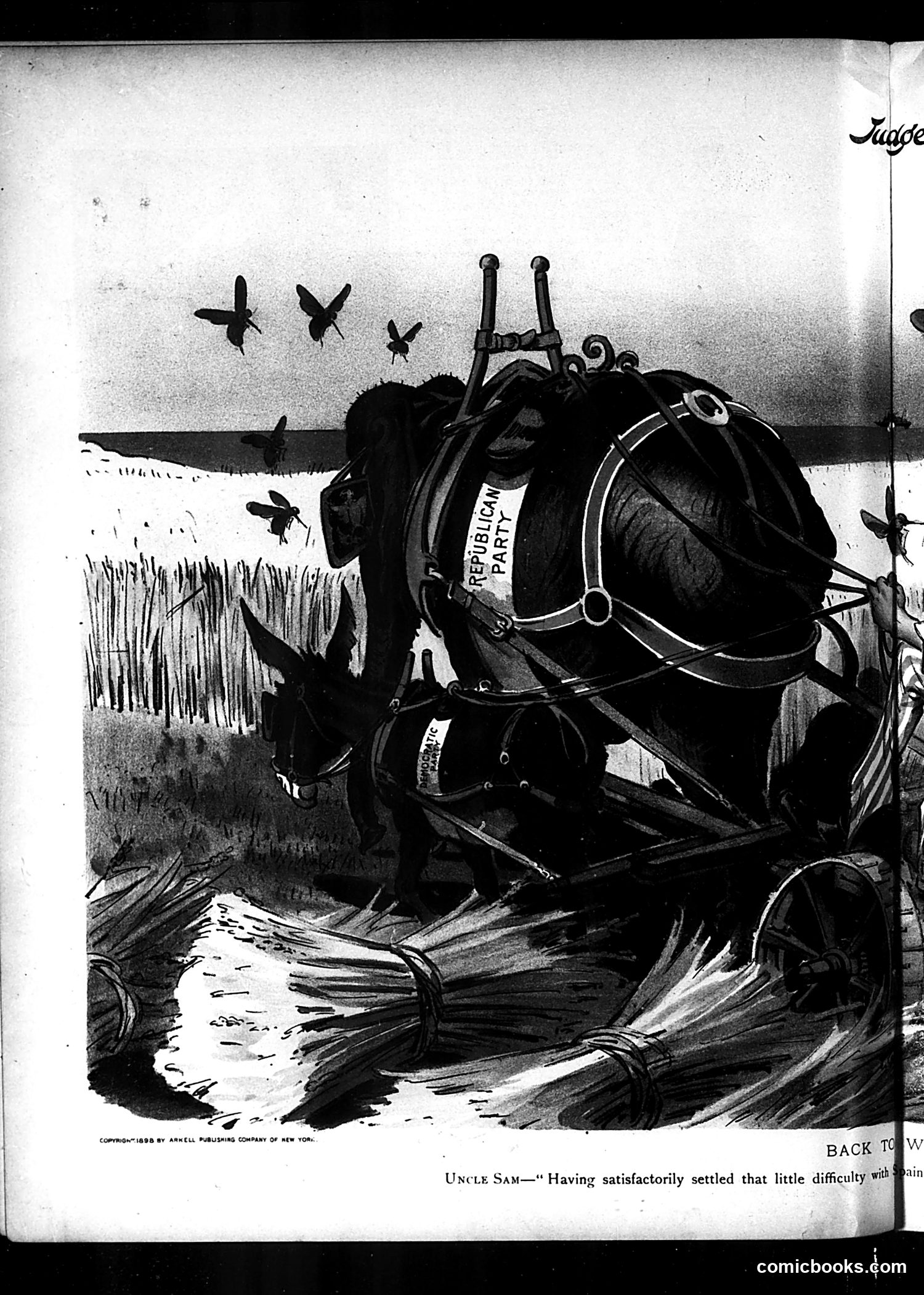
This Judge magazine cartoon depicts Uncle Sam (personified America) with two horses labeled "REPUBLICAN PARTY." The horses pull a cart filled with bundles, suggesting the Republican Party as beasts of burden serving national interests. The caption references Uncle Sam "having satisfactorily settled that little difficulty with Spain"—likely alluding to the Spanish-American War (1898) or its aftermath. The flying planes overhead and military imagery reinforce wartime themes. The cartoon appears to satirize either Republican handling of post-war affairs or criticize the party's role in American foreign policy expansion. The "werepublicani" label (partially visible) suggests mockery of Republican identity or inconsistency. Without a clear date visible, the exact "difficulty with Spain" referenced remains uncertain, though the iconography points to early-20th-century American imperialism debates.
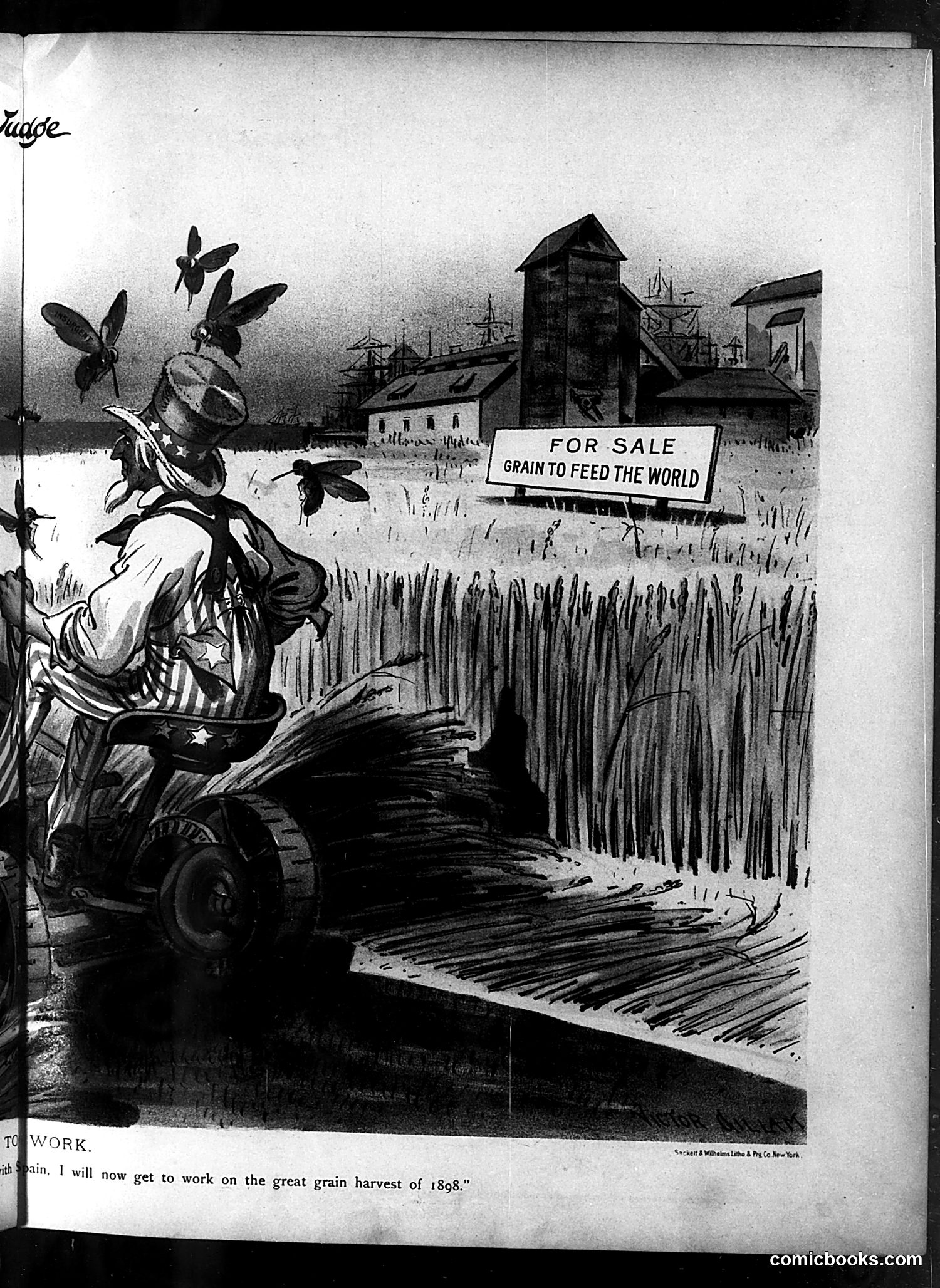
This Judge magazine cartoon uses **Lady Liberty** (identifiable by her star-emblazoned clothing and characteristic appearance) as the central figure. She stands before American grain silos and farmland, with a sign reading "FOR SALE—GRAIN TO FEED THE WORLD." The caption references "the great grain harvest of 1898," suggesting this cartoon addresses American agricultural exports during that period. The satire appears to celebrate American agricultural abundance and the nation's capacity to feed global markets—positioning the U.S. as a major grain exporter. Lady Liberty's prominent placement suggests this is patriotic messaging about American economic strength and agricultural dominance. The cartoon likely promotes American grain sales or export policies as a source of national pride and economic benefit during the 1890s.
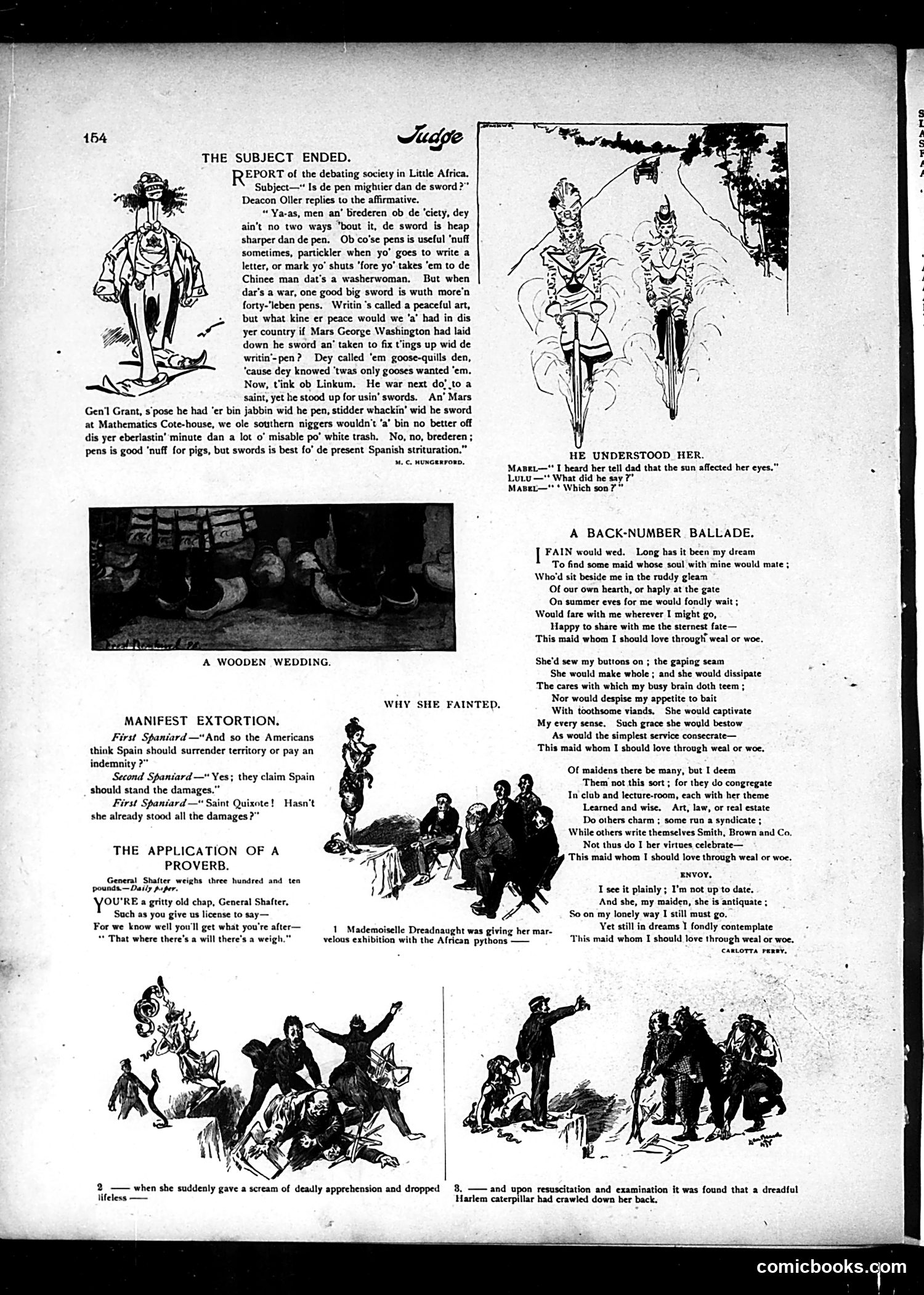
This page contains racist satirical content typical of late-19th-century American humor magazines. The main cartoon depicts a debate among Black speakers in "Little Africa" about whether the pen or sword is mightier. The speakers use heavy dialect and reference figures like Washington, Lincoln, and Grant to argue that swords (warfare) matter more than writing—presented as crude humor mocking Black intellectual discourse. The other cartoons include: a "Manifest Extortion" joke about Spanish-American War reparations; "Why She Fainted," a pun about a woman affected by "the sun" (likely meaning a son/male); and a "Back-Number Ballade" poem lamenting women who pursue education and careers rather than domestic service. The page reflects Judge's editorial stance: mocking both Black Americans and women's advancement through caricature and wordplay.
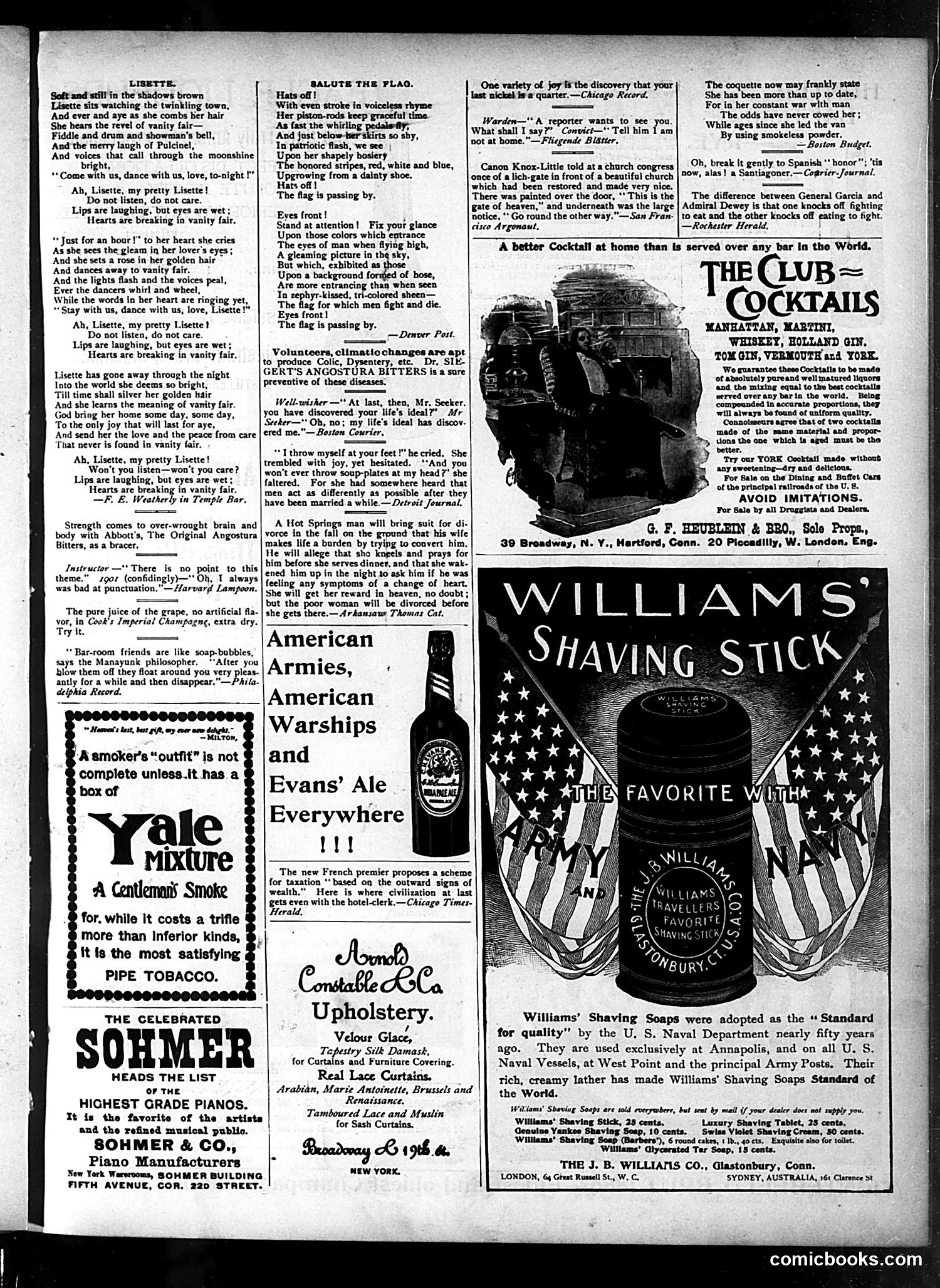
This page is primarily **advertisements and light verse**, not political cartoons. The main literary content is **"Lisette,"** a sentimental poem warning young women against frivolous nightlife ("vanity fair"). It's a cautionary moral tale—typical of the era—suggesting that pursuing glamorous entertainment leads to ruin, and that women should seek lasting domestic happiness instead. **"Salute the Flag"** is a humorous poem playing on patriotic imagery: it describes a woman's legs and patriotic-themed stockings passing by, tongue-in-cheek suggesting that the "flag" (her patriotic hosiery) is more "entrancing" than the actual flag itself. It's mild visual humor about male distraction. The remainder is **product advertising**: Yale Mixture tobacco, Sohmer pianos, Angostura Bitters, champagne, and shaving products—typical period advertisements with brief comedic taglines. **No significant political satire appears on this page.** It reflects early-20th-century attitudes about female morality, patriotism, and consumer goods, but doesn't address specific political events or figures.
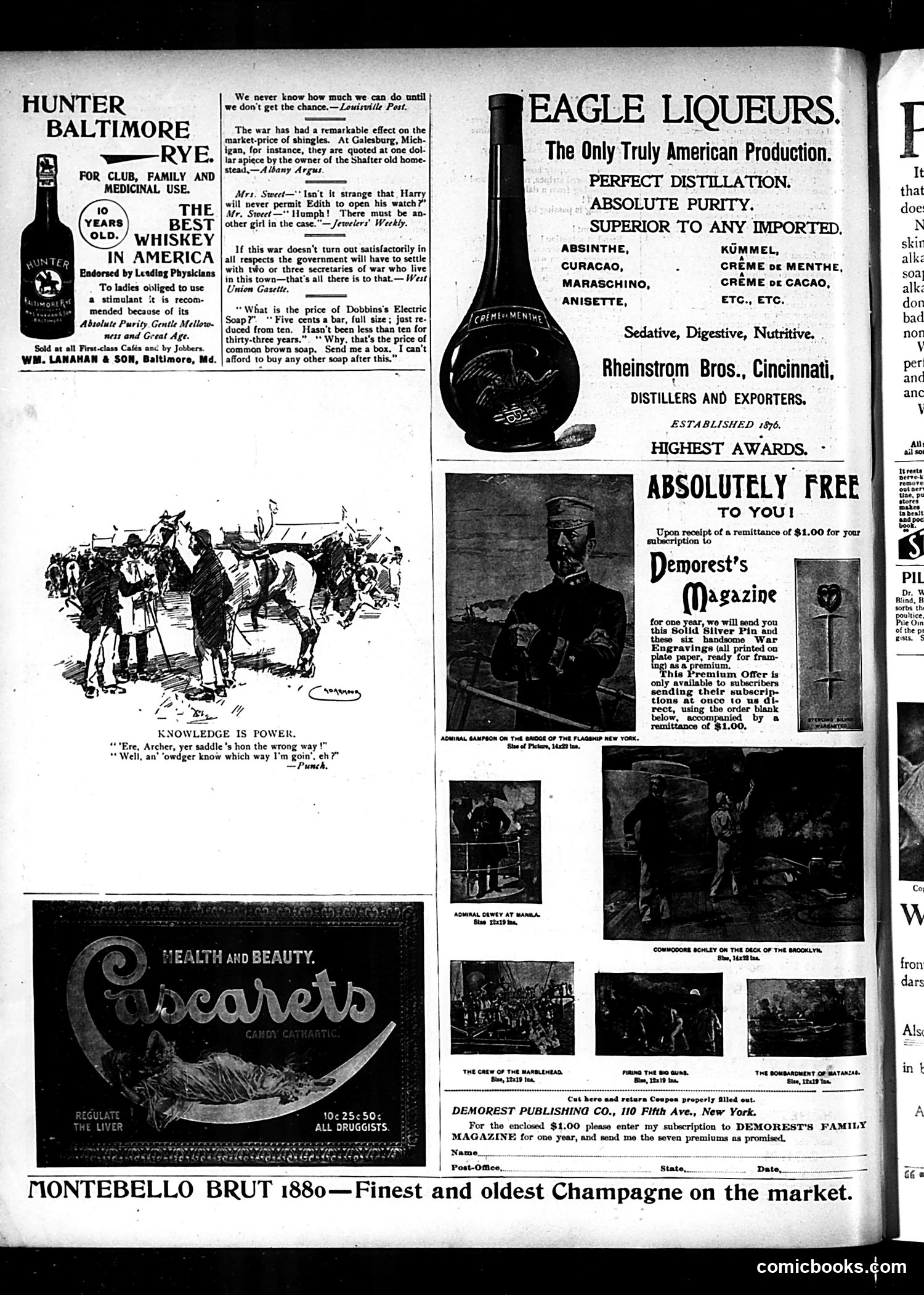
This page is primarily **advertising**, not political satire. It contains liquor and patent medicine ads typical of late-19th-century American magazines, plus subscription promotions. The small cartoons are generic humor: - "Knowledge is Power" shows a British soldier mounting his saddle backward—a visual gag about ignorance, using working-class dialect ("'owdger know"). - Various short quoted jokes about marriage, war profiteering, and soap prices are filler content. The ads themselves reflect period attitudes: whiskey marketed "for medicinal use" and endorsed by physicians (before Prohibition and FDA regulation), liqueurs claiming therapeutic properties ("sedative, digestive"), and patent medicines like Cascarets promising to "regulate the liver." The Demorest's Magazine subscription offer—$1 for a year plus "seven premiums" including engravings and a silver pin—was standard direct-mail marketing of the era. This page documents consumer culture and unregulated advertising rather than political commentary.
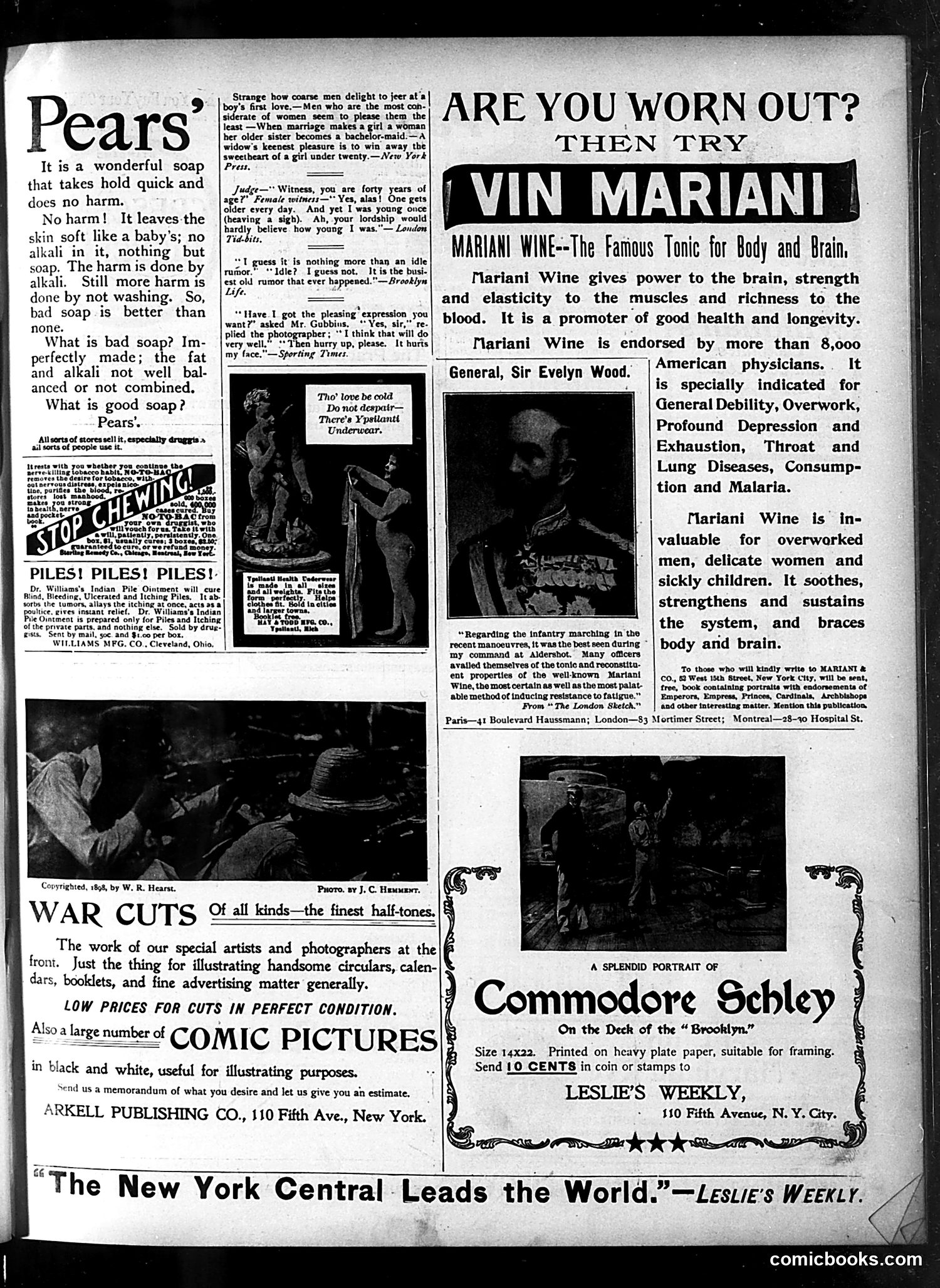
This page is primarily **advertising**, not political cartoons. It contains: **Left side:** Ads for Pears' soap, a piles ointment, and war photography cuts for publishers. Interspersed are brief humorous quotes from various publications (New York Press, London Tidbits, Brooklyn Life, Sporting Times)—these are jokes about aging women, rumors, and photography, not satire of current events. **Right side:** A large advertisement for Mariani Wine, a "tonic" endorsed by 8,000 physicians and military figures like General Sir Evelyn Wood. The wine claims to cure exhaustion, depression, malaria, and other ailments—typical of patent medicine marketing of the 1890s. A portrait of "Commodore Schley" appears below (likely Admiral Winfield Scott Schley, a Spanish-American War figure). **Context for modern readers:** This reflects pre-FDA regulation when medicines made extravagant health claims without evidence. The page is circa 1898, evidenced by the "War Cuts" reference to current front-line photography (Spanish-American War era).
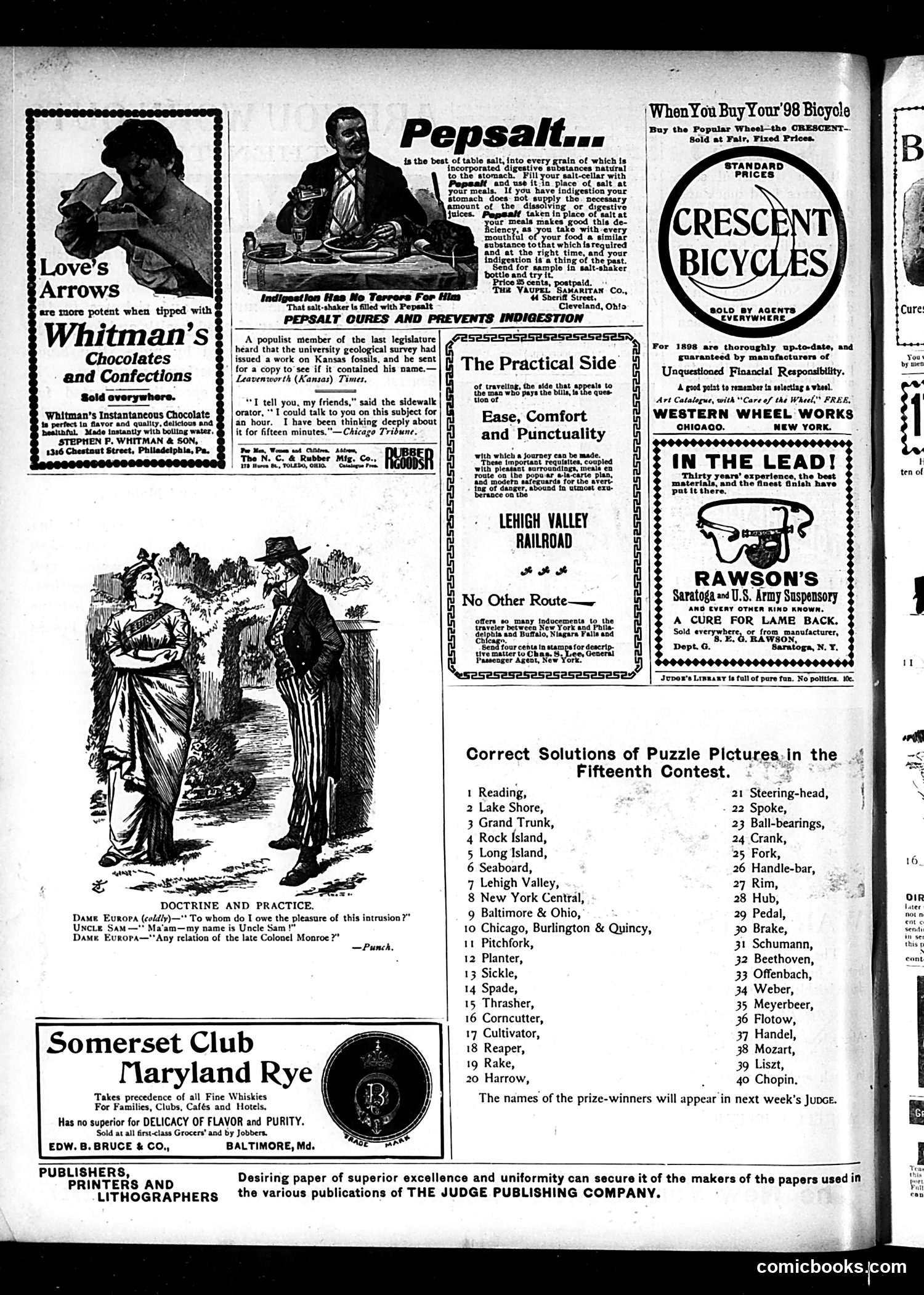
This political cartoon depicts a dialogue between "Dame Europa" (representing Europe) and "Uncle Sam" (the United States personified). The joke plays on the contrast between stated principles and actual behavior—the "doctrine and practice" of the title. Dame Europa coldly asks Uncle Sam to identify himself, and when he replies with his name, she sarcastically questions whether he's "any relation of the late Colonel Monroe"—a pointed reference to the Monroe Doctrine of 1823, which asserted American opposition to European intervention in the Americas. The satire targets American hypocrisy: Uncle Sam invokes Monroe's isolationist doctrine while increasingly pursuing imperial expansion (the Spanish-American War occurred in 1898, the year this appears). The cartoon suggests the U.S. is abandoning its founding principles of non-intervention as it becomes an imperial power itself—practicing something quite different from its stated doctrine.
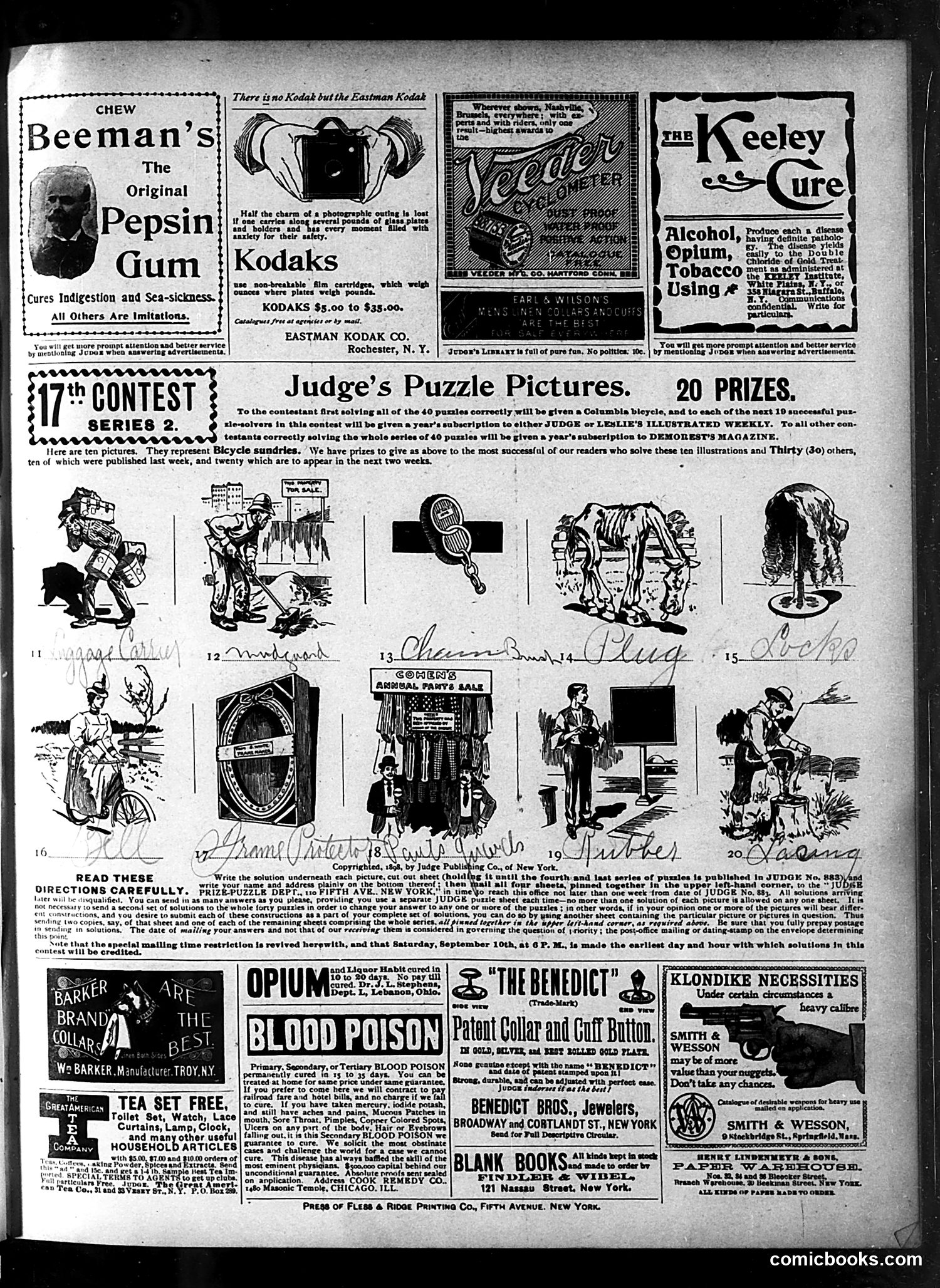
This page is primarily **advertising and a puzzle contest**, not political satire. The main content is Judge's "Puzzle Pictures" contest (Series 2), offering prizes including a Columbia bicycle and magazine subscriptions for solving 40 picture puzzles depicting bicycle sundries. The instructions occupy significant space with rules for entry and submission deadlines (September 10th). The surrounding advertisements are period-typical patent medicines and products: Beeman's Pepsin Gum (claimed to cure indigestion and sea-sickness), Kodak cameras, "The Keeley Cure" (an alcohol and opium treatment), and notably, an "Opium Blood Poison" cure—reflecting late 19th-century medical advertising's aggressive marketing of substances now recognized as dangerous. A "Barker Brand Collar" advertisement and other household goods complete the page. **There is no evident political cartoon or satirical commentary here**—it's a commercial page typical of Judge magazine's revenue model, mixing light puzzle entertainment with advertisements for dubious medical remedies and consumer products.
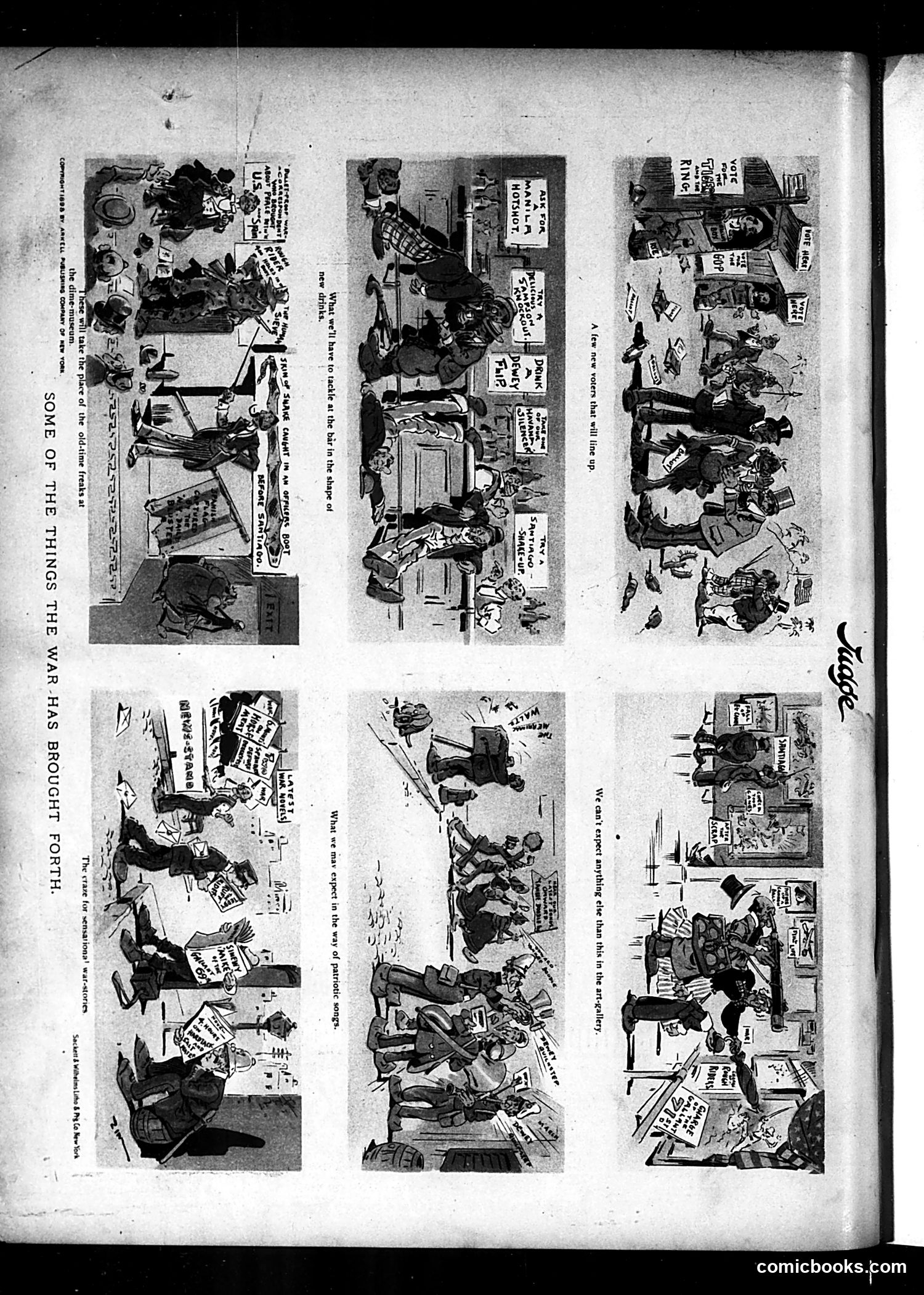
This page satirizes how the war (likely WWI, based on the style) has created new commercial attractions and sensations for the public. The cartoons depict various "war-related" entertainment and novelties that have emerged—depicted as oddities comparable to old dime-museum attractions. The caption "What we'll have to tackle at the bar" and reference to replacing "old dime-museum" curiosities suggests the cartoonist is mocking how Americans have commercialized and trivialized war experiences into entertainment commodities. The specific attractions appear to include war-themed novelties and sensational war stories being marketed for public consumption. The satire critiques American popular culture's tendency to package serious events (warfare) into exploitative spectacles for profit and amusement—treating genuine wartime experiences as mere curiosities for paying customers, much like the exploitative dime museums of the era.