
A complete issue · 16 pages · 1898
Judge — August 13, 1898
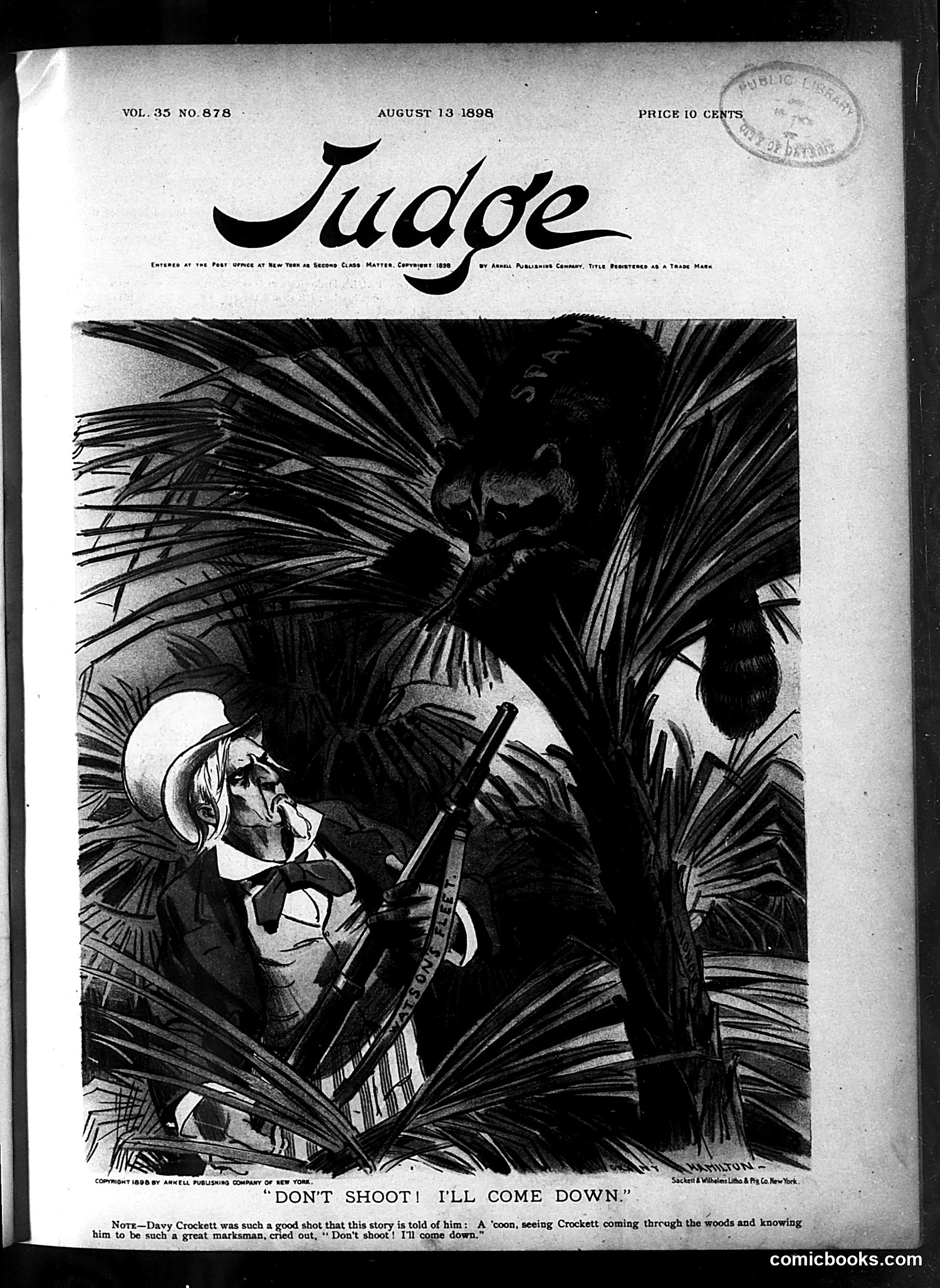
This illustration depicts a confrontation in palm trees between a hunter (left, wearing a hat) and what appears to be a large primate or ape (top). The caption reads "DON'T SHOOT! I'LL COME DOWN." The accompanying note references Davy Crockett and a famous anecdote: a coon, seeing Crockett approaching through woods and recognizing him as a great marksman, cried out "Don't shoot! I'll come down." This appears to be a satirical commentary using the Crockett legend—likely applied to a contemporary political or social figure of 1898, though the specific target remains unclear from the image alone. The joke plays on the idea of someone voluntarily surrendering rather than facing inevitable defeat by a superior force.
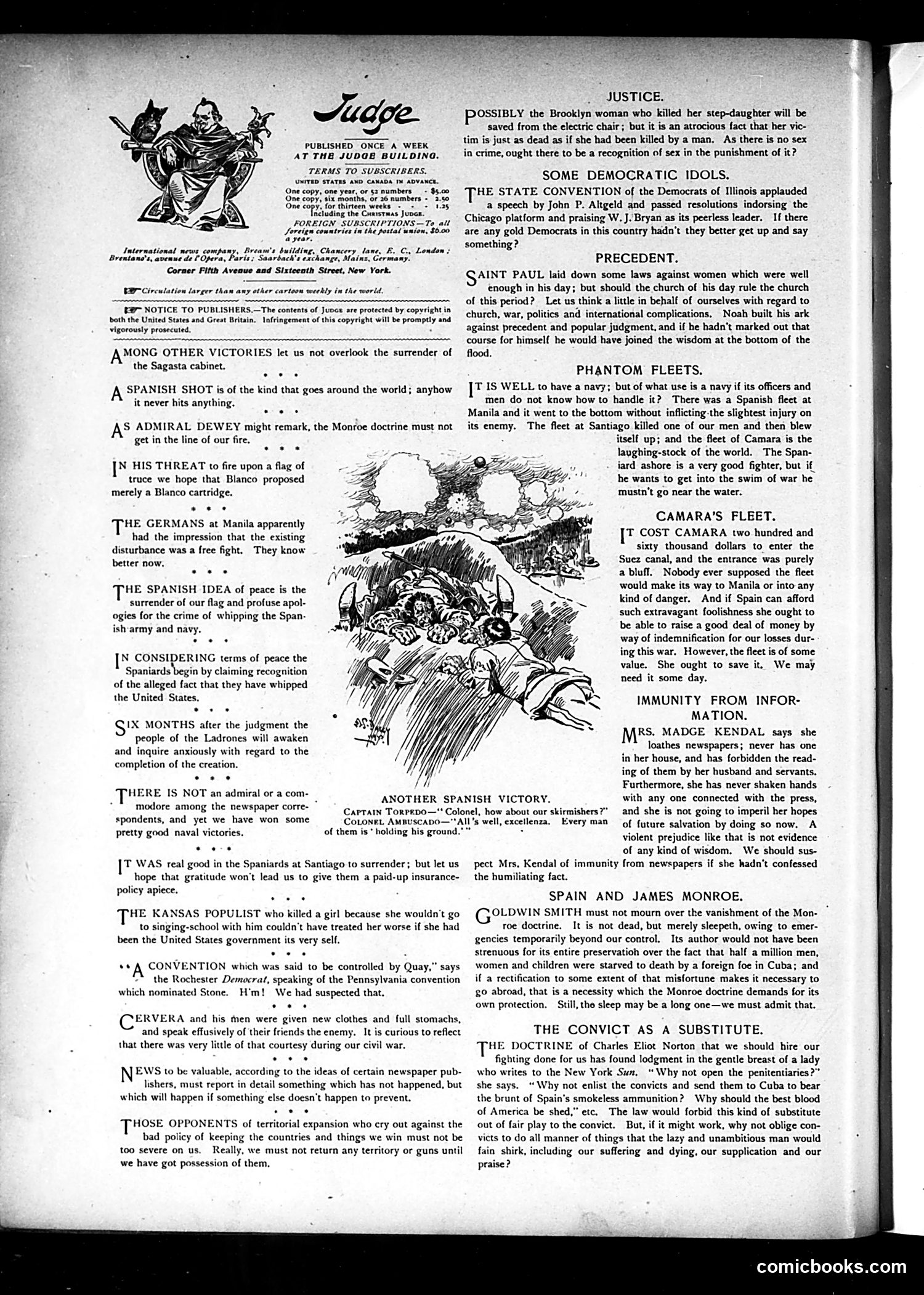
The main cartoon depicts a figure lying in water labeled "ANOTHER SPANISH VICTORY," satirizing Spain's naval defeats during what appears to be the Spanish-American War. The drowning figure represents Spain's humiliation despite claims of victory. The text columns mock Spanish military incompetence and inflated rhetoric about their fleet's strength, particularly regarding Camara's fleet and the cost of defending the Suez Canal. Judge ridicules Spain's "extravagant foolishness" while praising American naval superiority. The editorial also critiques Democratic politicians for weak positions and addresses social issues like a Kansas populist's violence and Mrs. Kendal's newspaper immunity claims. The satire targets Spanish military failure, Democratic weakness, and various contemporary social contradictions through pointed commentary and mockery.
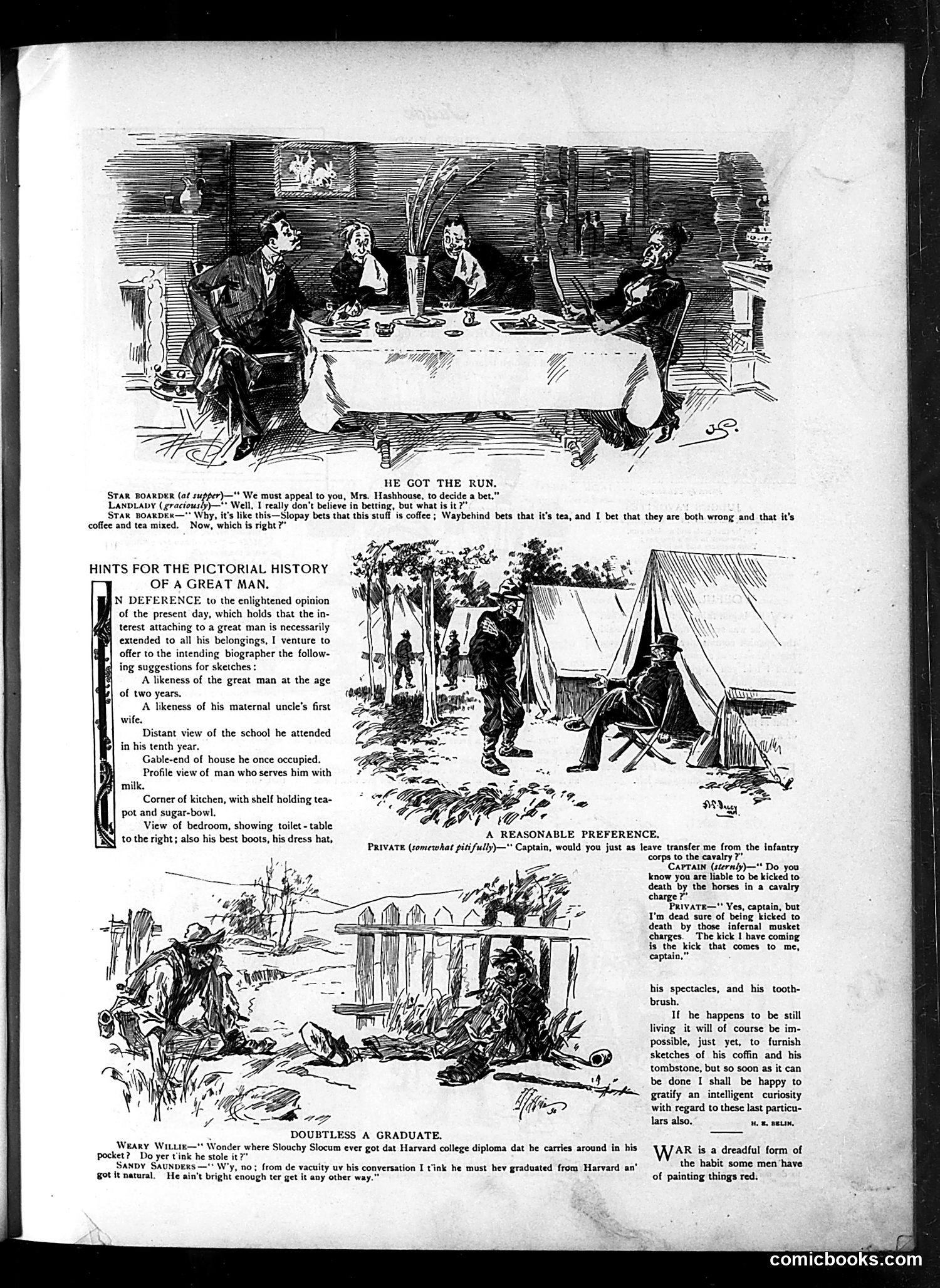
This page contains three satirical scenes from what appears to be a military-themed issue: **"He Got the Run"** depicts a debate about whether to bet on tea or coffee—likely mocking trivial concerns during wartime. **"Hints for the Pictorial History of a Great Man"** offers suggestions for documenting a notable figure's life through various domestic and personal scenes (his home, school, relatives, kitchen details). **"A Reasonable Preference"** shows a military exchange where a private requests cavalry transfer over infantry service, joking about preferring being kicked by horses to artillery shrapnel. **"Doubtless a Graduate"** satirizes an educated person (possibly referencing Harvard) caught in an embarrassing situation, suggesting even education doesn't prevent foolish behavior. The overall theme suggests commentary on military life, education, and human nature during wartime. The humor relies on incongruity and understated British-style wit characteristic of Judge magazine.
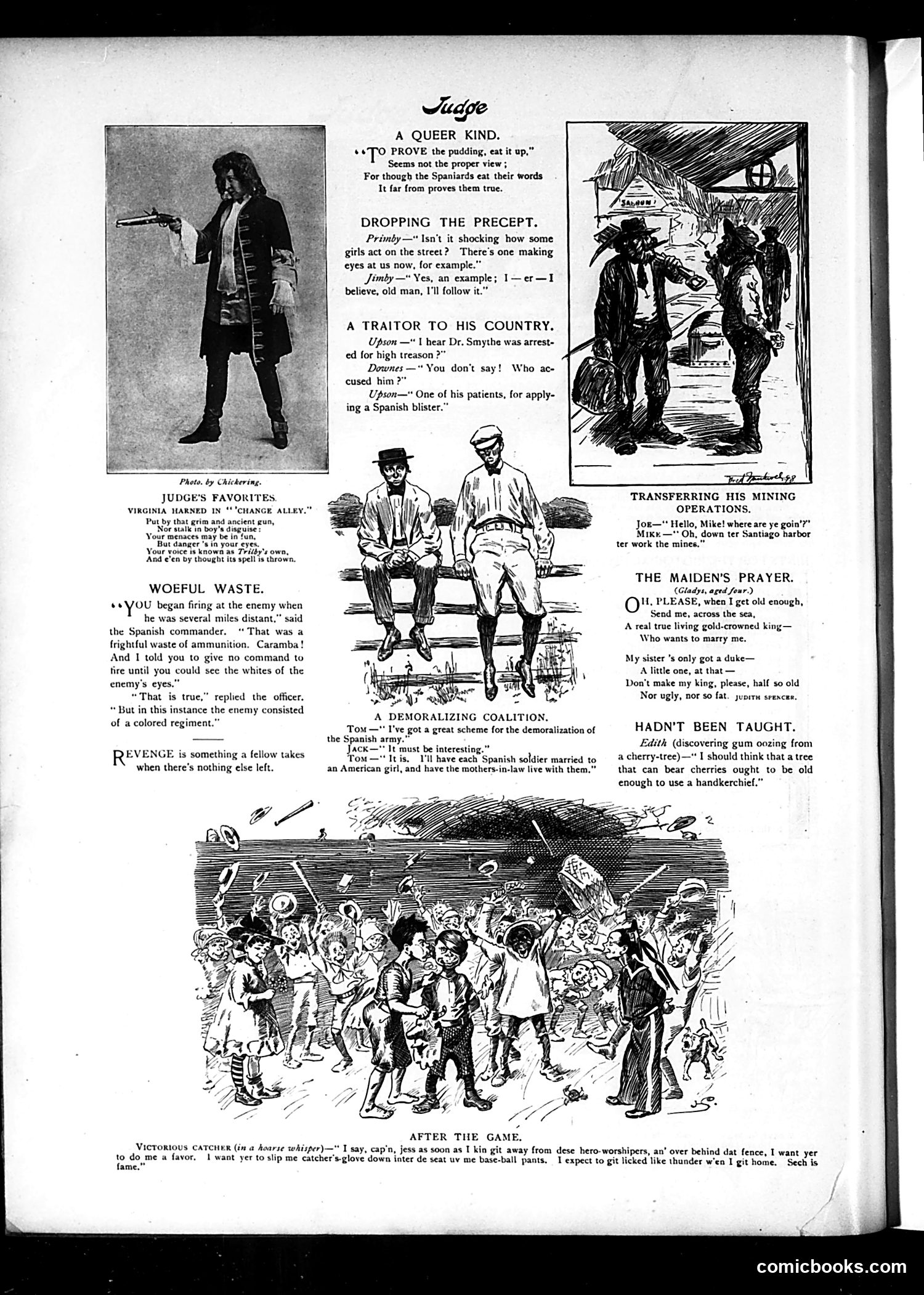
This page satirizes turn-of-the-century American political and social issues through several cartoons: **"A Queer Kind"** mocks the Spanish-American War era, debating whether eating pudding "proves" truthfulness—likely referencing debates about American imperialism's justification. **"Dropping the Precept"** jokes about girls behaving improperly on streets, with someone "applying a Spanish blister" (physical punishment)—reflecting anxieties about changing social norms for women. **"A Traitor to His Country"** references a Dr. Smyths arrested for high treason after treating a Spanish patient—satirizing war-era xenophobia and paranoia about enemy sympathizers. The bottom cartoon, **"After the Game,"** depicts children as baseball enthusiasts, with accompanying humor about catching games—reflecting baseball's growing popularity in American culture. The page reflects early 1900s American social tensions: imperialism, gender norms, xenophobia, and cultural modernization.
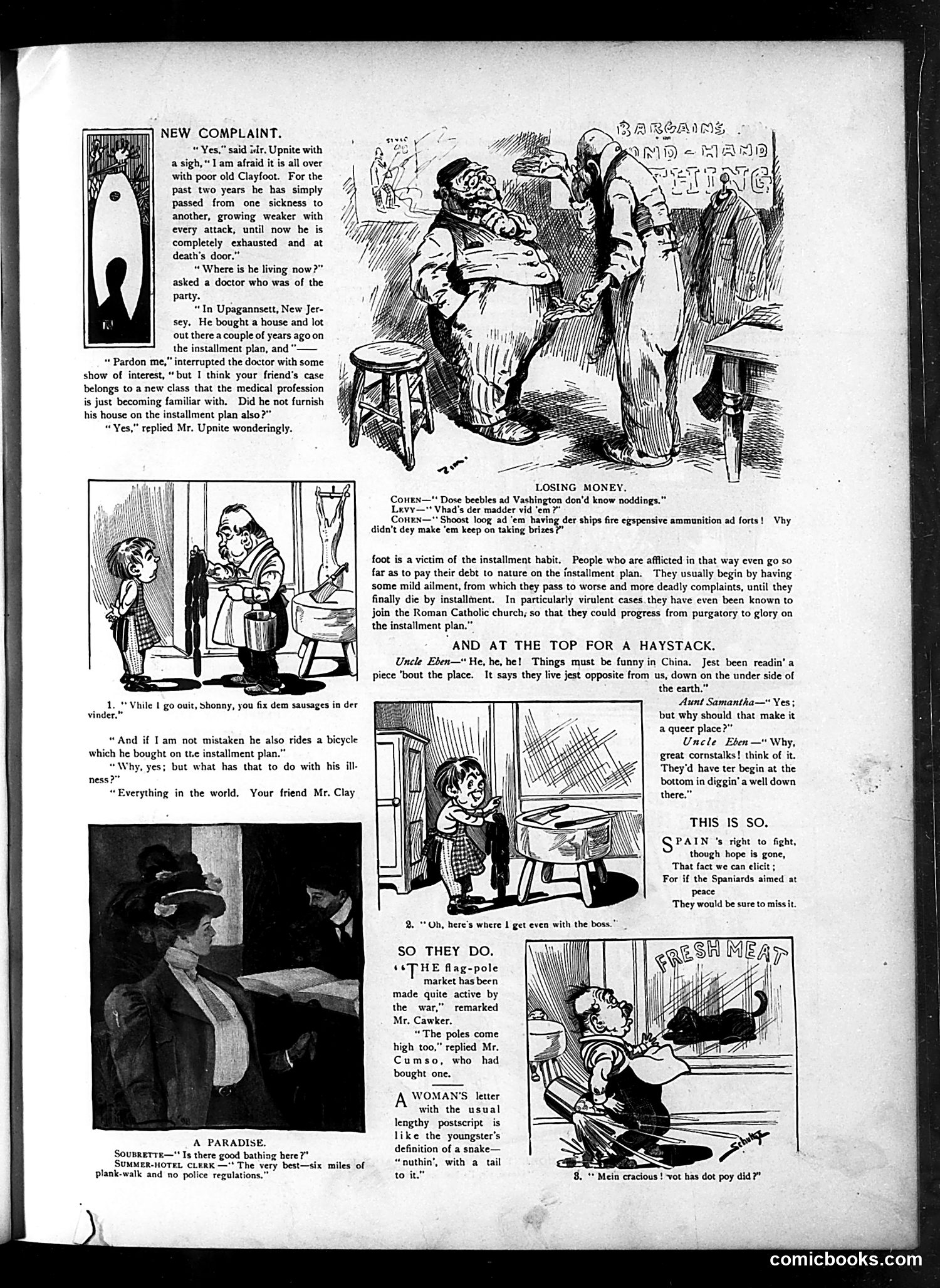
This page satirizes **the installment-plan purchasing system** that had become widespread in America. The central joke is that people buy everything on credit—houses, furniture, bicycles—and become so habituated to this debt that they're metaphorically dying "by installment," even joining churches to progress toward death "on the installment plan." Secondary items mock: - **Spanish-American War military strategy**: A character criticizes the Navy for firing expensive ammunition rather than continuing profitable "prizes" (captured ships). - **Immigration**: Dialect humor from "Uncle Eben" and German-accented speakers reflects period stereotyping of immigrant communities. - **Spain's military prospects**: A brief poem suggests Spain's situation is so hopeless they'd miss peace if they aimed for it. The cartoons use exaggeration and wordplay typical of *Judge*'s satirical approach, targeting contemporary consumer culture and military inefficiency rather than specific political figures.
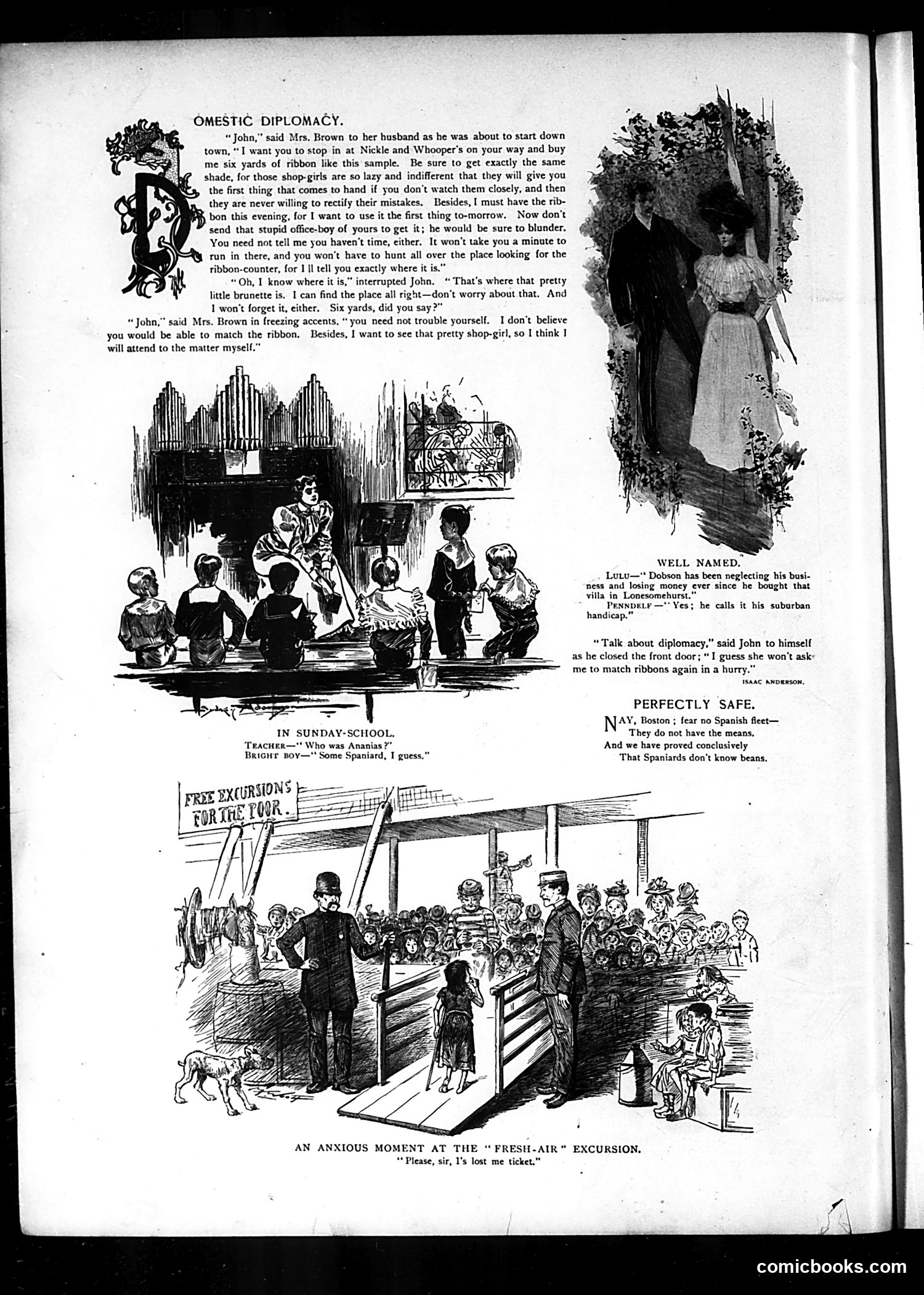
This page contains three unrelated satirical pieces from Judge magazine: **"Domestic Diplomacy"** (top): Mrs. Brown sends her husband to buy ribbon, giving detailed instructions while suspicious he's really interested in the "pretty little brunette" shop-girl. She calls his bluff by deciding to go herself. The joke critiques domestic power dynamics—wives using their knowledge of husbands' weaknesses to maintain control, while husbands rationalize personal errands as marital duty. **"Well Named"** (middle right): A brief joke about a man named Dobson who bought a villa in "Lonesomehurst" and calls it his "suburban handicap"—suggesting the investment ruined his business and marriage. **"In Sunday-School"** (bottom left): A child mistakes "Ananias" (biblical liar) for a Spaniard—likely a topical jab at Spanish dishonesty, possibly referencing Spanish-American War tensions. **"Fresh-Air Excursion"** (bottom): A child loses his ticket at a crowded seaside outing—a simple comedic moment about urban working-class recreation.
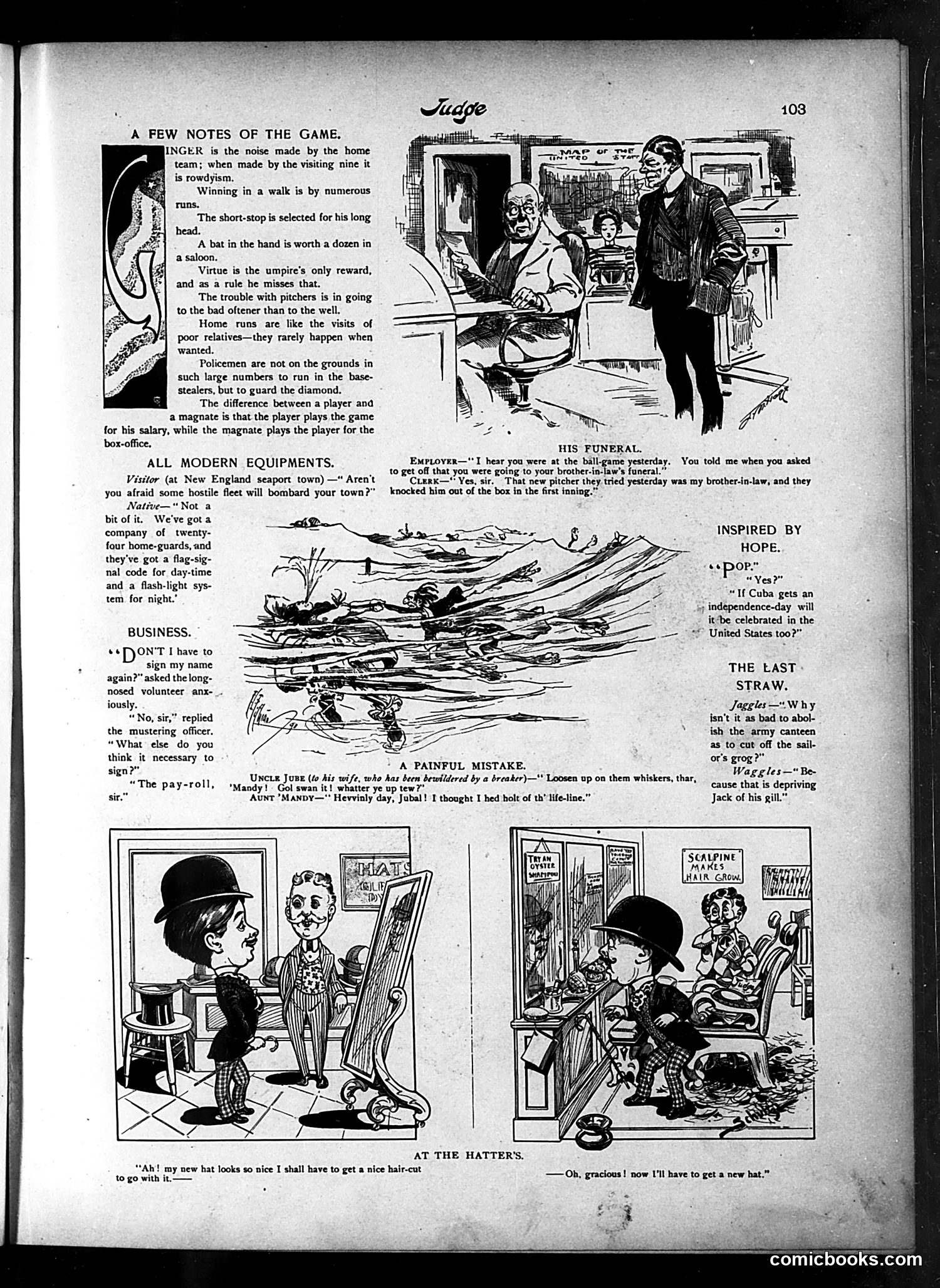
This page from *Judge* contains baseball humor and social satire typical of early 20th-century American comedy. **"A Few Notes of the Game"** offers cynical observations about baseball: contrasting how home team noise is "cheering" while visiting team noise is "rowdyism"; noting umpires receive no reward and "miss" their only one (virtue); and comparing home runs to unwanted visits from poor relatives. **The main cartoons mock working-class life:** One shows an employer catching an employee in a lie about attending his brother-in-law's funeral—which was actually the employee going to a baseball game. Another depicts a coastal town's comically inadequate military defenses (flag signals and flashlights). **"At the Hatter's"** shows a barber/hatmaker joke where a customer must buy a new hat to accompany his new haircut. The satire targets class hypocrisy, masculine leisure pursuits, and working-class anxieties about employment and appearances rather than explicitly political content.
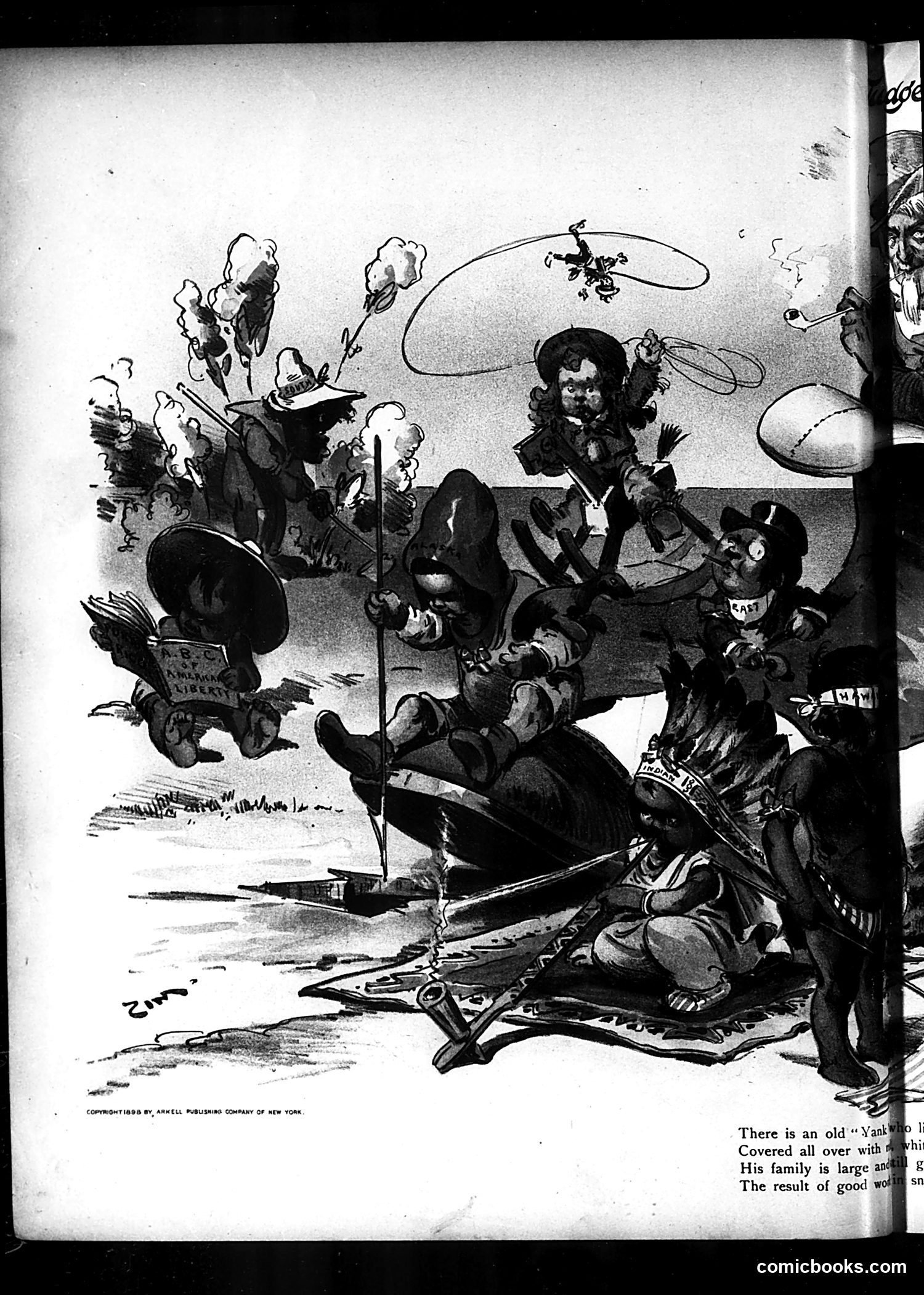
This appears to be a satirical cartoon showing figures engaged in some form of labor or activity. The OCR text fragment references "an old Yankee" whose family is "large" and mentions "the result of good work," suggesting commentary on American industriousness or family productivity. The cartoon depicts multiple caricatured figures in what looks like a work scene, though the exact context is unclear from the damaged/incomplete text. Given Judge magazine's focus on political and social satire in the late 19th/early 20th century, this likely comments on American labor conditions, immigration, or social class dynamics—common targets of the publication's humor. Without clearer text or identifying visible labels, the specific reference remains uncertain, though the chaotic composition and caricature style typical of Judge's editorial cartoons suggests social criticism rather than praise.
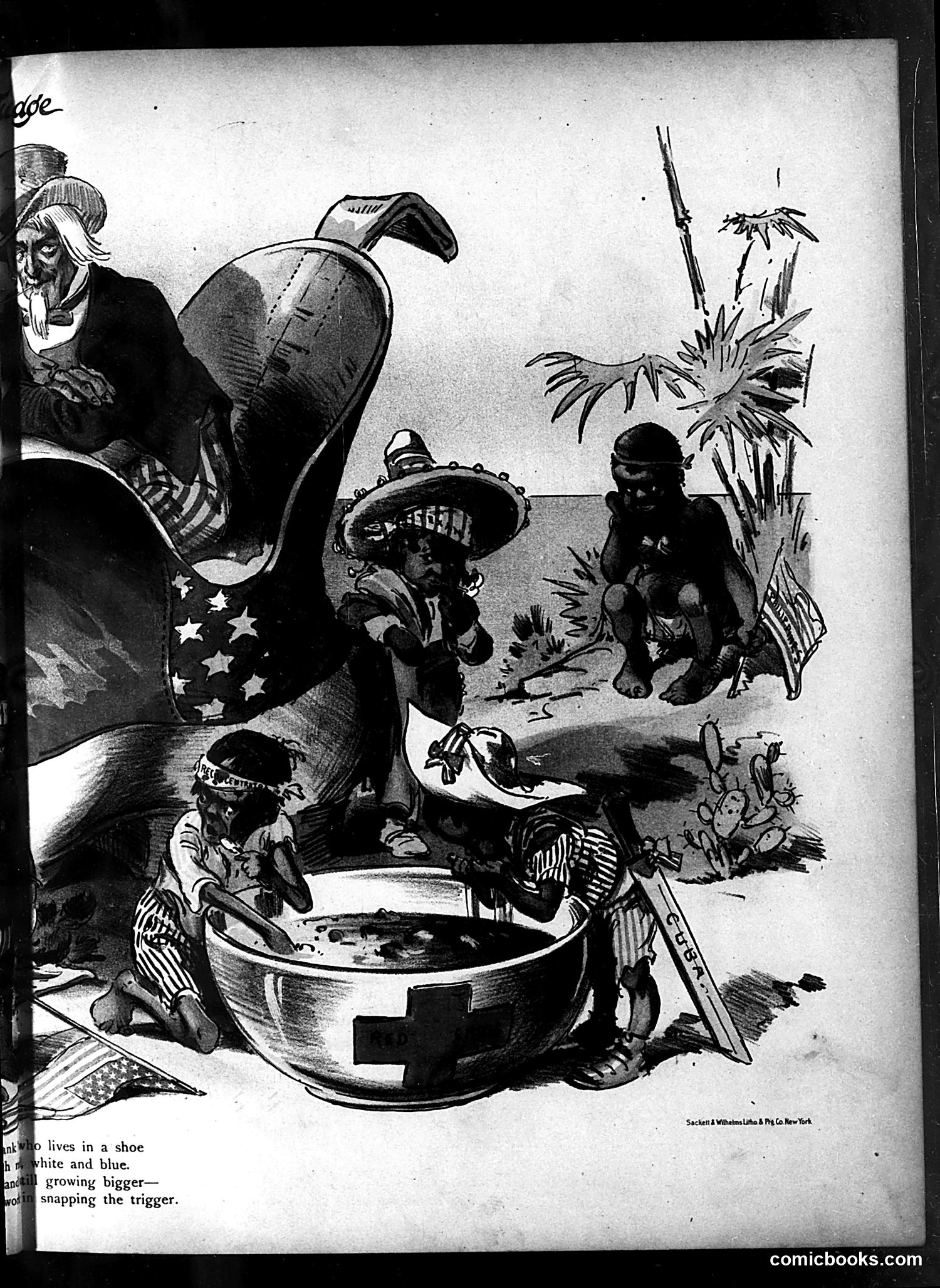
This political cartoon satirizes American imperial expansion, likely from the early 1900s. The large figure on the left appears to represent Uncle Sam (identifiable by the stars-and-stripes clothing), depicted as an old, menacing character. He looms over smaller figures wearing Mexican and Asian dress, who huddle around a cauldron in a desert landscape with sparse vegetation. The rhyming text references "a shoe" and "white and blue," suggesting the nursery rhyme "There Was an Old Woman Who Lived in a Shoe"—here twisted into dark commentary. The message appears critical of American expansionism: Uncle Sam as an aggressive force "growing bigger" and "snapping the trigger," implying military aggression against smaller nations. The cauldron suggests brewing conflict or colonial exploitation. This reflects contemporary criticism of U.S. interventionism in Latin America and Asia.
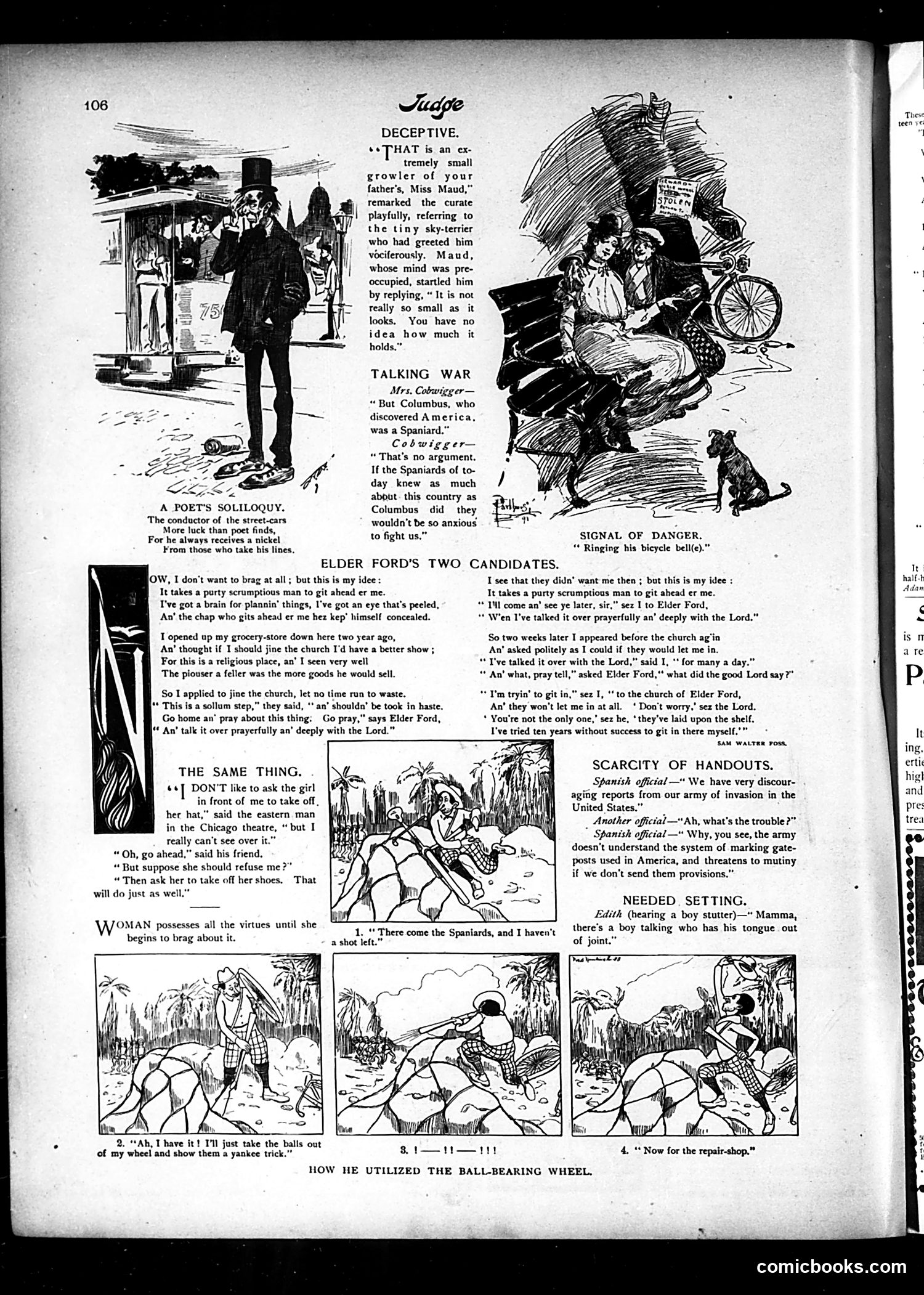
This page contains multiple brief satirical pieces from an American humor magazine, likely from the Spanish-American War era (references to Spain's invasion of the U.S. appear). **Key content:** - **"Elder Ford's Two Candidates"**: A longer narrative poem satirizing religious hypocrisy. A grocer joins a church not from faith but to boost business. Elder Ford advises prayer, and the grocer later reports the Lord told him he couldn't get in either—a joke about exclusion and divine indifference to human schemes. - **"Talking War"**: Mocks Americans' knowledge of geography/history regarding Spain. A man argues Spaniards wouldn't invade if they understood America as well as Columbus did. - **Comic strip "Ball-Bearing Wheel"**: A Spaniard loses bicycle parts and uses them to trick Americans, presumably showing resourcefulness or trickery during the invasion scare. - **Various one-liners**: Jokes about women, theater etiquette, and religious cant. The overall tone reflects American anxiety and superiority regarding Spanish military threat, mixing patriotic mockery with social satire.
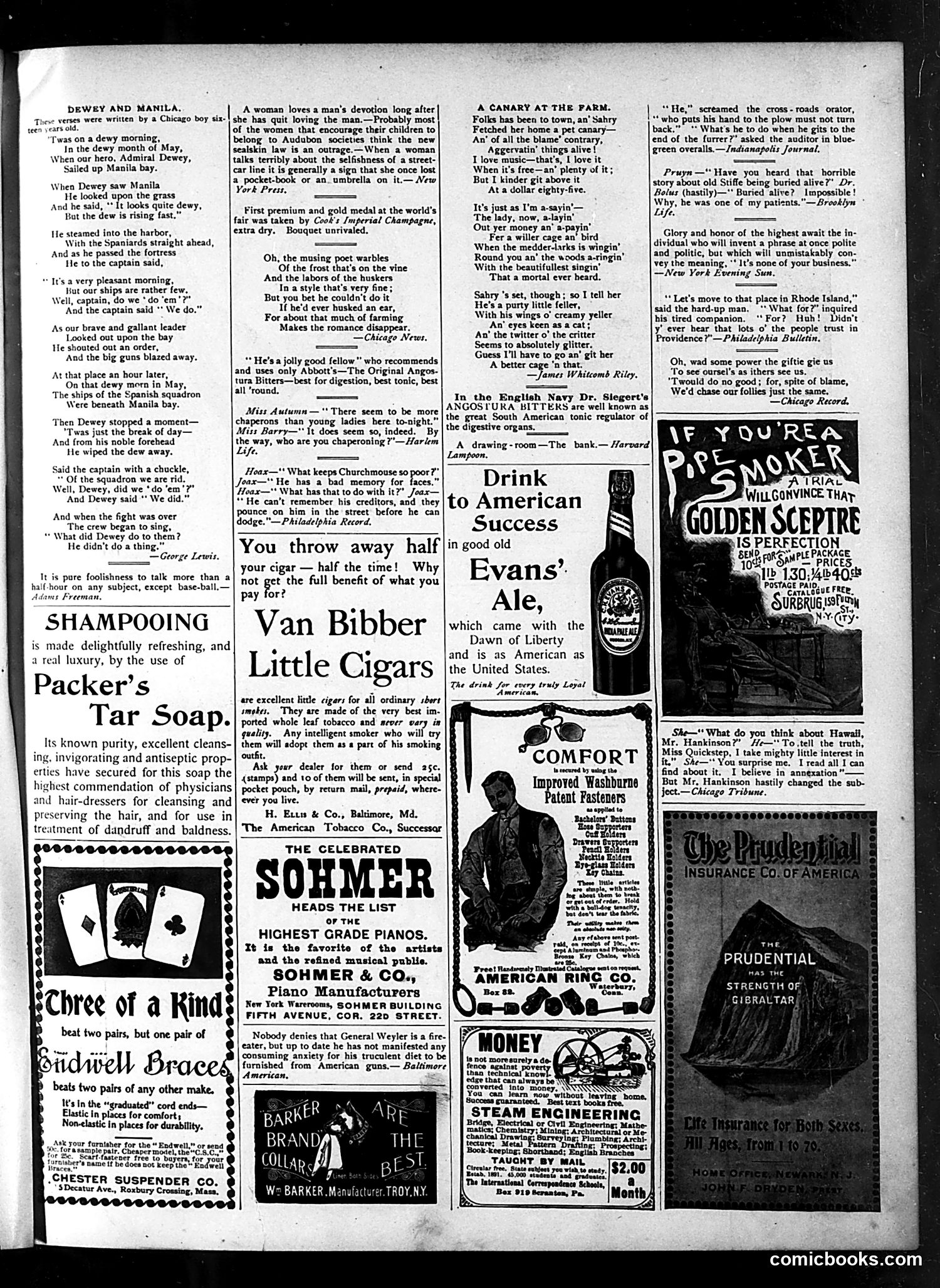
This page is primarily **poetry and advertising** rather than political cartoons. The main satirical content is the poem "Dewey and Manila," which celebrates Admiral Dewey's 1898 naval victory at Manila Bay during the Spanish-American War. The humor is gentle and patriotic—the poem repeatedly puns on "dewy" (the time of day) while describing a decisive American military triumph. The final couplet ironically undercuts the celebration: after all the fanfare, "He didn't do a thing." The page also contains light social satire in scattered quotes mocking human nature—women's inconsistency in love, hypocrisy about conservation, complaints about transportation. These are mild observational humor typical of the era. The remainder consists of product advertisements (cigars, soap, pianos, braces, ales) common to magazines of this period. **Context for modern readers:** The Dewey poem celebrates American military expansion in 1898, when the U.S. was becoming a global imperial power.
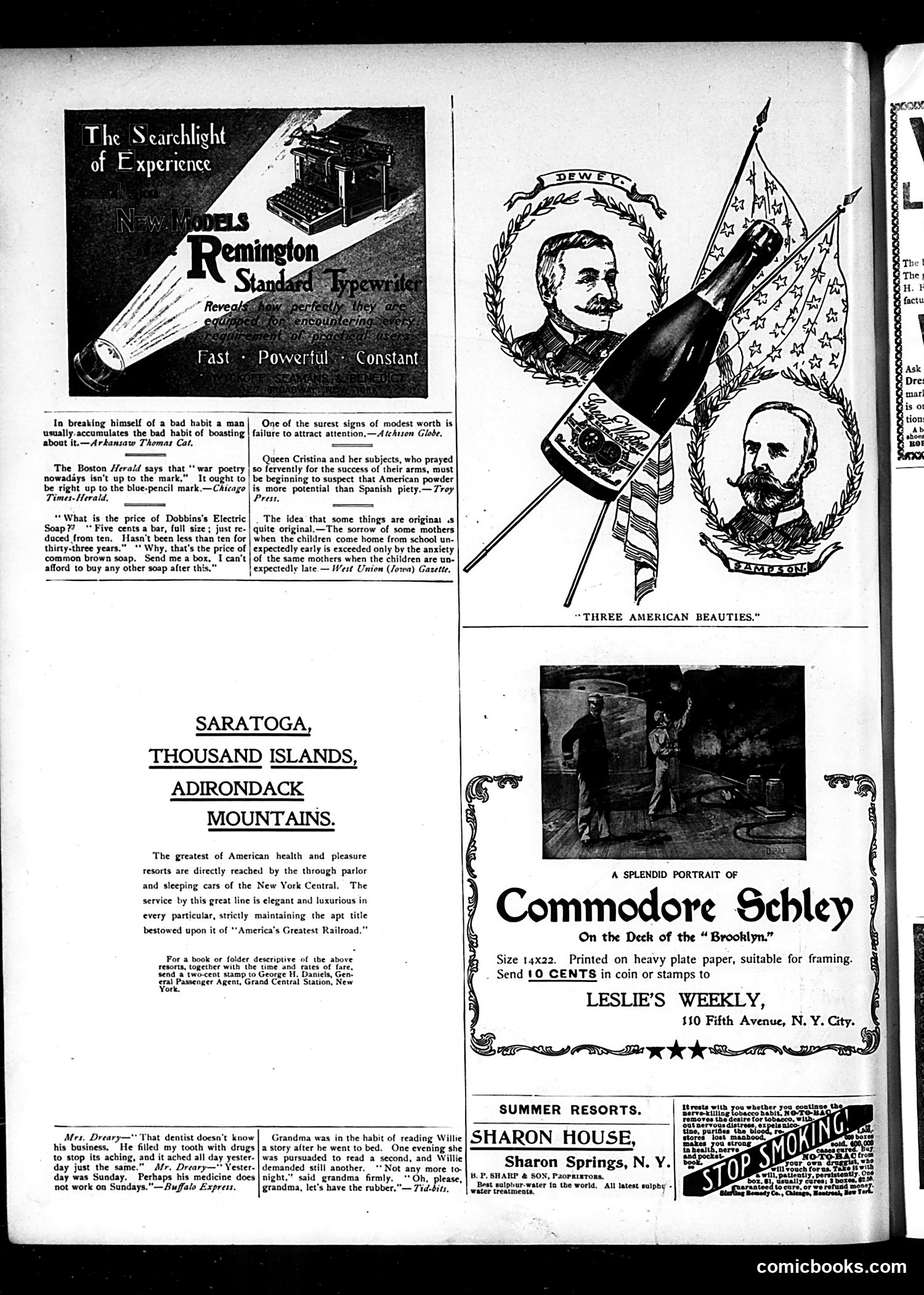
This page from the satirical magazine **Judge** contains primarily **short humorous quips and advertisements** rather than political cartoons. The text jokes target contemporary targets: The Boston Herald's criticism of modern war poetry; a soap company's pricing claims; and the Spanish-American War, with a jab at "Spanish piety" versus "American powder" effectiveness. The only significant illustration is titled **"Three American Beauties,"** showing **Dewey** (Admiral George Dewey, hero of the 1898 Manila Bay victory) with champagne bottles and American flags—celebrating American military success, likely referencing the recent Spanish-American War. Most of the page is **advertisements**: Remington typewriters, New York Central Railroad resort destinations, and a portrait of Commodore Schley (another Spanish-American War naval commander), plus a resort hotel ad. The humor is light domestic satire—dentists, grandmothers, soap prices—typical of Judge's comedic approach rather than sharp political commentary.
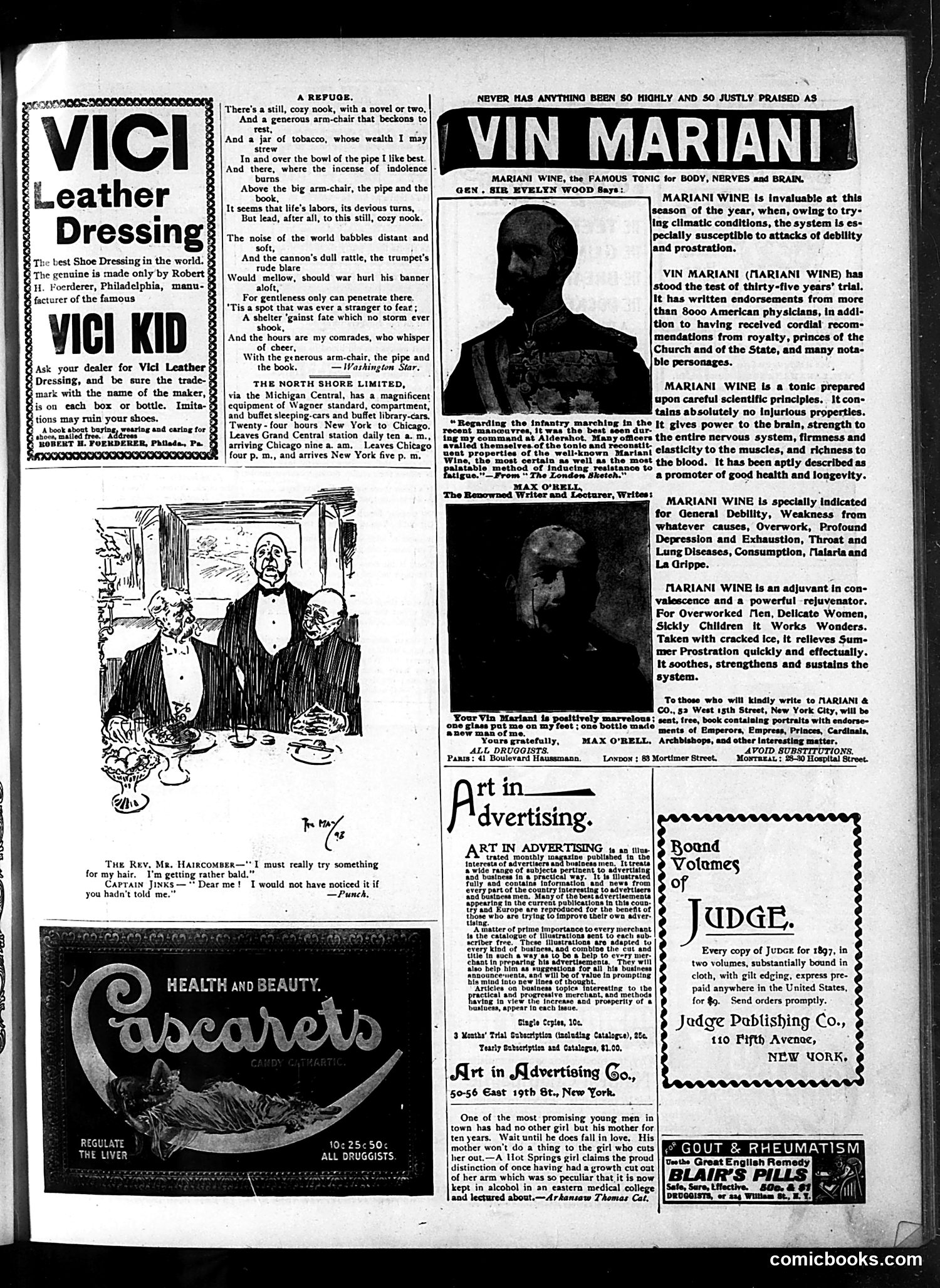
This page is primarily **advertising**, not satire or political commentary. The dominant content promotes **Vin Mariani**, a patent medicine wine marketed as a tonic for nerves, brain, and body. The testimonials from prominent figures (Sir Evelyn Wood, "Max O'Rell") and claims of endorsements from "8000 American physicians" typify late 19th/early 20th-century medical advertising, before FDA regulation. The small cartoon at bottom-left is a mild joke: Rev. Haircomber complains of baldness; Captain Jinks replies he hadn't noticed—implying the reverend was already so bald it made no difference. Secondary ads include **Vici Leather Dressing** and **Cascara** (a laxative). The page also contains poetry about finding refuge in a quiet study—thematic filler typical of Judge's format. The page reflects an era when magazines liberally mixed editorial content with unvetted product claims.
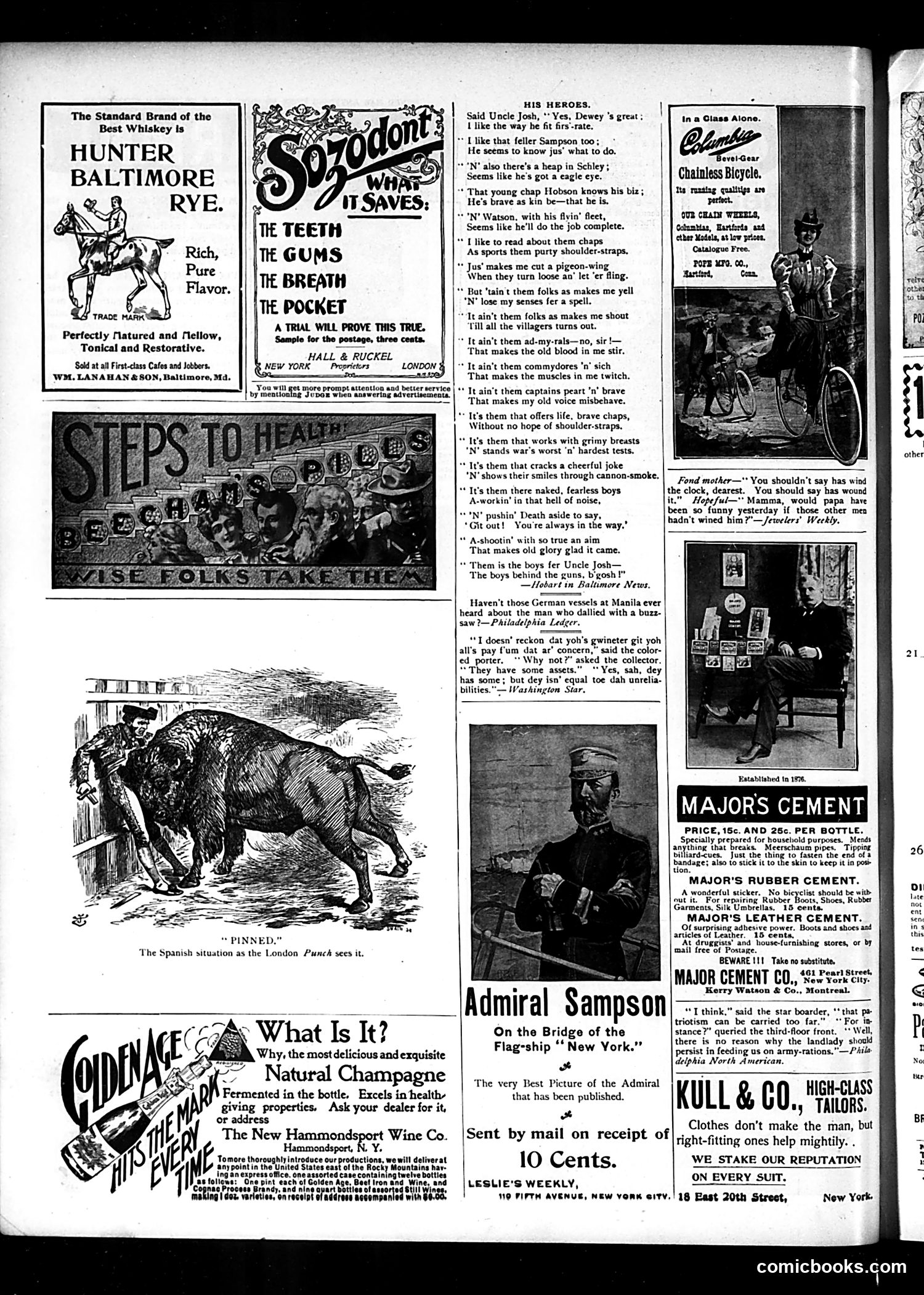
This page celebrates American military heroes from the Spanish-American War (1898). The main poem, "His Heroes," presents Uncle Josh praising naval and military figures: **Dewey** (Admiral George Dewey, who defeated Spanish fleet at Manila), **Sampson** (Admiral William Sampson), **Schley** (Commodore Winfield Scott Schley), **Hobson** (Richmond Hobson, famous for sinking a ship to block Santiago harbor), and **Watson** (likely Admiral John Crittenden Watson). Uncle Josh's sentiment is clear: he admires these officers, but *truly* honors the ordinary enlisted sailors and soldiers—the unnamed men working with "grimy breasts" in the gun crews and below decks. They face death without hope of glory or promotion ("shoulder-straps"), yet maintain courage and humor amid cannon fire. This is patriotic satire with democratic undertones—elevating the common soldier as the real hero, not the celebrated admirals. The accompanying advertisements (Sozodont toothpaste, bicycles, cement) are typical magazine filler.
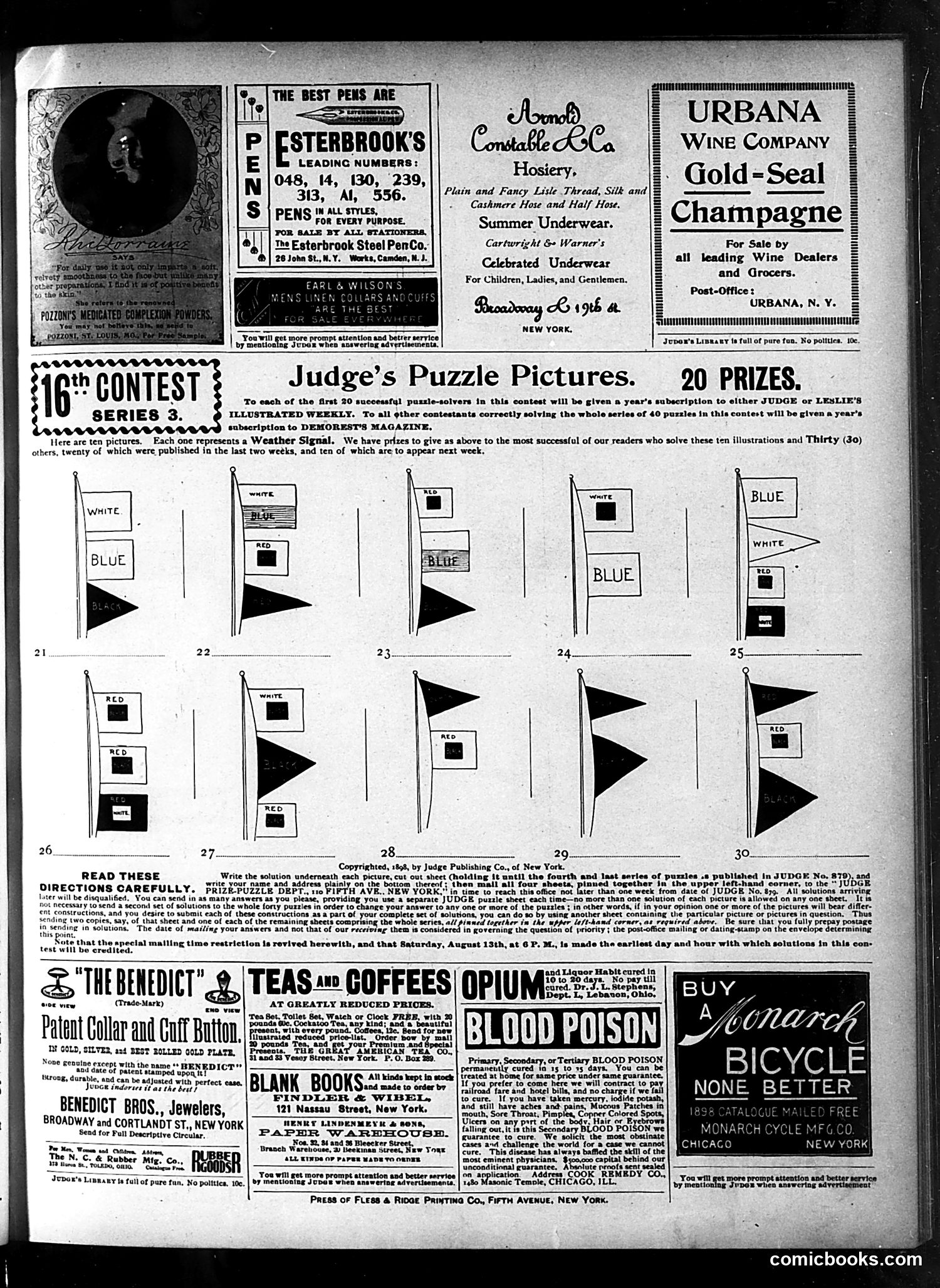
This page is primarily **advertising and a puzzle contest**, not political satire. The main feature is "Judge's Puzzle Pictures" — a contest offering subscriptions to Judge or Leslie's Illustrated Weekly to solvers. Readers must identify ten weather signal illustrations (shown as simple flag designs in various color combinations). The contest includes 40 total puzzles across multiple issues. The advertisements are typical of the era: pen companies (Esterbrook), hosiery/underwear (Constable), champagne (Urbana Wine Company), collar buttons (Benedict Bros.), and patent medicines. One ad notably promotes "Blood Poison" treatment and another advertises the Monarch bicycle. The page includes detailed contest rules emphasizing proper mailing procedures and deadlines—suggesting this was a popular, participation-driven feature. The tone is businesslike rather than satirical. Without knowing Judge's publication date or broader editorial context from this issue, the political content remains unclear from this page alone.
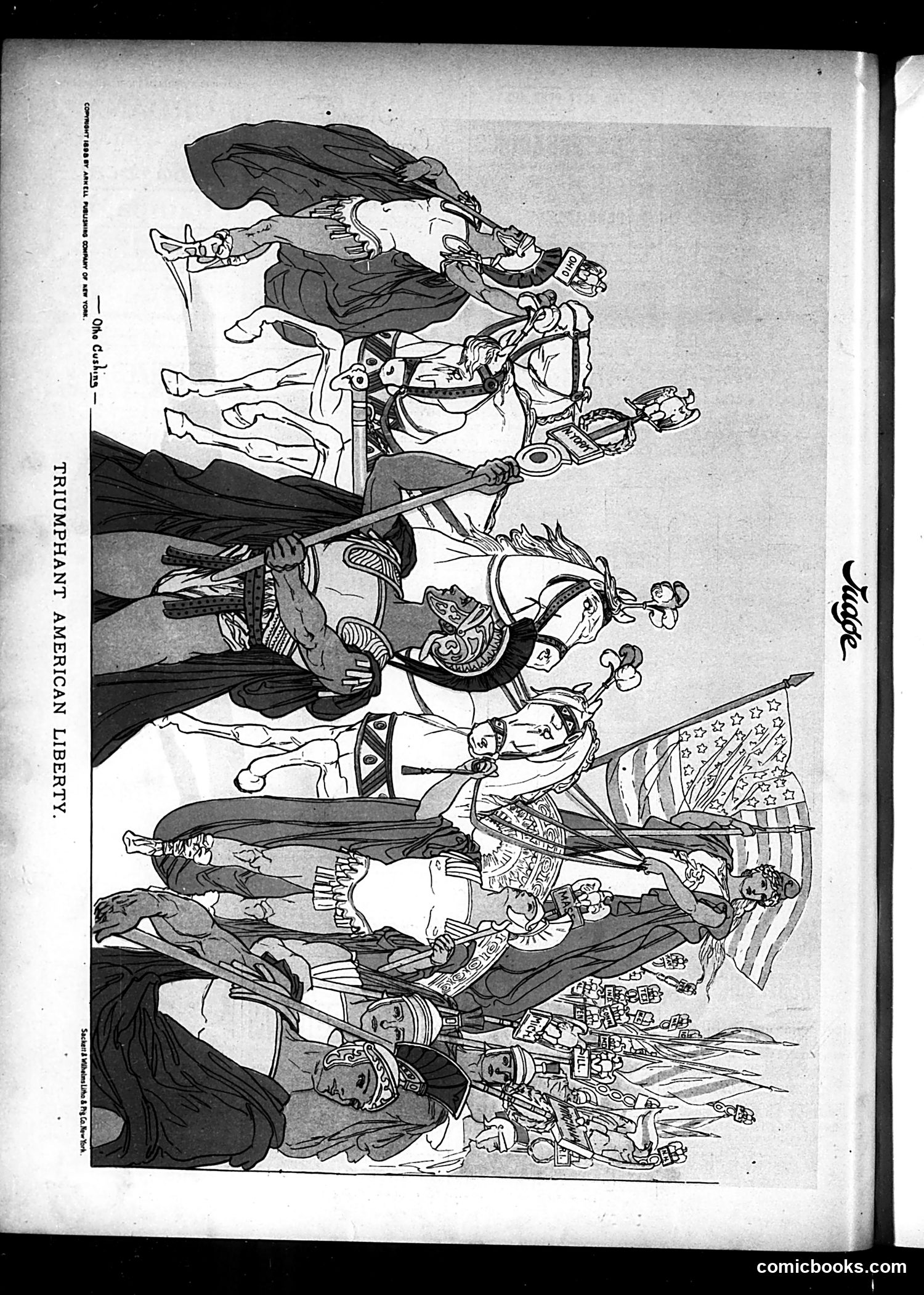
This 1898 cartoon by Otho Cushing depicts "Triumphant American Liberty" as a classical female figure presiding over an elaborate procession of diverse characters and pageantry. The image celebrates American imperial expansion following the Spanish-American War. The composition shows Liberty as a commanding central figure overlooking military personnel, civic leaders, indigenous peoples, and various national representatives—likely symbolizing America's newly acquired territories (Cuba, Puerto Rico, Guam, the Philippines). The ornate details and hierarchical arrangement suggest American dominance over these colonial subjects. The satire likely critiques American expansionism by presenting it as "triumphant" while ironically depicting the subjugation of diverse populations under Liberty's rule. This reflects contemporary debates about American imperialism and whether territorial acquisition contradicted democratic ideals.