
A complete issue · 16 pages · 1898
Judge — July 30, 1898
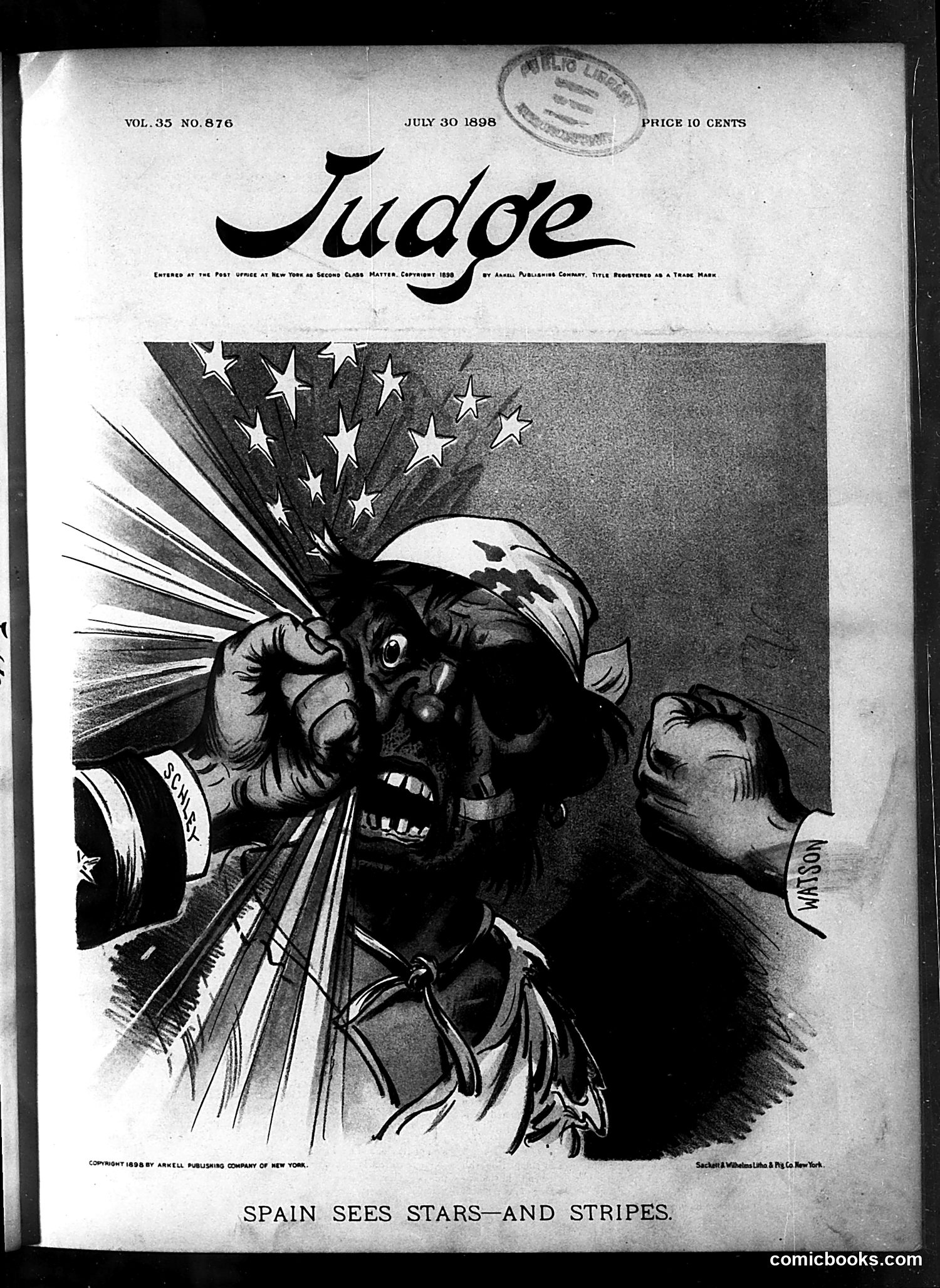
This **Judge** magazine cover from July 30, 1898, references the Spanish-American War. The central caricature depicts Spain as a grotesque, suffering figure wearing a bandaged head and appearing dazed or defeated—"seeing stars" from being struck. The American flag looms behind Spain's head, while labels identify figures as "Spain," "Schley" (likely Admiral Winfield Scott Schley, who commanded U.S. naval forces), and what appears to be another American military figure. The radiating lines suggest explosive impact or a sudden blow. The satire celebrates America's military dominance in the brief 1898 conflict, which resulted in Spain losing colonial territories including Cuba, Puerto Rico, and the Philippines. Spain is portrayed as overwhelmed and humiliated by American force.
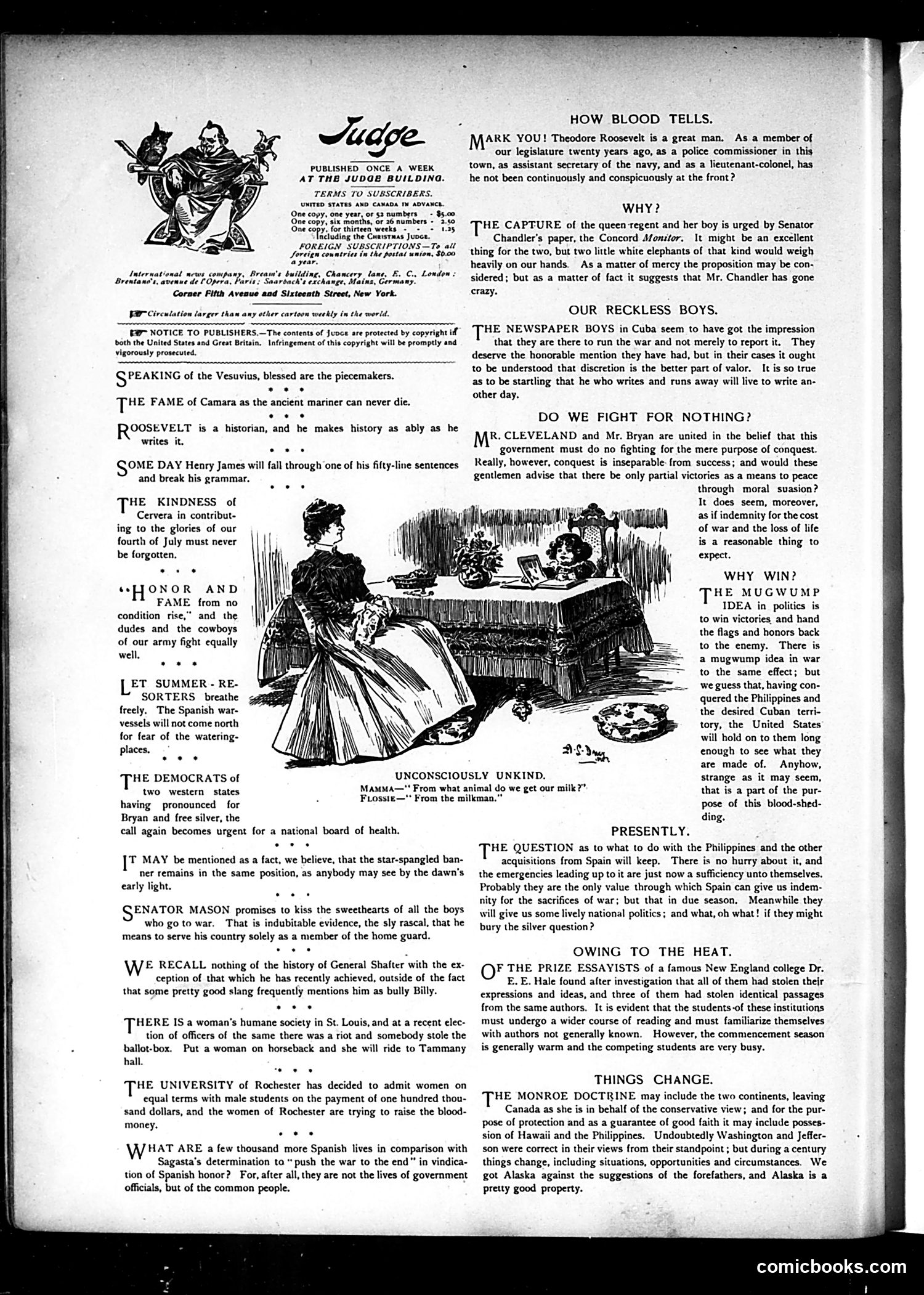
The main cartoon titled "Unconsciously Unkind" depicts a woman asking a milkman "From what animal do we get our milk?" to which he replies "From the milkman." This is a gentle domestic joke playing on the woman's naive question and the milkman's deadpan response—satirizing either female ignorance about food sources or the absurdity of the question itself. The surrounding editorial commentary discusses Spanish-American War politics, senators' positions on conflict, newspaper coverage of Cuban operations, and debates over territorial acquisition (Philippines, Hawaii, Alaska). The text critiques political rhetoric about fighting for noble causes while pursuing imperial expansion—typical Progressive-era satire questioning American foreign policy motivations during the 1898 conflict.
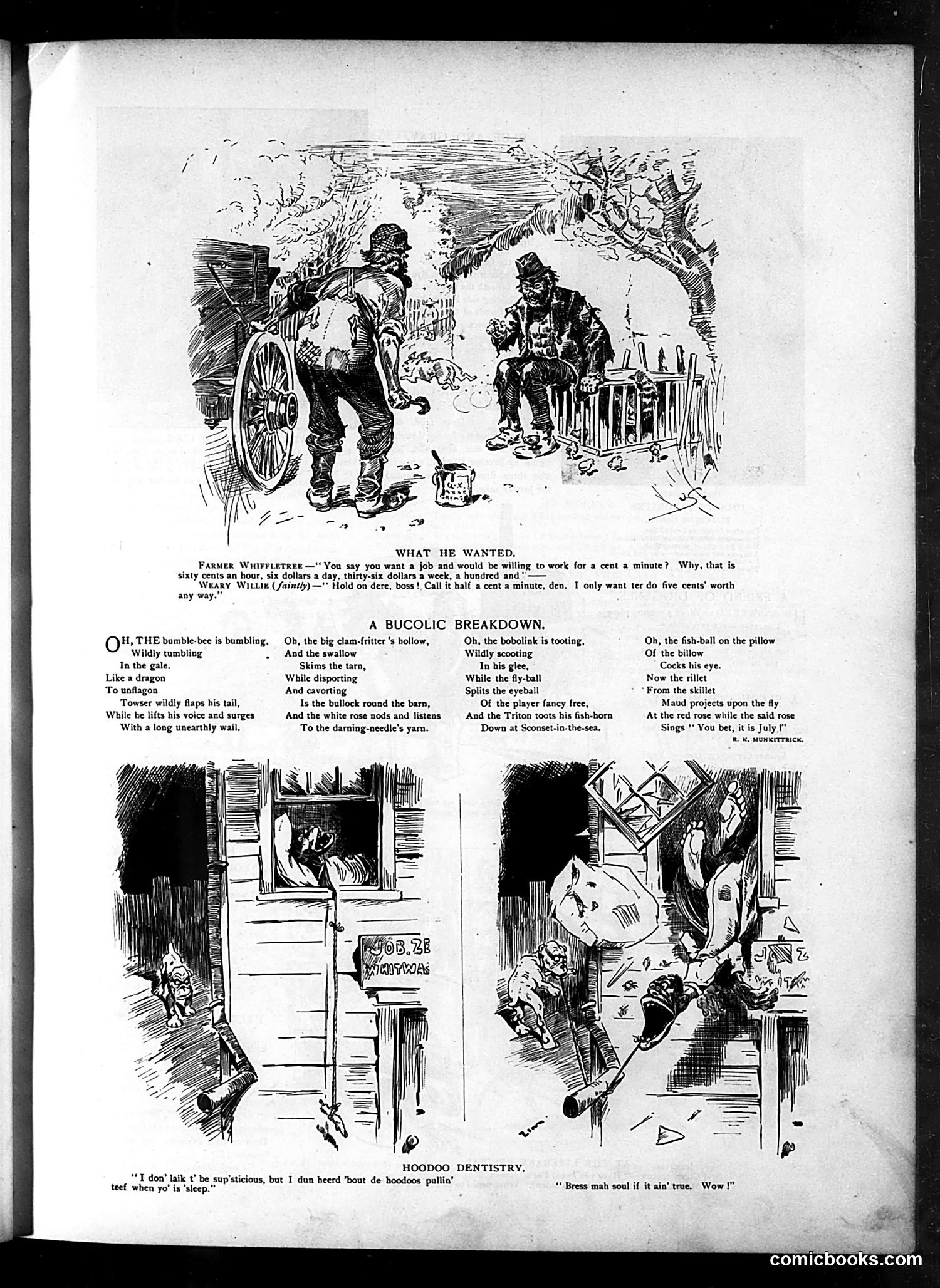
**Top Cartoon - "What He Wanted":** This depicts a dialogue between "Farmer Whipletree" and "Soapy Willie" about wage expectations. The farmer offers a cent per minute (roughly 60 cents daily), but Soapy Willie demands half a cent minimum or won't work. This satirizes labor disputes of the era—likely mocking either workers' unrealistic demands or employers' stingy offers, depending on the magazine's stance. **Middle Section - "A Bucolic Breakdown":** A humorous poem about a bumblebee's chaotic flight through rural settings, mixing physical comedy with wordplay ("billow," "bullock," "swallow"). **Bottom Illustrations - "Hoodoo Dentistry":** Two sketches depicting apparent folk remedies or superstitious dental practices ("'bout de hoodoos pallis"), likely satirizing unscientific or dangerous medical treatments among working-class or immigrant communities.
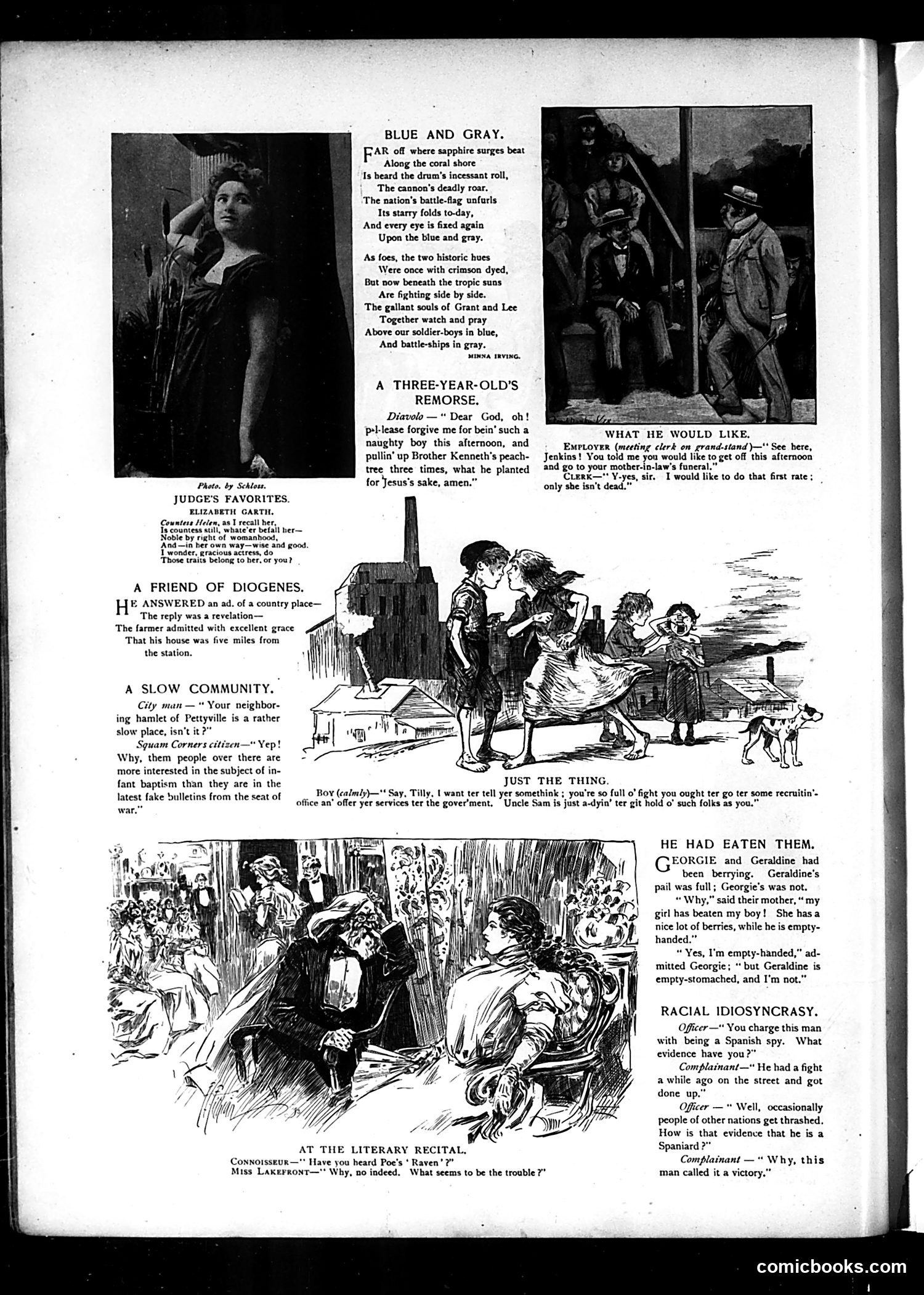
This page contains several satirical pieces and illustrations typical of Judge's early 20th-century humor: **"Blue and Gray"** is a poem about the Spanish-American War, referencing former enemies (Union and Confederate soldiers) now fighting together against Spain in the tropics. **"A Three-Year-Old's Remorse"** is a humorous children's anecdote about a young child confessing mischief. **"What He Would Like"** depicts a military recruitment scene, satirizing enlistment pitches and economic desperation. **"Racial Idiosyncrasy"** and other vignettes mock contemporary prejudices and social attitudes. The sketches throughout employ Judge's characteristic style—mixing sentimental Victorian imagery with biting social commentary on class, war, and contemporary politics. The publication satirized American society across multiple registers simultaneously.
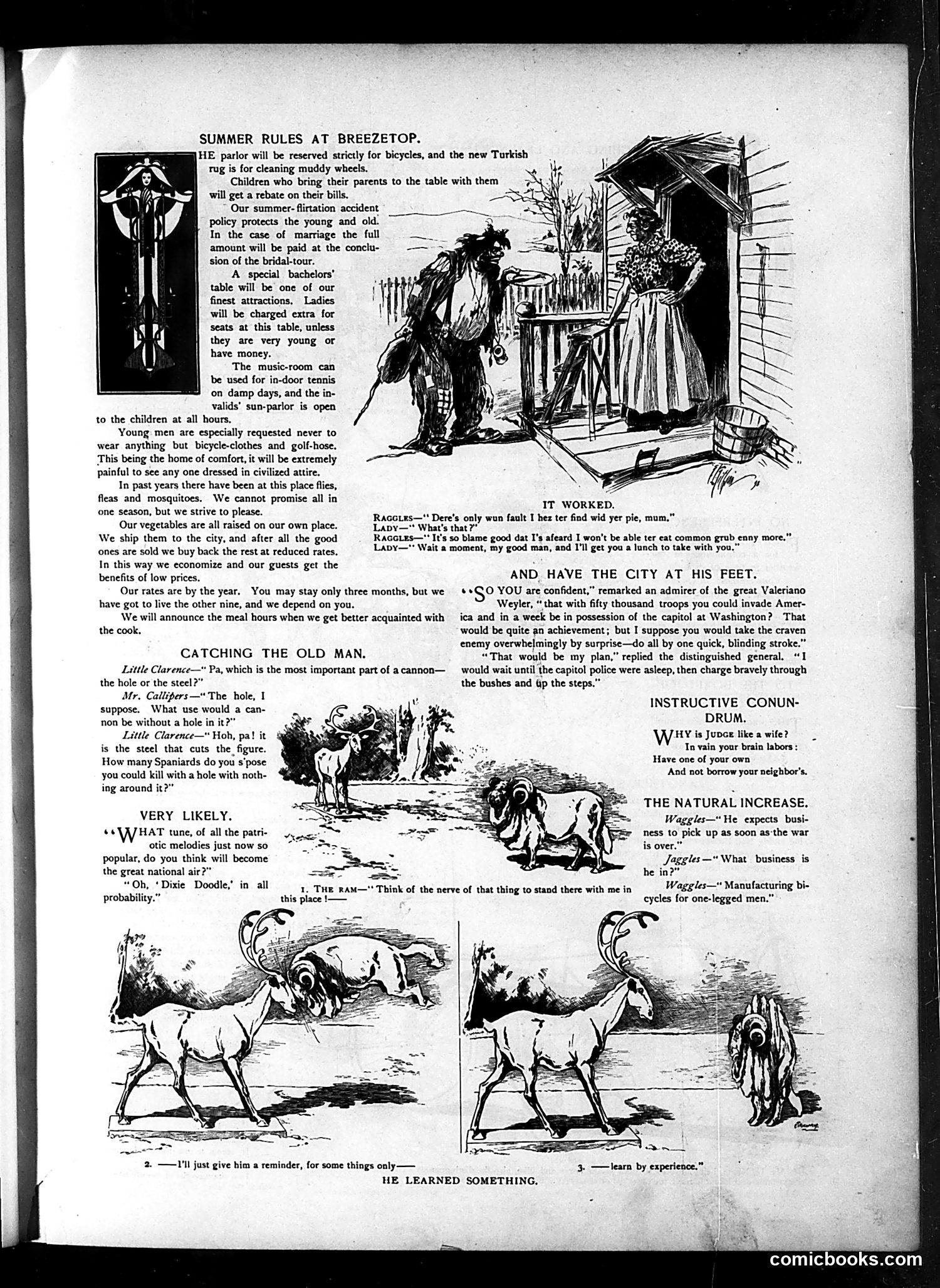
This page contains several distinct satirical pieces mocking American life circa the Spanish-American War era (the Weyler reference places it around 1898). **"Summer Rules at Breezetop"** satirizes pretentious resort hotels through absurd "rules"—charging extra for women at bachelor tables, selling guests their own vegetables at markup, and hiring cooks before setting meal times. The humor targets class-conscious vacation culture and hospitality industry greed. **"Catching the Old Man"** features a child's logic puzzle about cannons, poking fun at parental condescension. **"And Have the City at His Feet"** mocks Spanish General Valeriano Weyler's invasion boasts about conquering America. The joke: his grand military strategy is literally sneaking past sleeping Capitol police—absurd hyperbole ridiculing Spanish military confidence during the Spanish-American War. **"The Natural Increase"** jokes darkly about manufacturing bicycles for "one-legged men," implying war casualties. Overall, the page blends domestic social satire with contemporary war commentary, using humor to critique pretension, militarism, and American optimism.
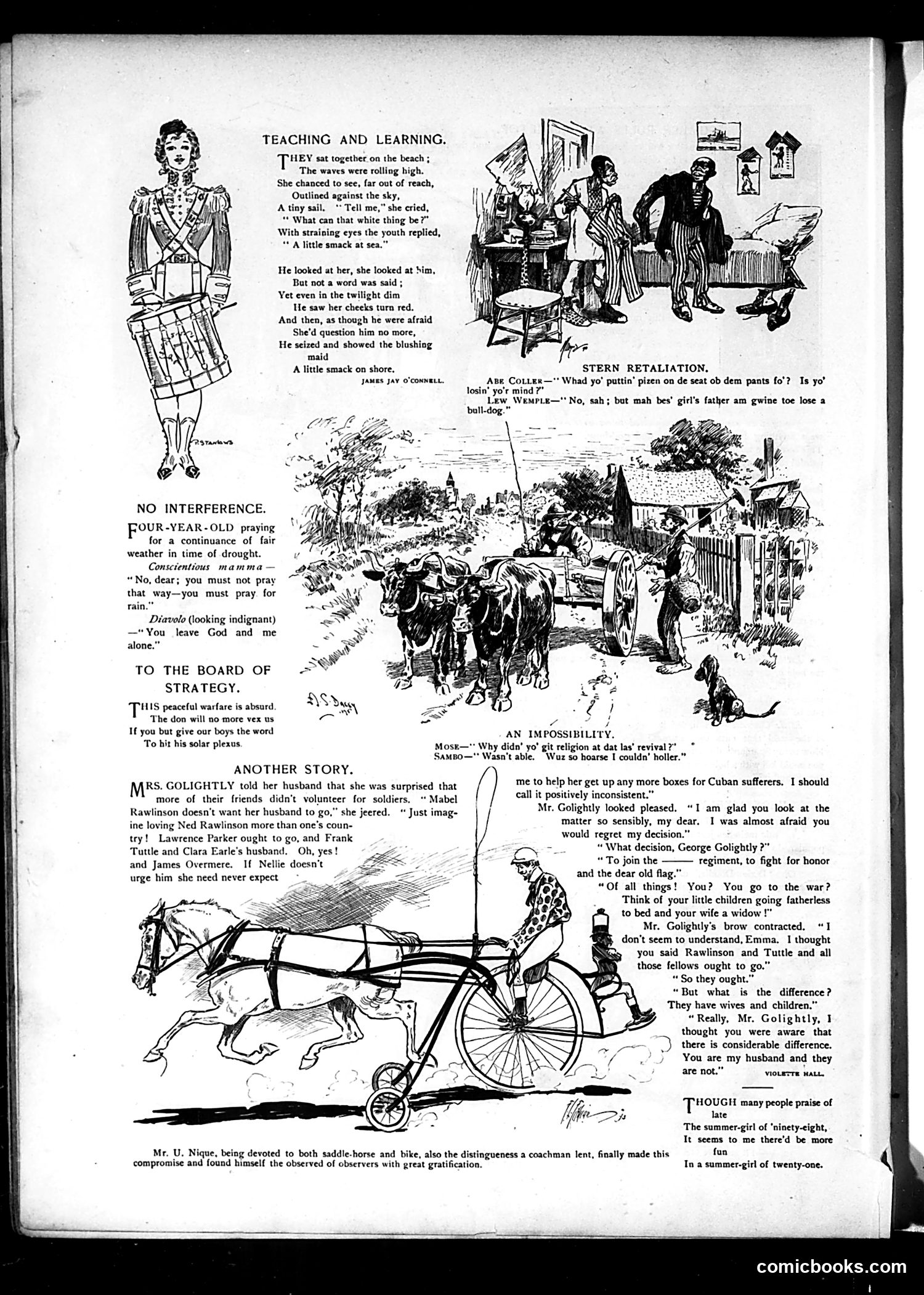
This page contains multiple satirical pieces typical of Judge magazine's humor: **"Teaching and Learning"** is a risqué poem about a couple on a beach. The youth's innocent explanation of seeing "a little smack at sea" (a small boat) becomes a double entendre when he then gives the blushing girl "a little smack on shore"—a kiss. **"Stern Retaliation"** appears to be dialect humor featuring African American characters discussing poisoning a rival's pants to harm his girlfriend's father's dog—crude comedy typical of the era. **"Another Story"** satirizes patriotic hypocrisy: Mrs. Golightly praises other men enlisting for the Spanish-American War (likely the 1898 conflict) but becomes horrified when her own husband volunteers, revealing her nationalism is performative. The joke critiques selective patriotism. Remaining pieces include short humorous vignettes about prayer, religion, and cycling fashions—standard magazine filler content.
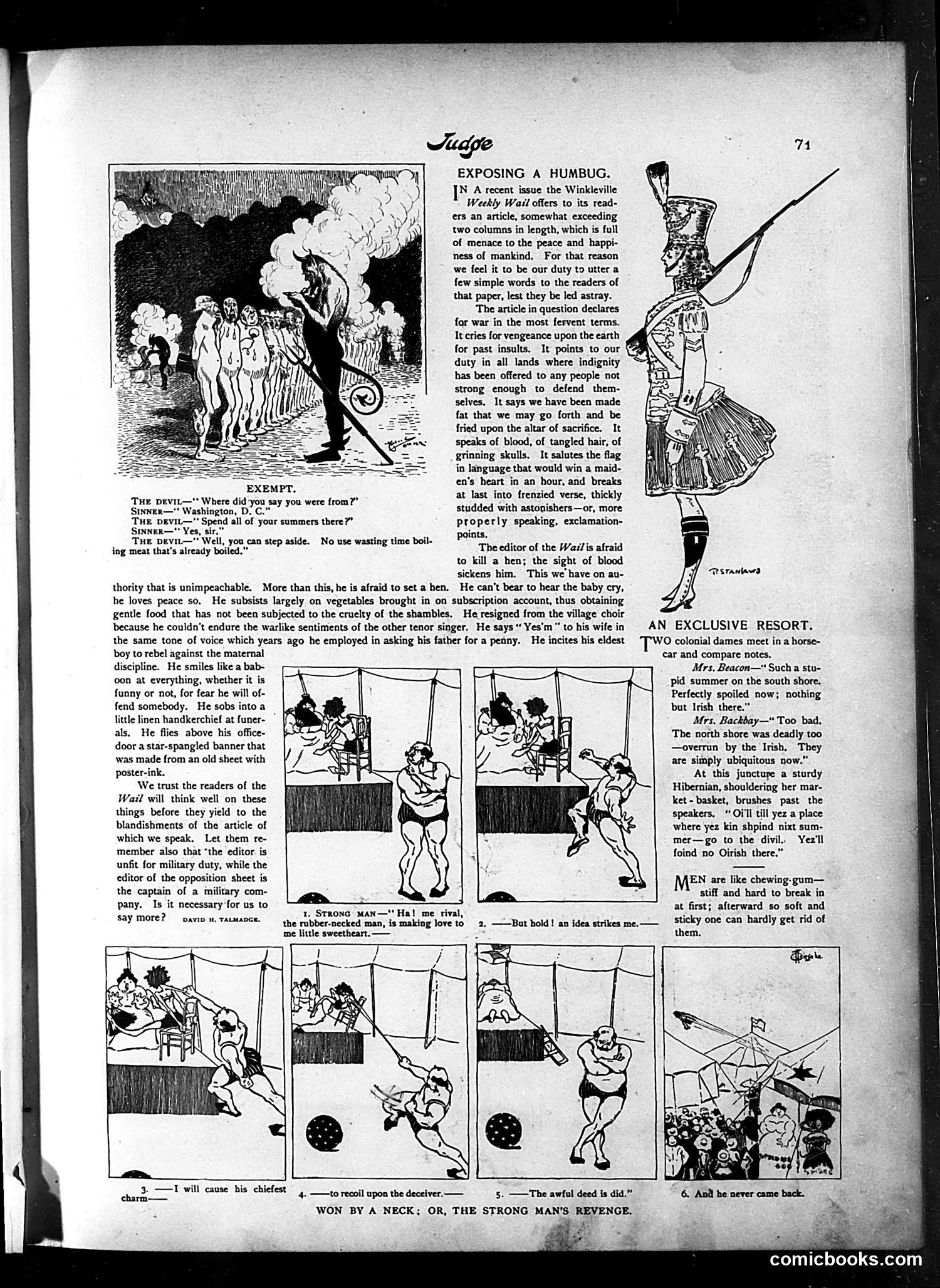
This page contains three distinct pieces of satire: 1. **"Exposing a Humbug"**: Judge attacks the *Winkleville Weekly Wait* (a rival publication) for publishing inflammatory war rhetoric. The editorial mocks the opposing editor as a pacifist hypocrite—he opposes war yet his publication advocates it. The satire exposes editorial inconsistency and questions the sincerity of warmongers. 2. **"Won by a Neck; or, The Strong Man's Revenge"**: A comic strip depicting a strongman's romantic rivalry and violent revenge, featuring slapstick violence (strangulation, a ball to the head). 3. **Two brief humor pieces**: "An Exclusive Resort" mocks wealthy women's snobbery about Irish immigrants; "Men are like Chewing Gum" offers a cynical observation about romance. The page reflects turn-of-the-century American anxieties about war, class, and immigration, using sharp satire and physical comedy typical of Judge's style.
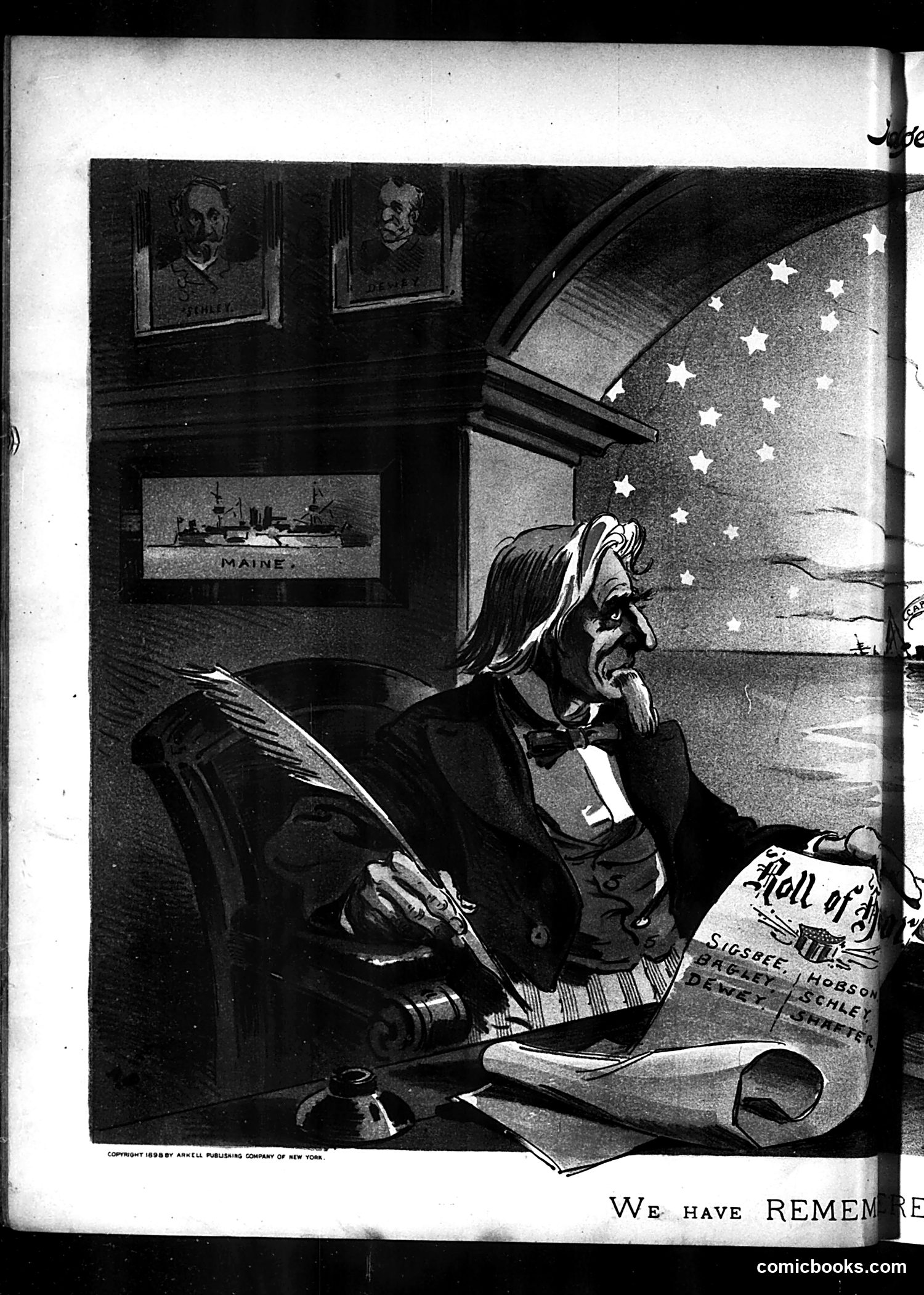
This 1898 Judge magazine cartoon commemorates the USS Maine, the American battleship that exploded in Havana Harbor in February 1898, killing over 260 sailors. The explosion became a catalyst for the Spanish-American War. The caped figure appears to be Uncle Sam or a personified America, gazing at a starry memorial vault containing the USS Maine model. Two portrait busts above (likely political figures of the era) observe the scene. A "Roll of" document (partially visible) lists names, presumably of the Maine's victims. The phrase "We have remember[ed]" suggests this is a solemn tribute to those lost and a statement about American resolve following the disaster—imagery that would have resonated powerfully with readers during the war period.
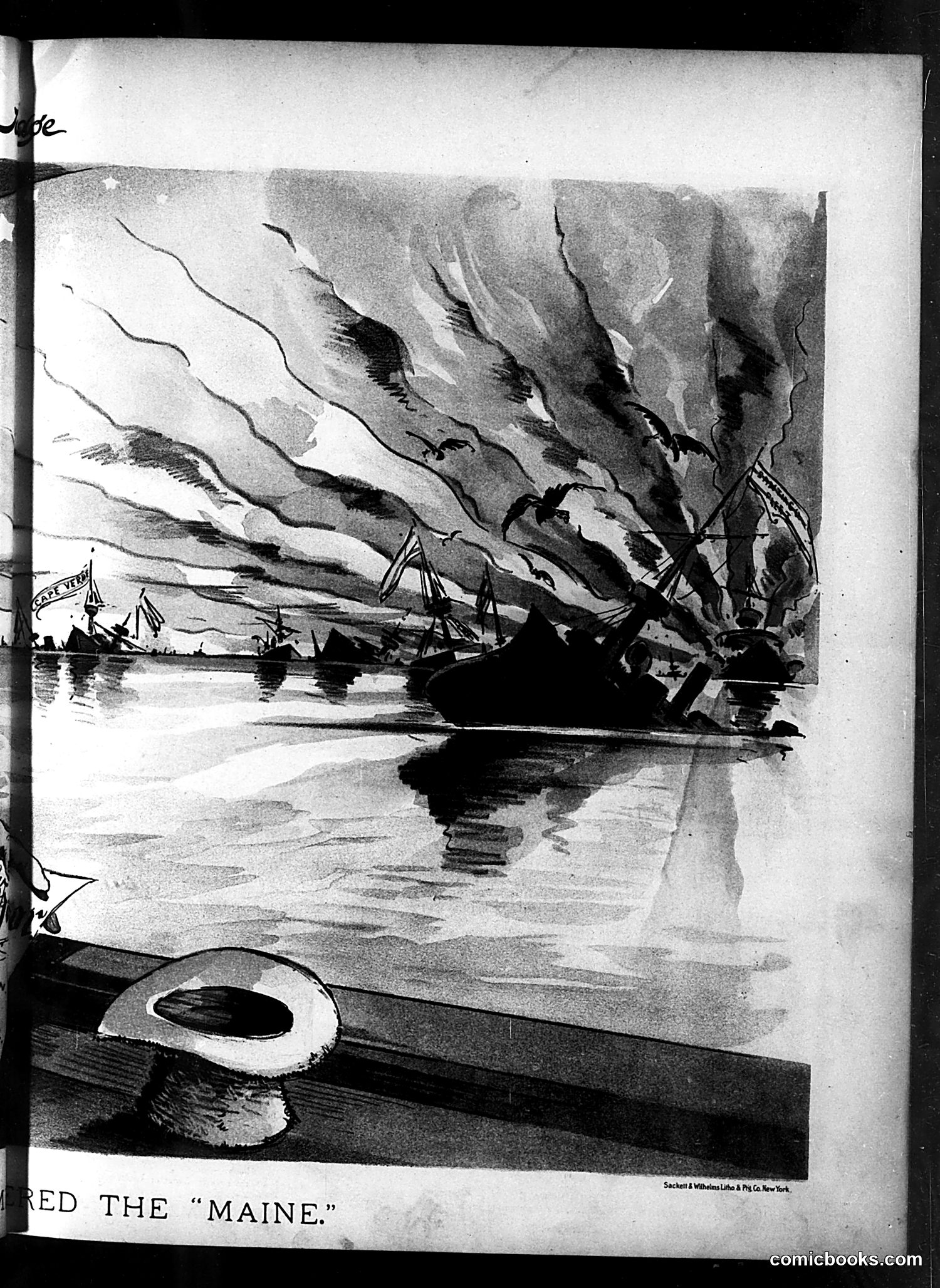
This political cartoon depicts a naval battle scene with American warships attacking what appears to be Spanish vessels. The title references the USS Maine, the American battleship that exploded in Havana Harbor in February 1898—an incident that triggered the Spanish-American War. The dramatic imagery of destruction and combat represents American military retaliation for the Maine's sinking. The cartoon celebrates American naval superiority and military action, likely supporting the war effort that was popular with the American public at the time. The satirical magazine *Judge* used this imagery to comment on American imperialism and the nation's growing military power in the late 1890s.
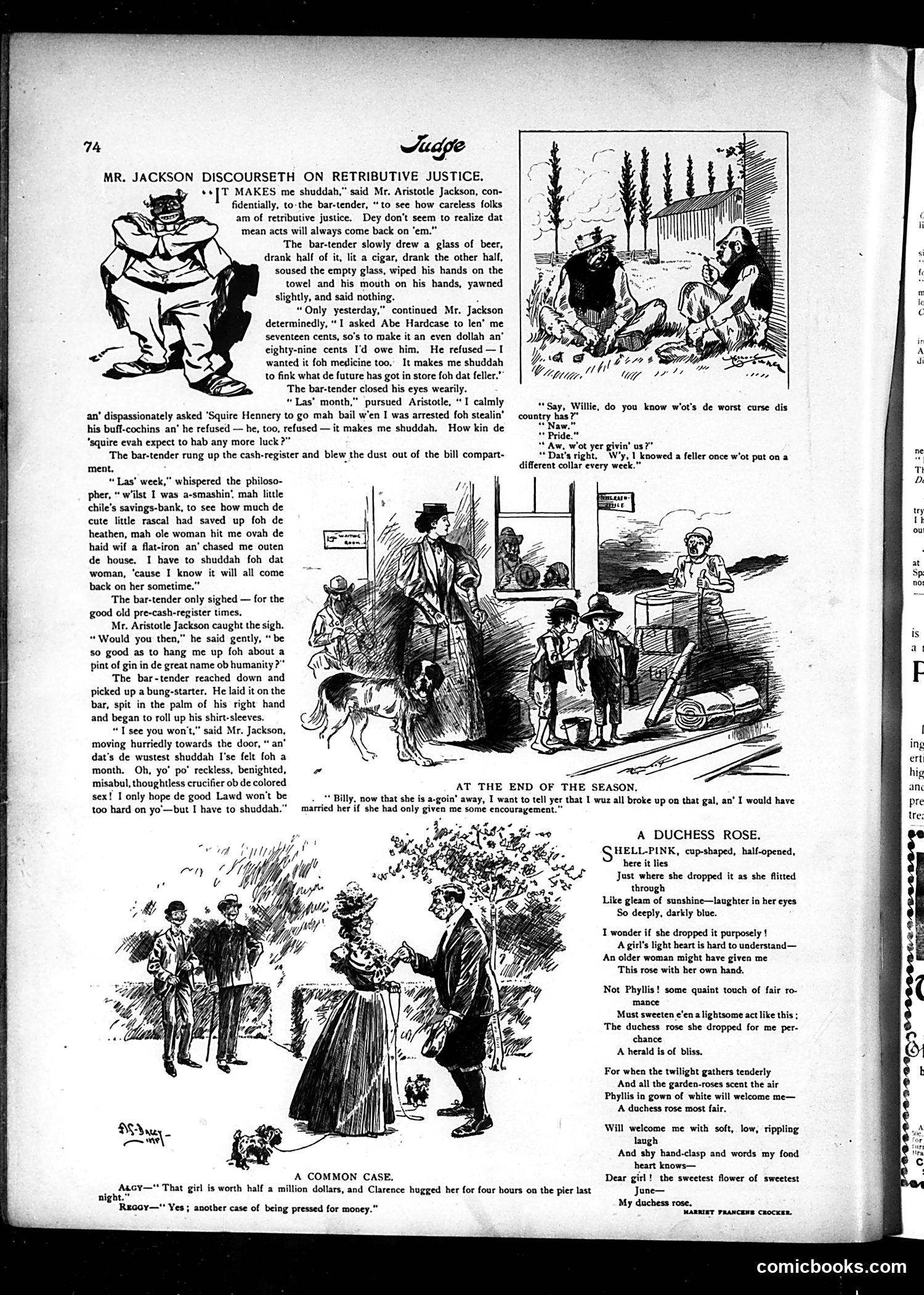
This satirical piece mocks working-class Black discourse through the character "Mr. Aristotle Jackson," who lectures a bartender about karma and moral consequences while himself behaving immorally—borrowing money he won't repay, stealing chickens, destroying his child's savings. The joke is his oblivious hypocrisy: he preaches retribution for others' wrongs while committing his own. The bartender's responses (refusing Jackson a loan, threatening violence with a bung-starter) represent comic "comeuppance." The dialect and caricature reflect period racial stereotypes common to Judge magazine. The page also includes lighter content: a poem about a dropped rose and romantic sentimentality, and brief comic vignettes about appearance and infidelity. The satire targets hypocrisy and self-deception generally, though expressed through now-offensive racial caricature.
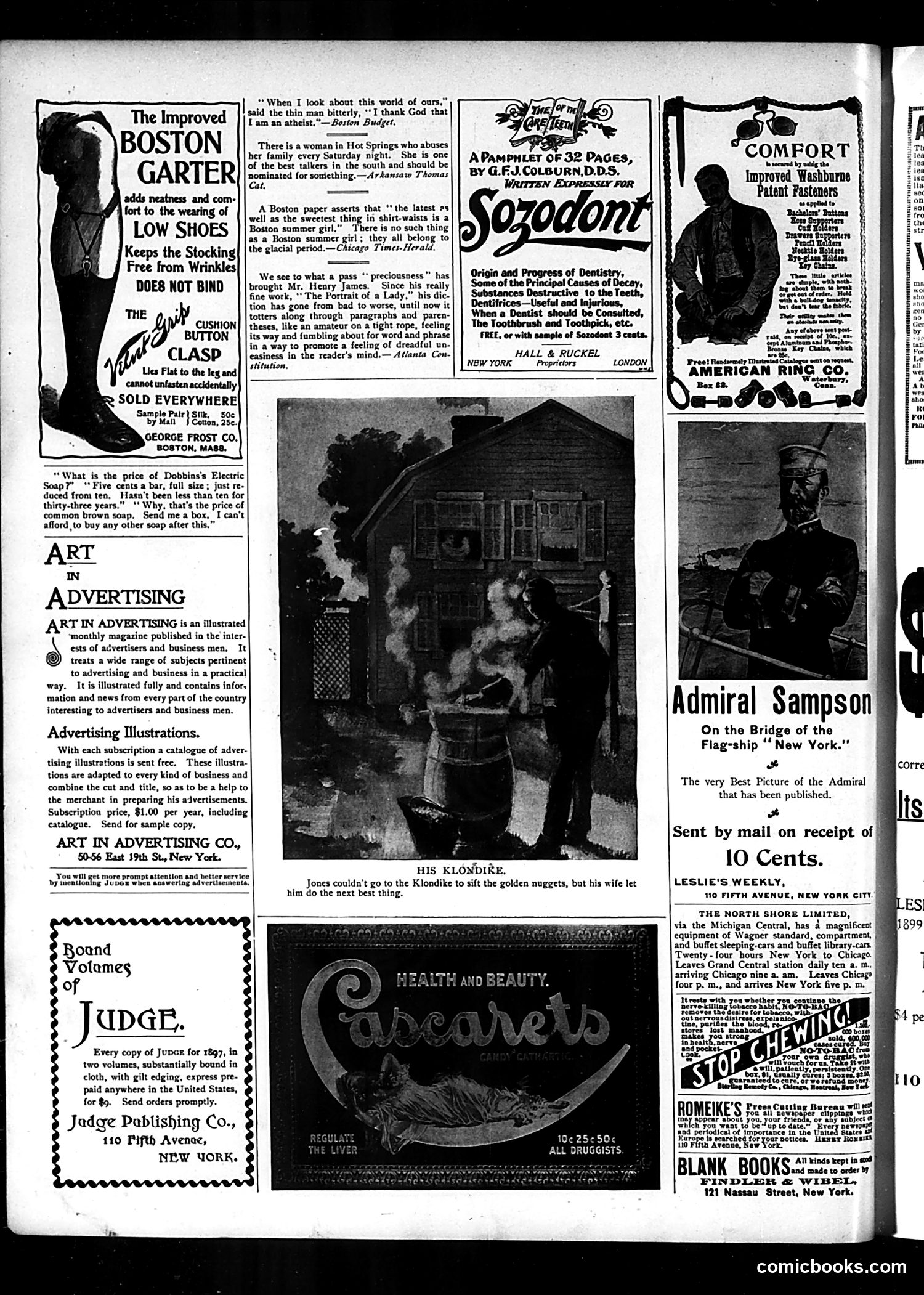
This page is primarily **advertisements and filler content** rather than political cartoons. The main visual elements are ads for shoes, books, and patent medicines. The notable satirical content includes brief quips about contemporary figures and issues: 1. **Henry James critique**: A jab at novelist Henry James for increasingly convoluted prose style—his writing had become precious and difficult to follow since his acclaimed novel *The Portrait of a Lady*. 2. **"His Klondike" cartoon**: A domestic joke about a man who couldn't travel to the Klondike gold rush (then happening, 1896-1898), so his wife let him do "the next best thing"—apparently meaning housework or domestic labor as substitute excitement. 3. **Minor social observations**: Brief satirical notes mocking Boston summer girls, Arkansas abuse, and atheism. The page reflects Judge's typical mix of gentle social satire about manners, literature, and domestic life, alongside extensive product advertising for the magazine's paying sponsors.
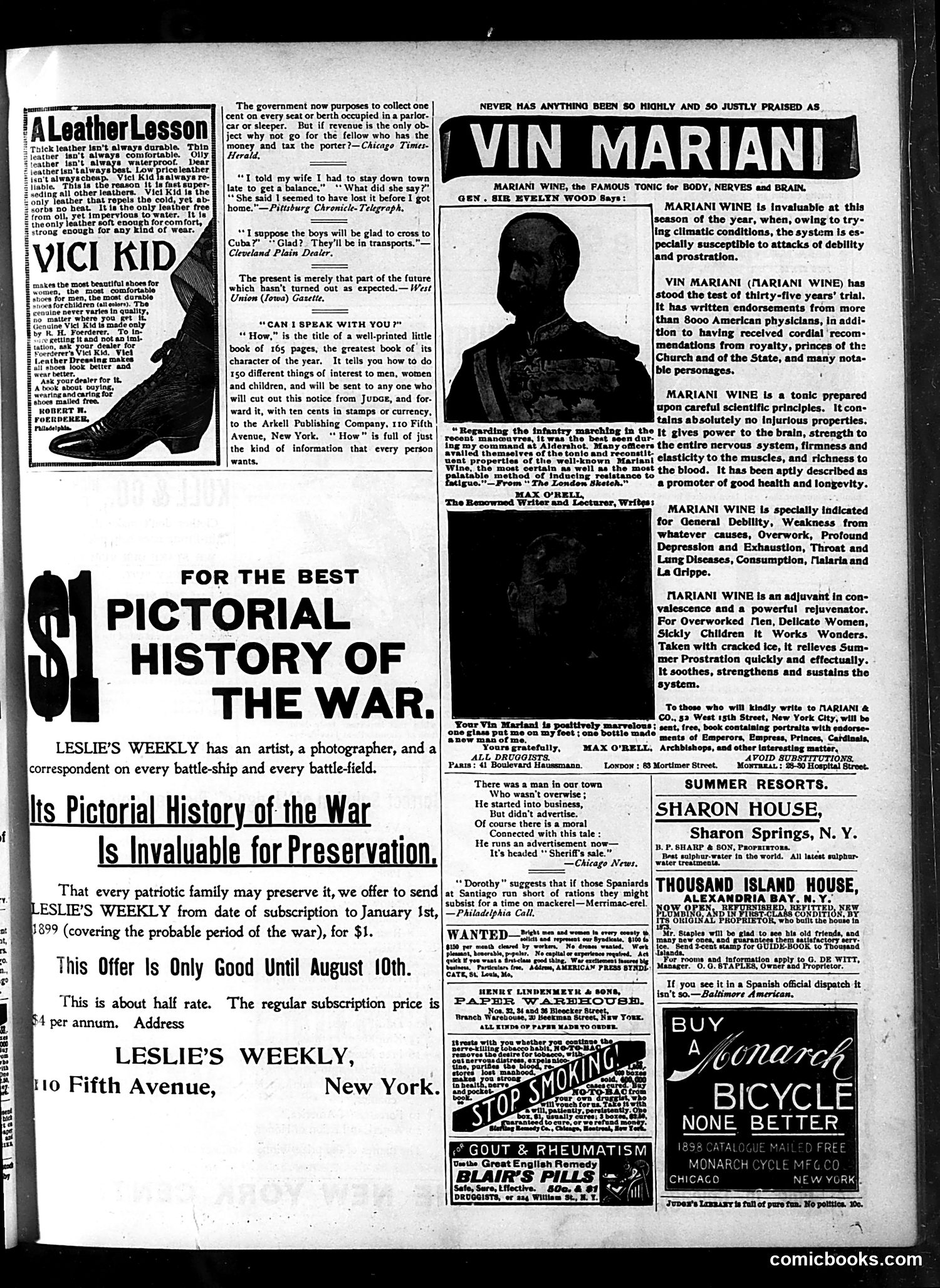
This page is primarily **advertising and filler content**, not political satire. The dominant feature is a large advertisement for **Mariani Wine**, a patent medicine marketed as a tonic for "nerves and brain." The ad cites endorsements from military figures and writers to establish credibility—a common advertising tactic of the 1890s. The small jokes and quips scattered throughout mock contemporary topics: a proposed government tax on railroad parlor-car seats, marital miscommunication, and the Spanish-American War (references to Cuba). These are mild social humor rather than pointed satire. The page also advertises **Leslie's Weekly** as a pictorial war history—relevant because the text mentions coverage through "January 1st, 1899," indicating this was published during the Spanish-American War (1898), when such publications capitalized on public appetite for battle imagery. The overall page reflects late-1890s consumer culture: patent medicines with dubious medical claims, illustrated news magazines, and light domestic humor.
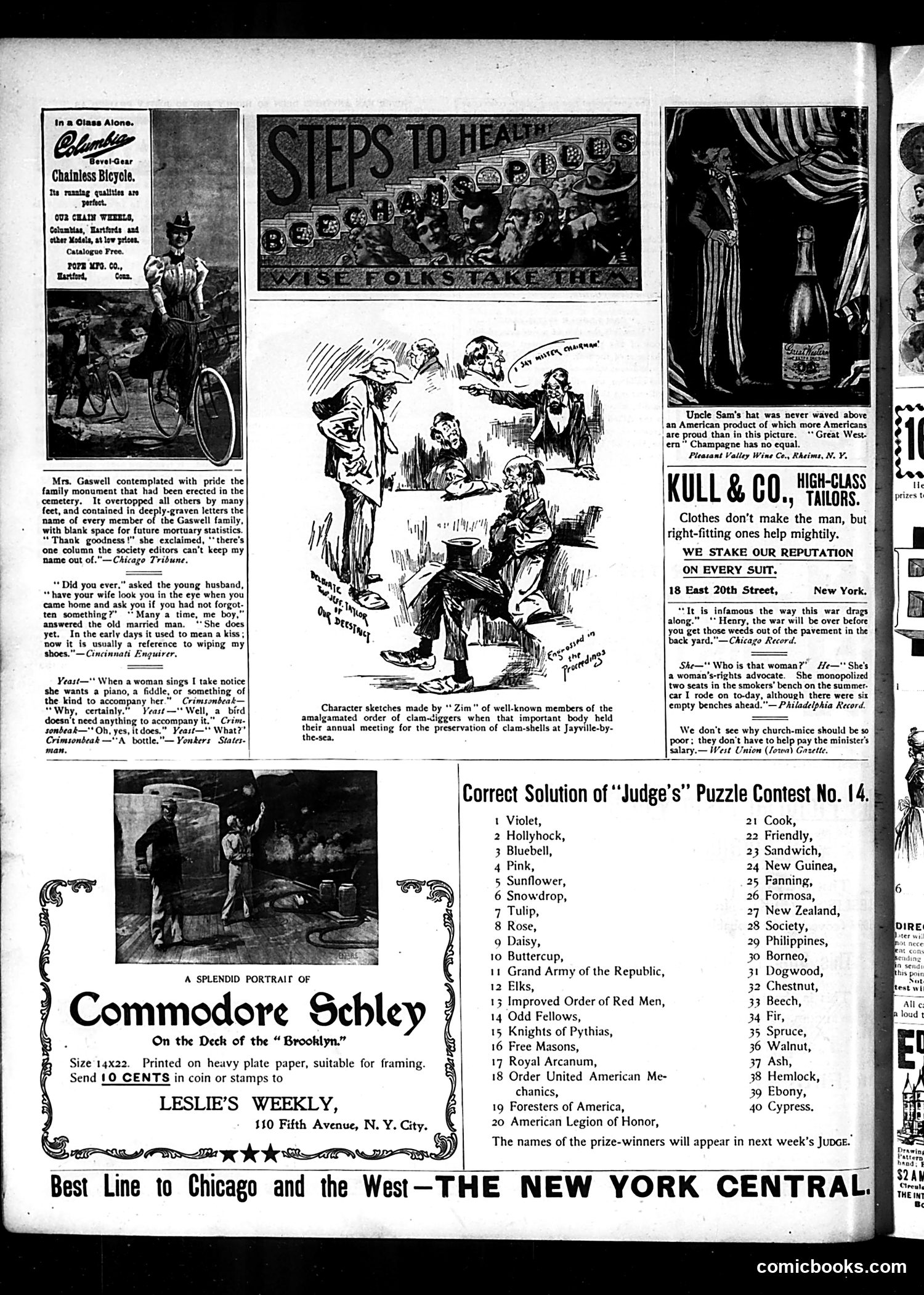
This page from *Judge* magazine contains several short humorous anecdotes and advertisements typical of early 1900s American satire. **The cartoons/jokes satirize:** - **Female vanity**: A widow celebrates her family monument's prominence, wanting her name visible in society columns even in death. - **Marriage dynamics**: Jokes about wives' expectations and husbands' domestic forgetfulness, with the punchline that early romantic gestures ("a kiss") devolved into reminders about muddy shoes. - **Women's rights hypocrisy**: A woman advocate monopolizes multiple seats on public transportation while claiming equality—mocking inconsistency in women's liberation arguments. - **Wartime complaints**: Someone complains a war drags on while ignoring weeds in their own yard—trivializing impatience with the (likely Spanish-American) war effort. The central illustration shows caricatured "clam-diggers" at their annual meeting—likely working-class humor, though the specific reference is unclear today. **Advertisements** promote bicycles, tailoring services, champagne, and a portrait of Commodore Schley (Spanish-American War naval officer), reflecting contemporary commercial interests.
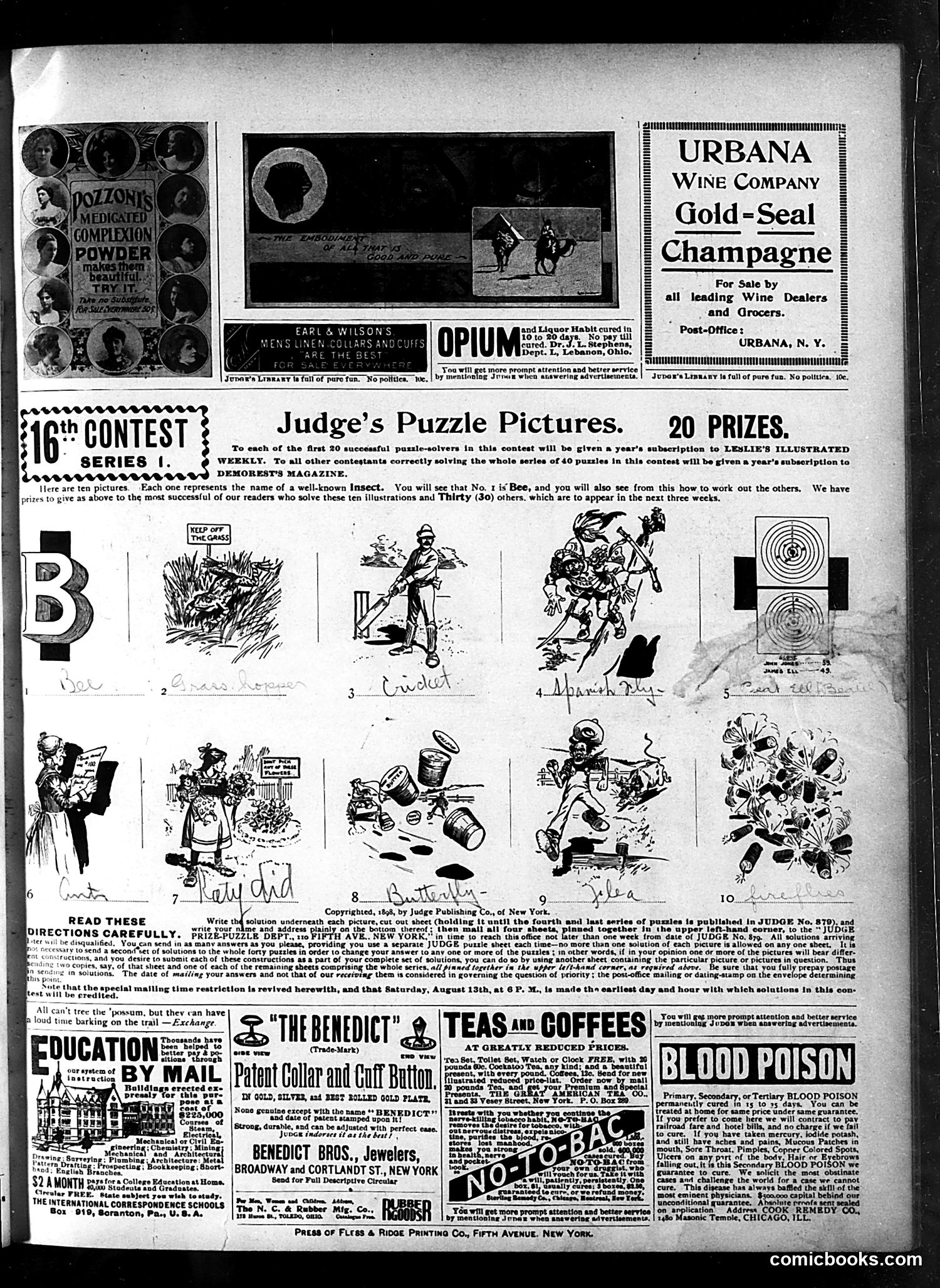
This page is primarily a **puzzle contest**, not a political cartoon. Judge magazine (1898) hosted a "Judge's Puzzle Pictures" competition where readers identified ten insects from sketches—the first one labeled "Bee" served as the key to solving others (likely "Grasshopper," "Cricket," "March Fly," etc.). The contest offered magazine subscriptions as prizes and ran serially over multiple weeks. Detailed rules governed submission procedures, deadlines, and eligibility. The remainder of the page contains period **advertisements**—for champagne, patent collar buttons, correspondence school education, teas and coffees, and a dubious "Blood Poison" cure (likely for syphilis). These ads reflect late-19th-century consumer culture and the era's unregulated medical claims. The page contains **no political satire**—it represents Judge's hybrid business model of combining entertainment contests with advertising revenue. The "no politics" note reinforces that puzzles aimed at broad family appeal rather than partisan commentary.
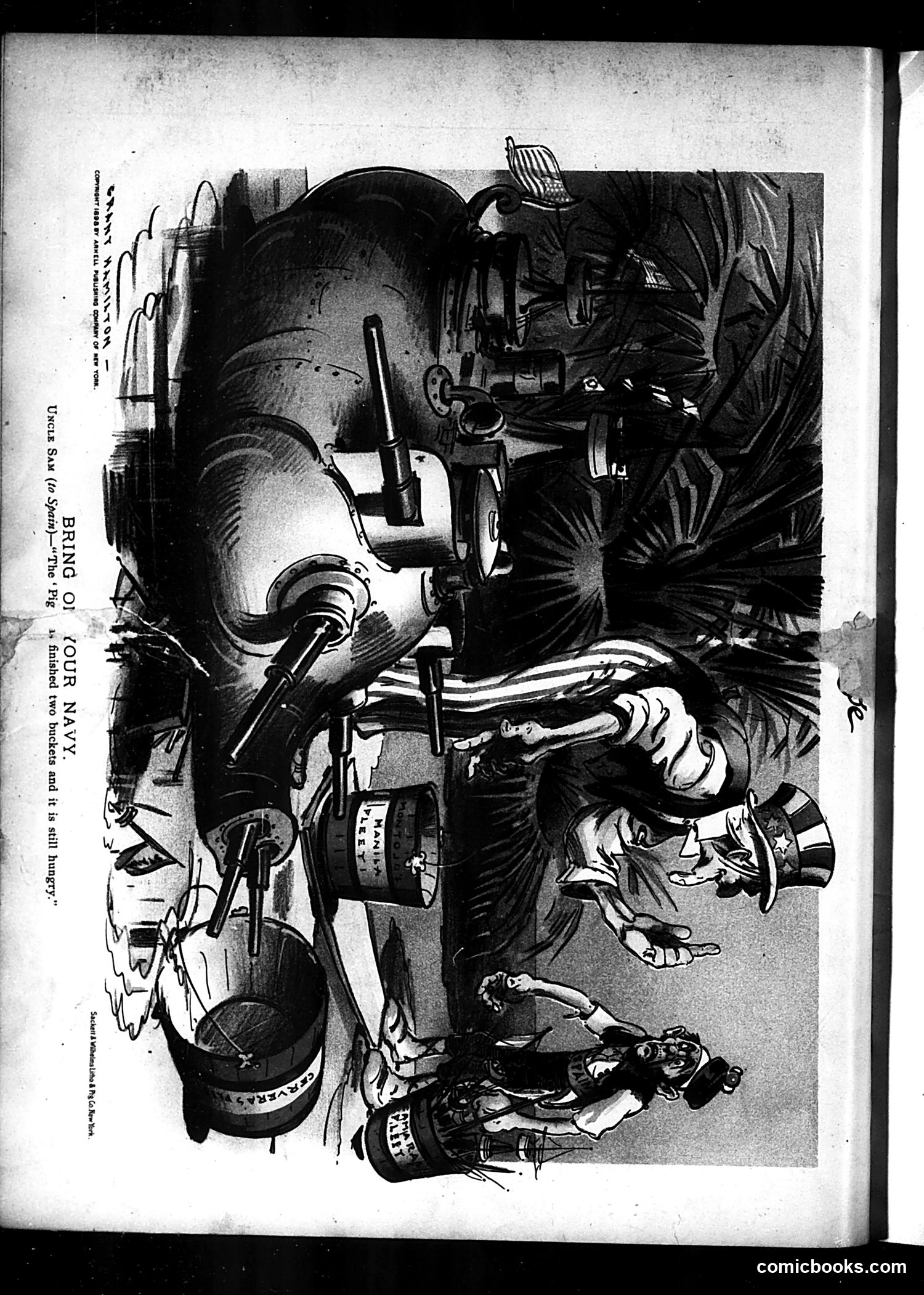
This 1898 Judge cartoon satirizes American naval superiority during the Spanish-American War. Uncle Sam represents the United States, addressing Spain as a pig being fed from buckets—a degrading metaphor suggesting Spain is being consumed or defeated by American military might. The caption indicates the U.S. Navy has already "finished two buckets" of Spain's resources or territory, yet remains unsatisfied ("still hungry"), implying American imperial ambitions extend beyond initial military victories. The cartoon celebrates American naval dominance while mocking Spain's weakness. This reflects contemporary American expansionism following the war, when the U.S. acquired Spanish colonial territories including Cuba, Puerto Rico, Guam, and the Philippines.