
Judge, 1898-07-30 · page 4 of 16
Judge — July 30, 1898 — page 4: what you’re looking at
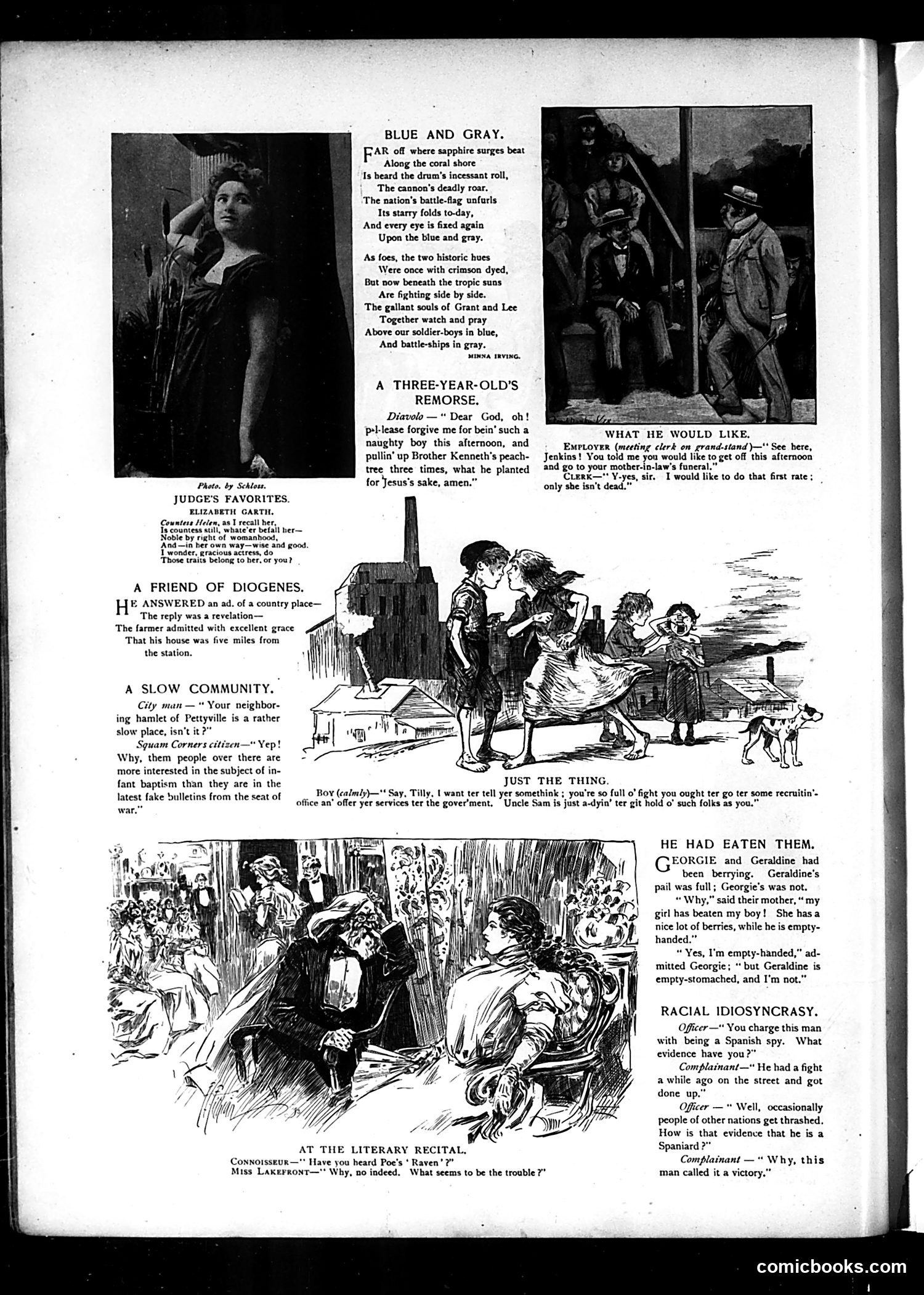
What you’re looking at
This page contains several satirical pieces and illustrations typical of Judge's early 20th-century humor: **"Blue and Gray"** is a poem about the Spanish-American War, referencing former enemies (Union and Confederate soldiers) now fighting together against Spain in the tropics. **"A Three-Year-Old's Remorse"** is a humorous children's anecdote about a young child confessing mischief. **"What He Would Like"** depicts a military recruitment scene, satirizing enlistment pitches and economic desperation. **"Racial Idiosyncrasy"** and other vignettes mock contemporary prejudices and social attitudes. The sketches throughout employ Judge's characteristic style—mixing sentimental Victorian imagery with biting social commentary on class, war, and contemporary politics. The publication satirized American society across multiple registers simultaneously.
📄 Transcribed text from this page (OCR, searchable)
Machine-transcribed from the original scan — historical spelling and the odd misread are preserved.
BLUE AND GRAY. FAR of where sapphire surges beat Along the coral shore Is beard the drum’s incessant roll, The cannon's deadly roar. The nation’s battle-flag unfurls Its starry folds to-day, And every eye is fixed again Upon the blue and gray. As foes, the two historic hues Were once with crimson dyed, But now beneath the tropic suns Are fighting side by side. The gallant souls of Grant and Lee Together watch and pray Above our soldier-boys in blue, ‘And battle-ships in gray. MOEA IRVING. A THREE-YEAR-OLD’S REMORSE, Diavolo —“ Dear God, oh! pel-lease forgive me for bein’ such a naughty boy this afternoon, and Emptover (meeting clerk on grand-stand }—' See here, pullin’ up Brother Kenneth’s peach- Jenkins! You told me you would like to get off this afternoon tree three times, what he planted nd go to your mother-in-law's funeral.” ‘esiia's sah = Cuerk—" Y-yes, sit. I would like to do that first rate; _ Photo. by Schloss. for Jesus's sake, amen. only she isn’t dead. JUDGE'S FAVORITES. ELIZADETH GARTH. Countess Helen, as T recall her, Ts countess still, whate’er befall her— Noble by right of womanhood, ‘And—in ber own way—wise and good. I wonder, gracious actress, do ‘Those traits belong to her. or you? WHAT HE WOULD LIKE. A FRIEND OF DIOGENES. E ANSWERED an ad. of a country place— The reply was a revelation— The farmer admitted with excellent grace ‘That his house was five miles from the station. A SLOW COMMUNITY. City man —“ Your neighbor- ing hamlet of Pettyville is a rather slow place, isn’t it?” Squam Corners citizen—" Yep! Why, them people over there are more interested in the subject of in- : fant baptism than they are in the JUST THE THING. emcee seater Box (calmly)—"' Say, Tilly, 1 want ter tell yer somethink ; you're so full o' fight you ought ter go ter some recruitin'= = fake bulletins from the seat of or.25 an’ offer yer services tet the gover'ment, "Uncle Sam fs just a-dyin’ ter git hold o' such folks s3 you." HE HAD EATEN THEM. EORGIE and Geraldine had been berrying. Geraldine’s pail was full; Georgie’s was not. * Why,” said their mother, “my girl has beaten my boy! She hasa nice lot of berries, while he is empty- handed.” “Yes, I'm empty-handed,” ad- mitted Georgie; “ but Geraldine is empty-stomached, and I'm not.” RACIAL IDIOSYNCRASY. Officer —"* You charge this man with being a Spanish spy. What evidence have you?” Complainant—" He had a fight awhile ago on the street and got done up.” Officer —* Well, occasionally people of other nations get thrashed. How is that evidence that he is a AT THE LITERARY RECITAL, Spaniard >” Coxnotsseur—"* Have you heard Poe's ‘ Raven’ ?” Complainant —“ Why, this Miss Lakerront—"* Why, no indeed, What seems to be the trouble 7” man called it a victory.” comicbooks.com i