
A complete issue · 16 pages · 1898
Judge — March 12, 1898
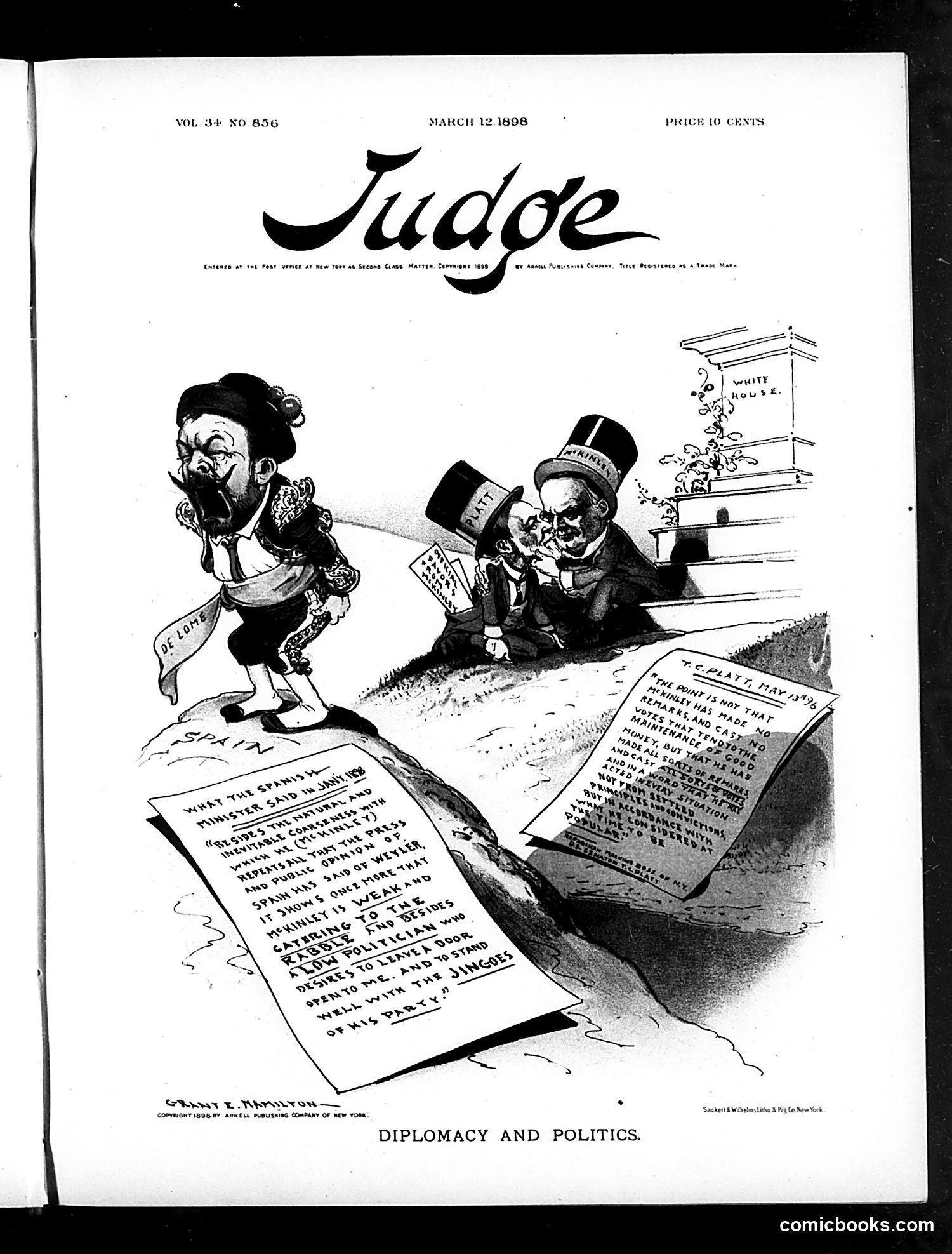
This political cartoon satirizes international diplomacy surrounding Spain during the Spanish-American War crisis. The figure on the left, labeled "DE LÔME" (Spanish diplomat Enrique Dupuy de Lôme), stands on Spanish soil. Two figures in top hats approach the White House, carrying what appear to be diplomatic documents or treaties. The tablets in the foreground list various diplomatic issues and grievances. The cartoon mocks the failure of Spanish diplomatic efforts to prevent American intervention. Spain's diplomatic corps—represented by the documents and formal negotiations—proves ineffective against American political pressure. The satire suggests formal diplomacy cannot resolve the underlying conflict, with the White House remaining unmoved by Spanish entreaties. This reflects the period's growing American interventionism and the approaching Spanish-American War (declared April 1898).
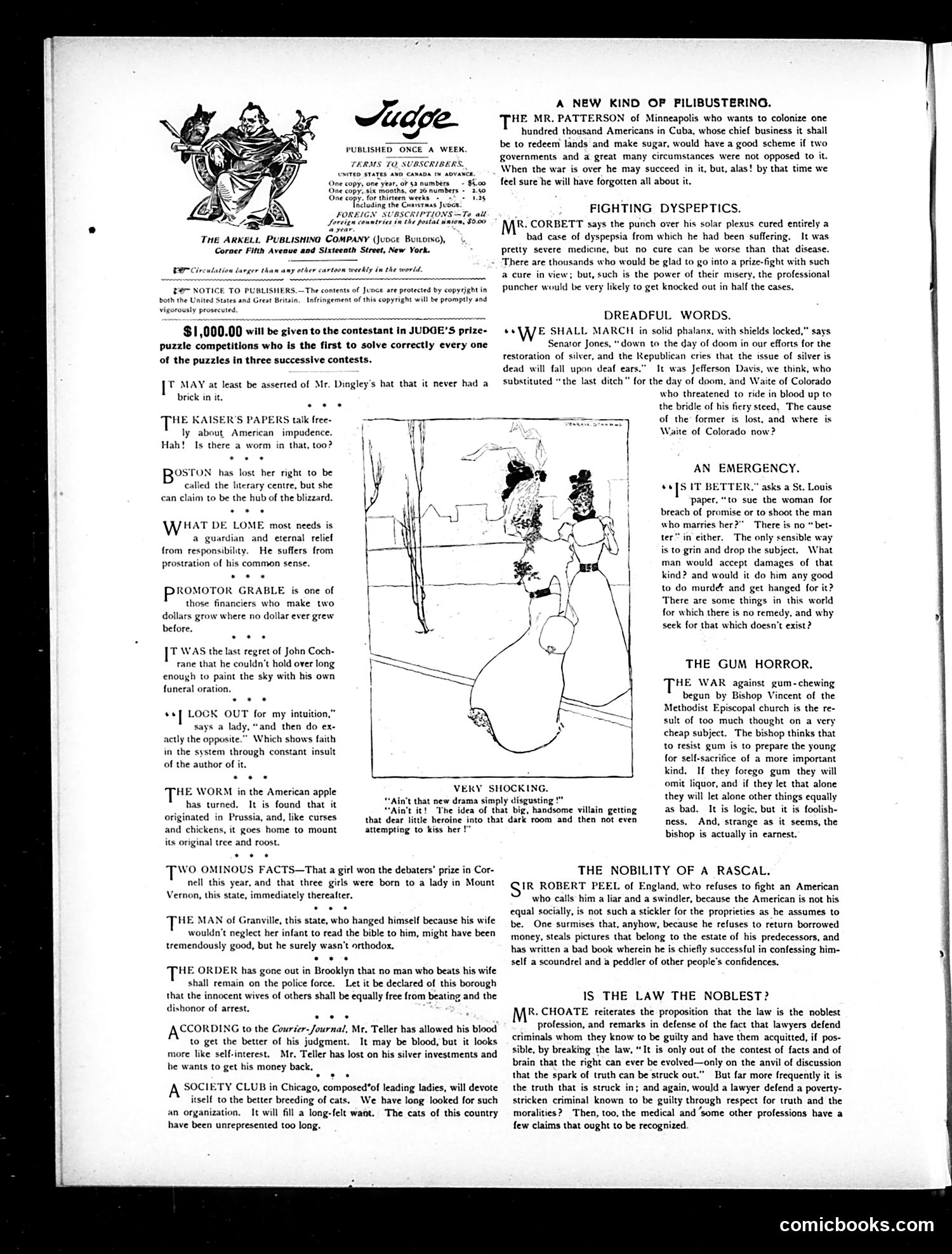
The central cartoon titled "VERY SHOCKING" depicts a woman discovering her husband's infidelity—he's in bed with another woman. The caption reads: "Ain't that new drama simply disgusting? I'm shocked that any author would have the audacity that drew little heroine into that dark room and then not even attempting to kiss her!" The satire mocks Victorian prudishness. Rather than being shocked by actual adultery, the observer is scandalized that the *dramatization* of seduction lacks explicit kissing. This lampoons the era's hypocritical moral standards—people were more offended by theatrical impropriety than real moral transgression. The joke exposes the gap between expressed outrage at stage "indecency" and indifference to actual marital betrayal.
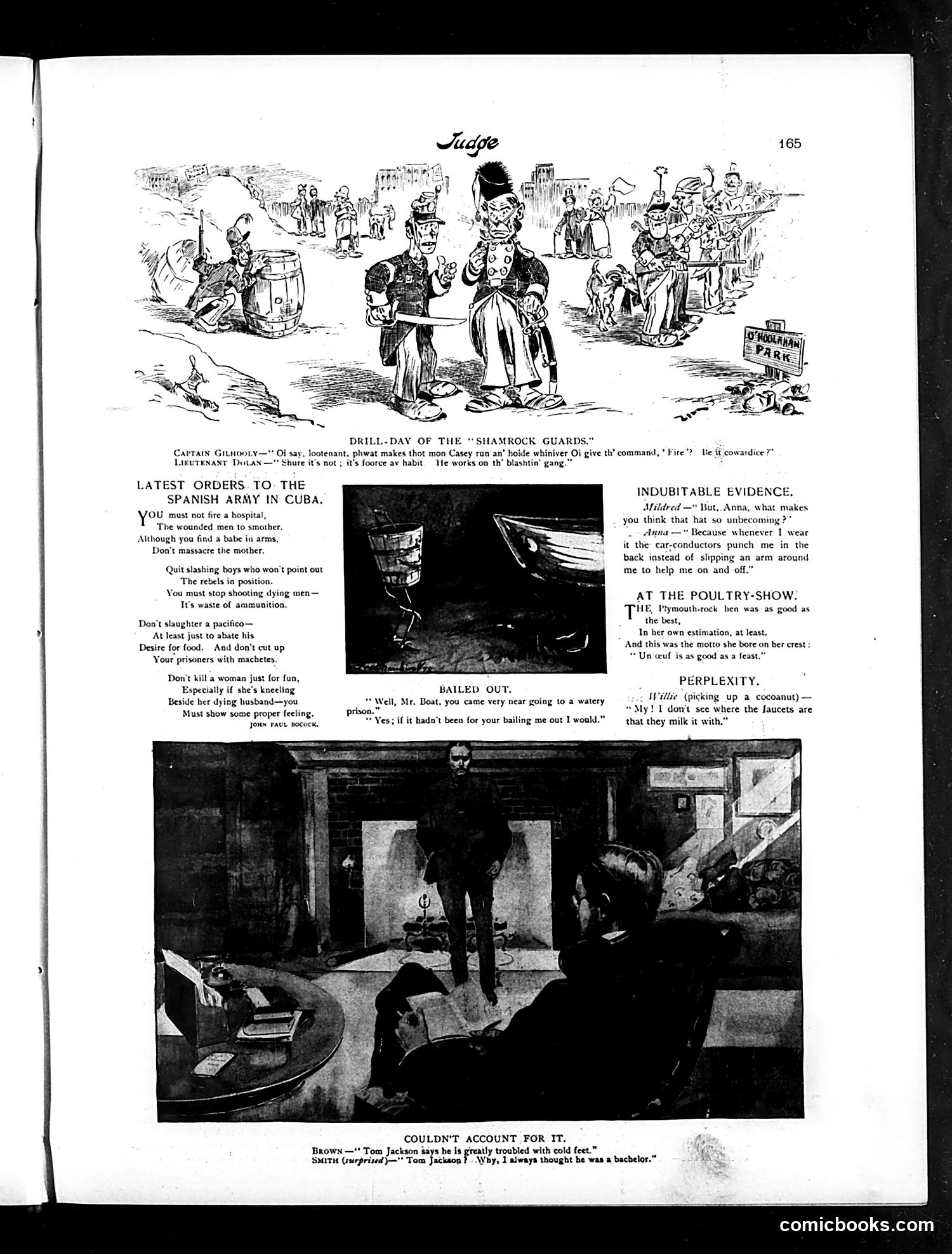
This page contains satirical military content from an American publication. The top illustration titled "Drill—Day of the 'Shamrock Guards'" depicts Irish immigrant soldiers in comedic fashion, mocking their accent and military incompetence through dialogue about holding "whistle" and command execution. Below are four separate humorous items: "Latest Orders to the Army in Cuba" (likely referencing the Spanish-American War era), "Indubitable Evidence" (a domestic joke about arm-punching), "At the Poultry-Show" (wordplay about roosting), and "Perplexity" (about milk faucets). The bottom photograph with caption "Couldn't Account for It" shows what appears to be a domestic scene with a man explaining suspicious behavior to another—likely a social satire on marital or workplace situations. The page overall reflects early 20th-century American humor regarding military matters, Irish stereotypes, and domestic life.
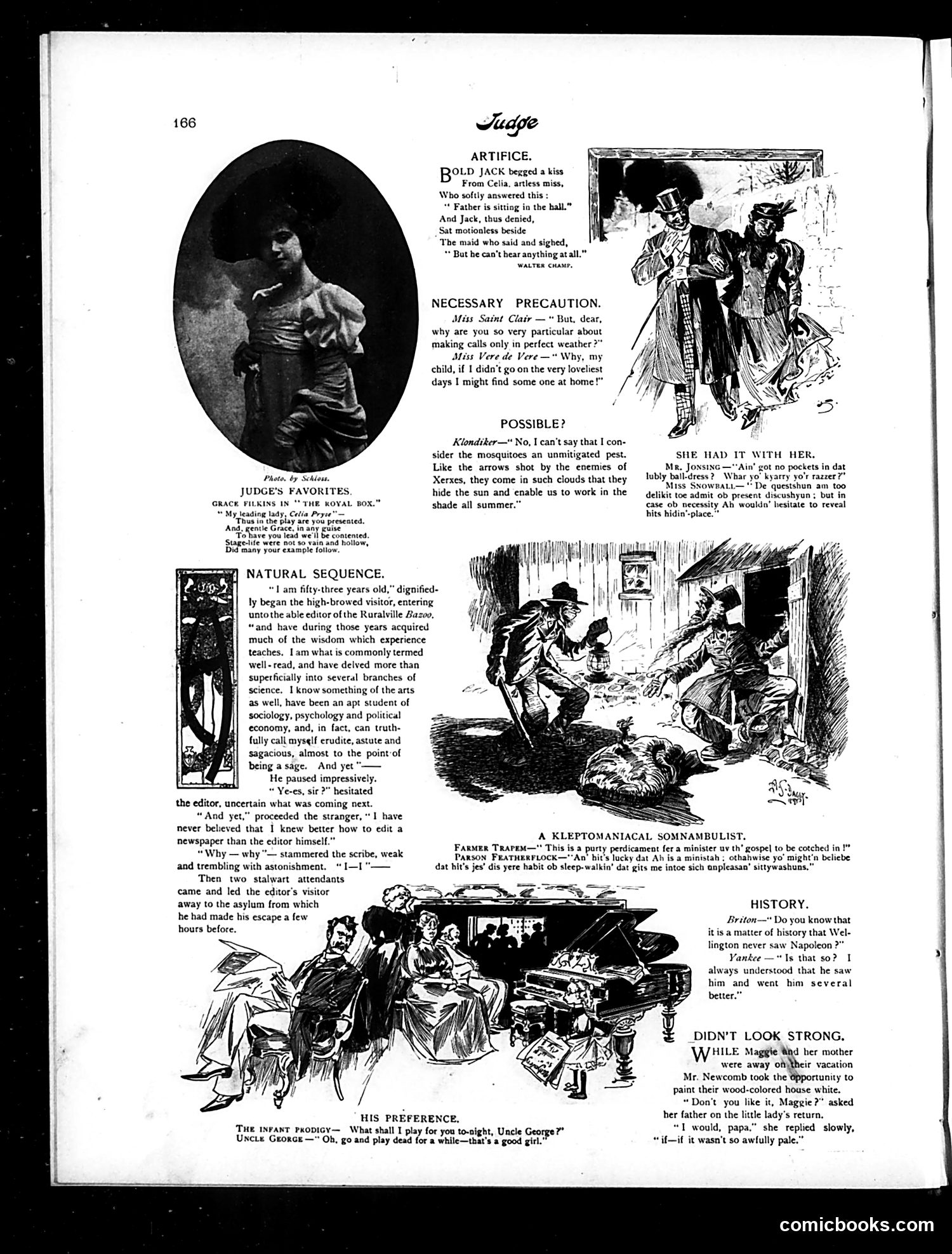
This page contains several short humorous pieces rather than a unified political cartoon. The sketches depict everyday social situations with satirical commentary: **"Artifice"** mocks social pretense—a man denies his father is present while sitting in the same room. **"Necessary Precaution"** and **"Possible?"** joke about mosquitoes and weather-related social calls, reflecting turn-of-century concerns about disease vectors and proper etiquette. **"Natural Sequence"** appears to be a longer piece about intellectual pretension, mocking someone who claims expertise across multiple disciplines. The illustrations accompanying these pieces show Victorian-era clothing and domestic settings. Overall, the page satirizes middle-class social conventions, intellectual posturing, and the gap between public appearance and private reality—typical Judge magazine fare targeting contemporary urban society rather than specific political figures.
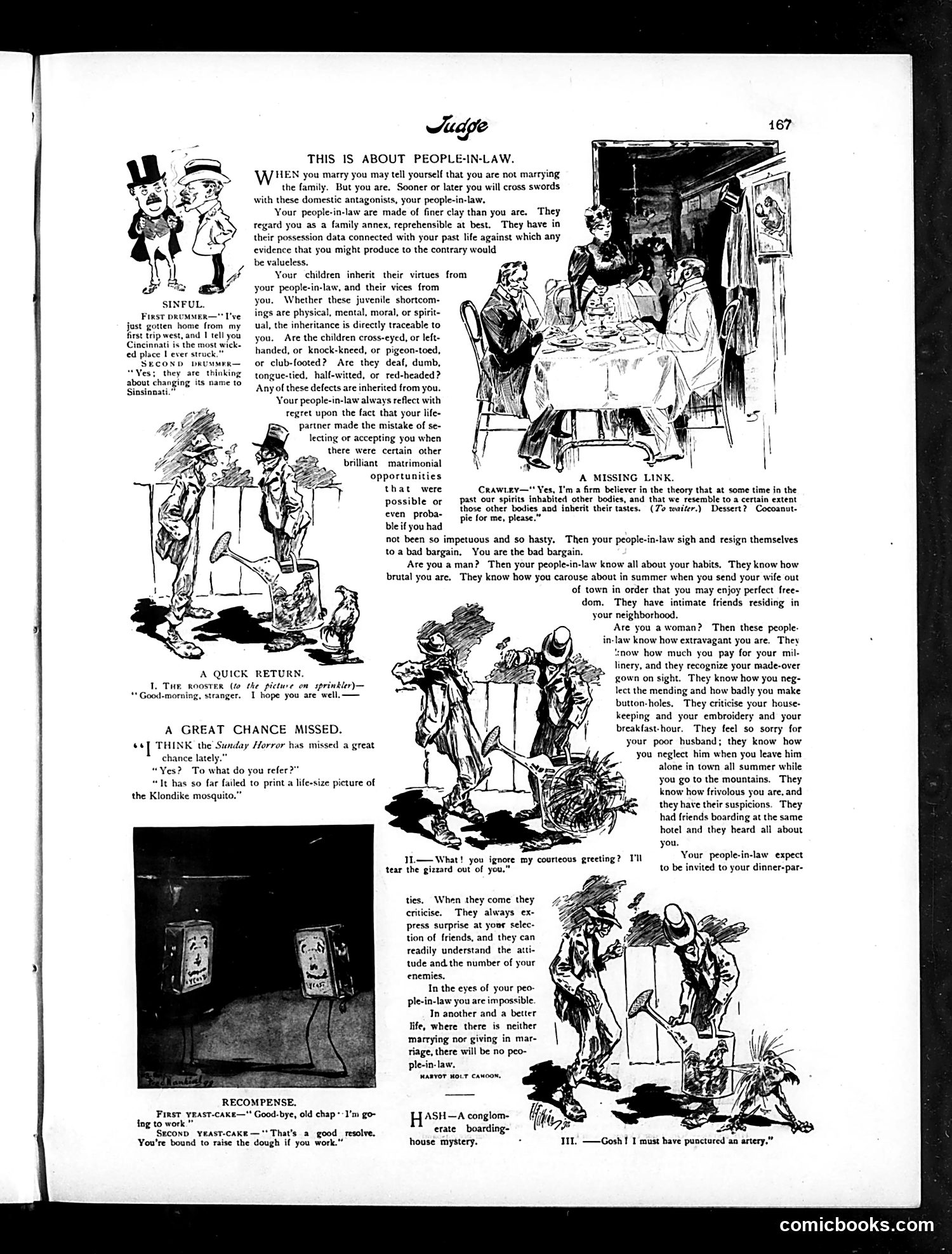
This multi-panel feature satirizes the universal tension between spouses and their in-laws. The central argument: when you marry, you inherit not just a partner but critical, judgmental relatives who view you as fundamentally inferior to their family. The satire targets in-laws' hypocrisy and intrusiveness. They claim superiority while meddling extensively—monitoring your finances, habits, parenting, and social choices. The cartoon "A Missing Link" jokes that in-laws seem to belong to an evolutionary stage above you. The piece ridicules gender-specific expectations: husbands are judged as brutish and unfaithful; wives as spendthrift and neglectful. A recurring theme: in-laws possess damaging information about your pre-marriage past used to diminish your credibility. The humor targets both in-law arrogance and the trapped feeling of marriage itself. The closing line—that in heaven there will be "no people-in-law"—sardonically suggests escaping them requires death. This represents early 20th-century American middle-class anxieties about marriage, family judgment, and social conformity.
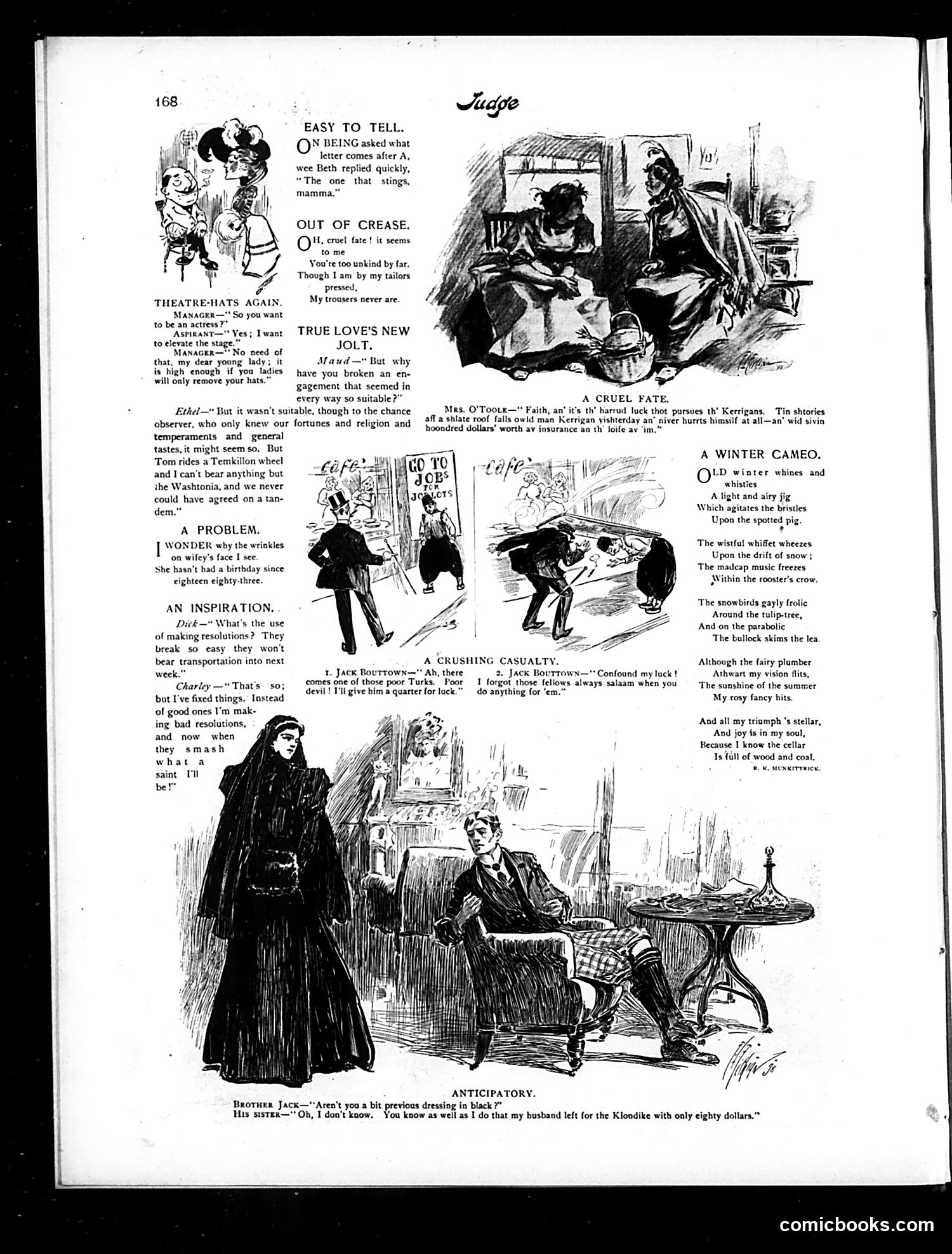
This page contains humorous sketches and comic dialogue typical of late 19th-century American satire. The jokes address contemporary social concerns: **"Theatre-Hats Again"** mocks women wearing oversized hats to theater, blocking other patrons' views—a genuine complaint of the era. **"True Love's New Jolt"** satirizes the emerging bicycle craze by suggesting a couple breaks their engagement over incompatible bicycle preferences (Temkillon vs. Washtonia wheels), poking fun at how trivial concerns sometimes override genuine compatibility. **"A Cruel Fate"** uses Irish immigrant dialect humor to joke about a man surviving a dangerous fall despite having life insurance—suggesting ironic bad luck for his family's financial interests. **"Anticipatory"** appears to reference Turkish affairs (unclear exact context), while other pieces joke about wrinkles, New Year's resolutions, and a man dressing in black in anticipation of a relative's death from the Klondike gold rush. The content reflects period concerns: fashion, courtship, immigration, and contemporary crazes like bicycles and the Klondike rush.
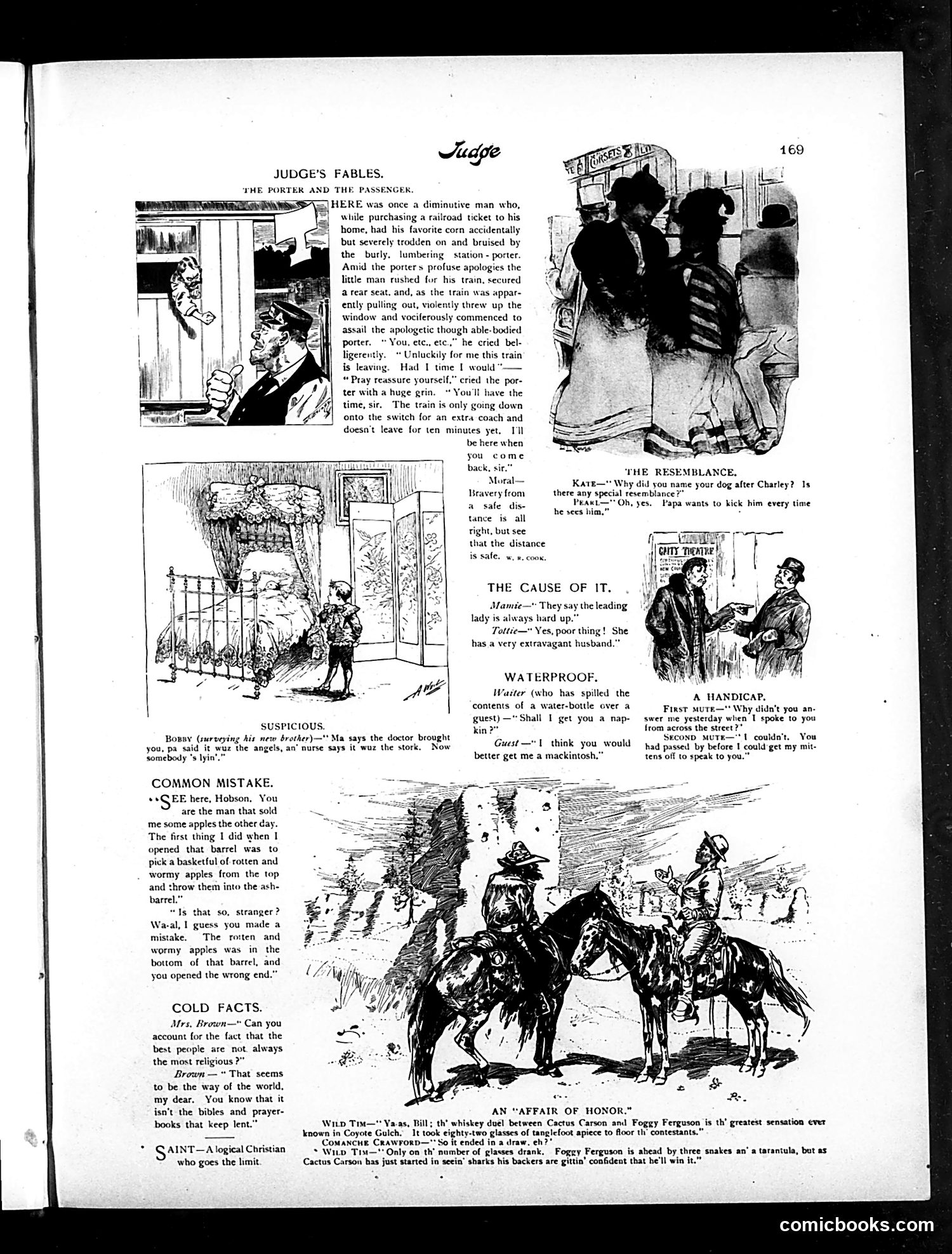
This page collects six brief humorous anecdotes typical of *Judge* magazine's "fables"—moral tales with ironic twists. **"The Porter and the Passenger"** mocks a diminutive man who threatens violence against a porter for stepping on his corn, then is humiliated when the train hasn't actually departed. The joke: bluster without power. **"Common Mistake"** satirizes a customer who complains about rotten apples sold to him, only to learn he opened the barrel upside-down—mockery of the foolish consumer. **"Cold Facts"** and other brief items employ similar logic: deflating pretension through simple reversals (religious hypocrisy, mute etiquette, extravagant wives). **"An Affair of Honor"** parodies Wild West dueling culture, where two cowboys escalate a whiskey-drinking contest absurdly, with bystanders adding snake and tarantula casualties as proof of honor. Overall, these fables satirize social pretension, male foolishness, and absurd customs of the period through straightforward comedic reversals rather than explicit political commentary.
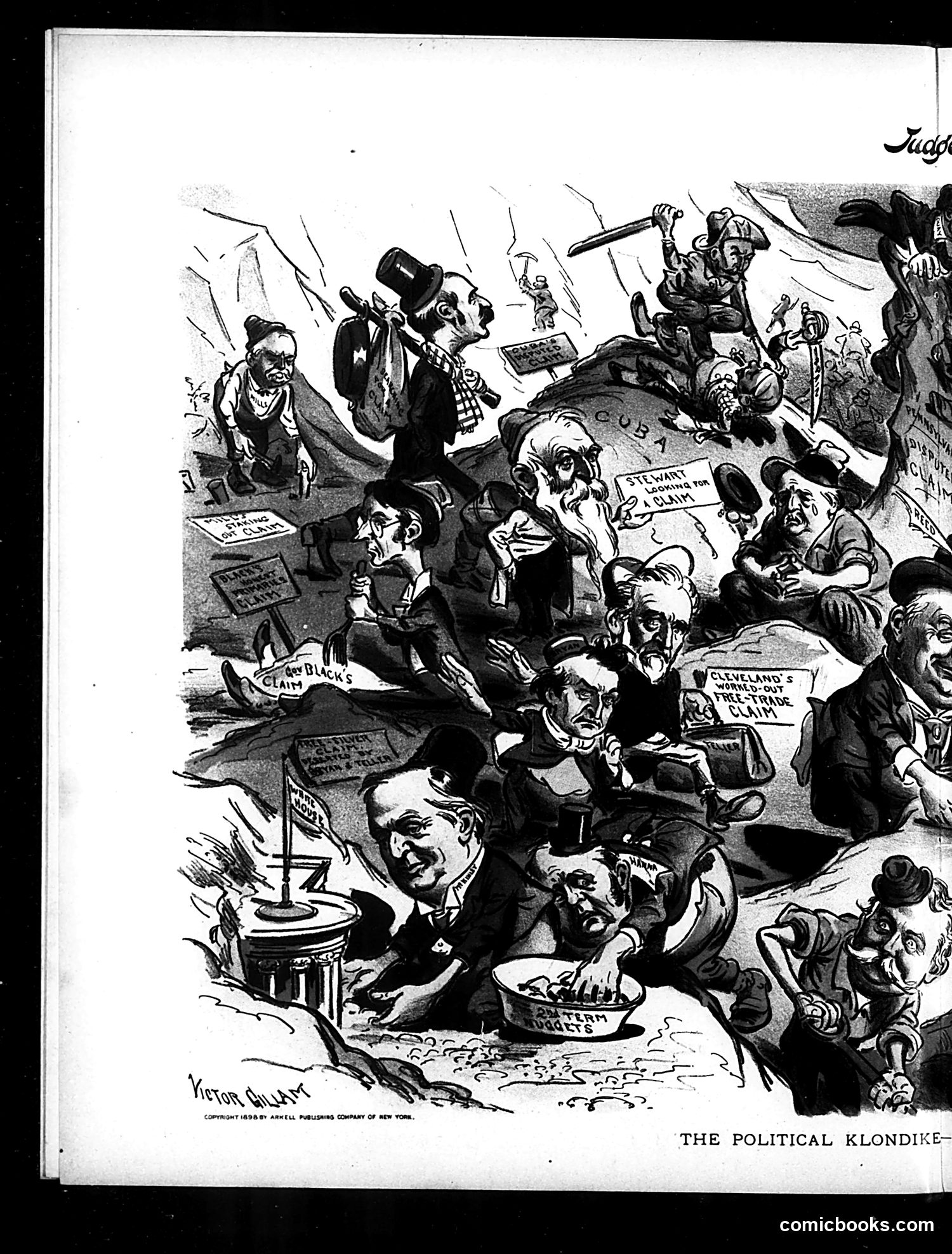
This satirical cartoon depicts American politicians as prospectors during the Klondike Gold Rush, scrambling chaotically to extract wealth. The title suggests politicians treat politics like a gold rush—opportunistically seeking personal enrichment rather than serving the public. Various figures wield pickaxes and shovels amid labels referencing political scandals and issues. Visible text includes references to "Cleveland" (likely President Grover Cleveland) and what appears to be accusations of corruption. The cartoonist (Victor Gillam, per the signature) portrays the political establishment as undignified and self-serving, with politicians portrayed as greedy prospectors fighting over spoils. This reflects late 19th-century public cynicism about political corruption and the spoils system that dominated American politics.
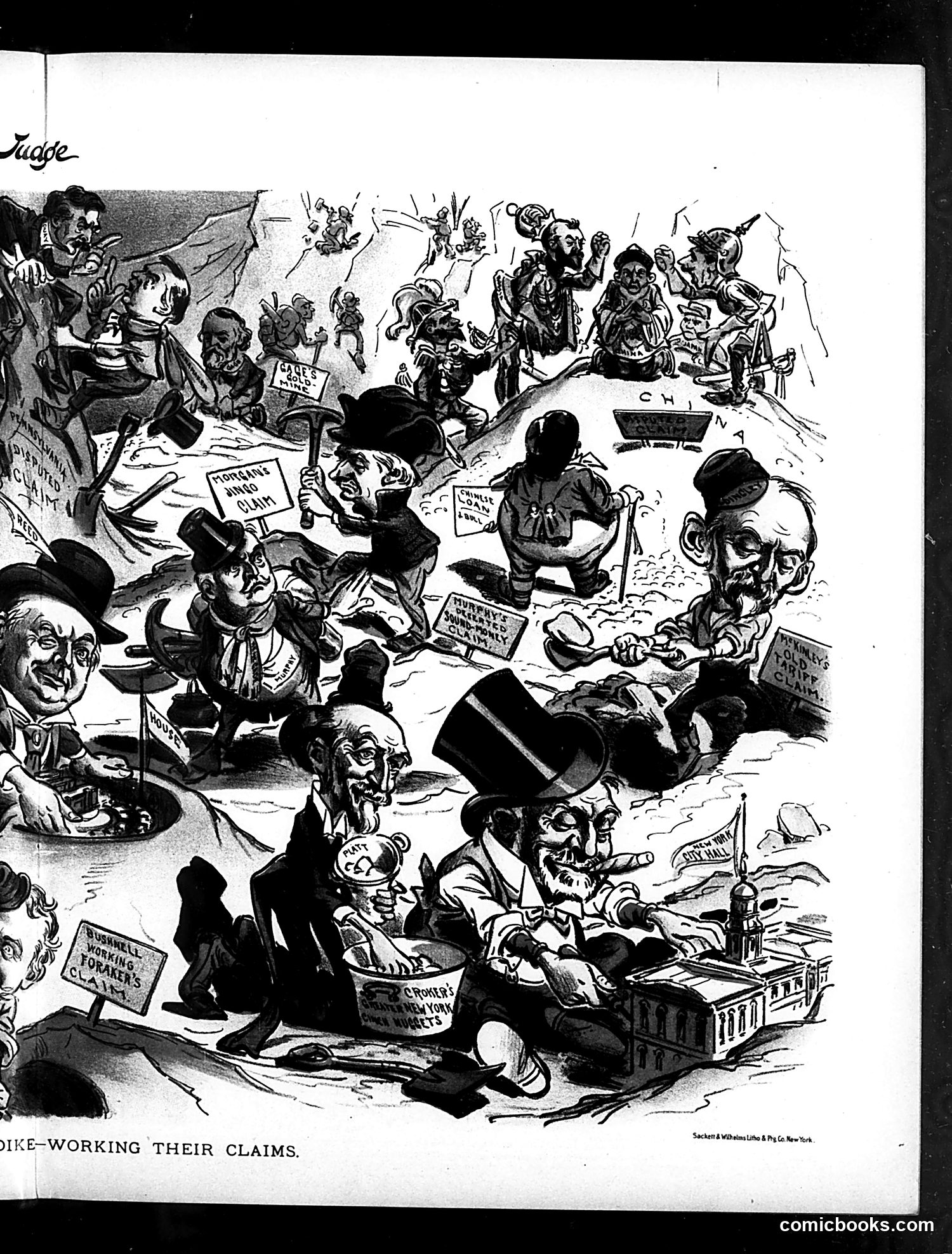
This political cartoon satirizes various figures and interests aggressively pursuing claims or demands, depicted as demonic or grotesque characters in a chaotic scene labeled "China." The title's pun on "Ike" (likely President Eisenhower) combined with "working" suggests political maneuvering. The caricatured figures appear to represent different nations or political factions—identifiable by some holding signs—competing for advantage or territory in China during the Cold War era. The exaggerated, demonic imagery is typical of Judge's anti-communist rhetoric from the 1950s, depicting various parties (possibly communist forces, rival powers, or business interests) as threatening or corrupt. Without clearer visible labels on all figures, the specific identities remain unclear, but the cartoon criticizes aggressive power-grabbing in international affairs.
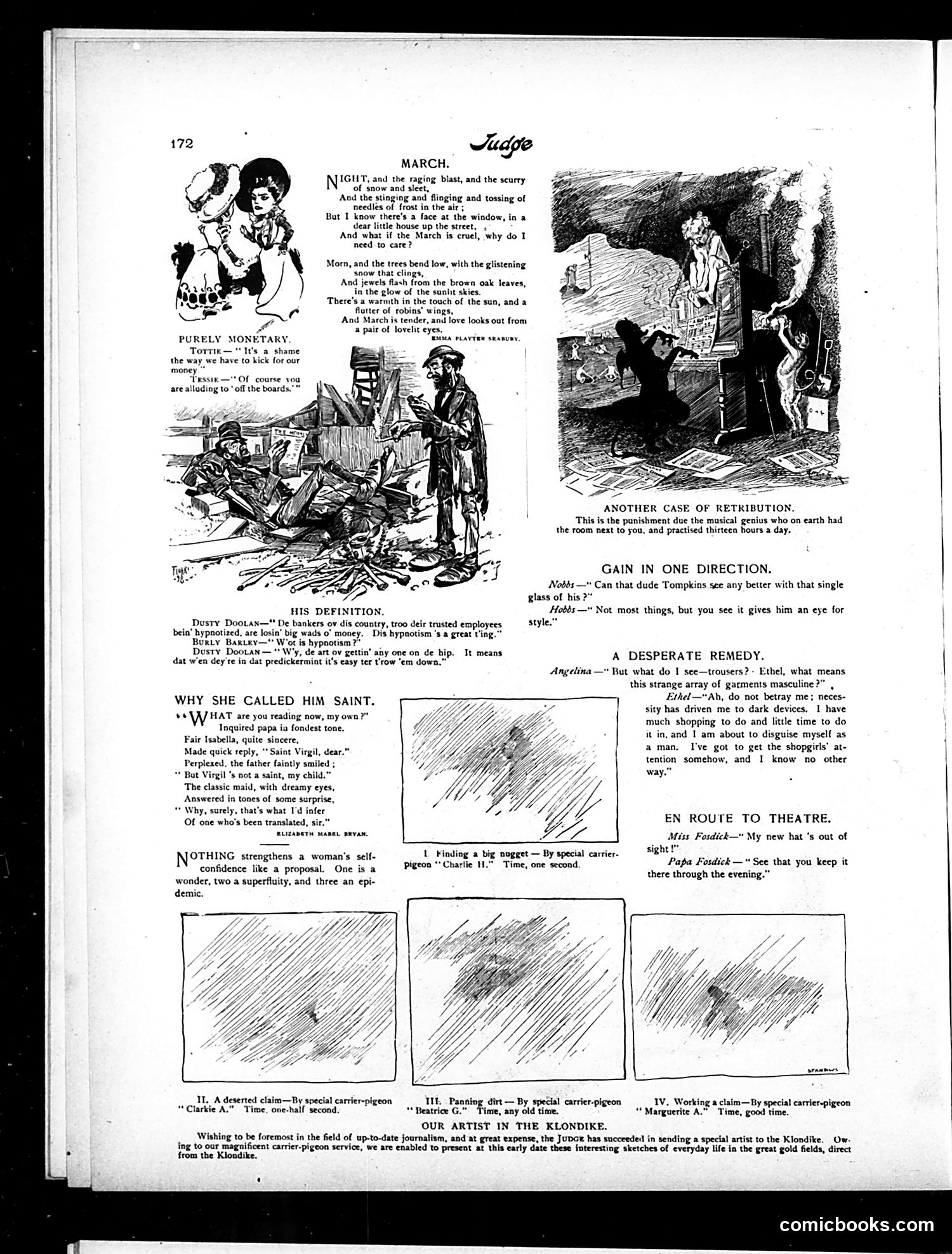
This page mixes poetry, humor cartoons, and satirical jokes typical of Judge's format. **Main content:** The top features romantic poetry about March weather. Below are several short comic vignettes mocking contemporary life: - "Purely Monetary" satirizes theatrical performers demanding payment - "His Definition" jokes about bankers being hypnotized into losing money to employees - "Why She Called Him Saint" puns on the name "Virgil" (sounding like "virgin") being "translated" (a saint reference) - "A Desperate Remedy" shows a woman disguising herself as a man to get shopgirls' attention while shopping **Bottom feature:** "Our Artist in the Klondike" parodies the Klondike Gold Rush (1890s) by claiming Judge sends an artist via "carrier pigeon service" to report on mining operations. The crude sketches mock both the gold rush craze and modern journalism's competition for timely reporting. The satire targets materialism, gender conventions, and sensationalized news coverage of contemporary fads.
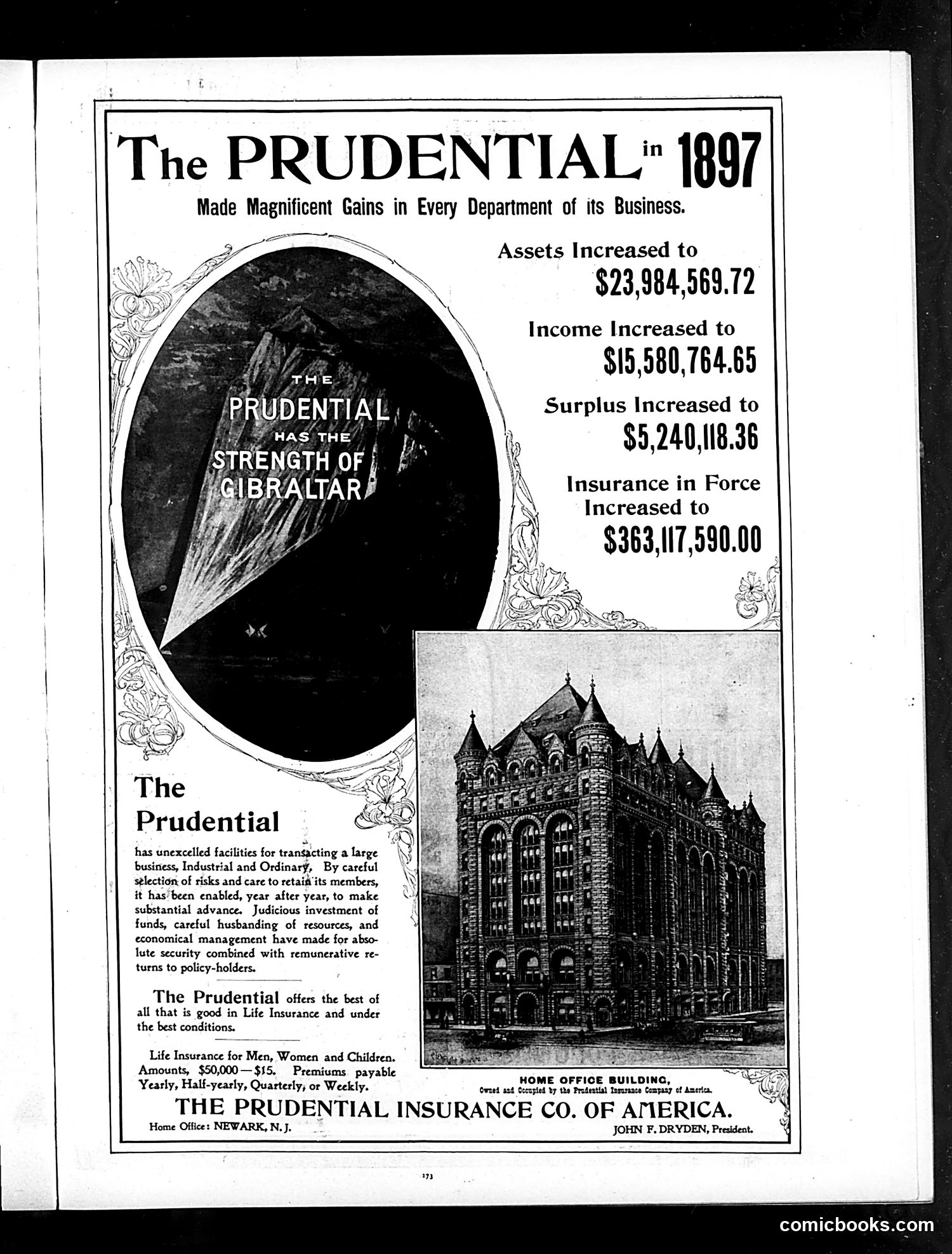
This is primarily **a full-page advertisement**, not political satire. It's a boastful corporate promotion for The Prudential Insurance Company of America (1897). **Key elements:** - **The Gibraltar imagery** (oval portrait): Uses the Rock of Gibraltar as a metaphor for strength and stability—a common insurance industry trope suggesting the company is immovable and secure. - **Financial statistics**: Lists impressive growth figures ($23.9M assets, $15.5M income, etc.) to attract investors and policy-holders. - **Home office building** (architectural photo): Demonstrates physical, tangible presence and legitimacy through an impressive Newark, N.J. headquarters. - **"Best of all that is good"**: Hyperbolic marketing language typical of Gilded Age advertising. This page reflects the era's confidence in industrial capitalism and emerging corporate power. For modern readers: this is how insurance companies marketed trustworthiness—through fortress imagery, inflated numbers, and architectural grandeur—before regulatory disclosure requirements existed.
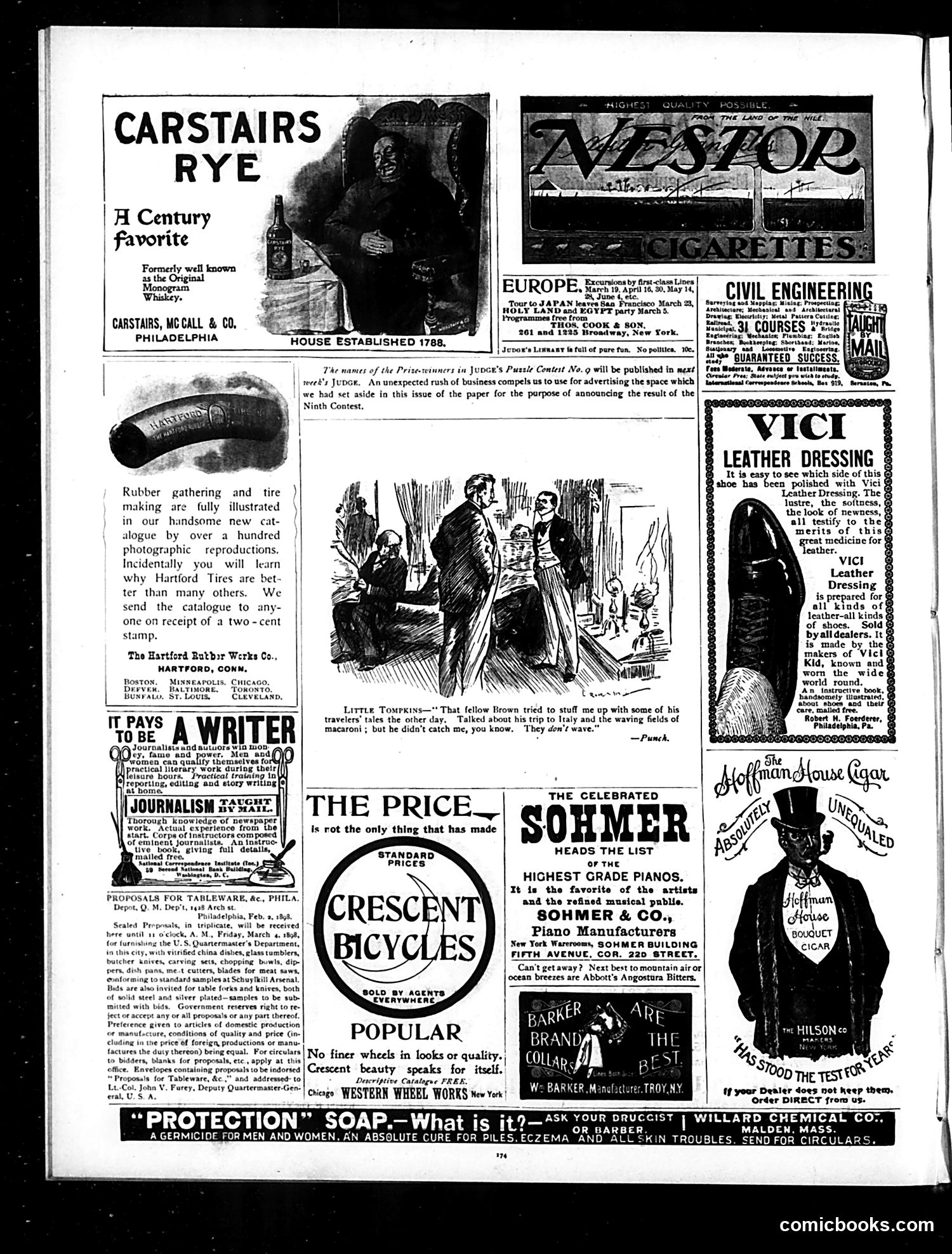
This page is primarily **advertisements and filler content**, not political satire. The masthead indicates it's from Judge, a satirical weekly, but this particular page contains mostly commercial ads with only one small cartoon. The single editorial cartoon shows "Little Tompkins" rejecting a traveler's embellished account of an Italian trip—specifically the claim about "waving fields of macaroni." The joke mocks travelers' exaggeration and gullibility: the character refuses to be fooled by obviously false tall tales (macaroni fields don't literally wave). The rest of the page advertises consumer goods (Carstairs Rye whiskey, Hartford tires, Crescent bicycles, Sohmer pianos, Vici leather dressing), writing courses, and military procurement notices. An editorial note explains that Judge postponed announcing contest winners to accommodate unexpected advertising demand.
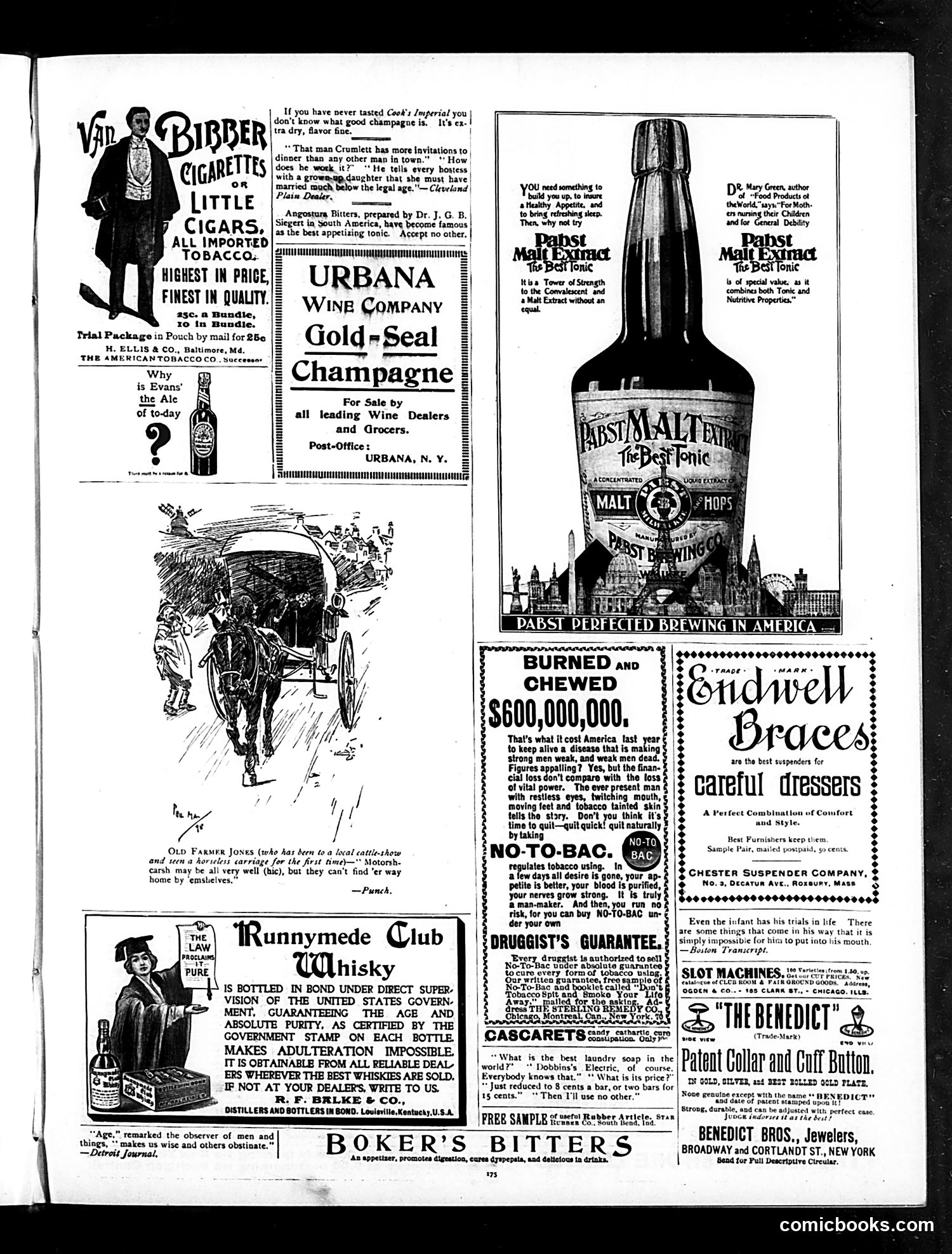
This is primarily a **advertising page** from Judge magazine, containing various product endorsements rather than political satire. The one cartoon present depicts **Old Farmer Jones** marveling at an early automobile ("horseless carriage"), expressing skepticism that it can find its way home without human guidance. This reflects early-1900s anxieties about newfangled motor technology—a common theme when automobiles were novel and unreliable. The page is dominated by ads for alcohol (whisky, champagne, bitters), tobacco products, and patent medicines. Notably, there's a prominent anti-tobacco ad for "NO-TO-BAC," claiming to cure tobacco addiction and citing "$600,000,000" spent annually on tobacco-related disease—representing early health concerns about smoking. Other ads promote suspenders, collar buttons, laundry soap, and druggist remedies, typical of the era's commercial culture. The page reflects turn-of-the-century consumer products and their marketing appeals, rather than satirical political commentary.
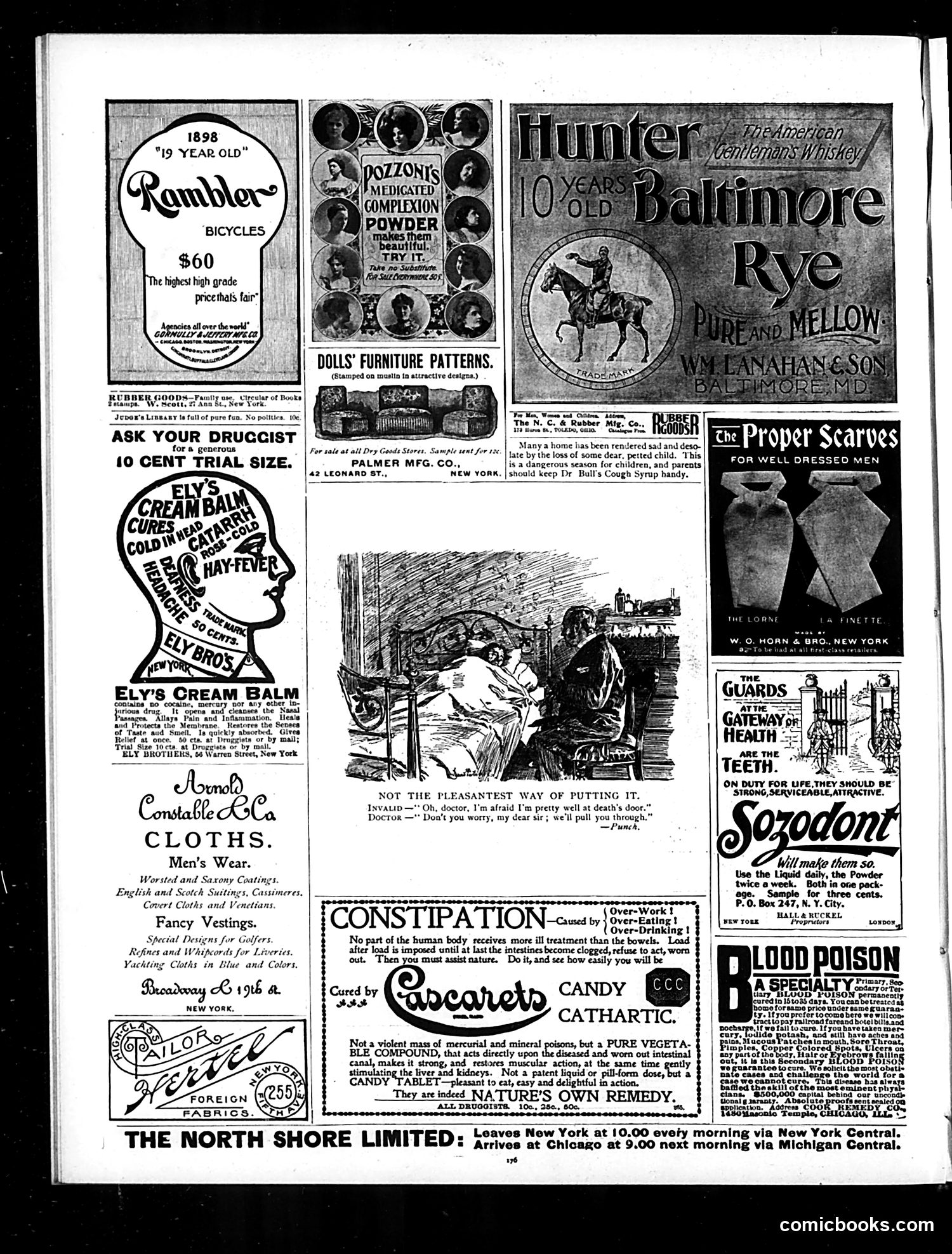
This page is primarily **advertisements** with one small cartoon. The central cartoon, titled "Not the Pleasantest Way of Putting It" (credited to *Punch*), depicts a doctor reassuring a dying patient. The joke relies on blunt honesty: the invalid fears he's "at death's door," and the doctor confirms this grim assessment before offering reassurance—an awkward bedside manner that prioritizes truthfulness over comforting bedside manners. The surrounding ads reflect **1890s consumer products and medical attitudes**: Ely's Cream Balm, Rumbler bicycles, Pozzoni's complexion powder, Hunter whiskey, scarves, toothpaste, and notably **Cascarets Candy Cathartic**—a laxative. The constipation remedy's long testimonial emphasizes it's a "pure vegetable compound" rather than "mercurial and mineral poisons," reflecting period anxieties about patent medicine ingredients. The page captures turn-of-the-century commercialism and medical pseudoscience typical of *Judge*.
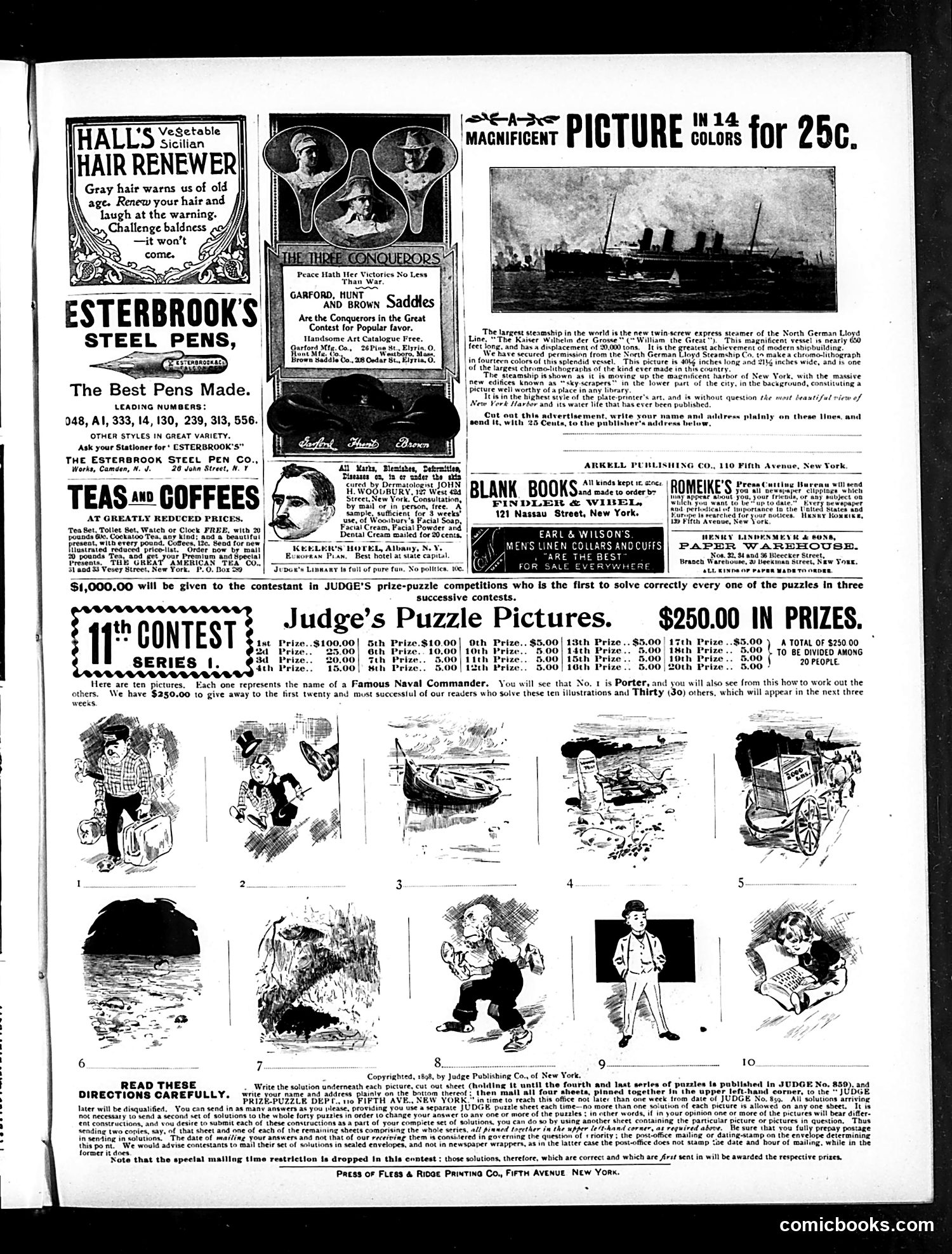
This page is primarily **advertising and a puzzle contest**, not political satire. The main content is "Judge's Puzzle Pictures"—a contest where readers identify ten famous naval commanders from illustrated rebuses. The first answer is shown as "Porter" (a play on words/image). The page contains numerous product advertisements typical of 1890s magazines: Hall's Hair Renewer, Esterbrook Steel Pens, teas and coffees, and blank books. One notable ad features **"The Three Conquerors"** (saddles by Garford, Hunt, and Brown), and a large illustrated advertisement for the German steamship "Kaiser Wilhelm der Grosse." **Historical context**: This appears to be from 1898 (copyright visible), during the Spanish-American War era, which may explain the naval commander theme and German ship advertisement. The puzzle itself—identifying military figures—likely appealed to contemporary readers' patriotic interests, but the page is fundamentally commercial rather than satirical.
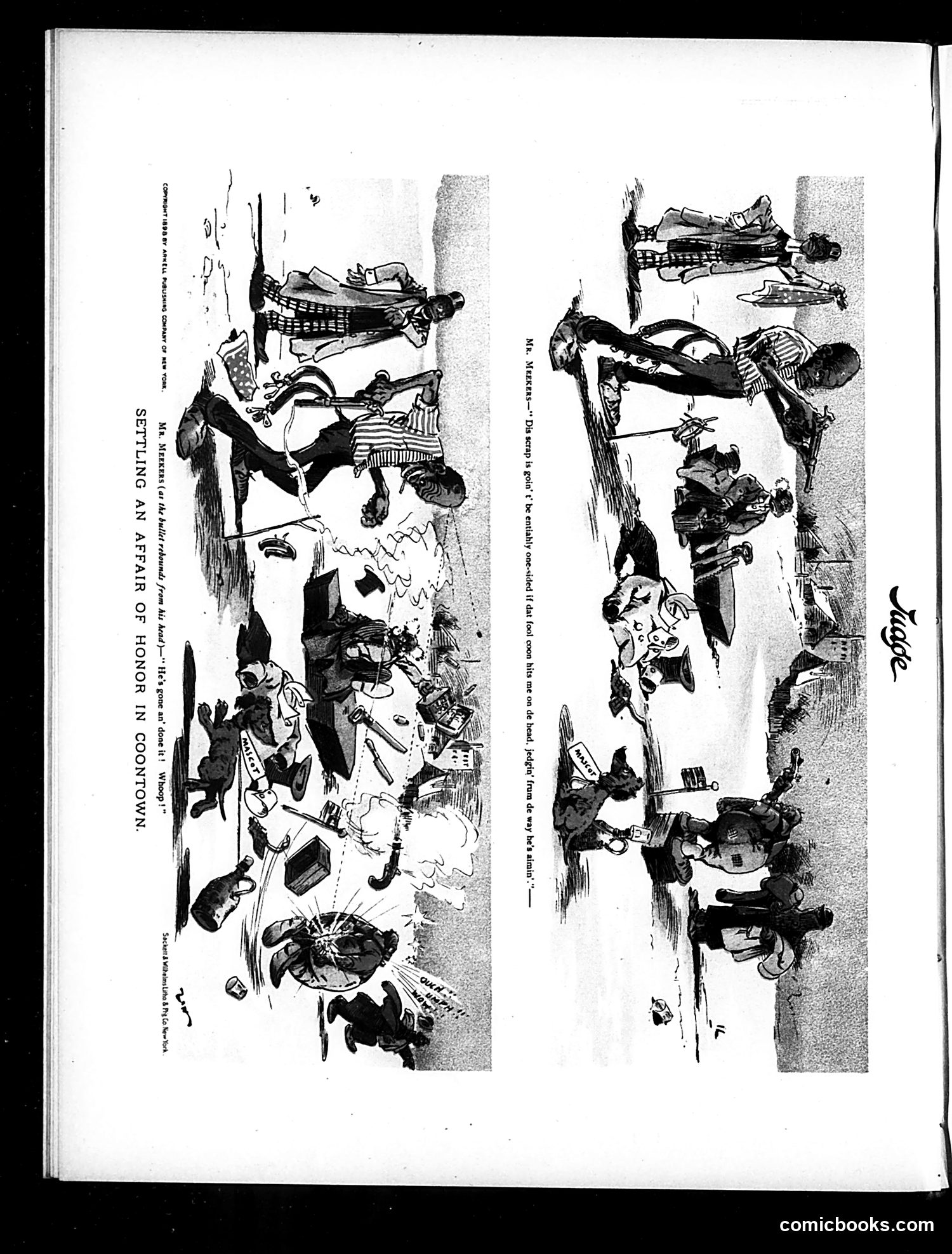
This is a satirical cartoon titled "Settling an Affair of Honor in Coontown" from Judge (copyright 1898). The image depicts a violent scene with racial caricatures representing African Americans in a derogatory manner typical of late-19th-century racist imagery. The cartoon shows figures engaged in what appears to be a chaotic fight or "duel," with one character stating "He's gone an' done it! Whoop!" after a bullet rebounds from someone's head. The satire appears to mock African American violence and dispute-resolution, presenting it as comedic and less civilized than white society's formal "affairs of honor" (duels). This reflects deeply racist attitudes of the Gilded Age, using grotesque caricature and stereotypes to demean Black Americans. The humor relies entirely on dehumanizing portrayal—a reminder of how mainstream publications normalized racist content during this period.