
A complete issue · 16 pages · 1898
Judge — February 19, 1898
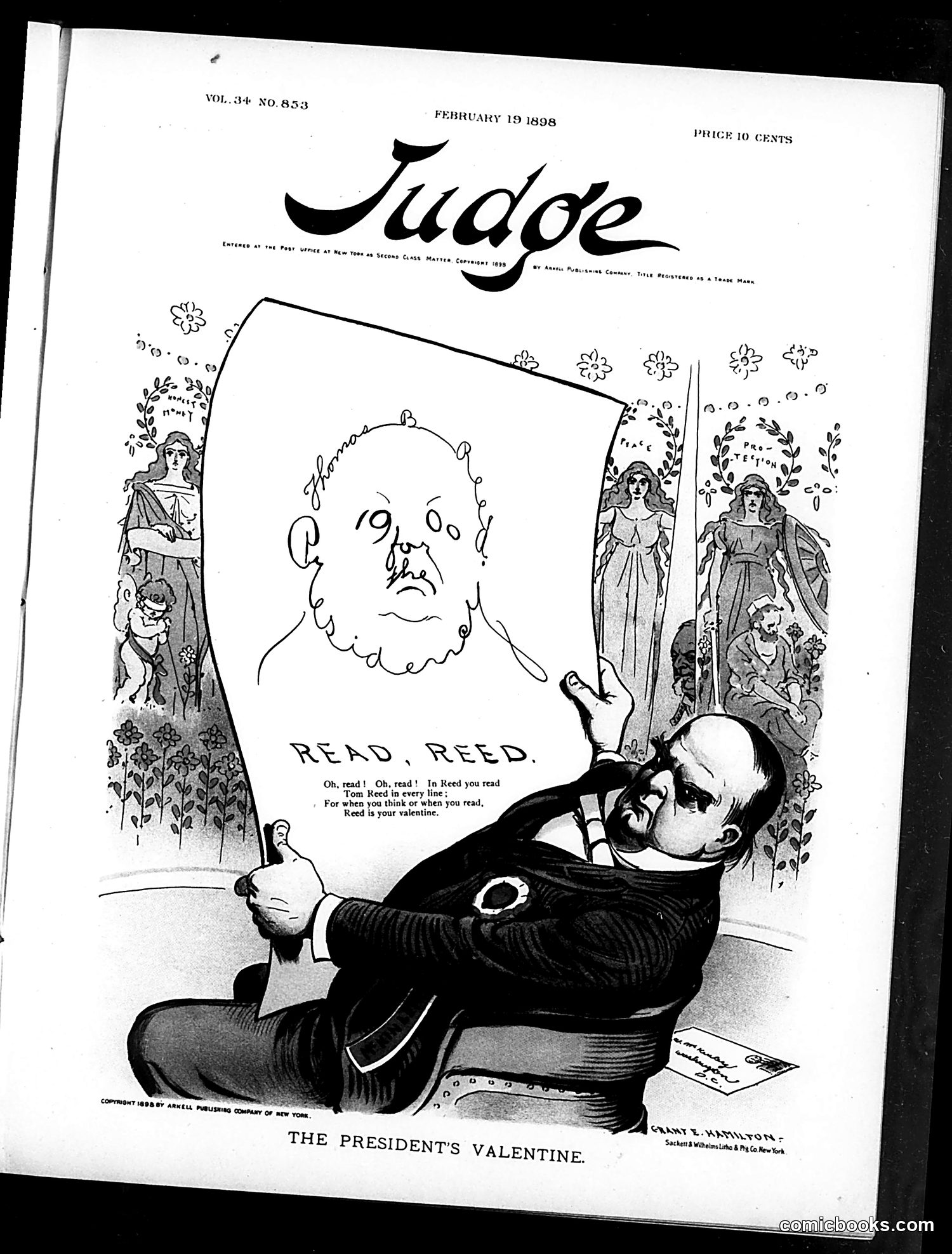
This *Judge* magazine cover from February 19, 1898, presents a political cartoon titled "The President's Valentine." A bald man in formal dress reclines while holding up a large portrait of a bearded face labeled "READ, REED" with text reading: "Oh, don't say you've read Tom Reed in every line; / For when you think or when you read, / Reed is your valentine." The cartoon appears to satirize President McKinley's relationship with Thomas Brackett Reed, likely the House Speaker, suggesting McKinley is devoted to or dependent upon Reed's influence. The Valentine's Day framing creates mockery around this political entanglement, implying McKinley cannot escape Reed's presence even in his personal sentiments. The surrounding classical female figures suggest themes of ideal leadership being compromised by factional loyalty.
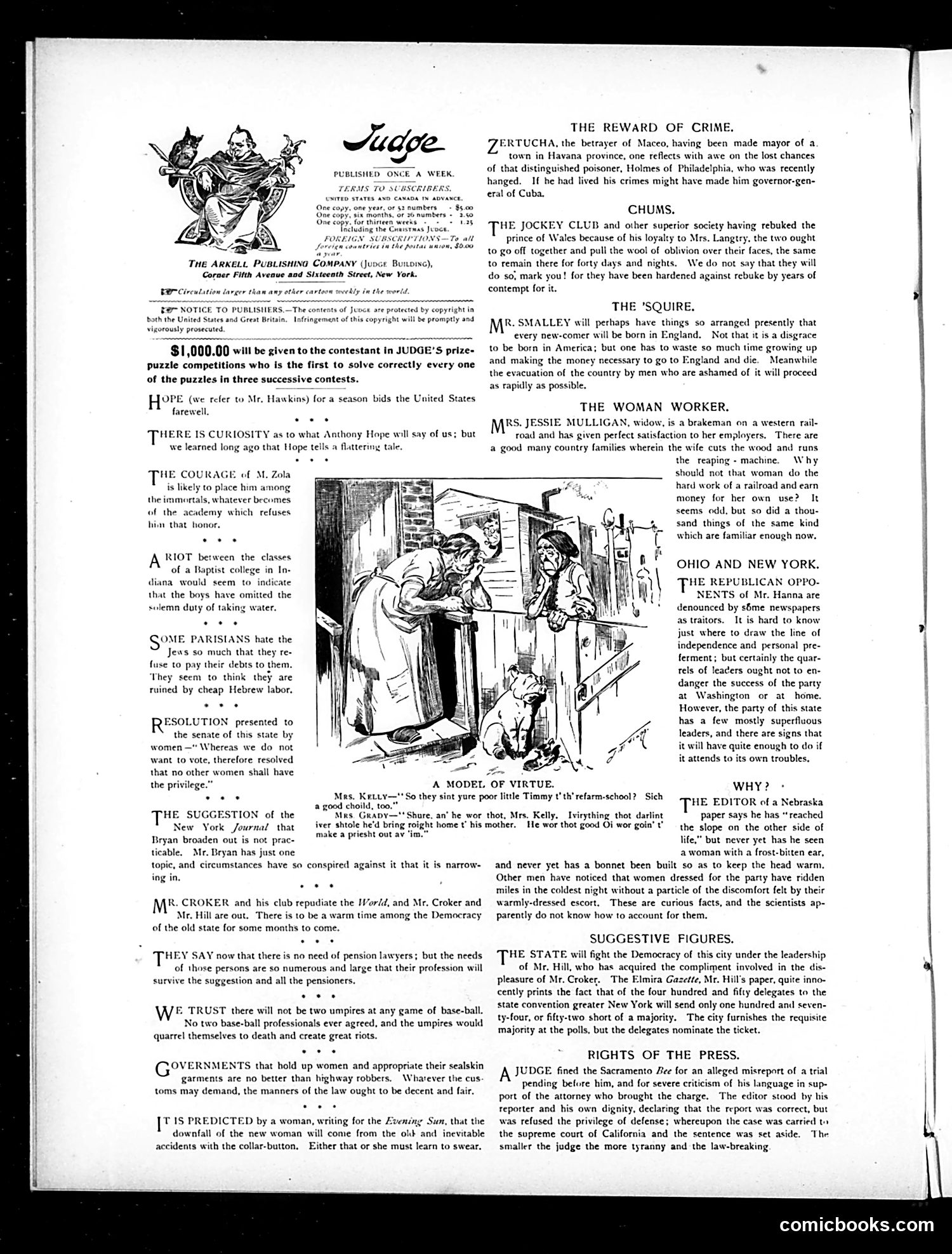
This page contains multiple short political commentaries rather than a single cartoon. The central illustration depicts a domestic scene of apparent poverty or working-class life. The commentaries satirize contemporary social issues: a Cuban politician (Zertucha) who betrayed his position; the Jockey Club's snobbishness toward the Prince of Wales; Mr. Smalley's inconvenient return from America; and Mrs. Mulligan, a railroad worker earning her own wages—presented as noteworthy because women's independent labor was still uncommon enough to warrant editorial comment. The "Ohio and New York" section critiques Republican politicians as potential traitors. The final pieces address press freedoms and women's voting rights, indicating this reflects late-19th-century reform debates.
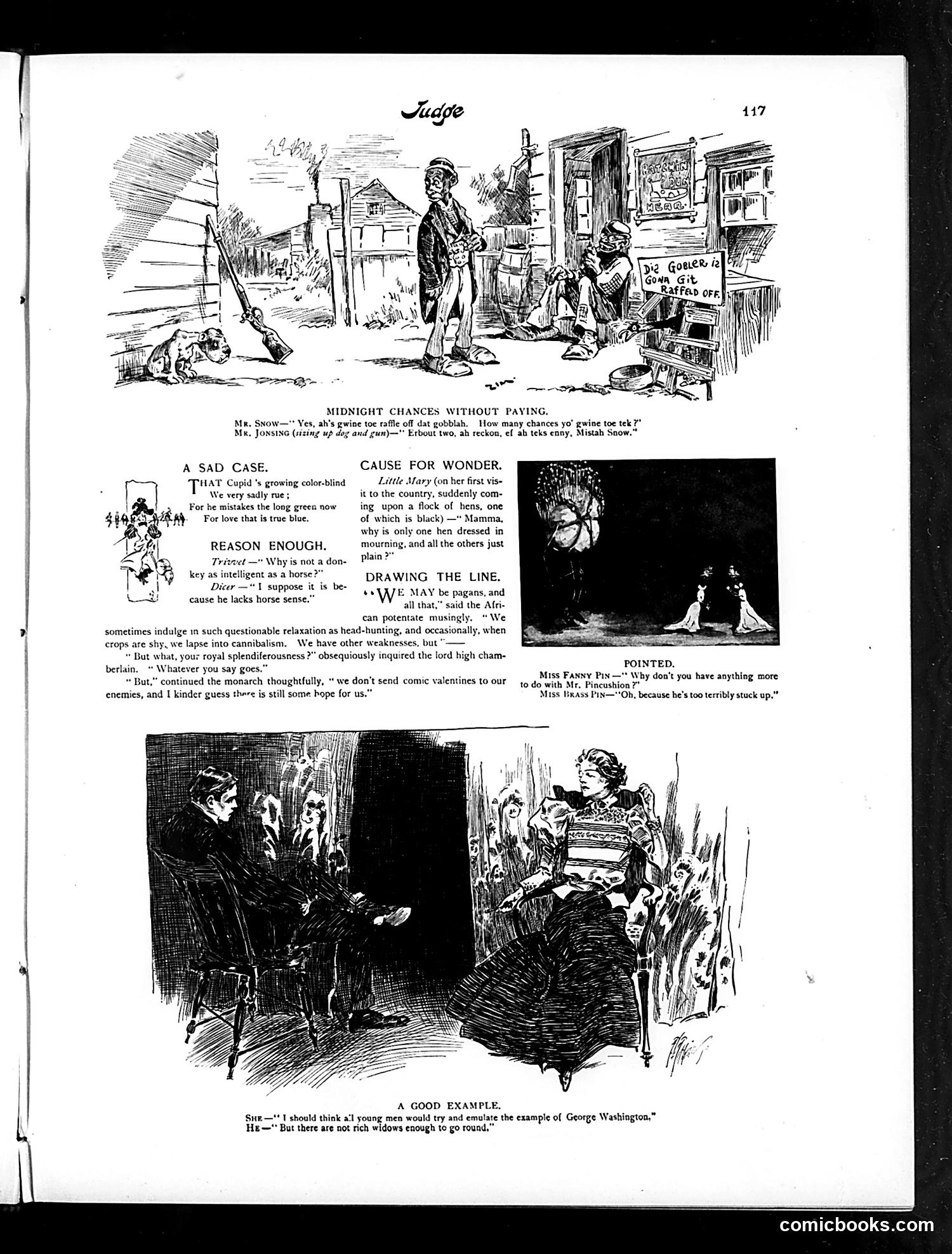
This page contains several Victorian-era humor pieces satirizing human nature and social pretense: **"Midnight Chances Without Paying"** mocks working-class attempts at gambling ("raffle," "chances") without money—depicting street hustlers and their dubious schemes. **"A Sad Case," "Reason Enough," and related items** are brief joke exchanges about human folly: color-blindness, donkeys' intelligence, and the tendency toward cannibalism when hungry. **"A Good Example"** (bottom) shows a wealthy woman lecturing a young man about George Washington's moral example, while the caption's punchline reveals her own hypocrisy: she has "not rich widows enough to go round"—suggesting she's seeking wealthy women for undisclosed purposes. The humor targets social pretense, class struggles, and moral hypocrisy through sharp, brief satirical exchanges typical of Judge magazine's editorial voice.
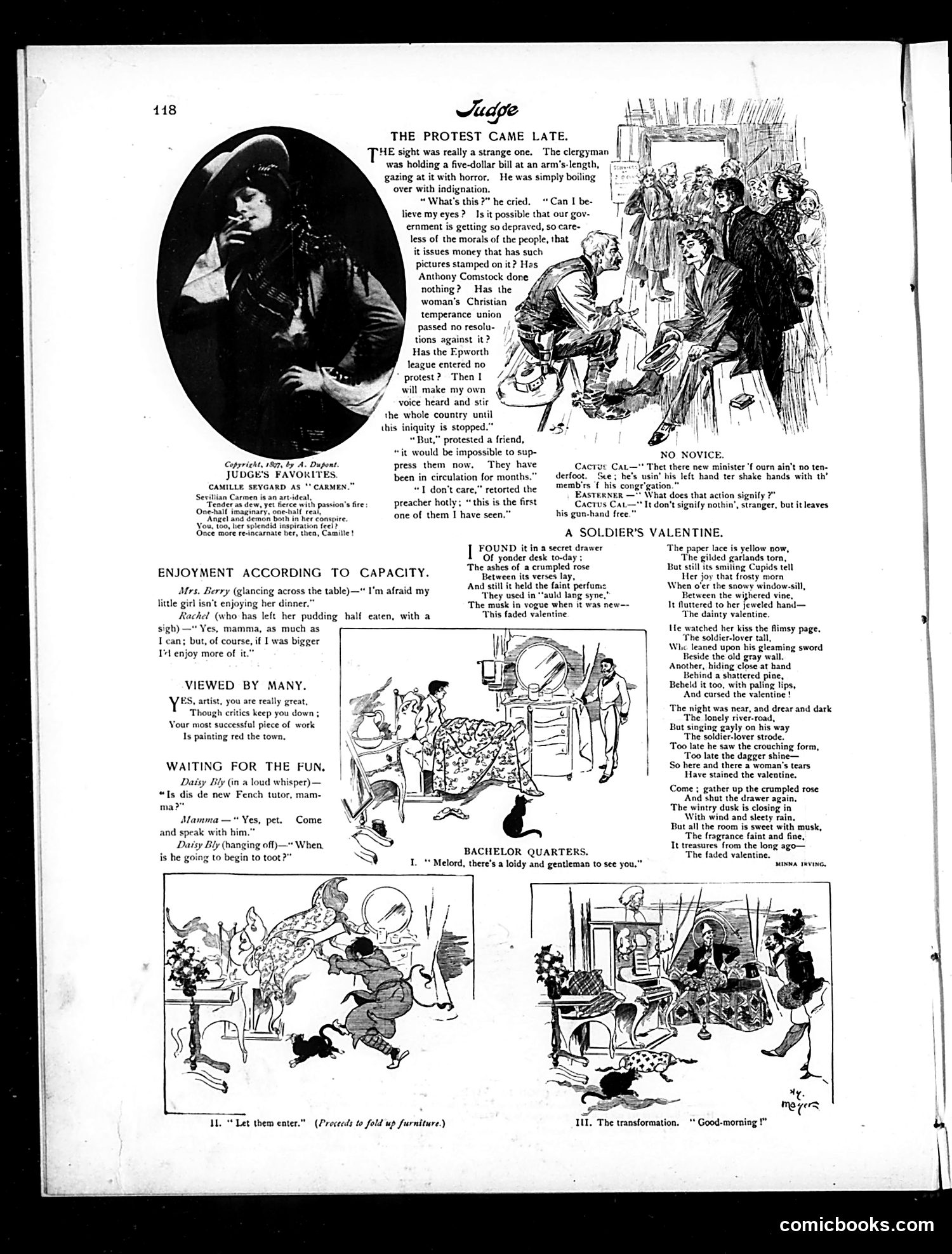
This page contains several satirical pieces from Judge magazine, likely from the WWI era based on the military references. **"The Protest Came Late"** features a clergyman horrified by government-issued currency bearing indecent images. The satire criticizes the delayed moral outrage of religious institutions—the preacher questions why Christian groups haven't protested sooner if they're so offended now. **"A Soldier's Valentine"** is a sentimental poem about a soldier preserving a faded Valentine, contrasting romantic memory with wartime hardship. The remaining cartoons ("Enjoyment According to Capacity," "Viewed by Many," "Waiting for the Fun," and "Bachelor Quarters") appear to be domestic humor sketches about civilian life during wartime. The overall tone mixes patriotic sentiment with criticism of institutional hypocrisy regarding morality.
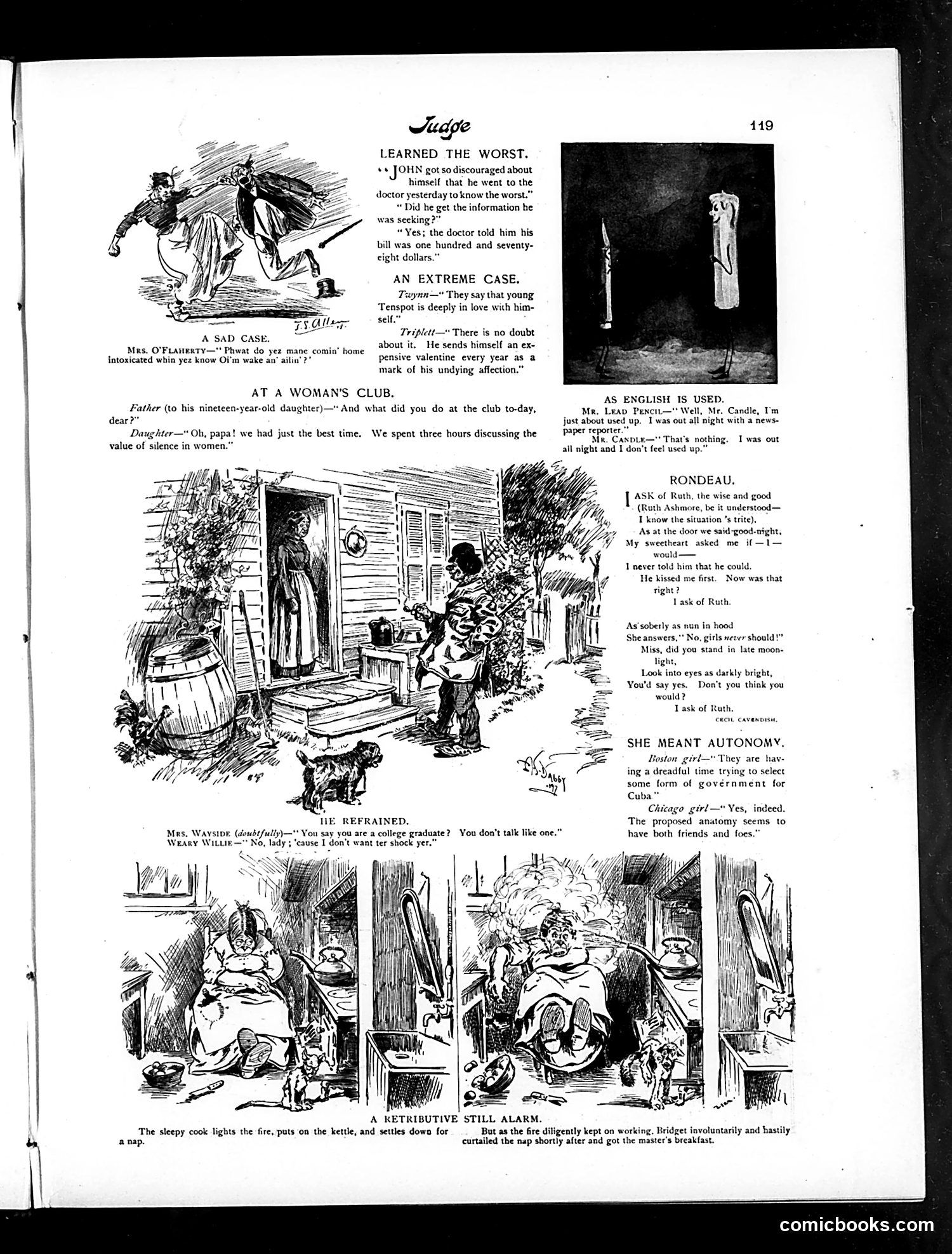
This page collects brief humorous anecdotes and cartoons typical of Judge's satirical style. Key targets: **Medical satire** ("Learned the Worst"): Mocks doctors' inflated bills—the "worst" news isn't diagnosis but cost. **Vanity/narcissism** ("Extreme Case"): Ridicules excessive self-love through the absurd image of a man sending himself valentines. **Gender satire** ("Woman's Club"): A daughter reports spending three hours discussing "the value of silence in women"—implying women should stay quiet, presented as progressive club activity. **Language humor** ("As English is Used"): Mocks malapropisms, like "anatomy" (autonomy) for Cuba's government. **Class/education mockery** ("Weary Willie"): A college graduate speaks poorly to avoid "shocking" his working-class listener—inverting expectations. **Domestic comedy** (bottom cartoon): A lazy cook nearly burns the house down; the master's urgent alarm forces her to complete breakfast hastily. The overall tone reflects turn-of-century American humor: class-conscious, gender-stereotyping, and focused on everyday absurdities.
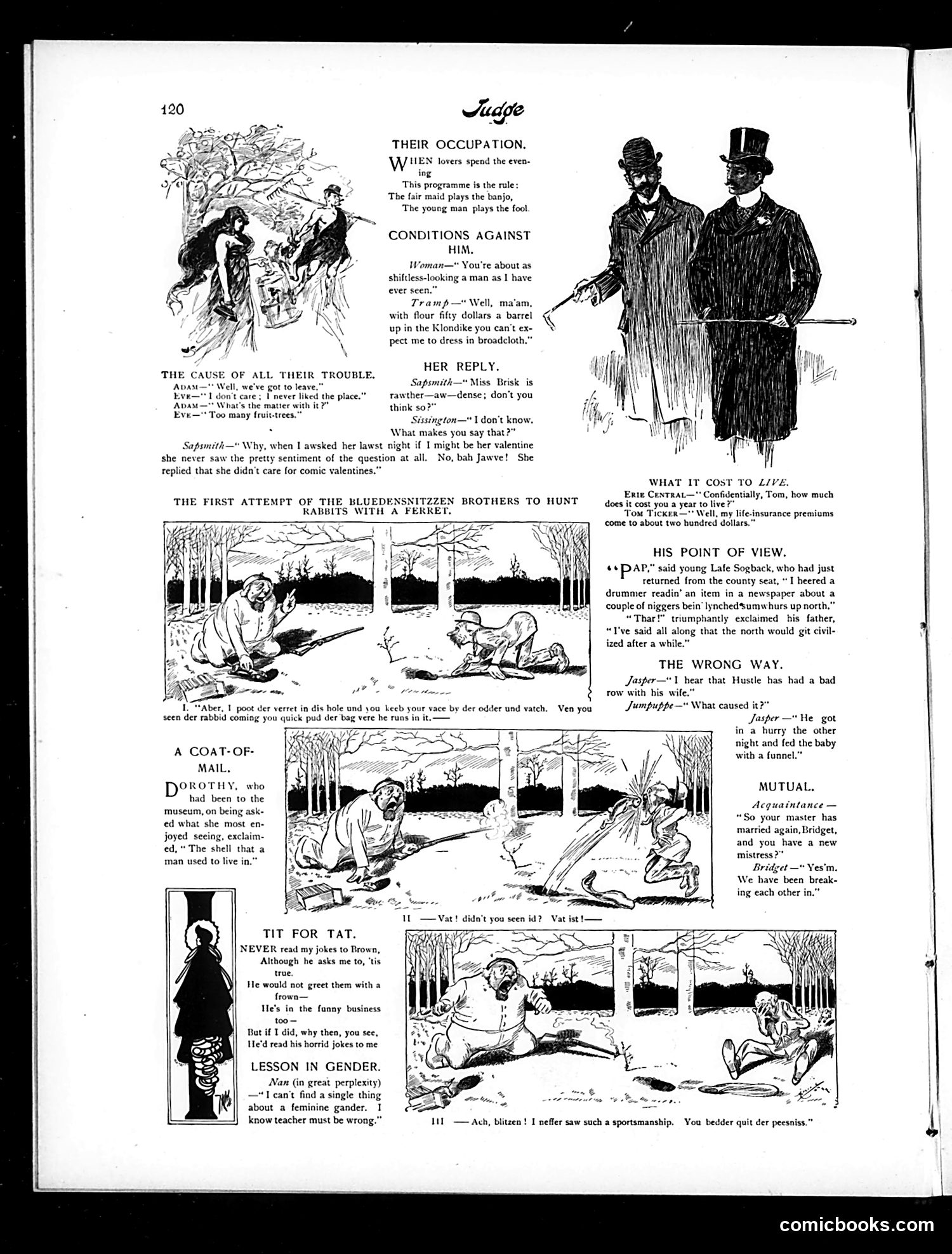
This page collects brief humorous sketches typical of Judge's satirical format. Key content includes: **Social satire**: "Their Occupation" mocks courting rituals where men play "the fool" while women entertain. A tramp references the Klondike Gold Rush as justification for shabby dress—contemporary topical humor about economic desperation. **Regional/ethnic humor**: A dialogue features a father and son with rural Southern dialect celebrating Northern lynchings as "civilization"—reflecting Judge's often crude racial attitudes typical of 1890s publications. **Class commentary**: A wealthy character mentions life insurance premiums casually; a domestic worker discusses adjusting to a new mistress—presenting servant/employer relationships as entertainment. **Comic confusion**: Dorothy's museum joke about shells; a woman confused about "feminine gander" grammar—gentle wordplay humor. **Ethnic caricatures**: German-accented hunters attempting to trap rabbits with incompetent instructions—stereotypical "immigrant fool" comedy common to the era. The page exemplifies Judge's mix of domestic humor, class observation, and period prejudices now jarring to modern readers.
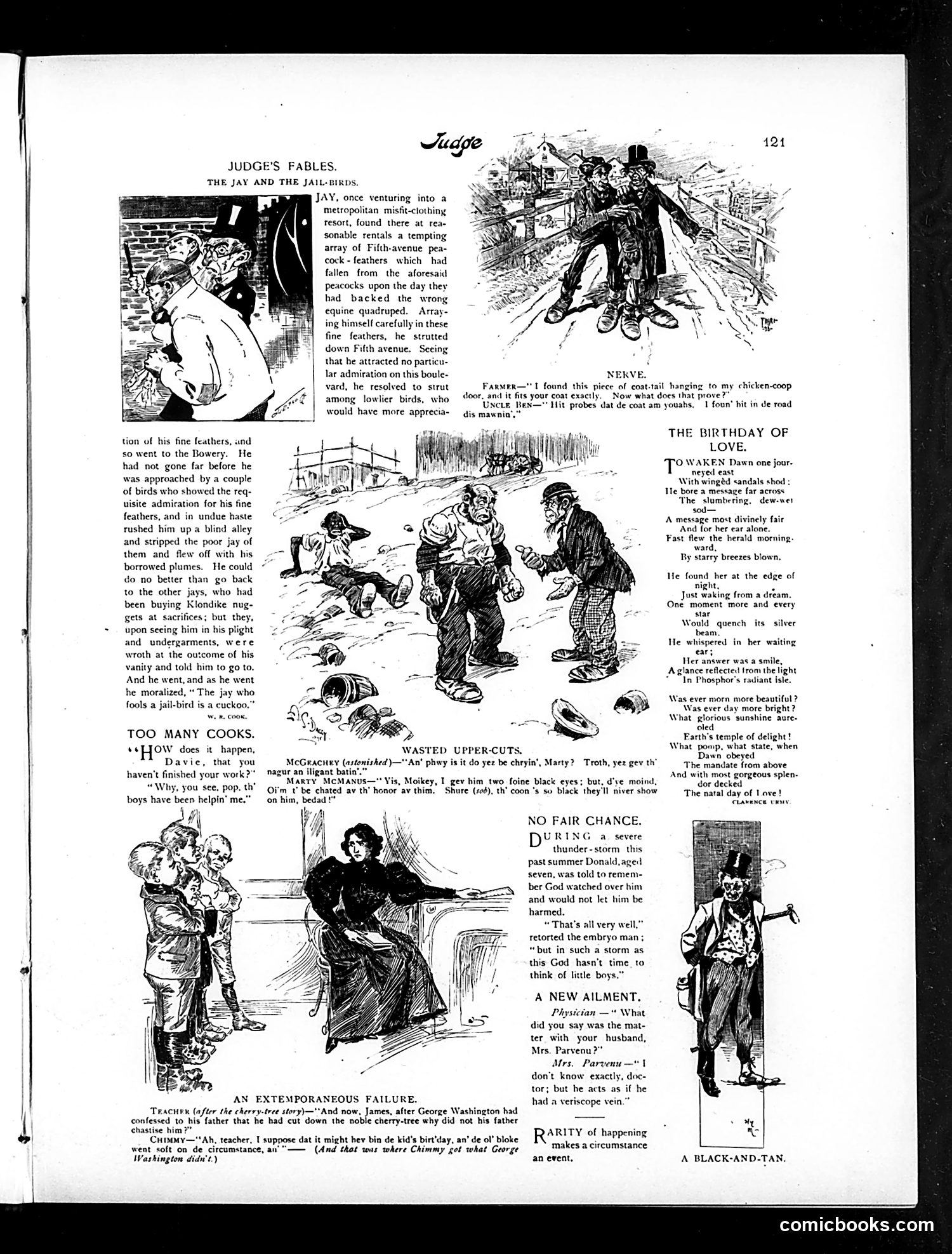
This page contains multiple satirical fables and humorous sketches typical of Gilded Age humor: **"The Jay and the Jail-Birds"** is a morality fable mocking social climbers. A jay borrows fancy "peacock feathers" (borrowed status symbols) to impress Fifth Avenue crowds, finds no appreciation, and moves to the Bowery seeking admiration from lower-class birds. There he's robbed by actual criminals ("jail-birds"), losing everything—a warning against false pretense and slumming. **Other sketches** include Irish immigrant dialect humor (common in period comedy), a story about George Washington's cherry tree adapted for working-class children, and a joke about a child's logical objection to divine protection during storms. The page reflects late-19th-century American satire: class anxiety, immigrant stereotyping, and lessons about authenticity versus pretense. The crude woodcut illustrations are typical of Judge's visual style. The content assumes reader familiarity with contemporary literary references and working-class New York geography (the Bowery, Fifth Avenue).
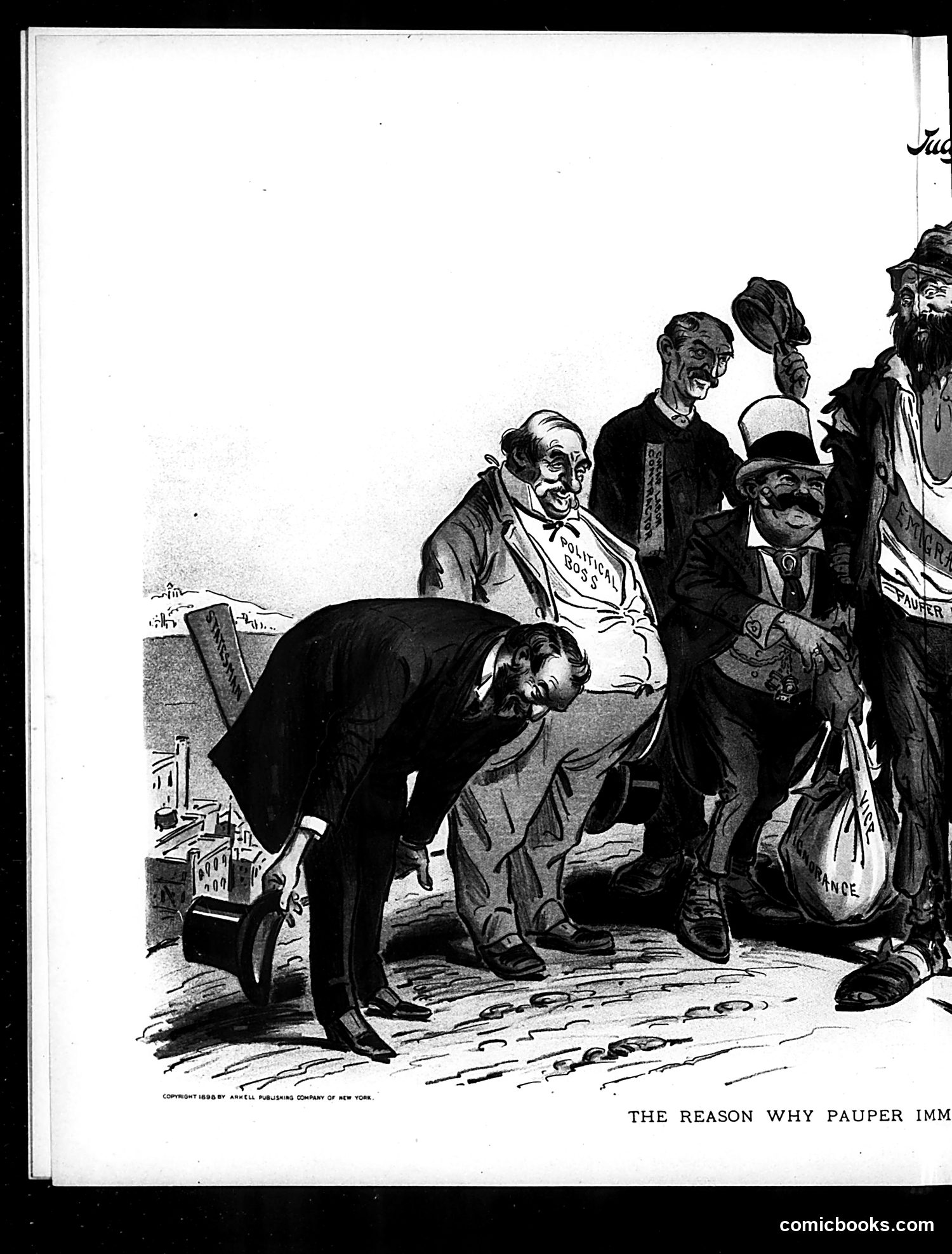
This appears to be a political cartoon from *Judge* magazine (copyright 1893 by the Arkell Publishing Company). The visible title reads "THE REASON WHY PAUPER IMM[IGRATION]"—likely addressing pauperism and immigration, a heated political topic in 1890s America. The cartoon depicts a well-dressed man bowing obsequiously to a group of immigrants carrying bags labeled "FRANCE" and other European nations. The satire suggests that wealthy American interests were profiting from or encouraging poor European immigration to the U.S., despite claims of opposing it. The bowing figure appears to represent American business or political leadership complicit in this system. The exaggerated, caricatured faces reflect period stereotypes of European immigrants.
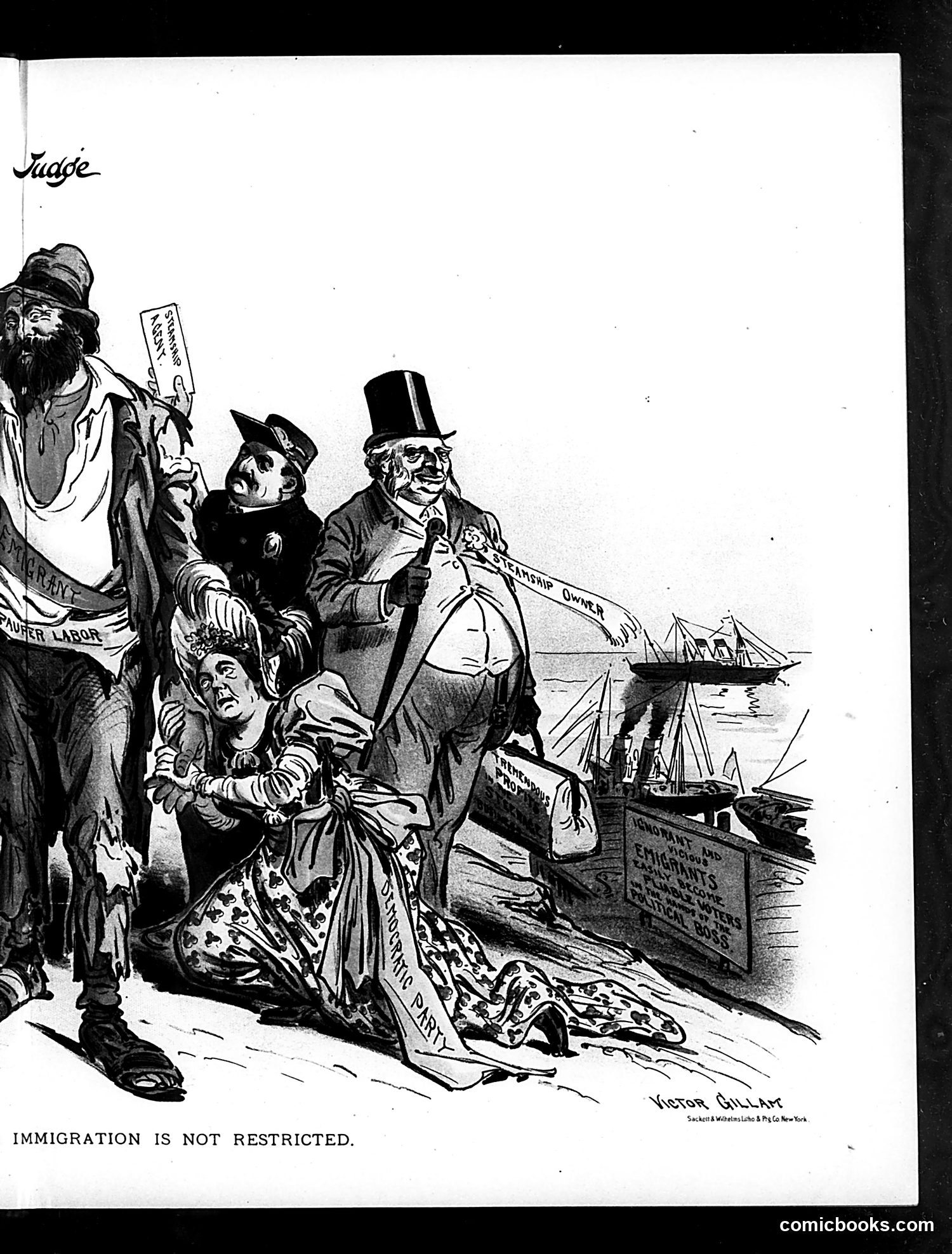
This Victor Gillam cartoon satirizes unrestricted immigration policy. The scene depicts a wealthy gentleman in a top hat (likely representing capital or industrial interests) welcoming poor immigrants at a dock. A woman labeled with "PAUPER LABOR" sits distressed among her belongings, while other ragged figures crowd behind her. Ships in the background suggest ongoing mass arrival. The satire's point: unrestricted immigration benefits wealthy industrialists who gain cheap labor, while harming working-class conditions and poverty. The contrast between the well-dressed gentleman's enthusiasm and the immigrants' desperate circumstances underscores the cartoon's critique—that immigration policy serves capitalist interests rather than protecting workers or immigrants themselves. This reflects late 19th/early 20th-century American labor debates.
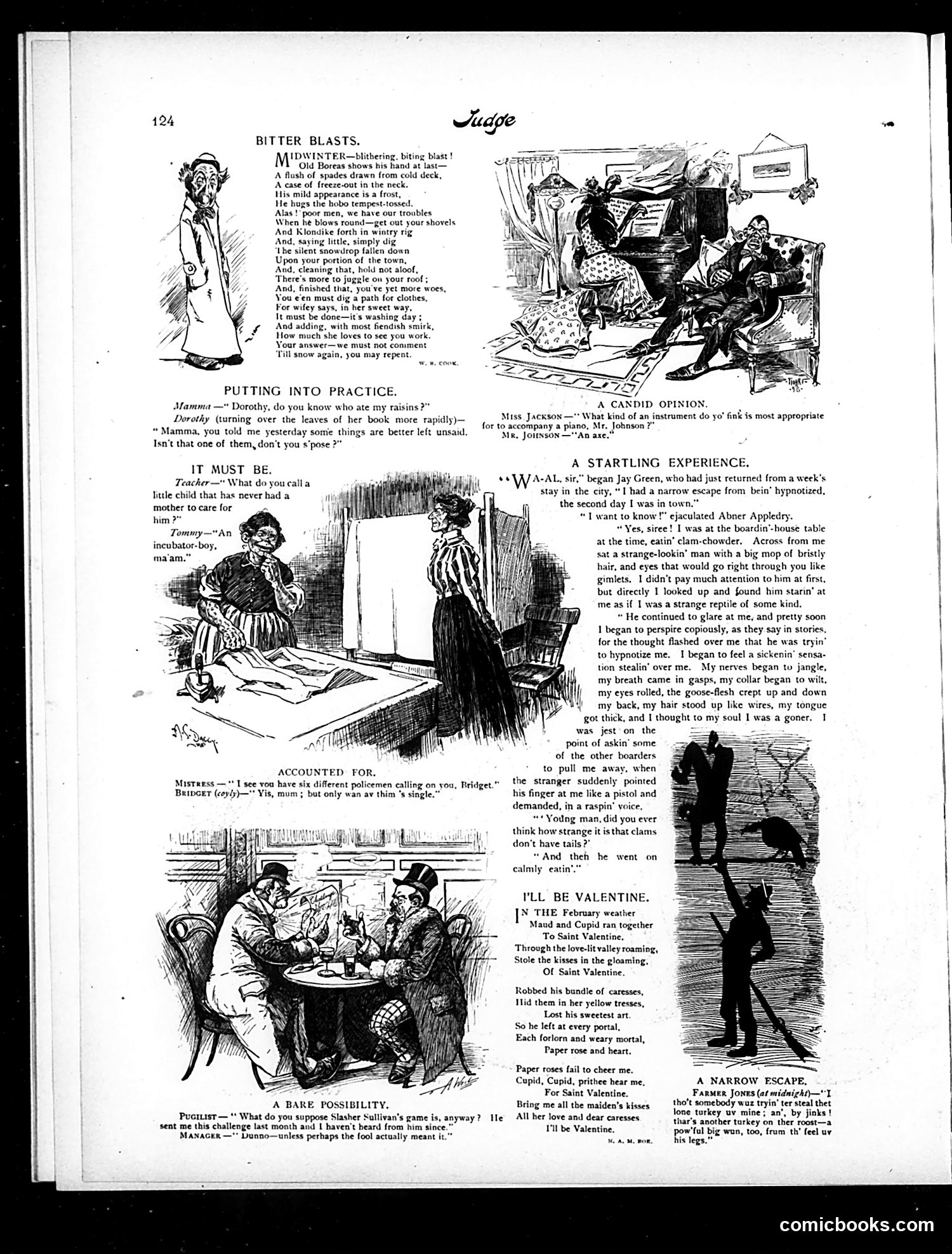
This page contains several humorous short pieces typical of Judge's satirical style: **"Bitter Blasts"** mocks winter's hardships—snow removal, domestic obligations—with the complaint that wives demand laundry be done despite freezing conditions. The satire targets both harsh winter and henpecked husbands. **"Putting Into Practice"** shows a child deflecting her mother's question about eaten raisins by citing yesterday's advice that "some things are better left unsaid"—absurdist humor about a child's clever logic-twisting. **"A Startling Experience"** describes a man nearly hypnotized by a boarder's intense stare, only to discover the stranger simply wanted to pose an absurd philosophical question about clams lacking tails. The joke mocks contemporary hypnotism crazes and overwrought melodrama. Minor pieces include teaching humor and romantic verses. The illustrations are typical period pen-and-ink sketches. Overall, the page satirizes everyday domestic life, urban anxieties, and contemporary fads rather than specific political figures.
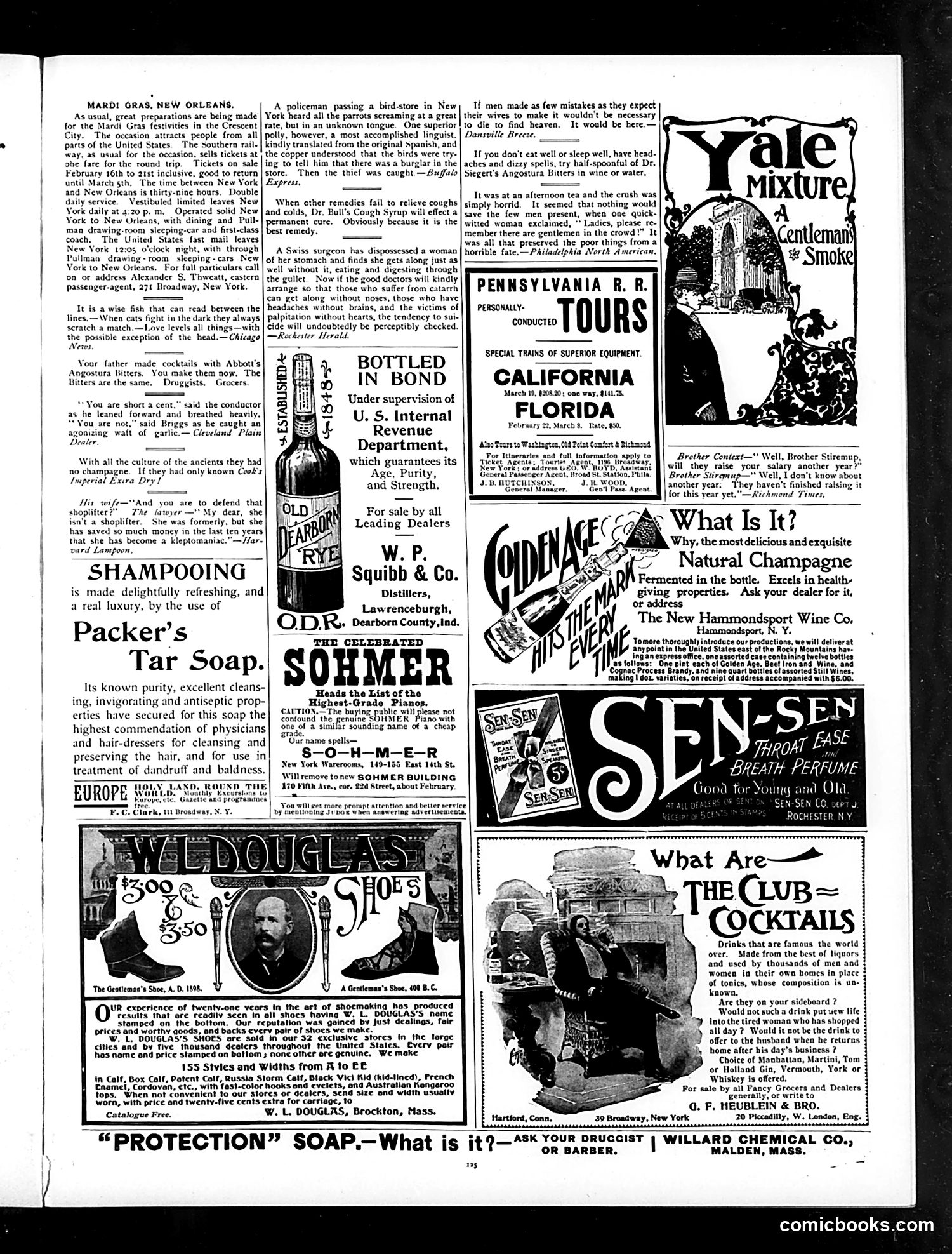
This page is primarily **advertising**, with brief humorous anecdotes scattered throughout—typical of Judge magazine's format. The content includes: - **Travel advertisement**: Southern Railway promoting Mardi Gras trips to New Orleans - **Product ads**: Angostura Bitters, Dr. Bull's Cough Syrup, Packer's Tar Soap, Sohmer Pianos, and various other patent medicines and goods - **Short humor pieces**: Anecdotes about a parrot burglar alert, a conductor's garlic complaint, and a lawyer's wordplay about a woman reformed from shoplifting **Social context**: The ads reflect early 20th-century consumer culture and patent medicine marketing (many products made dubious health claims). The jokes rely on mild domestic humor and puns typical of period magazines. **No significant political cartoon appears** on this visible portion—it's primarily a commercial page with light entertainment filler, representative of how Judge monetized through advertising while providing satirical content elsewhere in the publication.
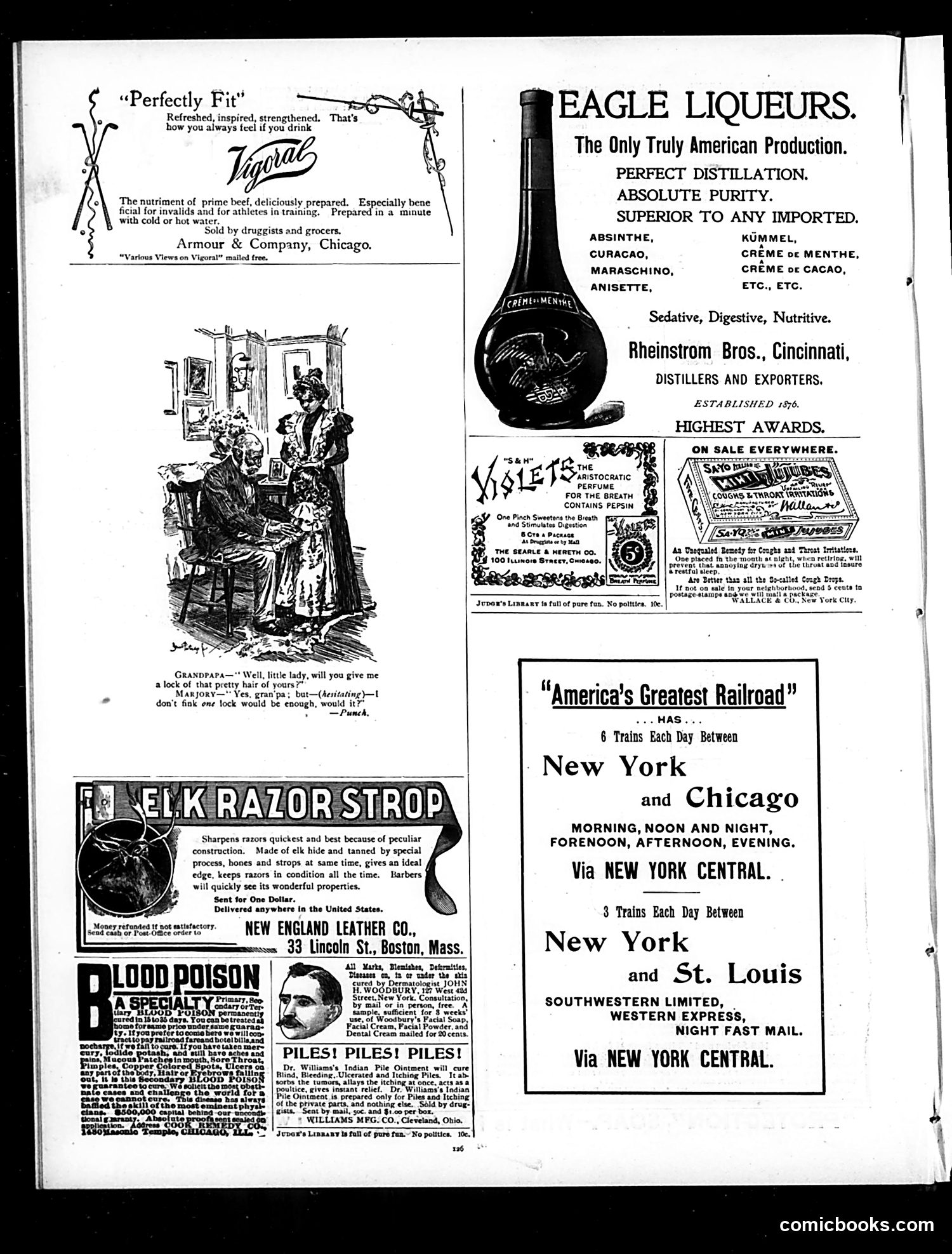
This page is primarily **advertising**, not political satire. It contains: **Main cartoon**: A brief domestic joke showing a grandfather asking his granddaughter for a lock of her hair. She hesitantly agrees but worries one lock won't be enough—implying he's bald or balding. The humor relies on gentle ribbing of elderly male hair loss. **Advertisements** dominate the page, including: - Vigoral (beef extract tonic) - Elk Razor Strop - Blood Poison/STD treatments - Pile/hemorrhoid remedies - Vistola perfume - Eagle Liqueurs (claiming to be "the Only Truly American Production") - Railroad services (New York Central) **Notable context**: The medical ads reflect late 19th/early 20th-century patent medicine marketing, when such conditions were advertised directly to consumers. The Eagle Liqueurs ad's nationalist claim is typical of the era's commercial patriotism. The page represents Judge's hybrid format: mixing light humor with revenue-generating classified advertising.
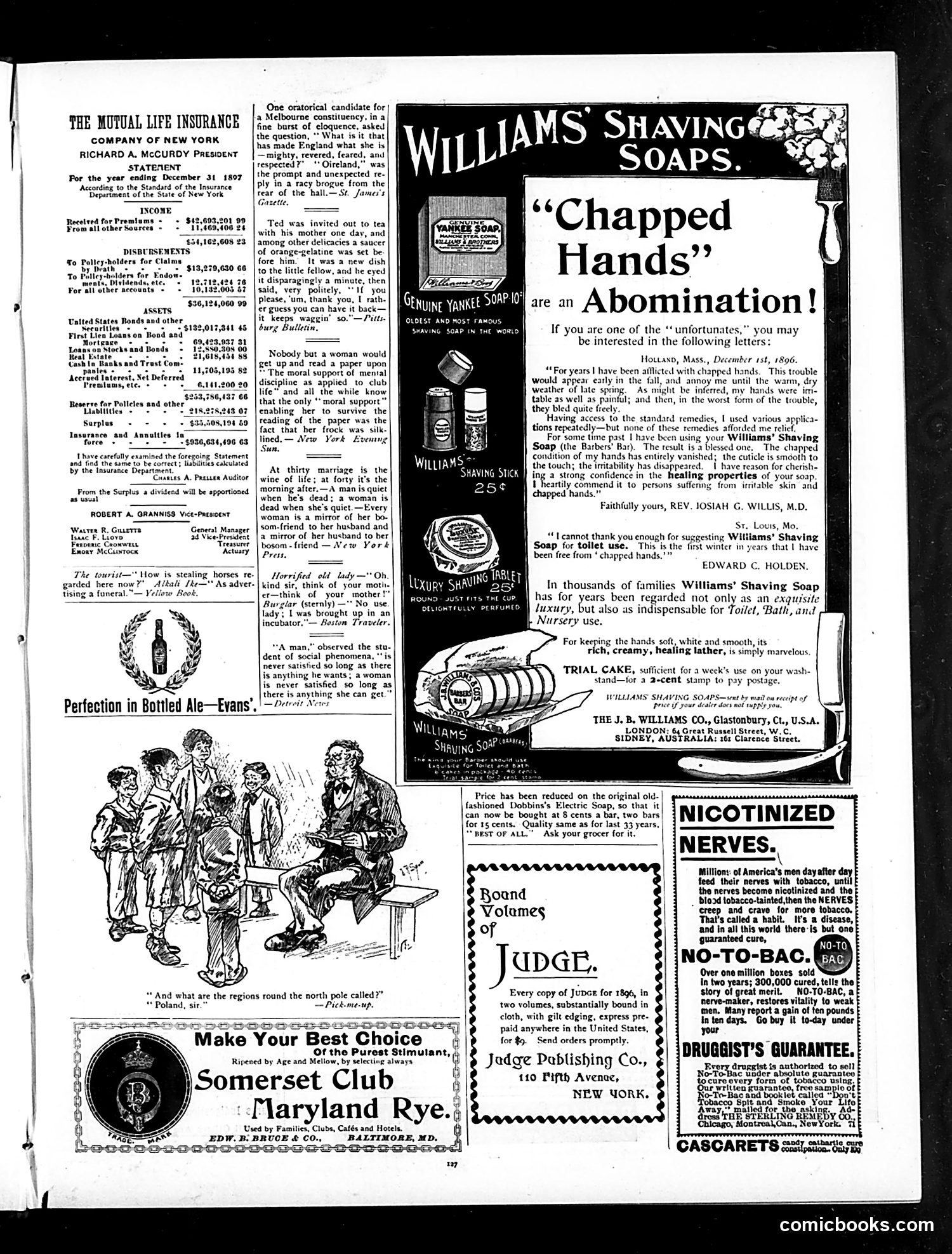
This page is primarily **advertising and financial statements**, not political satire. The top left contains the Mutual Life Insurance Company's annual financial report for 1897, listing assets, income, and disbursements—standard corporate documentation. The bulk of the page features advertisements, including: - **Williams' Shaving Soaps** (prominent right side): testimonial ads claiming the product cures chapped hands, with letters from satisfied customers like "Rev. Josiah G. Willis, M.D." - **Somerset Club Maryland Rye** whiskey - **Judge Publishing Co.** advertising bound volumes - **No-To-Bac** (nicotine addiction cure) and **Cascarets** laxatives The small cartoon at bottom-left ("Perfection in Bottled Ale—Evans'") is a brief joke, not political commentary. The scattered short humorous passages about marriage, stealing, and social observations are typical light filler content for period magazines, not satirical commentary on specific events or figures. **This is a commercial/financial page, not political satire.**
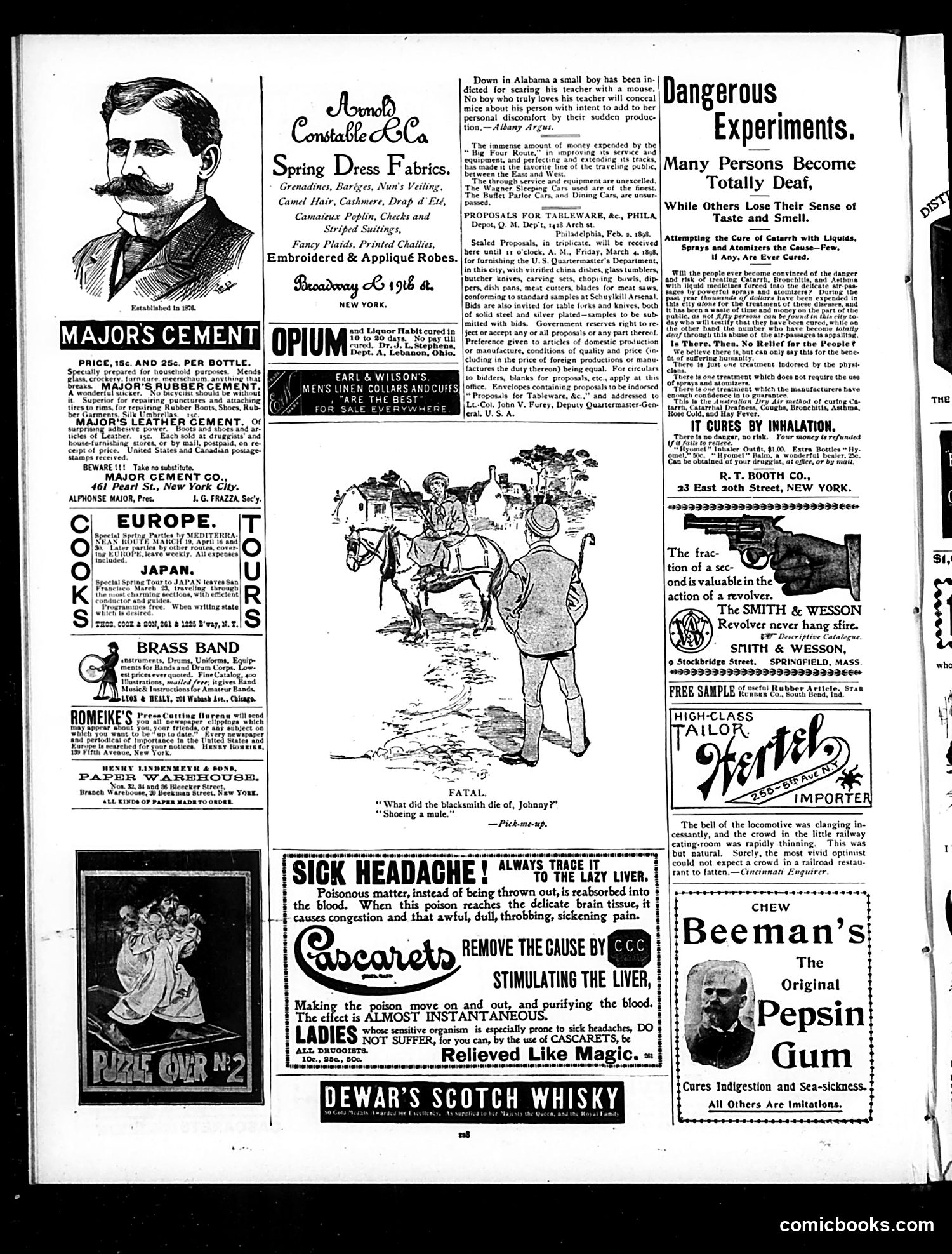
This page is primarily **advertising**, with one central cartoon and numerous product advertisements typical of late 19th-century American magazines. **The Main Cartoon:** The illustration captioned "FATAL" depicts a blacksmith and a mule, accompanying a joke: "What did the blacksmith die of, Johnny?" "Shoeing a mule." The humor relies on a pun—"shoeing" (fitting horseshoes) versus the animal injuring the blacksmith fatally. This is straightforward wordplay rather than political satire. **Notable Context:** The page's advertisements reveal period concerns: patent medicines (for alcohol and opium addiction cures), dubious medical treatments (catarrh cures via inhalation), and various household products. The headline "Dangerous Experiments" and subtitle mentioning deafness and lost taste/smell likely refer to these questionable medical remedies—reflecting contemporary skepticism about unregulated health claims. **No clear political figures or satire are present** on this particular page; it functions mainly as a commercial vehicle.
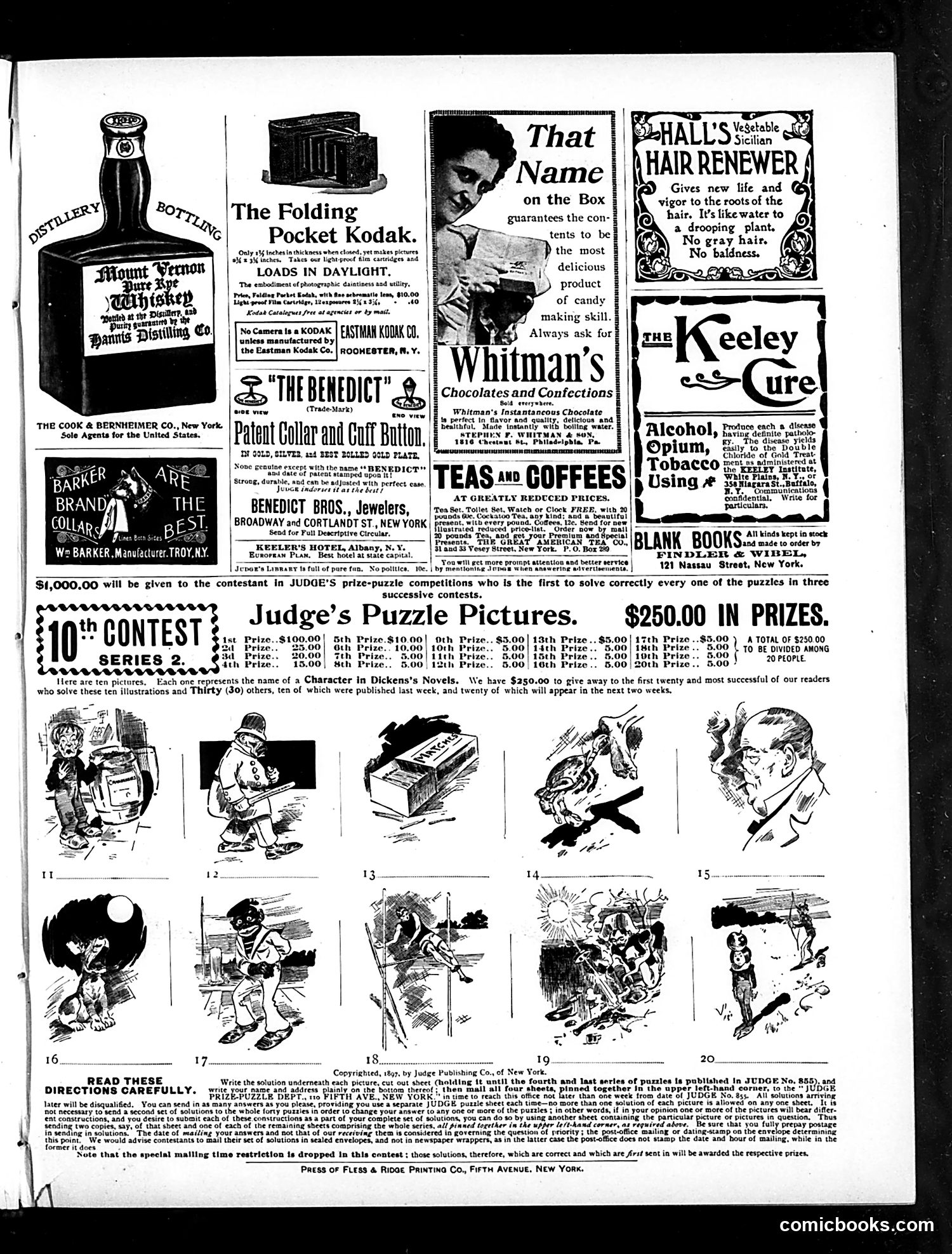
This page is primarily **advertising and a puzzle contest**, not political satire. The upper half contains typical late-1890s product ads: hair tonic, Kodak cameras, chocolates, jewelry, patent collar buttons, and patent medicines (including opium and alcohol treatments—legal then). The main content is **Judge's Puzzle Pictures Contest**, offering $250 in prizes. Readers must identify characters from **Charles Dickens novels** based on ten illustrations. The puzzle shows sketched scenes depicting recognizable Dickensian moments or character types. The contest rules indicate this was serial: four sets of puzzles published over successive weeks, with $1,000 awarded to anyone solving all puzzles correctly across three consecutive contests. **For modern readers:** This reflects how late-Victorian magazines engaged audiences through interactive contests while promoting products, and how Dickens remained culturally dominant enough to anchor a popular puzzle game.
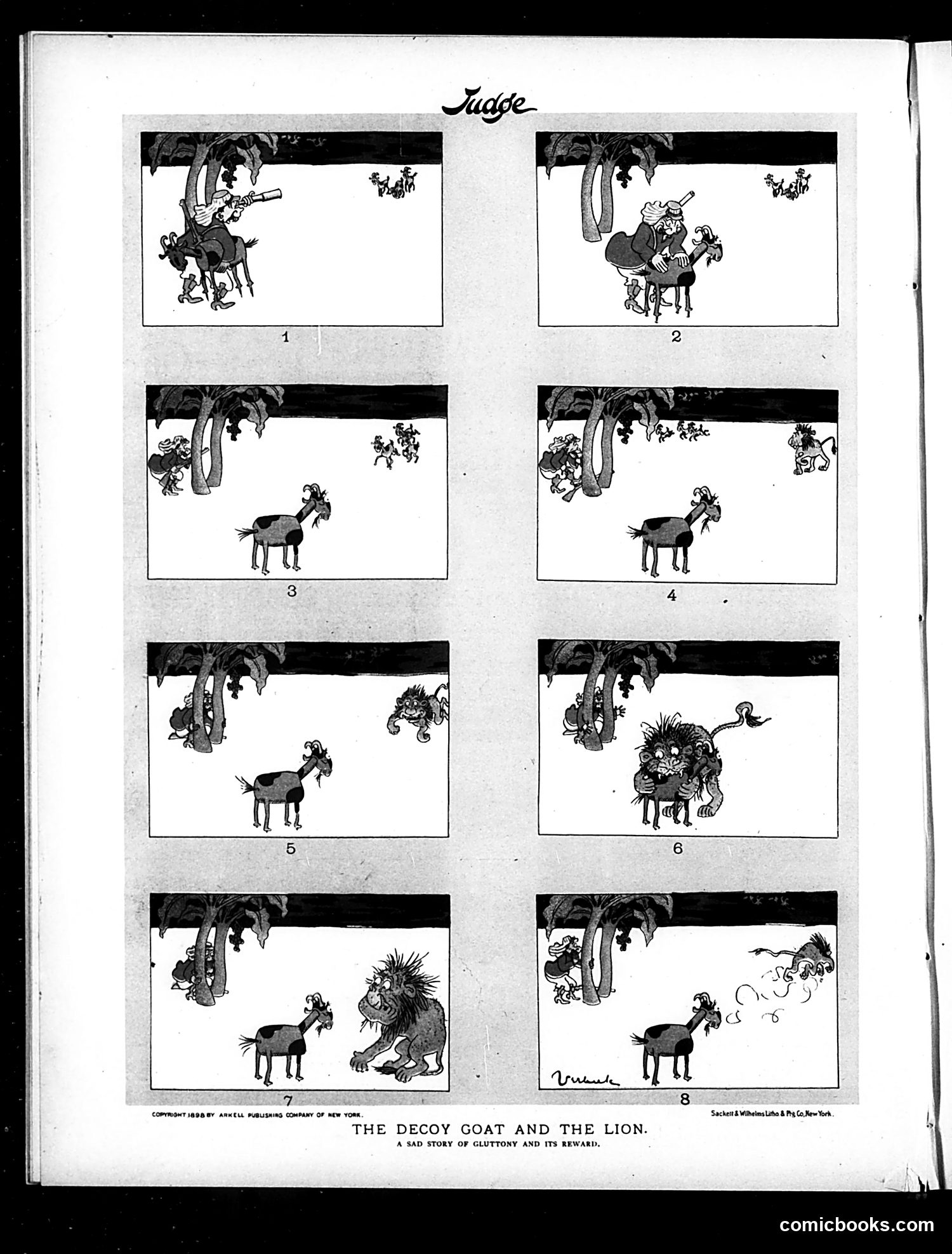
This is a visual fable presented as an eight-panel comic strip. The narrative follows a goat (used as bait or "decoy") and a lion, illustrating consequences of gluttony. The story appears to progress: Panel 1 shows a hunter with the goat; panels 2-5 depict the goat encountering a lion in the jungle; panels 6-8 show the lion's fate—apparently becoming so consumed with attacking/eating the goat that it falls into a trap or pit (visible in the final panels). The moral lesson, indicated by the subtitle "A Sad Story of Gluttony and Its Reward," suggests the satire targets excessive appetite and greed. The "decoy goat" serves as the temptation that lures the greedy lion to its own destruction. This functions as a cautionary tale typical of *Judge* magazine's satirical approach—using animal fables to critique human vices and behaviors.