
A complete issue · 16 pages · 1898
Judge — February 5, 1898
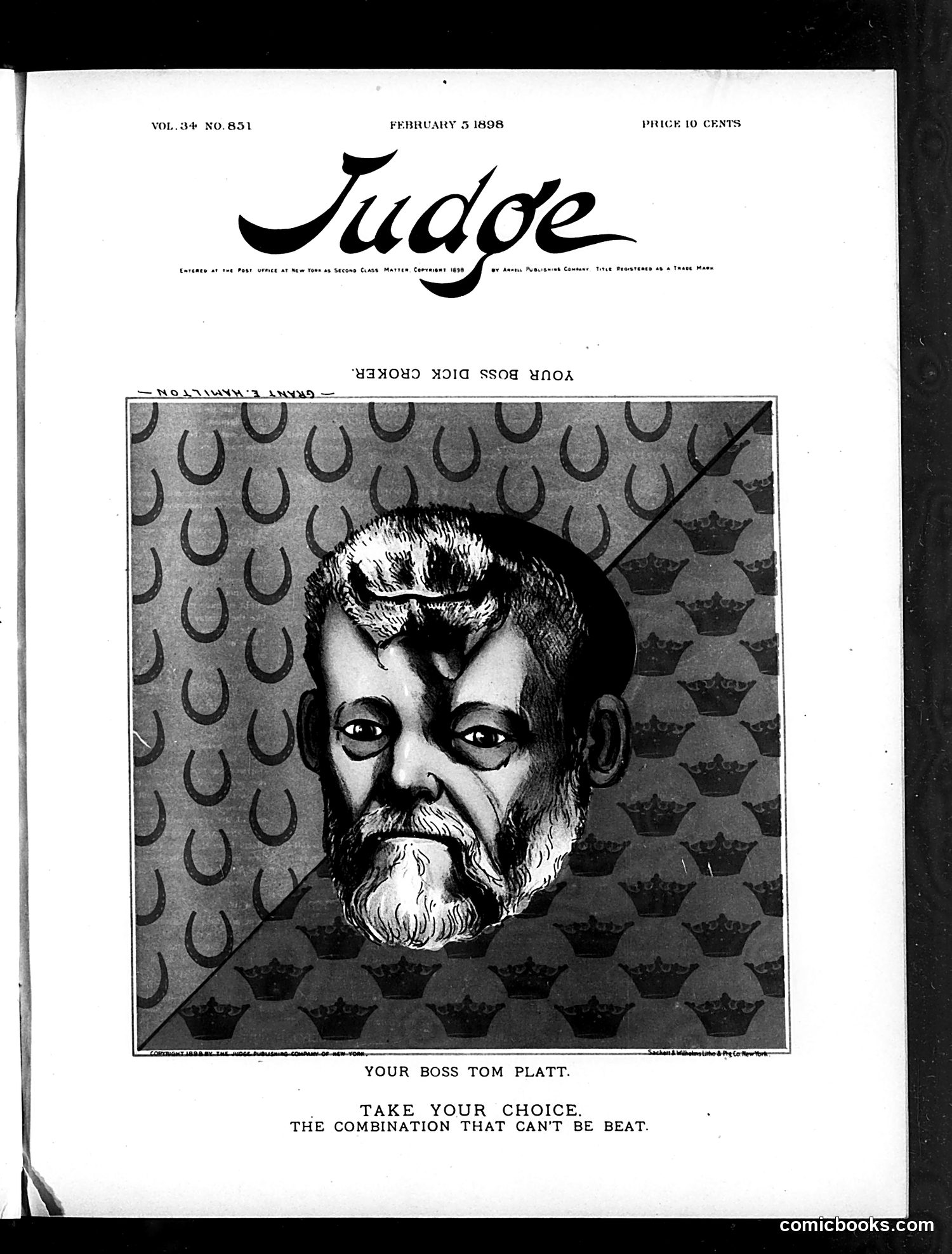
This is the cover of Judge magazine from February 5, 1898. The caricatured face depicts **Tom Platt**, a prominent Republican politician (likely a U.S. Senator from New York during this period). The caption reads "YOUR BOSS TOM PLATT" and "TAKE YOUR CHOICE. THE COMBINATION THAT CAN'T BE BEAT." The satire appears to reference Platt's political dominance and machine politics—suggesting he was the controlling "boss" figure in Republican politics. The decorative background pattern (horseshoes and crowns) may symbolize luck or power. For modern readers: this mocks Platt as a manipulative political boss wielding behind-the-scenes control, a common target of Judge's satirical commentary on the era's corrupt political machines and bosses.
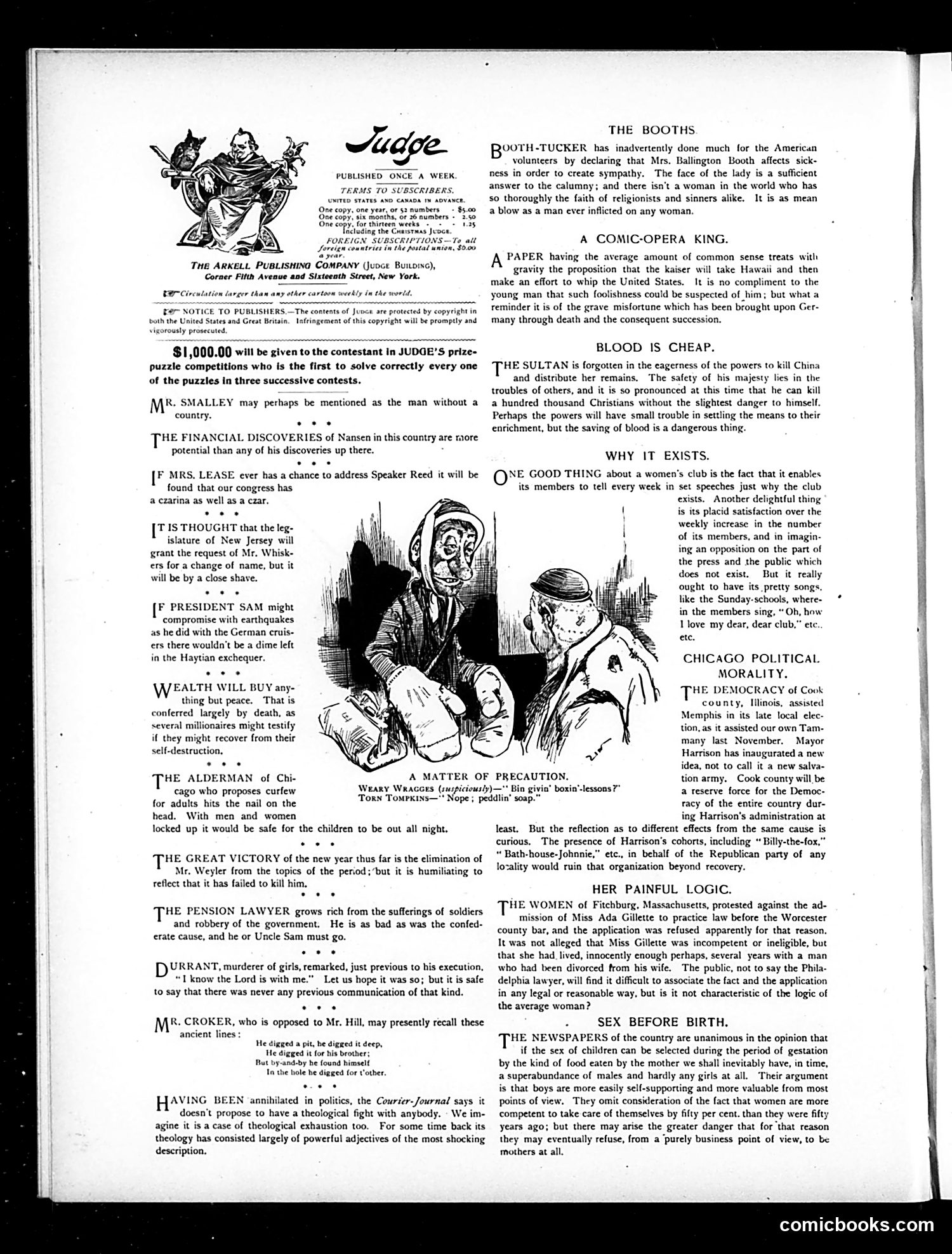
The cartoon depicts two figures labeled "Weary Wharves (apparently)" and "Tom Tompkins," with one saying "Big givin' boxin' lessons" and the other responding "Nope, peddlin' soap." This appears to be satirizing street-level commerce and con-artistry in urban America. The joke likely plays on the double meaning of "giving boxing lessons" (actual fighting instruction versus beating someone up) versus the more honest if humble occupation of soap peddling. The humor seems to mock either unscrupulous street vendors or the desperation of urban workers trying to survive by whatever means available. Without additional context about these specific characters or the issue's date, the precise satirical target remains unclear, though it reflects Judge's typical focus on urban working-class life and petty fraud.
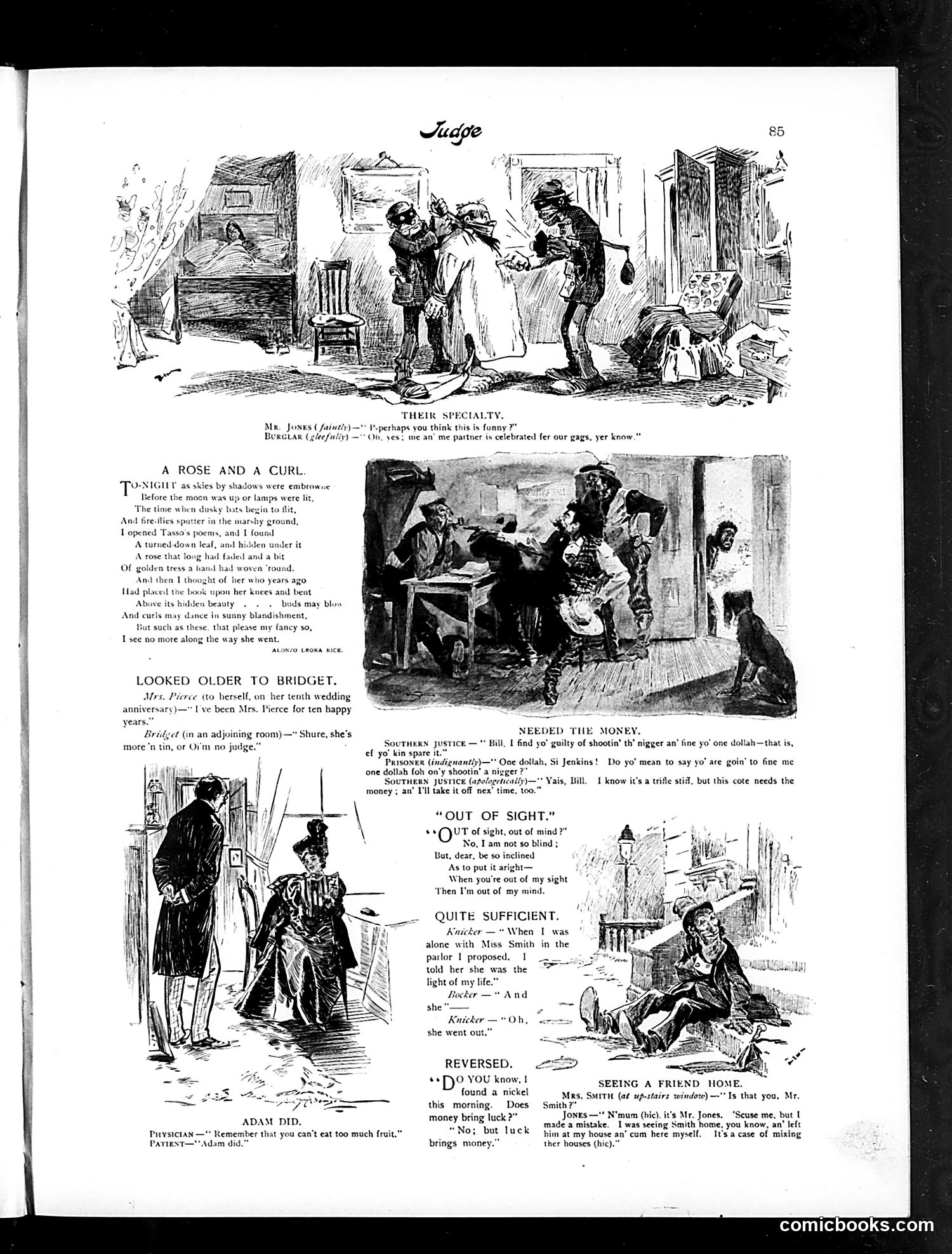
This page contains several Victorian-era humor pieces, mostly untethered to specific political figures or events. **"Their Specialty"** depicts burglars discussing their criminal trade—a generic crime joke. **"A Rose and a Curl"** is sentimental poetry about discovering a pressed flower in a book, with no political content. The remaining titled sections—"Looked Older to Bridget," "Needed the Money," "Out of Sight," "Quite Sufficient," "Adam Did," "Reversed," and "Seeing a Friend Home"—appear to be domestic humor sketches about ordinary life situations: marriage proposals, financial need, missed connections, and social awkwardness. None reference identifiable political figures or contemporary events. This page represents Judge's general satirical humor targeting middle-class social customs and domestic situations rather than political satire.
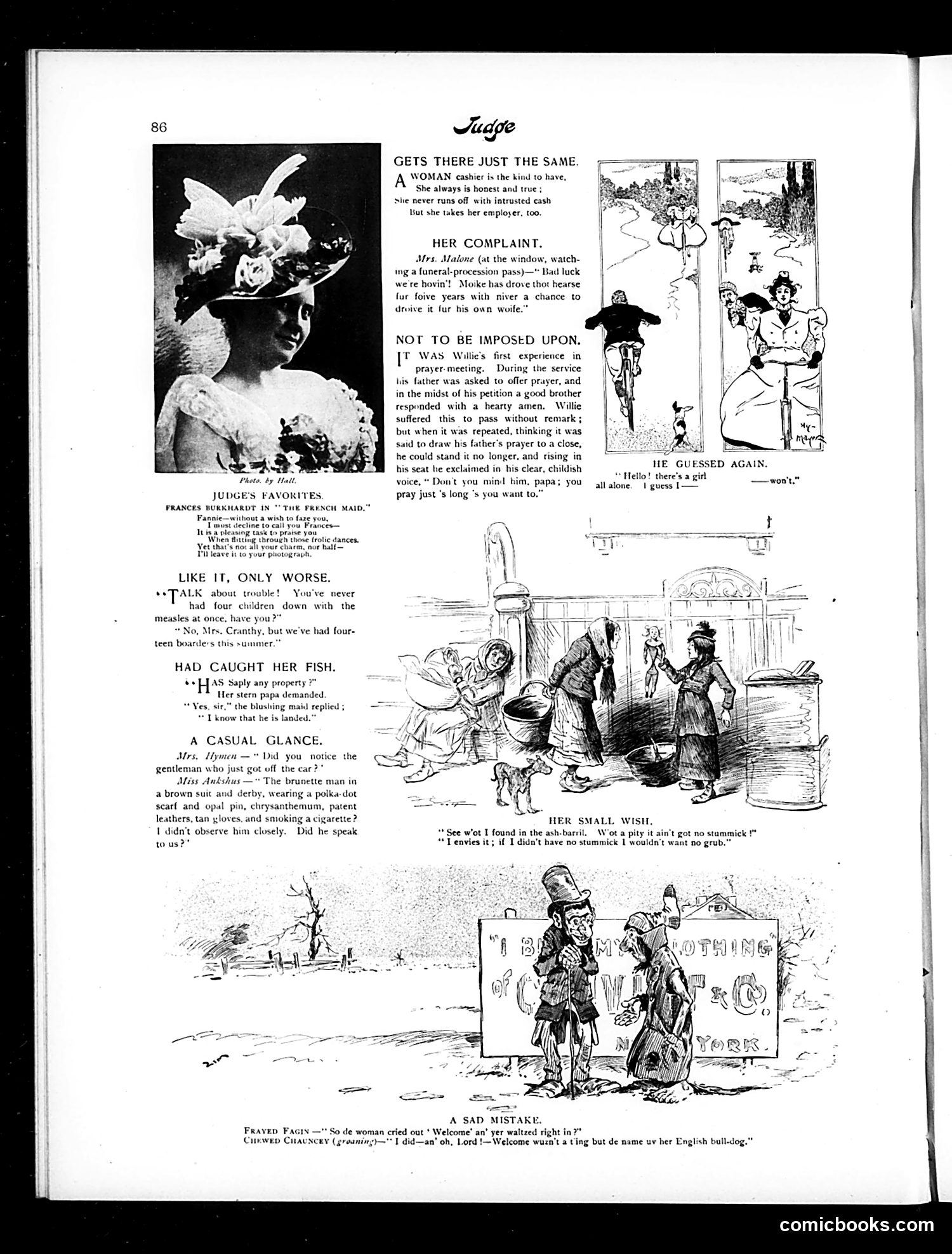
This page contains several brief humorous anecdotes with accompanying illustrations rather than political cartoons. The sketches mock everyday social situations: **"Judge's Favorites"** features Frances Burkharde in "The French Maid," likely a theatrical reference. The remaining pieces satirize common domestic and social frustrations: a woman's complaint about a lazy coachman, a child's disruption at prayer meeting, financial troubles, a servant's theft, and a gentleman's odd appearance. **"Her Small Wish"** depicts working-class characters in an ash-barrel, with dialogue about finding items and avoiding "stummick" trouble. **"A Sad Mistake"** shows two poor figures with a sign advertising "Nothing of Value" — appears to be satirizing poverty or homelessness through crude humor typical of the era. The satire targets class dynamics and servant/employer relationships rather than politics.
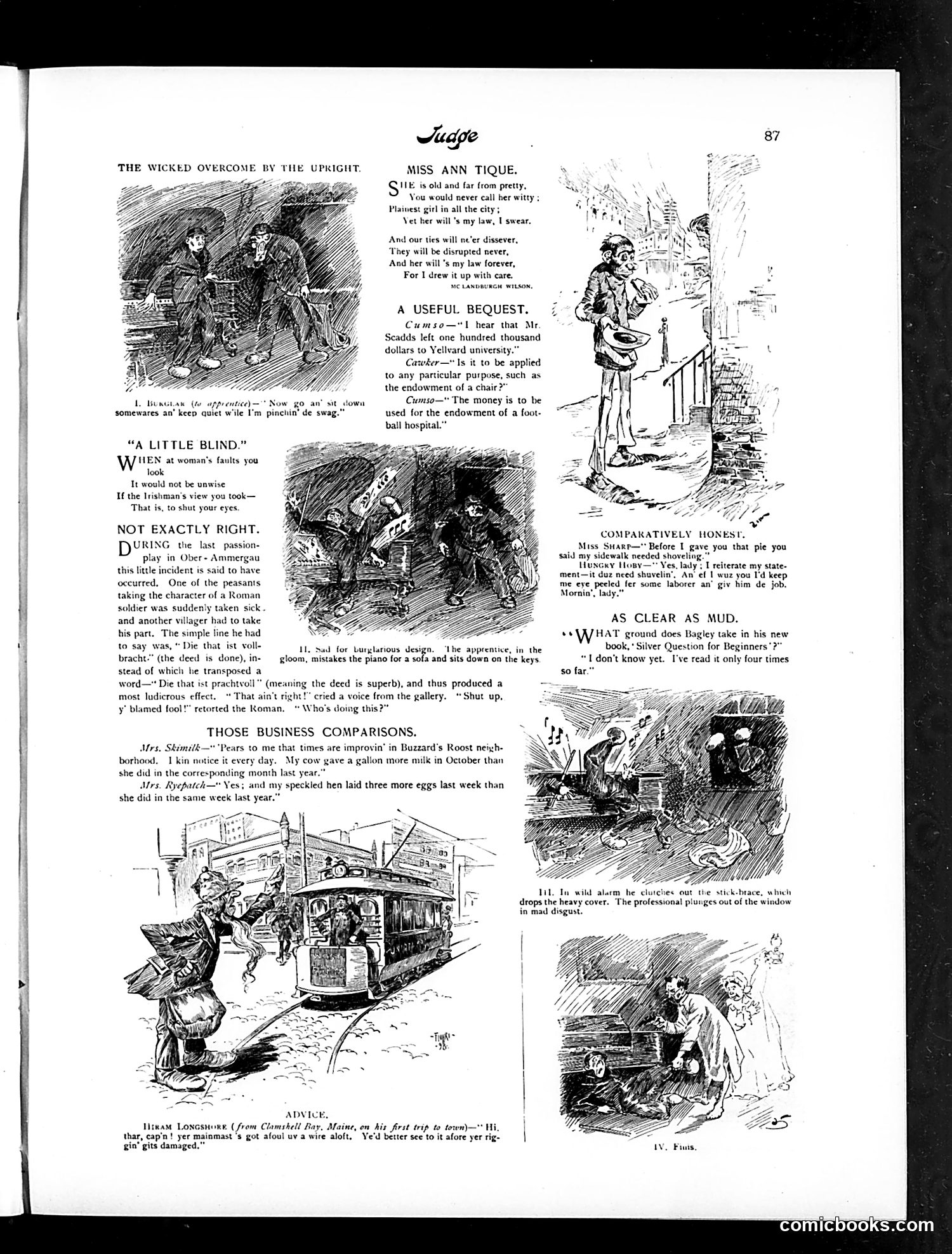
This page from Judge (a late 19th-century American satirical magazine) contains several unrelated humorous pieces mocking various social types and situations: **"A Little Blind"** jokes about Irish stereotypes—the implication being that Irish people overlook women's faults. **"Not Exactly Right"** satirizes the famous Oberammergau Passion Play, recounting how a peasant actor mispronounced a German line ("prachtvoll"/superb instead of "voll-bracht"/accomplished), creating unintended comedy during this supposedly solemn religious drama. **"Those Business Comparisons"** mocks rural/working-class people boasting about trivial increases in farm productivity (milk, eggs) as major improvements. **"A Useful Bequest"** jokes that a university's hundred-thousand-dollar donation goes toward a "football hospital"—satirizing American colleges' prioritization of athletics over academics. Other brief pieces mock "Miss Ann Tique" (a pun on "antique"), an unattractive woman who nonetheless controls her suitor through her will, and various other character types. The cartoons illustrate these jokes with period-appropriate illustrations.
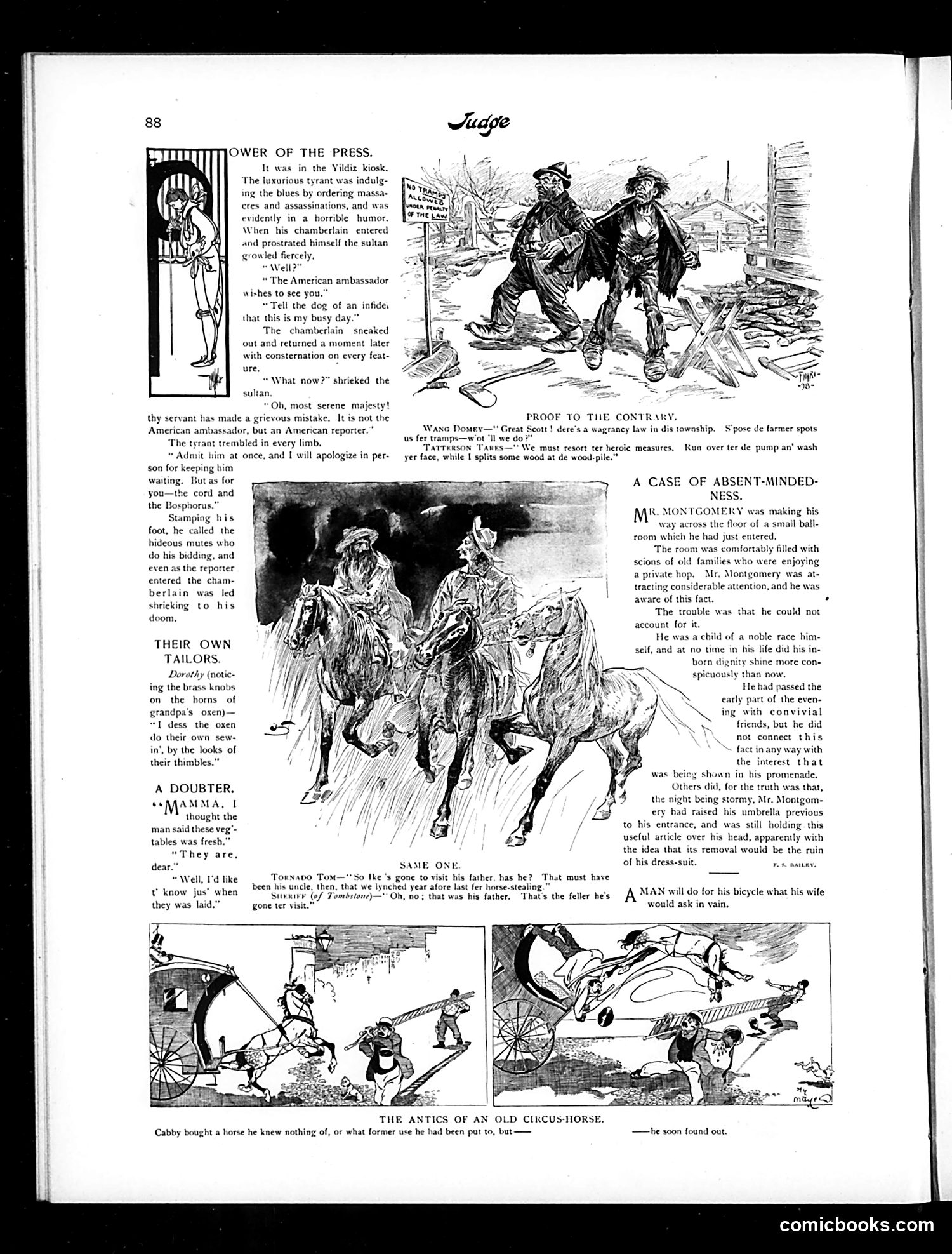
This page contains multiple unrelated satirical pieces typical of Judge magazine's format. **"Power of the Press"** mocks Ottoman Sultan Abdul Hamid II (ruler of the Yildiz kiosk), depicting him as a bloodthirsty tyrant who orders massacres casually. The joke: he trembles in fear upon learning an American *reporter* (not ambassador) seeks him—suggesting the press's investigative power frightens despots more than diplomacy does. This reflects late 19th-century anxieties about Ottoman brutality and American journalism's growing international influence. The remaining sketches are lighthearted domestic humor: Montgomery attending a party while absurdly holding his umbrella indoors; a "doubter" questioning vegetable freshness; dialogue about horse-stealing in frontier towns; and a final comic sequence about a circus horse's unpredictable behavior. These pieces satirize everyday American life—absent-mindedness, food quality skepticism, frontier violence, and animal unpredictability—rather than specific political figures or events.
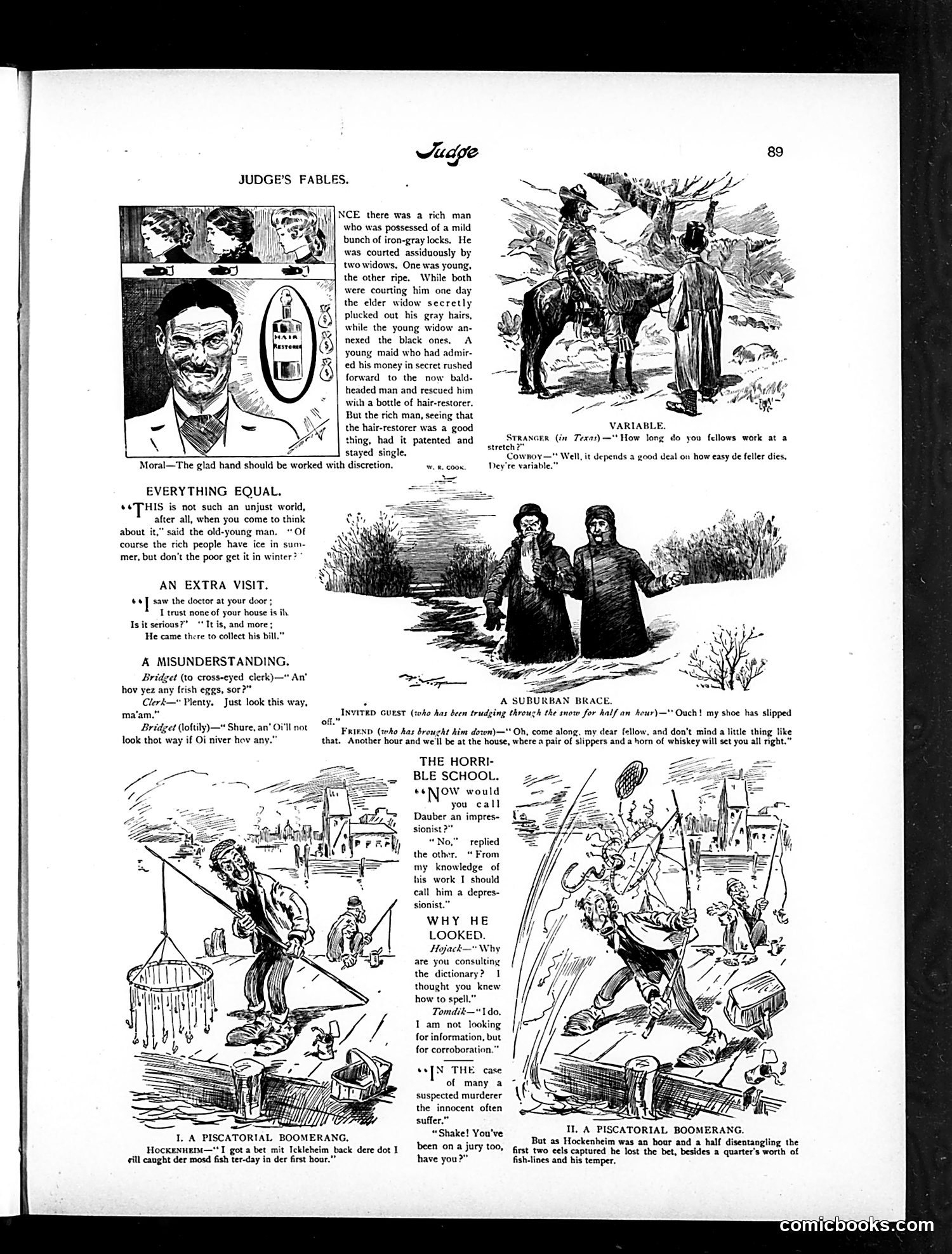
This page contains several satirical cartoons and humorous anecdotes typical of early 20th-century American humor: **"Judge's Fables"** opens with a morality tale: a rich man with gray hair is courted by two widows—one plucks his gray hairs, the other his black ones, leaving him bald. A young woman "rescues" him with hair-restorer, which he patents rather than marry her. The satire targets fortune-hunters and the foolishness of unmarried wealth. **"Everything Equal"** mocks the wealthy man's false equivalence: the rich enjoy ice in summer while the poor get it in winter (as frozen water)—satirizing self-serving rationalizations about class inequality. The remaining items are brief comedic sketches: a doctor collecting overdue bills, a cross-eyed clerk misunderstanding an order for "Irish eggs," a painter called a "depressionist," someone checking a dictionary for "corroboration" rather than information, and fishing anecdotes about wagers and temper. The humor relies on wordplay, visual gags in accompanying illustrations, and gentle mockery of human vanity and pretension rather than sharp political commentary.
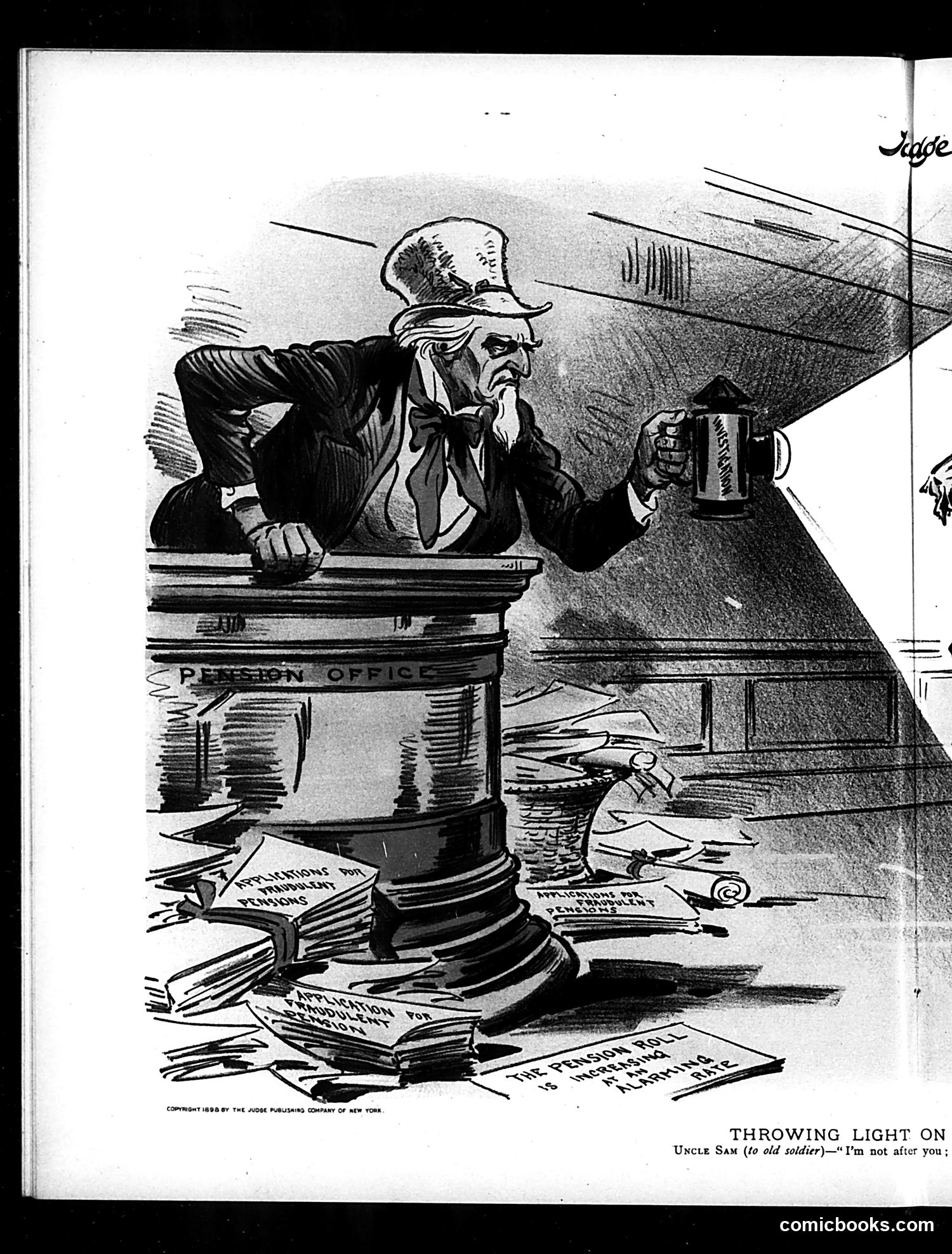
This 1898 Judge cartoon depicts **Uncle Sam** (representing the United States government) as a figure emerging from a "Pension Office," shining a spotlight or lamp toward an "old soldier." The surrounding papers on the ground appear to reference pension-related documents and regulations. The cartoon satirizes the **U.S. pension system for Civil War veterans**. Uncle Sam's declaration—"I'm not after you"—suggests irony, as the spotlight/investigation implies scrutiny of pension claims or fraud. The scattered documents suggest bureaucratic complexity or investigations into fraudulent pension applications, which were a significant political issue in the 1890s. The satire likely critiques either overzealous pension investigations targeting legitimate veterans, or conversely, the government's efforts to catch fraudulent claimants. The exact target remains somewhat unclear from the visible text alone.
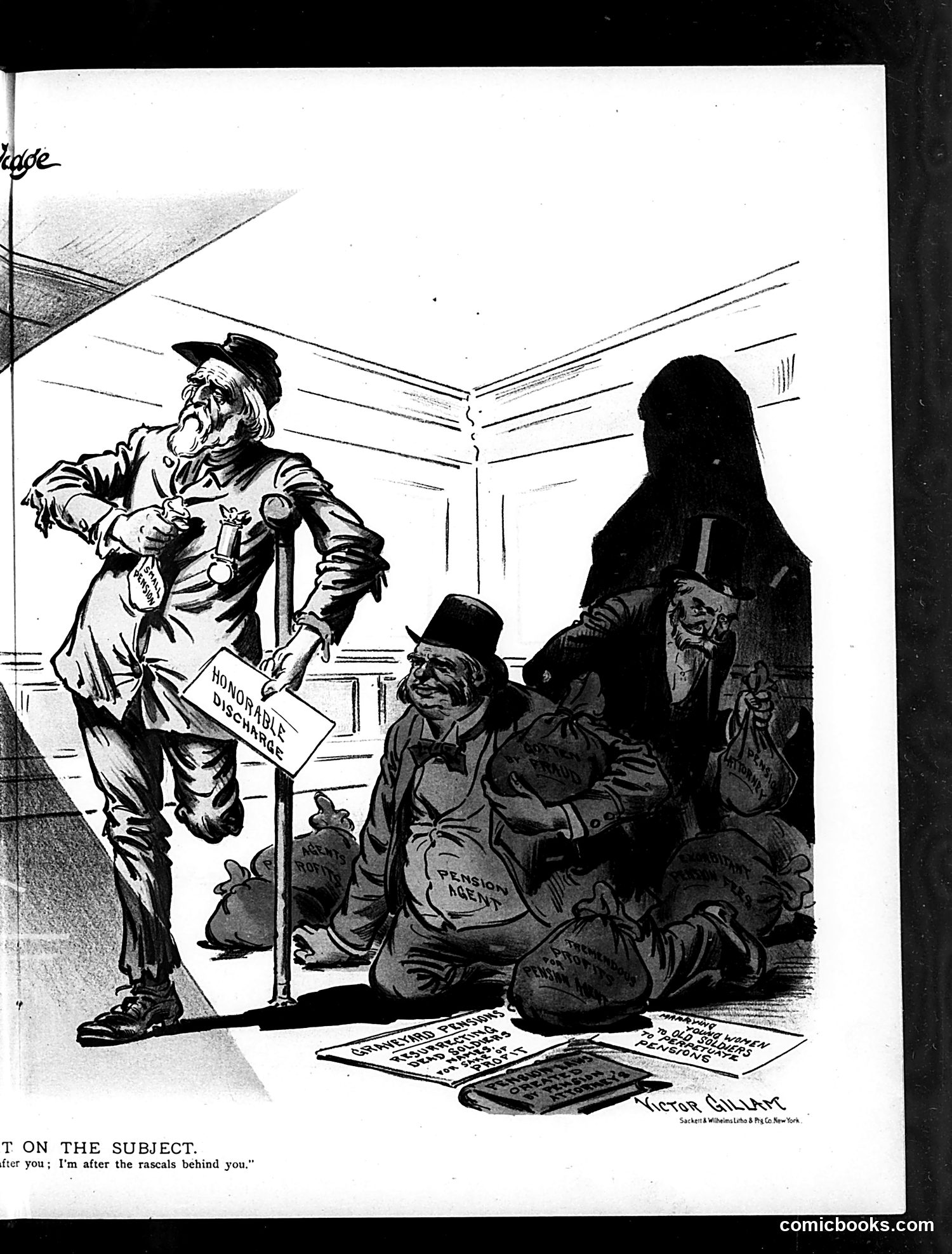
This Judge magazine cartoon by Victor Gillam depicts a military or authority figure (left, with medals and "Honorable Discharge" badge) confronting a group of seated poor people—a man, woman, and children carrying bags labeled "Pension Debt" and similar economic burdens. The figure declares he's "after the rascals behind you," suggesting he pursues those responsible for citizens' financial hardship rather than blaming the poor themselves. The satire critiques how authority figures deflect responsibility: rather than addressing systemic poverty or government mismanagement, they claim to target shadowy culprits "behind" the suffering masses. The cartoon likely comments on post-war pension disputes, government accountability, or class inequality—though the specific historical moment remains unclear without the publication date.
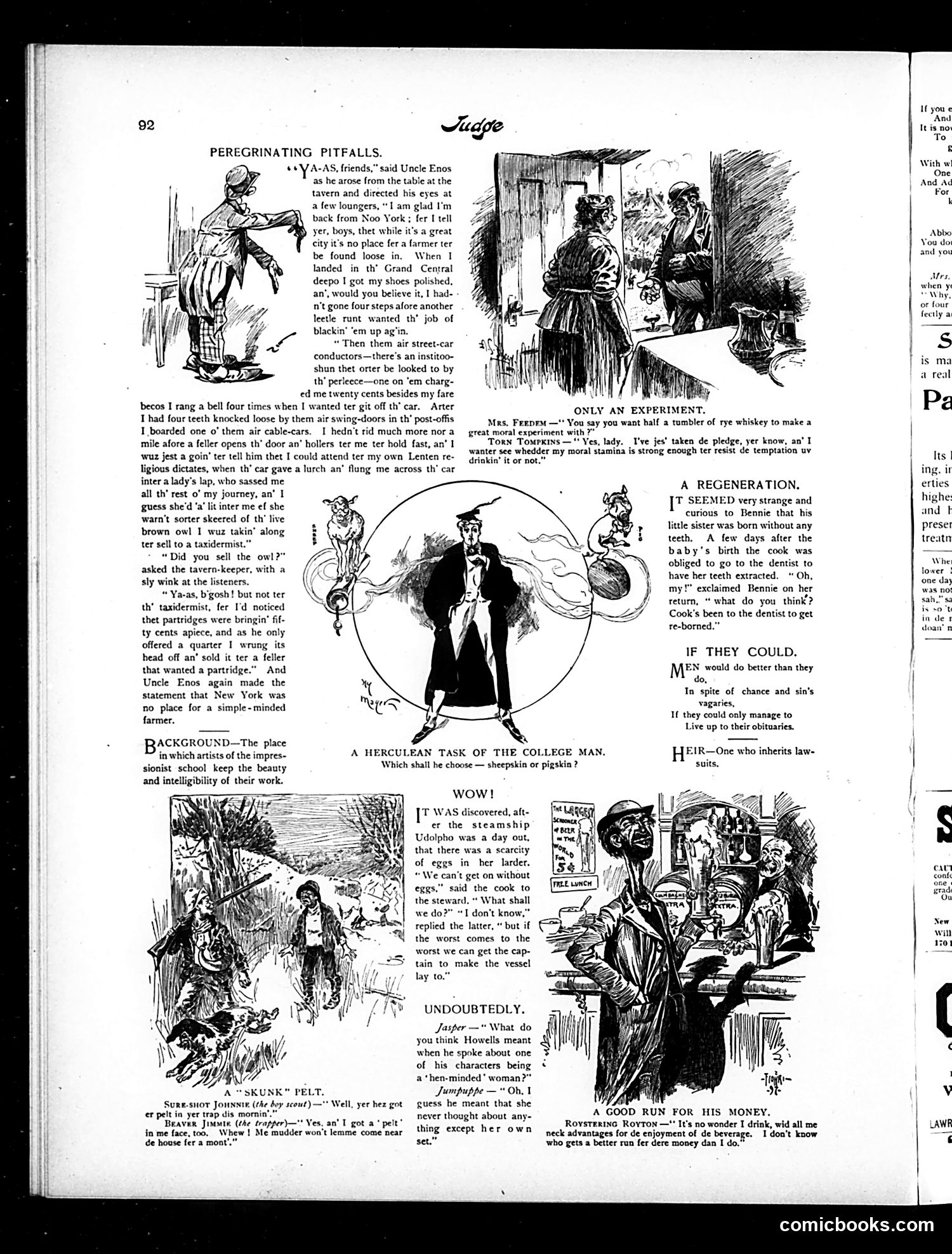
This page contains several short satirical pieces typical of Judge's humor: **"Peregrinating Pitfalls"**: Uncle Enos recounts misadventures visiting New York City, depicting rural-urban culture clash. The satire targets city inconveniences (aggressive shoe-shiners, aggressive conductors charging extra, cable car dangers) and portrays the farmer as out of place—a common theme mocking both rural simplicity and urban chaos. **"A Herculean Task of the College Man"**: The circular illustration shows a dilemma between "sheepskin or pigskin"—a pun referring to a diploma versus a football. This satirizes college priorities, suggesting students must choose between academic achievement and athletics. **"Regeneration" and "If They Could"**: Brief moral commentary pieces—one about a child's tooth extraction, another about people failing to live up to their obituary ideals. **"A Good Run for His Money"**: Discusses a captain making a ship "lay to" (stop) for eggs, and a "hen-minded woman"—wordplay humor typical of period magazines. The page reflects 1890s concerns: rural-urban tensions, college culture, and middle-class morality.
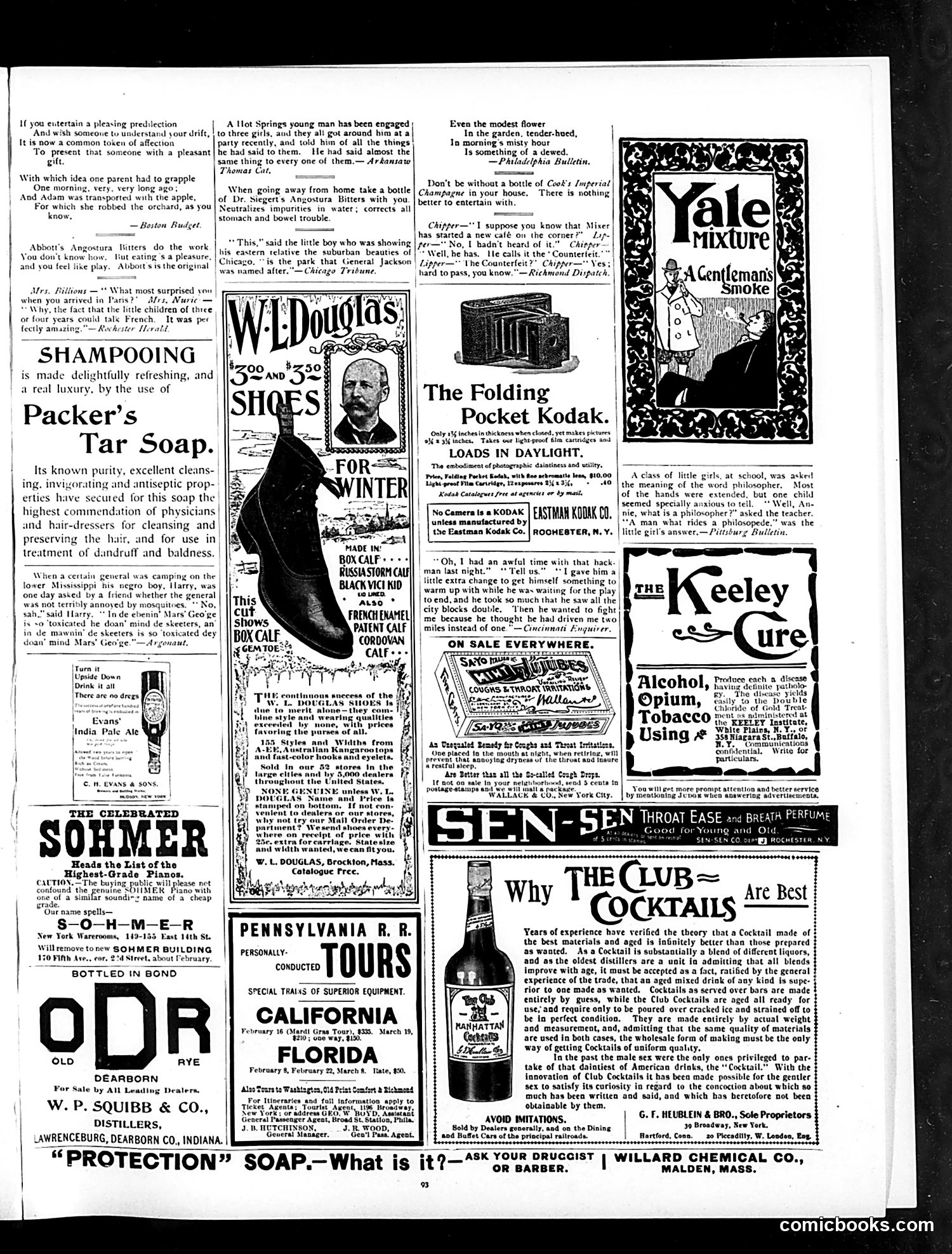
This page is primarily **advertisements interspersed with short humorous anecdotes** rather than political cartoons. The jokes reflect turn-of-century American social humor: **Notable Content:** - **Short comedic pieces**: A young man engaged to three girls simultaneously (social commentary on courtship); children in Paris speaking French (American amazement at European sophistication); a freedman's encounter with a drunken hackman (post-Civil War racial humor, now offensive). - **Major advertisements**: W.I. Douglas shoes, Kodak cameras (marketed as portable/convenient), Packer's Tar Soap, Pennsylvania Railroad tours to California, and various patent medicines. - **Keeley Cure ad** (right side): Prominently advertises treatment for "Alcohol, Opium, Tobacco"—reflecting early 20th-century addiction treatment industry. The page shows **Judge's dual nature**: satirical publication mixed with commercial advertising. The humor is genteel, family-oriented, and focuses on contemporary conveniences (photography, rail travel) and social awkwardness rather than political satire.
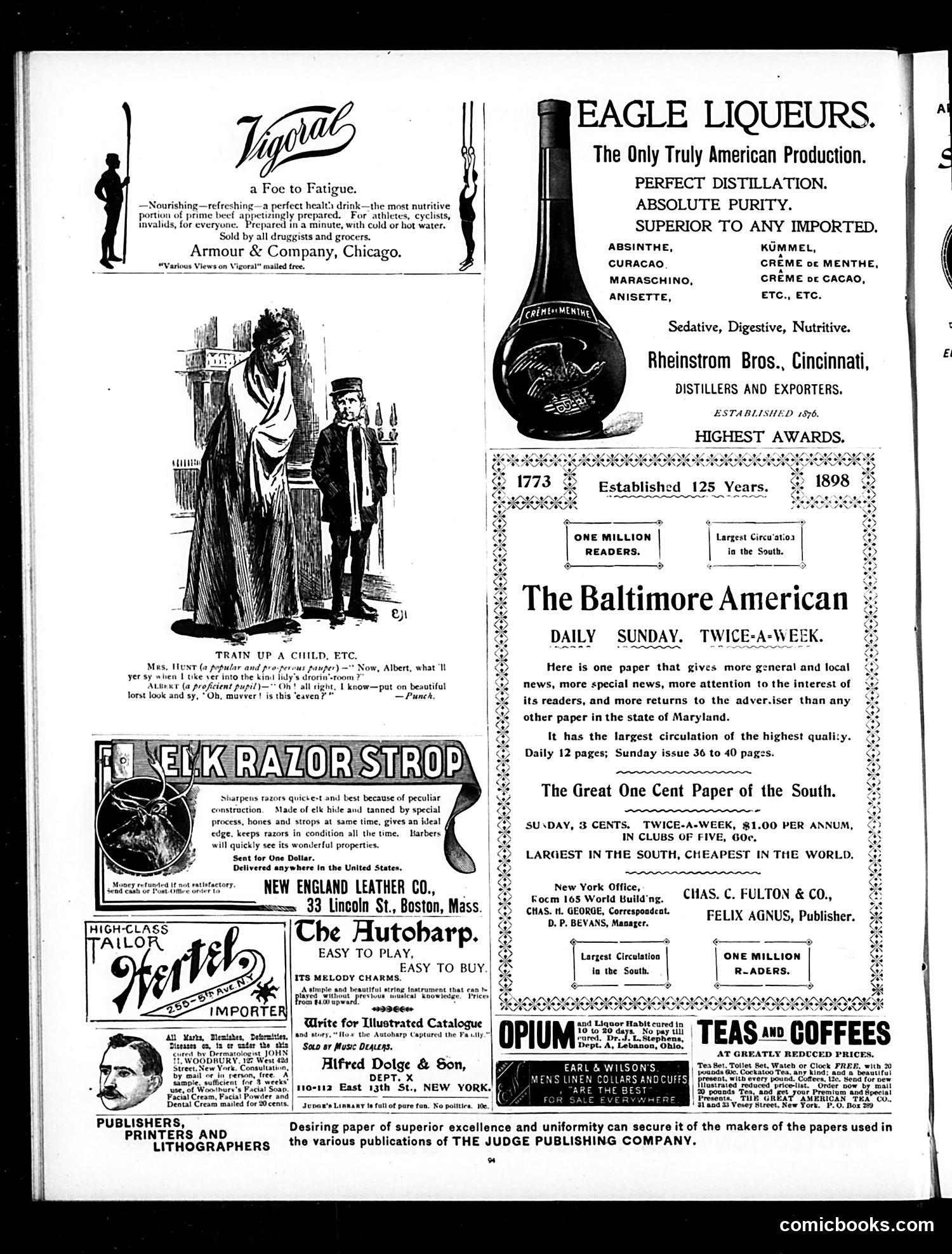
This page is **primarily advertising**, not editorial cartoons. However, it contains one small satirical cartoon titled "Train Up a Child, Etc." (center-left), referencing the biblical proverb "Train up a child in the way he should go." The cartoon depicts a poor woman instructing her son Albert on proper etiquette for visiting wealthy homes—specifically, to look impressed and exclaim "Oh, muvver! is this 'eaven?" The satire mocks both poverty and class pretension: the mother coaches her child to perform deference and gratitude for material comfort, suggesting how the poor must perform for the wealthy to gain access to their spaces. The remainder of the page consists of period advertisements for liqueurs, razors, newspapers (The Baltimore American), musical instruments, patent medicines, and other consumer goods—typical late-19th/early-20th-century advertising fare. The note at bottom indicates Judge Publishing provided paper stock to various publications.
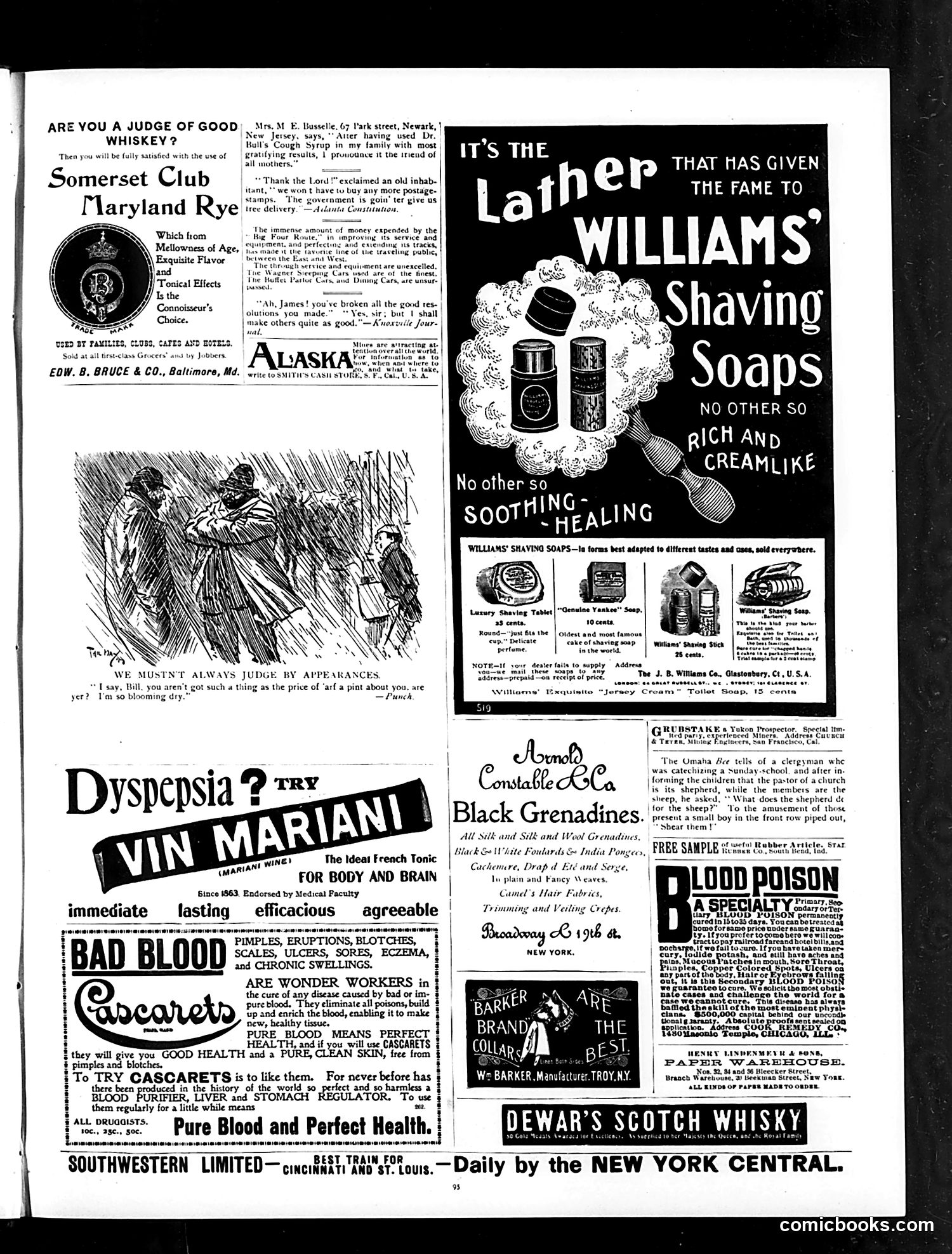
This small cartoon depicts two working-class men in conversation. One asks the other for money to buy "half a pint" (a measure of alcohol), claiming to be thirsty. The joke plays on the phrase "judge by appearances"—the man's ragged clothing and rough demeanor suggest poverty and desperation, but the cartoon implies he's simply seeking drinking money rather than food or necessities. The humor reflects early-20th-century attitudes toward working-class drinking and social class assumptions. The caption suggests that outward appearance can be misleading about a person's true character or needs. It's credited to *Punch*, a British satirical magazine, indicating this was a reprinted joke. The surrounding page is primarily **advertising**—for whiskey, medicines, soaps, and tonics—typical of Judge magazine's revenue model.
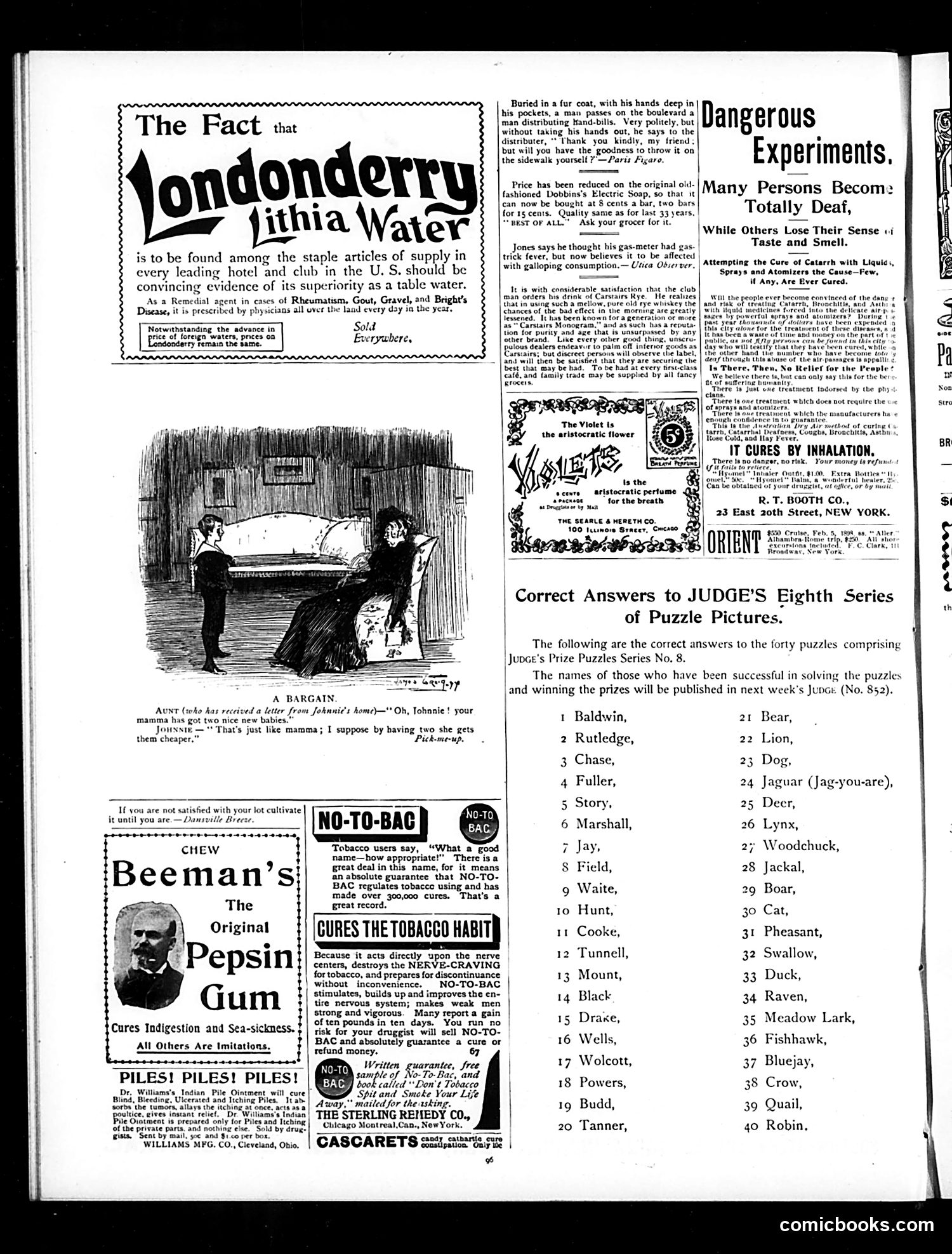
This single-panel cartoon depicts a domestic humor scenario typical of Judge magazine's style. An aunt has received a letter from Johnnie's home commenting that he has "two nice new babies." The aunt responds with mock sympathy, saying "That's just like mamma; I suppose by having two she gets them cheaper." The joke relies on Victorian-era assumptions about large families and economics: the humor comes from the aunt's deadpan misinterpretation, suggesting the mother had multiple babies to economize on childbearing costs—absurd logic that satirizes both penny-pinching domestic attitudes and the social reality of large families being common in this era. The surrounding page consists primarily of patent medicine advertisements (typical of Judge), making this a largely commercial publication rather than political satire.
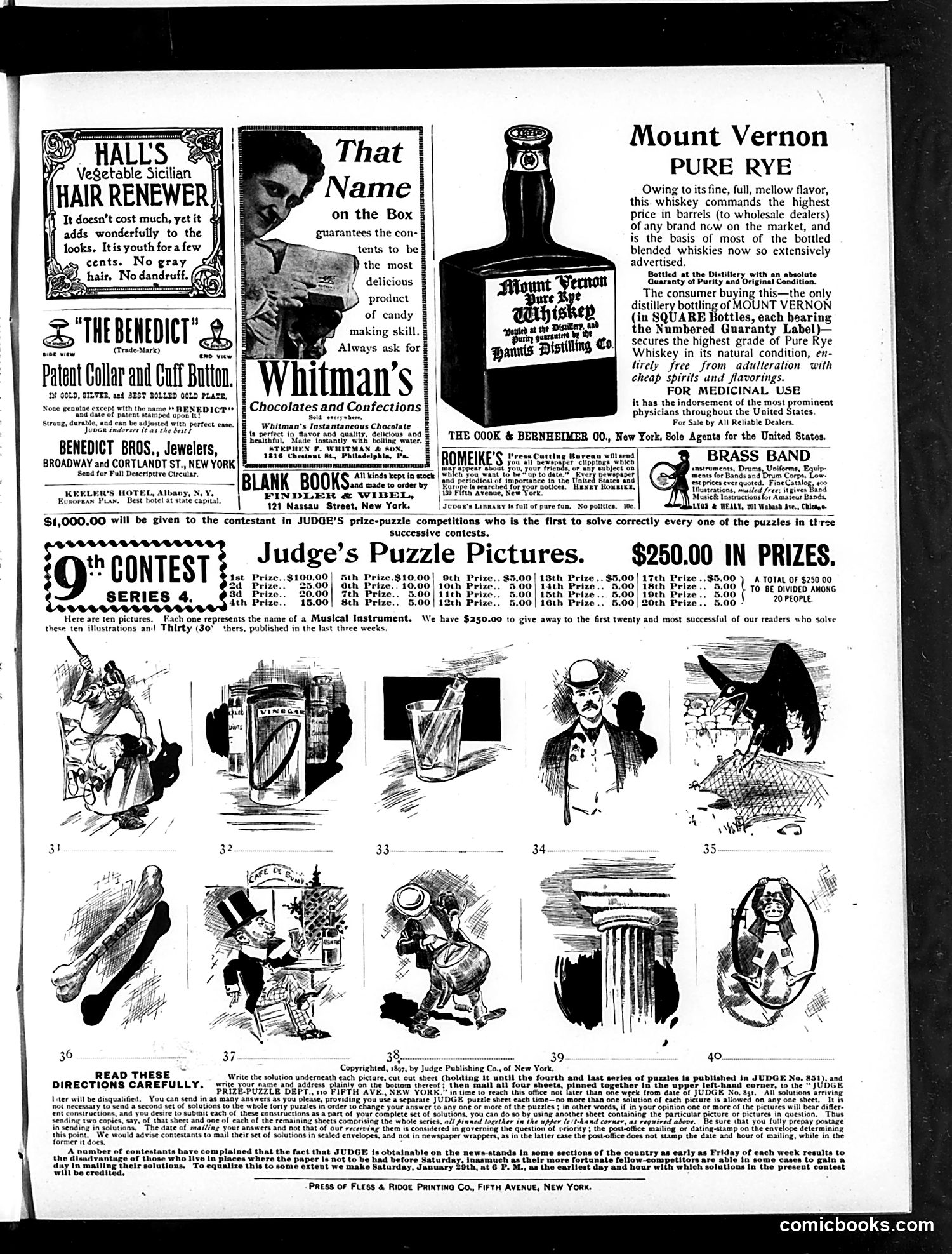
This page is primarily **advertising and a puzzle contest**, not political satire. The main content is a "Judge's Puzzle Pictures" competition offering $250 in prizes to readers who identify ten musical instruments from sketches (numbered 31-40). The advertisements dominate: Hall's Hair Renewer, Whitman's Chocolates, Mount Vernon Pure Rye Whiskey, and other commercial products typical of late 19th-century magazines. The puzzle instructions indicate this is part of a four-part series, with contestants needing to solve puzzles across multiple Judge issues to compete for grand prizes totaling $1,000. **No significant political or social satire is visible on this page.** It represents Judge's business model of combining light entertainment (puzzles, product ads) with illustrated humor to build readership and revenue. The page reflects the magazine's era through the products advertised—patent hair treatments, medicinal whiskey, and brass band instruments.
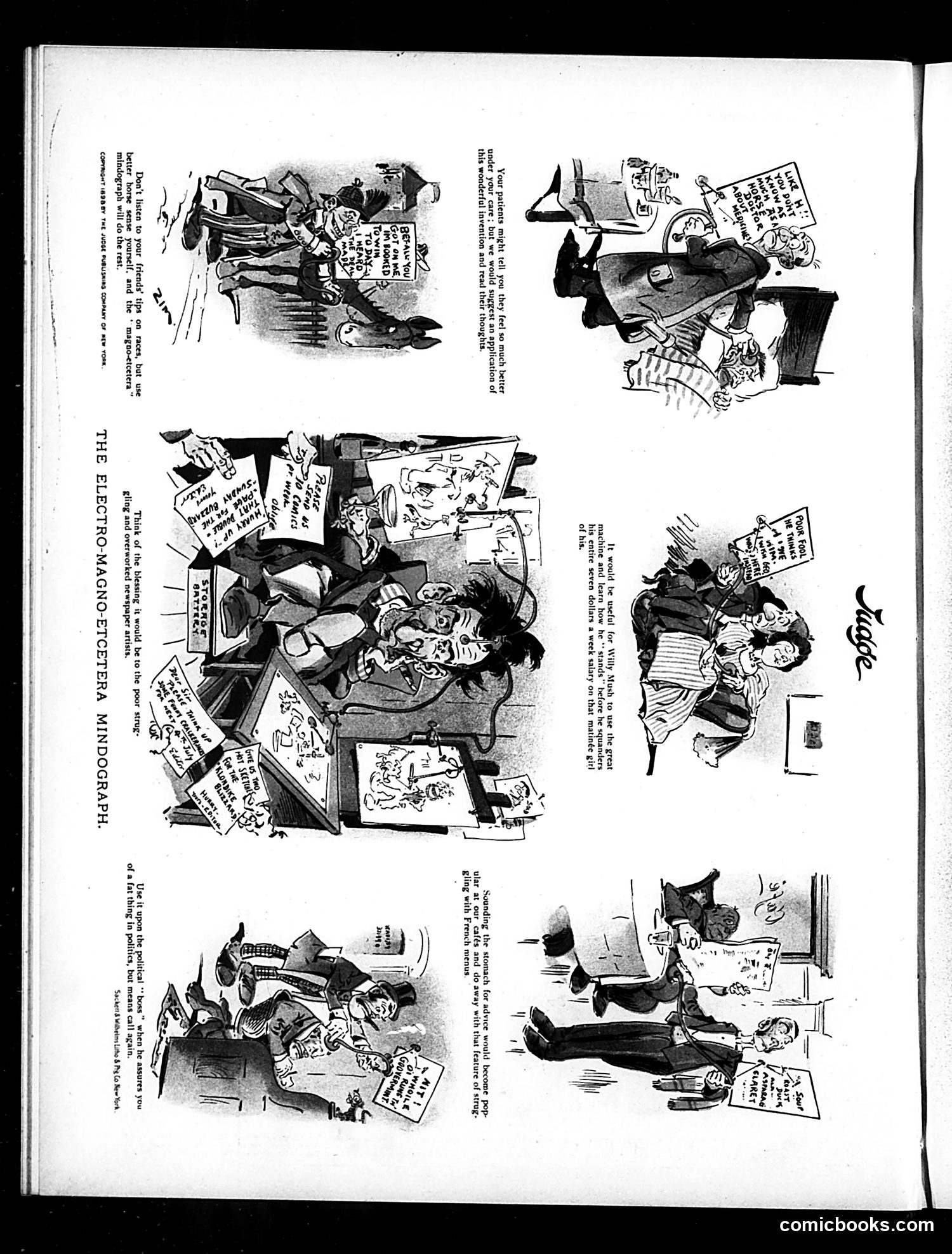
This page satirizes the late-19th-century craze for pseudoscientific "mind-reading" machines and electrical cure-alls. The cartoon depicts an invented device that purports to reveal people's true thoughts—exposing the gap between what they say and what they actually think. The satire targets multiple groups: doctors who claim patients feel better (when they don't), horse-racing tipsters offering false advice, newspaper artists struggling with deadlines, physicians using dubious diagnostic methods, French restaurants serving poor food, and dishonest employers. Each vignette shows the machine revealing hidden truths—patients' real suffering, skepticism about tips, genuine exhaustion, stomach problems, and broken promises. The joke relies on the public's familiarity with both electromagnetic "wonder machines" marketed as cure-alls and the gap between public claims and private reality. It mocks gullibility while satirizing various professions through their exposed hypocrisy.