
A complete issue · 16 pages · 1898
Judge — January 29, 1898
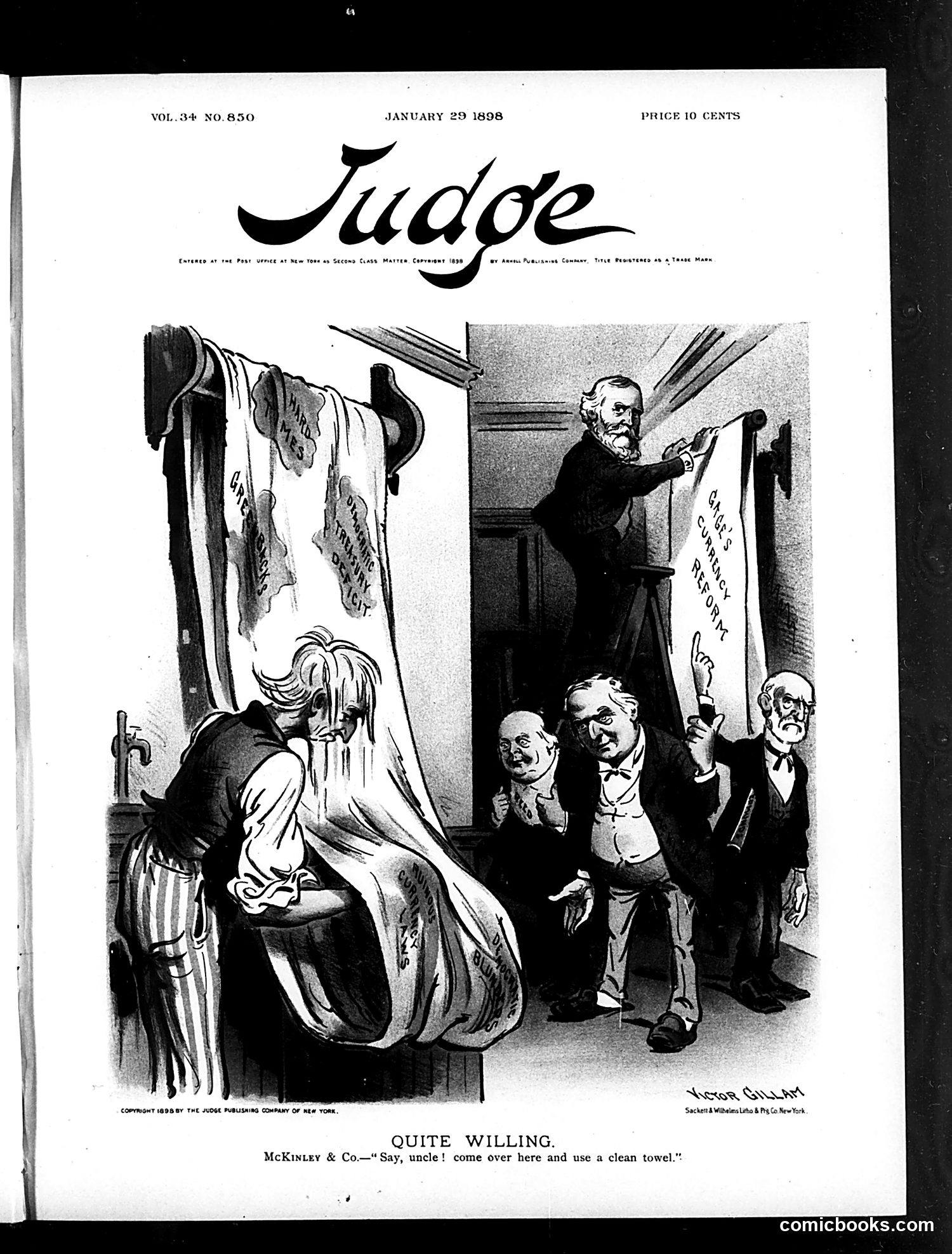
This cartoon satirizes **McKinley & Co.** (President William McKinley's administration) during the Spanish-American War period. The image depicts Lady Liberty (draped figure on left) being presented with a dirty towel by politicians. The caption's pun — "come over here and use a clean towel" — suggests the administration is offering false cleanliness or legitimacy to what the cartoonist views as a morally questionable enterprise. The men on the right appear to be government officials or politicians. The satire likely critiques the administration's justification for military intervention, implying their stated noble purposes mask self-interested or imperialistic motives. The "dirty" versus "clean" towel contrast symbolizes the gap between official rhetoric and actual conduct.
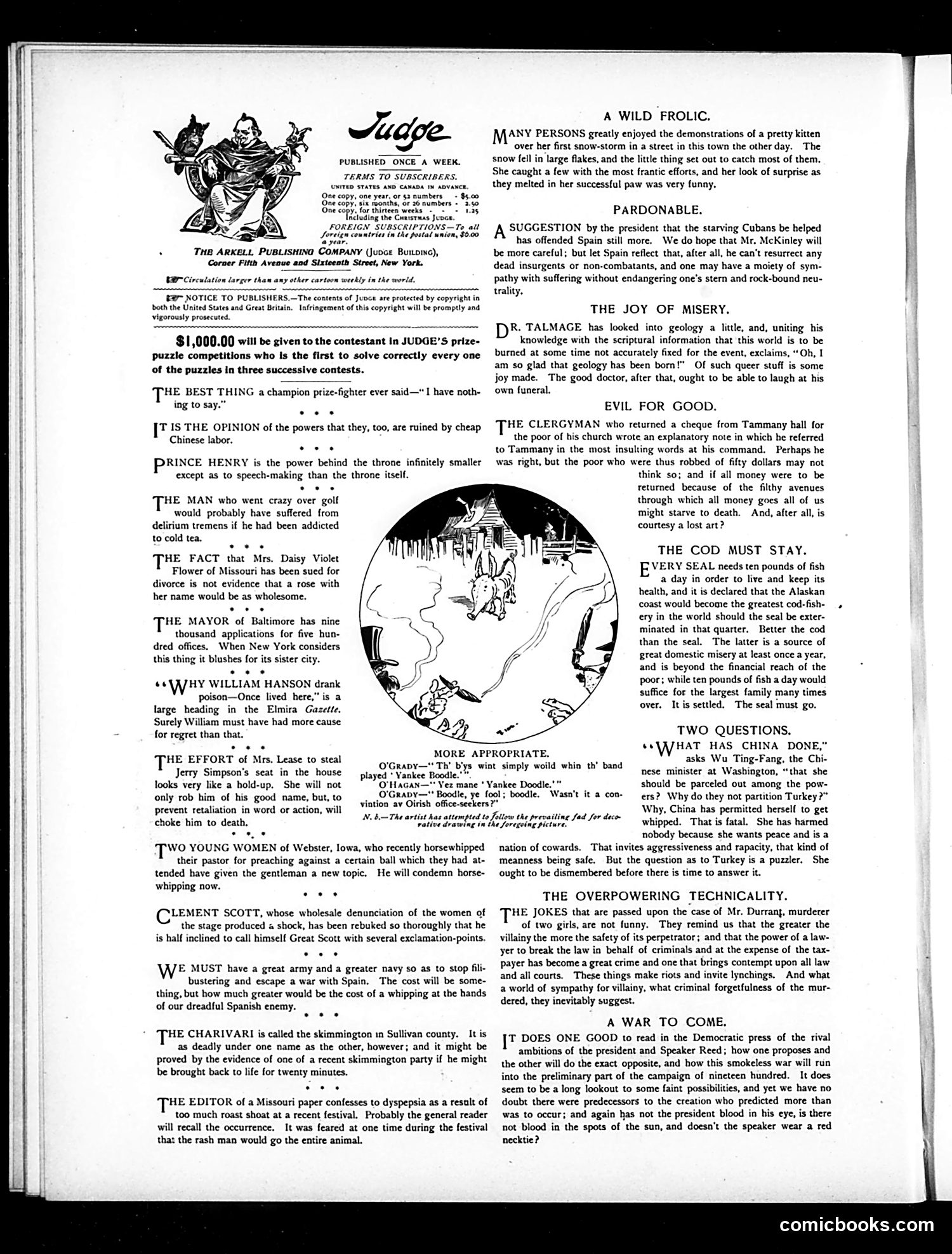
The main cartoon depicts a large face in profile containing a domestic scene—a family gathered around a table. This appears to illustrate the article "THE OVERPOWERING TECHNICALITY," which critiques legal proceedings in a case involving two girls and a Mr. Durrant. The cartoon satirizes how technical legal arguments can obscure the moral reality of criminal cases. The text suggests the legal system's focus on procedural technicalities allows guilty parties to escape justice, prioritizing courtroom mechanics over actual guilt or innocence. The surrounding editorial pieces address various political and social issues of the era, including references to Spain, Cuba, and Baltimore politics, typical of Judge's satirical commentary on contemporary American affairs.
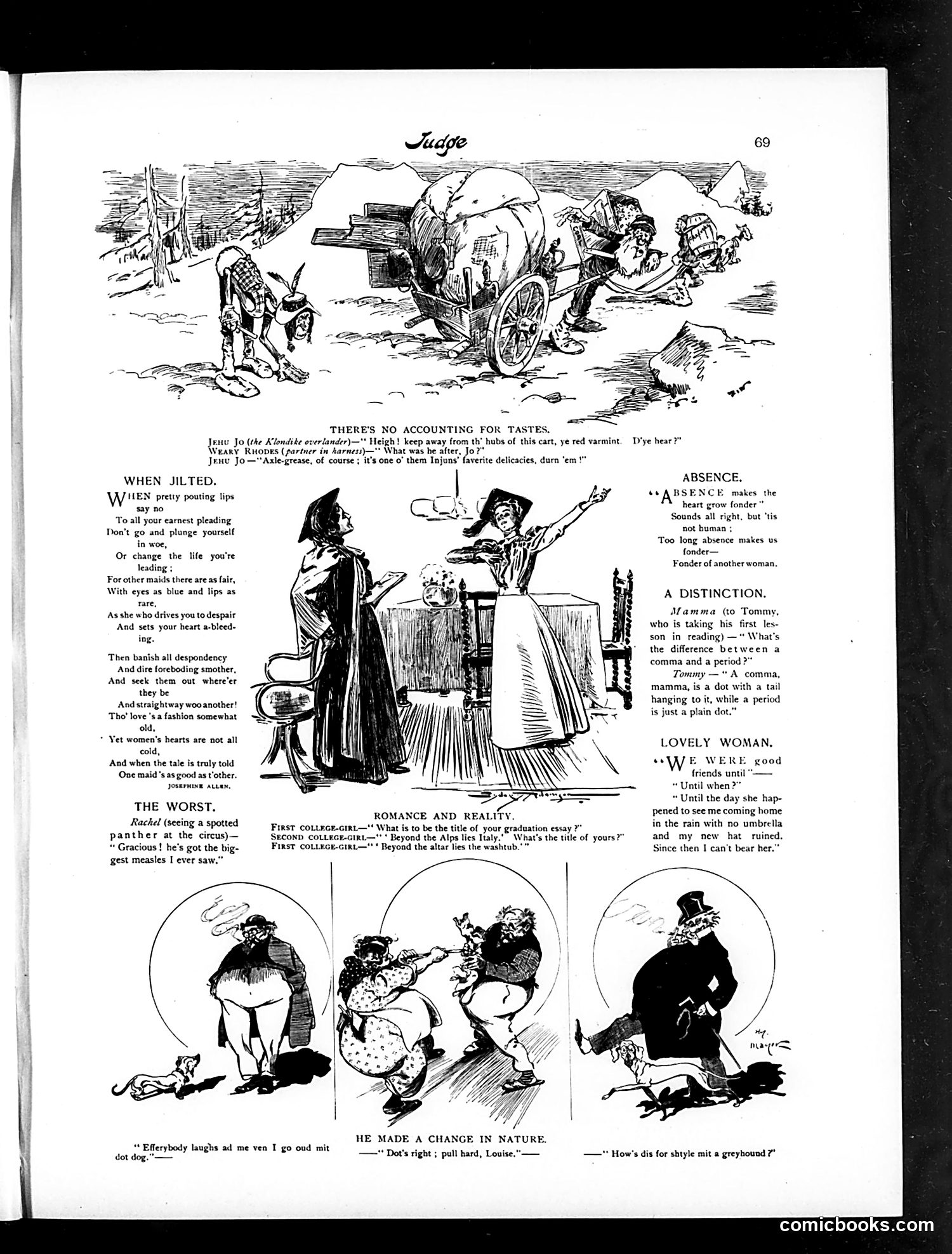
This page contains several unrelated satirical items typical of Judge's format: **Top cartoon**: Shows travelers with a cart, satirizing incomprehensible accents and regional dialects ("red varmint," "harbor in Sarsens"). The humor relies on Scottish and Irish brogue stereotypes common to period humor. **"When Jilted"**: A poem about romantic rejection, using flowery Victorian language to mock melodramatic responses to heartbreak. **Side items**: Brief satirical observations on human nature—"Absence," "A Distinction" (about punctuation), "Lovely Woman" (about forgetting a lover)—each a paragraph-long joke. **Bottom section**: Three cartoon vignettes with captions about everyday situations, appearing to mock social behaviors rather than specific political figures or events. The page exemplifies Judge's miscellaneous humor format: no overarching political narrative, instead offering scattered social commentary through poetry, short jokes, and illustrated gags.
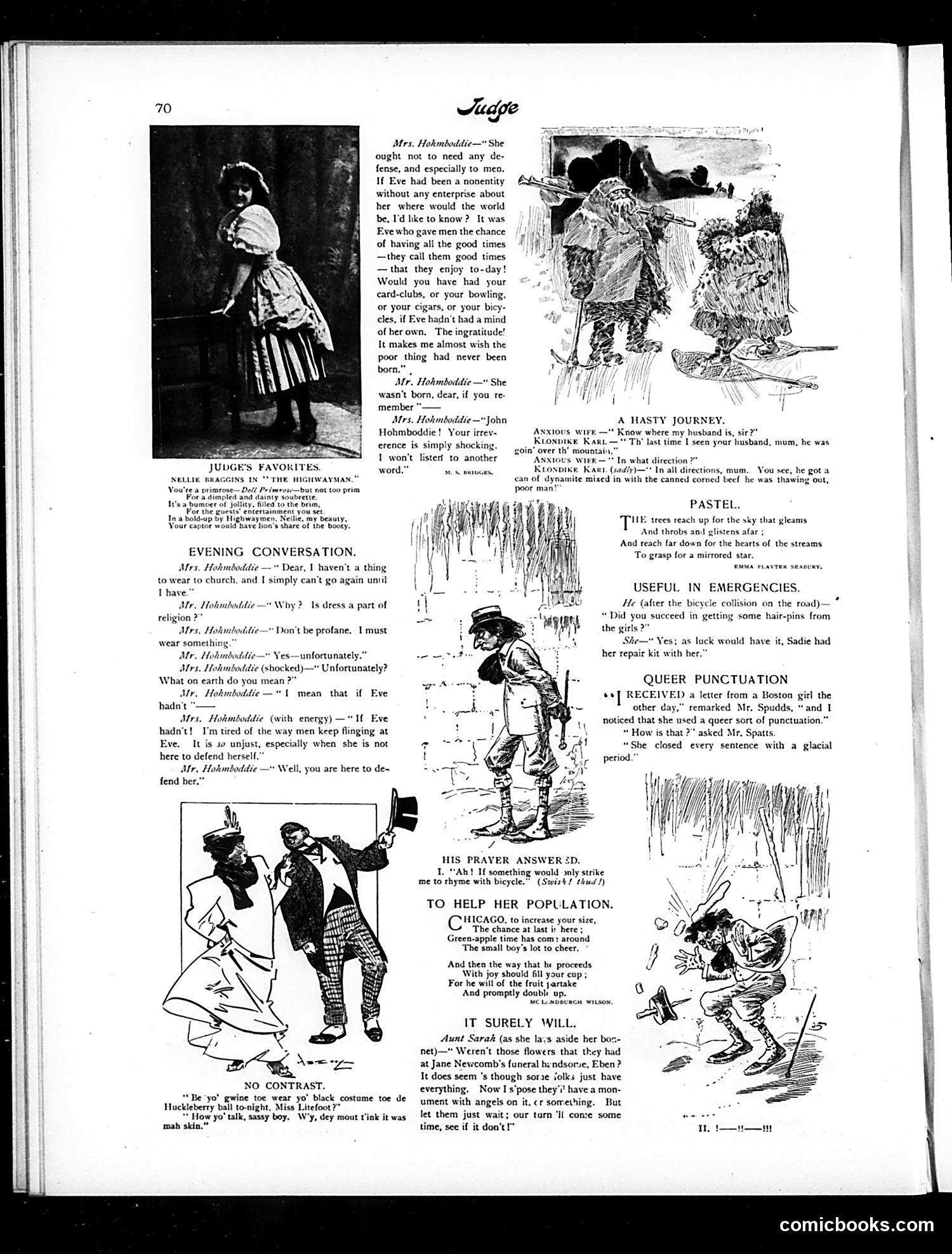
This page contains several distinct humor pieces rather than unified political cartoons: **"Judge's Favorites"** features Nellie Brackins from "The Highwayman," a theatrical production. **"Evening Conversation"** presents a domestic dispute between Mr. and Mrs. Hohwaddie, satirizing marital disagreements about women's social activities and independence—likely referencing contemporary debates about women's dress codes and leisure pursuits. **"No Contrast"** depicts a man in formal attire beside someone in a black costume, apparently mocking fashion choices at a Huckleberry Ball event. The remaining sections ("A Hasty Journey," "Pastel," "Useful in Emergencies," etc.) are brief humorous anecdotes and witticisms rather than political commentary, typical of Judge's miscellaneous humor format. The overall page reflects early 20th-century domestic and social satire rather than focused political critique.
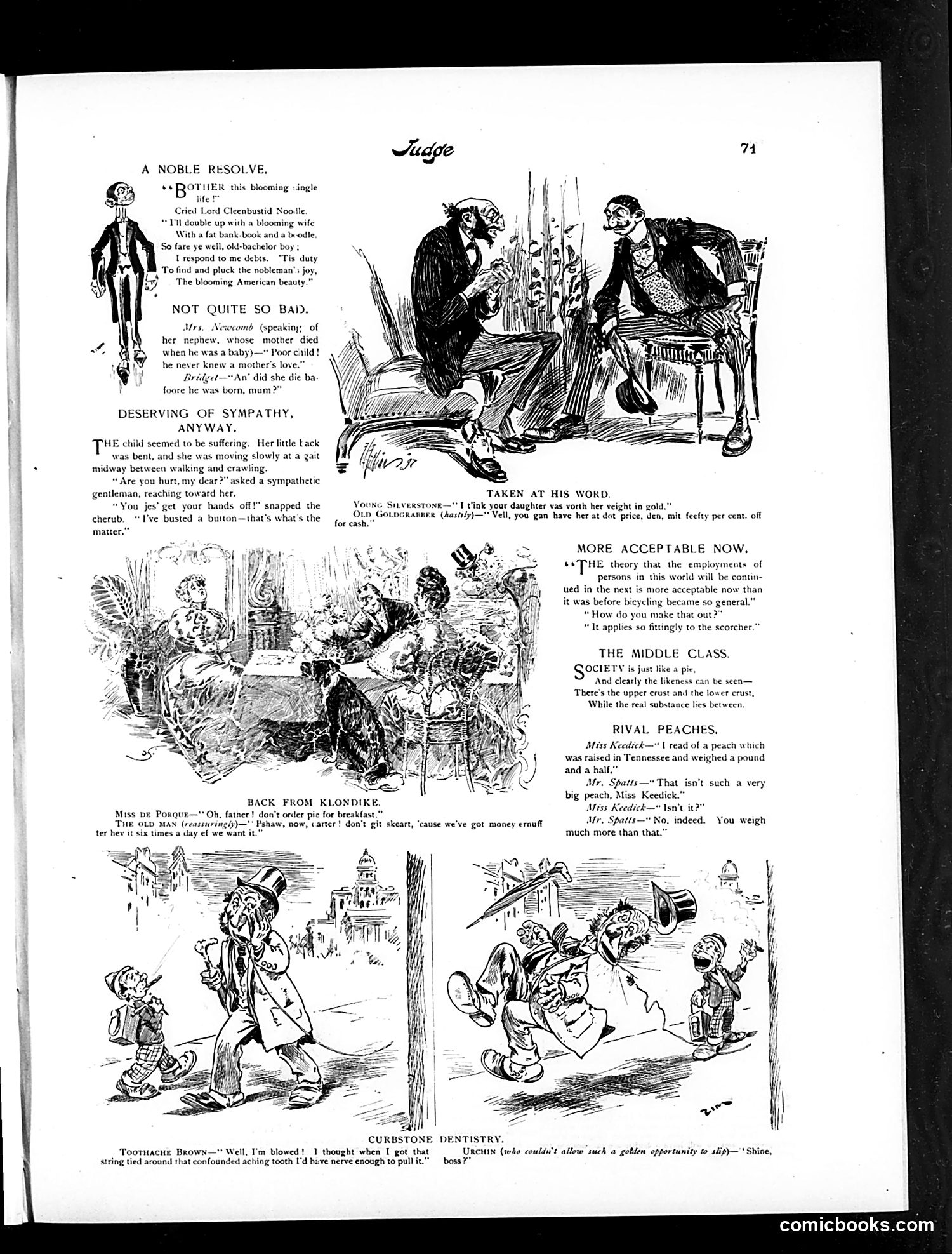
This page contains several brief satirical sketches typical of Judge's humor: **"A Noble Resolve"** mocks a British aristocrat ("Lord Cleenbustid Noole") who declares he'll marry an American heiress for her wealth—the "blooming American beauty" is really her bank account, not her character. **"Not Quite So Bad"** is a simple joke about Irish servant Bridget misunderstanding a conversation about a nephew who never knew his mother's love, asking if the mother died before he was born. **"Deserving of Sympathy"** uses irony: a child appears to be suffering, but her real complaint is merely a broken button. **"Taken at His Word"** plays on a fortune-seeker's compliment about a daughter's worth—the father immediately tries to sell her at that price with a discount. **"More Acceptable Now"** references bicycling fads and scorchers (reckless cyclists), joking that if people continue their earthly occupations in heaven, at least scorchers will fit right in. Other brief gags satirize the middle class, compare rival peaches, mock newfound Klondike wealth, and feature curbstone dentistry.
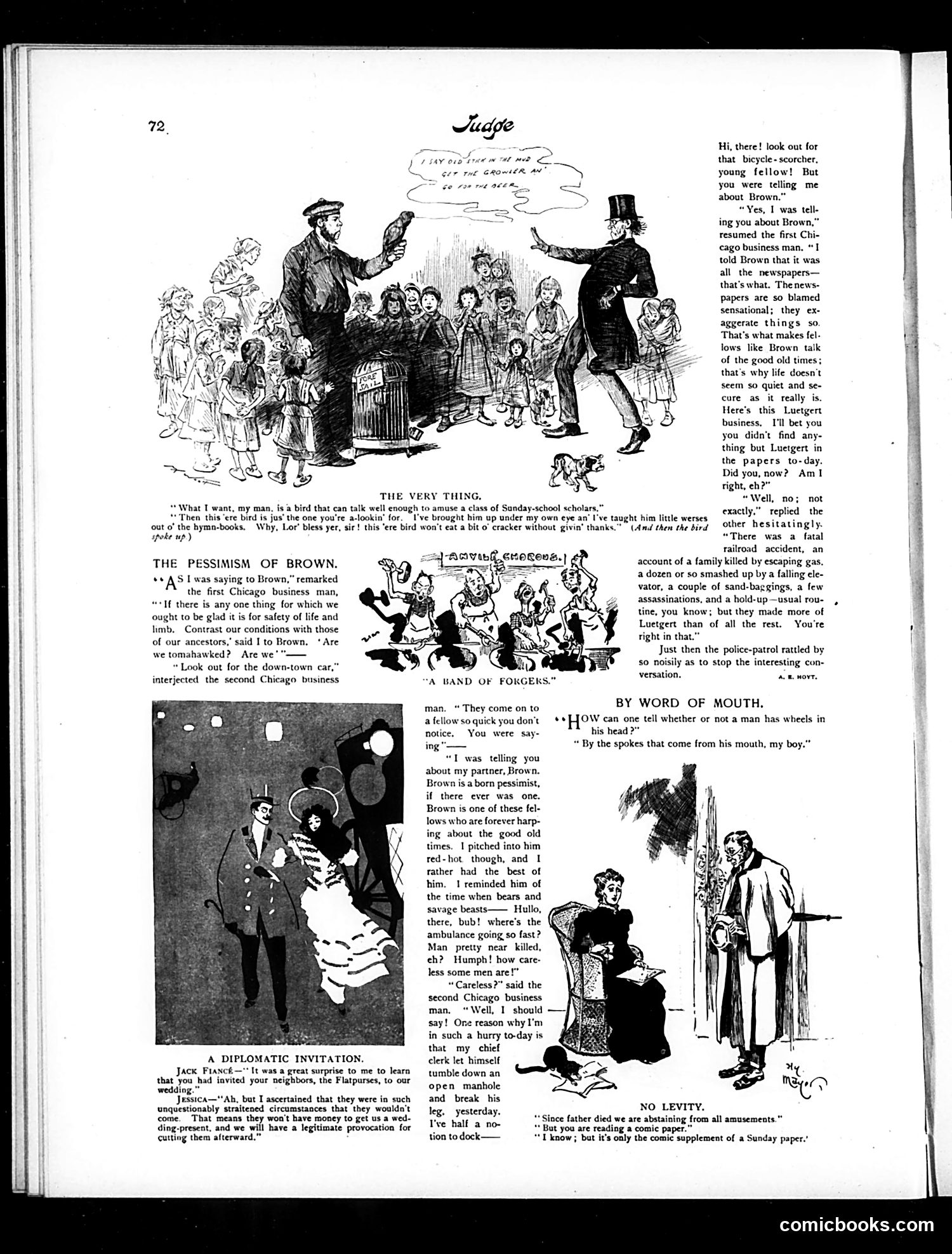
This page satirizes Chicago businessmen's obsessive pessimism and obliviousness to urban dangers. The main cartoon, "The Pessimism of Brown," depicts two Chicago businessmen attempting conversation while constantly interrupted by nearby disasters—a streetcar, a falling person, an ambulance, a manhole injury. The joke: One businessman argues that modern life is safer than the past, citing absence of tomahawks, while Brown contradicts him by dwelling on "the good old times." The irony is heavy-handed—they're interrupted repeatedly by genuine contemporary perils (accidents, injuries, crime), yet the businessman blames newspapers for sensationalism rather than acknowledging actual danger. The reference to "Luetgert" likely alludes to a prominent Chicago murder case. The cartoonist's point: these businessmen are so absorbed in pessimistic philosophizing they miss the very real hazards surrounding them, and they blame media exaggeration rather than accepting urban reality.
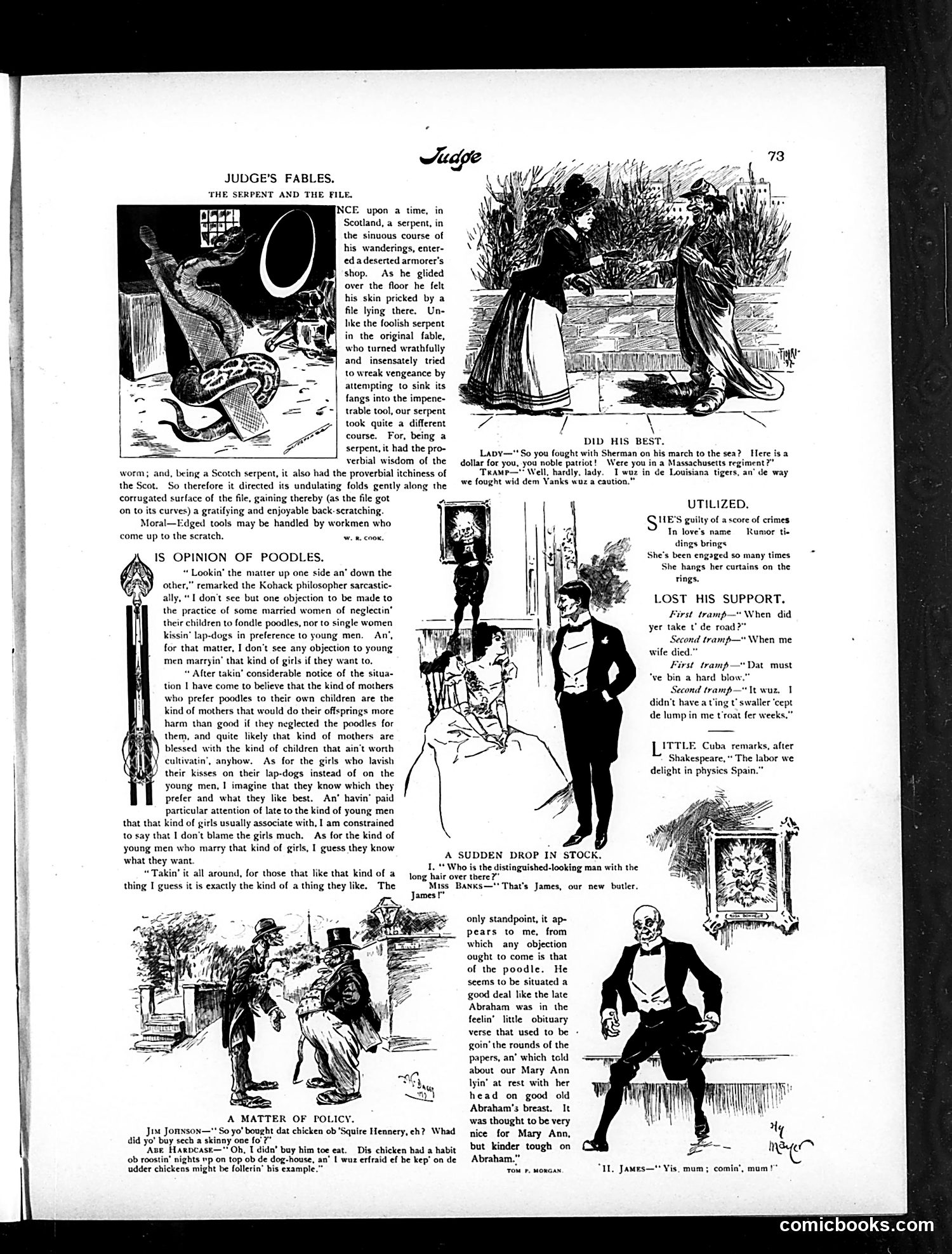
This page from the satirical magazine *Judge* contains several fables and humorous vignettes satirizing American social customs: **"The Serpent and the File"** mocks Scottish frugality by depicting a Scottish serpent "scratching" itself on a file rather than attacking it—a practical, profit-minded alternative to the original fable's foolish serpent. **"Opinion of Poodles"** critiques wealthy women who neglect children to coddle lap dogs, suggesting such mothers and their children deserve each other anyway. The piece sarcastically dismisses moral objections, arguing only the poodle deserves sympathy—trapped between an indifferent woman and her worthless offspring. **"Did His Best"** jokes about a Civil War veteran claiming service in Sherman's campaign, then revealing he actually fought for the Confederacy ("Louisiana tigers"), making his patriotic credentials fraudulent. **"A Matter of Policy"** presents a racist dialect joke about a Black man buying a thin chicken to prevent other chickens from following its roost-sitting habit. The overall tone reflects late-19th-century *Judge* satire: snobbish class commentary, ethnic stereotyping, and cynical social observation.
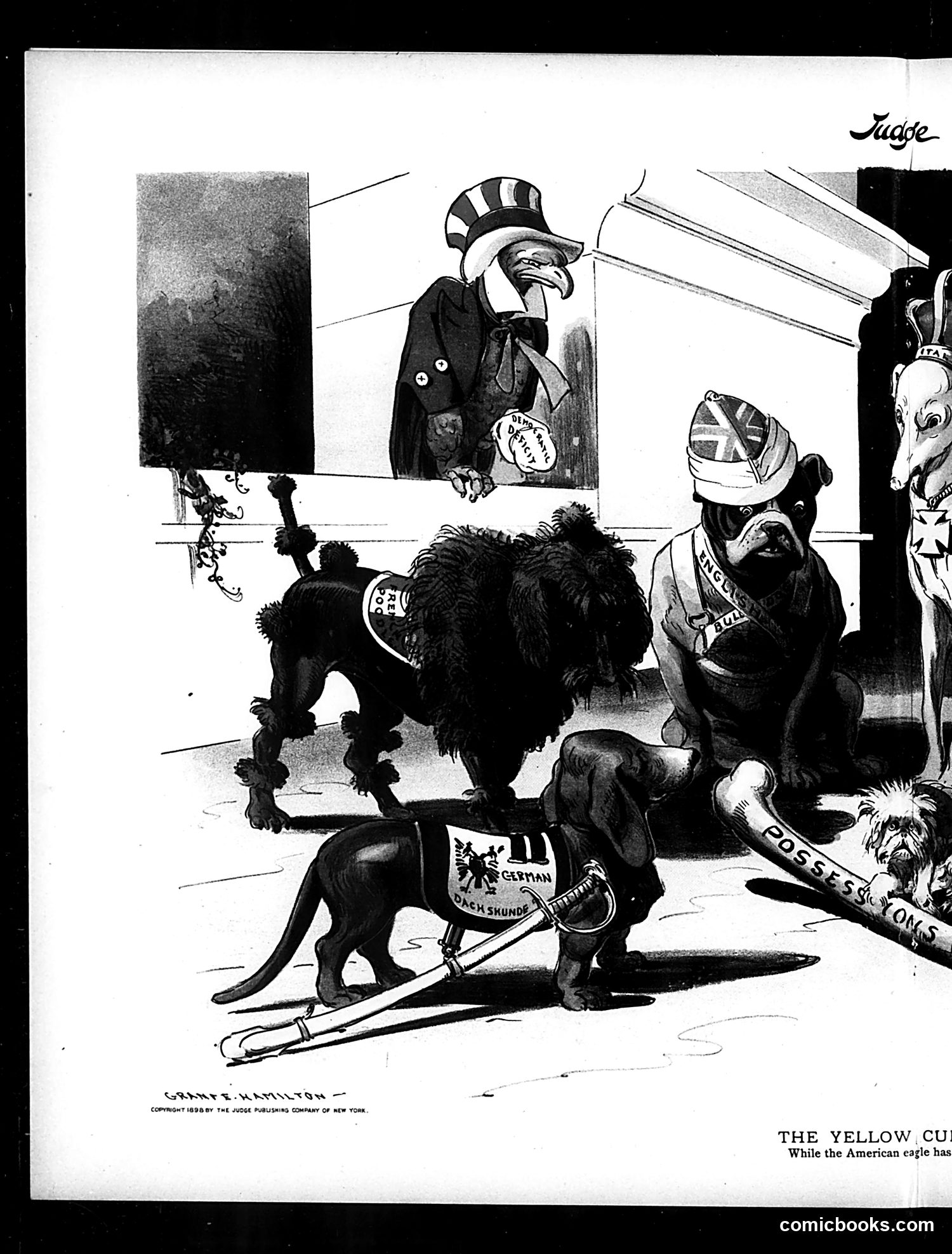
This Judge magazine cartoon (copyright 1898) satirizes international power dynamics, likely regarding American imperial expansion. The central figure appears to be Uncle Sam (identifiable by the striped top hat), depicted as a stern authority figure overseeing various nations represented as dogs wearing national emblems and collars—including what appears to be German and British insignia. The "Yellow Peril" reference in the title suggests anxiety about Asian (likely Chinese or Japanese) influence or competition. The dogs' submissive postures suggest nations under American dominance or control. The cartoon critiques either American interventionism abroad or concerns about losing American influence to rival powers—typical themes of 1890s American political discourse during the era of imperialism and the Spanish-American War.
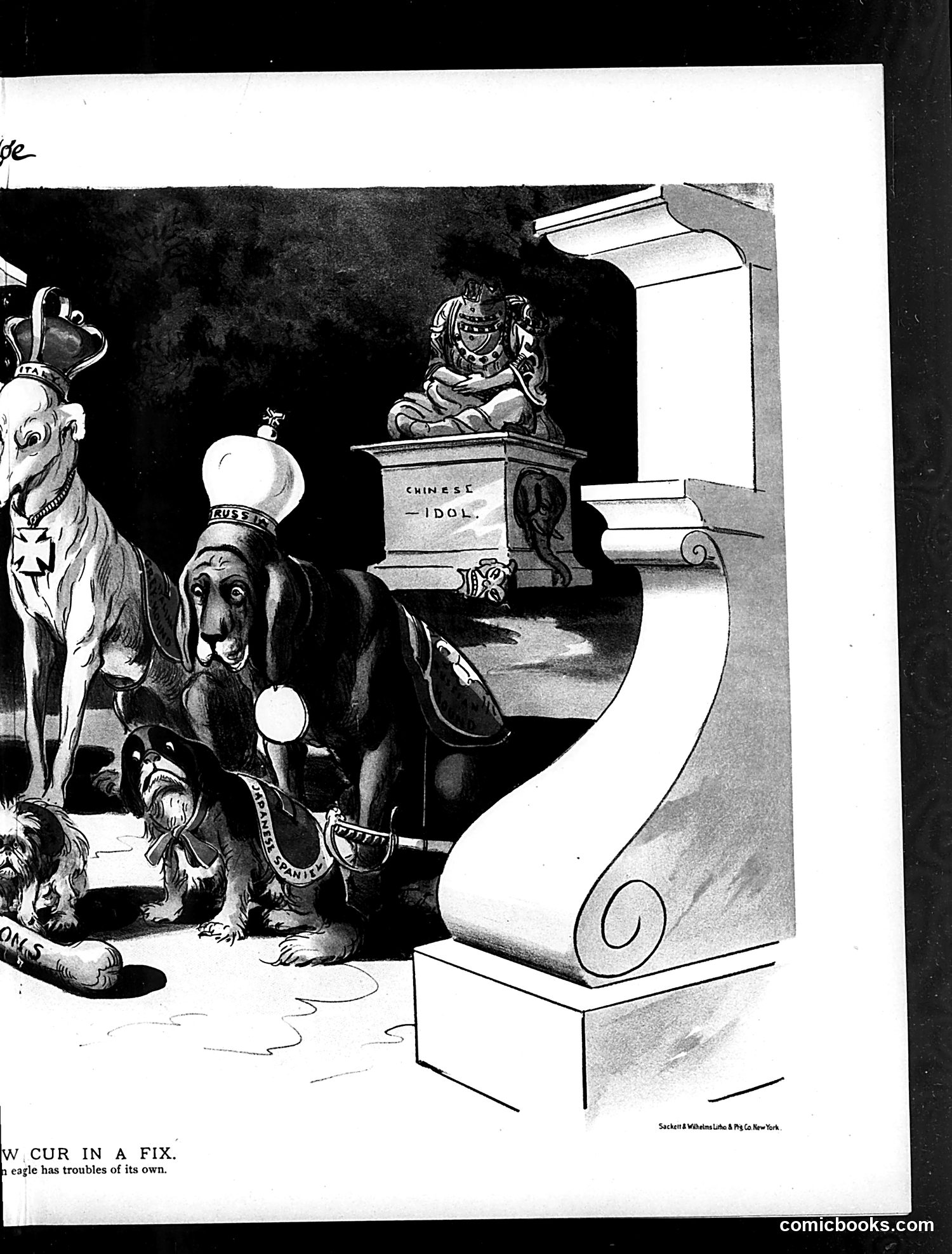
This political cartoon depicts an American eagle (representing the U.S.) on a pedestal labeled "CHINESE IDOL," surrounded by various dogs wearing collars—likely representing different nations or political interests competing for American favor or influence. The title "Cur in a Fix" (with the partial text "eagle has troubles of its own") suggests the cartoon satirizes America's complicated foreign relations, specifically regarding China. The dogs worshipping at the altar-like pedestal imply other powers are vying for dominance or influence over Chinese affairs, while America finds itself caught or "fixed" in this mess. The elaborate architectural setting and formal positioning suggest this addresses late 19th or early 20th-century imperial competition in Asia, possibly related to the Boxer Rebellion or Open Door Policy debates—when Western powers jockeyed for economic and political advantage in China.
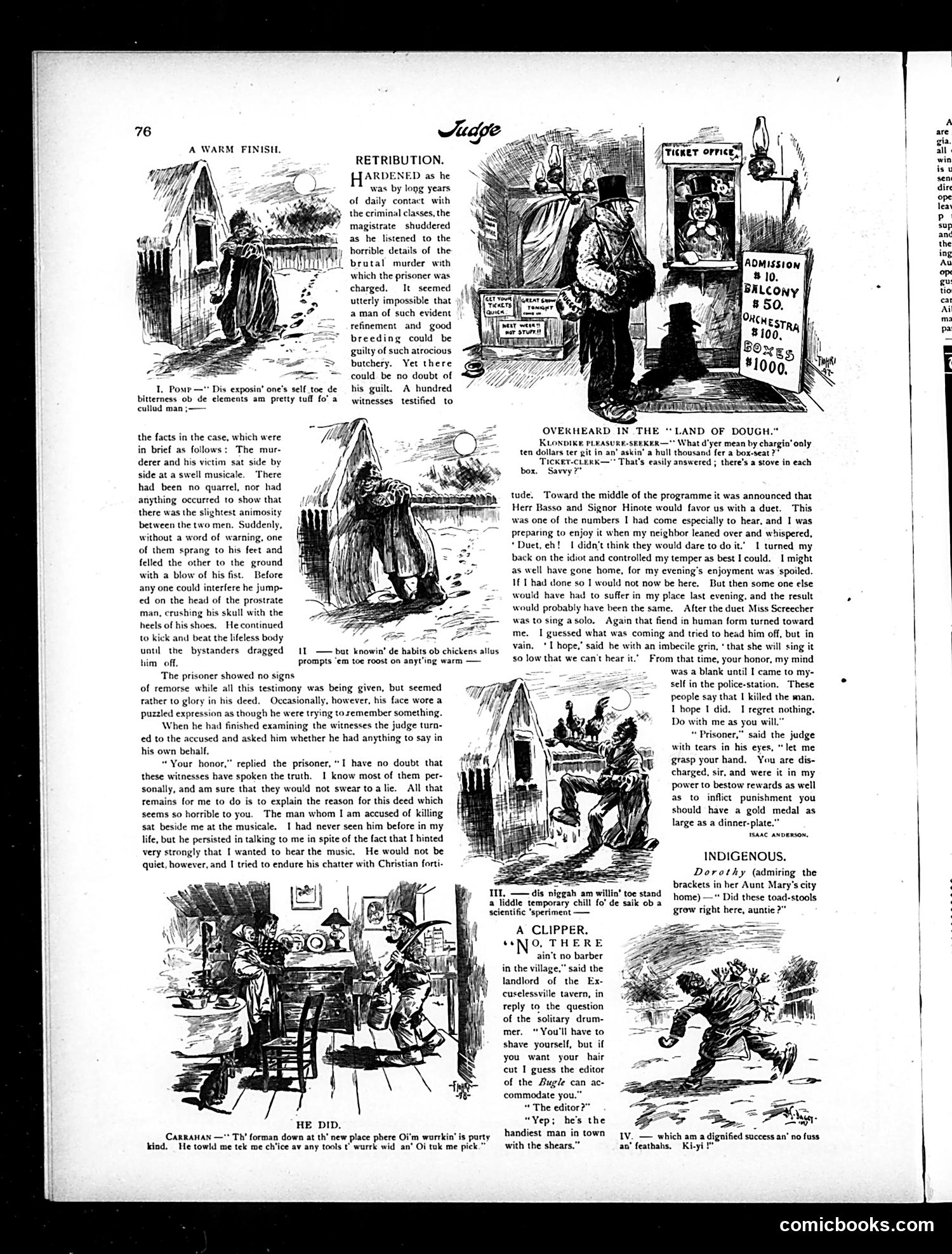
This page contains multiple unrelated satirical pieces typical of Judge magazine's format. **"A Warm Finish"** depicts a courtroom drama where a refined gentleman is tried for brutally murdering a concertgoer. His defense: the victim repeatedly talked during a musical performance, ruining his evening. The satire mocks both the absurdity of using minor social annoyance as justification for violence and the magistrate's shock that a "gentleman" could commit such brutality—suggesting that social refinement masks darker impulses. **"Retribution"** and other vignettes use African American dialect humor (reflecting period prejudices) for comic effect about rural/working-class life. **"Overheard in the 'Land of Dough'"** satirizes Klondike Gold Rush profiteering, where concert box seats command inflated prices ($1,000) due to included amenities (a stove for warmth). The cartoons employ Judge's characteristic approach: social commentary through exaggeration and irony, though some rely on now-offensive racial stereotyping common to that era.
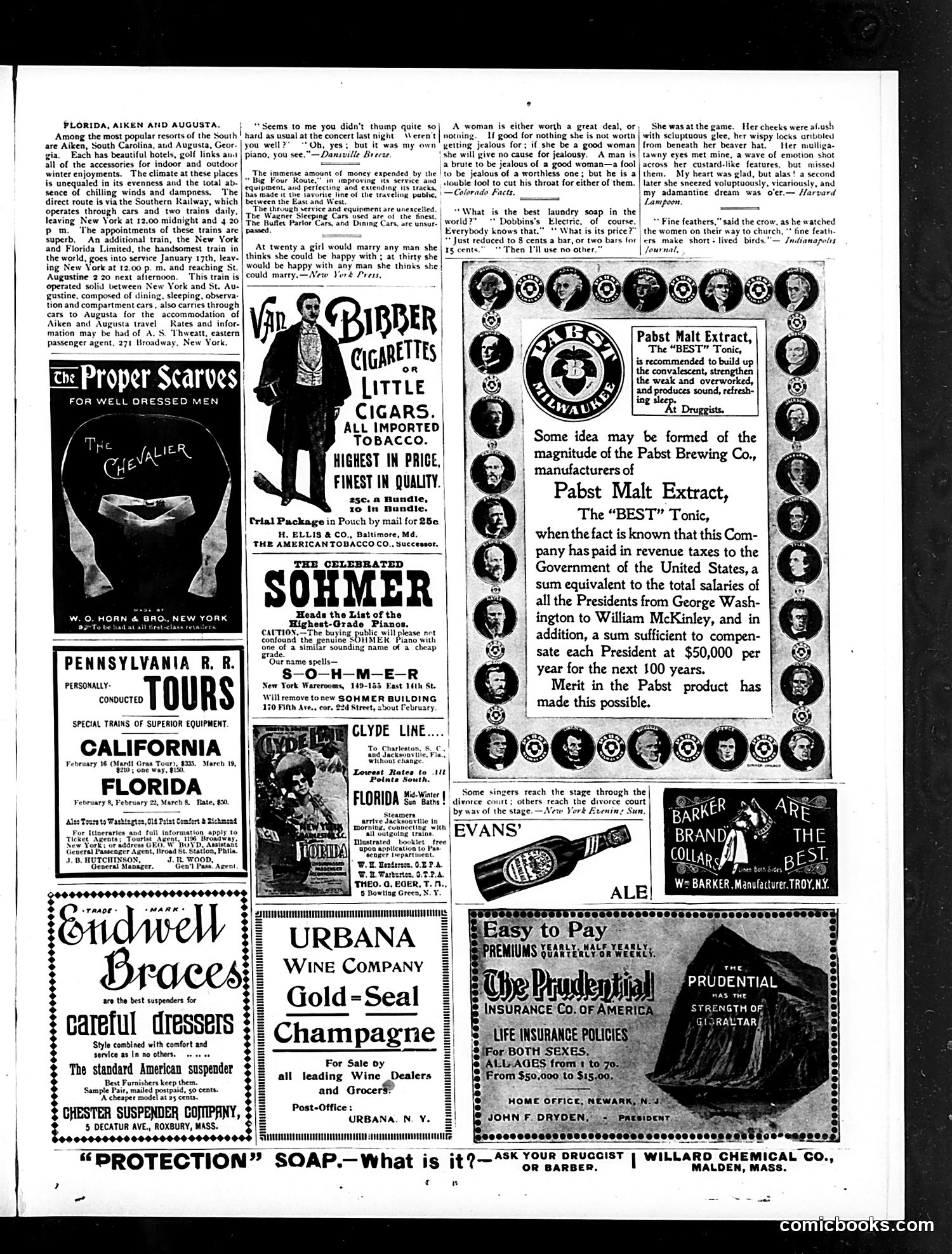
This page is primarily **advertising**, typical of Judge magazine's revenue model. The cartoons and jokes are brief filler content between ads. ## The Humor: **Top section**: A dated gender stereotype joke—a woman's value depends entirely on her utility to men (usefulness or obedience). The punchline relies on calling any woman outside these categories worthless. **Middle left**: A joke about piano playing technique that's a mild pun on "thumping." **Bottom**: A crow's observation that women prioritize fashion ("fine feathers") over longevity—another dismissive joke about women's priorities. ## Context: These reflect early 1900s attitudes where Judge's humor frequently relied on misogyny. The jokes assume readers share assumptions about women's limited value and foolish spending habits. ## The Ads: Railways, suspenders, cigars, champagne, insurance, and soap dominate—marketing to wealthy male readers who could afford winter resort travel and leisure goods.
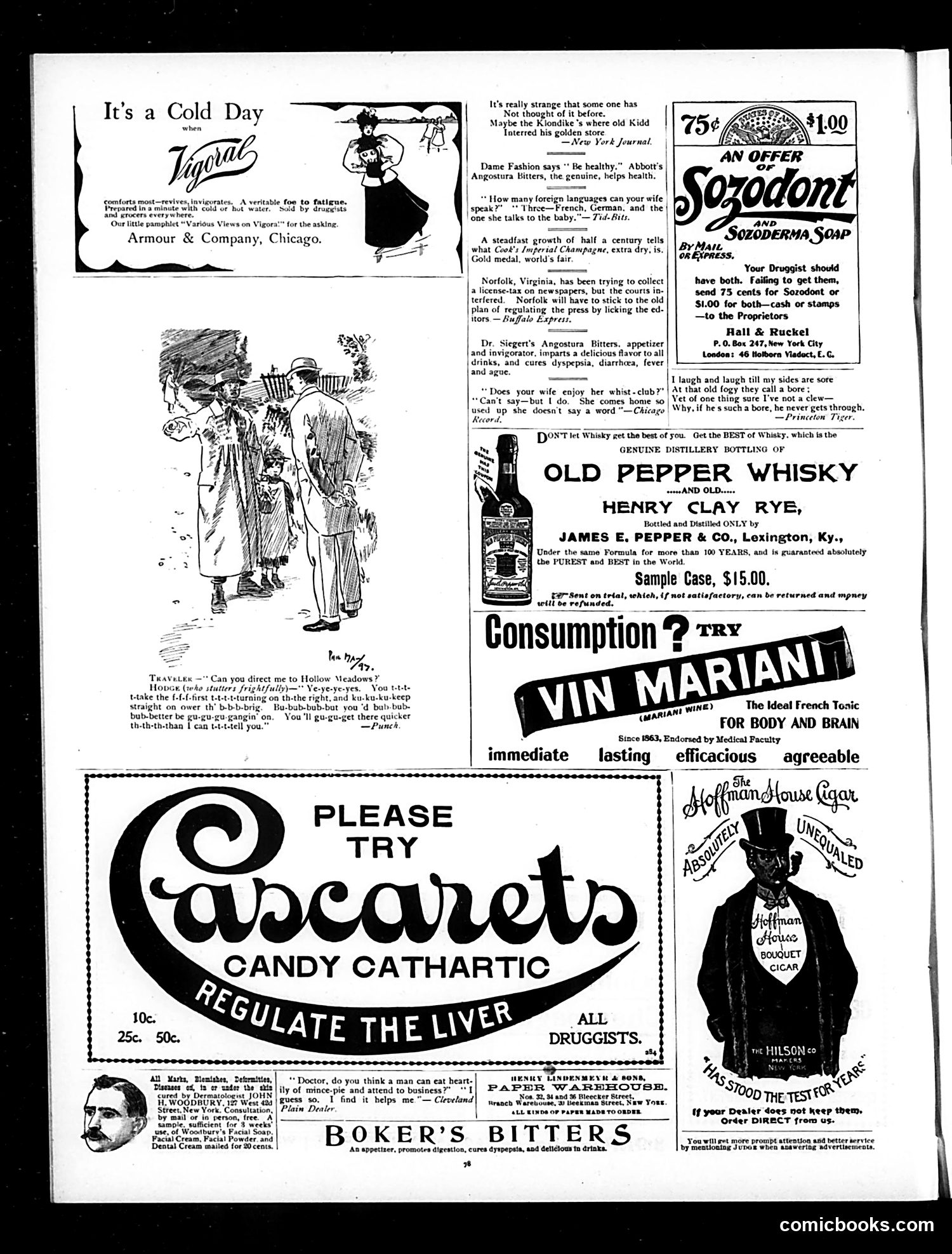
This is primarily an **advertising page** from Judge magazine, featuring multiple patent medicines and consumer products typical of the late 19th/early 20th century. The small cartoons interspersed are light humor pieces: one depicts a traveler asking directions from a severe stutterer (mocking the speech impediment for comedy), another jokes about a wife who won't stop talking to the baby in foreign languages. **The advertisements reveal period attitudes:** - "Sozodont" soap and tonics promised to cure virtually everything (digestive issues, fever, etc.) - Products like Angostura Bitters and Boker's Bitters were marketed as medicinal tonics, though they were primarily alcohol - "Cascarets Candy Cathartic" promised liver regulation - Vin Mariani wine was endorsed as brain food These ads reflect an era before FDA regulation, when patent medicines made extravagant health claims without scientific evidence. The casual inclusion of alcohol-based "tonics" and unproven remedies shows how differently health products were marketed and perceived then.
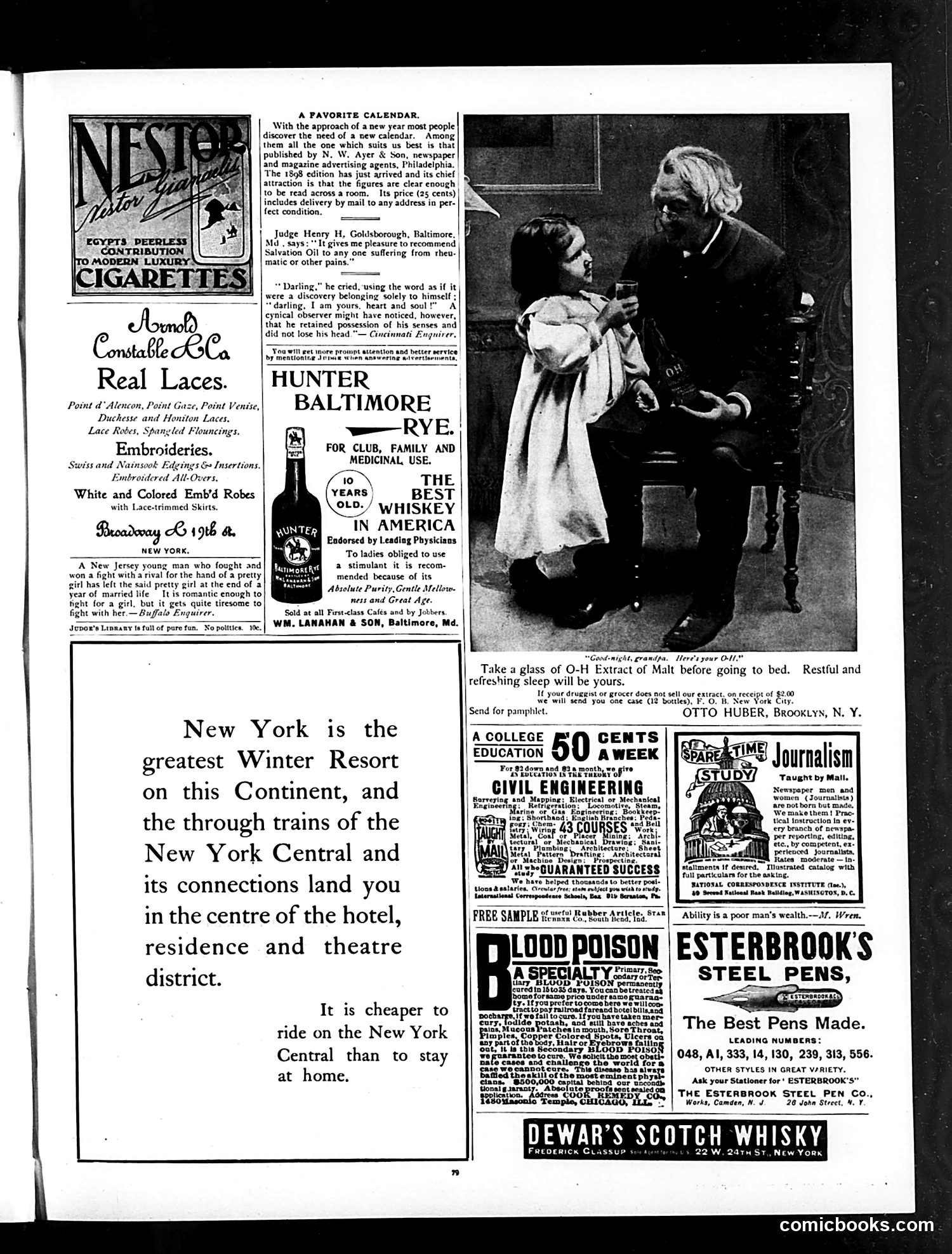
This page is primarily **advertising**, typical of late-1890s magazines. The dominant content includes ads for whiskey, pens, laces, and correspondence courses. The one notable editorial content is a small photograph captioned "Good-night, grandpa. Here's your OH"—showing an elderly man with a young child, advertising O-H Extract of Malt as a sleep aid. This appears to be a gentle domestic scene rather than satire. The page also includes brief humorous anecdotes about relationships (a New Jersey man who fought for a girl then divorced her after a year), reprinted from other newspapers, and endorsements like Judge Henry Goldsborough praising "Salvation Oil" for rheumatism. The satirical magazine's actual content is minimal here; the page functions primarily as a revenue vehicle. The few jokes present are mild domestic humor rather than political satire, reflecting Judge's mixed editorial-advertising nature in this era.
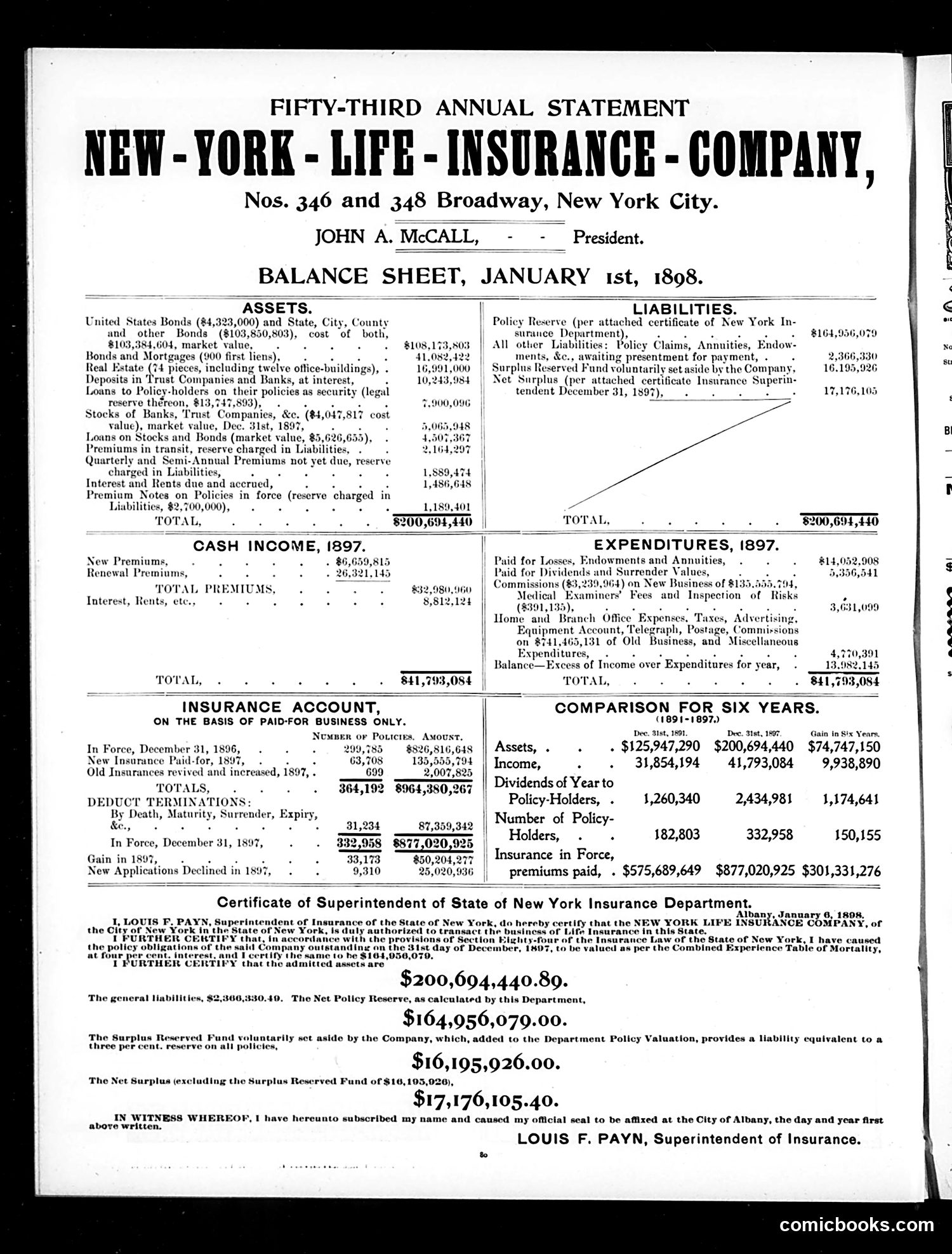
This is **not a cartoon or satirical content** — it's a financial statement. This is the Fifty-Third Annual Statement of the New York Life Insurance Company, dated January 1, 1898, published in *Judge* magazine as corporate disclosure/advertising. The page contains: - Balance sheet showing assets (~$200 million) and liabilities - Cash income and expenditures for 1897 - Insurance account details (policies in force, premiums paid) - A six-year comparison table (1891-1897) - Official certification from New York's Insurance Superintendent **For modern readers:** This represents how major corporations advertised financial stability and transparency to the public in the late 1800s. Publishing detailed statements in prestigious magazines like *Judge* was a way to build investor confidence. The impressive numbers ($575 million in premiums paid, hundreds of thousands of policyholders) demonstrated the company's growth and reliability during a period of rapid American industrialization.
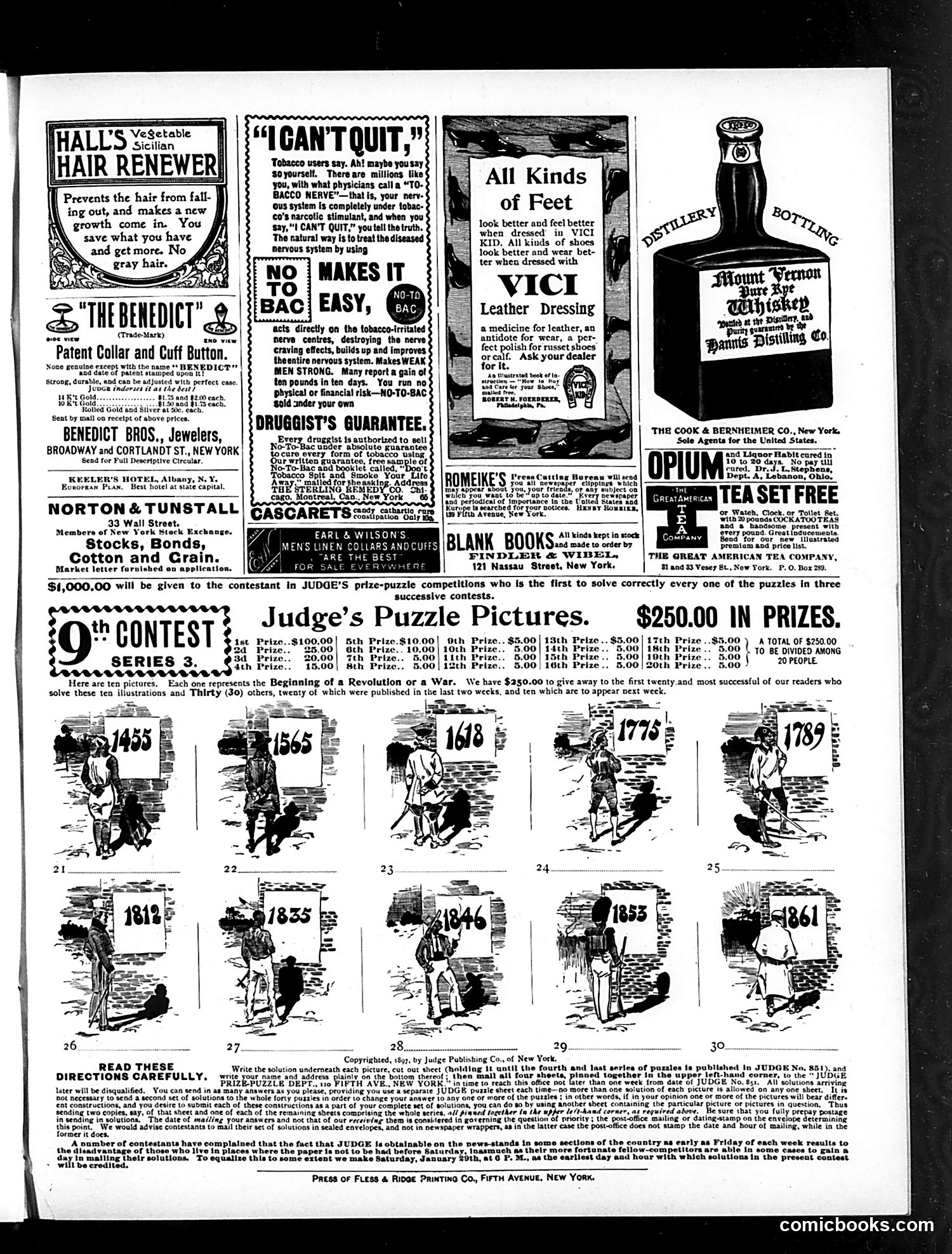
This page is primarily a **puzzle competition** rather than political satire. Judge's 9th Contest challenges readers to identify ten historical scenes—each dated from 1455 to 1861—depicting "the Beginning of a Revolution or a War." Readers must solve all puzzles across four published series to compete for $250 in prizes. The illustrations show figures in period dress engaged in historical moments, though specific identities are unclear from the images alone. The competition targets Judge's educated readership, appealing to historical knowledge as entertainment. The page is otherwise dominated by **patent medicine and commercial advertisements**—typical of 1890s magazines. These promote dubious remedies: "No-To-Bac" (tobacco addiction cure), Hall's Hair Renewer, and various other products with exaggerated health claims, all sold "under druggist's guarantee." This reflects the era's unregulated patent medicine market and Judge's reliance on such advertising revenue.
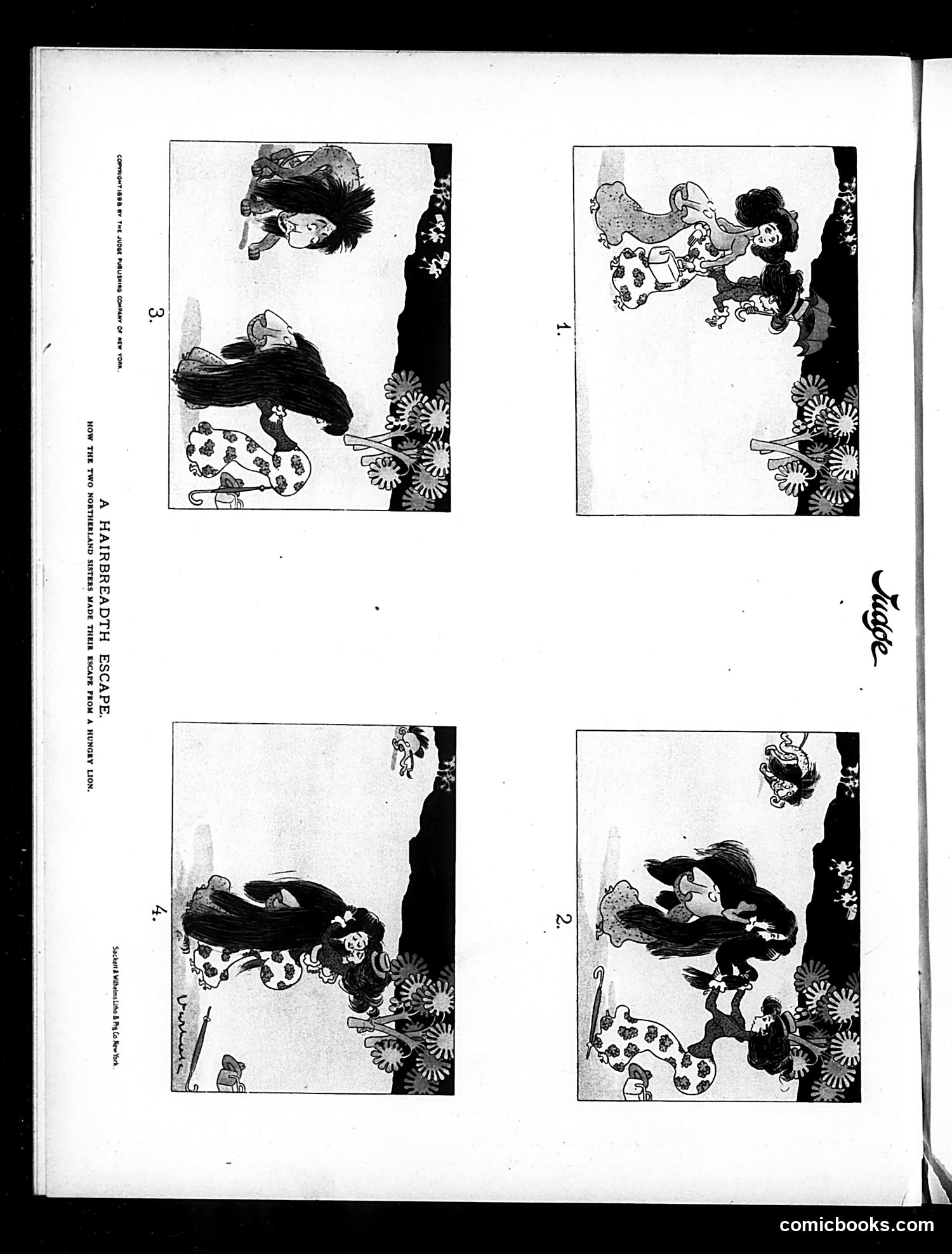
This appears to be a sequential four-panel comic titled "A Hairbreadth Escape" depicting two young women evading a lion. The panels show the sisters in increasingly dramatic situations—the lion pursuing them through what appears to be an African setting (indicated by decorative foliage). The women use various tactics to escape, including running and possibly climbing. The title references "Northerland Sisters," though their specific identity is unclear from the visible text. This reads as adventure humor rather than political satire—a common Judge magazine format mixing escapist narrative with comedic illustration. The "hairbreadth" escape setup was familiar entertainment fare in early 20th-century American publications, playing on contemporary fascination with exotic locales and perilous situations. The satire likely mocks exaggerated adventure fiction popular at the time.