
Judge, 1898-01-29 · page 6 of 16
Judge — January 29, 1898 — page 6: what you’re looking at
What you’re looking at
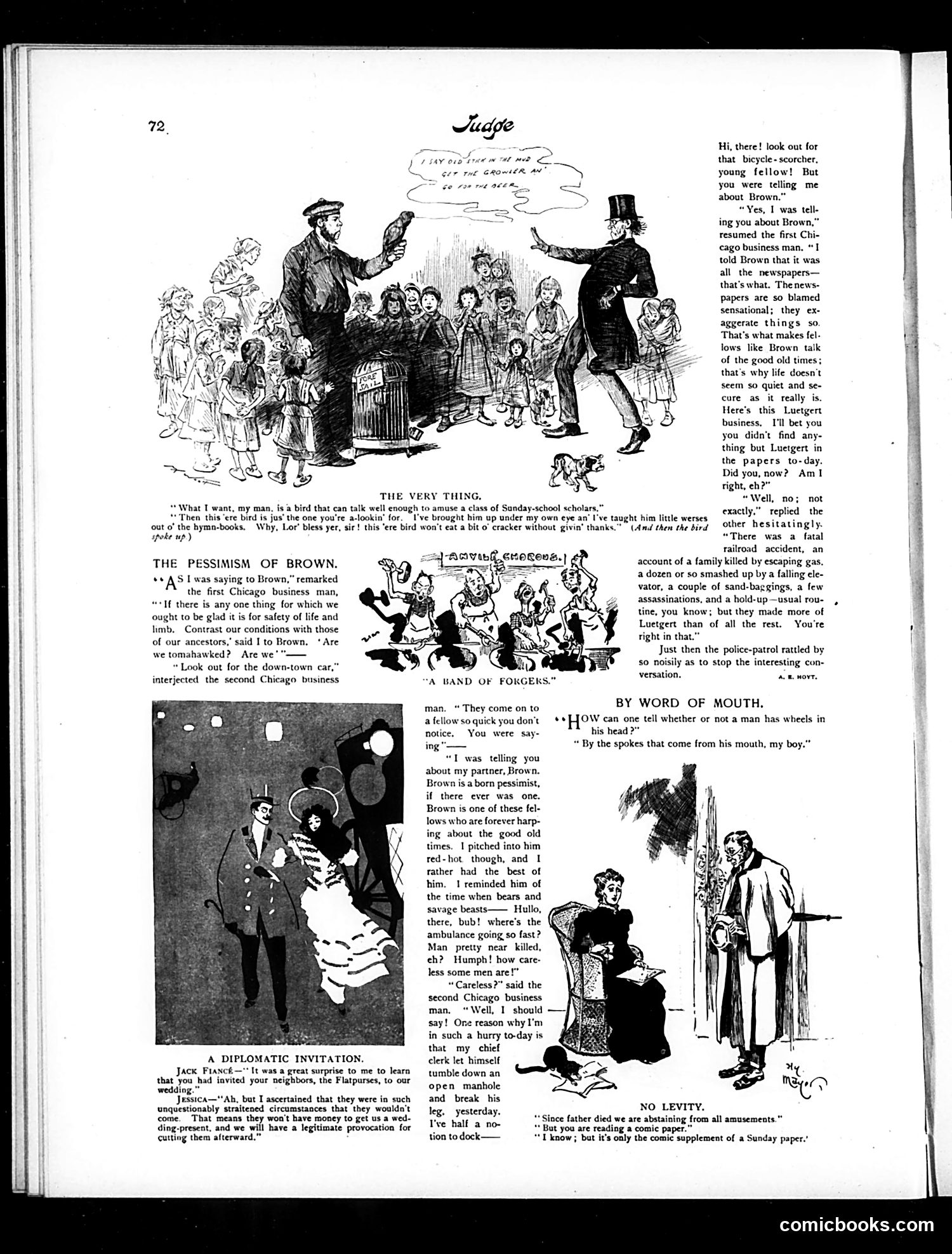
This page satirizes Chicago businessmen's obsessive pessimism and obliviousness to urban dangers. The main cartoon, "The Pessimism of Brown," depicts two Chicago businessmen attempting conversation while constantly interrupted by nearby disasters—a streetcar, a falling person, an ambulance, a manhole injury. The joke: One businessman argues that modern life is safer than the past, citing absence of tomahawks, while Brown contradicts him by dwelling on "the good old times." The irony is heavy-handed—they're interrupted repeatedly by genuine contemporary perils (accidents, injuries, crime), yet the businessman blames newspapers for sensationalism rather than acknowledging actual danger. The reference to "Luetgert" likely alludes to a prominent Chicago murder case. The cartoonist's point: these businessmen are so absorbed in pessimistic philosophizing they miss the very real hazards surrounding them, and they blame media exaggeration rather than accepting urban reality.
📄 Transcribed text from this page (OCR, searchable)
Machine-transcribed from the original scan — historical spelling and the odd misread are preserved.
‘Then this ‘ere bird is jus’ the one you're a-lookin’ for. spoke up) THE PESSIMISM OF BROWN. . *A5 I was saying to Brown,” remarked | the first Chicago business man, | “If there is any one thing for which we ' ought to be glad it is for safety of life and limb. Contrast our conditions with those of our ancestors,’ said I to Brown, ‘Are we tomahawked? Are we’ "—— “Look out for the down-town car,” interjected the second Chicago business A DIPLOMATIC INVITATION. * It was a great surprise to me to learn xd your neighbors, the Flatpurses, to our Jessica—"‘Ah, but I ascertained that they were in such unquestionably straitened circumstances that they wouldn't come. That means they won't have money to get us a wed- ding-present, and we will have a legitimate provocation for cutting them afterward,” udge fo ron ie EES | THE VERY THING, “What T want, my man, is a bird that can talk well enough to amuse a class of Sunday-school scholars.” I've brought him up under my own eye an’ I've taught him little werses out o' the hymn-books. Why, Lor’ bless yer, sir! this ‘ere bird won't eat a bit o' cracker without givin’ thanks.” “A BAND OF FOKGE! man. “ They come on to a fellow so quick you don’t notice. You were say- ing "—— “Twas telling you about my partner, Brown. Brown isa born pessimist, if there ever was one. Brown is one of these fel- lows who are forever harp- ing about the good old times. 1 pitched into him red-hot though, and 1 rather had the best of him. 1 reminded him of the time when bears and savage beasts— Hullo, there, bub! where's the ambulance going so fast ? Man pretty near killed, ch? Humph! how care- ess some men are!” “Careless?” said the second Chicago business man, “Well, I should say! One reason why I'm in such a hurry to-day is that my chief clerk let himself tumble down an open manhole and break his leg, yesterday. I've half a no- tion to dock— J 1 SAY OLD Trae mE Me ger rut GROmIER AYN * Since father died we are abs But you are reading a comic paper.” “I know ; bat it's only the comic supplement of a Sunday paper.’ Hi, there! look out for that bicycle- scorcher, young fellow! But you were telling me about Brown.” “Yes, I was telle ing you about Brown, resumed the first Ch cago business man. told Brown that it was all the newspapers— that's what, The news- Papers are so blamed sensational; they ex- aggerate things so. That's what makes fel- lows like Brown talk of the good old times; that's why life doesn’t seem so quiet and se- cure as it really is. Here's this Luetgert Tl bet you you didn’t find any- thing but Luetgert in the papers to-day. Did you, now? Am right, eh?” “Well, no; not exactly,” replied the (And then the bird Other hesitatingly. “There was a fatal railroad accident, an account of a family killed by escaping gas, a dozen or so smashed up by a falling ele- vator, a couple of sand-baggings, a few assassinations, and a hold-up —usual rou- tine, you know; but they made more of Luetgert than of all the rest. You're right in that.” Just then the police-patrol rattled by ly as to stop the interesting con- BY WORD OF MOUTH. . “HOW can one tell whether or not a man has wheels in his head?” “ By the spokes that come from his mouth, my boy.”* NO LEVITY. ing from all amusements." Seer Stee comicbooks.com