
A complete issue · 18 pages · 1898
Judge — January 1, 1898
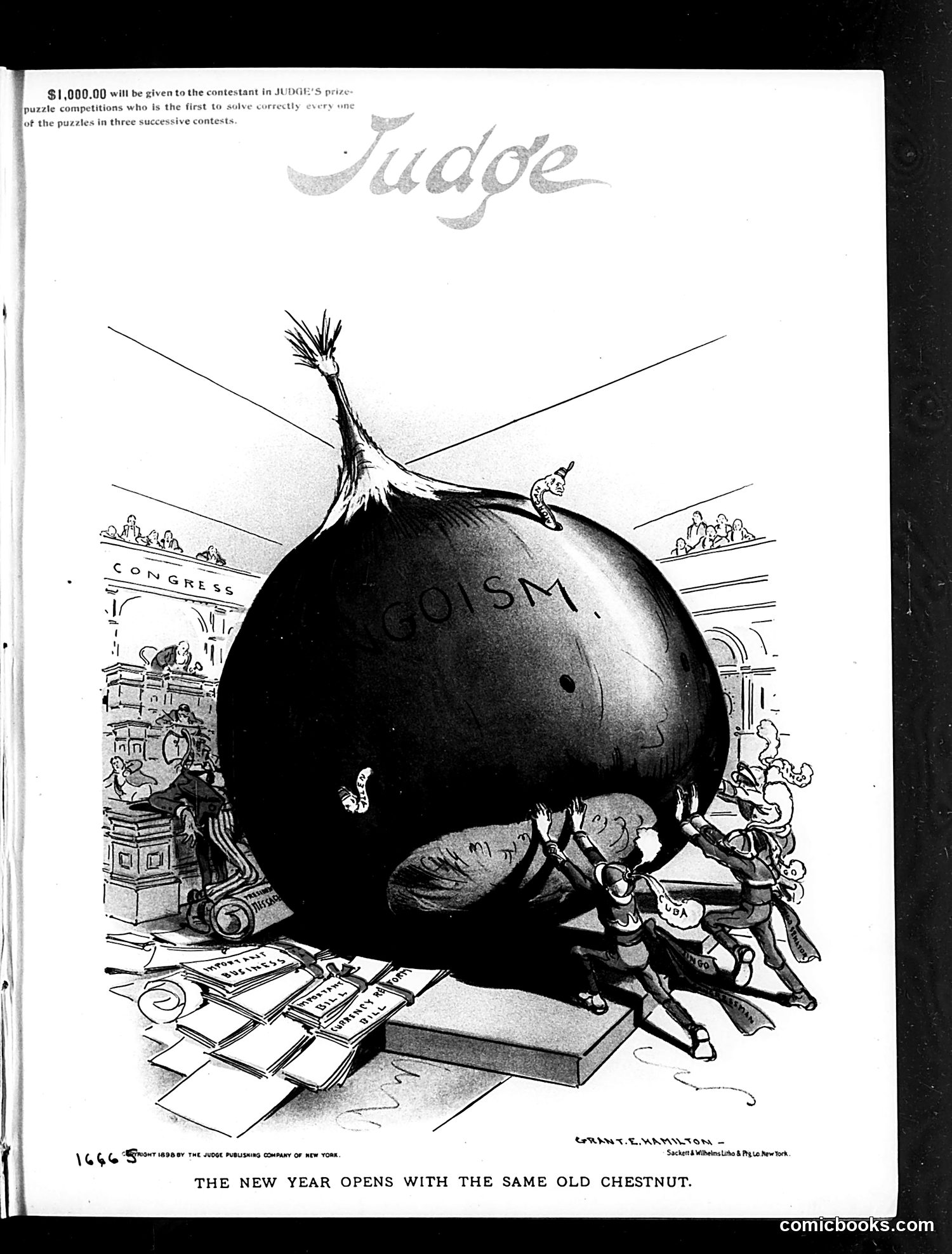
This Judge magazine cartoon satirizes **government gridlock and corruption**. The massive bomb labeled "GRAFT" dominates the composition, with "Congress" visible in the Capitol building behind it. The fuse is lit (radiating lines suggest imminent explosion), while small figures representing politicians or special interests frantically attempt to defuse or control the situation. The caption—"THE NEW YEAR OPENS WITH THE SAME OLD CHESTNUT"—suggests this corruption scandal is cyclical and recurring, not newly exposed. The cartoon critiques Congress's inability or unwillingness to address systemic graft despite repeated public awareness. The imagery presents corruption as an explosive threat to the government itself, with elected officials helpless to prevent disaster.
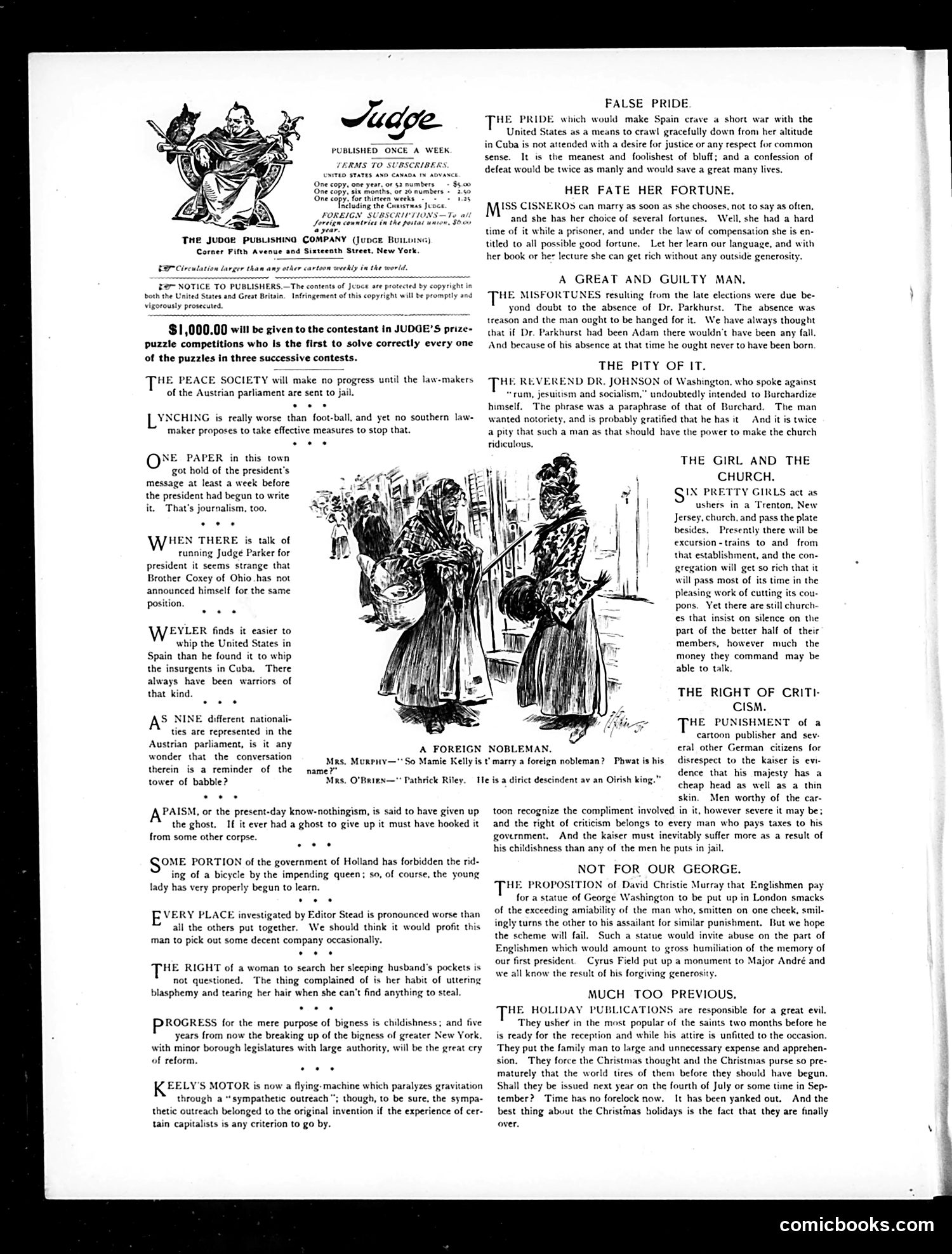
The central cartoon depicts two women discussing a prospective suitor. One asks if "Mamie Kelly" will marry "a foreign nobleman," while the other responds it's "Patrick Riley" — "a strict descendant as an Irish king." The satire mocks the American upper class's fascination with European nobility. The joke hinges on the contrast between genuine European aristocracy and an Irish-American man claiming noble descent, suggesting that wealthy Americans' desire to marry their daughters to foreign titles was so indiscriminate they'd accept dubious claims of nobility from Irish immigrants. This reflects Gilded Age anxieties about social climbing and the perceived foolishness of Americans seeking European validation through aristocratic marriages.
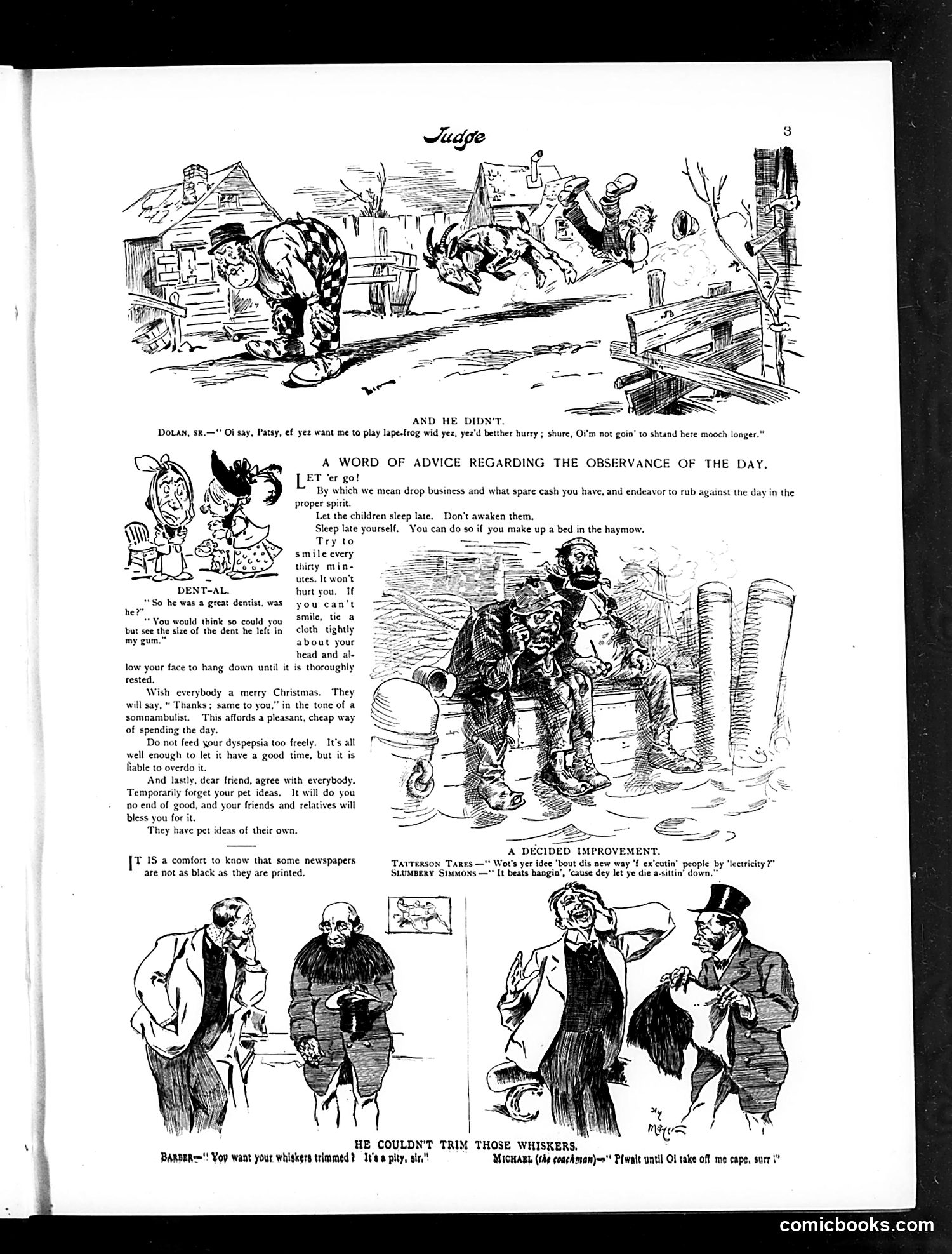
This page contains multiple satirical sketches about Christmas Day observance and urban life. The top cartoon "And He Didn't" depicts a rural scene where a character refuses to engage in holiday festivities, defying pressure to participate in seasonal activities. The middle section, "A Word of Advice Regarding the Observation of the Day," offers tongue-in-cheek guidance about Christmas relaxation—letting children sleep late, avoiding work, and enjoying modest comforts. The lower cartoons target urban professionals: "He Couldn't Trim Those Whiskers" shows a barber criticizing a customer's facial hair, while "A Decided Improvement" depicts taxi and omnibus drivers boasting about their services. These sketches mock working-class vanity and competitiveness. The overall page satirizes class differences and holiday attitudes across American society—rural resistance, middle-class advice-giving, and urban working-class pride.
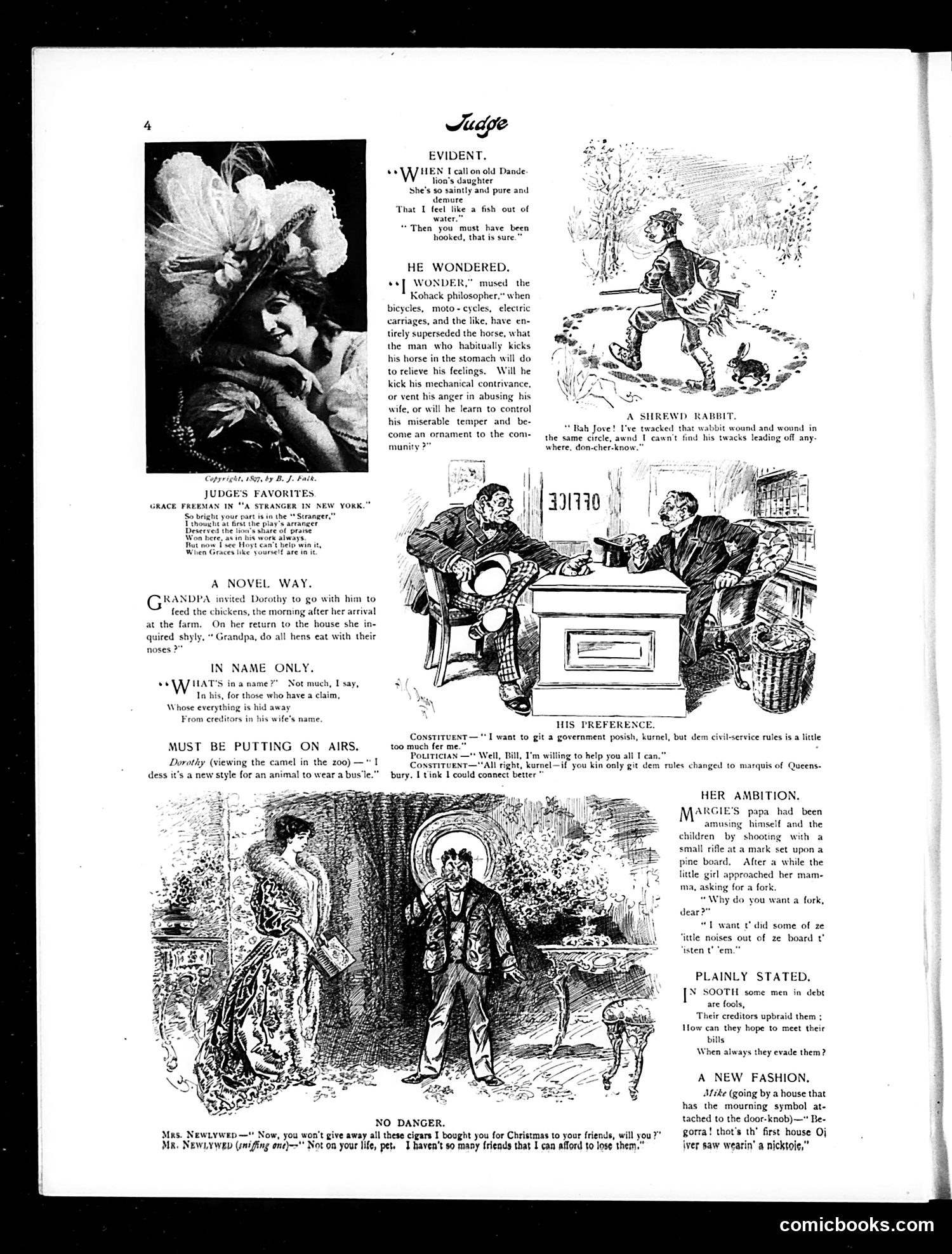
This page contains several satirical vignettes typical of Judge's humor. "Evident" mocks a man who feels like "a fish out of water" after being kicked by his horse—the joke being his absurd comparison. "He Wondered" philosophizes about whether mechanical objects absorb their owners' temperaments. "A Novel Way" and subsequent sections present domestic humor: a grandfather feeding chickens, wordplay about names, and observations about social pretension. "Her Ambition" depicts a girl wanting "little noises" from a rifle at a shooting range—satire on women's changing social roles and aspirations. "No Danger" shows dialogue about giving away organ pipes as Christmas gifts, with humor about friendship obligations. The final section, "A New Fashion," references a door wreath symbol (unclear reference without additional context). These represent typical turn-of-century American satirical commentary on domestic life, social aspirations, and gender roles.
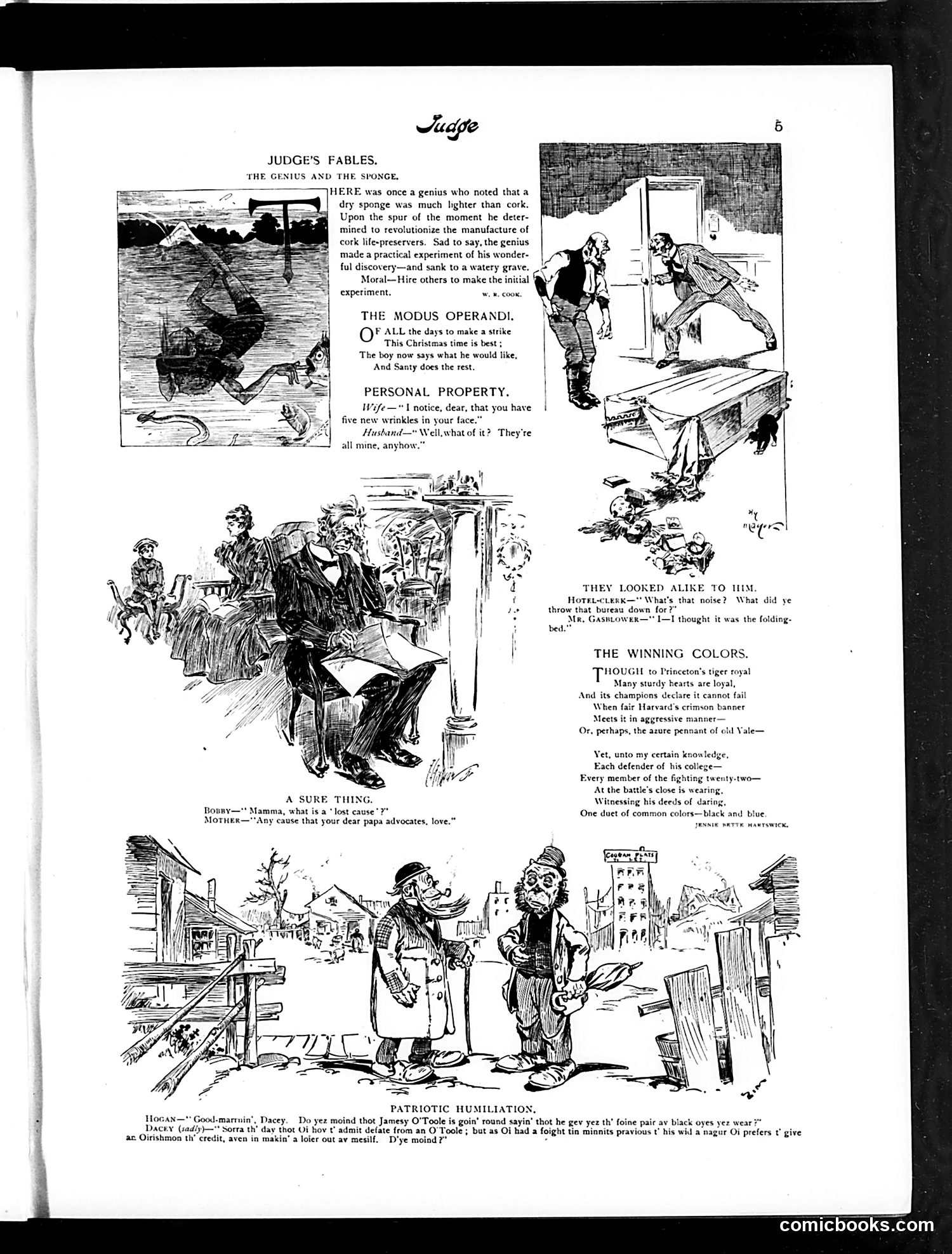
This page contains several short satirical pieces typical of Judge magazine's humor: **"The Genius and the Sponge"** mocks impractical inventors who don't test their own theories—a common target of late 19th-century satire about industrial innovation. **"The Modus Operandi"** jokes about Christmas commercialism and children's demands during the holiday season. **"Personal Property"** is a domestic humor quip about a husband claiming ownership of his wrinkles. **"They Looked Alike to Him"** features an Irishman confusing a bureau with a folding bed—ethnic humor typical of the era. **"The Winning Colors"** celebrates college sports rivalry between Princeton, Harvard, and Yale, ending with the joke that all athletes end up "black and blue" (bruised). **"A Sure Thing"** is a brief joke about wives dismissing their husbands' causes. **"Patriotic Humiliation"** uses Irish dialect humor, with one Irishman embarrassed that another gave him a black eye, preferring to credit a fight with a "nagur" (contemporary racial slur) instead—offensive by modern standards but reflecting period prejudices.
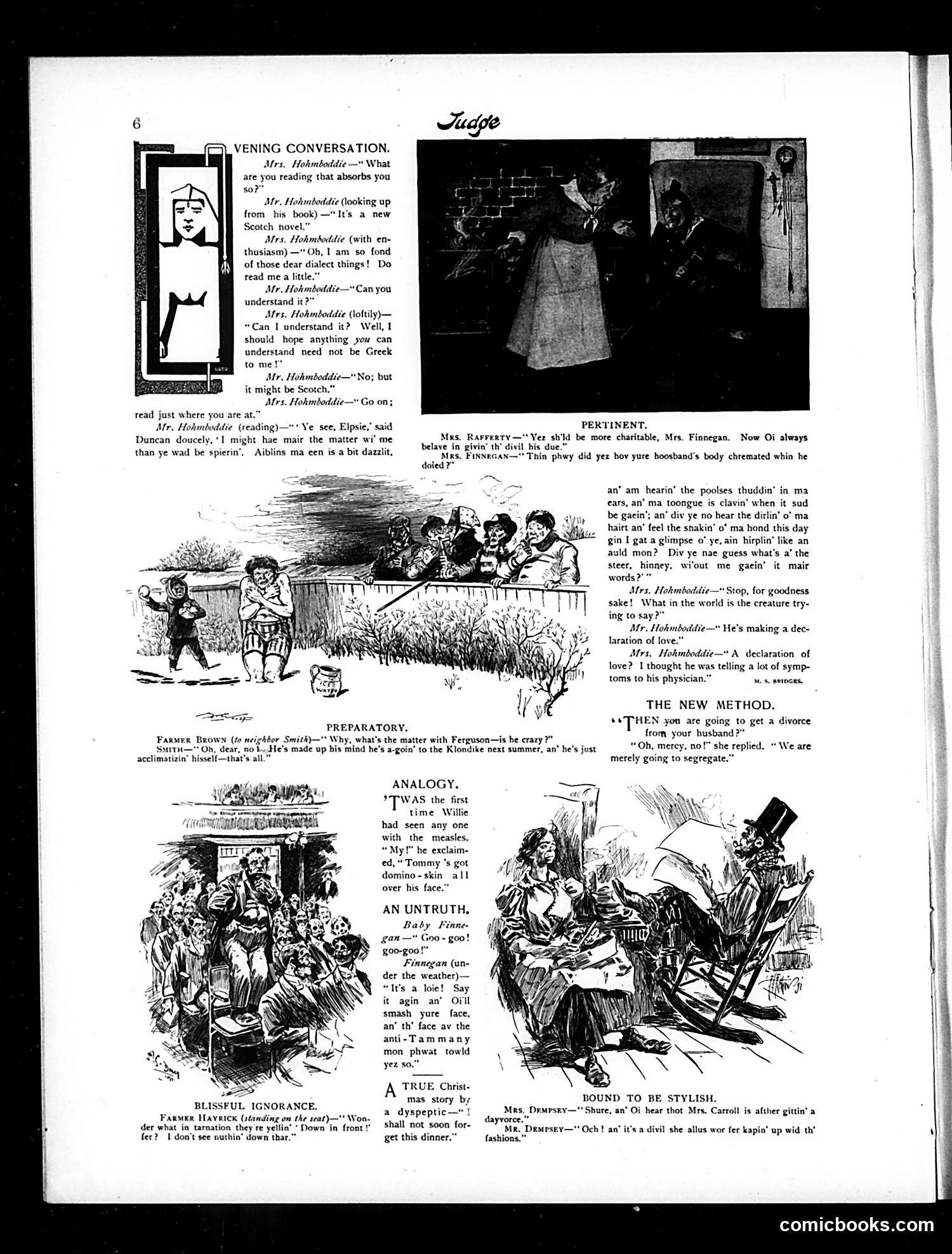
This page contains several short humorous sketches satirizing domestic life and social conventions of the era. **"Evening Conversation"** mocks the pretentiousness of Scottish dialect literature. A husband reads his wife passages from a Scotch novel so incomprehensible she mistakes a love declaration for medical complaints—satirizing both the affectation of reading dialect fiction and women's limited education. **"The New Method"** jokes about "segregation" as a new divorce euphemism, poking fun at the era's reluctance to use direct language about marital dissolution. The remaining sketches target Irish-American immigrant characters (identifiable by names like Finnegan, Hayrick, and dialect spellings). **"An Untruth"** depicts Irish working-class violence; **"Pertinent"** shows Irish women gossiping about cremation and marital infidelity; **"Bound to Be Stylish"** ridicules Irish women slavishly chasing fashion trends through divorce. The overall page reflects Judge's typical satirical targets: pretentious bourgeois culture, and stereotyped immigrant communities portrayed as coarse, violent, or foolishly status-conscious.
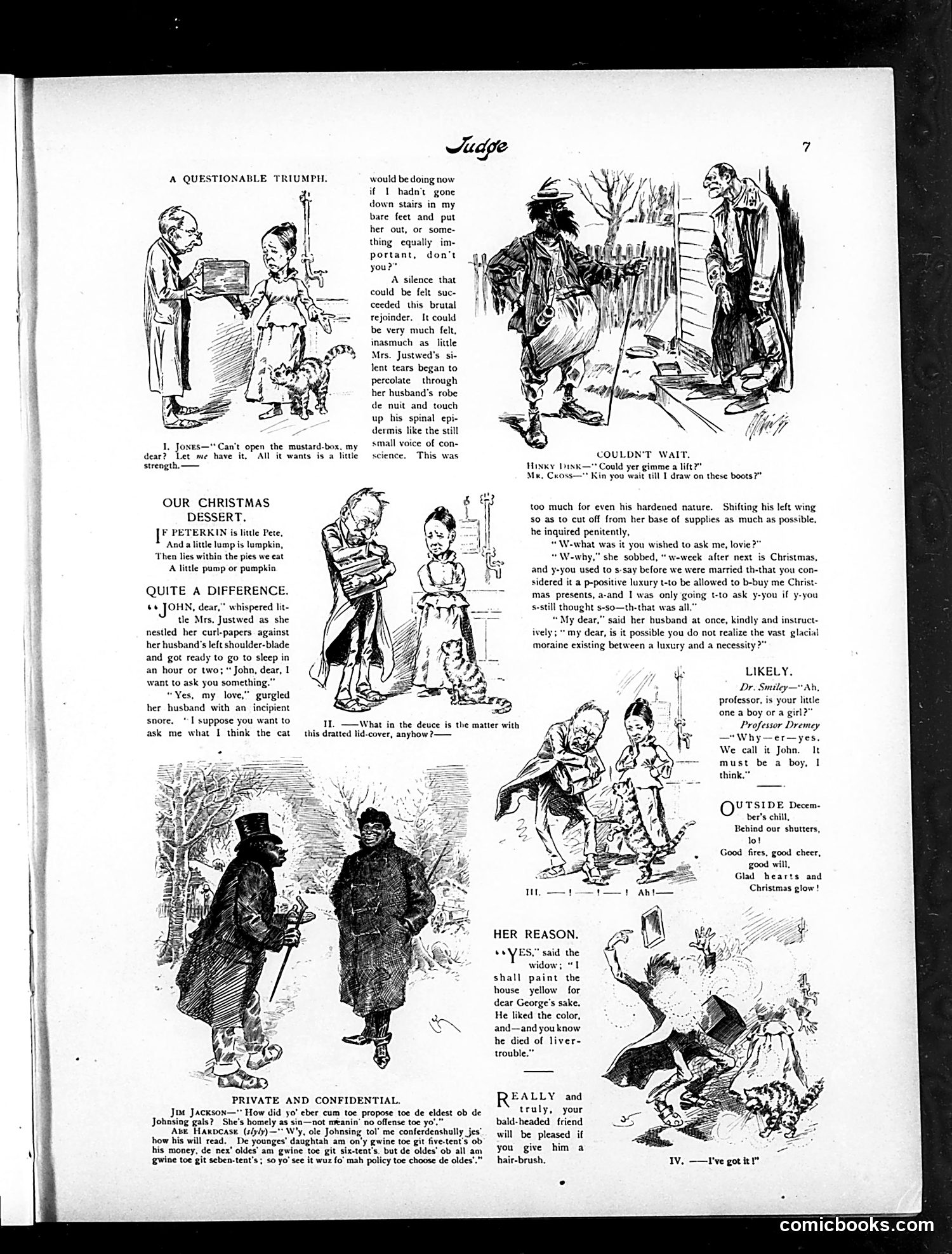
This page contains multiple brief satirical sketches mocking Victorian marriage dynamics and social pretensions: **"A Questionable Triumph"** depicts a newlywed husband boasting he "put her out" downstairs—a crude assertion of dominance that backfires when his wife's silent tears trigger guilt. **"Quite a Difference"** shows the same couple negotiating Christmas gifts. The husband pedantically argues that luxury gifts are morally indistinguishable from necessities, denying her request—satire on husbandly stinginess disguised as philosophy. **"Private and Confidential"** (bottom) features racist dialect humor common to the era: two Black men discuss marrying daughters based on inheritance amounts, with the punchline being mercenary calculation. The remaining items are brief jokes: puns about dessert ingredients, confusion over a child's gender, and a gift suggestion. The satire targets newlywed husbands as selfish and emotionally tone-deaf, and relies on period-typical racial caricature for "humor."
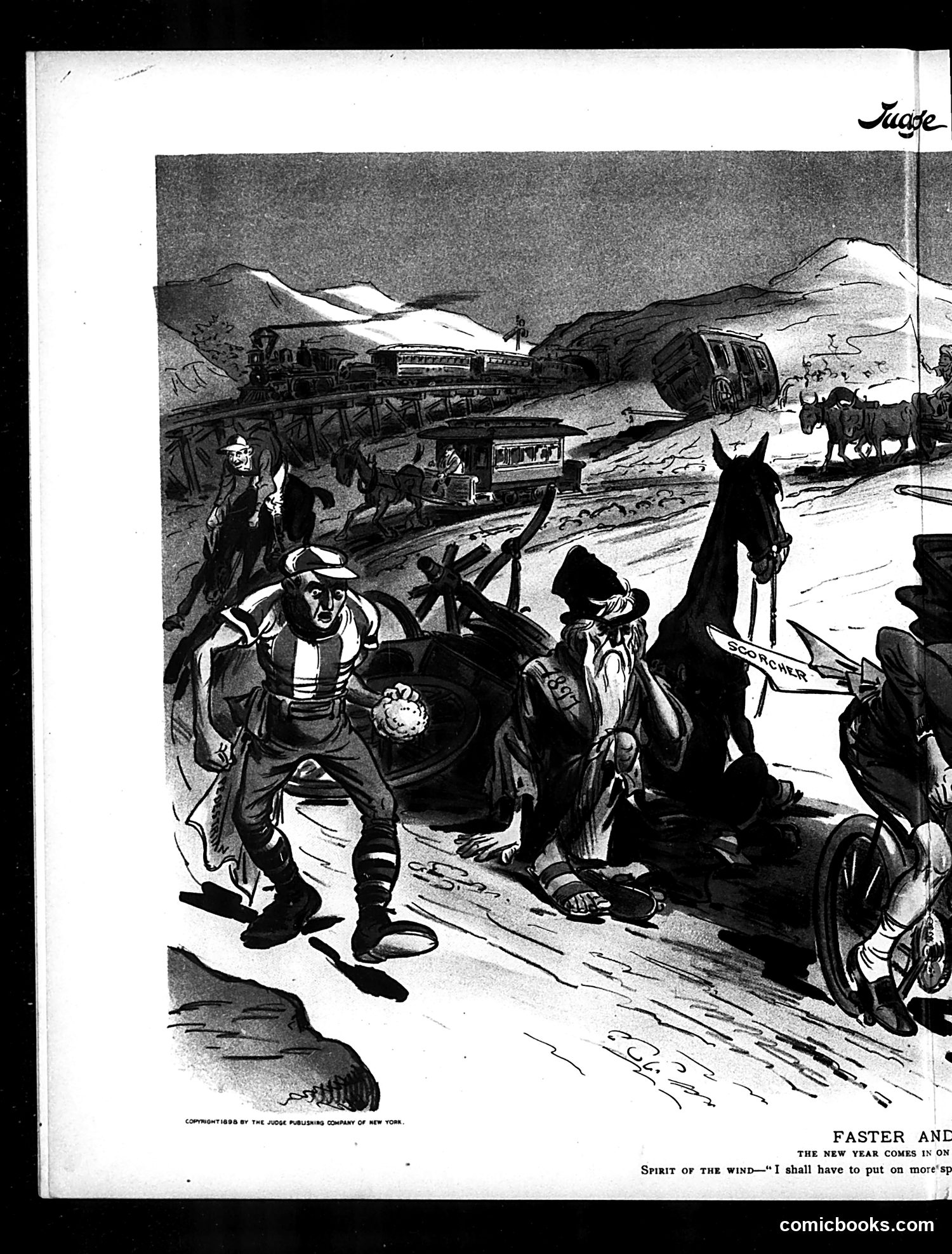
This Judge magazine cartoon depicts a chaotic Western frontier scene with figures on horseback and a steam train in the background. The caption "Faster and The New Year Comes In On" with the partial quote "Spirit of the Wind—'I shall have to put on more speed'" suggests commentary on accelerating progress or competition. The cartoon appears to satirize the rapid modernization of America, contrasting Old West imagery (horses, wagons, frontier characters) with new industrial technology (the locomotive). The juxtaposition likely critiques the pace of change as the new year approaches, or possibly addresses competition between transportation methods or economic systems during America's industrial expansion. Without seeing the full caption or knowing the specific publication date, the exact political target remains unclear, but the theme emphasizes speed, progress, and cultural transformation.
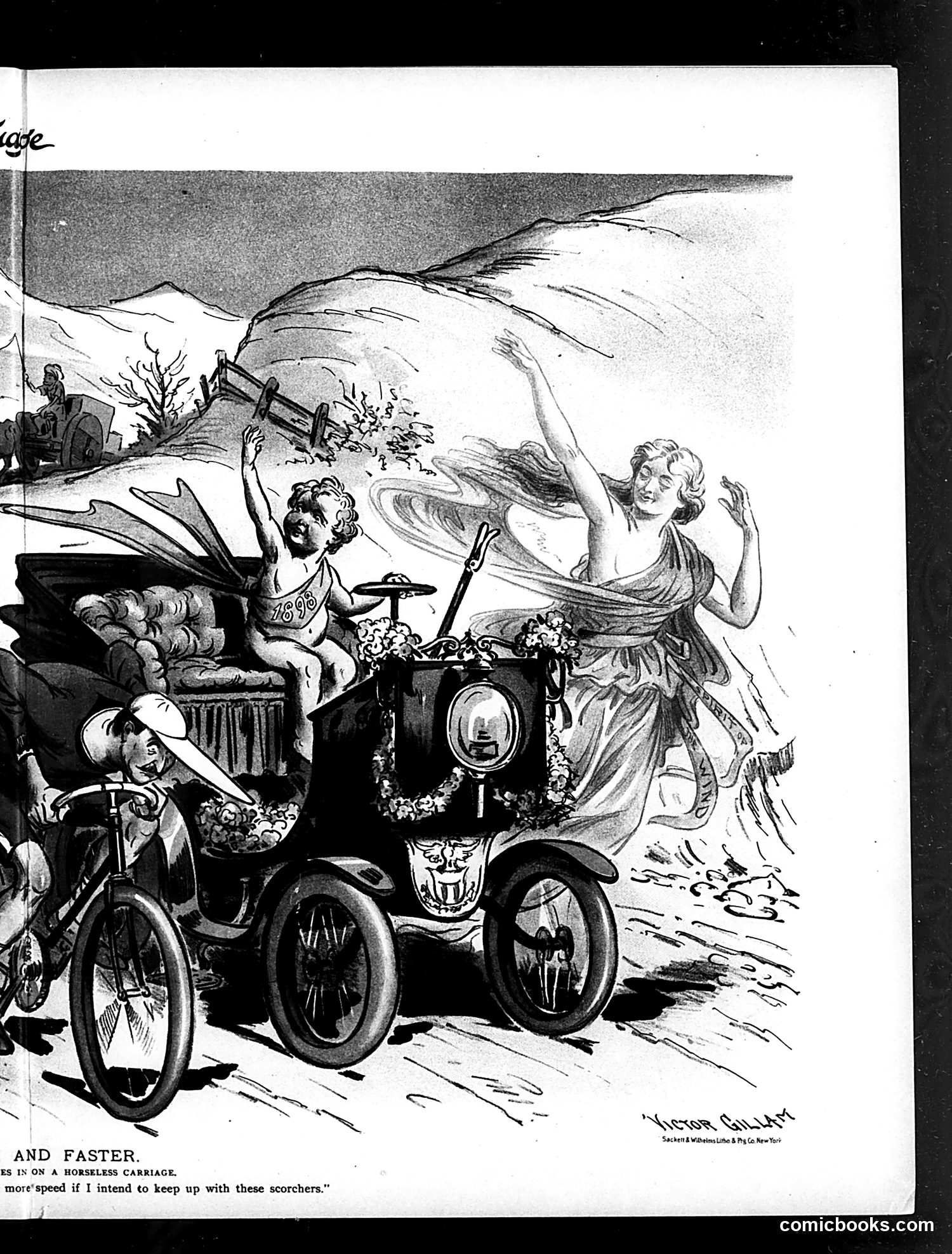
This Judge magazine cartoon satirizes the early automobile era's "speed craze." The image depicts a wealthy woman in classical drapery (representing perhaps Progress or Fashion) driving a motorcar at dangerous speeds, while a man on a bicycle struggles to keep pace behind her. The caption's reference to "scorchers"—slang for reckless speeders—mocks both the new technology's dangers and society's embrace of dangerous speeds for status. The classical allegorical female figure suggests how automobiles were marketed as modern, progressive symbols. The joke targets wealthy early adopters who drove recklessly through city streets, endangering pedestrians and cyclists. The cartoon critiques not just the vehicles themselves, but the social obsession with speed and the class divide it represented—only the wealthy could afford these "horseless carriages."
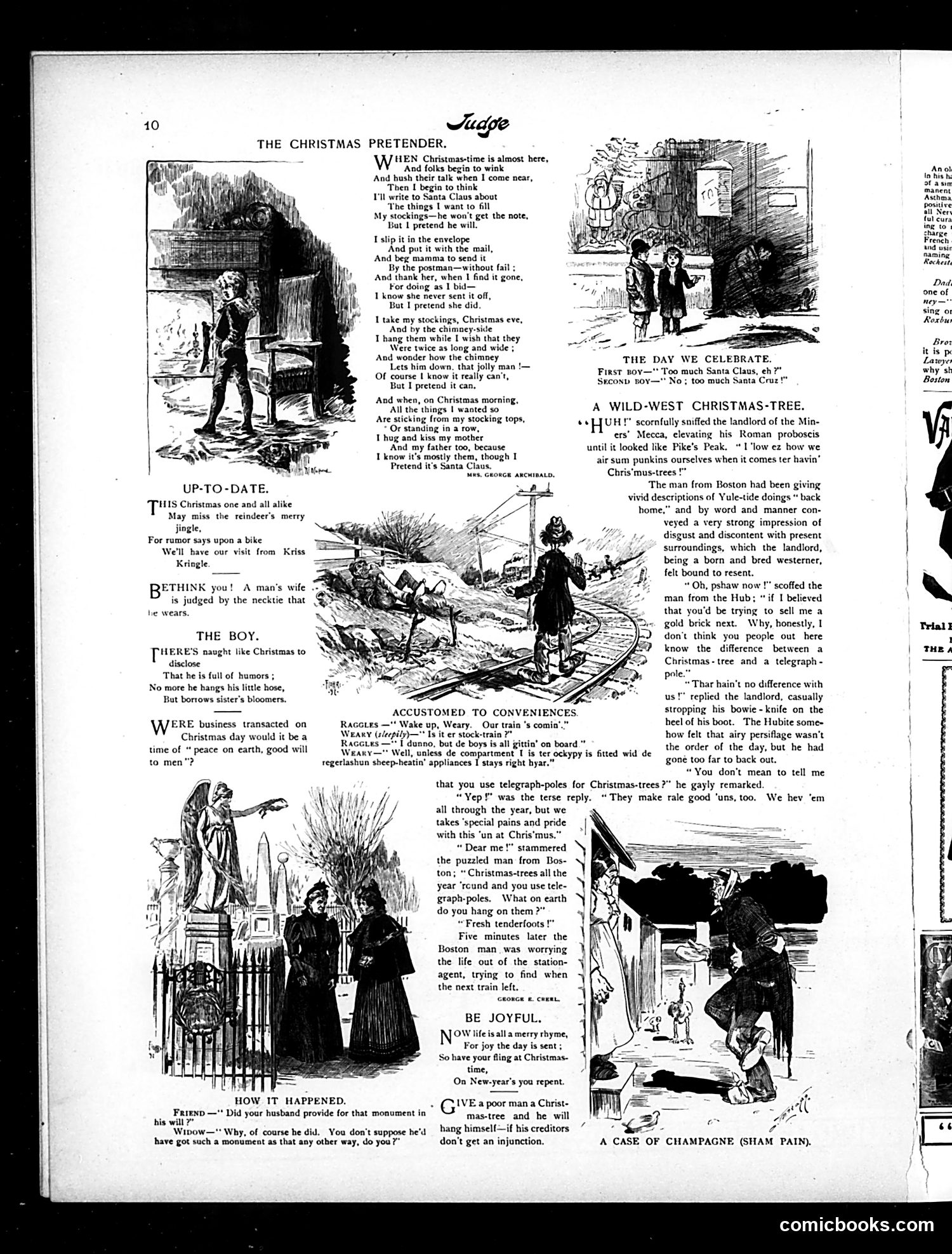
This Judge magazine page contains several Christmas-themed satirical pieces poking fun at American life circa early 1900s. **"The Christmas Pretender"** mocks children who pretend to believe in Santa Claus while knowing better—the child writes letters to Santa, hangs stockings, and maintains the fiction despite understanding parents actually provide gifts. **"Up-to-Date"** jokes that Santa will soon deliver presents by bicycle instead of reindeer, reflecting anxieties about technology replacing tradition. **"A Wild-West Christmas-Tree"** satirizes cultural tension between Eastern sophistication and Western frontier crudeness. A Boston visitor boasts about elaborate Christmas traditions; a Western saloon landlord responds that their "Christmas-trees" are telegraph poles, and when pressed, casually remarks they "hang fresh tenderfoots" on them—a dark joke about lynching that reflects period anxieties about lawlessness in the American West. The remaining items are brief humorous observations about Christmas customs and social pretense.
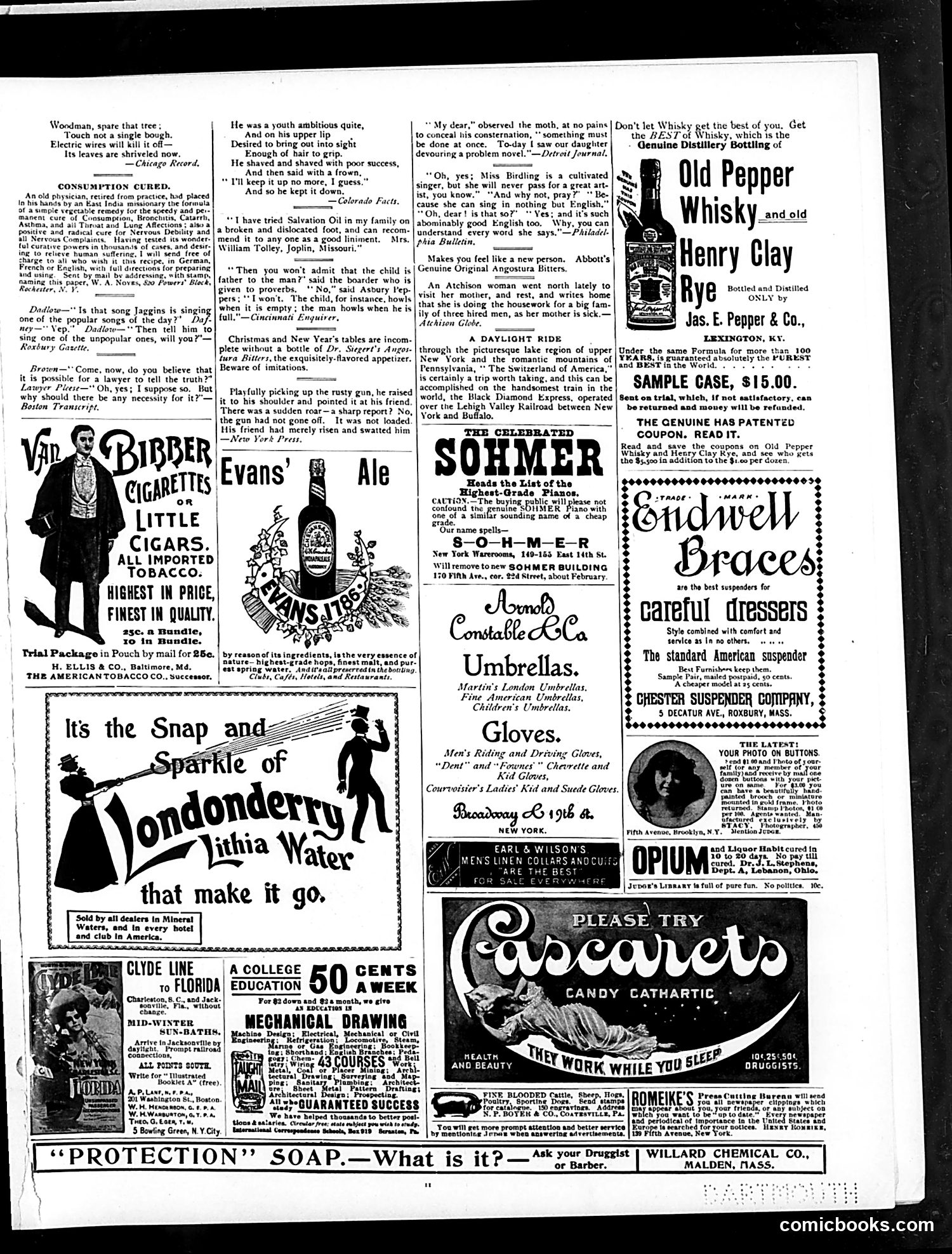
This page from *Judge* is primarily **advertisements and filler humor**, not political satire. The content includes: **Humorous Verses**: Brief comedic pieces about everyday topics—a man failing to grow a mustache, a child who cries when hungry but howls when full, a lawyer admitting truth has no practical necessity. These are gentle domestic humor, not political commentary. **Notable Cartoon**: A small illustrated joke about a man playfully pointing an unloaded rusty gun at a friend, who responds by swatting him. This appears to be slapstick humor about foolish behavior rather than satire. **Advertisements**: The page is dominated by product ads for whisky, soap, Sohmer pianos, corsets, candy, and educational programs—typical of *Judge*'s revenue model. **No Clear Political Content**: Unlike typical *Judge* satirical cartoons targeting politicians or social issues, this page contains no identifiable political figures or pointed social criticism. It's largely commercial and light entertainment filler.
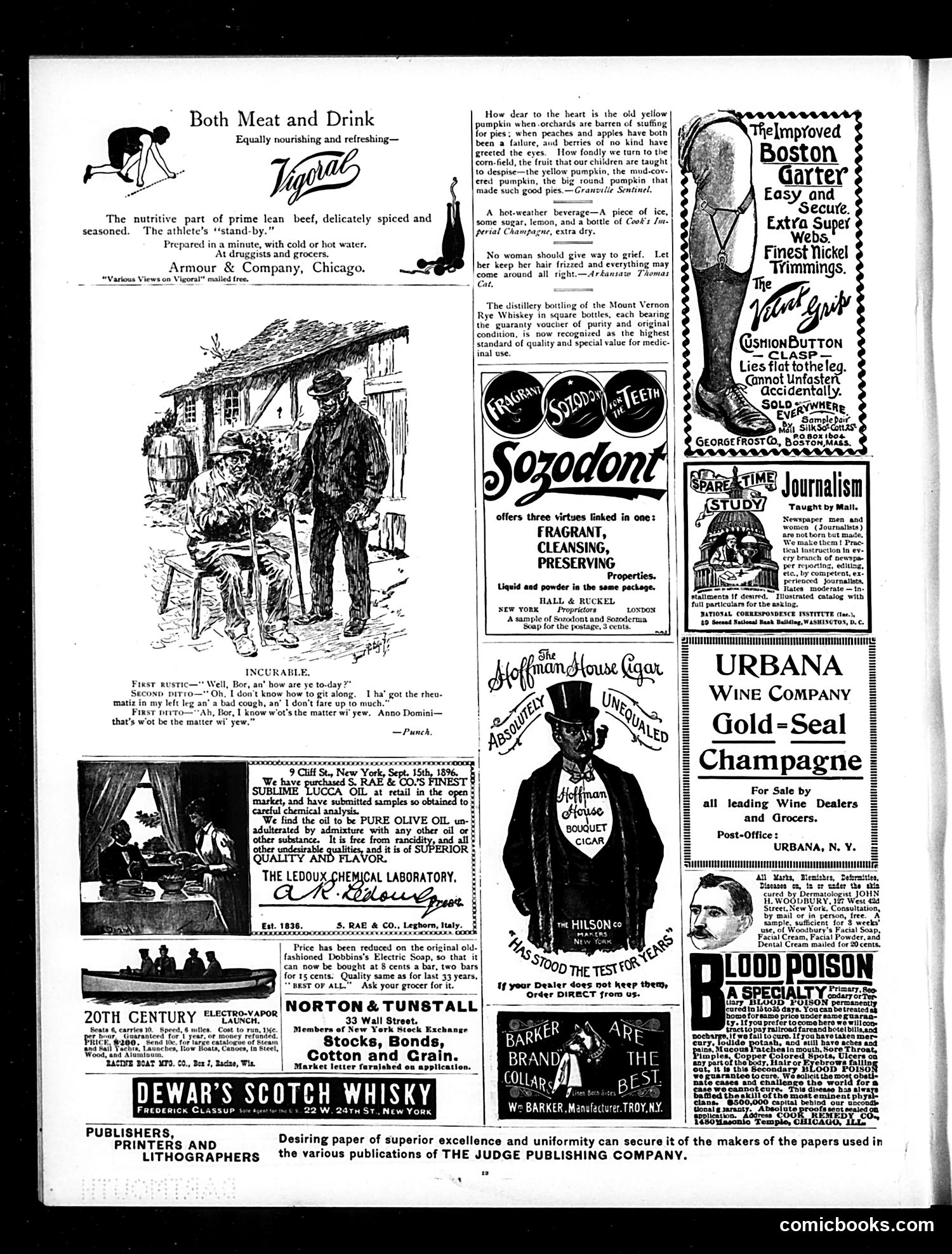
This page is primarily **advertising**, typical of Judge's revenue model. Most content consists of product advertisements for patent medicines, alcohol, food products, and services popular in the early 1900s. The one cartoon appears in the upper left: a dialogue between two working-class men discussing ailments of old age ("Anno Domini"—literally "in the year of the Lord," a humorous personification of aging itself as the culprit). One man lists rheumatism, a bad cough, and general decline; the other diagnoses their shared enemy as simply getting old. The humor is gentle—acknowledging that advancing age causes accumulating health complaints that no single remedy can fix. The ads reflect period concerns: products for rheumatism, hair care, dental health, and multiple "blood poison" treatments (likely syphilis remedies, a common advertised concern). Notably, many ads make exaggerated medical claims now considered fraudulent. The page reflects Judge's audience: relatively affluent readers who could afford patent medicines and investments in stocks and bonds.
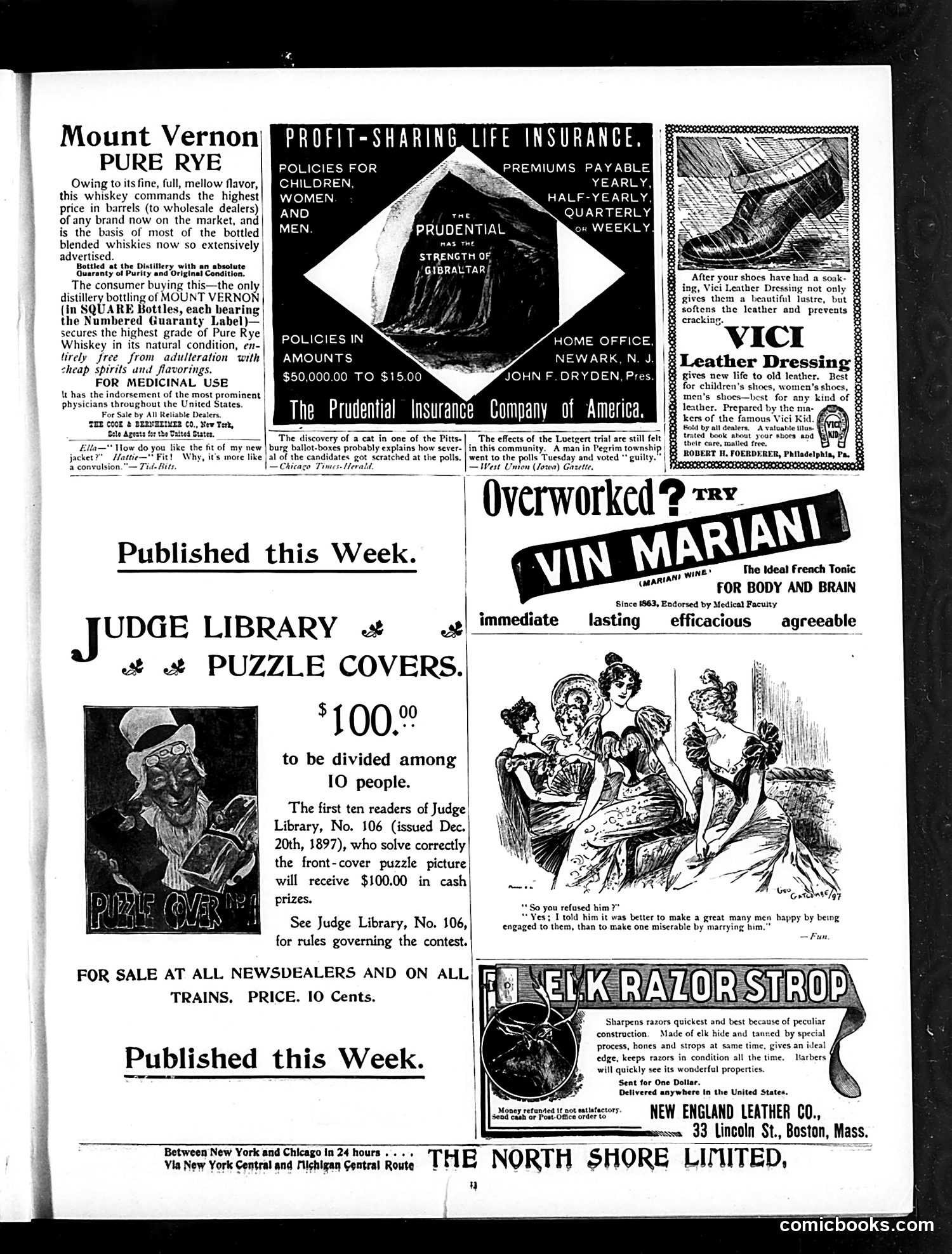
This is primarily an **advertising page** from Judge magazine (circa 1897), not a satirical cartoon page. The page contains multiple product advertisements rather than political or social satire. The notable content includes: **Mount Vernon Whiskey** advertisement emphasizing its purity and medicinal use—reflecting the era when alcohol was marketed for health purposes. **The Prudential Insurance Company** advertisement offering life insurance policies for various demographics. **Vici Leather Dressing** shoe product advertisement. **Judge Library Puzzle Cover Contest** offering $100 divided among 10 winners—a circulation-building promotional device. **Vin Mariani** tonic advertised as beneficial "for body and brain," endorsed by medical faculty since 1863—likely a cocaine-containing patent medicine, common in this period. **Elk Razor Strop** and **North Shore Limited** rail service advertisements complete the page. The page demonstrates how late-19th-century magazines funded themselves through advertising, including now-questionable products marketed with medical claims.
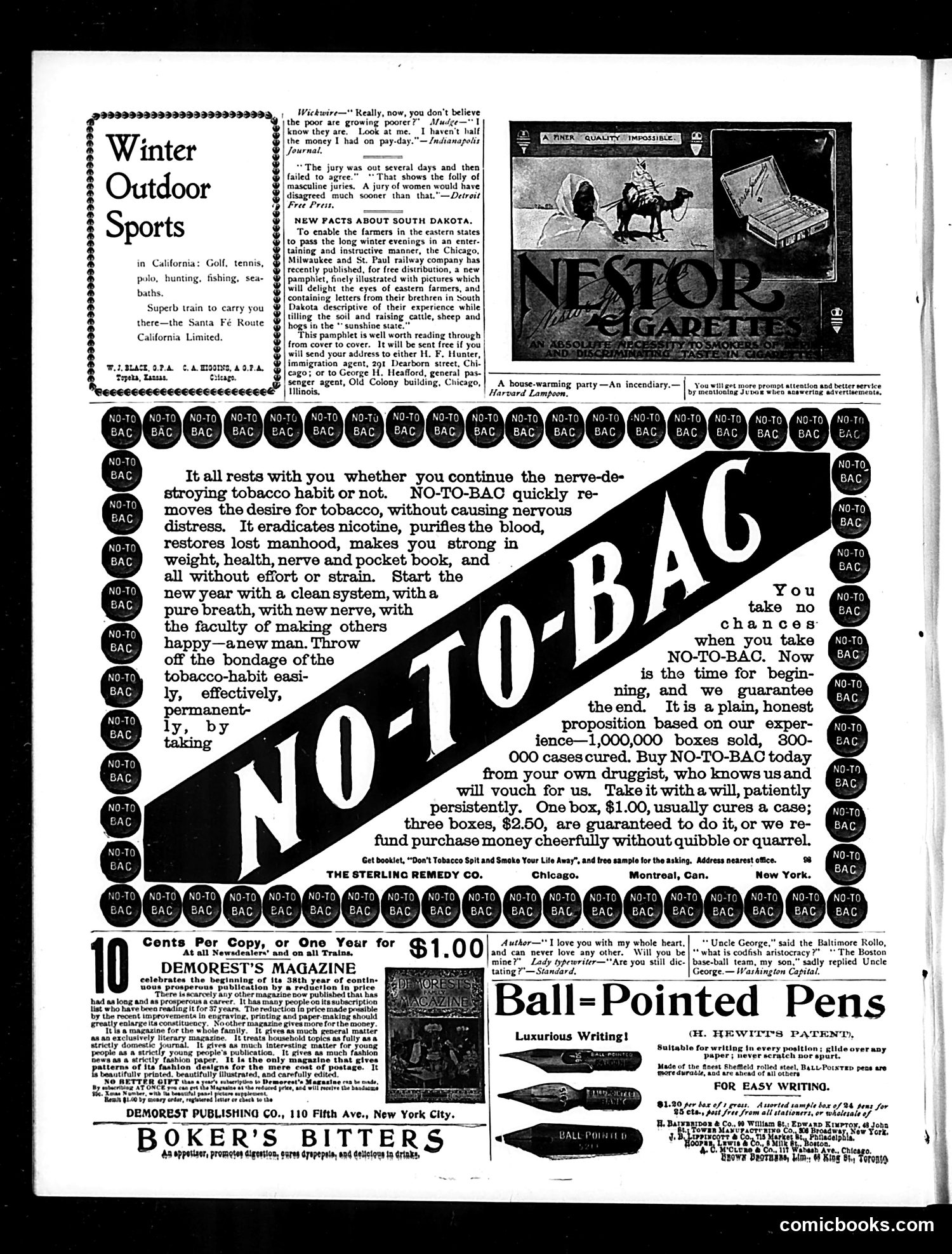
This page is primarily **advertising and filler content** rather than political satire. It contains: **Winter Sports Advertisement** (top left): Promotes California travel via the Santa Fe Railway, emphasizing golf, tennis, and outdoor activities as winter recreation. **Two brief humor snippets** (top center): One jokes about poverty wages; another makes a sexist jab at women jurors, claiming they'd "disagree much sooner." **South Dakota promotional content**: Railroad company information encouraging eastern farmers to learn about settling in South Dakota. **Large NO-TO-BAC advertisement** (center): A tobacco cessation product claiming to eliminate nicotine addiction and restore "lost manhood"—reflecting early 1900s patent medicine marketing. **Ball-Pointed Pens advertisement** (lower right): Promotes a new writing technology. **Demorest's Magazine advertisement** (bottom): General magazine promotion. The page reflects early 20th-century American consumer culture with minimal political commentary. The sexist humor and pseudo-scientific medical claims are notable period artifacts showing contemporary attitudes.
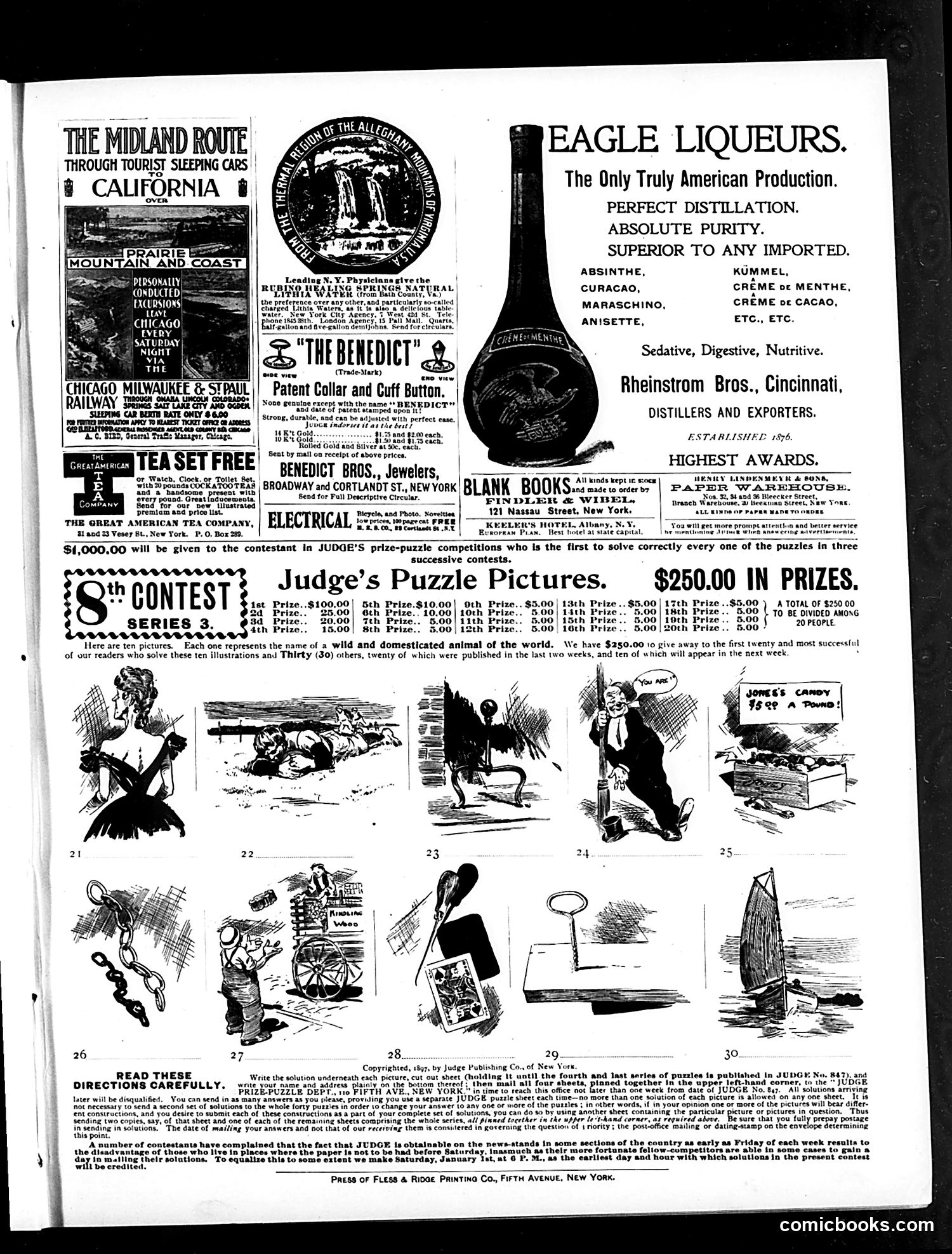
This page is primarily a **puzzle contest advertisement** rather than political satire. The central feature is Judge's "8th Contest Series," offering $250 in prizes to readers who can identify ten animals from cartoon illustrations (numbered 21-30). The surrounding space contains **commercial advertisements** typical of the era: liquor brands (Eagle Liqueurs, Rheinstrom Bros.), railroad travel (Midland Route through California), jewelry, blank books, and patent products (the "Benedict" collar button). **No identifiable political figures or satire appear.** The ten cartoon vignettes shown are visual riddles—each supposedly depicting a wild or domesticated animal—meant to be solved by readers. The contest rules explain that solvers must identify not just these ten, but also thirty additional puzzles published in Judge's previous and upcoming issues. This represents Judge's **commercial strategy**: using contests to drive readership and engagement while selling advertising space. The content reflects early 1900s popular entertainment rather than political commentary.
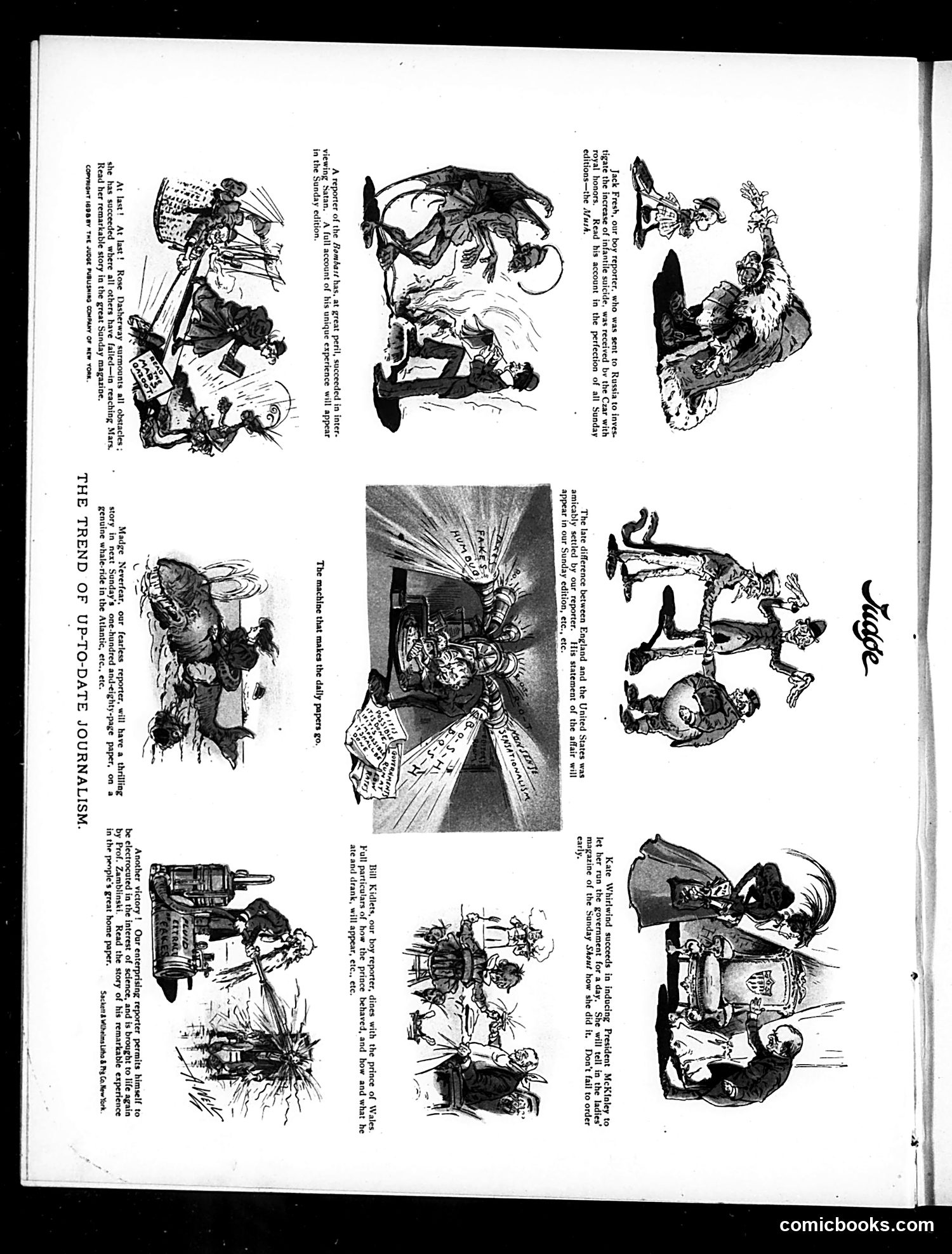
This satirical page mocks the sensationalism of early 20th-century newspaper journalism. Judge presents fictional exploits by reporters ("Jack Fresh," "Rose Dasherway," "Madge Neverfear") performing increasingly absurd stunts: interviewing Satan, getting electrocuted and revived, riding whales, and securing private audiences with royalty and world leaders. The satire targets the competitive race among newspapers to attract readers through outrageous, implausible stories. Each caption exaggerates the reporter's bravery or access, promising exclusive "thrilling" accounts for Sunday editions. The cartoons visually reinforce the chaos and danger these reporters supposedly endured. The page critiques how newspapers prioritized circulation-boosting sensationalism over serious journalism, treating reporters as entertainment performers rather than news gatherers. It reflects contemporary anxieties about media credibility and the ethics of yellow journalism.

I can see this is a mostly blank page from Judge magazine with minimal visible content. The page appears to be largely empty white space with some binding marks on the left edge and what looks like a publication watermark or notation in the bottom right corner ("comicbooks.com"). Without legible text or discernible cartoon imagery, I cannot identify specific figures, political references, or satire content. This may be a blank advertising page, a title page, or a page where the original content has faded significantly in reproduction. To accurately explain the cartoon's meaning and historical context, I would need a page with visible illustrations and readable text.
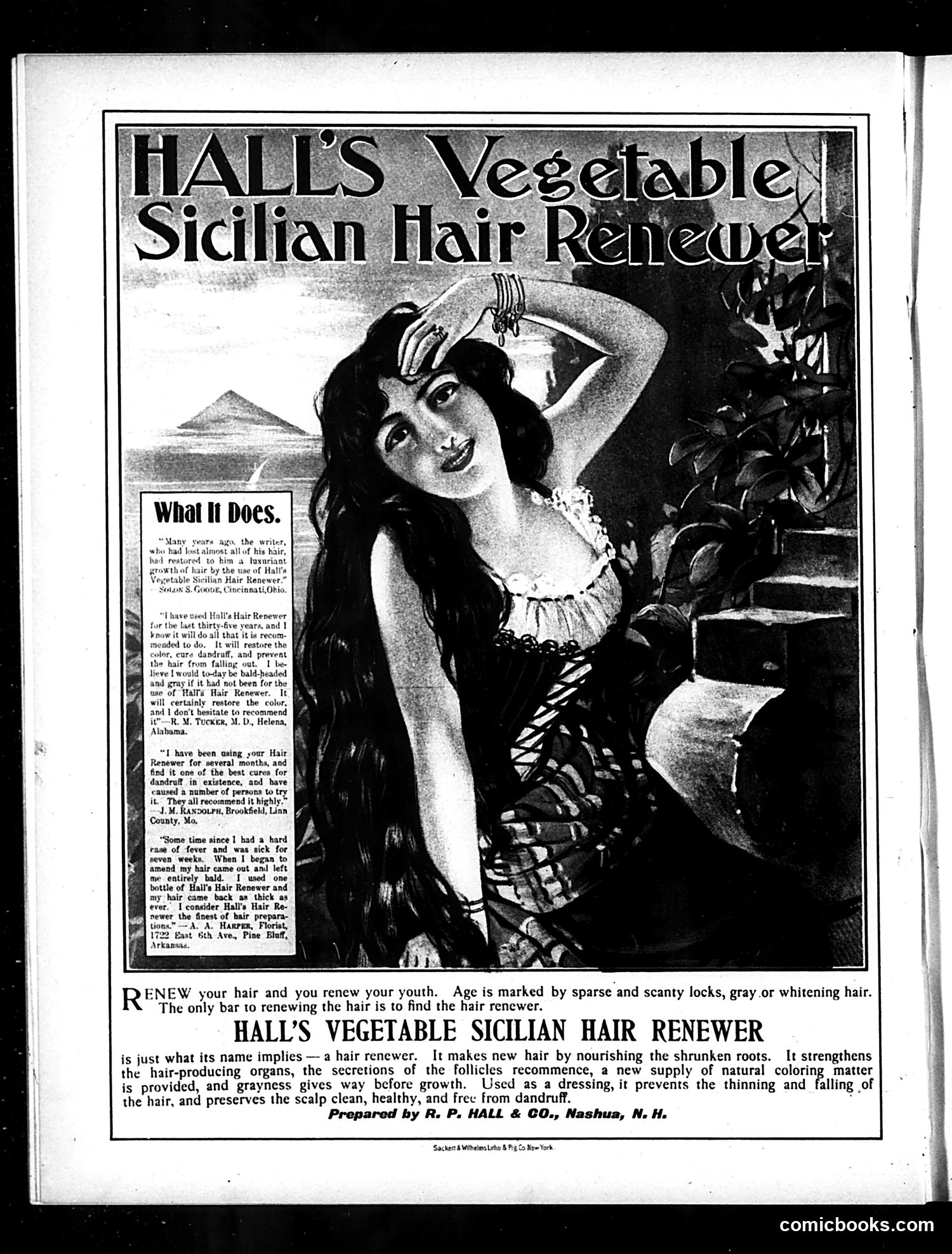
This is **not a cartoon or satire**—it's a full-page advertisement for Hall's Vegetable Sicilian Hair Renewer, a patent medicine from the late 19th or early 20th century. The page features a glamorous woman with luxuriant long dark hair in a classical pose, accompanied by testimonials from satisfied customers (a doctor, a farmer, a florist) claiming the product cured baldness and restored gray hair to its natural color. The advertisement plays on period anxieties about aging and appearance, promising that hair restoration equals "renewing youth." The testimonials lend false credibility through professional credentials. For modern readers: this represents the era of unregulated patent medicines making exaggerated health claims. Such products typically contained ineffective or sometimes harmful ingredients. The imagery and marketing tactics—using attractive models and fabricated endorsements—prefigure modern advertising deception, though today's regulations would prohibit such unfounded claims.