A complete issue · 16 pages · 1897
Judge — December 4, 1897
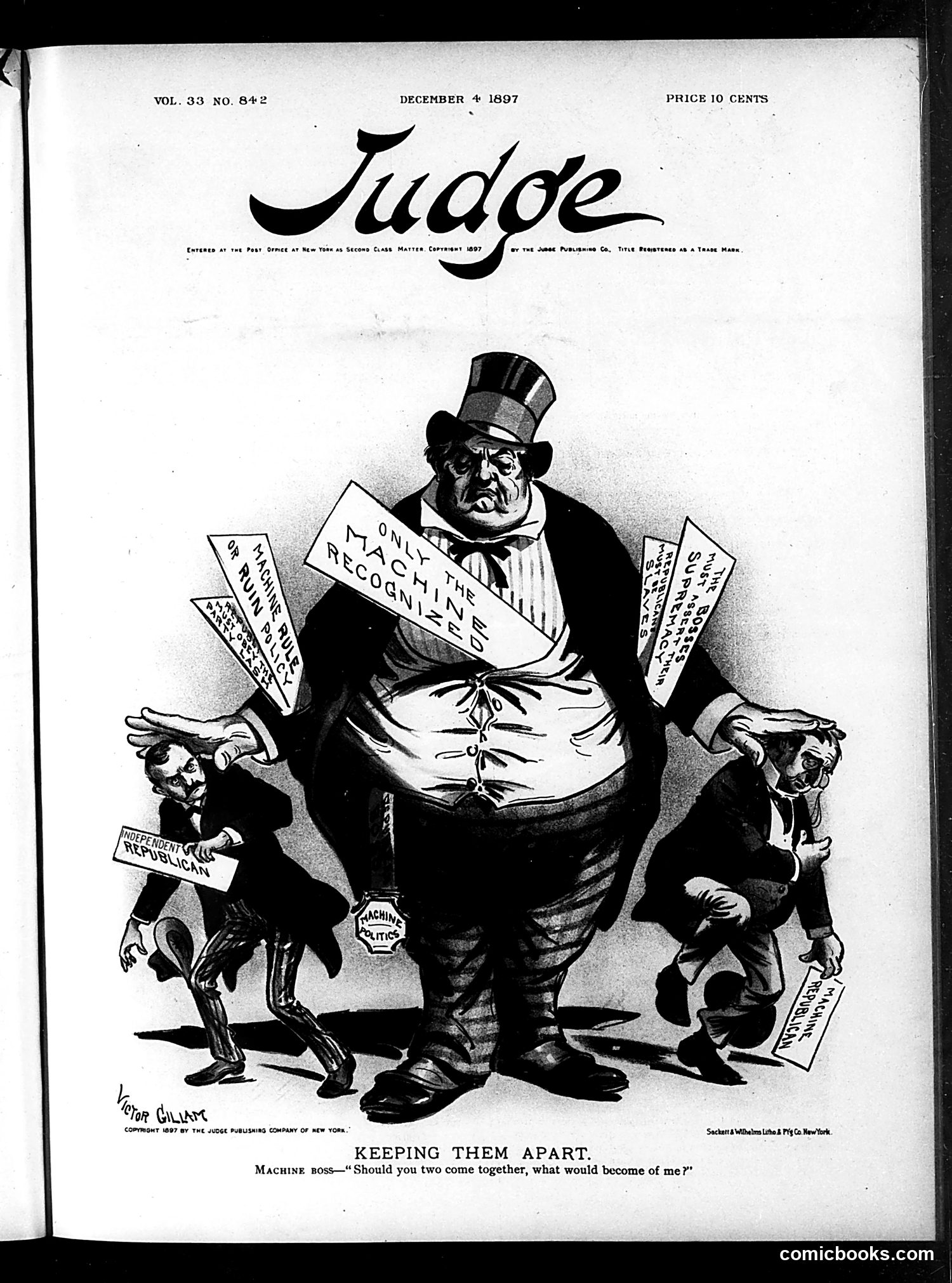
This political cartoon depicts a portly "Machine Boss" figure—likely representing corrupt political machine leadership of the era—holding apart two smaller, monkey-like caricatures labeled as representatives of rival factions. The banners reference "Only Machine Recognizes" and various political affiliations. The satire appears to comment on how political machine bosses maintained power by keeping competing groups divided and dependent. The caption, "Should you two come together, what would become of me?" reveals the joke: the boss profits from factional conflict and fears unity among his rivals would threaten his control. This reflects 1890s concerns about urban political corruption and machine politics that dominated American cities during the Gilded Age.
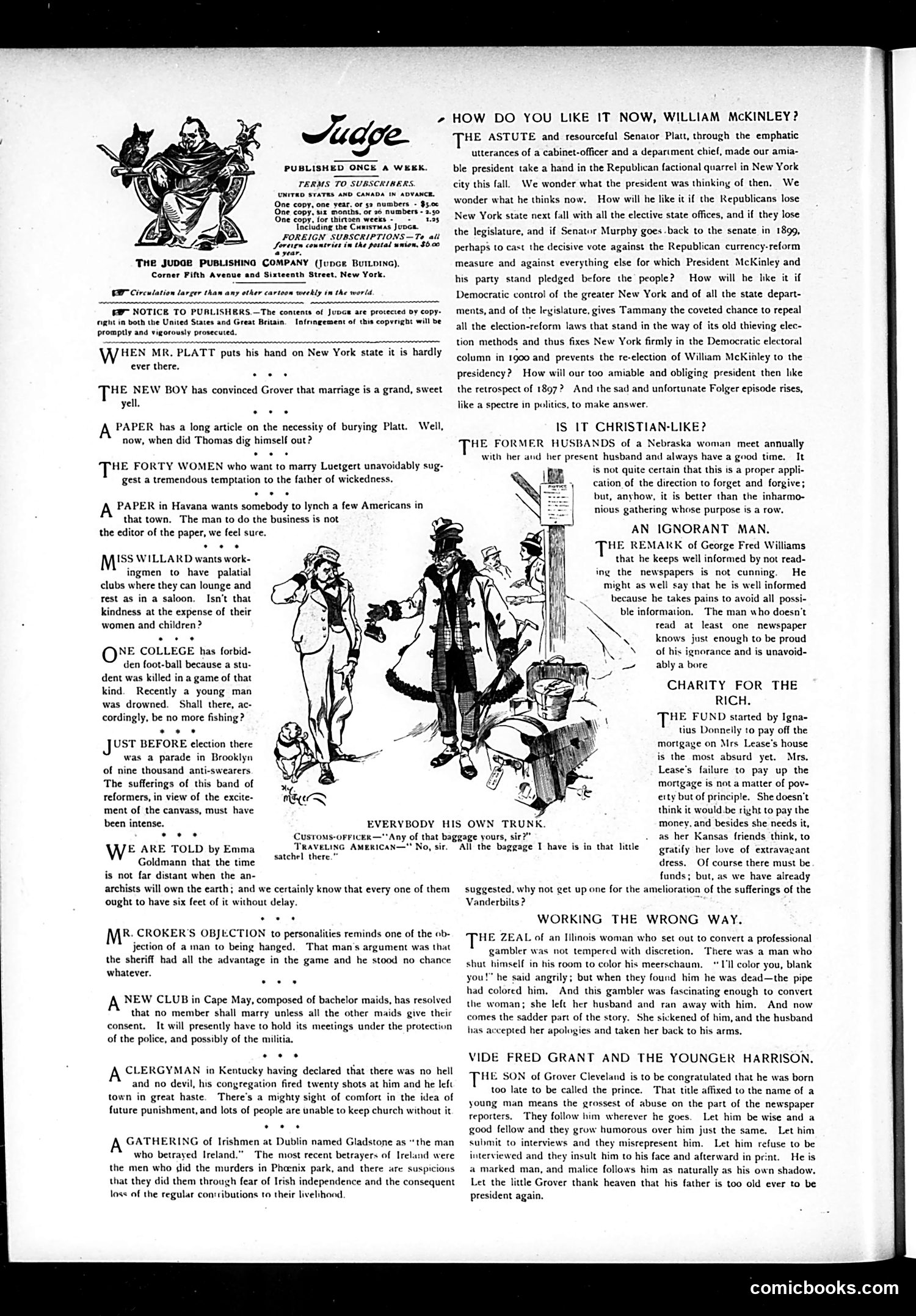
This page contains a satirical cartoon titled "Everybody His Own Trunk" depicting a customs officer and traveling American discussing luggage at what appears to be a port of entry. The sketch mocks the American tourist stereotype—specifically the assumption that travelers carry excessive baggage. The accompanying text snippets are brief editorial commentaries on contemporary issues: political discord in New York over election reform, a Nebraska woman attempting to convert a professional gambler, and criticism of an Illinois woman who converted her husband's room into a saloon without his consent. The overall theme targets American manners, politics, and domestic absurdities of the era. The specific political references (Senator Murphy, Democratic reform) suggest this is from the 1890s. The humor relies on familiar stereotypes about American travelers and domestic life.
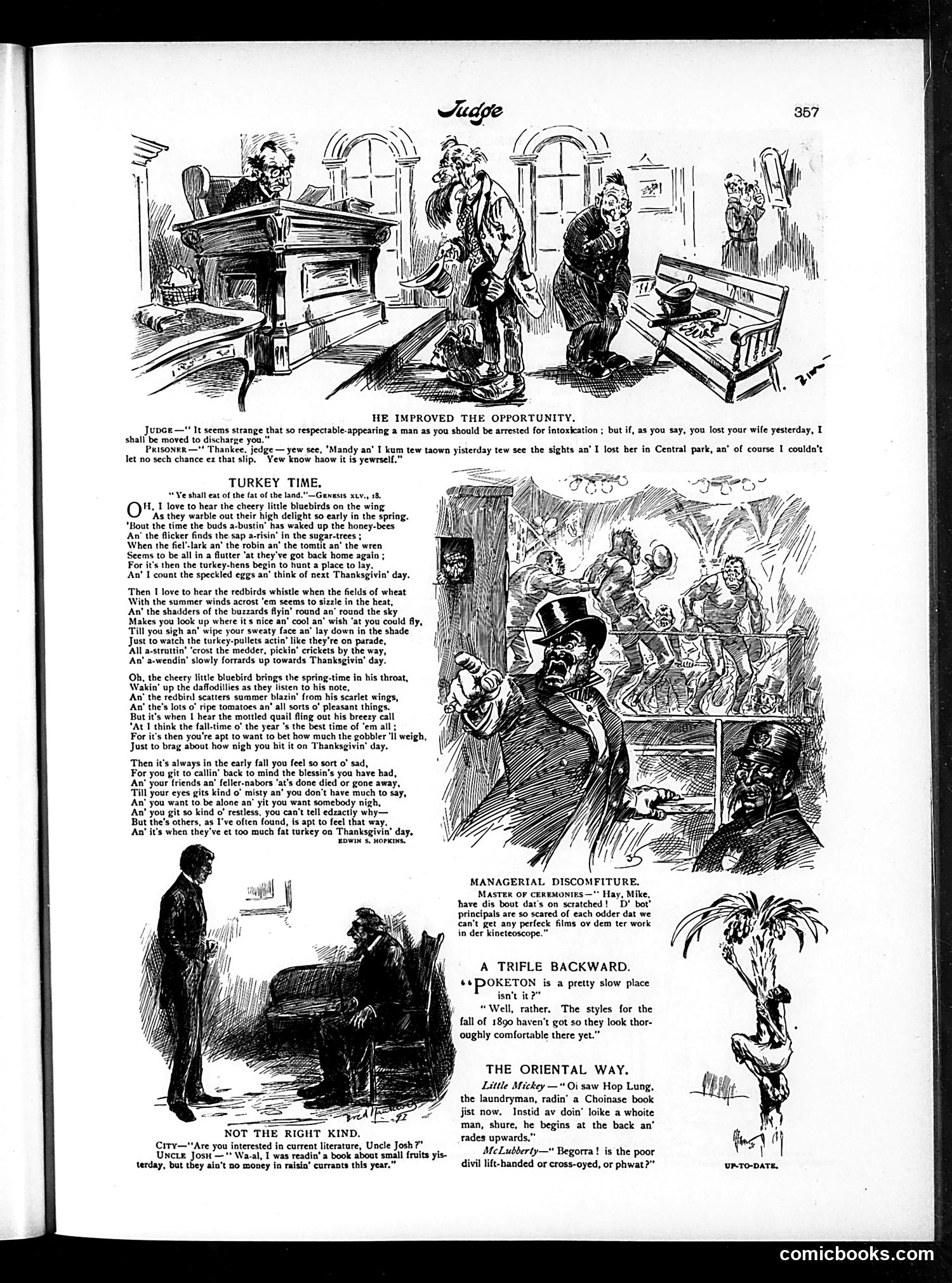
This Judge magazine page contains several brief satirical sketches rather than one cohesive cartoon: **"He Improved the Opportunity"**: A judge hears a case where a man was arrested for intoxication, but the defendant claims he lost his wife yesterday and hasn't seen her since. The satire mocks both the man's convenient excuse and judicial ineffectiveness. **"Turkey Time"**: A sentimental poem about Thanksgiving, celebrating autumn imagery and holiday traditions—not political satire. **Other sketches** mock everyday absurdities: a manager's concern about scratched microscope slides, provincial attitudes toward modern styles, and a laundyman's unfamiliarity with proper procedures. The page represents Judge's typical format: mixing social commentary on class, professions, and modern inconveniences rather than focusing on major political events.
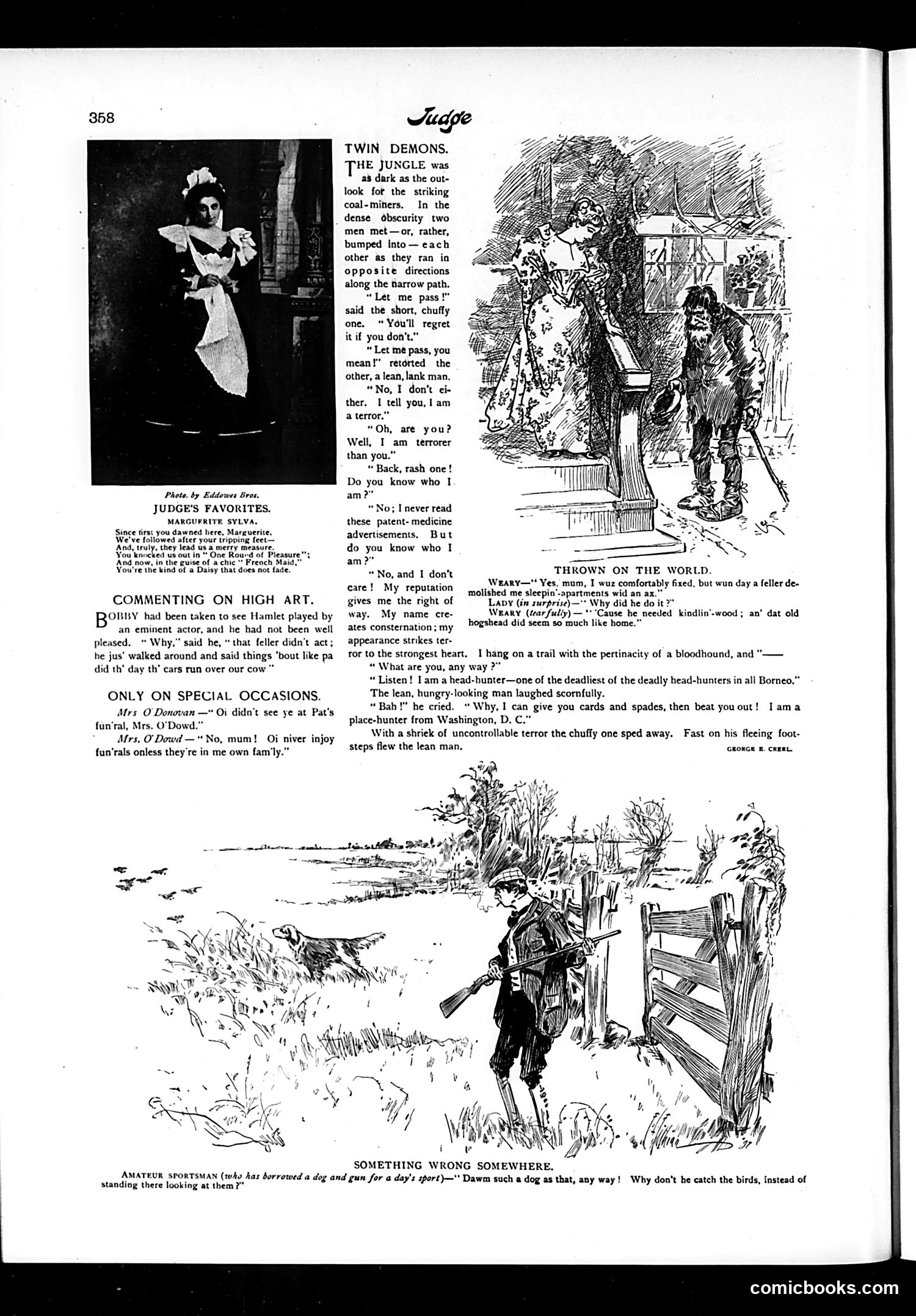
This page contains several satirical pieces typical of early 20th-century American humor: **"Twin Demons"** depicts two men in a jungle path who bump into each other, each claiming to be more terrifying. One reveals himself as a head-hunter from Borneo; the other counters by identifying as a "place-hunter from Washington, D.C."—the joke being that American political patronage-seekers are equally dangerous and self-serving as literal headhunters. This satirizes government corruption and the spoils system. **"Thrown on the World"** shows a destitute man explaining he was evicted because his landlord needed kindling-wood and found his old boardinghouse suitable for burning—dark humor about poverty and landlord exploitation. **"Commenting on High Art"** mocks an actor's poor Hamlet performance through a working-class character's blunt observation. The remaining items are brief comic anecdotes about Irish immigrants and an incompetent sportsman—standard Judge fare mixing social satire with ethnic humor typical of the era.
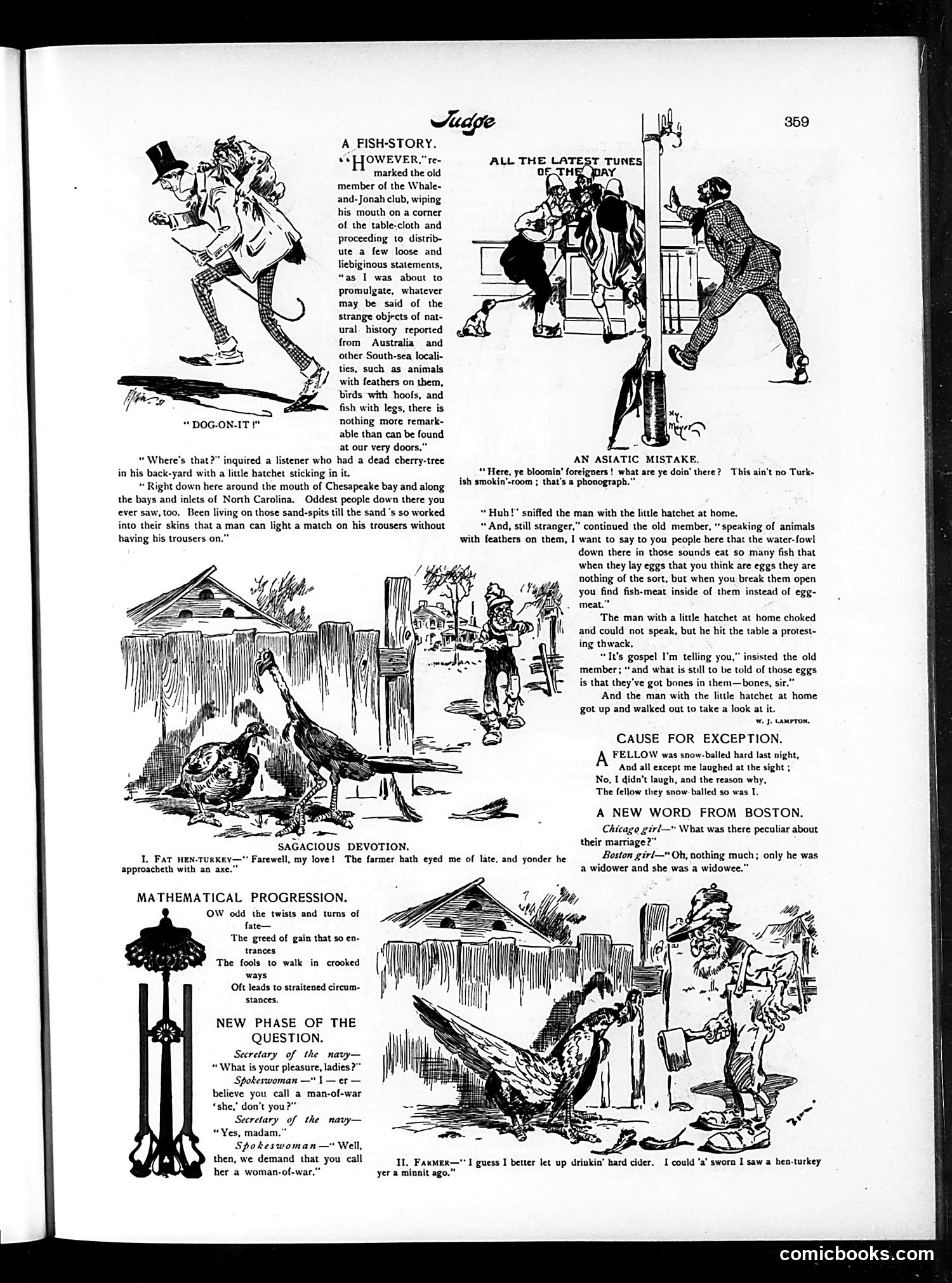
This page collects several humorous pieces typical of Judge's satirical style: **"A Fish-Story"** mocks tall tales and regional stereotypes. A club member describes absurd phenomena from North Carolina's coastal regions—people so sand-covered they can light matches on their trousers, and water-fowl that lay eggs containing fish-meat and bones instead of yolk. The joke targets both the credulous listener and exaggerated frontier stories popular in late-19th-century American humor. **"New Phase of the Question"** satirizes suffragism. Women demand the Navy call warships "woman-of-war" instead of "man-of-war"—a pun on the semantic argument that gendered language matters, mocking what Judge considered pedantic feminist logic. **"An Asiatic Mistake"** plays on xenophobic humor about foreigners misunderstanding American customs—here, Asians confused a phonograph for a Turkish smoking room. Lesser pieces include wordplay about Boston dialect ("widowee"), mathematical progression jokes, and rural humor. The page exemplifies Judge's blend of political satire, social commentary, and period stereotypes.
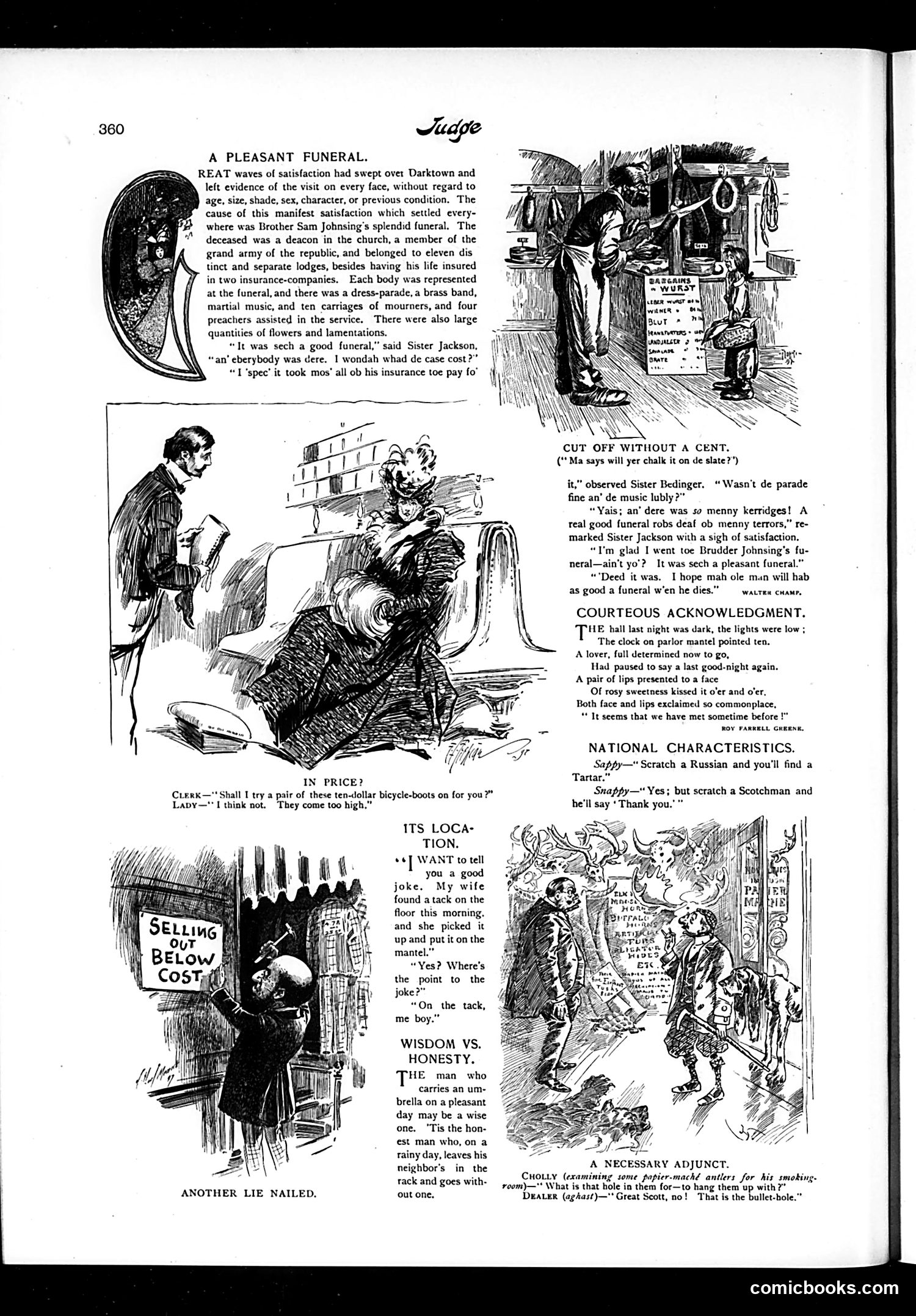
This page contains multiple satirical pieces typical of early 20th-century American humor: **"A Pleasant Funeral"** mocks African American funeral practices in "Darktown" (a racist caricature setting common to the era). The satire depicts elaborate funerals funded by life insurance as wasteful spectacle—the joke being that Brother Sam Johnsing's expensive funeral consumed nearly all his insurance proceeds, leaving nothing behind despite his multiple lodge memberships and church standing. **"Another Lie Nailed"** is a simple pun about a store sign advertising goods "below cost"—the joke relies on double meaning (physically below vs. economically below market price). The remaining items are brief, unrelated jokes: a tack pun, umbrella honesty philosophy, a courtship poem, ethnic stereotypes about Russians/Scots, and a hunting trophy with a bullet hole. The page reflects period attitudes: racial caricature, gender stereotypes, and ethnic humor presented as lighthearted satire typical of Judge's satirical approach.
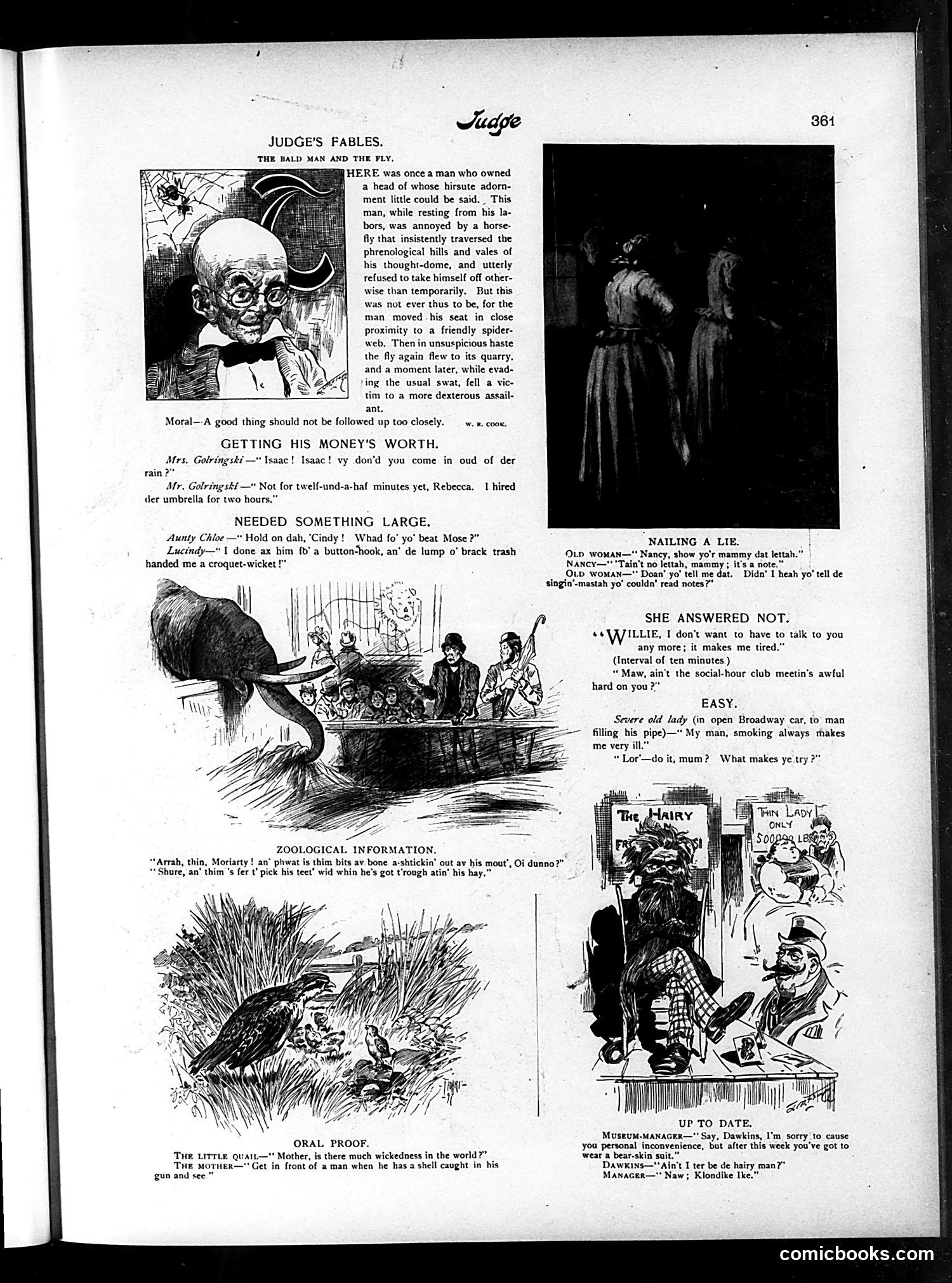
This page contains multiple brief satirical pieces typical of Judge's humor: **"The Bald Man and the Fly"** is a fable about a bald man who, annoyed by a horsefly, sits near a spider web where the fly is caught instead. The moral critiques excessive persistence—don't pursue good outcomes too aggressively. **"Getting His Money's Worth"** mocks Jewish immigrants (stereotyped dialect) through a man staying in rain to use an umbrella he rented for two hours' worth of time. **Other brief jokes** include ethnic humor (Irish and Black dialect pieces) and domestic comedy. The "Museum Manager" cartoon references the Klondike Gold Rush era, joking about replacing one exhibition performer with another. The page reflects late 19th/early 20th-century American satire's reliance on ethnic stereotypes and dialectical humor—content that would be considered offensive today. The jokes target working-class immigrants and minorities as sources of comic absurdity.
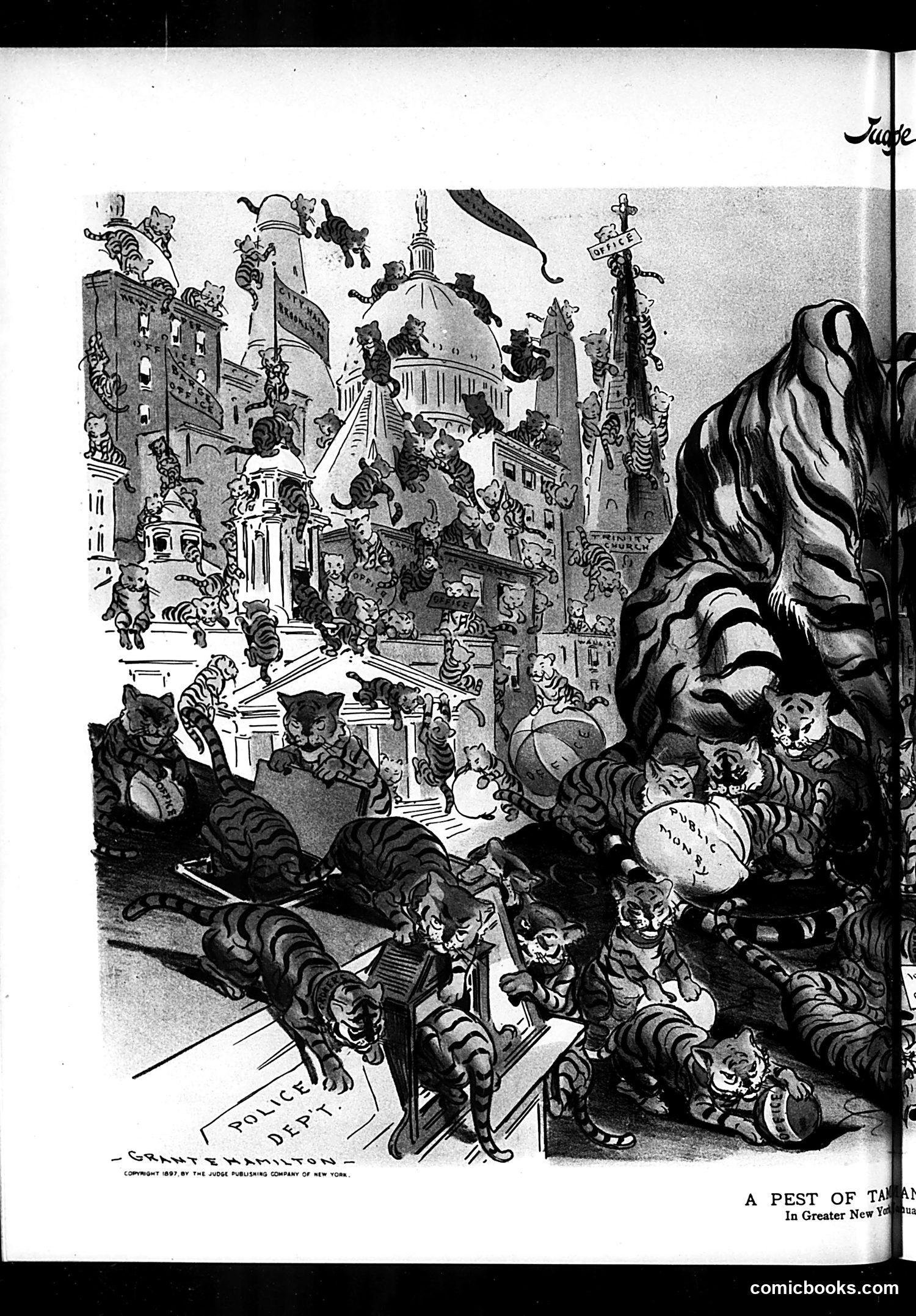
This 1897 Judge cartoon satirizes **Tammany Hall**, the notoriously corrupt Democratic political machine that dominated New York City politics. The image depicts the iconic dome of City Hall (center) under siege by rats and demon-like figures representing corrupt politicians and their schemes. The rats emerging from a "Police Dept." label suggest police corruption tied to Tammany's influence. The elaborate architectural chaos symbolizes how Tammany's corruption infested New York's civic institutions. The title "A Pest of Tammany" plays on both the literal rats (pests) and the metaphorical infestation of graft, bribery, and machine politics that plagued the city. Judge magazine regularly mocked Tammany's control over New York government during this Gilded Age period.
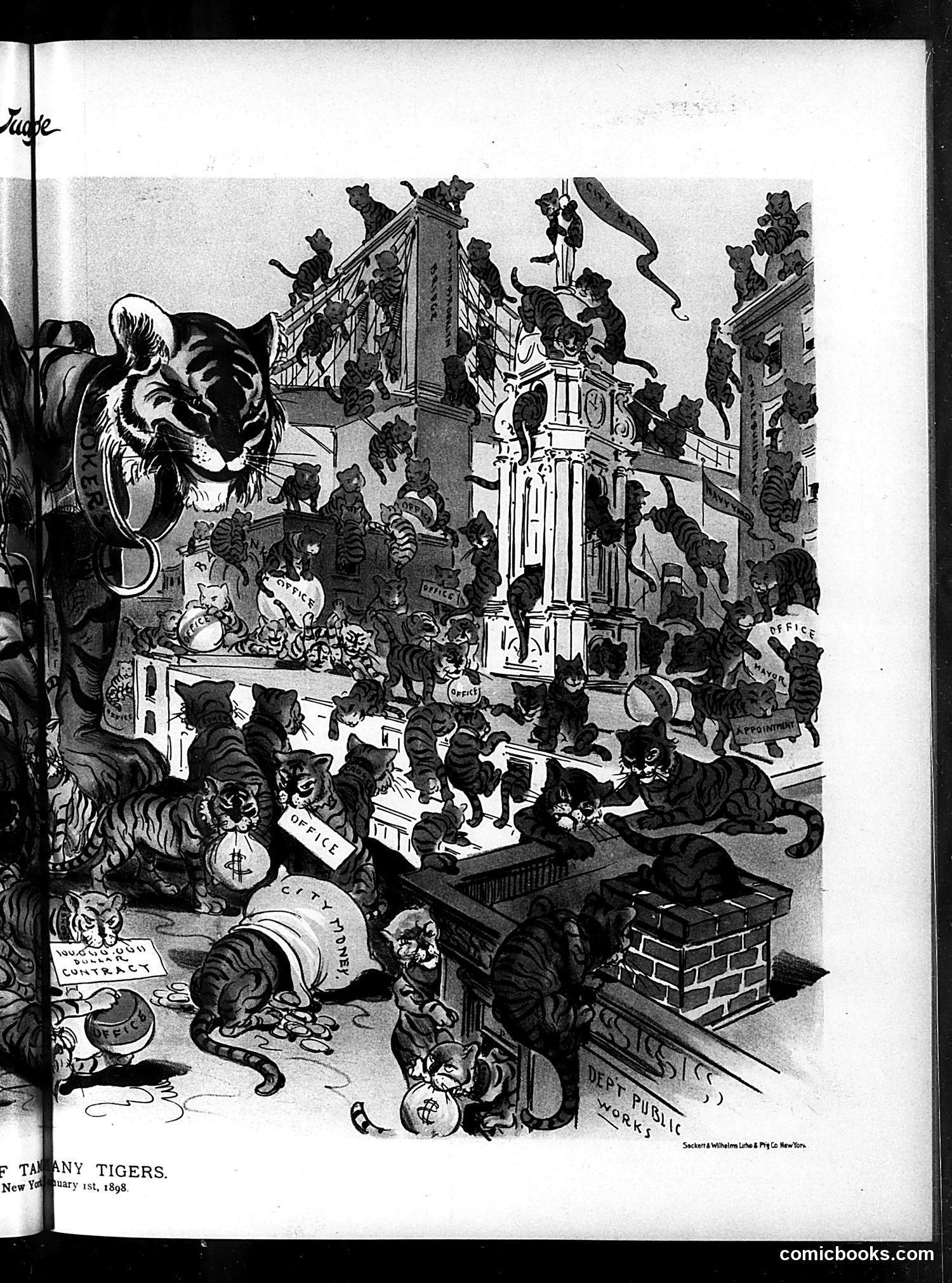
This Judge magazine cartoon from February 1, 1898, satirizes **Tammany Hall**, New York's corrupt Democratic political machine, depicted as tigers overrunning a city building labeled "OFFICE" and "DEPT OF PUBLIC WORKS." The proliferating tigers represent Tammany's patronage system—the practice of filling government positions with party loyalists rather than qualified officials. The chaotic scene of animals commandeering city departments illustrates how the organization prioritized political rewards over competent governance. The large tiger on the left likely represents Tammany's leadership. This reflects Progressive Era anxieties about urban machine politics and institutional corruption. The cartoon argues that Tammany's control of NYC government was characterized by incompetence and self-serving appointment practices rather than merit-based administration.
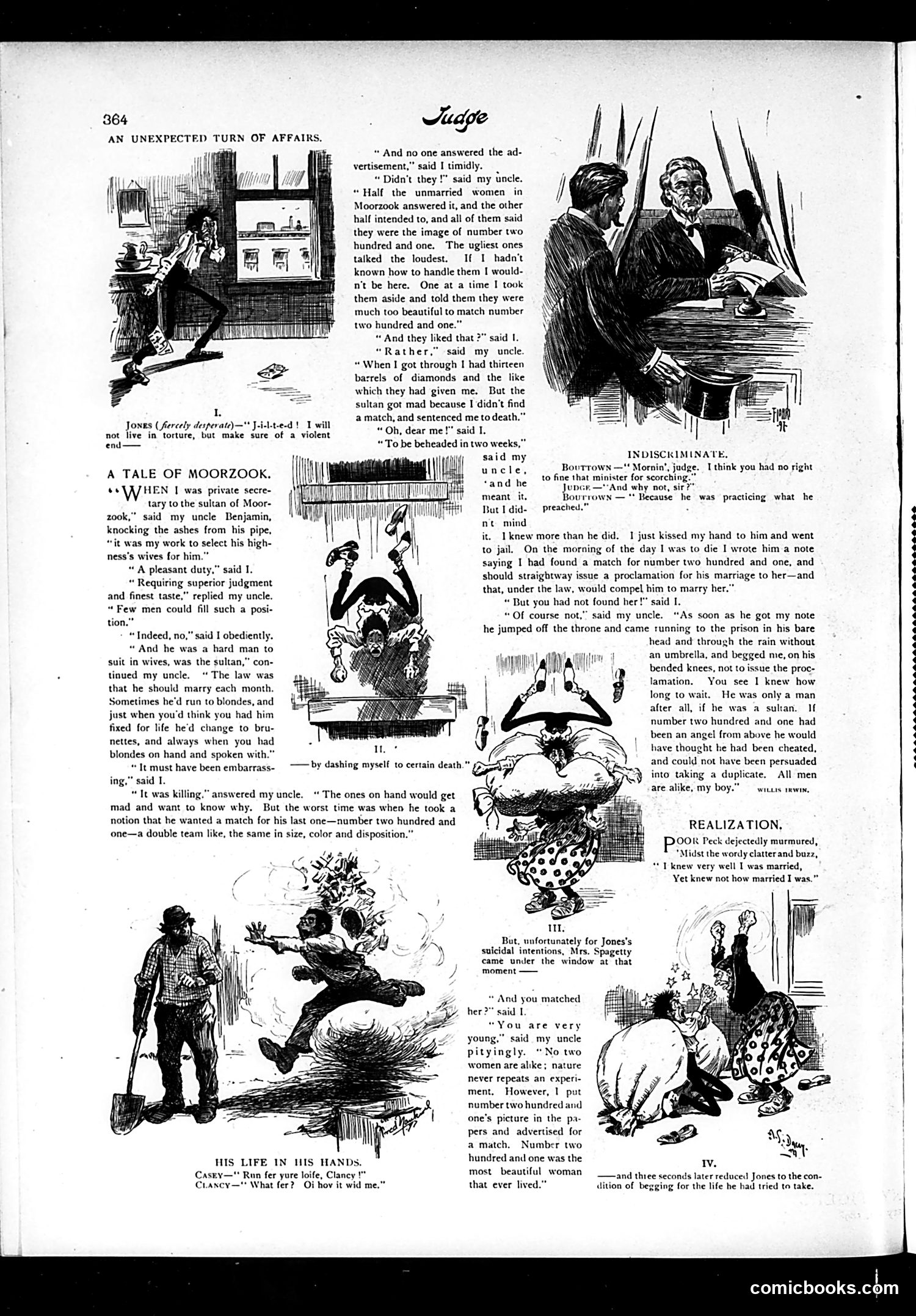
This page contains a framed narrative story with multiple illustrations. A man recounts his experiences as a private secretary to a fictional sultan, describing how he managed the ruler's wife selection by flattering ugly applicants into thinking themselves too beautiful for the position—then extracting diamonds from them as payment. When sentenced to death, he escapes execution by falsely promising to find the sultan's ideal match, knowing the vain ruler will abandon everything to pursue it, then surrender when the secretary offers to marry someone else instead. The satire satirizes male vanity and manipulation through romantic delusion. The accompanying standalone caption jokes ("Indiscrimate," "Realization") offer brief cynical observations about marriage and hypocrisy. The cartoons use exaggerated features typical of period humor but reflect late 19th/early 20th-century attitudes toward romance, class, and deception.
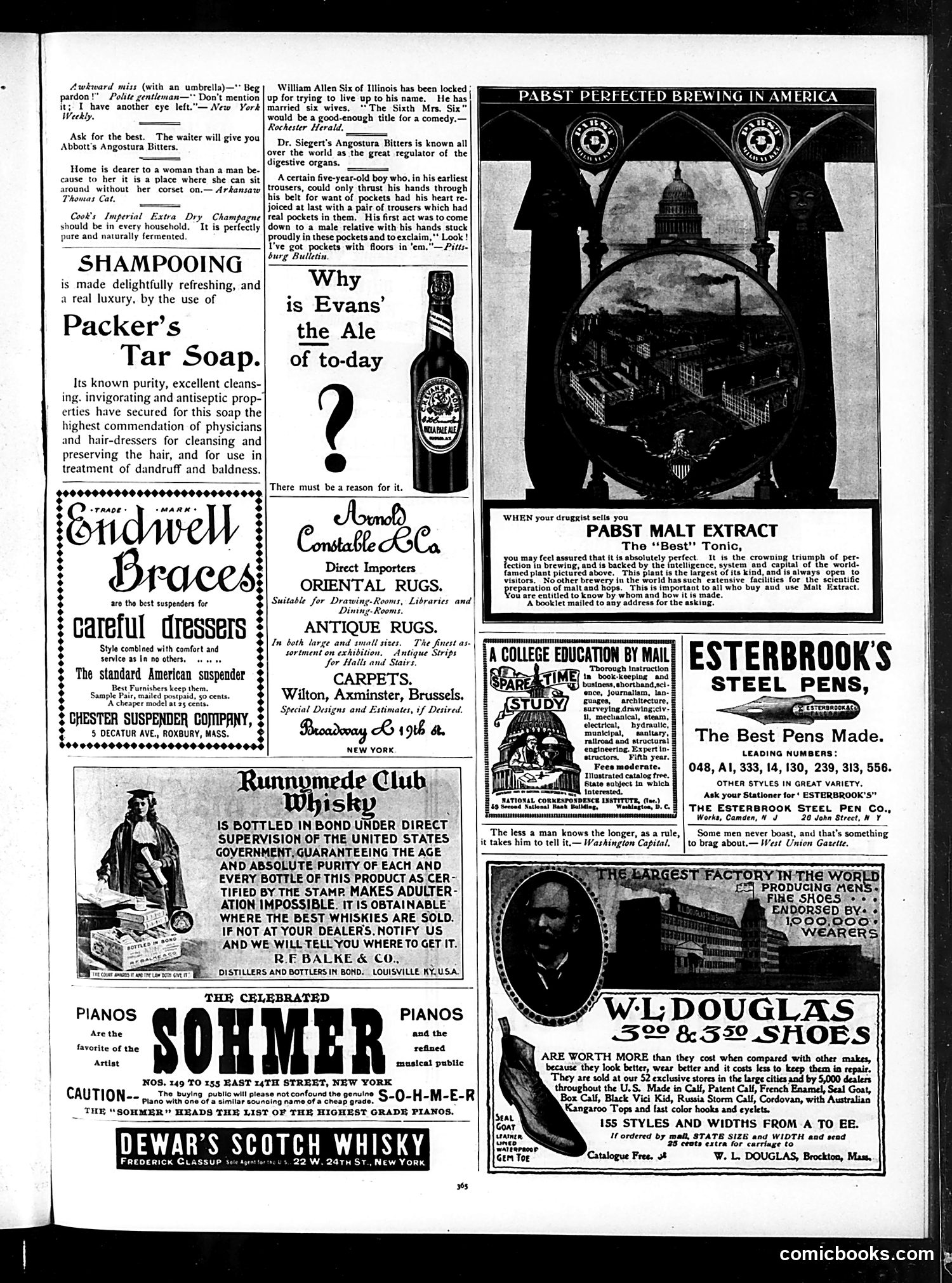
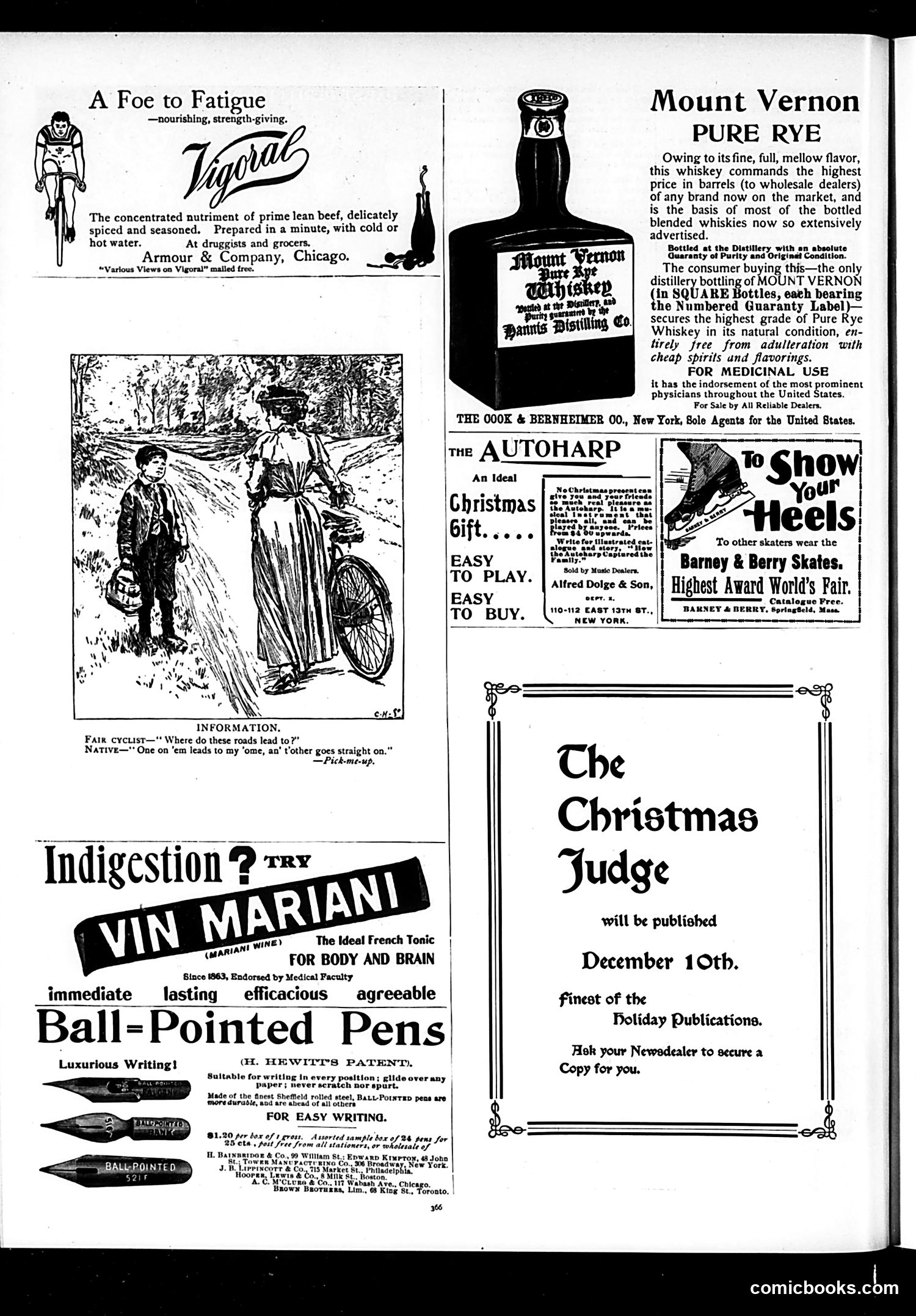
This page is primarily **advertisements** rather than satirical content. The notable elements: **Main Advertisements:** - **Vigoral** (Armour & Company): A beef extract marketed as fatigue-fighting, "nourishing" nutrition - **Mount Vernon Pure Rye Whiskey**: Marketed as premium, "for medicinal use" with physician endorsement—reflecting the era when alcohol was legitimately promoted for health benefits - **Autoharp**: A stringed instrument advertised as an ideal Christmas gift - **Barney & Berry Skates**: Ice skates claiming "Highest Award World's Fair" - **Vin Mariani**: A French "tonic for body and brain" for indigestion - **Ball-Pointed Pens**: Writing instruments emphasizing durability **Minor Content:** A small rural humor panel about roads, typical of period magazines. **Historical Context:** The medicinal claims (whiskey, wine tonics) and the emphasis on "purity" and "no adulteration" reflect early 1900s advertising before strict FDA regulations. These ads reveal contemporary health beliefs and consumer anxieties about product quality.
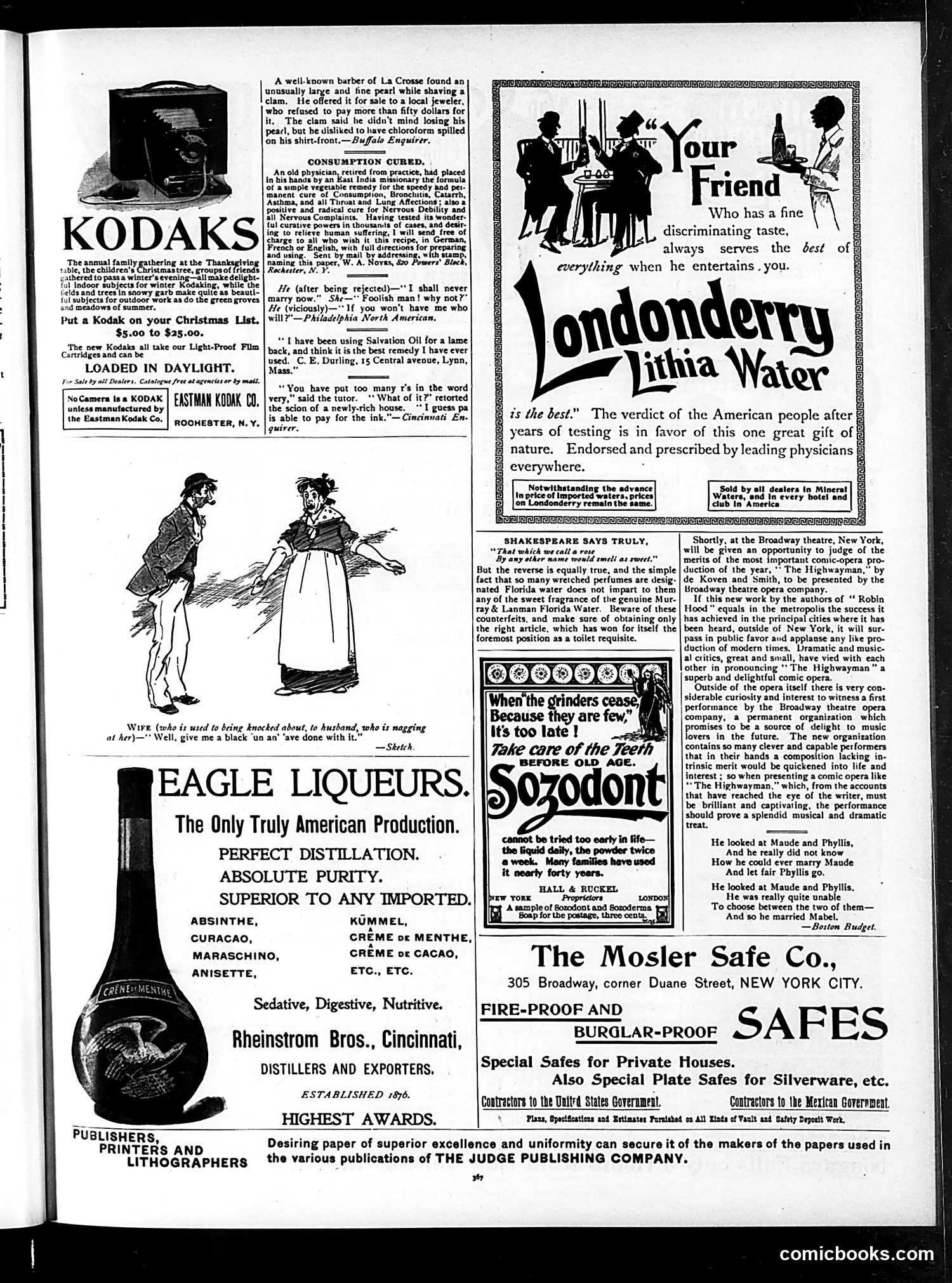
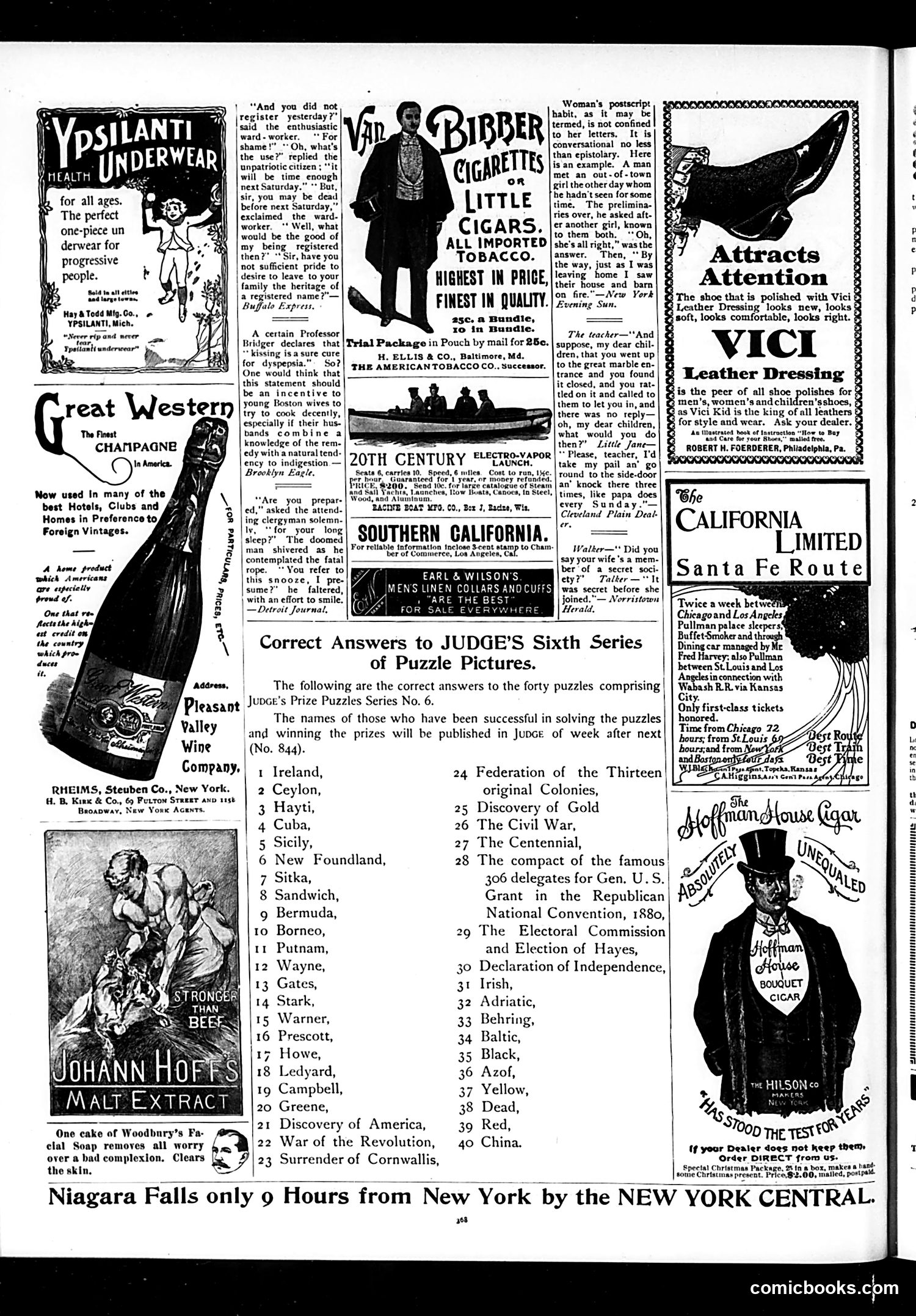
This page is primarily **advertising with some light satirical content**. The main cartoon elements are minor: **The Dialog Cartoons:** - One mocks a man's lack of civic duty (not registering to vote) - Another jokes about a wife's "secret society" membership (likely a women's club or social organization) - A third features a child innocently repeating her father's Sunday behavior at school **Key Context for Modern Readers:** The voter registration joke references early-1900s voter participation debates. The "secret society" reference plays on period anxieties about women's autonomous organizations, treating women's clubs as mysteriously exclusive. **Bulk Content:** The page is dominated by **period advertisements** (Van Bibber Cigarettes, Vici Leather Dressing, Hoffmann House Cigars) and **puzzle answer solutions** from Judge's sixth puzzle series—not satirical content. The page also advertises the **Santa Fe Railway** and various patent medicines (malt extract, electro-vapor baths), typical of early-1900s Judge magazine filler.
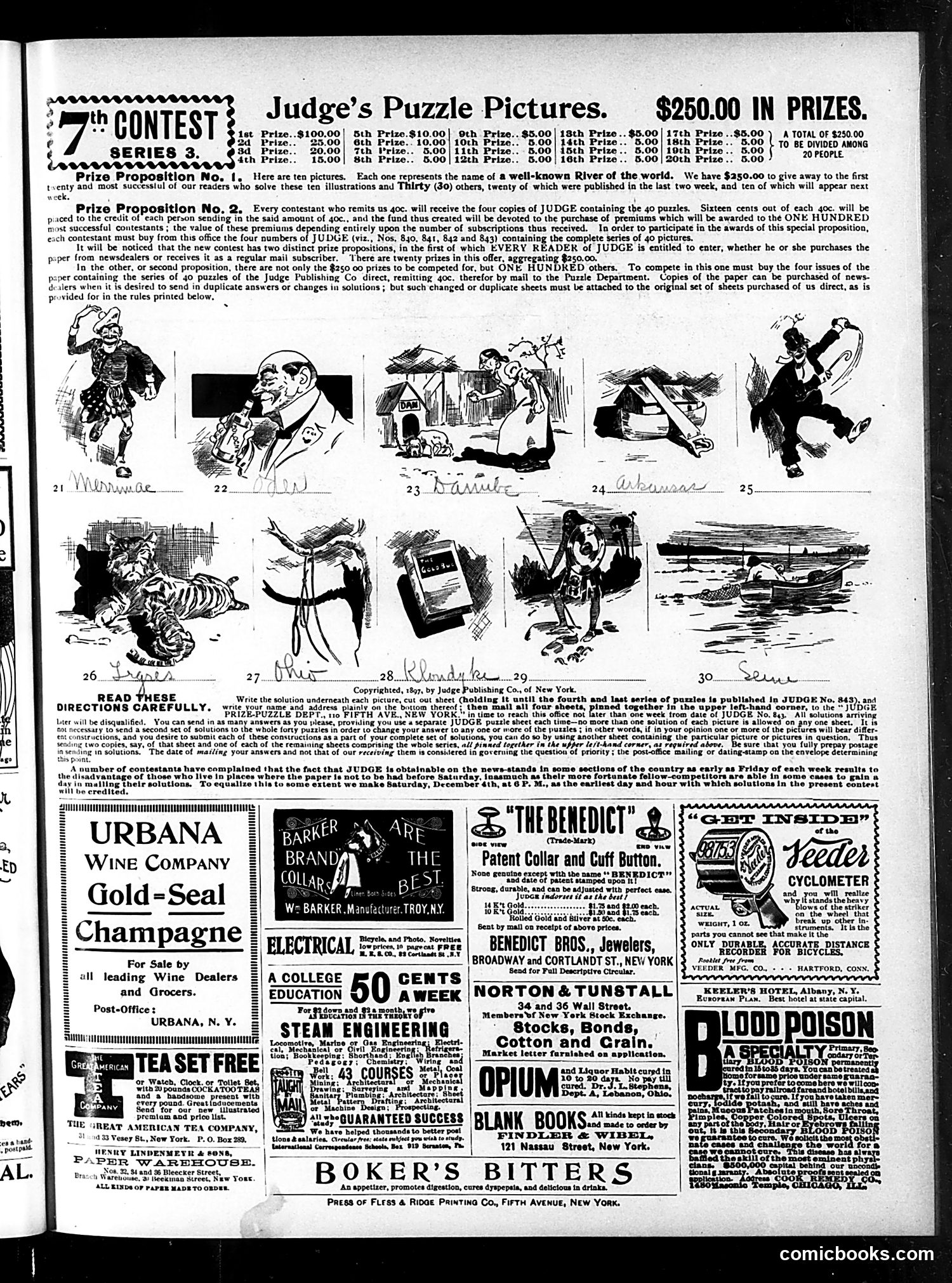
This page announces a puzzle-solving competition from Judge magazine (Series 3). Readers must identify ten rivers of the world from cartoon illustrations (numbered 21-30), with additional puzzles to follow in subsequent issues. The contest has two prize structures: one offering $250 total to winners who solve all 40 puzzles, and another awarding $250 plus one hundred additional prizes to subscribers who purchase the four magazine issues directly from Judge Publishing Company for 40 cents. The bottom half features period advertisements for champagne, tea sets, patent collar buttons, cyclometers, and other consumer goods—typical of late 19th-century magazine revenue. This represents Judge's attempt to boost readership and direct subscriptions through an interactive contest format popular in the 1890s.