
A complete issue · 16 pages · 1897
Judge — November 20, 1897
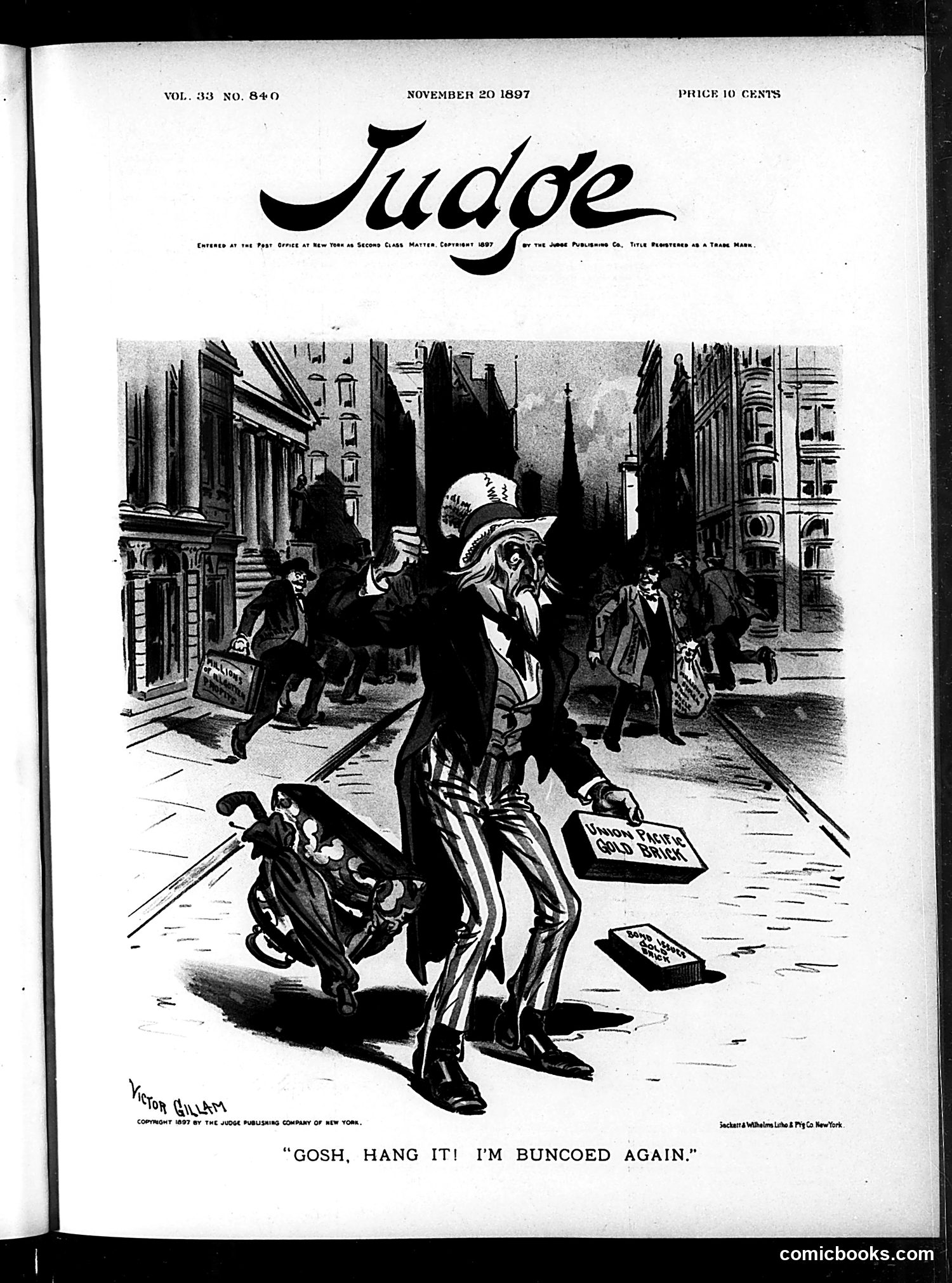
This 1897 Judge cartoon by Victor Gillam depicts Uncle Sam (the tall figure in striped pants and starred hat) being swindled on a city street. He's dropped money labeled "Union Gold Brick" and "Bonds" while clutching a bag of valuables. Other figures around him appear to be con artists or pickpockets in a urban setting. The "bunco" (confidence game/swindle) reference suggests satire about financial fraud or economic schemes affecting the nation. The cartoon likely criticizes either specific financial scandals of the 1890s era or broader concerns about corruption and schemes targeting American interests. The "gold brick" reference—a classic con involving fake gold—reinforces the swindling theme.
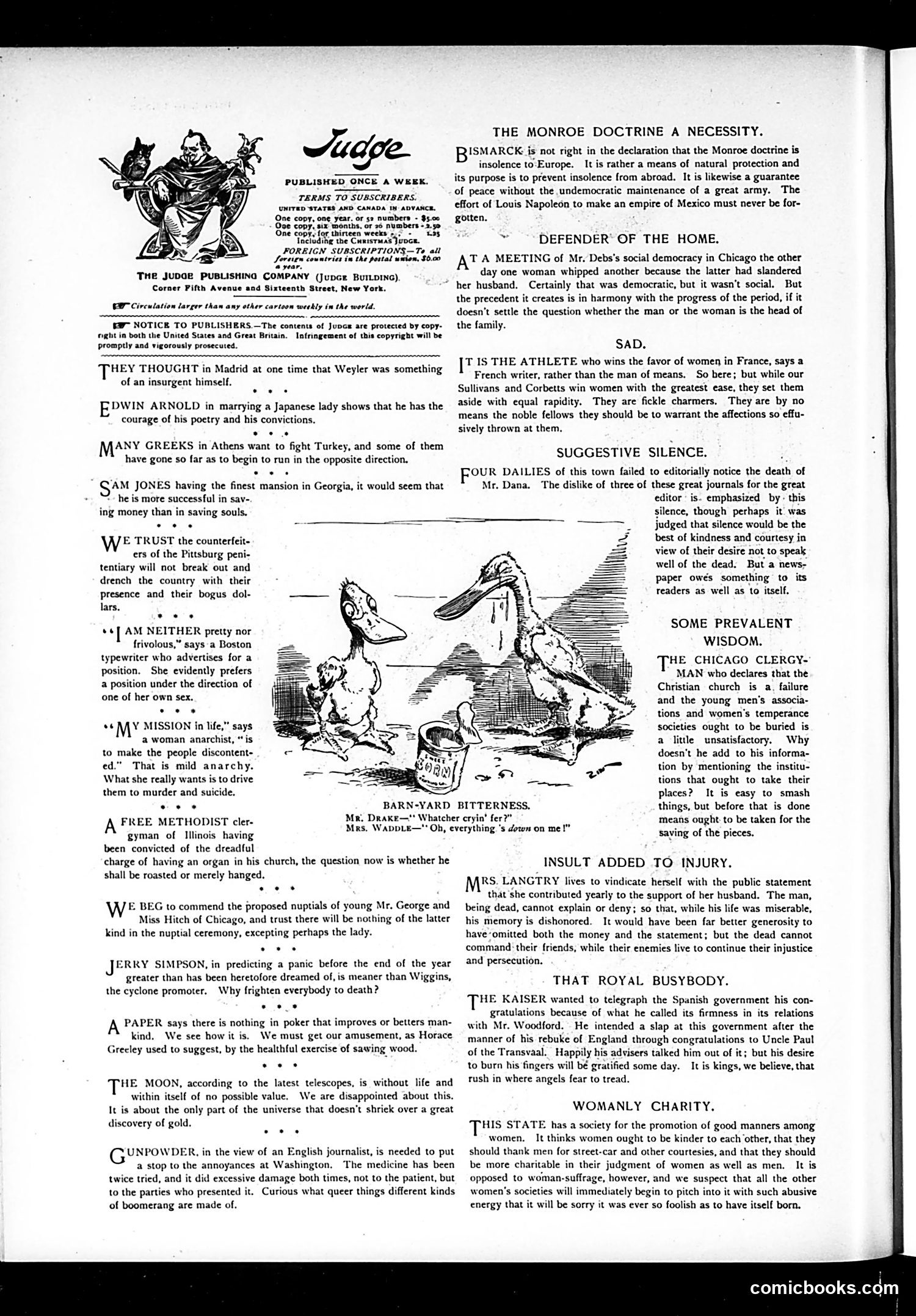
This cartoon depicts a confrontation between two geese or ducks, with one asking "Whether cryin' fer?" and the other responding "Oh, everything's down on me!" The image serves as visual commentary on complaint and blame-shifting. The farmyard setting uses animal characters—a common satirical device—to mock human behavior, likely targeting public figures or social groups who habitually blame others for their misfortunes rather than accepting responsibility. The crude, exaggerated animal expressions emphasize the foolishness of perpetual grievance-mongering. Without additional context from the specific historical moment, the exact targets remain unclear, but the satire generally mocks victimhood mentality and scapegoating among those seeking sympathy.
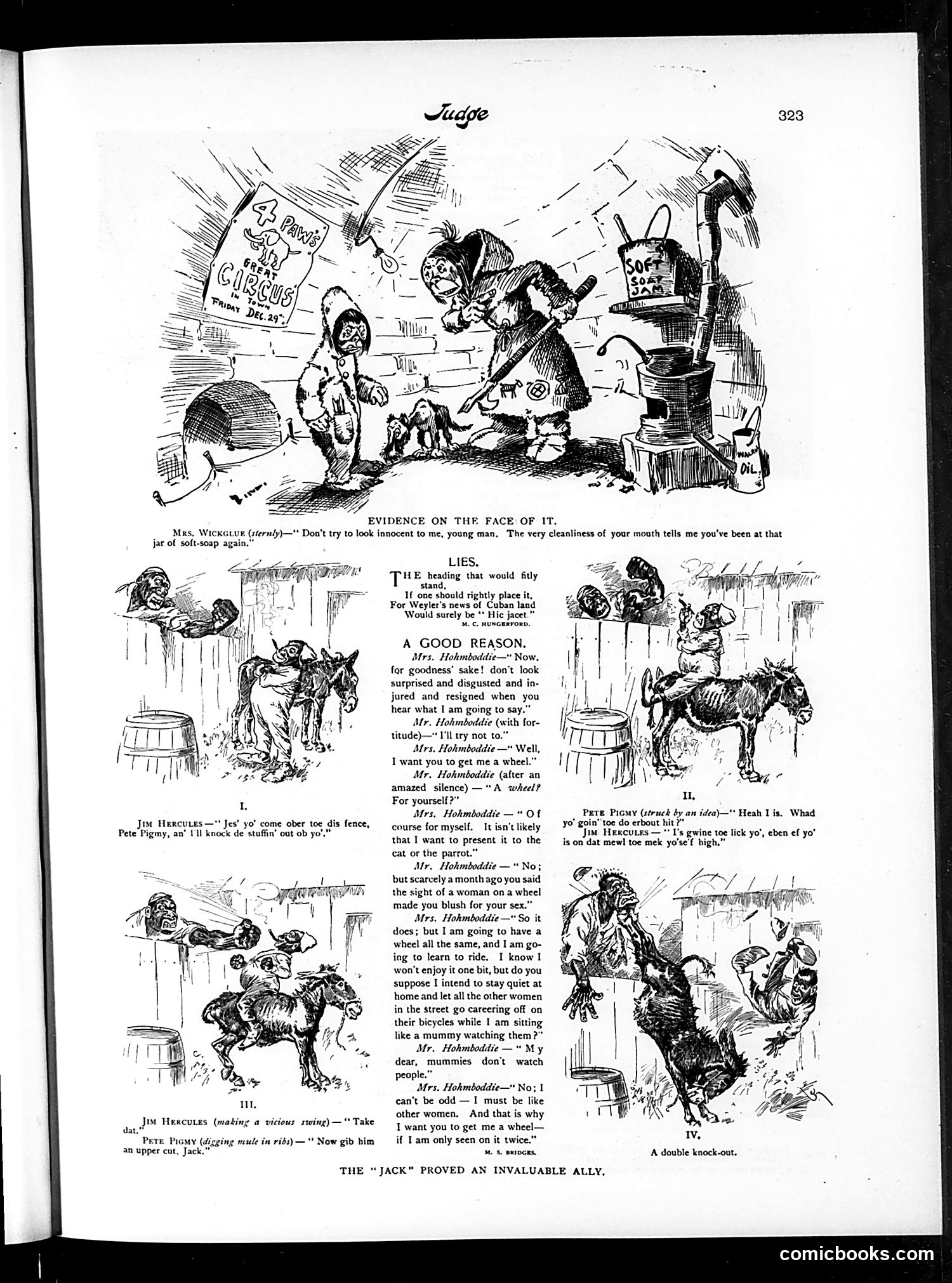
This page satirizes turn-of-the-century gender politics, specifically women's emerging demands for independence and mobility. The central cartoon shows Mrs. Wickham (likely a stock character) being caught at a circus—suggesting impropriety—with the caption "Don't try to look innocent to me, young man. The very cleanliness of your mouth tells me you've been at that jar of cold cream again!" The surrounding comics feature "Mrs. Holmsdiddle" and "Mr. Holmsdiddle" debating whether women should ride bicycles. The husband resists; the wife insists, ultimately demanding a wheel to avoid being confined at home while other women enjoy this new freedom. The satire targets both women's growing independence (bicycles represented radical mobility) and husbands' anxieties about losing control. "Jack proved an invaluable ally" suggests unexpected male support for women's rights.
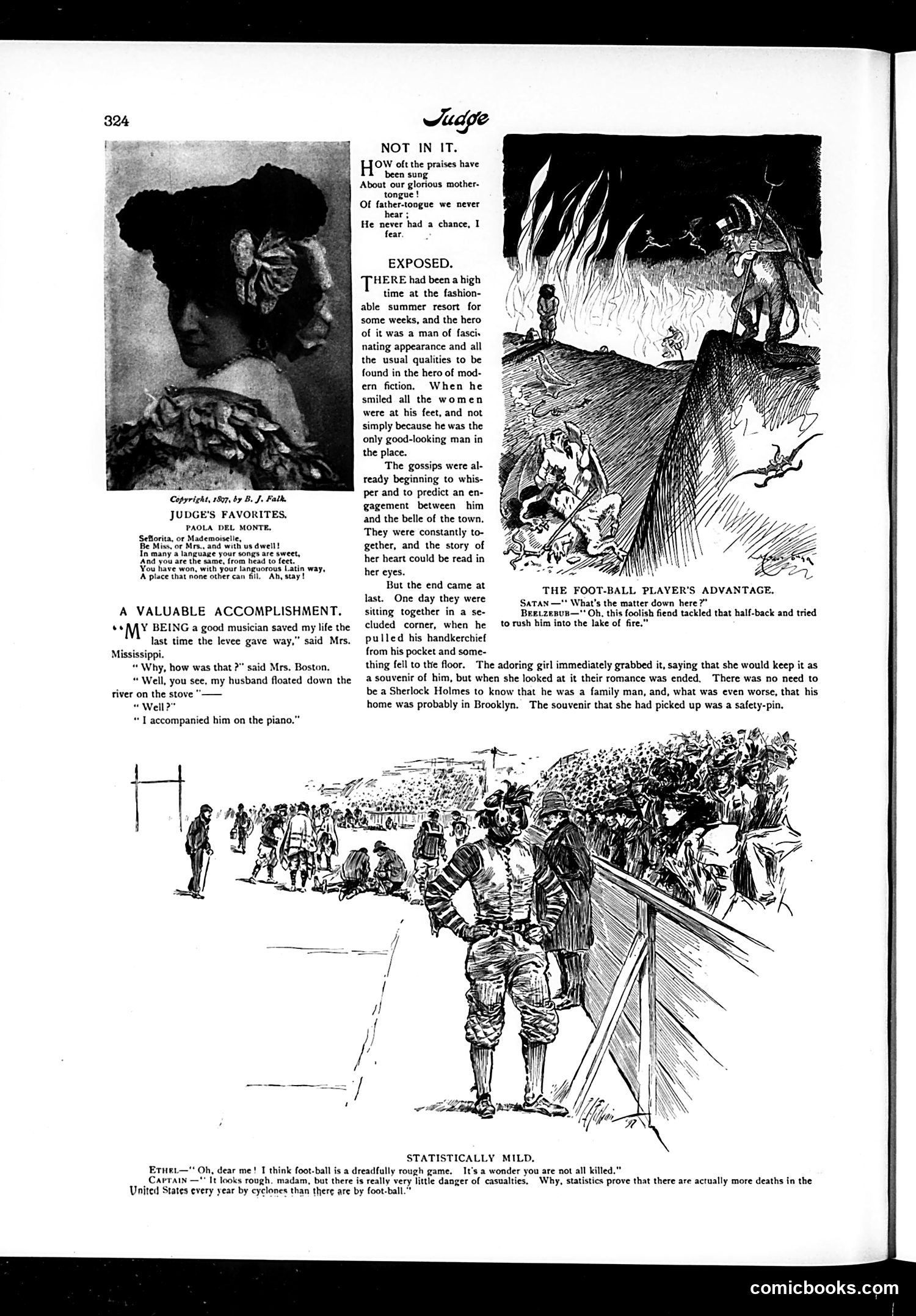
This page contains several satirical pieces typical of early 20th-century American humor: **"Not in It"** mocks the celebration of English as the "mother tongue" while completely ignoring fathers' linguistic contributions—a lighthearted gender critique. **"Exposed"** tells of a charming man at a resort who captivates women until a woman finds a *safety pin* in his handkerchief, revealing he's a married man from Brooklyn. The satire targets both masculine deception and the shallow romanticism of resort culture. **"The Foot-Ball Player's Advantage"** presents a heavenly scene where a half-back's tackling skills literally drive someone into hell's lake of fire—absurdist satire on football's violence. **"Statistically Mild"** defends football's safety by claiming more Americans die annually from cyclones than football injuries—dark humor about statistics being used to minimize genuine dangers. The page reflects early 20th-century preoccupations: gender relations, suburban domesticity (Brooklyn), and the emerging brutality of American football.
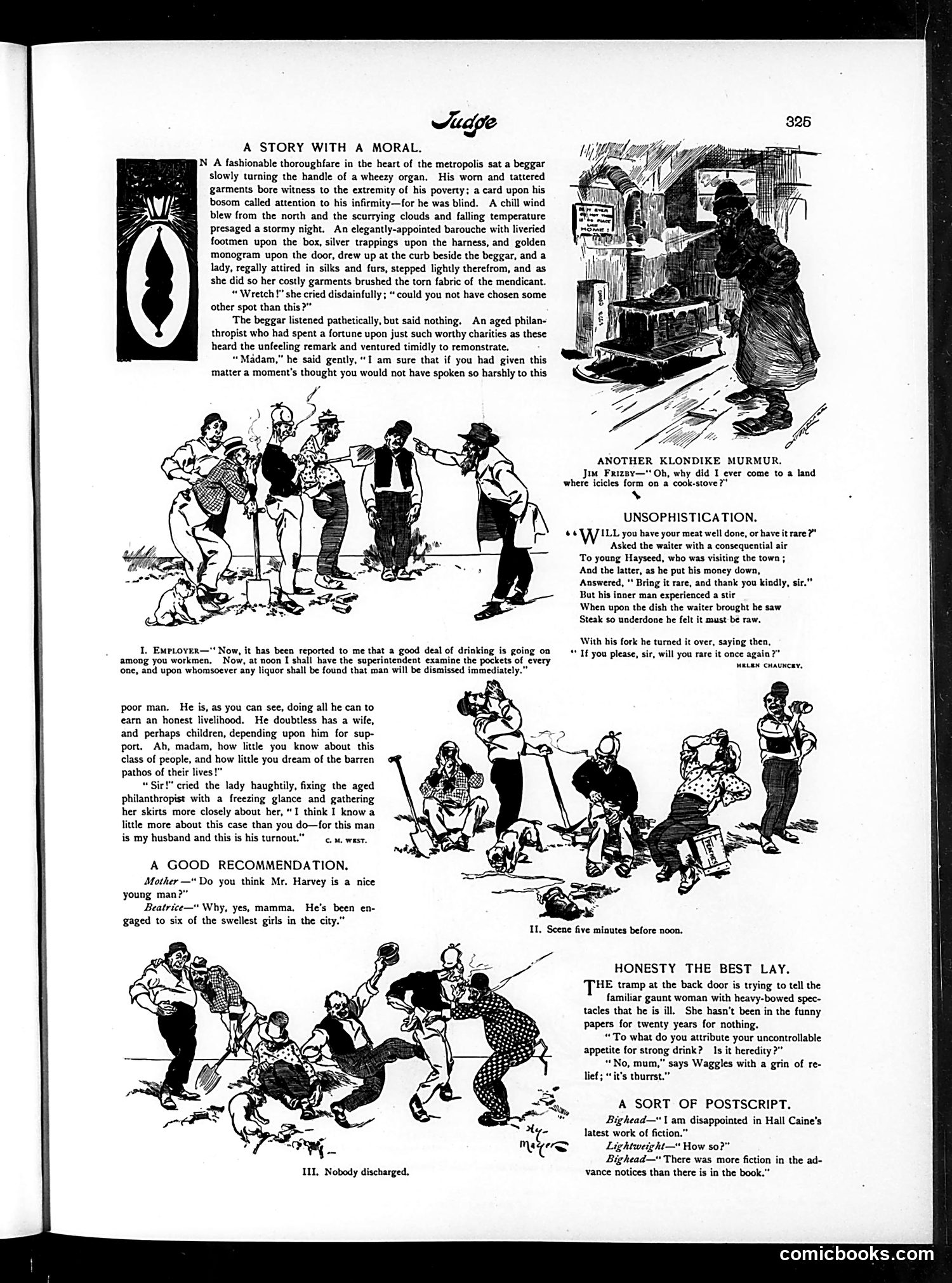
This page contains multiple short satirical pieces typical of Judge's format: **"A Story with a Moral"**: A wealthy woman in furs scolds a blind street musician for choosing her fashionable street to beg on. An elderly philanthropist gently remonstrates, but the lady haughtily reveals the beggar is actually her *husband* and this is *his* carriage—a twist exposing the woman's hypocrisy and class pretension. **Other vignettes mock**: - Gold rush disappointment ("Klondike murmur") - Rural naiveté (a country visitor misunderstands "rare" meat) - Employer paternalism and worker drinking - Courtship as transactional (a girl engaged to six wealthy suitors) - Vagrant cunning (a tramp exploiting sympathetic stereotypes) - Literary criticism (fiction in advertisements versus the book itself) The page satirizes Gilded Age hypocrisy, class anxiety, rural-urban cultural gaps, and workplace power dynamics. The humor relies on moral reversals and exposing pretense.
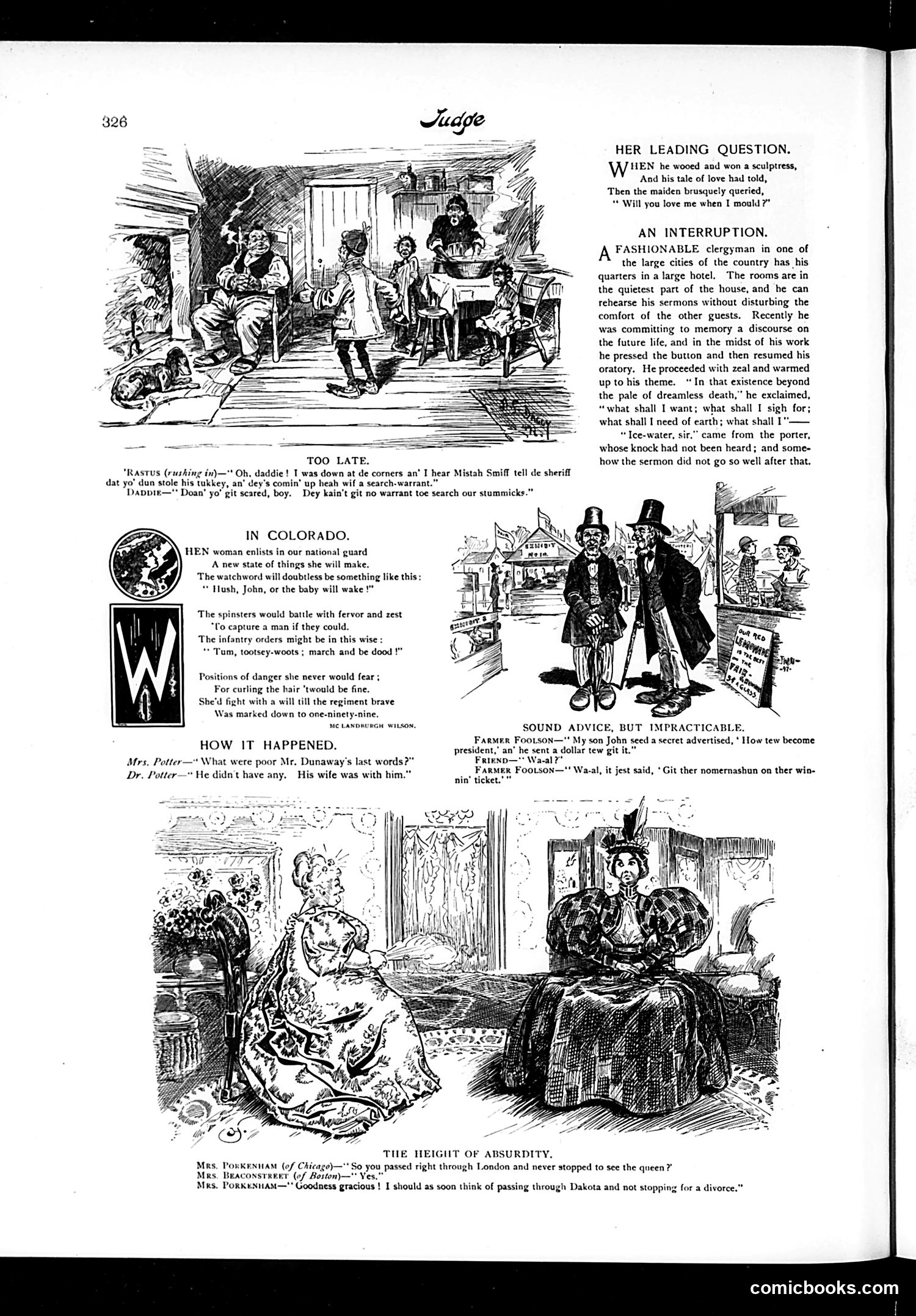
This page contains multiple brief satirical pieces typical of Judge's humor: **"Her Leading Question"** jokes about a sculptor's fiancée asking if he'll love her "when I mould"—a pun on her profession. **"An Interruption"** mocks a fashionable clergyman rehearsing a sermon on the afterlife in his hotel room, interrupted by a porter delivering ice water at precisely the wrong moment ("Tee-water, sir"), deflating his theatrical delivery. **"In Colorado"** satirizes women's newly granted entry into the National Guard, suggesting they'd prioritize vanity (curling hair) over combat, using condescending dialect and implying their enlistment would reduce regiment strength through frivolity. **"How It Happened"** uses racist dialect humor about a Black man whose wife was unfaithful. **"Sound Advice"** presents a farmer whose son paid for a "secret" on becoming president—the punchline being getting his party's nomination on a "winning ticket." **"Height of Absurdity"** contrasts a Boston woman who skipped seeing the Queen with a Bostonian who wouldn't skip stopping for a divorce in Dakota—implying divorce was more culturally significant than royalty.
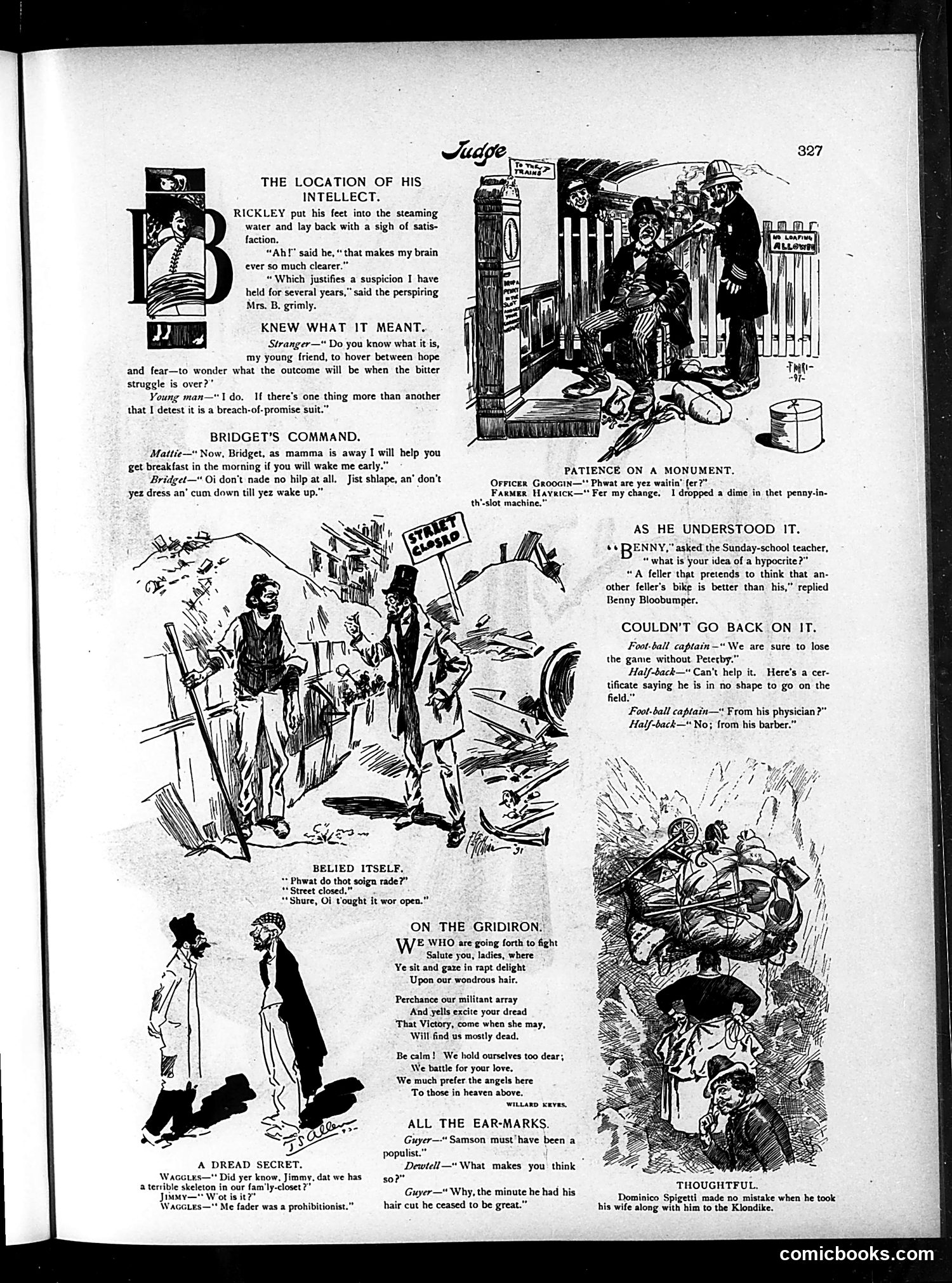
This page contains multiple brief satirical jokes and cartoons typical of early 20th-century American humor: **"The Location of His Intellect"** mocks a man who claims hot water clears his mind; his wife's response suggests his intellect is located elsewhere (implying stupidity). **"Knew What It Meant"** jokes about a young man's fear of breach-of-promise lawsuits—a now-obsolete legal threat for romantic entanglements. **"Bridget's Command"** uses Irish dialect humor (common in period satire) depicting a servant's authority over her mistress. **"On the Gridiron"** satirizes college football players' vanity, suggesting they care more about impressing women than actual victory. **"All the Ear-marks"** references Populist Party politics, likely mocking William Jennings Bryan or similar figures. **Other pieces** joke about Prohibition, penny-slot machines, and a barber's haircut affecting athletic performance. The page reflects period concerns: servant-class dynamics, emerging college sports culture, and contemporary political movements.
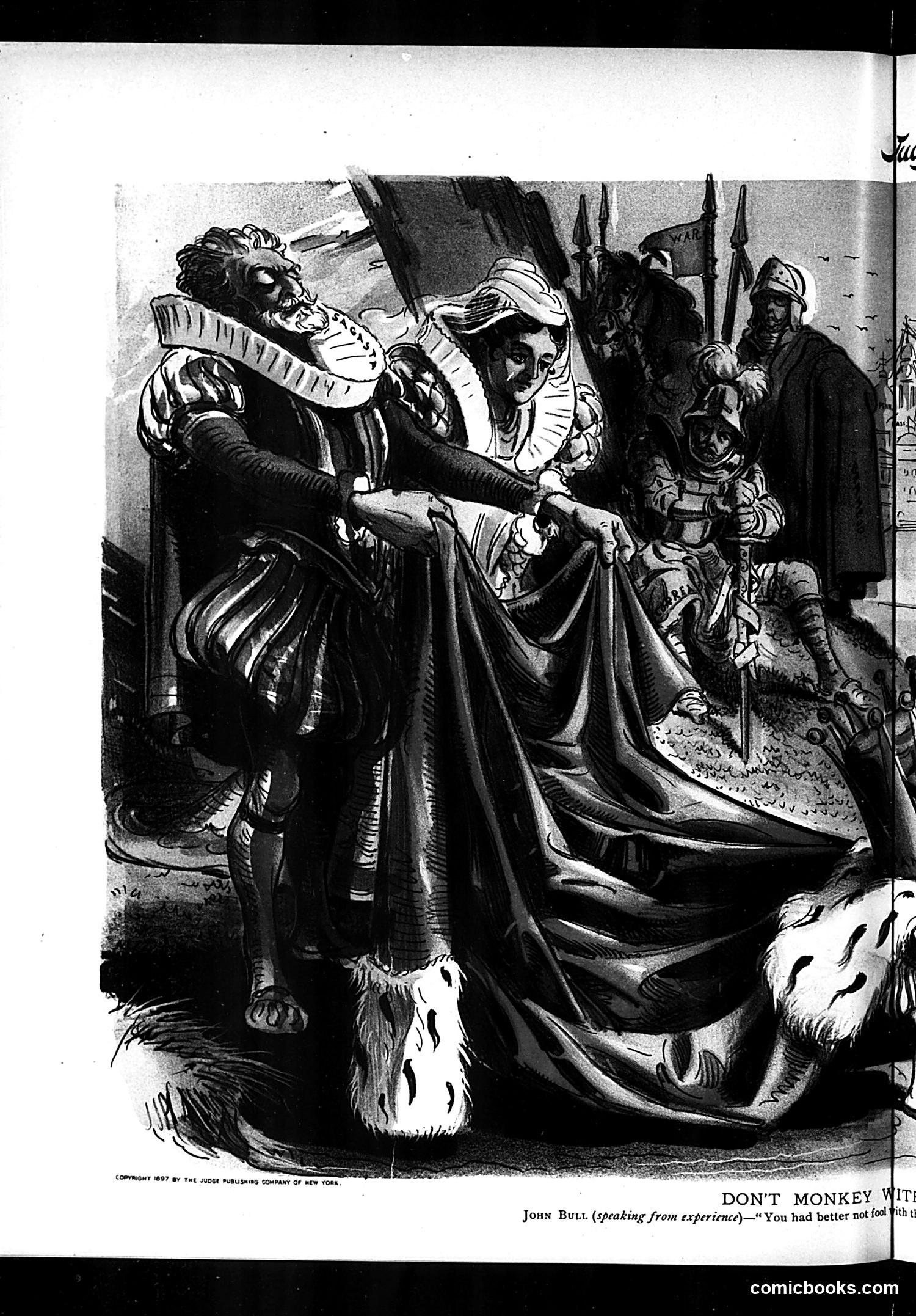
This is a satirical cartoon from *Judge* magazine featuring "John Bull" (the personified character representing Britain) speaking from experience to warn someone—likely Uncle Sam (America) or another figure—against "fooling with" something specific (the text is cut off). The elaborate costumes, ornate dress, and military context suggest this references British imperial power or a diplomatic/military situation. John Bull's prominent caricatured features and the hierarchical staging (with attendants and soldiers visible) emphasize British authority. The satire appears to mock either American foreign policy ambitions or warn against interference with British interests, using the venerable John Bull character's "experience" as ironic authority. Without the complete caption, the specific target remains unclear.
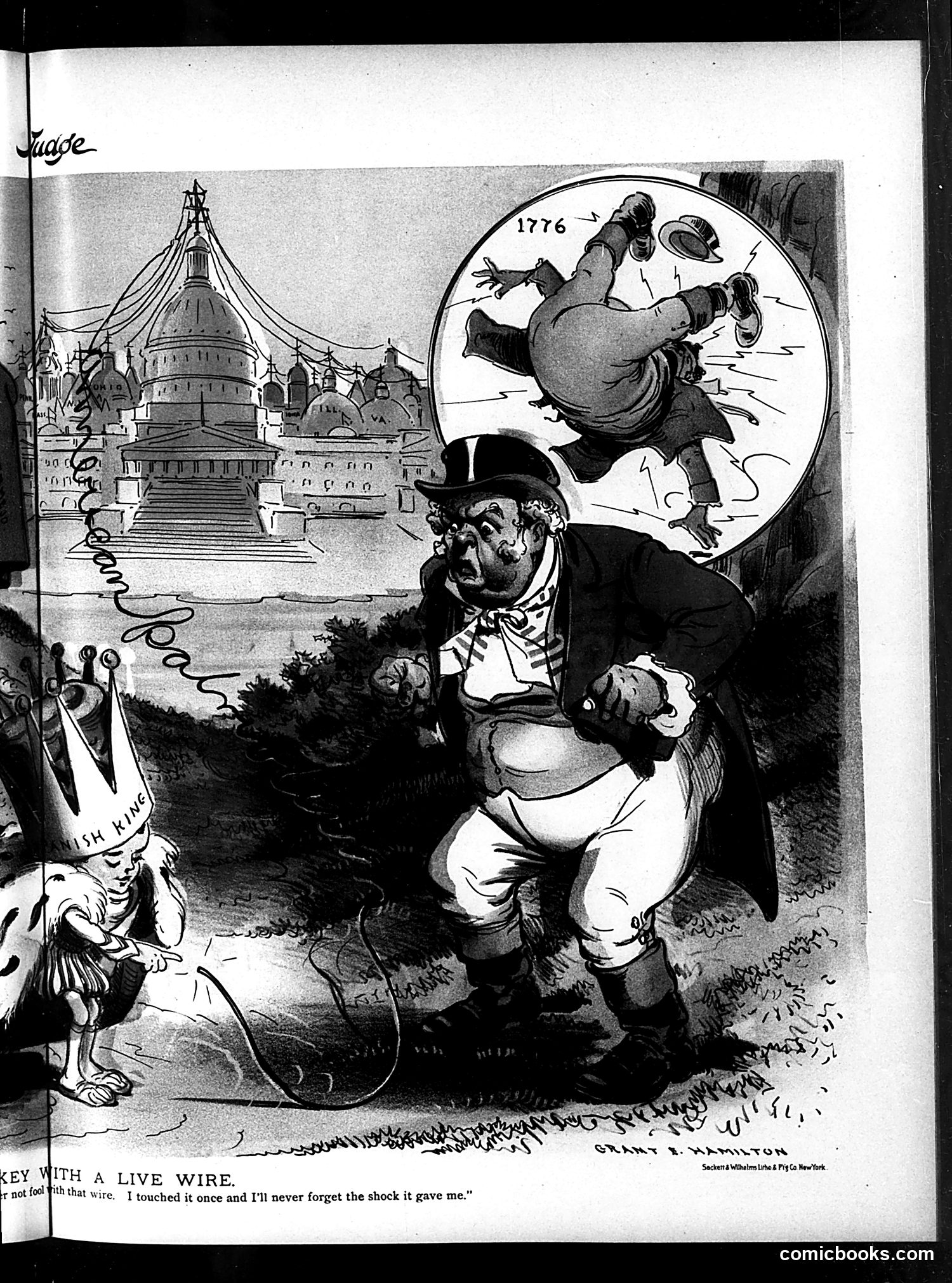
This political cartoon satirizes a prominent figure (caricatured with exaggerated features) who appears to be associated with a "live wire"—a metaphor for dangerous, unpredictable conduct. The image shows him being shocked or caught by electrical current, with a vision bubble dated 1776 depicting a figure being launched from the Capitol building, suggesting chaos or upheaval affecting American institutions. The figure on the left labeled "IRISH KING" appears to reference Irish-American political influence. The cartoon warns against engaging with someone volatile and dangerous, using the "live wire" metaphor to suggest their involvement causes destructive consequences for the nation. Without clearer identification, the specific target remains unclear, though the 1776 reference suggests commentary on threats to American founding principles.
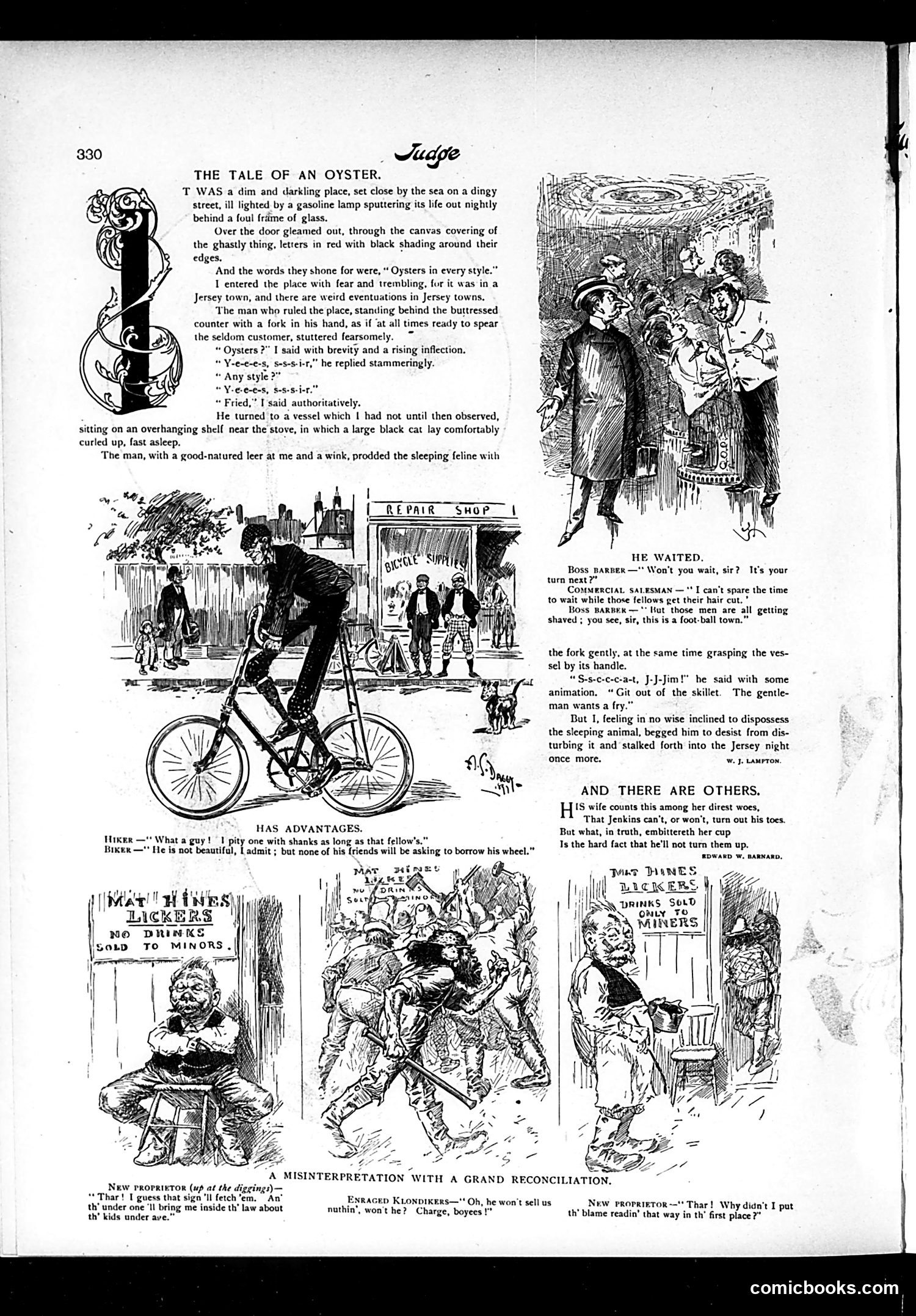
This page contains several satirical sketches typical of Judge magazine's humor: **"The Tale of an Oyster"** (main story by W.J. Lampton): A humorous narrative about visiting a disreputable Jersey oyster bar. The proprietor, depicted with a stammer, attempts to cook a cat sleeping in a skillet, mistaking it for cookware. The joke relies on the dingy, unsanitary conditions of the establishment and the absurd horror of nearly serving feline instead of oyster. **Secondary cartoons** mock various social types: a barber complaining about slow business in a "foot-ball town"; criticisms of wives' complaints about husbands' physical traits; and a sketch about mining camp proprietors whose poorly-worded signs ("No Drinks Sold to Miners") initially discourage business until reworded. The humor is typically turn-of-century American: focused on class mockery, regional stereotypes (Jersey towns, mining camps), domestic squabbles, and absurdist situations. The satire targets poor establishments, social pretension, and human folly rather than specific political figures.
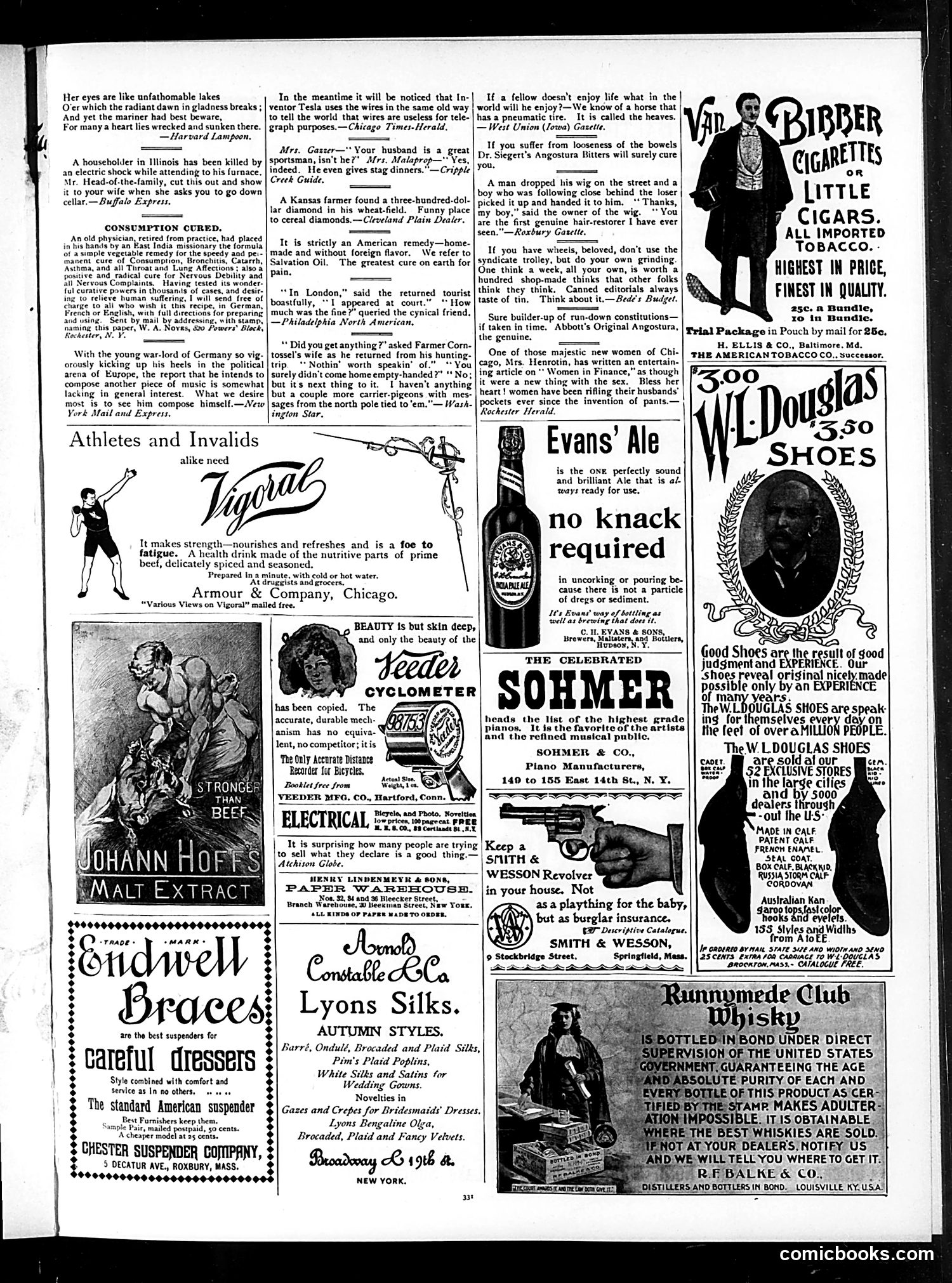
This is primarily a **advertisements and miscellaneous humor page** from Judge magazine, featuring vintage product ads and brief joke items rather than political cartoons. The short humorous pieces are genteel, conversational jokes typical of the era: - A husband electrocuted attending the furnace (warning husbands about domestic tasks) - Tesla's irony: he uses wires while claiming they're useless - A Kansas farmer finding diamonds in wheat (absurdist humor) - A tourist claiming he "appeared at court" in London—the joke being he paid a fine The advertisements reflect **late 19th/early 20th-century products**: Vigoral beef extract for athletes, bicycle speedometers, shoe polish, whisky, and suspenders. One brief topical reference: the "young war-lord of Germany" (likely Kaiser Wilhelm II) is mentioned—the writer hopes he'll "compose himself" rather than write more music, a light jab at his political aggression. The page contains **no substantive political satire or caricatures**—it's essentially filler material typical of magazine layout from this period.
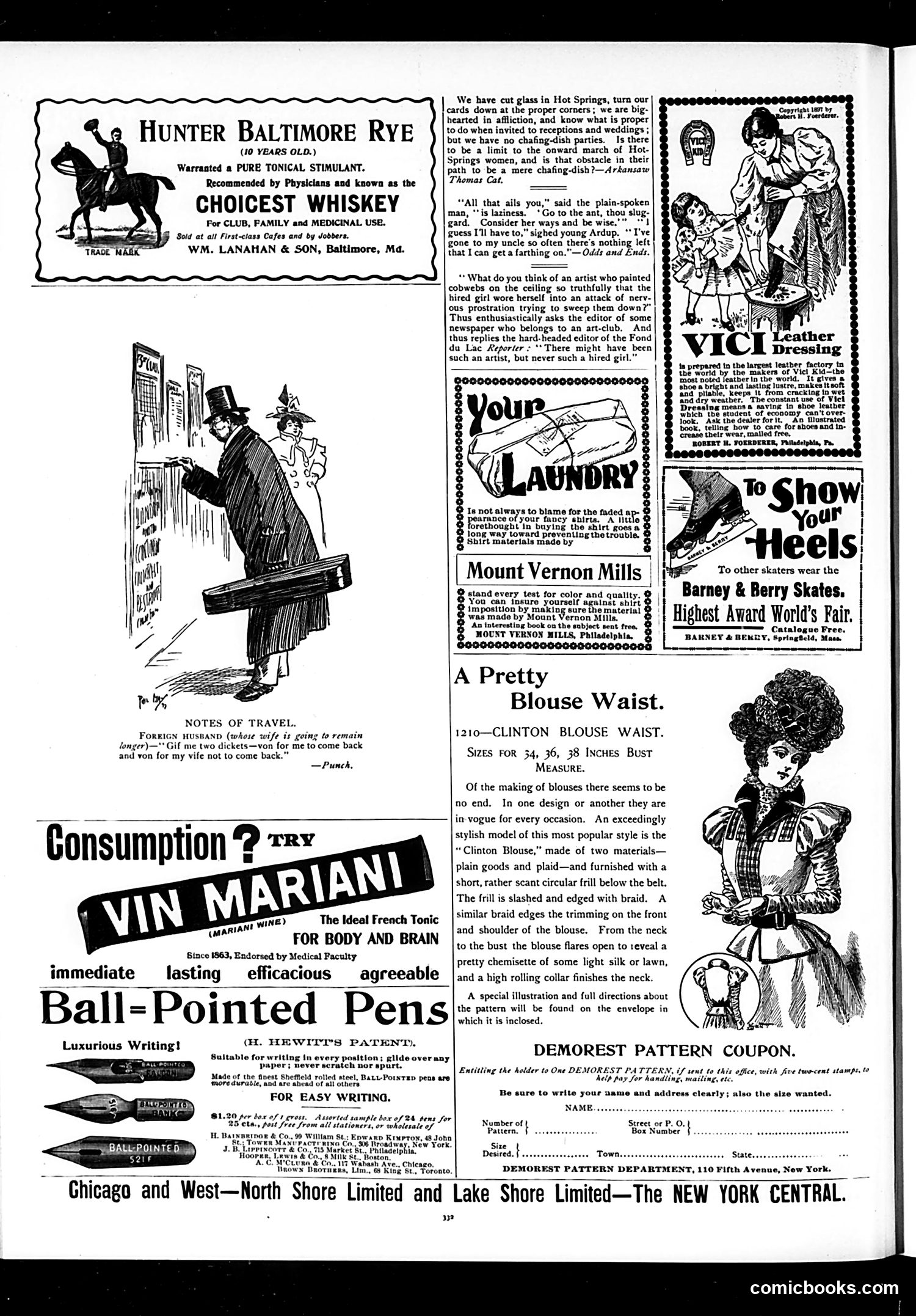
This page is primarily **advertising**, typical of late-19th/early-20th-century American magazines. The few editorial cartoons present are brief satirical jokes: **"Notes of Travel"** cartoon depicts a foreign husband (indicated by accent in caption) buying train tickets—one for himself to return home, one for his wife *not* to return. The joke mocks marital discord and the stereotype of unhappy European marriages. The other small cartoons make quick social jabs: one about laziness and poverty (a man named "Ardup" borrowing from relatives), another about a naive hired girl deceived by realistic ceiling cobwebs in a painting. **The bulk of the page** consists of period product advertisements: whiskey marketed as medicinal, laundry starch, ice skates, leather dressing, ball-point pens, and a Demorest sewing pattern for a "Clinton Blouse Waist." These ads reveal consumer culture and gendered marketing of the era—women are targeted for fashion/domestic products, men for tonics and writing instruments. The content reflects Judge's formula: brief satirical commentary mixed with revenue-generating advertisements.
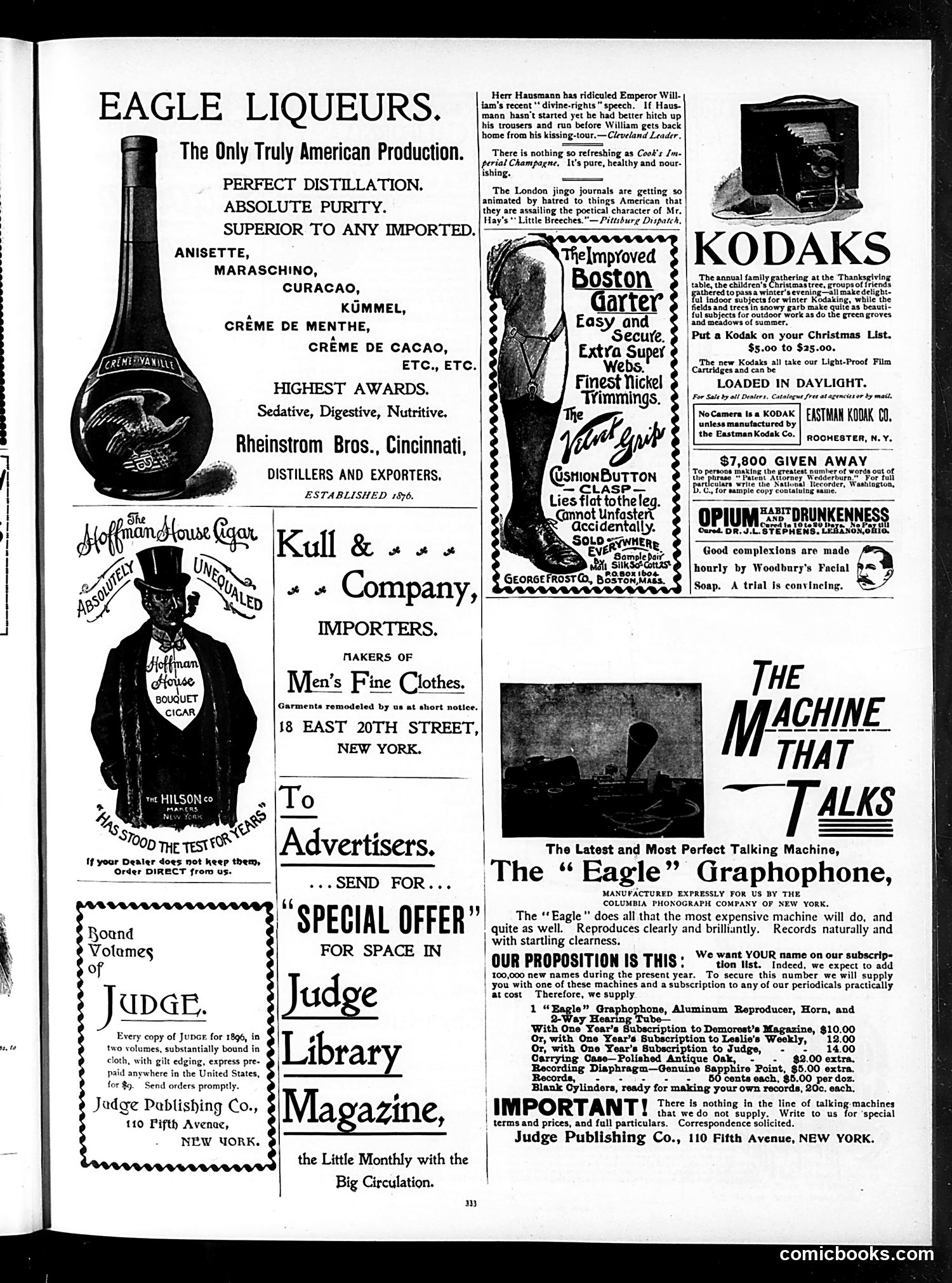
This is primarily an **advertising page** from Judge magazine (circa 1896, based on the bound volumes reference). The page contains minimal editorial content—only one brief satirical note. ## The Satire The single political reference mocks **German Emperor Wilhelm II**. A columnist reports that Herr Hausmann ridiculed Wilhelm's recent "divine-right" speech, joking that Hausmann better "hitch up his trousers and run" before the Emperor returns from his "kissing-tour." The humor targets Wilhelm's authoritarian pretensions and his well-documented habit of extensive foreign diplomacy tours. ## The Advertisements The bulk of the page advertises liqueurs (Eagle Liqueurs by Rheinstrom Bros.), men's clothing (Kull & Company), cigars (Hoffman House), photography equipment (Kodak cameras), and consumer products (graphophones, soap, Judge magazine subscriptions themselves). The **Eagle Graphophone** advertisement notably uses patriotic language—"The Machine That Talks"—emphasizing it as American-manufactured by Columbia Phonograph Company. This reflects Judge's dual nature: satirical commentary mixed with commercial advertisements targeting educated, affluent readers.
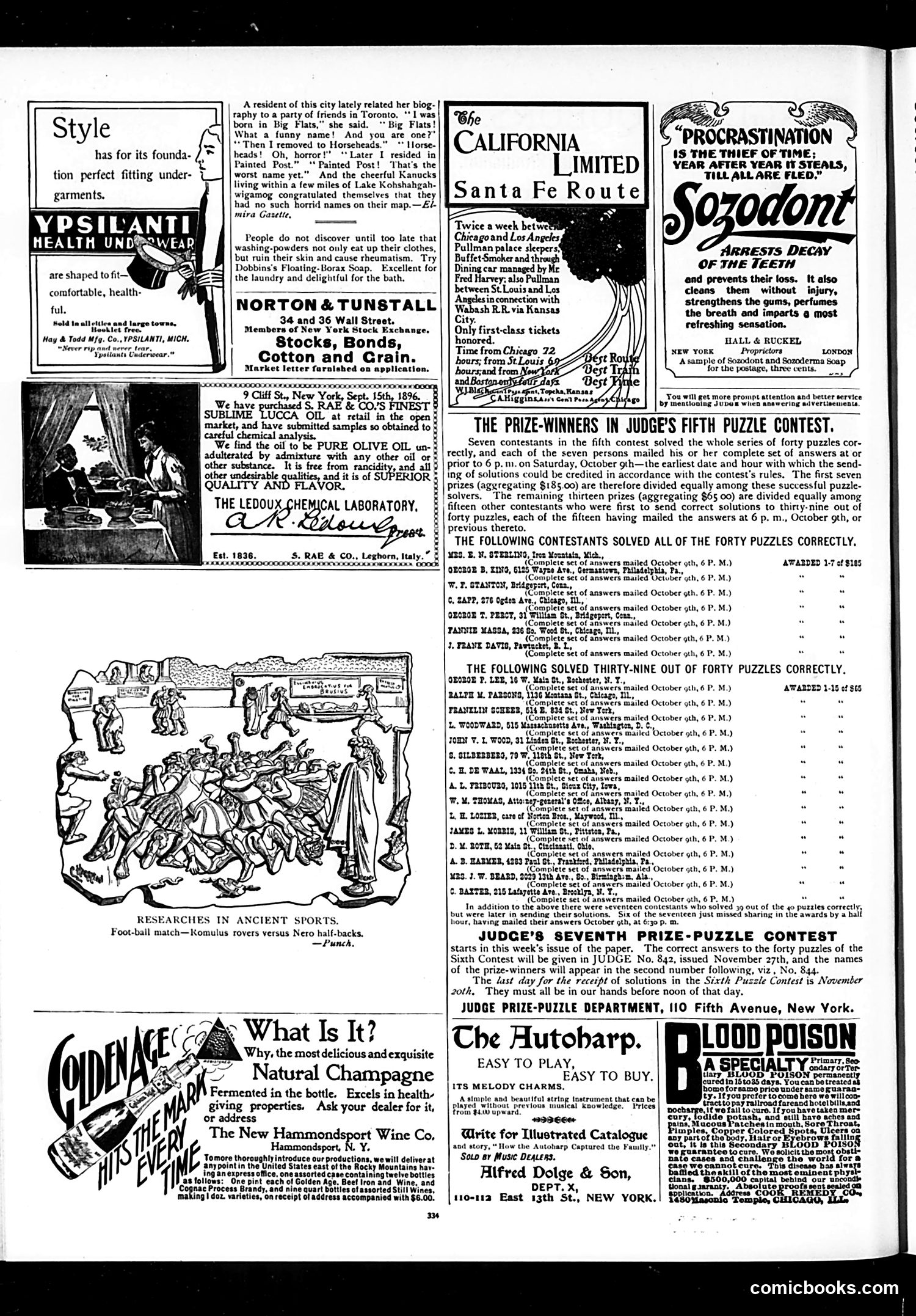
This is primarily a **commercial advertising page** rather than satirical content. The page features various product advertisements typical of late-19th-century magazines: health underwear, olive oil, wine, soap, and dental products. The one genuine humorous piece is a brief anecdote about a woman from "Big Flats" who later moved to "Horseheads"—mocking absurdly-named American towns. Canadian friends allegedly found these names ridiculous, providing gentle satirical commentary on American geography's peculiar nomenclature. The page also announces Judge's puzzle contest winners, offering monetary prizes to readers who solved riddles correctly—a common engagement strategy for magazines of this era. The illustrations are generic commercial imagery and a classical sports reference ("Researches in Ancient Sports") rather than political or social satire. This represents Judge's business side: selling advertising space and promoting reader contests to boost circulation and engagement.
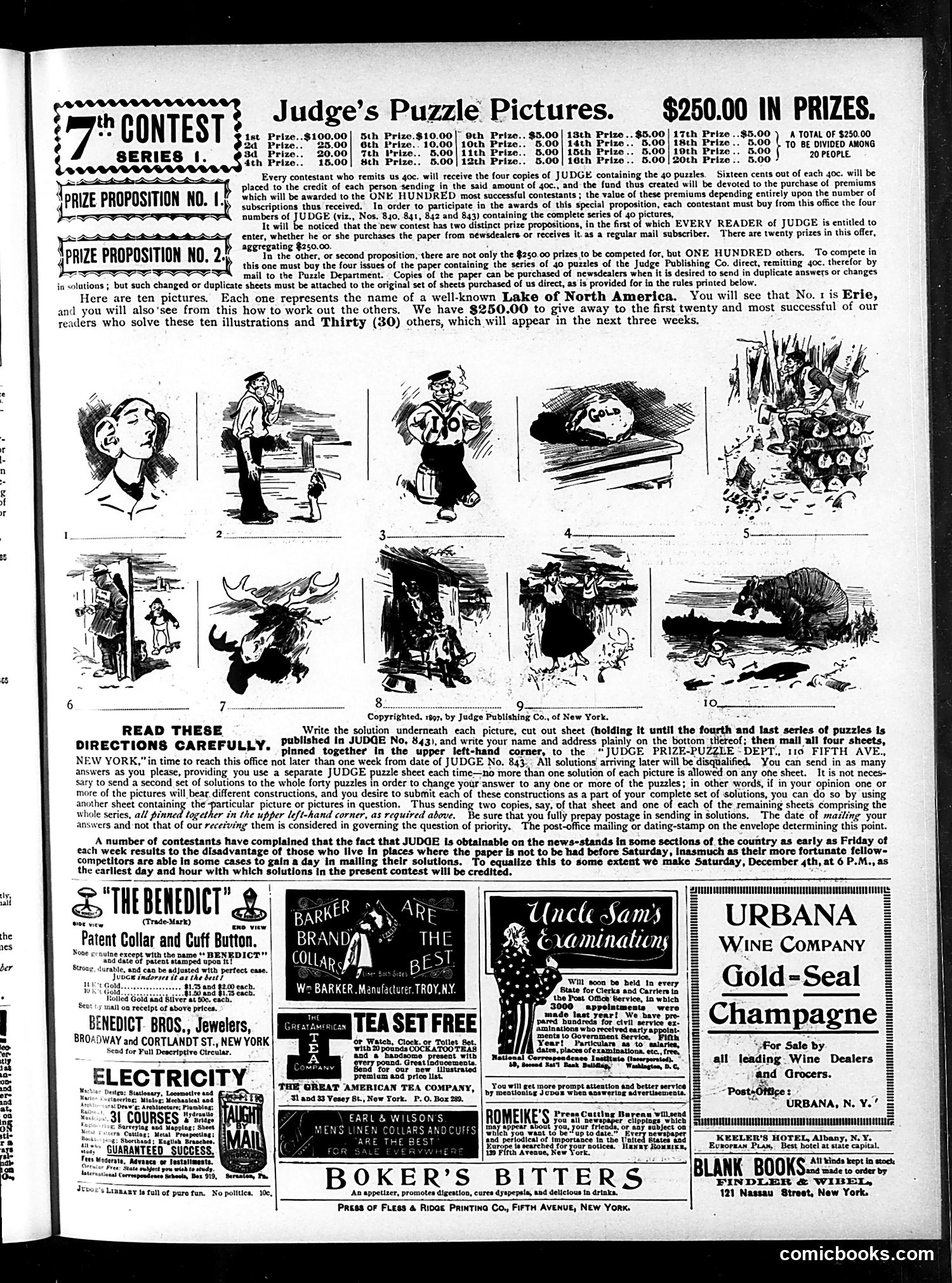
This page announces Judge magazine's "7th Contest Series" — a puzzle competition offering $250 in prizes. Readers must identify ten North American lakes from cartoon illustrations; the example shows picture #1 depicts "Erie" (a man's face in profile, playing on the sound of the name). The contest operates on two propositions: one open to any JUDGE reader buying the paper normally, offering twenty $250-distributed prizes; another requiring direct mail subscription ($0.40) to compete for those prizes *plus* one hundred additional awards. The ten illustrated lake-name puzzles shown are visual puns or rebus-style riddles — readers must decipher which lake each cartoon represents. Thirty additional puzzles would appear in subsequent issues over three weeks. This reflects late-19th-century popular entertainment: puzzle contests and wordplay were common magazine features, and the tiered prize structure encouraged both casual readership and direct subscriptions — a circulation-building strategy typical of the era.
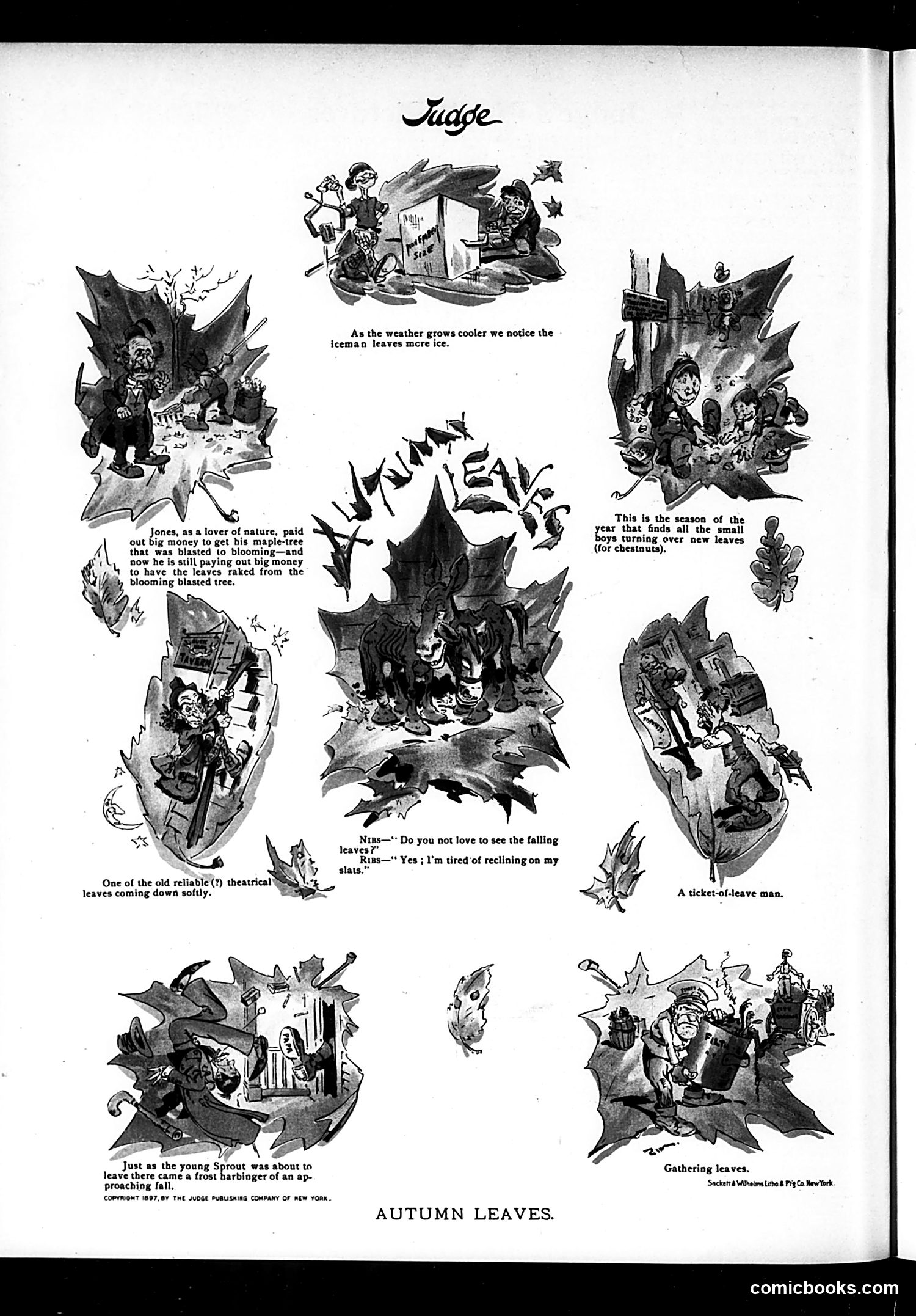
This page uses autumn leaf-fall as a framework for social satire. The central jokes mock various character types and situations: **The wealthy man** who spent lavishly to make his maple tree bloom in spring now pays again to rake fallen leaves—absurd circular waste. **"Small boys turning over new leaves (for chestnuts)"** puns on the moral phrase about reformation; they're just after chestnuts, not self-improvement. **The theatrical performer** complains about reclining on theater seats with broken slats while romanticizing falling leaves—preferring nature to uncomfortable working conditions. **The young "Sprout"** nearly gets hit by a frost before escaping—personifying youth fleeing autumn's hardship. The overall theme: autumn's beauty masks discomfort and expense. The leaf-bursting imagery emphasizes chaotic, explosive disorder. This reflects late-19th-century Judge's satirical style, mocking pretension, greed, and the gap between romanticized nature and practical human experience.