
A complete issue · 16 pages · 1897
Judge — October 23, 1897
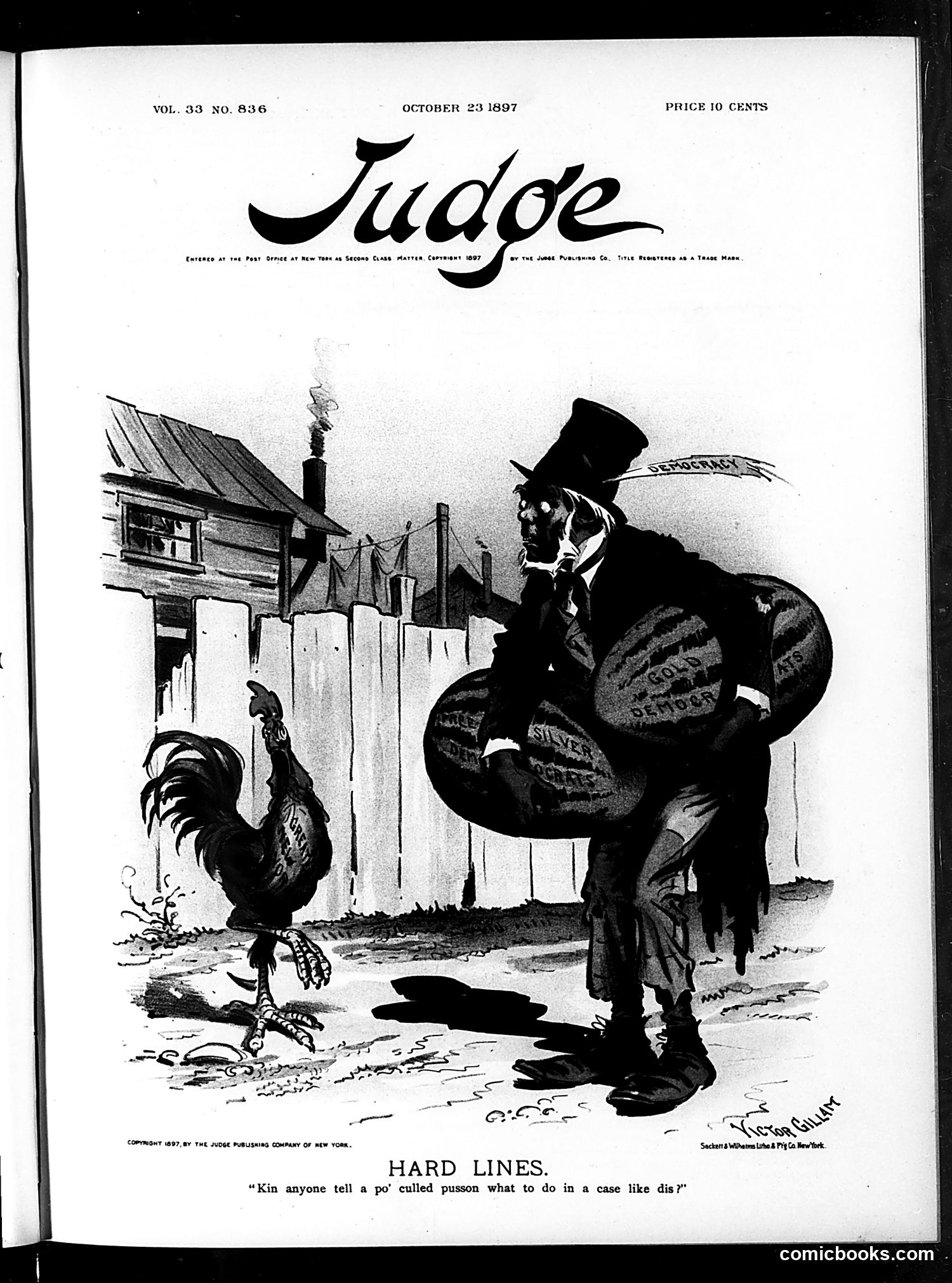
This political cartoon depicts a well-dressed man in a top hat labeled "Democracy" carrying heavy sacks marked with what appear to be political or social burdens. He confronts a rooster—a traditional symbol of France or French politics. The caption reads: "Kin anyone tell a po' called pusson what to do in a case like dis?" (dialect speech, common in 1890s satire) The cartoon appears to satirize American democracy struggling under political or economic hardships of the 1890s era. The rooster likely represents French interference or influence. The man's distressed, impoverished appearance contrasts with his formal dress, suggesting democracy's compromised state. The overall message critiques democratic governance facing difficult circumstances during this period.
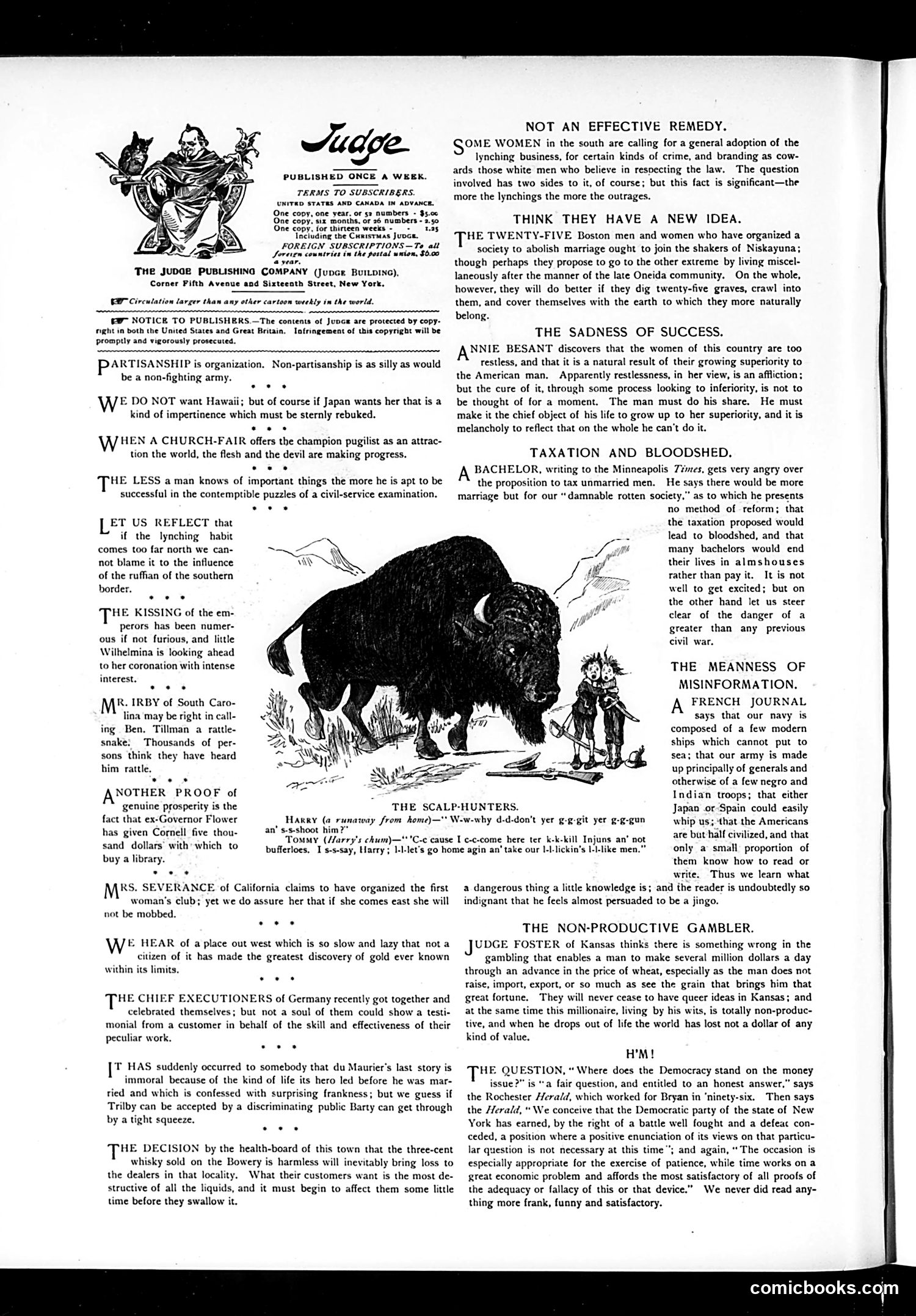
This cartoon depicts two Native American figures (labeled "Harry" and "Tommy") discussing scalp-taking, with a caption presenting their dialogue as comedic gibberish. The accompanying article criticizes a French journal for spreading misinformation about America—claiming the U.S. has few modern ships, a weak army, and is "only half civilized." The cartoon's satire operates on two levels: it mocks both the stereotype of Native Americans as "savage scalp-hunters" (reinforcing period prejudices) while simultaneously using this imagery to satirize European criticisms of American civilization. The irony is that Judge uses dehumanizing caricature to defend American sophistication against European condescension—a common rhetorical move in American periodicals of this era.
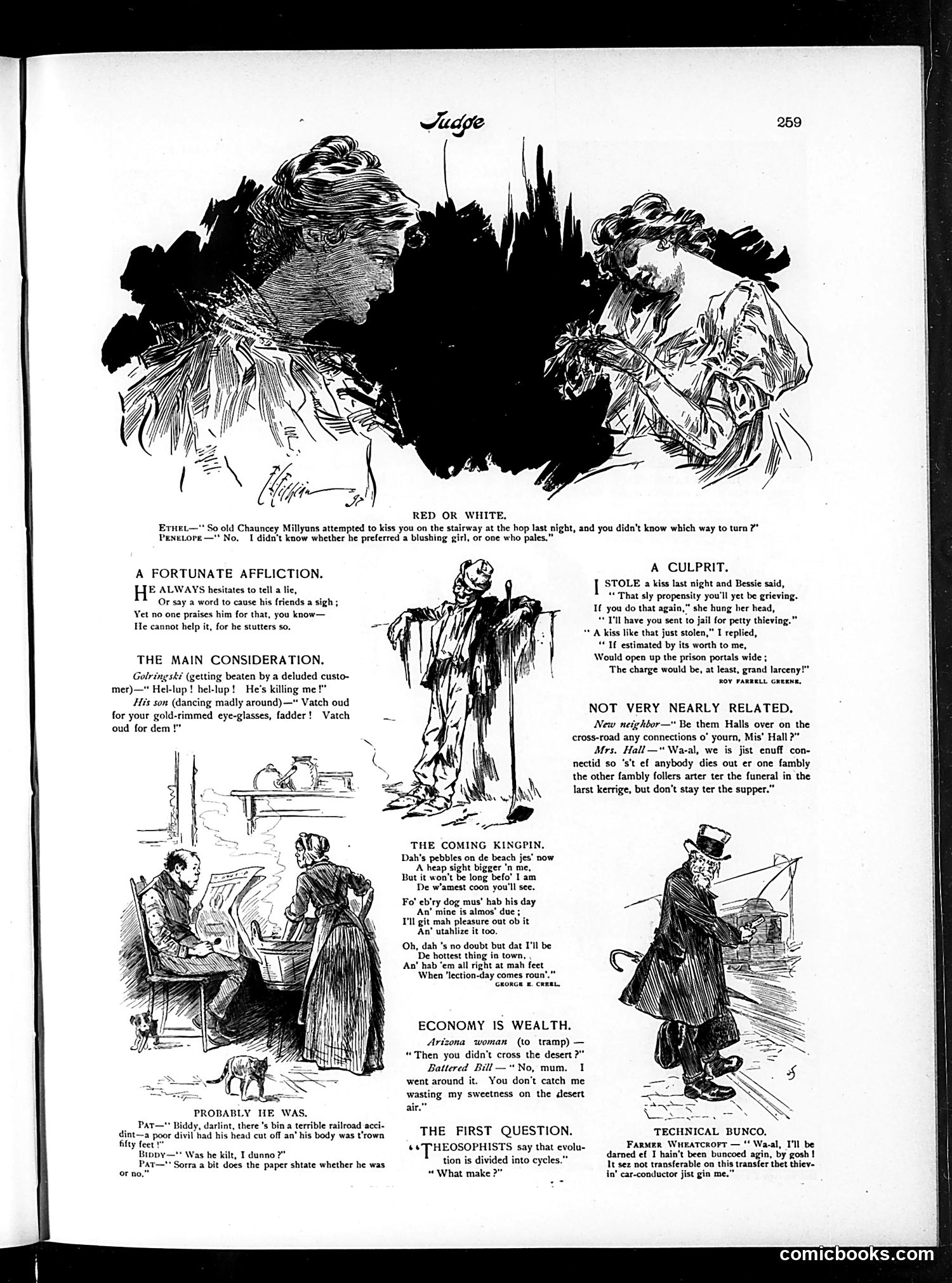
This page contains multiple brief humorous sketches and jokes typical of Judge's satirical format. The top illustration labeled "RED OR WHITE" depicts a social encounter at a hop (dance), with the joke about mistaking a girl's identity. The sketches below address various social topics: "THE MAIN CONSIDERATION" mocks a man's priorities regarding eyeglasses; "PROBABLY THE WAR" presents dialogue about a railroad accident; "A FORTUNATE AFFLICTION" jokes about hesitation in lying; "A CULPRIT" involves theft accusations; "NOT VERY NEARLY RELATED" discusses family connections; "THE COMING KINGPIN" contains verse about ambition; "ECONOMY IS WEALTH" presents a desert crossing anecdote; "THE FIRST QUESTION" references Theosophist philosophy; and "TECHNICAL BUNCO" discusses electrical conductors. The humor targets contemporary social pretensions, domestic situations, and everyday absurdities rather than specific political figures.
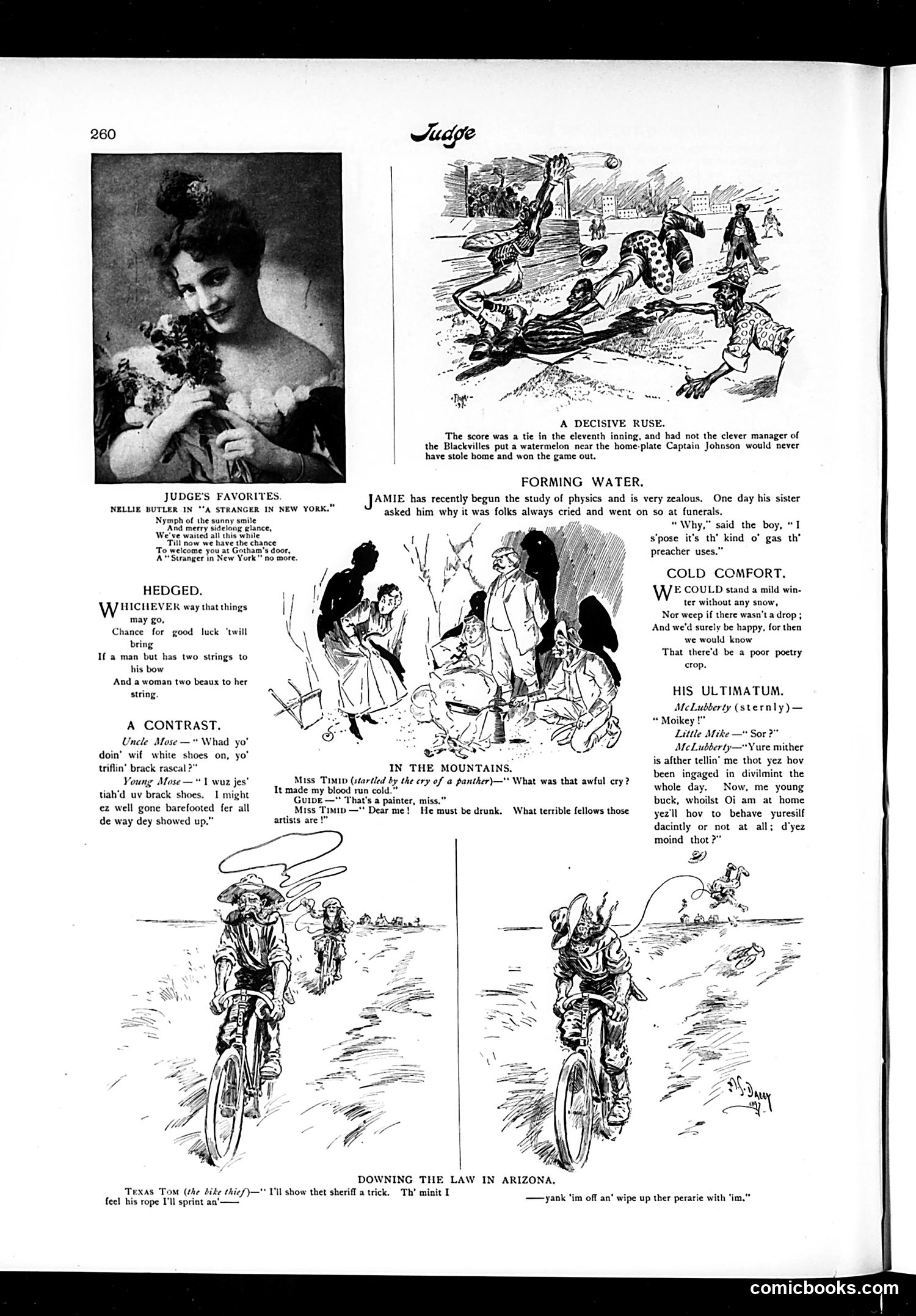
This page from *Judge* (early 1900s) contains mostly humor pieces and light satirical sketches rather than political commentary: **"Judge's Favorites"** celebrates actress Nellie Butler in a Broadway play—typical celebrity coverage for the magazine. **"Hedged," "A Contrast,"** and **"Cold Comfort"** are brief humorous verses about romance, racial dialect humor (common but now offensive), and poetry. The cartoon sketches feature everyday absurdities: a woman mistaking a panther's cry for a drunk "painter"; Jamie's misunderstanding of funeral crying as "preacher gas"; a baseball manager using a watermelon to distract opposing players; and an Irish father (McLubberty) scolding his mischievous son. **"Downing the Law in Arizona"** depicts a cyclist ("Texas Tom") evading a sheriff—likely referencing the bicycle craze of the era as comic material. The page prioritizes gentle domestic humor and wordplay over political satire, reflecting *Judge*'s entertainment-focused editorial direction during this period.
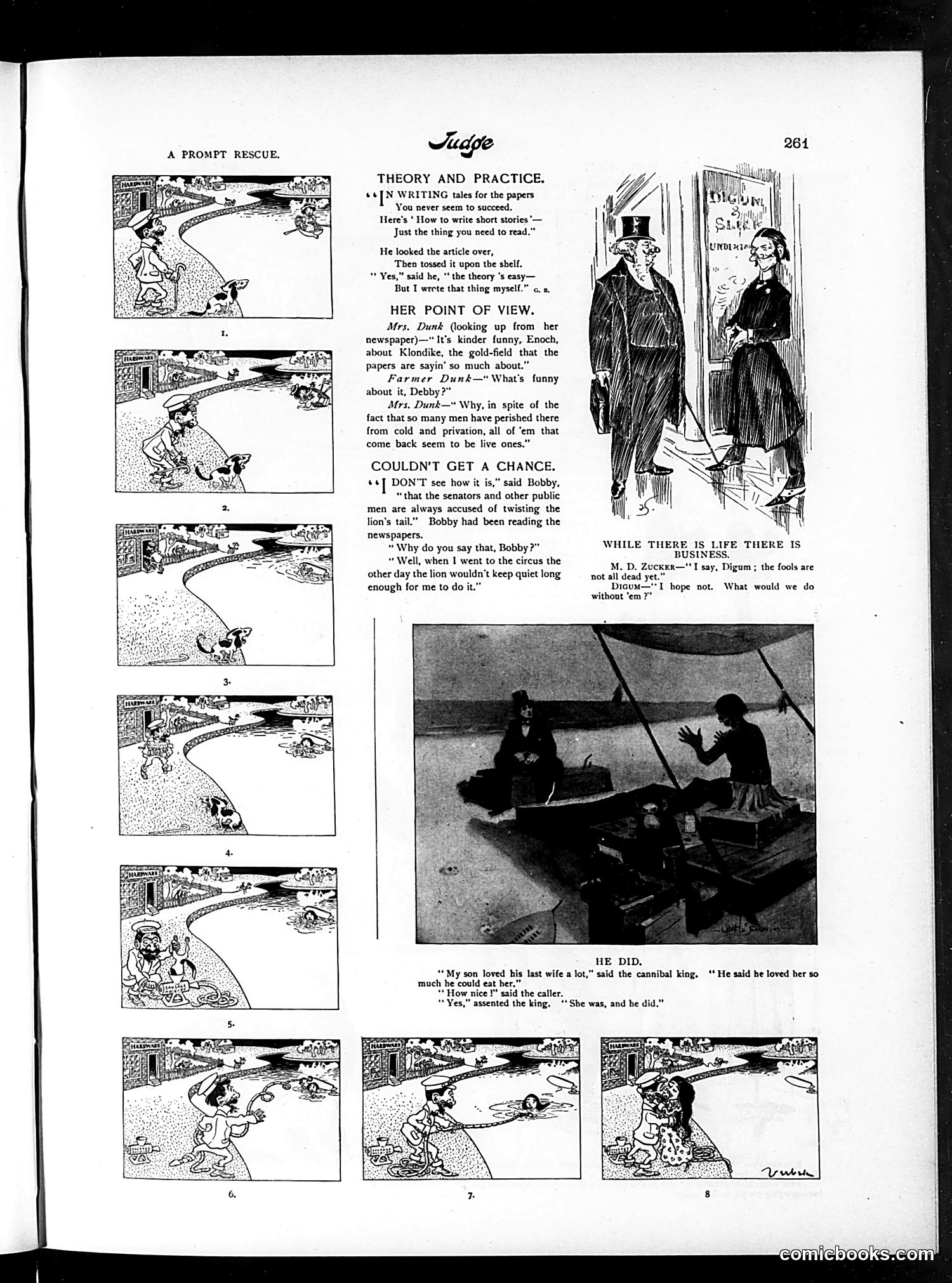
This page contains several brief satirical pieces typical of Judge magazine's humor: **"Theory and Practice"**: Mocks writing advice literature—a man reads an article on "how to write short stories" but ironically admits he wrote the very book being recommended to him. **"Her Point of View"**: Rural couple (Mr. and Mrs. Dunk) discuss the Klondike Gold Rush (1890s). Mrs. Dunk finds it absurd that despite reports of deaths from cold and hardship, all returning prospectors claim to have survived—an obvious logical contradiction presented as folk wisdom humor. **"Couldn't Get a Chance"**: A boy misinterprets the phrase "twisting the lion's tail" (a political idiom meaning to provoke/antagonize someone, often Britain). He literally thought politicians were physically twisting a circus lion's tail. **"While There Is Life There Is Business"**: A dark joke about a cannibal king whose wife was so delicious he ate her—presented as romantic devotion ("he said he loved her"). The page exemplifies Judge's style: wordplay, misunderstandings, rural naïveté, and macabre humor.
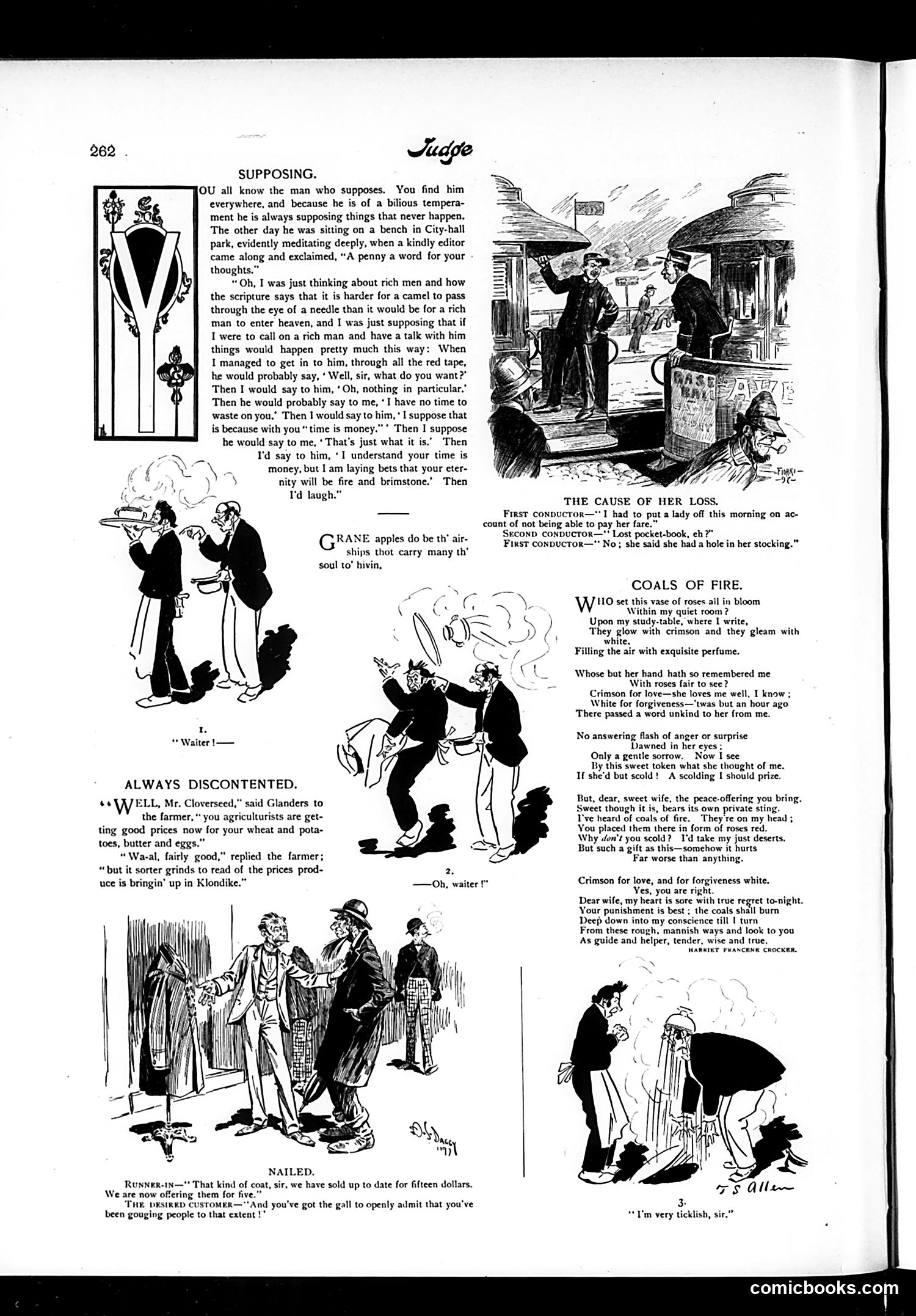
This page contains several satirical pieces typical of early 20th-century American humor: **"Supposing"** mocks a pessimistic character who imagines worst-case scenarios—specifically, a confrontation with a wealthy man about biblical teachings on wealth and the afterlife. The satire targets both the "supposer's" fatalism and implicit criticism of rich men's materialism. **"Always Discontented"** ridicules a farmer who complains about local produce prices despite good current earnings, fixating instead on distant Klondike gold-rush profits. It satirizes perpetual human discontent. **"Nailed"** shows a shopkeeper caught in a contradiction—admitting he previously overcharged customers. **"Coals of Fire"** is a sentimental poem about a husband receiving roses (red for love, white for forgiveness) from his wife after an unkind word. Rather than scolding him, her gentle gesture causes deeper remorse—"coals of fire" referencing Biblical punishment through kindness. The minor jokes about conductors and stocking holes provide light filler. Overall, the page blends cynical social commentary with Victorian-era sentiment about domestic virtue.
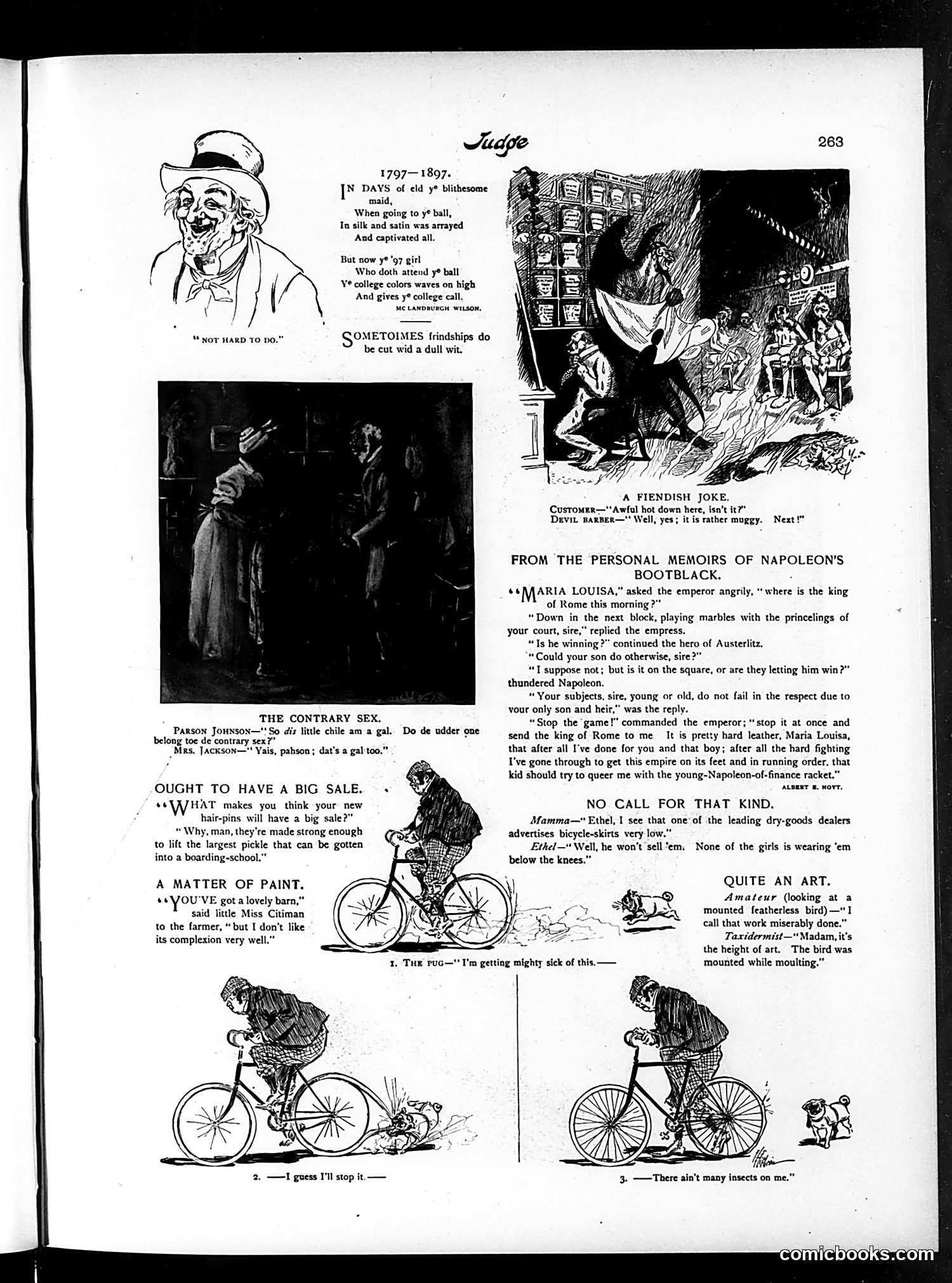
This page from Judge (circa 1897) collects various satirical sketches and jokes reflecting turn-of-the-century American social anxieties: **"1797-1897" poem**: Contrasts demure women of 1797 with the "modern" 1897 college girl—who wears college colors and gives rousing cheers. This mocks the emerging "New Woman" of the 1890s: educated, athletic, and socially independent. **"Bicycle-Skirts" joke**: References the scandal of women cyclists wearing shortened skirts (above the knee), considered shockingly immodest. The mother notes a shopkeeper advertises them "very low" (cheap), but Ethel reports no respectable girl would wear them that short—satirizing both the moral panic and the persistence of the fashion. **Other sketches** include absurdist humor about hair-pins, barn paint, and a farcical "Napoleon" anecdote where the emperor worries his heir is cheating at marbles. The cartoons reflect fin-de-siècle preoccupations with changing gender roles, new technologies (bicycles), and generational conflict—wrapped in Judge's characteristic irreverent tone.
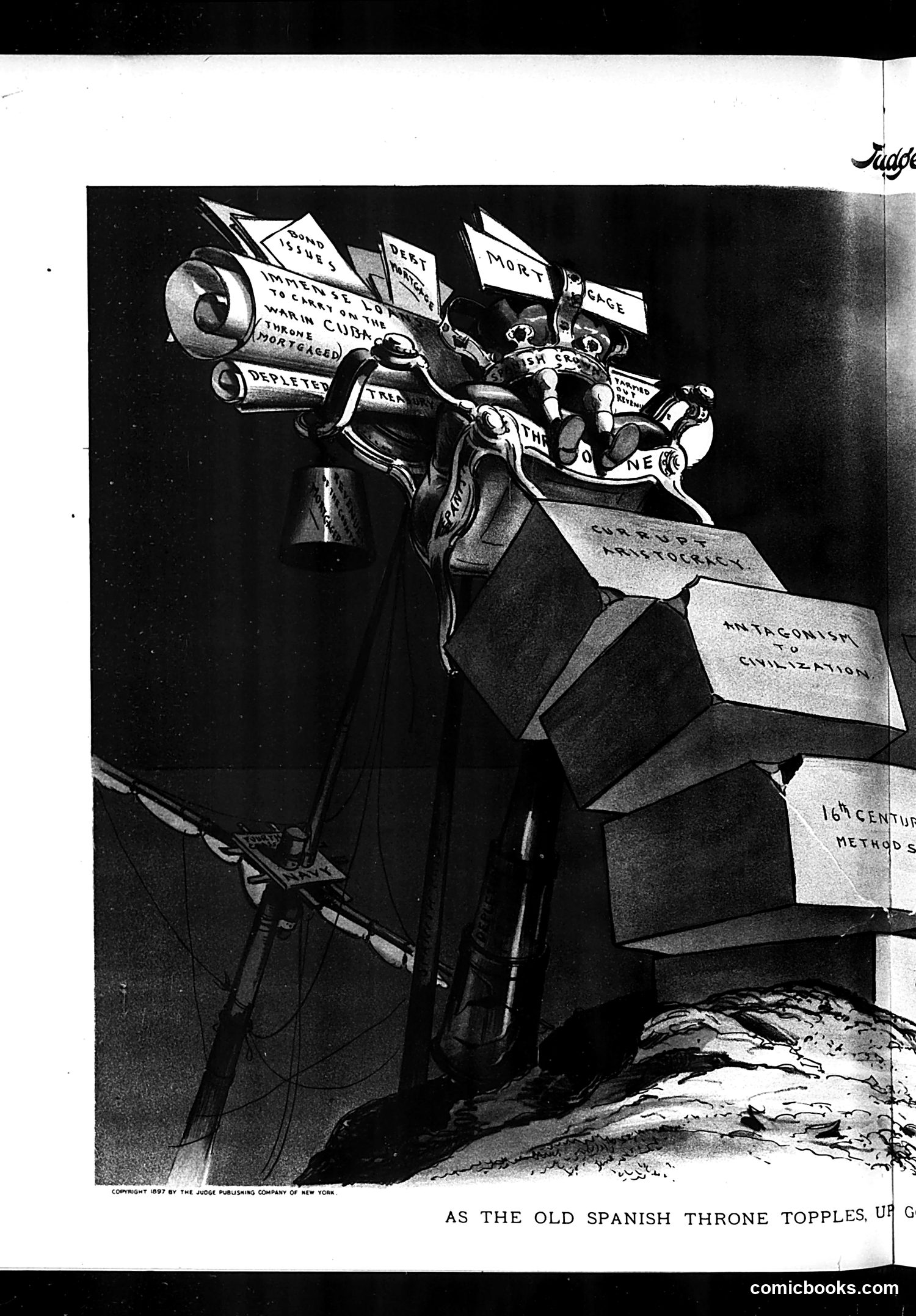
This political cartoon depicts the collapse of Spain's monarchy, as indicated by the caption "As the Old Spanish Throne Topples." The image shows an ornate throne or seat of power literally crumbling and falling apart, with various labeled boxes and objects tumbling down, representing institutions and policies associated with Spanish rule. The scattered labels reference specific governmental concerns—visible text includes references to "antagonism to civilization" and "16th century methods"—suggesting the cartoon critiques Spain's government as archaic and backwards-looking. This likely comments on Spain's political instability during the early 20th century, possibly relating to the Spanish-American War (1898) or subsequent internal Spanish conflicts. The satire mocks Spain's outdated governance as fundamentally unstable and destined for collapse.
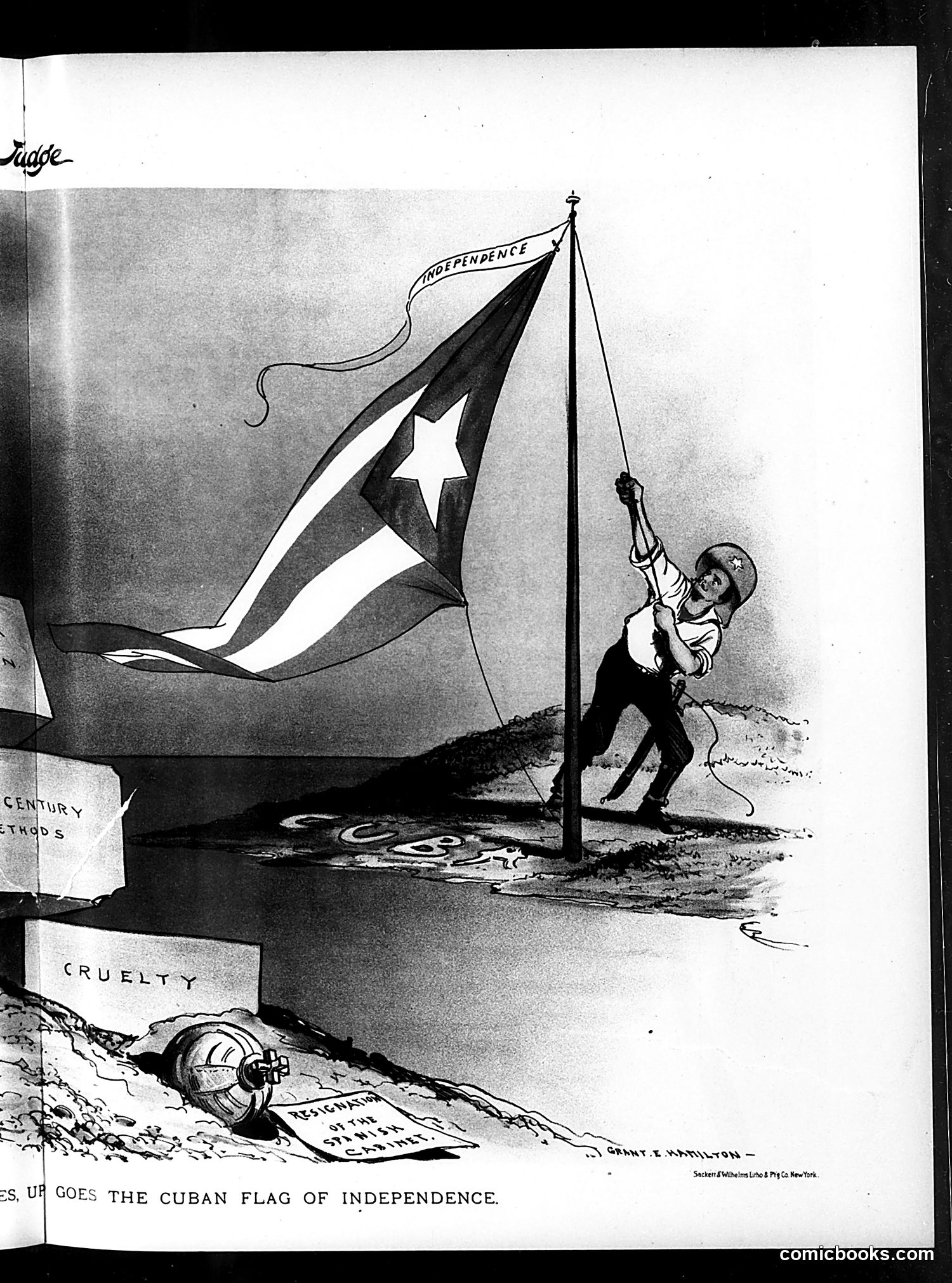
This political cartoon satirizes American intervention in Cuba. A figure (likely representing American political interests or imperialism) struggles to raise the Cuban flag of independence while surrounded by obstacles labeled "Cruelty" and "Century of Methods" — references to Spain's brutal colonial rule. The banner reading "Independence" waves above, but the heavy weight of the flag-pole and surrounding rubble suggest the difficulty of achieving true independence. The satire appears critical of whether Cuban independence can genuinely succeed given the obstacles and foreign interference. Created during Judge magazine's run, this likely comments on the Spanish-American War era (1898) and questions whether Cuba would achieve meaningful self-governance or simply exchange Spanish colonialism for American control.
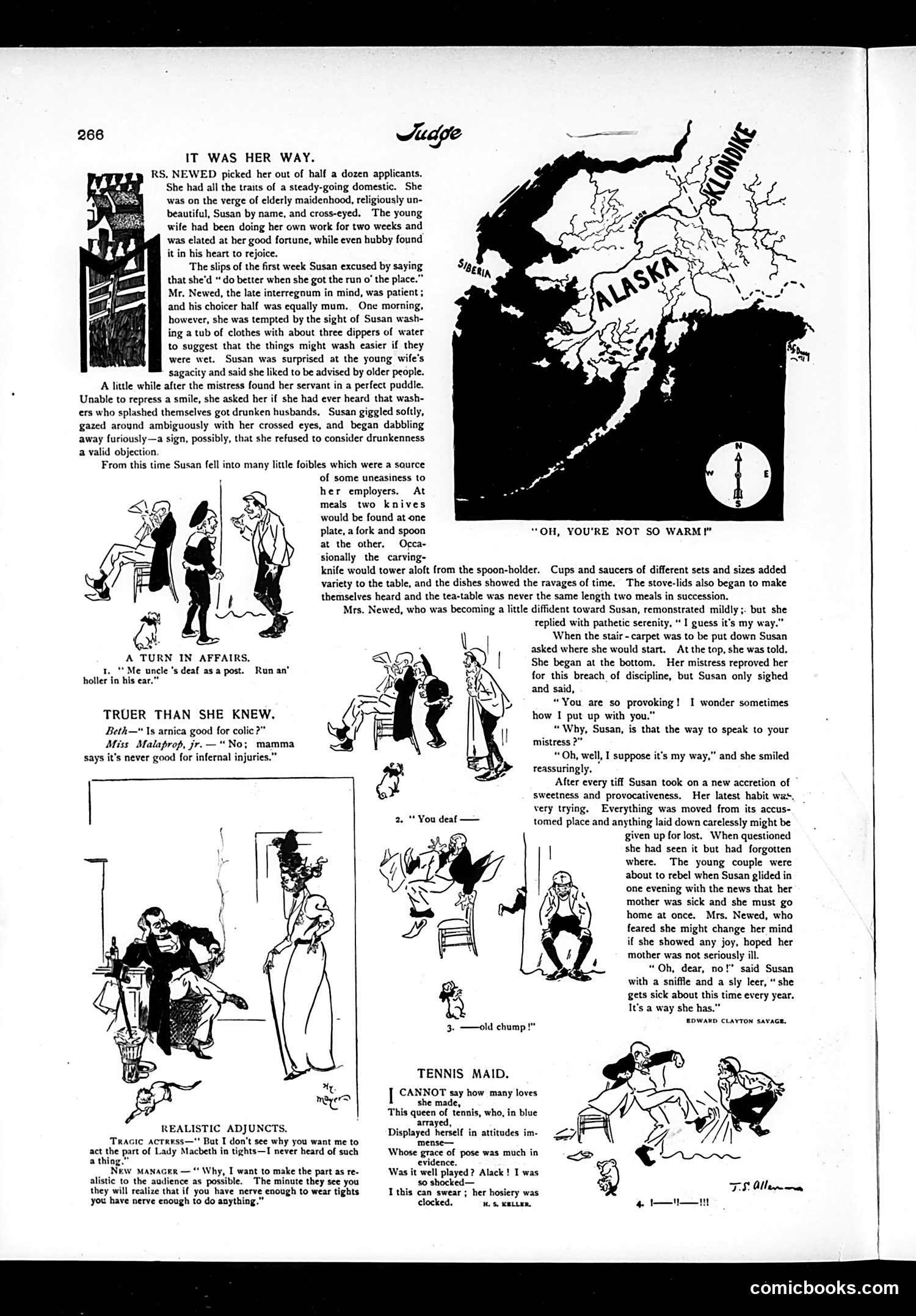
This page contains multiple satirical pieces poking fun at domestic servants and their employers in what appears to be early 20th-century America. The main story, "It Was Her Way," depicts Susan, a cross-eyed servant hired by a young couple. She repeatedly makes mistakes—using too little water to wash clothes, setting tables incorrectly, laying carpets backwards—but excuses everything with "I guess it's my way." The satire mocks both Susan's stubborn incompetence and the employers' ineffectual complaints. The humor relies on class dynamics: the "respectable" young wife and husband are outsmarted by their servant's passive-aggressive stubbornness. Secondary cartoons include "A Turn in Affairs" (about a deaf uncle), "Truer Than She Knew" (a malapropism joke), "Tennis Maid" (satirizing athletic women), and "Realistic Adjuncts" (about stage acting). The Alaska map appears decorative/contextual but isn't clearly explained by the visible text. Overall, the page targets domestic employment frustrations and servant-employer class tensions common to the era.
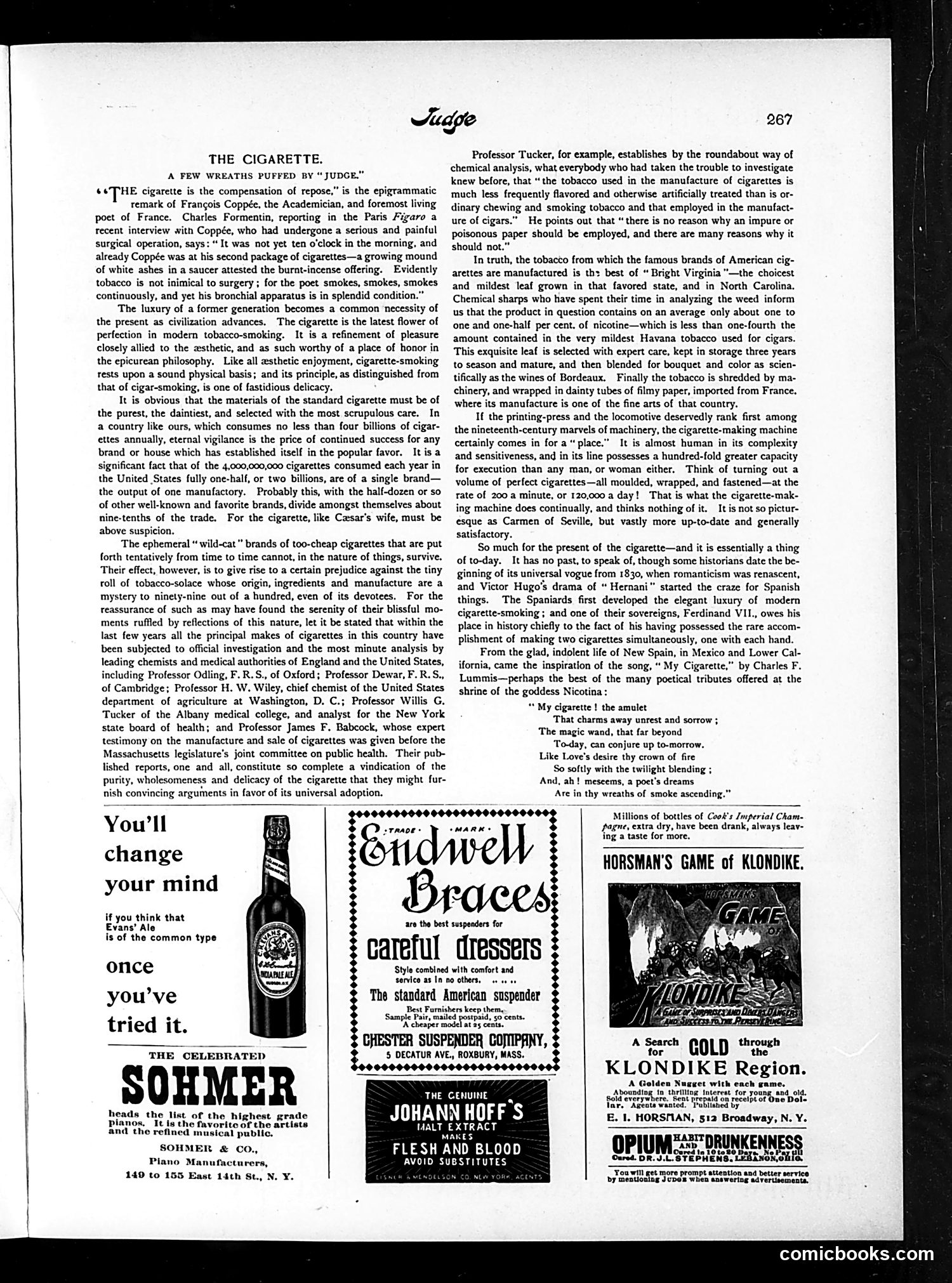
This page is primarily a **pro-cigarette editorial essay** rather than a political cartoon. The text defends cigarette smoking as refined and healthful, citing French poet François Coppée's devotion to cigarettes and endorsing their "fastidious delicacy." The article argues that cigarettes deserve consumer trust because major brands have been tested by prestigious scientists including professors from Oxford, Cambridge, and U.S. agricultural/medical authorities. It dismisses cheap "wild-cat" brands while defending established manufacturers. **The satire's target is unclear from the text alone**, but Judge appears to be earnestly advocating for cigarette consumption as an aesthetic luxury—a position that reads strangely today given tobacco's documented harms. The essay seems either genuinely pro-tobacco or possibly ironic, though the numerous scientific endorsements cited suggest sincere advocacy rather than satire. The page includes period advertisements for beer, suspenders, and pianos—standard magazine filler.
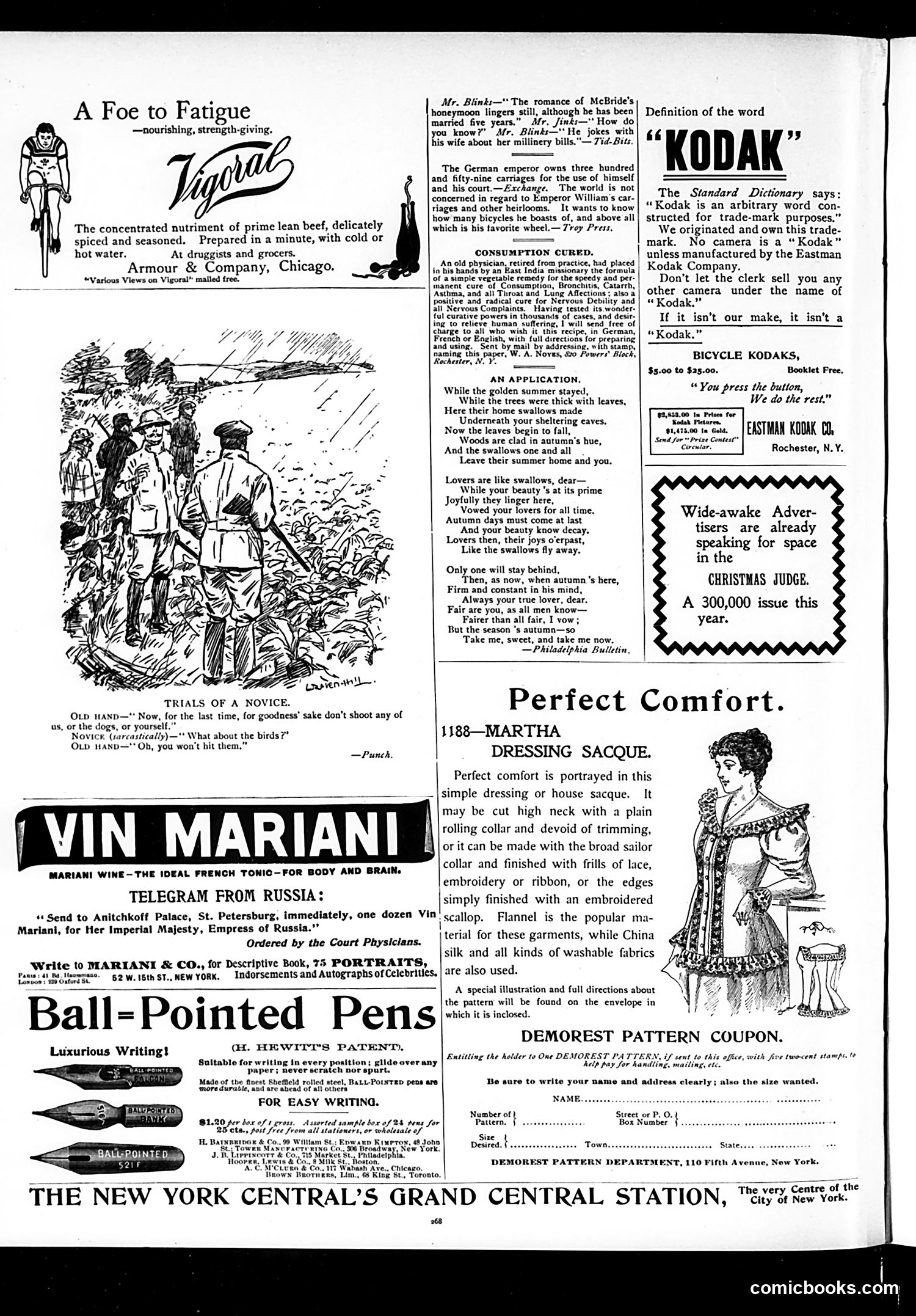
This page is primarily **advertising with minimal editorial content**. The cartoons present are brief, conventional humor: **"Trials of a Novice"** depicts a hunting scene where an experienced hunter instructs a novice not to shoot people, dogs, or himself—then dismisses concerns about hitting birds with "you won't hit them." The joke relies on the novice's incompetence as a marksman. **Other brief gags** include jokes about a husband's five-year marriage (still joking about his wife's millinery bills) and German Emperor William II's carriages—mocking European aristocratic excess while suggesting readers care more about bicycles than royal coaches. The page is dominated by **period advertisements**: Vigoral beef extract, Mariani wine (endorsed by the Russian Empress's physicians), Ball-Pointed pens, and notably, **Kodak cameras**—which includes a defensive definition of the trademark, suggesting camera competitors were already misusing the brand name by this era. The content reflects late-19th/early-20th-century middle-class American concerns: health tonics, writing instruments, and emerging consumer photography technology.
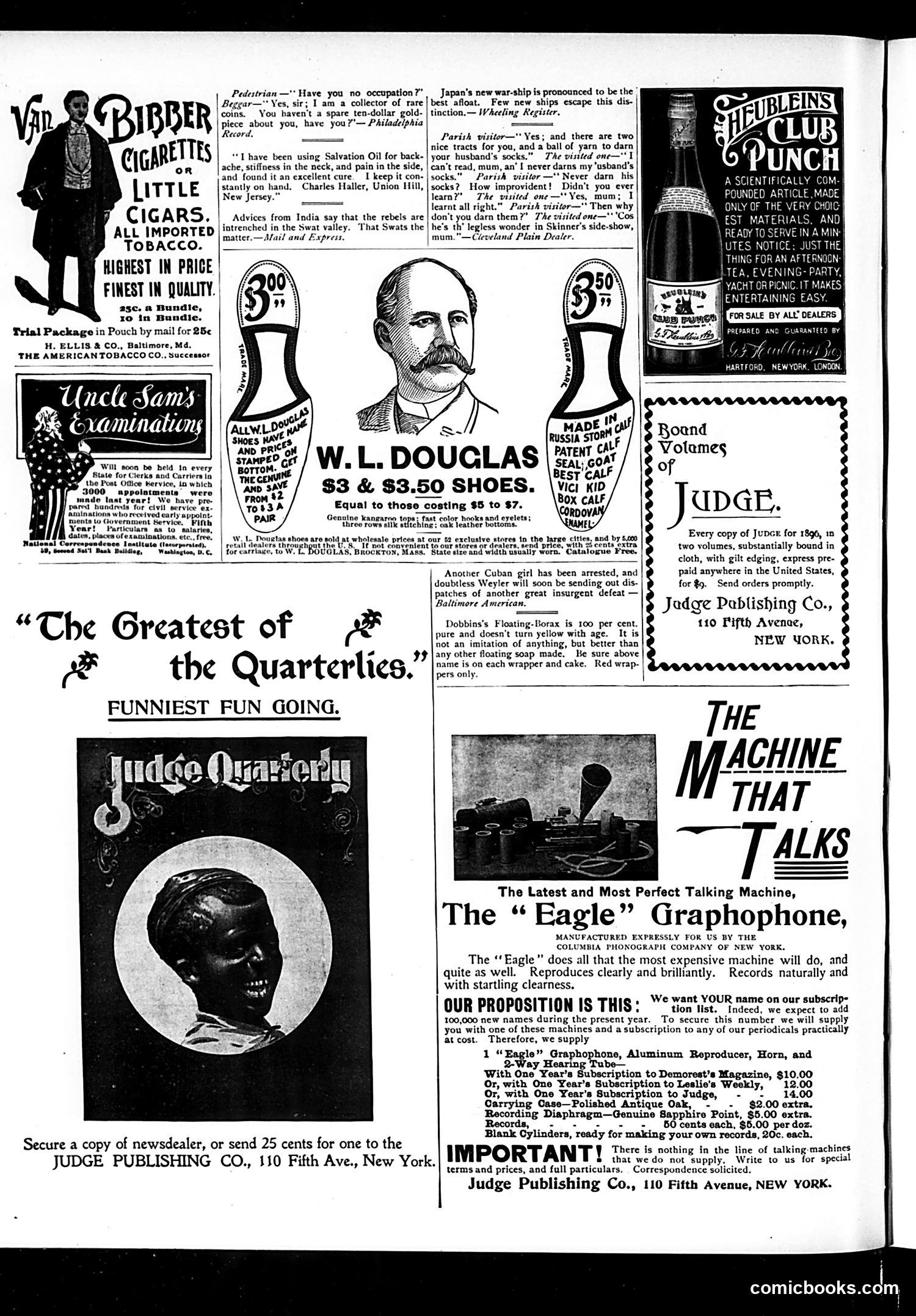
This page is primarily **advertising with scattered humor pieces**, typical of Judge's format. The satirical content includes: **The "Pedestrian" joke**: A beggar claims to be a "collector of rare coins"—a euphemism for panhandling. The humor mocks both poverty and pretentious self-description. **The Parish Visitor anecdote**: A social worker offers literacy materials and yarn to a poor woman, only to learn her husband is a legless circus performer ("Skinner's side-show"). The satire targets well-meaning but oblivious charitable visitors who don't understand their subjects' actual circumstances. **The Cuba reference**: A brief jab at General Weyler (Spanish commander in Cuba during the 1890s insurgency), suggesting his dispatches of military victories are propaganda covering actual defeats—commentary on the Spanish-American War era. **The Japanese warship joke**: A pun on "Swat valley" (India) with no deeper meaning. The page otherwise contains advertisements for shoes, soap, graphophones, and tobacco—reflecting late-1890s consumer culture.
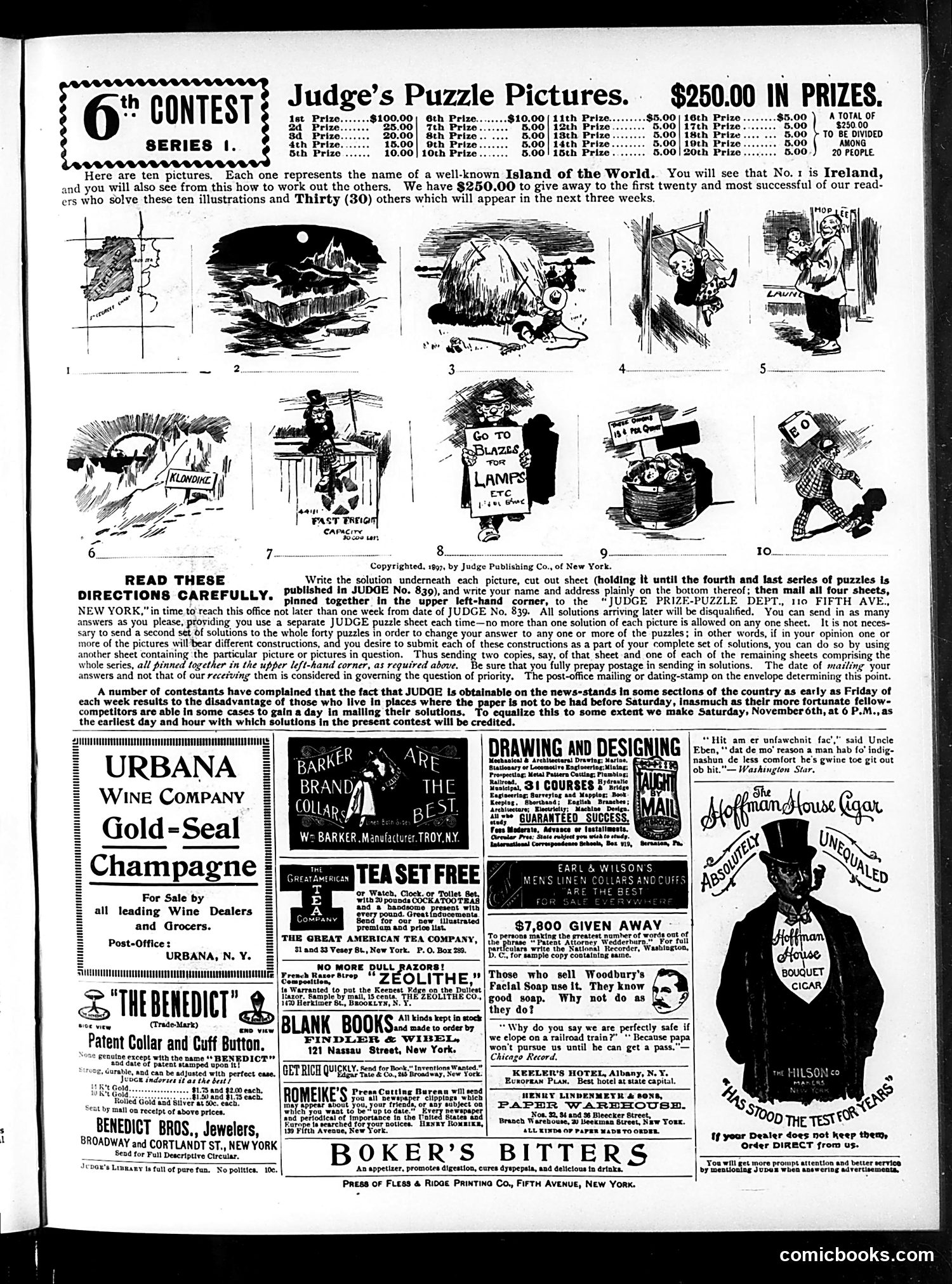
This page presents a contest puzzle where readers must identify ten famous islands from illustrated visual clues. Picture 1 depicts Ireland through a map outline. The remaining nine pictures use symbolic imagery—though the specific islands aren't fully legible in this image—requiring solvers to decode visual references. The contest offered $250 in prizes distributed across twenty winning entries. Contestants had to solve all forty puzzles (distributed across four issues) and mail their solutions to Judge's offices within a specified timeframe. The detailed rules address fairness concerns about regional distribution delays affecting competitors' mailing times. The rest of the page consists primarily of period advertisements for wine, tea, books, jewelry, and household products—typical of Judge magazine's revenue model during this era.
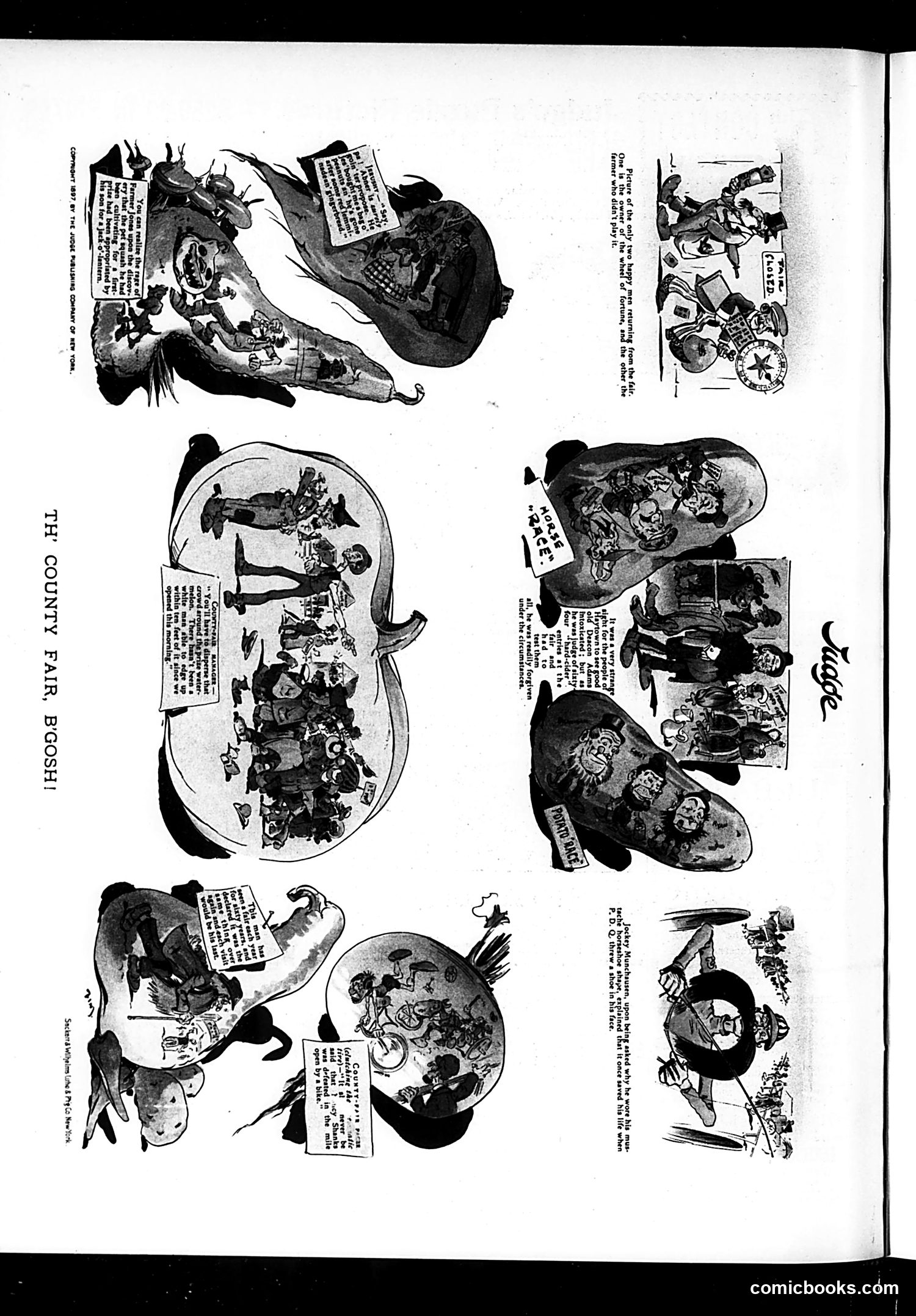
This page depicts "The County Fair Boosh" — a satirical commentary on rural American county fairs, likely from the early 20th century. The cartoons show exaggerated scenes of fair activities: livestock competitions, carnival rides, food vendors, and crowds of country folk. The satire mocks the perceived simplicity and rustic nature of county fair culture, portraying attendees with exaggerated features typical of period caricature. The title itself — "Boosh" — appears to be slang mockery of rural/backwoods culture. The OCR text is severely corrupted and unreadable, preventing identification of specific captions or targets. However, the visual style suggests this mocks the contrast between rural America's self-serious agricultural traditions and urban satirists' perception of them as quaint or absurd spectacles. Without legible text, the specific political or social critique remains unclear, though the tone is clearly dismissive of rural American culture.