
A complete issue · 16 pages · 1897
Judge — October 9, 1897
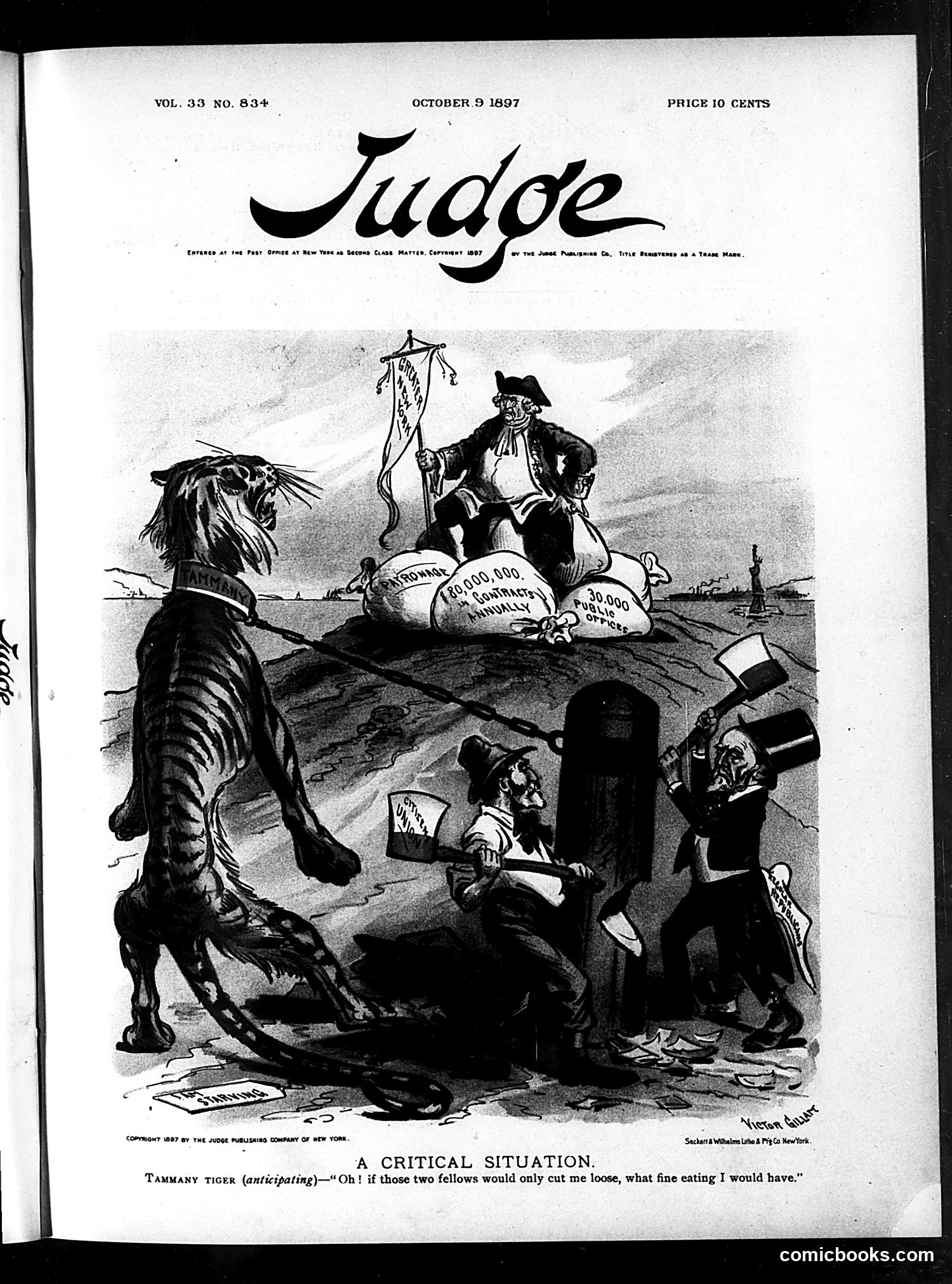
This political cartoon depicts a tiger (labeled "Tammany Tiger," referencing Tammany Hall, the corrupt Democratic political machine controlling New York City) being baited by figures holding scales of justice. The tiger is shown restrained, with observers nearby holding what appear to be official documents or notices. The caption's joke—the tiger anticipating being freed to "eat" the two men—suggests commentary on Tammany Hall's predatory political practices. The figures with scales of justice represent legal/governmental oversight attempting to constrain the machine's corruption. The cartoon satirizes the tension between Tammany's power and reform efforts, portraying the political organization as a dangerous beast barely contained by legal authority. This reflects 1890s Progressive Era criticism of urban political corruption.
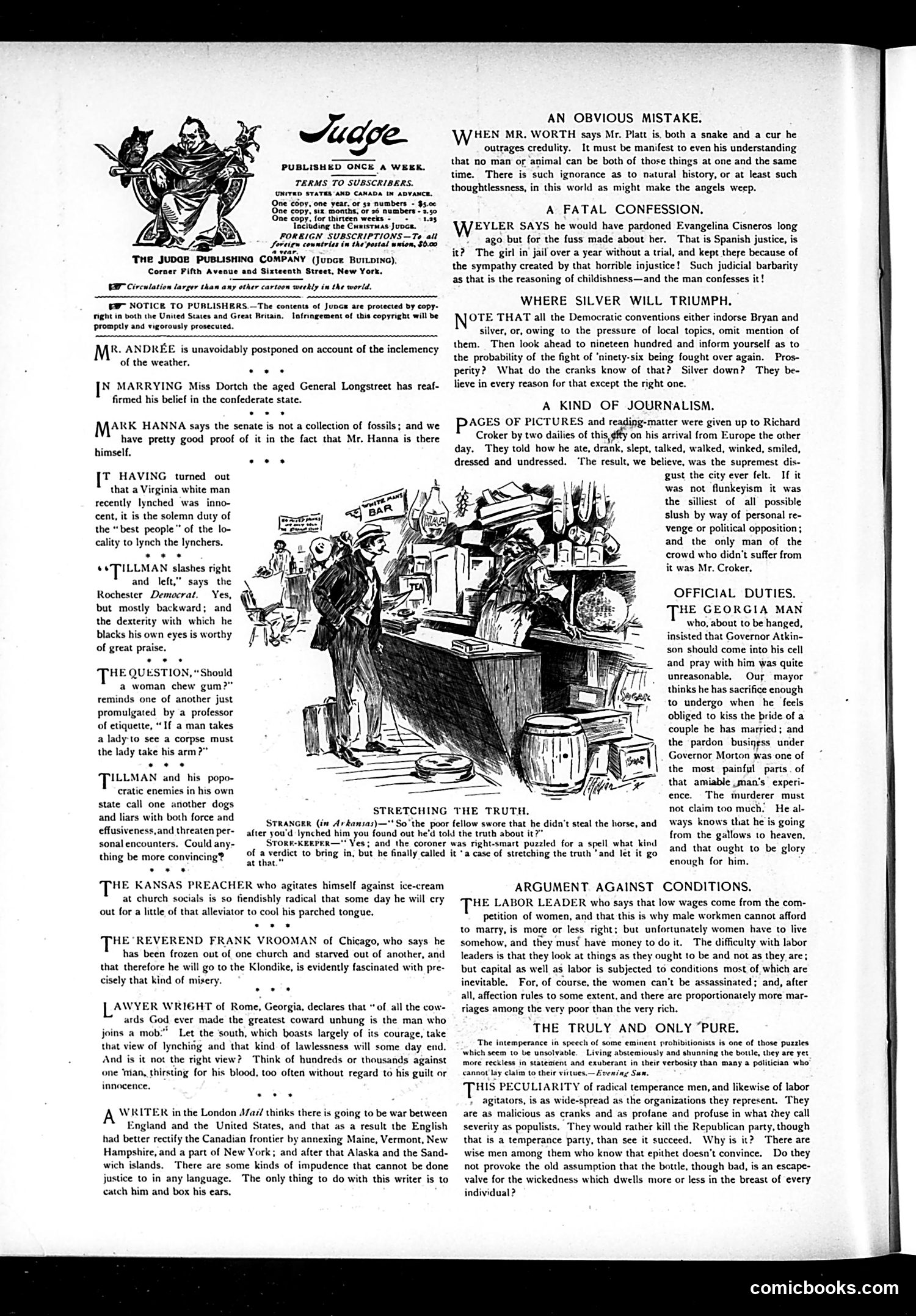
This page contains opinion pieces rather than a primary political cartoon. The visible illustration shows a saloon scene depicting working-class life—likely commentary on labor conditions or urban social issues common to Judge's satirical coverage. The text pieces address various topics: wage competition affecting women workers, the conditions of the poor, and criticisms of labor agitators. One piece mocks what it calls "radical" labor organizers as "malicious" and comparable to Republican problems. The overall thrust appears to be **centrist social criticism**—acknowledging real hardships (poverty, low wages) while skeptical of radical solutions. Without clearer identification of specific contemporary figures or events referenced, the exact political targets remain somewhat unclear, though the tone suggests critique of both extreme labor activism and conservative indifference to workers' suffering.
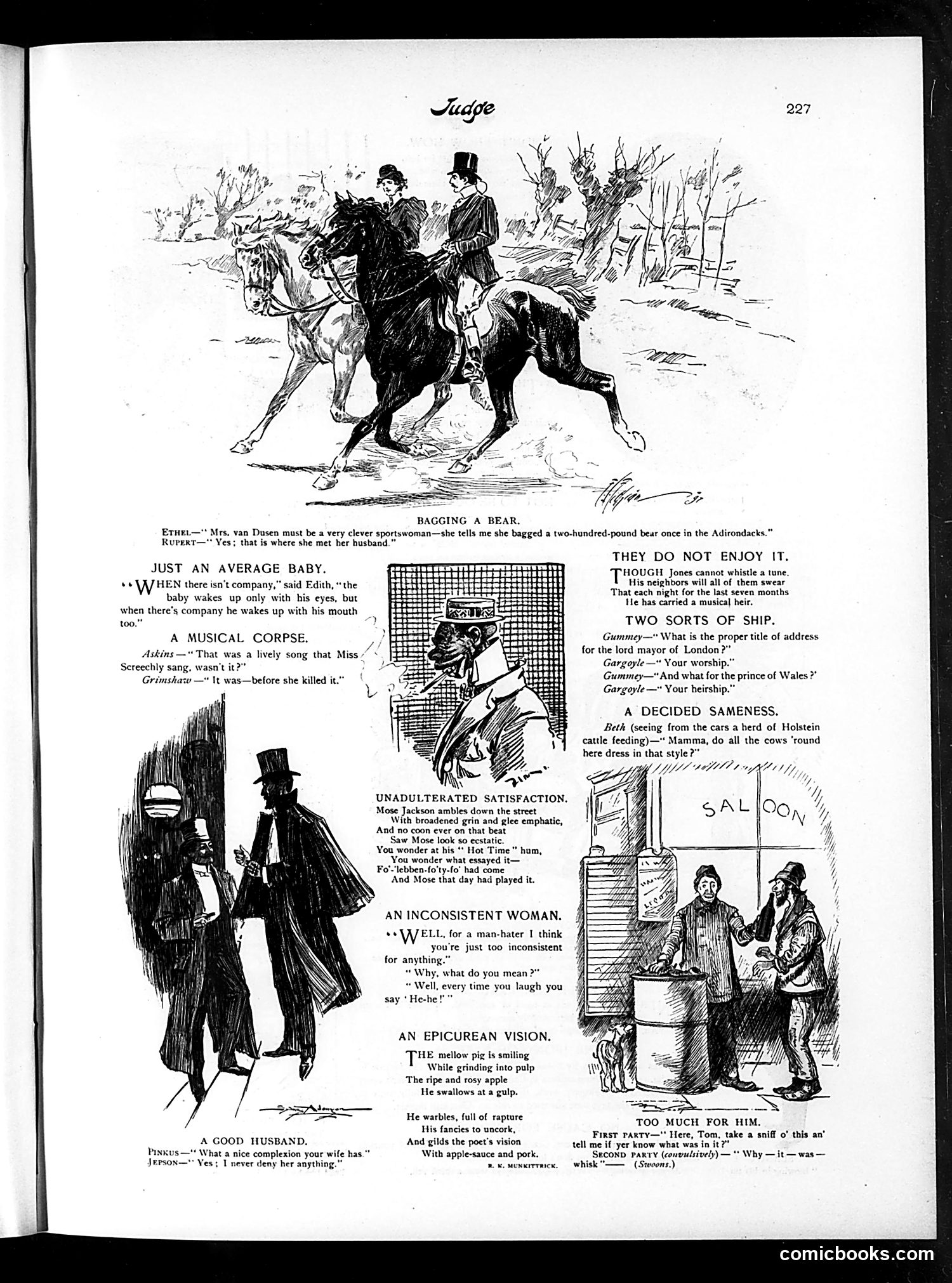
This page contains various satirical short jokes and sketches typical of Judge magazine's humor format, rather than unified political cartoons. **"Bagging a Bear"** (top): Depicts a woman on horseback claiming to have shot a 200-pound bear in the Adirondacks—a tall tale mocking women's exaggerated hunting stories. **Other sketches** address domestic themes: marital inconsistency, musical incompetence, and workplace absurdities. The humor relies on everyday social situations rather than specific political events. **"Too Much for Him"** shows a saloon scene, likely satirizing working-class masculinity or immigrant stereotypes common in period humor. The page represents Judge's standard format of brief, disconnected comic vignettes targeting Victorian-era social conventions and domestic life rather than major political events or figures.
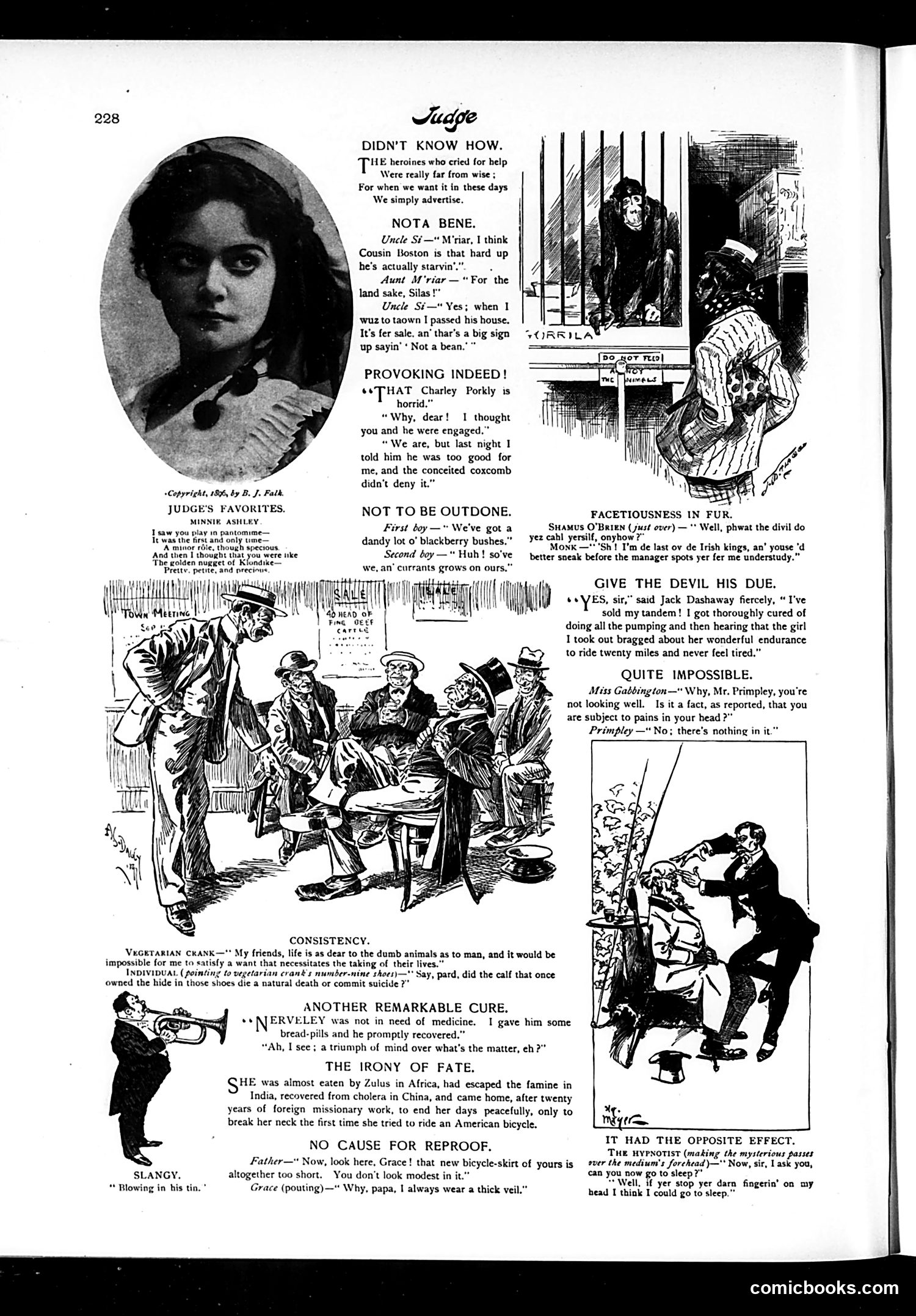
This page from Judge (circa 1896, based on copyright) contains multiple satirical vignettes mocking contemporary American society and manners: **Key Satires:** 1. **"Didn't Know How"** — Mocks modern reliance on advertising rather than genuine heroism or help-seeking. 2. **"Provoking Indeed"** — A woman complains her fiancé didn't deny being "too good for her," satirizing either false modesty or masculine vanity. 3. **"The Irony of Fate"** — A missionary survives African, Indian, and Chinese dangers only to die from a bicycle accident at home—mocking the newfangled bicycle craze and its dangers, particularly for women in restrictive clothing. 4. **"Consistency"** — A vegetarian's leather shoes expose his hypocrisy about animal welfare. 5. **Miscellaneous jokes** about Irish stereotypes, courting customs, and hypnotism. The overall tone reflects 1890s anxieties about modernization (bicycles, advertising, hypnotism fads) and social pretense.
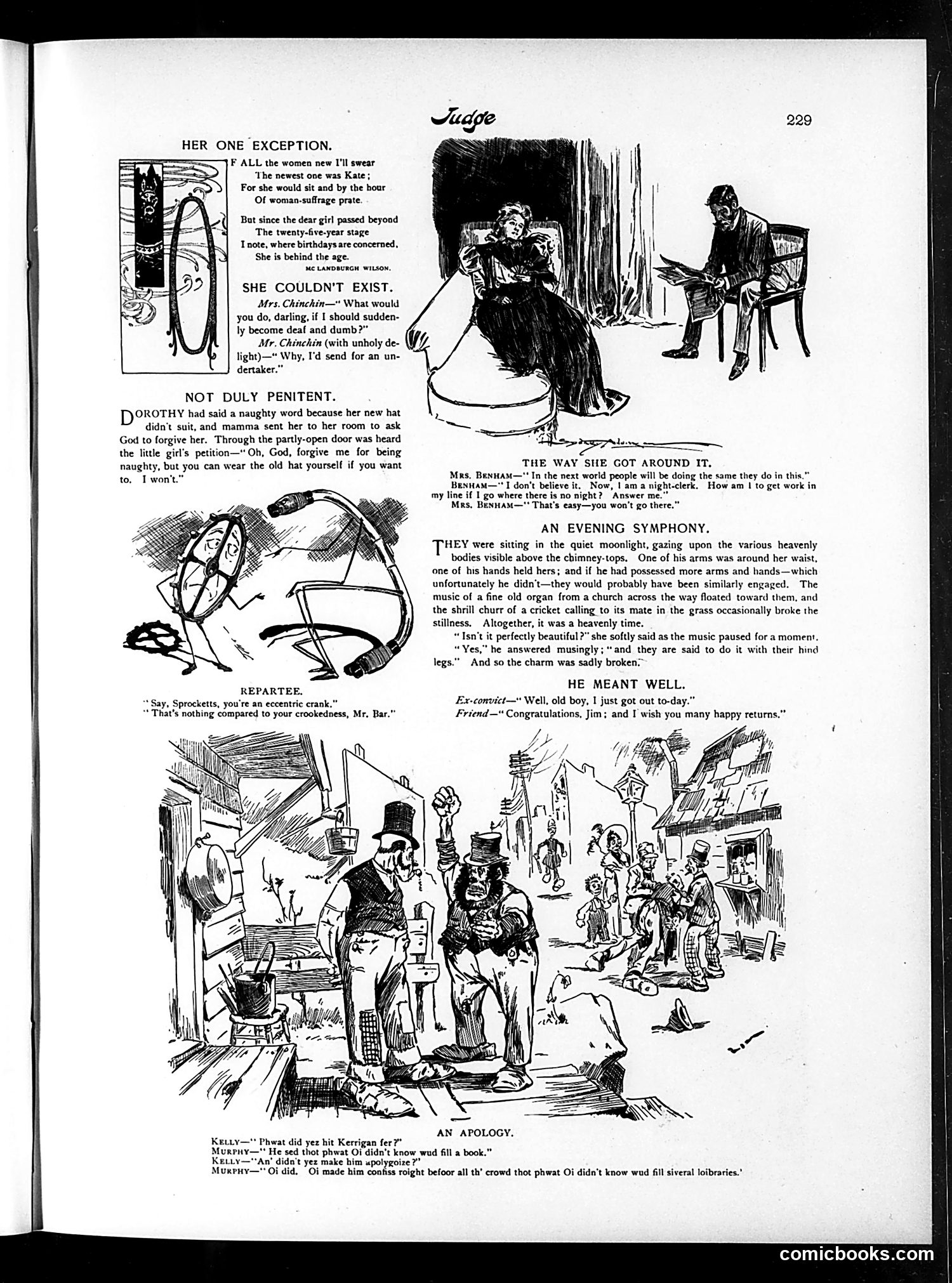
This page contains several satirical humor pieces typical of early 20th-century American comedy: **"Her One Exception"** mocks women's suffrage advocates, suggesting a woman who passionately championed voting rights abandoned her principles upon reaching middle age—satirizing the perceived hypocrisy of some activists. **"She Couldn't Exist"** is dark domestic humor: a husband jokes he'd hire an undertaker if his wife became deaf and dumb, suggesting her chattiness is her defining (and only) quality. **"An Evening Symphony"** depicts a romantic couple whose tender moment is ruined when the man absent-mindedly reveals he was actually musing about crickets mating with their hind legs—a joke about male inattentiveness and the mundane thoughts behind supposedly romantic gestures. **"An Apology"** features Irish-accented working-class characters in a brief joke about illiteracy. The cartoons employ period-typical stereotypes and rely on domestic/romantic humor rather than explicit political commentary.
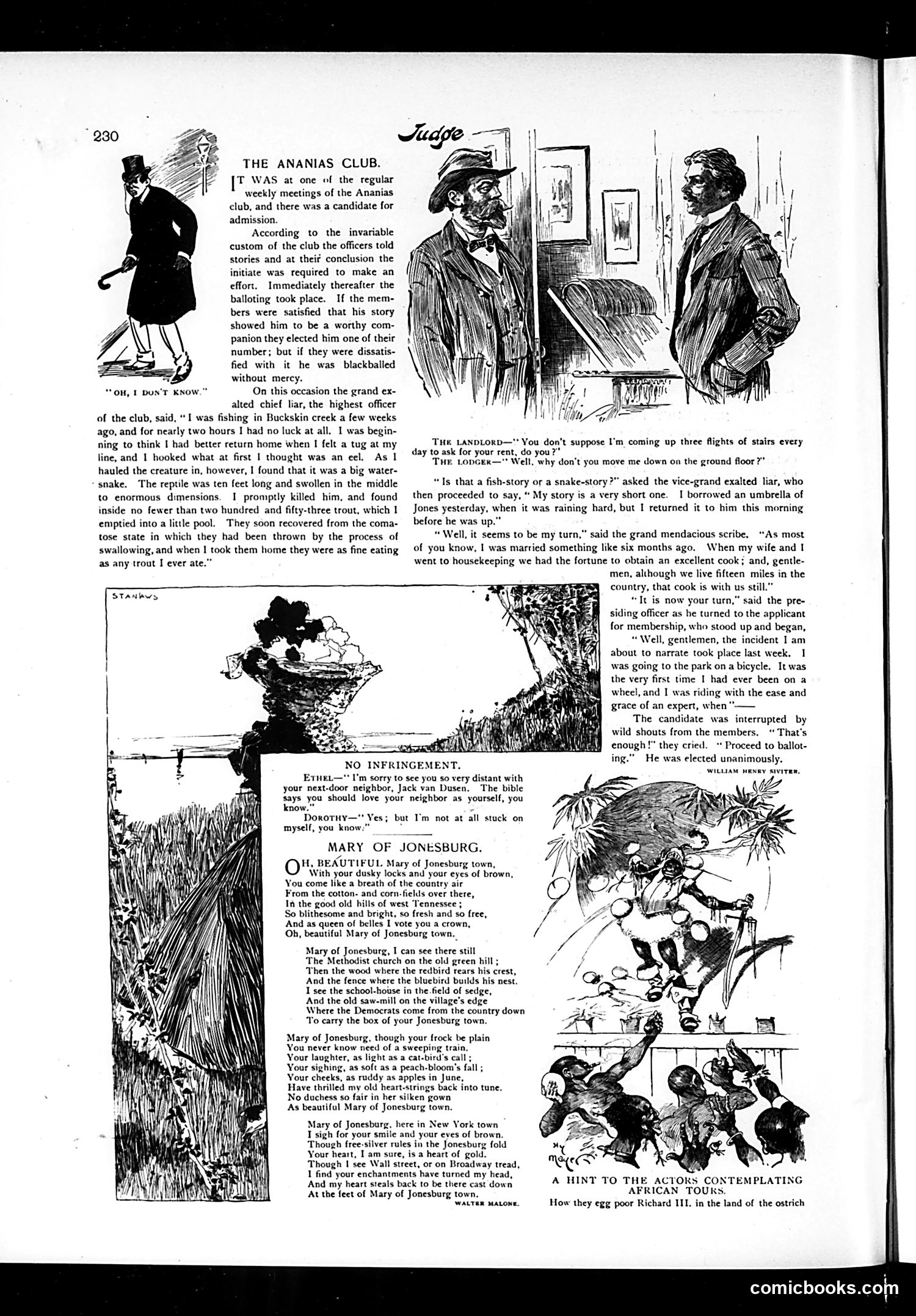
This page contains three distinct pieces of satirical humor: **"The Ananias Club"** is the main feature—a satire on habitual liars. The "club" selects members based on who can tell the most convincing false stories. The joke culminates when a candidate begins an implausibly exaggerated tale about his first bicycle ride ("with the ease and grace of an expert") and is immediately interrupted and elected unanimously—the implication being his obvious lie was *so bad* it was actually the most honest thing said, exposing the hypocrisy of the entire enterprise. **"No Infringement"** and **"Ethel/Dorothy"** are brief comic vignettes playing on wordplay and social attitudes. **"Mary of Jonesburg"** is a nostalgic poem celebrating a idealized rural Southern woman. The page satirizes a broader Gilded Age concern about truthfulness, dishonesty in public life, and the cultural gap between urban and rural America. The "Ananias Club" specifically mocks how people construct and accept convenient falsehoods.
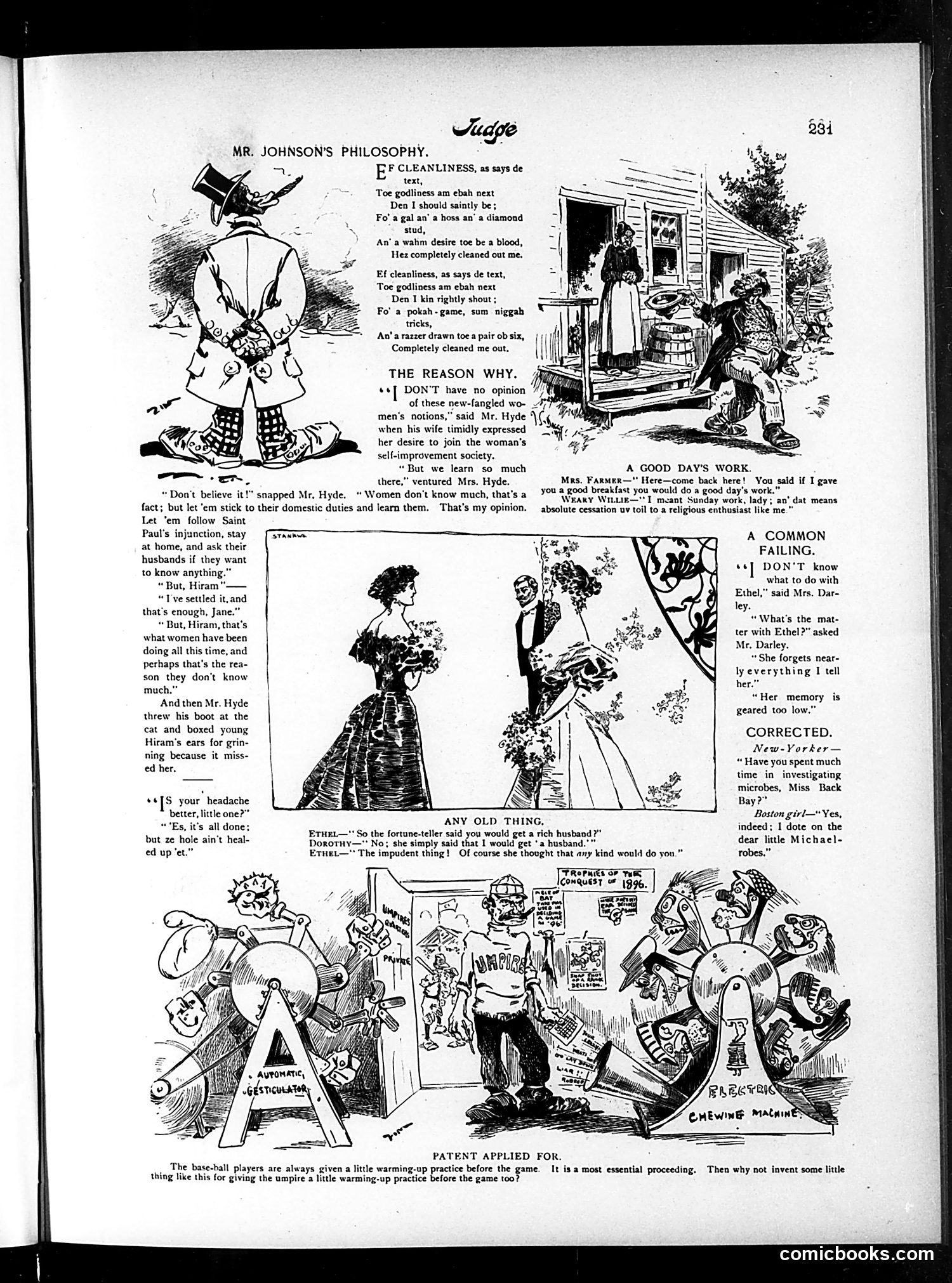
This page from the satirical magazine *Judge* contains several distinct cartoons mocking late-19th-century social attitudes: **"Mr. Johnson's Philosophy"** uses dialect humor (problematic by modern standards) to satirize a man who claims cleanliness equals godliness while being financially and morally "cleaned out" by gambling and vice—highlighting hypocrisy. **"The Reason Why"** ridicules a husband (Mr. Hyde) who opposes his wife joining a women's self-improvement society, insisting women should remain ignorant and domestic. The violence depicted (throwing boots, boxing his son's ears) satirizes patriarchal control. **"A Good Day's Work"** and **"A Common Failing"** are brief domestic humor pieces about forgetfulness and marital disagreements. **"Any Old Thing"** jokes about marriage prospects. **"Patent Applied For"** proposes a mechanical device to "warm up" baseball umpires—satirizing their temperamental behavior by treating them like athletes needing practice. The page reflects *Judge's* satirical focus on gender roles, class hypocrisy, and social pretension characteristic of Gilded Age American humor.
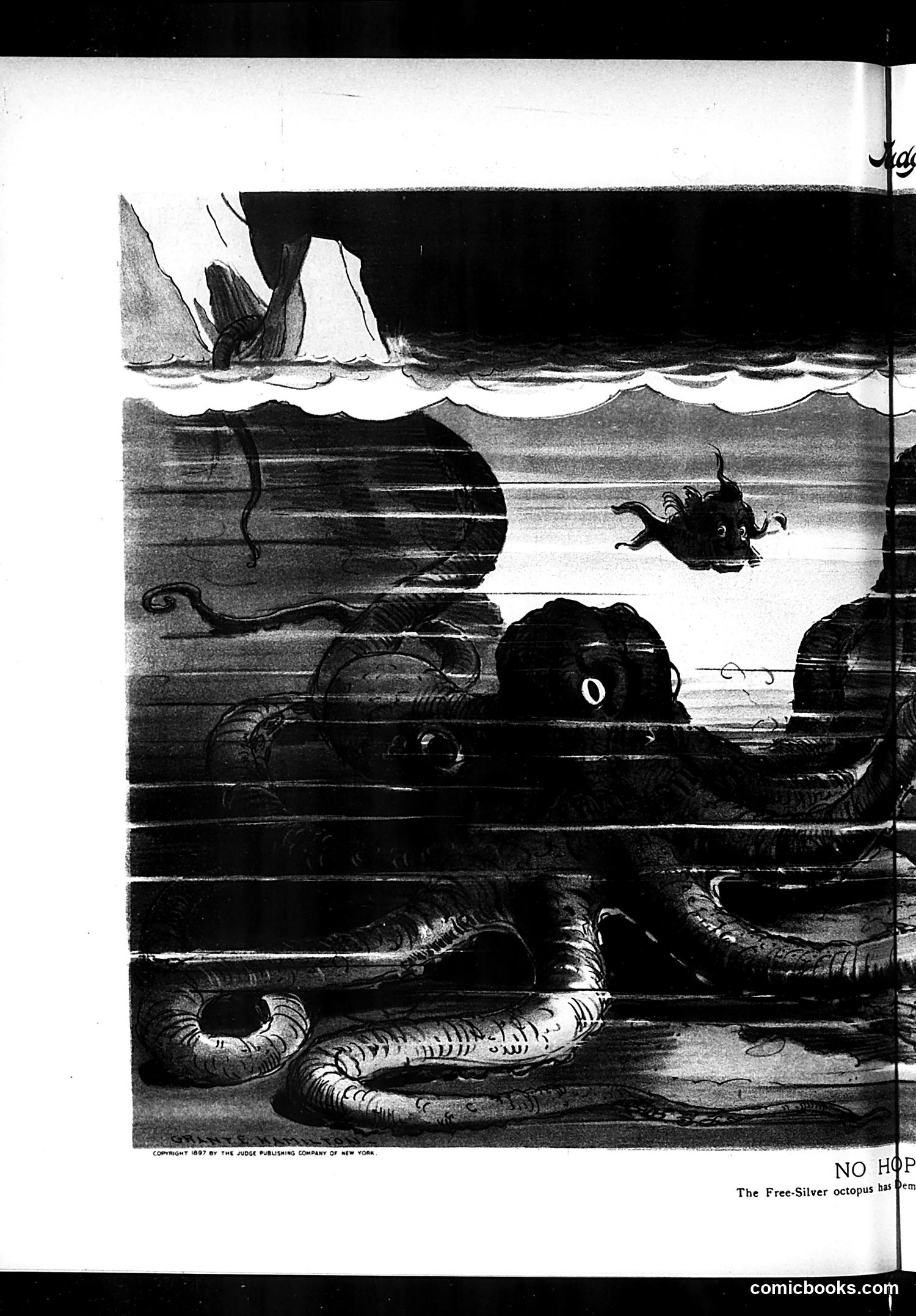
This 1897 Judge cartoon satirizes the "Free-Silver octopus"—a metaphor for the free silver movement, a major political debate of the 1890s. Free silver advocates wanted unlimited coinage of silver to inflate the currency and help debtors (especially farmers). The octopus, a common symbol for dangerous monopolistic forces or spreading threats, has multiple tentacles reaching into various domains—likely representing how free-silver proponents saw the issue infiltrating politics and commerce. The drowning figure at top appears to represent someone threatened by this economic "menace." The cartoon opposes free silver, depicting it as a dangerous, octopus-like threat strangling American interests. This reflects Judge's general conservative stance during this era of intense monetary policy debate.
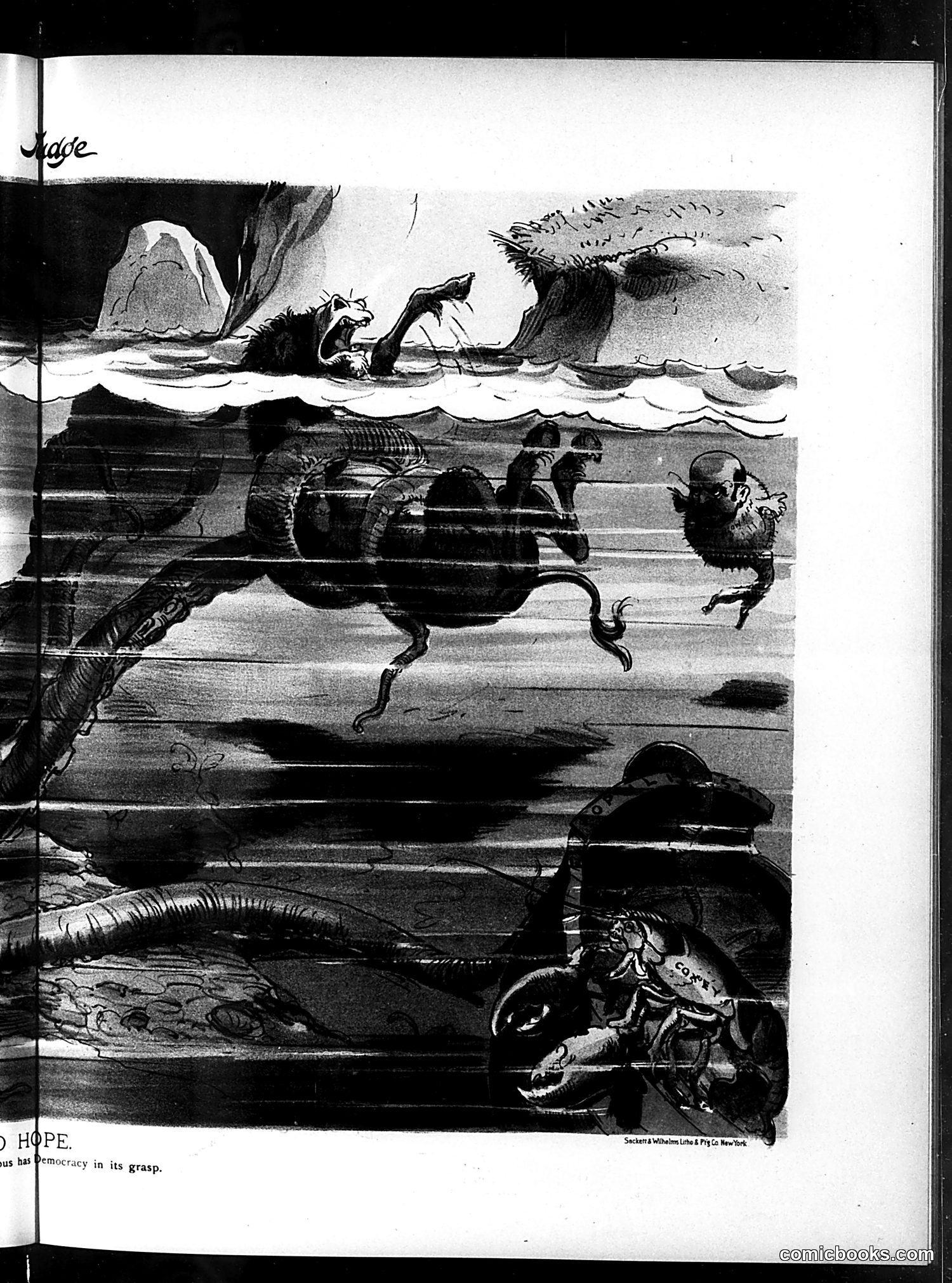
This appears to be a satirical cartoon from *Judge* magazine depicting democracy as being seized by hostile forces. The composition shows multiple grotesque creatures or figures—some appearing beast-like or demonic—in what seems to be an underwater or chaotic scene, with human figures struggling or fleeing. The visible text fragment "us has Pemocracy in its grasp" (likely "Democracy in its grasp") confirms the central message: democracy is under attack or being strangled by opposing forces. The layered, dramatic imagery with multiple threatening figures suggests the cartoon was meant to warn of multiple dangers simultaneously threatening democratic institutions. Without the complete text and publication date, the specific historical context remains unclear, though the style suggests early-to-mid 20th century American political anxiety.
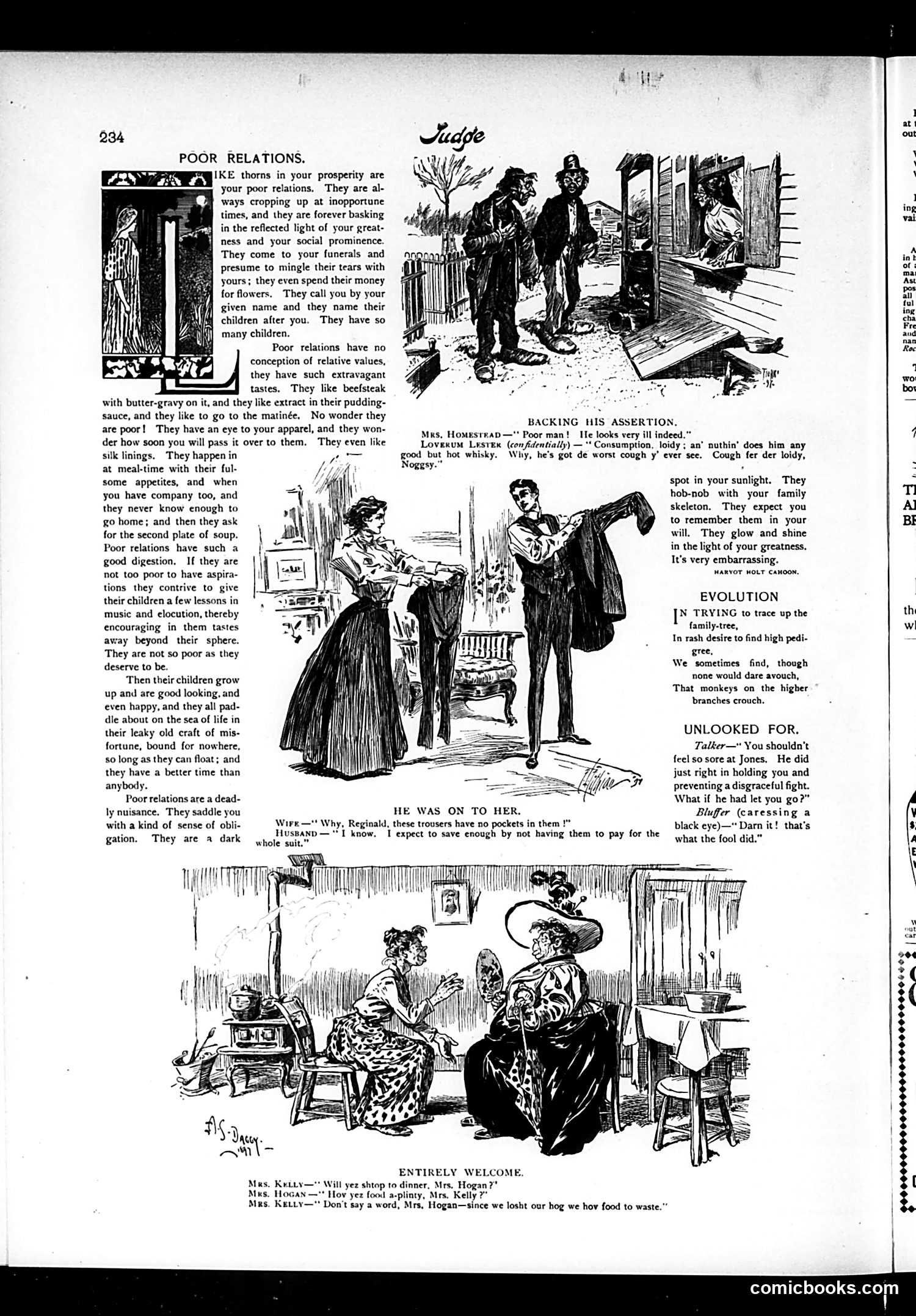
This page satirizes the Victorian-era social burden of poor relatives. The main essay mocks how impoverished family members exploit wealthy relatives' hospitality—attending funerals uninvited, naming children after benefactors, eating excessively at dinners, and expecting inheritance despite their inferior station. The accompanying sketches illustrate these embarrassments: one shows poor relations making unwanted visits; another depicts a woman attributing a man's illness to whisky consumption rather than acknowledging poverty as the cause. Secondary humor includes "Evolution" (joking that ancestry research reveals monkey relatives—a dig at genealogical pretension), and dialogue jokes about trousers without pockets and a man bruised by a friend's intervention in a fight. The satire targets class anxiety and social climbing of the era: the wealthy's discomfort with visible poor relations threatening their respectability, and the assumption that poverty stems from moral failing rather than circumstance.
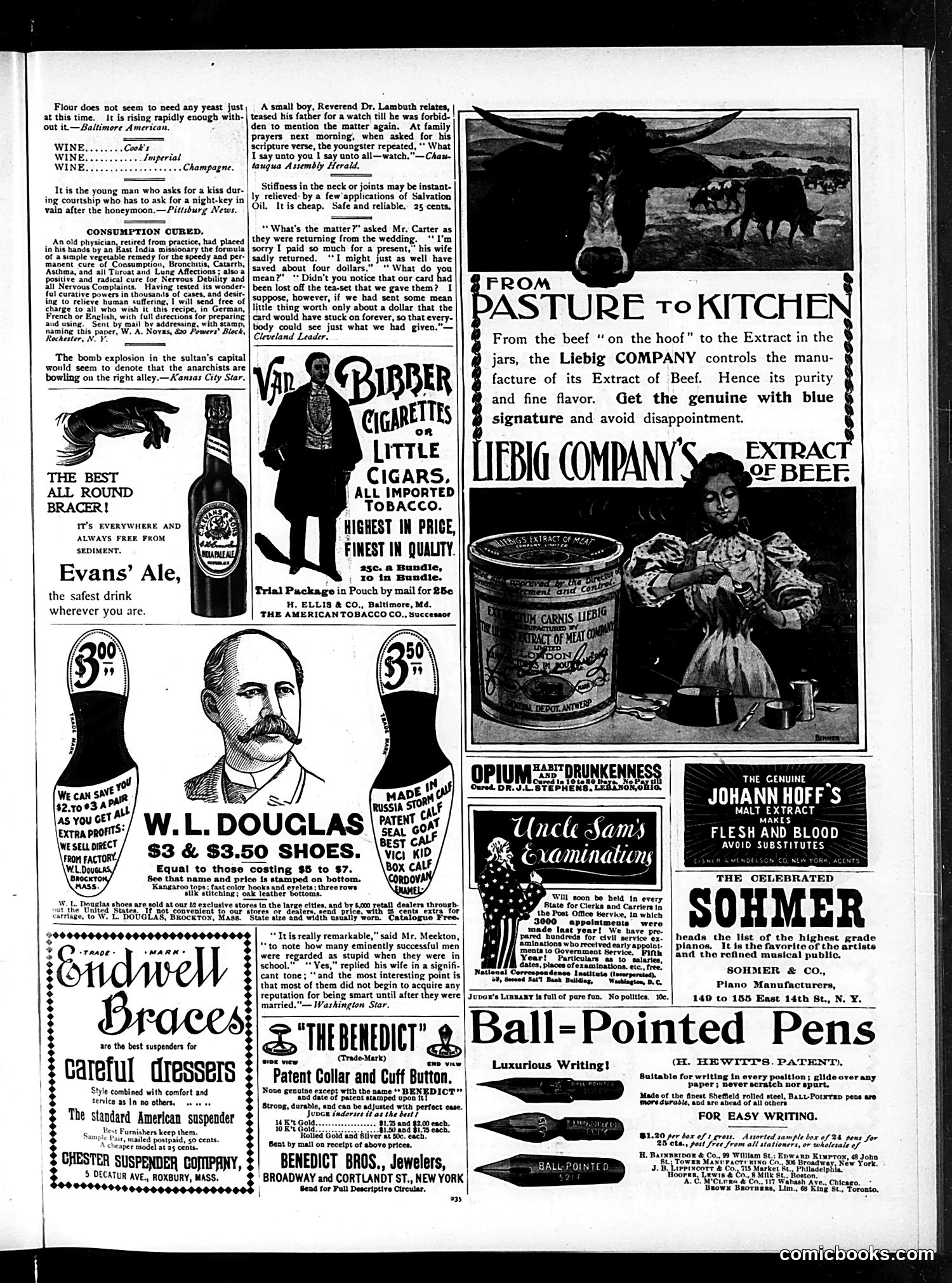
This page is primarily **advertisements** with brief humorous text snippets interspersed. The cartoons are minimal—mostly product illustrations rather than satirical political commentary. The page features ads for consumer goods (Evans' Ale, W.L. Douglas Shoes, tobacco products, Liebig Company beef extract) typical of the era. Notable is an ad for "Opium" as a cure for drunkenness—reflecting the period when such substances were marketed as medical remedies without regulation. The small jokes scattered throughout mock domestic life (a husband's stinginess about wedding gifts, a wife's nagging about a night-key) and contain mild religious humor (a boy's clever scripture misquote about "watching"). One text snippet references a bomb explosion in "the sultan's capital," likely alluding to Ottoman politics, but provides no clear satirical point. The page reflects **turn-of-century American consumer culture and attitudes**, including unregulated pharmaceutical marketing and conventional domestic humor, rather than sharp political satire.
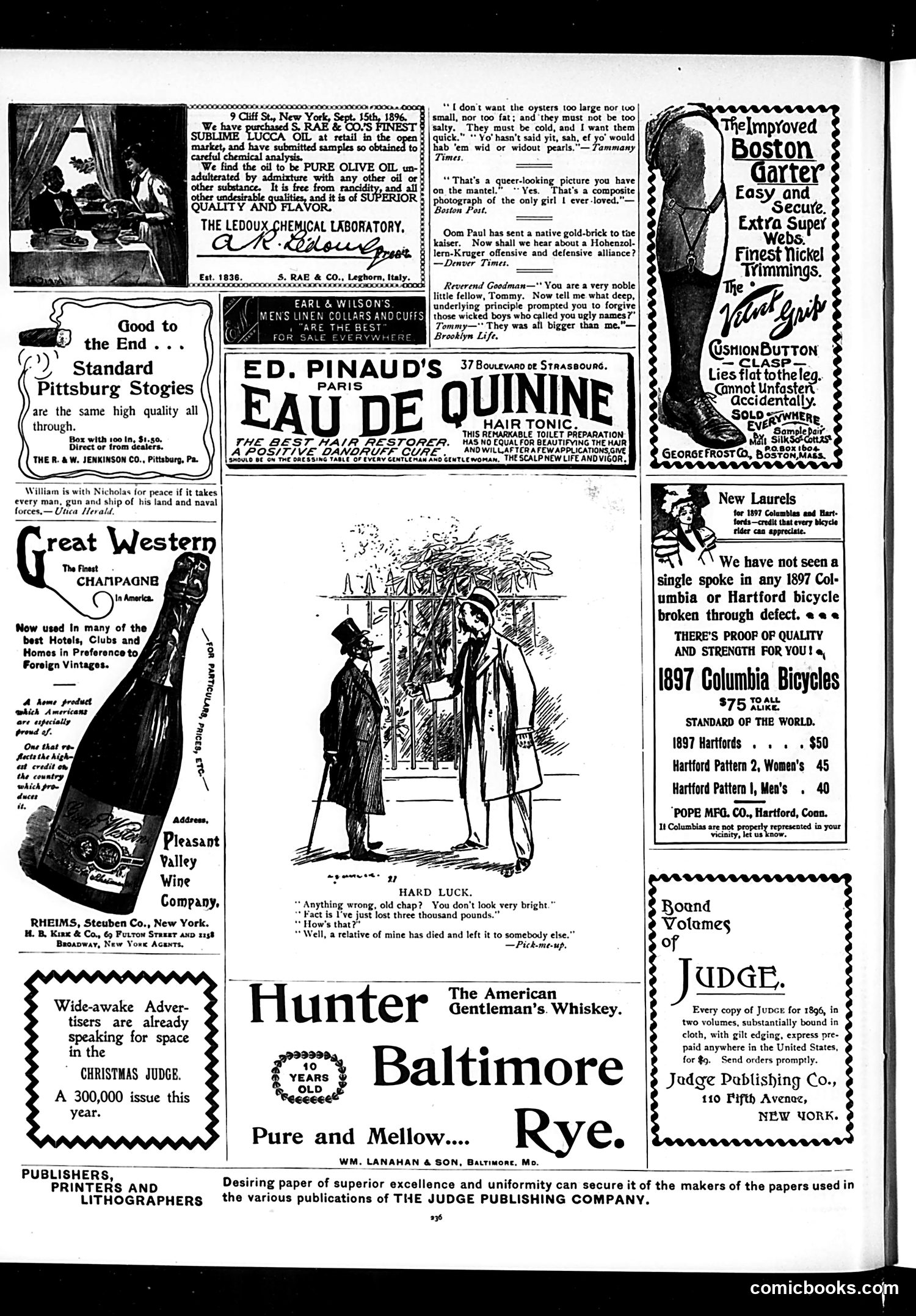
The central cartoon depicts two well-dressed men in conversation. One complains he's "just lost three thousand pounds" — a substantial sum. When asked how, he explains that "a relative of mine has died and left it to somebody else." The joke satirizes the perverse luck of inheritance: the man expected to benefit from a relative's death, but the money went to another heir instead. The title "Hard Luck" underscores the bitter irony — he experienced loss without gain, despite death in the family seemingly promising financial benefit. This reflects late-Victorian anxieties about wealth transfer, family obligations, and the precariousness of fortune. The cartoon mocks both greedy expectations around inheritance and the disappointment when such hopes fail to materialize.
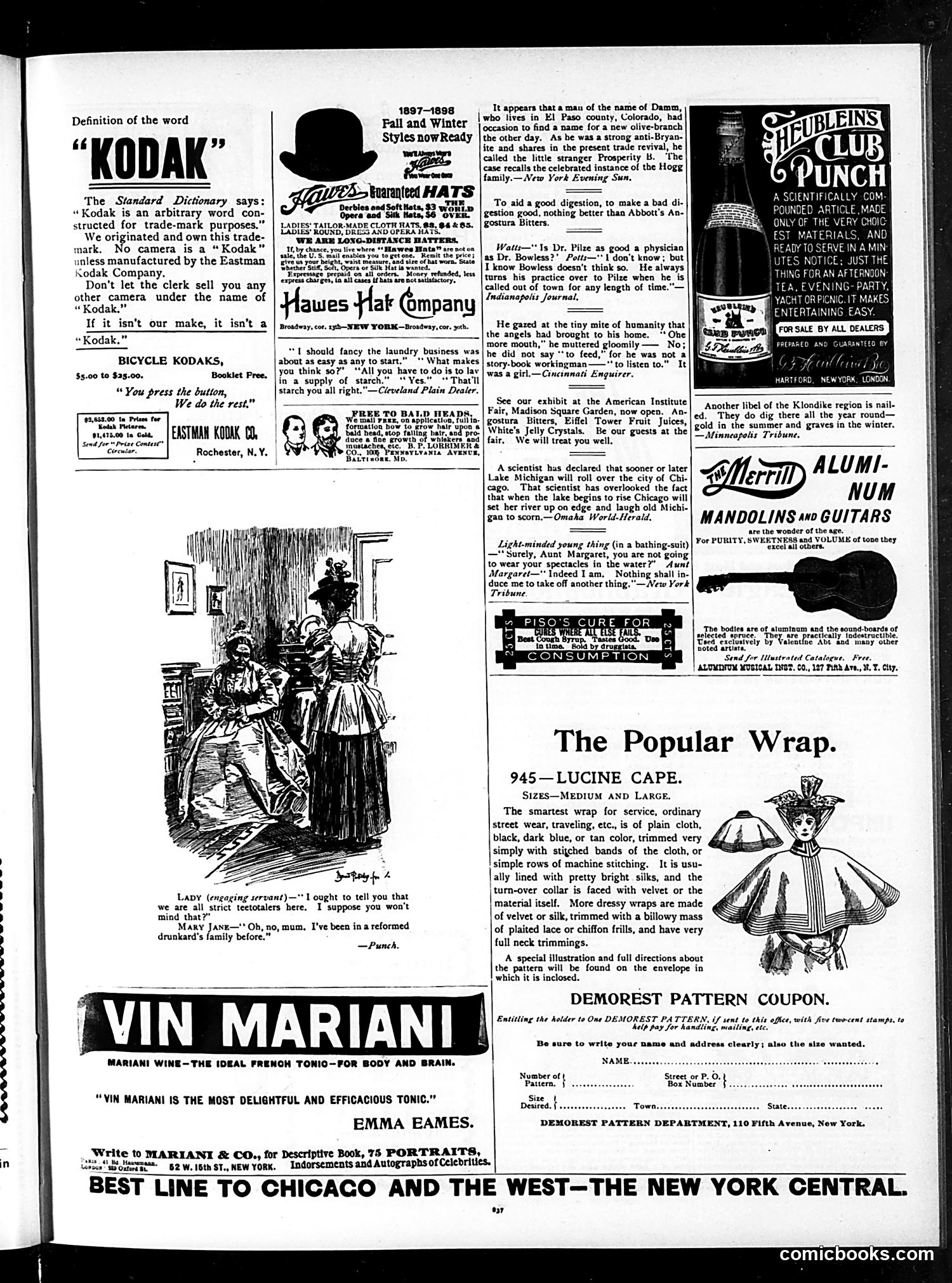
This page is primarily **advertising** with a few satirical jokes scattered throughout. The main content includes: **Key Advertisements:** - Eastman Kodak cameras (defending their trademark) - Hawes Hat Company (Fall/Winter styles) - Vin Mariani wine (a French tonic) - Abbott's Angostura Bitters - Merrill aluminum mandolins **Satirical Jokes:** The page includes several brief humor pieces typical of Judge's style—mostly puns and domestic comedy. One notable item discusses a Colorado man named Damm who named his olive tree "Prosperity B," celebrating McKinley-era economic revival (anti-Bryan reference suggests Republican perspective). **Visual Content:** A single cartoon depicts a domestic servant scene (based on OCR text showing a "Lady" and "Mary Jane" dialogue about temperance), though the image quality makes specific details difficult to discern. The page reflects 1897-1898 advertising and humor styles rather than sustained political satire.
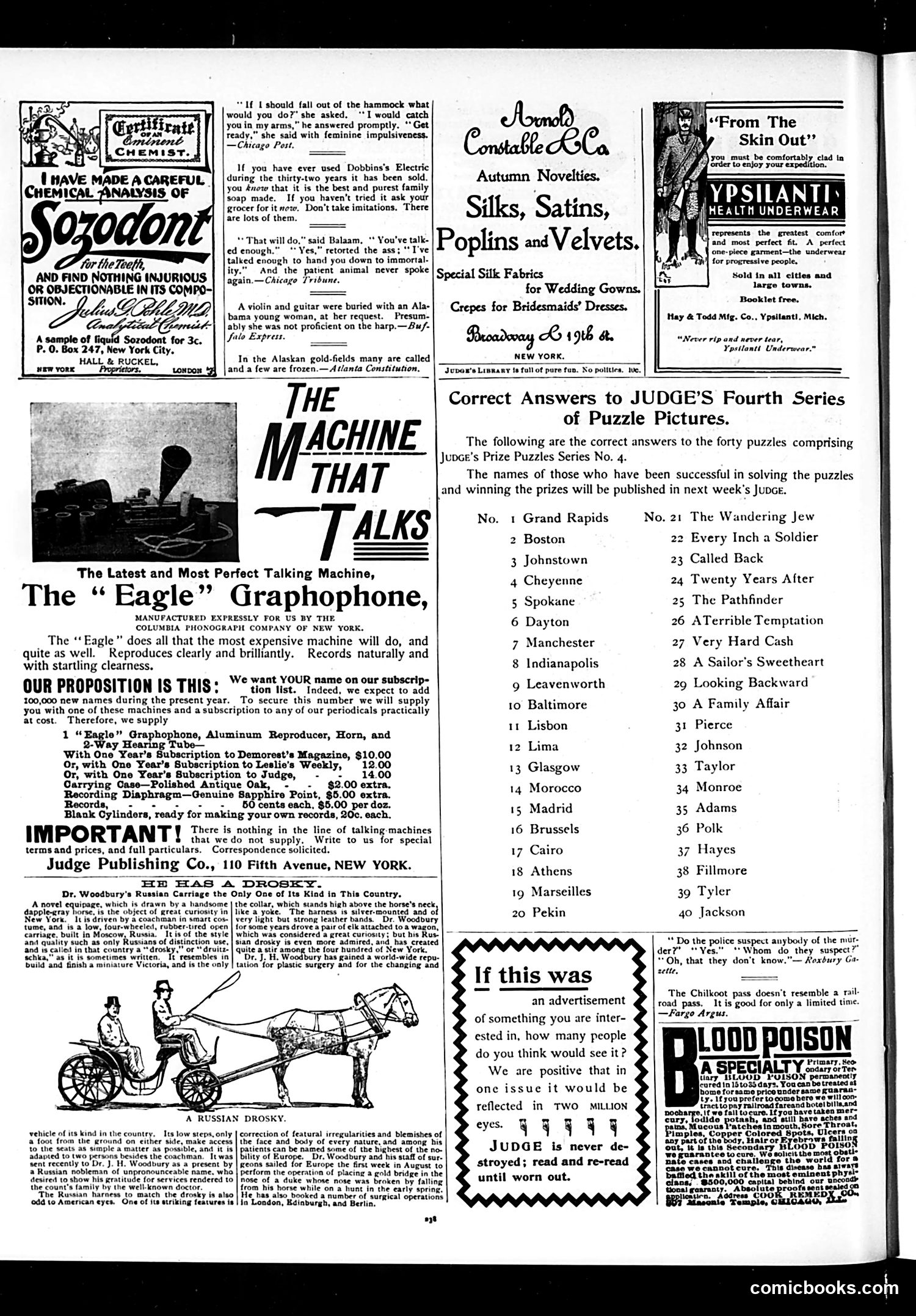
This page consists primarily of **advertisements and notices** rather than political cartoons. The main content includes: **Editorial/Humorous Snippets**: Brief jokes about domestic life and animals, typical of Judge's satirical format—a woman testing if her suitor will catch her if she falls from a hammock; an ass claiming it achieved immortality by talking to Balaam. **Prominent Advertisements**: - **Sozodont** (tooth powder) with a "careful chemical analysis" - **Dobbins's Electric Soap** (32-year-old product) - **Arnold Constable & Co.** (silk fabrics, wedding gowns) - **Ypsilanti Health Underwear** ("never rip and never tear") - **Eagle Graphophone** (talking machine subscription offer) **Notable Feature**: A description of "Dr. Woodbury's Russian Carriage"—apparently the only Russian sleigh-style carriage in the United States, driven in New York. This appears to reference a novelty item of curiosity value. The page reflects early 1900s commercial culture and consumer goods targeting middle-class Judge readers.
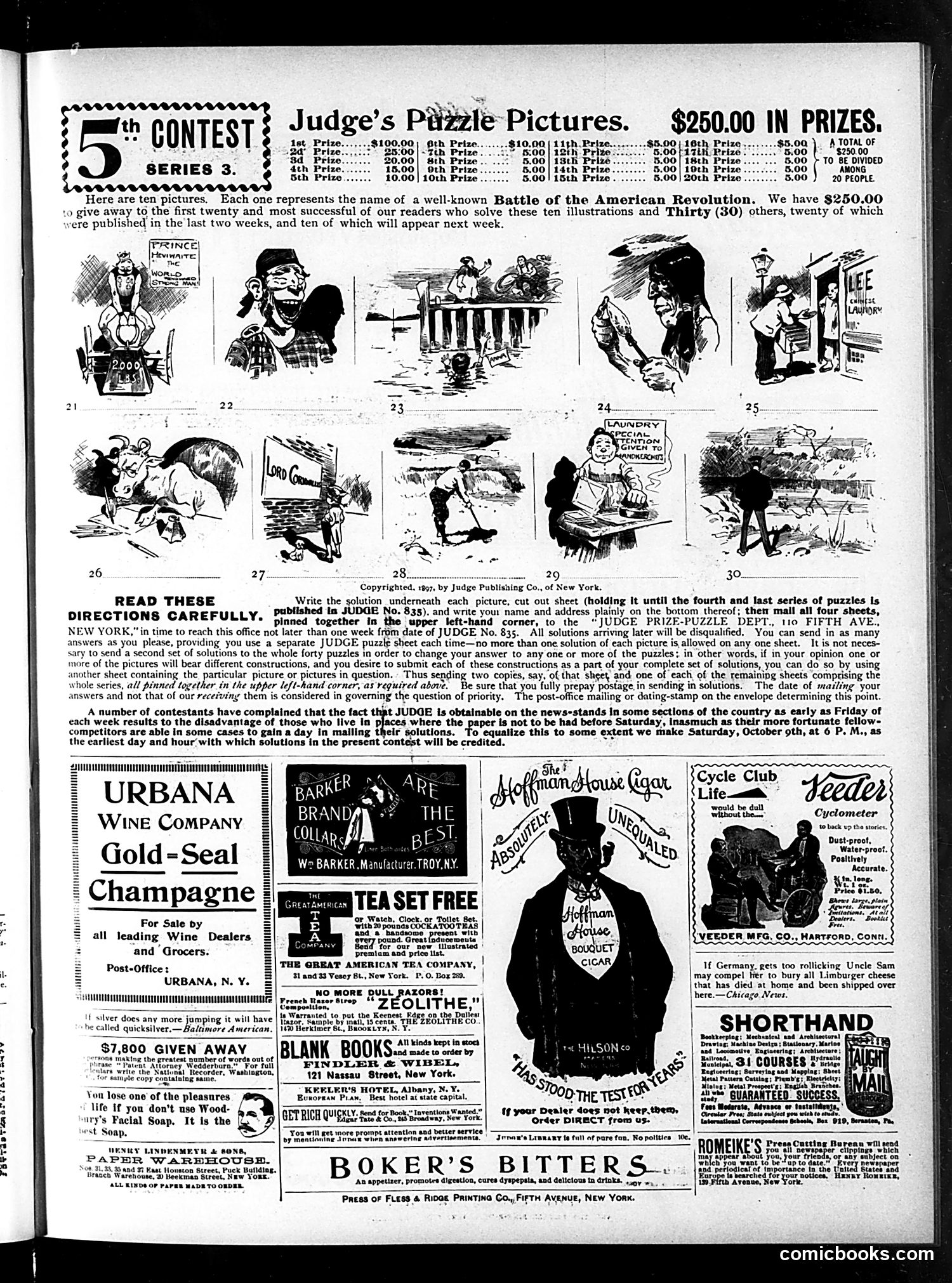
This page announces Judge magazine's "$250.00 in Prizes" puzzle contest, Series 3. Readers must identify ten illustrations representing famous **Battles of the American Revolution**—such as those visible in sketches numbered 21-30 (images 25 and 27 appear to show "Lord Cornwallis" and colonial scenes). The contest mechanics are detailed: solvers identify battles, mail solutions to "Judge Prize-Puzzle Dept." by a deadline, with prizes distributed among twenty winners. The text notes complaints from subscribers in areas where Judge arrives late, so the magazine sets a uniform deadline (Saturday, October 6th) for fairness. The remaining page space contains period advertisements (wine, cigars, razors, business courses) typical of 1890s magazines. This is primarily a **contest announcement** rather than political satire—though the Revolutionary War theme reflects Americans' historical interest in their founding era.
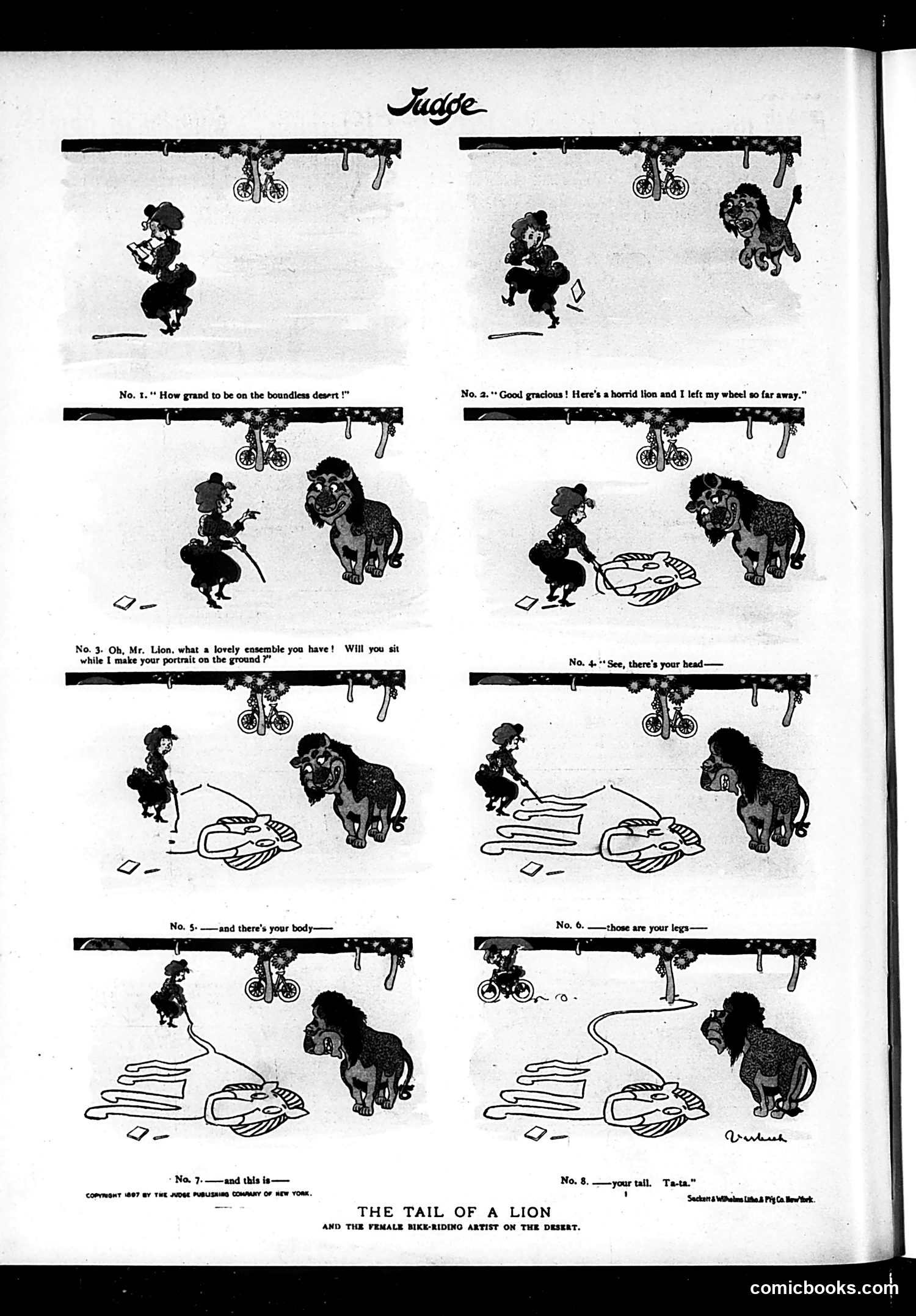
This is a humorous sequential comic strip about a female artist attempting to paint a lion's portrait in the desert. The joke progresses through eight panels: A woman artist asks a lion to sit for a portrait. The lion agrees but becomes increasingly agitated as she draws him piece by piece—first his head, then body, then legs. The satire appears to target the fashionable "New Woman" of the late 1800s: the independent, bicycle-riding female artist venturing into unconventional spaces (the desert, alone with a wild animal). The humor lies in the absurdity of her polite, artistic pretensions clashing with the obvious danger and the lion's growing irritation. The title puns on "tail" (the animal part) and "tale" (the story), suggesting both a literal and figurative narrative. This reflects period anxieties about women's changing social roles and their entrance into traditionally male-dominated activities.