
A complete issue · 16 pages · 1897
Judge — October 2, 1897
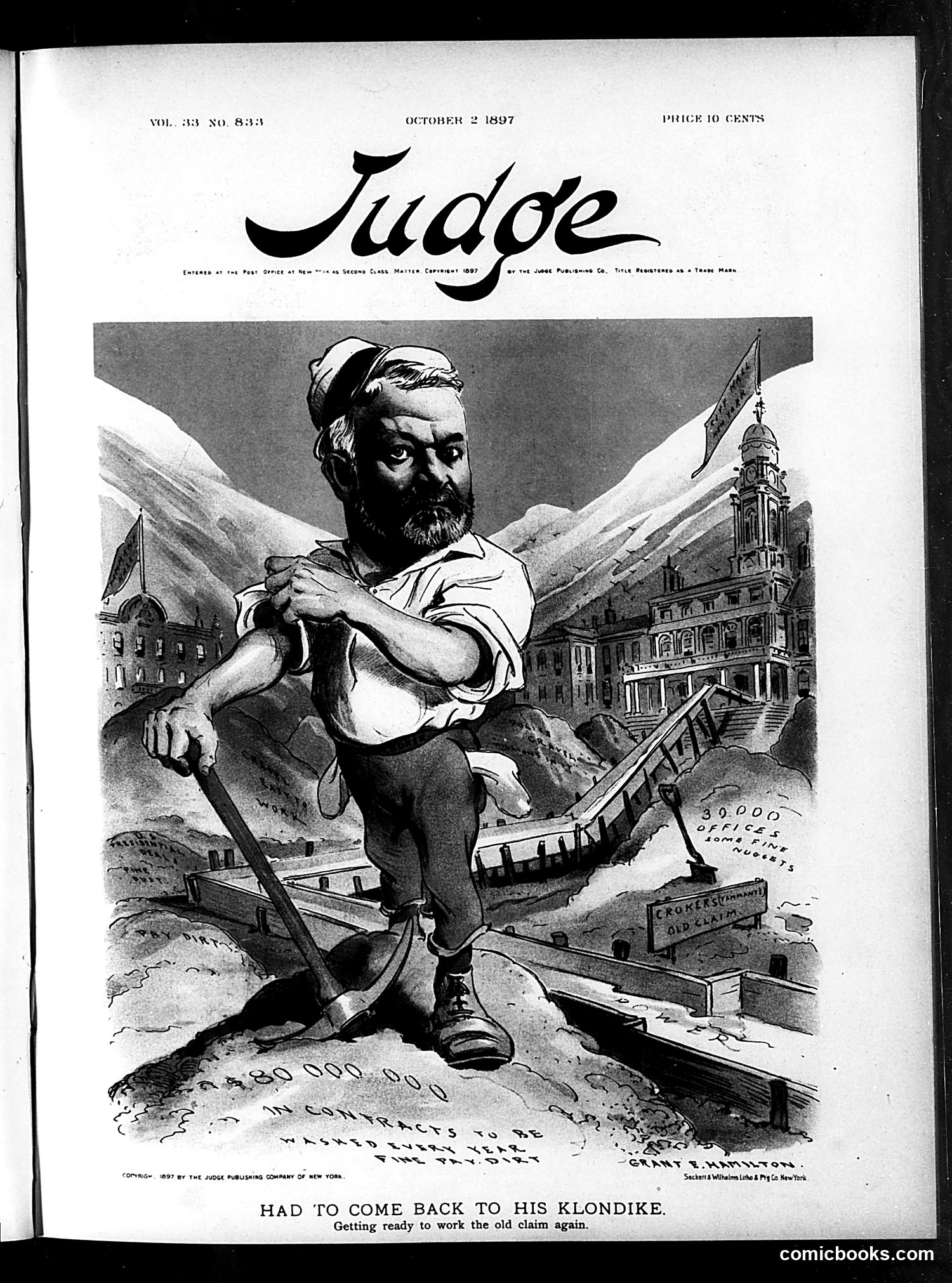
This October 1897 Judge cartoon satirizes someone returning to work an old Klondike gold claim. The bearded man, depicted as a laborer with pickaxe and shovel, stands amid mountainous terrain with buildings and a steamship visible in the background—typical Klondike imagery from the Gold Rush era. The caption's subtitle, "Getting ready to work the old claim again," suggests the figure represents a politician or public figure returning to exploit some previous opportunity or constituency for personal gain. The caricature style and publication date coincide with the peak Klondike Gold Rush (1896-1899), making this likely commentary on contemporary political opportunism disguised as legitimate enterprise. The specific identity of the subject remains unclear without additional context.
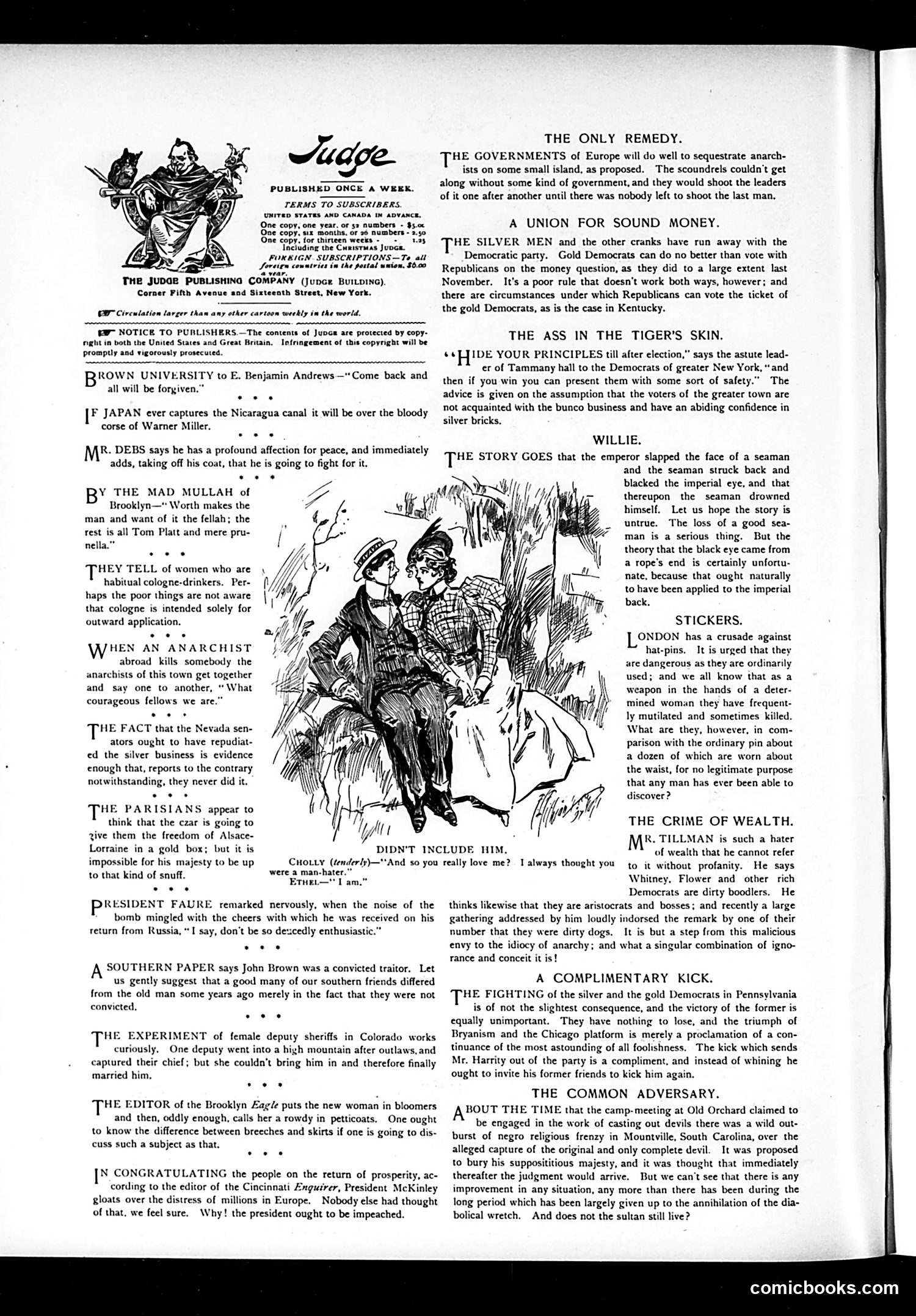
This page contains political commentary rather than a cartoon. The main illustration shows two men in a casual encounter, with text "DIDN'T INCLUDE HIM" and dialogue about man-hating. The articles target specific political figures and movements of the era: - "The Only Remedy" discusses anarchists and government sequestration - "A Union for Sound Money" addresses gold Democrats and Republican voting strategy - "The Ass in the Tiger's Skin" references Tammany Hall Democrats in New York - "The Crime of Wealth" attacks wealthy Democrats like Whitney and Flower as "dirty boodles" The content satirizes late 19th-century political corruption, wealth inequality, and factional disputes within the Democratic Party over monetary policy (gold versus silver). The magazine takes a Republican/conservative stance, mocking Democratic hypocrisy and opportunism.
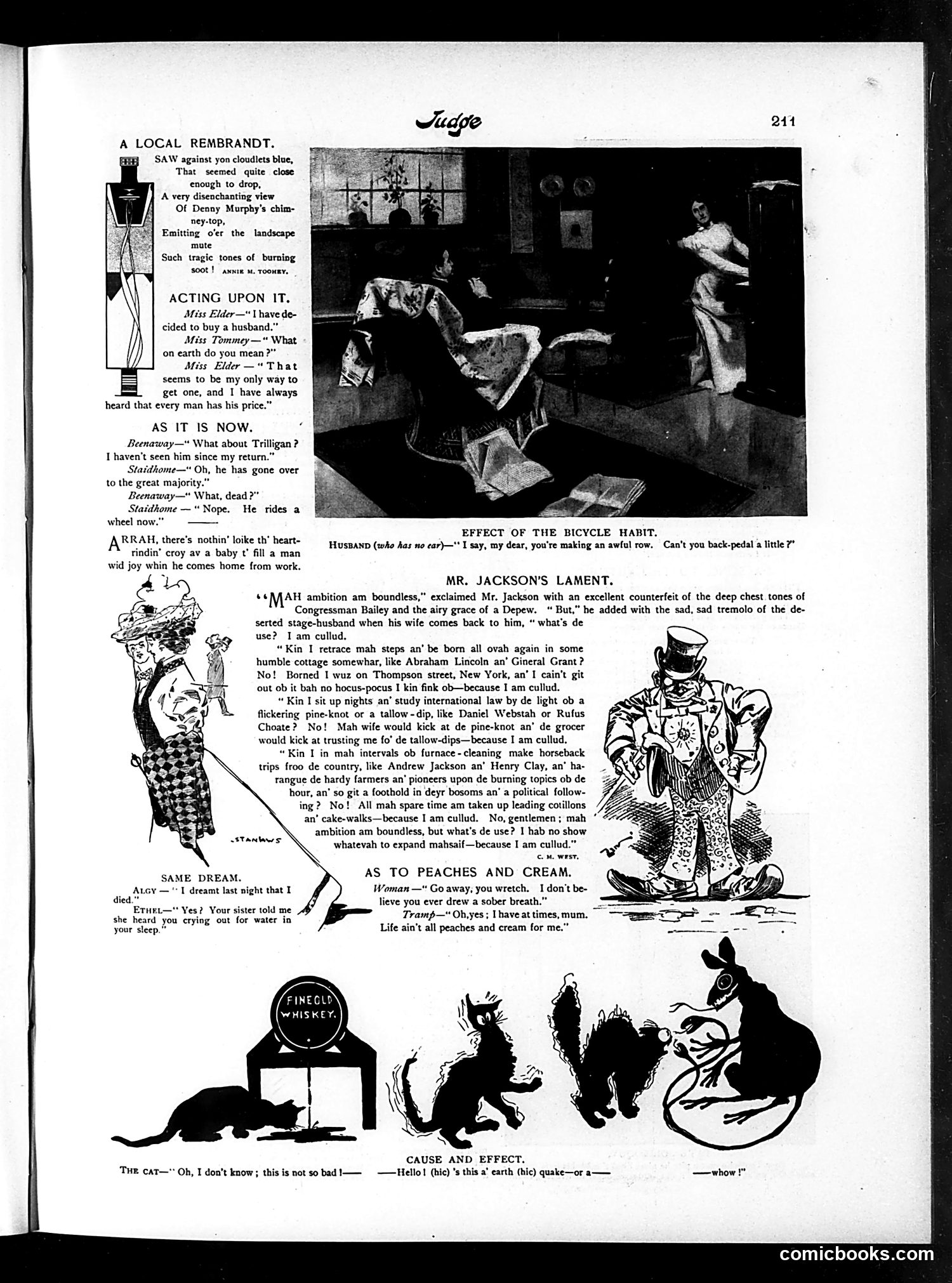
This page contains several unrelated satirical sketches typical of Judge magazine's format: **"A Local Rembrandt"** mocks pretentious art appreciation, with the sketch showing someone admiring a painting of what appears to be an ugly or poorly-rendered subject. **"Effect of the Bicycle Habit"** depicts a woman on a bicycle, satirizing the late-19th/early-20th century social concern that cycling made women unfeminine or caused physical deformation. **"Mr. Jackson's Lament"** features a lengthy monologue from a man complaining about his limited ambitions due to being "culled" (apparently a class or social status), expressing frustration at inability to achieve like famous men (Lincoln, Clay). **"Cause and Effect"** shows a cat near whiskey, with rats fleeing—a visual gag about consequences. The page is primarily humorous commentary on contemporary social concerns and class anxieties of the period.
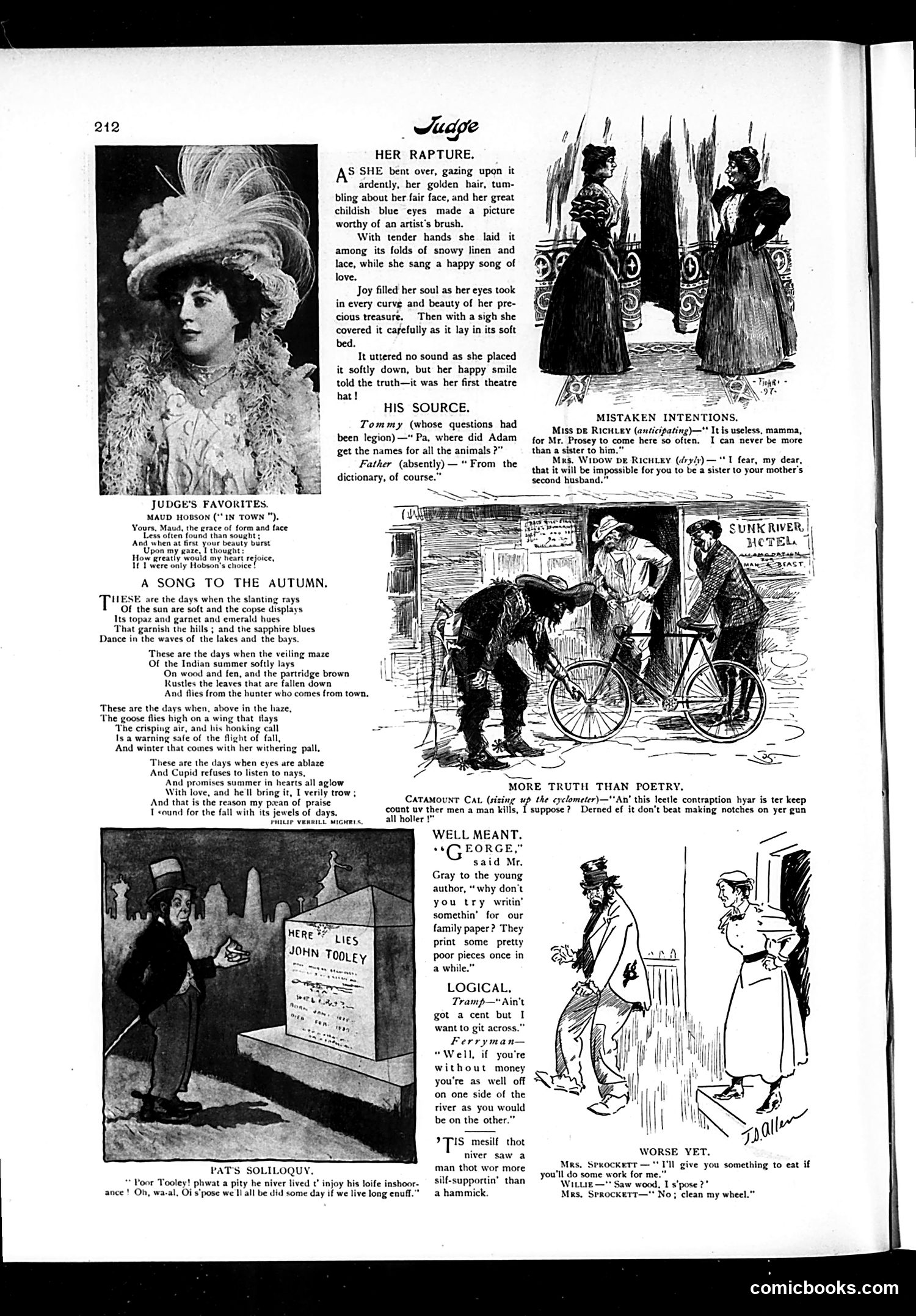
This page contains several unrelated humorous pieces typical of early Judge magazine: **"Her Rapture"** depicts a young woman's joy upon receiving her first theatre hat—a commentary on women's fashion obsession and theatrical culture. **"His Source"** shows a child asking his father where Adam got animal names; the father's dismissive "dictionary" answer satirizes parental evasion of difficult questions. **Various one-liners** mock Irish immigrants (the "Pat's Soliloquy" and "Catamount Cat" pieces use exaggerated dialect humor), social pretension ("Mistaken Intentions"), and rural/working-class figures ("Well-Meant," "Logical," "Worse Yet"). The cartoons employ period stereotypes—Irish servants, hobos, rural characters—reflecting Judge's satirical approach to American social hierarchies. The humor relies on class-based caricature and dialect comedy that would be considered offensive today. A poem "A Song to the Autumn" fills space with sentimental verse unrelated to satire.
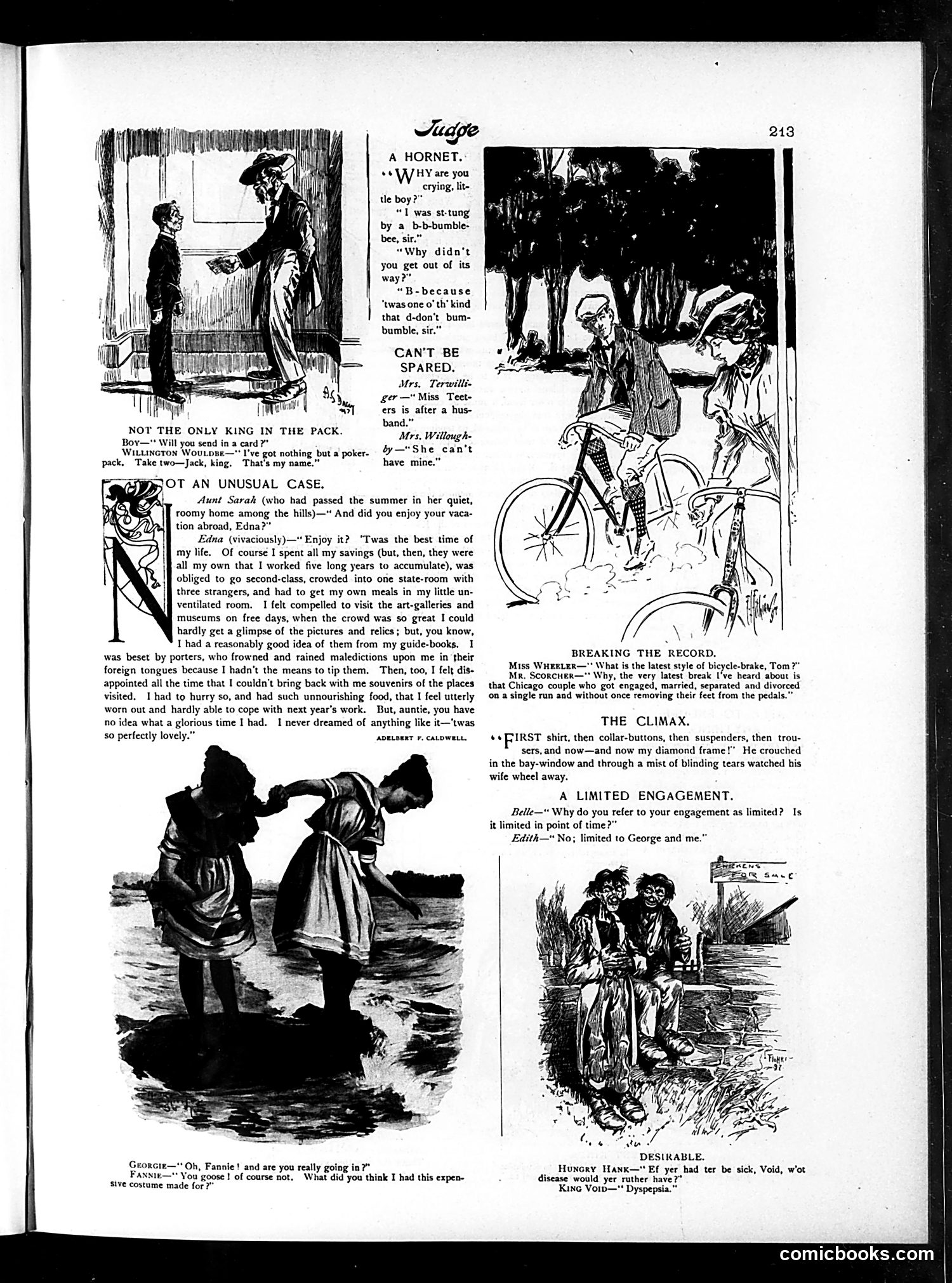
This page contains several brief satirical comic vignettes typical of early 20th-century American humor: **"A Hornet"**: A child's wordplay joke about a bumblebee that doesn't "bumble"—simple absurdist humor. **"Not the Only King in the Pack"**: A poker player's pun—his only card is a king, which is also his name. **"An Unusual Case"**: Satire of pretentious travel culture. A woman brags about a miserable European vacation (crowded conditions, financial strain, inability to afford tips and souvenirs) while calling it "perfectly lovely." The joke mocks both her snobbery and the performative nature of leisure tourism among the middle class. **"Breaking the Record"**: A bicycle joke about a couple who got engaged, married, separated, and divorced without dismounting—satirizing hasty marriages. **"The Climax"**: A man watches his wife cycle away after he's surrendered his clothing piece by piece, suggesting marital capitulation. **"A Limited Engagement"**: An engaged woman limits her engagement to just herself and her fiancé—implying reluctance to publicly acknowledge it. These represent Judge's typical blend of social commentary and domestic humor.
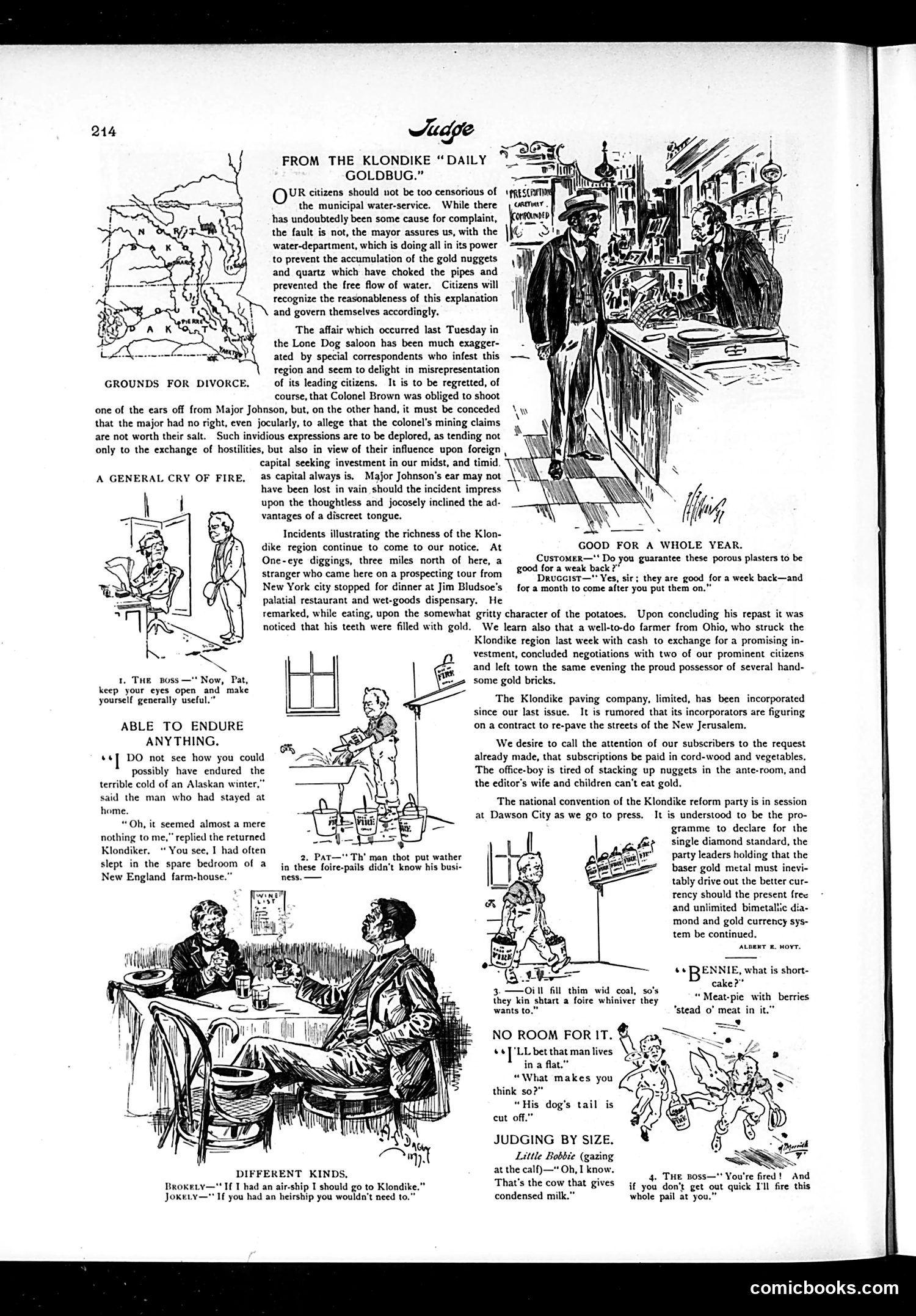
This page satirizes the Klondike Gold Rush through mock-serious commentary. The opening section parodies Yukon newspapers by treating absurdities (gold nuggets clogging water pipes, a prospector's teeth filled with gold, "gold bricks" as currency) as normal civic concerns. The cartoons mock Gold Rush stereotypes: rugged miners enduring Alaskan hardship, get-rich-quick schemers ("if you had an heirship you wouldn't need to" go prospecting), and urban naïveté (a child mistaking a cow for one producing "condensed milk"). The "Lone Dog saloon" incident satirizes frontier violence as acceptable local business—a colonel shooting Major Johnson over mining claims is treated with bureaucratic casualness. Overall, Judge presents the Klondike region as simultaneously lawless and obsessed with wealth accumulation, mocking both the frontier mentality and eastern investors' gullibility toward schemes and "gold bricks" (fraud).
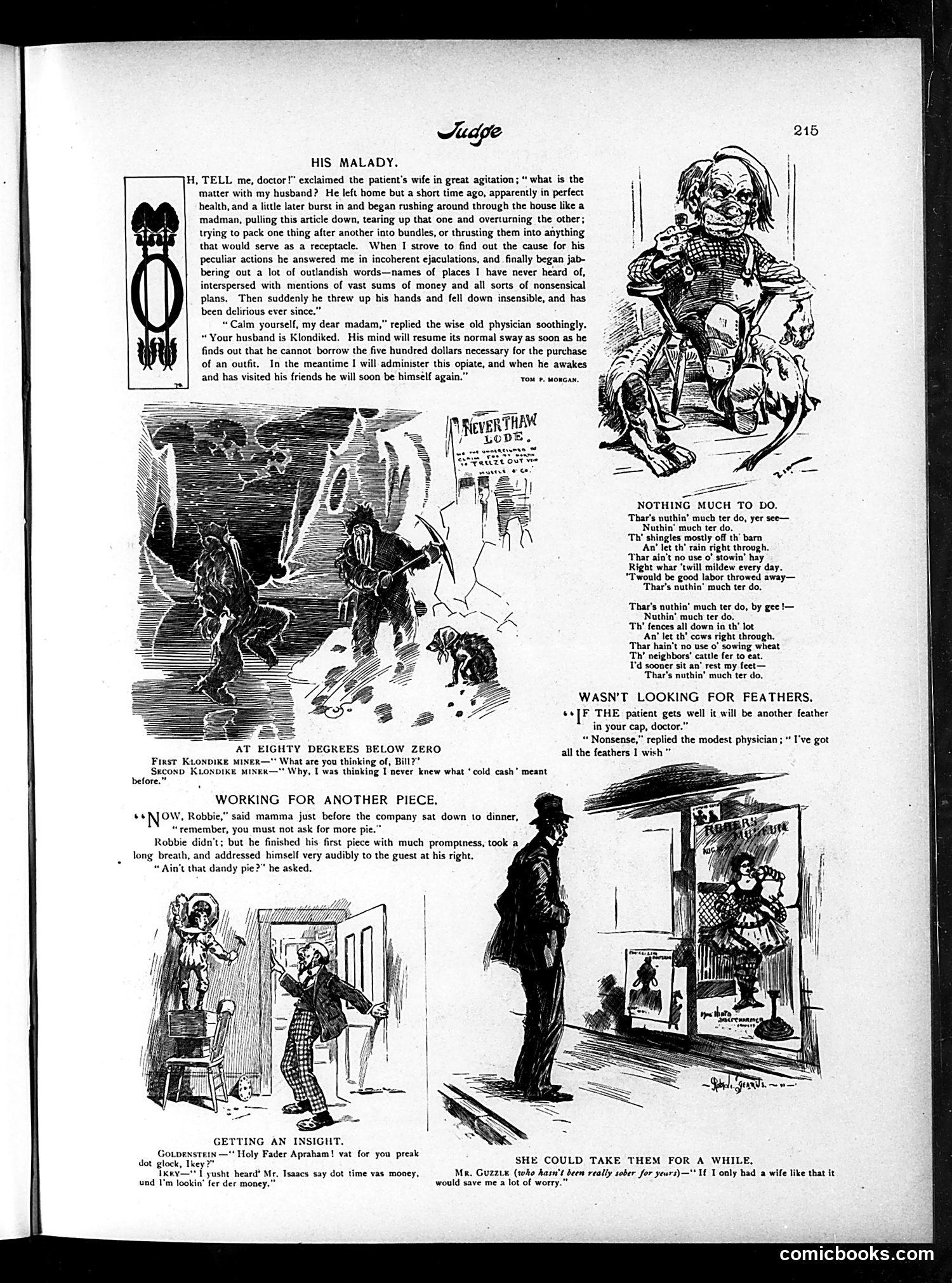
This page satirizes the **Klondike Gold Rush** (1890s), a major historical event when prospectors rushed to Canada's Yukon seeking gold fortunes. **"His Malady"** depicts a husband suddenly afflicted with "Klondike fever"—manic obsession with gold-rush riches. He's wildly gathering supplies and money, speaking incoherently about unfamiliar place names and vast sums. The doctor's diagnosis is sardonic: the "cure" is realizing he can't afford the required $500 outfit. This mocks how get-rich-quick fever gripped ordinary Americans, most unprepared for harsh frontier conditions. **"At Eighty Degrees Below Zero"** is a brief joke about Klondike miners discovering that "cold cash" has a literal meaning in such extreme conditions. The other scattered cartoons and poems ("Nothing Much to Do," "Working for Another Piece," "Getting an Insight") appear unrelated to Klondike, offering general domestic humor typical of Judge's satirical content. The page's primary target is the irrational gold-rush mania and its false promises to average citizens.
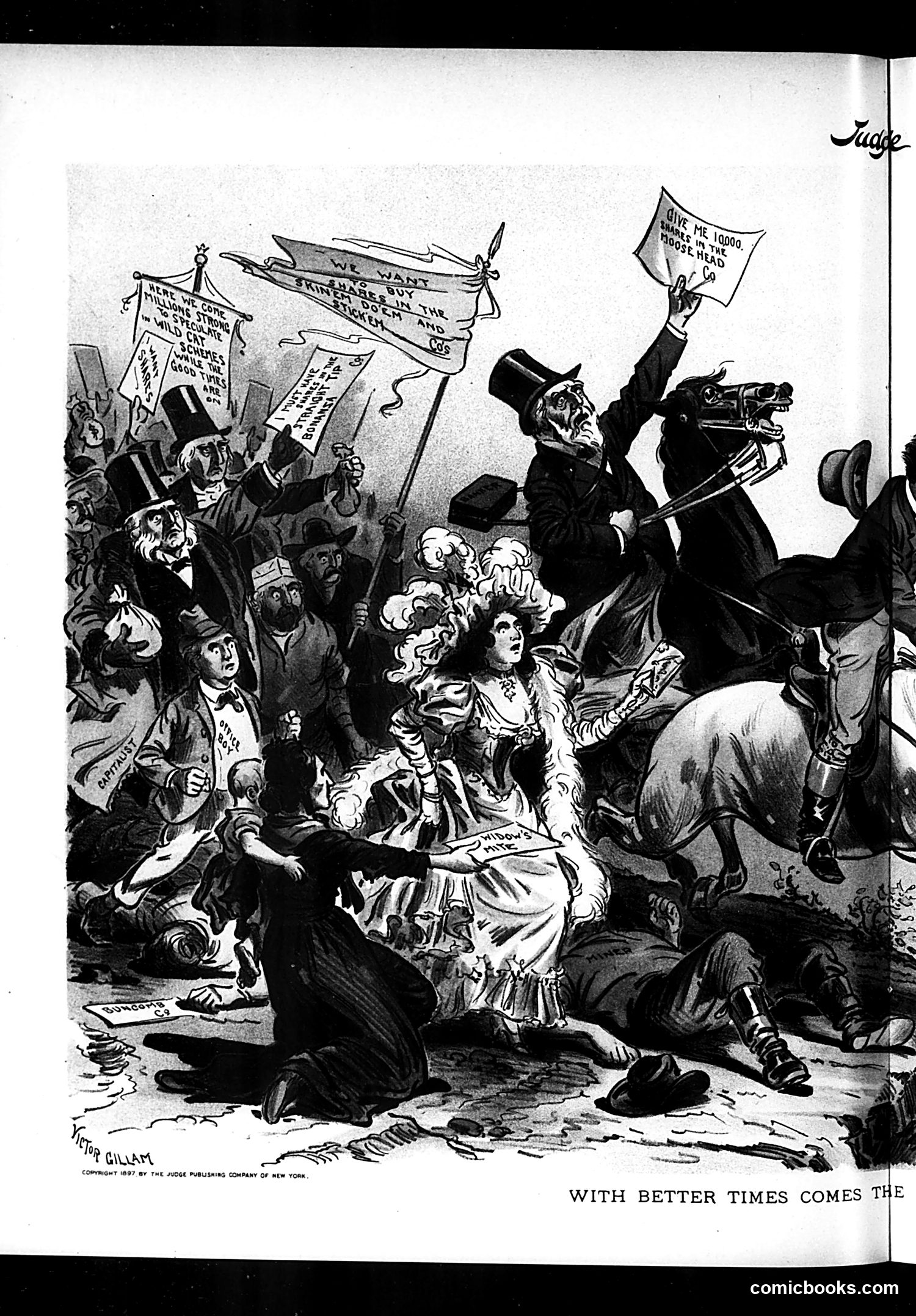
This political cartoon by Victor Gillam satirizes economic hardship and social upheaval. A well-dressed aristocrat on horseback (representing wealthy elites or political leadership) looms over a distressed woman surrounded by a desperate crowd holding protest signs. The signs appear to reference labor disputes and economic grievances, though specific text is difficult to read clearly. The woman in the center, possibly representing "Lady Liberty" or the nation itself, appears vulnerable and overwhelmed. The contrast between the elevated, powerful figures on horseback and the kneeling, impoverished masses below illustrates class conflict and inequality. The caption "WITH BETTER TIMES COMES THE..." suggests ironic commentary—implying that economic improvement fails to reach ordinary people despite promises. This likely critiques Gilded Age wealth concentration and unequal distribution of prosperity during a period of industrial labor unrest.
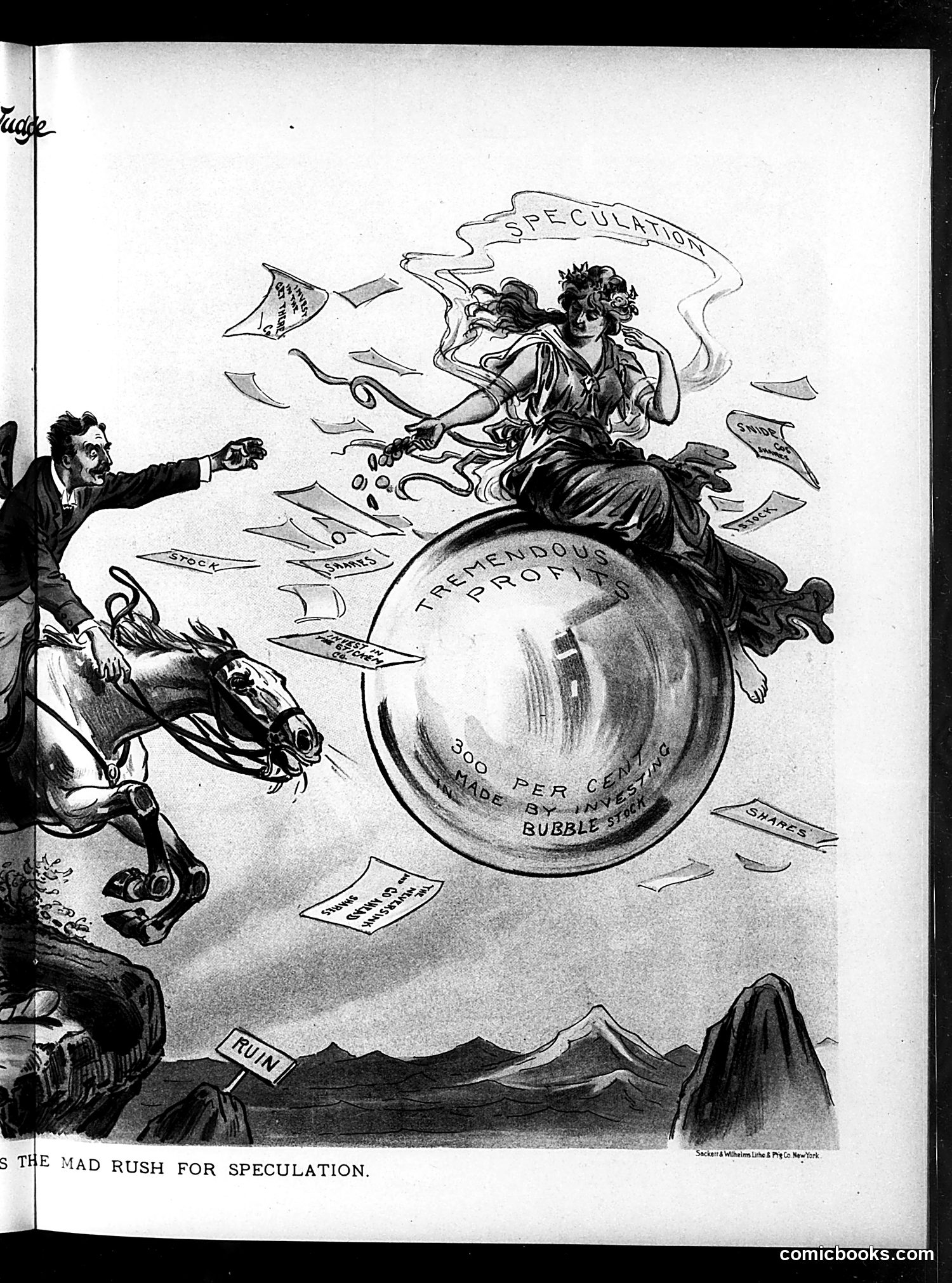
This political cartoon satirizes speculative investment mania, likely from the late 19th century. A large bubble labeled "Tremendous Profits" and "300 Per Cent" floats precariously, carrying two allegorical female figures (representing Speculation and perhaps Greed or Fortune). A man on the left points frantically, urging investors toward it. Flying papers labeled "Stock," "Shares," and "Swindles" scatter around the bubble. The cartoon warns against blind pursuit of get-rich-quick schemes. The bubble itself—a classic symbol of market inflation—suggests these profits are illusory and will inevitably burst. The mountainous landscape below labeled "Ruin" emphasizes the catastrophic consequences awaiting those who chase unrealistic returns. The satire targets the irrational exuberance of speculators who ignore risk in pursuit of spectacular gains.
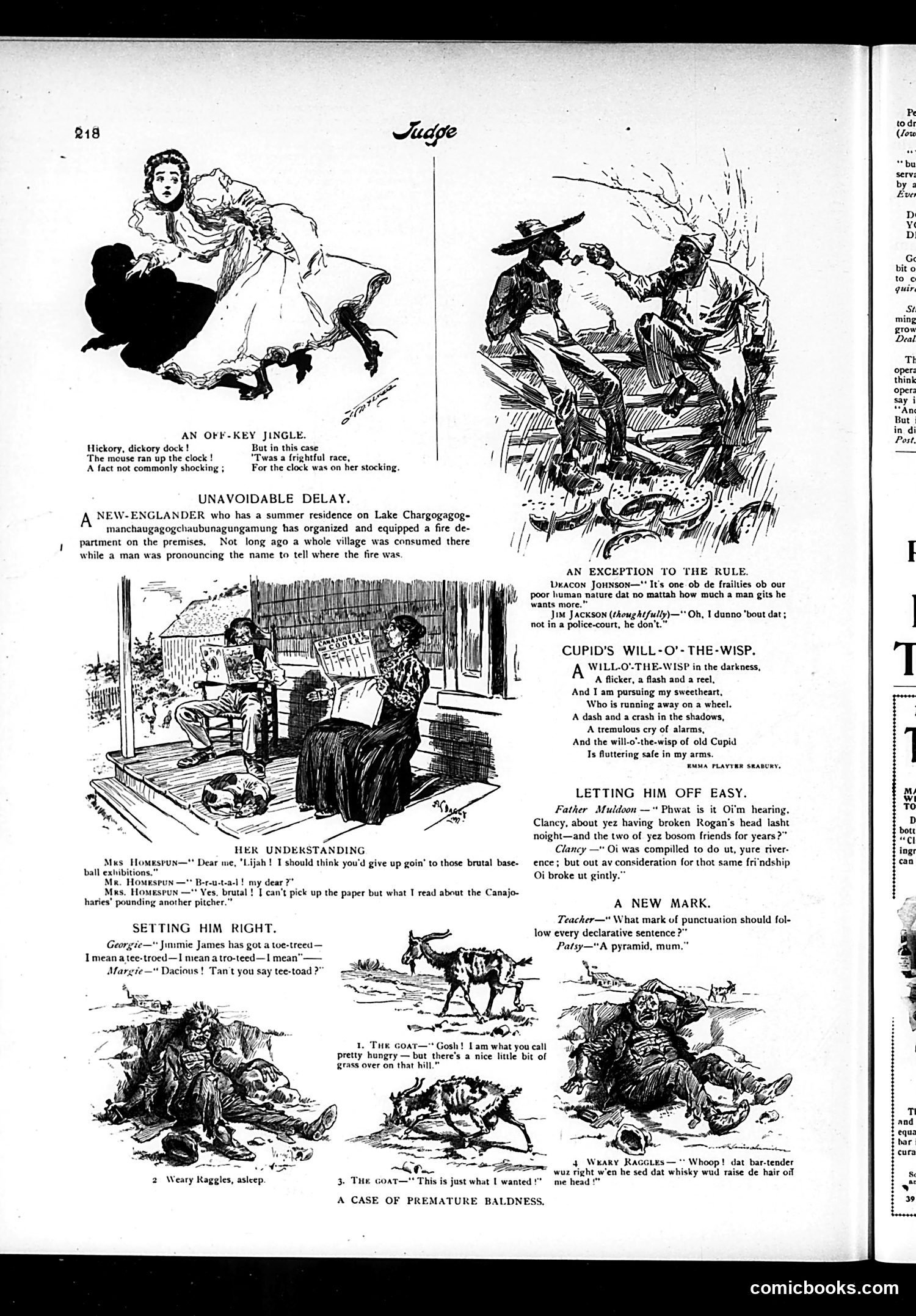
This page collects brief humorous sketches typical of Judge magazine's satirical content: **"An Off-Key Jingle"** plays on the nursery rhyme "Hickory Dickory Dock," suggesting an absurd twist where a mouse runs up a clock on a woman's stocking—mocking forced rhyming in poetry. **"Unavoidable Delay"** jokes about a New Englander with a comically long lake name (Chargogagogmanchaugagogchaubunagungamung—a real Massachusetts place). The satire: a fire department can't respond because the man pronouncing the address takes too long. **"Exception to the Rule"** features dialect-heavy characters (Deacon Johnson and "Jist Jackson") debating human greed, with Jackson claiming he doesn't want more—because he's in police court, suggesting criminal poverty. The remaining sketches are light romantic/domestic humor about bicycles, Irish dialect comedy, punctuation, and animals. These represent Judge's typical mix of wordplay, ethnic comedy, and visual gags for genteel audiences.
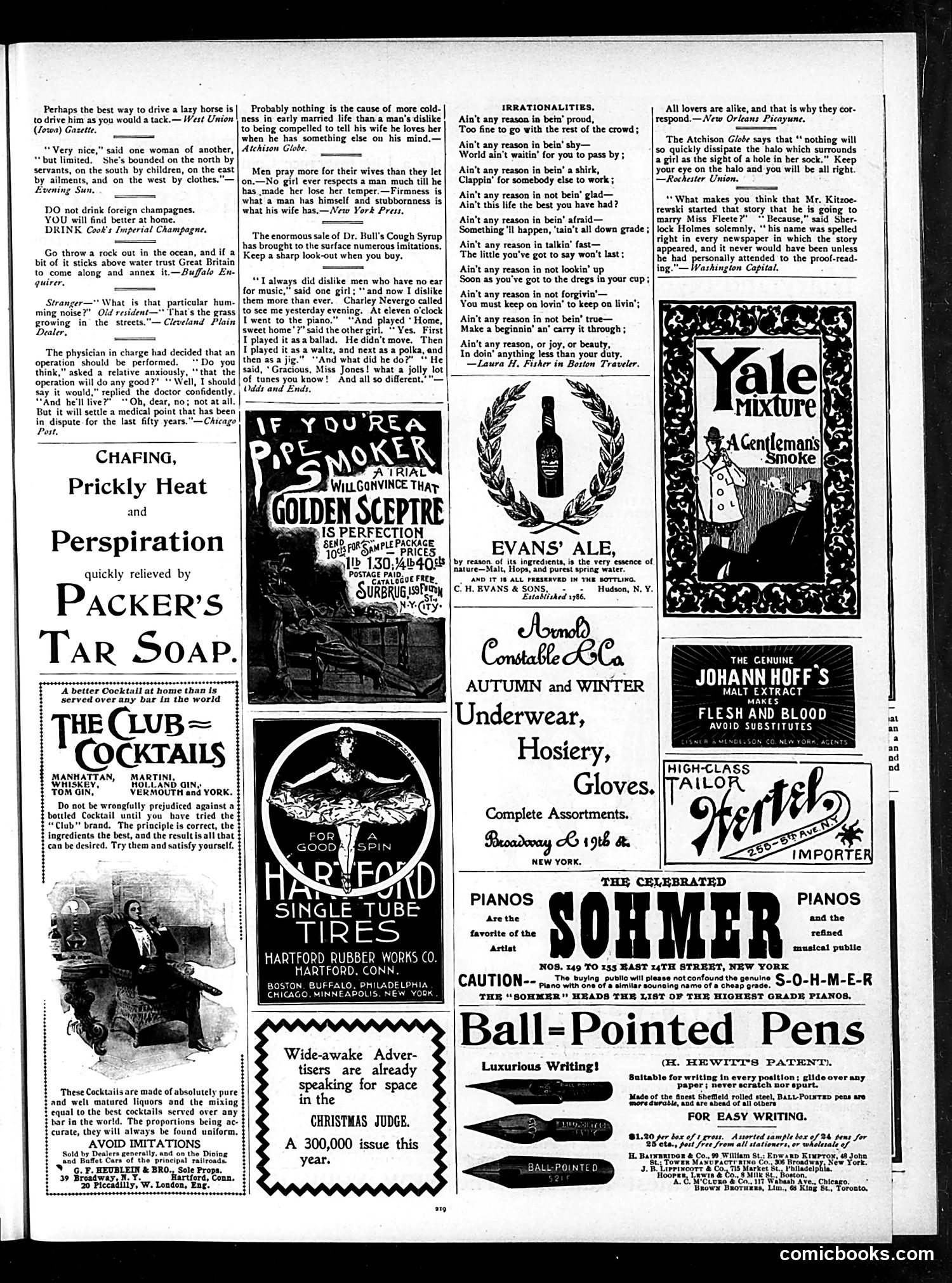
This page is primarily **advertising** for commercial products (soap, champagne, tires, pens, pianos, underwear, cocktails) typical of early 20th-century magazines. The editorial content consists of brief humorous observations rather than political satire. The "Irrationalities" poem by Laura H. Fisher is a moralizing verse about life philosophy—encouraging readers to avoid pride, shyness, laziness, and negativity. It reflects common Progressive Era themes about self-improvement and duty. The scattered jokes address domesticity and marriage: one notes that husbands dislike being forced to profess love when preoccupied; another mocks a woman's limited horizons (bounded by servants, children, ailments, and clothes). These reflect period attitudes about gender roles. A joke about Great Britain annexing objects appears to reference 19th-century British imperialism, though it's dated even for this era. **Overall**: This is primarily a commercial page with light domestic humor and moral verses—not political cartoon satire. The content appeals to middle-class readers through gentle ribbing of marriage, gender expectations, and national stereotypes.
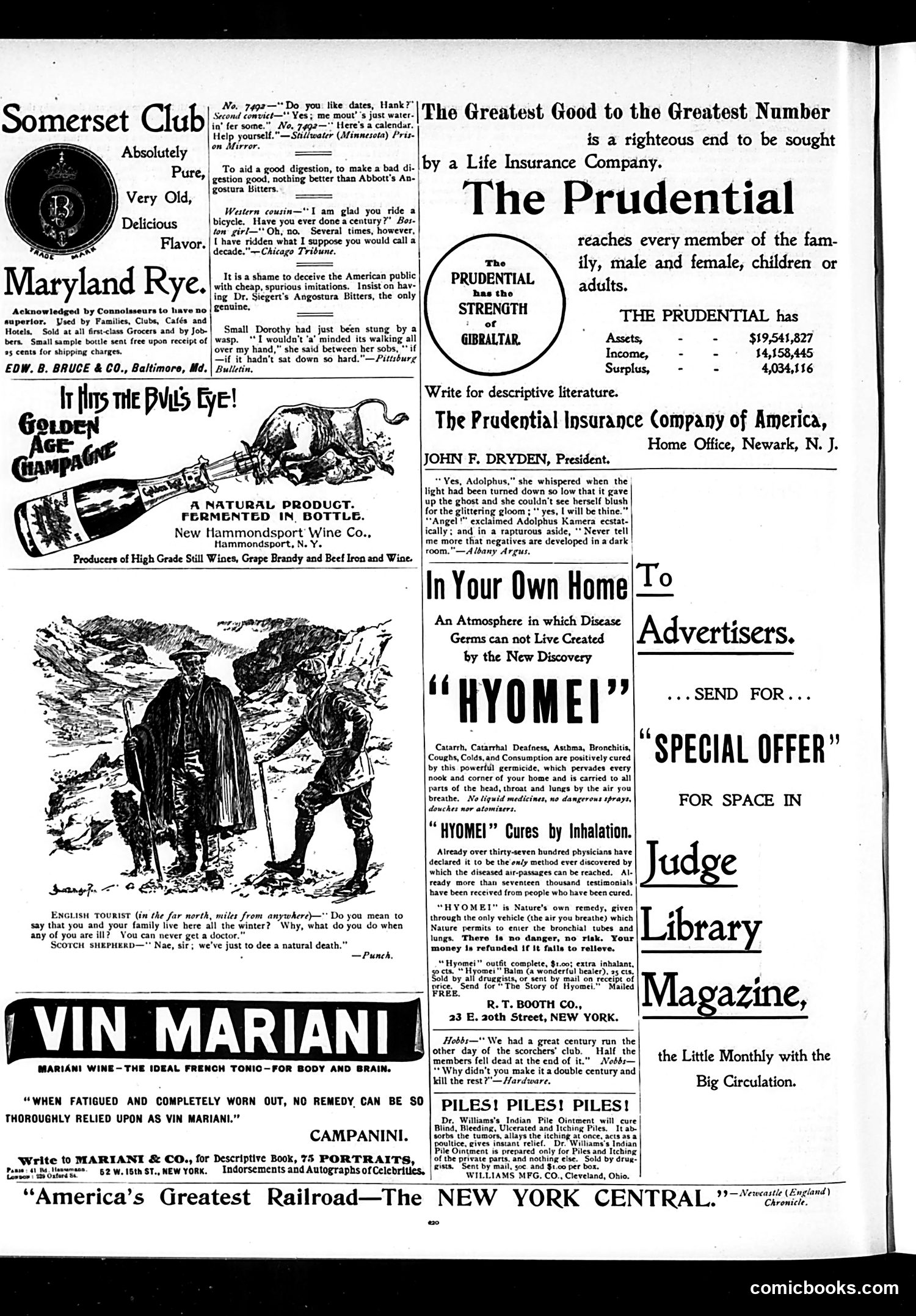
This page is primarily **advertising**, with minimal editorial cartoons. The notable satirical content includes: **"English Tourist" cartoon (bottom left):** A Scottish shepherd explains to a bewildered English visitor that remote highland families handle illness by simply "doing a natural death"—dark humor about rural isolation and lack of medical access in early 20th-century Scotland. **Humorous anecdotes sprinkled throughout** mock social pretensions: a Boston girl claiming she's ridden a "decade" (10 years) instead of a "century" (100 miles) on a bicycle, and a young couple's romantic exchange where the man makes a crude photography joke about "negatives developed in a dark room." The bulk of the page advertises patent medicines ("Hyomei" for respiratory diseases), alcoholic beverages (Somerset Club Rye, Vin Mariani wine tonic), and life insurance. The Hyomei ad exemplifies the era's snake-oil marketing—claiming miraculous cures via inhalation with dubious medical endorsements.
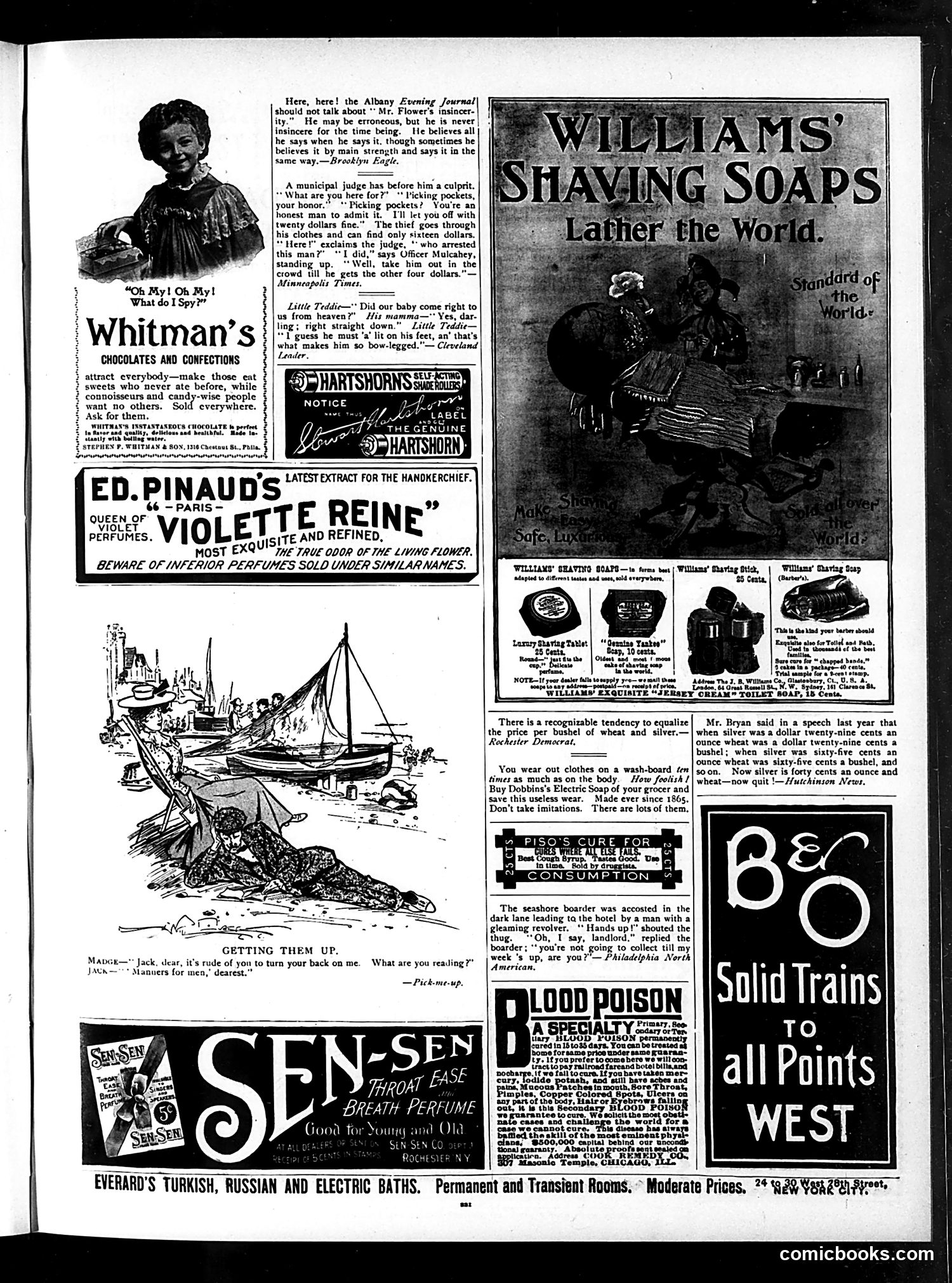
This page is primarily **advertising with interspersed short jokes and anecdotes**, typical of Judge magazine's format. The topical content references **William Jennings Bryan's monetary arguments** (visible in the bottom text): Bryan had claimed a direct correlation between silver prices and wheat prices. The anonymous satirist mocks this correlation, suggesting Bryan's economic logic has collapsed—when silver dropped to forty cents per ounce, wheat didn't follow proportionally, exposing the flawed reasoning behind Bryan's silver-standard advocacy. The scattered jokes are period humor with no particular political thrust—a municipal judge allowing a thief to steal from a crowd to complete his fine, a child's crude joke about a baby's bowed legs, and social observations about laundry wear. The remaining content consists entirely of advertisements for period products: Whitman's chocolates, perfumes, Williams' Shaving Soaps, patent medicines, and railroad services. This advertising-heavy format was standard for Judge.
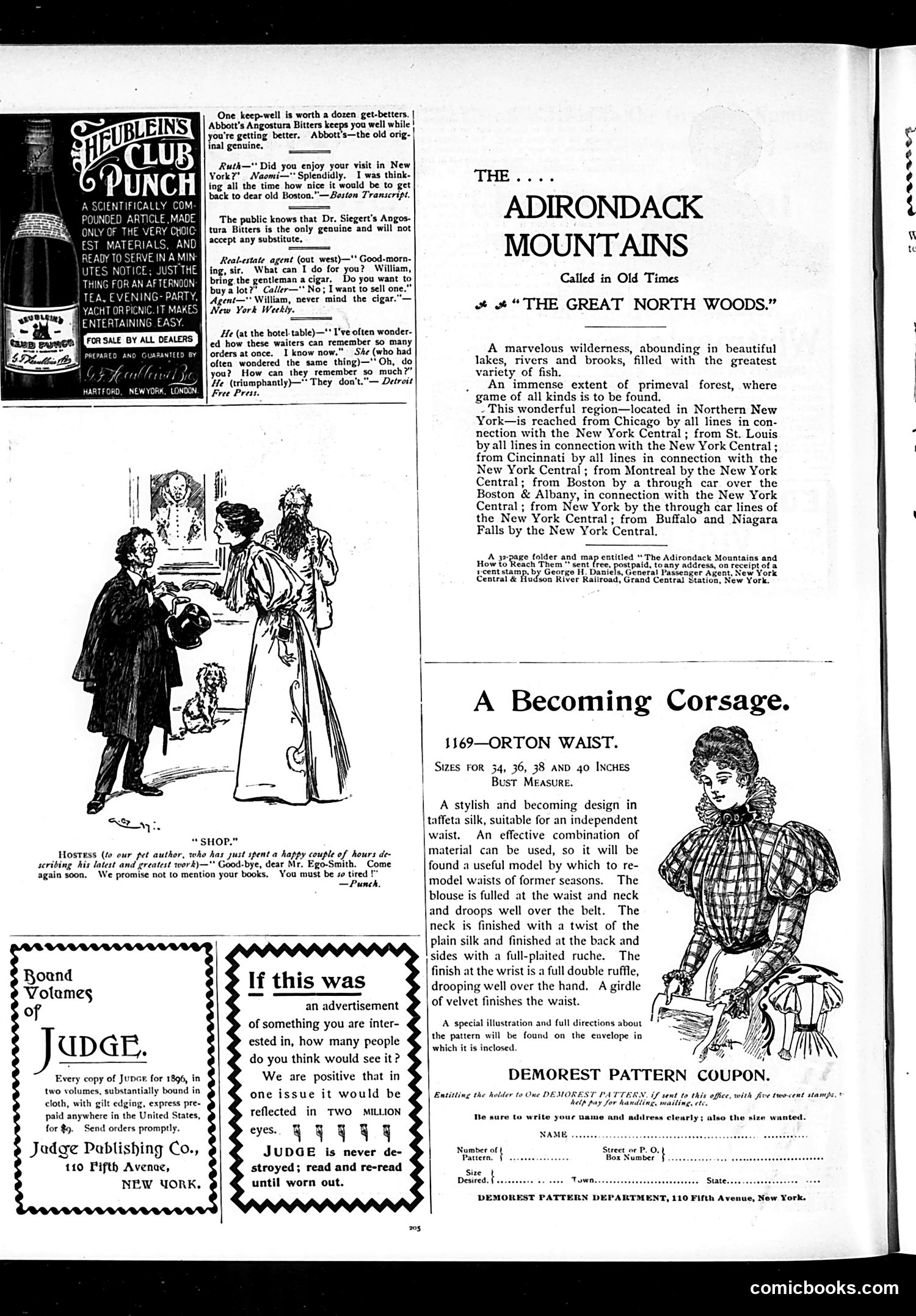
This page is primarily **advertising and fashion content** rather than political satire. The main cartoon—titled "SHOP"—shows a social satire about vanity: a hostess dismisses an egotistical author, promising not to mention his books while admitting she's exhausted from hearing about them. It's gentle mockery of authorial self-importance. The page includes various product advertisements (Shebleins Club Punch, Abbott's Bitters) and humorous anecdotes about travel, real estate, and restaurant service—typical filler for late 19th-century magazines. The substantial content concerns the **Adirondack Mountains** tourist promotion and a **Demoreset sewing pattern** for a women's waist. These reflect the magazine's dual purpose: entertainment plus revenue from advertisers and pattern companies seeking middle-class female readers. The "JUDGE" publishing promotion boasts two million readers—emphasizing advertising reach—typical of how magazines monetized their circulation numbers.
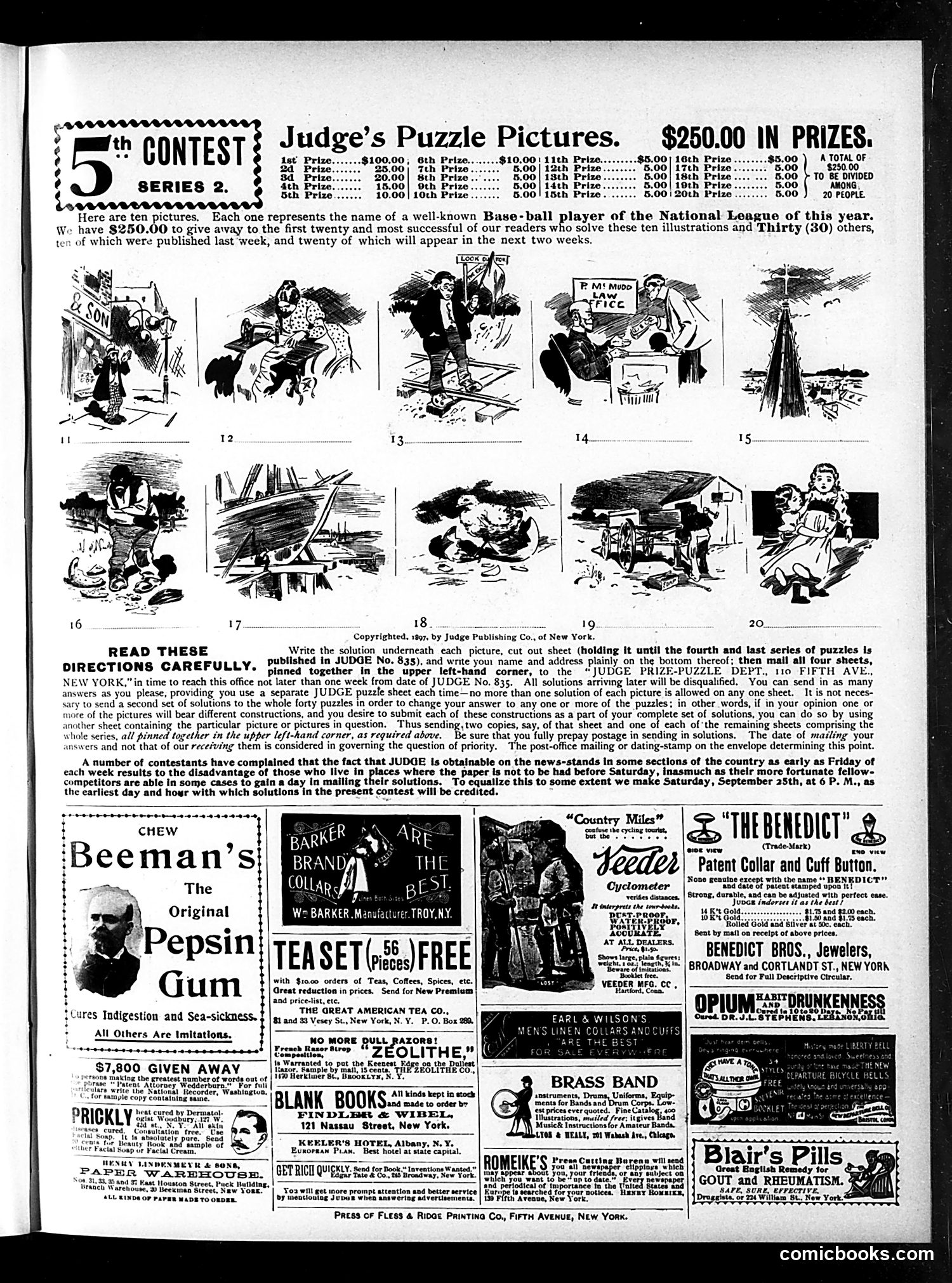
This page features **Judge's 5th Contest Series**, a puzzle competition offering $250 in prizes for readers who identify ten baseball players from caricatured illustrations (numbered 11-20, with additional puzzles in subsequent weeks). The cartoons depict exaggerated physical characteristics typical of early 20th-century sports caricature—likely representing recognizable National League players of the era, though specific identities aren't labeled here. Readers submitted solutions by mail with their answers written beneath each picture. The page is primarily a **contest announcement and entry mechanism**, not political satire. The lower half contains period advertisements (Beeman's Gum, tea sets, patent collar buttons, and dubious medical remedies like "Opium for Drunkenness"), typical of Judge's commercial content. The detailed instructions emphasize postal fairness—acknowledging that regional newspaper distribution delays disadvantaged some contestants—a practical concern for 1897 mass-media competitions.
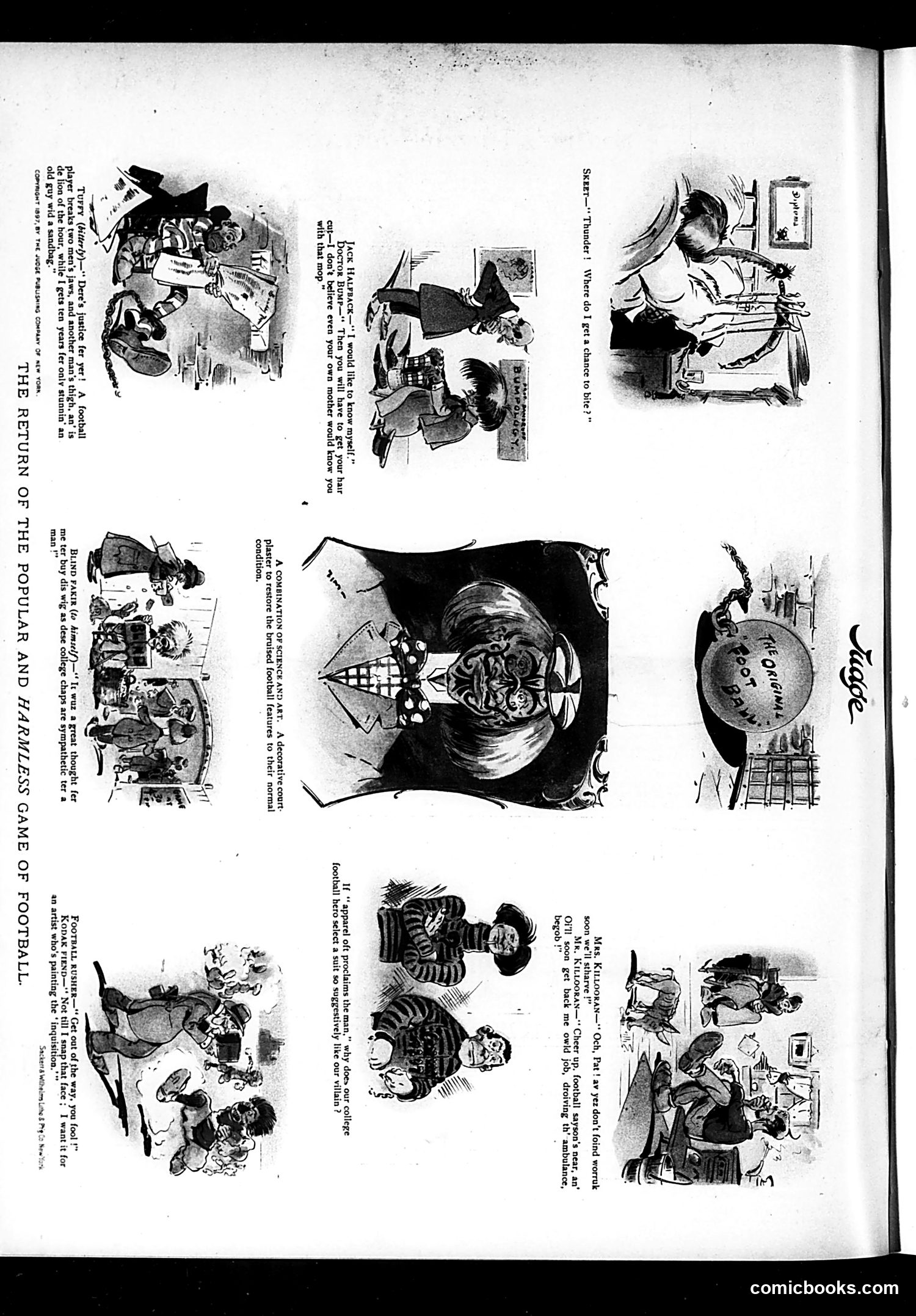
This Judge magazine page satirizes American college football's violence and social consequences circa 1897. Multiple cartoons mock football's brutality: **Key figures/scenarios:** - Mr. and Mrs. Killooran: Irish immigrants; he jokes he'll resume his job "driving th' ambulance" during football season—implying players need constant medical transport - A doctor telling an injured "football hero" he needs a haircut to be recognized (suggesting his face is unrecognizable from injuries) - A criminal complaining a football player causes serious injury yet becomes celebrated ("lion of the hour"), while he receives ten years imprisonment for similar violence - A "blind fakir" selling wigs, noting college students buy them—dark humor suggesting players lose their hair/scalp from injuries **The satire:** Football is presented as socially acceptable violence that injures players so severely they require ambulances and become disfigured, yet society celebrates rather than condemns it. The irony is that identical injuries from other causes bring criminal prosecution.