
A complete issue · 16 pages · 1897
Judge — September 4, 1897
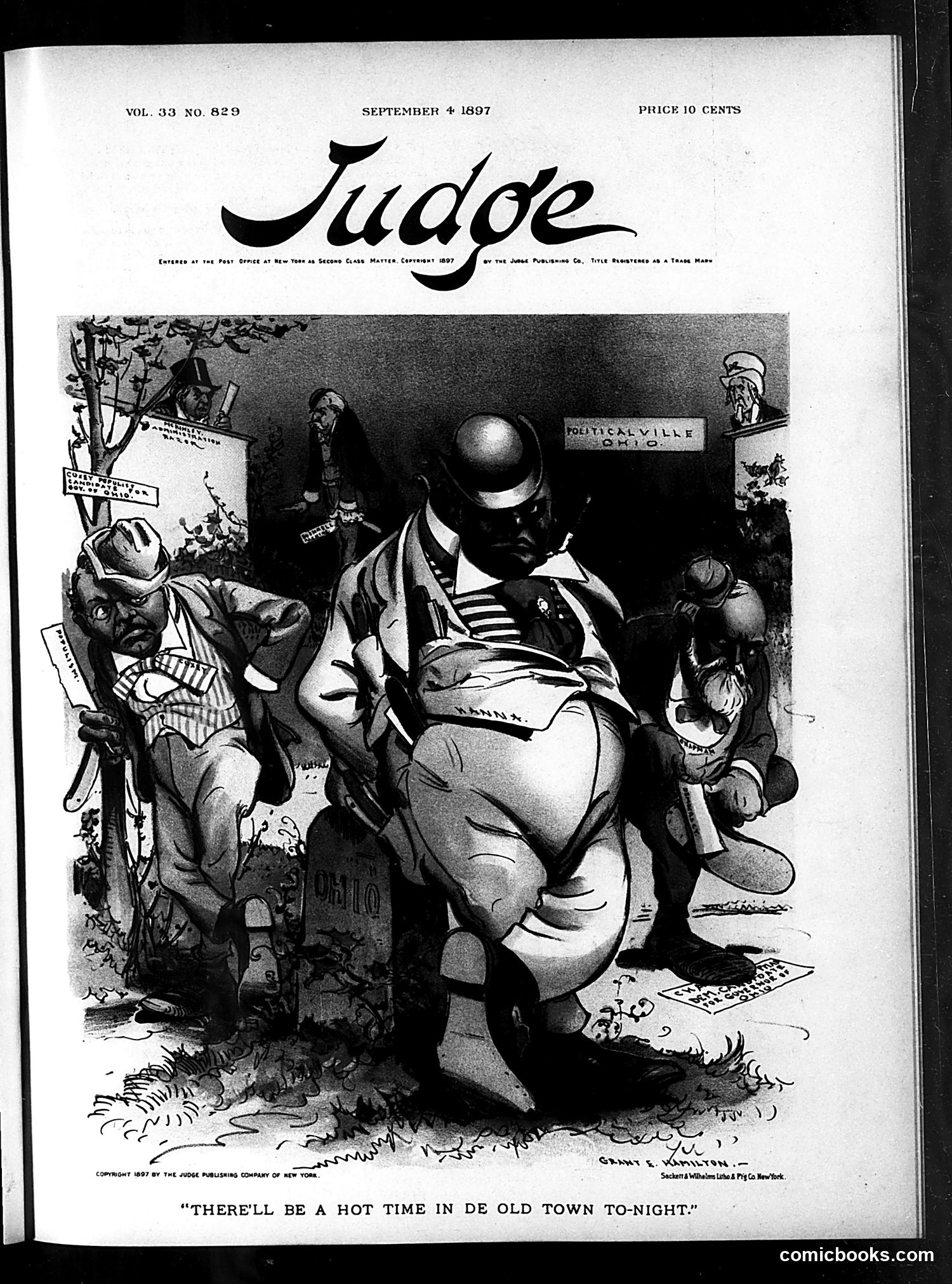
This political cartoon satirizes conditions in Ohio during the 1897 period. The caption "There'll Be a Hot Time in De Old Town To-Night" (a popular song reference) suggests coming civil unrest or political turmoil. The central caricatured figure appears to represent Ohio itself or its political leadership, depicted as bloated and weighted down. Surrounding figures with military/official regalia likely represent various political factions or interest groups competing for control. The "Politicalville Ohio" sign indicates the cartoon's geographic focus. The overall composition suggests chaos, corruption, or mismanagement in Ohio's governance—various forces pulling the state in different directions. Without identifying specific individuals, the satire critiques general political instability and competing power struggles affecting the state during this period.
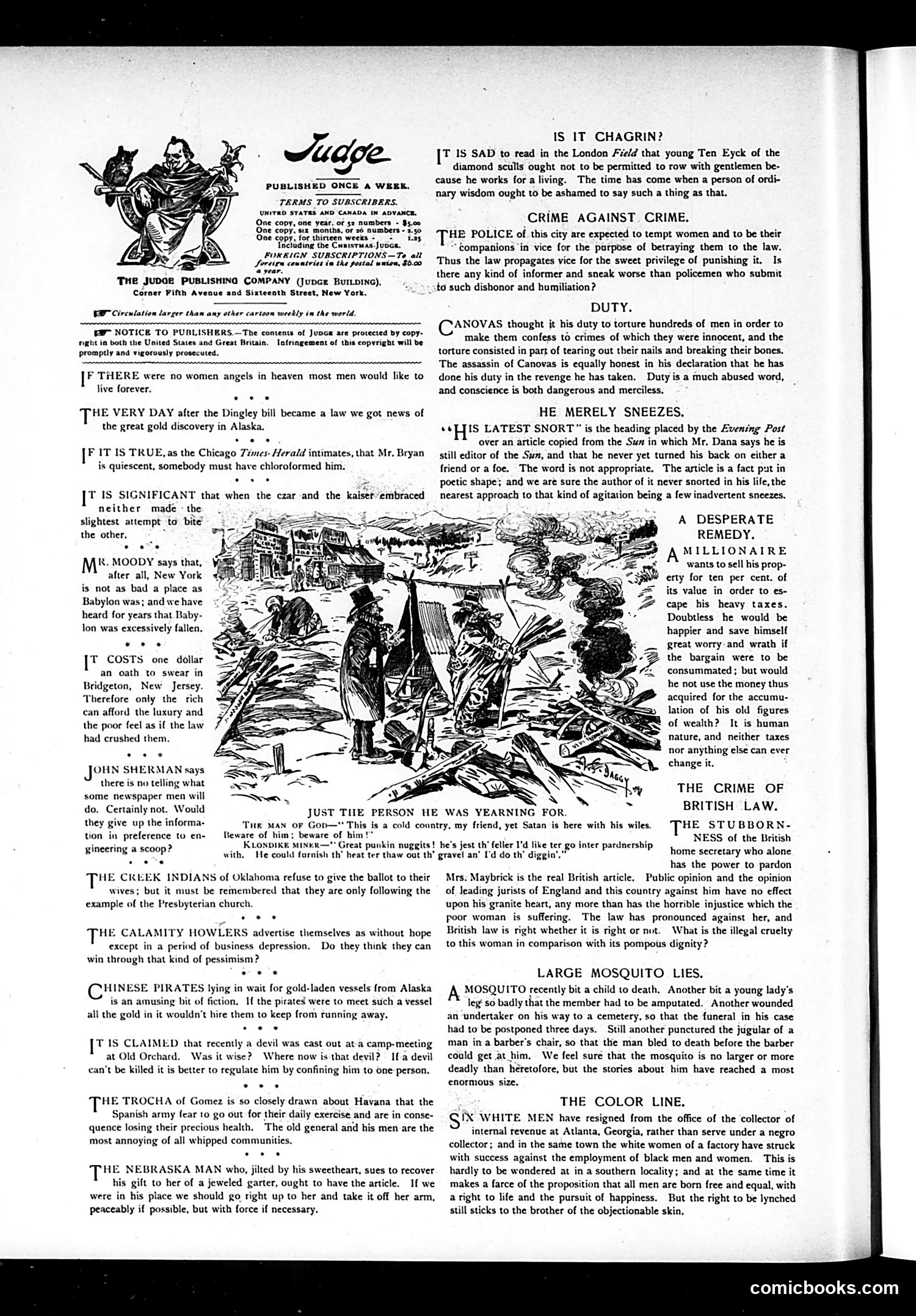
The central cartoon depicts a ragged man in winter conditions, captioned "Just the Person He Was Yearning For." The accompanying text references "a cold country" and "Satan," suggesting this satirizes someone's dangerous or unwelcome arrival or alliance. The page contains multiple brief satirical commentaries on contemporary issues: police entrapment of women ("Crime Against Crime"), dubious journalistic practices ("He Merely Sneezes"), legal injustices affecting women ("The Crime of British Law"), and racial discrimination ("The Color Line," regarding employment of Black workers in Atlanta). The overall tone targets institutional hypocrisy—law enforcement, journalism, legal systems, and racial prejudice—exposing contradictions between stated principles and actual practices. Without specific dates or context provided, the exact figures and events referenced remain unclear, though the satire consistently attacks systemic abuses of power.
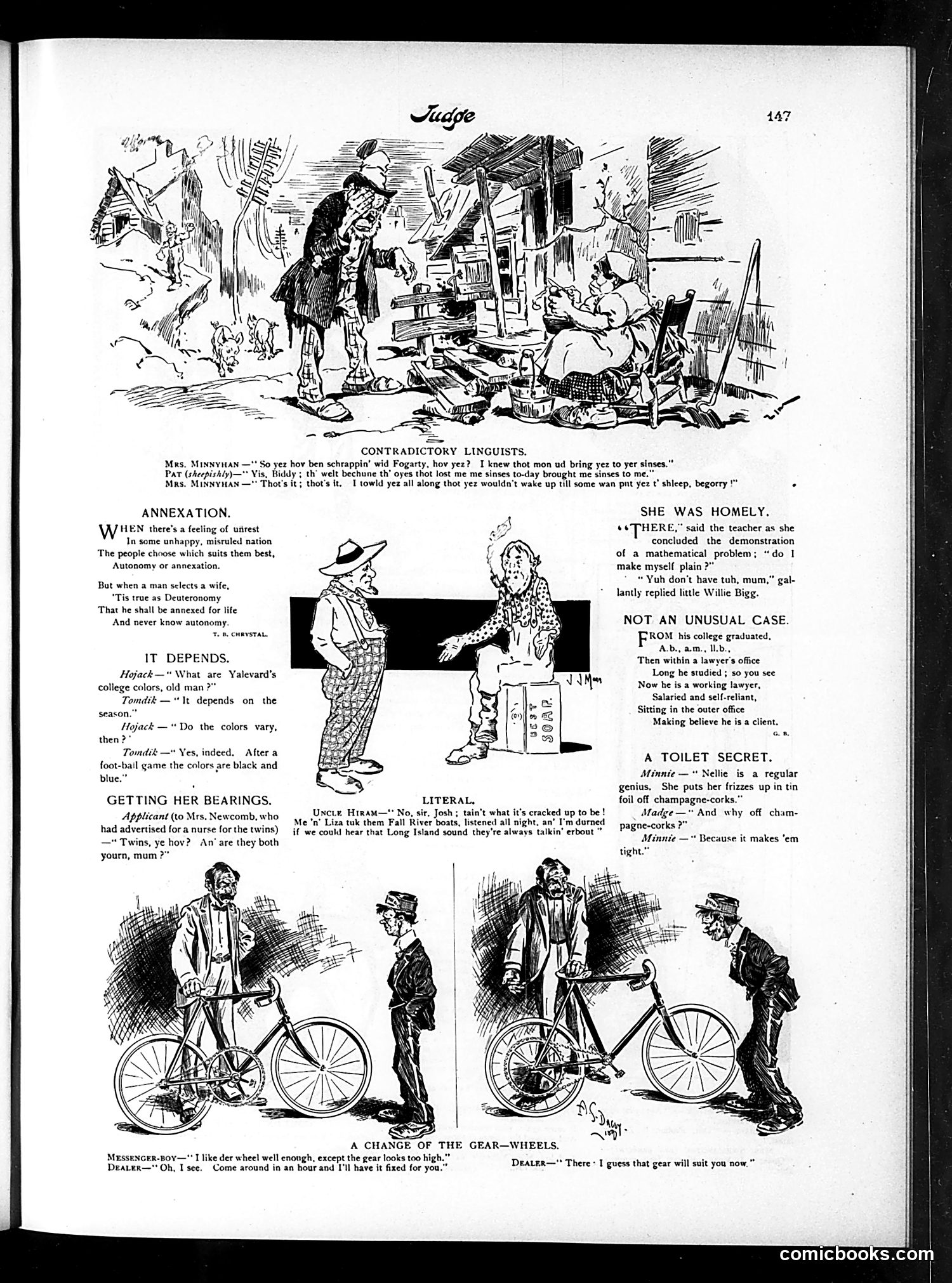
This page contains several unrelated satirical sketches typical of Judge's format: **"Contradictory Linguists"** (top): A domestic dispute where Mrs. Mannahan accuses her husband of contradicting himself about their neighbor Fogarty and his singing—she catches him in an obvious logical inconsistency. The satire targets marital bickering and husbands' poor reasoning. **Lower sketches** include: - "Annexation" and "It Depends"—likely political commentary on contemporary annexation debates (unclear which specific event) - "Getting Her Bearings," "A Toilet Secret," and "Change of the Gear-Wheels"—various domestic humor about women, bicycles becoming popular, and marriage The bicycle jokes reflect the 1890s cycling craze. Overall, the page emphasizes marital discord and contemporary social changes through observational humor rather than pointed political satire.
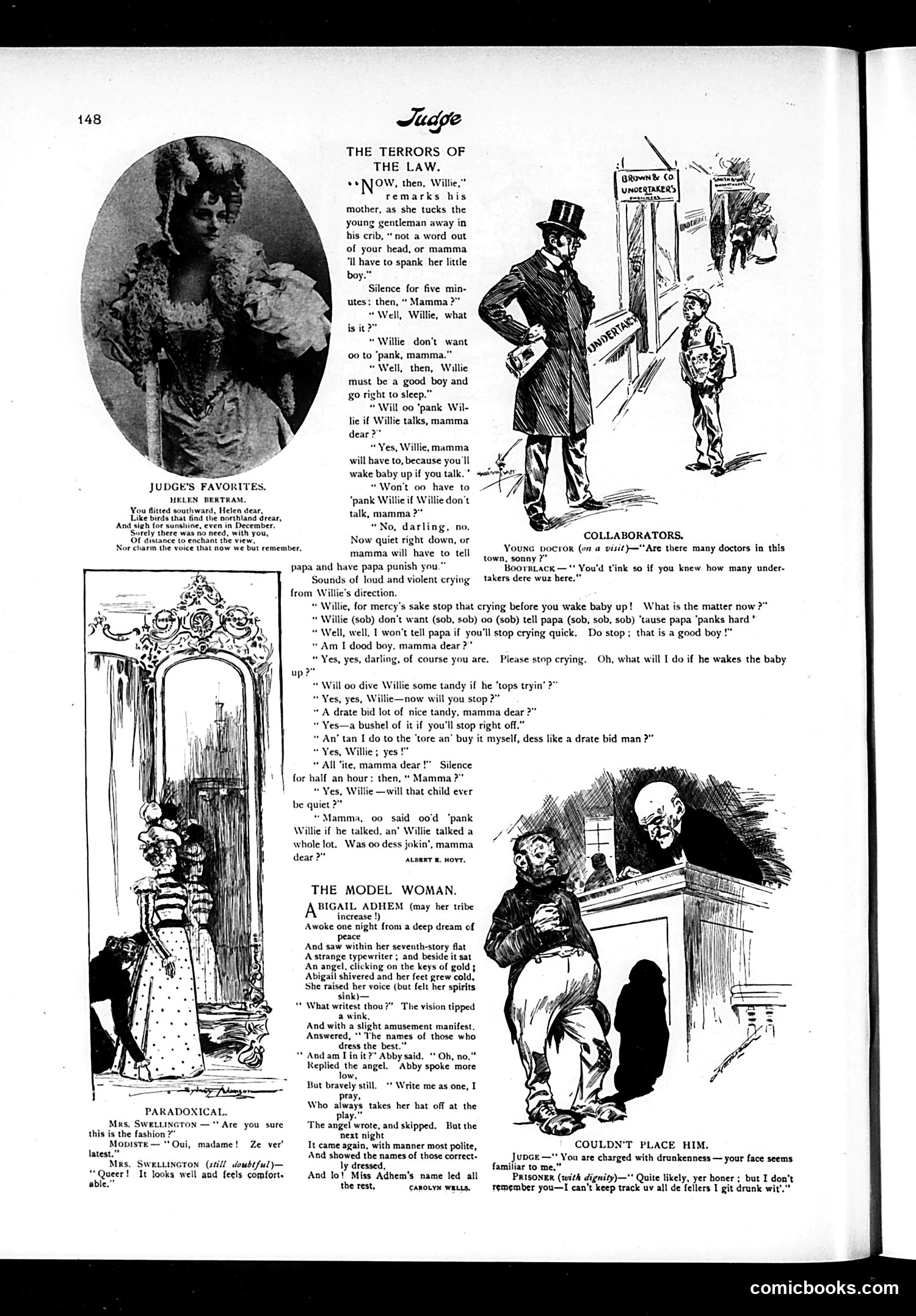
This page from *Judge* magazine contains three satirical pieces: **"The Terrors of the Law"** mocks Victorian parenting anxieties through a child's logic. Willie exploits his mother's threats of punishment by noting that if she spanks him for talking, she violates her own rule—thus he's "safe" to cry loudly. The satire targets parents who use poorly-reasoned discipline and make empty threats. **"Judge's Favorites"** and **"Paradoxical"** are brief romantic/fashion poems poking fun at society women and fashion contradictions. **"The Model Woman"** parodies self-righteous morality, imagining an angel recording "those who dress the best." When asked if she's included, Abigail requests to be listed as someone who removes her hat at plays (a modest gesture). The angel's return showing her name "led all the rest" suggests even modest virtue-signaling is just vanity in disguise. **"Collaborators"** and **"Couldn't Place Him"** are brief joke captions about doctors and drunkenness. The humor relies on exposing hypocrisy in Victorian social conventions and parenting.
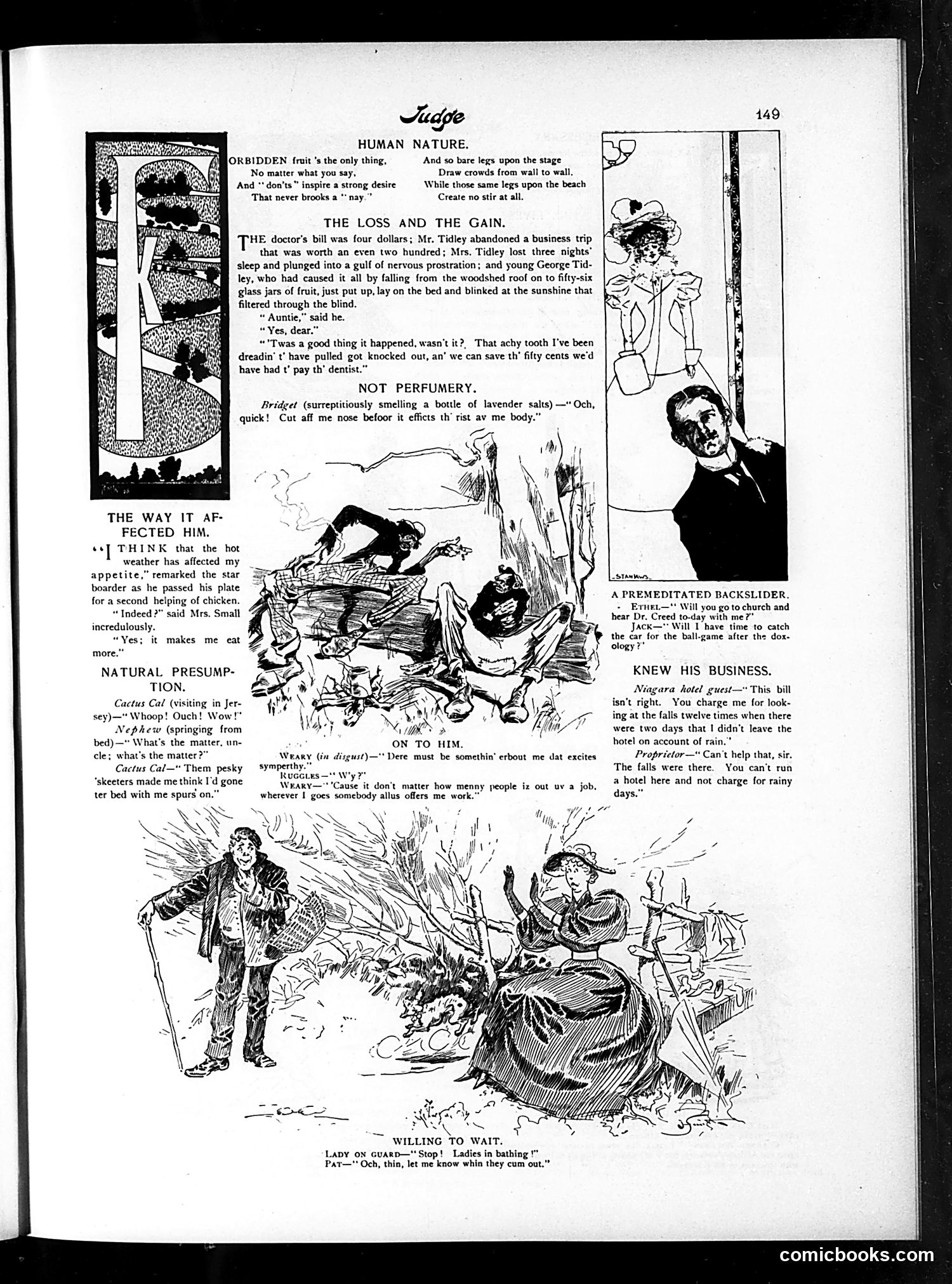
This page contains multiple brief satirical vignettes typical of Judge's humor: **"The Loss and the Gain"** mocks childish logic: a boy injures himself falling onto fruit jars, causing his family significant financial loss and emotional distress, yet celebrates because he avoided a 50-cent dentist bill—absurdly weighing minor gain against major loss. **"Human Nature"** observes social hypocrisy: bare legs in theaters draw crowds, but identical legs on beaches attract no attention, satirizing how artificial context and prohibition drive desire. **"Not Perfumery"** features an Irish servant (Bridget, a common ethnic stereotype) comically misunderstanding lavender salts as a dangerous substance affecting the body. **"Willing to Wait"** depicts an Irish laborer (Pat) willing to wait indefinitely for women to exit a bathing area, playing on period stereotypes. **"Knew His Business"** satirizes a hotel proprietor charging guests for viewing Niagara Falls even on rainy days when they couldn't leave—exploiting tourists through absurd logic. These are lighthearted domestic and social humor pieces rather than political commentary, representing typical Judge content.
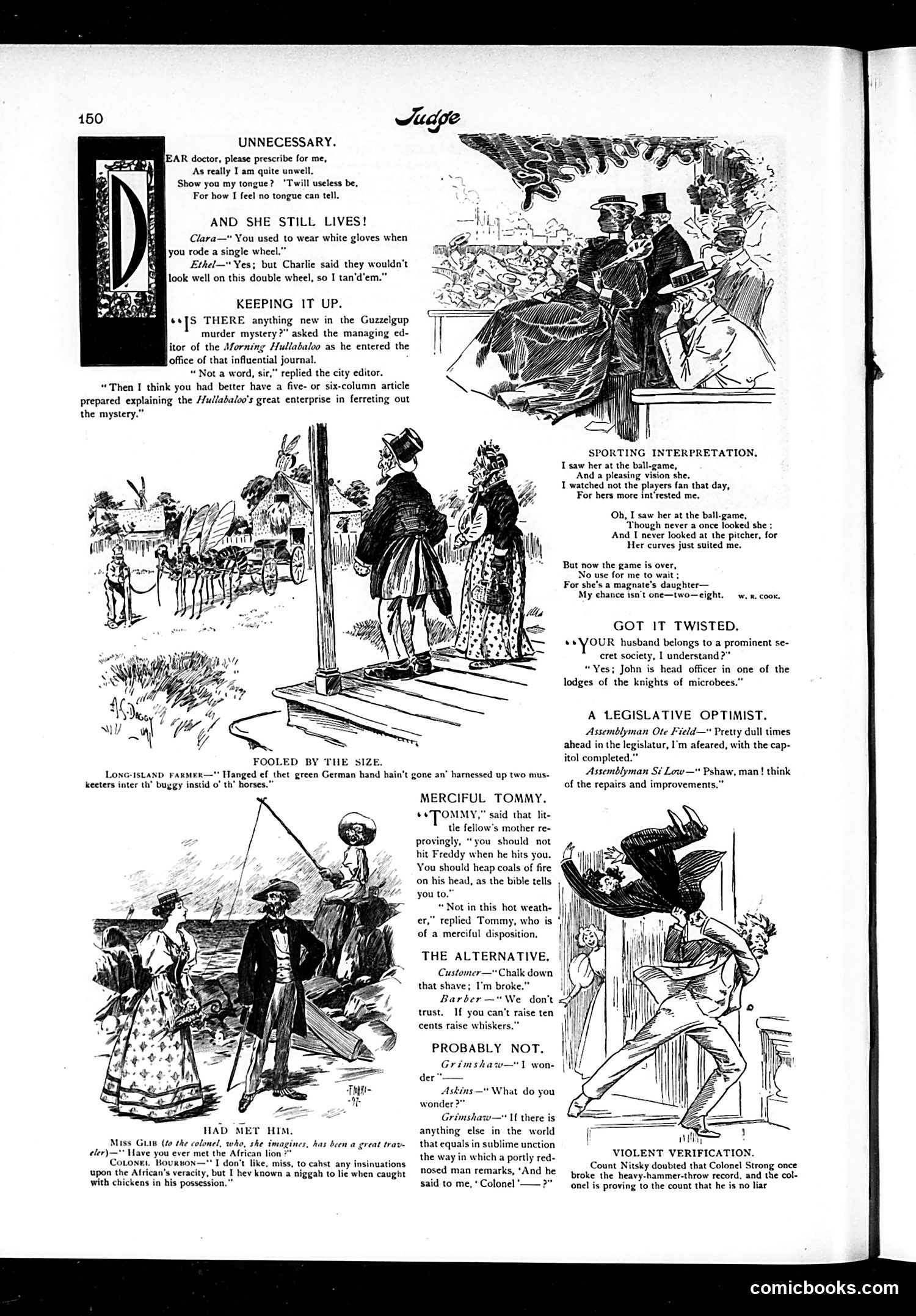
This page from *Judge* contains multiple short humorous pieces typical of the magazine's satirical format: **Key content includes:** - **"AND SHE STILL LIVES!"** — A joke about women's fashion/bicycles, referencing the transition from single to "double wheel" (tandem bicycles), with a woman tanning her gloves to match the new style. - **"KEEPING IT UP"** — Satire on sensationalist journalism: a newspaper editor suggests fabricating a detailed article about an unsolved murder to boost readership, despite having no actual news. - **"FOOLED BY THE SIZE"** — A rural dialect joke about a farmer mistaking large insects for horses. - **"MERCIFUL TOMMY"** — A child's practical misinterpretation of biblical instruction (heaping coals of fire), choosing mercy due to hot weather rather than moral principle. - Various other brief jokes about credit, travel, and social situations. The page reflects *Judge*'s approach: light satirical commentary on contemporary American life—press sensationalism, fashion, rural simplicity, and social pretension—through accessible humor aimed at middle-class readers.
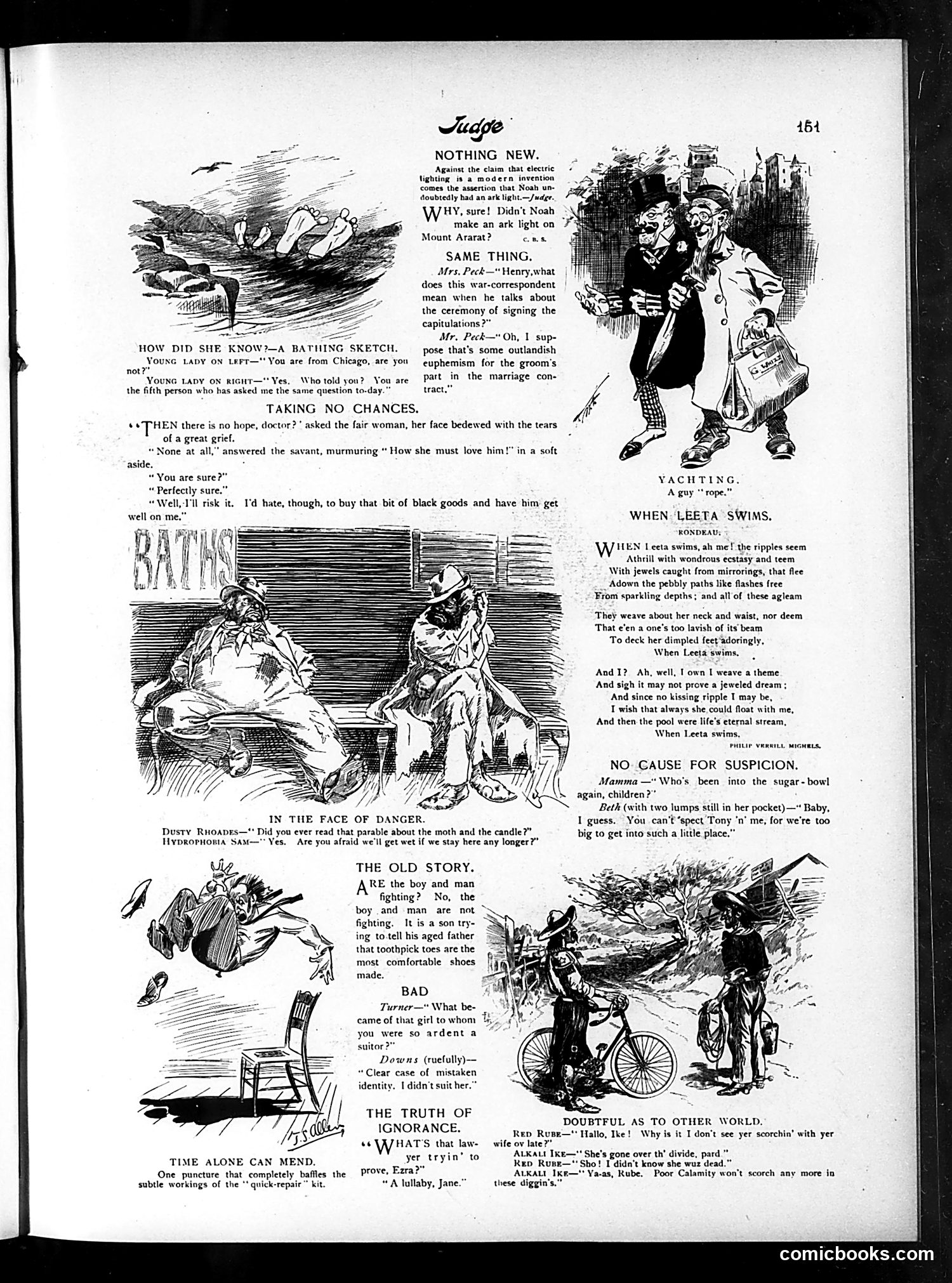
This page from Judge magazine (circa early 1900s) contains multiple brief satirical jokes and sketches typical of the publication's humor: **"Nothing New"** mocks the claim that electric lighting is a modern invention, joking that Noah must have had ark lights. **"How Did She Know?"** uses a bathing sketch to humorously suggest a young woman from Chicago is so unremarkable that five different men have asked her the same question in one day. **"Taking No Chances"** presents dark humor: a woman asks a doctor if her ill husband will die. When assured he will, she hesitates to buy mourning clothes, worried he might recover and she'd waste money on black goods. **Other sketches** include a poem about swimming ("When Leeta Swims"), gentle domestic humor about children eating sugar, and various brief comic dialogues about courtship, footwear comfort, and frontier life. The page reflects early-20th-century American humor: mild social observation, wordplay, gender stereotypes, and sentimental poetry mixed with cynicism—typical of Judge's satirical but genteel approach.
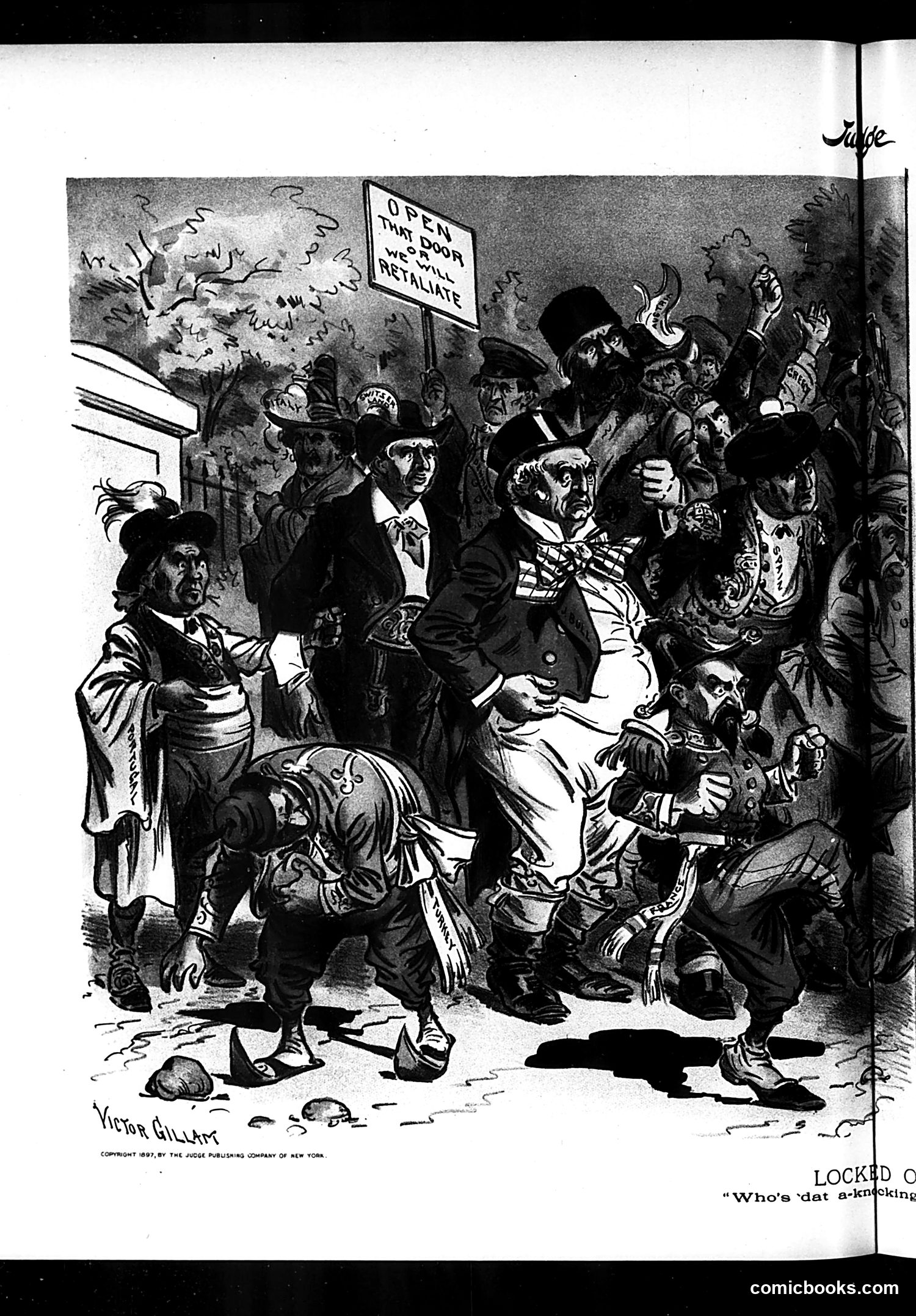
This is a satirical cartoon by Victor Gillam from Judge magazine (copyright 1897, The Judge Publishing Company). The image depicts a crowded scene of military and political figures gathered outside what appears to be a door marked "OPEN TO THOSE WHO DARE TO RETALIATE." The central figure appears to be a caricatured military or political leader in formal dress, surrounded by various uniformed officials and dignitaries. The scene suggests political maneuvering or military posturing, likely referencing late 19th-century international tensions or colonial conflicts. The partially visible caption "Who's 'dat a-knocking" suggests mockery of the assembled figures attempting entry or influence. Without the complete text and full historical context, the specific political situation referenced remains unclear, though the formal gathering suggests high-stakes diplomatic or military matters of the 1897 era.
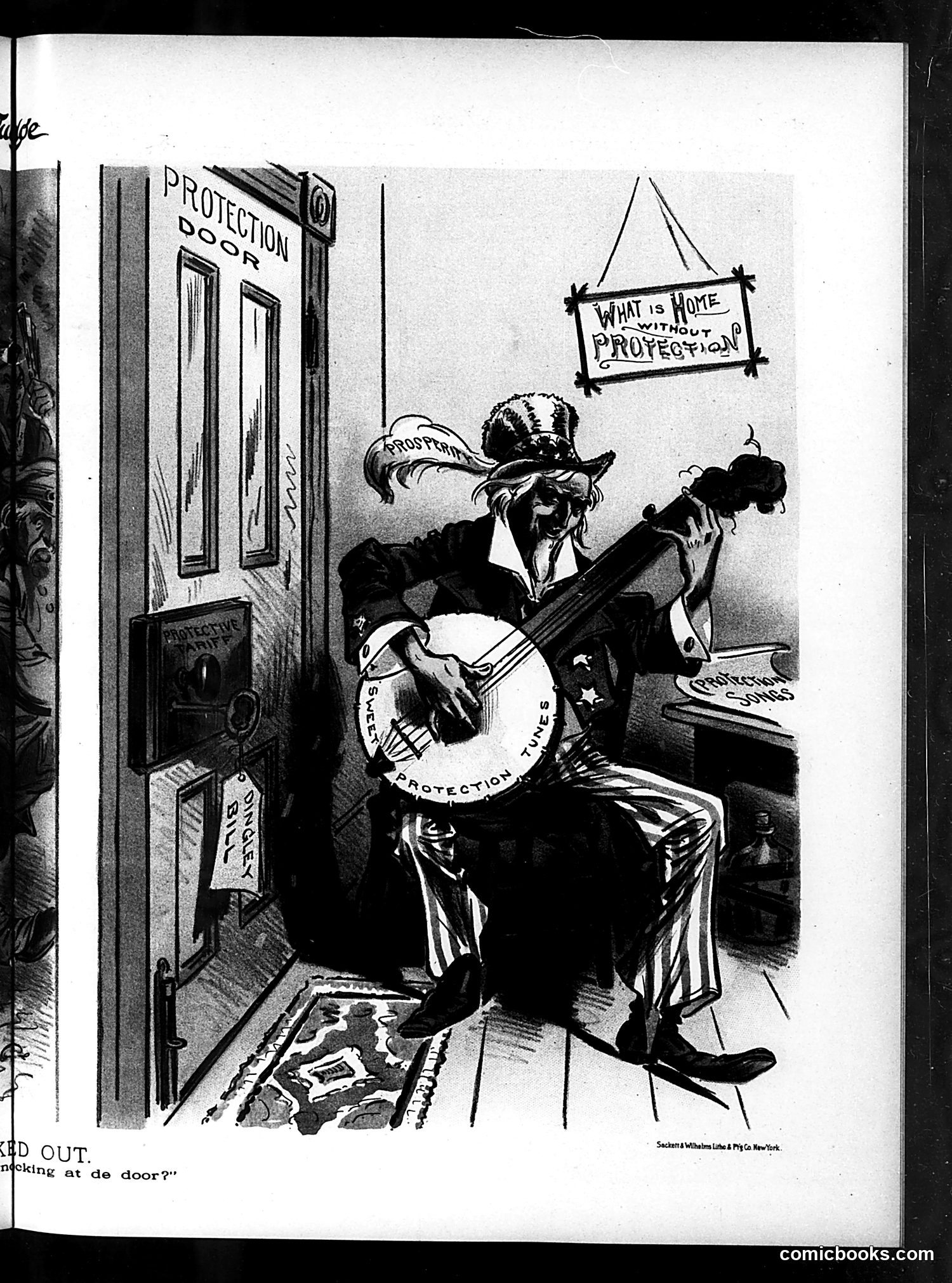
This Judge magazine cartoon satirizes American protectionist trade policy. Uncle Sam, identifiable by his top hat and starred clothing, sits playing a banjo labeled "Protection" while singing about tariffs. The "Protection Door" behind him represents government trade barriers. The cartoon's central joke appears in the sign: "What is Home Without Protection?" — sarcastically suggesting that protective tariffs are as essential to American homes as the door itself. Uncle Sam's deliberate, self-satisfied performance mocks the enthusiastic promotion of protectionist economic policies. The satire likely critiques how political leaders promote tariffs as economically beneficial, when the cartoon suggests such policies are ultimately hollow or self-defeating. The musical performance frames protection advocates as tone-deaf performers rather than serious economists.
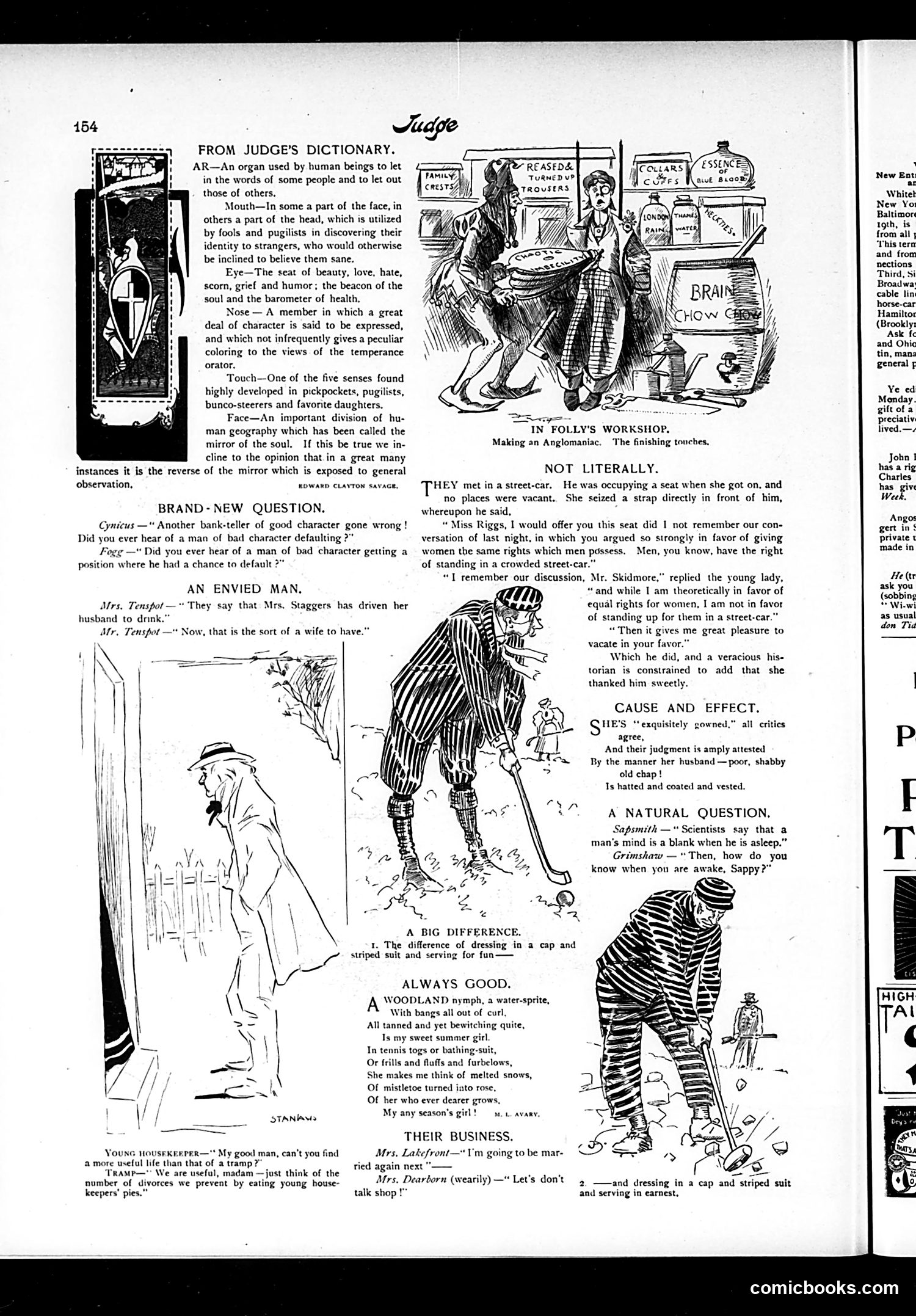
This page from *Judge* contains satirical humor typical of the publication's social commentary. The main cartoons mock gender relations and hypocrisy: **"Not Literally"** depicts a street-car encounter where a woman argues passionately for women's equal rights to men, then immediately asks a man to give up his seat—exposing the contradiction between her stated feminist principles and practical expectations. The humor lies in her convenient inconsistency. **"In Folly's Workshop"** contrasts two approaches to dressing in striped suits: one for "fun" (presumably theatrical or costume contexts) versus genuinely. This appears to satirize pretension or false personas. The page also includes dictionary-style definitions mocking human nature (noses revealing character, faces being "mirrors of the soul," etc.) and various brief jokes about marriage, divorce, and social behavior—typical *Judge* fare targeting middle-class hypocrisy and gender dynamics of the era. The overall thrust: exposing gaps between what people claim to believe and how they actually behave, particularly regarding women's rights and social equality.
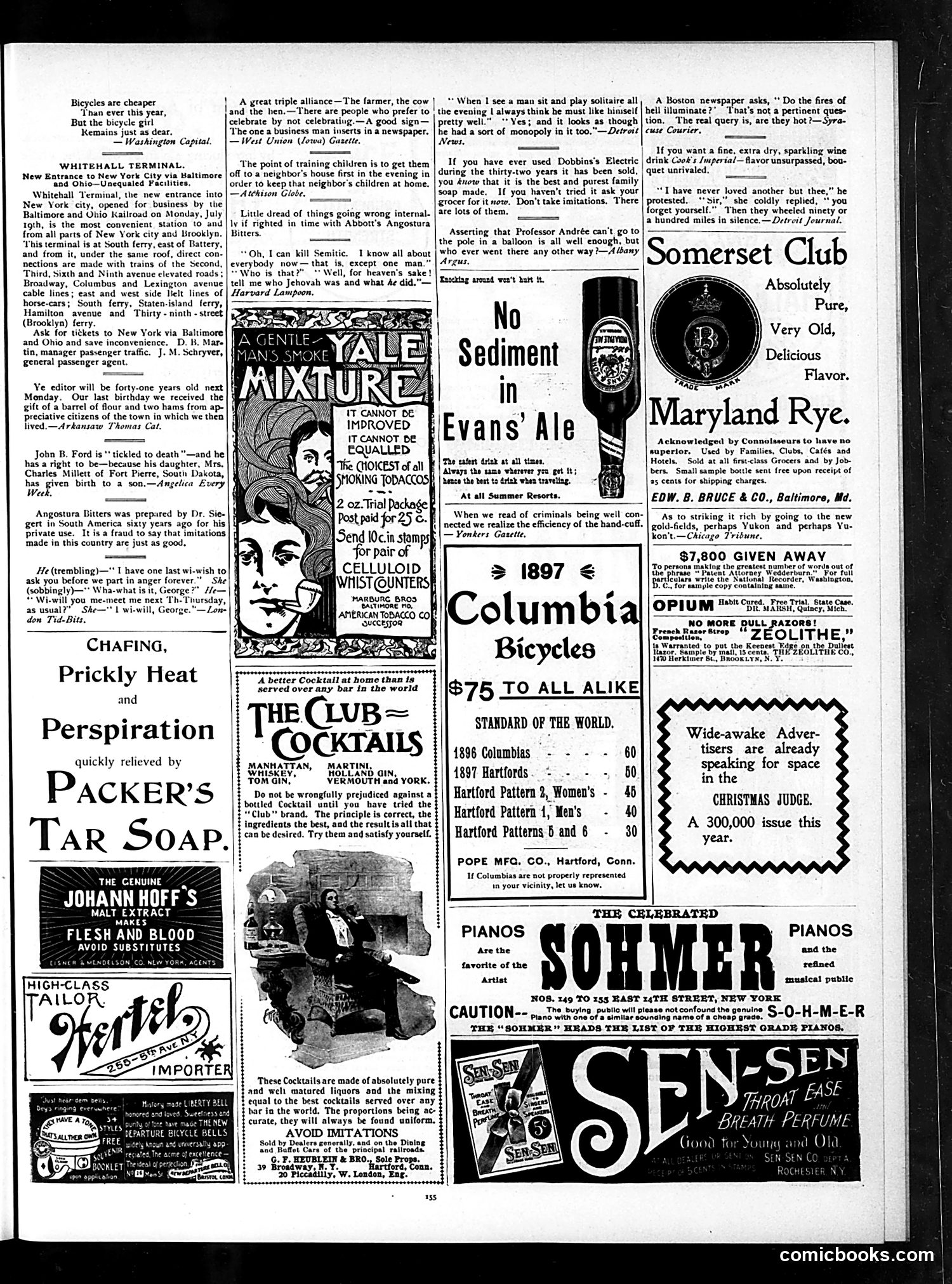
This page is primarily **advertisements and social commentary**, not political cartoons in the traditional sense. The advertisements dominate—promoting bicycles (Columbia brand at $75), pianos (Sohmer), ales and soaps, and various patent medicines. The text snippets are humorous observations about contemporary life: bicycles being cheap but "bicycle girls" remaining expensive; the absurdity of training children to visit neighbors; a joke about a man playing solitaire appearing to have a monopoly on self-regard. One notable reference: "Professor Andrée" likely refers to the Swedish explorer S.A. Andrée, who famously attempted a polar expedition by hot-air balloon (this page appears to be from the 1890s, matching Andrée's 1897 expedition attempt). The joke mocks those who doubt his balloon method while offering no alternative. The page reflects **turn-of-the-century consumer culture**, advertising, and light domestic humor rather than sharp political satire. Most references are now obscure without historical context.
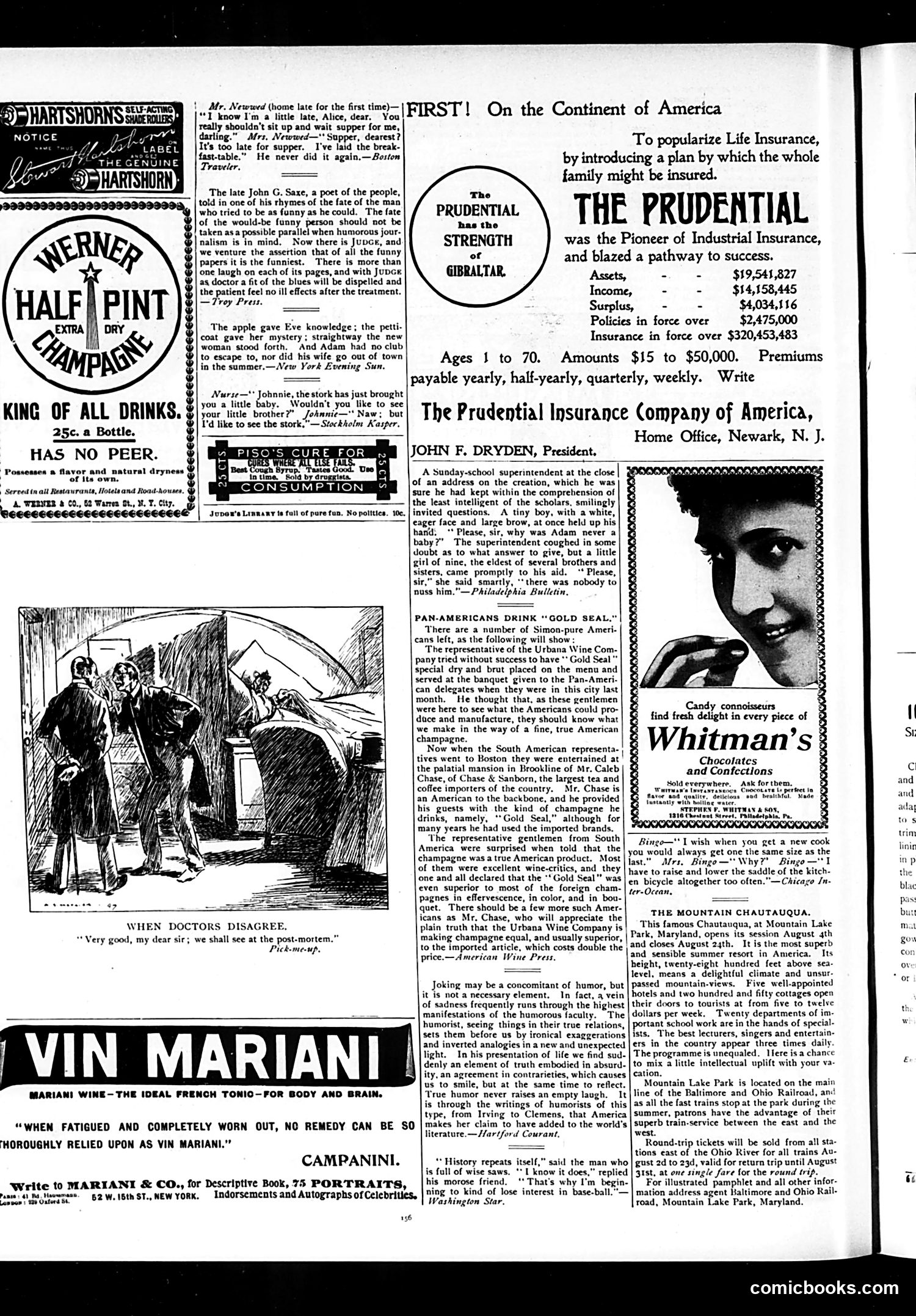
This page from *Judge* magazine is primarily advertising, but includes one notable cartoon titled "When Doctors Disagree," showing two physicians in disagreement beside a patient's deathbed. The caption reads: "Very good, my dear sir; we shall see at the post-mortem." **The Satire:** The joke mocks medical incompetence and professional disagreement. When doctors cannot agree on diagnosis or treatment during a patient's life, the cartoon suggests the only way to resolve their dispute is through autopsy—implying the patient will die regardless. This reflects period skepticism toward medical expertise and professional authority. The cartoon cynically suggests that doctors prioritize being "right" over actually saving patients' lives. The page otherwise consists of advertisements for beverages (Hartshorns, Werner champagne, Mariani Wine, Prudential Insurance) and other period products, with scattered humorous anecdotes.
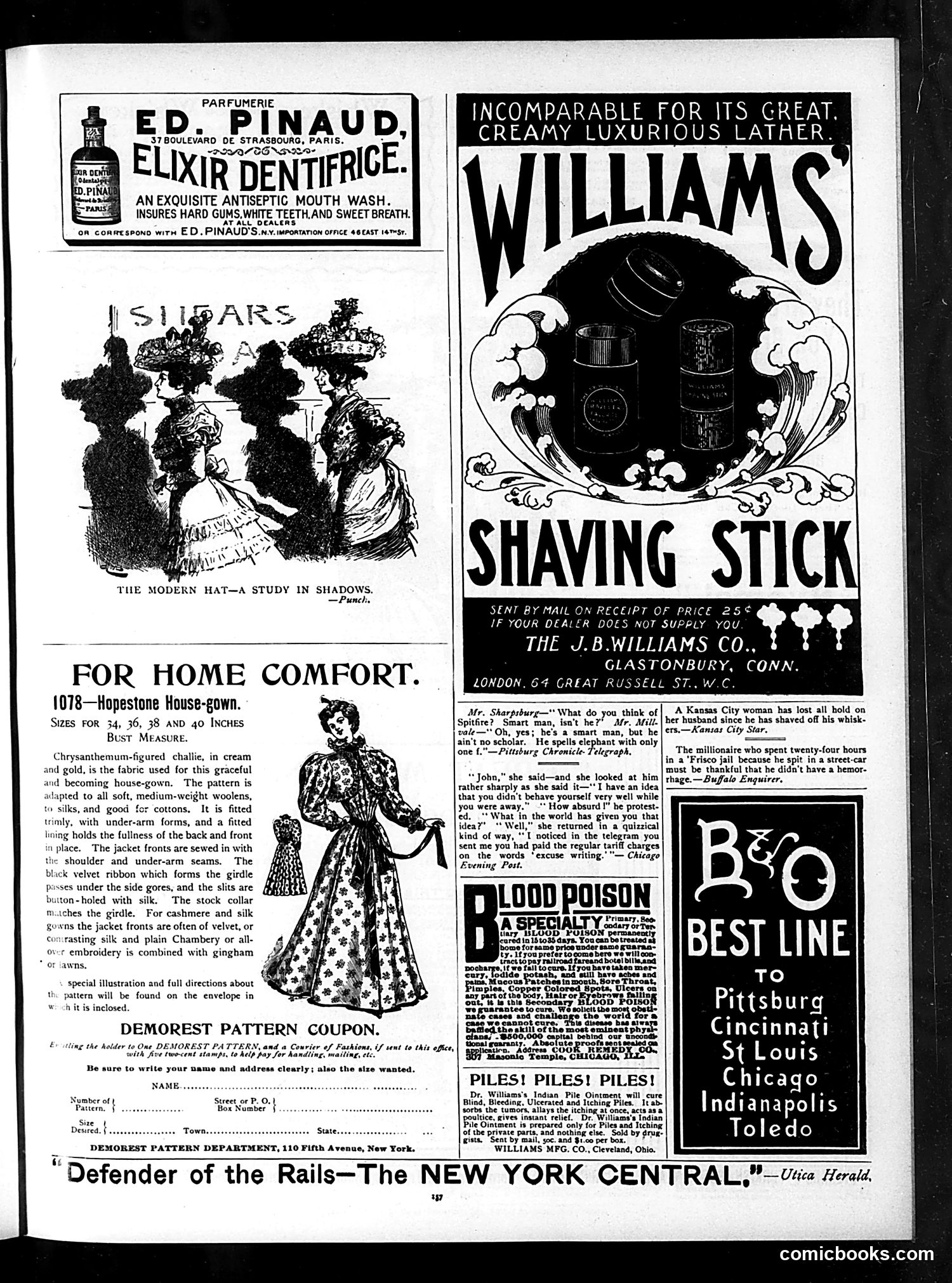
This page is primarily **advertising and fashion content** rather than political satire. The main elements include: **Fashion Section:** A Demorest house-gown pattern (item 1078) for women, featuring detailed descriptions of a chrysanthemum-figured challie dress with fitted construction and velvet ribbon details. This represents typical early 20th-century women's fashion advertising. **Cartoon ("Modern Hat—A Study in Shadows"):** A brief Punch-sourced sketch showing silhouettes of women in elaborate hats—satirizing the exaggerated, oversized hat fashions that dominated the era. **Advertisements:** Multiple patent medicine ads (dental elixir, blood poison treatment, piles ointment) and a railroad ad—typical of Judge's revenue model. **Humor Snippets:** Short anecdotes about marital relations, spelling, and urban life—standard filler content. The page reflects early 1900s concerns: elaborate fashion, dubious medical "cures," and railroad infrastructure. It's primarily a commercial product catalog rather than political commentary.
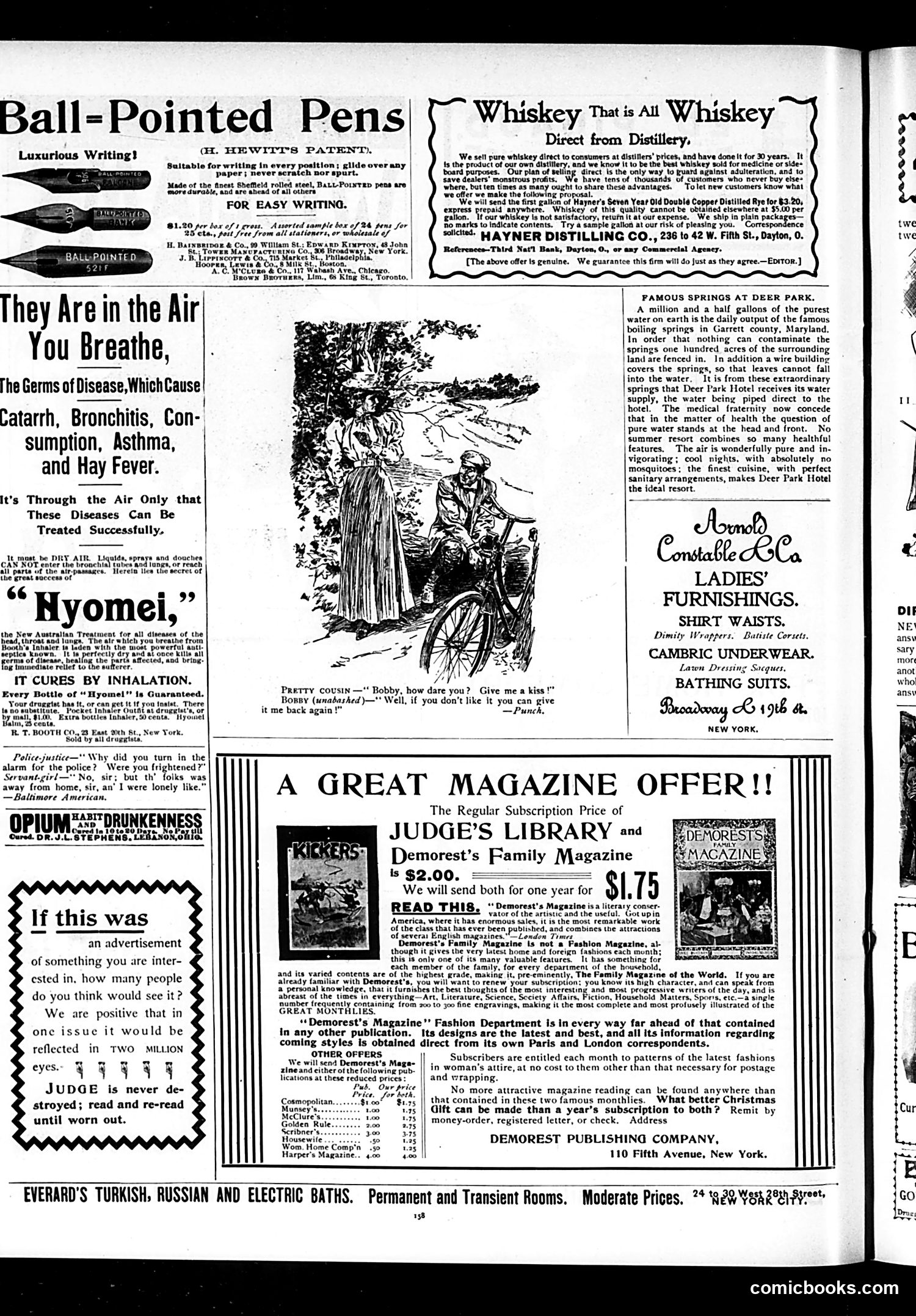
This page is primarily **advertising**, with only minor satirical content. The main advertisements promote: 1. **Ball-Pointed Pens** — marketed as superior writing instruments that "glide over any paper; never scratch nor spurt" 2. **Hayner Whiskey** — sold "direct from distillery," emphasizing purity and cutting out middlemen's profits 3. **Deer Park Hotel's spring water** — marketed as healthful, highlighting pure water's medical benefits 4. The page includes small **humorous snippets** (typical of Judge magazine): a brief cartoon joke about a girl asking "Bobby" for a kiss, and a police-court joke about a servant-girl calling police. 5. **Patent medicines** promoting "Hyomei" inhalation treatment for respiratory diseases — reflecting the era's unregulated patent medicine industry The **satirical punch** appears minimal here. The page reflects **Gilded Age consumer culture** — promoting mail-order commerce, dubious health remedies, and products claiming scientific superiority. The humor is light domestic comedy rather than political satire.
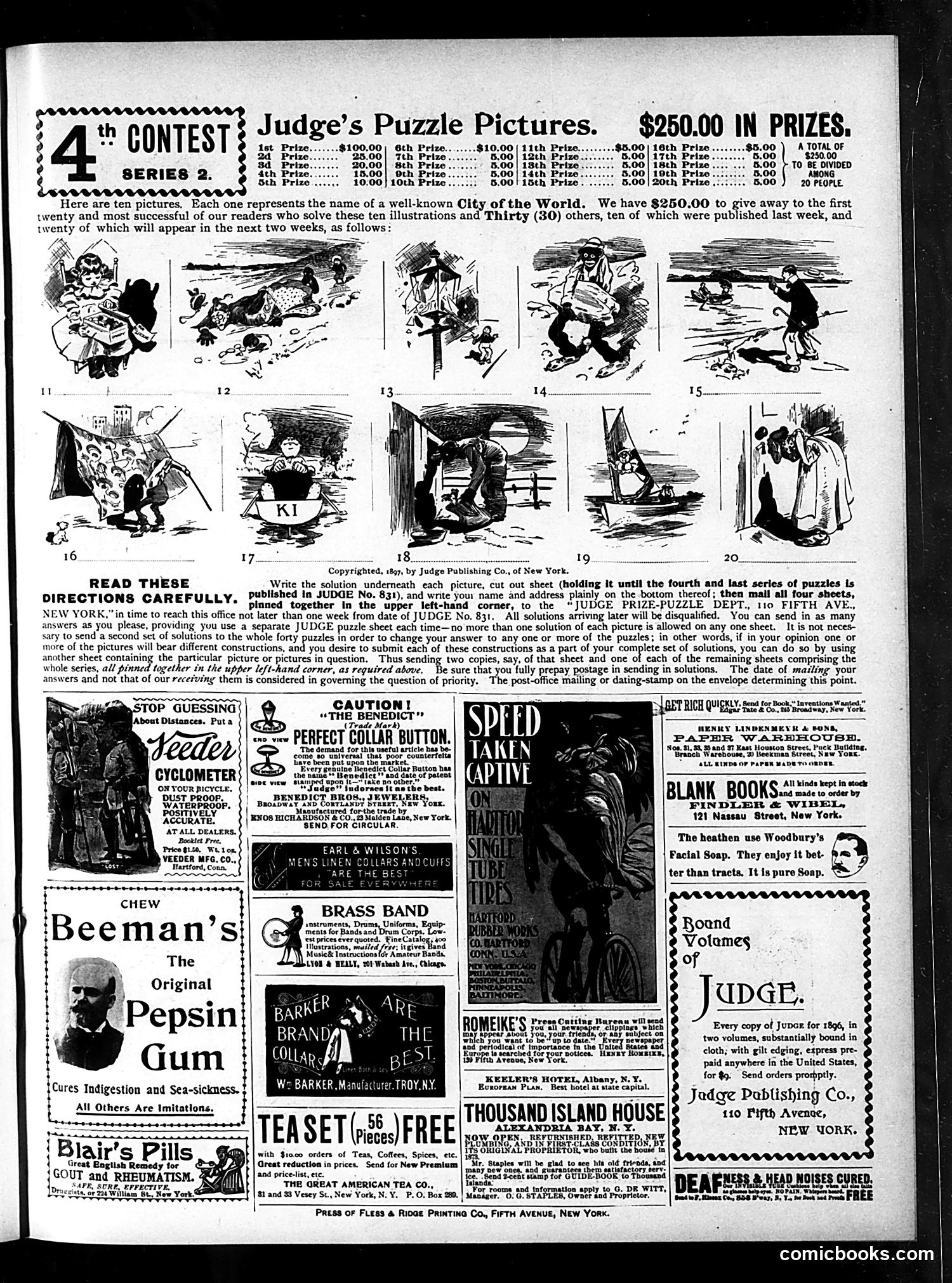
This page announces Judge magazine's puzzle competition offering $250 in prizes. Readers must identify ten silhouette illustrations representing "well-known Cities of the World." The contest spans four weeks across multiple magazine issues, with forty total puzzles to solve. The main content is the puzzle grid itself—ten black silhouette vignettes showing various scenes (figures with landmarks, activities, landscapes) that represent different cities. Solvers must write their answers and submit them to Judge's offices. The remainder is advertising for period products (Beeman's Pepsin Gum, Blair's Pills, tea sets, collar buttons, blank books, etc.) and Judge Publishing Company's bound volumes. The page reflects typical late-1890s magazine format: contests and puzzles as reader engagement tools, surrounded by commercial advertisements.
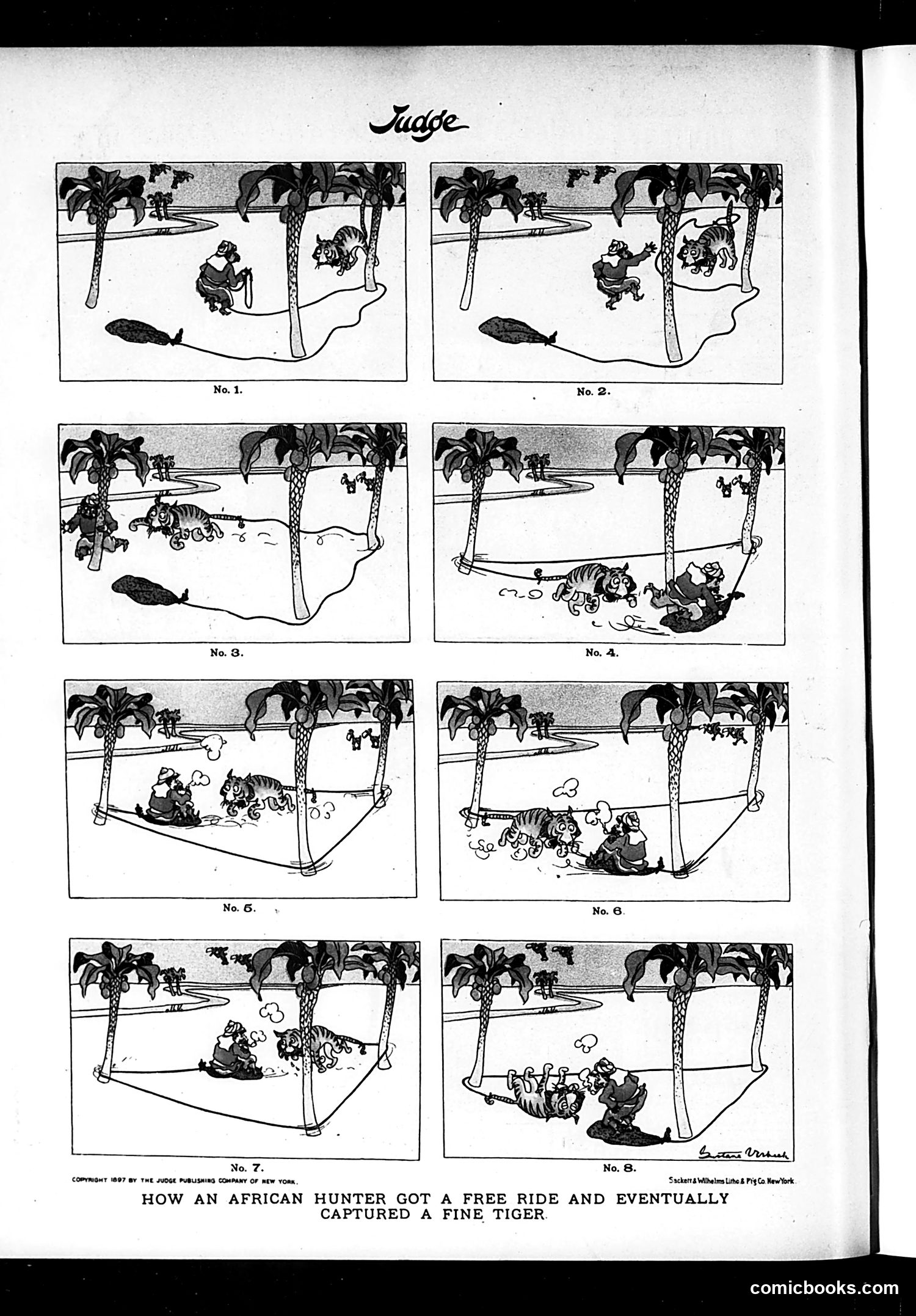
This 1897 Judge cartoon is a visual joke told in eight sequential panels about an African hunter obtaining a "free ride" and capturing a tiger. The humor appears to derive from the hunter's unconventional method: he uses a large fish or whale as transportation across water to approach the tiger. The cartoon reflects late-Victorian attitudes toward colonial Africa and "exotic" hunting adventures popular in period literature and entertainment. The sequential narrative format—following the hunter's journey from initial encounter through final capture—was a common satirical structure in Judge magazine. The specific satire likely mocks exaggerated hunting stories or adventure tales of the era, though without additional historical context, the precise target remains unclear. The title's emphasis on a "free ride" suggests the joke centers on the hunter's resourcefulness or luck rather than skill.