A complete issue · 16 pages · 1897
Judge — August 21, 1897
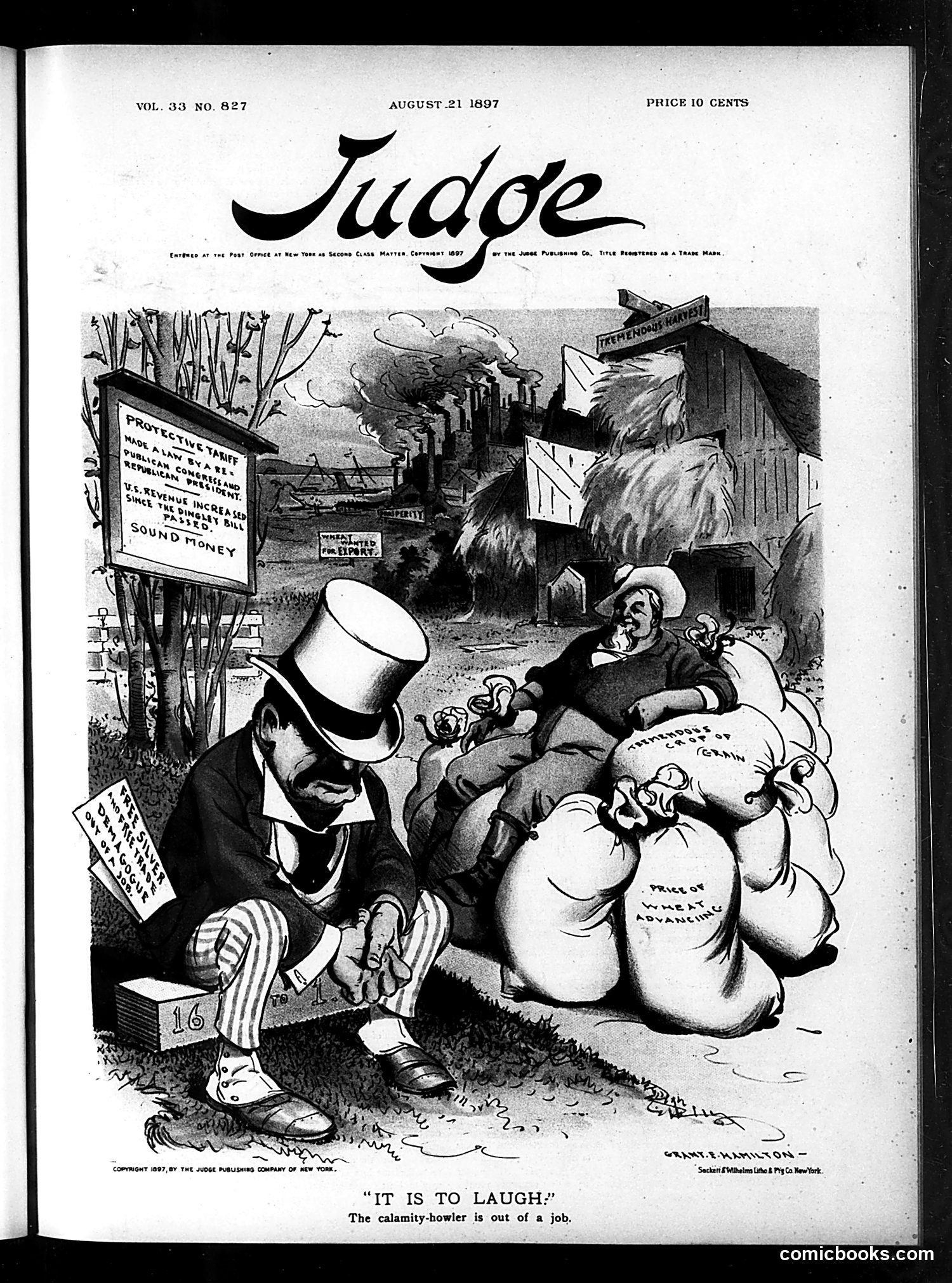
This August 1897 *Judge* cartoon satirizes the protective tariff debate. The well-dressed man (left) represents a tariff supporter, examining large inflated sacks labeled with tariff-protected goods and their inflated prices. The sacks are labeled "PRICE OF WHEAT," "PRICE OF WOOL," and similar items, suggesting artificially bloated costs to consumers. The sign references the "Protective Tariff" and "sound money" — economic policies debated during the 1890s. The cartoon's caption, "It is to laugh: The calamity-howler is out of a job," appears ironic, implying tariff critics had legitimate grievances about high prices caused by protectionist policies. The satire mocks either the tariff's ineffectiveness or its harmful consumer impact, depending on the cartoonist's stance.
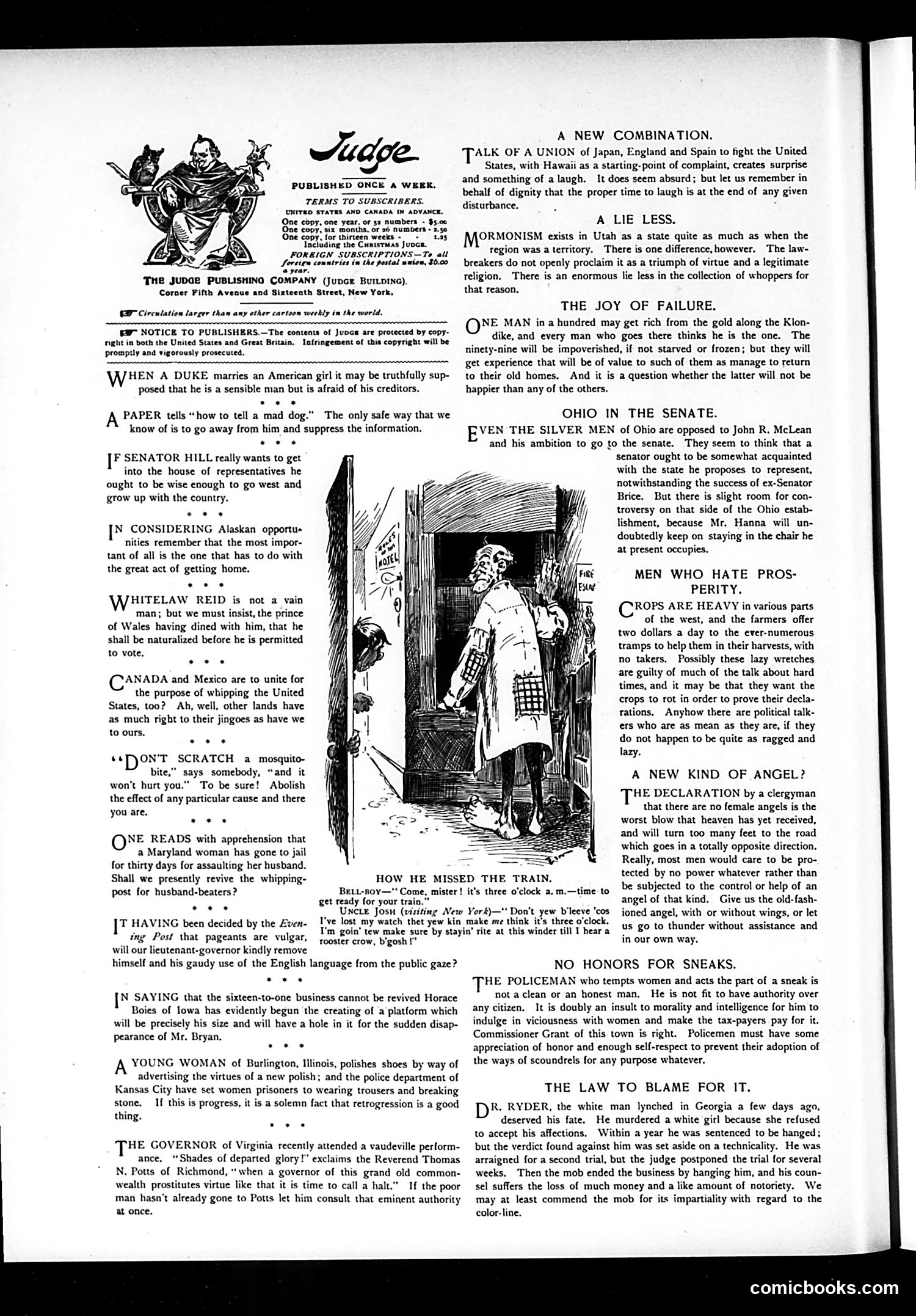
The main cartoon titled "HOW HE MISSED THE TRAIN" depicts a man in a doorway speaking to someone outside. The dialogue references a man named "Conductor" and discusses missing a 3 o'clock train. One character mentions "stayin' riet at this winder till I hear a safe coop, I guess!" — suggesting the man is avoiding going outside, possibly due to fear or evasion. The surrounding text columns contain satirical commentary on various topics: Mormonism in Utah, Senate appointments (mentioning John R. McLean of Ohio), crop failures among western farmers, and—most seriously—a lynching in Georgia where Dr. Ryder murdered a white girl. Without clearer publication date information visible, the specific historical references remain partially unclear, though the tone suggests early 20th-century American social and political commentary.
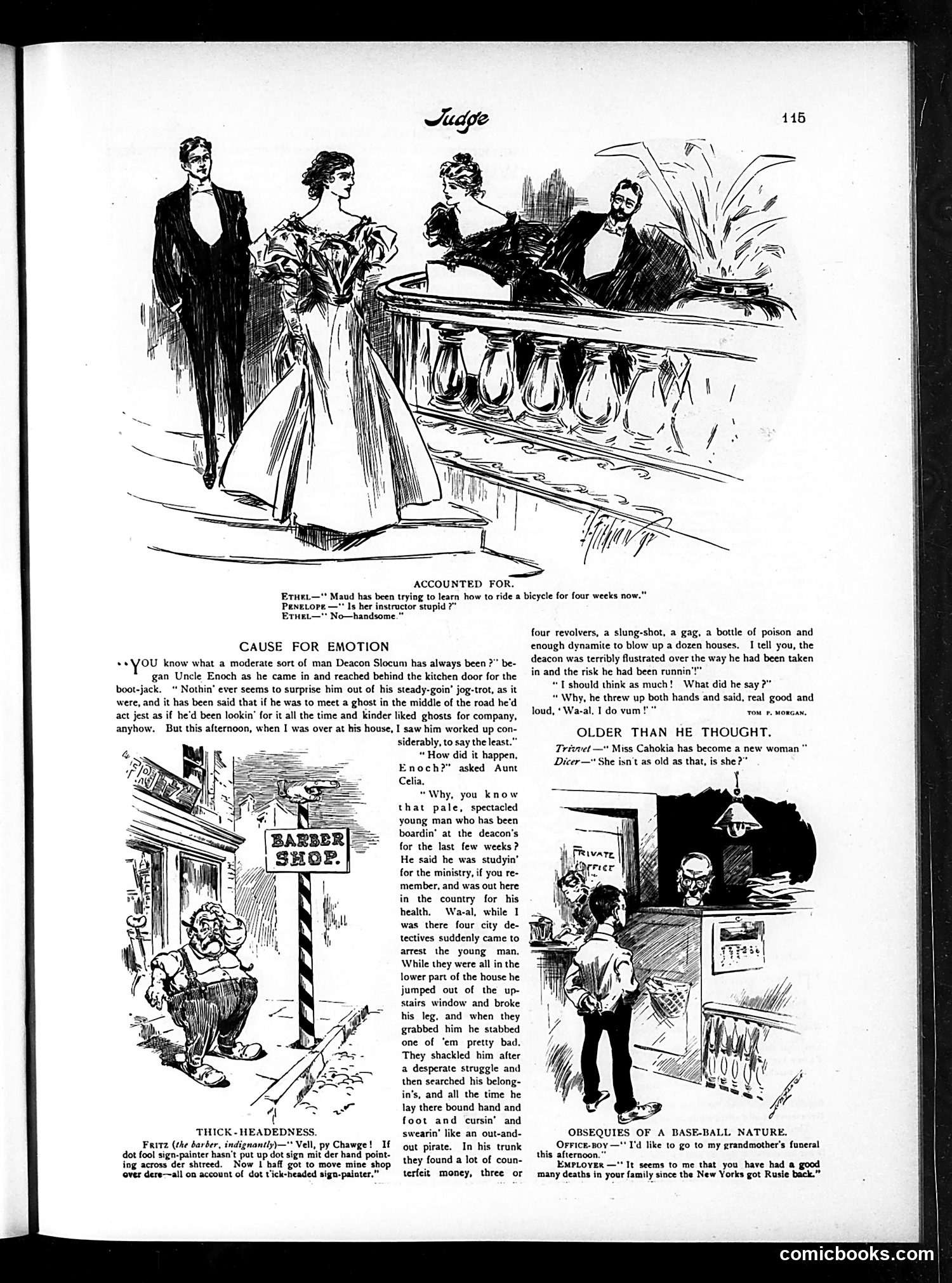
This page contains three separate satirical pieces typical of Judge's humor: 1. **"Accounted For"** (top): A social cartoon about a woman learning to ride a bicycle, mocking both her slow progress and her instructor's competence—reflecting the bicycle craze of the 1890s-1900s. 2. **"Cause for Emotion"** (left): A story about Uncle Enoch encountering what he thought was a ghost on a country road, later revealed to be a pale young man studying for the ministry. The humor derives from the deacon's dramatic overreaction. 3. **"Thick-Headedness"** (bottom left) and **"Obsequies of a Base-Ball Nature"** (bottom right): Brief humorous vignettes about a foolish sign-painter and office employees discussing funeral attendance. The page reflects turn-of-century American leisure activities, social anxieties, and workplace humor rather than explicit political satire.
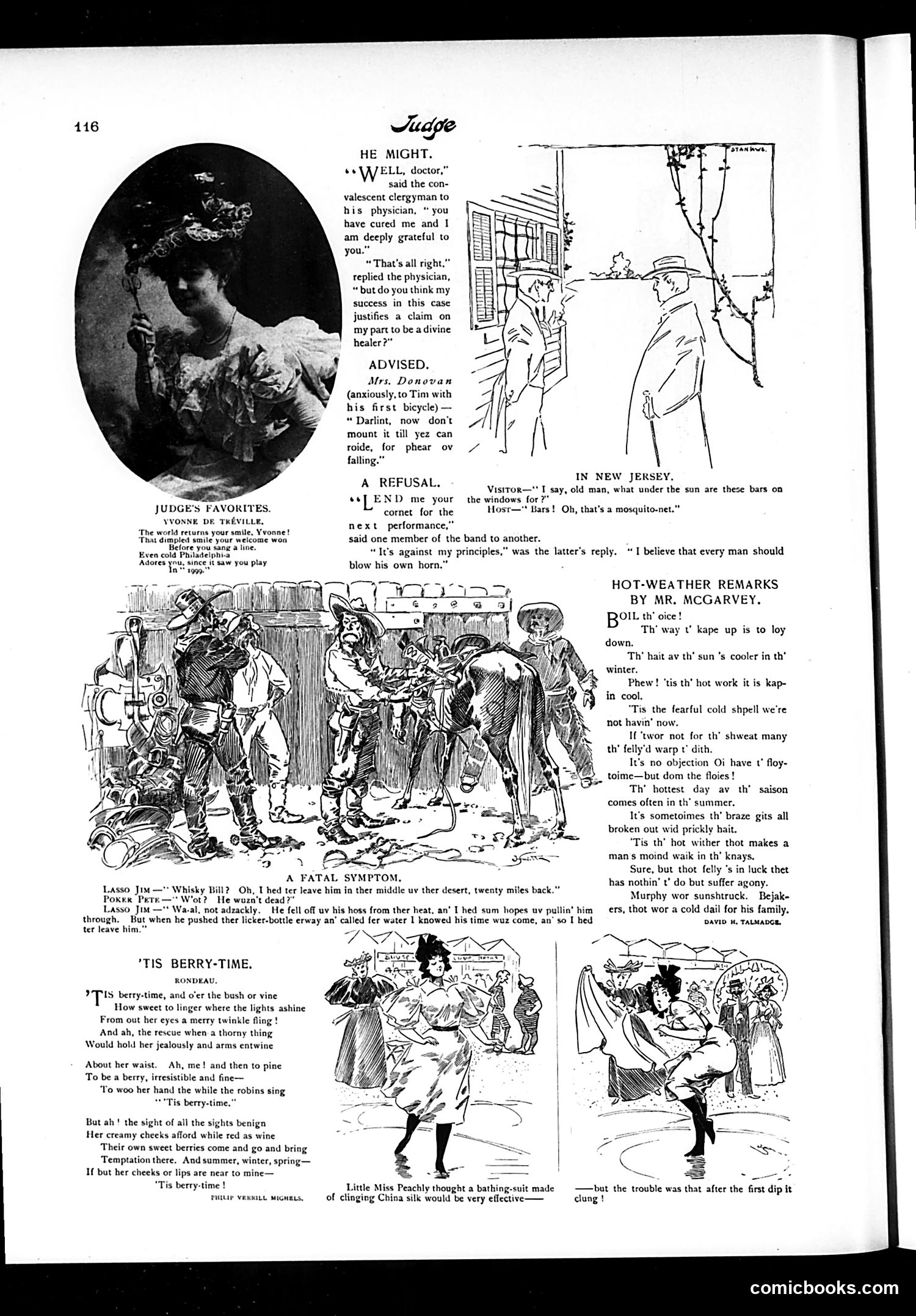
This page from Judge contains multiple satirical pieces typical of early 20th-century American humor: **"He Might"** mocks "divine healers"—a contemporary phenomenon where charismatic figures claimed healing powers. The joke: a doctor cures a clergyman, then asks if this proves he's a divine healer, exposing the absurdity of such claims. **"In New Jersey"** satirizes mosquitoes as a regional pest problem, with a visitor mistaking window bars for mosquito netting. **"Hot-Weather Remarks by Mr. McGarvey"** features an Irish-accented character offering comically absurd observations about summer heat, exploiting period ethnic humor stereotypes. **"'Tis Berry-Time"** is a romantic poem with accompanying illustrations showing summer courtship and a final joke about a woman's clinging wet bathing suit. Minor pieces include bicycle safety advice (Irish dialect), a band member's principled refusal, and a desert survival anecdote. The page emphasizes period-appropriate humor: ethnic caricature, romantic sentimentality, and observational comedy about everyday problems.
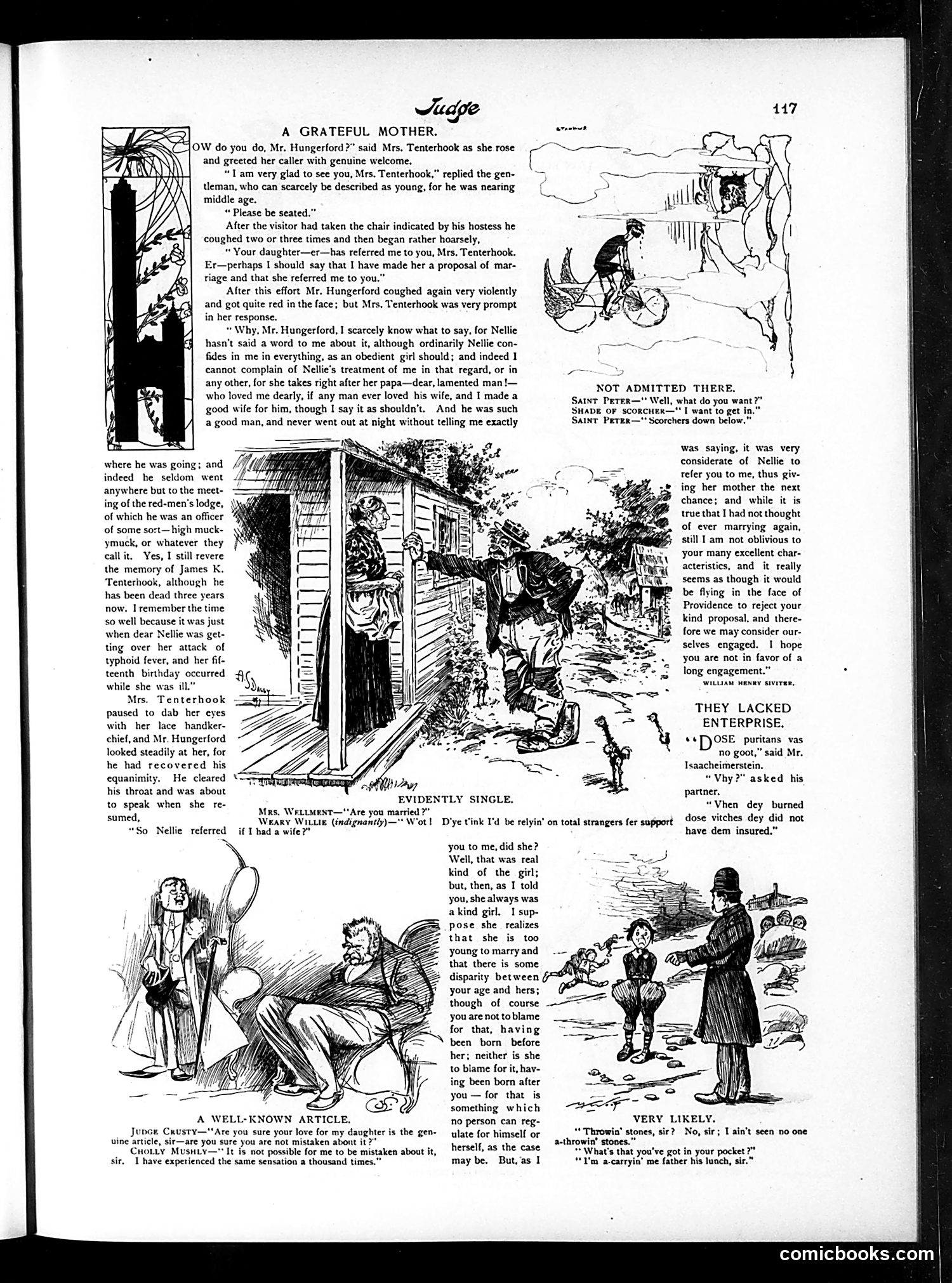
This page satirizes marital customs and social pretension among the middle class. The main story depicts Mrs. Tenterhook, a widowed mother whose verbose, self-aggrandizing monologues suggest she's engineered her daughter Nellie's engagement to the older, uncomfortable Mr. Hungerford. The satire targets: 1. **Maternal manipulation**: Mrs. Tenterhook accepts the proposal ostensibly on her daughter's behalf, positioning herself as gatekeeper 2. **Tiresome sentimentality**: Her endless reminiscences about her late husband mock affected mourning and self-importance 3. **Social climbing**: Her eagerness to marry off her daughter to a "respectable" older man despite age disparity The accompanying smaller cartoons mock other social types: bachelors avoiding commitment, immigrant businessmen's cynicism, and street people's opportunism. The overall theme critiques American social hypocrisy and mercenary attitudes toward marriage among various classes.
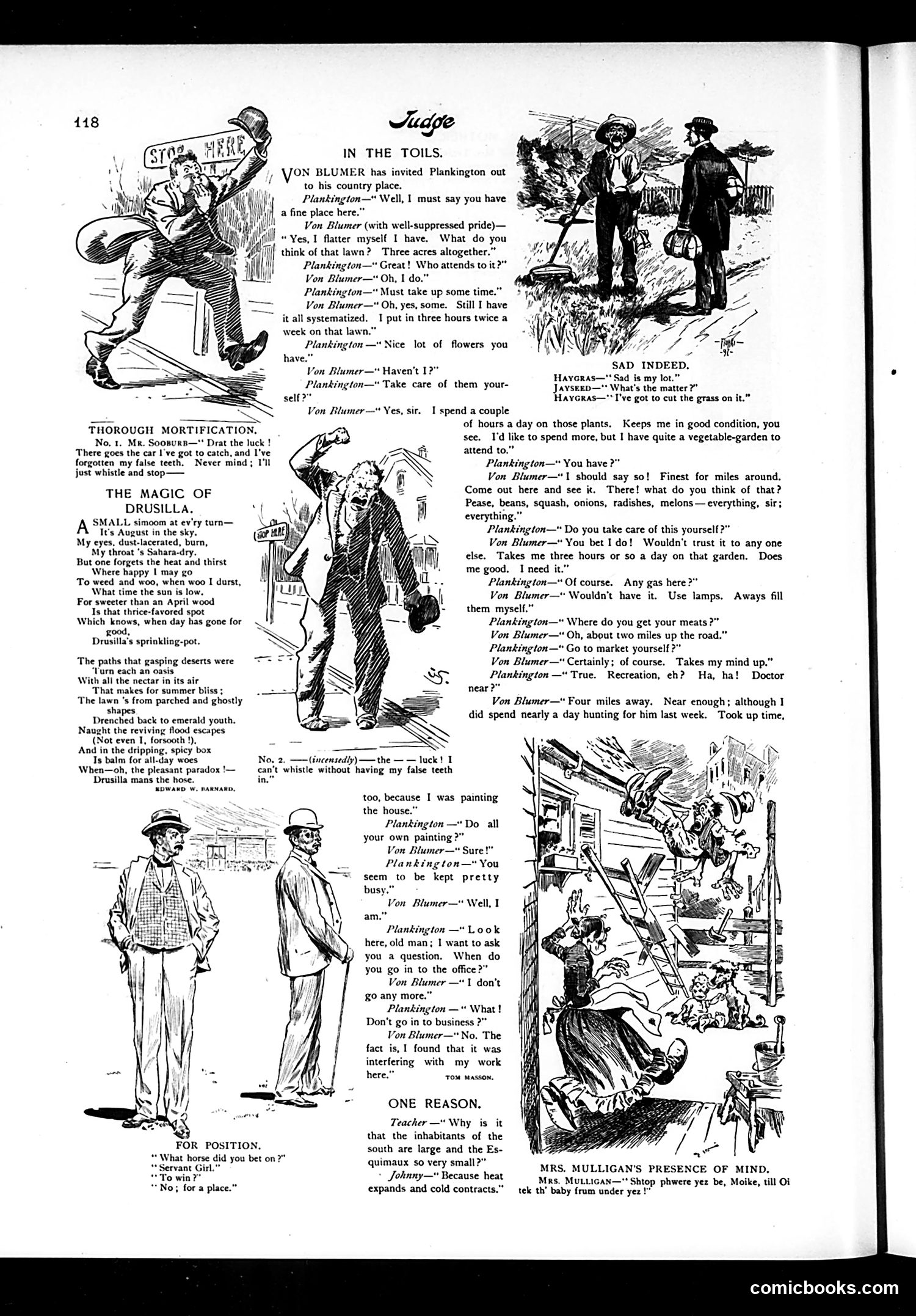
This page contains several humorous short pieces satirizing American life circa early 1900s: **"In the Toils"** mocks wealthy pretension. Von Blumer boasts to visiting Plankington about his country estate—his manicured lawn, vegetable garden, flowers—claiming he personally tends everything for hours daily. The joke: he's so absorbed in maintaining his gentleman-farmer image that he's essentially become a laborer, defeating the purpose of leisure and wealth. Plankington gradually realizes Von Blumer has made himself a servant to his property. **"The Magic of Drusilla"** is sentimental verse about finding romance while watering the garden on a hot August day. **"Thorough Mortification"** is a one-liner joke about a man forgetting his false teeth while rushing to catch a train. **"One Reason"** is a schoolroom joke explaining why southern people are large (heat expands) and Eskimos small (cold contracts). The page satirizes middle-class anxiety about status, domesticity, and the exhausting performance of genteel living.
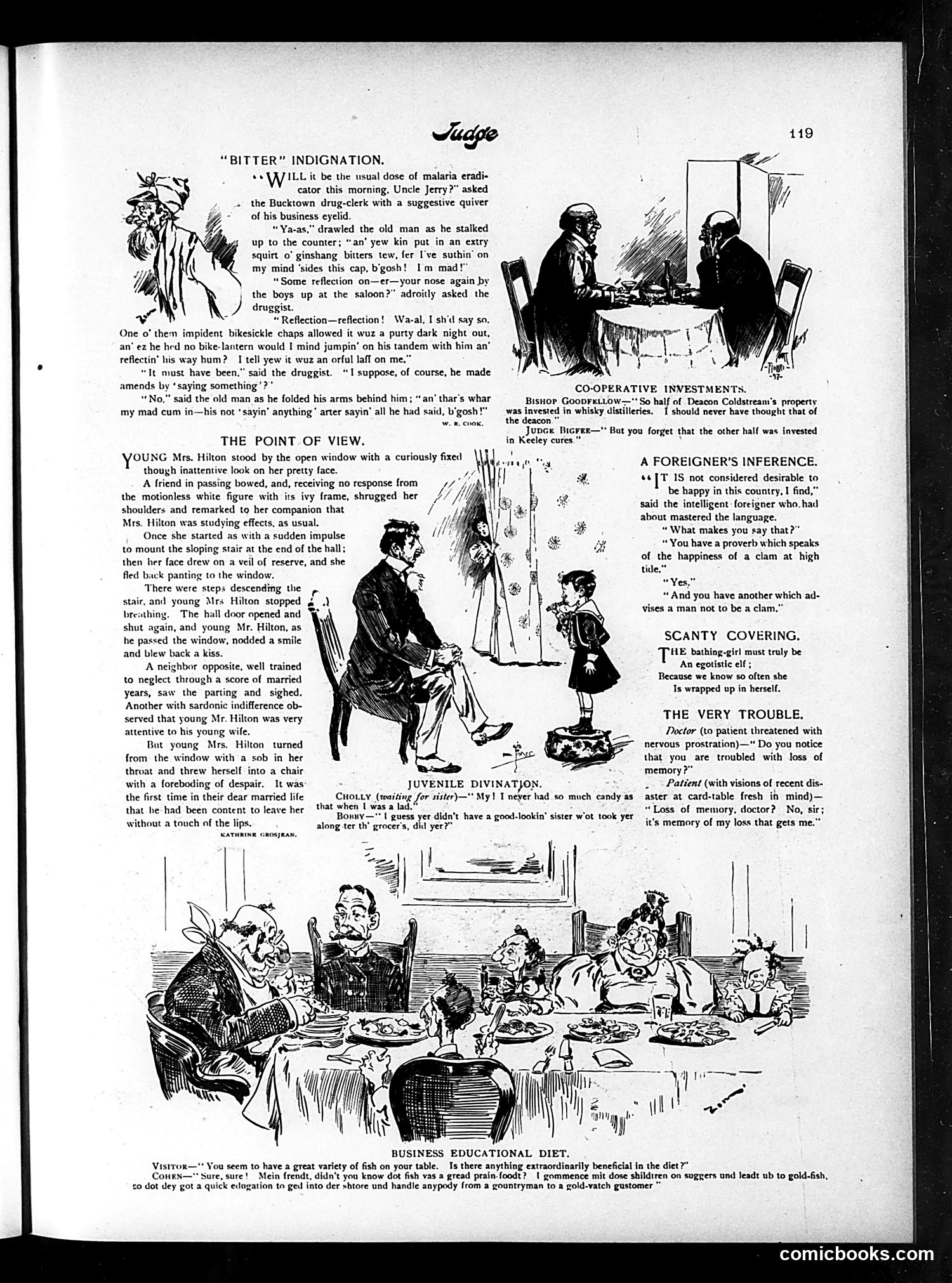
This page contains multiple satirical sketches typical of Judge's humor circa early 1900s: **"Bitter" Indignation**: A rural character complains to a druggist that a cyclist wouldn't apologize after hitting him in darkness—the joke being the old man's outrage over the lack of an apology, not the accident itself. Satirizes petty grievances and rural dialect humor. **"The Point of View"**: A wife watches her husband depart from a window with conflicted emotion—appearing happy to observers but internally distressed. Likely satirizes the gap between public marital propriety and private unhappiness, a common Judge theme. **"Co-operative Investments"**: A bishop and judge discuss a deacon investing equally in whisky distilleries and Keeley Cures (addiction treatment centers)—mocking hypocrisy and the irony of simultaneous investment in vice and its "cure." **Minor sketches** include wordplay on clams/happiness, bathroom humor, and medical comedy. The page demonstrates Judge's focus on domestic situations, rural characters, and institutional hypocrisy rendered through exaggerated caricature and dialect.
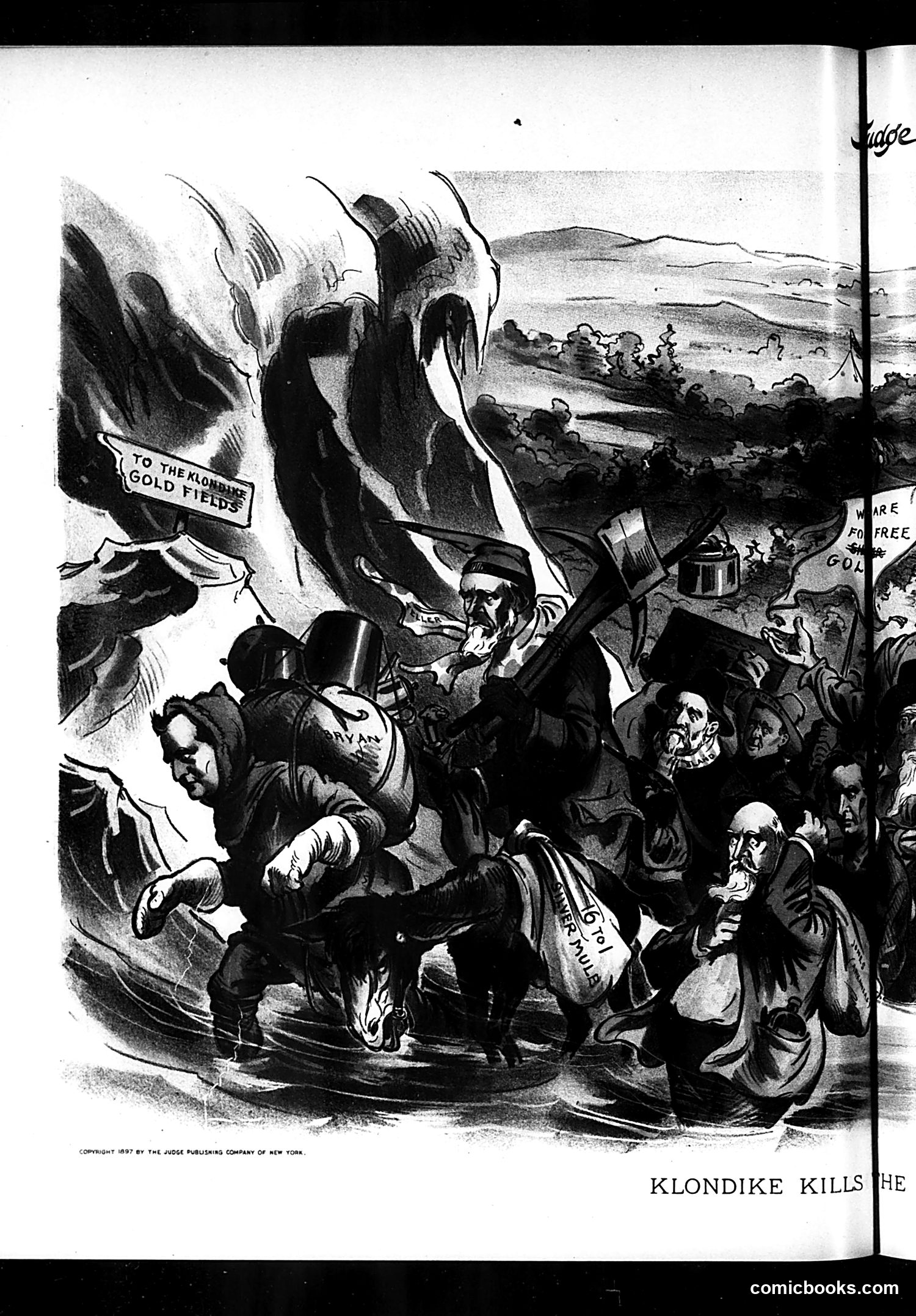
This satirical cartoon depicts the Klondike Gold Rush (1896-1899), referencing the frenzied migration to Canada's Yukon territory following gold discoveries. The image shows a chaotic scene with prospectors and fortune-seekers being lured toward "The Klondike Gold Fields" by what appears to be death or disaster—represented by the skeletal, grim-reaper-like figure on the left wielding a scythe. The satire critiques the gold rush's dangers and false promises. While the landscape shows the distant goldfields and crowds of hopeful miners, the prominent death imagery suggests the venture was deadly and deceptive. Miners' faces display desperation and hardship. The sign reading "To the Klondike Gold Fields" contrasts sharply with the ominous skeletal presence, implying that pursuit of sudden wealth often led to suffering or death rather than fortune.
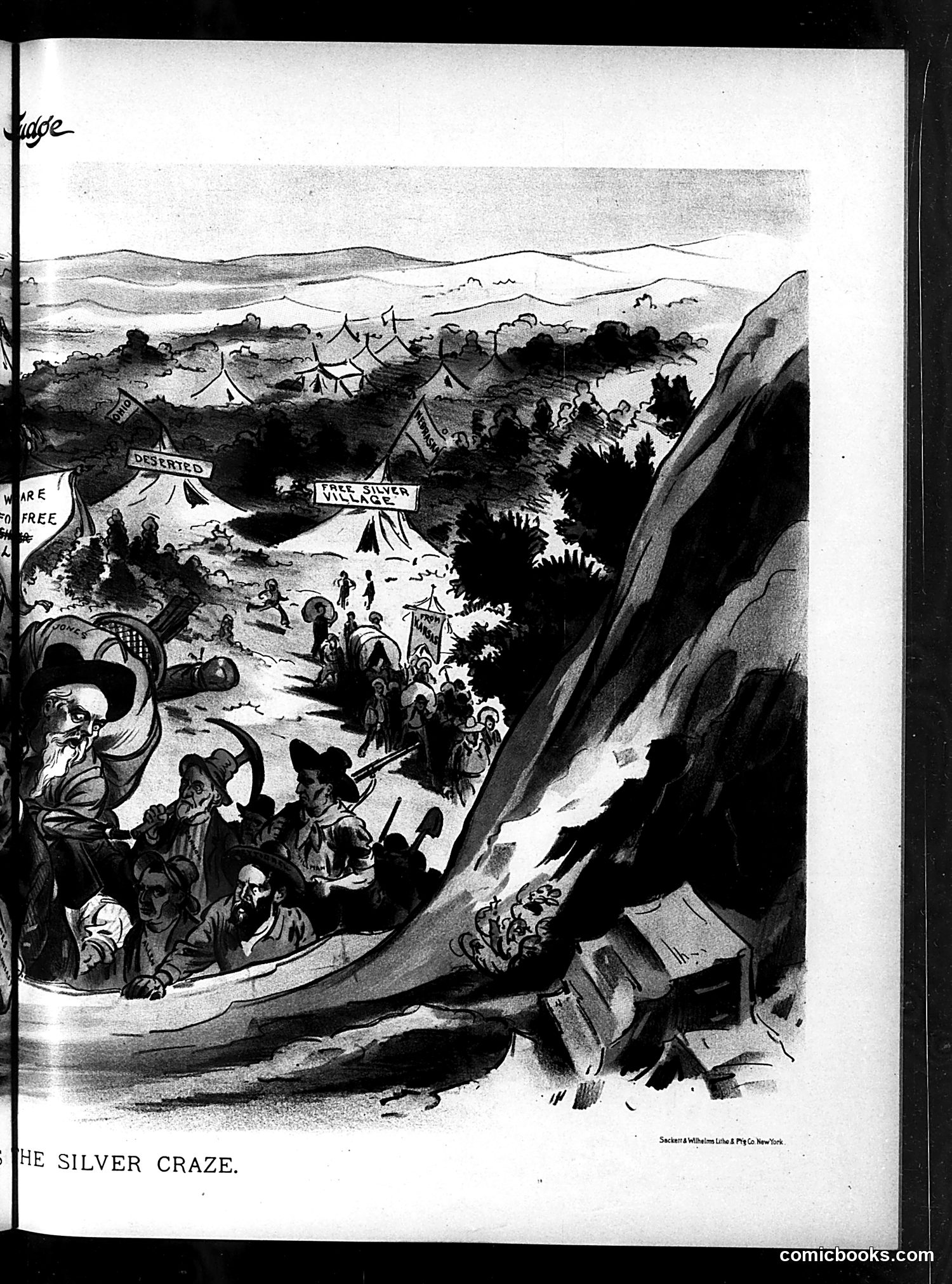
This Judge cartoon satirizes the silver mining rush, likely from the late 19th century. The image depicts a chaotic mining camp with tents labeled "FREE SILVER" and "DESERTED," showing the frenzy and disorder of prospectors seeking fortune. The composition contrasts wealthy miners and speculators (left foreground, depicted with satisfied expressions) against the larger masses of common laborers crowding the encampment. The mountainous landscape and dramatic perspective emphasize both the scale of migration and the precarious nature of the venture. The satire appears to mock both the irrational enthusiasm for silver speculation and the exploitation inherent in the boom—wealthy interests profit while ordinary people chase illusory wealth. The abandoned tents suggest failed ventures and disappointed hopes, critiquing the "Silver Craze" as a destructive economic phenomenon rather than genuine opportunity.
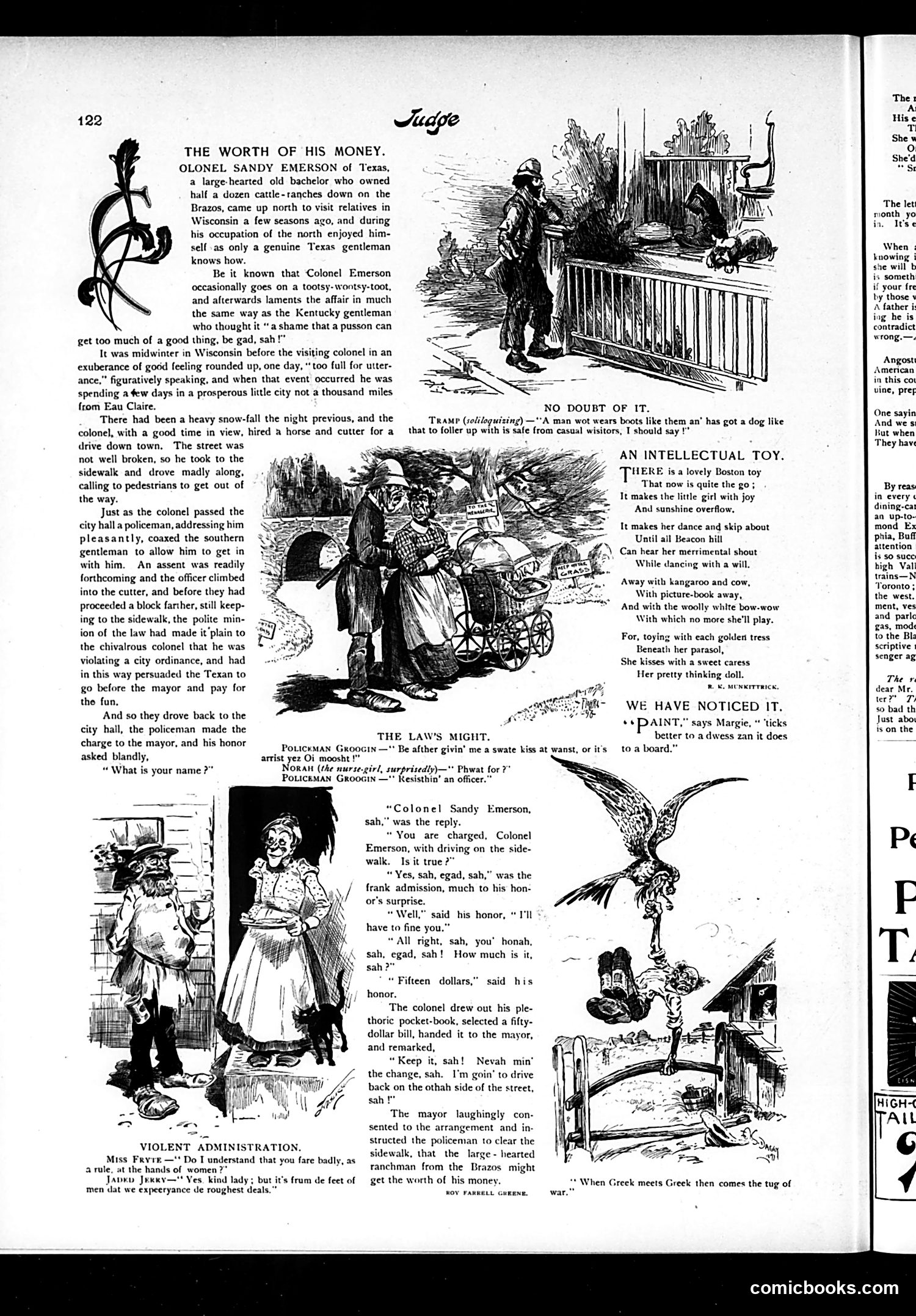
This page satirizes wealth and privilege through Colonel Sandy Emerson, a wealthy Texas rancher visiting Wisconsin. The main story depicts Emerson drunkenly driving a sleigh on the sidewalk in winter, violating city ordinances. When arrested and brought before the mayor, he's fined $15—but then deliberately hands over a $50 bill and announces he'll drive on the *other* sidewalk next time, keeping the change as payment for the "privilege." The joke targets the notion that wealthy men can buy their way out of consequences and social rules. Emerson's casual disregard for law and his assumption that money grants immunity satirizes Gilded Age corruption and the idea that the rich operate under different standards than ordinary citizens. His charming Southern accent and frank admission of guilt only reinforce that his wealth makes the violation irrelevant.
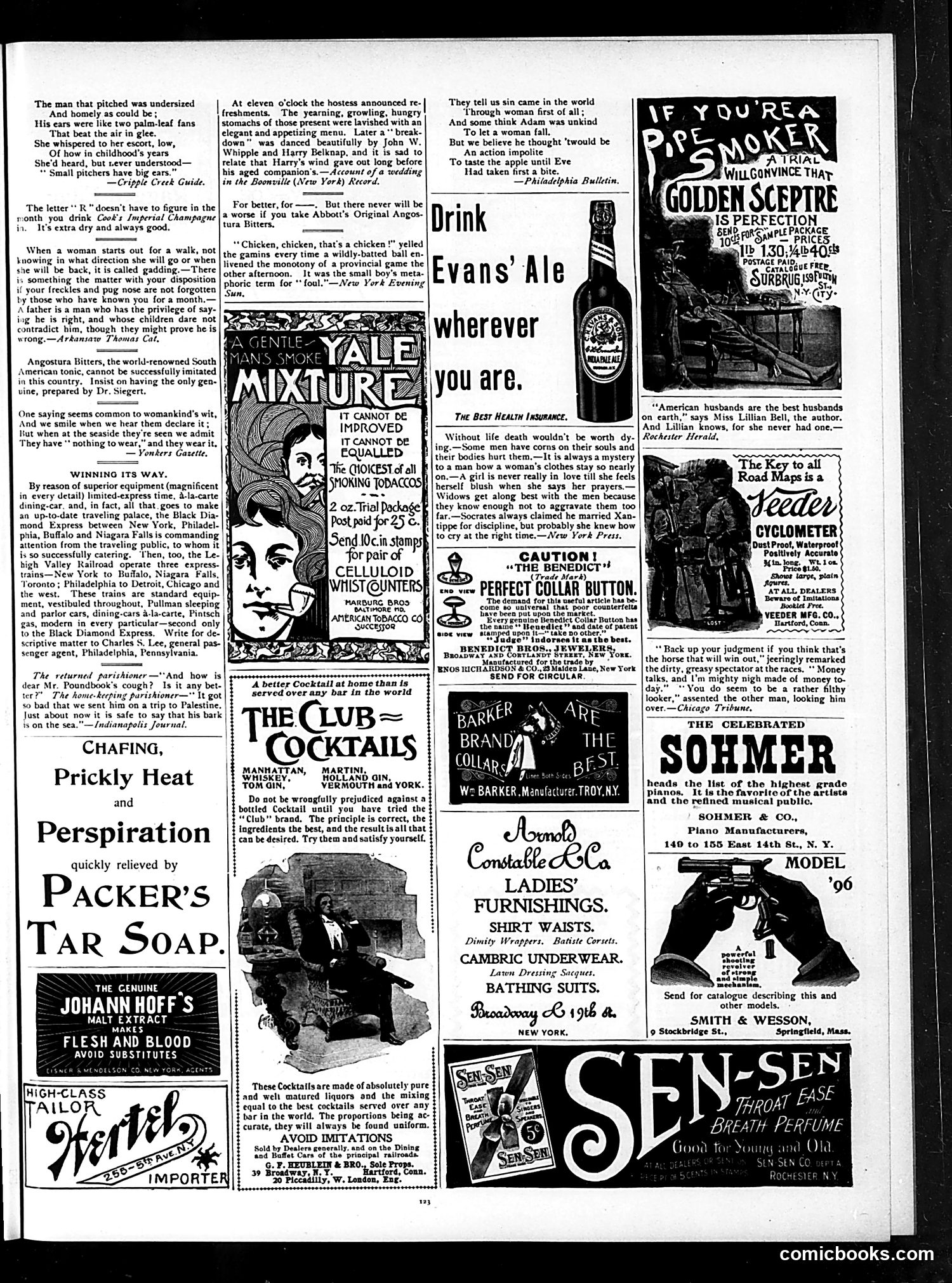
This page is primarily **advertising**, with some humorous filler text typical of early 20th-century magazines. The main content consists of **product advertisements** for items like Evans' Ale, Packer's Tar Soap, various cocktail brands, and a revolver. There are no political cartoons visible. The scattered short humorous pieces—about a homely baseball pitcher with big ears, a woman's seaside wardrobe, and a parishioner's cough—are **light social satire** mocking everyday life. These joke about physical appearance, female vanity, and Victorian propriety rather than serious political issues. The only illustrated cartoon shows **two men examining cocktail bottles**, advertising the "Club" brand—a straightforward commercial image with no satirical intent. In sum: this appears to be a standard Judge magazine advertising page from the early 1900s, featuring consumer products and mild humor rather than the political satire the magazine was known for.
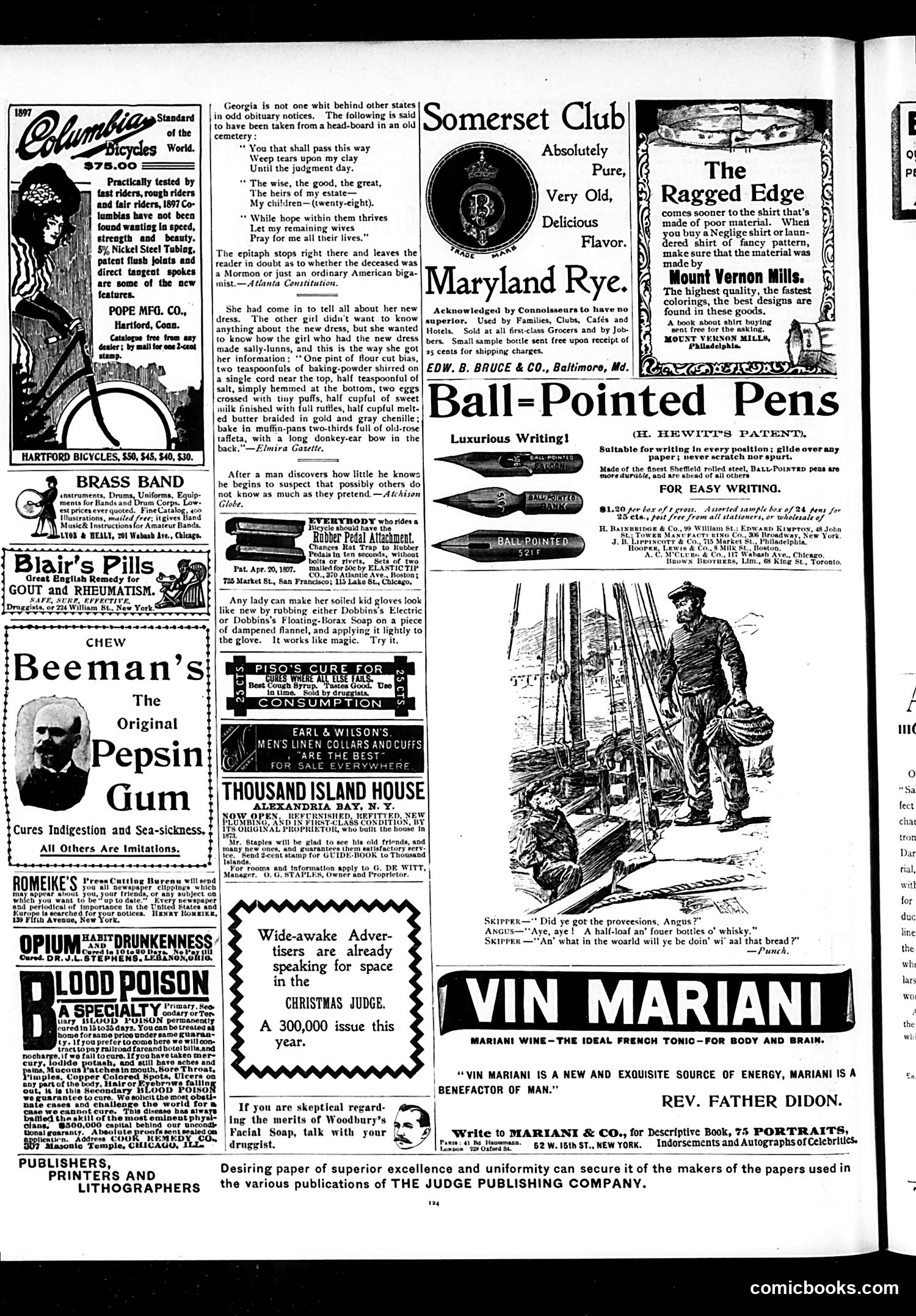
This page is predominantly **advertising** with a few short humorous anecdotal pieces interspersed. The main cartoons/humor appear minimal. One notable piece satirizes **Mormon polygamy**: an epitaph describes a man leaving "twenty-eight" children to "remaining wives," leaving readers unsure if he was "a Mormon or just an ordinary American bigamist." This jokes about the association of Mormonism with plural marriage while suggesting such practices weren't exclusively Mormon. A second brief humor piece mocks **female vanity and domesticity**: a girl discussing her fashionable dress inadvertently reveals a recipe for "sally-lunns" (a type of cake) through elaborate sewing terminology—poking fun at how women supposedly reduce all conversations to domestic concerns. The rest is product advertising (bicycles, pens, whiskey, patent medicines) typical of *Judge* magazine's revenue model. No major political or social satire is evident on this particular page beyond these modest observations about gender roles and religious practice.
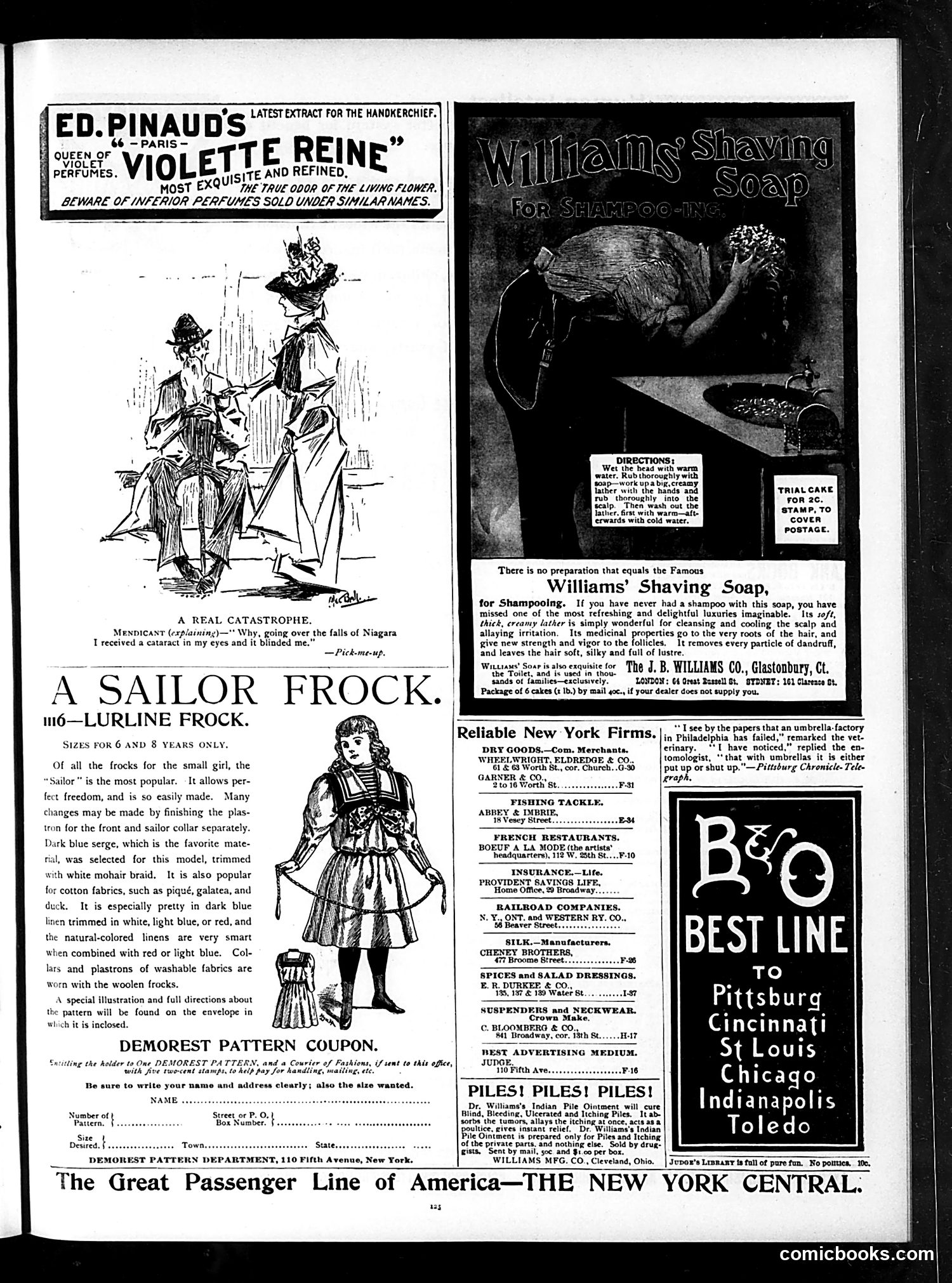
This page is primarily **advertising and merchandise**, typical of Judge's revenue model. Key content includes: **"A Real Catastrophe"** (upper left): A brief visual joke where a merchant, having gone over Niagara Falls, received a "cataract" in his eyes—a pun conflating the waterfall with the eye condition, leaving him blinded. Simple wordplay humor. **"A Sailor Frock"** (center): A Demorest pattern advertisement for children's clothing, emphasizing the popular "sailor" dress style for girls ages 6-8. **Commercial advertisements**: The remainder features luxury goods and services—French perfume (Ed. Pinaud's), shaving soap, fishing tackle, dry goods, and patent medicines. These reflect Edwardian consumer culture. **Minor joke** (right side): An exchange between a veterinarian and entomologist about umbrellas being "put up or shut up"—mild wordplay unrelated to politics. This is **not primarily satirical content**—it's a revenue page showcasing the consumer economy Judge's affluent readership patronized.
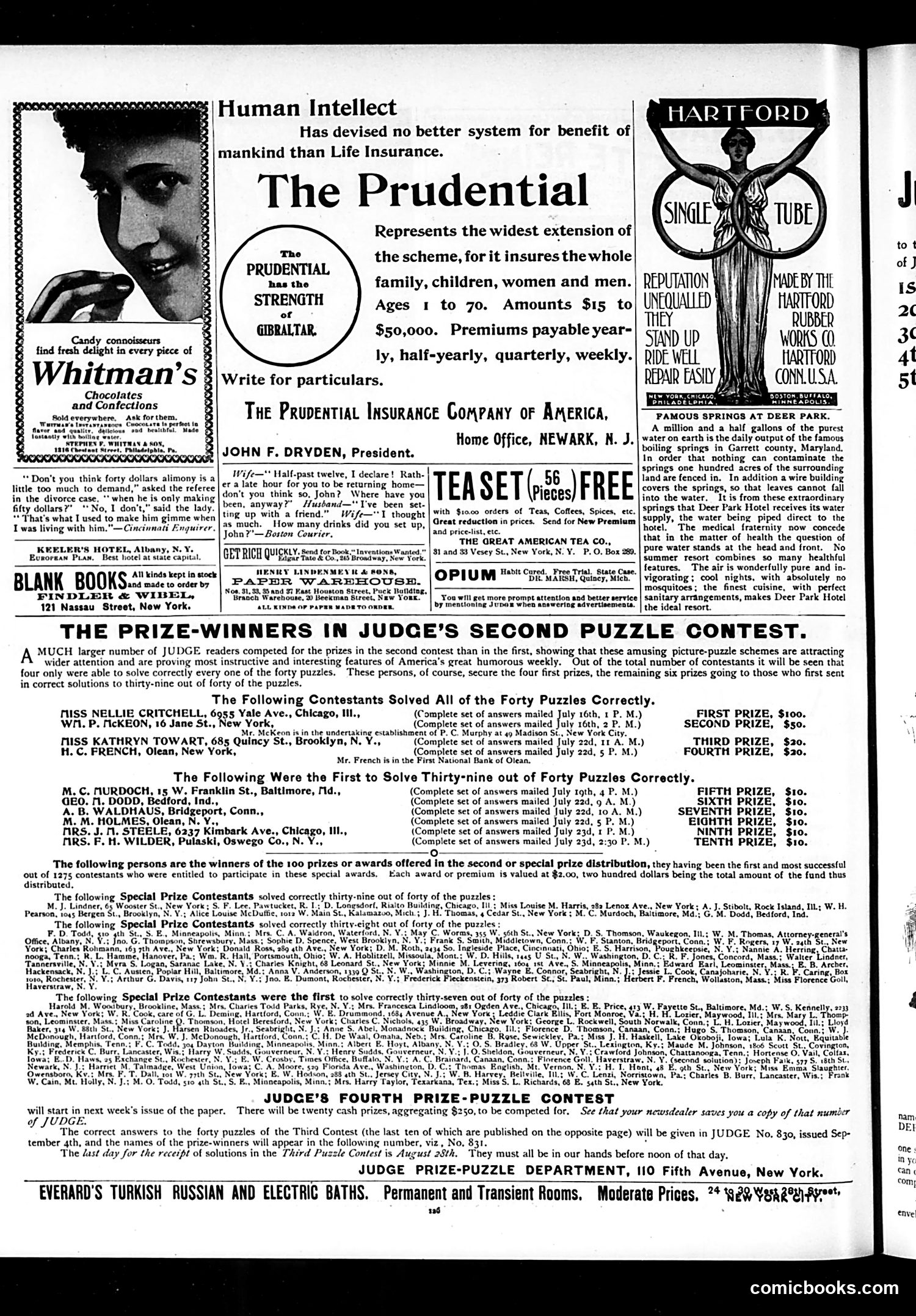
This page from *Judge* magazine is primarily devoted to **advertising and contest announcements**, not political cartoons. The actual editorial content is minimal. The notable elements include: 1. **Advertisements** for life insurance (*The Prudential*), chocolates (*Whitman's*), and resorts (*Deer Park Hotel*)—typical period marketing. 2. **Two brief anecdotes** at bottom-left: one humorous exchange about alimony demands in a divorce case, and another about a husband's late return home. These are domestic/marital humor, reflecting early 20th-century attitudes toward divorce and gender relations, but lack overt political satire. 3. **Prize puzzle contest announcements**—*Judge's* main content here is celebrating readers who solved picture-puzzles correctly. The page reflects a publication oriented toward middle-class readers interested in consumer goods, light domestic humor, and puzzle entertainment rather than sharp political commentary. No identifiable political figures or major satirical targets are evident.
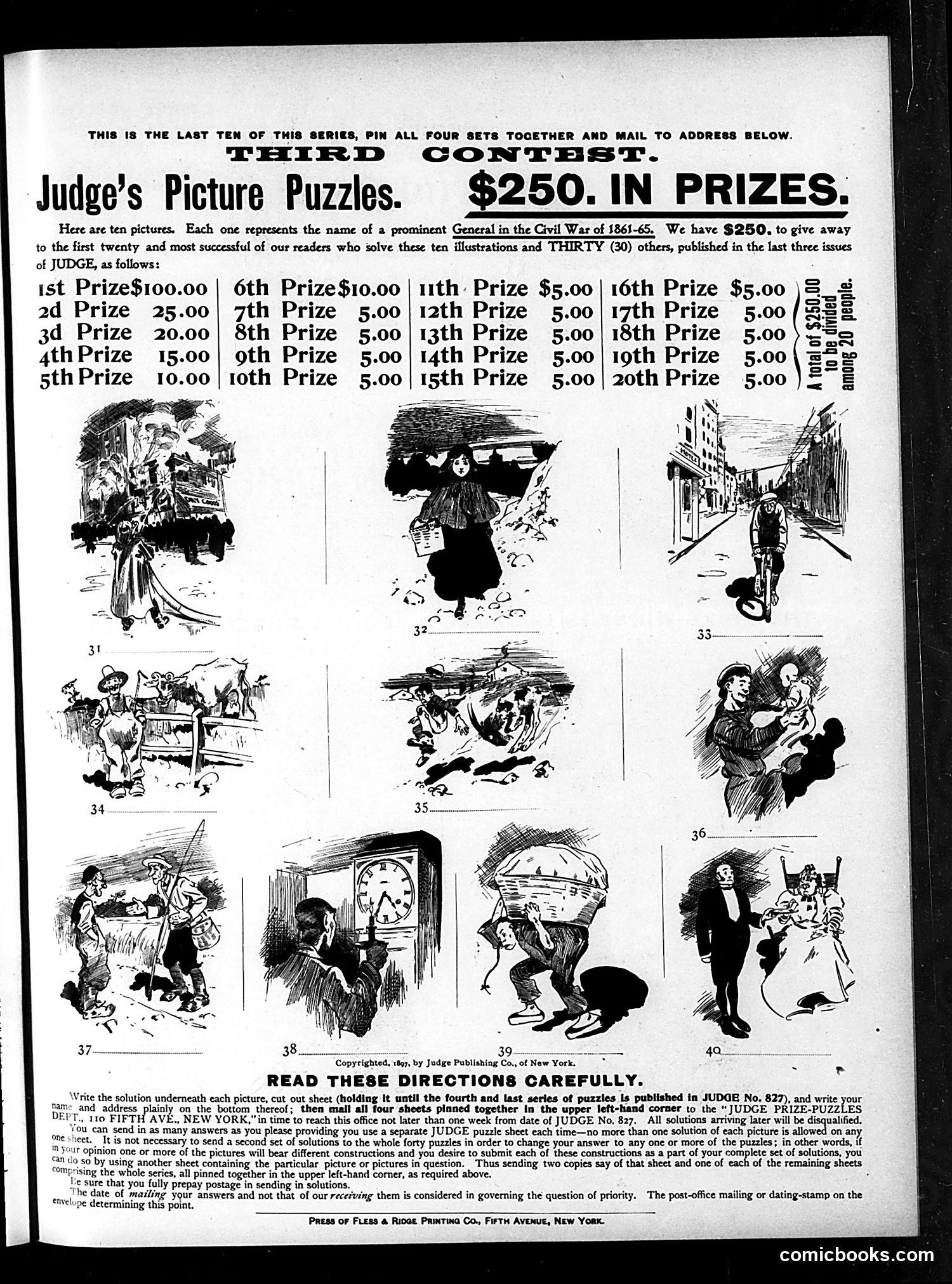
This page announces a contest where readers solve visual rebuses—ten pictorial puzzles shown here, plus thirty more in previous issues—to identify prominent Civil War generals (1861-65). Winners receive $250 in prizes distributed among the first twenty correct solvers. The ten sketches use visual puns and symbolic imagery to represent generals' names. For example, image 31 appears to show a military scene, while image 32 depicts a figure with an umbrella in rain, and image 33 shows a cyclist. Without solving them, the specific general names aren't obvious—that's the puzzle's challenge. This was a popular advertising/engagement tool for *Judge*, the satirical magazine, encouraging reader participation and repeat purchases across multiple issues. The contest reflects late-19th-century American cultural interest in Civil War history and illustrated wordplay entertainment.