
A complete issue · 16 pages · 1897
Judge — August 14, 1897
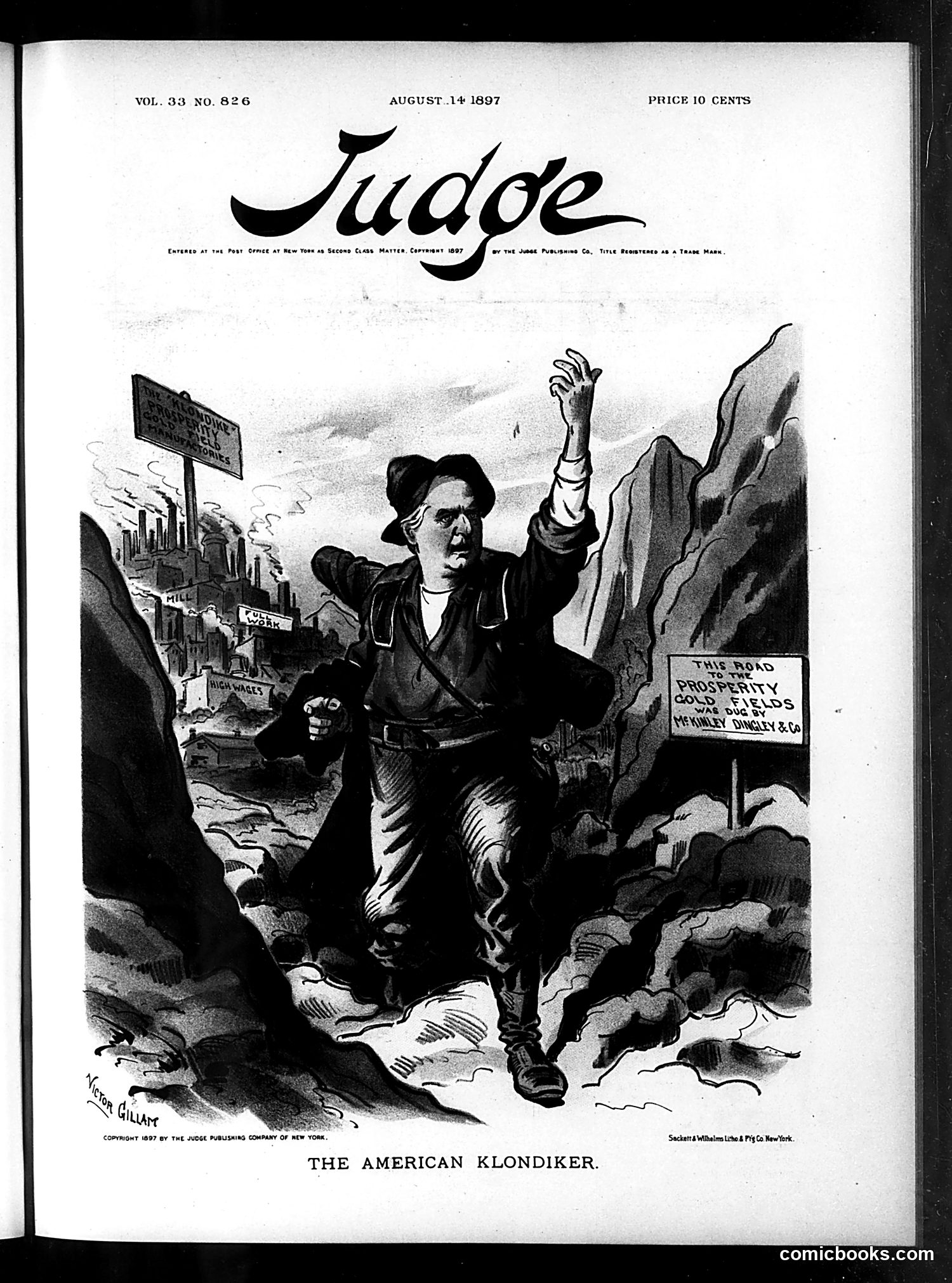
This cartoon satirizes American gold prospectors rushing to the Klondike gold fields in Canada's Yukon Territory during the 1897-98 gold rush. The central figure, depicted as an American, celebrates striking it rich while standing between rocky cliffs. Signs visible in the background reference mining operations and prosperity routes. The satire likely mocks the get-rich-quick fever gripping Americans, or possibly critiques American opportunism in Canadian territory. The exaggerated pose and expression convey both the prospectors' inflated optimism and the cartoonist's skepticism about their actual chances of success. The Klondike rush was a major news event of 1897, making this timely commentary on speculative mania and frontier adventurism.
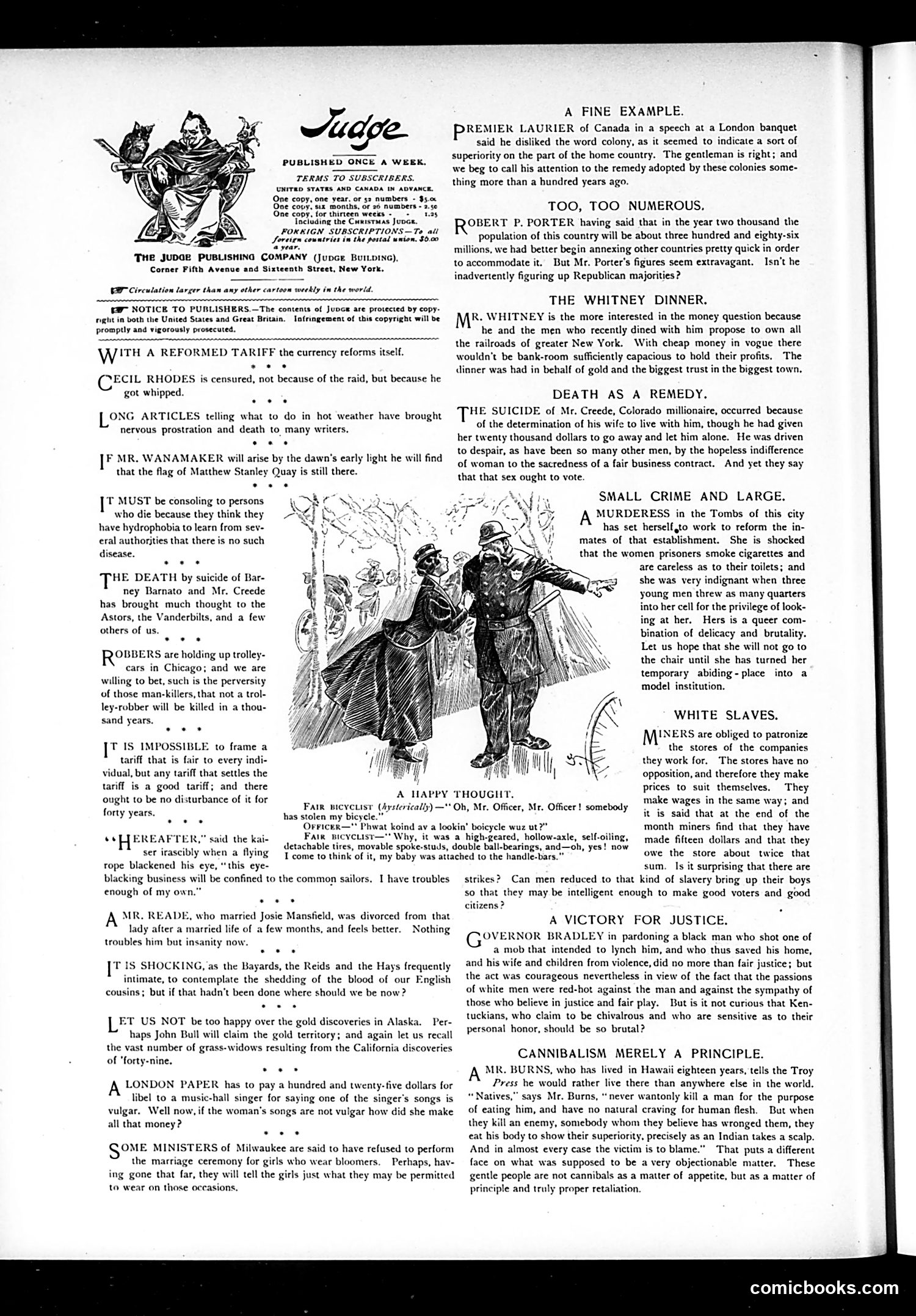
This page contains brief satirical commentary on contemporary issues rather than a single cartoon. The main illustration depicts two men in winter clothing, apparently engaged in some altercation or dramatic moment on a street. The text items mock various topics: population concerns, tariff reform, railroad monopolies, a wealthy man's dinner, suicide among the wealthy, crime in city jails, miners' labor conditions, and colonial governance. One section critiques "Governor Bradley" for pardoning a Black man accused of shooting a white family—suggesting satirical commentary on racial justice and white anxieties of the era. Another section mocks cannibalism as "merely a principle" among certain groups, reflecting period attitudes toward indigenous peoples. The overall tone targets social hypocrisy, economic inequality, and contemporary political failures.
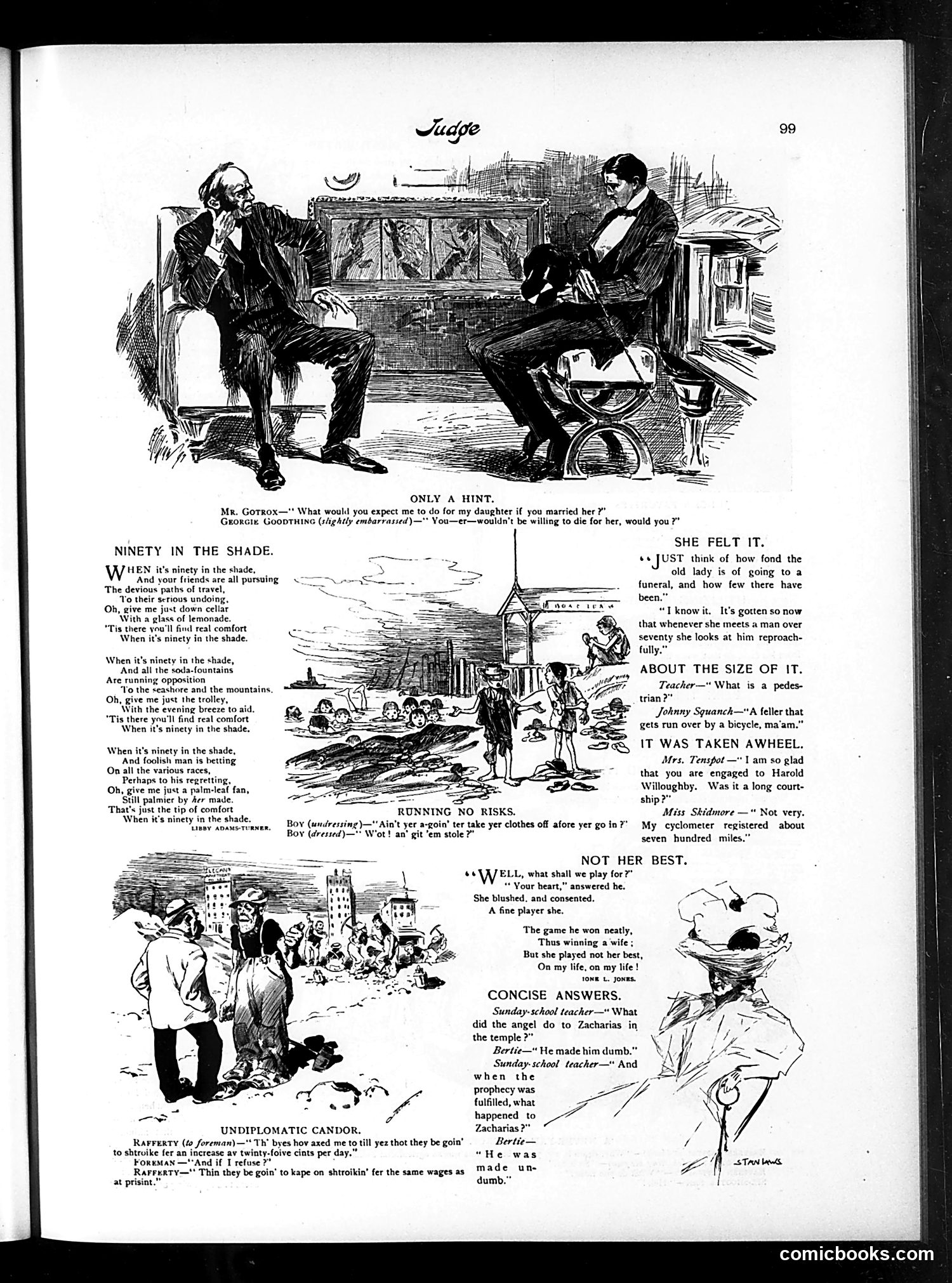
This page contains several satirical pieces and illustrations typical of Judge's humor format: **"Only a Hint"** (top cartoon): A dialogue between Mr. Gotrox and General Goodthumb about marriage expectations—satirizing upper-class assumptions about women's roles and willingness to sacrifice. **"Ninety in the Shade"** (left): A poem about summer heat, a common seasonal satire topic in Victorian-era magazines. **"Running No Risks"** (center): A beach scene joke about a boy protecting his clothes. **"Undiplomatic Candor"** (bottom): Workers discussing wage negotiations—likely satirizing labor disputes or class tensions of the era. **Various short humor items** ("She Felt It," "About the Size of It," "Not Her Best," "Concise Answers") offer quick jokes on marriage, courtship, and domestic life. The page reflects Judge's focus on social satire, particularly targeting Victorian gender roles and class dynamics.
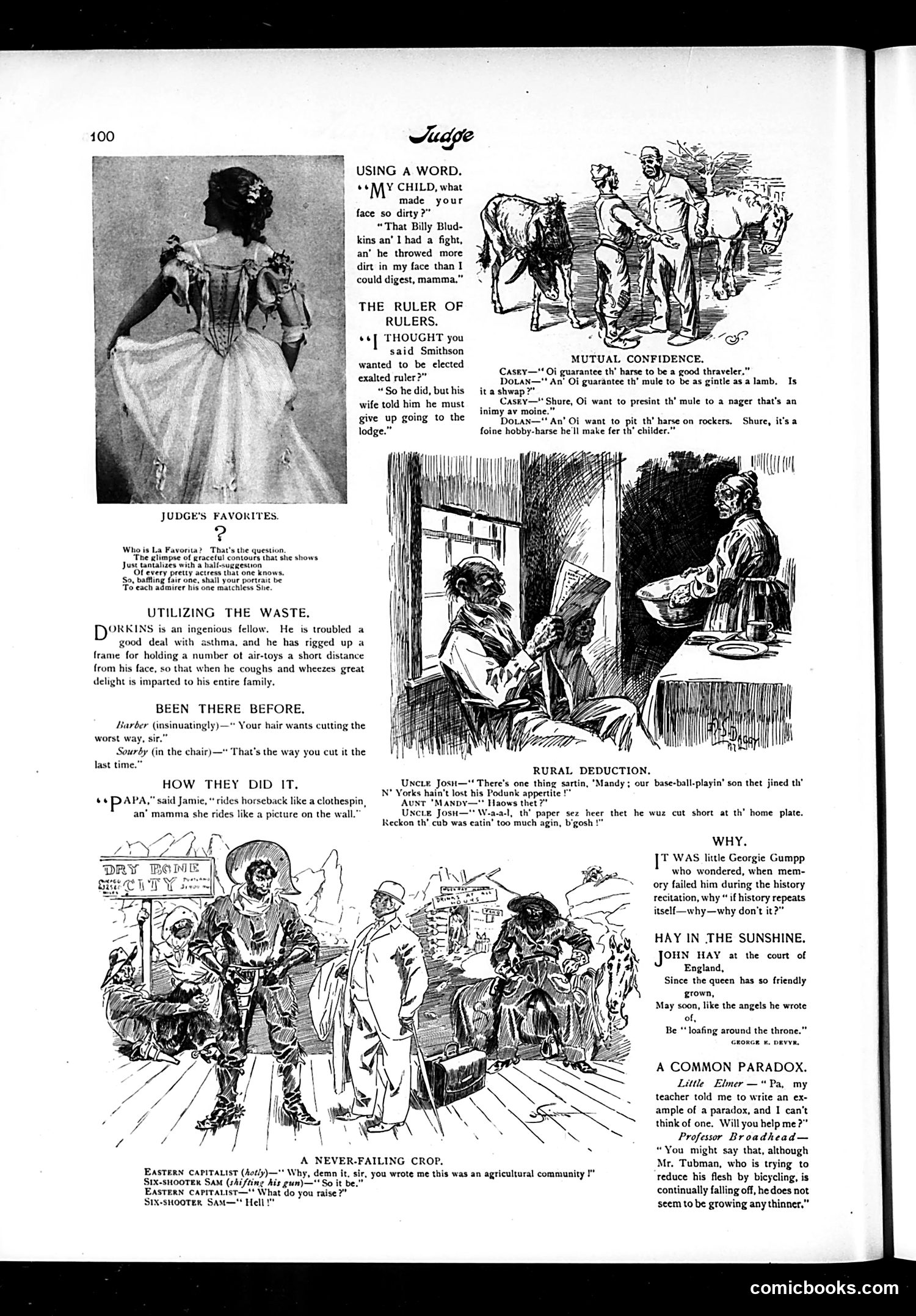
This page from *Judge* (likely early 1900s) contains several brief humorous sketches and jokes typical of the magazine's satirical style: **Main content includes:** - **"Judge's Favorites"**: A mystery illustration of an attractive woman ("La Favorita"), inviting readers to guess her identity - **Social/domestic humor**: Sketches mocking everyday life—a man using air-toys while coughing, a barber's poor haircuts, children's observations about their parents' riding styles - **Class satire**: "Utilizing the Waste" and "A Never-Failing Crop" joke about inefficiency and questionable rural practices (the final sketch features "Six-Shooter Sam," a Western character stereotype who admits his community's main "crop" is violence) - **Ethnic humor**: Several sketches employ Irish dialect ("Oi," "Shure") in conversations about trading horses and mules - **Topical reference**: "Hay in the Sunshine" references John Hay (Secretary of State) at the English court, with a mild pun on his name The page reflects *Judge*'s mix of gentle domestic humor and social commentary, with some now-dated ethnic stereotyping typical of the era.
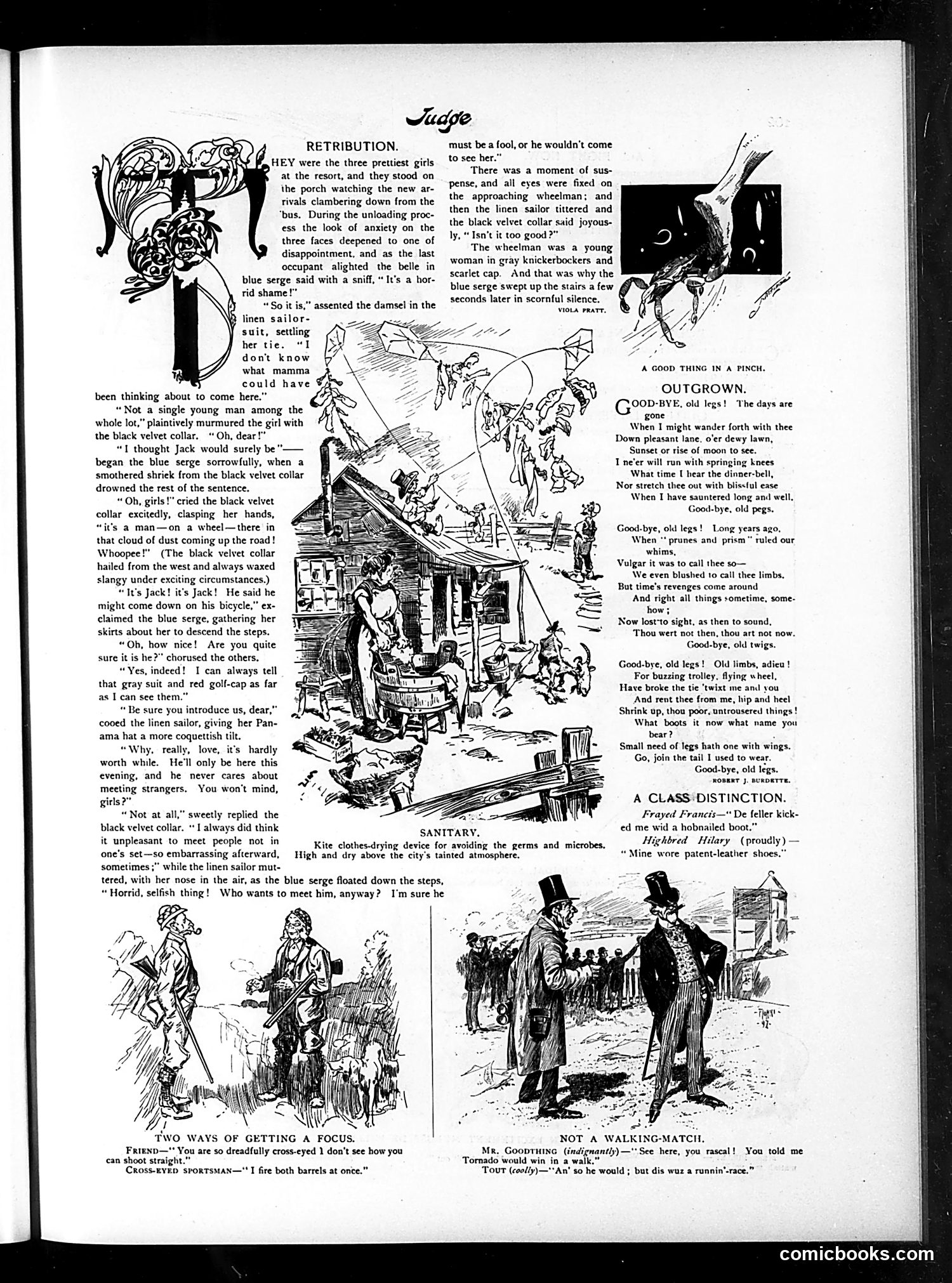
This page contains several satirical pieces mocking early 1900s social pretensions and gender dynamics: **"Retribution"** (main story): Three snobbish resort girls dismiss arriving guests as undesirable. When an attractive young woman arrives on a bicycle wearing practical "gray knickerbockers and scarlet cap," the girls are scandalized—presumably because she's independent and athletically dressed, representing the "New Woman" challenging Victorian femininity. The irony: their own rudeness about meeting strangers backfires when they discover the cyclist is desirable company they've now excluded themselves from. **"Outgrown"** (poem): A nostalgic lament bidding farewell to aging legs, mocking how modern life (trolleys, wheels, automobiles) has rendered women's legs obsolete for walking while simultaneously making them more visible and vulnerable to injury. **Minor cartoons**: "Sanitary" jokes about hygiene fads; "Class Distinction" and "Not a Walking-Match" mock social pretension; "Two Ways of Getting a Focus" is a simple visual pun. Overall, the page satirizes class anxiety and resistance to women's changing roles during the Progressive Era.
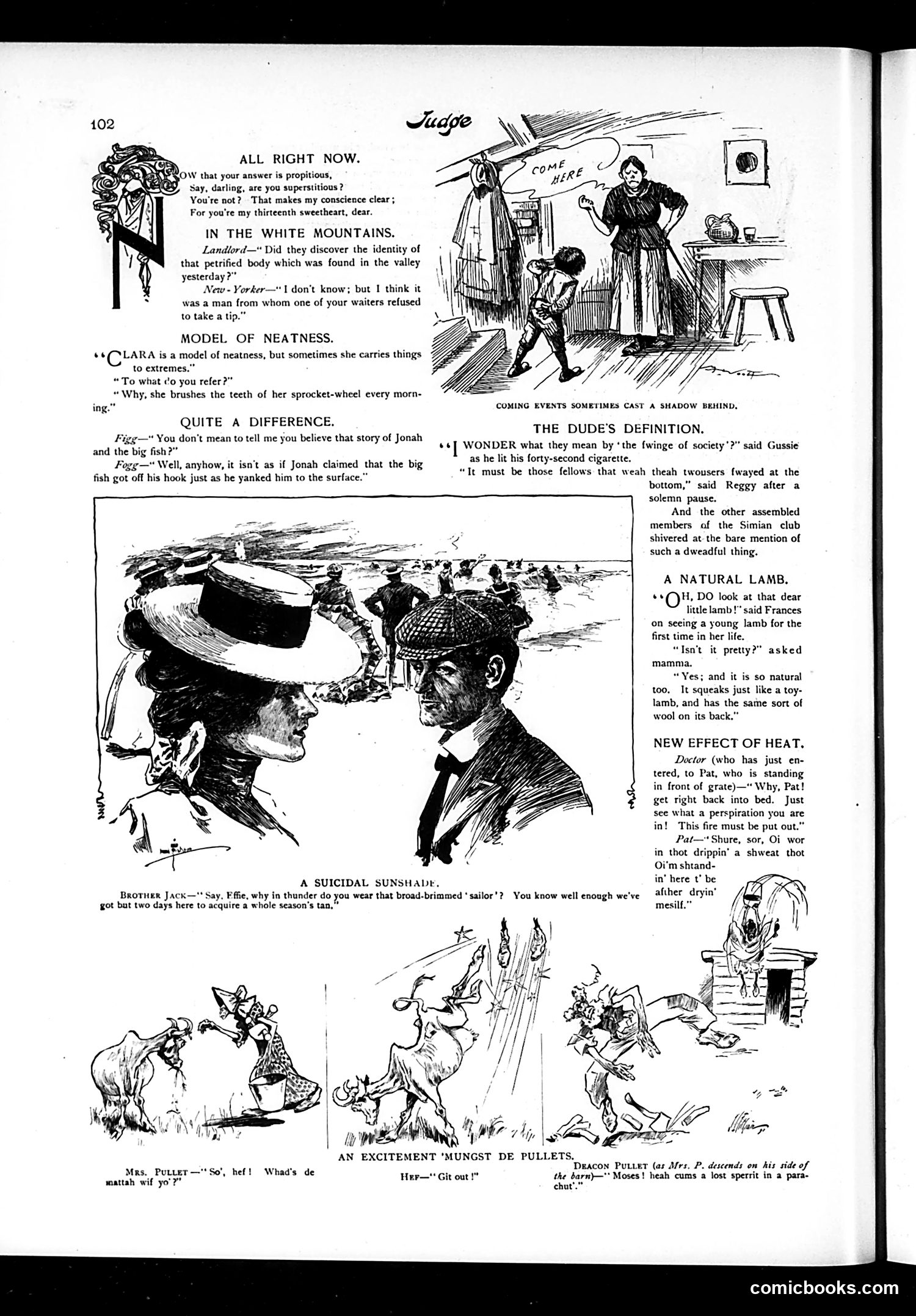
This page contains several short humorous vignettes typical of early-20th-century satirical magazines: **"All Right Now"** plays on superstition—a suitor jokingly notes his girlfriend is his thirteenth romantic partner. **"In the White Mountains"** mocks New York tourists' cheapness: a visitor's extreme frugality is so notorious that waiters refused his tips, leaving him "petrified" in the valley. **"Model of Neatness"** exaggerates female fastidiousness through absurd detail about cleaning bicycle parts. **"The Dude's Definition"** satirizes wealthy dandies' pretension: they misinterpret "wings of society" as referring to frayed trouser bottoms—suggesting their shallow materialism and affected speech patterns ("fwayed," "twousers"). **"A Natural Lamb"** gently mocks urban ignorance: a city woman sees a real lamb for the first time and compares it to a toy. The remaining cartoons contain ethnic dialect humor (Irish "Pat," African American "Deacon Putter") typical of the era's casual prejudices. Overall, the page targets vanity, pretension, and social class differences.
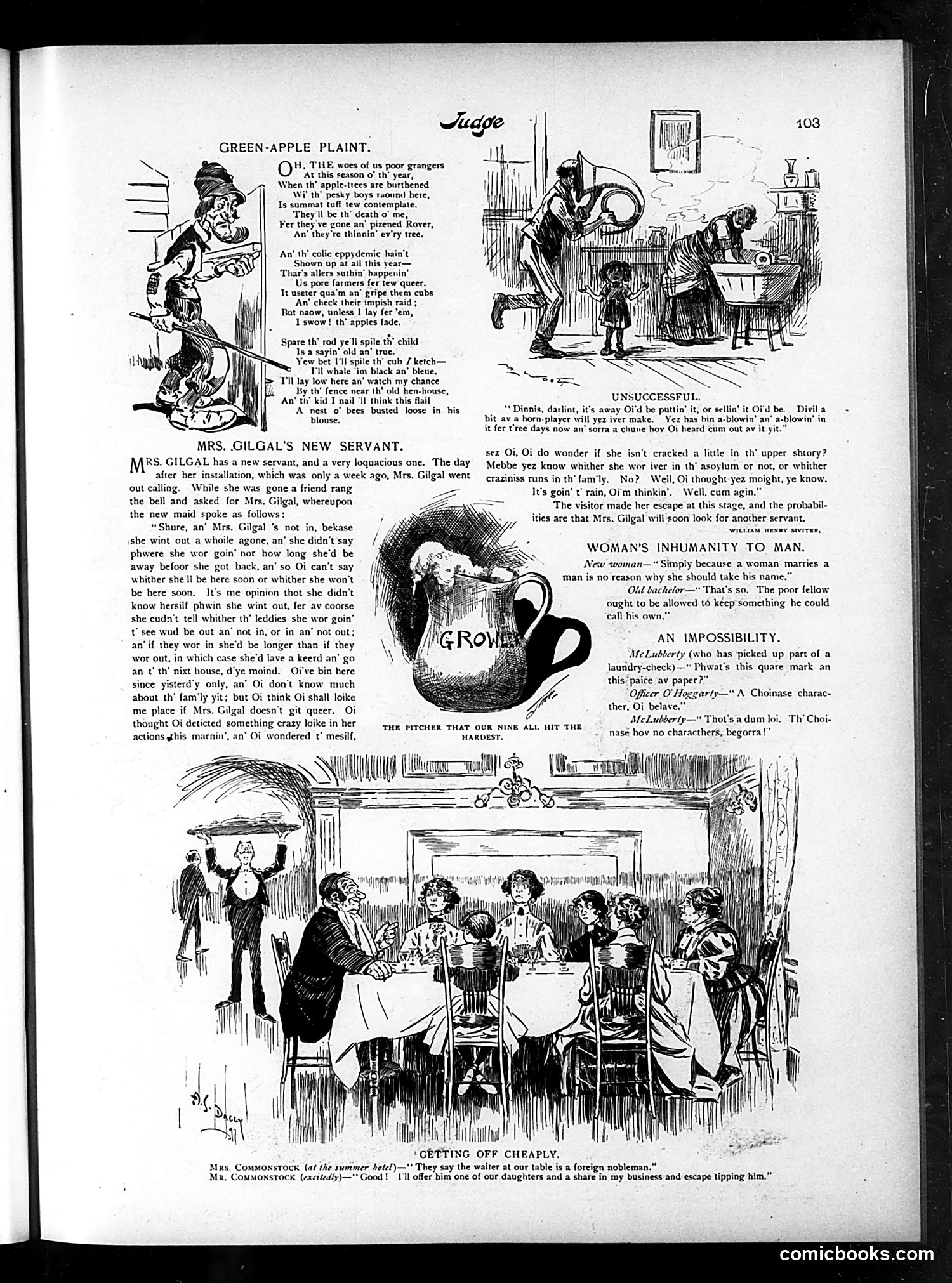
This page contains five satirical pieces from a late-19th-century American humor magazine: **"Green-Apple Plaint"**: A rural farmer complains (in exaggerated dialect) about boys stealing his green apples and making his dog sick. The satire mocks both the farmer's speech patterns and the timeless problem of orchard theft. **"Mrs. Gilgal's New Servant"**: An Irish maid gives an absurdly verbose, circular explanation for why her employer is out—satirizing immigrant domestic workers' perceived chattiness and poor English. **"The Unsuccessful Hornplayer"**: A brief joke about a boy unable to play an instrument despite days of practice. **"Woman's Inhumanity to Man"**: A "New Woman" (referencing the 1890s women's movement) refuses to take her husband's name. The old bachelor complains he's lost ownership of something. This mocks feminist demands for independence. **"Getting Off Cheaply"**: A wealthy businessman jokes about using his daughters as currency to avoid tipping a foreign nobleman waiter—satirizing both nouveau-riche tackiness and class anxiety. The page targets immigrants, rural workers, and emerging women's rights advocates.
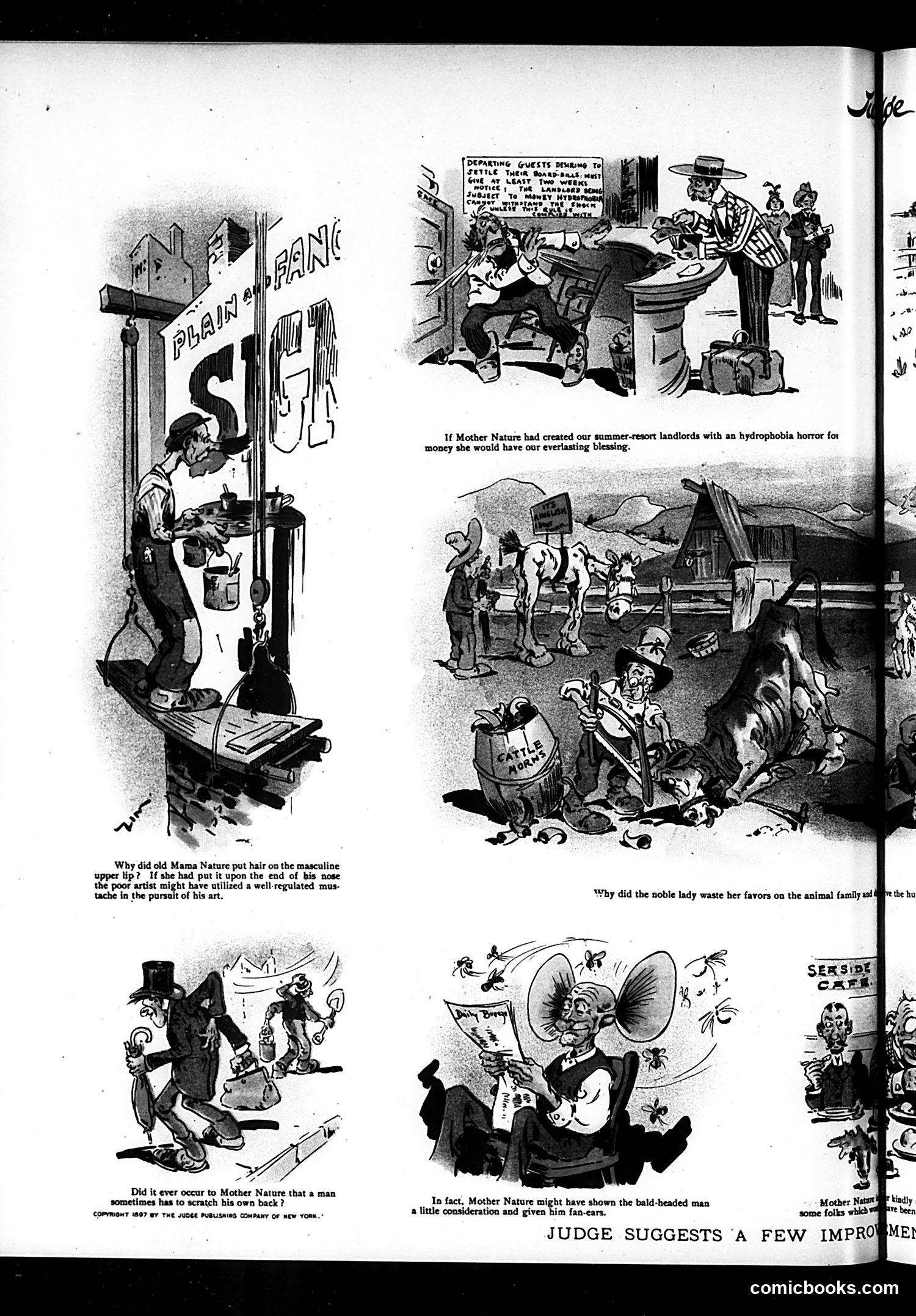
This page features multiple cartoons mocking "Mother Nature" for her supposed design flaws in creating humans. The satire targets various social annoyances of the era: **Upper cartoons**: Summer resort landlords are criticized for their obsession with money; a satirical jab at hospitality industry greed. **Middle cartoons**: Absurdist humor about masculine features—mocking the placement of facial hair and suggesting alternative designs (nose hair for artists' mustaches, fan-shaped ears for bald men to cool themselves). **Overall theme**: "Judge Suggests a Few Improvements" frames the page as humorous complaints about human design. The cartoons use exaggerated caricatures and slapstick scenarios to comment on contemporary social types and annoyances. The satire employs body-focused ridicule common to early 20th-century humor, targeting baldness, facial hair, and wealth-obsessed landlords—representing everyday frustrations with nature and social classes. The tone is light mockery rather than serious critique.
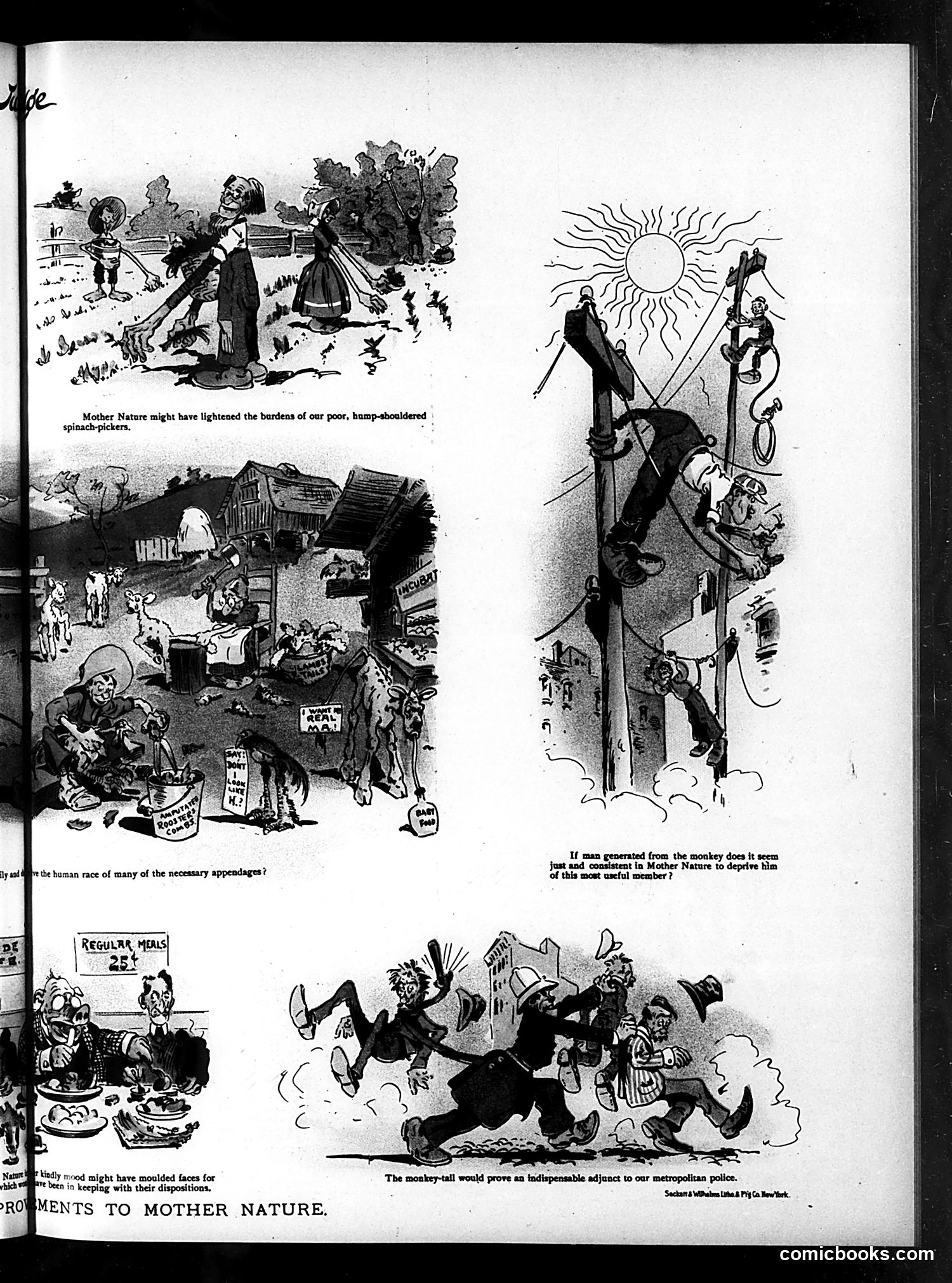
This page presents satirical cartoons criticizing what the cartoonist views as Mother Nature's poor design of humanity. The top cartoon mocks poor agricultural workers ("spinach-pickers") as physically deformed, suggesting Nature should have given them better bodies for their laborious work. The middle cartoon depicts a figure climbing a pole toward the sun, apparently critiquing how humans lack useful animal appendages (tails, wings) that could improve survival or labor. The bottom cartoon suggests Mother Nature bungled human facial design—people's appearances don't match their dispositions or character. The final panel shows figures appearing to riot or rebel, captioned that a "monkey-tail would prove an indispensable adjunct to our metropolitan police," sarcastically implying even police need evolutionary improvements. Overall, the page uses pseudo-Darwinian humor to mock both human imperfection and social inequality in early 20th-century America.
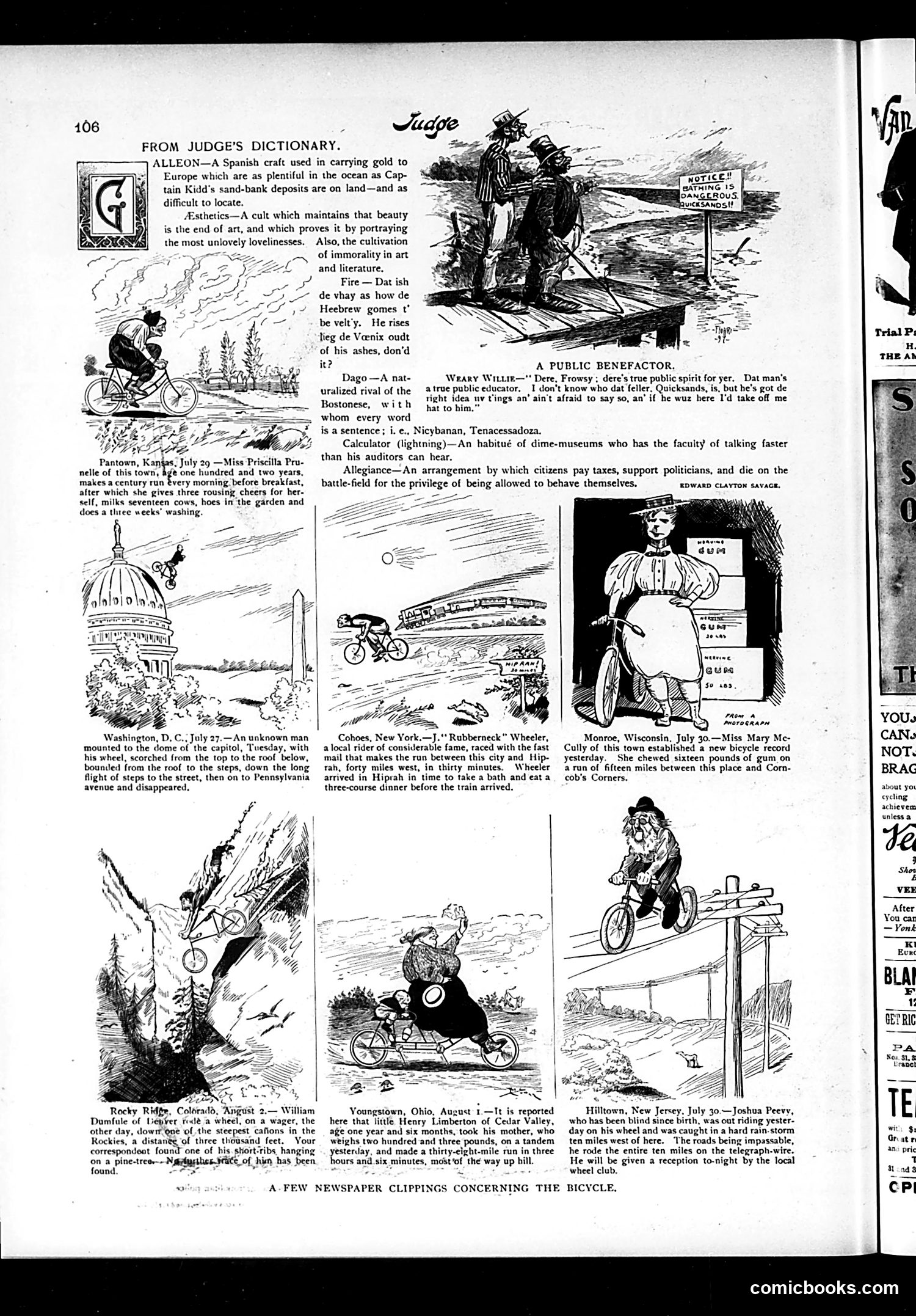
This page from Judge magazine satirizes the bicycle craze of the 1890s through mock newspaper clippings featuring absurdly impossible bicycle feats. The cartoons depict cyclists performing physically impossible stunts: riding down cliffs, leaping from Capitol domes, riding on telegraph wires during storms, and traveling at impossible speeds while performing elaborate activities (eating three-course dinners, chewing gum, carrying heavy passengers). The humor targets both the obsessive enthusiasm for bicycles as the era's new technology and the exaggerated newspaper reporting of the period. The accompanying dictionary definitions mock pretentious language and concepts, with "A Public Benefactor" satirizing self-righteous blowhards. Together, these elements ridicule both bicycle mania and sensationalist journalism's tendency toward outlandish claims—a common theme in Judge's satirical content of this period.
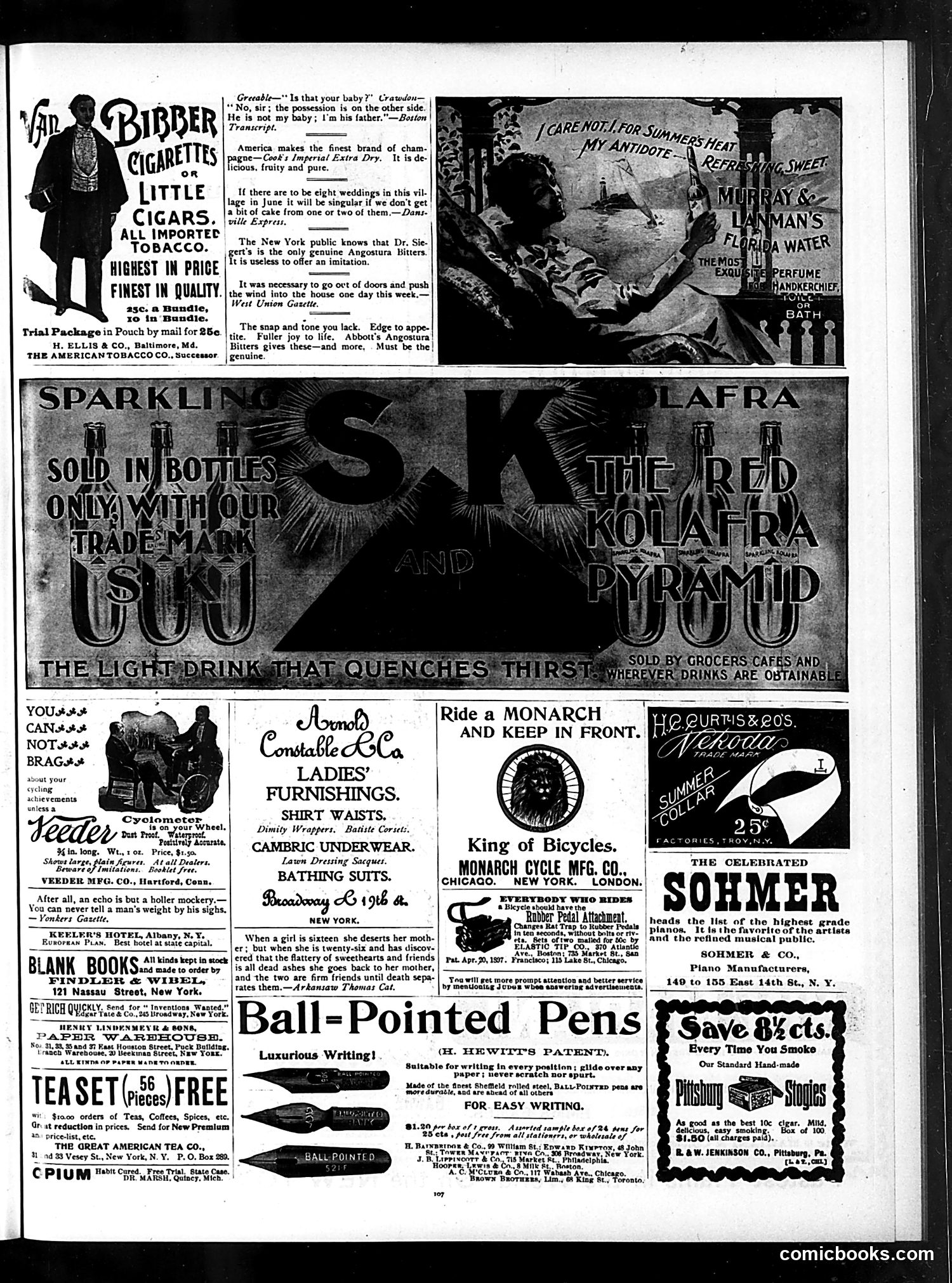
This page is **primarily advertisements** rather than political satire. The bulk consists of commercial ads for products like cigarettes, bicycles, pens, pianos, and various furnishings typical of early 1900s American commerce. The only cartoon element is a small dialogue at top-left, depicting what appears to be a domestic dispute over paternity. A man protests "He is not my baby; I'm his father"—a humorous non-sequitur suggesting legal/marital complications. This reflects Judge's satirical humor about marriage and social relations, common themes in the magazine. The page also includes a large beverage advertisement for S&K sparkling drinks ("The Light Drink That Quenches Thirst"), featuring decorative illustrated lettering but no obvious political commentary. Overall, this represents Judge's format: mixing satirical social commentary with era-appropriate advertisements, reflecting consumer culture and family dynamics of the period.
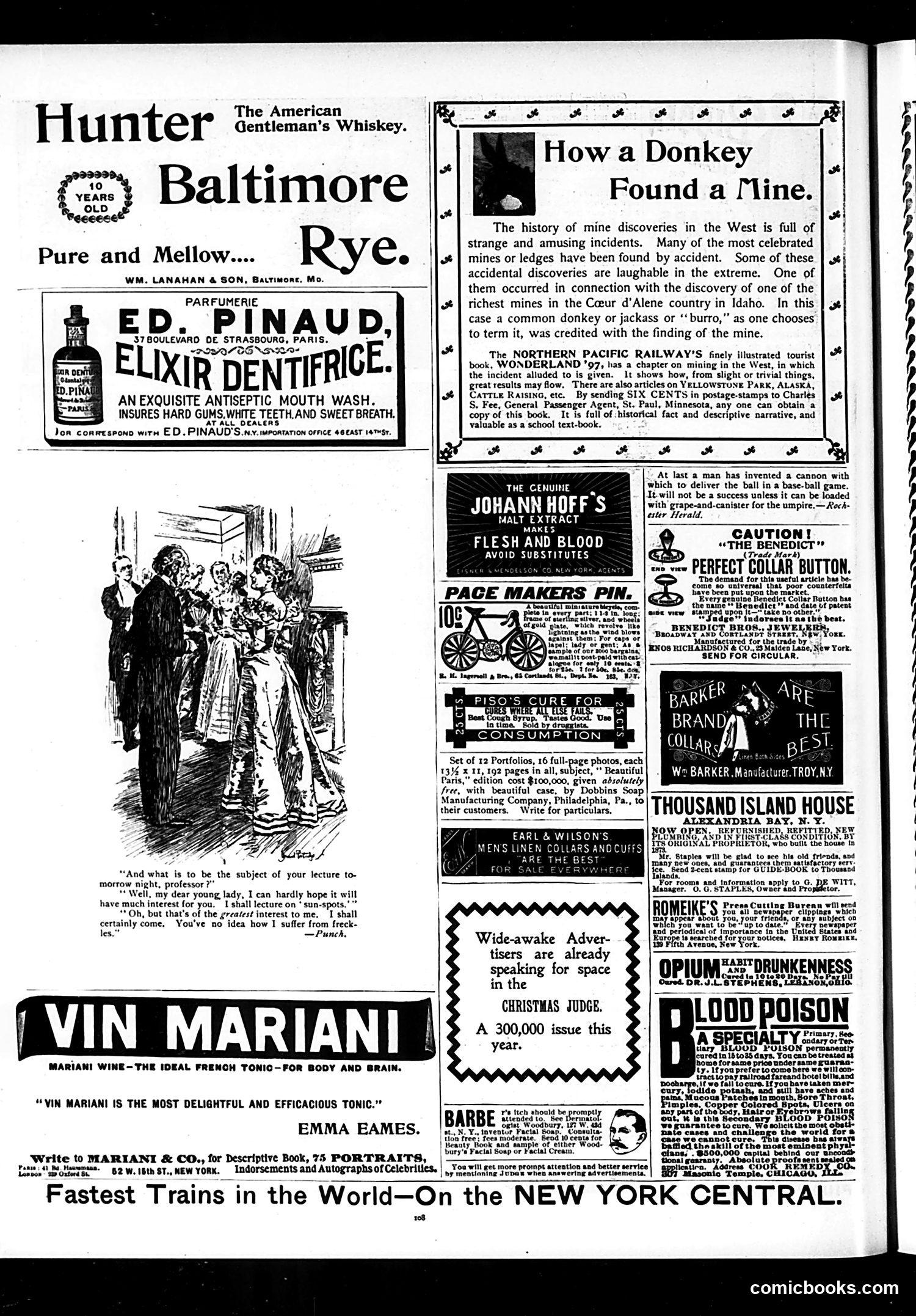
This is primarily an **advertising page** from Judge magazine, not a political cartoon. The content consists almost entirely of period product advertisements and small humorous anecdotes rather than political satire. Notable items: **The donkey mine story** (top right) describes how a burro accidentally discovered a rich mine in Idaho's Coeur d'Alene region—a genuine historical anecdote, now packaged as tourism promotion by the Northern Pacific Railway. **The Professor joke** (bottom left) is a Victorian-era humor piece: a young woman claims to suffer from "freckles" triggered by the sun, so she wants to attend his lecture on sun-spots—absurd pseudo-scientific logic used for comedic effect. The remaining content advertises patent medicines (Vin Mariani, Johann Hoff's Malt Extract), spirits, dentifrice, and various consumer goods typical of 1890s publications. These ads reveal period attitudes toward health and consumption rather than offer political commentary.
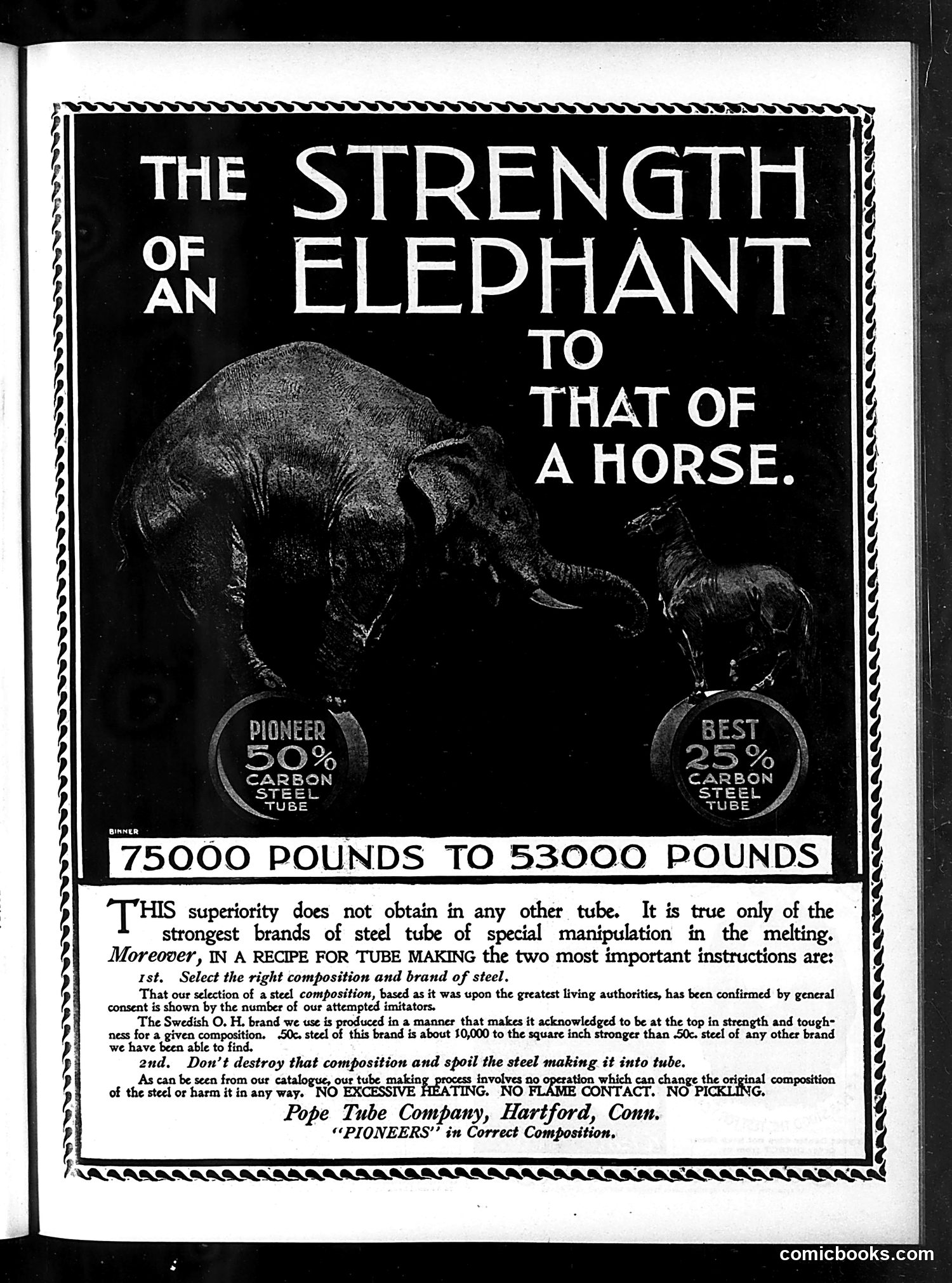
This is a **product advertisement**, not political satire or editorial cartoon. It promotes Pope Tube Company's steel tubing, headquartered in Hartford, Connecticut. The visual comparison—an elephant versus a horse—illustrates the company's claim that their steel tubes possess superior strength-to-weight ratio (750,000 pounds breaking strength versus 530,000 for competitors). The elephant represents Pope's "Pioneer" brand (50% carbon steel); the horse represents rival "Best" brand (25% carbon steel). The text emphasizes two manufacturing principles: selecting superior Swedish O.H. steel composition and avoiding destructive processing (no excessive heating, flame contact, or pickling). The advertisement positions Pope as "pioneers" in correct tube composition, implying competitors are imitators with inferior products. This appears in **Judge magazine** likely because Judge published commercial advertisements alongside satirical content. The page reflects early 20th-century industrial marketing rhetoric comparing products through animal strength metaphors.
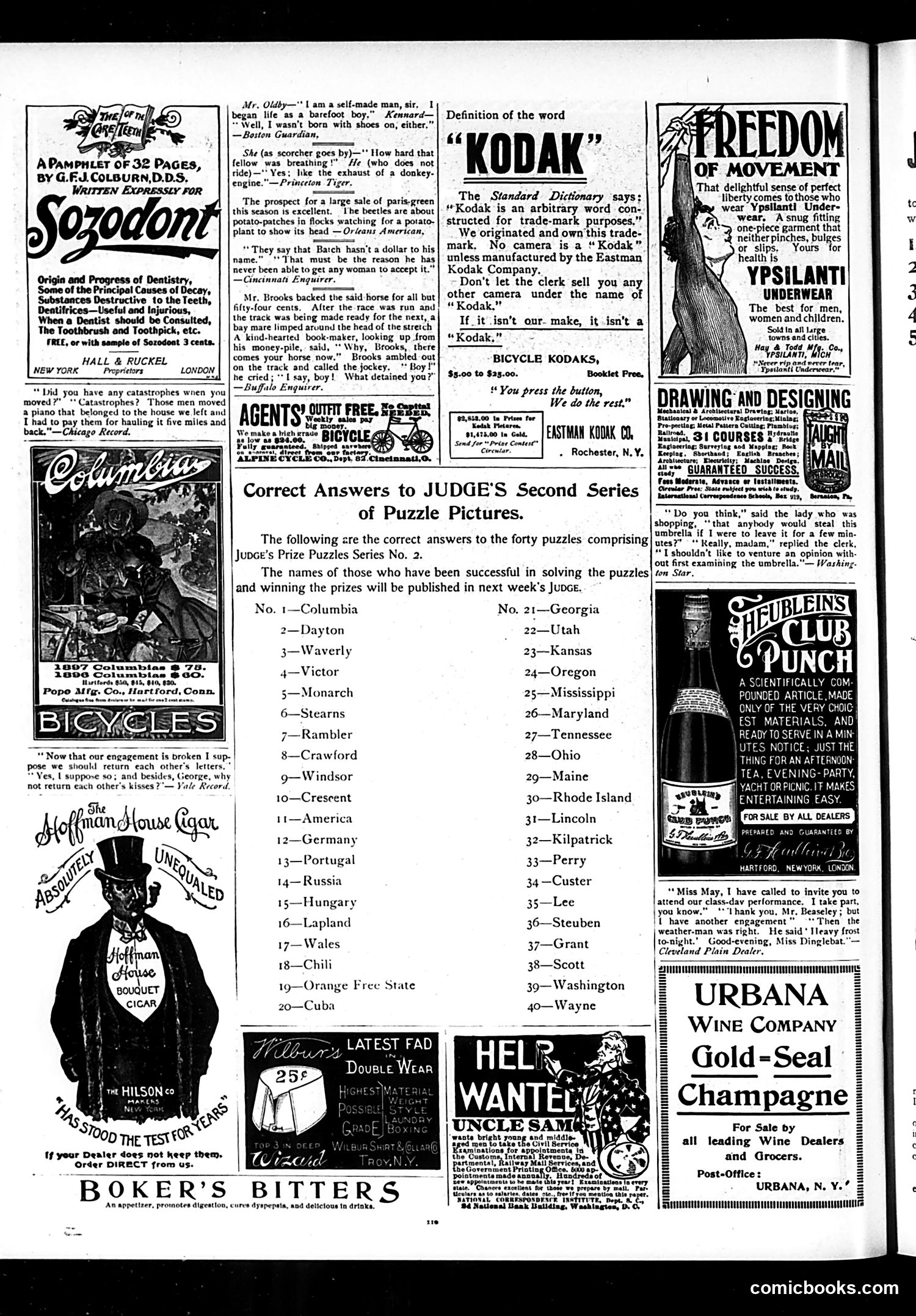
This page is primarily **advertisements and reference material** rather than political satire. The main content includes: **Advertisement Section**: Kodak camera company asserts its trademark, warning consumers not to buy cameras labeled "Kodak" unless manufactured by Eastman Kodak Company—an early trademark-protection notice targeting counterfeit or imitation products. **Puzzle Answers**: A list of 40 state and geographical puzzle solutions, likely referencing contemporary bicycle brand names (Columbia, Dayton, Victor, etc.) and American place names/historical figures (Grant, Lincoln, Custer, Lee—Civil War generals). **Minor Humor Snippets**: Brief joke excerpts about moving day mishaps, bicyclists, and romantic entanglements—typical light humor filler. **Product Advertisements**: Cigars, bitters, champagne, underwear, and other consumer goods typical of 1890s-era magazines. The page reflects **turn-of-century consumer culture** rather than political commentary. It shows early corporate trademark concerns and the integration of advertising into magazine content.
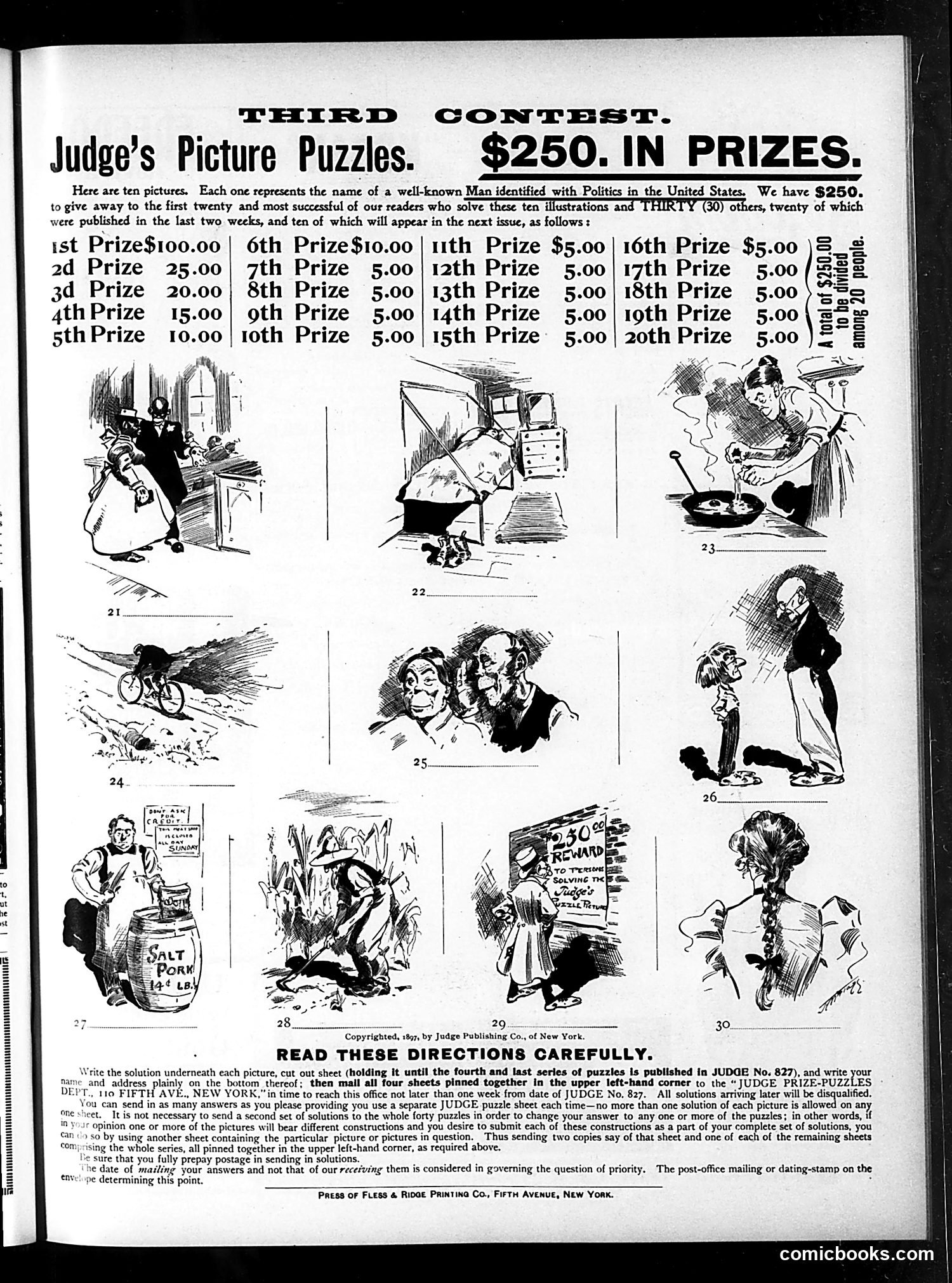
This is a contest page from *Judge* magazine offering $250 in prizes for readers to identify ten political figures from satirical cartoon illustrations. The puzzles represent "well-known Men identified with Politics in the United States." The page shows ten numbered cartoon sketches (numbered 21-30) depicting various politicians through caricature and visual puns—a popular format in 19th-century satirical magazines. Readers had to guess the politicians' names and submit solutions. The contest rules are detailed: winners would be selected from those correctly solving these ten images plus thirty others published across multiple issues. The first prize was $100, with decreasing amounts down to the 20th prize of $5. Without being able to identify specific individuals from the sketches alone, the exercise reflects how *Judge* magazine engaged readers in contemporary political satire, assuming its audience could recognize major U.S. politicians from exaggerated visual representations.
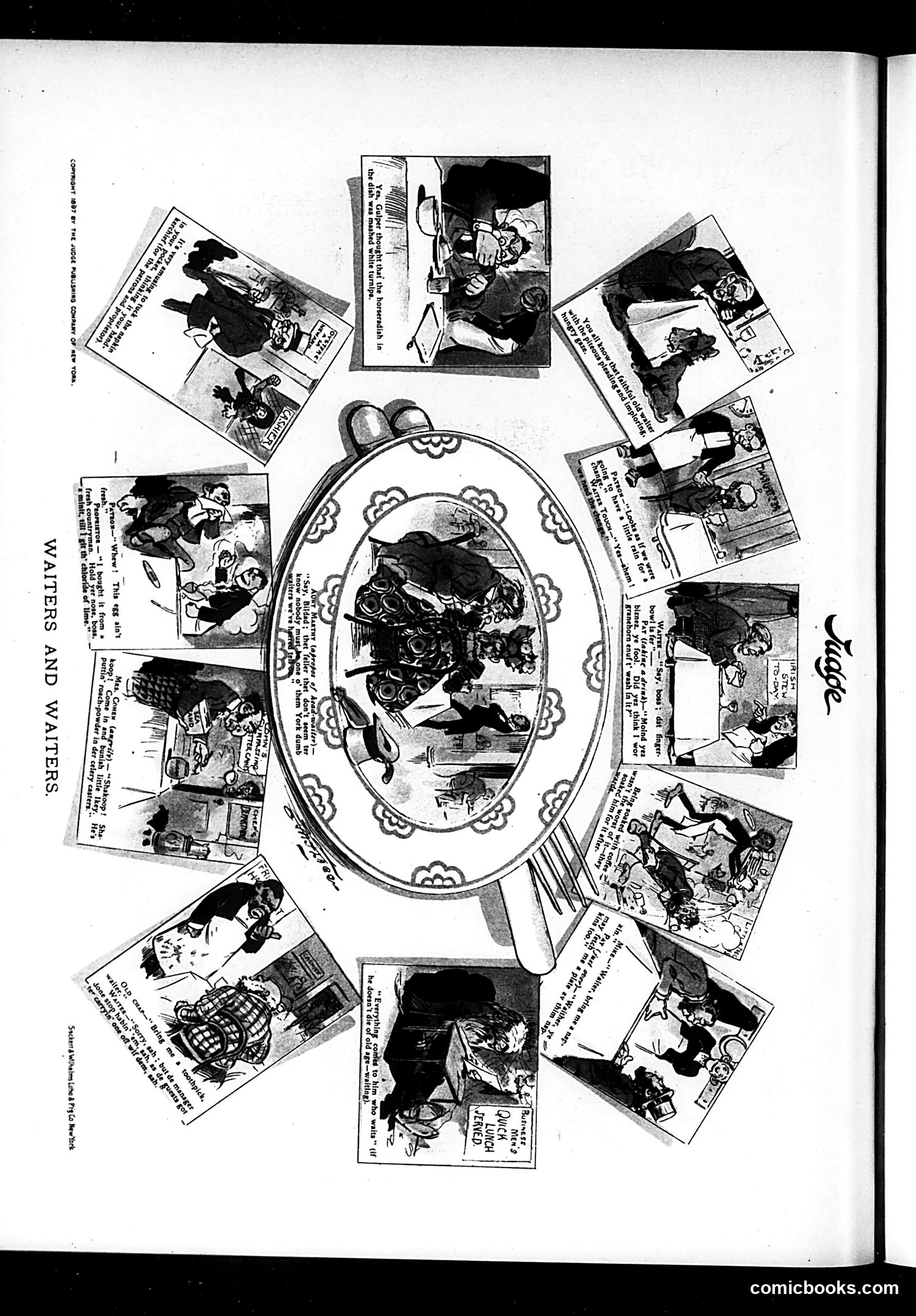
This page appears to be a comic strip arrangement satirizing restaurant service workers, specifically waiters. The central oval frame contains what seems to be a chaotic kitchen or dining scene, surrounded by individual comic panels depicting various waiter scenarios and mishaps. The OCR'd dialogue fragments suggest humor based on waiters' incompetence or mishearing orders—phrases like "This egg ain't from" and complaints about service quality. The title "Waiters and Waiters" likely plays on different types or classes of waiters, poking fun at service industry workers and their varying levels of competence. Without clearer text or visible captions, the specific satirical targets remain unclear, but the overall theme appears to mock working-class service employment common to early 20th-century American urban life.