
Judge, 1897-08-14 · page 7 of 16
Judge — August 14, 1897 — page 7: what you’re looking at
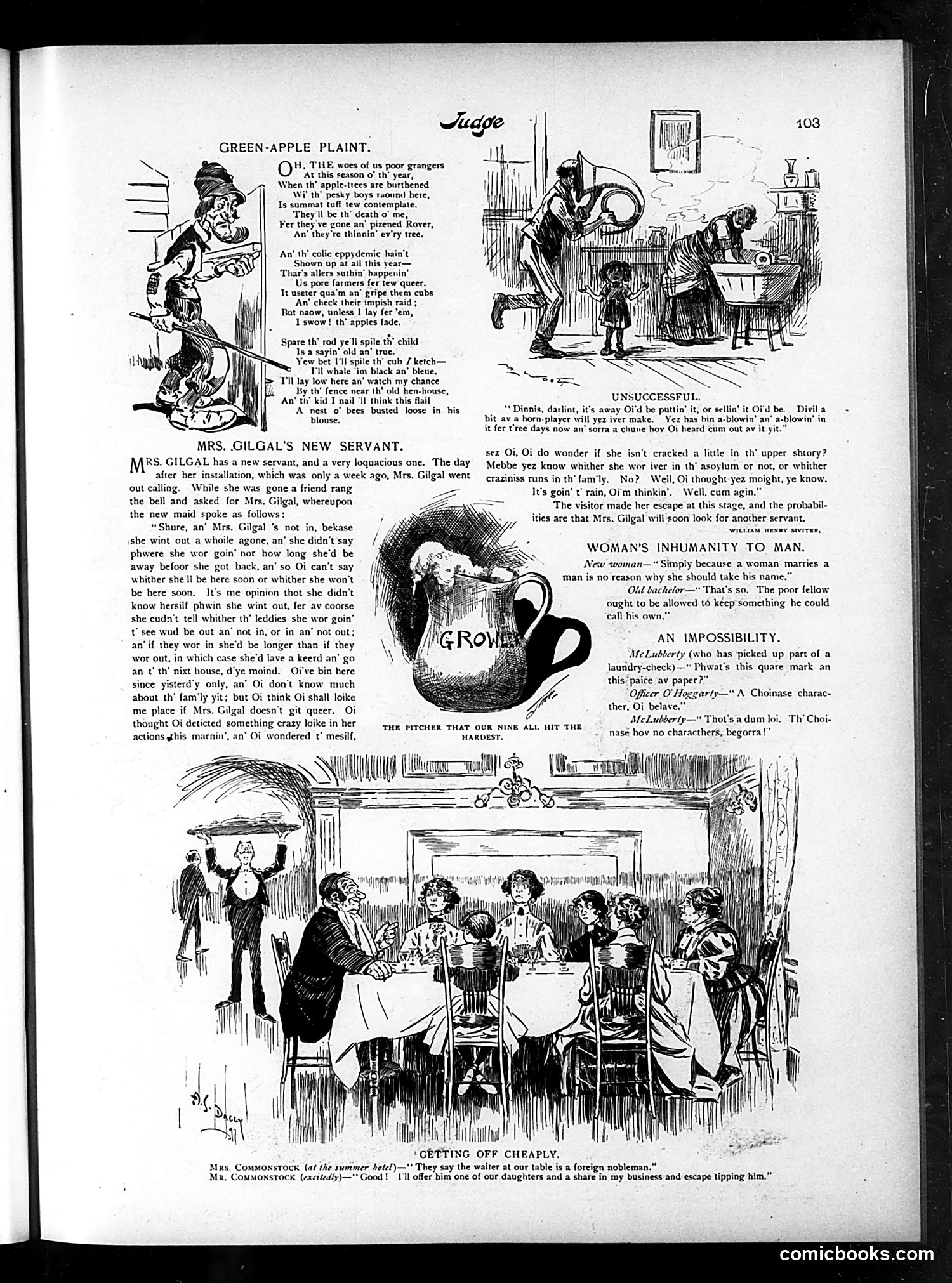
What you’re looking at
This page contains five satirical pieces from a late-19th-century American humor magazine: **"Green-Apple Plaint"**: A rural farmer complains (in exaggerated dialect) about boys stealing his green apples and making his dog sick. The satire mocks both the farmer's speech patterns and the timeless problem of orchard theft. **"Mrs. Gilgal's New Servant"**: An Irish maid gives an absurdly verbose, circular explanation for why her employer is out—satirizing immigrant domestic workers' perceived chattiness and poor English. **"The Unsuccessful Hornplayer"**: A brief joke about a boy unable to play an instrument despite days of practice. **"Woman's Inhumanity to Man"**: A "New Woman" (referencing the 1890s women's movement) refuses to take her husband's name. The old bachelor complains he's lost ownership of something. This mocks feminist demands for independence. **"Getting Off Cheaply"**: A wealthy businessman jokes about using his daughters as currency to avoid tipping a foreign nobleman waiter—satirizing both nouveau-riche tackiness and class anxiety. The page targets immigrants, rural workers, and emerging women's rights advocates.
📄 Transcribed text from this page (OCR, searchable)
Machine-transcribed from the original scan — historical spelling and the odd misread are preserved.
GREEN-APPLE PLAINT. H, THE woes of us poor grangers ‘At this season o” th’ year, When th’ apple-trees are burthened Wi’ th’ pesky boys raound here, Is summat tuff tew contemplate. They Il be th’ death o' me, Fer they've gone an’ pizened Rover, An’ they're thinnin’ ev'ry tree, An’ th colic eppydemic Shown up at all thi Thar's allers suthin’ hay Us pore farmers fer tew queer. It useter qua’m an’ gripe them cubs An’ check their impish raid ; Bat naow, unless I lay fer ‘em, 1 swow! th’ apples fade. Spare th’ rod ye'll spile th’ child Is a sayin’ old an’ true. Yew bet lll spile th’ cub / ketch— Tl whale ‘im black an’ bleue, T'll lay low here an’ watch my chance By th’ fence near th’ old hen-house, An’ th’ kid T nail "Il think this fail A nest o' bees busted loose in his blouse, MRS. GILGAL’S NEW SERVANT. 'S. GILGAL has a new servant, and a very loquacious one. The day after her installation, which was only a week ago, Mrs. Gilgal went cout calling. While she was gone a friend rang the bell and asked for Mrs. Gilgal, whereupon the new maid spoke as follow: “Shure, an’ Mrs. Gilgal 's not in, bekase she wint out a whoile agone, an’ she didn’t say phwere she wor goin’ nor how long she'd be away befoor she got back, an’ so Oi can’t say whither she'll be here soon or whither she won't be here soon, It’s me opinion thot she didn’t know hersilf phwin she wint out, fer av coorse she cuda’t tell whither th’ leddies she wor goin’ t' see wud be out an’ not in, or in an’ not out; an’ if they wor in she'd be longer than if they wor out, in which case she'd lave a keerd an’ go an ¢' th’ nixt house, d'ye moind. Oi've bin here since yisterd’y only, an’ Oi don’t know much about th’ fam'ly yit; but Oi think Oi shall loike me place if Mrs. Gilgal doesn’t git queer. Oi thought Oi deticted something crazy loike in her actions ghis marnin’, an’ Oi wondered t’ mesilf, THE PITCHER THAT OUR NINE ALL HIT THE HARDEST. UNSUCCESSFUL. ** Dinnis, darlint, it's away Oi'd be puttin’ it, or sellin’ it Oi'd be. bit av a horn-player will yez iver make. Yez has bin a-blowin’ it fer t'ree days now an’ sorra a chune hov Oi heard cum out a Divila blowin’ in sez Oi, Oi do wonder if she isn’t cracked a little in th’ upper shtory? Mebbe yez know whither she wor iver in th’ asoylum or not, or whither craziniss runs in th’ fam'ly. No? Well, Oi thought yez moight, ye know. It's goin’ train, Oi'm thinkin’. Well, cum agin.” The visitor made her escape at this stage, and the probabil- ities are that Mrs. Gilgal will soon look for another servant. WOMAN’S INHUMANITY TO MAN. New woman—* Simply because a woman marries a man is no reason why she should take his name.” Olt bachelor—* That's 50. The poor fellow ought to be allowed to keep something he could call his own,” AN IMPOSSIBILITY. McLubberty (who has picked up part of a laundry-check)—* Phwat’s this quare mark an this*paice av paper?” Officer O' Hoggarty— N Choinase charac- ther, Oi belave.” MeLubberty—* Thot's a dum loi. Th’ Choi- nasé hov no characthers, begorra!” ‘] TA ih sd ne Vill f a 'GETTING OFF CHEAPLY. Mrs. Commonstock (af the summer hotel)—"* They say the waiter at our table is a foreign nobleman.” Mr. Comaonstock (excitedly)—" Good! I'll offer him one of our daughters and a share in my business and escape tipping him.” comicbooks.com