
A complete issue · 18 pages · 1897
Judge — May 29, 1897
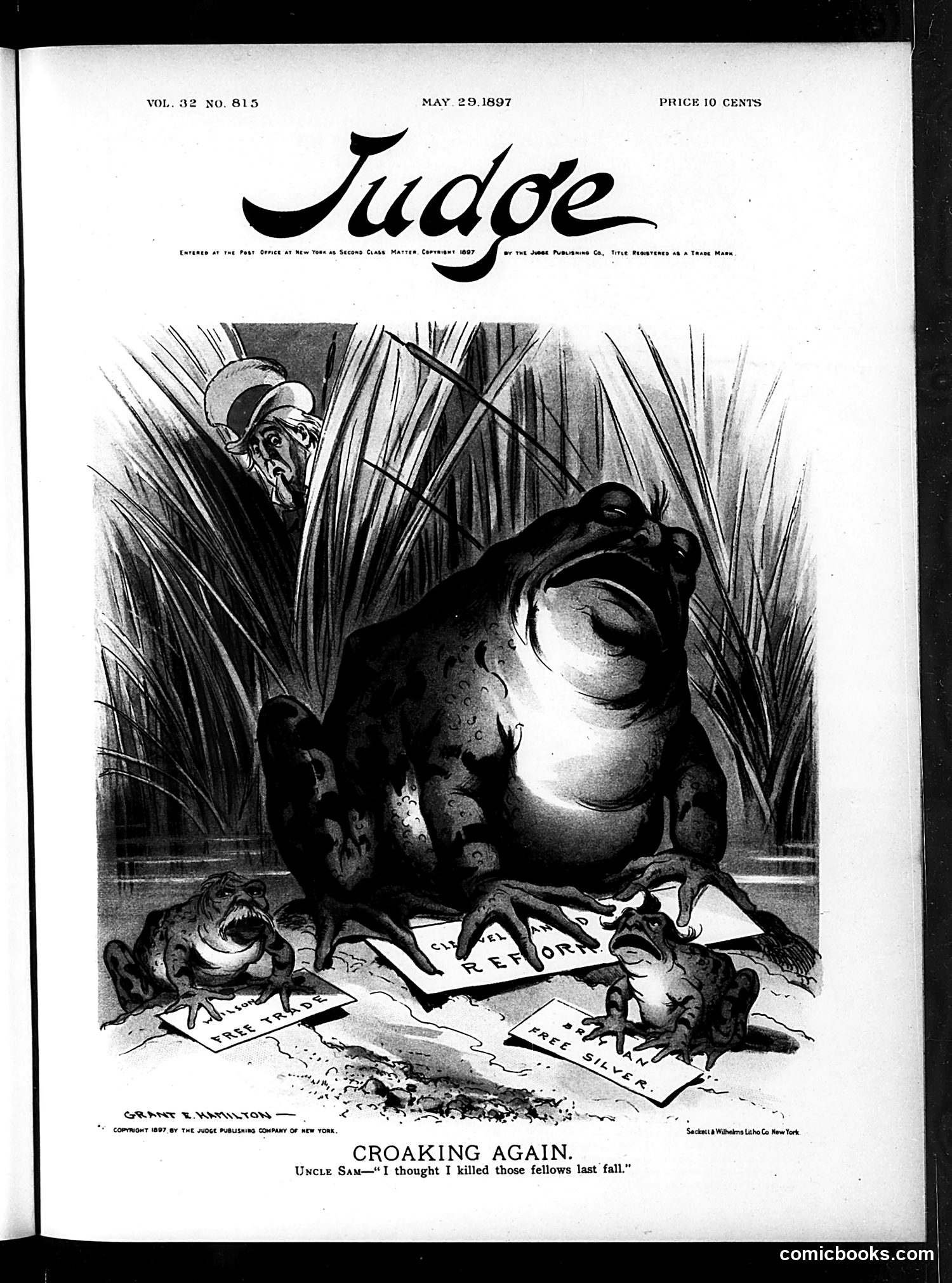
This political cartoon by Grant E. Hamilton satirizes the resurrection of economic crises. A large frog labeled "Free Silver" dominates the image, with smaller frogs nearby bearing labels including "Free Trade" and what appears to be "Silver Reform." Uncle Sam stands in the background, seeming to observe the revival of these issues. The cartoon suggests that despite efforts to suppress these controversial economic policies—particularly free silver (unlimited coinage of silver), which was a major political issue in the 1890s—they continue to resurface like croaking frogs. The title "Croaking Again" plays on both the frog imagery and the idea of these "dead" issues coming back to haunt American politics. The satire criticizes the persistent return of failed or unpopular policies.
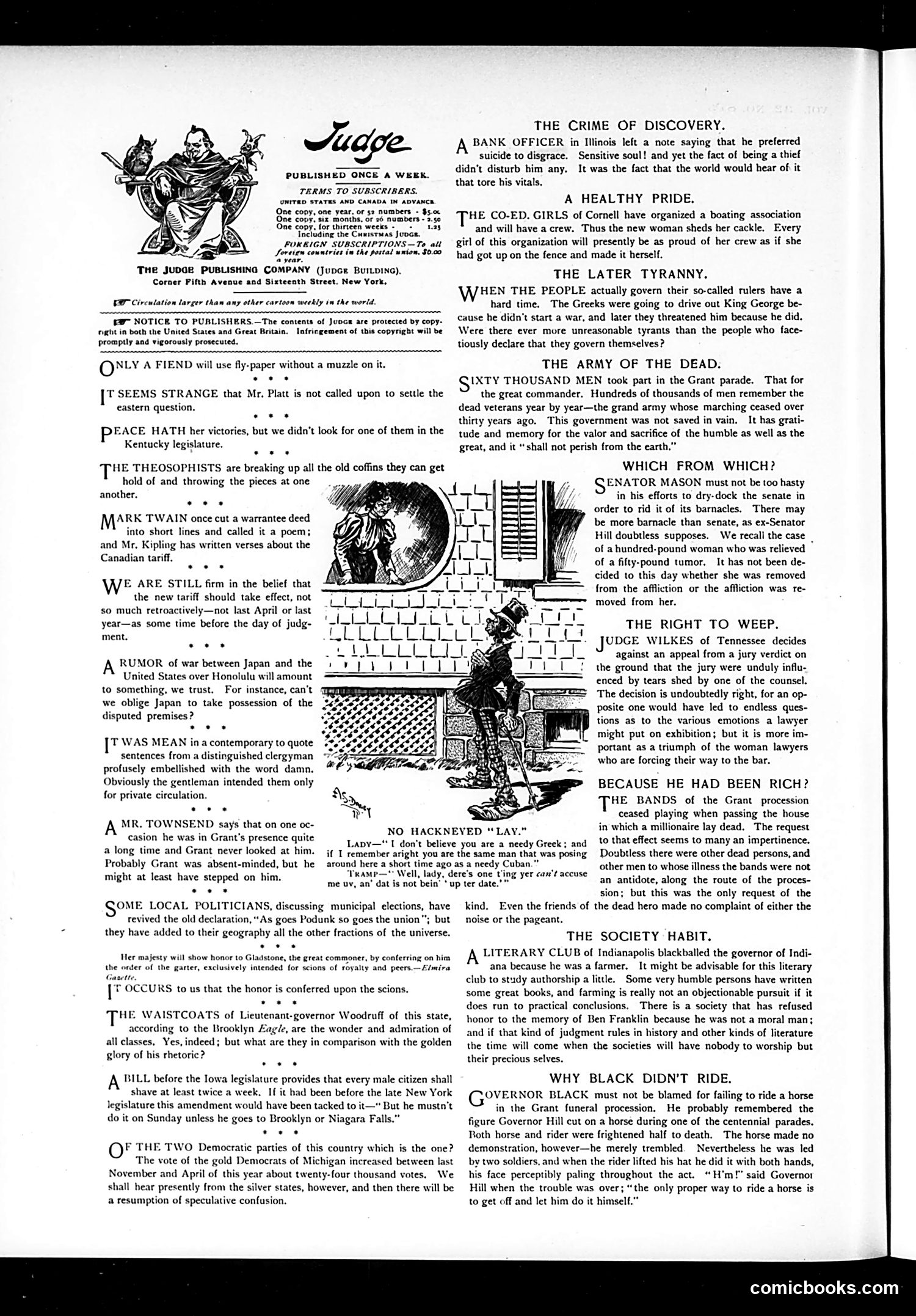
The main cartoon depicts a confrontation between a "Tramp" and a "Lady," with the tramp claiming to be a Greek and the lady skeptical of his identity. The caption reads "NO HACKNEYED 'LAW,'" suggesting satire about con artists or vagrants using false personas to solicit sympathy or money. The surrounding editorial sections target various political figures and social issues of the era, including references to Governor Woodruff, Governor Black, and Senator Mason. One piece criticizes the Grant administration's military parade and another mocks a Indianapolis literary club's decision to honor Ben Franklin despite questionable moral character. The overall tone satirizes political hypocrisy, racial issues ("Why Black Didn't Ride"), and social pretension common to Gilded Age America.
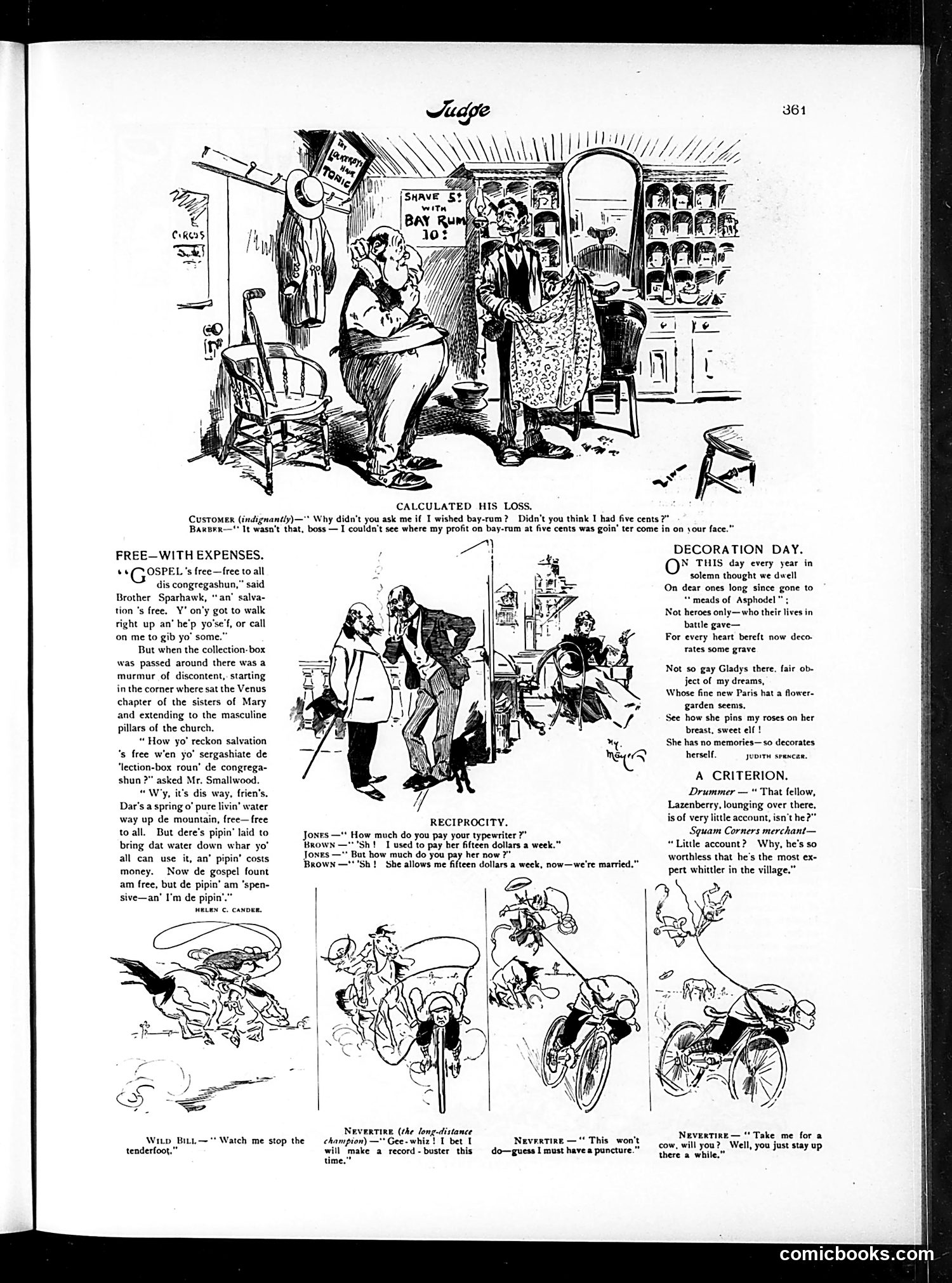
This page contains several unrelated satirical pieces typical of Judge magazine's format: **"Calculated His Loss"** depicts a barber shop scene where a customer complains about a five-cent price increase, claiming he can't see where the money went on his face—satirizing penny-pinching customers during economic hardship. **"Free—With Expenses"** mocks religious hypocrisy, showing a preacher's claims that "gospel's free" while the collection box circulates, highlighting the disconnect between spiritual promises and financial demands on congregants. **"Reciprocity"** and the bicycle comics use wordplay and visual humor about everyday situations (wage increases, punctures). **"Decoration Day"** is a sentimental poem about Memorial Day observances. The page exemplifies Judge's mix of social commentary, religious satire, and genteel humor targeting middle-class American life, likely from the early 20th century.
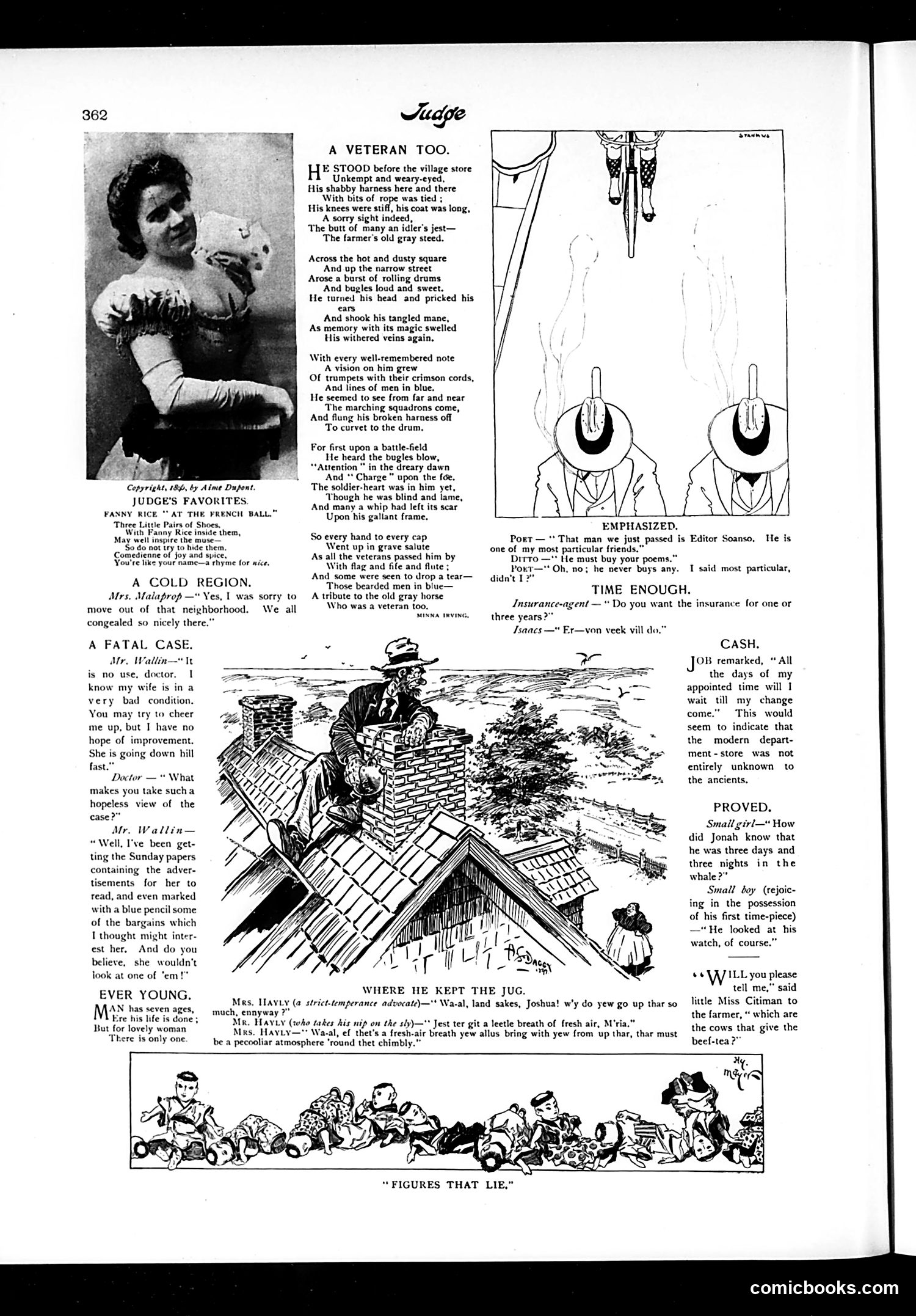
This page from Judge (a 19th-century American satirical magazine) contains several short humorous pieces: **"A Veteran Too"** is the longest piece—a sentimental poem about an old farm horse who, hearing military drums and bugles, recalls his Civil War service. The satire celebrates the horse's lingering military spirit despite age and lameness, with soldiers saluting him in tribute. This reflects post-Civil War nostalgia common in the era. **Shorter jokes** include marital humor ("A Cold Region," "Where He Kept the Jug"—depicting a temperance-advocate wife and her secretly drinking husband), editorial commentary ("Emphasized"—mocking a poet-editor who doesn't buy poems), and children's wit ("Proved"—a child explaining Jonah knew whale-duration by checking his watch). The cartoons are largely domestic and sentimental rather than overtly political. "A Veteran Too" appears to honor both human and animal sacrifice, while other pieces mock common Victorian social types: nagging wives, pretentious editors, and precocious children.
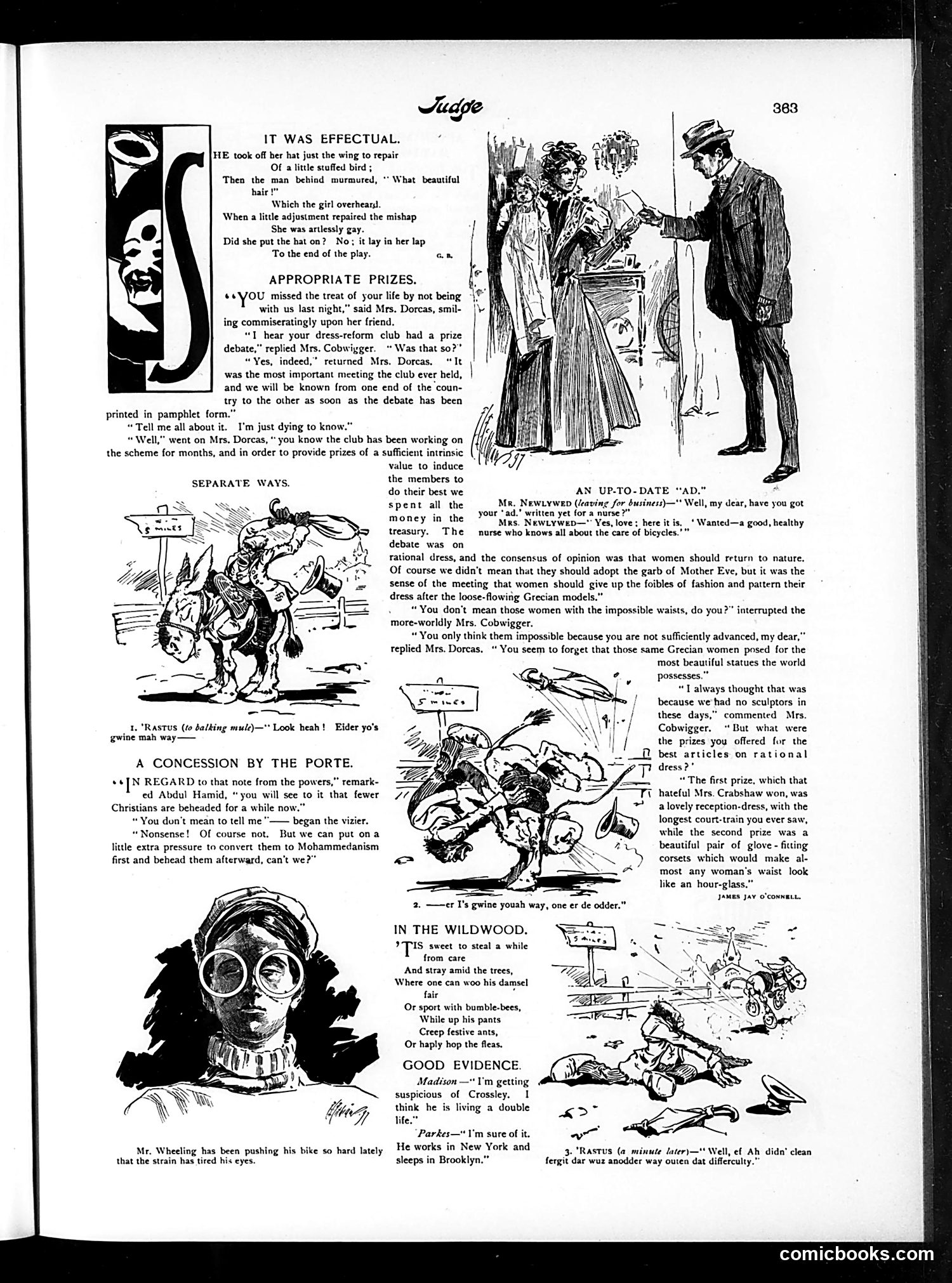
This satirical page mocks the "dress reform" movement of the late 19th/early 20th century through Mrs. Dorcas's club debate. The satire operates on multiple levels: **Main Joke**: The club spent its entire treasury on prizes for debating rational dress reform—advocating loose Grecian styles to replace restrictive Victorian fashion. The irony: the two prizes awarded were a dress with an impractically long court-train and tightly-fitting corsets—the very garments they opposed. This perfectly captures Judge's skepticism toward reform movements that lack practical follow-through. **Social Context**: Dress reform was a genuine movement supported by feminists and health advocates who opposed corsets. Judge ridicules this by showing reformers as hypocritical and ineffectual—they talk progressively but remain enslaved to fashion conventions. **Other items** on the page (the "up-to-date ad," jokes about Abdul Hamid and Christian conversions, romantic mishaps) are typical Judge filler content mocking contemporary social absurdities. The cartoons use exaggerated caricature and ironic juxtaposition—the standard tools of American satirical magazines of this era.
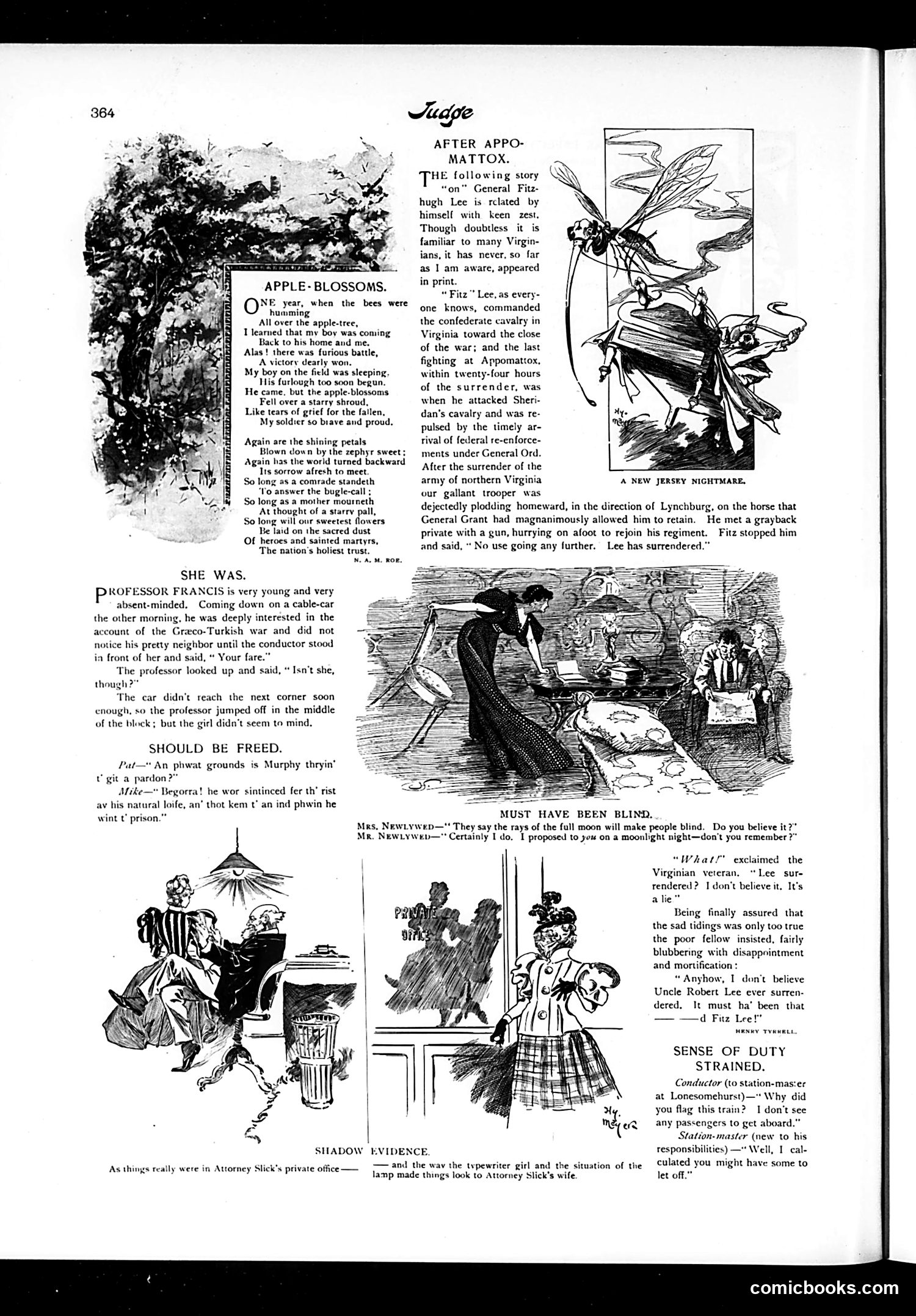
This page contains several unrelated satirical pieces typical of Judge magazine's format: **"After Appomattox"** is the main feature—a story about Confederate General Fitzhugh Lee after the Civil War's end. The anecdote depicts a Confederate soldier dejectedly heading home after surrender, met by a straggler still trying to rejoin his regiment. When told Lee has surrendered, the soldier refuses to believe it, blaming instead "that d—d Fitz Lee," suggesting Lee's late cavalry actions prolonged the war futilely. The satire mocks both Confederate stubbornness and the war's tragic waste. The page also includes lighter comedic vignettes: a professor absent-mindedly compliments a woman's appearance when asked for train fare; an Irishman seeks pardon after a life sentence; a newlywed husband proposes during a full moon and blames lunar rays for his wife's acceptance; and a station-master flags a train unnecessarily out of duty. The illustrations are period woodcuts and engravings typical of 1880s-90s Judge publication style.
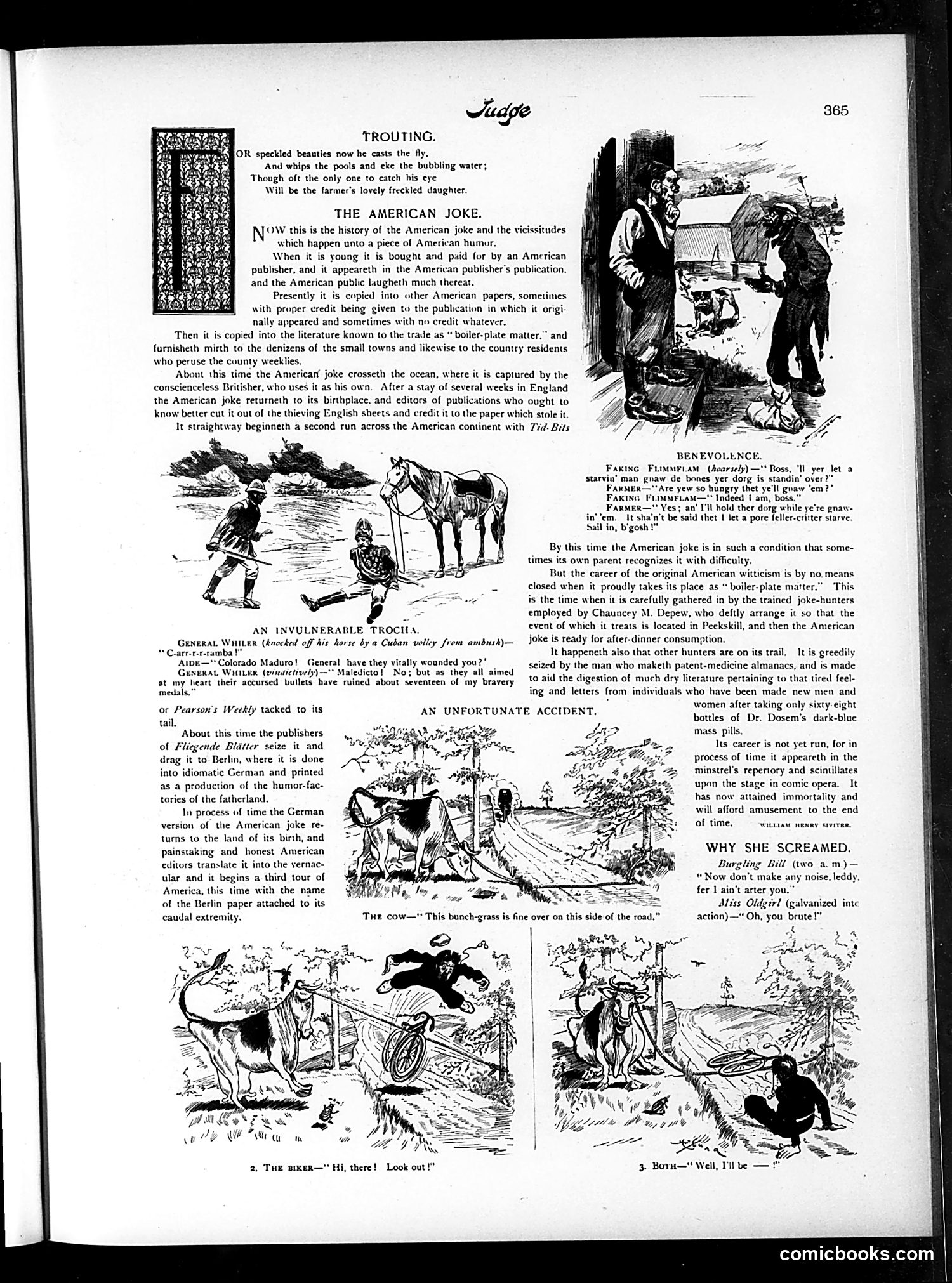
**"The American Joke"** is the main satirical article—a tongue-in-cheek history of how American humor gets recycled internationally. The piece mocks the lack of copyright protection and journalistic ethics of the era: an American joke is published, copied into "boiler-plate" (syndicated) newspapers without credit, stolen by British publishers, returned to America credited to the British source, then sent to German humor magazines and back again—each iteration losing its origin until no one remembers the source. The satire targets both careless American editors and "conscienceless Britishers" who profit from intellectual theft. The accompanying comic vignettes illustrate unrelated jokes: "Benevolence" shows a farmer offering starving beggar bones while holding his dog; "An Invulnerable Trocha" references General Winter in Cuba (likely Spanish-American War era); "An Unfortunate Accident" depicts comedic mishaps. **Context**: Pre-international copyright law made content theft commonplace and normalized.
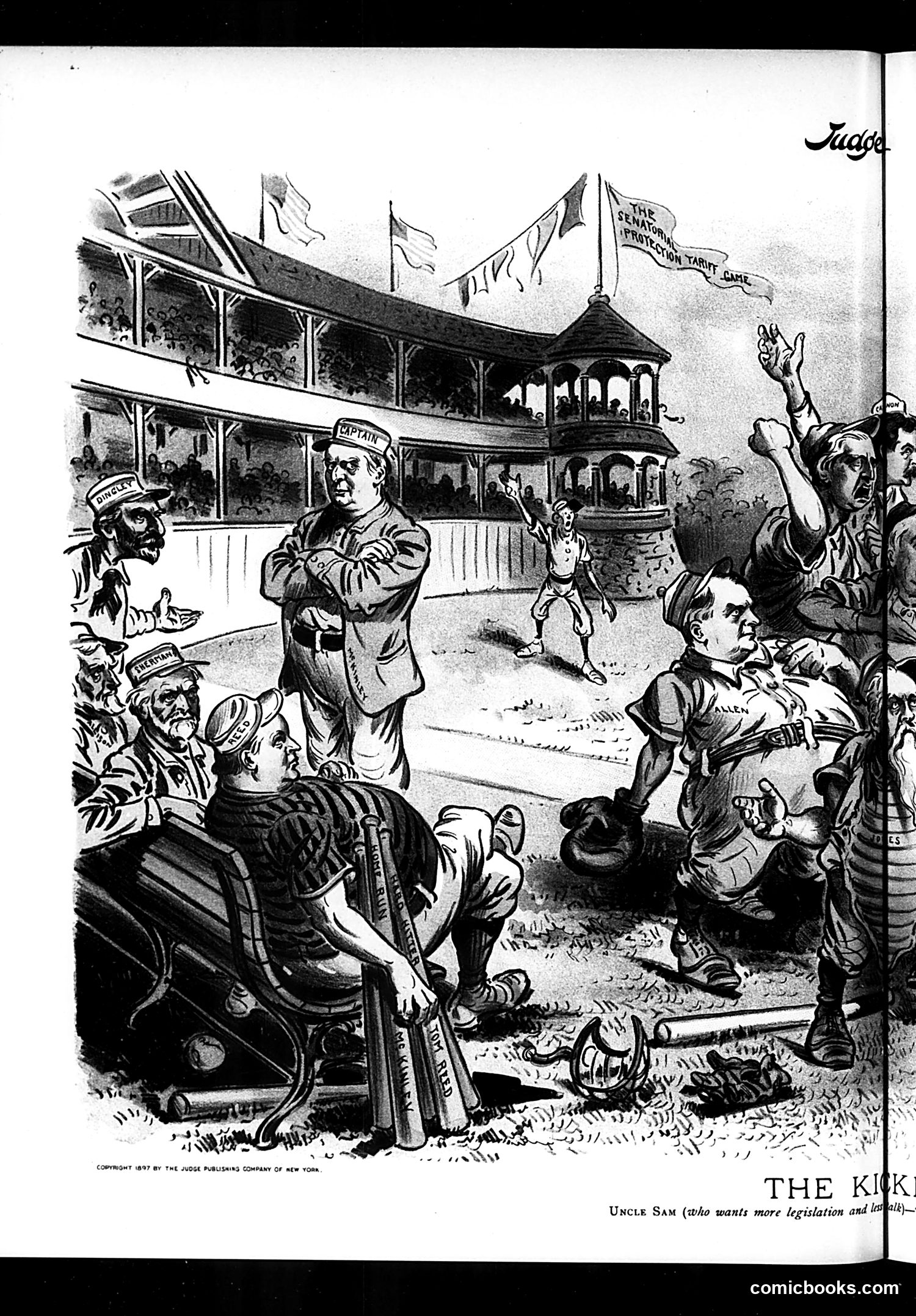
This cartoon depicts **Uncle Sam** (the tall figure in center, identified by the caption) at what appears to be a baseball or sporting event with a grandstand. He's being "kicked" by various figures representing different interests or political factions surrounding him. The caption notes Uncle Sam "wants more legislation and [possibly] less filibuster," suggesting the cartoon satirizes political gridlock or obstruction in Congress. The crowded scene with competing figures "kicking" at Uncle Sam likely represents different political groups pulling in opposing directions, frustrated with legislative paralysis. The sporting venue setting implies this political struggle is treated as entertainment or sport—satirizing how political conflicts play out as public spectacle while actual governance stalls. Without a specific date visible, the exact legislative disputes referenced remain unclear, but the theme concerns congressional dysfunction.
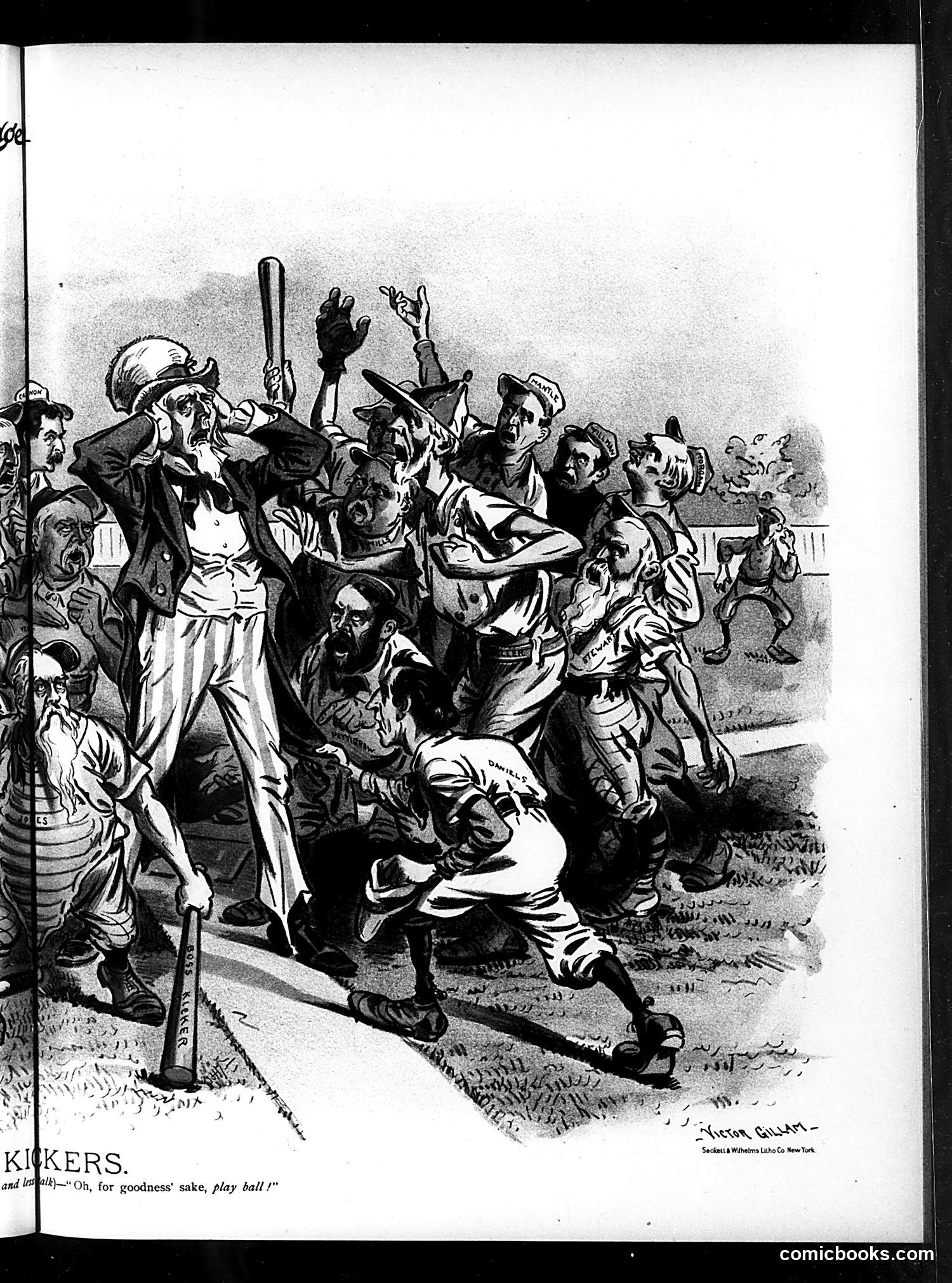
This cartoon depicts a chaotic baseball scene titled "Kickers," with the caption "Oh, for goodness' sake, play ball!" The image shows multiple caricatured figures in period dress (likely late 19th century) engaged in disorder rather than actual baseball gameplay. The figures appear to be politicians or public figures, with exaggerated facial features typical of Judge magazine's satirical style. The satire suggests these figures are obstructing or preventing proper "play" — likely referencing political obstruction or factionalism preventing effective governance. The plea to "play ball" (cooperate) indicates criticism of partisan bickering. Without clearer identification of specific figures or dated context, the exact political situation remains unclear, though it critiques political dysfunction through baseball metaphor.
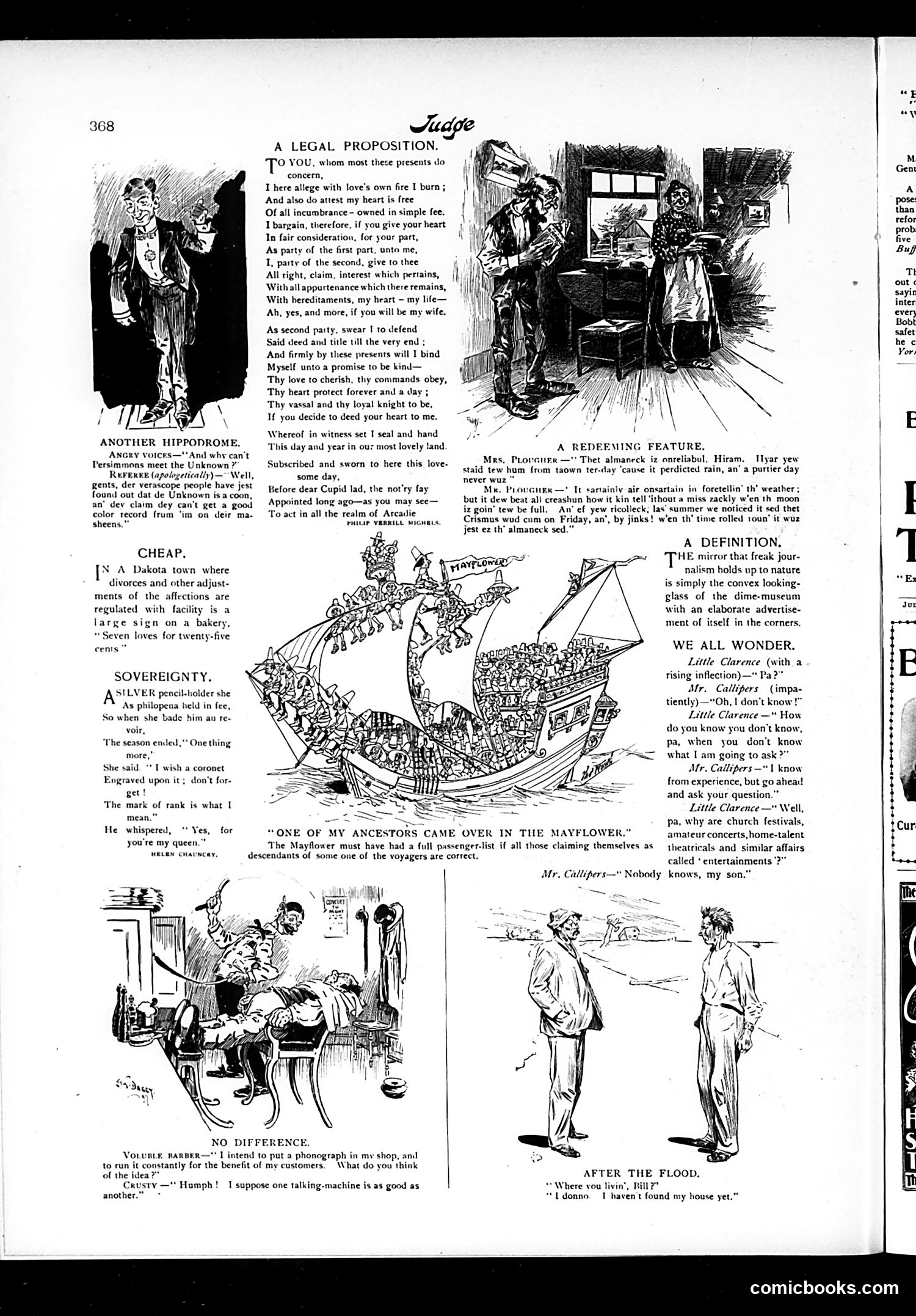
This page contains multiple brief humorous pieces typical of Judge magazine's satirical humor: **"Another Hippodrome"** mocks early cinema technology, suggesting filmmakers couldn't capture "the Unknown" (likely a vaudeville act) because he was Black—the racist implication being that their equipment couldn't properly film dark skin tones. **"A Legal Proposition"** parodies overwrought legal language by presenting a marriage proposal written entirely in contract terminology, satirizing how Americans over-formalize romantic matters. **"Sovereignty"** jokes about a woman demanding a coronet engraved on a pencil holder as a symbol of her dominance in the relationship. **"Cheap"** and other brief pieces offer quick one-liners about divorce, phonographs, and other contemporary topics. The rural dialect pieces ("A Redeeming Feature") represent period-typical humor mocking rural speech patterns and folk wisdom about almanacs predicting weather and seasons. Overall, the page demonstrates Judge's mix of satirical commentary on technology, social customs, and American life circa early 1900s.
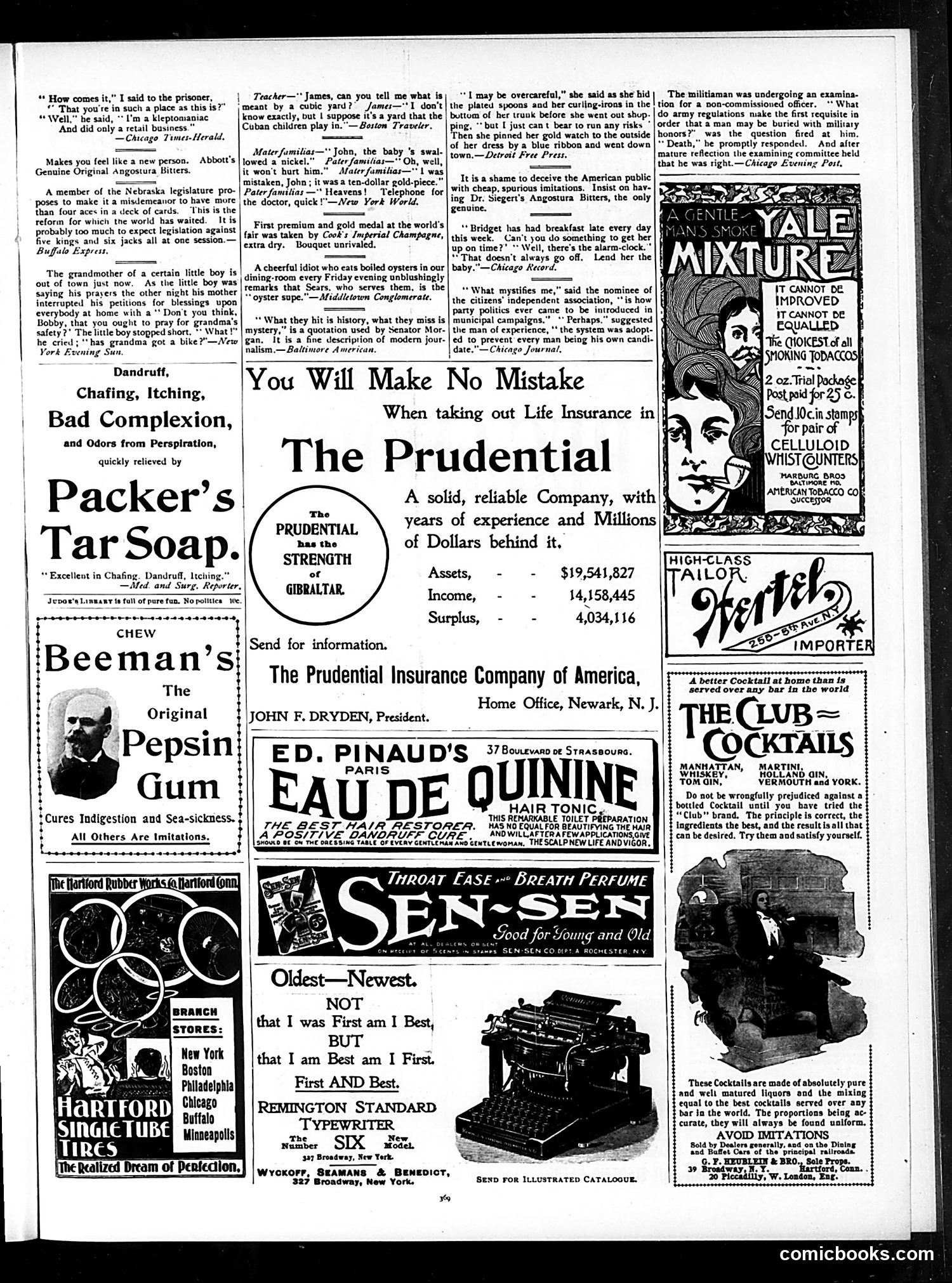
This is primarily an **advertising page** with scattered humorous anecdotes rather than political cartoons. The main content includes: **Central Advertisement**: The Prudential Insurance Company dominates, emphasizing stability with financial figures ($19.5M+ assets). The circular "Prudential Has the Strength of Gibraltar" logo appears—a trusted, fortress-like assurance for potential customers. **Scattered Jokes** (upper margins): Include commentary on Prohibition, imperialism, and bureaucratic absurdity—typical Judge fare mocking contemporary issues. One anecdote references a legislator's attempt to prevent card cheating by banning multiple aces, satirizing ineffective reform efforts. **Surrounding Ads**: Products like Beeman's Pepsin Gum, Hartford Tires, and Sen-Sen Breath Perfume typify early-1900s patent medicine advertising. These ads often made dubious health claims (Sen-Sen advertised as beneficial for "young and old"). **Overall Context**: This page reflects Judge's model of combining satirical humor with premium product advertising aimed at educated, affluent readers. The Prudential ad's prominent placement signals magazine economics—high-value insurance companies were major advertisers to this demographic.
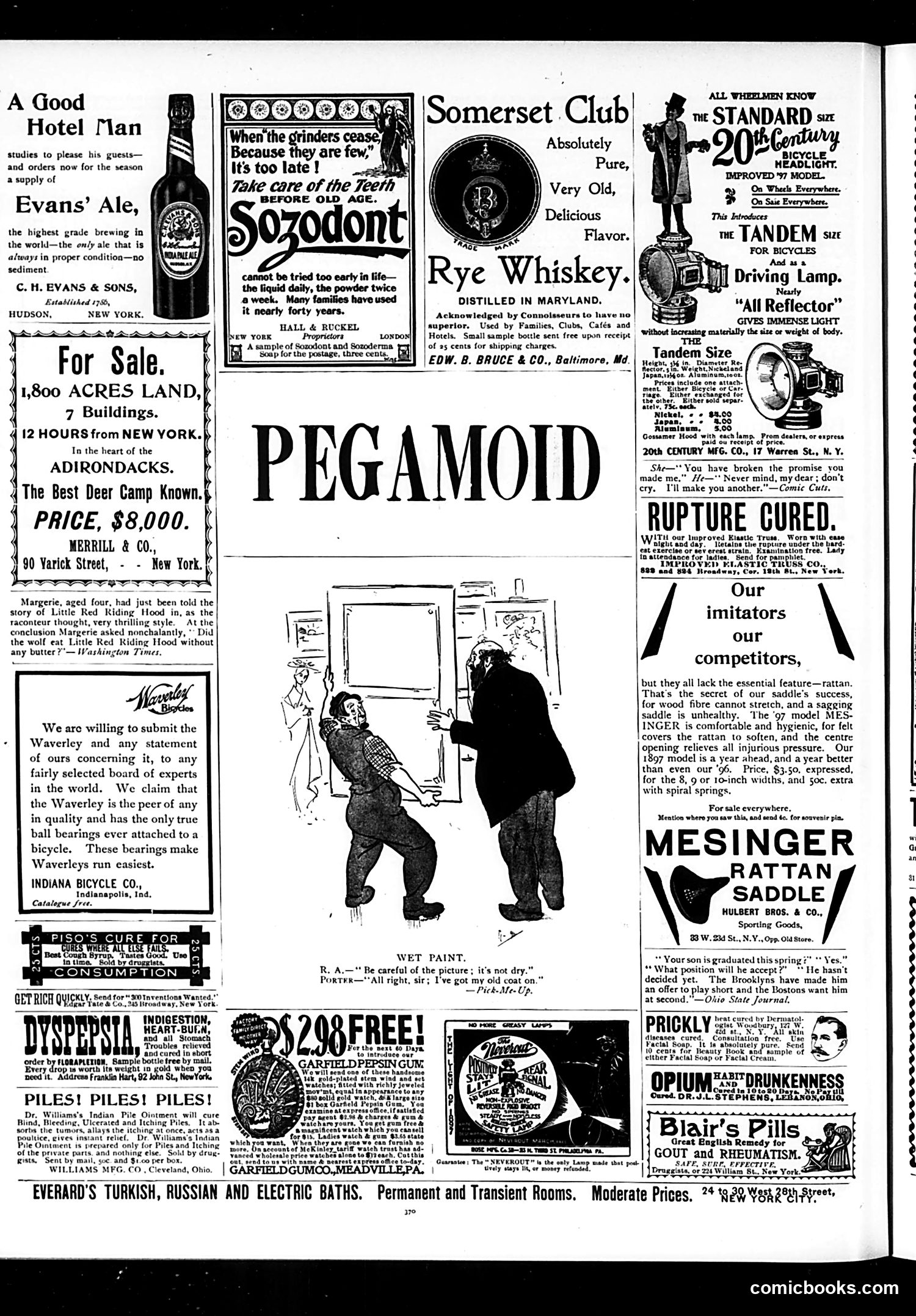
This is primarily an **advertising page** from Judge magazine, with one small cartoon labeled "WET PAINT." ## The Main Cartoon The cartoon shows two figures - one painting a doorway while another (labeled "R.A." and "Porter") enters. The joke relies on a verbal misunderstanding: the painter warns "be careful of the picture; it's not dry," meaning the wet paint, but the other man responds "All right, sir, I've got my old coat on" - implying he thought the painter was warning about damaging a valuable artwork, not about getting paint on himself. The humor comes from this class-based miscommunication between working-class characters. ## The Advertisements The page is dominated by period product ads: dental care (Sozodont), alcoholic beverages (Evans' Ale, Somerset Club Rye Whiskey), bicycles and bicycle accessories (Waverly bicycles, Tandem lamps), medical devices (rupture trusses, saddles), and dubious patent medicines (treatments for dyspepsia, piles, opium addiction). These reflect late-19th-century consumer culture and marketing practices.
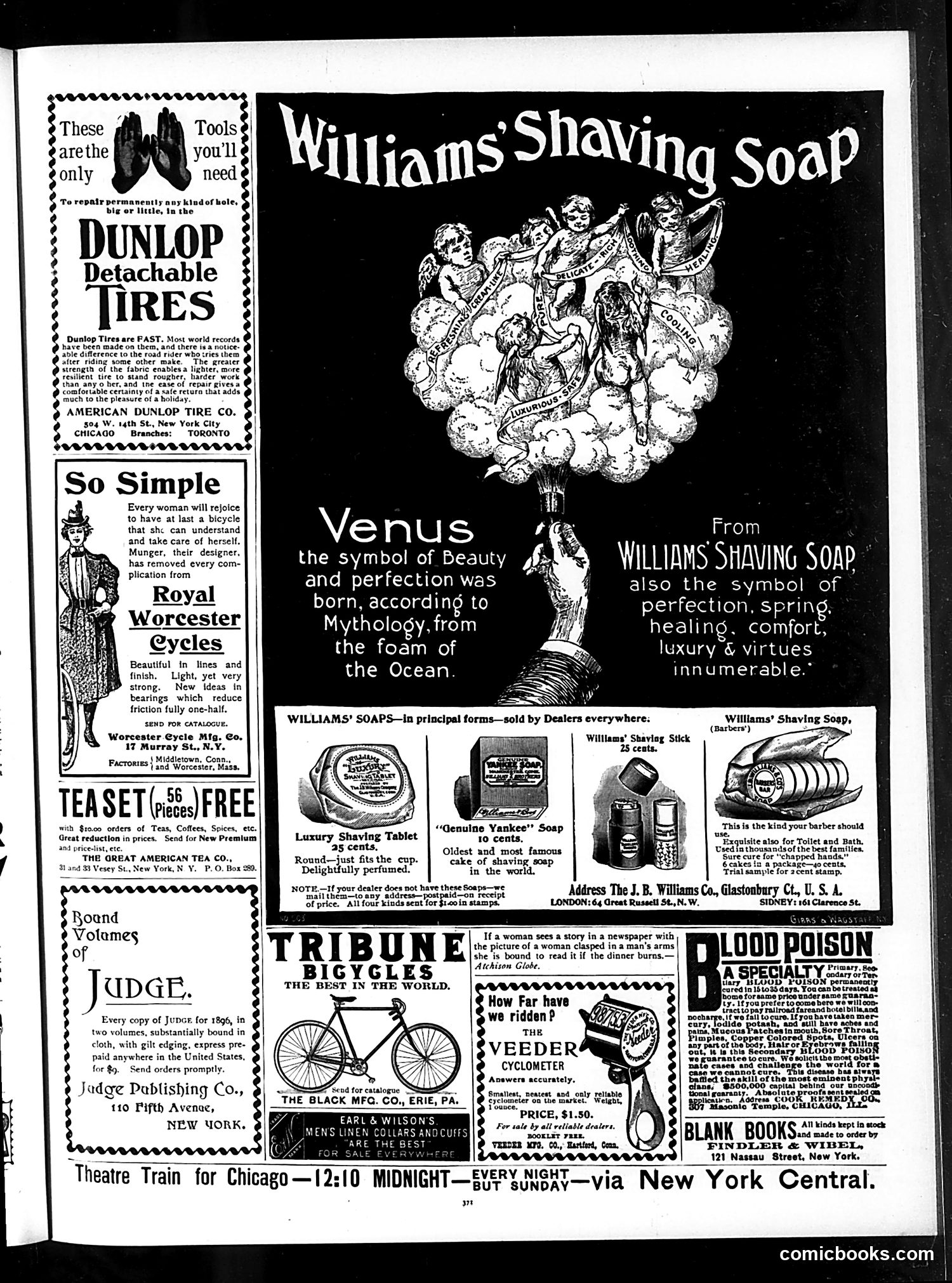
This is primarily an **advertising page** from Judge magazine, not a satirical cartoon. The page features multiple product advertisements typical of late 19th-century publications. The dominant advertisement is for **Williams' Shaving Soap**, which uses classical mythology imagery—Venus emerging from foam—to market the product as a symbol of "perfection, spring, healing, comfort, luxury & virtues." This reflects Victorian advertising's common practice of associating consumer goods with elevated ideals. Other notable ads include Dunlop Detachable Tires, Royal Worcester Bicycles, Tribune Bicycles, and a Veeder Cyclometer. The bicycle advertisements are particularly significant, as they emphasize **women's independence**—the Worcester Cycles ad explicitly states "Every woman will rejoice to have at last a bicycle that she can understand and take care of herself," reflecting the bicycle's role in late-Victorian women's liberation. The page also advertises Judge Publishing's bound volumes and various patent medicines, including a "Blood Poison" cure, typical of the era's unregulated medical advertising.
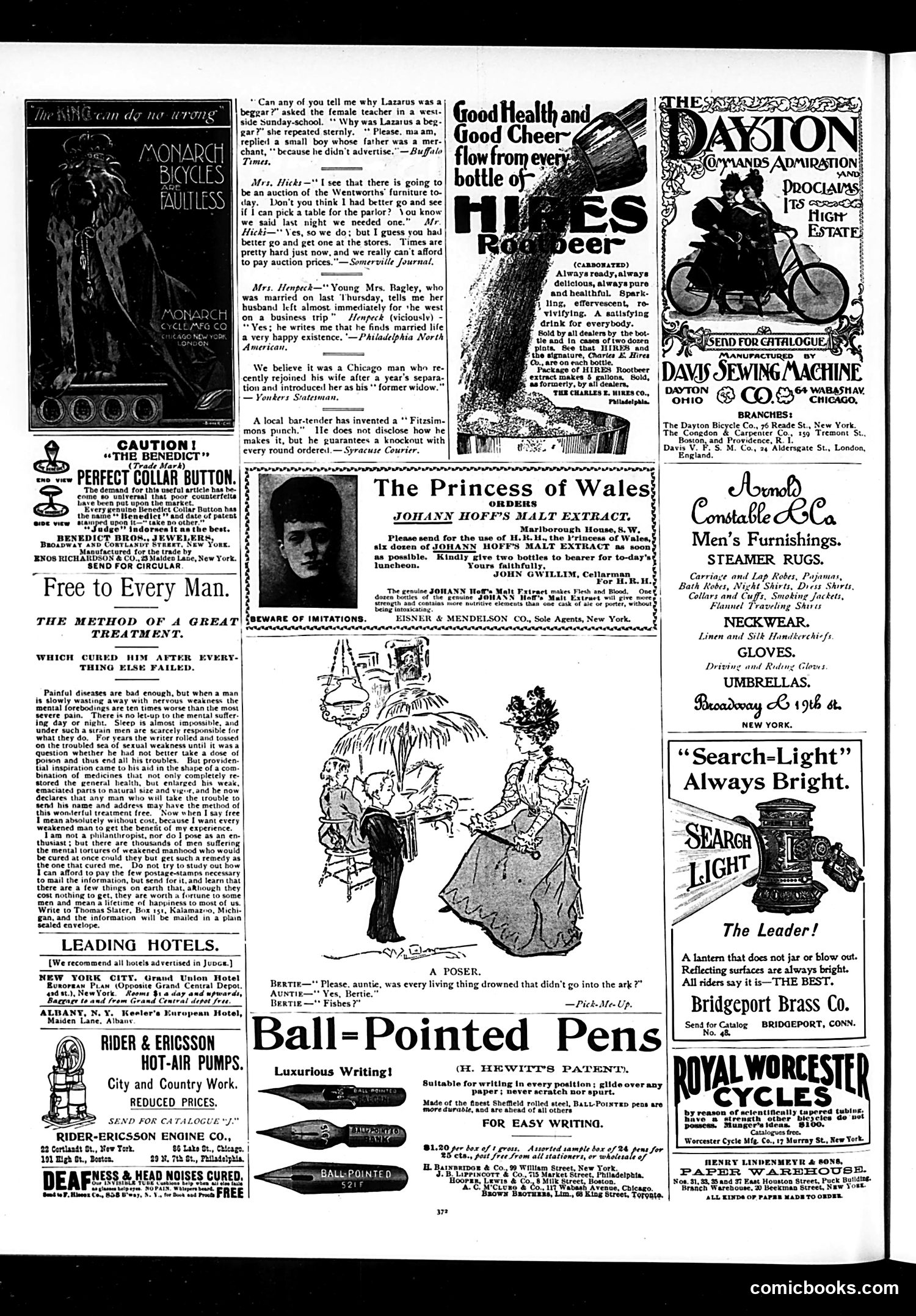
This page is primarily **advertising with light humor pieces**. The cartoons are brief comic anecdotes rather than political commentary. The humor relies on domestic and business scenarios: - A Sunday school joke about Lazarus the beggar—punchline being he failed to "advertise" (contemporary advertising obsession) - Married couples discussing furniture and separations - A bartender's "Fitzsimmons punch" (likely referencing boxer Bob Fitzsimmons, implying a knockout drink) The page is dominated by **product advertisements**: bicycles, sewing machines, collar buttons, pens, sewing machines, rugs, and searchlights. One ad parodies upper-class pretension—a fake endorsement from "The Princess of Wales" for malt extract, with an ornate fake letterhead. This reflects early 1900s *Judge* content: satirical but non-political, mixing light domestic satire with commercial advertising. The "Princess" ad mockingly suggests products claim aristocratic endorsement.
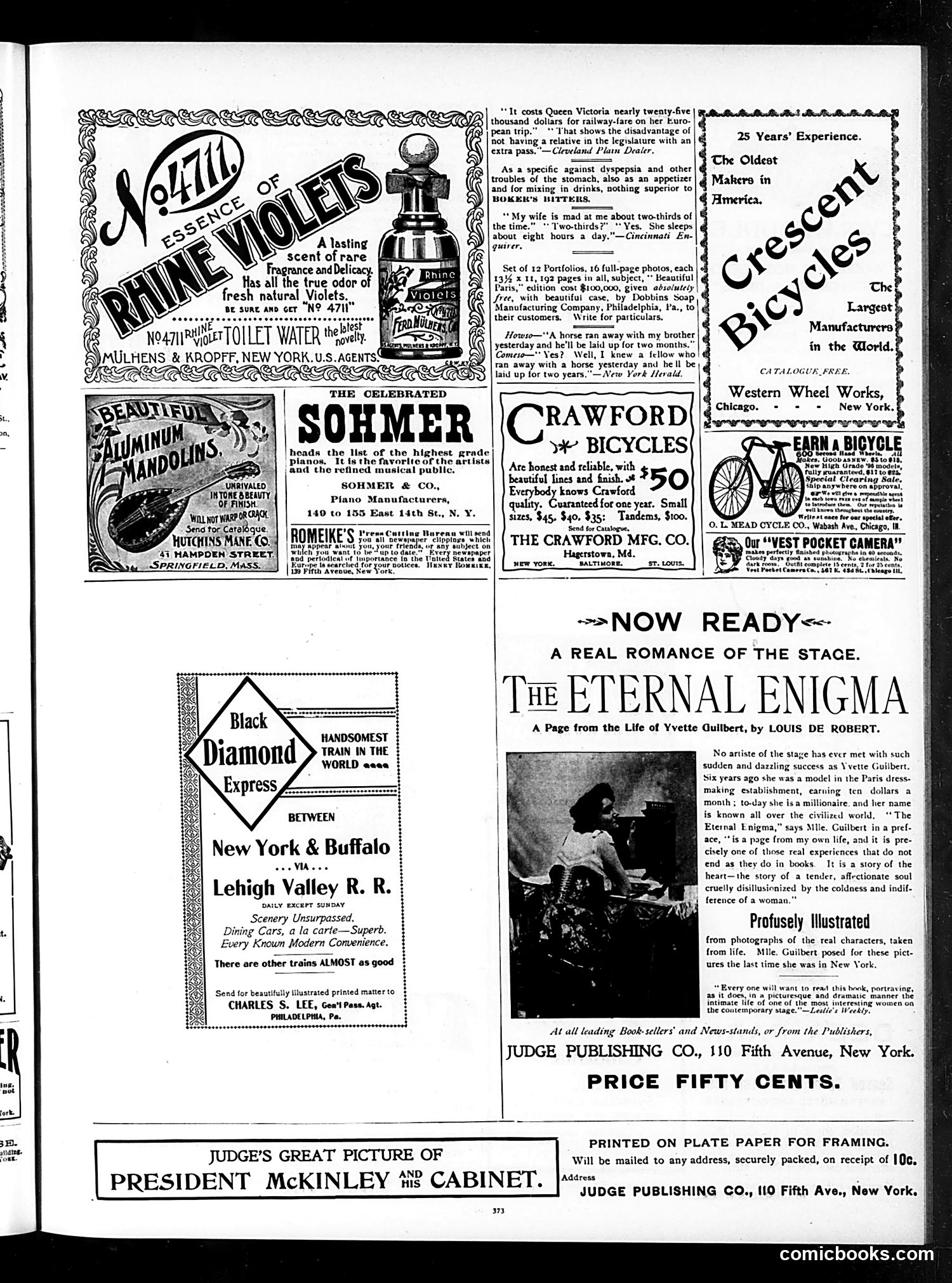
This page is primarily **advertising and promotional content** from *Judge* magazine, not political satire. The page advertises various products (perfume, pianos, bicycles, trains) and promotes upcoming publications. The only potentially political element is a small text joke about **Queen Victoria's railway costs**, which satirizes royal expense and the disadvantage of lacking legislative representation—likely referencing the constitutional principle that taxes require representation. The page's main content promotes **"The Eternal Enigma,"** a book about French entertainer Yvette Guilbert's rise from seamstress to millionaire, emphasizing her dramatic life story. Below this appears an advertisement for **Judge Publishing's portrait of President McKinley and his Cabinet**, available for framing. The page reflects late-19th-century magazine culture: advertisements subsidized editorial content, and publishers cross-promoted their own books and merchandise alongside commercial vendors' products.
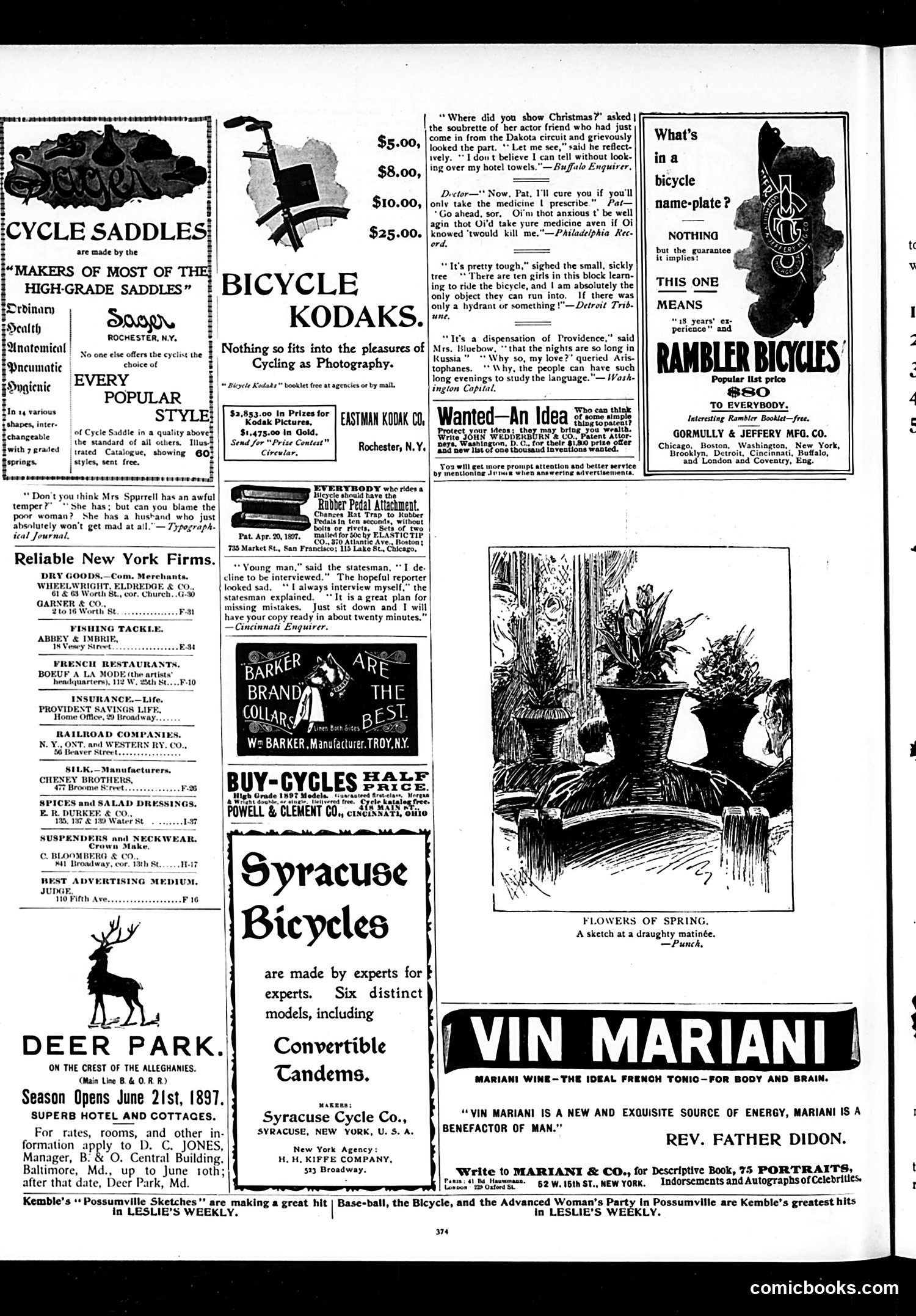
This is primarily an **advertising page** from Judge magazine (circa 1897), dominated by bicycle-related ads reflecting the cycling craze of the 1890s. The page includes several elements: **Content:** - Multiple bicycle manufacturer advertisements (Rambler, Syracuse, Kodak cameras for cyclists) - Short humorous anecdotes in the margins, typical of Judge's satirical format **The Cartoons/Humor:** The small jokes scattered throughout are light social commentary: - An actor's travel story about tracking his whereabouts through hotel towels (mockery of touring actors) - A sickly tree complaining that bicycle-riding girls only crash into it (gentle nature humor) - A woman's frustration with her perpetually calm husband (domestic comedy) **Context for Modern Readers:** The 1890s bicycle boom was genuinely significant—cycling was fashionable, recreational, and associated with modernity and women's independence. These ads and jokes reflect that cultural moment. The humor is gentle rather than cutting; Judge here functions partly as lifestyle magazine.
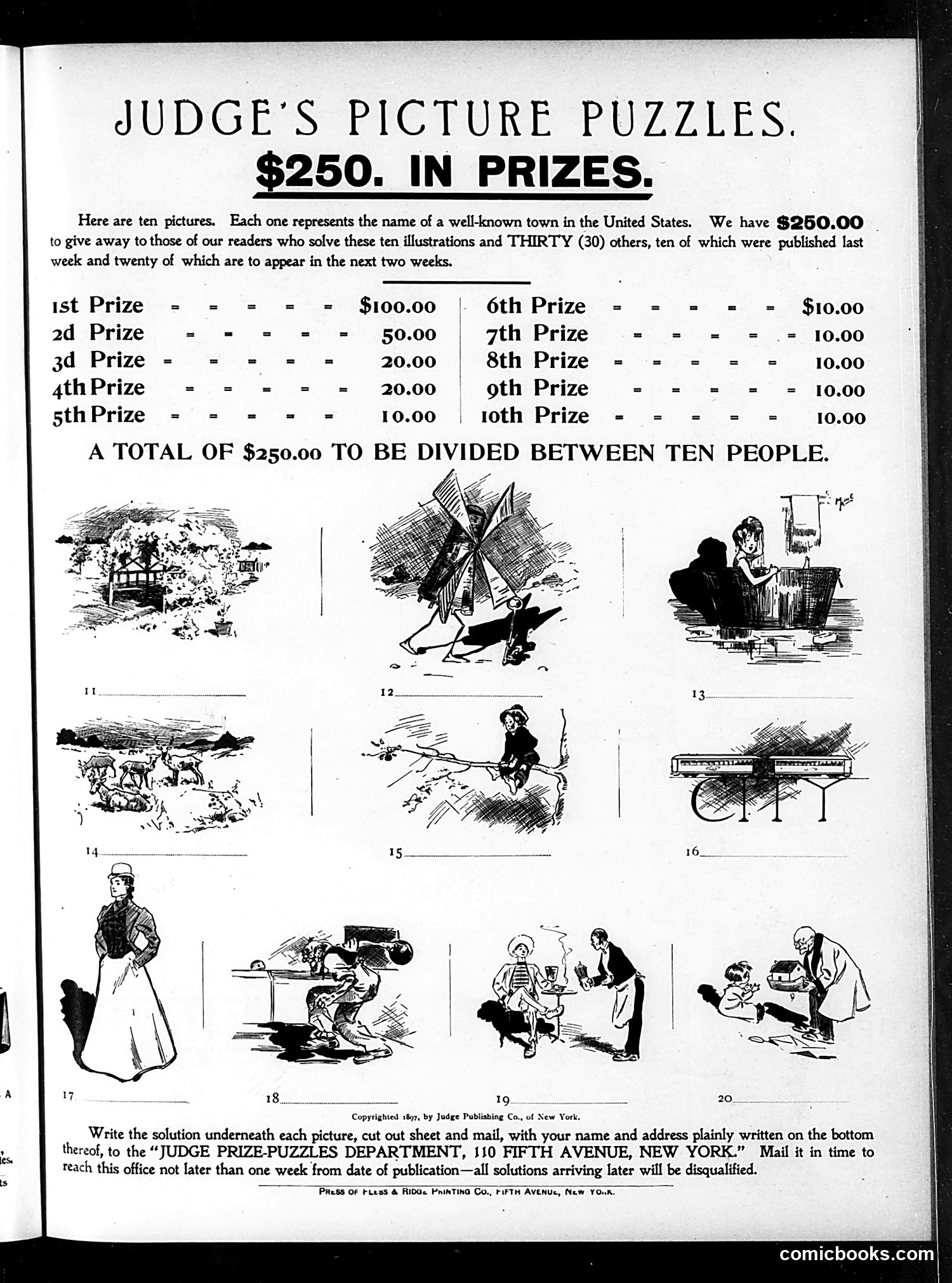
This is **not a satirical cartoon page**, but rather a **contest/puzzle feature** from Judge magazine. The page presents ten visual rebuses (picture puzzles) where each illustration represents the name of a well-known American town—solvers must identify them. The contest offered $250 in total prizes distributed among ten winners (1st prize: $100; 2nd: $50; remaining eight: $10-$20 each). Readers were instructed to write solutions beneath each picture, mail the sheet to Judge's offices at 110 Fifth Avenue, New York, with their name and address. This was part of a larger 40-puzzle series spanning three weeks, with ten illustrations published the previous week and twenty more to follow. The copyright date of 1897 indicates this reflects Judge's competitive reader-engagement tactics of that era.
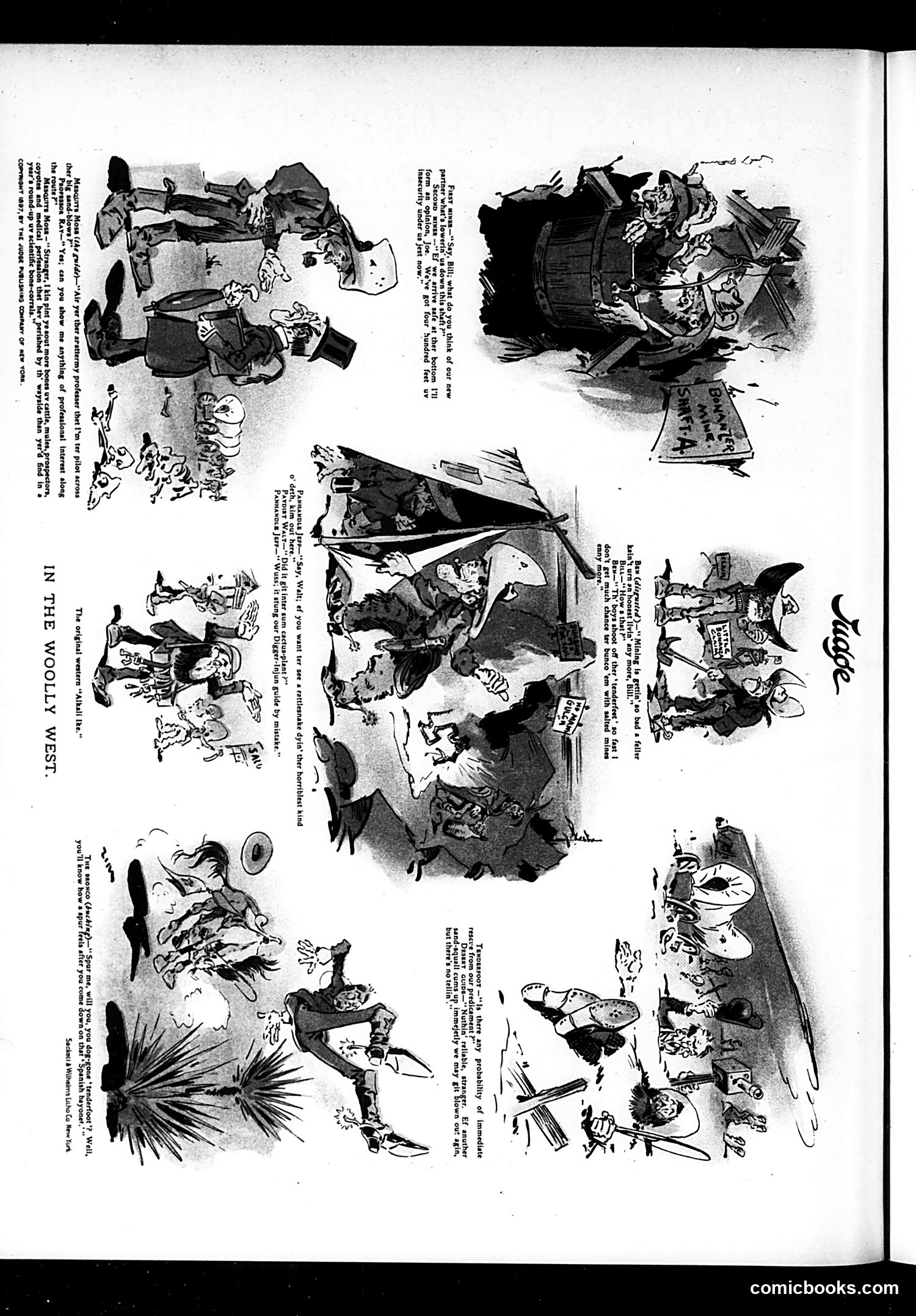
This page presents multiple cartoon vignettes mocking frontier/Wild West life and characters. The sketches depict stereotypical "woolly west" types: prospectors, miners, cowboys, and tenderfoots (inexperienced easterners) in various comedic predicaments. The central narrative appears to involve miners descending a mine shaft with an unreliable "partner," joking nervously about the 400-foot drop beneath them. Other panels show typical western mishaps: a tenderfoot being threatened with spurs by a cowboy, and various rough characters in dangerous or absurd situations. The humor relies on period stereotypes of violent, unpredictable frontier behavior, linguistic dialect ("Nuthin' reliable, stranger"), and the danger/chaos of mining and frontier life. The satire targets both the romanticized "Wild West" mythology and the vulnerability of inexperienced easterners venturing into that environment. The 1897 copyright places this as late-frontier nostalgia satire.