
Judge, 1897-05-29 · page 2 of 18
Judge — May 29, 1897 — page 2: what you’re looking at
What you’re looking at
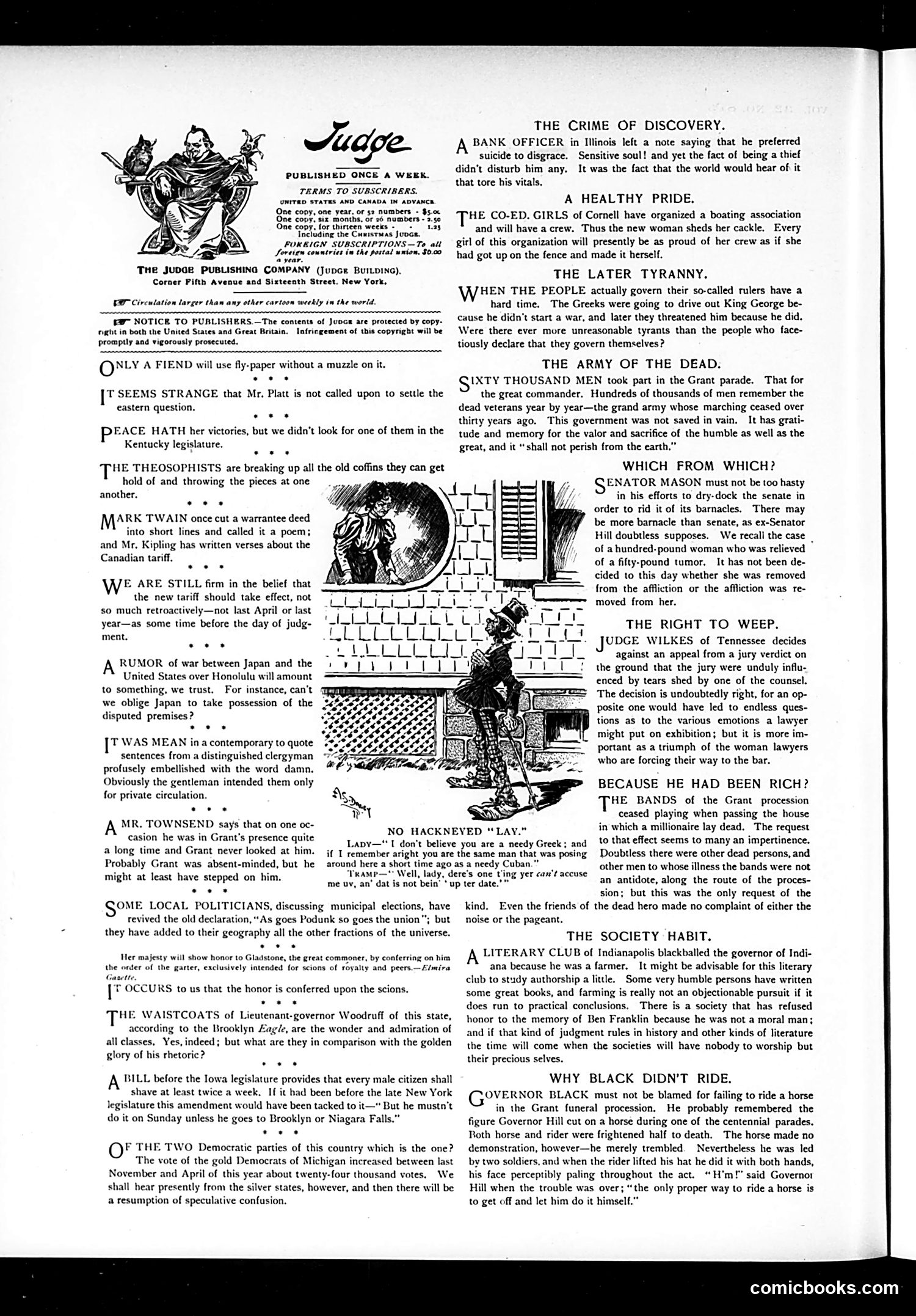
The main cartoon depicts a confrontation between a "Tramp" and a "Lady," with the tramp claiming to be a Greek and the lady skeptical of his identity. The caption reads "NO HACKNEYED 'LAW,'" suggesting satire about con artists or vagrants using false personas to solicit sympathy or money. The surrounding editorial sections target various political figures and social issues of the era, including references to Governor Woodruff, Governor Black, and Senator Mason. One piece criticizes the Grant administration's military parade and another mocks a Indianapolis literary club's decision to honor Ben Franklin despite questionable moral character. The overall tone satirizes political hypocrisy, racial issues ("Why Black Didn't Ride"), and social pretension common to Gilded Age America.
📄 Transcribed text from this page (OCR, searchable)
Machine-transcribed from the original scan — historical spelling and the odd misread are preserved.
TERMS TO SUBSCRIBERS. UNITRD STATES AND CANADA IN ADVANCE ‘One copy, one year. or s2 numbers - $5.0 One copy, siz months, or 26 numbers - 2.56 One copy. for thirteen weeks = = 1.25 Inclading the Cumistwas Juoce. SUBSCRIPTIO} rs im the postal = vei THE JUDGE PUBLISHING COMPANY (JuDGE BUILDING). Corner Fifth Avenue and Sixteenth Street. New York, To alt ‘$0.00 68 Circulation larger than any other cartoon weekly tn the world. §9~ NOTICE TO PUBLISHERS.—The contents of Jvoce are protected by copy- ght in both the United States and Great Britain. Infriegement of this copyright will be promptly and vigorously prosecuted. ONLY A FIEND will use fly-paper without a muzzle on it. eee T SEEMS STRANGE that Mr. Platt is not called upon to settle the eastern question, og oy PEACE HATH her victories, but we didn’t look for one of them in the Kentucky legislature. HE THEOSOPHISTS are breaking up all the old coffins they can get hold of and throwing the pieces at one another. eae MAk« TWAIN once cut a warrantee deed into short lines and called it a poem; and Mr. Kipling has written verses about the Canadian tariff. E ARE STILL firm in the belief that the new tariff should take effect, not so much retroactively—not last April or last year—as some time before the day of judg- ment. eee A RUMOR of war between Japan and the THE CRIME OF DISCOVERY. BANK OFFICER in Illinois left a note saying that he preferred suicide to disgrace. Sensitive soul! and yet the fact of being a thief didn’t disturb him any, It was the fact that the world would hear of it that tore his vitals. A HEALTHY PRIDE, THE CO-ED. GIRLS of Cornell have organized a boating association and will have a crew. Thus the new woman sheds her cackle, Every girl of this organization will presently be as proud of her crew as if she had got up on the fence and made it herself. THE LATER TYRANNY. WHEN THE PEOPLE actually govern their so-called rulers have a hard time. The Greeks were going to drive out King George be- cause he didn’t start a war, and later they threatened him because he did. Were there ever more unreasonable tyrants than the people who face- tiously declare that they govern themselves? THE ARMY OF THE DEAD. S'’tY THOUSAND MEN took part in the Grant parade. That for the great commander. Hundreds of thousands of men remember the dead veterans year by year—the grand army whose marching ceased over thirty years ago. This government was not saved in vain, It has grati- tude and memory for the valor and sacrifice of the humble as well as the great, and it “shall not perish from the earth.” WHICH FROM WHICH? SENATOR MASON must not be too hasty in his efforts to dry-dock the senate in order to rid it of its barnacles. There may be more barnacle than senate, as ex-Senator Hill doubtless supposes. We recall the case _ of a hundred- pound woman who was relieved of a fifty-pound tumor. It has not been de- cided to this day whether she was removed from the affliction or the affliction was re- moved from her. THE RIGHT TO WEEP. UDGE WILKES of Tennessee decides against an appeal from a jury verdict on the ground that the jury were unduly influ- United States over Honolulu will amount to something, we trust. For instance, can’t we oblige Japan to take possession of the disputed premises ? woe [TWAS MEAN ina contemporary to quote sentences from a distinguished clergyman profusely embellished with the word damn. Obviously the gentleman intended them only for private circulation. eee A MR. TOWNSEND says that on one oc- casion he was in Grant's presence quite a long time and Grant never looked at him. Probably Grant was absent-minded, but he might at least have stepped on him. oe Some LOCAL POLITICIANS, discussing municipal elections, have revived the old declaration, “As goes Podunk so goes the union”; but they have added to their geography all the other fractions of the universe. Her majesty will show honor to Gladstone, the great commoner, by conferring on him of the garter, exclusively intended for scions of royalty and peers.—Elmira Lapy—"T the Gautte. [¥ OCCURS to us that the honor is conferred upon the scions. THE WAISTCOATS of Lieutenant-governor Woodruff of this state, according to the Brooklyn Eag/e, are the wonder and admiration of all classes, Yes, indeed; but what are they in comparison with the golden glory of his rhetoric? A BILL before the Iowa legislature provides that every male citizen shall shave at least twice a week. If it had been before the late New York legislature this amendment would have been tacked to it—" But he mustn't do it on Sunday unless he goes to Brooklyn or Niagara Falls.” eee OF THE TWO Democratic parties of this country which is the one? The vote of the gold Democrats of Michigan increased between last November and April of this year about twenty-four thousand votes. We shall hear presently from the silver states, however, and then there will be a resumption of speculative confusion. NO HACKNEYED “LAY.” don’t believe you are a needy Greek ; and if I remember aright you are the same man that was posing around here a short time ago as a needy Cuban.” ‘Tramp—" Well, lady, dere’s one ting yer can't accuse me uv, an’ dat is not ‘bein’ * up ter date.’ enced by tears shed by one of the counsel. The decision is undoubtedly right, for an op- posite one would have led to endless ques- tions as to the various emotions a lawyer might put on exhibition; but it is more im- portant as a triumph of the woman lawyers who are forcing their way to the bar. BECAUSE HE HAD BEEN RICH? HE BANDS of the Grant procession ceased playing when passing the house in which a millionaire lay dead. The request to that effect seems to many an impertinence. Doubtless there were other dead persons, and other men to whose illness the bands were not an antidote, along the route of the proces- sion; but this was the only request of the kind. Even the friends of the dead hero made no complaint of either the noise or the pageant, THE SOCIETY HABIT. A EITERARY CLUB of Indianapolis blackballed the governor of Indi- ana because he was a farmer. It might be advisable for this literary club to study authorship a little. Some very humble persons have written some great books, and farming is really not an objectionable pursuit if it does run to practical conclusions, There is a society that has refused honor to the memory of Ben Franklin because he was not a moral man; and if that kind of judgment rules in history and other kinds of literature the time will come when the societies will have nobody to worship but their precious selves. WHY BLACK DIDN'T RIDE. OVERNOR BLACK must not be blamed for failing to ride a horse in the Grant funeral procession. He probably remembered the figure Governor Hill cut on a horse during one of the centennial parades. Roth horse and rider were frightened half to death. The horse made no demonstration, however—he merely trembled. Nevertheless he was led by two soldiers, and when the rider lifted his hat he did it with both hands, his face perceptibly paling throughout the act. “H'm!" said Governot Hill when the trouble was over; “the only proper way to ride a horse is to get off and let him do it himself.” comicbooks.com