
A complete issue · 16 pages · 1897
Judge — May 8, 1897
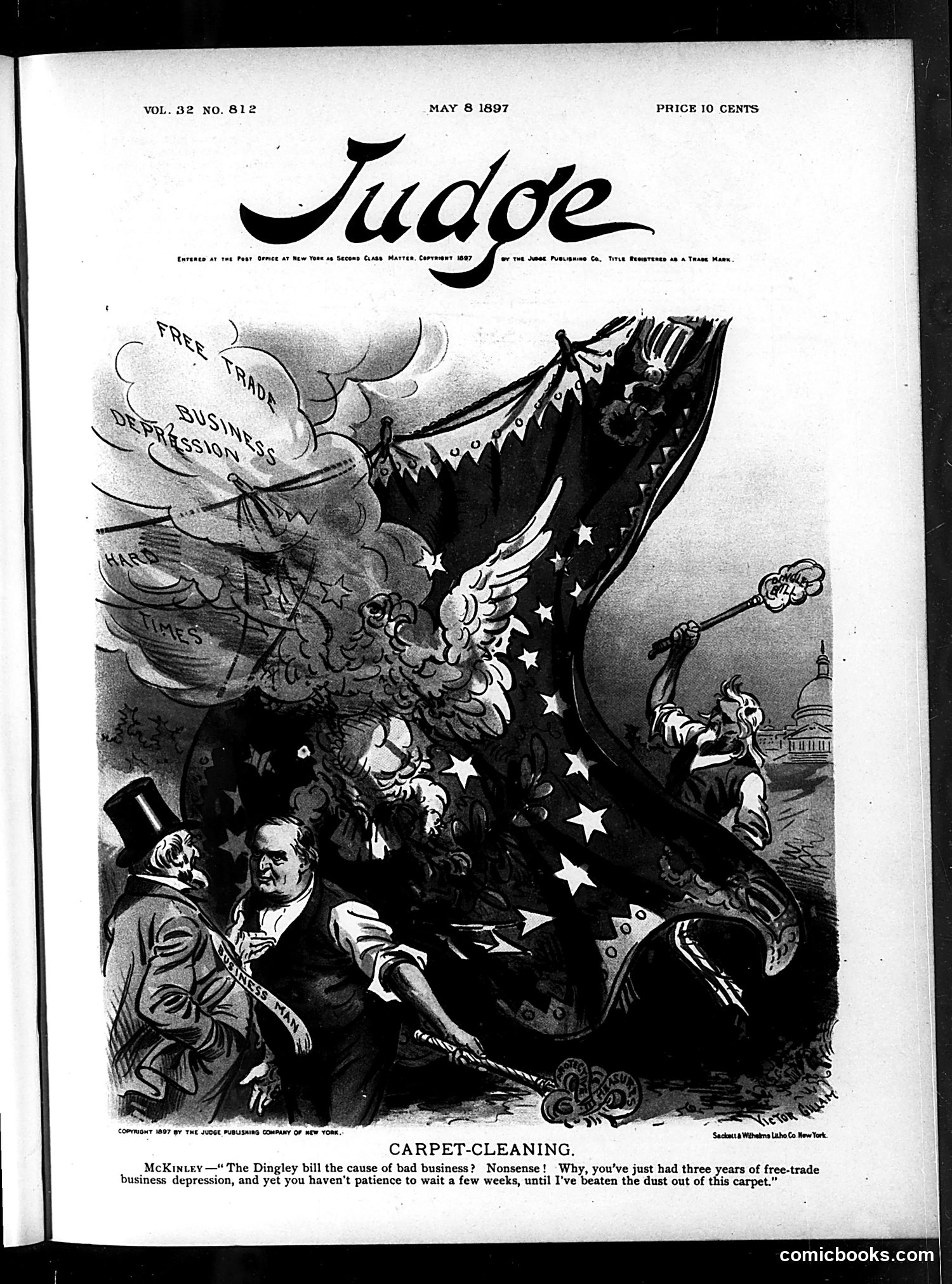
This May 8, 1897 *Judge* cartoon satirizes President McKinley's economic policies. The eagle (representing America) looms large above two businessmen discussing the Dingley Tariff Bill. One figure appears to be McKinley himself, defending protective tariffs as necessary "dust-beating" after three years of economic depression from free-trade policies. The "carpet" metaphor represents the American economy. McKinley argues that tariff protection will restore business health by shielding domestic industry from foreign competition. The Capitol building visible in the background emphasizes this is about national policy. The satire criticizes the administration's impatience—McKinley won't wait for natural recovery, insisting his tariff solution will aggressively "clean" the economic mess caused by previous free-trade depression.
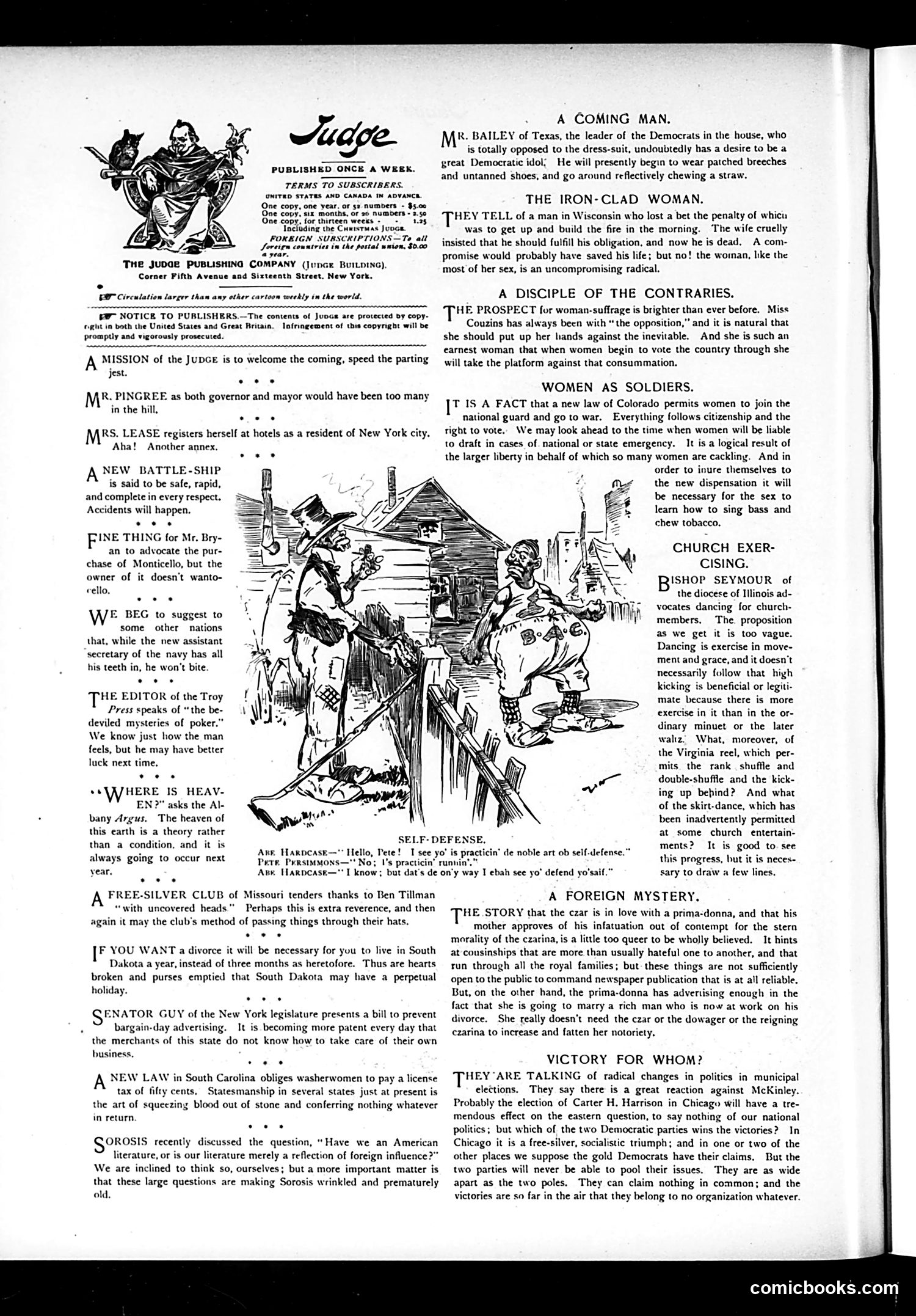
The central illustration depicts a rural scene labeled "Self-Defense," showing what appears to be a confrontation between figures near a log cabin. The cartoon illustrates the accompanying text about a Wisconsin man who lost a bet and was forced to build a fire—his wife's cruel punishment. The satire mocks both the man's misfortune and critiques marital dynamics of the era. The page contains multiple brief satirical commentary sections on contemporary political and social issues, including women's suffrage, women as soldiers, and church dancing debates. These short items represent Judge's typical format: quick jabs at current events and social trends, using humor to critique established institutions and emerging social movements of the early 20th century.
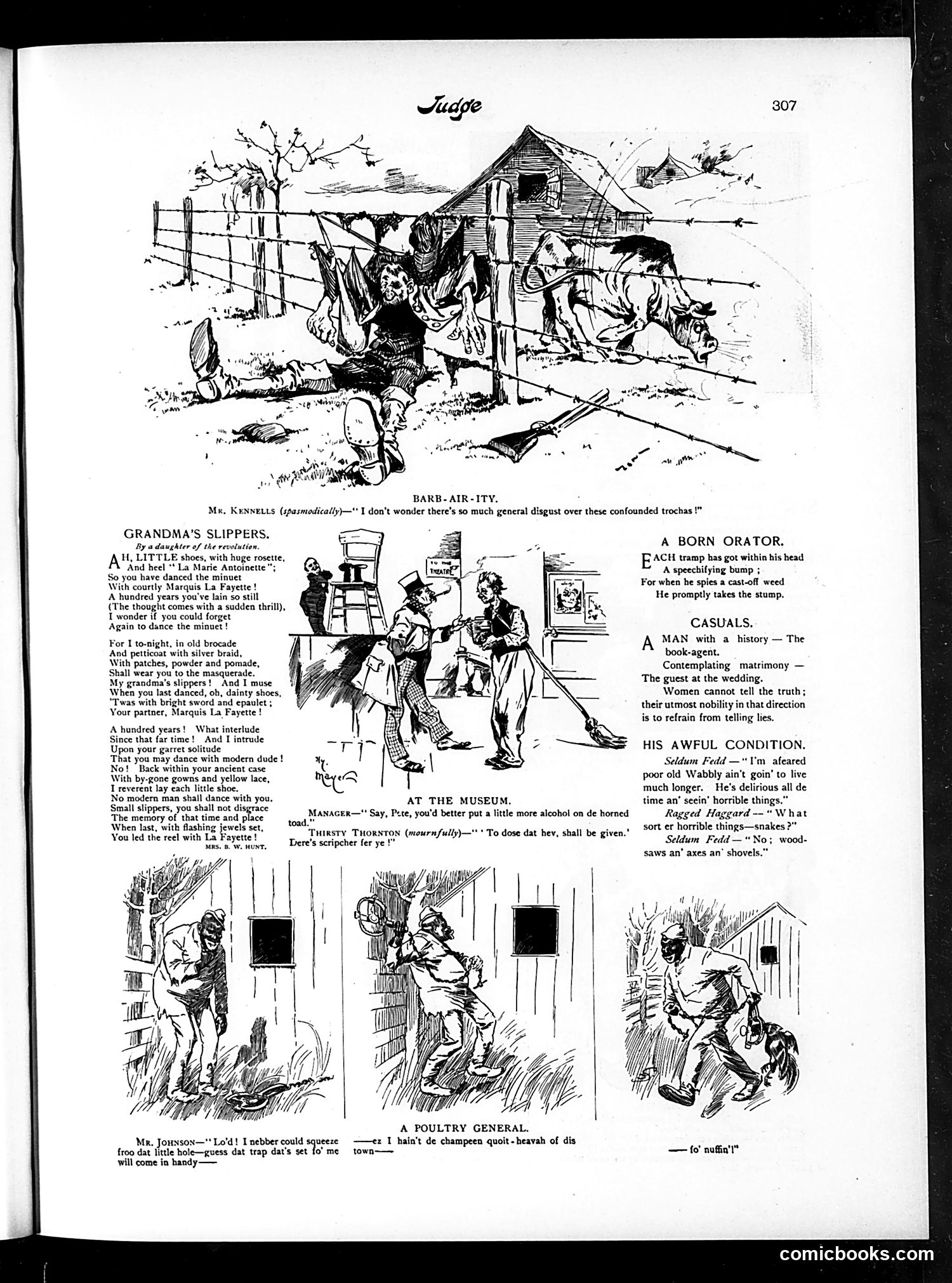
This page contains several satirical pieces typical of Judge's humor: **"Barb-Air-ity"** (top): Mr. Kennells complains about "confounded trochas" (likely referring to forest paths or trails), suggesting frustration with rural conditions or hunting difficulties. **"Grandma's Slippers"**: A nostalgic poem about old-fashioned dancing and courtship, contrasting modern dating with the romantic past. **"At the Museum"**: A brief joke about a museum manager and Trinity Thurston regarding alcohol consumption and a corpse—typical Victorian dark humor. **Lower cartoons**: Depict working-class characters in domestic situations—a laborer with a trap, someone squeezing a poultry general—using puns and wordplay for comedy. The page relies on period-specific references (modern dance criticism, nostalgic sentimentality) and working-class humor that modern readers would find mildly amusing but largely dated.
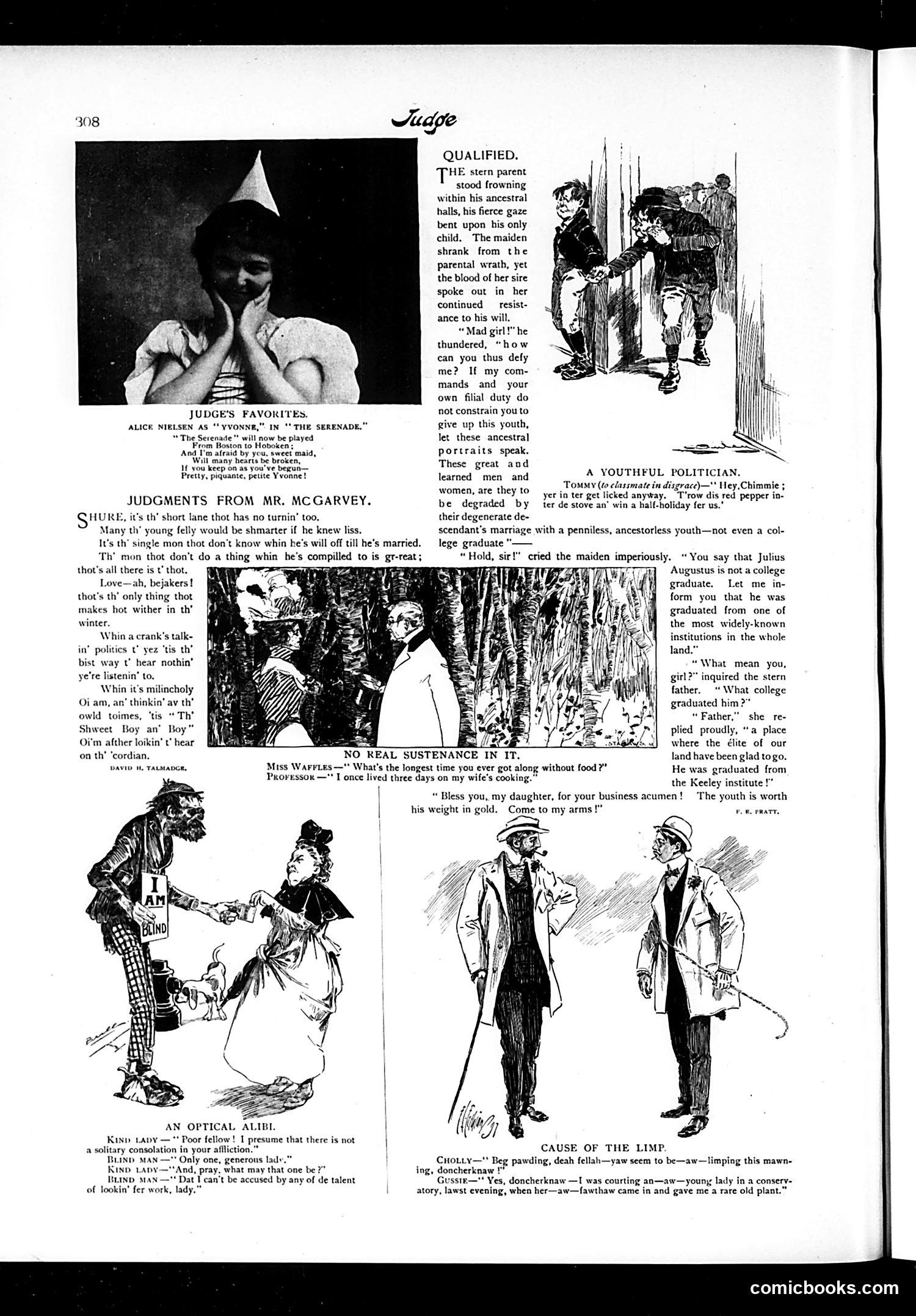
This page contains multiple unrelated satirical sketches typical of Judge's format: **"Qualified"** mocks class pretension. A stern father objects to his daughter marrying a penniless youth without college credentials. She triumphantly reveals her fiancé graduated from "the Keeley institute"—a well-known institution for treating alcoholism. The joke: she's inadvertently proven he's a drunk, not accomplished. **"A Youthful Politician"** depicts a schoolboy manipulating his classmate into causing trouble (throwing pepper in a stove) to win a half-holiday—satirizing opportunistic political scheming in miniature. **Other sketches** include McGarvey's Irish-dialect wisdom sayings, an "optical alibi" (blind man joke), and brief comedic exchanges about food and courtship. The page also features Alice Nielsen, a contemporary actress, praised for her role in "The Serenade." The humor relies on class anxiety, ethnic stereotypes (Irish dialect), and domestic/romantic complications—standard Judge fare of the era.
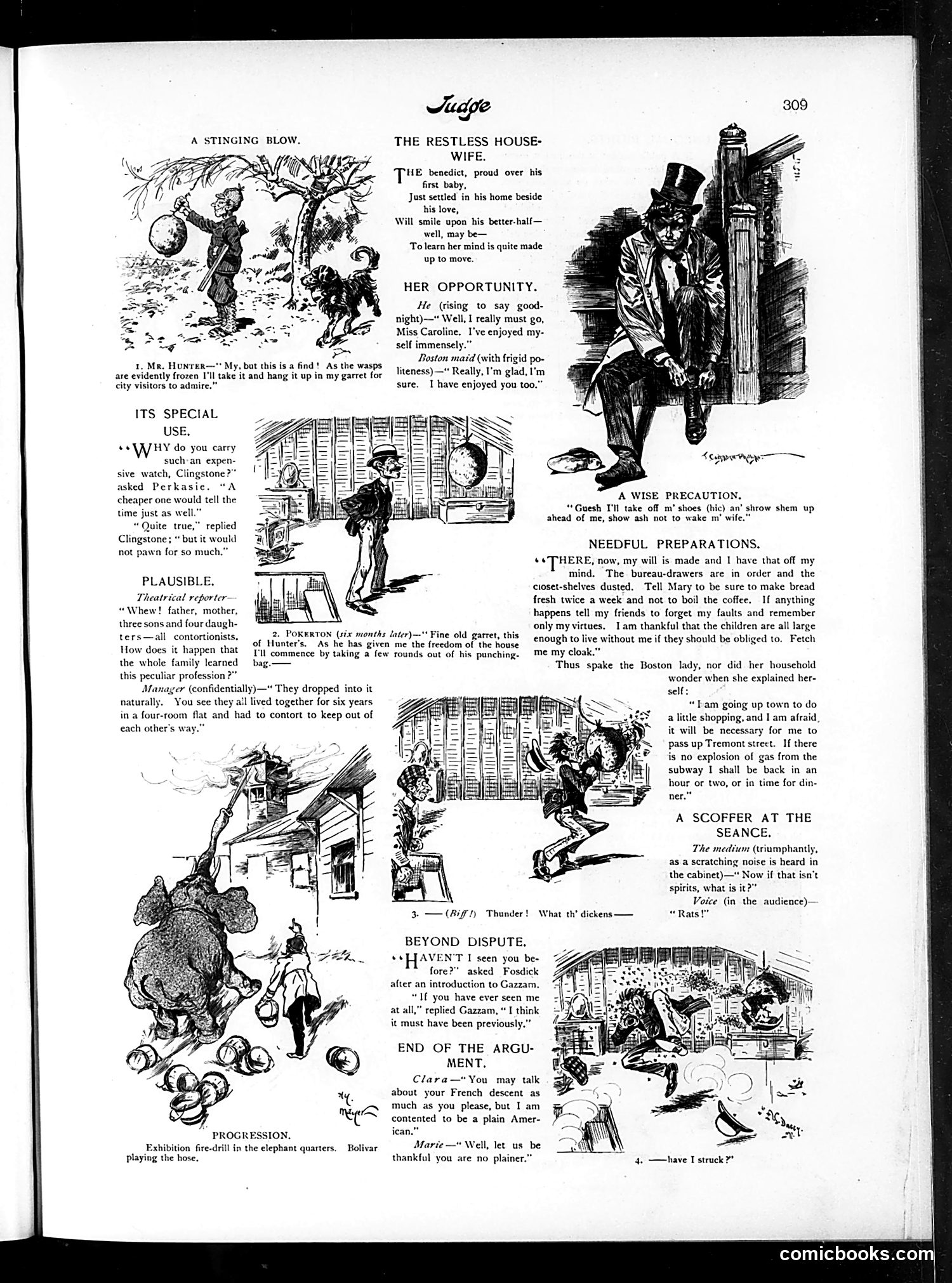
This page collects satirical vignettes on domestic life and social pretension circa early 1900s: **"The Restless Housewife"**: A husband proud of his new baby learns his wife is already eager to move—satirizing the stereotype of restless, dissatisfied wives. **"A Wise Precaution"**: A drunk man removes his shoes before entering home to avoid waking his wife—mocking both marital tension and alcoholism. **"Needful Preparations"**: A Boston widow meticulously organizing her affairs before death, with instructions about bread-making and coffee—poking fun at detailed domestic control and class-conscious feminine propriety. **"A Scoffer at the Séance"**: Someone attributes supernatural scratching sounds to rats rather than spirits—ridiculing spiritualism and séance fraud, then popular among credulous middle-class Americans. **"End of the Argument"**: Clara claims contentment as a "plain American" rather than pretending French descent—mocking social climbing and fake aristocratic pretensions. The humor targets matrimonial discord, class anxiety, superstition, and domestic pretension among respectable society.
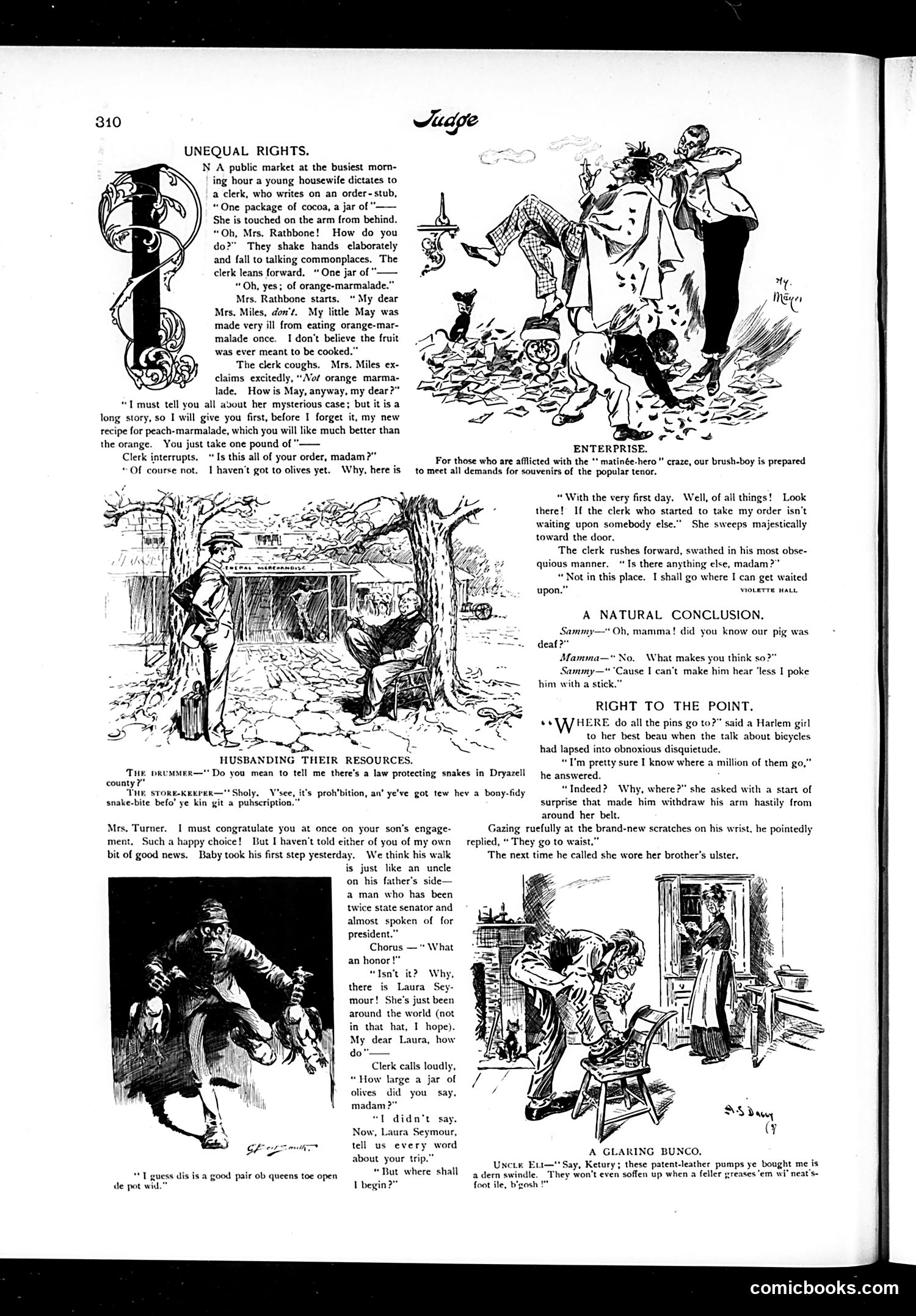
This page satirizes **gender inequality in service and attention**. The main cartoon depicts a housewife repeatedly interrupted while placing a market order. She engages in prolonged social chitchat with Mrs. Rathbone, completely forgetting the waiting clerk and ignoring his attempts to complete her order. When she finally leaves, she complains the clerk wasn't attentive enough—despite *her* monopolizing his time through endless conversation. The satire is cutting: women of leisure demanded immediate service and deference from clerks, yet felt entitled to ignore those same workers' needs and time. The title "Unequal Rights" suggests the hypocrisy—women claimed they deserved better treatment, but didn't extend basic professional courtesy to service workers themselves. The page includes other brief humorous items typical of Judge magazine's format, but the main critique addresses class and gender dynamics in early 20th-century consumer culture.
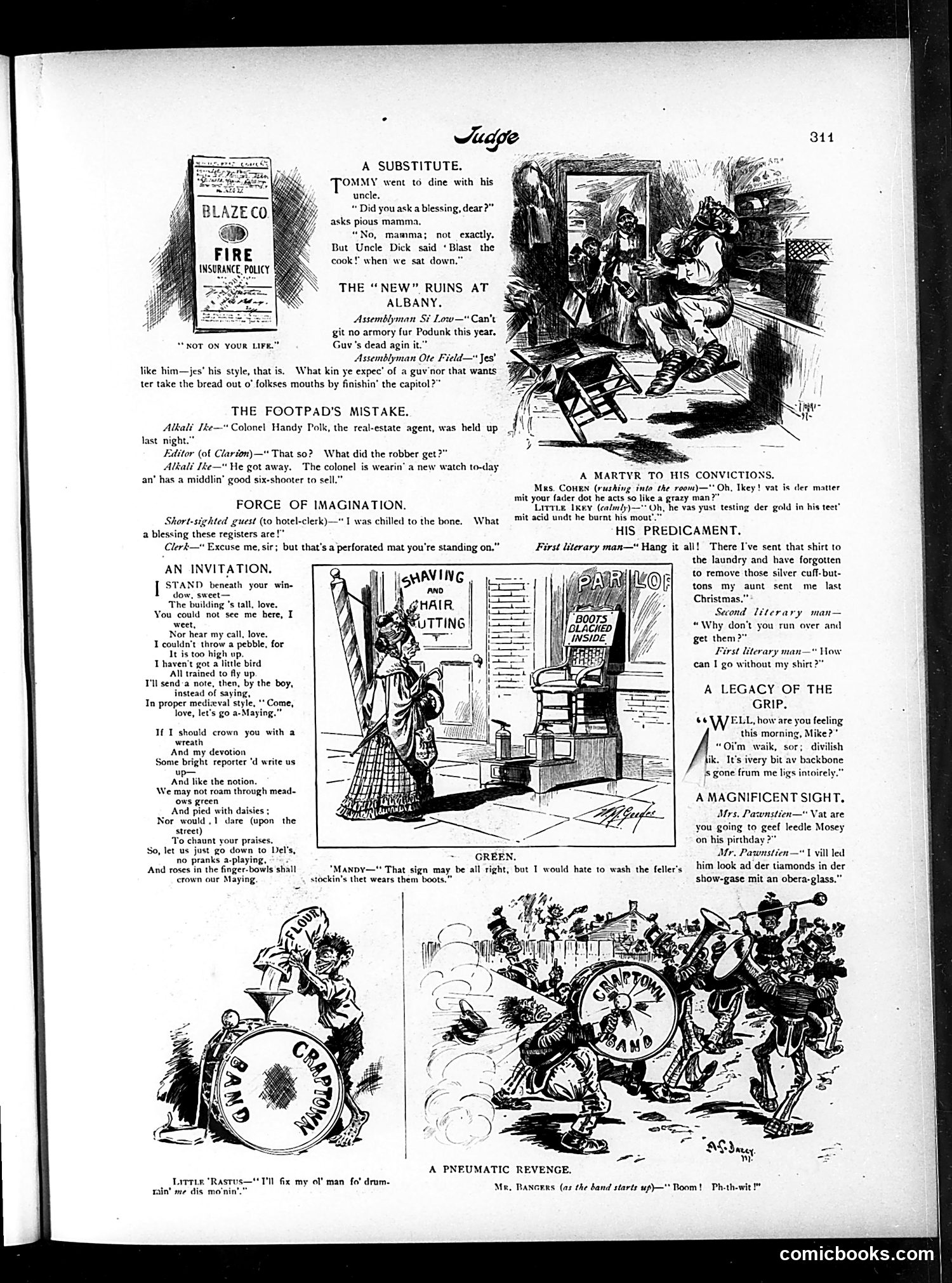
This page contains multiple short humorous pieces typical of late-19th-century satirical magazines: **"A Substitute"** jokes that a child's uncle's profanity ("Blast the cook!") serves as an irreverent dinner blessing instead of a proper prayer. **"The 'New' Ruins at Albany"** uses rural dialect to mock Albany politicians complaining the governor won't fund local projects because he's focused on finishing the state capitol building—satirizing typical provincial political grievances. **"The Footpad's Mistake"** presents a frontier humor piece: a robber holds up a real-estate agent but gains nothing of value, while the agent profits from selling the stolen watch afterward. **"An Invitation"** is a whimsical poem about courting in constrained Victorian society—unable to openly woo, the suitor must resort to proper channels. Other brief jokes target domestic life, immigrant accents (the Pawnsteins), and post-influenza weakness ("Legacy of the Grip"—referencing the 1889-90 flu pandemic). The page is primarily light domestic and regional satire with ethnic humor typical of the era.
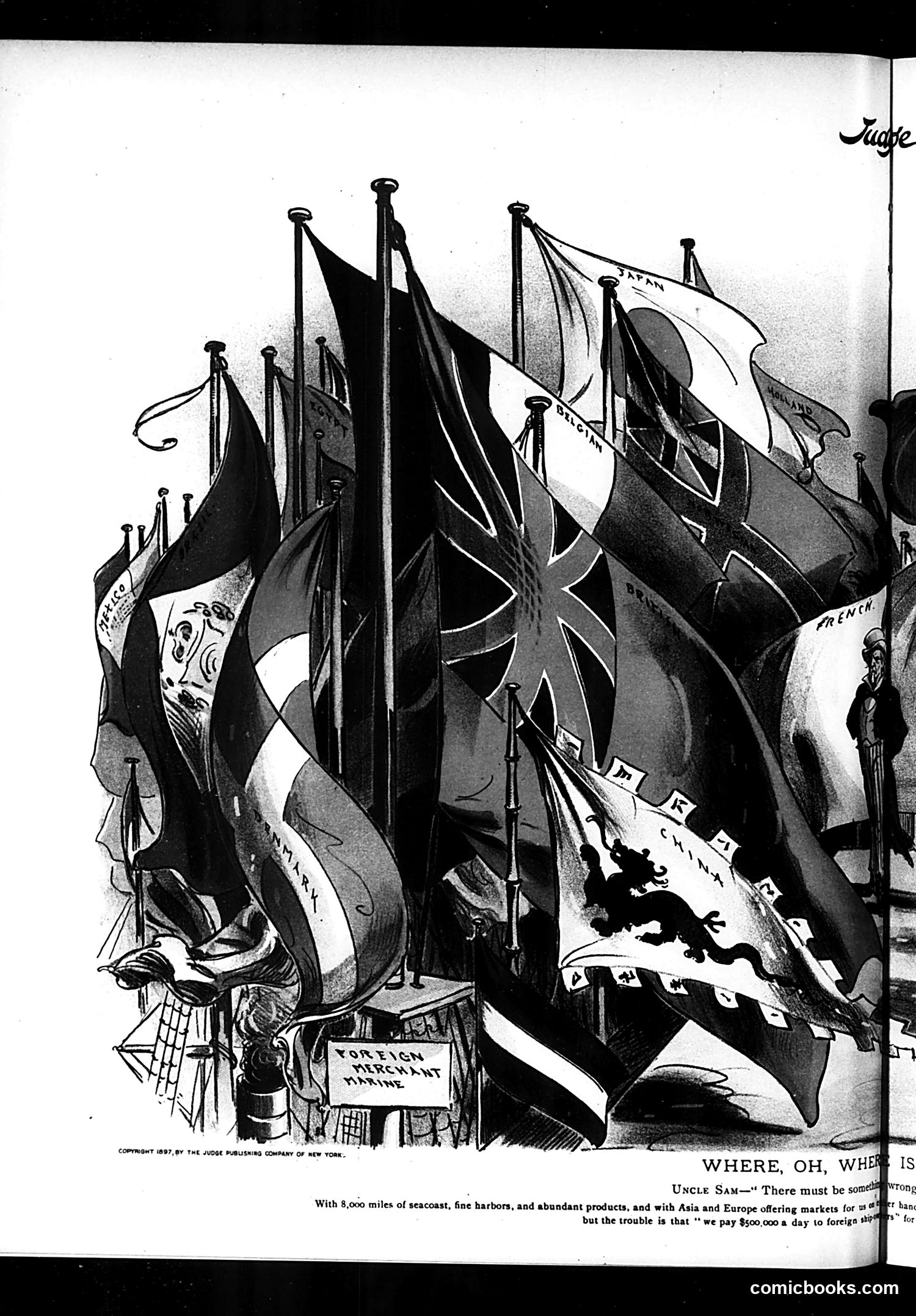
This 1897 Judge cartoon satirizes America's merchant marine crisis. Uncle Sam (personified as the United States) laments the absence of a strong commercial fleet despite obvious advantages: 8,000 miles of coastline, fine harbors, and abundant trade goods. The flags depicted represent competing foreign merchant marines (appears to include French and British vessels based on visible emblems). The joke's bitter irony: America possesses all the natural resources and market opportunities for profitable foreign trade, yet pays $500,000 daily to foreign shipping companies instead of developing its own merchant fleet. This reflects late-19th-century anxieties about American industrial competitiveness and economic independence. The cartoon advocates for government investment in American shipping infrastructure and naval commerce—a recurring policy debate during this era of American industrial expansion and imperial ambitions.
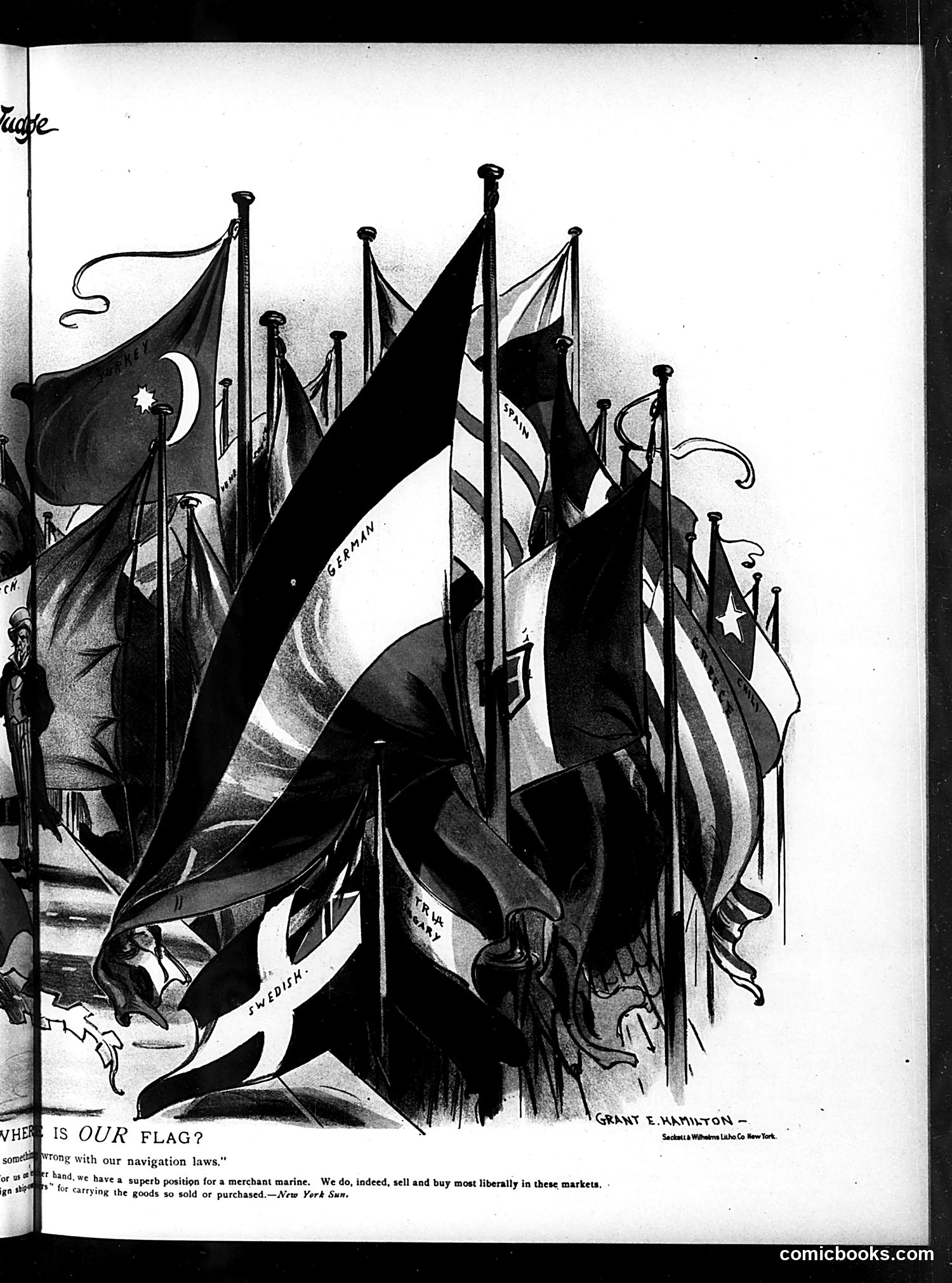
This editorial cartoon by Grant E. Hamilton critiques American merchant marine policy. The central figure appears to be Uncle Sam (identifiable by the tall hat with star), surrounded by flags of various nations (Germany, Sweden visible). The composition suggests chaos or competition among foreign shipping interests. The cartoon illustrates a New York Sun editorial complaint: America supposedly has favorable trade positions yet lacks a strong merchant marine to carry its own goods. Instead, foreign vessels dominate American commerce. The satirical point is that despite America's commercial strength, it ironically depends on foreign ships—a vulnerability the cartoonist presents as foolish national policy, particularly regarding navigation laws that should protect American maritime interests.
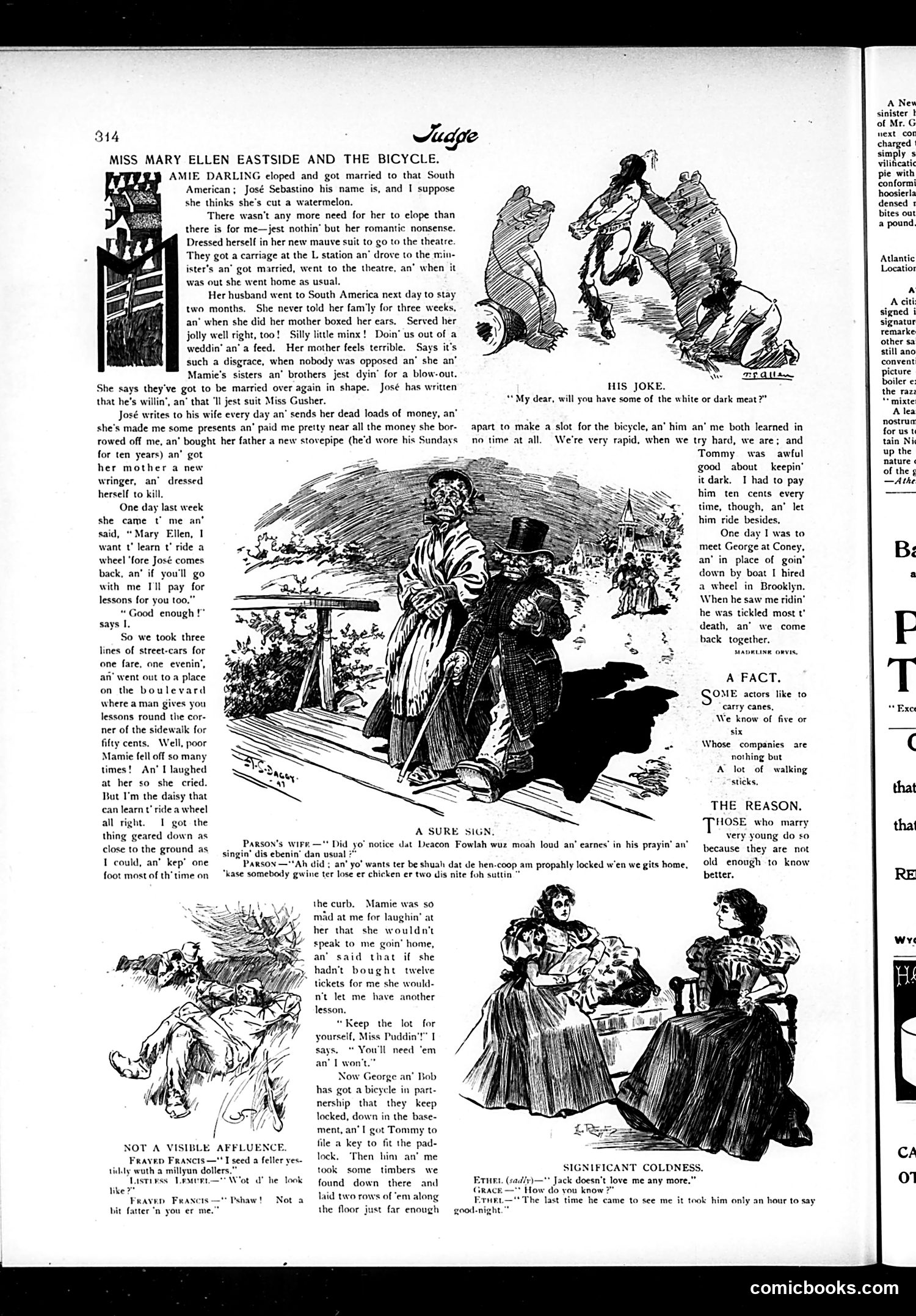
This page contains a serialized comic story about working-class women learning to ride bicycles—a contemporary social phenomenon of the 1890s. The narrator, Mary Ellen, describes how her friend Mamie (who made a romantic elopement to South America) wants to learn cycling before her husband returns. The humor derives from period-specific class anxieties: bicycles were relatively new, expensive, and associated with modern independence—especially for women. The story's dialect-heavy, gossipy tone satirizes both working-class pretension and the social disruption caused by this technology. The smaller cartoons address related themes: "His Joke" appears to mock bicycle-related courtship; other panels joke about visible wealth and theatrical affectation. The bicycle itself represents modernity and female autonomy, making this satire about how new technologies challenge traditional social hierarchies and gender roles among ordinary people.
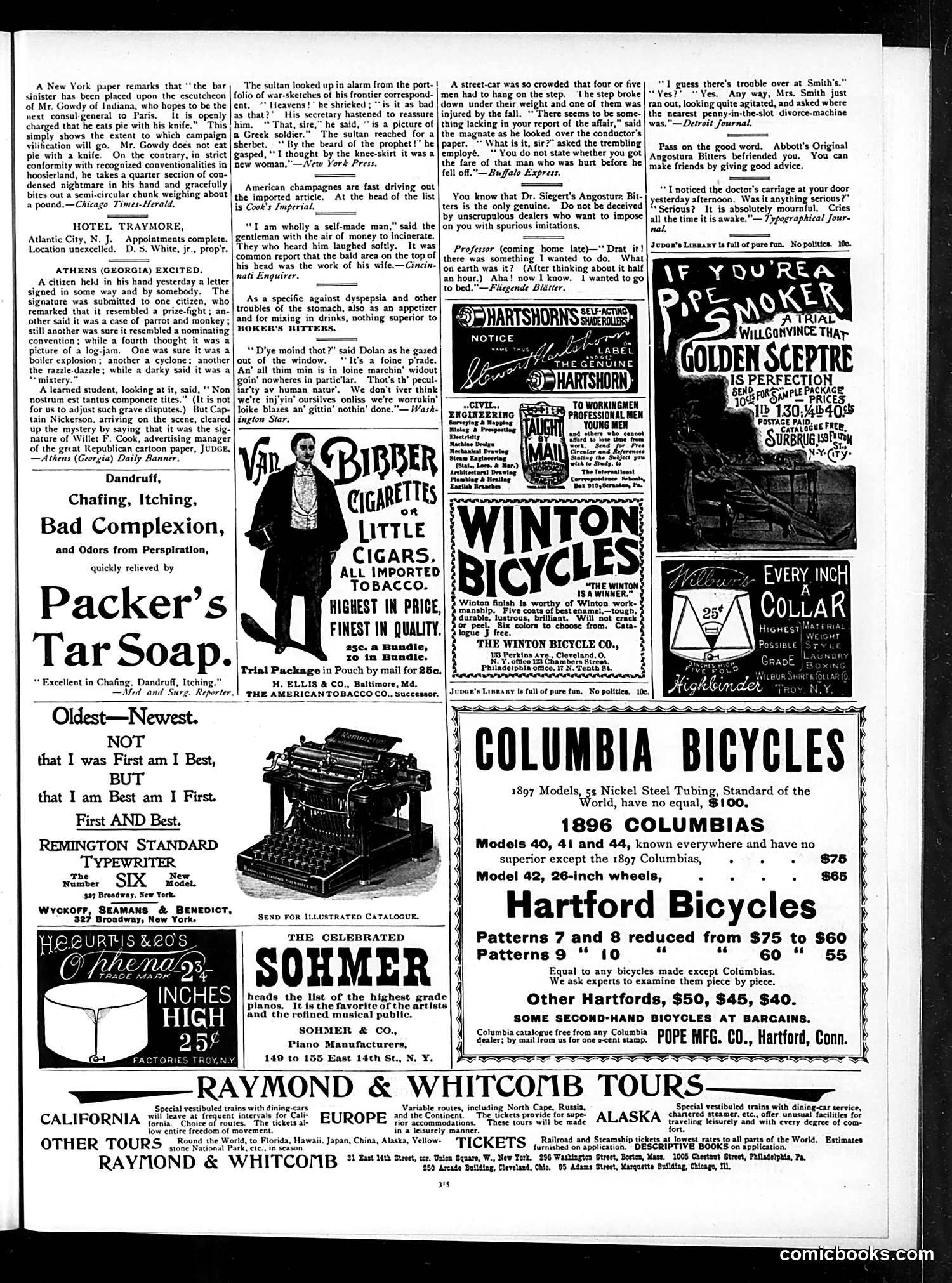
This page is primarily **advertising and filler content**, typical of Judge magazine's layout. The advertisements dominate—bicycles, typewriters, soap, cigarettes, and tours occupy most space. The small satirical items are brief, light jokes: 1. **Gowdy of Indiana**: A political candidate is attacked for allegedly eating pie with a knife—the joke mocks how campaign vilification reaches absurd extremes over minor etiquette violations. 2. **Athens signature**: A humorous piece about an illegible signature from Judge's own advertising manager, Willet F. Cook, that various people interpret as different disasters (explosion, cyclone, etc.). 3. **"Self-made man"**: A wealthy man claims self-made success; the joke implies his wife actually made him (bald spot). 4. **Dolan's parade**: An Irishman observes people marching without purpose—satire on human nature's need for activity over genuine enjoyment. The humor is gentle, domestic, and apolitical—typical of Judge's lighter filler material between major satirical pieces.
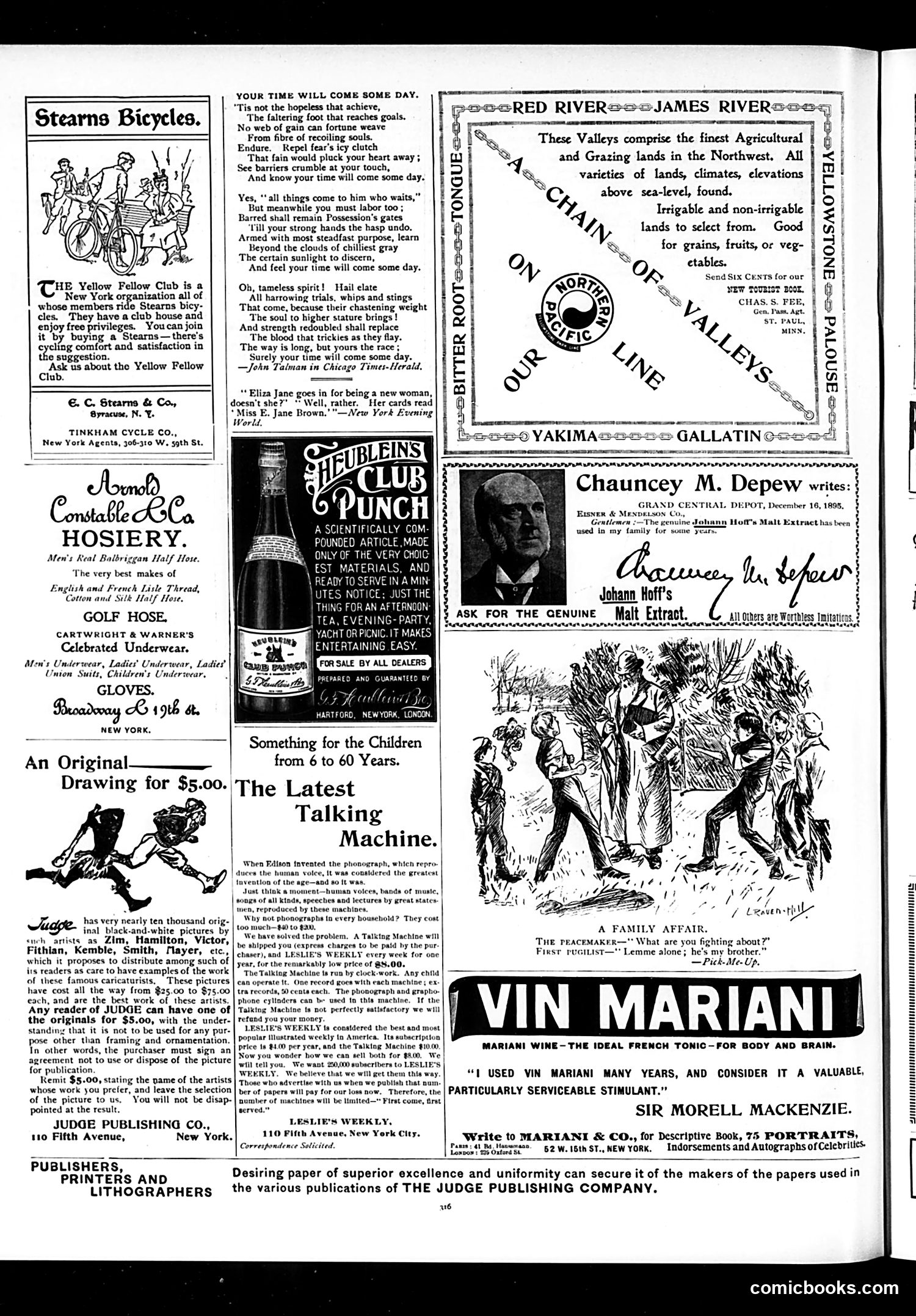
This is primarily an **advertising page** from Judge magazine, not a satirical cartoon page. The content consists almost entirely of commercial advertisements and promotional material: The main items include ads for **Stearns Bicycles** (promoting a "Yellow Fellow Club" membership), hosiery and underwear, golf hose, and gloves. There's also promotion for Judge Publishing's original artwork sales ($5 for framed drawings by famous cartoonists) and an ad for **Heublein's Club Punch** beverage. A small illustration titled "A Family Affair" appears to show a domestic scene, though its satirical point is unclear from the visible caption fragments. The page also contains ads for **Vin Mariani** (a wine-based tonic) endorsed by Sir Morell Mackenzie, and tourism promotion for the Red River/James River valleys in the Northwest. **There is no significant political or social satire visible on this page**—it's a revenue-generating advertisements section typical of magazine back pages from this era.
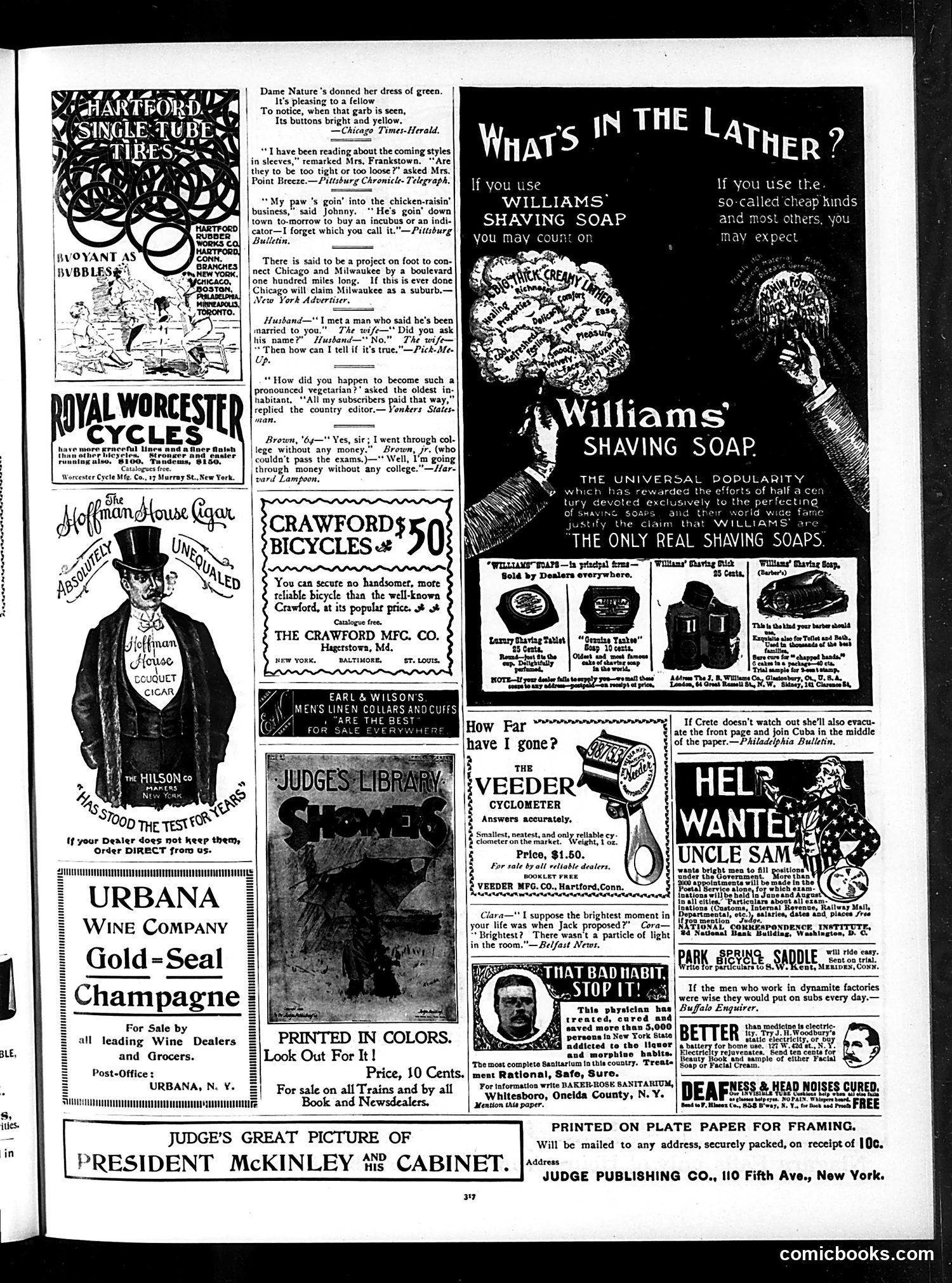
This page is primarily **advertising**, with small comic snippets interspersed. The main content includes: **Notable Cartoon/Joke:** The top section contains brief joke exchanges about clothing fit and various humorous anecdotes—typical of Judge's satirical humor. **Political Reference:** The bottom announces "Judge's Great Picture of President McKinley and His Cabinet"—indicating this magazine was published during William McKinley's presidency (1897-1901), offering readers a framed portrait of the administration. **Context for Modern Readers:** The page reflects late-19th-century American consumer culture and advertising practices. Products like "Williams' Shaving Soap," bicycles, and wine were marketed through satirical magazines. The joke about "Crete" evacuating like "Cuba" references the Spanish-American War era (1898) and colonial politics. The magazine format mixed light humor with commercial pitches, targeting educated middle-class readers interested in current events and consumer goods.
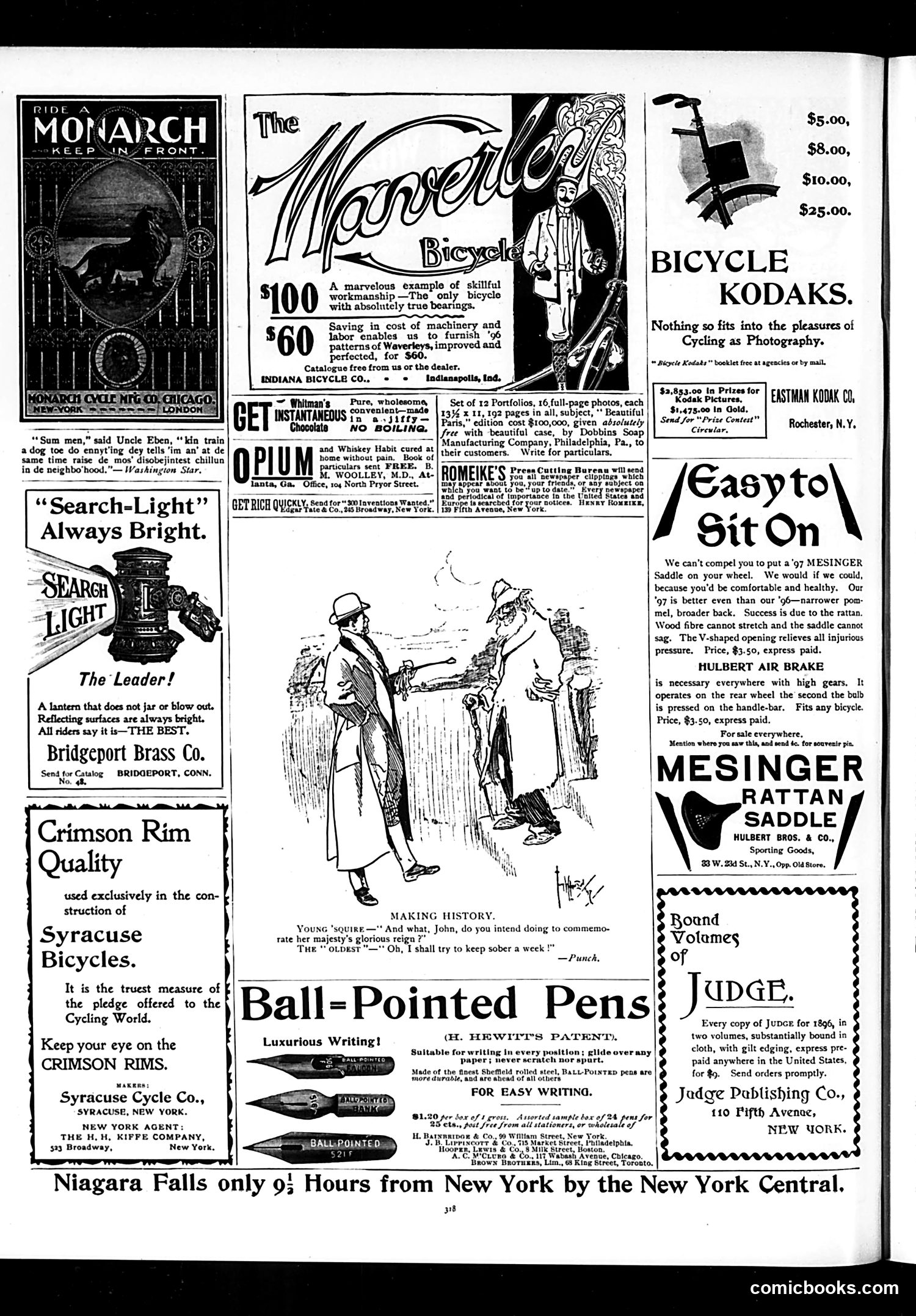
This is primarily an **advertising page** from Judge magazine, circa 1896, with one small cartoon and editorial joke. ## The Cartoon ("Making History") The single cartoon depicts two men—one appears to be a young suitor and the other an older gentleman (likely representing paternal or societal authority). The caption references commemorating "her majesty's glorious reign," suggesting a British royal occasion. The joke's punchline—"I shall try to keep sober a week"—is a mild temperance-era joke mocking someone's inability to abstain from alcohol even for a brief celebratory period. This reflects 1890s anxieties about drinking habits. ## Supporting Joke The "Uncle Eben" dialect piece references training dogs versus raising disobedient children—a period-typical observation about parental discipline. ## Overall Context The page is dominated by bicycle advertisements (Waverly, Syracuse, Mesinger saddles) and product ads (pens, chocolate, kodaks), reflecting the 1890s bicycle craze and emerging photography hobby. The modest cartoon serves mainly as filler among commercials rather than as serious political satire.
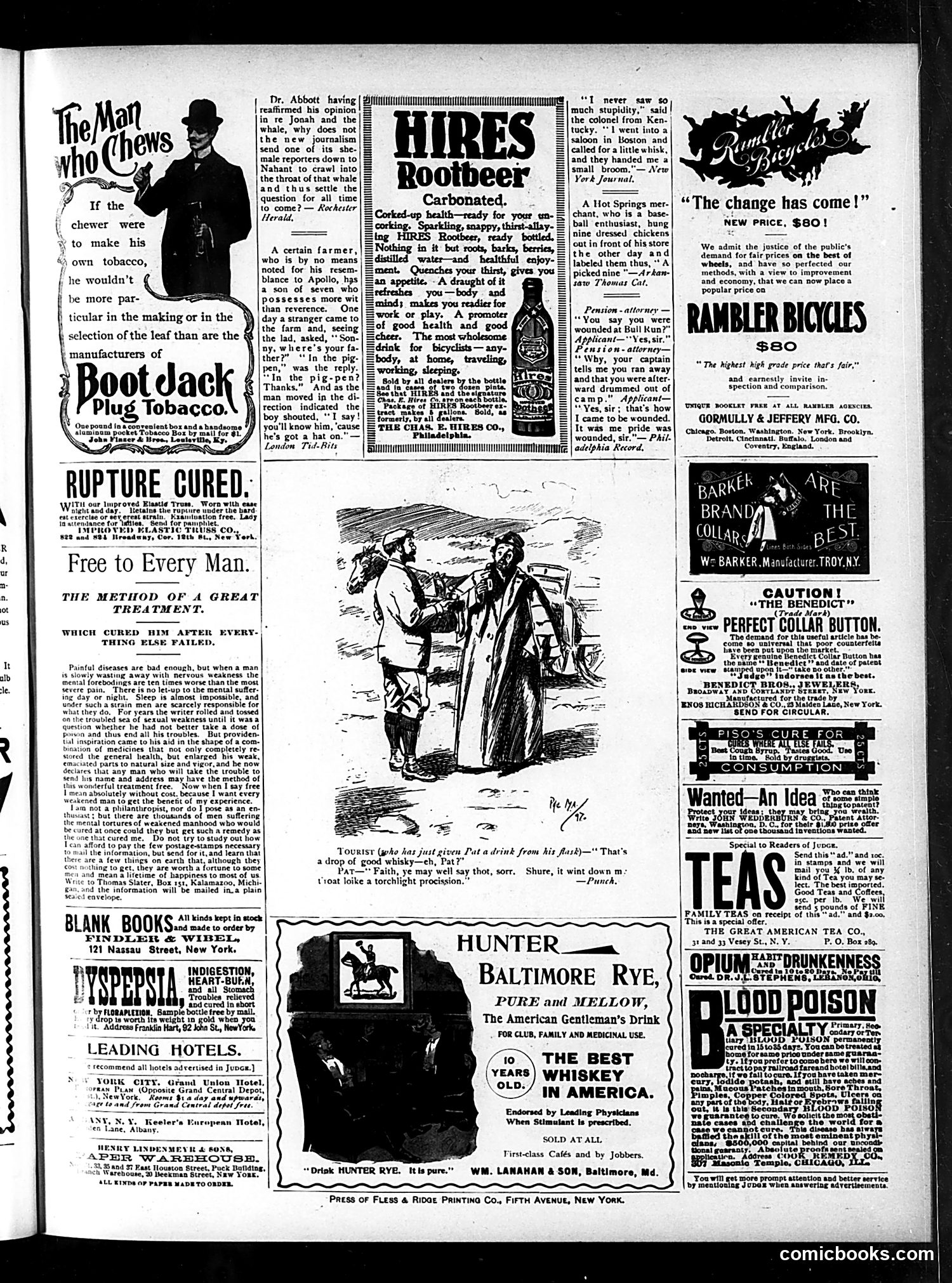
This is primarily an **advertising page** from Judge magazine, with scattered humorous short items typical of the era's satirical publications. The main cartoon shows a **tourist and local guide** in a rural setting. The humor derives from class/education stereotypes: the tourist asks directions, and the guide's response relies on physical description rather than landmarks—suggesting rural simplicity. The caption's joke about needing a "torchlight procession" to locate someone plays on period stereotypes of rural backwardness. The **advertisements** reflect late-19th/early-20th century concerns: patent medicines (rupture cures, "blood poison" treatments), tobacco products, and whiskey marketed as medicinal tonics. Notable is the **racial pseudoscience** in medical ads claiming to cure conditions through dubious means. The scattered jokes mock **provincial attitudes** (the Kentucky colonel's confusion about "whisk"/"brush") and military service (pension applicant's humorous misunderstanding). This page demonstrates Judge's mix of advertising revenue and light humor—the satire is gentle social comedy rather than political commentary.
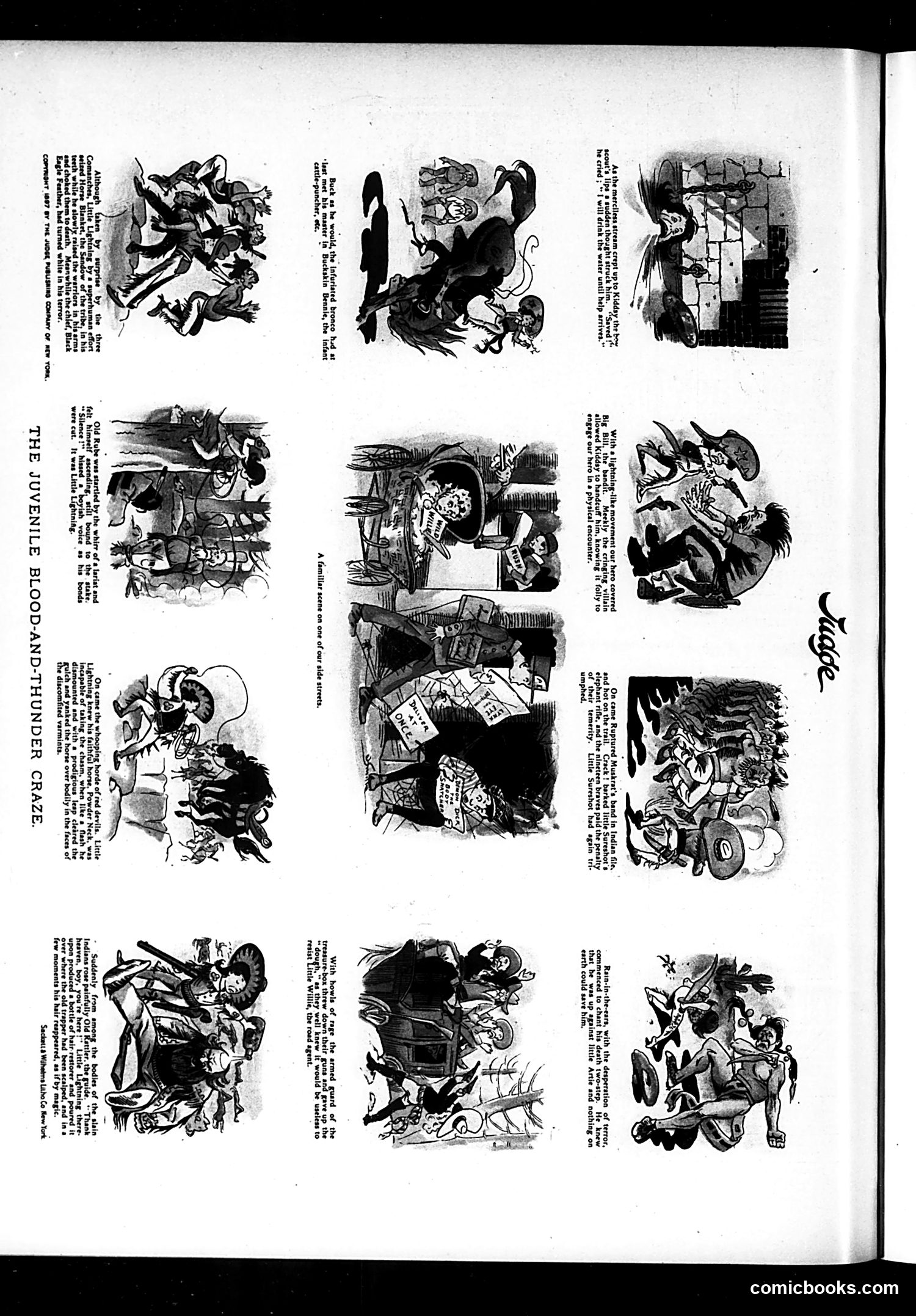
This page satirizes the wildly popular dime novels and pulp fiction stories for boys that dominated late 19th-century America. These cheap serialized adventures featured exaggerated heroes with absurd names—"Buckskin Bennie," "Little Lightning," "Little Sureshot," "Little Willie the road agent"—performing impossible feats against Indians, bandits, and outlaws. The satire mocks how these stories glorified violence and lawlessness while presenting cartoonishly competent child protagonists. The repeated "Little" prefix parodies the genre's formula of marketing increasingly younger heroes. The caption "A familiar scene on one of our side streets" sarcastically suggests these fantasies influenced real urban youth behavior. Judge magazine was critiquing how sensationalized adventure fiction shaped juvenile readers' imaginations and potentially encouraged violent imitation in actual city life.