
A complete issue · 16 pages · 1897
Judge — April 3, 1897
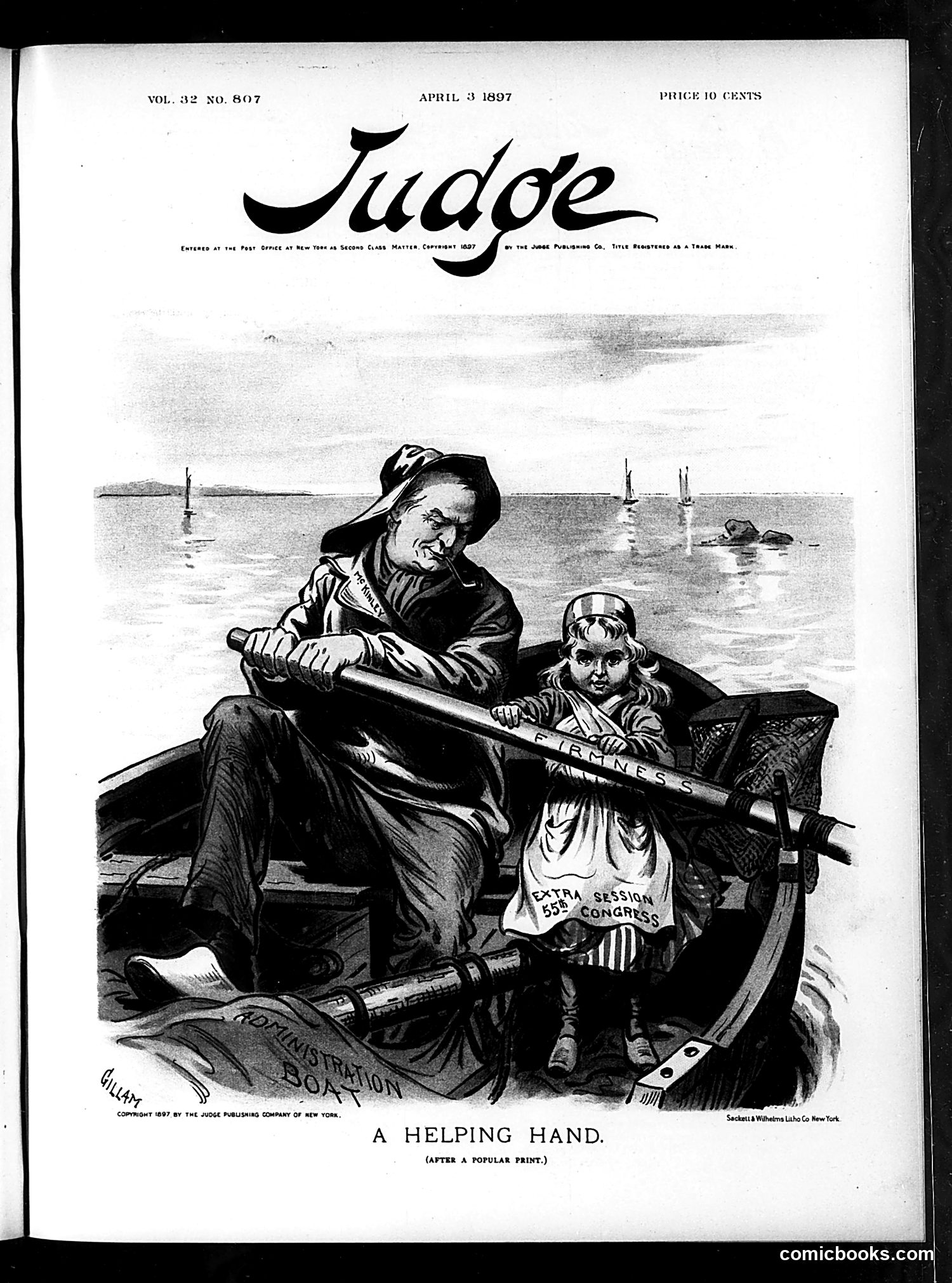
This political cartoon satirizes government support for business interests. An older, sinister-looking male figure (likely representing a politician or corrupt official) rows a boat labeled "FOUNDATIONS" while a young female figure representing "55TH SESSION CONGRESS" sits passively holding an oar labeled "BUSINESS." The cartoon critiques how Congress passively allows or enables wealthy interests to steer policy. The "helping hand" of the title is ironic—the politician manipulates Congress rather than Congress exercising independent judgment. The water setting and boats suggest navigating treacherous economic waters. The overall message suggests collusion between political leadership and big business during the Gilded Age, with Congress depicted as naive or complicit rather than acting as a check on special interests.
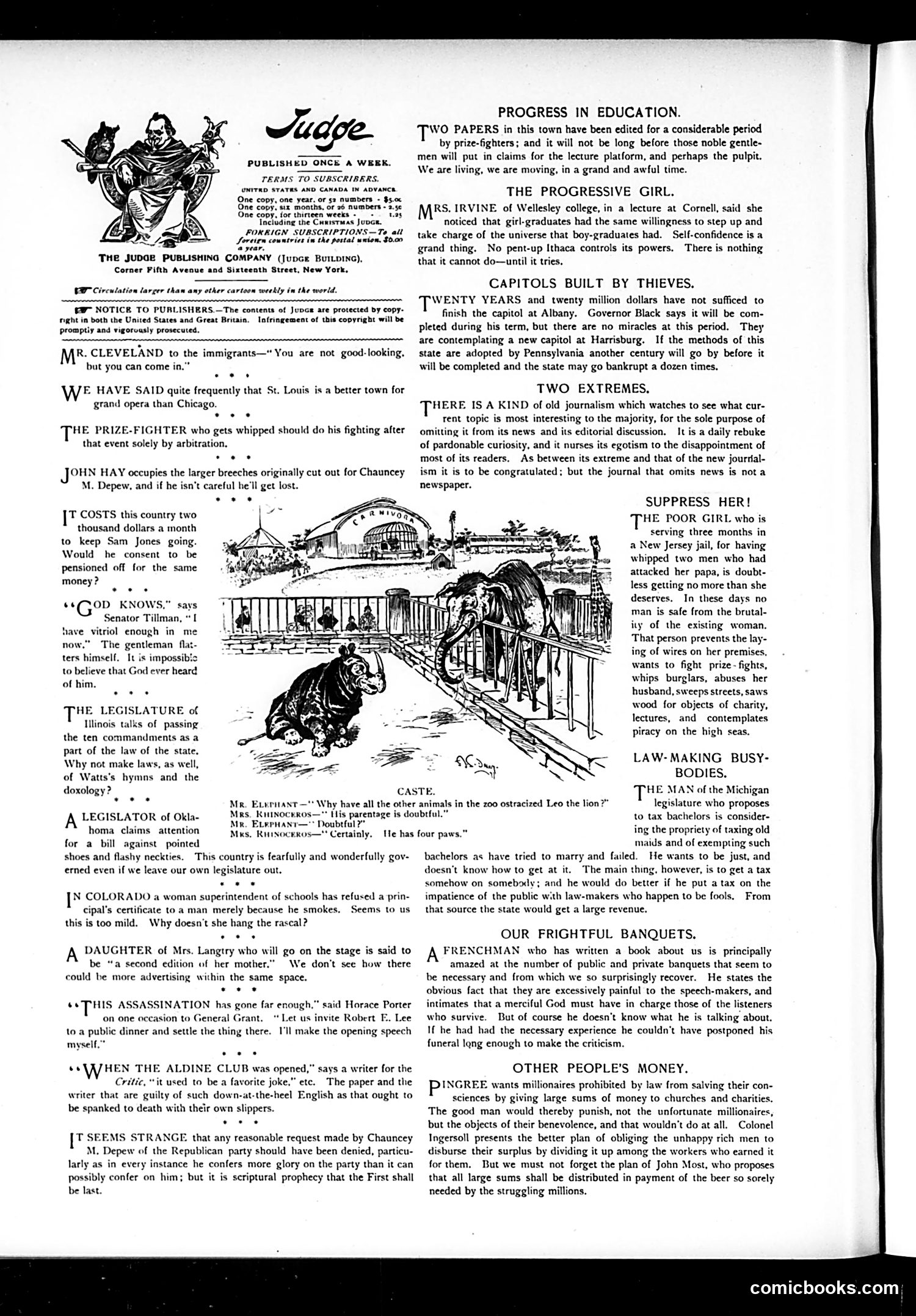
The main cartoon titled "CASTE" depicts an elephant refusing to enter a zoo cage alongside a lion, with dialogue suggesting the elephant objects to sharing space with the lion due to caste distinctions. This appears to be political satire about social hierarchy and class prejudice in America, using animal characters as metaphors for human social divisions. The surrounding text contains brief satirical commentary on contemporary issues: the expense of maintaining Sam Jones (likely a public figure), Illinois legislature passing laws, Colorado school superintendent controversies, and critiques of wealthy philanthropists giving money to churches rather than directly helping workers. The overall thrust critiques rigid social hierarchies, wasteful government spending, and hypocritical charity among the wealthy.
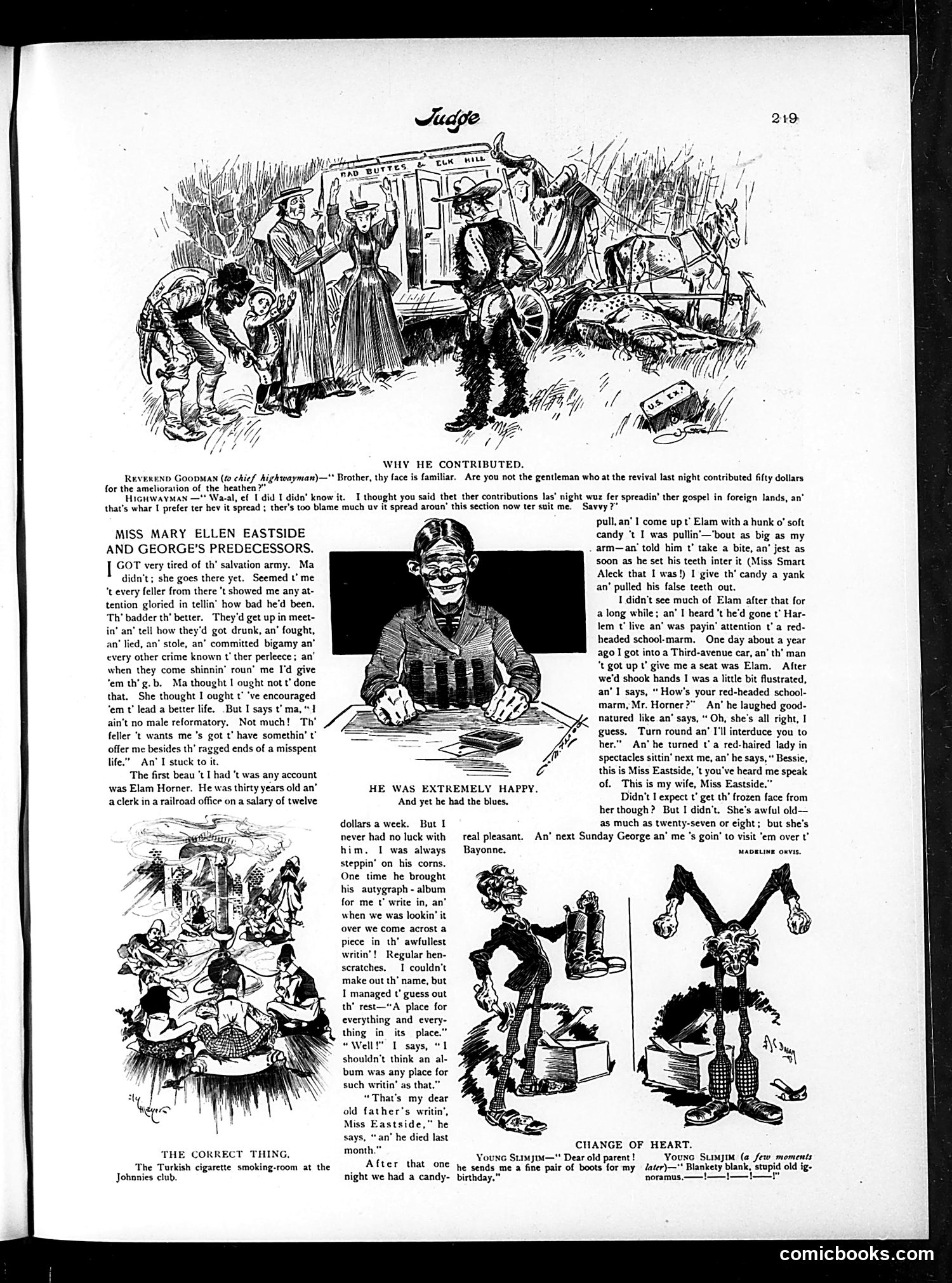
This page contains satirical stories and illustrations typical of Judge magazine's humor. The main content includes: **"Why He Contributed"** - A story mocking a man's dishonest fundraising excuse to Rev. Goodman, claiming he contributed money to a revival when he actually hadn't. **"Miss Mary Ellen Eastside and Her Predecessors"** - A narrative about a woman tired of the Salvation Army, describing her employment as a railroad clerk under a man named Elam Horner. The story humorously chronicles her work experience and romantic entanglement. **Small cartoons** illustrate various scenes: "The Correct Thing" shows Turkish cigarette smoking at the Johnnies club; "Change of Heart" depicts a young person's emotional shift. The illustrations use typical period caricature styles. Overall, the page satirizes middle-class life, charitable organizations, workplace dynamics, and romantic complications common to early 20th-century American society.
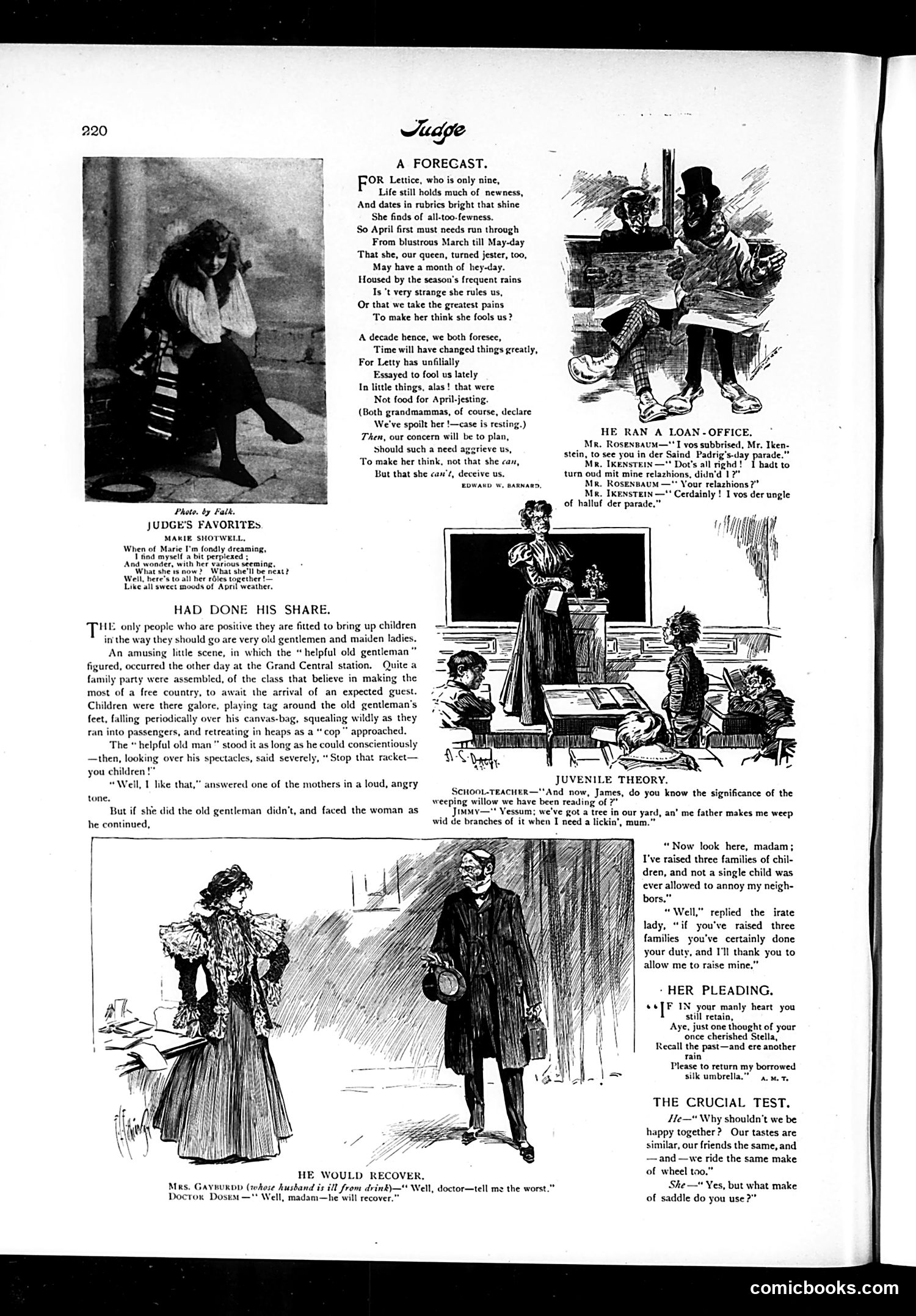
This page contains multiple satirical pieces typical of early 20th-century American humor: **"A Forecast"** uses a child named Lettice as vehicle for commentary on generational change and discipline. The poem warns that a mischievous nine-year-old will become a woman who can "deceive" her elders—satirizing anxieties about changing social standards and women's autonomy. **"He Ran a Loan-Office"** appears to mock Irish-Jewish immigrant relations through ethnic dialect humor. The joke plays on "relations" (family members in a parade) versus "business relations," likely reflecting period tensions over assimilation and ethnic stereotyping. **"Had Done His Share"** satirizes sanctimonious elderly people lecturing parents about child-rearing. An old man criticizes unruly children at Grand Central Station; a mother retorts that he's "done his share"—implying his parenting success doesn't qualify him to judge hers. Minor pieces include sentimental poetry about a favorite actress and light romantic humor about saddles and courtship preferences. The overall tone reflects Judge's typical mix of social observation, class commentary, and gentle mockery of contemporary manners.
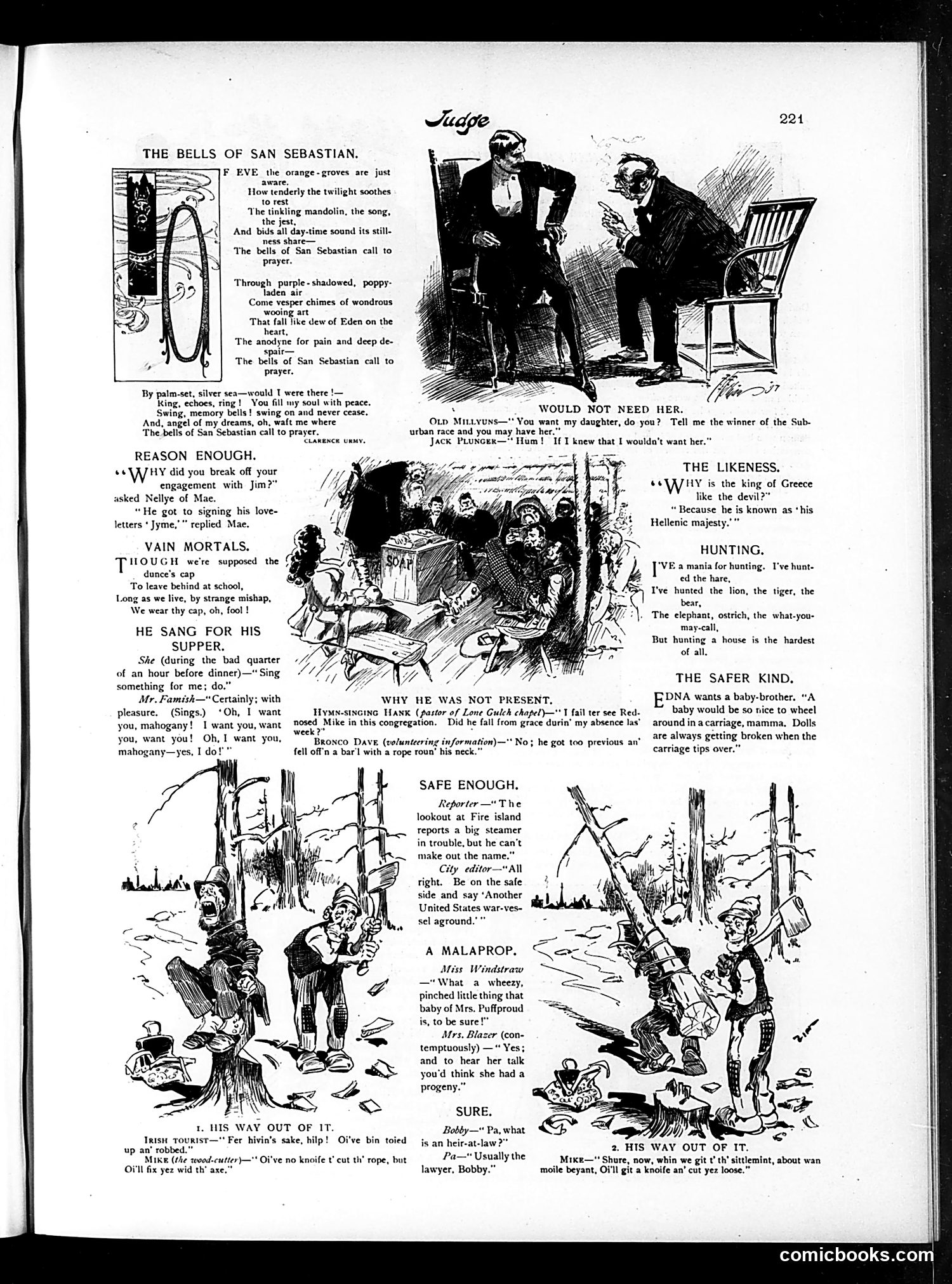
This page from Judge magazine contains multiple brief satirical pieces typical of the publication's humor style: **"Would Not Need Her"** mocks a suitor's priorities—he'd only want a woman if he could predict horse-racing winners, suggesting his interest is mercenary rather than romantic. **"Reason Enough"** jokes about a broken engagement over a man signing love letters with a nickname, poking fun at courtship conventions. **"The Likeness"** makes a pun equating the Greek king with the devil through his title "His Hellenic Majesty." **"Why He Was Not Present"** depicts a frontier preacher noting a parishioner's absence, with a cowboy explaining the man fell from a barrel with a rope around his neck—implying suicide or accidental death, presented as dark frontier humor. Other items include hunting boasts, baby-carriage safety jokes, and Irish-dialect humor featuring characters "Mike" and "Bronco Dave" using thick brogue, reflecting period ethnic stereotyping common in American humor magazines. The overall tone is lighthearted domestic and social satire.
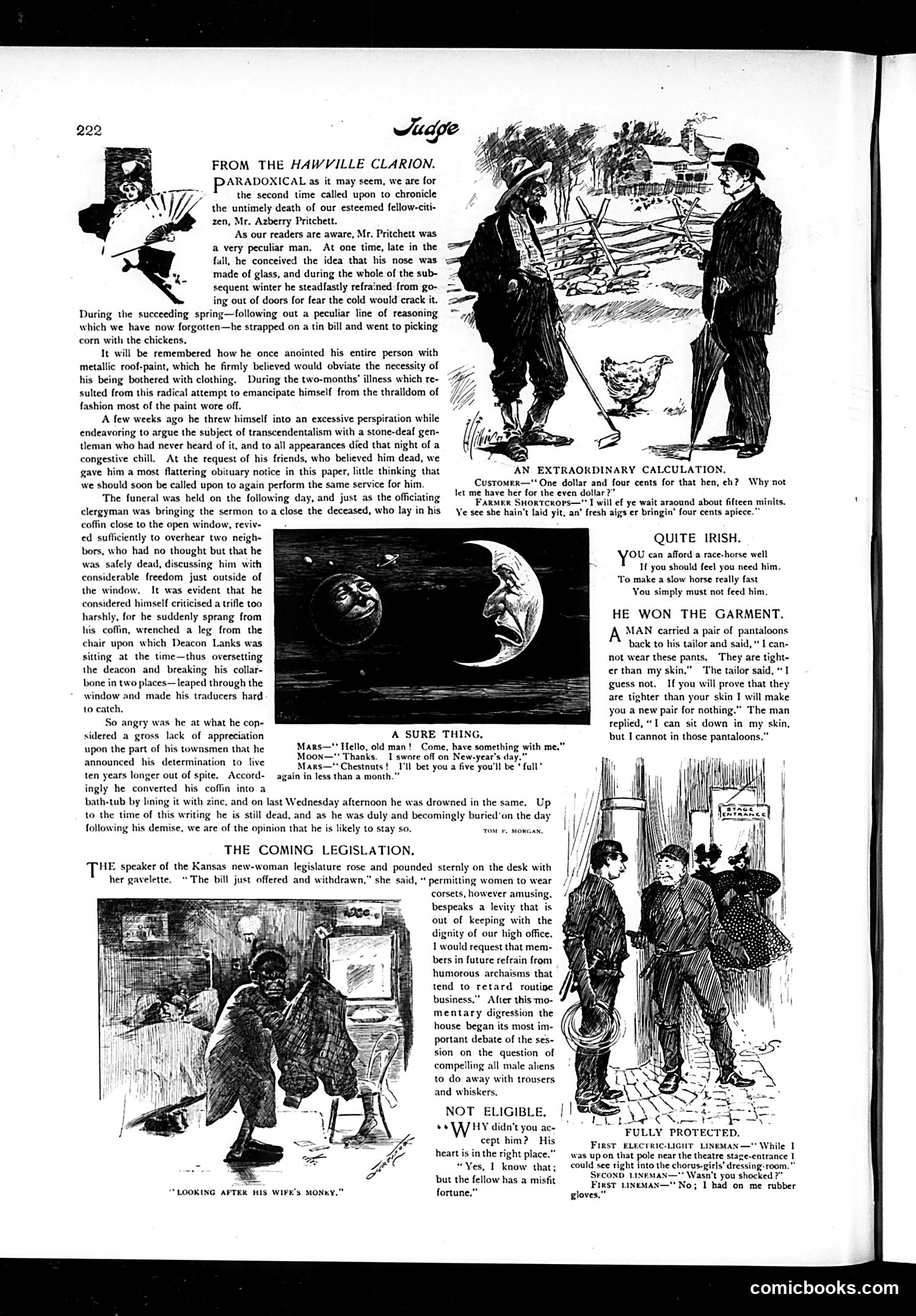
This page contains multiple satirical pieces mocking eccentric behavior and emerging social changes: **"From the Hawville Clarion"** tells a tall tale about Mr. Pritchett, an absurdly irrational man who believes his nose is glass, paints himself metallic, and eventually drowns in his coffin-turned-bathtub. The satire targets gullible newspaper reporting and human folly generally. **The Kansas legislation cartoon** references the women's suffrage movement, specifically Kansas's early adoption of female voting rights. The satire mocks "new women" legislators by depicting them as frivolous (debating corsets) yet tyrannically imposing ridiculous restrictions on men (banning trousers and whiskers). This reflects contemporary anxieties about female political power and gender role disruption. The smaller cartoons—"Extraordinary Calculation," "A Sure Thing," "He Won the Garment," and "Fully Protected"—offer quick comic vignettes on various absurdities. Overall, the page satirizes human irrationality, newspaper sensationalism, and conservative fears about women's changing social status.
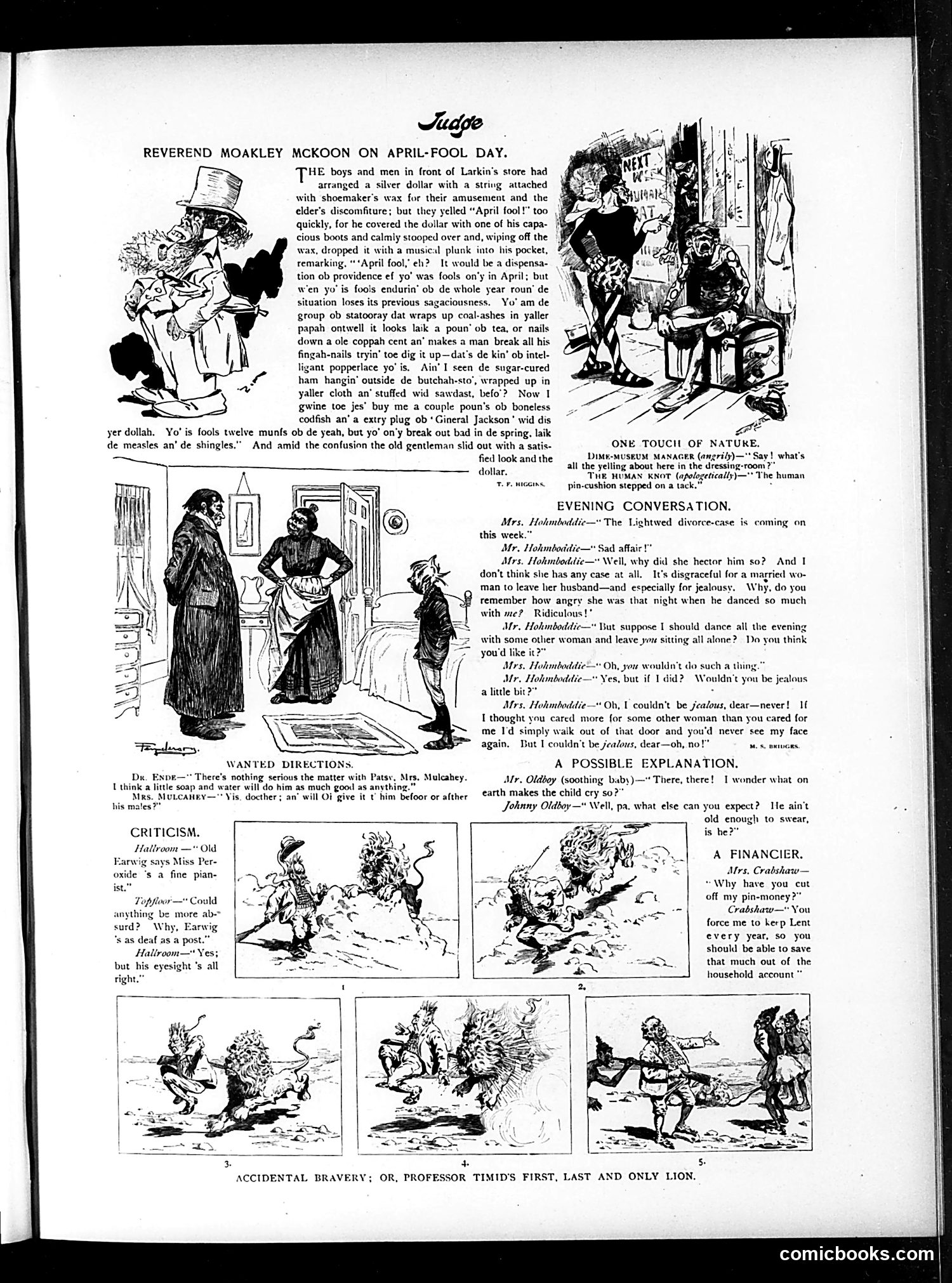
This page contains several standalone humorous sketches typical of late 19th/early 20th-century American satire: **"Reverend Moakley McKoon on April-Fool Day"**: A reverend outwits pranksters who've set a string-attached dollar trap. Rather than falling for it, he keeps the dollar and lectures them in dialect about their year-round foolishness—a commentary on foolish social behavior beyond just April Fools' Day pranks. **"Evening Conversation"**: A married couple debates jealousy and fidelity, with the wife insisting she'd never be jealous if her husband danced with another woman—a transparent lie that satirizes marital hypocrisy and double standards. **Other sketches**: Include domestic humor ("Wanted Directions," "A Financier," "A Possible Explanation") and a comic sequence titled "Accidental Bravery" depicting someone's encounter with a lion. The page mixes social satire with domestic comedy, targeting human vanity, marital discord, and foolish behavior—common Judge magazine themes of the era.
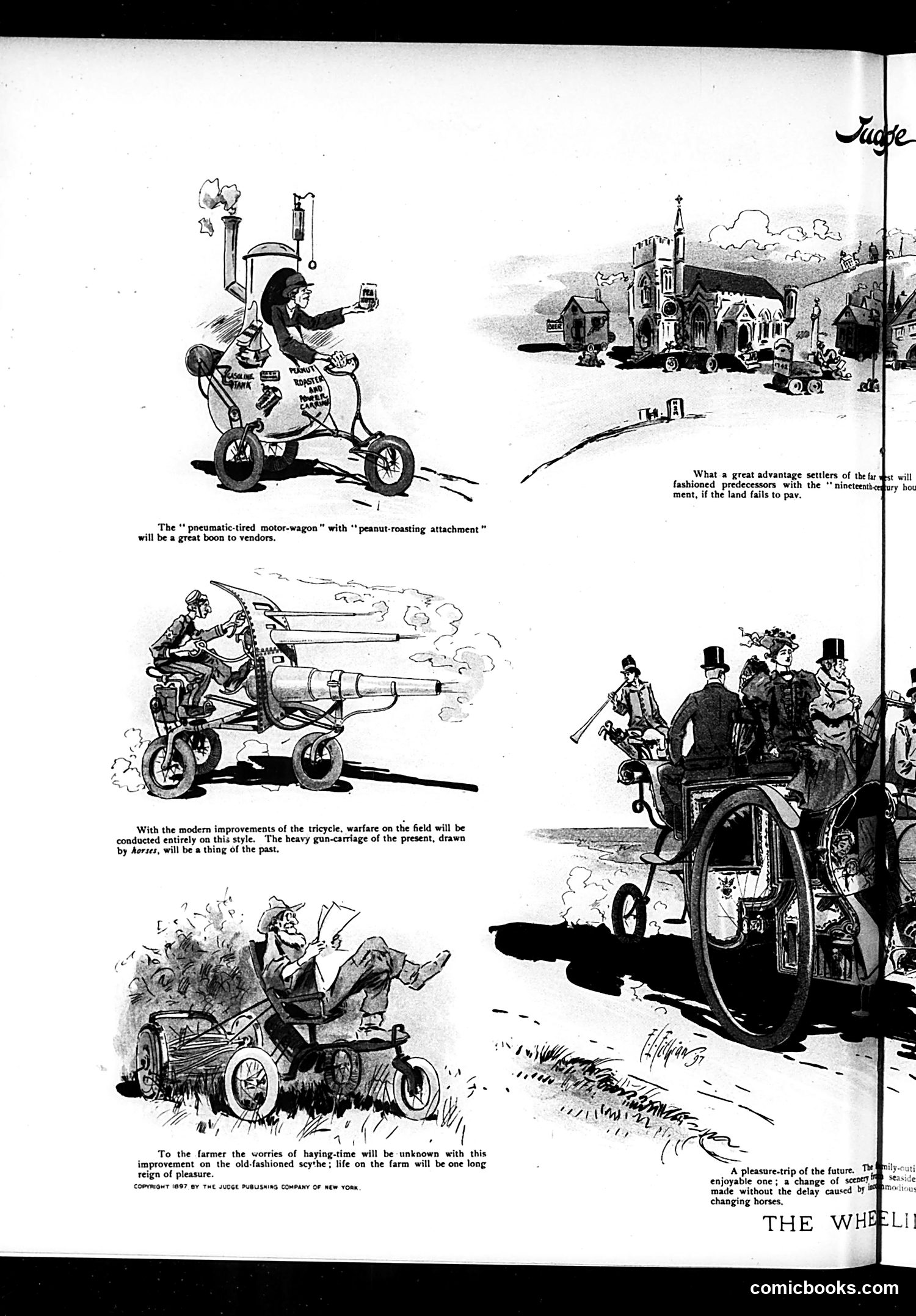
This page satirizes the era's utopian technological optimism by imagining absurd future applications of bicycles and tricycles. Each panel presents an exaggerated "improvement": 1. **Peanut-roasting motor-wagon**: A vendor's bicycle equipped with roasting apparatus—mocking impractical mechanization. 2. **Tricycle warfare**: Replaces horse-drawn cannons with pedal-powered gun carriages, suggesting ridiculous militarization of bicycles. 3. **Farming innovation**: A tricycle "scythe" for haymaking, promising farmers effortless labor. 4. **Pleasure transportation**: A group ride replacing horse-drawn carriages. The satire targets 1890s boosterism about cycling and mechanical progress. The cartoonist mocks inventors and promoters who envisioned bicycles as universal solutions to all problems—farming, warfare, commerce, transportation—without acknowledging practical limitations. It's gentle ridicule of technological utopianism and the bicycle craze's exaggerated promises.
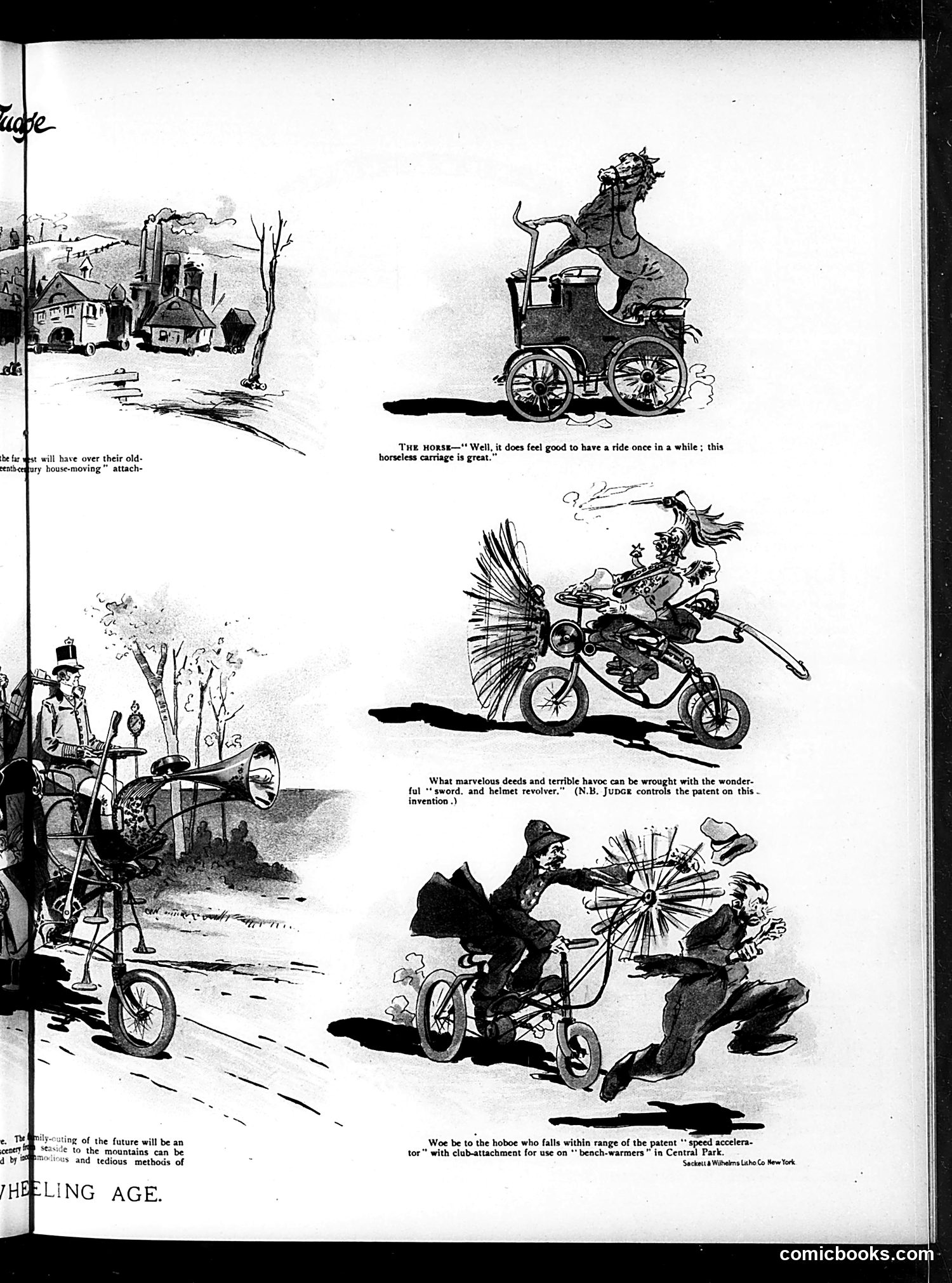
This Judge magazine page satirizes the early automobile era's technological innovations and their social implications. The central joke features a horse commenting that horseless carriages are "great"—ironic, since automobiles are replacing horses. The other cartoons mock dangerous or absurd inventions allegedly patented by Judge magazine itself: a "sword and helmet revolver," a bicycle with elaborate mechanical attachments, and a "speed accelerator with club-attachment" supposedly designed to attack homeless people ("hoboes") and vagrants ("bench-warmers") in Central Park. The satire targets both reckless inventors and society's hostile attitudes toward the poor. By attributing these violent contraptions to Judge itself (with a humorous disclaimer), the magazine is mocking the era's enthusiasm for mechanical gadgets regardless of their practical utility or ethical concerns.
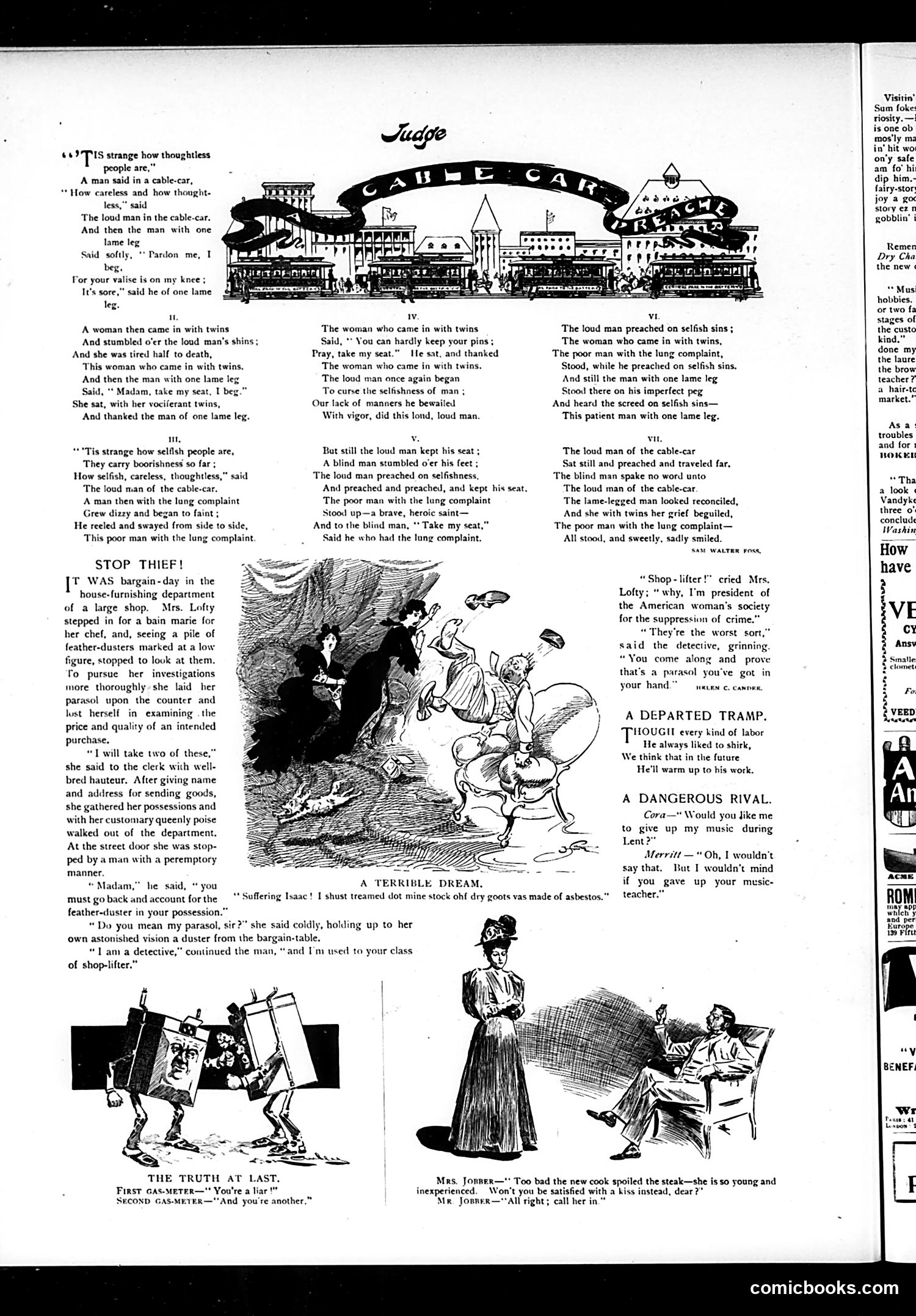
This page contains several satirical stories and cartoons typical of Judge's social commentary: **"The Cable Car" narrative poem** mocks hypocrisy about selfishness. A loud man continuously lectures other passengers about their rudeness and lack of manners—while himself refusing to give up his seat to a woman with twins, a blind man, and a sick man with lung complaints. The irony is that everyone *except* the preachy loud man demonstrates actual kindness by yielding their seats. The satire targets self-righteous moralizing disconnected from actual behavior. **"Stop Thief!"** depicts a wealthy woman (Mrs. Lofty, president of a "crime suppression society") suspected of shoplifting a feather-duster. A detective stops her, discovering she's hidden merchandise under her parasol—exposing the hypocrisy of the privileged classes who preach morality while committing petty crimes themselves. Both pieces use Judge's typical approach: revealing the gap between what people *claim* to believe and how they actually behave, particularly targeting the self-satisfied middle and upper classes.
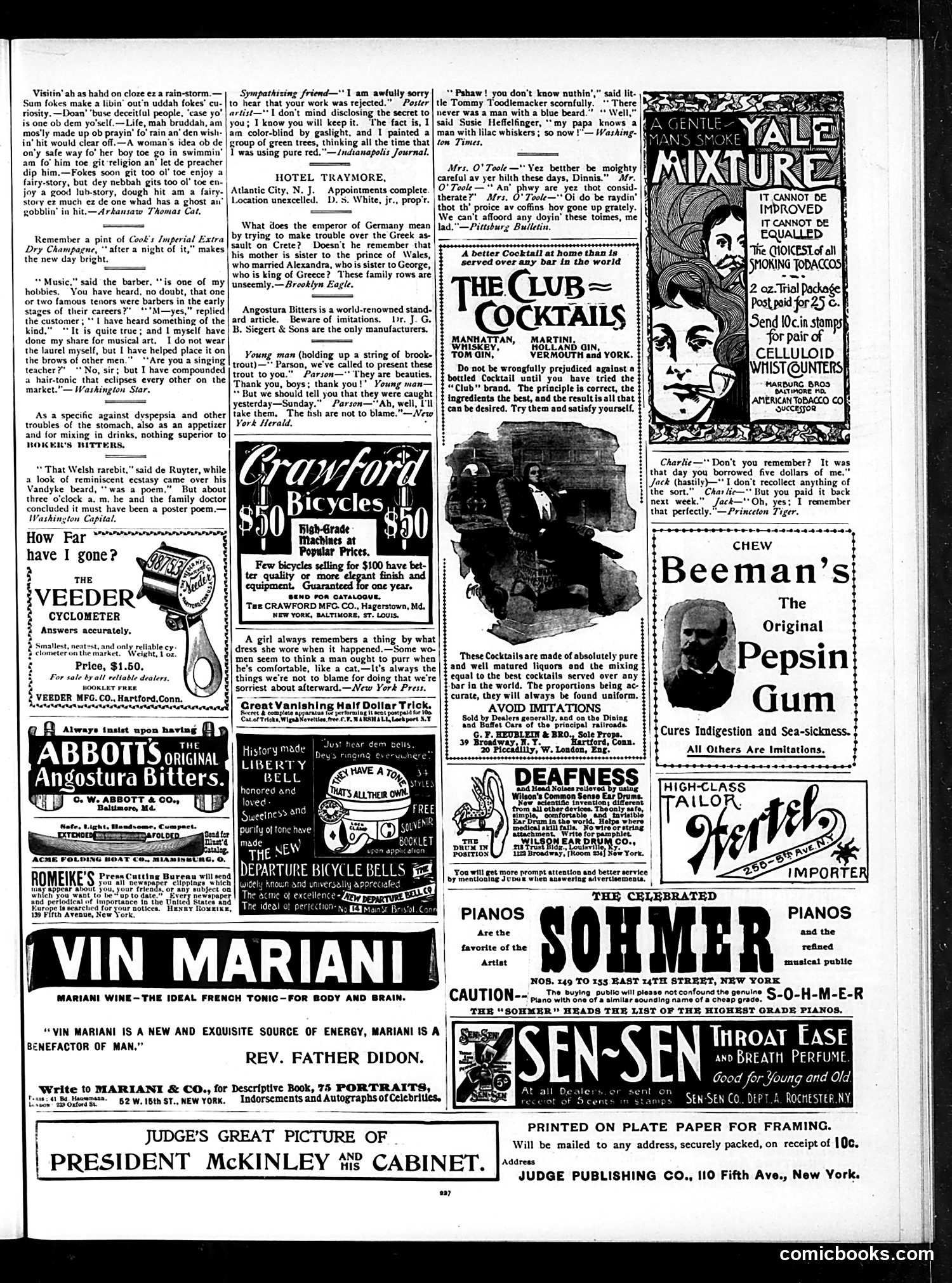
This page from *Judge* magazine contains primarily **advertisements and short humorous anecdotes** rather than political cartoons. The text pieces are brief, dialect-heavy jokes featuring African American vernacular ("Doan' 'buse deceitful people"), Irish-accented characters discussing coffin prices during economic hardship, and domestic humor (children discussing blue beards, a barber claiming musical contributions). The **advertisements dominate**: bicycles, cocktail recipes, Vin Mariani wine (marketed for "body and brain"), pianos, throat lozenges, and various patent medicines. These ads reflect early 20th-century consumer culture and the era's unregulated medical claims. One notable item: a *Judge* ad promoting "President McKinley and His Cabinet" as a framed picture—indicating this is from the McKinley administration period (1897-1901 or 1901-1909). **No significant political satire is visible** on this particular page—it's primarily a showcase of period advertising and light domestic humor.
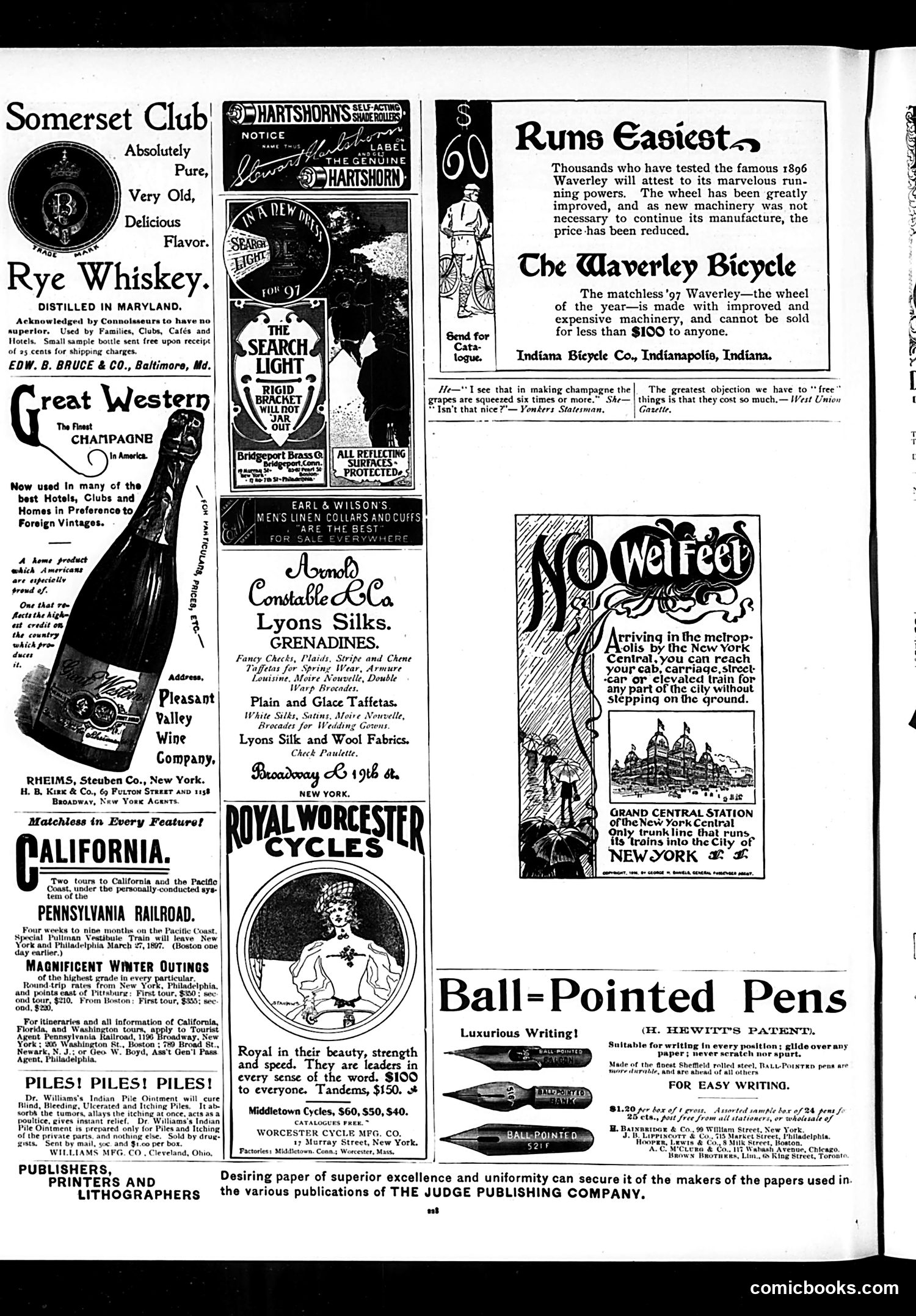
This is primarily an **advertising page** from Judge magazine, circa 1896-1897, with minimal editorial or satirical content. The page contains numerous product advertisements typical of the era: whiskeys (Somerset Club Rye, Great Western), bicycles (Waverley, Royal Worcester), railroad tours to California, and various luxury goods (Lyons Silks, ball-pointed pens). There is **one joke** visible: a brief dialogue about champagne production—a woman finds it "nice" that grapes are squeezed six times, with the unstated implication being a crude double entendre about repetitive squeezing. The **only notable visual element** is a wood-engraved illustration for "No Wet Feet," promoting New York Central's Grand Central Station, showing pedestrians never needing to step outdoors between trains and carriages. The page reflects Judge's business model: advertisements subsidized the satirical content appearing elsewhere in the magazine. Most items advertised target middle to upper-class consumers (luxury whiskeys, bicycles, silk fabrics, travel), indicating the magazine's affluent readership.
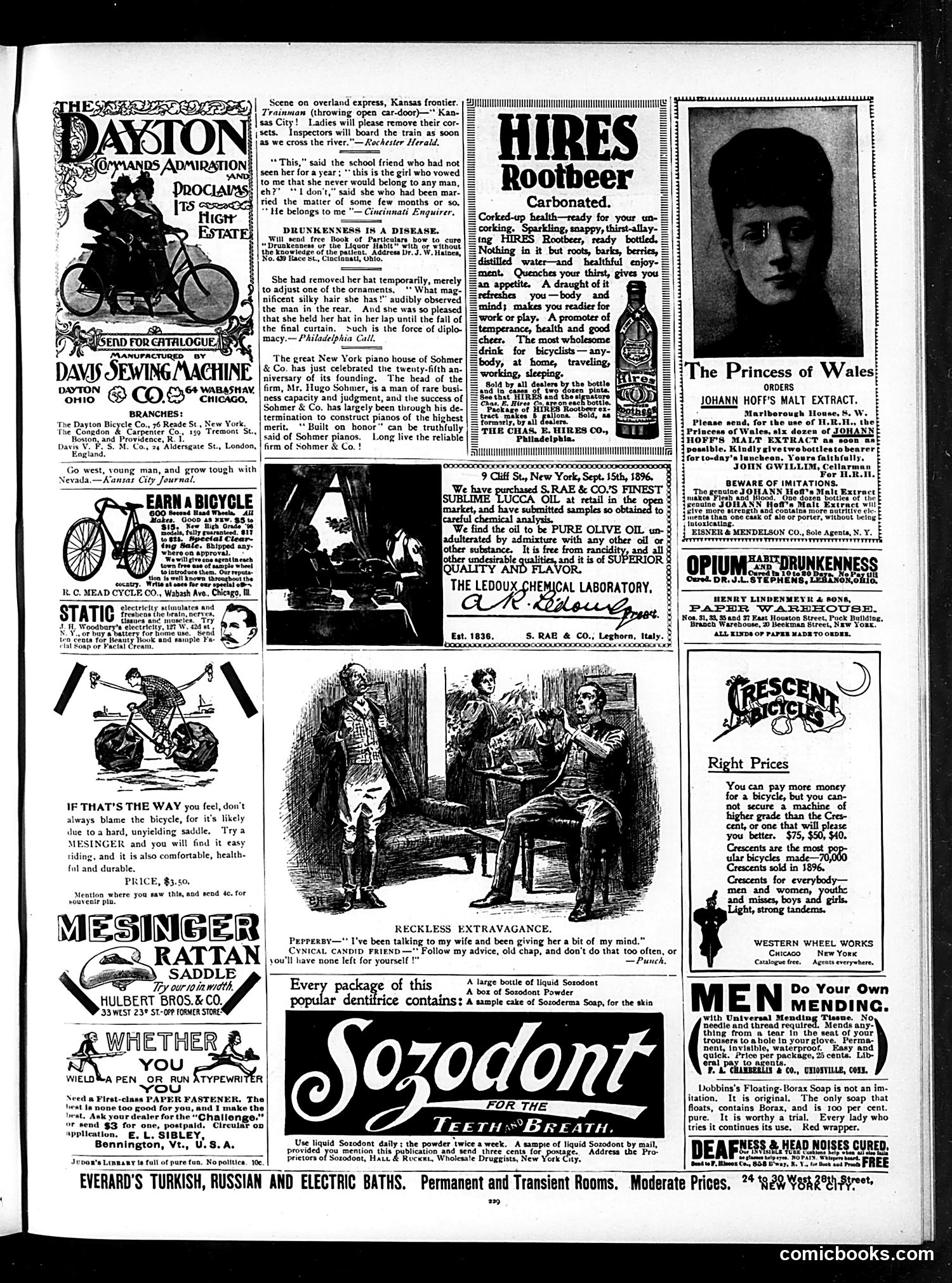
This is primarily an **advertising page** with minimal political cartoon content. The main illustrated item is titled "Reckless Extravagance"—a domestic scene showing a wife telling her husband she's been "giving [him] a bit of [her] mind" while he complains he'll have "none left for yourself." This is a **gender-role joke** mocking marital dynamics: the implication being that wives talk excessively, leaving husbands with nothing to say. The page otherwise contains product advertisements (bicycles, dental products, rootbeer, piano pianos, saddles, paper fasteners) interspersed with brief humorous observations about contemporary life—women removing corsets on trains, newlyweds, theater etiquette. These are **mild social commentary** reflecting late-1890s concerns about feminine fashion, marriage, and public behavior rather than serious satire. No identifiable political figures or events appear on this page.
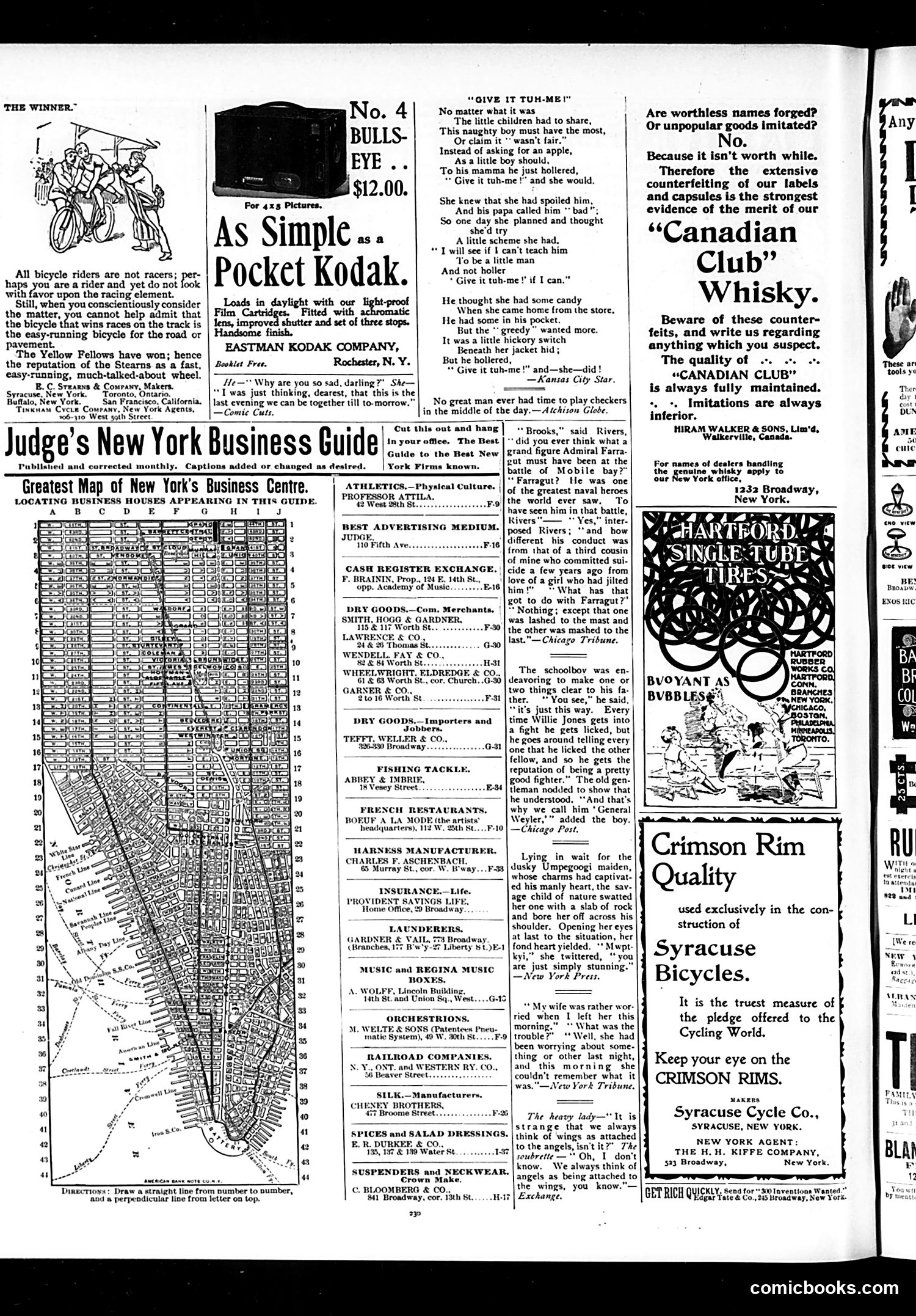
This page is predominantly **advertisements and business directory** rather than satirical editorial content. The main cartoons visible are minor: **"Give It Tuh-Me!"** (top right) - A sentimental domestic anecdote about a spoiled boy who constantly demands things, illustrating parental indulgence. This appears to be filler narrative rather than political satire. **The dominant content** is Judge's New York Business Guide—a practical city directory listing merchants, services, and manufacturers organized by category (Dry Goods, Insurance, Harness Manufacturing, etc.), accompanied by a detailed street map of Manhattan's business center. **Notable advertisements** include Kodak cameras, Stearns bicycles, Canadian Club whisky (with a counterfeit warning), Hartford and Syracuse bicycle tire brands, and various other goods. The page represents Judge's hybrid model: mixing light humor with practical commercial content to fund publication and serve its urban readership.
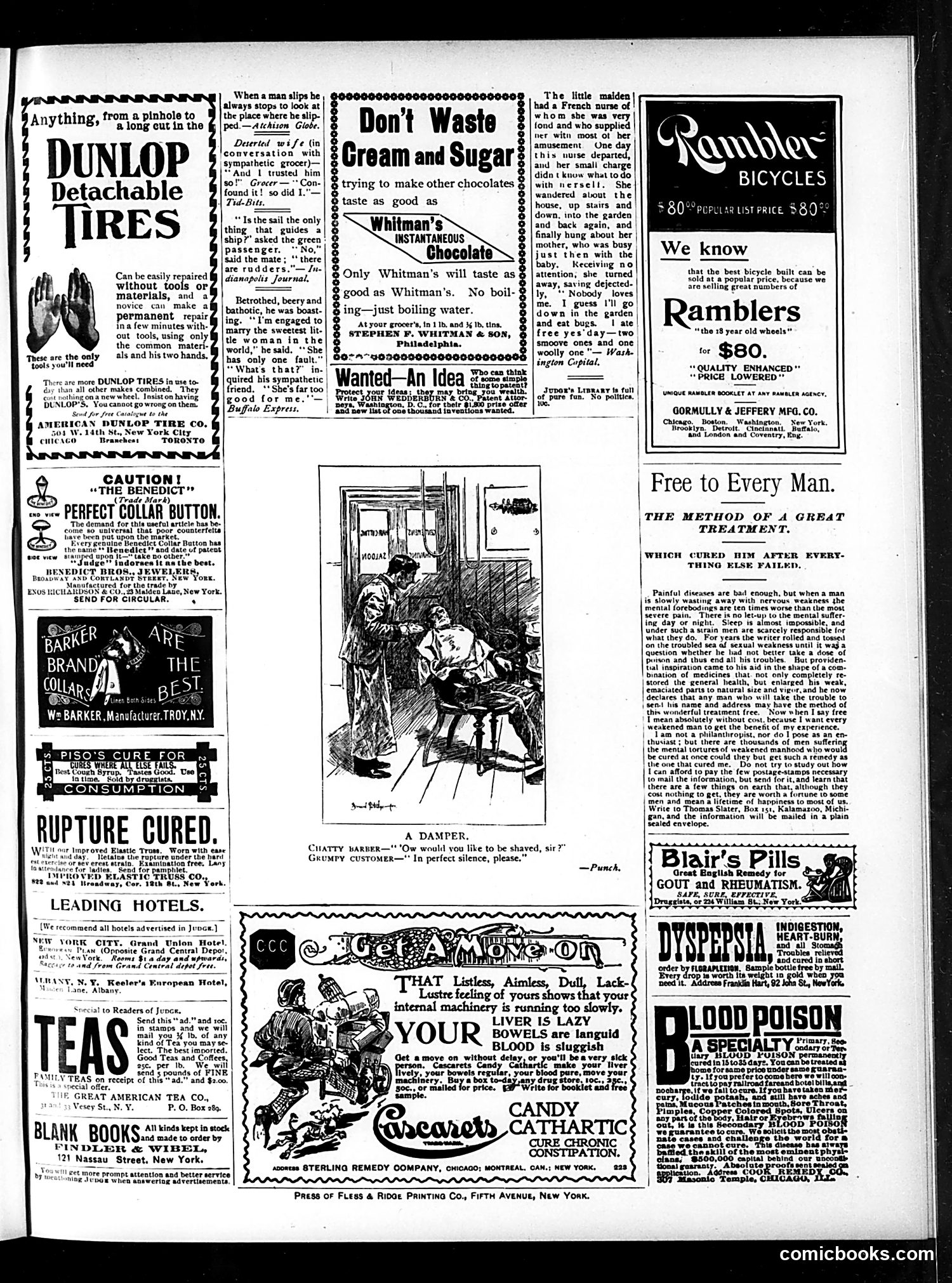
This page is primarily **advertising** interspersed with brief humorous anecdotes and jokes typical of Judge magazine's format. The main cartoon—titled "A Damper"—shows a barber shop scene where a chatty barber asks a grumpy customer how he'd like to be shaved. The customer demands silence, to which the barber replies curtly. The joke satirizes the garrulous nature of barbers, a common stereotype of the era, and the customer's futile attempt to escape their relentless conversation. The page otherwise features period product advertisements (Dunlop tires, Whitman's chocolate, Rambler bicycles, Blair's Pills) and short jokes about everyday life—a woman discussing a broken engagement, a child losing her French nurse, and anecdotes about slips and engagements. The humor reflects early 20th-century middle-class American concerns and social conventions, with no apparent political satire present.
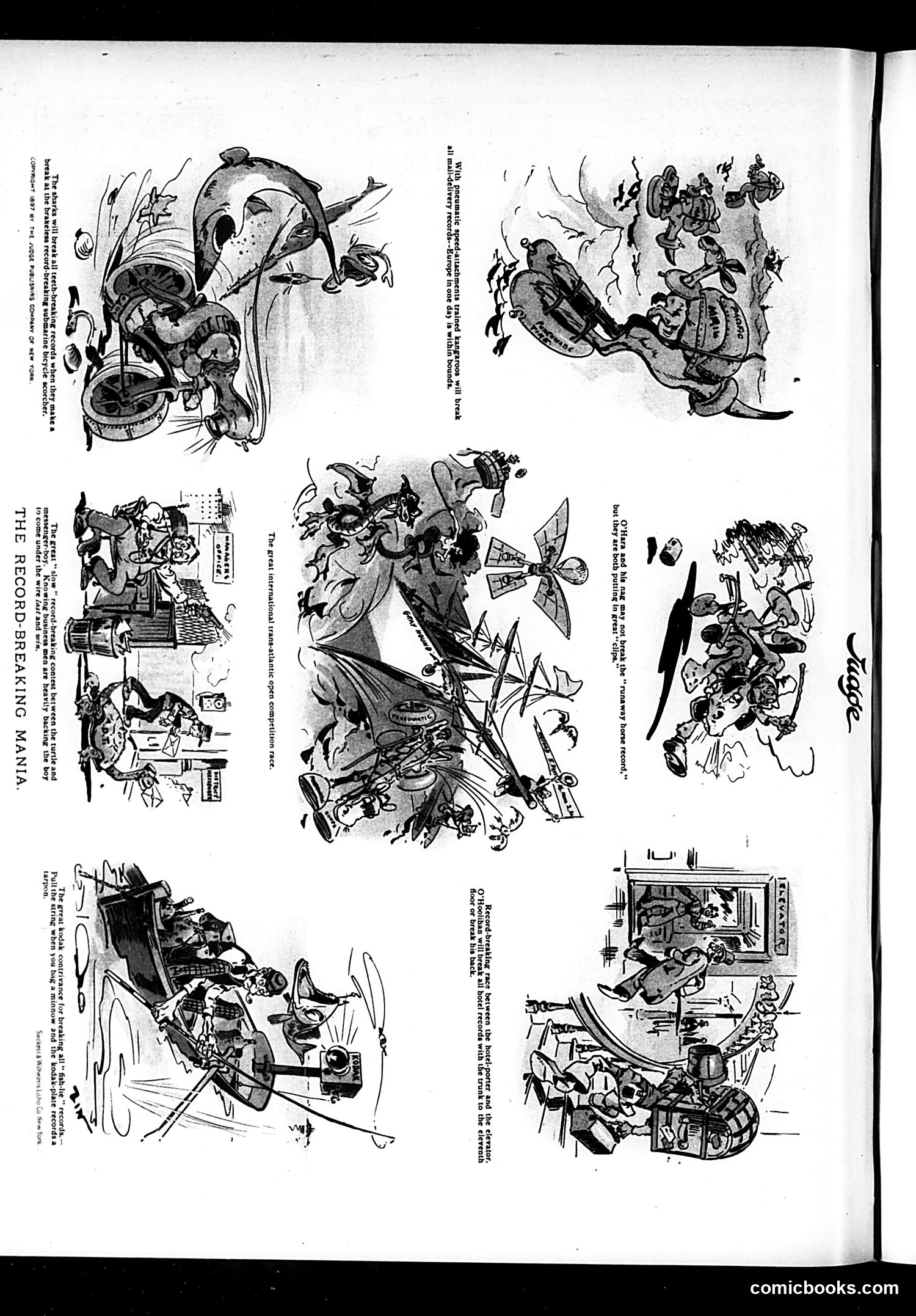
I cannot reliably decode this page. The OCR text is severely corrupted and unreadable, making it impossible to identify the specific political or social references, the figures being caricatured, or the satirical point being made. The page contains six black-and-white cartoon illustrations in Judge's characteristic satirical style, arranged around text blocks. The drawings appear to depict various scenes with multiple figures engaged in action or chaos, but without legible accompanying text, I cannot accurately explain what events, people, or issues they're meant to ridicule. To provide accurate historical context as requested, I would need either clearer OCR text or the original source material. I cannot responsibly guess at political meanings or identities.