
A complete issue · 16 pages · 1897
Judge — February 6, 1897
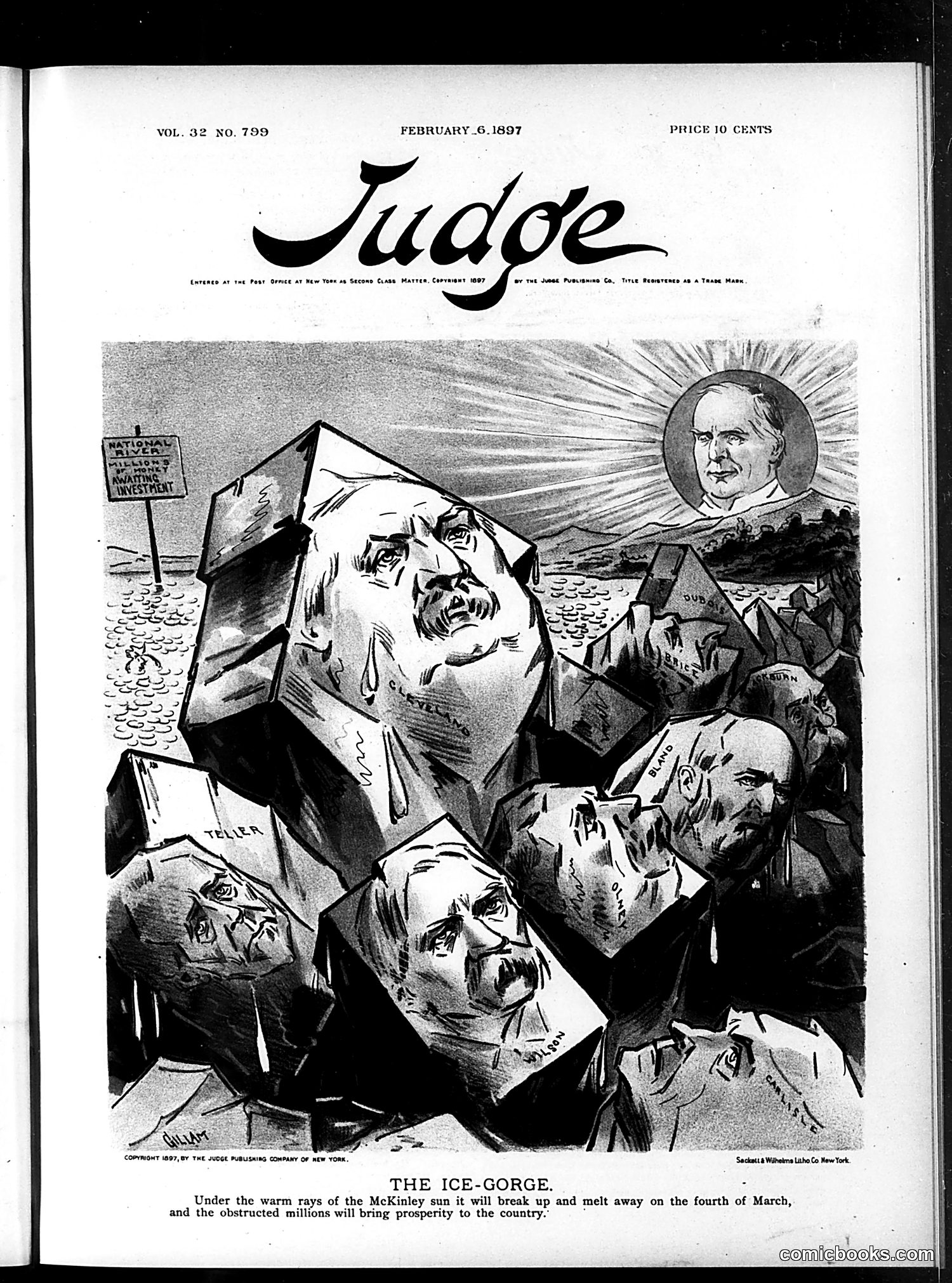
This political cartoon satirizes the obstruction of President McKinley's legislative agenda. The central image depicts a massive ice jam—a real phenomenon that blocked rivers and prevented spring navigation—as a metaphor for political blockage. The "ice-gorge" contains caricatured faces of political opponents (likely Democratic senators or party leaders) literally freezing McKinley's progress. The caption states that when McKinley's "sun" breaks through on March 4th, the obstructions will "melt away on the fourth of March, and the obstructed millions will bring prosperity to the country." The satire equates political obstruction with natural disaster, suggesting Republican obstacles will dissolve once McKinley consolidates power, allowing prosperity to flow to the nation.
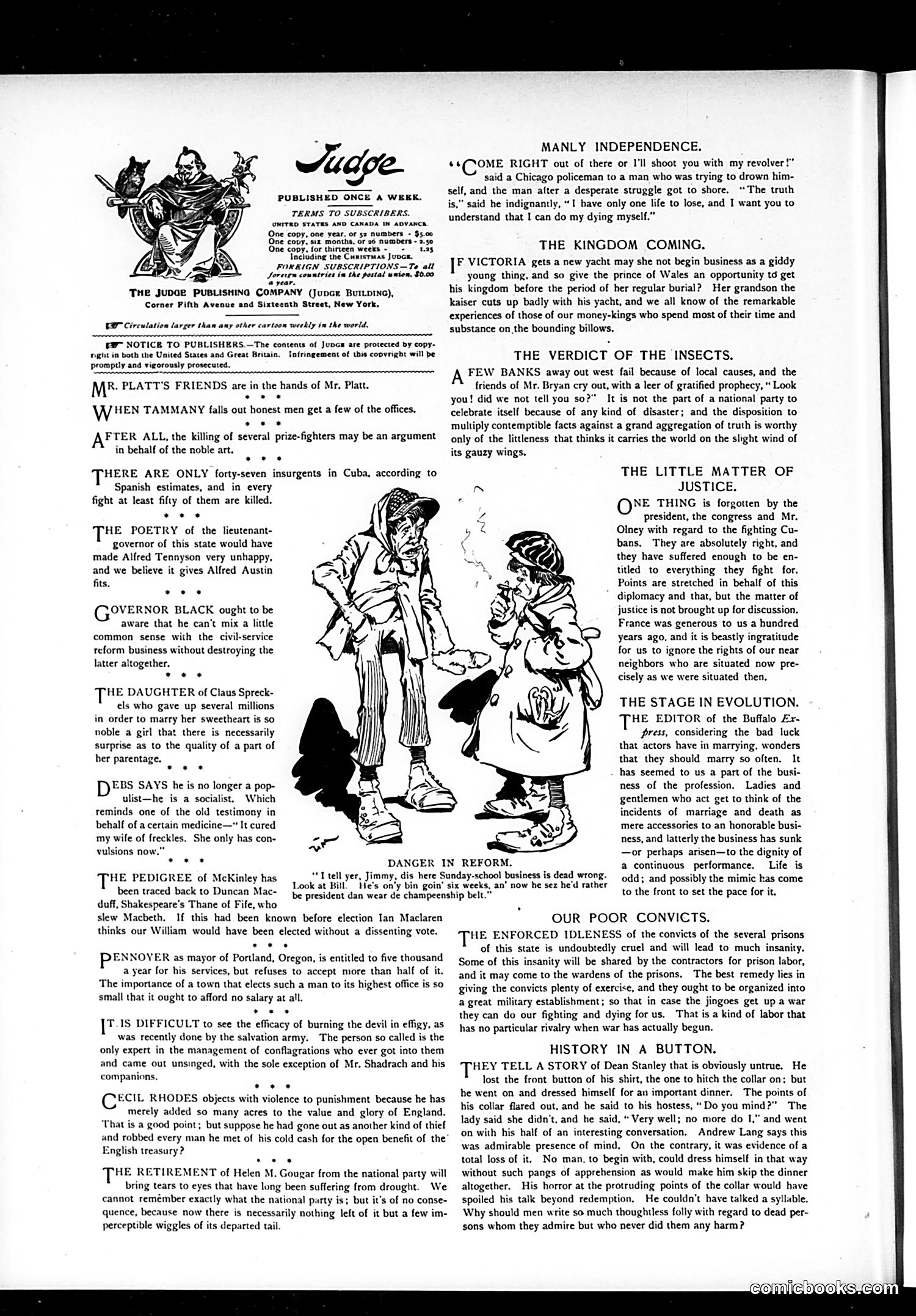
The central cartoon, "Danger in Reform," depicts an adult (appearing to be a reform advocate or politician) warning a child about "Sunday-school business" being "dead wrong." The child responds that the president also wears a championship belt, suggesting hypocrisy—reformers demand moral standards they themselves don't follow. The surrounding editorial snippets critique various targets: politicians' self-serving behavior, the treatment of prize-fighters and Cuban casualties, and inconsistent justice. "The Little Matter of Justice" argues that America ignores neighbors' rights while discussing French generosity from centuries past. Overall, the page satirizes Progressive Era reformers as hypocritical—preaching virtue while ignoring present injustices and maintaining double standards based on class and political convenience.
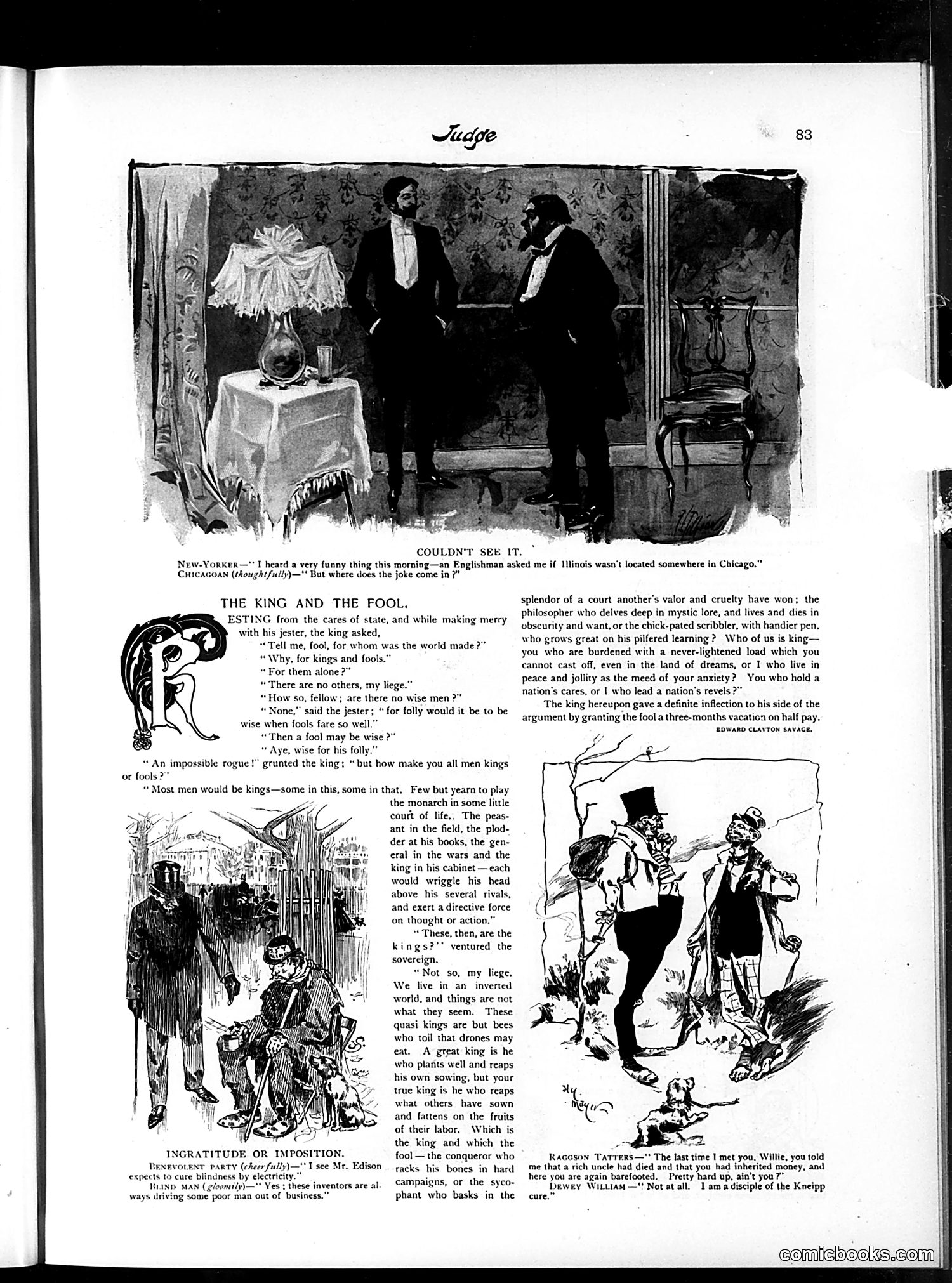
**Top Cartoon "Couldn't See It"**: A New York joke about geographic ignorance—an Englishman asks if Illinois is in Chicago, confusing a state with a city. This satirizes perceived European unfamiliarity with American geography. **Main Story "The King and the Fool"**: A philosophical dialogue where a fool questions a king about governance. The king argues that true kings are those who plant and reap their own labor, while "quasi kings" (conquerors, despots) exploit others. The satire suggests that genuine leadership comes from productive work, not tyranny—likely critiquing Gilded Age robber barons or authoritarian rulers who accumulated wealth through exploitation rather than merit. **Bottom Cartoons**: Appear to be separate satirical vignettes on social pretension and class dynamics, typical of Judge's satirical focus.
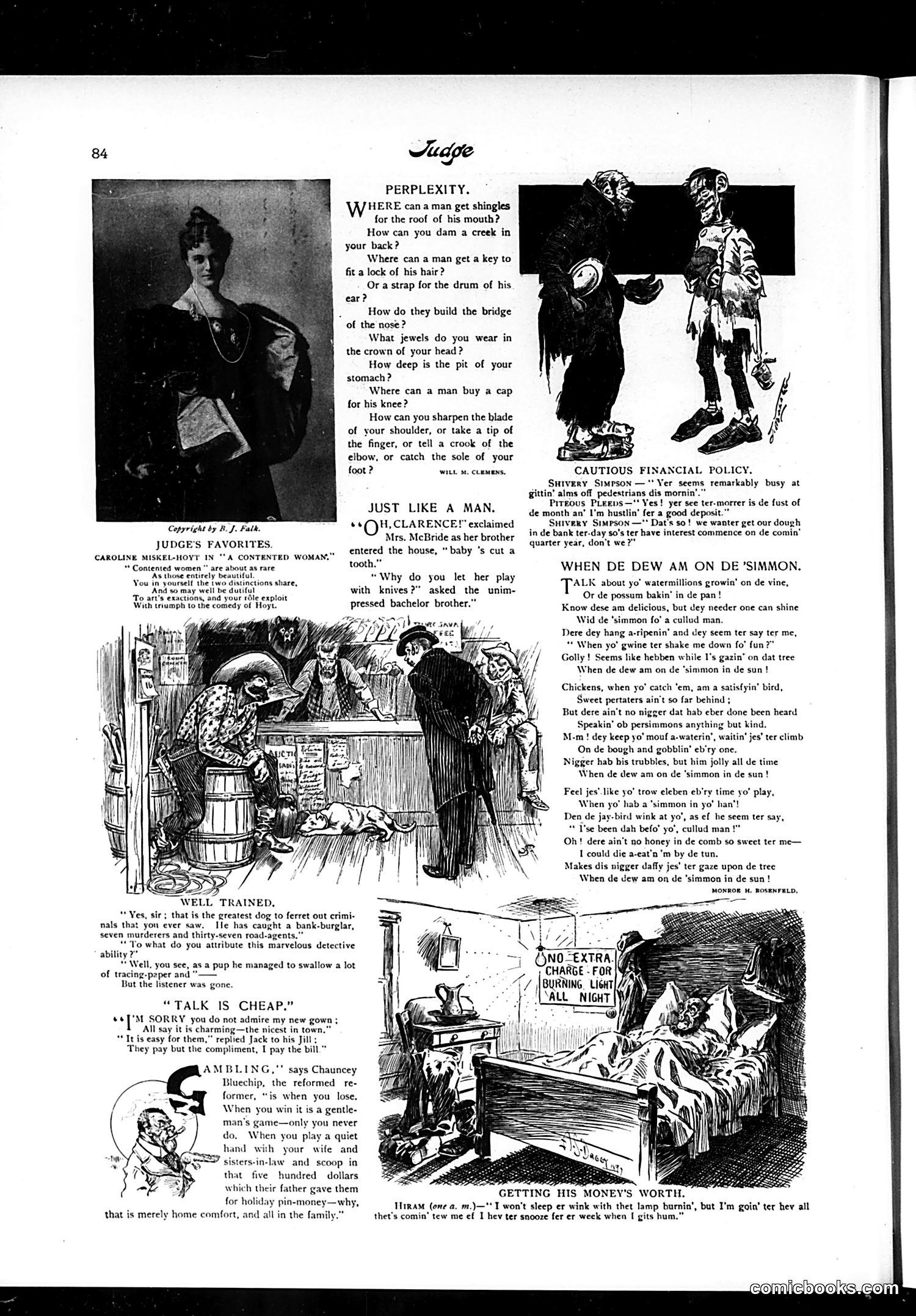
This page contains several satirical pieces typical of early 1900s American humor: **"Perplexity"** is a wordplay joke listing anatomical puns (shingles for a mouth's roof, damming a back creek), exploiting the double meanings of body parts with architectural/construction terms. **"Just Like a Man"** satirizes male bachelor logic—a man questions why a woman lets a baby play with knives after she announces the baby cut a tooth, missing her obvious meaning. **"Cautious Financial Policy"** depicts two street beggars timing their solicitation to coincide with the month's first day, when banks open for deposits—satirizing the poor's understanding of financial systems. **"When De Dew Am On De 'Simmon"** uses racist dialect stereotyping (characteristic of the era) to portray Black affection for persimmons. This reflects period attitudes rather than endorsing them. The remaining items are brief comedic vignettes about marriage finances and gambling ethics. The page emphasizes wordplay, domestic comedy, and social observation humor popular in Judge's satirical format.
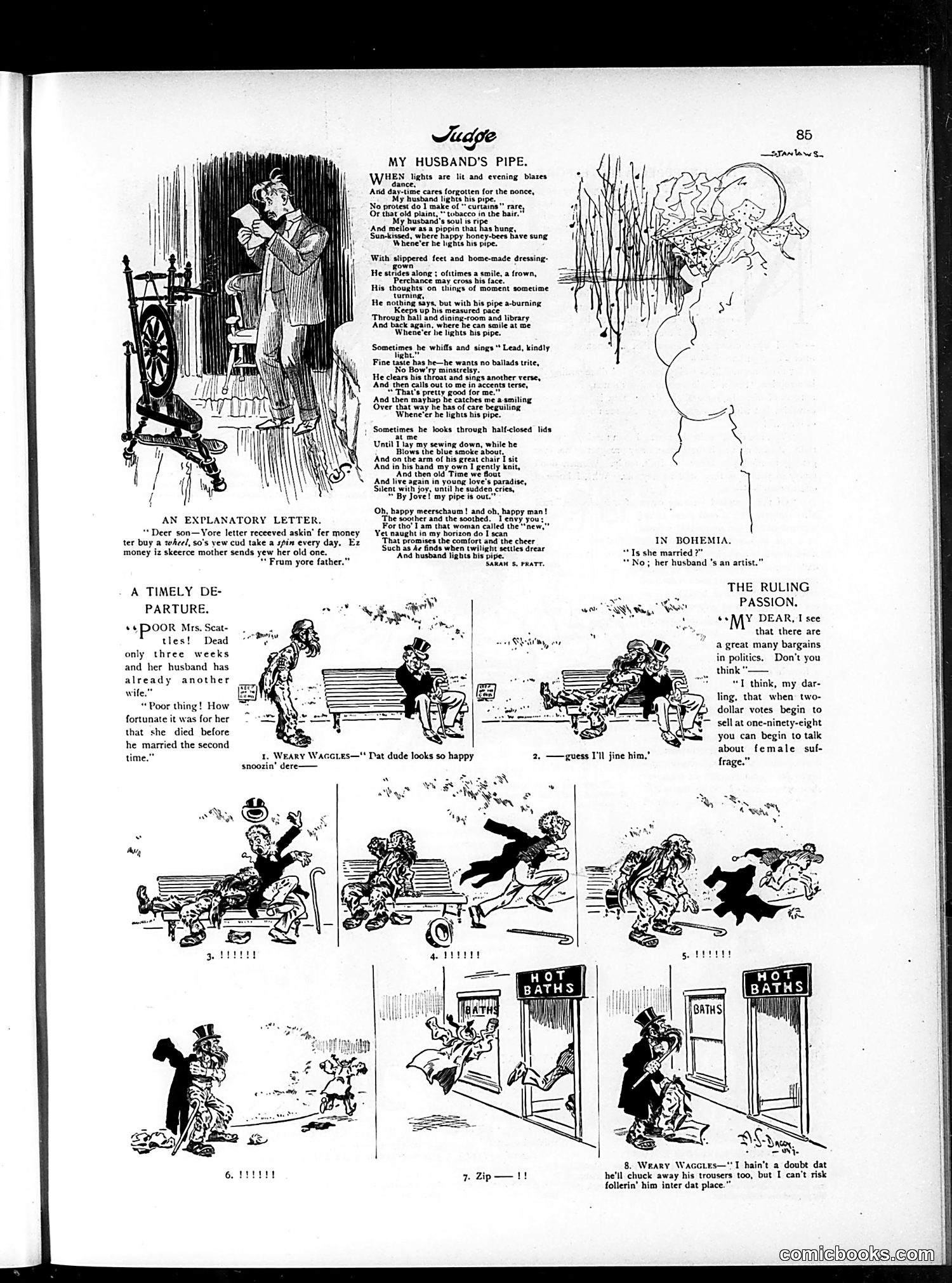
This page contains several satirical pieces typical of early 20th-century American humor: **"My Husband's Pipe"** is sentimental verse celebrating domestic contentment—a husband smoking his pipe in the evening represents peace, tradition, and marital harmony. The satire is gentle, idealizing the dutiful wife finding fulfillment in her husband's comfort. **"A Timely Departure"** satirizes rapid remarriage: a widow barely dead three weeks, yet her widower immediately takes a new wife. The dark joke critiques both hasty matrimony and the callous opportunism of remarriage. **"The Ruling Passion"** mocks female suffrage advocates. A woman discusses "bargains in politics" while her husband dismisses women's voting rights, suggesting female voters are purchasable at cheap prices ("one-ninety-eight"). The satire targets suffragettes as corruptible and unsuited for political participation. **"A Timely Departure"** comic strip shows a vagabond fleeing a hot-bath establishment, satirizing sanitation concerns or discomfort with modern hygiene. The page reflects pre-women's-suffrage attitudes and traditional gender politics of the era.
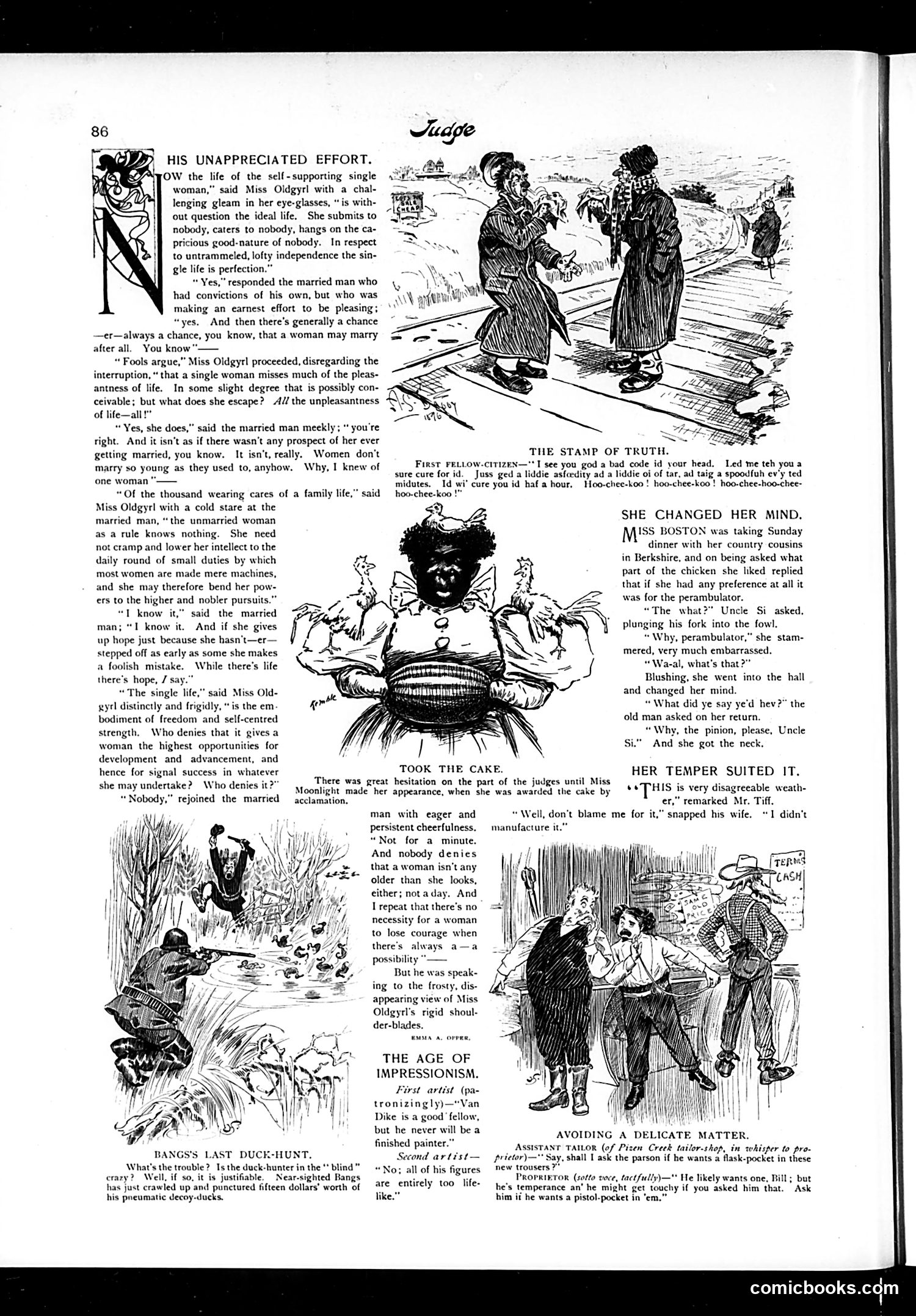
This page contains multiple satirical pieces lampooning social attitudes of the era: **"His Unappreciated Effort"** mocks a self-righteous unmarried woman (Miss Oldgyrl) who lectures about the superiority of single life, while a married man futilely tries to agree with her—only to be rebuffed. The satire targets both her sanctimoniousness and his ineffectual appeasement. **"She Changed Her Mind"** jokes about class/cultural differences: a city woman (Miss Boston) embarrasses herself at rural cousins' dinner by using the word "perambulator" (British term for baby carriage) instead of common poultry names, revealing her pretension. **Other brief pieces** include puns on chicken parts, a joke about a hunter damaging decoys, and marital bickering over weather—all representing typical Judge humor mocking everyday social pretension and domestic friction. The cartoons use exaggerated character types and dialect humor common to early-20th-century American satire, targeting snobbery, failed communication, and gender relations.
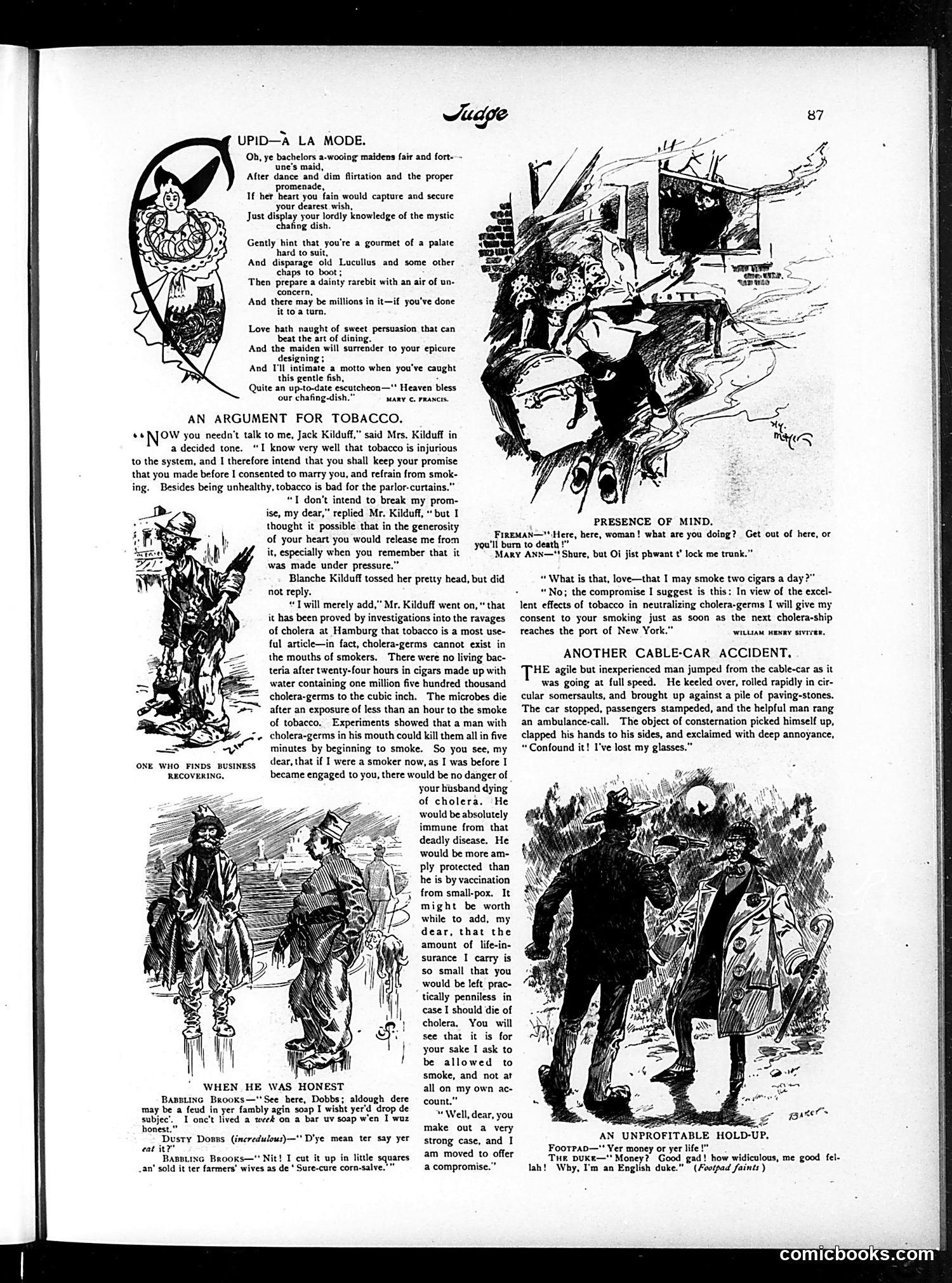
This page contains three satirical pieces mocking courtship, marriage, and social anxieties of the era: **"Cupid à la Mode"** ridicules the notion that culinary skill (specifically mastering a chafing dish) is a romantic tool to win women—poking fun at both masculine pretension and female susceptibility. **"An Argument for Tobacco"** presents Mr. Kilduff deploying increasingly absurd pseudo-scientific claims about tobacco's health benefits (citing Hamburg cholera studies) to convince his wife to release him from a pre-marriage promise not to smoke. His argument becomes transparently self-serving: he adds that his life insurance is meager, so she should *want* him smoking to protect her financially. The satire targets male rationalization and marital power dynamics. **"Another Cable-Car Accident"** offers a brief comic vignette: a man jumps from a moving cable-car, rolls catastrophically, and upon being rescued, complains only about lost eyeglasses—absurd understatement of injury. These reflect early-20th-century concerns: courtship rituals, health fads, marriage negotiations, and urban transportation hazards.
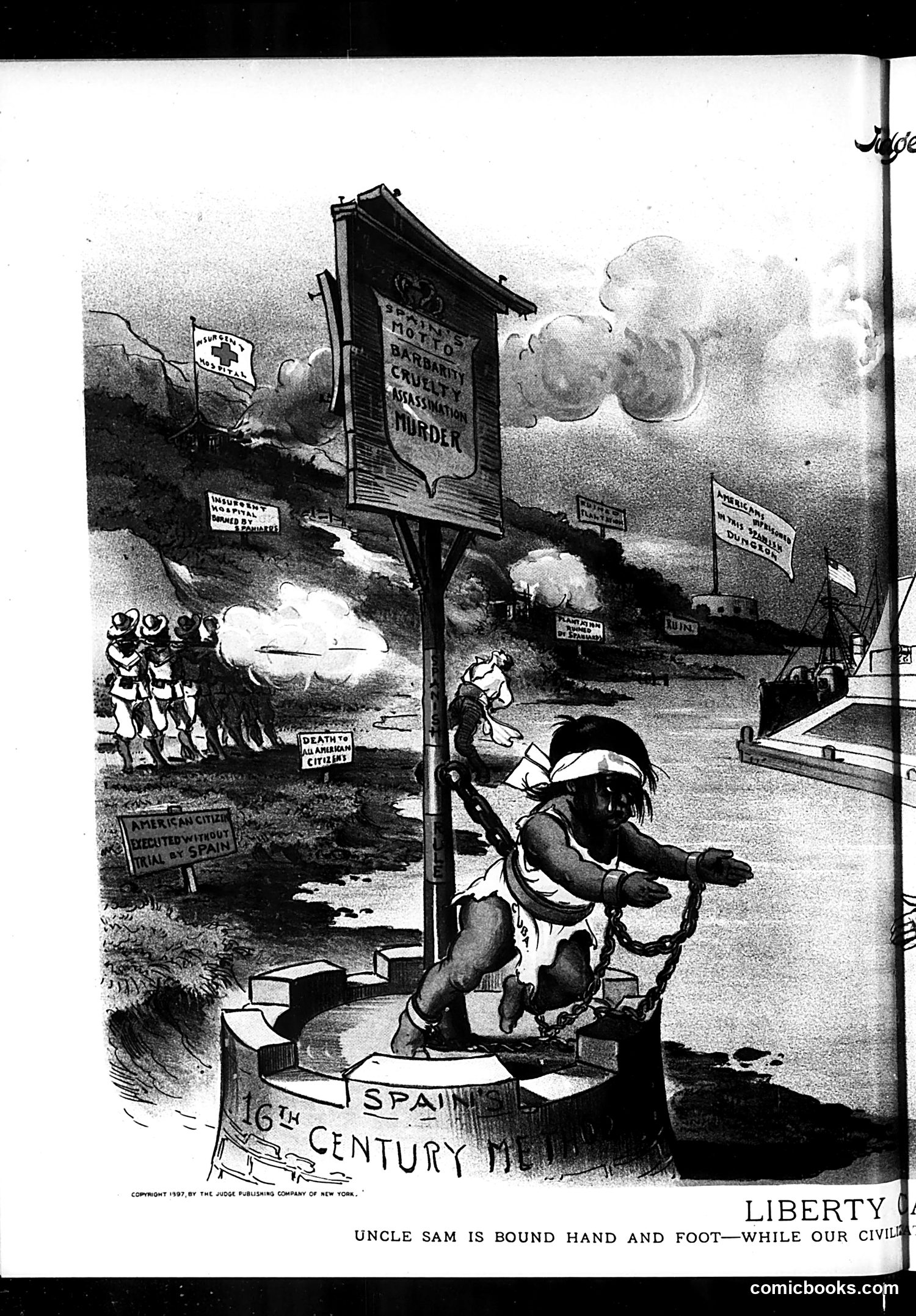
This 1897 Judge magazine cartoon depicts Uncle Sam bound hand and foot, unable to act. The central figure appears to be Spain, shown as a captor or aggressor. The background shows violent conflict labeled "Death to American Citizens" and references "American Citizen Executed Without Trial in Spain." The cartoon critiques American passivity regarding Spanish atrocities, likely referencing the Spanish-American tensions preceding the 1898 war—particularly Spanish colonial brutality in Cuba. The sign reading "Barbarity, Cruelty, Assassination, Murder" indicts Spanish conduct. The titular phrase "UNCLE SAM IS BOUND HAND AND FOOT—WHILE OUR CIVIL[...]" (text cut off) suggests America's inability or unwillingness to intervene despite witnessing injustice. The "16th Century" label on Spain implies the cartoon views Spanish imperialism as anachronistic and barbaric. The satire urges American action against Spanish colonialism.
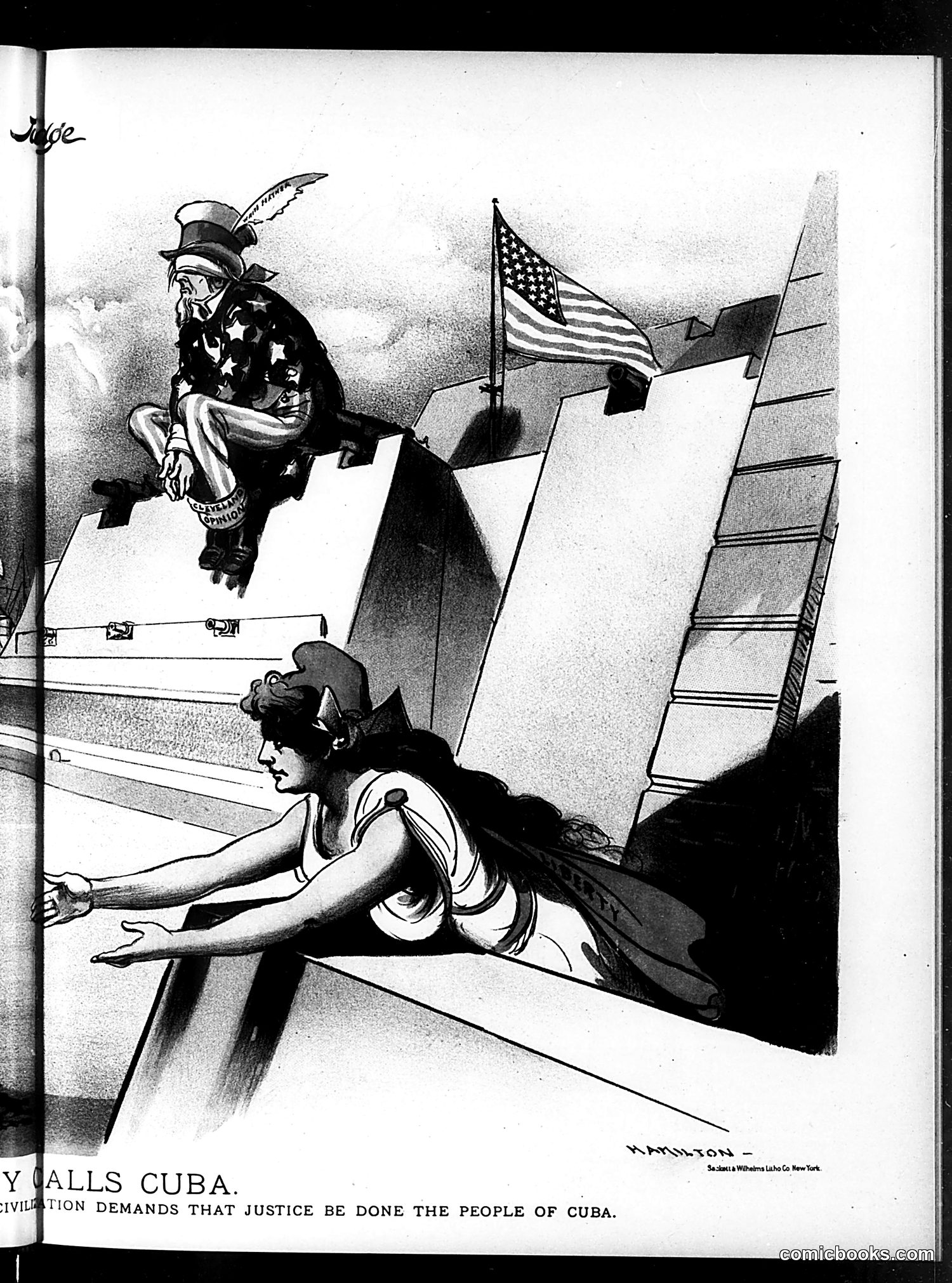
This political cartoon from *Judge* magazine depicts Uncle Sam (the bearded figure in starred coat) perched above a female figure representing Cuba. The caption reads "CIVILIZATION DEMANDS THAT JUSTICE BE DONE THE PEOPLE OF CUBA." The cartoon satirizes American interventionism regarding Cuba, likely referencing debates over U.S. involvement in Cuban affairs during the late 19th or early 20th century. Uncle Sam's elevated, controlling position above the feminized Cuba figure suggests American paternalism—the claim that the U.S. must "civilize" or "save" Cuba supposedly for its own good. The satire critiques this rhetoric as self-serving justification for American imperialism and political domination, rather than genuine humanitarian concern. The artist appears skeptical of such "civilizing" rhetoric masking colonial ambitions.
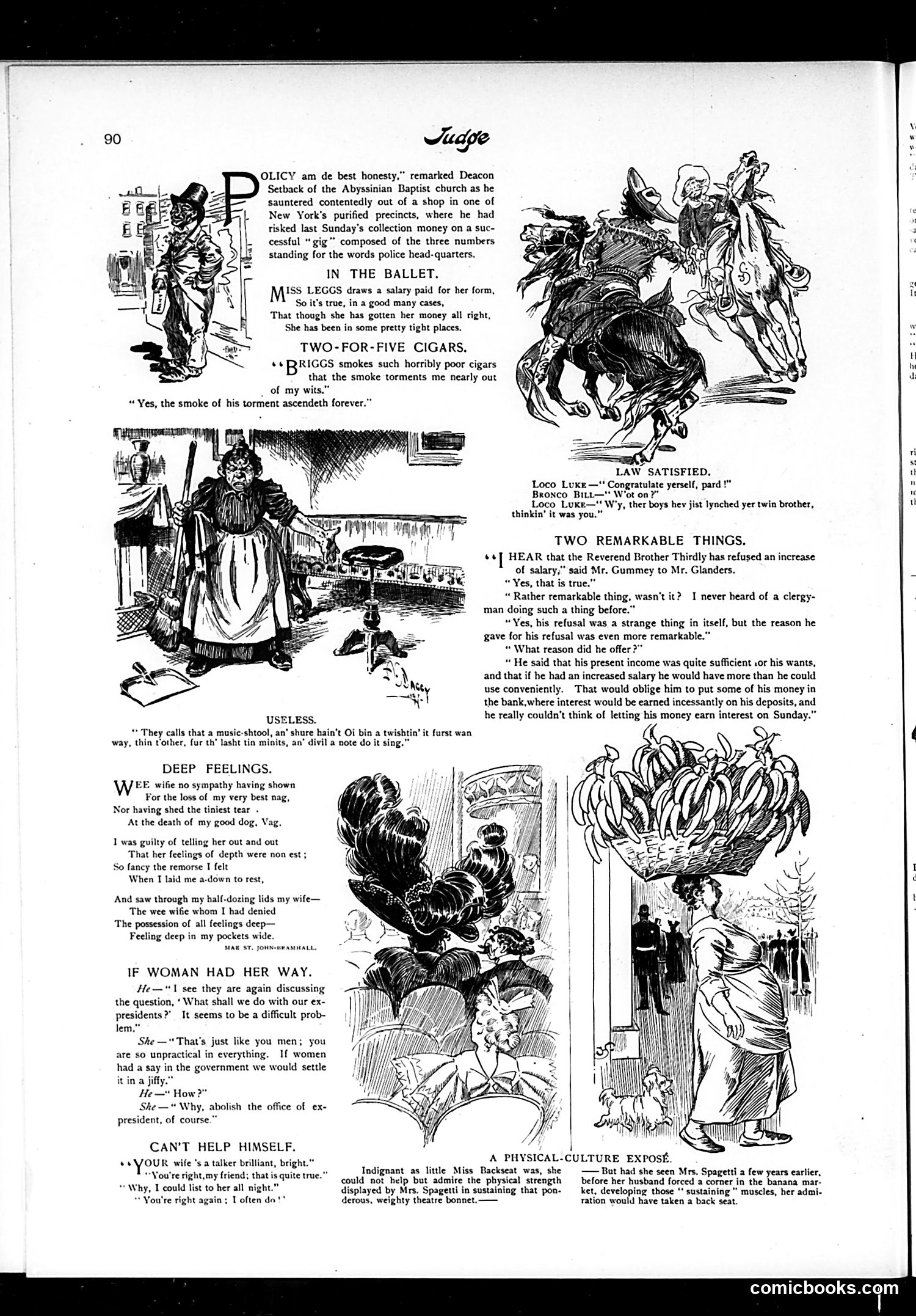
This page contains multiple short satirical pieces typical of early 20th-century American humor magazines: **"Policy"** mocks a church deacon who gambles away the Sunday collection on numbers betting—satirizing both religious hypocrisy and the illegal "numbers game" (a form of gambling popular in working-class neighborhoods). **"In the Ballet"** and **"Two-for-Five Cigars"** are brief, crude jabs: the first suggests a ballet dancer has "earned" money through morally questionable means; the second is a domestic complaint about a husband's cheap cigars. **"If Woman Had Her Way"** satirizes women's perceived incompetence in governance—a common anti-suffrage trope of the era, suggesting women would make absurd decisions like abolishing the presidency. **"Law Satisfied"** appears to be dark humor about a lynching, suggesting mistaken identity. **"Two Remarkable Things"** satirizes clerical greed masked as piety—a reverend refuses a raise claiming he couldn't ethically earn interest income on Sundays. **"Physical-Culture Exposé"** jokes that a woman's impressive musculature comes from years of physical labor, not genteel exercise. The overall tone reflects period attitudes toward class, gender, and religion.
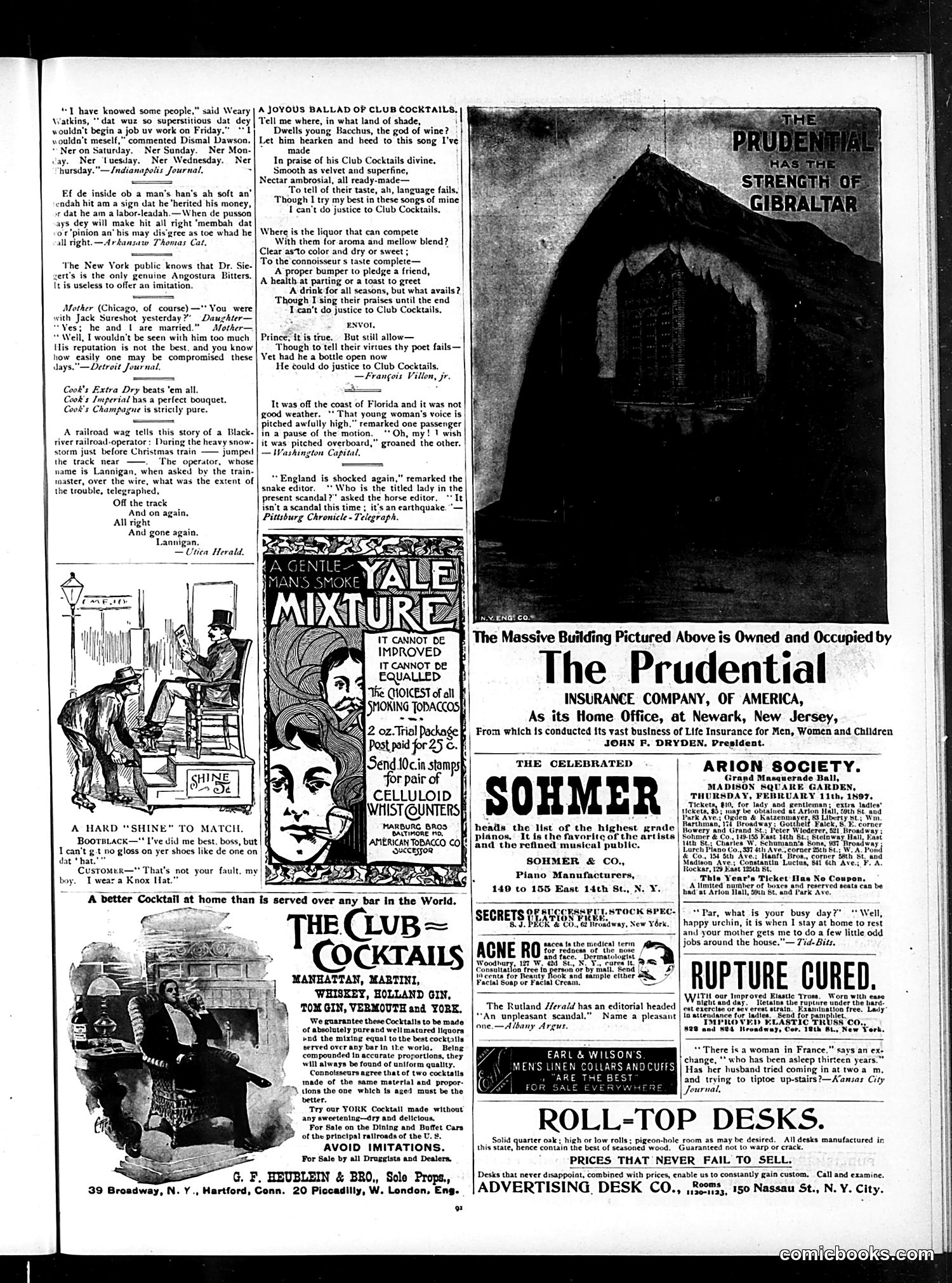
This page from *Judge* magazine is primarily **advertising and light humor**, not political satire. The dominant content advertises cocktails and related products—reflecting the pre-Prohibition era when alcohol advertising was common in publications. The cartoons are mild social commentary: 1. **"A Hard Shine to Match"** depicts a bootblack unable to match his work to a customer's shoes—a joke about quality standards, not political critique. 2. **"Club Cocktails" poem** is whimsical advertising verse praising mixed drinks, playfully suggesting even the poet can't adequately praise them (the "Envoi" jokes that having a bottle open would help). The page's scattered anecdotes mock superstition and gossip but carry no deeper political meaning. The *Prudential Insurance* building advertisement and *Sohmer Piano* ads indicate this is a general-audience magazine mixing humor with commerce—typical of early 20th-century American publishing before *Judge* became more explicitly political.
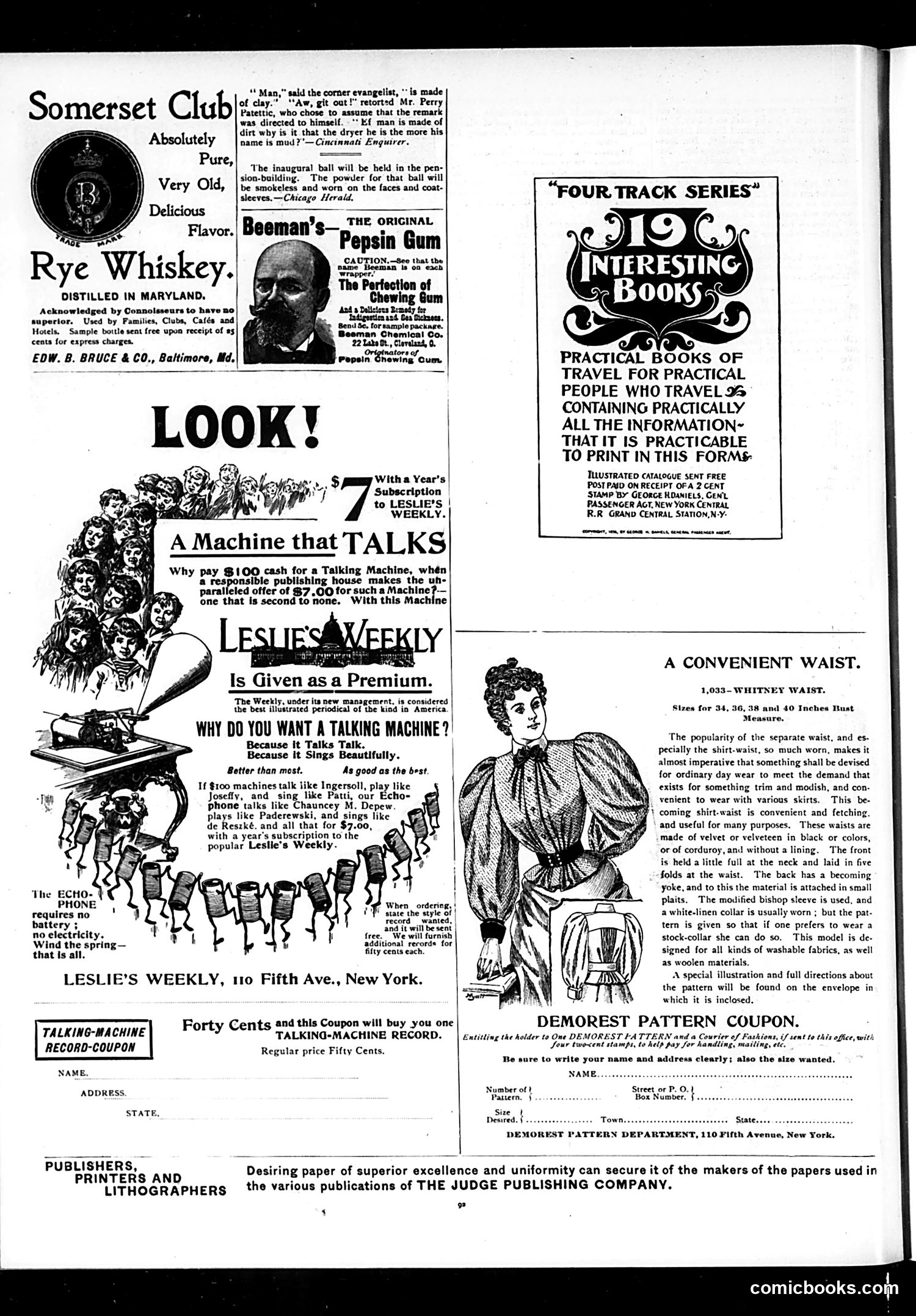
This page is primarily **advertising and promotional content** rather than political satire. The main elements include: **Advertisements:** - Somerset Club Rye Whiskey (Maryland distilled) - Beeman's Popsin Chewing Gum - Leslie's Weekly magazine promoting a "$7 talking machine" phonograph as a subscription premium - Four Track Series travel guides - Demorest Pattern Company fashion coupon for a "Whitney Waist" **Minor satirical content:** At the top, there are brief joke excerpts from newspapers (Cincinnati Enquirer, Chicago Herald) about mundane topics—a pun about "mud" and a joke about inaugural ball powder—but these are fillers, not the page's focus. **Historical context:** This appears to be early 1900s advertising aimed at middle-class consumers, showcasing new consumer goods (talking machines, ready-to-wear clothing patterns) and leisure publications. The page reflects the era's marketing strategies and consumer culture rather than containing political commentary.
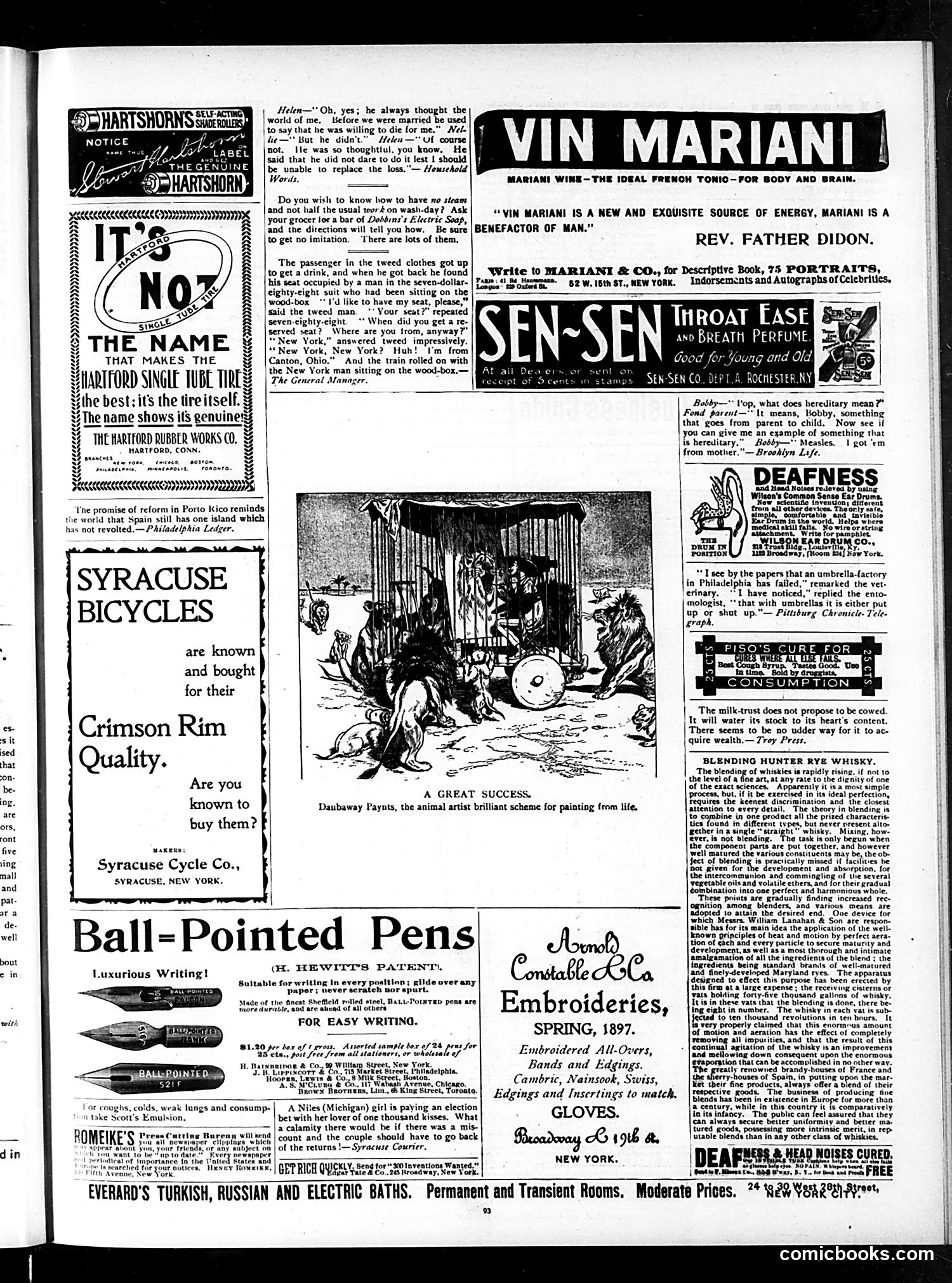
This page is primarily **advertising**, typical of late 19th-century magazines. Notable ads include Vin Mariani (a cocaine-containing wine tonic endorsed by "Rev. Father Didon"), Piso's Consumption Cure, and various patent medicines—products now recognized as fraudulent or dangerous. The page includes several **brief humorous anecdotes** rather than political cartoons: - A dialogue about a husband's thoughtfulness regarding his wife's jewelry - A train-seat dispute between a traveler from New York and one from Canton, Ohio (likely satirizing regional American differences and class assumptions) - A joke about "hereditary" measles - A pun about a milk-trust "watering its stock" - A reference to an umbrella factory failure The **central illustration** depicts "Daubaway Paynts, the animal artist," using a "brilliant scheme for painting from life"—appears to show an artist in a barn or stable setting, though the specific satirical point is unclear without additional context. The content reflects Judge's mix of social observation and product promotion typical of the era.
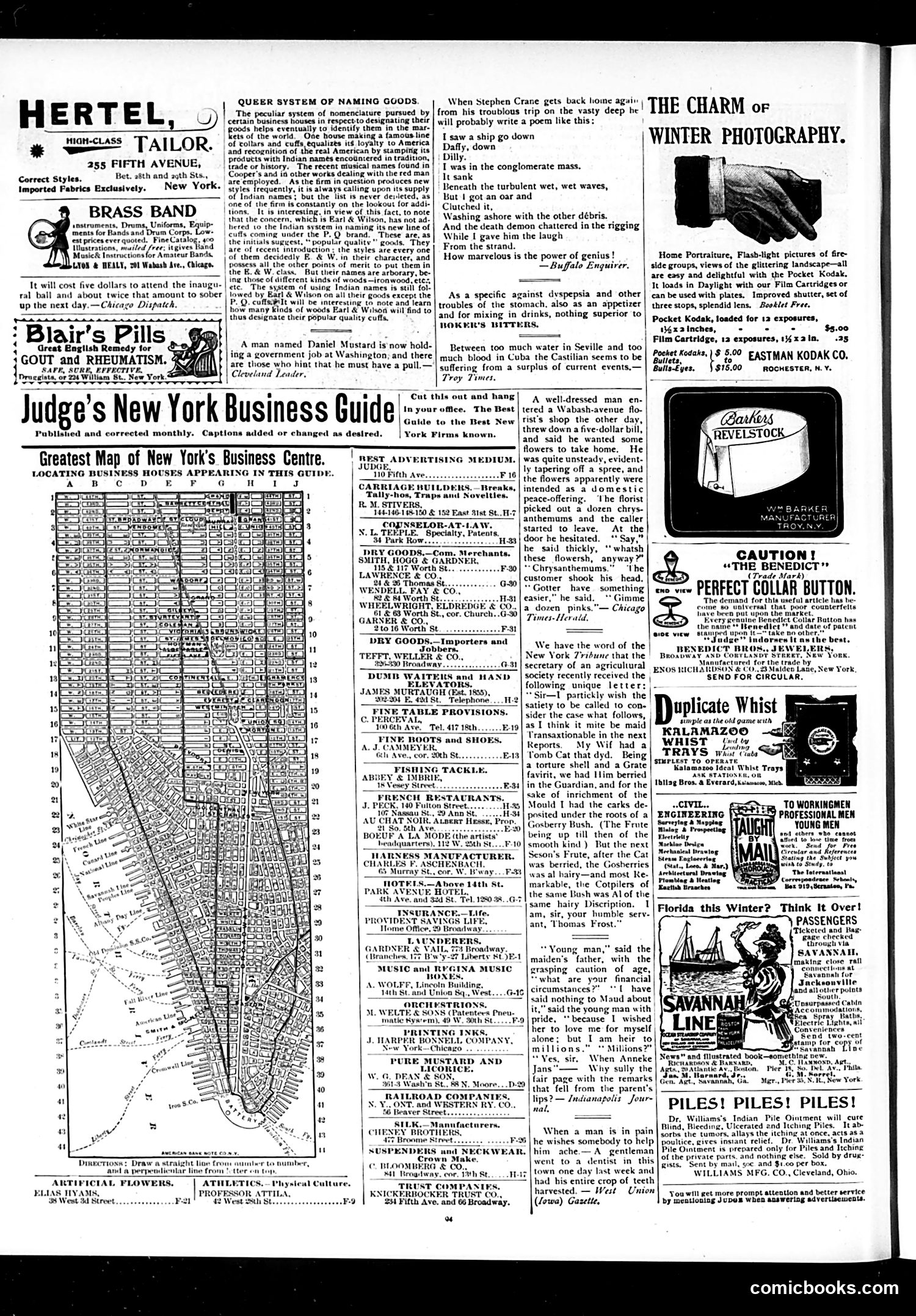
This page is primarily **advertising and business directory**, not political satire. However, it contains several humorous brief items: **"Queer System of Naming Goods"** mocks Earl & Wilson's inconsistency: they name their Indian-branded collars after Native American tribal names (following a trendy naming practice), but inexplicably switch to wood names (ironwood, etc.) for their cheaper "PQ" line. The satire suggests arbitrary, unconvincing marketing. **Stephen Crane joke**: References the author's recent maritime ordeal, satirizing how he'd likely compose overwrought poetry about it—mocking Crane's florid, affected literary style. **Daniel Mustard joke**: A pun on the name "Mustard" holding government office, suggesting only political connections ("a pull") explain hiring someone with such an absurd name. The rest comprises advertisements for tailors, brass bands, medical products, and Kodak cameras—typical Judge magazine filler.
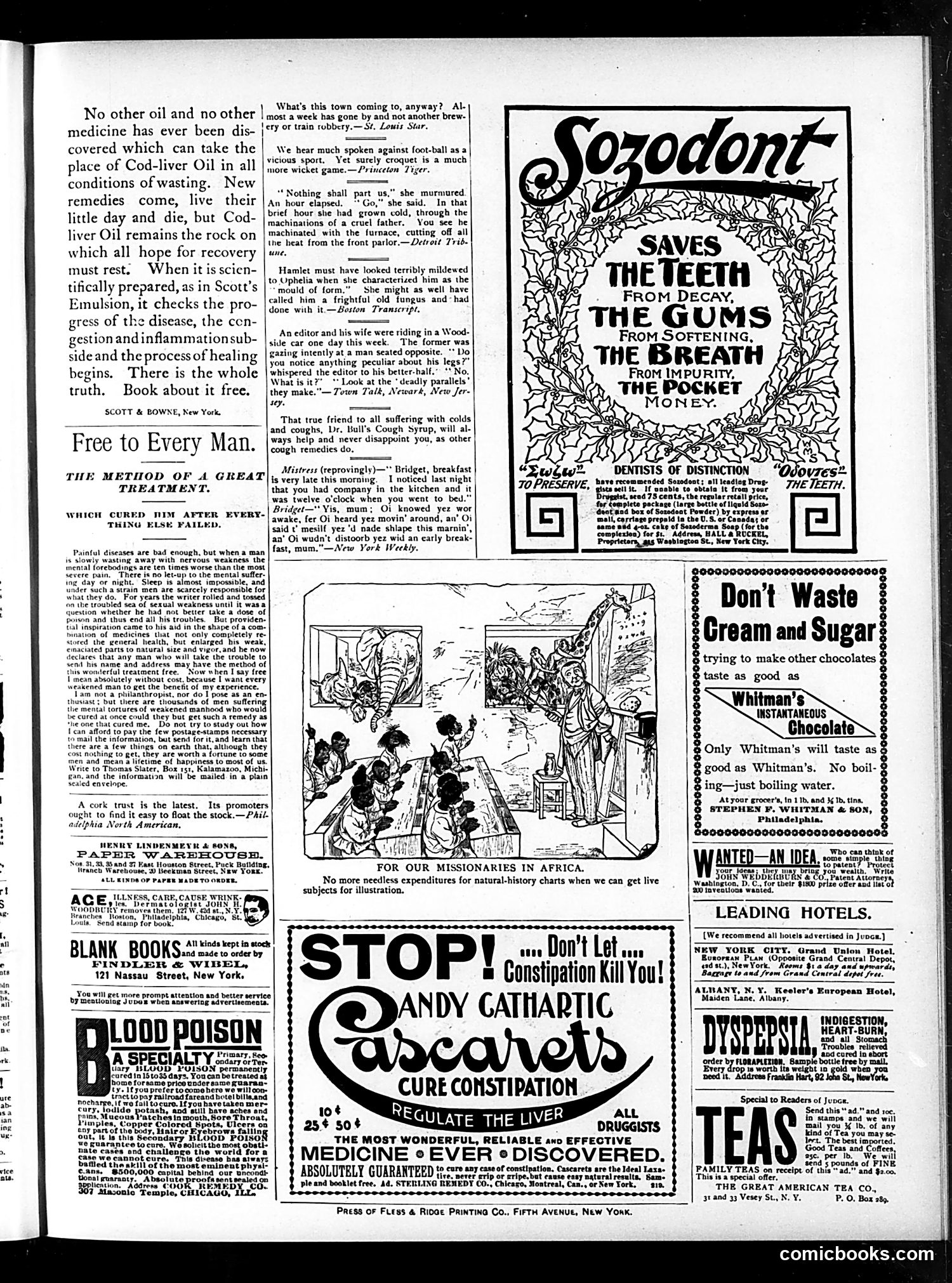
This page is primarily **advertising and filler content**, not political satire. The visible cartoons are minimal; most of the page contains patent medicine ads and commercial notices typical of early 20th-century magazines. The small comic snippets scattered throughout are brief, non-political quips—humorous observations about everyday life (a town with no recent crimes, croquet being dangerous, a furnace cutting off heat during a romantic moment, etc.). These are gentle jokes, not satire. The advertisements dominate: Scott's Emulsion (cod liver oil), treatments for "nervous weakness" and "blood poison," Sozodont toothpaste, Sandy Cathartic laxatives, and various other patent medicines. These reveal the era's medical attitudes—promoting dubious remedies as cure-alls. **No clear political content or caricatured figures** are evident in the cartoons shown. This appears to be a standard Judge issue mixing light humor with the revenue-generating advertisements that subsidized magazine publishing at this time.
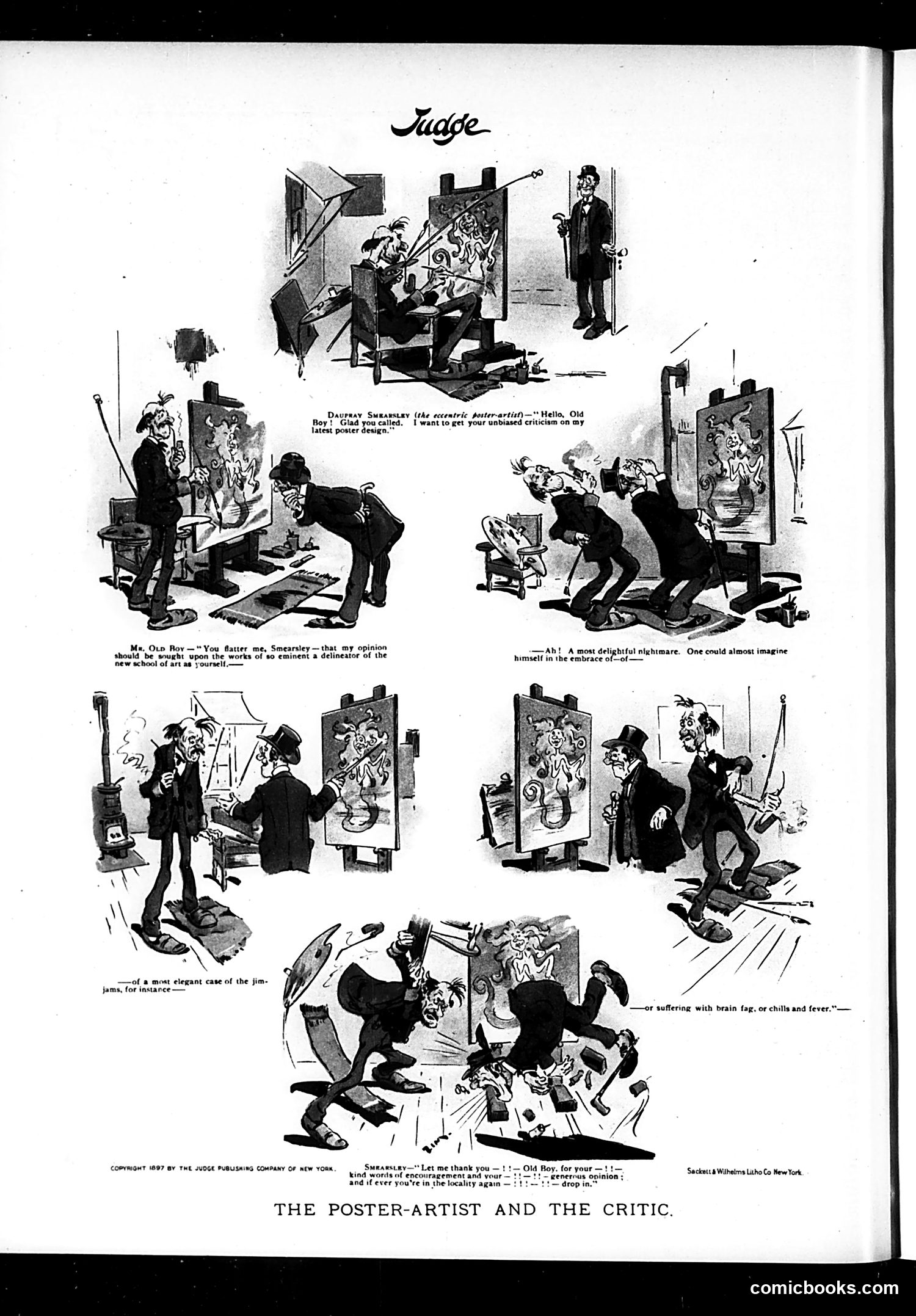
This 1897 *Judge* satire mocks the emerging "Art Nouveau" poster movement and artistic pretension. A flamboyant poster-artist named "Daureay Smearsley" seeks criticism from "Old Boy," a conventional critic, on his garish, chaotic designs. The joke: Smearsley's posters are deliberately ugly and incomprehensible—swirling, distorted figures that look like "the jim-jams" (delirium tremens hallucinations). Yet he affects great artistic importance, calling himself "eminent" while producing visual garbage. The satire targets two things: avant-garde artists' self-seriousness despite creating bewildering work, and critics' pretense at understanding modern art movements they find baffling. The cartoonist suggests that "new school" poster art is essentially nonsensical—a diagnostic symptom of artistic madness rather than legitimate creativity. This reflects conservative Victorian resistance to modernist aesthetics emerging in the 1890s.