
Judge, 1897-02-06 · page 2 of 16
Judge — February 6, 1897 — page 2: what you’re looking at
What you’re looking at
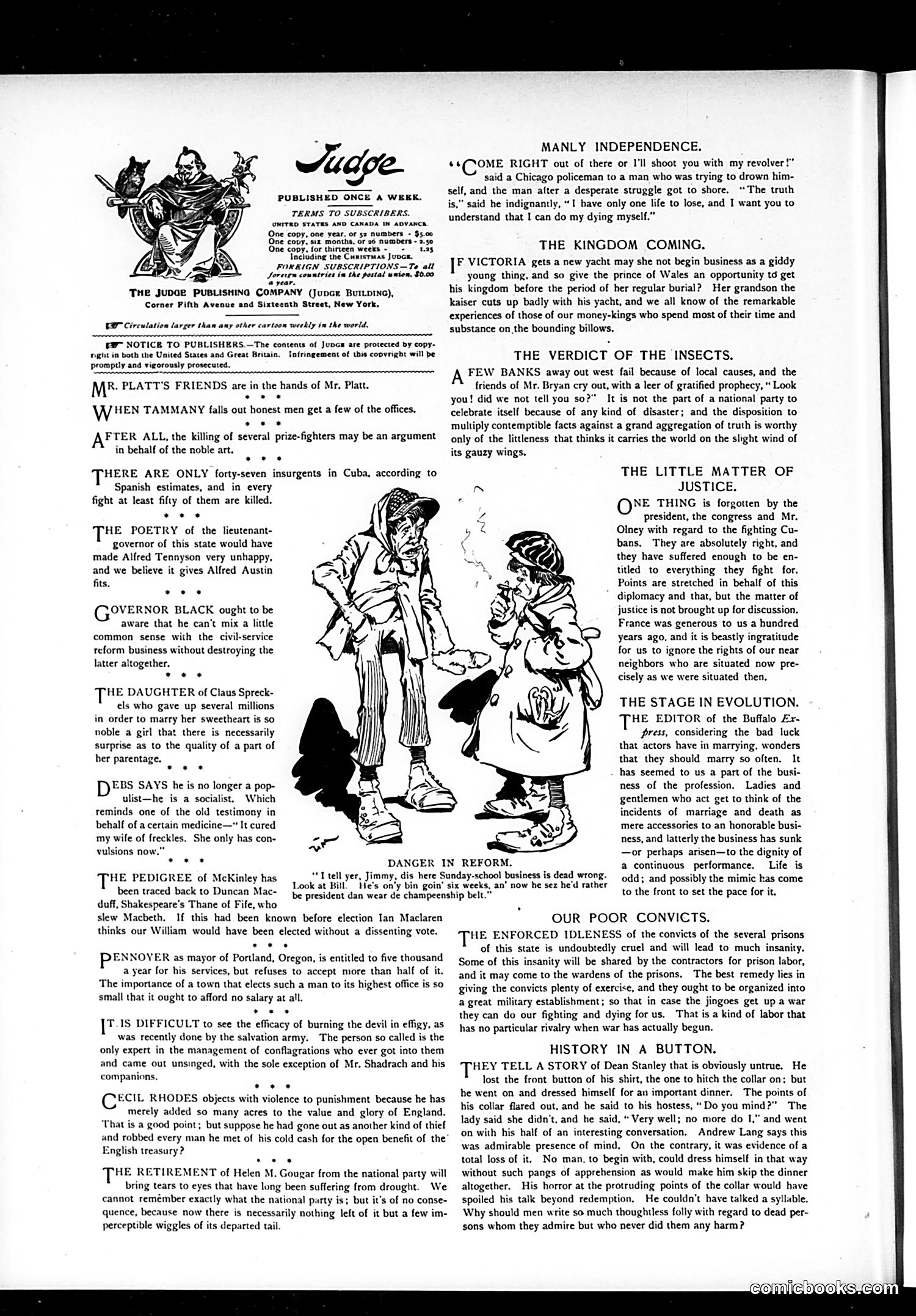
The central cartoon, "Danger in Reform," depicts an adult (appearing to be a reform advocate or politician) warning a child about "Sunday-school business" being "dead wrong." The child responds that the president also wears a championship belt, suggesting hypocrisy—reformers demand moral standards they themselves don't follow. The surrounding editorial snippets critique various targets: politicians' self-serving behavior, the treatment of prize-fighters and Cuban casualties, and inconsistent justice. "The Little Matter of Justice" argues that America ignores neighbors' rights while discussing French generosity from centuries past. Overall, the page satirizes Progressive Era reformers as hypocritical—preaching virtue while ignoring present injustices and maintaining double standards based on class and political convenience.
📄 Transcribed text from this page (OCR, searchable)
Machine-transcribed from the original scan — historical spelling and the odd misread are preserved.
PUBLISHED ONCE A WEEK. TERMS TO SUBSCRIBERS. UNITED STATES AND CANADA IN ADVANCE One copy, one year. or $2 numbers - $5.00 One copy, six months, or 26 numbers - 2.50 One copy, for thirteen weeks - = 1.25 Incliding the Cunistmas Juocx. FORBIGN SUBSCRIPTIONS —Te alt Soreven countries im the postal union, $0.00 ‘a year. THE JUDGE PUBLISHING COMPANY (Jupce BuILpING), Corner Fifth Avenue and Sixteenth Street, New York. §@- Circulation larger than any other cartoon weekly in the world. 2 NOTICE TO PUBLISHERS.—The contents of Juoce are protected by copy- right in both the United States and Great Britain. Tofringement of this copyright will be Promptly and vigorously prosecuted, M®- PLATT’S FRIENDS are in the hands of Mr. Platt. cee WHEN TAMMANY falls out honest men get a few of the offices. eee AFTER ALL, the killing of several prize-fghters may be an argument in behalf of the noble art. e- THERE ARE ONLY forty-seven insurgents in Cuba, according to Spanish estimates, and in every fight at least fifty of them are killed. eee HE POETRY of the lieutenant- governor of this state would have made Alfred Tennyson very unhappy, and we believe it gives Alfred Austin fits. eee GOVERNOR BLACK ought to be aware that he can’t mix a little common sense with the civil-service reform business without destroying the latter altogether. eee THE DAUGHTER of Claus Spreck- els who gave up several millions in order to marry her sweetheart is so noble a girl that there is necessarily surprise as to the quality of a part of her parentage. . . DEBS SAYS he is no longer a pop- ulist—he is a socialist. Which reminds one of the old testimony in behalf of a certain medicine—* It cured my wife of freckles. She only has con- -— vulsions now.” ™~ se THE PEDIGREE of McKinley has been traced back to Duncan Mac- duff, Shakespeare’s Thane of Fife, who slew Macbeth. If this had been known before election Ian Maclaren thinks our William would have been elected without a dissenting vote. OVER as mayor of Portland, Oregon, is entitled to five thousand a year for his services, but refuses to accept more than half of it. The importance of a town that elects such a man to its highest office is so small that it ought to afford no salary at all. It IS DIFFICULT to see the efficacy of burning the devil in effigy, as was recently done by the salvation army. The person so called is the only expert in the management of conflagrations who ever got into them and came out unsinged, with the sole exception of Mr. Shadrach and his companions, Look at Bill E eee CECIL RHODES objects with violence to punishment because he has merely added so many acres to the value and glory of England. ‘That is a good point; but suppose he had gone out as another kind of thief ind robbed every man he met of his cold cash for the open benefit of the’ English treasury? eee THE RETIREMENT of Helen M. Gougar from the national party will bring tears to eyes that have long been suffering from drought. We cannot remémber exactly what the national party is; but it’s of no conse- quence, because now there is necessarily nothing left of it but a few im- perceptible wiggles of its departed tail. DANGER IN REFORM. “Ttell yer, Jimmy, dis here Sunday-school business is dead wrong. tie's on’y bin goin’ six weeks, an’ now he sez he'd rather be president dan wear de champeenship belt.” MANLY INDEPENDENCE. $4(COME RIGHT out of there or I'll shoot you with my revolver!” said a Chicago policeman to a man who was trying to drown him- self, and the man alter a desperate struggle got to shore. “The truth is," said he indignantly, “1 have only one life to lose, and I want you to understand that I can do my dying myself.” THE KINGDOM COMING. [F VICTORIA gets a new yacht may she not begin business as a giddy young thing, and so give the prince of Wales an opportunity to get his kingdom before the period of her regular burial? Her grandson the kaiser cuts up badly with his yacht, and we all know of the remarkable experiences of those of our money-kings who spend most of their time and substance onthe bounding billows. THE VERDICT OF THE INSECTS. FEW BANKS away out west fail because of local causes, and the friends of Mr. Bryan cry out, with a leer of gratified prophecy, “ Look you! did we not tell you so?” It is not the part of a national party to celebrate itself because of any kind of disaster; and the disposition to multiply contemptible facts against a grand aggregation of truth is worthy only of the littleness that thinks it carries the world on the slight wind of its gauzy wings. THE LITTLE MATTER OF Nn JUSTICE. ONE THING is forgotten by the president, the congress and Mr. Olney with regard to the fighting Cu- bans. They are absolutely right, and they have suffered enough to be en- titled to everything they fight for. Points are stretched in behalf of this diplomacy and that, but the matter of justice is not brought up for discussion. France was generous to us a hundred years ago, and it is beastly ingratitude for us to ignore the rights of our near neighbors who are situated now pre- cisely as we were situated then, THE STAGE IN EVOLUTION. THE EDITOR of the Buffalo Ex- press, considering the bad luck that actors have in marrying, wonders that they should marry so often. It has seemed to us a part of the busi- ness of the profession. Ladies and gentlemen who act get to think of the incidents of marriage and death as mere accessories to an honorable busi- ness, and latterly the business has sunk —or perhaps arisen—to the dignity of a continuous performance. Life is odd; and possibly the mimic has come to the front to set the pace for it. OUR POOR CONVICTS. HE ENFORCED IDLENESS of the convicts of the several prisons of this state is undoubtedly cruel and will lead to much insanity. Some of this insanity will be shared by the contractors for prison labor, and it may come to the wardens of the prisons. The best remedy lies in giving the convicts plenty of exercise, and they ought to be organized into a great military establishment; so that in case the jingoes get up a war they can do our fighting and dying for us. That is a kind of labor that has no particular rivalry when war has actually begun. HISTORY IN A BUTTON. HEY TELL A STORY of Dean Stanley that is obviously untrue. He lost the front button of his shirt, the one to hitch the collar on; but he went on and dressed himself for an important dinner. ‘The points of his collar flared out, and he said to his hostess, “Do you mind?” The lady said she didn't, and he said, “ Very well; no more do I,” and went on with his half of an interesting conversation, Andrew Lang says this was admirable presence of mind, On the contrary, it was evidence of a total loss of it. No man. to begin with, could dress himself in that way without such pangs of apprehension as would make him skip the dinner altogether. His horror at the protruding points of the collar would have spoiled his talk beyond redemption, He couldn't have talked a syllable. Why should men write so much thoughtless folly with regard to dead per- sons whom they admire but who never did them any harm?