
Judge, 1897-02-06 · page 3 of 16
Judge — February 6, 1897 — page 3: what you’re looking at
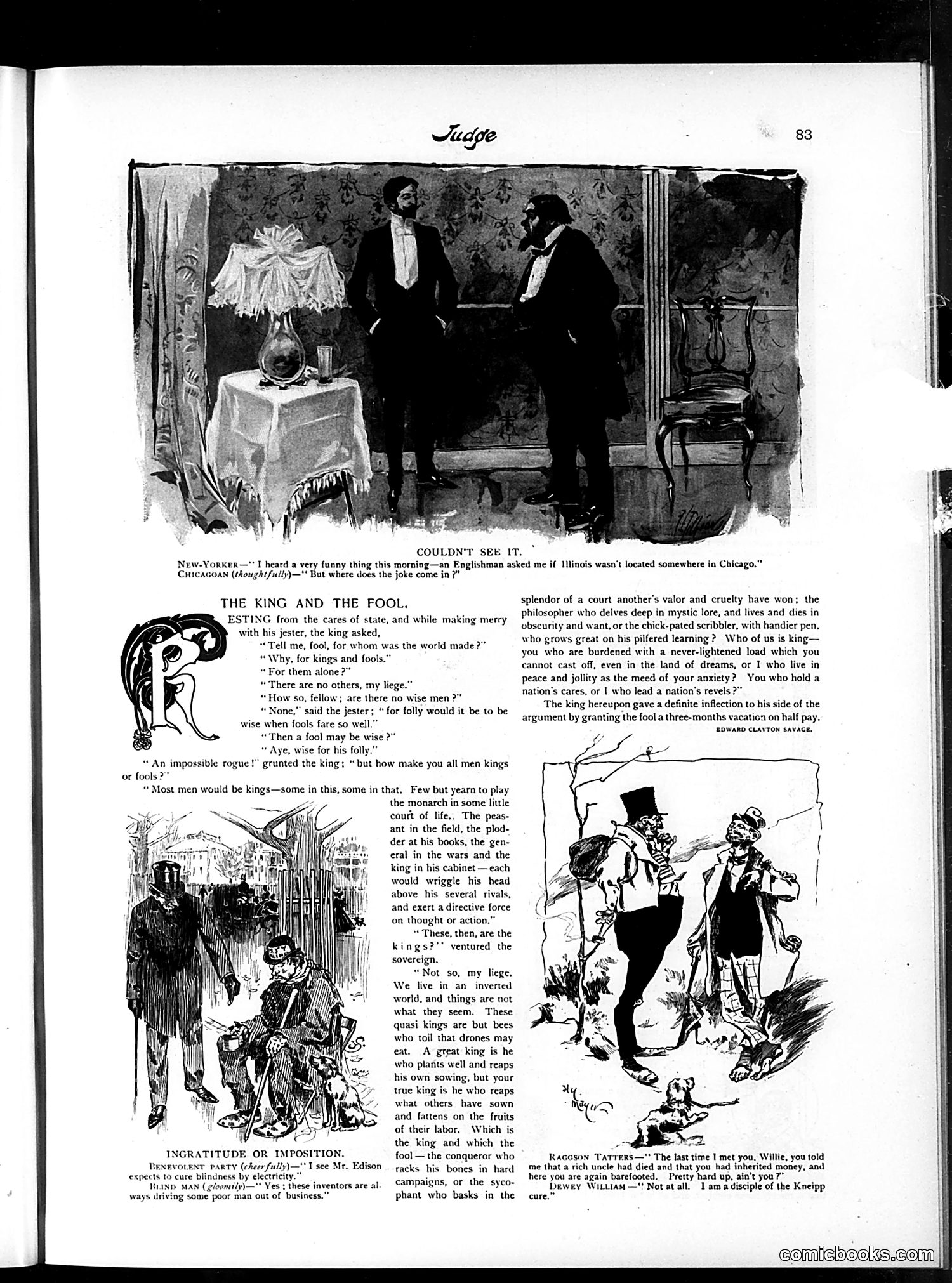
What you’re looking at
**Top Cartoon "Couldn't See It"**: A New York joke about geographic ignorance—an Englishman asks if Illinois is in Chicago, confusing a state with a city. This satirizes perceived European unfamiliarity with American geography. **Main Story "The King and the Fool"**: A philosophical dialogue where a fool questions a king about governance. The king argues that true kings are those who plant and reap their own labor, while "quasi kings" (conquerors, despots) exploit others. The satire suggests that genuine leadership comes from productive work, not tyranny—likely critiquing Gilded Age robber barons or authoritarian rulers who accumulated wealth through exploitation rather than merit. **Bottom Cartoons**: Appear to be separate satirical vignettes on social pretension and class dynamics, typical of Judge's satirical focus.
📄 Transcribed text from this page (OCR, searchable)
Machine-transcribed from the original scan — historical spelling and the odd misread are preserved.
COULDN'T SEE IT. ‘oRKeR—"*I heard a very funny thing this morning—an Englishman ask AN (thoughtfully)—"* But where does the joke come in?” THE: KING AND THE FOOL. G from the cares of state, and while making merry with his jester, the king asked, “Tell me, fool, for whom “Why, for kings and fools. “For them alone? “There are no others, my liege.” “How so, fellow; are there no wise men?” “ None,” said the jester; “for folly would it be to be wise when fools fare so well. then a fool may be wise ?” Aye, wise for his folly. grunted the king; “but how make you all men kings ‘as the world made?” “An impossible rogue !” or fools?" Most men would be Kings—some i in this, some in that, Few but yearn to play the monarch in some little court of life.. The peas- ant in the field, the plod- der at his books, the gen- eral in the wars and the king in his cabinet —each would wriggle his head above his several rivals, and exert a directive force on thought or action.” ~ These, then, are the kings?'’ ventured the sovereign. “Not so, my liege. We live in an inverted world, and things are not what they seem. These quasi kings are but bees who toil that drones may eat. A great king is he who plants well and reaps his own sowing, but your true king is he who reaps what others have sown and fattens on the fruits of their labor. Which is the king and which the fool — the conqueror who racks his bones in hard campaigns, or the syco- phant who basks in the INGRATITUDE OR IMPOSITION. DexevouenT panty (cheerfully) —" 1 see Mr. Edison ed me if Illinois wasn't located somewhere in Chicago.” splendor of a court another's valor and cruelty have won; the philosopher who delves deep in mystic lore, and lives and dies in obscurity and want, or the chick-pated scribbler, with handier pen, who grows great on his pilfered learning? Who of us is king— you who are burdened with a never-lightened load which you cannot cast off, even in the land of dreams, or I who live in peace and jollity as the meed of your anxiety? You who hold a nation’s cares, or | who lead a nation’s revels?" The king hereupon gave a definite inflection to his side of the argument by granting the fool a three-months vacation on half pay. EDWARD CLAYTON SAVAGE, Racason TaTreRs—"* The last time I met you, Willie, you told ‘me that a rich uncle had died and that you had inherited money, and here you are again barefooted. Pretty hard up, ain't you 7" Dewey WitttaM —"t Not at all. Iam adisciple of the Kneipp cure.” comichooks.com