
A complete issue · 16 pages · 1897
Judge — January 23, 1897
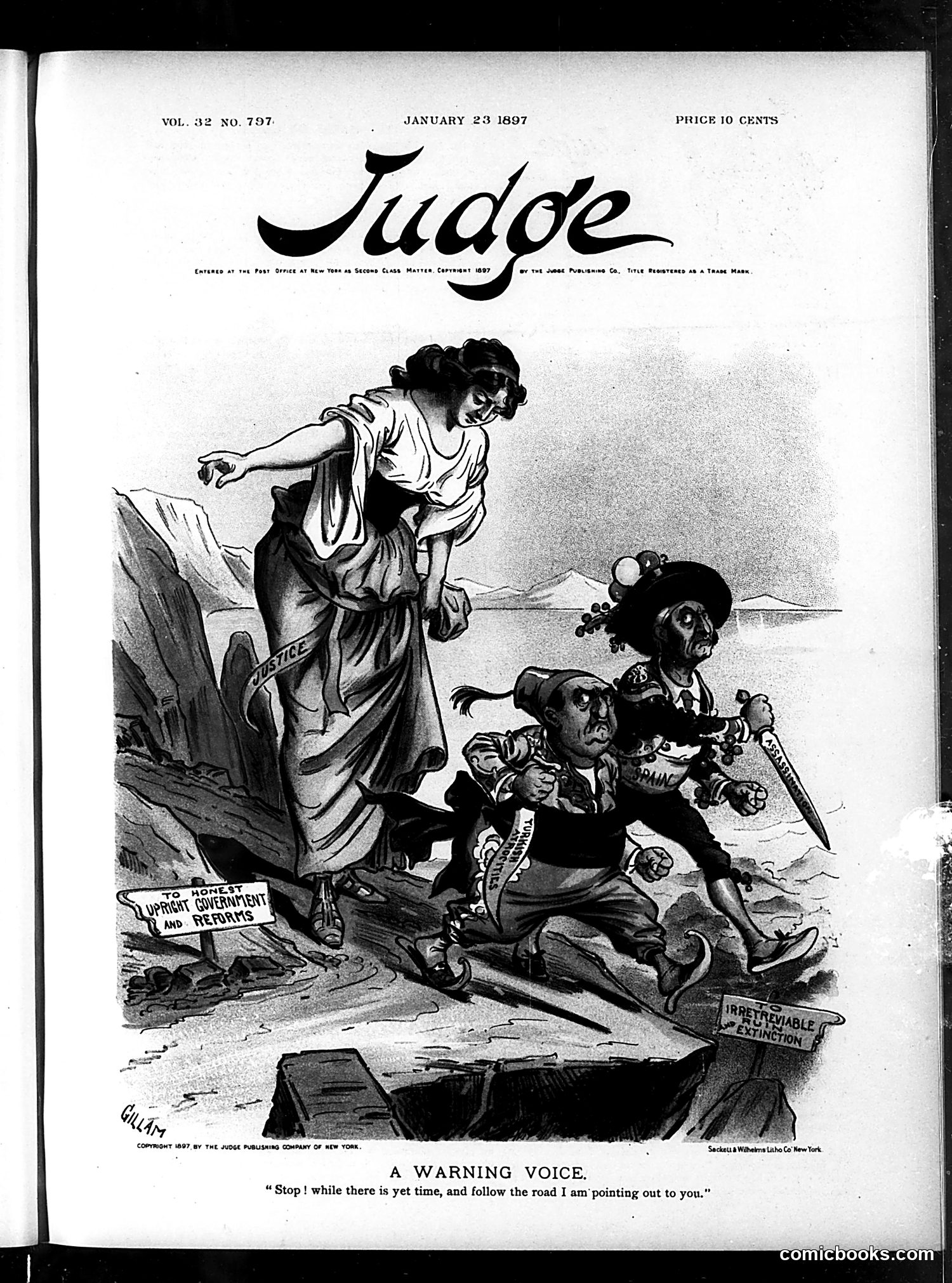
This January 1897 *Judge* cartoon depicts Lady Justice pointing downward at three caricatured political figures crawling along a path labeled "Irretrievable Extinction." The figures appear to represent corrupt politicians or leaders, depicted with exaggerated features common to period political cartoons. Lady Justice stands above a banner reading "Honest Upright Government and Restraint," suggesting these figures have abandoned such principles. The caption—"Stop! while there is yet time, and follow the road I am pointing out to you"—warns that their current trajectory leads to ruin. The satire critiques political corruption and moral decline among leadership, urging a return to honest governance. Without identifying specific individuals, the cartoon functions as a general warning about the consequences of abandoning democratic and ethical standards.
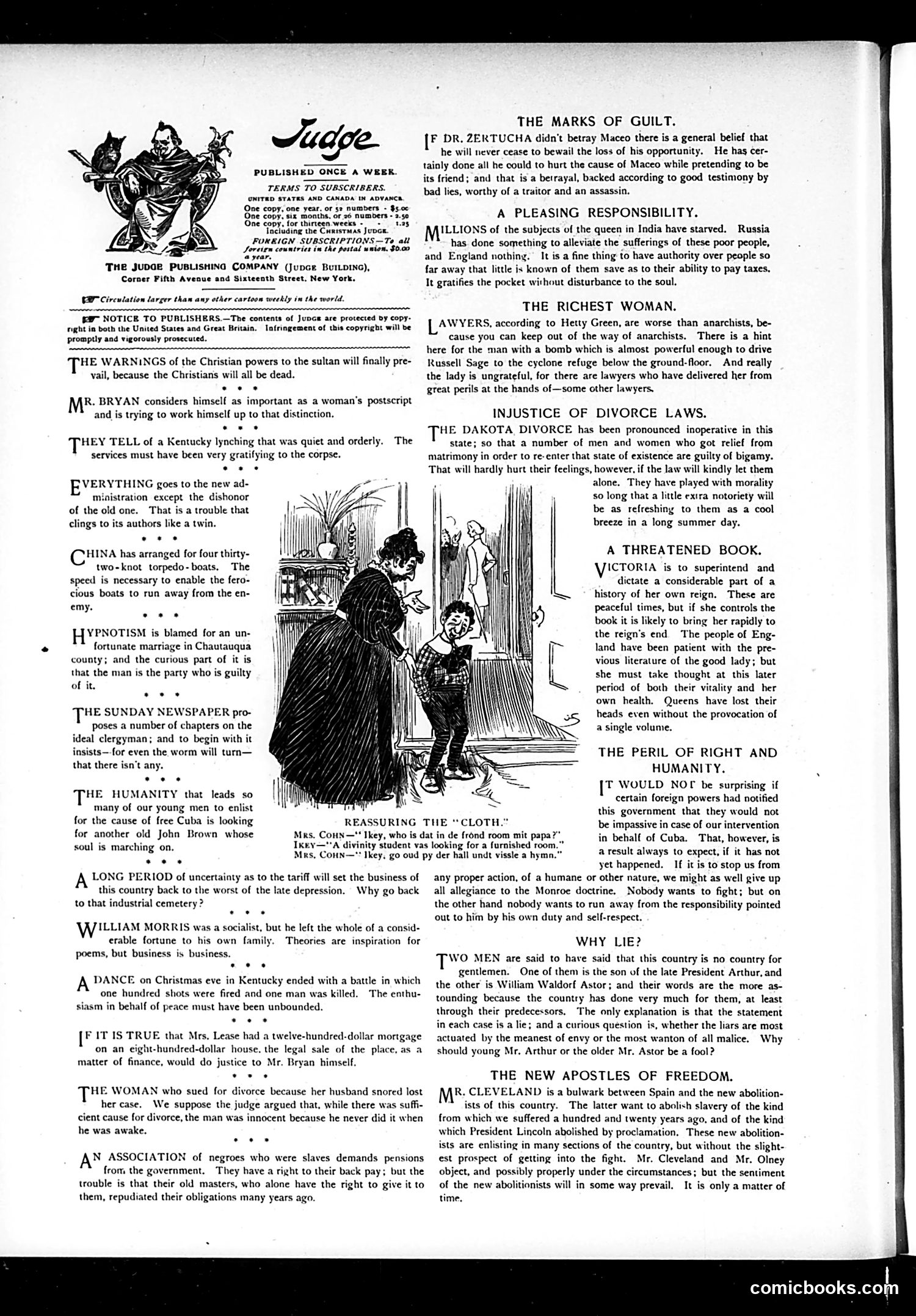
The main illustration, titled "REASSURING THE 'CLOTH,'" depicts a woman (labeled Mrs. Coan) at a door speaking with what appears to be a student (Irvy) seeking lodging. The caption records their exchange about renting a furnished room. This cartoon satirizes landlords' anxieties about their tenants' respectability—here, a landlady screening a student to ensure he's morally acceptable. The humor lies in the period's class consciousness and concerns about proper boarding arrangements. The surrounding text contains brief satirical commentary on contemporary issues: tariffs, socialism, divorce laws, hypnotism, and political figures like William Morris and William Waldorf Astor. The content reflects late 19th-century American social anxieties about modernization, foreign influence, and changing social structures.
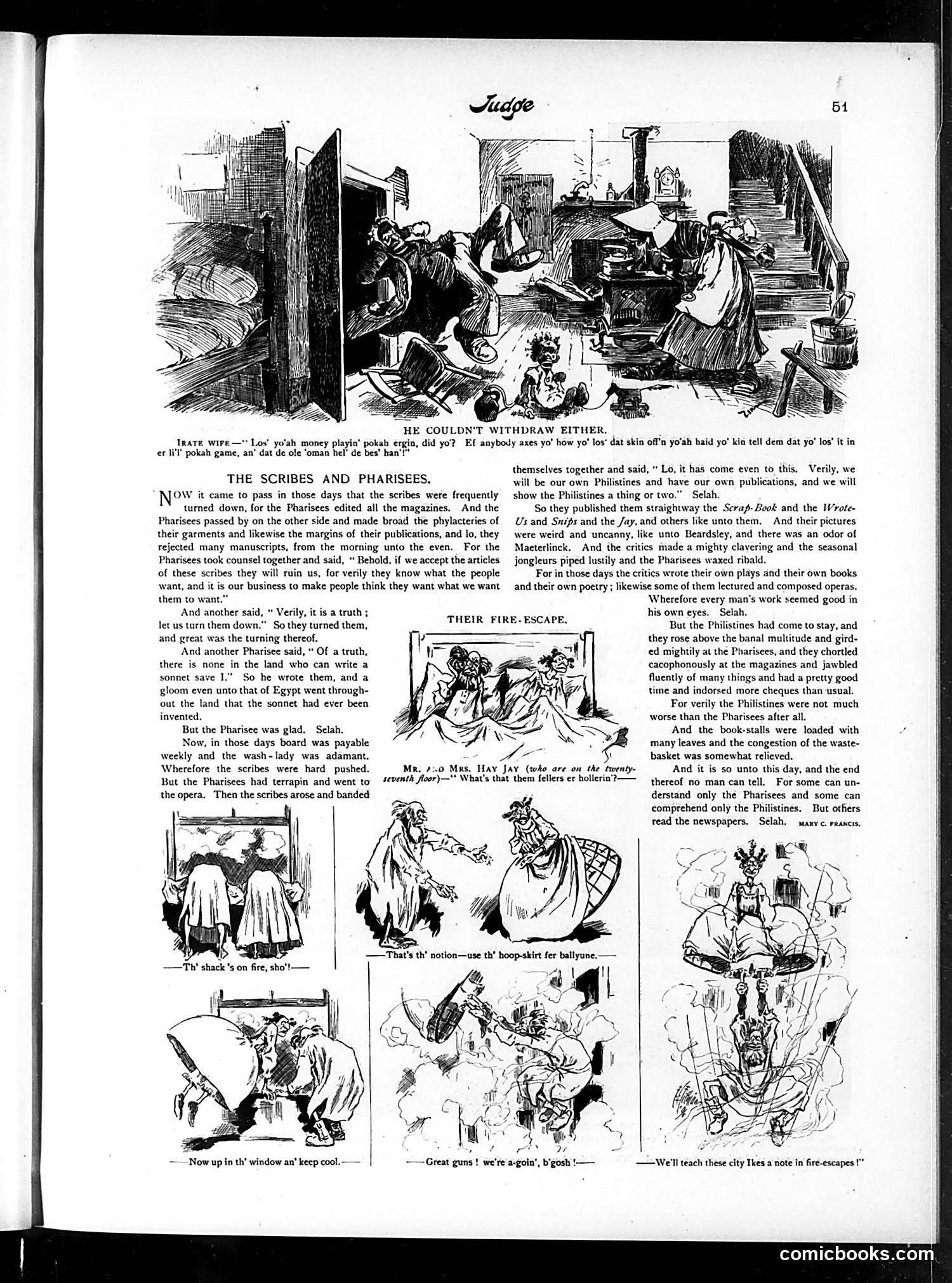
This page satirizes the conflict between the **Scribes and Pharisees** (religious authorities) and the **Philistines** (apparently representing literary critics or competing publications). The top narrative describes how Pharisees edited magazines and controlled publications, rejecting manuscripts they didn't approve of. The satire criticizes their gatekeeping power: they turned down writers' work, then published their own inferior pieces in the *Scrap Book* and *Waste-and-Stuff* magazines. The Philistines challenged this monopoly, creating their own publications. The cartoon sequence shows comedic "fire-escape" scenes of chaos—figures fleeing, using book-sacks as parachutes, and escaping through windows. This visually exaggerates the literary conflict as physical mayhem, mocking both factions' dramatic posturing over magazine control and literary merit.
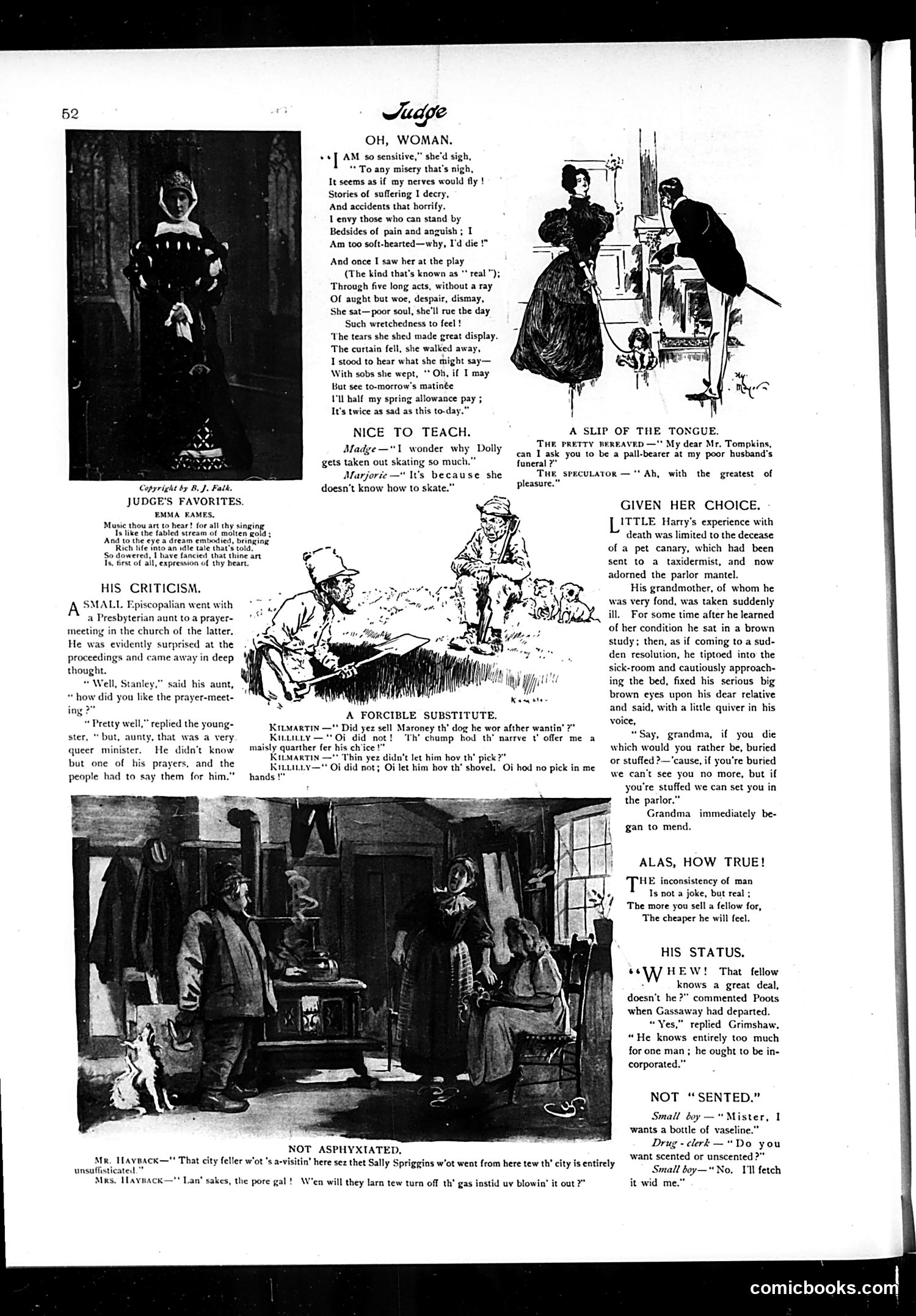
This page contains multiple satirical pieces typical of early 20th-century Judge magazine humor: **"Oh, Woman"** mocks feminine sentimentality—a woman claims delicate nerves prevent attending sad events, yet eagerly pays for a second matinee, revealing her theatricality is performative rather than sincere. **"Nice to Teach"** jokes that a girl gets frequent skating outings because she's incompetent, so her companion must constantly accompany her. The Irish dialect pieces ("A Forcible Substitute," "Not Asphyxiated") employ ethnic stereotypes common to the era, depicting working-class Irish characters in comedic situations involving miscommunication and rustic behavior. **"Given Her Choice"** presents dark humor: a child, familiar only with taxidermy from a pet bird, asks his dying grandmother whether she'd prefer burial or stuffing for display—innocently applying his limited experience to a tragic situation. The page reflects period attitudes toward gender, class, and ethnicity through gentle mockery rather than harsh satire.
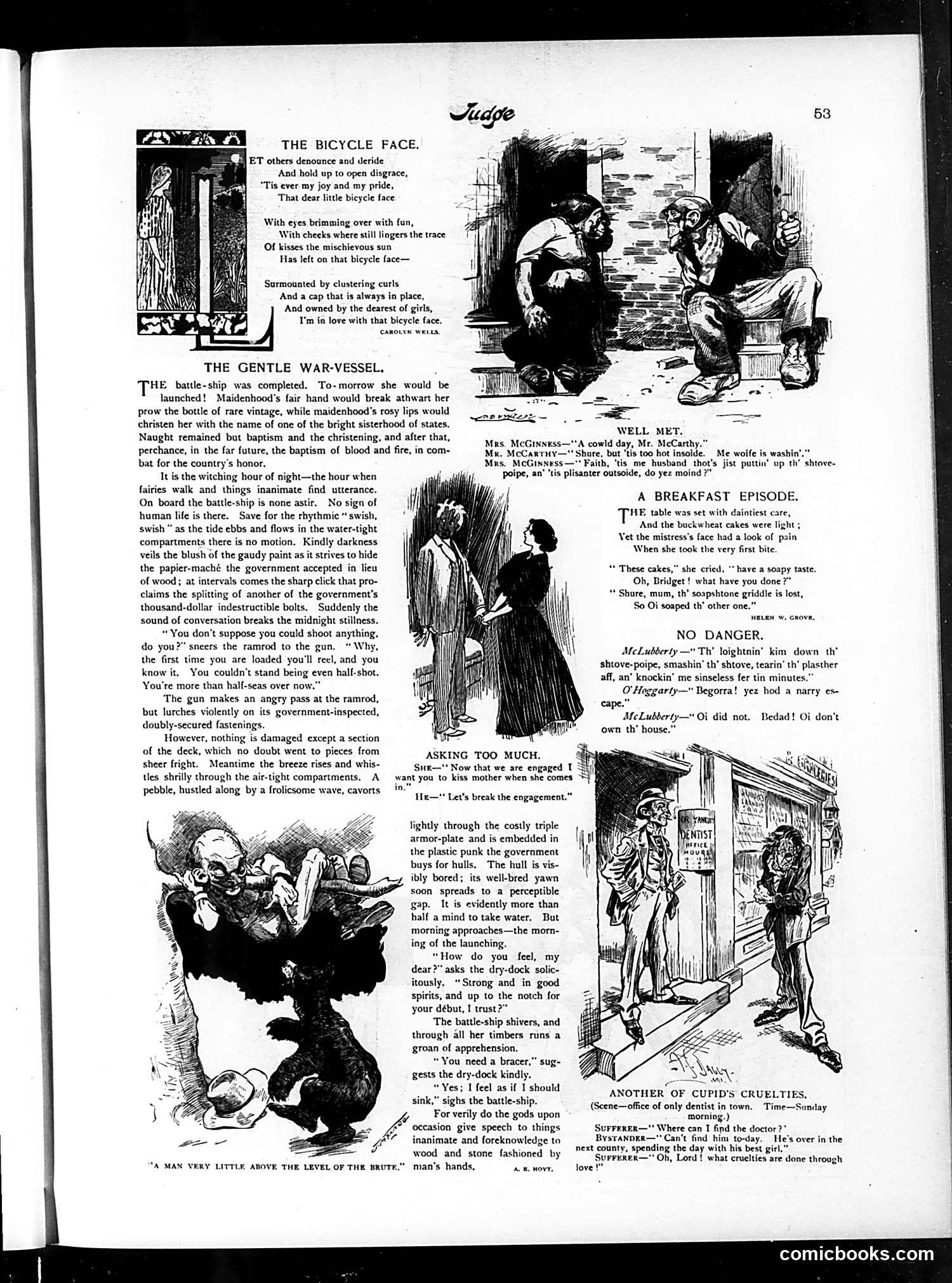
This page from Judge satirizes several turn-of-the-century American concerns: **"The Bicycle Face"**: A lighthearted poem celebrating the "bicycle face"—a real term of the era referring to the distinctive facial expression (allegedly) developed by women cyclists. Rather than joining detractors who mocked this look, the poem romanticizes it as charming and youthful. **"The Gentle War-Vessel"**: A satirical story anthropomorphizing a newly-built battleship. The humor lies in exposing government incompetence: the ship contains cheap materials ("papier-maché"), defective bolts, and shoddy construction masquerading as military strength. The ship's internal "conversations" mock both the vessel's poor quality and the absurdity of military procurement fraud. The remaining short humorous pieces ("Well Met," "Breakfast Episode," "No Danger") are Irish-dialect jokes typical of the period's casual ethnic humor. Together, the page reflects Judge's role as social and political satirist, targeting government waste and pretension.
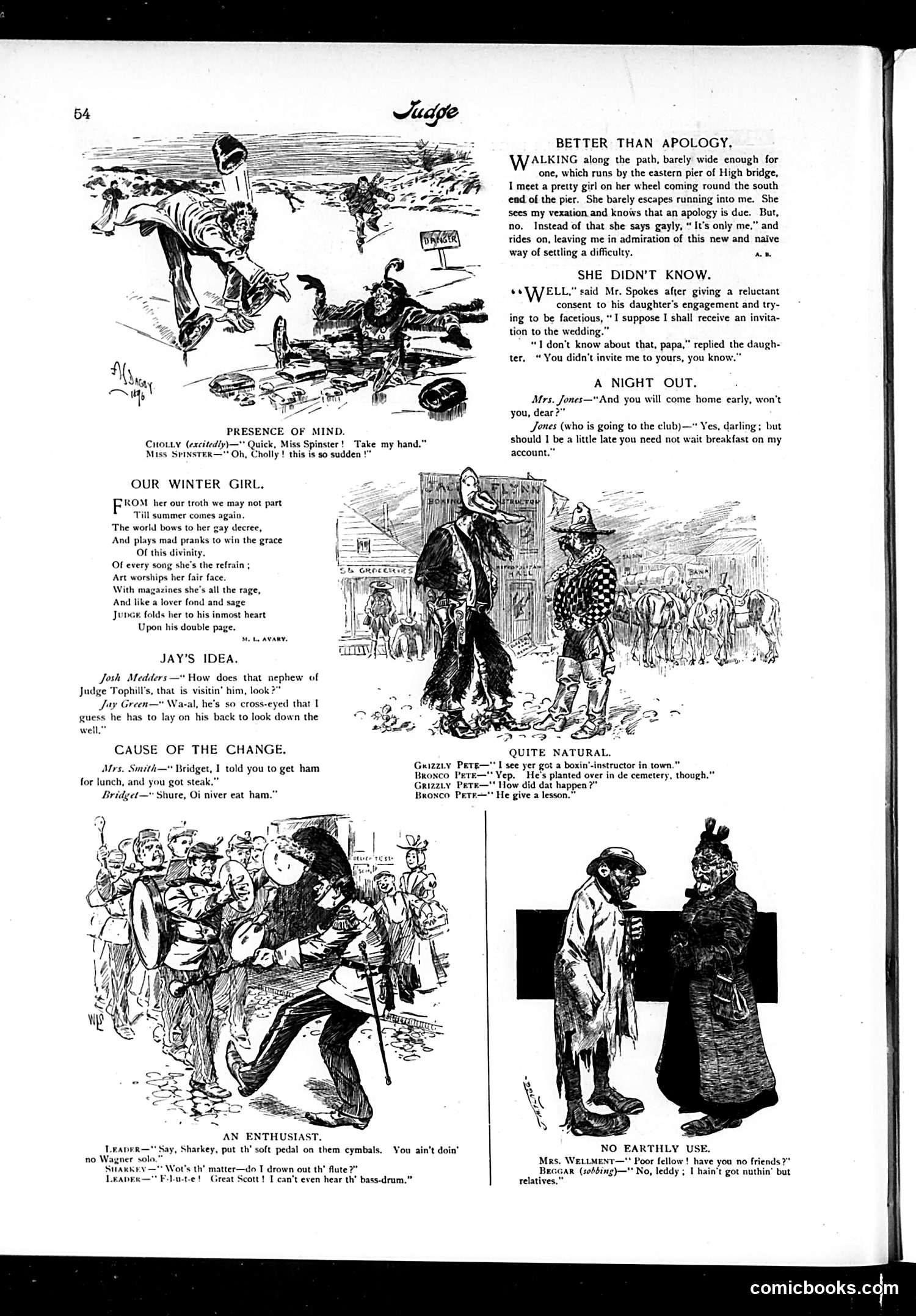
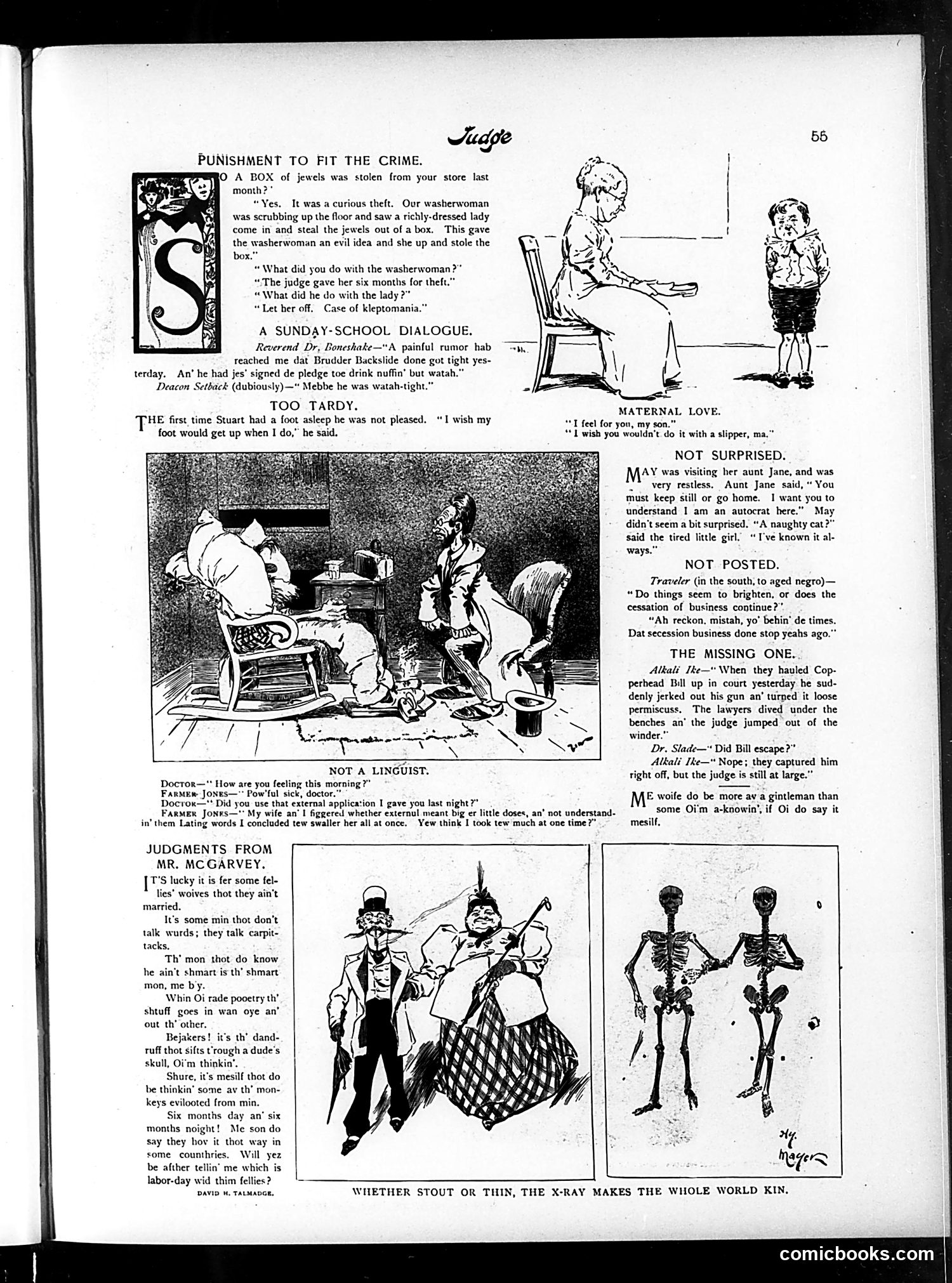
This page contains multiple satirical vignettes typical of early-20th-century American humor: **"Punishment to Fit the Crime"** mocks class-based justice: a wealthy woman caught stealing jewels receives a diagnosis of "kleptomania" and goes free, while a poor washerwoman who steals a box gets six months imprisonment. The satire critiques how the legal system treated wealthy defendants as mentally ill (thus excusable) while punishing working-class theft severely. **Other brief jokes** include Irish dialect humor ("Mr. McGarvey"), racial caricature ("Traveler in the South"), and domestic comedy. The X-ray cartoon bottom-right suggests X-ray technology's novelty as a cultural phenomenon making "the whole world kin"—a contemporary fascination. The page reflects Judge's typical formula: class satire alongside ethnic stereotypes and technological commentary, all reflecting Progressive-era anxieties about justice, immigration, and modernity.
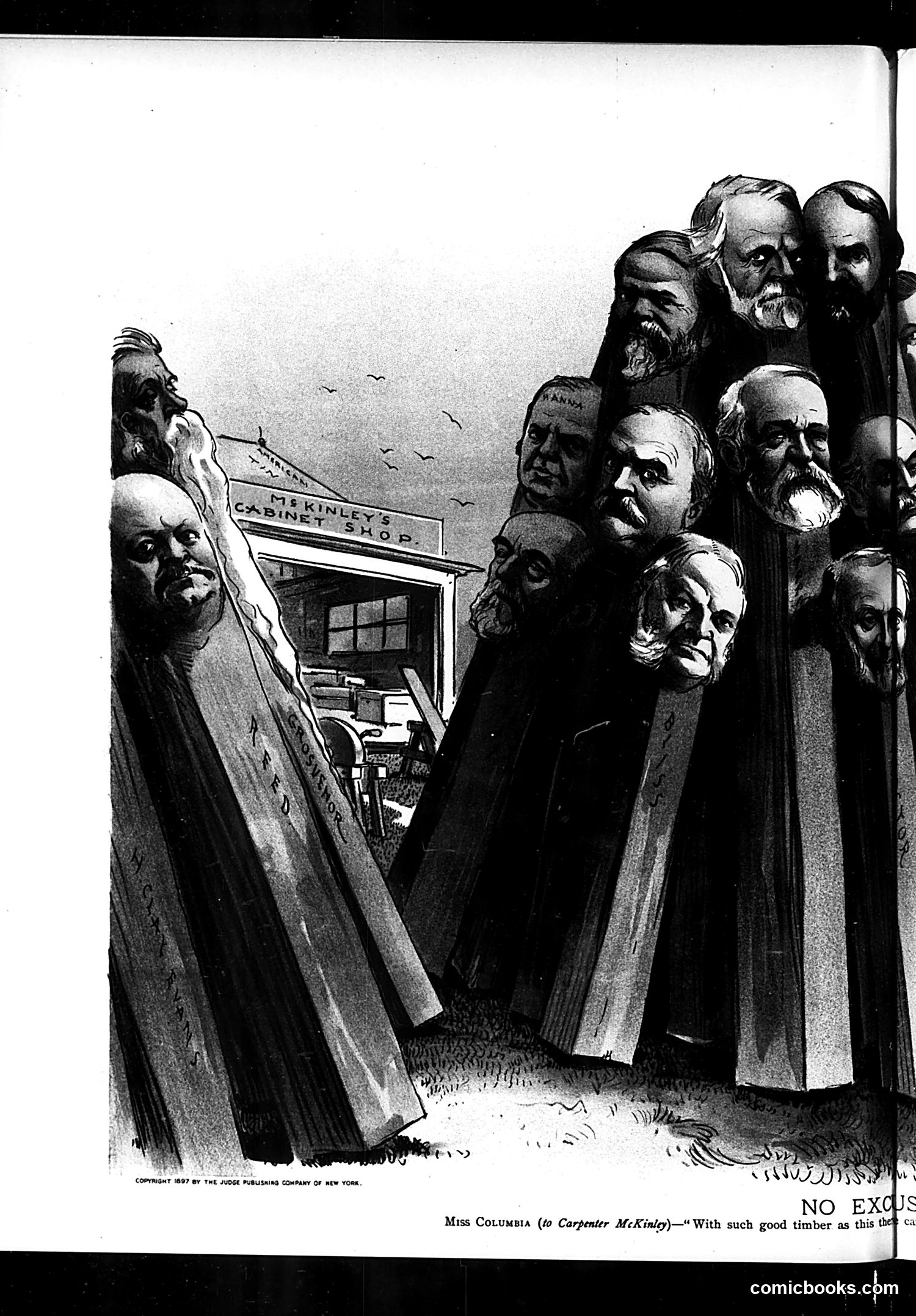
This 1897 Judge cartoon satirizes President William McKinley's cabinet selections. "Miss Columbia" (personification of America) addresses "Carpenter McKinley," referencing his profession before politics. She examines his chosen advisors—depicted as rough, bearded men emerging from "Kinley's Cabinet Shop"—comparing them to timber or lumber. The satire suggests McKinley is constructing his cabinet from inferior or questionable material, implying his selections are crude, unrefined, or poorly chosen. The carpentry metaphor plays on both his background and the idea of hastily "building" an administration. The diverse, rough appearances of the figures emphasize Columbia's skeptical assessment of their quality and suitability for high office.
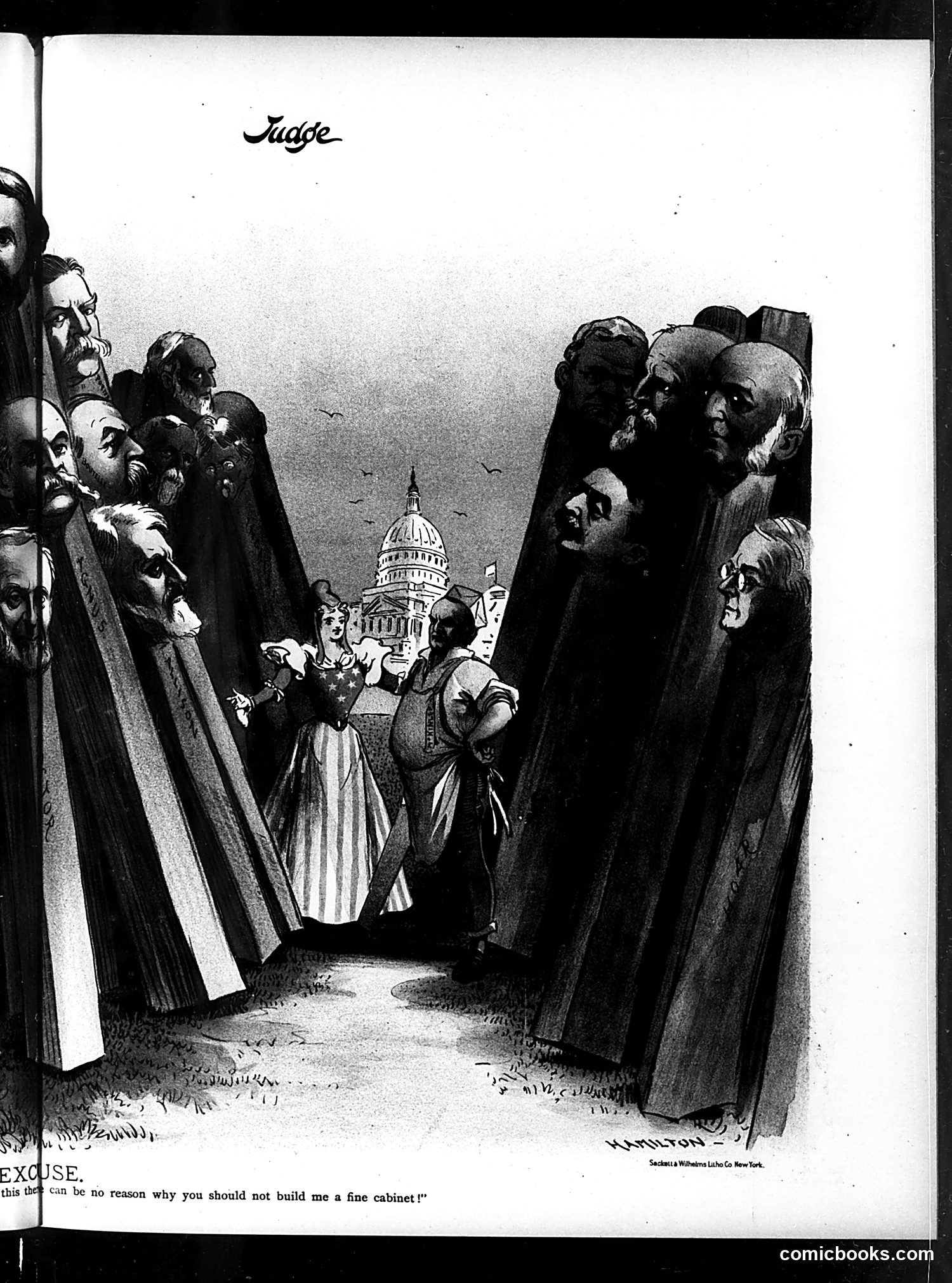
This cartoon, titled "Judge," depicts a figure (likely representing a political figure or wealthy patron) surrounded by robed men on both sides, with the U.S. Capitol building visible in the background. The central figure, dressed distinctly from the others, appears to be appealing to these officials. The caption reads: "Excuse, this the? can be no reason why you should not build me a fine cabinet!" The satire appears to criticize **political patronage and corruption**—specifically, the practice of appointing unqualified individuals to cabinet positions in exchange for favors or support. The "robed men" likely represent judges or political officials, while the Capitol suggests governmental authority. The cartoon mocks the assumption that political connections alone justify high office, satirizing the era's patronage system where personal relationships trumped merit.
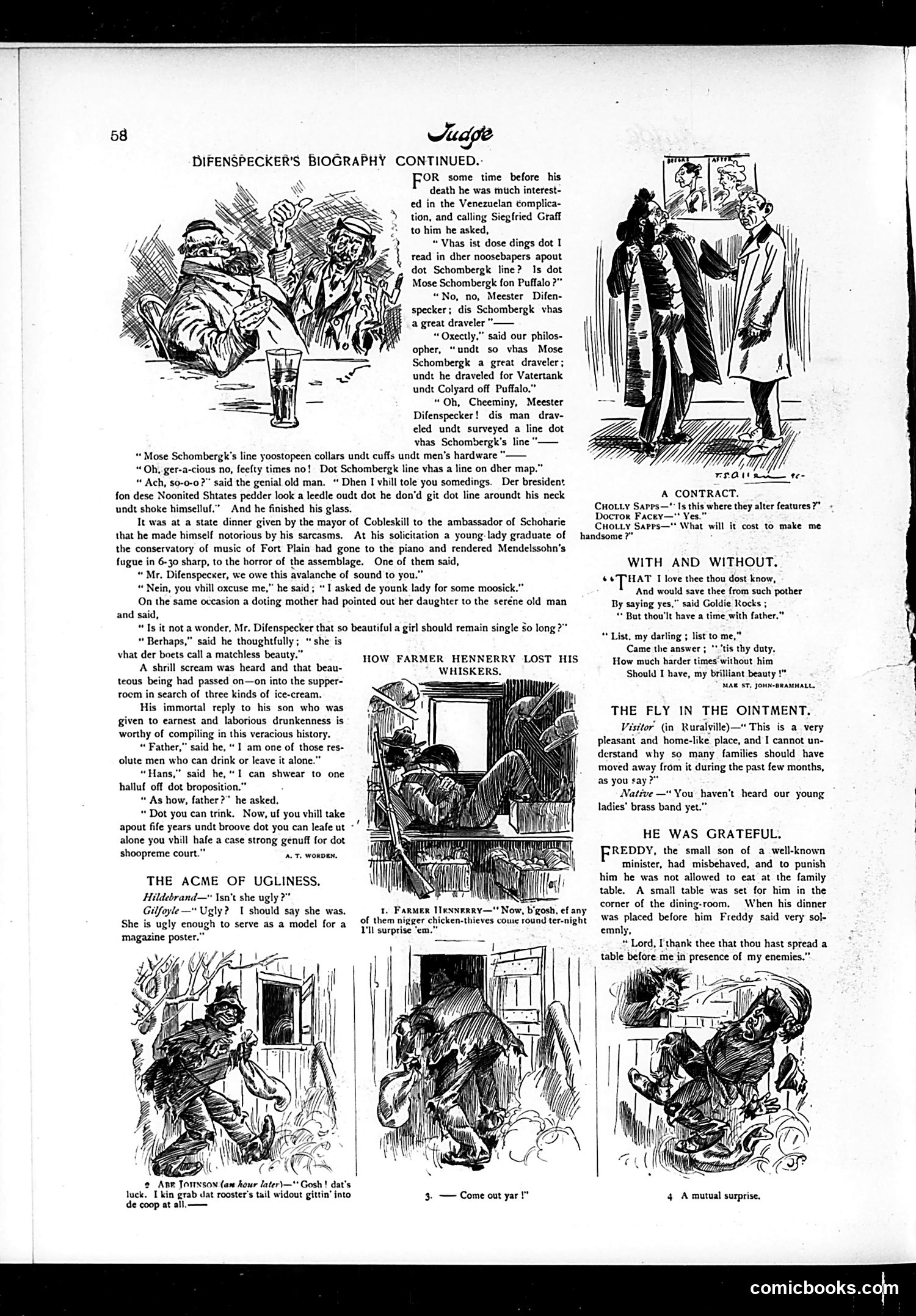
This page from Judge contains multiple satirical pieces typical of late-19th-century American humor: **Main Feature - "Difenspecker's Biography":** A continuing series about a German-accented philosopher character who makes witty observations. The humor relies on heavy dialect humor (common for the era) and plays on misunderstandings—notably, he confuses the Schombergk Line (a disputed boundary in the Venezuelan crisis) with a local person named Mose Schombergk from Buffalo. **Other Pieces Include:** - "How Farmer Henberry Lost His Whiskers" - rural/farmer humor with period racial slurs - "The Acme of Ugliness" - mocking a woman's appearance - "A Contract" and "With and Without" - romantic/courtship humor - "The Fly in the Ointment" - rural commentary The dialect humor and mockery of appearance reflect period conventions that modern readers would find offensive. The Venezuelan boundary reference shows Judge engaged with contemporary political news, though filtered through comedic stereotypes.
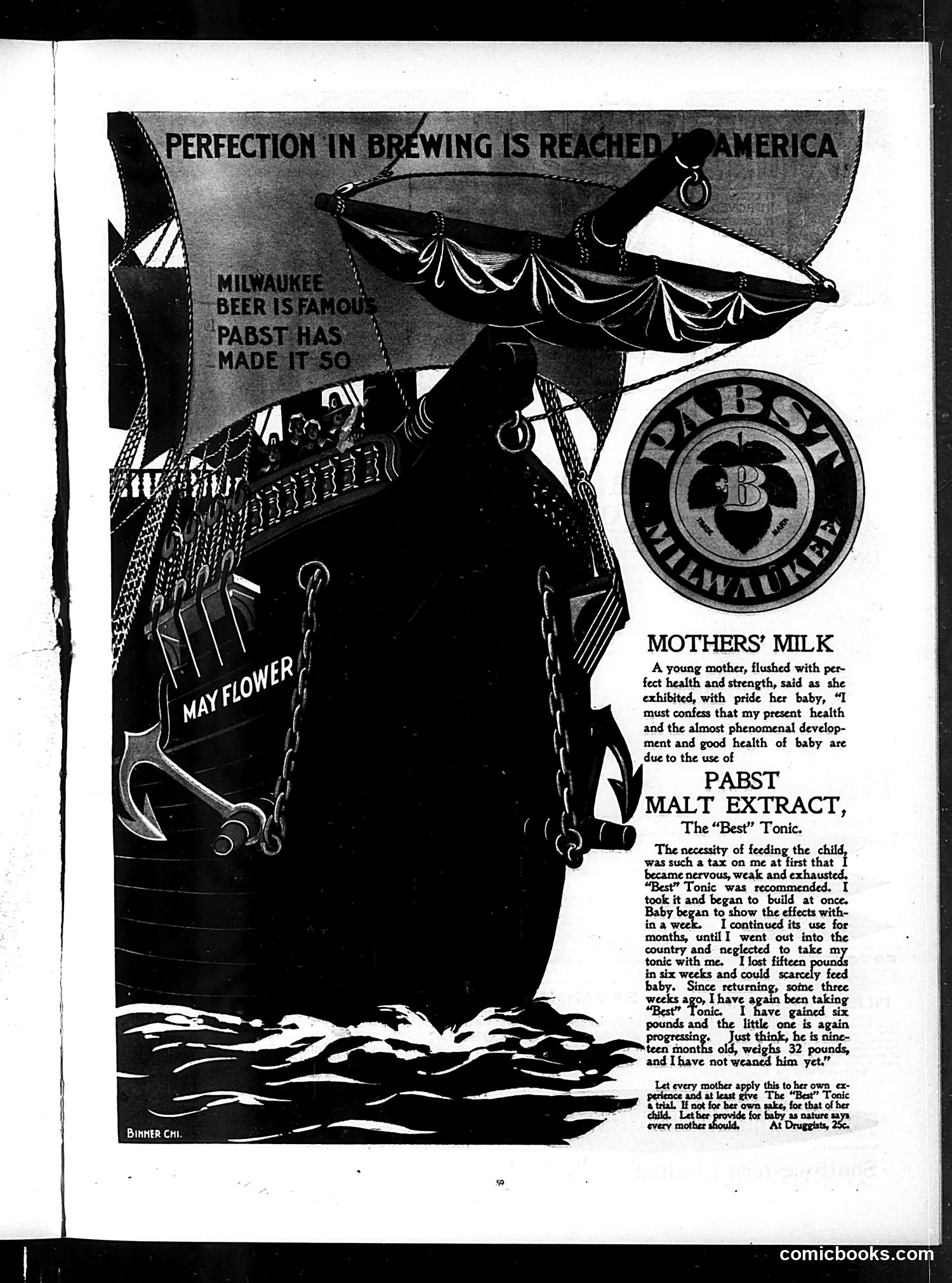
This is primarily a **patent medicine advertisement**, not satire. It features a mother testifying to Pabst Malt Extract's health benefits for herself and her infant child. The image shows an elaborate ship (the Mayflower, referencing American heritage) and a "Pabst Milwaukee" logo. The testimonial claims the mother used this product to regain strength after childbirth and to promote her baby's growth—the child allegedly gained six pounds in six weeks and now weighs 32 pounds at nineteen months. **Historical context modern readers need:** This reflects early 20th-century patent medicine marketing, when unregulated tonics containing alcohol and various substances were widely advertised with health claims—even for infants. Such advertisements exploited maternal anxiety about child nutrition. This practice is now recognized as predatory and medically dangerous. The "scientific" testimonial format was standard advertising technique of the era.
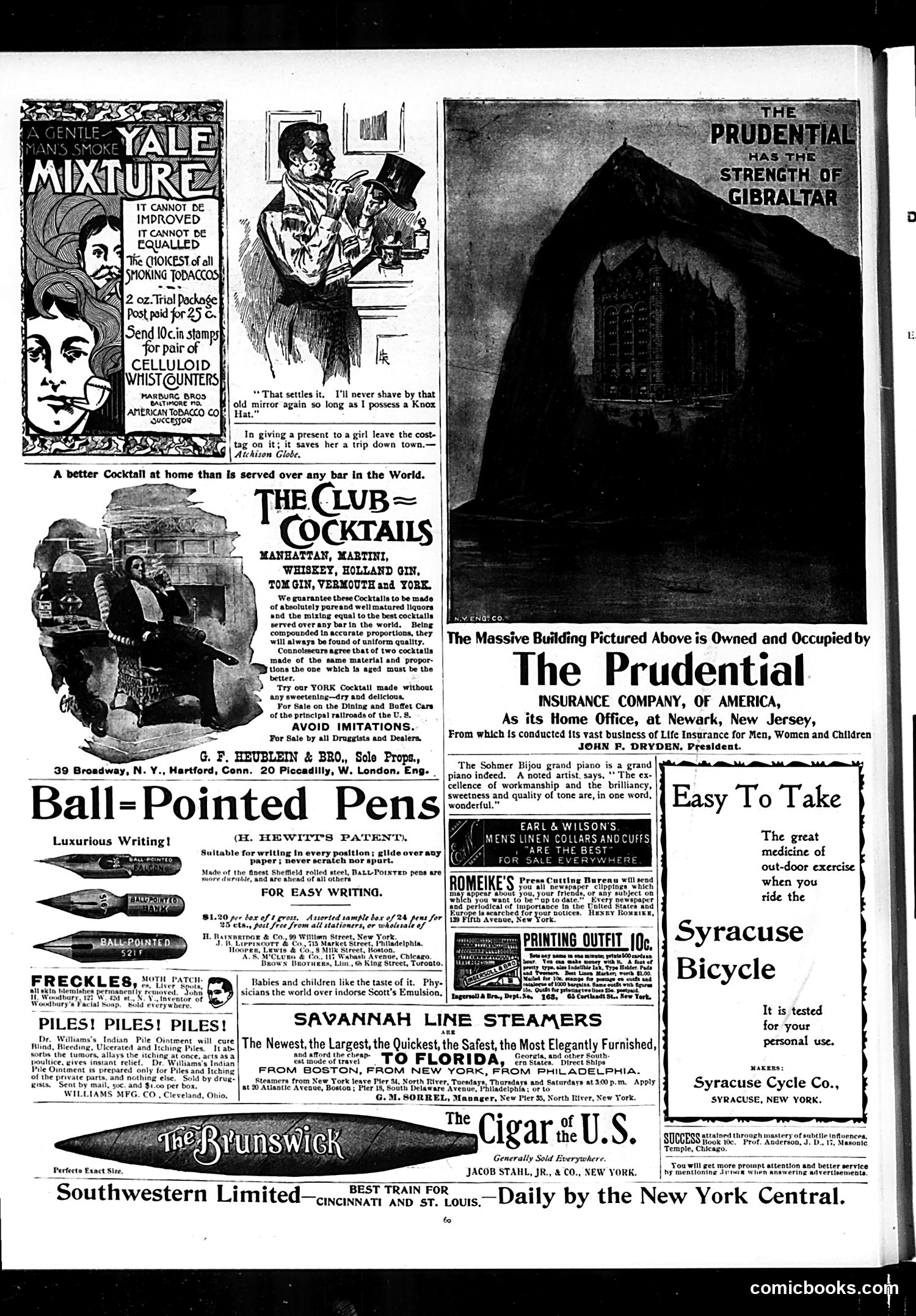
This is primarily an **advertising page** from Judge magazine, not a political cartoon page. The content consists almost entirely of commercial advertisements typical of early 20th-century publications. The few editorial elements present include: - **A brief cartoon** showing a man shaving, with the caption about preferring a Knox Hat to an old mirror—a simple product endorsement joke with no political content. - **A humorous quote** about giving gifts to girls with price tags attached, credited to the Atchison Globe (a newspaper). The bulk of the page advertises various products: tobacco mixtures, cocktail recipes, writing pens, insurance (Prudential), pianos, men's collars, bicycles, patent medicines, steamship lines, cigars, and trains. The Prudential Insurance building photograph is the most prominent image, essentially functioning as corporate advertising rather than satire. There is **no identifiable political satire or social commentary** on this particular page.
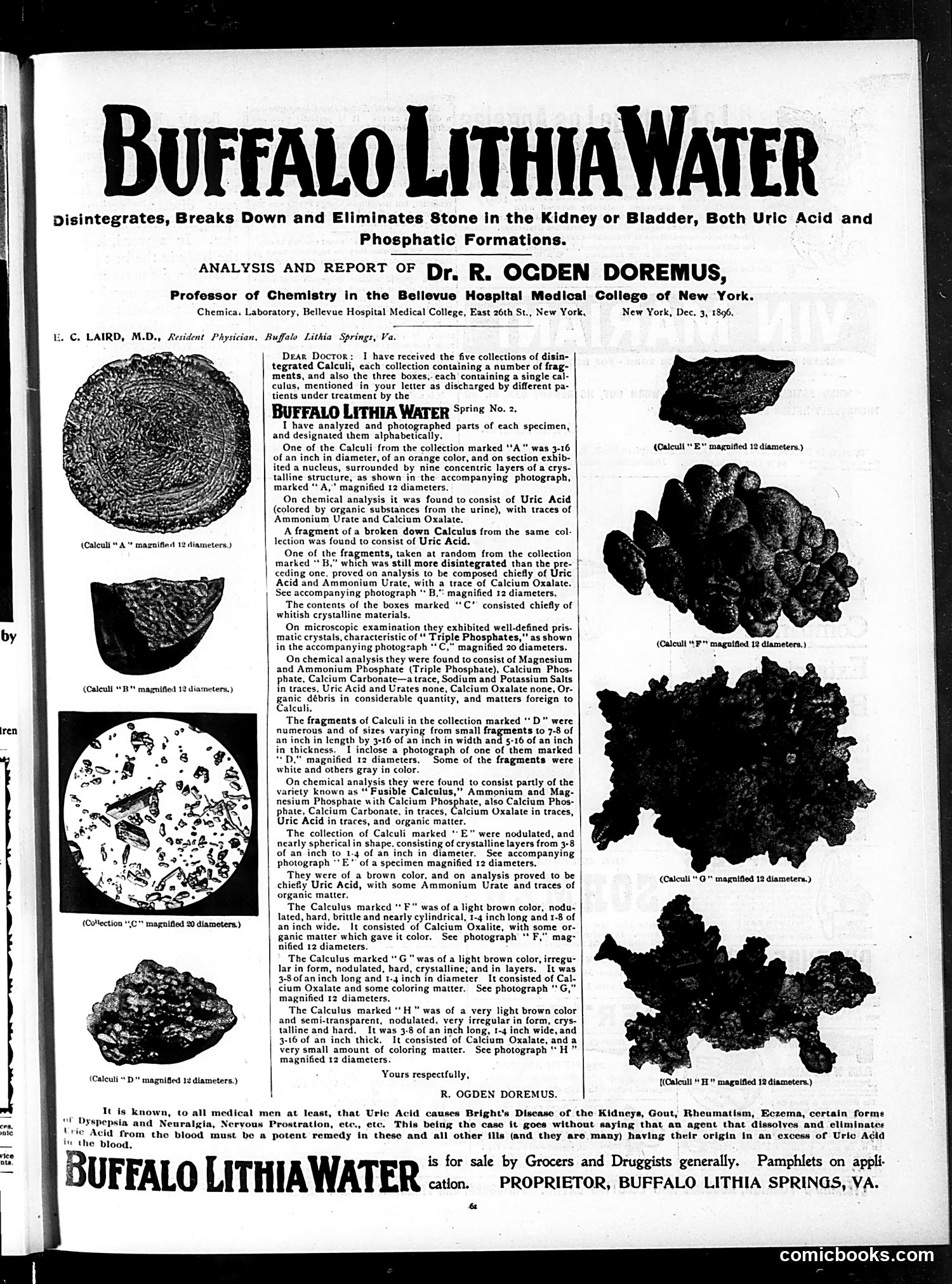
This is not a political cartoon but rather a **full-page advertisement** disguised as medical authority. The page presents supposed scientific analysis of kidney stones allegedly dissolved by Buffalo Lithia Water, a patent medicine. The "analysis" is attributed to Dr. R. Ogden Doremus, a real chemistry professor at Bellevue Hospital Medical College in New York, lending false credibility. The photographs show actual calculi (kidney stones) with technical-sounding descriptions of their chemical composition. This represents classic **19th-century medical fraud**: marketing mineral spring water as a cure-all for kidney disease, gout, rheumatism, and other ailments. The scientific language, professorial endorsement, and detailed microscopic imagery were designed to convince readers this was legitimate medicine rather than snake oil. Such advertisements frequently appeared in magazines like *Judge*, exploiting public anxiety about untreatable conditions.
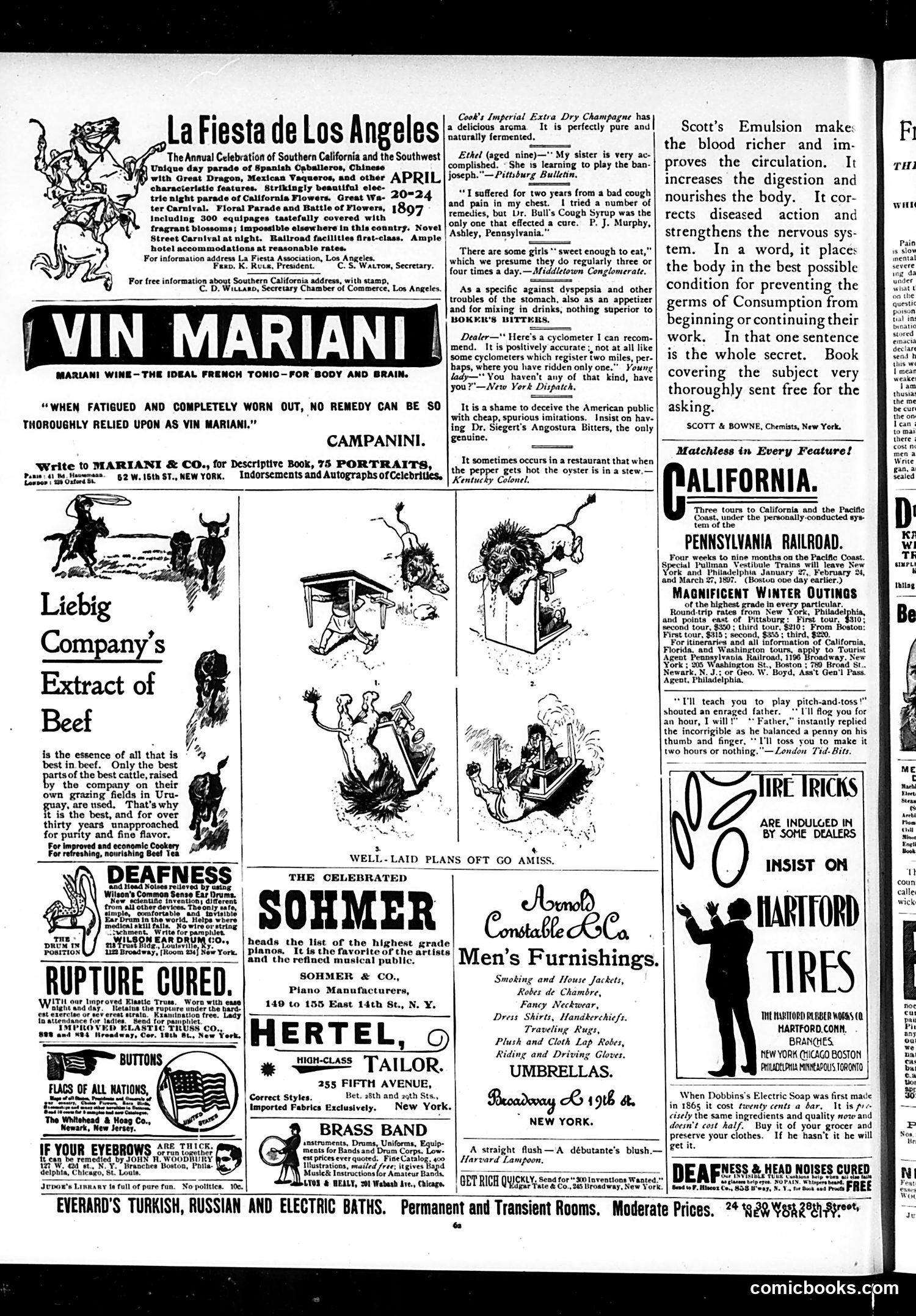
This page is primarily **promotional advertising** with one small humorous cartoon at the bottom center. The cartoon titled **"Well-Laid Plans Off Go Amiss"** uses exaggerated line drawings to satirize the chaos that ensues when well-intentioned schemes fall apart—likely depicting comedic mishaps, though the specific scenario isn't entirely clear from this reproduction quality. The bulk of the page features period advertisements for patent medicines (Vin Mariani wine tonic, Dr. Bull's Cough Syrup, Boker's Bitters), medical devices (ear treatments for deafness, trusses for rupture), and commercial goods. There's also promotion of **La Fiesta de Los Angeles**, a 1897 Southern California celebration. These ads relied on testimonials and celebrity endorsements—common in Judge magazine to lend credibility to largely unregulated products. The magazine itself mixed gentle satire with commercial content, blending editorial humor with advertiser support.
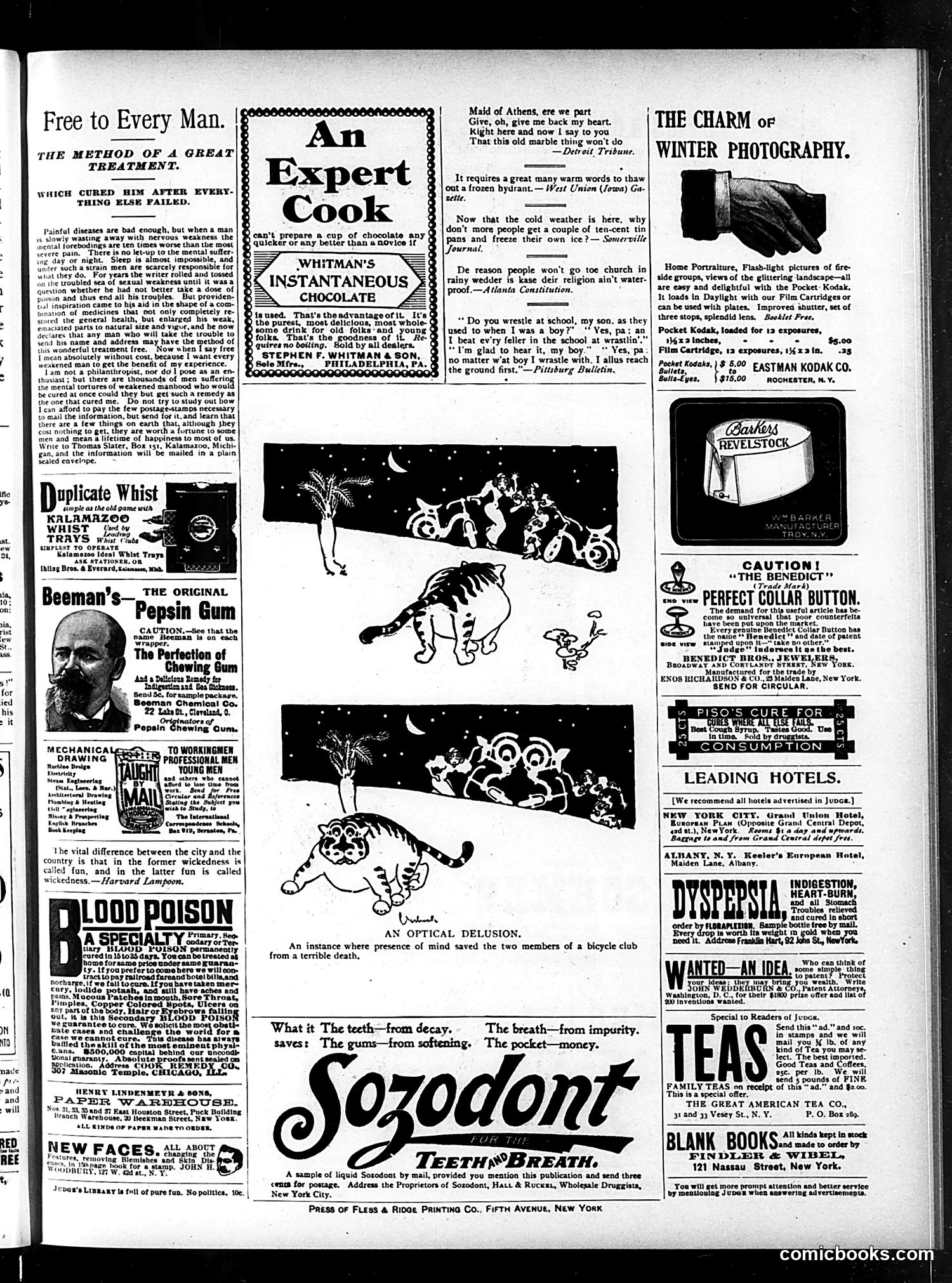
This page is primarily **advertising**, with minimal editorial cartooning. The main visual elements are: 1. **"An Optical Delusion" cartoon**: Two illustrated panels showing cyclists experiencing a visual trick—the bicycle wheels and riders appear to move/transform between frames, creating an optical illusion. The caption explains: "An instance where presence of mind saved two members of a bicycle club from a terrible death." This is a lighthearted visual gag exploiting the novelty of optical illusions popular in that era. 2. **Sozodont advertisement** (lower center): A large product ad for tooth powder/paste, using the common Victorian marketing trope of listing benefits in rhyming verse ("What it the teeth—from decay..."). The page is dominated by remedial product ads (for sexual dysfunction, blood poison treatment, pepsin gum, chocolate, etc.)—typical Judge content from this period mixing satirical commentary with lucrative advertising revenue. The cartoons lack political or social satire; they're purely entertainment-focused.
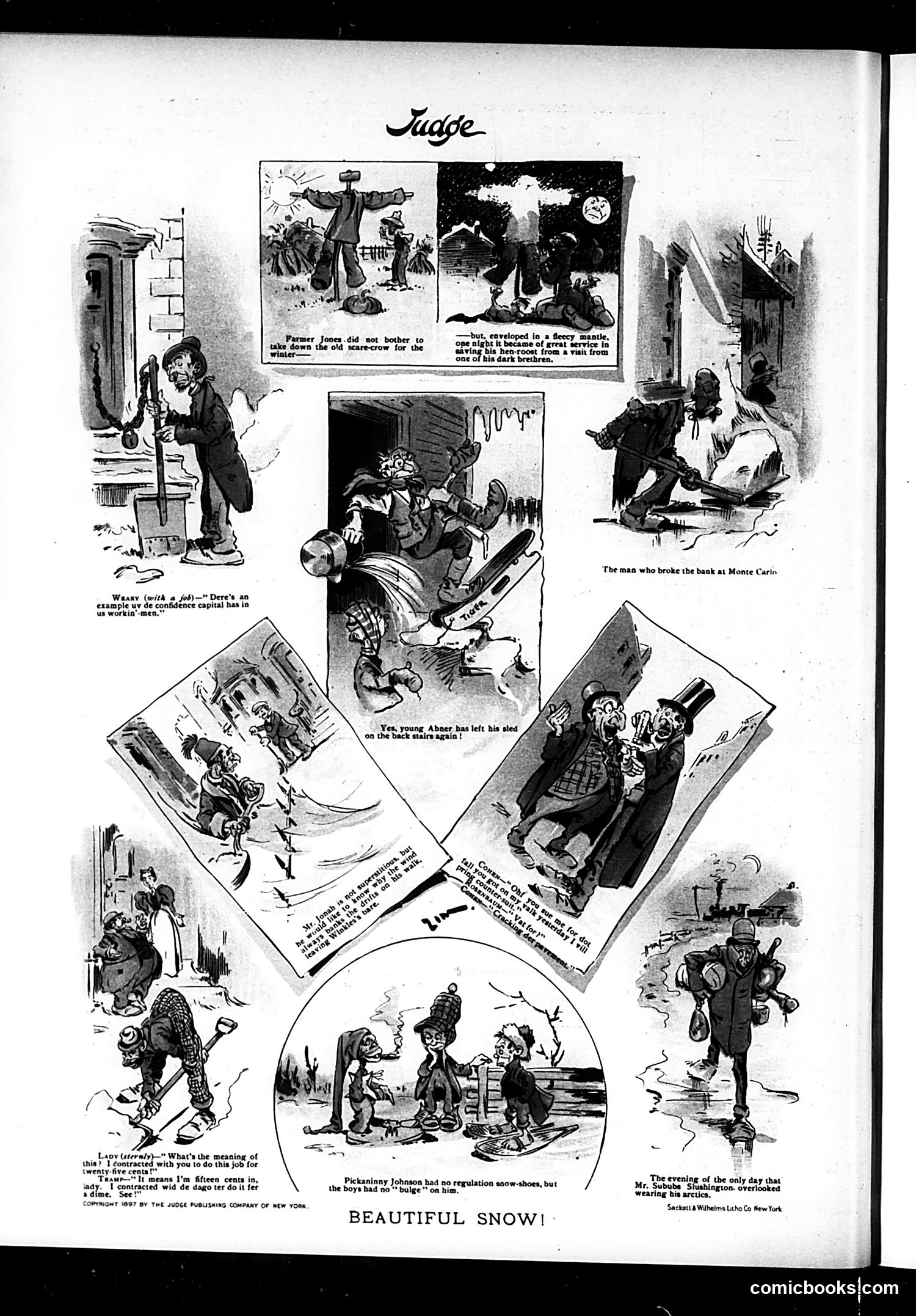
This satirical page from Judge (copyright 1897) presents vignettes mocking working-class poverty and racial stereotypes during the Gilded Age. The central theme concerns economic exploitation: "Weary" (a tramp) accepts work for 25 cents but subcontracts it to an Italian immigrant ("dago") for a dime, pocketing 15 cents profit—satirizing how the poor exploit each other while capital accumulates through their labor. Other panels ridicule: - A scarecrow left standing through winter (mocking rural negligence) - Pickanniny Johnson lacking proper snow-shoes (dehumanizing racial caricature) - Various comic scenarios of poverty and discomfort in snow The title "Beautiful Snow!" is ironic—the "beauty" masks hardship. The artwork reflects 1890s attitudes: casual racism toward African Americans and immigrants, cynicism about working-class dignity, and class-based humor treating poverty as inherently comic rather than tragic. The cartoons reinforce period stereotypes while ostensibly "satirizing" both capital and labor.