
Judge, 1897-01-23 · page 13 of 16
Judge — January 23, 1897 — page 13: what you’re looking at
What you’re looking at
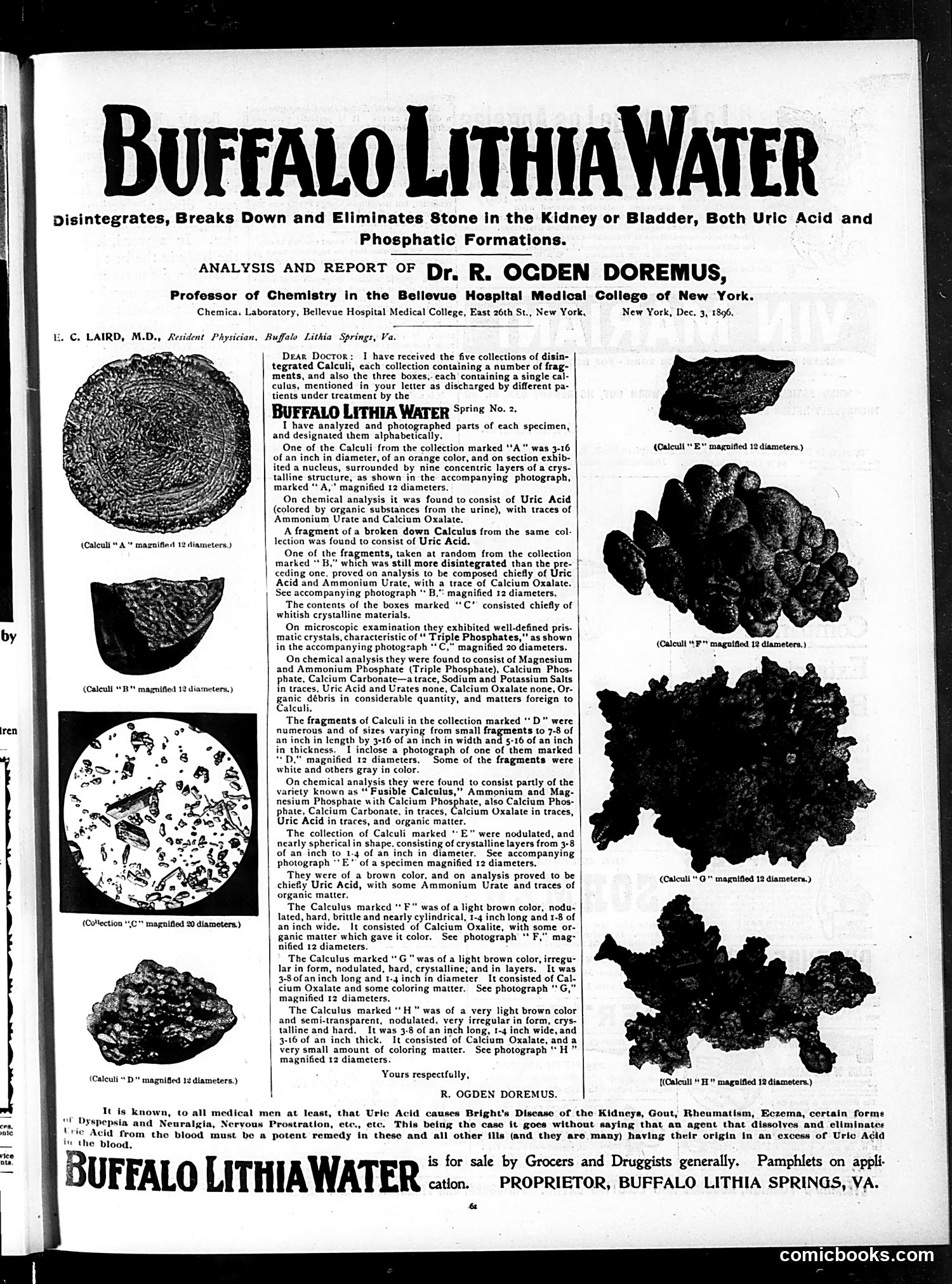
This is not a political cartoon but rather a **full-page advertisement** disguised as medical authority. The page presents supposed scientific analysis of kidney stones allegedly dissolved by Buffalo Lithia Water, a patent medicine. The "analysis" is attributed to Dr. R. Ogden Doremus, a real chemistry professor at Bellevue Hospital Medical College in New York, lending false credibility. The photographs show actual calculi (kidney stones) with technical-sounding descriptions of their chemical composition. This represents classic **19th-century medical fraud**: marketing mineral spring water as a cure-all for kidney disease, gout, rheumatism, and other ailments. The scientific language, professorial endorsement, and detailed microscopic imagery were designed to convince readers this was legitimate medicine rather than snake oil. Such advertisements frequently appeared in magazines like *Judge*, exploiting public anxiety about untreatable conditions.
📄 Transcribed text from this page (OCR, searchable)
Machine-transcribed from the original scan — historical spelling and the odd misread are preserved.
BUFFALO LITHIA WATER Disintegrates, Breaks Down and Eliminates Stone in the Kidney or Bladder, Both Uric Acid and Phosphatic Formations. ANALYSIS AND REPORT OF Dr. R. OCDEN DOREMUSs, Professor of Chemistry in the Bellevue Hospital Medical College of New York. Chemica. Laboratory, Bellevue Hospital Medical College, East 26th St., New York, New York, Dec. 3, 1896. LE, C. LAIRD, M.D., Resident Physician, Buffalo Lithia Springs, Va. Dear Doctor: I have received the five collections of disin- tegrated Calculi, each collection containing a number of frag- ments, and also the three boxes,-each containing a single ca culus, mentioned in your letter as discharged by different pa- tients under treatment by the BUFFALO LITHIA WATER °*°*« *°.= T have analyzed and photographed parts of each specimen, and designated them alphabetically. One of the Calculi from the collection marked "A" was of an inch in diameter, of an orange color, and on section exhib- ited a nucleus, surrounded by nine concentric layers of a crys- talline structure, as shown in the accompanying photograph, marked ‘ A,” magnified 12 diameters. On chemical analysis it was found to consist of Uric Acid (colored by organic substances from the urine), with traces of Ammonium Urate and Calcium Oxalate. A fragment of a broken down Calculus from the same col- lection was found to consist of Uric Acid. One of the fragments, taken at random from the collection marked “ B,” which was still more disintegrated than the pre- ceding one. proved on analysis to be composed chiefly of Uric Acid and Ammonium Urate, with a trace of Calcium Oxalate. See accompanying photograph “ B,": magnified 12 diameters. The contents of the boxes marked “"C’ consisted chiefly of whitish crystalline materials. On microscopic examination they exhibited wel matic crystals, characteristic of “ Triple Phosphate in the accompanying photograph ‘'C.” magnified 20 diameters. On chemical analysis they were found to consist of Magnesium and Ammonium Phosphate (Triple Phosphate), Calcium Phos- phate, Calcium Carbonate—a trace, Sodium and Potassium Salts in traces, Uric Acid and Urates none, Calcium Oxalate none, Or- ganic débris in considerable quantity, and matters foreign to Calculi. The fragments of Calculi in the collection marked ‘* D” were numerous and of sizes varying from small fragneats to 7-8 of an inch in length by 3-16 of an inch in width and 5-16 of an inch in thickness. I inclose a photograph of one of them marked ‘D." magnified 12 diameters. Some of the fragments were white and others gray in color. On chemical analysis they were found to consist partly of the variety known as ‘Fusible Calculus,” Ammonium and Mag- nesium Phosphate with Calcium Phosphate, also Calcium Phos- phate, Calcium Carbonate, in traces, Calcium Oxalate in traces, Uric Acid in traces, and organic matter, The collection of Calculi marked * were nodulated, and nearly spherical in shape. consisting of crystalline layers from 3-8 of an inch to 1-4 of an inch in diameter. See accompanying photograph "°Eof a specimen magnified 12 diameters. They were of a brown color, and on analysis proved to be eins rye chiefy Uric Acid, with some Ammonium Urate and traces of eg ee organic matter. The Calculus marked ‘ F” was of a light brown color, nodu- lated, hard, brittle and nearly cylindrical, 1-g inch long and 1-8 of an inch wide. It consisted of Calcium Oxalite, with some or- ganic matter which gave it color. See photograph “ F," mag- nified 12 diameters. The Calculus marked “ G" was of a light brown color, irregu- lar in form, nodulated, hard, crystalline, and in layers." It was 3-8 ofan inch long and 1-4 inch in diameter It consisted of Cal- cium Oxalate and some coloring matter. See photograph ‘G,” magnified 12 diameters. ‘The Calculus marked “H” was of a very light brown color and semi-transparent, nodulated, very irregular in form, crys- talline and hard. It was 3-8 of an inch long, 1-4 inch wide, and 3-16 of an inch thick. It consisted ‘of Calcium Oxalate, and a very small amount of coloring matter. See photograph " H ” magnified 12 diameters. Y (Calculi * D"* magnified 12 diameters.) cura respectially, R. OGDEN DOREMUS. (Calcul * H” maguified 12 diameters.) It is known, to all medical men at least, that Uric Acid causes Bright's Disease of the Kidneys, Gout, Rheumatism, Eczema, certain forme “' Dyspepsia and Neuralgia, Nervous Prostration, ete., etc. This being the case it gocs without saying that an agent that dissolves and eliminates \ ot from the blood must be a potent remedy in these and all other ills (and they are many) having their origin in an excess of Uric Acid in the blood, BUFFALO LITHIA WATER cn. oor see resets eae aaa & comicbooks.com