
A complete issue · 16 pages · 1897
Judge — January 16, 1897
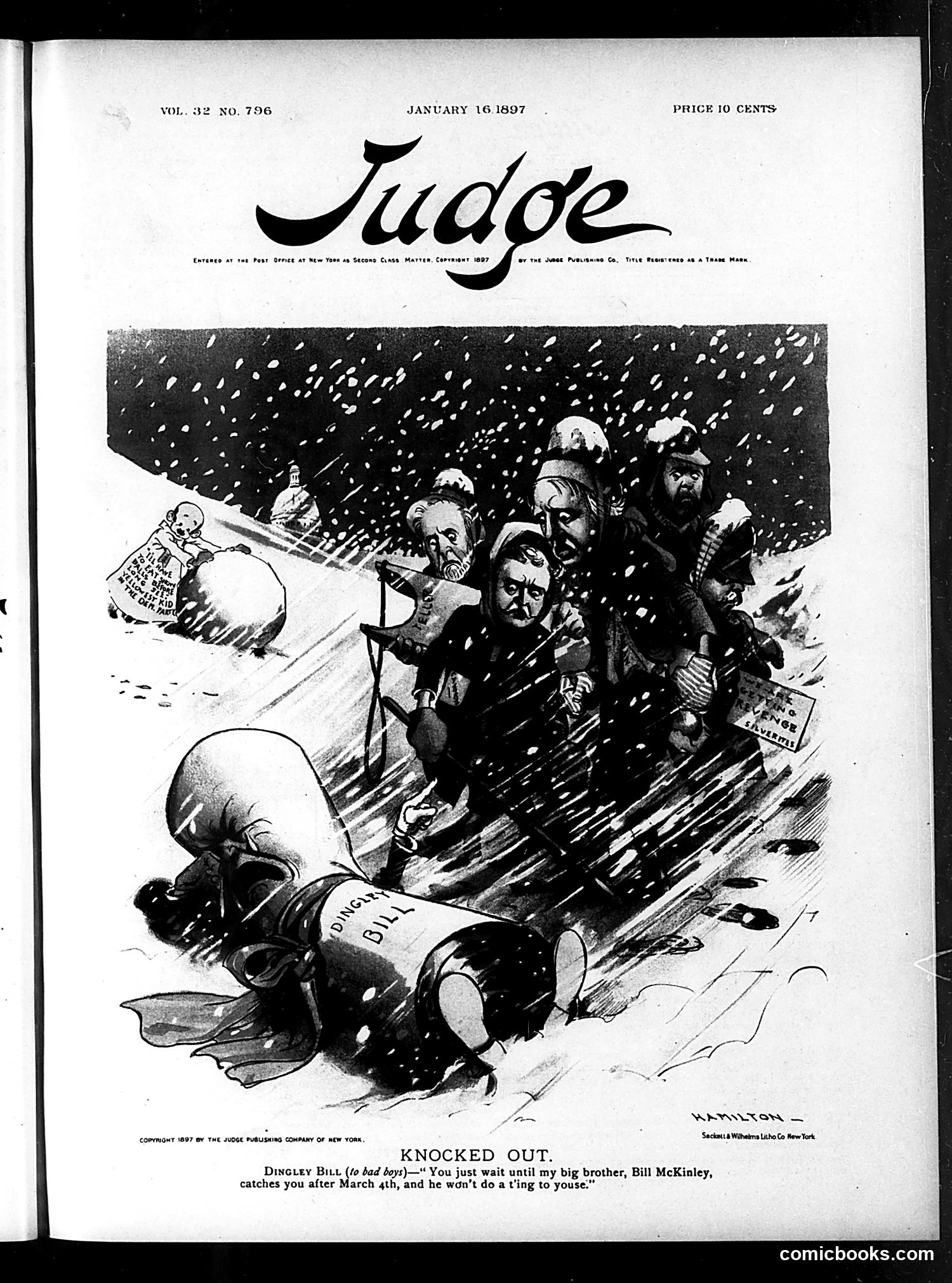
This political cartoon satirizes the **Dingley Tariff Bill**, a major piece of legislation under debate in Congress at that time. The image shows the bill as a large bomb or explosive device that has "knocked out" a group of political figures sledding downhill—suggesting the tariff's disruptive impact on politicians or their opponents. The caption references **Bill McKinley**, who as President supported protective tariffs. The joke appears to be about the Dingley Bill's explosive political consequences, with the sledding figures representing those caught in its wake. The cartoon uses winter sports imagery as metaphor for politicians being knocked off course by controversial legislation affecting trade and economics.
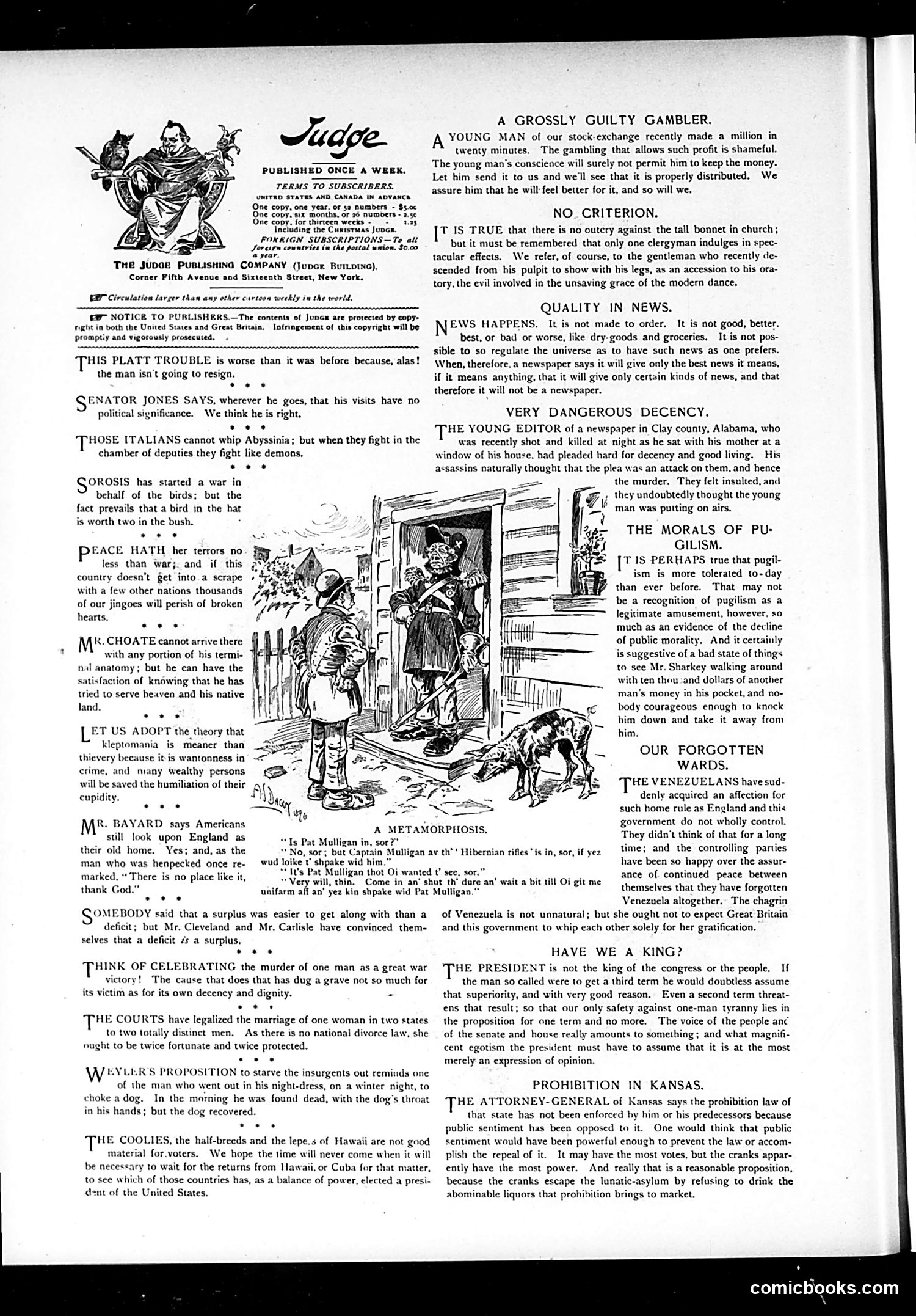
The page contains several editorial comment pieces rather than a unified cartoon. The most prominent illustration depicts "A Metamorphosis"—showing what appears to be a transformation or confrontation at a doorway, though the specific reference is unclear from context alone. The editorial snippets address contemporary issues: criticism of gambling profits, dancing's "modern" moral implications, newspaper standards, and references to politicians (Senator Jones, Mr. Hardin). One section discusses prohibition in Kansas, suggesting this is early 20th-century content. The cartoons and text employ Judge's typical satirical approach—mocking social hypocrisy, political incompetence, and moral decline. Without clearer identification of the figures or specific dates visible on this page, precise historical reference remains uncertain, though the tone reflects Progressive Era concerns about morality and governance.
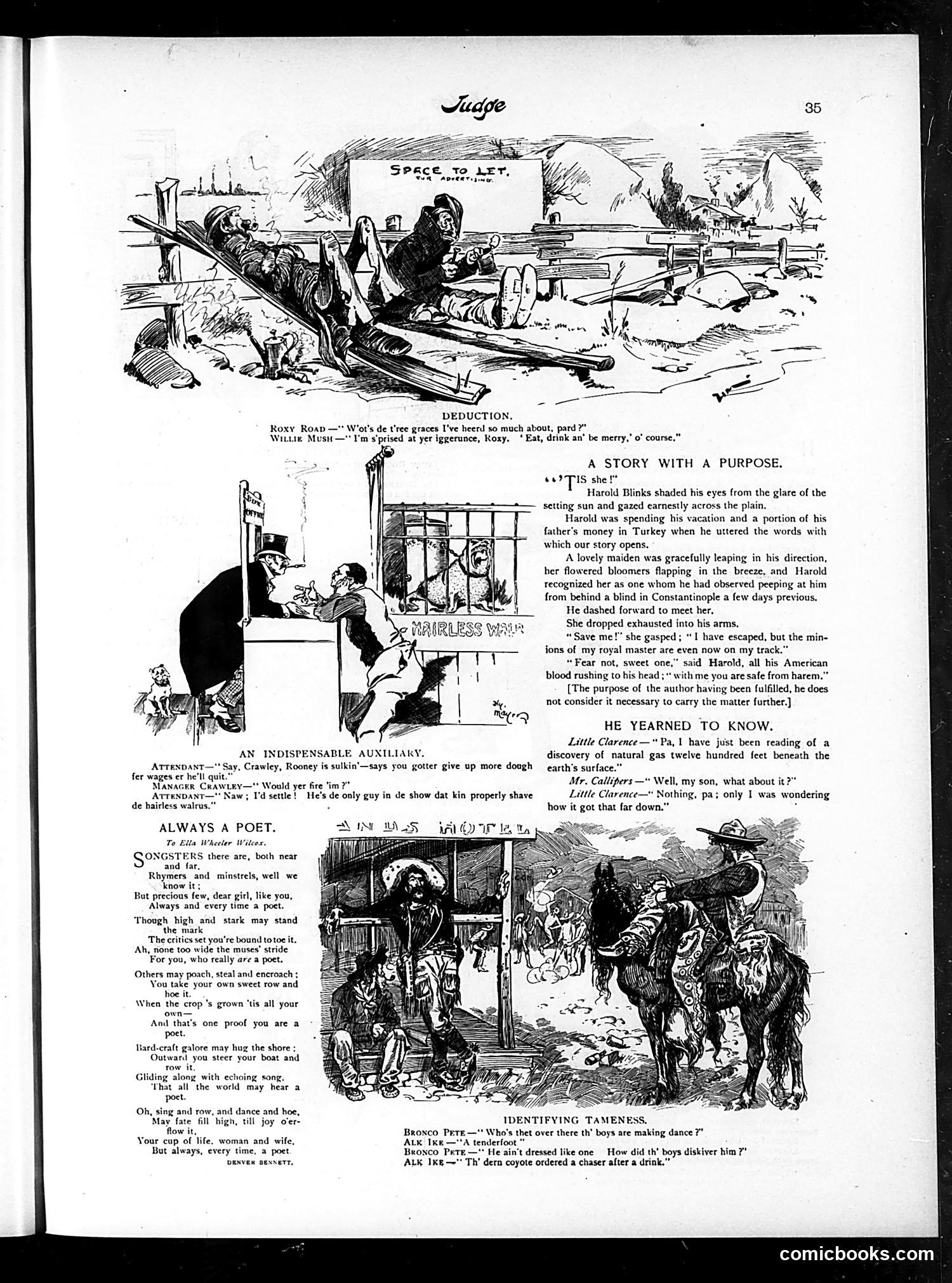
This page contains several distinct satirical pieces typical of Judge magazine's format: **"Deduction"** (top): A visual gag about two tramps near a "Space to Let" sign, playing on the phrase "eat, drink and be merry." **"A Story with a Purpose"** (center): Appears to be a serialized romantic narrative about Harold meeting a woman in Turkey, unrelated to satire. **"An Indispensable Auxiliary"** (left): A joke about a barber-shop attendant and manager, likely satirizing workplace dynamics or labor relations of the era. **"Always a Poet"** (bottom left): A poem celebrating poets' universal appeal and romantic nature—straightforward verse, not satirical. **"Identifying Tameness"** (bottom right): An illustration showing what appears to be performers or dancers, with dialogue suggesting commentary on entertainment or theatrical culture. The page mixes humor, serialized fiction, and light social commentary rather than heavy political satire.
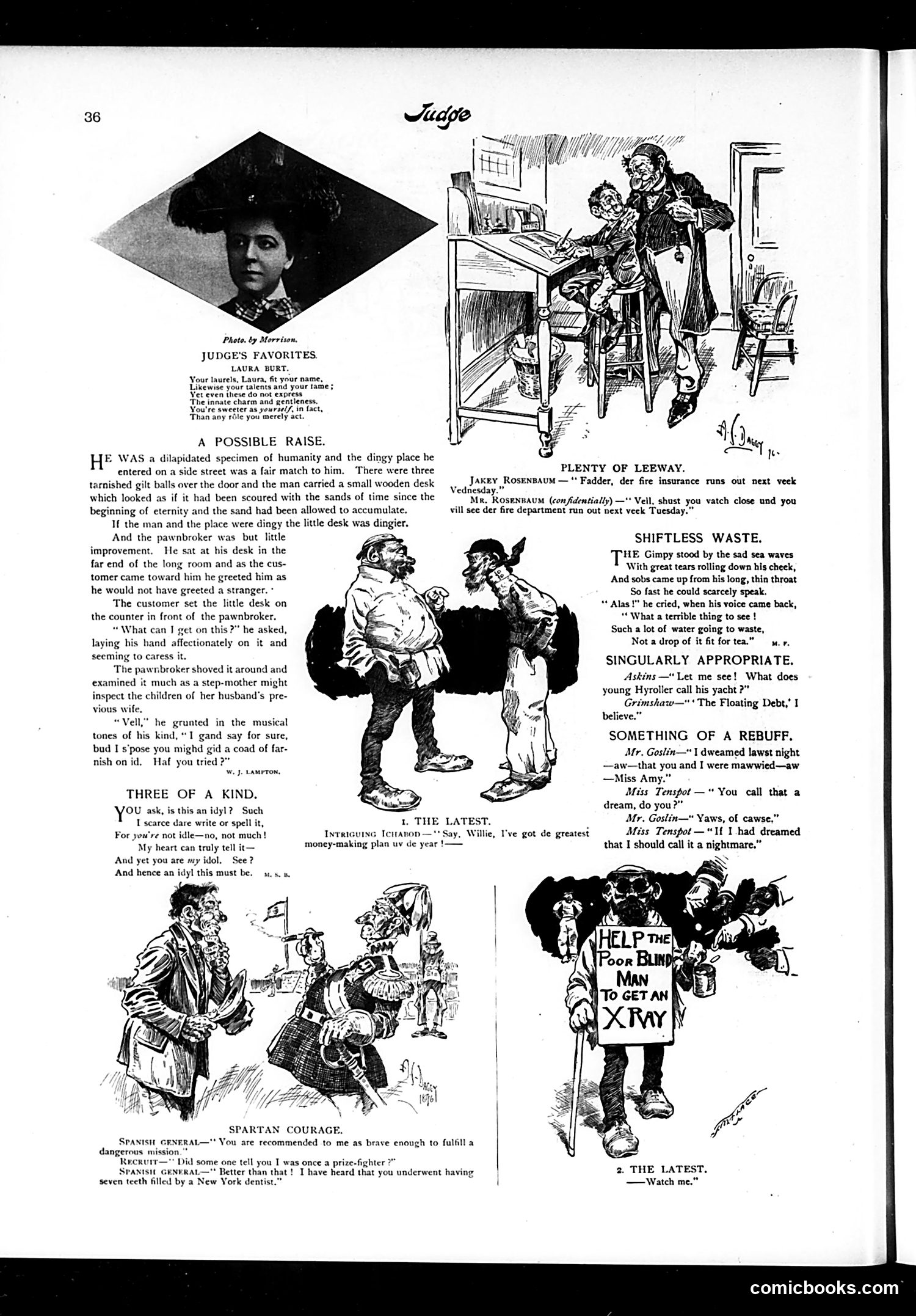
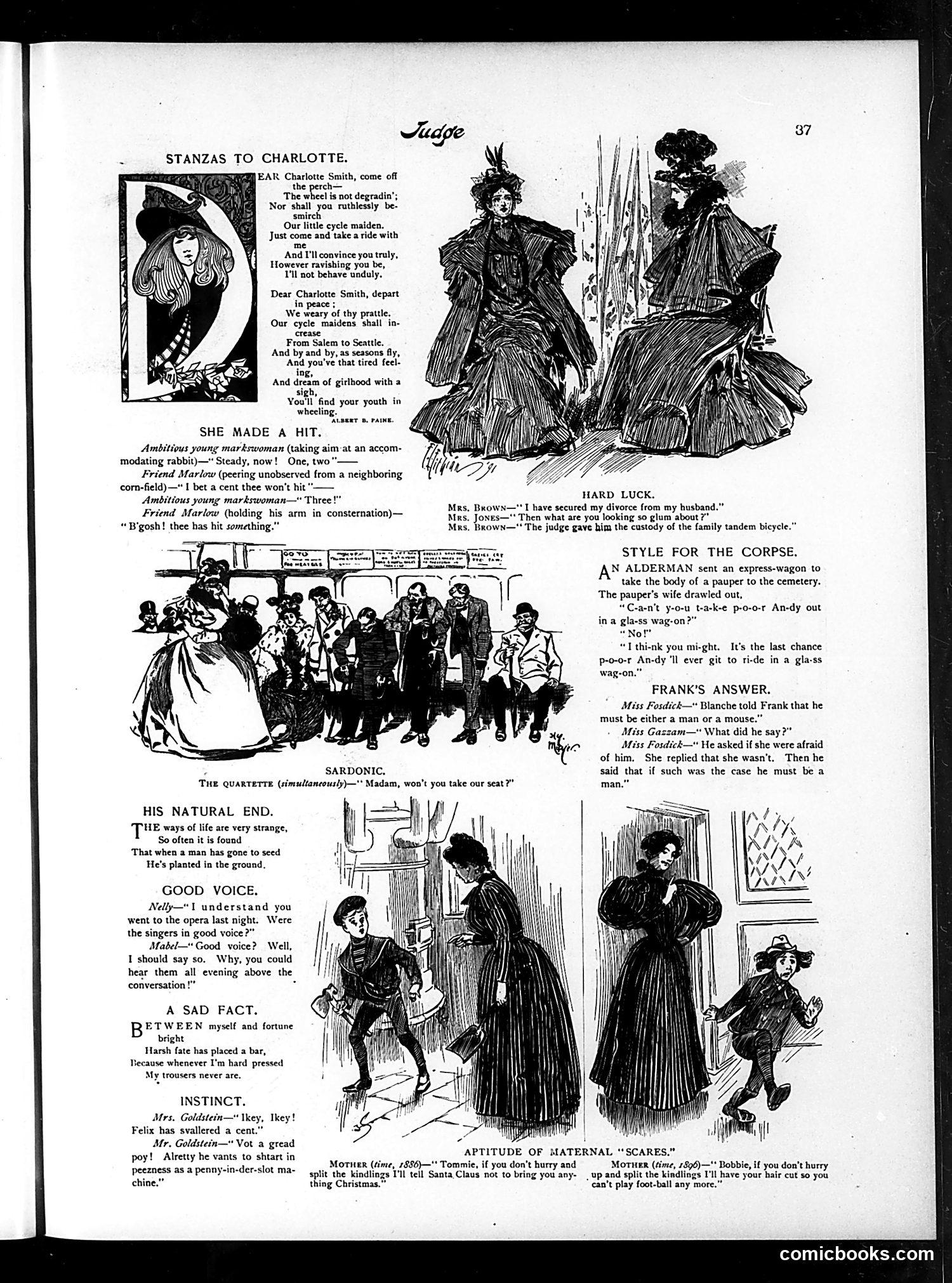
This page contains multiple short humorous sketches typical of 1890s satirical magazines: **"Stanzas to Charlotte"** mocks the "New Woman" craze—specifically women cyclists. Charlotte Smith is urged to abandon her resistance to cycling and join other "cycle maidens" gaining independence through bicycles. **"She Made a Hit"** plays on a woman marksman's accidental success shooting a rabbit, surprising her male observer. **"Hard Luck"** jokes about a woman who secured divorce but now grieves losing custody of a "family tandem bicycle"—satirizing how women valued newfound mobility and independence bicycles represented. **Other sketches** include comic observations about opera singers being loud, a pauper's widow's desire for a fancy glass carriage at her husband's funeral, and maternal threats invoking Santa Claus or haircuts as punishment. The page reflects 1890s anxieties about women's expanding freedoms (cycling, divorce) while treating these developments with gentle mockery rather than outright hostility. The bicycle repeatedly symbolizes women's independence.
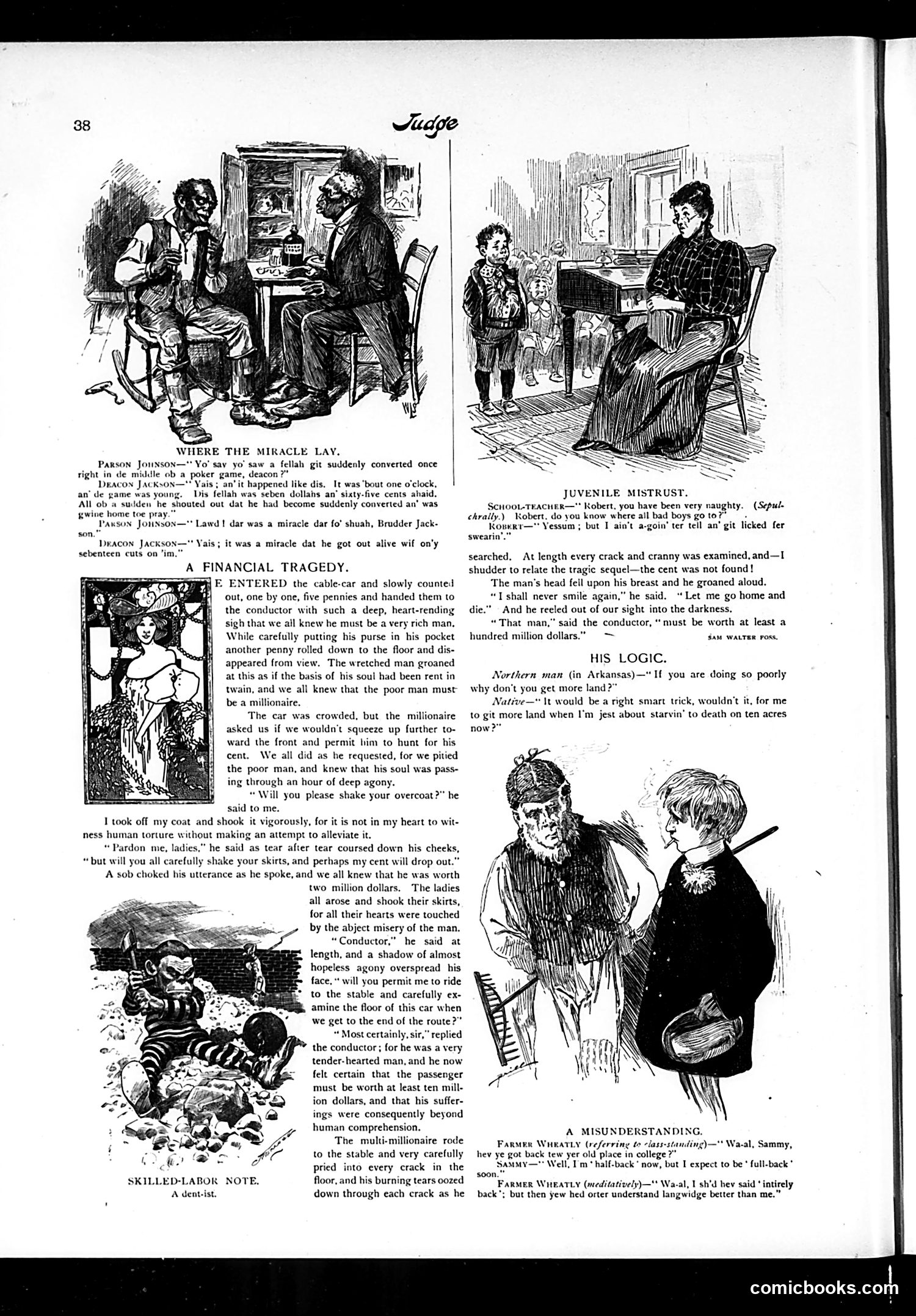
This page contains several satirical pieces mocking wealth, poverty, and class dynamics in late 19th-century America: **"Where the Miracle Lay"** features two Black characters discussing a poker player's sudden religious conversion—the joke being that surviving a game where he lost money (escaping with only 17 knife wounds) was the real "miracle." **"A Financial Tragedy"** satirizes extreme wealth by depicting an absurdly rich man's theatrical anguish over losing a single penny on a streetcar. The narrator and fellow passengers increasingly assume he's a millionaire based on his exaggerated emotional performance, illustrating how the wealthy perform their own suffering. **"His Logic"** and **"A Misunderstanding"** offer shorter comedic takes on rural/class misunderstandings about poverty and education. The overall theme: satire of how the wealthy dramatize minor losses while the poor suffer genuinely, and how class assumptions shape social perception.
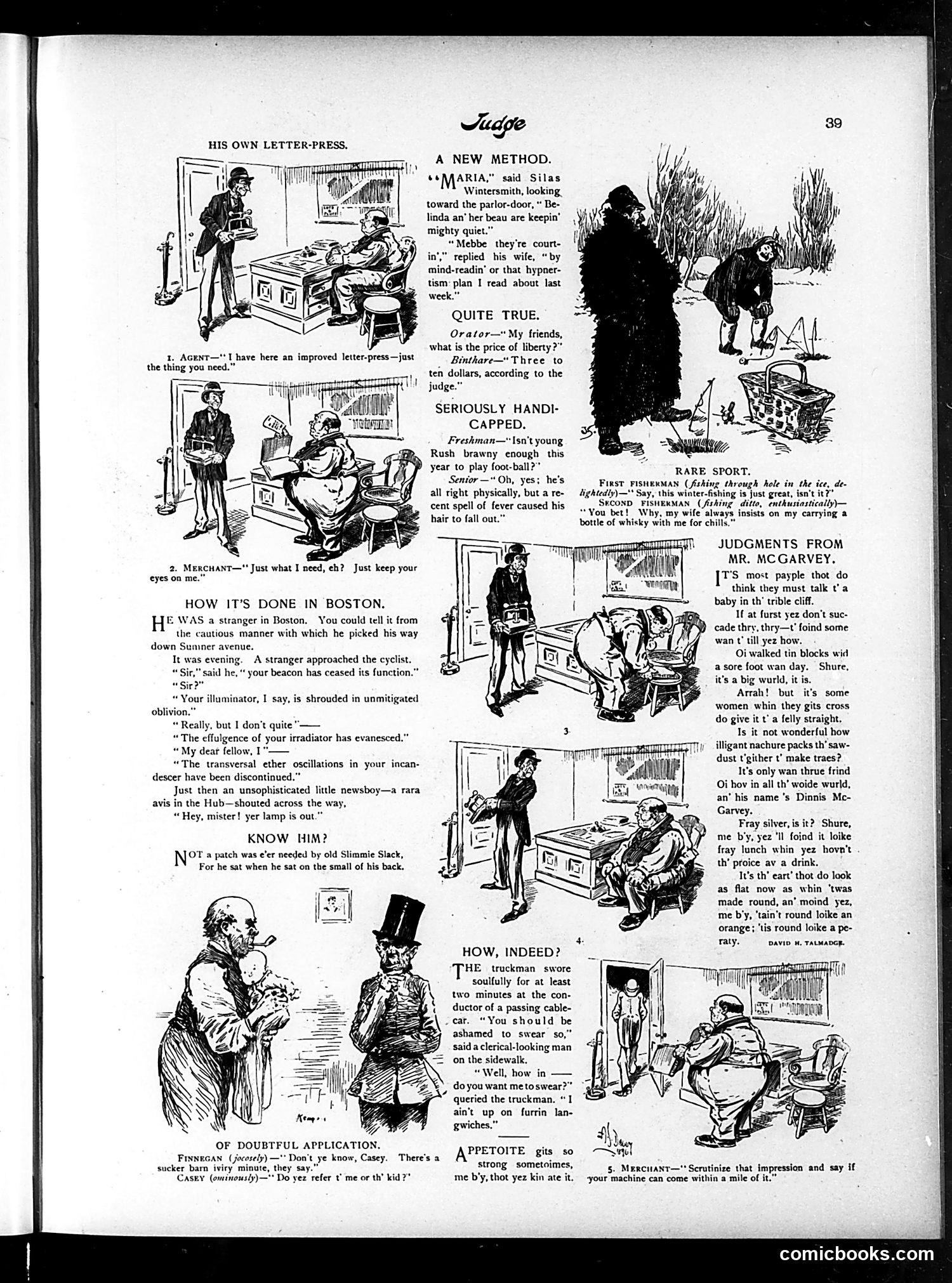
This page contains multiple standalone humorous sketches satirizing American life and manners: **"His Own Letter-Press"** mocks a merchant's gullible belief in a salesman's exaggerated claims about an "improved" printing device. **"How It's Done in Boston"** ridicules Boston's pretentious upper class through a stranger who uses absurdly elaborate vocabulary ("effulgence of your irradiator") to simply tell a cyclist his lamp is broken—punctured by a street newsboy's blunt, direct Boston accent: "yer lamp is out." The joke celebrates common sense over affected erudition. **"Know Him?"** is a brief character sketch. **Other sketches** humorously depict everyday situations: young courtship, sports injuries, ice-fishing culture, and Irish-immigrant dialect humor (McGarvey's column uses heavy phonetic Irish-American speech patterns typical of period humor). The magazine's overall tone is lighthearted social commentary on class differences, regional dialects, and urban American life circa the 1890s-1900s.
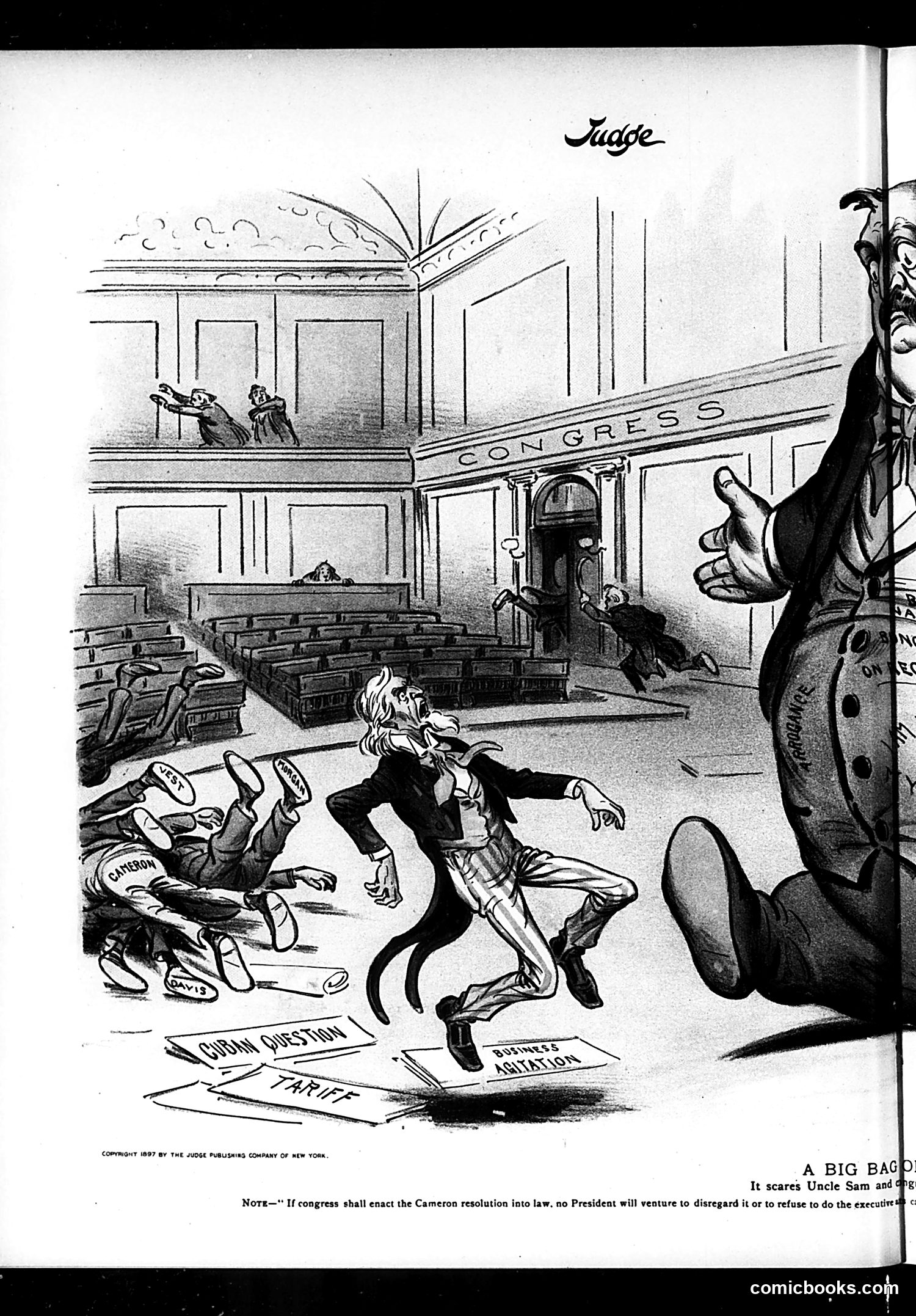
This 1887 Judge cartoon depicts Uncle Sam (the personified United States, shown as a large figure on the right) being frightened by a bag labeled with various political/economic concerns: "Tariff," "Business Agitation," and "Chinese Question." A disheveled figure dances in the center of Congress, apparently causing chaos. The accompanying note references the "Cameron resolution"—likely Senator James Donald Cameron's legislative proposal—suggesting Congress might pass laws that would constrain presidential executive power. The satire ridicules anxieties about congressional overreach and domestic political turmoil (tariff disputes, labor unrest, Chinese immigration policy), portraying these issues as a "big bag" of fears that could frighten the nation's leadership. The cartoon satirizes whether elected officials or the President should control policy responses to these pressing 1880s concerns.
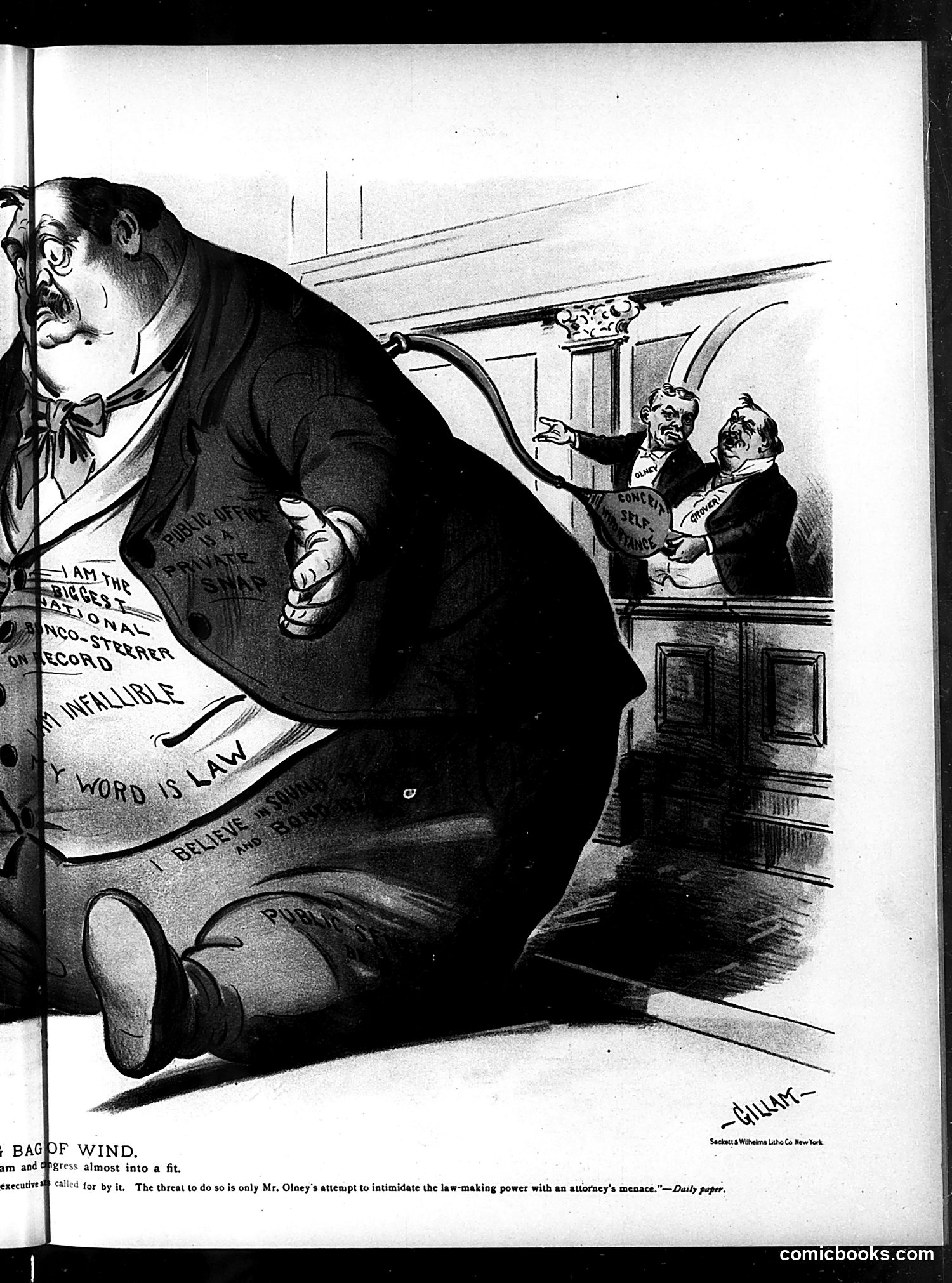
This political cartoon satirizes Attorney General Richard Olney's alleged attempt to intimidate Congress. The large figure on the left, labeled with phrases like "I AM THE BRIDGES," "NATIONAL CONCERN," and "MY WORD IS LAW," represents Olney as an authoritarian, bloated character threatening lawmakers visible in the background. The cartoon criticizes what the accompanying text calls Olney's "menace"—his use of legal threats to coerce legislative action rather than persuade through proper channels. The exaggerated physique and aggressive posture mock him as overreaching his executive authority. This appears to reference a specific political conflict between the executive and legislative branches during the 1890s regarding government power and proper constitutional limits.
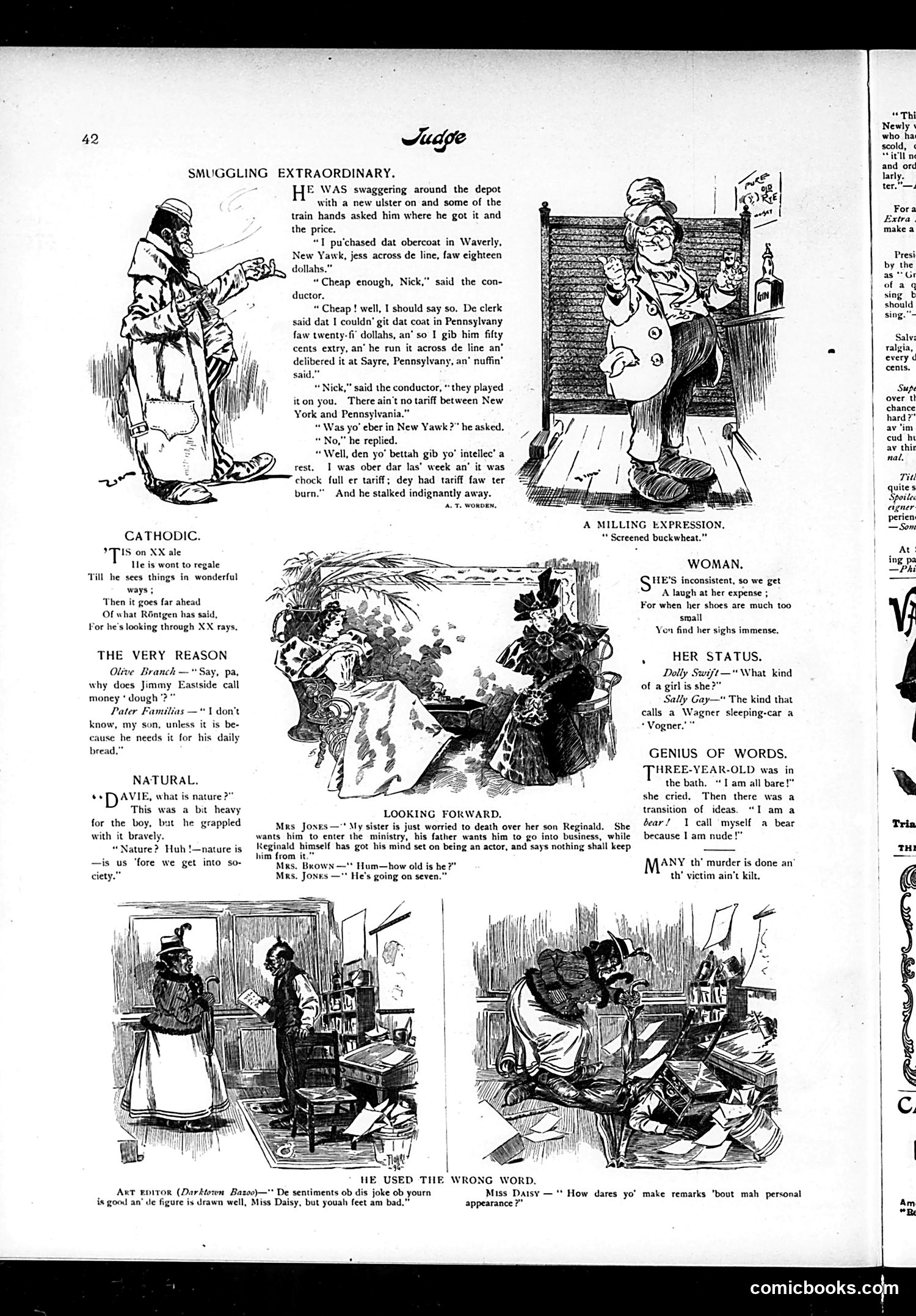
This page contains several short humorous sketches typical of Judge's satirical format: **"Smuggling Extraordinary"** depicts a con man who bought a cheap coat in New York and smuggled it across state lines into Pennsylvania to avoid tariffs. The conductor exposes the scam, explaining there's actually no tariff between states—the con artist was tricked into paying extra for "smuggling" a worthless coat. **"The Very Reason"** jokes about a boy's allowance, suggesting he needs money for his "daily bread" (a play on words about literal food). **"Natural"** presents a child's innocent definition of nature as "what we are before we get into society"—satirizing the Romantic-era notion of natural human goodness corrupted by civilization. Other short pieces mock women's inconsistencies, mispronunciations, and social pretensions. The page reflects Judge's focus on everyday American life, wordplay, and gentle social satire rather than specific political targets.
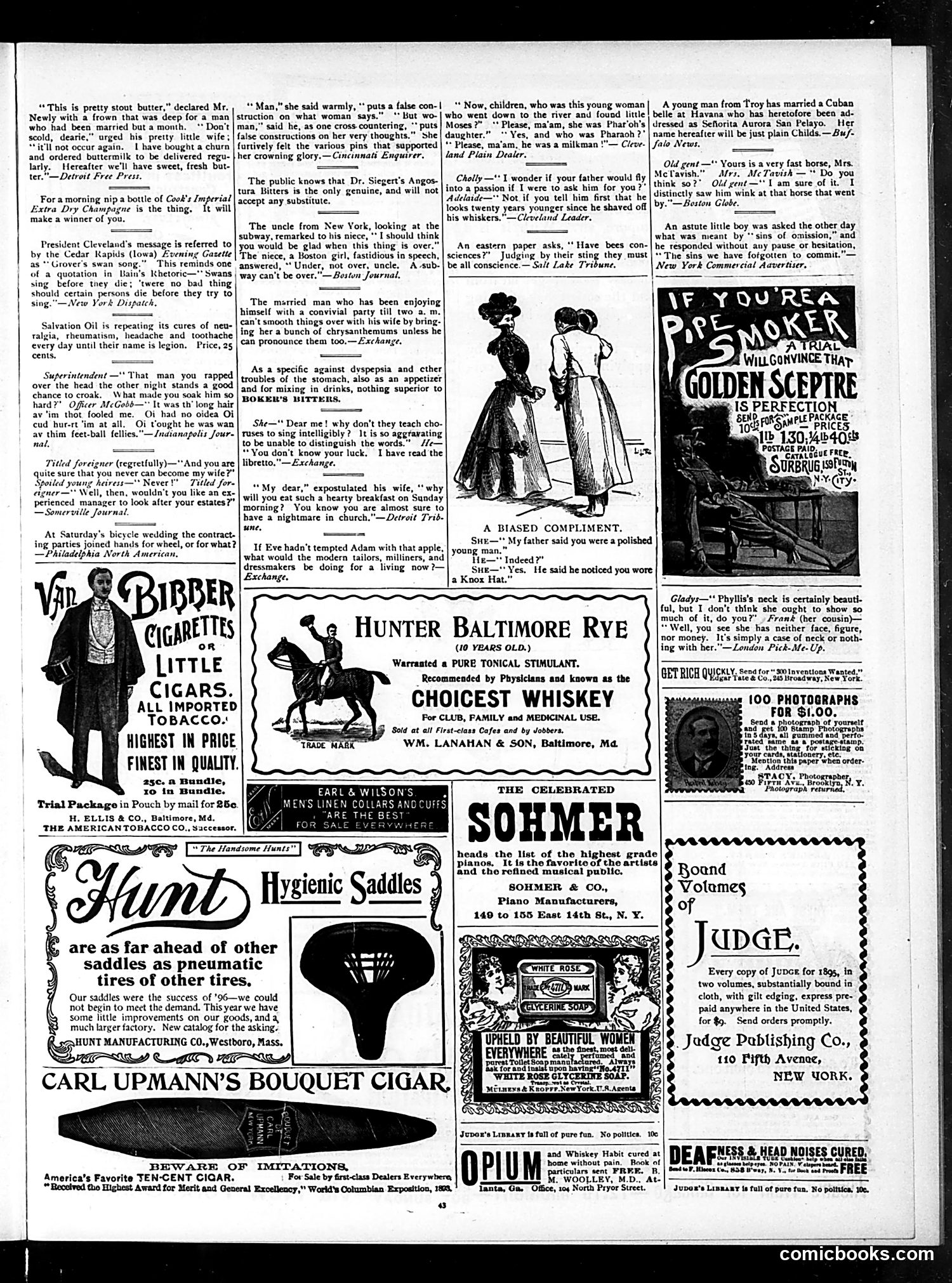
This page from the satirical magazine **Judge** consists primarily of **humorous anecdotes and advertisements** rather than political cartoons. The brief jokes scattered throughout mock domestic life and social conventions of the era. One anecdote ridicules a newlywed husband complaining about butter quality—establishing Judge's audience as middle-class Americans. Another jokes about a Boston woman's fastidious speech, reflecting contemporary class anxieties. A third mocks a child's misunderstanding of biblical history, typical of era humor. The advertisements dominate: endorsements for whiskey, cigars, saddles, and pianos appear throughout. Notably, one ad promotes "Opium" as a cure for "Whiskey Habit"—reflecting the pre-regulation era when such substances were openly marketed as medicines. **No identifiable political figures or specific events are referenced.** The content targets universal middle-class concerns: marriage, etiquette, and consumption rather than politics. This appears to be a lighter editorial section of the magazine focused on entertainment and advertising rather than satirical commentary.
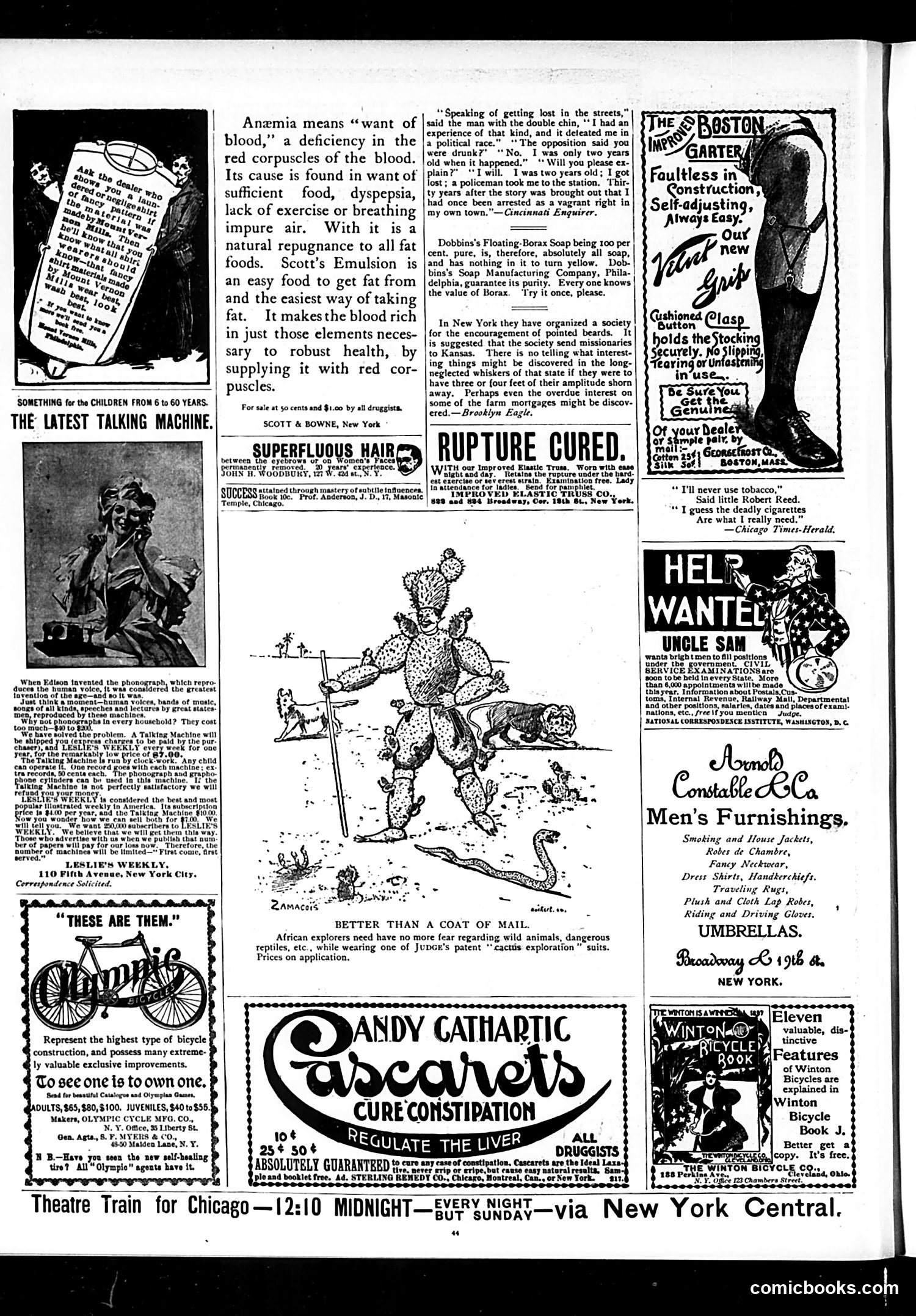
This page from Judge magazine contains primarily **advertisements and light humor** rather than sustained political cartoons. The main satirical content includes: 1. **"Something for the Children" section**: Mocks Edison's phonograph as a novelty, humorously suggesting it's entertainment for all ages (6-60 years). 2. **Political anecdote**: A joke about a man whose childhood arrest as a vagrant (at age 2, while lost) was weaponized against him in a political race 30 years later—satirizing how opponents exploit personal history. 3. **Kansas beard joke**: Mocks Kansas as so undeveloped that forming a society to encourage pointed beards there would be noteworthy, suggesting the state's backwardness. 4. **"Better Than a Coat of Mail"**: An illustration of an absurd "cactus exploration suit" for African explorers—likely satirizing overcomplicated colonial expedition gear. The page is primarily filled with commercial advertisements (Scott's Emulsion, soap, bicycles, clothing, remedies), which was typical of Judge's business model. The satire is mild social commentary rather than hard-hitting political critique.
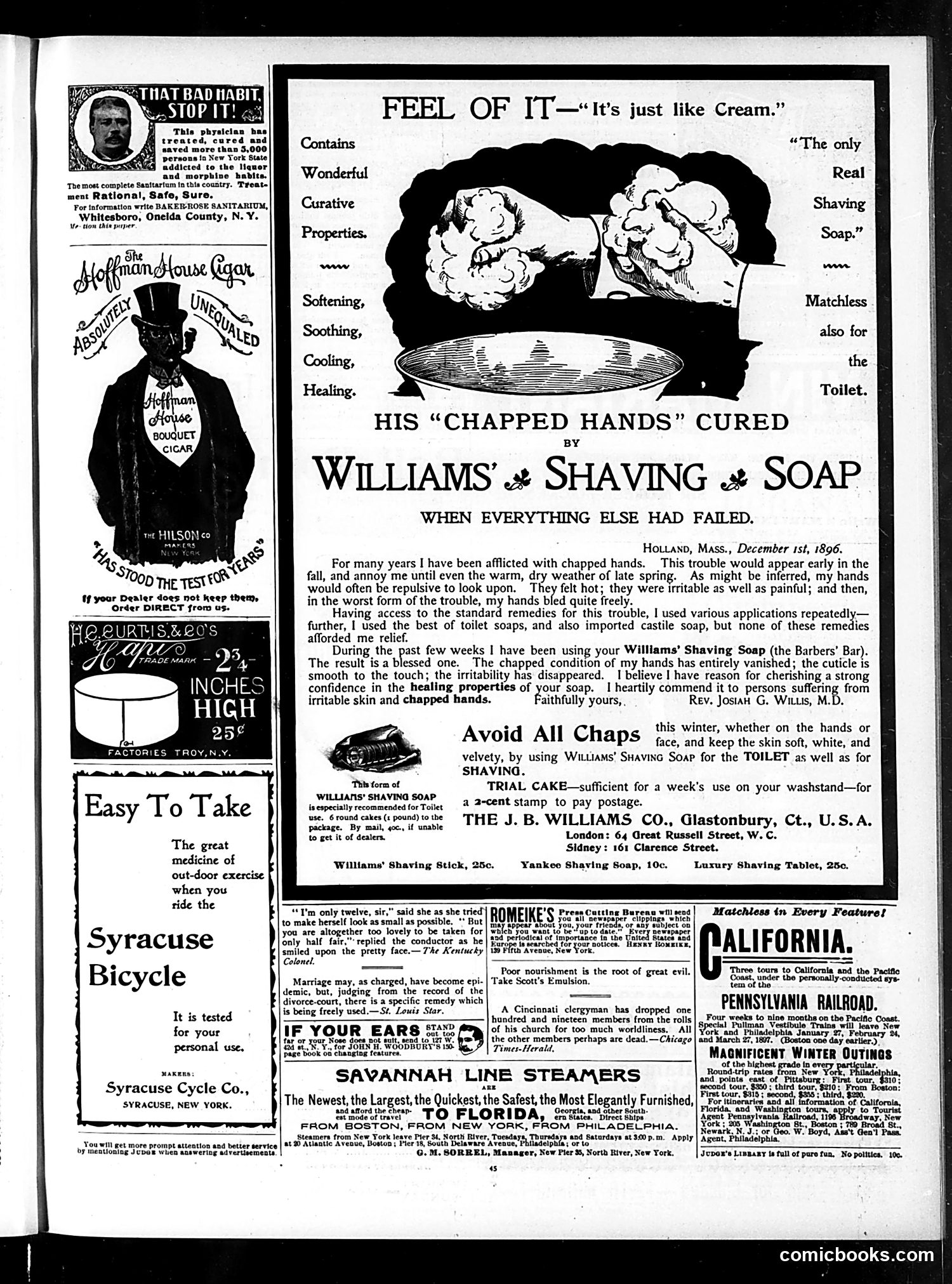
This page is primarily **advertising**, not satire or political content. The main advertisement occupies the center: **Williams' Shaving Soap**, marketed as a cure for chapped hands. It features a testimonial letter from "Rev. Josiah G. Willis, M.D." from Holland, Massachusetts (dated December 1, 1896), claiming the product healed his severely chapped, bleeding hands after "everything else had failed." The page includes supporting ads for other consumer products (Syracuse Bicycle, Hoffmann House Cigar, Baker-Rose Sanitarium) and travel services (Savannah Line Steamers, California tours, Pennsylvania Railroad). The small comic snippets scattered throughout are generic humor—a conductor's interaction with a young girl, observations about marriage and religion—unrelated to the main advertisement. This is typical late-19th century magazine advertising, using testimonials and product claims common to the era. No political satire is evident on this page.
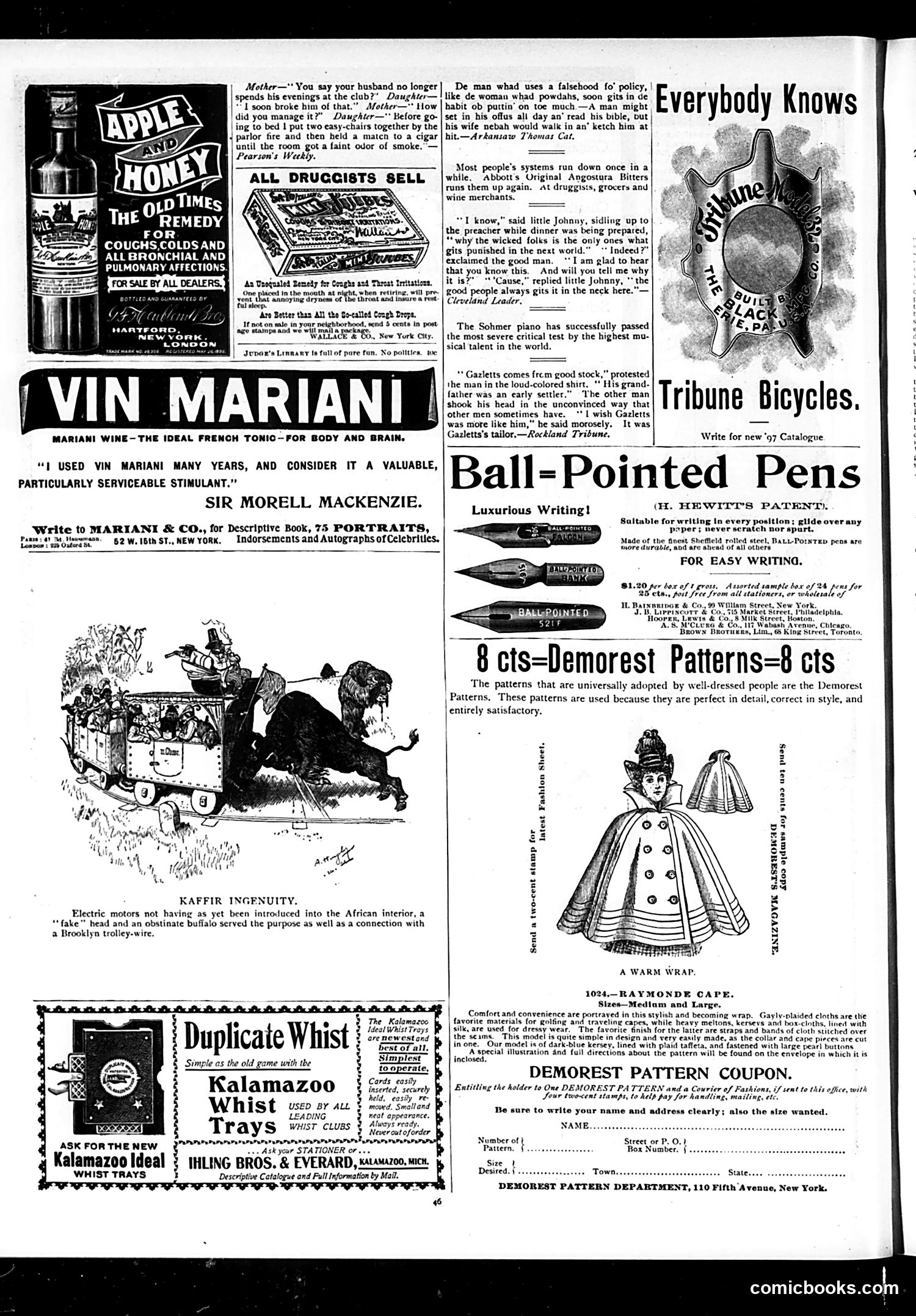
This page is primarily **advertisements and filler content** rather than political satire. The dominant feature is a large ad for **Vin Mariani** (a French wine tonic), endorsed by Sir Morell Mackenzie. The small humor pieces are domestically focused: 1. A **wife's trick** to keep her husband home from his club by creating cigar smoke in the parlor—mocking both marital manipulation and Victorian men's club culture. 2. **Folk wisdom** about liars and hypocrites (the "Arkansaw Thomas Cat" quote) and a child's observation that good people suffer punishment in *this* life rather than the next. 3. A **joke about tailoring**: a man named Gazletts is criticized for not resembling his early-settler grandfather—turns out the tailor is responsible, mocking sloppy workmanship. The **"Kaffir Ingenuity"** cartoon satirizes African technology (or lack thereof), depicting a buffalo and "fake head" substituting for electric motors in colonial Africa—reflecting period attitudes about colonized peoples. The remainder consists of advertisements for bicycles, pens, dress patterns, and whist trays.
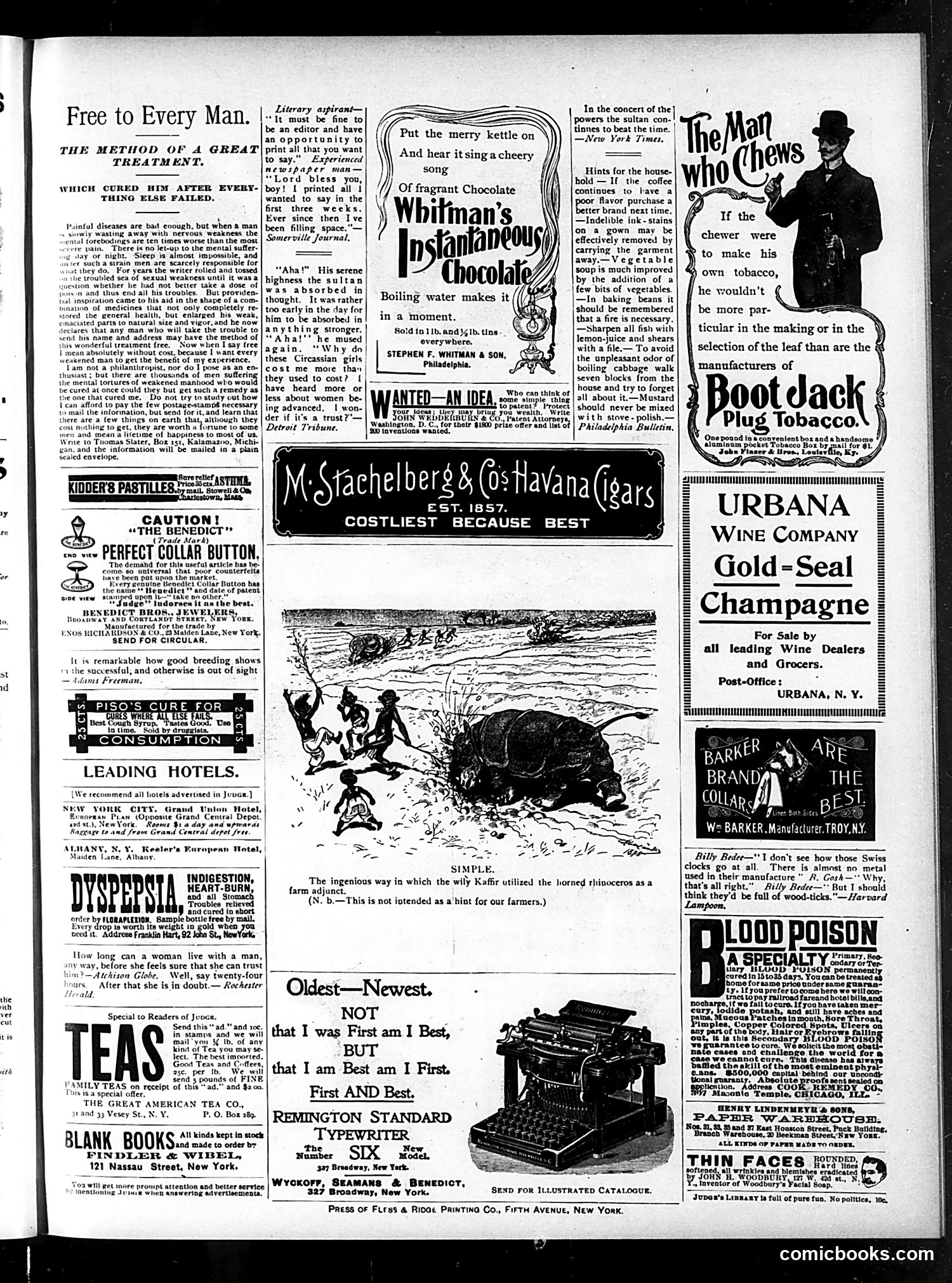
This page is primarily **advertising**, with minimal editorial content. The few satirical pieces are brief: **The main cartoon/joke** depicts a rhinoceros being used as a farm plow—captioned "SIMPLE" with a note clarifying this isn't intended as farming advice. The humor is absurdist: suggesting an absurdly impractical animal for agricultural work. **Editorial humor snippets** include: - A newspaper editor's confession that he printed everything he wanted to say in his first three weeks, and has merely been "filling space" since - A quip about women trusting men after "twenty-four hours," then doubting thereafter The page is dominated by patent medicines and consumer goods advertisements typical of the era—collar buttons, chocolate, champagne, typewriters, tea, blank books—reflecting late 19th/early 20th-century commercial culture. The sexual wellness remedy advertisement ("Free to Every Man") reflects period attitudes toward male health anxieties. There are **no identifiable political cartoons or caricatures** on this page.
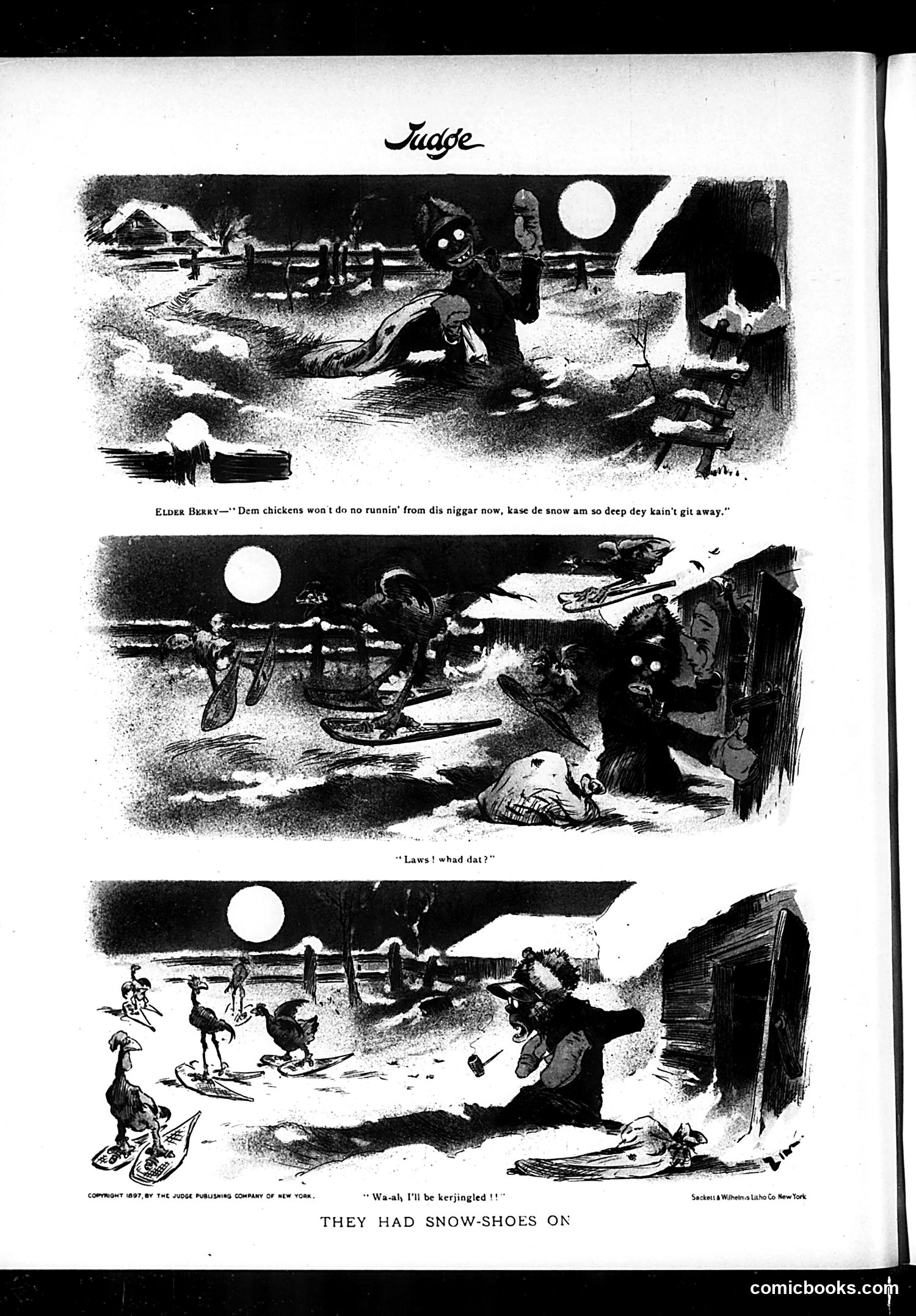
This three-panel comic from Judge magazine depicts a narrative involving snow and snow-shoes. The dialogue and dialect suggest the characters are portrayed using racial stereotypes common to early 20th-century American humor. The first panel shows a figure describing chickens unable to run in snow. The subsequent panels show escalating comic confusion or mishap, culminating in someone being "kerjingled" (struck or knocked). The humor appears to rely on physical comedy and exaggerated dialect rather than sophisticated satire. The title "They Had Snow-Shoes On" suggests the snow-shoes cause unexpected or absurd consequences. Without additional historical context about specific current events from 1907, the exact satirical target remains unclear, though the comic reflects the crude racial caricature conventions typical of Judge magazine during this era.