
A complete issue · 16 pages · 1897
Judge — January 2, 1897
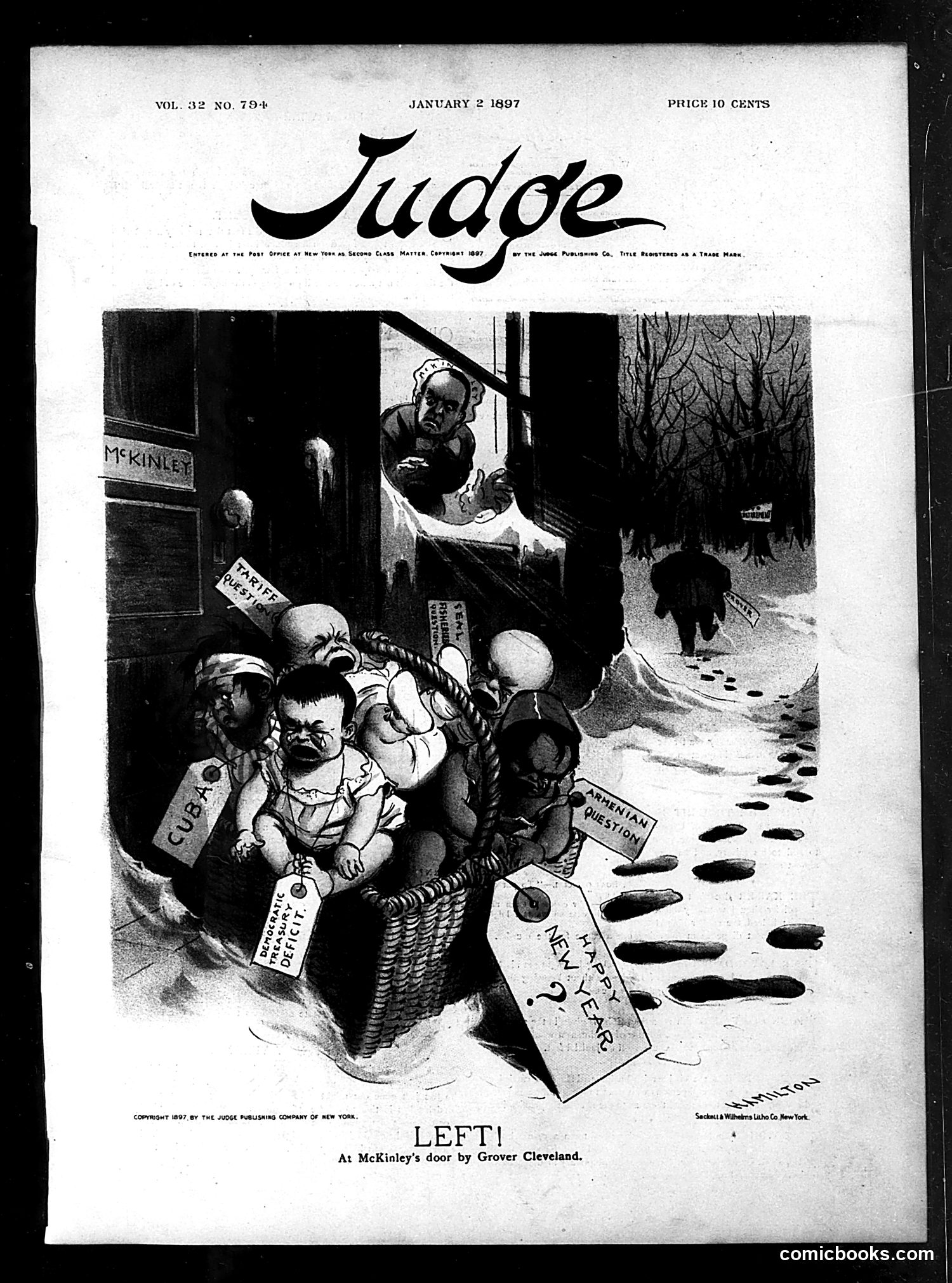
This political cartoon by Grover Cleveland satirizes the transition between presidential administrations. The image shows a basket of unwanted figures and issues being left at President McKinley's doorstep by the outgoing Cleveland administration. The cartoon depicts various caricatured problems—likely representing economic depression, unpopular policies, and political figures from Cleveland's presidency—being deposited as burdensome "gifts" for the incoming McKinley to handle. The footprints leading away suggest Cleveland's hasty departure from office. This reflects contemporary frustration with Cleveland's second term (1893-1897), which was marked by economic panic and unpopular decisions. The satire mocks the symbolic "mess" being inherited by the new administration, a common theme in transitional political humor.
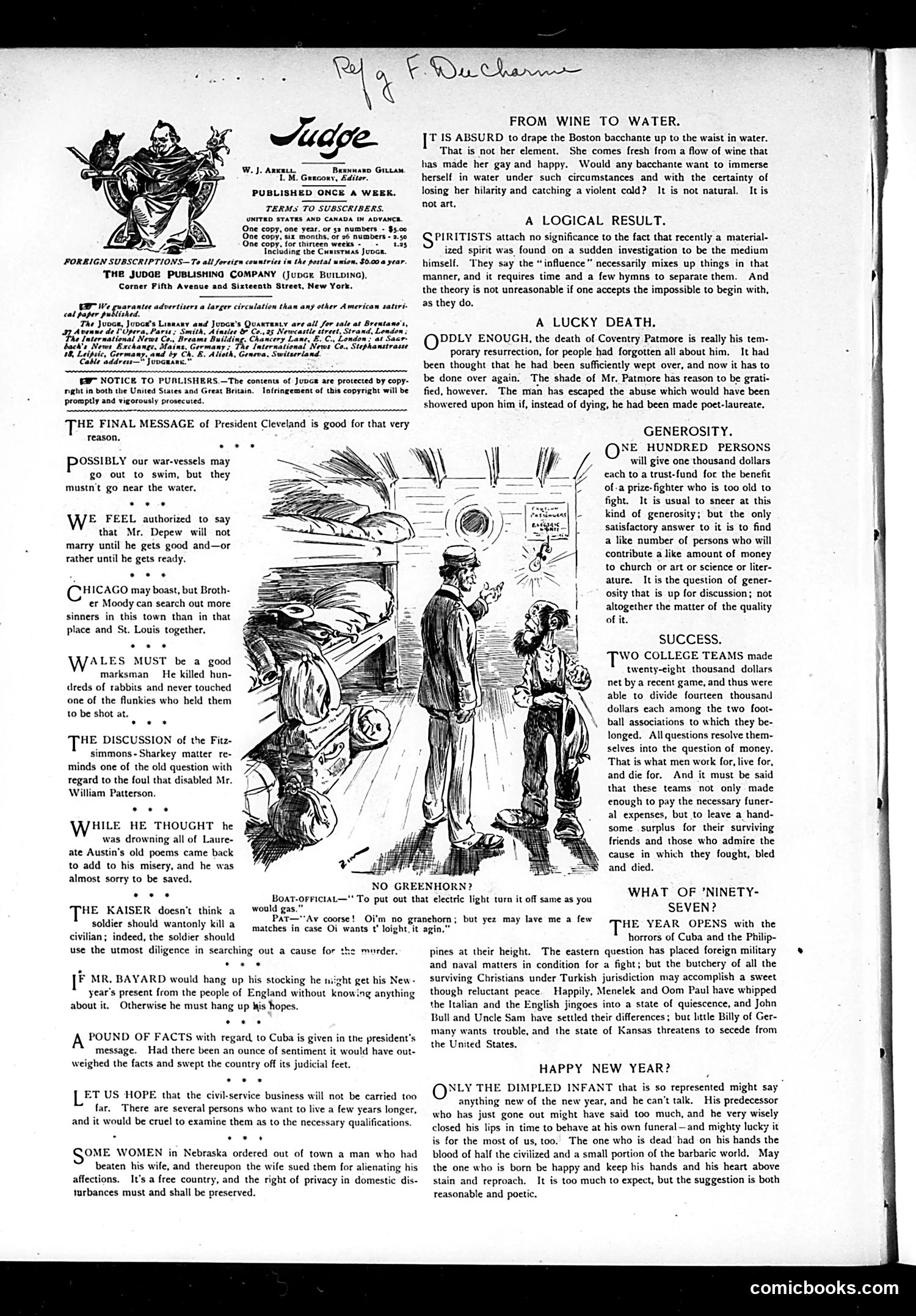
This page contains several editorial columns and a cartoon titled "NO GREENHORNS?" The cartoon depicts a boat official refusing to turn off an electric light, claiming it's the same as "gas" and saying "you may have me a few matches in case O' wants it bright it again." The joke appears to mock newly arrived immigrants ("greenhorns") unfamiliar with modern technology like electric lighting, treating them as foolish for not understanding the difference between gas and electricity. The surrounding text addresses various political and social issues including President Cleveland's final message, military matters regarding Cuba and the Philippines, and domestic concerns about civil service and marital privacy rights—typical Progressive Era debates in American society.
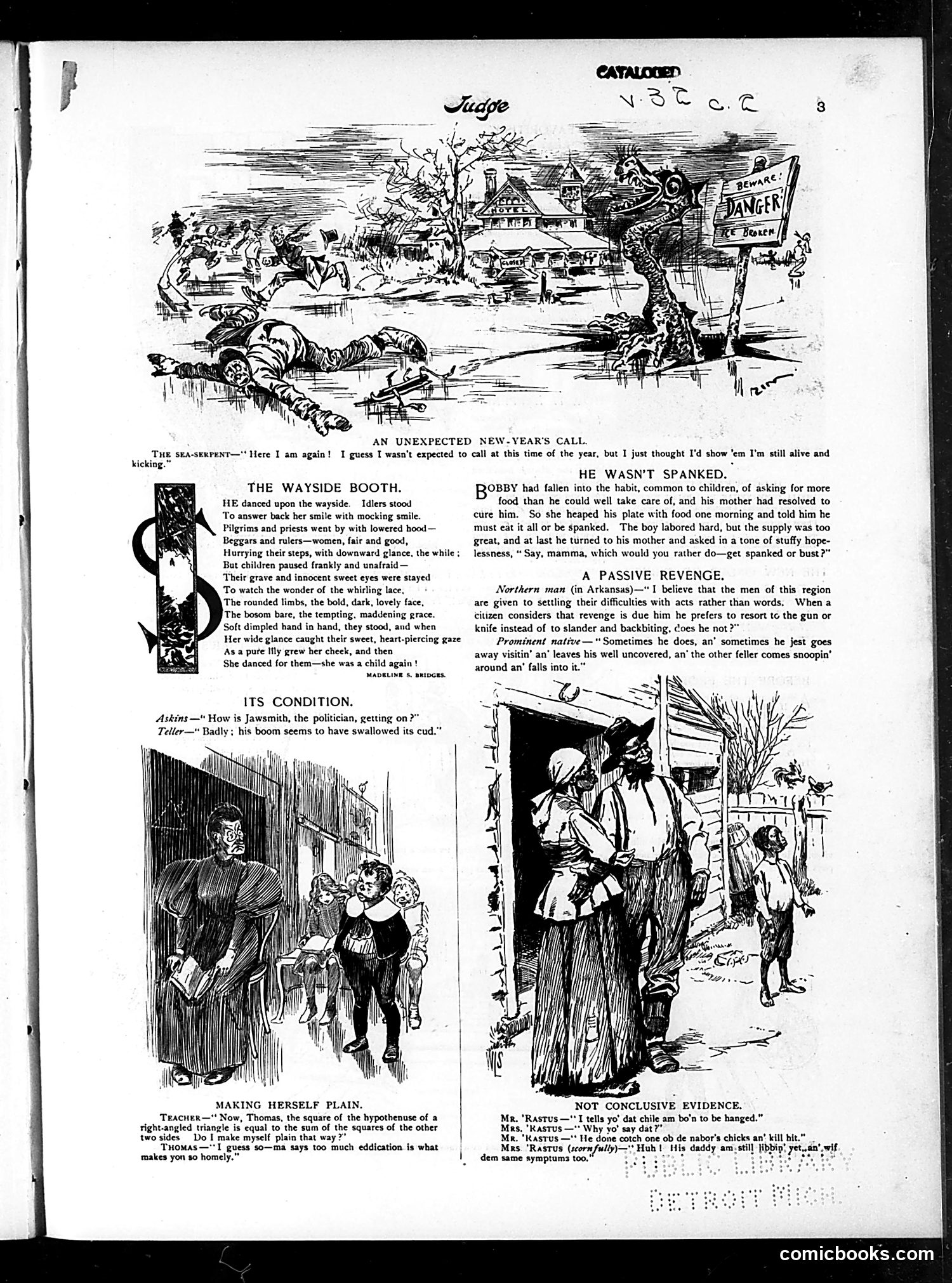
This page contains four separate humorous sketches typical of Judge magazine's satirical style: **"An Unexpected New Year's Call"**: A sea serpent visits, claiming to prove he's still alive—likely satirizing ongoing public fascination with sea monster sightings. **"The Wayside Booth"**: A poetic piece about a dancer at a fair attraction, celebrating her graceful performance. **"Its Condition"**: A brief joke about a politician's health, with a pun on swallowing a "cod" (possibly referring to a political figure). **"Making Herself Plain"** and **"Not Conclusive Evidence"**: Short domestic humor sketches about family conversations and misunderstandings. The page reflects turn-of-the-century American humor focused on everyday absurdities, cryptozoology curiosities, and domestic comedy rather than specific political figures or events. The satirical bite is gentle rather than pointed.
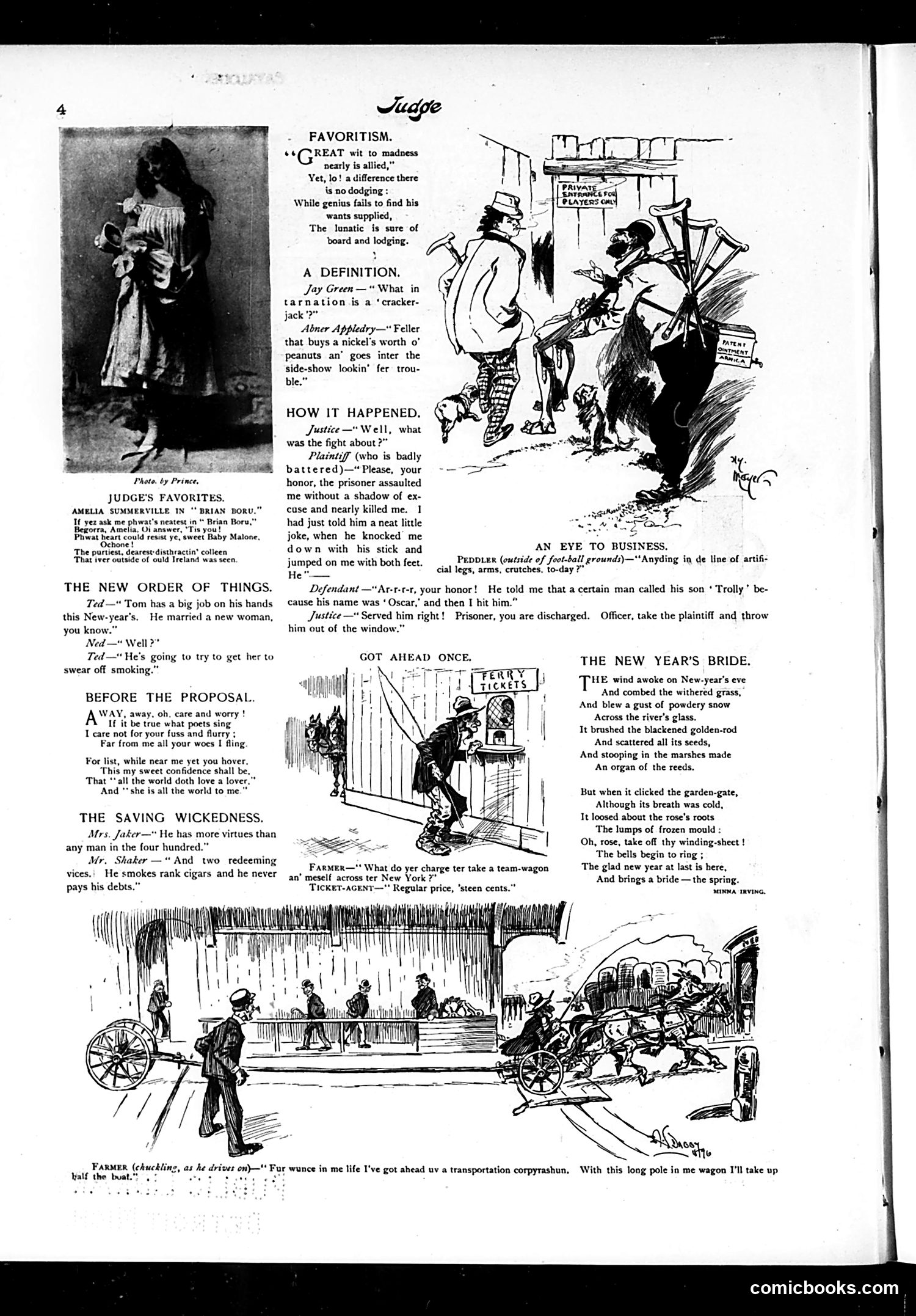
This page from the satirical magazine **Judge** contains multiple short humor pieces typical of late 19th/early 20th-century American comic publications. **Main Content:** The cartoons and text rely on contemporary social observations: "Favoritism" contrasts how the mentally ill receive institutional care while geniuses struggle; "A Definition" features rural characters discussing carnival attractions; "How It Happened" shows a courtroom scene where a plaintiff's joke prompted violent retaliation—satirizing legal absurdity. Other pieces mock marital dynamics ("The New Order of Things"), courtship sentimentality ("Before the Proposal"), and social hypocrisy ("The Saving Wickedness," where a man's vices are paradoxically his virtues). **Visual Elements:** A photograph of actress Amelia Summerville appears, promoting theatrical favoritism. Sketches show street scenes, courtrooms, and rural characters in period dress. **The Point:** Judge's humor targets class distinctions, legal incompetence, romantic pretension, and character contradictions—using vernacular dialogue and exaggerated situations for effect. The tone is cynical but lighthearted.
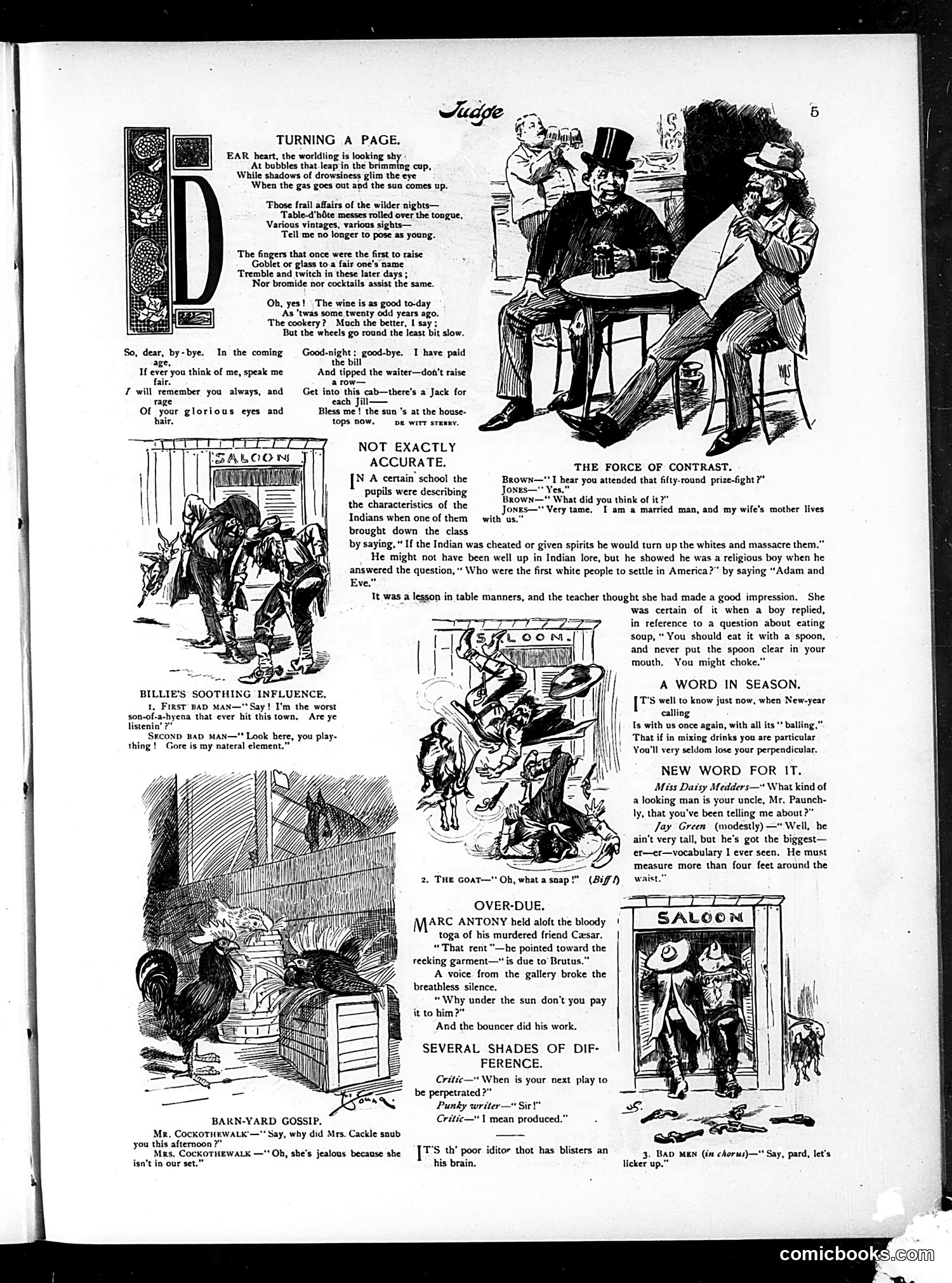
This page collects various humorous sketches typical of late 19th-century American satirical magazines: **"Turning a Page"** is sentimental verse about aging—a man reminiscing about youthful indulgences (wine, fine dining, romance) now lost to time, bidding farewell to a former love. **"Not Exactly Accurate"** mocks a schoolboy's garbled history lesson: asked who first settled America, he answers "Adam and Eve"—conflating biblical and American history. **"The Force of Contrast"** jokes about marital tension: a man mentions attending a prize-fight; his wife's mother lives with them, implying domestic discord. **"Billie's Soothing Influence"** depicts two "bad men" competing over toughness until a child's innocent intervention calms them—gentle humor about masculinity undone by innocence. **Other sections** include barnyard gossip (animal characters), theatrical wordplay, and drinking humor typical of the era. The cartoons use exaggerated illustrations and crude dialect for comedic effect. The satire targets social pretension, marital dynamics, and masculine posturing rather than specific political figures.
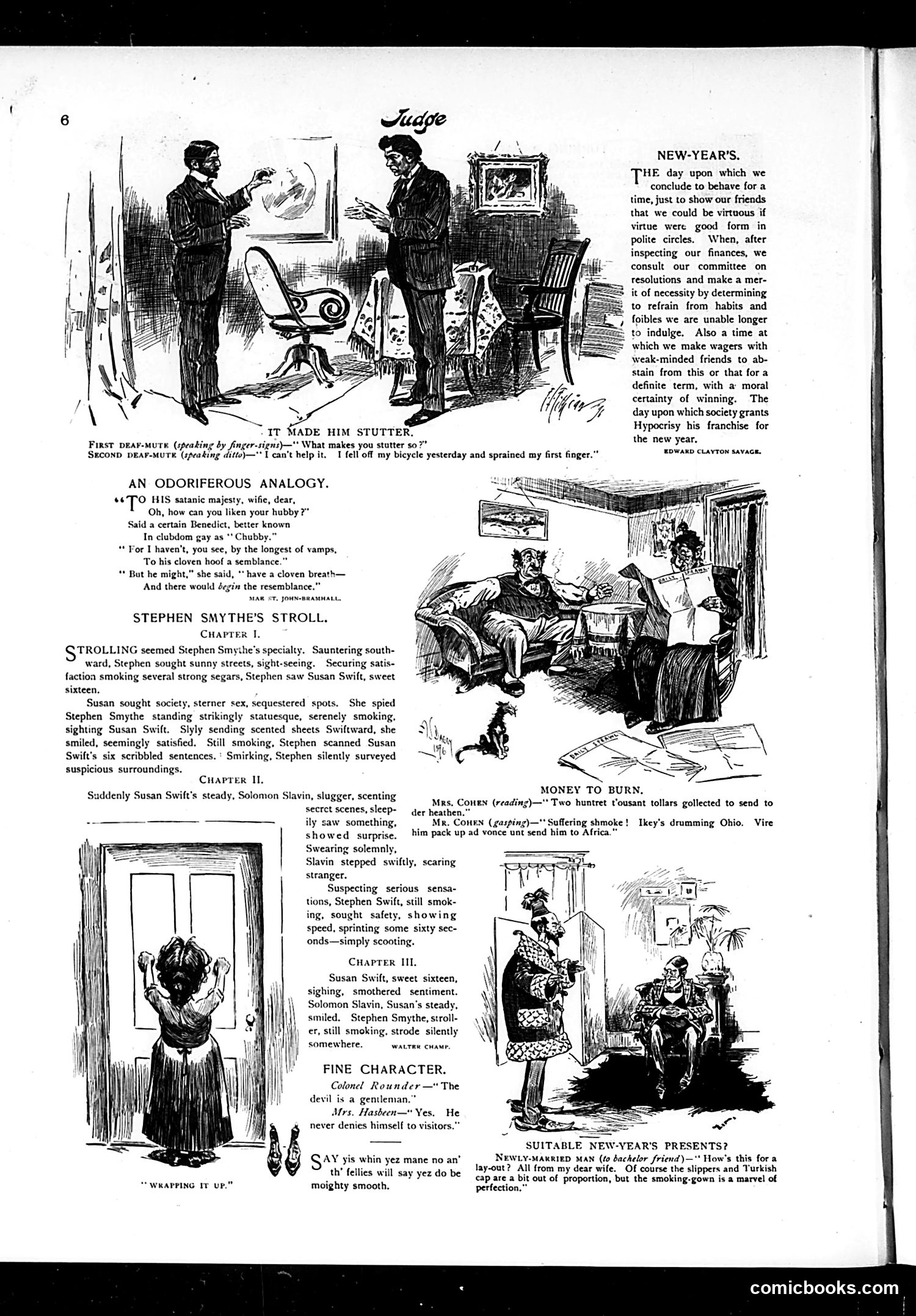
This page contains several satirical pieces typical of the era: **"It Made Him Stutter"** jokes about deaf-mutes communicating through sign language, playing on the absurdity of asking why someone "stutters" when using finger-signs. **"An Odoriferous Analogy"** is a domestic humor piece where a wife compares her husband unfavorably to the devil, suggesting his bad breath resembles a "cloven" (split) hoof—a crude insult about personal hygiene. **"Stephen Smythe's Stroll"** is an alliterative serialized story (heavily using 's' sounds) about a flirtation gone wrong: Stephen encounters Susan Swift, but her steady boyfriend Solomon Slavin intervenes, forcing Stephen to flee. **"New-Year's"** (by Edward Clayton Savage) is sharp social satire mocking New Year's resolutions as performative hypocrisy—people pretend virtue only temporarily to impress friends, knowing they'll break promises. **"Money to Burn"** and **"Suitable Presents"** use ethnic caricature and stereotypes common to the period, depicting working-class or immigrant characters in patronizing ways. The page emphasizes class-based and domestic humor typical of Judge's satirical approach.
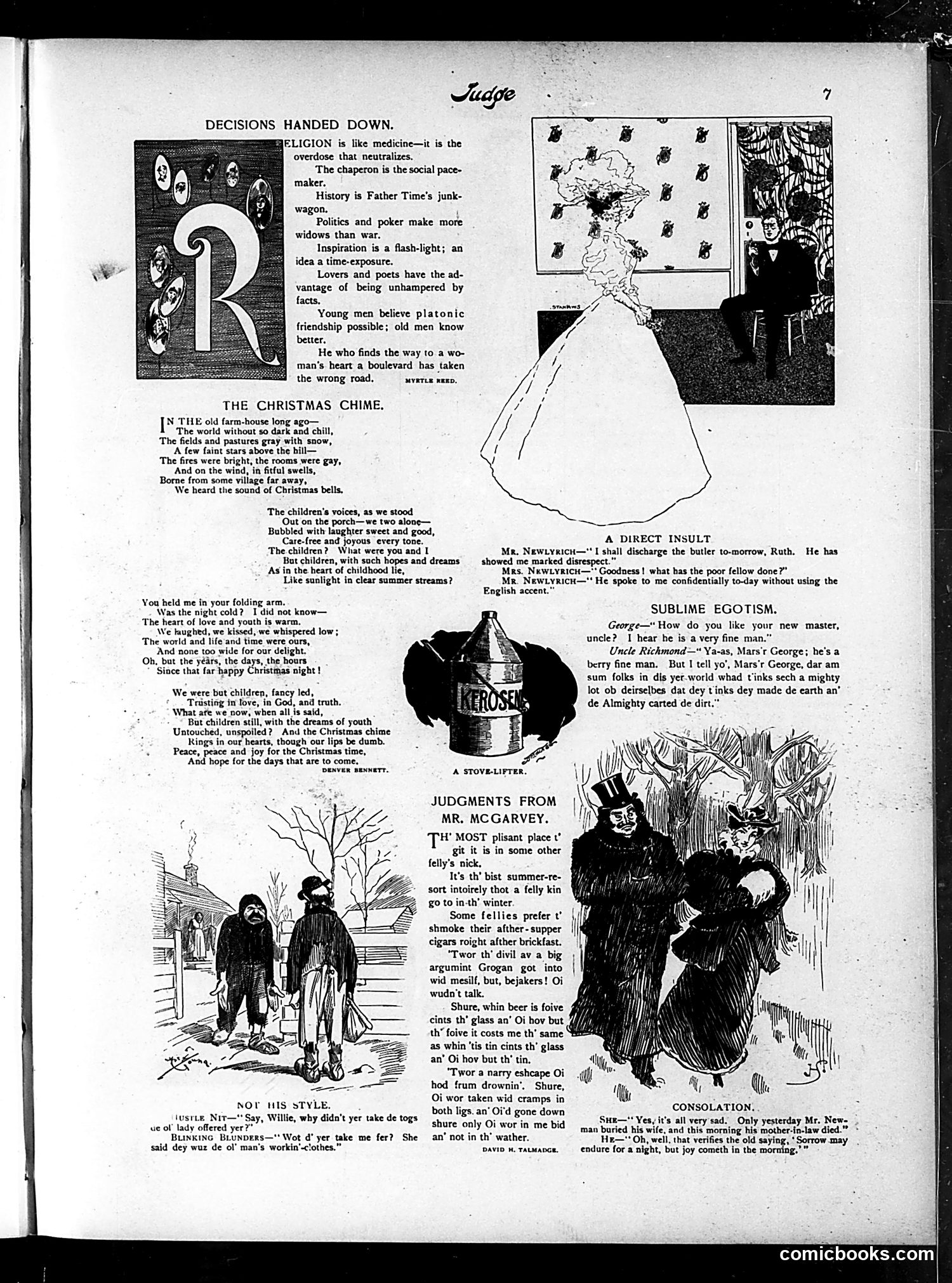
This page collects various satirical pieces typical of early 20th-century Judge magazine humor. **Main Content:** The "Decisions Handed Down" section offers cynical aphorisms attributed to Myrtle Reed, mocking romance, politics, and social conventions—typical Judge fare targeting middle-class pretensions. **The cartoons:** - "A Direct Insult" mocks the newly wealthy obsessing over status symbols; a butler's failure to use an "English accent" constitutes grave disrespect. - "Sublime Egotism" features an African American dialect character (Uncle Richmond) whose self-aggrandizement about his importance to Creation reflects period racial caricature—common but offensive by modern standards. - "Not His Style" jokes about working-class masculinity and social climbing. - "Consolation" presents dark humor about bereavement. "Judgments from Mr. McGarvey" offers Irish-dialect observations on drinking, summer resorts, and working-class life—ethnic humor typical of the era, now read as stereotyping. The page emphasizes satirizing social ambition, class anxiety, and domestic life rather than explicit politics.
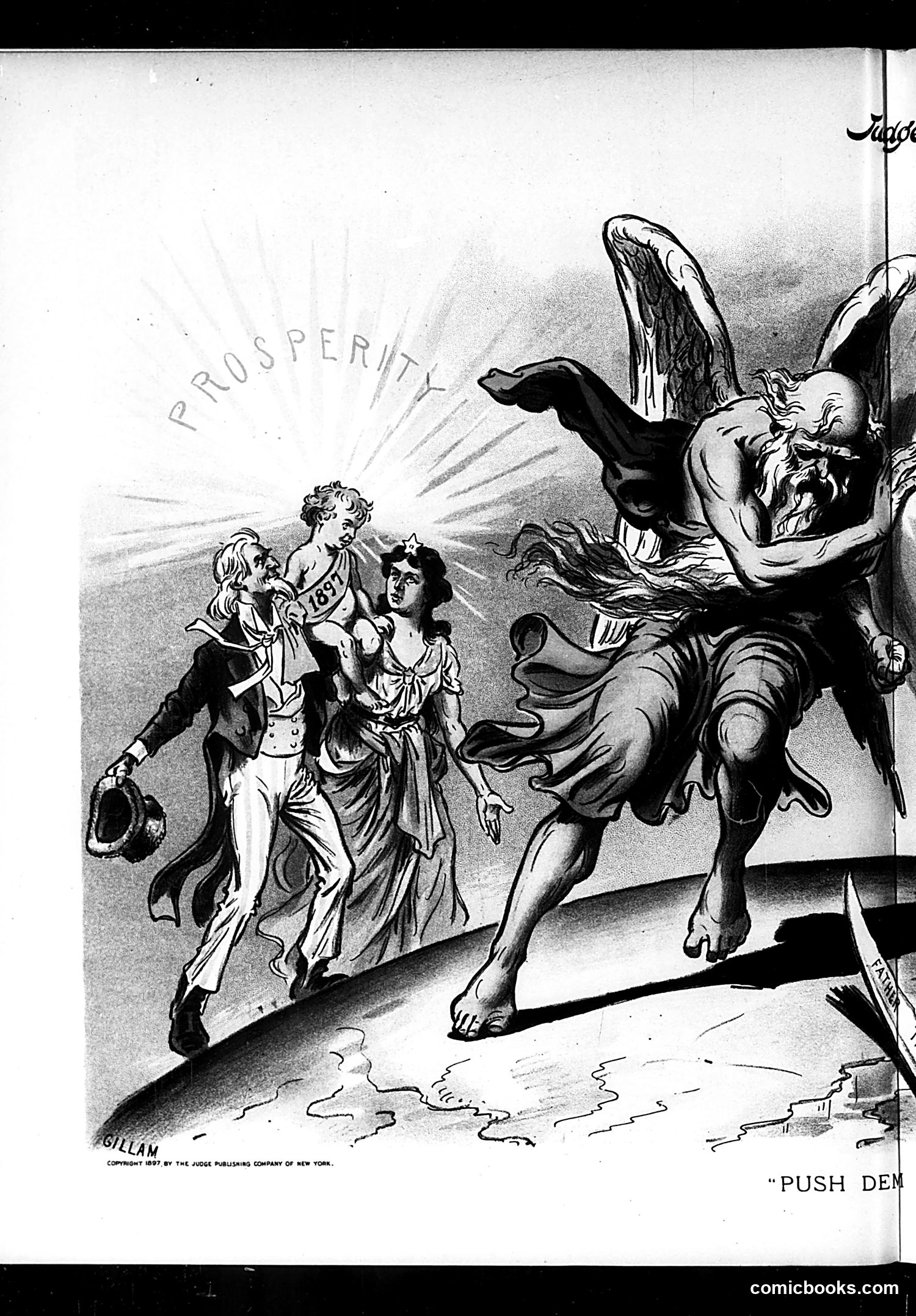
This political cartoon depicts an allegorical scene where "Prosperity" (radiating light in the background) appears to three well-dressed figures on the left—likely representing American citizens or political interests. On the right, demonic or monstrous figures seem to resist or push against this prosperity's arrival, suggested by the caption fragment "PUSH DEM" (likely "PUSH THEM"). The 1897 date places this during William McKinley's presidency and the post-Panic of 1893 economic recovery. The cartoon satirizes opposition to returning prosperity—portraying those resisting economic improvement (possibly protectionists, labor radicals, or political opponents of the Republican administration) as demons or obstacles to national progress. The classical allegorical style was typical of Judge's political commentary of this era.
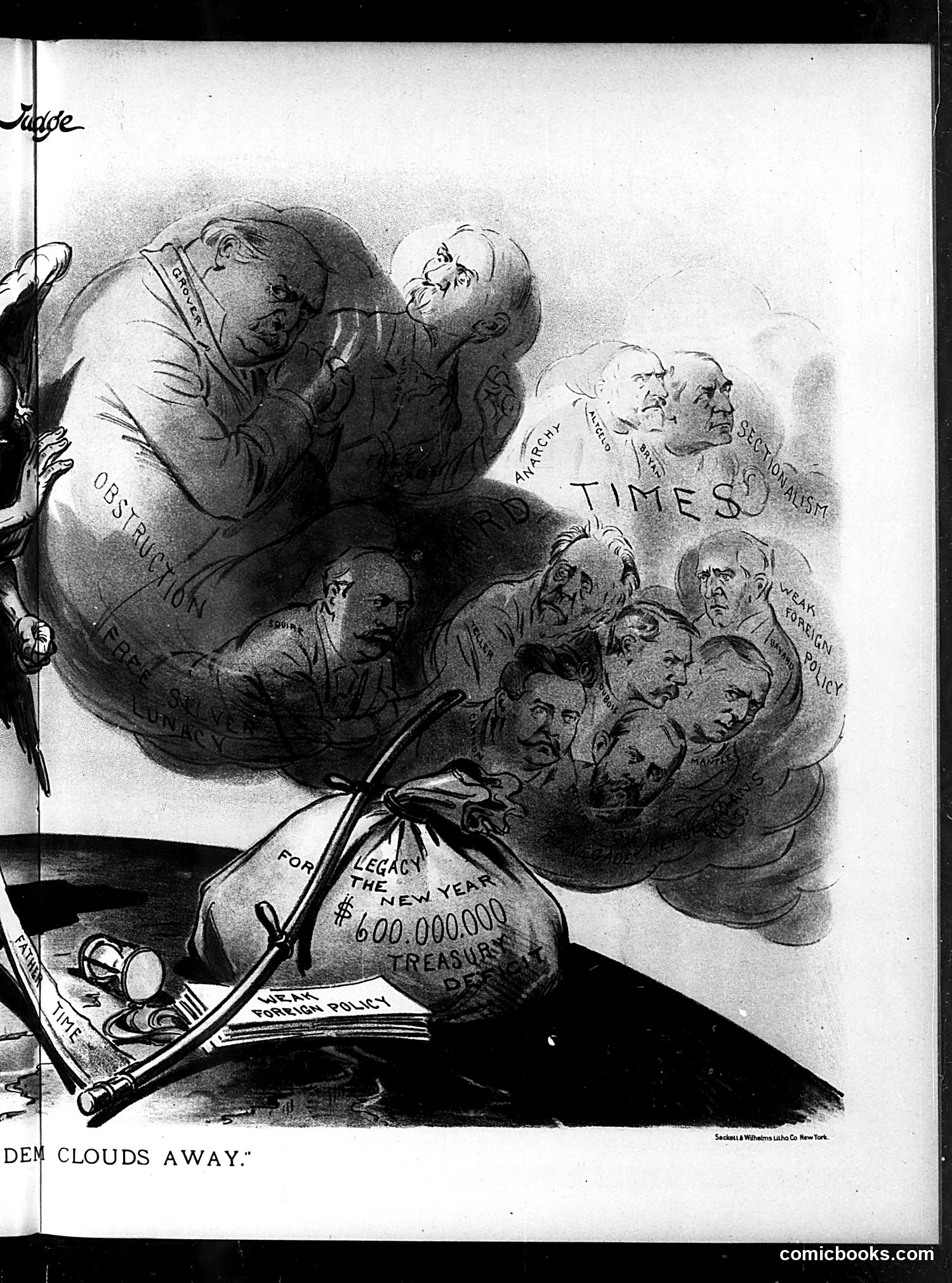
This Judge magazine cartoon satirizes Democratic Party anxieties about financial burdens heading into a new year. The large money bag labeled "LEGACY FOR THE NEW YEAR $600,000,000 TREASURY DEFICIT" represents inherited fiscal problems—likely from the previous administration or ongoing expenses. Two large Democratic figures at top appear distressed, gazing upward hopefully. Below them, a cluster of smaller Democratic politicians look worried or grim, labeled with terms like "TIMES," "ANARCHIST," "FOREIGN POLICY," and "PANIC"—suggesting multiple crises confronting the party. The title "DEM CLOUDS AWAY" (likely "THEM CLOUDS AWAY") is ironic: rather than clouds clearing, Democrats face mounting troubles. The cartoon mocks Democratic leadership's inability to resolve the deficit and multiple concurrent political problems, presenting them as inescapable burdens the party must carry forward.
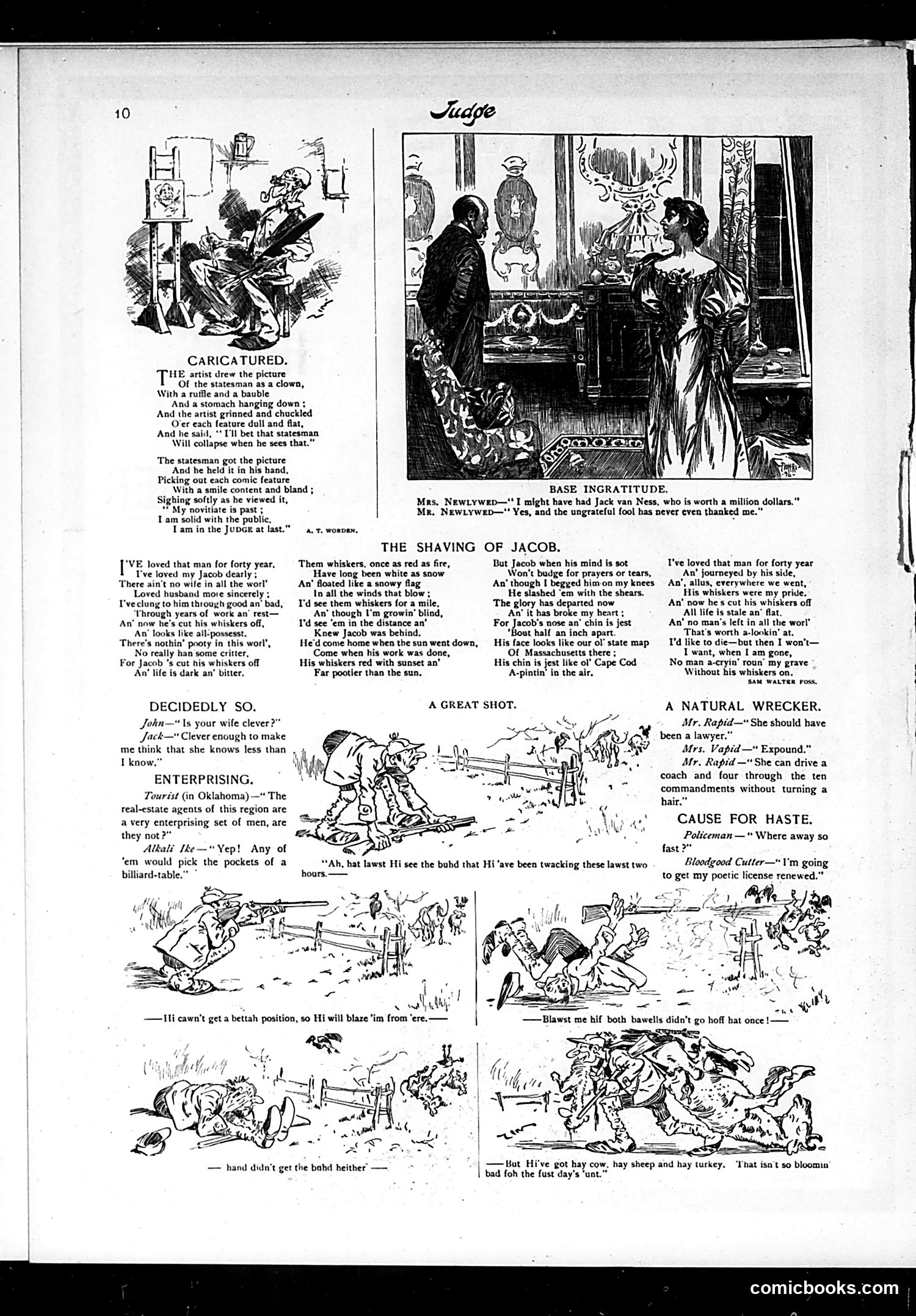
This page contains several humorous pieces typical of turn-of-the-century American satire: **"Caricatured"** and **"Base Ingratitude"** are brief comic vignettes: the first depicts a politician unmoved by unflattering caricature (suggesting thick-skinned politicians), the second mocks a husband ungrateful to a wealthy wife. **"The Shaving of Jacob"** is the longest piece—a sentimental poem where a rural wife mourns her husband's removal of his distinctive red whiskers. The humor lies in her exaggerated grief and her detailed descriptions of his now-exposed face as resembling Massachusetts geography, particularly Cape Cod. This satirizes domestic sentiment and rural speech patterns. **"A Great Shot,"** **"Decidedly So,"** **"Enterprising,"** **"A Natural Wrecker,"** and **"Cause for Haste"** are short joke captions accompanying comic illustrations—puns and wordplay typical of the period (a man joking about poetic license, lawyers exploiting loopholes, etc.). The overall tone reflects genteel satire aimed at middle-class readers, mixing sentimental parody with social observation and broad humor.
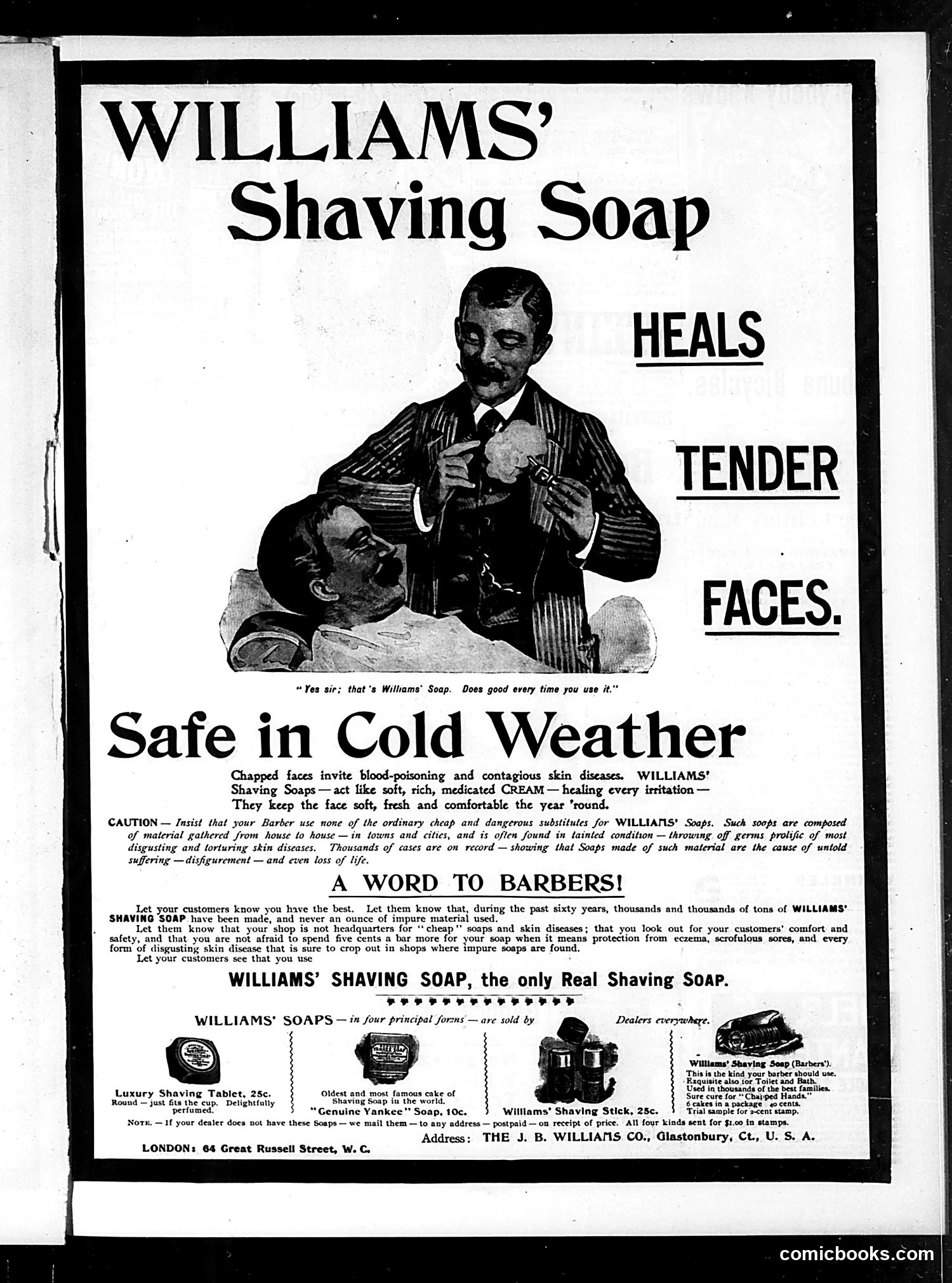
This page is primarily a product advertisement rather than satire or political cartoon. It promotes Williams' Shaving Soap to barbers and consumers, featuring an illustration of a barber applying soap to a customer's face. The ad's main pitch exploits **health anxiety about contamination**—a significant concern in the early 20th century. It warns that cheap soaps made from materials "gathered from house to house" could cause serious skin diseases, blood-poisoning, and eczema. This scaremongering was common in period advertising. The "Word to Barbers" section positions Williams as the premium, safe choice and encourages barbers to charge customers more for quality. The advertisement emphasizes the product's 60-year history and claims it's "the only Real Shaving Soap." The imagery and messaging reflect contemporary germ-theory anxieties and class-based marketing (expensive = safe/better), rather than political satire. It's vintage commercial persuasion through fear appeals about hygiene.
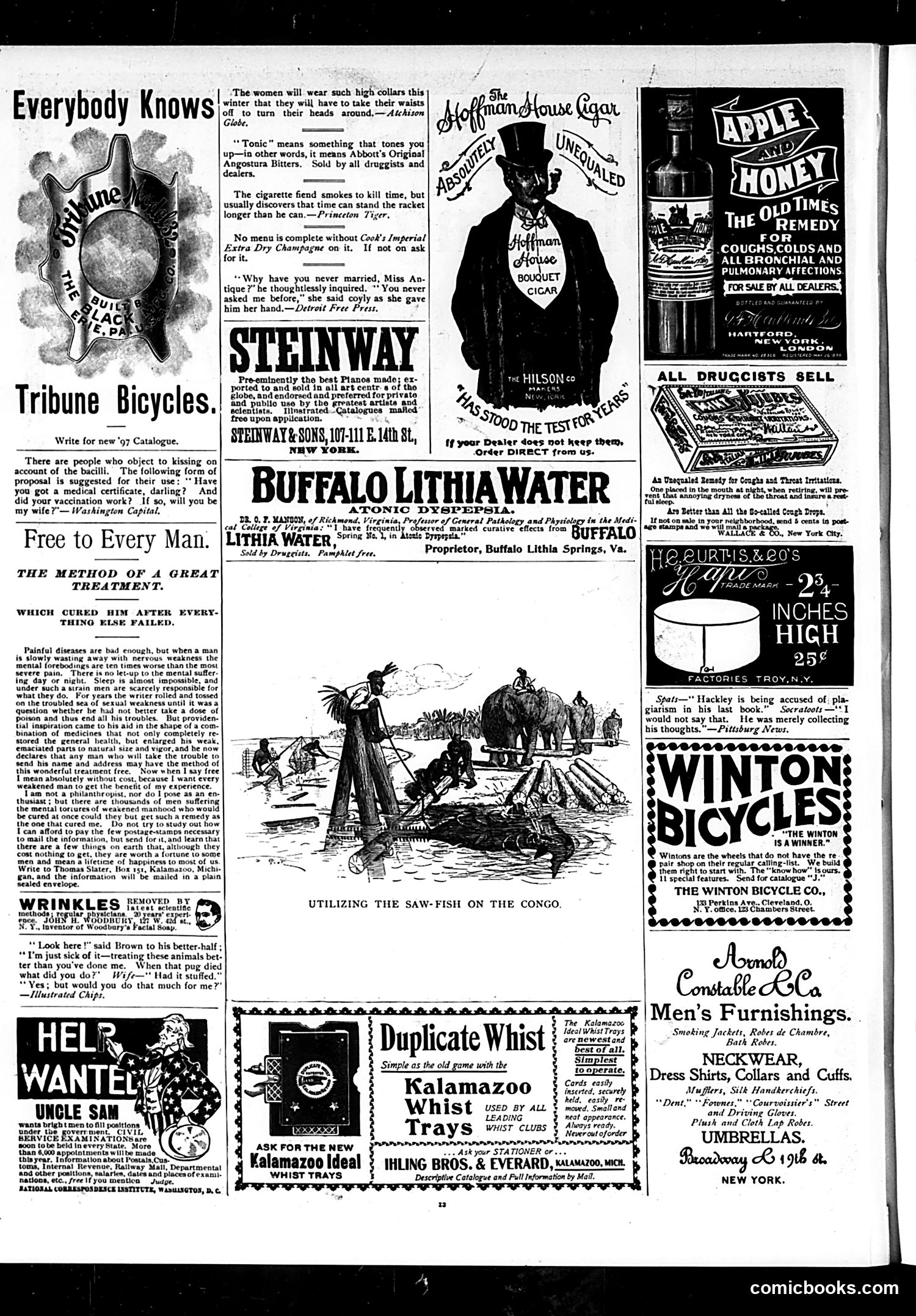
This is primarily an **advertising-heavy page** with modest satirical content typical of the 1890s era. ## Notable Elements: **The Cartoon**: The central illustration of "Utilizing the Saw-Fish on the Congo" appears to be absurdist humor—showing creative/ridiculous use of exotic animals, likely mocking colonialism or sensationalist travel writing popular at the time. **Satirical Snippets** include: - Jokes about high-necked women's collars making head-turning impossible - A dialog about kissing and "bacilli" (reflecting new germ-theory anxieties) - A marital joke about pet taxidermy preferences **The Advertisements** dominate: bicycles, patent medicines (lithia water for "dyspepsia"), pianos, cigars, and remarkably, a **medical mail-order treatment for "sexual weakness"**—common in this era despite being often fraudulent. The page reflects 1890s anxieties (germs, modernity, masculinity) and the magazine's reliance on both humor and dubious commercial claims characteristic of period publications.
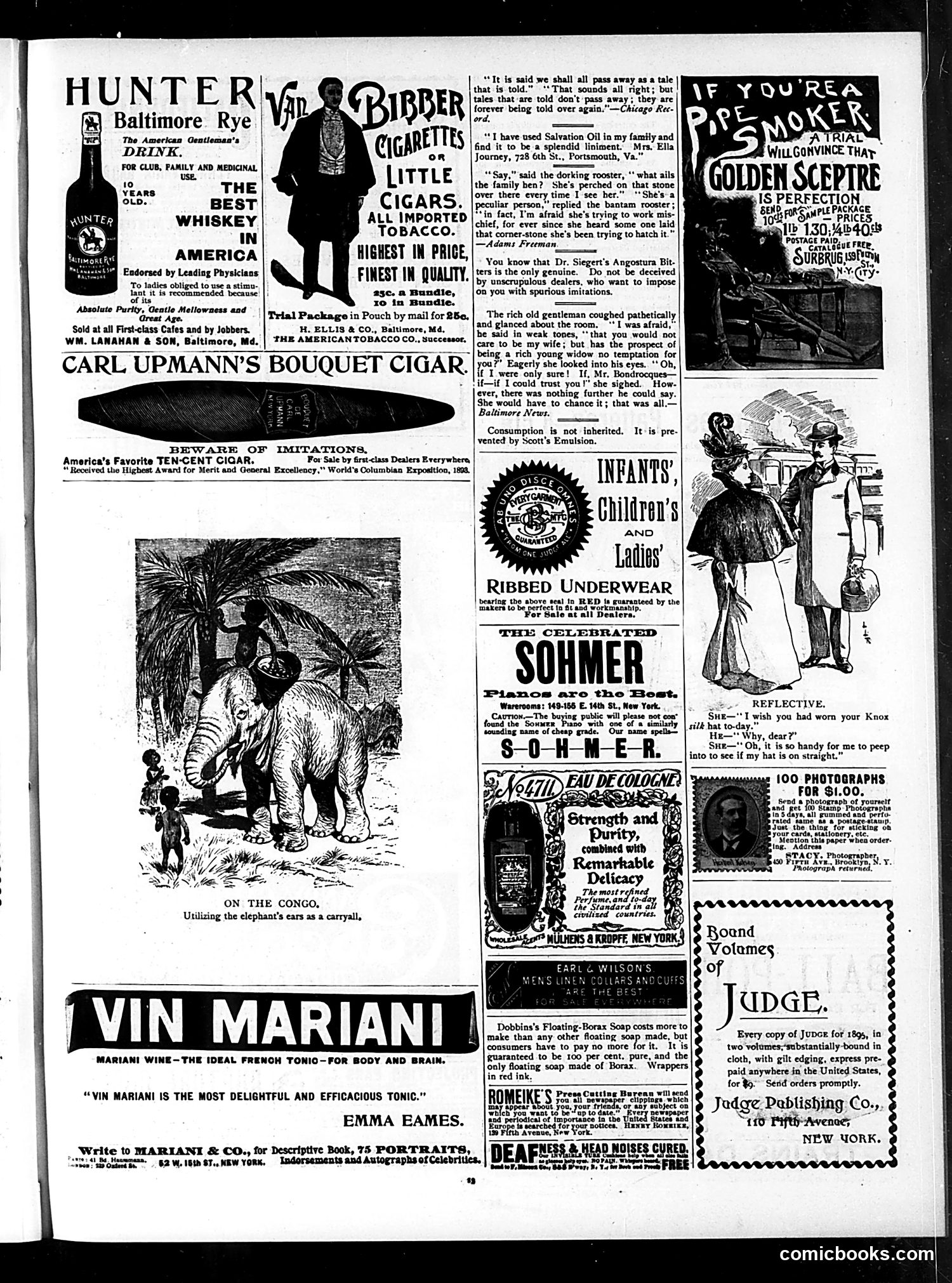
This page is primarily **advertisements** for products and services from the late 1800s, with minimal editorial content. The only cartoon appears to be "ON THE CONGO," depicting colonialism-era imagery: a man riding an elephant, using its ears as a carryall. This reflects the period's casual imperial attitudes toward Africa and reflect racist stereotypes common in that era. The page's humor comes mainly from brief anecdotes in ads—a rooster puzzled by a hen sitting on a cornerstone (misunderstanding construction), and a gold-digger agreeing to marry a wealthy old man only if she's "sure" he'll die soon. Products advertised include whiskey, cigars, piano, underwear, and Vin Mariani wine (coca-wine, legal then, now understood as containing cocaine). The anachronistic elements most striking to modern readers: endorsements by opera singer Emma Eames promoting wine; casual medical claims; and the casual imperial/racist imagery considered normal advertising.
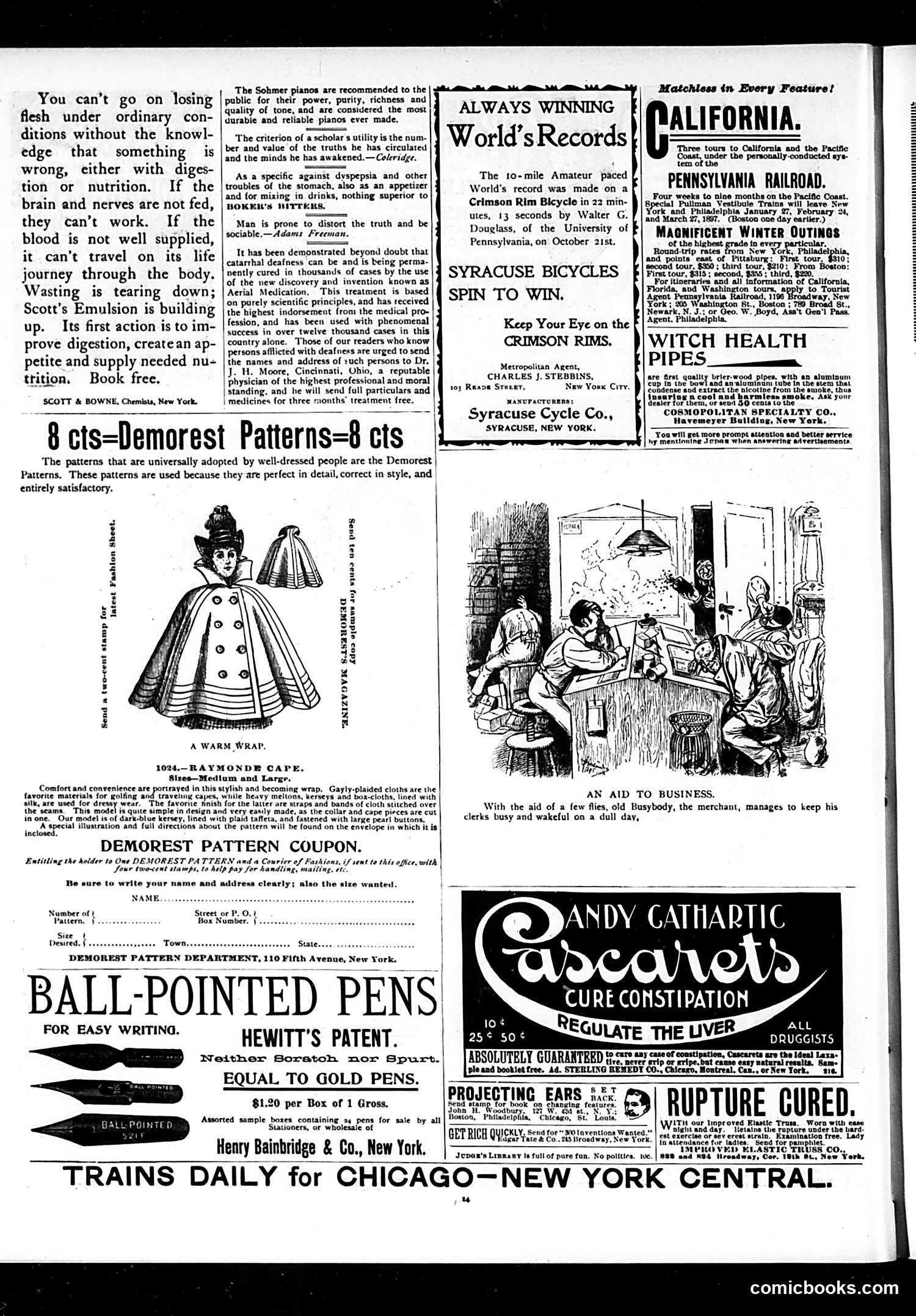
This page is primarily **advertising**, not political satire. It contains no political cartoons. The content consists of: - **Health/medical ads**: Scott's Emulsion (nutrition), Bokem's Bitters (stomach remedy), Aerial Medication (for deafness) - **Fashion**: Demorest Patterns promoting the "Raymonde Cape" wrap - **Bicycles**: Syracuse Bicycles advertising a 10-mile amateur speed record (22 minutes, 13 seconds) - **Writing implements**: Hewitt's ball-pointed pens - **Patent medicines**: Candy Cathartic laxative, rupture cures, ear projection devices - **Travel**: Pennsylvania Railroad California tours - **Sohmer pianos** - **Pattern coupon** for ordering dress designs The single illustration—labeled "An Aid to Business"—shows a merchant managing clerks at a desk; it's a generic business scene, not satire. The page represents typical late-19th-century magazine advertising targeting middle-class consumers.
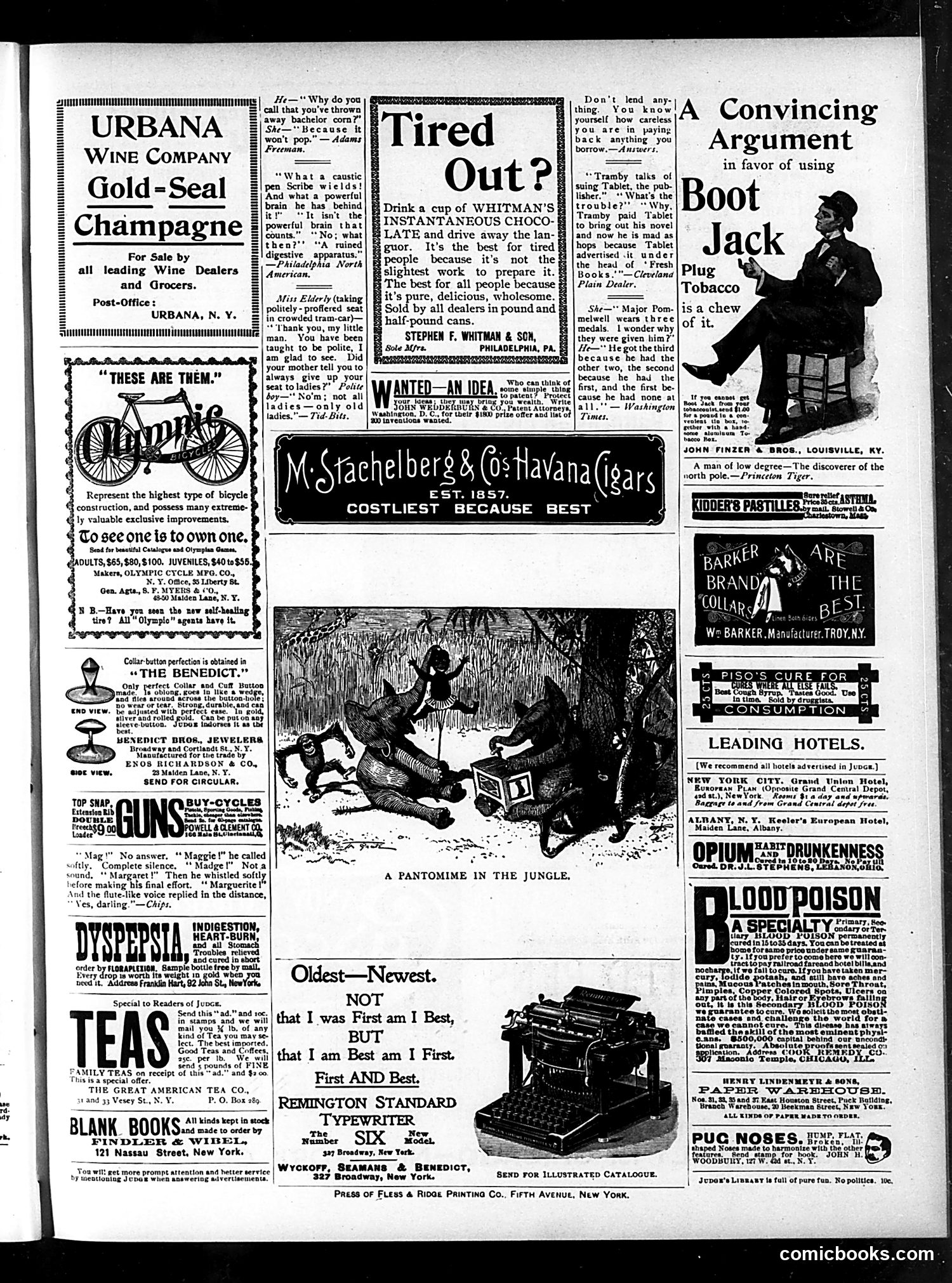
This page is primarily **advertisements** interspersed with small humor snippets typical of Judge magazine's format. The main illustrated cartoon, "A Pantomime in the Jungle," shows figures in what appears to be a comedic scene, though its specific satirical point is unclear from the image alone. The page includes numerous small joke captions addressing domestic life and social behavior—a husband avoiding lending money, a publisher dispute, a young boy's honest rudeness to an elderly woman, and a man's exaggerated effort to get his wife's attention ("Maggie," "Madge," "Margaret"). The advertisements cover patent law, bicycles, jewelry, cigars, champagne, chocolate, typewriters, hotels, and patent medicines (including controversial treatments for opium addiction and "blood poison"). These reflect late 19th/early 20th-century consumer products and the era's less-regulated medical claims. The page reflects Judge's dual nature: satirizing manners and social pretension while accepting advertisements from the commercial world it sometimes mocked.
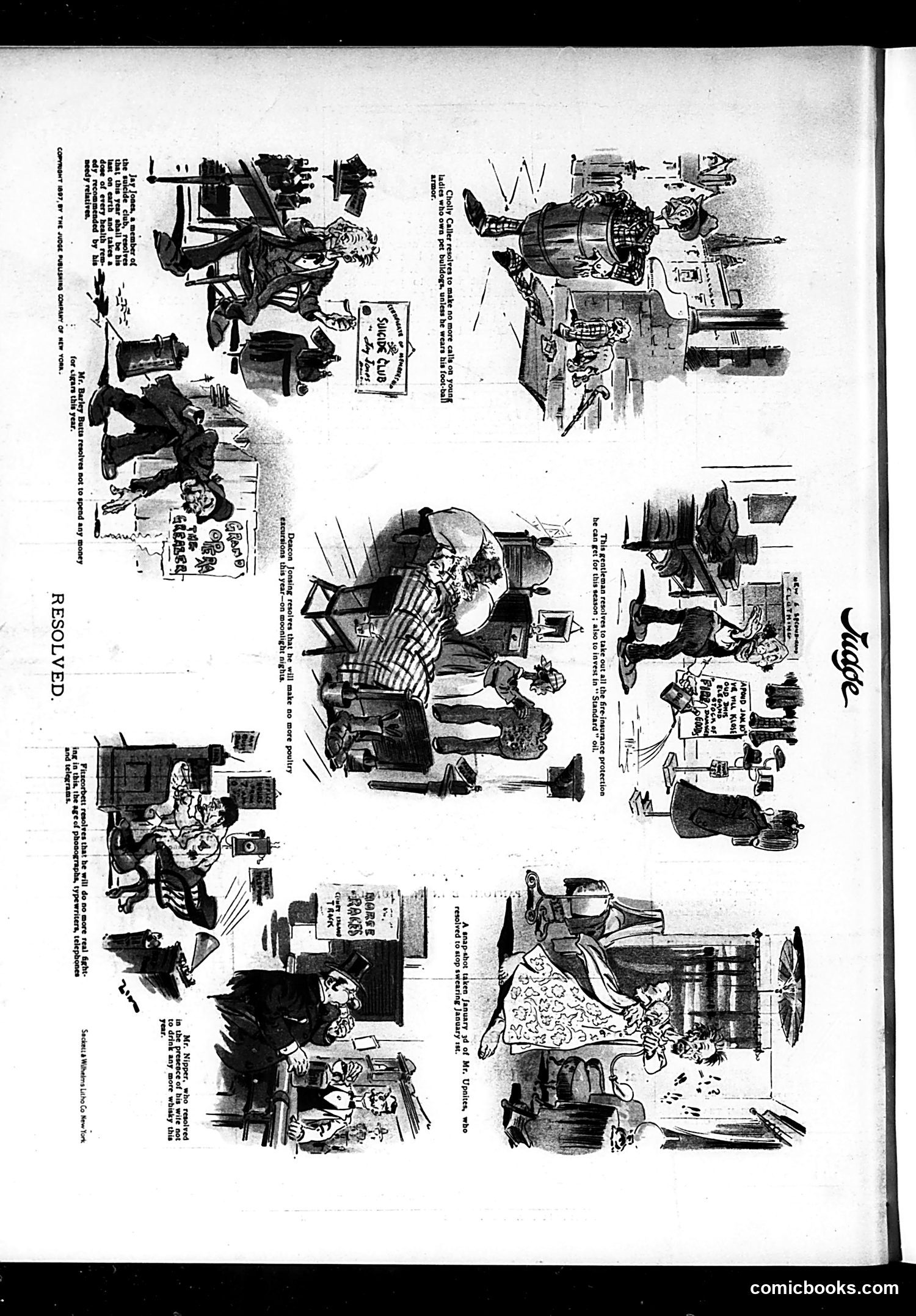
This is a satirical page mocking common New Year's resolutions that people predictably fail to keep. Each cartoon depicts a character who has made a resolution, with the humor deriving from the obvious impossibility or irony of their pledge: - A man buying insurance and Standard Oil stock (mocking speculative excess) - "Mr. Upnites" who resolved to stop swearing (shown cursing anyway) - "Jolly Caller" avoiding ladies with bulldogs (physical danger from pets) - "Deacon Jonsing" avoiding poultry theft on moonlit nights (stealing under cover of darkness) - Mr. Nipper struggling not to drink whisky despite his wife's presence - Fitz Corbett renouncing "real fighting" (likely a boxer unable to quit the sport) The satire targets human weakness and hypocrisy—the gap between stated intentions and actual behavior. The page mocks both the foolishness of making impossible resolutions and the predictable failure to maintain them, a timeless social commentary that remains relevant today.